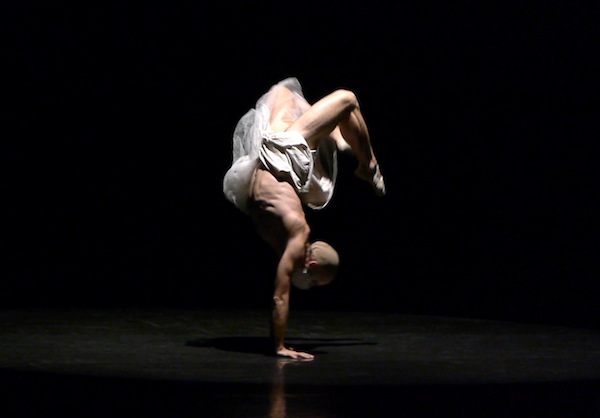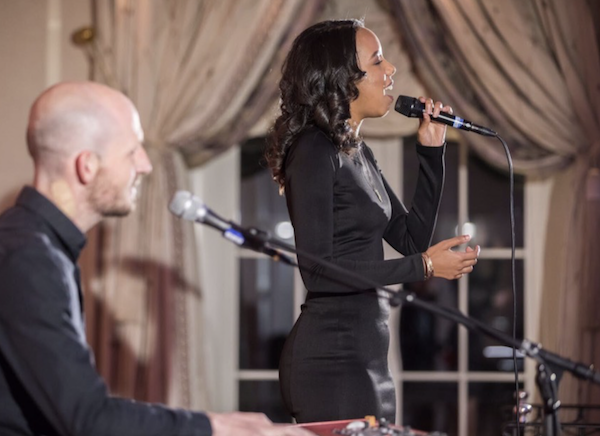
On Jan. 28 and 29, Music on Main hosts the world première livestream of Graveyards and Gardens, co-created and co-produced by Caroline Shaw (composer and recorded sound) and Vanessa Goodman (choreographer). A PuSh Festival Partner Presentation, the performance takes place among 400 feet of orange sound cables and an arrangement of plants – nature and technology being another synthesis the artists explore. Things begin with a long passage featuring an array of sounds – some come from tape decks, some from a record player, some from old Edison wax recordings – and this production is, among other things, a powerful display of the creative process.
New York-based vocalist, violinist, composer and producer Shaw, the 2013 Pulitzer Prize for Music winner, was Music on Main’s composer-in-residence from 2015-2016. Vancouver choreographer Goodman is the artistic director of Action at a Distance Dance Society.
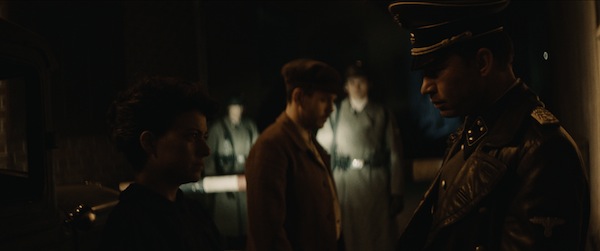
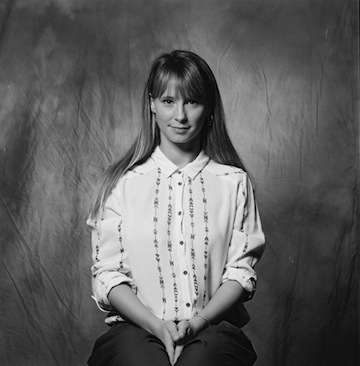
Catalina Beraducci plays Noemí Goldberg in the Topic film Noemí Gold. (photo from Topic)
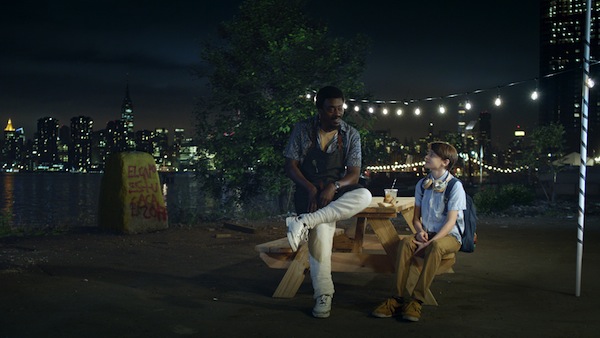
For his first feature film, writer and director Dan Rubenstein has done well. Noemí Gold, which is currently streaming exclusively on Topic, is a quietly engaging story that touches upon serious issues, though never delves into them. While the story is somewhat scattered and doesn’t always make sense, the acting is strong and the glimpse into Argentine culture interesting.
The title role is played by Catalina Beraducci, who is perfect for the part. Noemí Goldberg, 27, has accidentally become pregnant from a tryst with an egotistical artist of questionable talent and character. She is an unassuming person, recently graduating with her master’s in architecture, though she doesn’t appear to have a job. When she seeks a doctor who can perform an abortion – which was an illegal procedure in Argentina until just last month – she has some trouble raising the money she’ll need to go to Uruguay to get one.
Noemí has a couple close friends – eccentric roommate Rosa and party-girl Sol – both of whom help in small but important ways. Also in Noemí’s court is her grandmother, though we find out later in the movie that their relationship has had its complications. Lastly, while all this is going on, Noemí’s cousin, David, comes to visit from Los Angeles, where his family moved when he was 7, for tragic reasons we eventually find out.
David and Noemí were once close, but, for most of the movie, their interactions are strained. David works for an energy drink company and his job is, literally, to post photos on Instagram of himself enjoying the drink in various places and while doing various activities. (He is the only one in the film who has a job, it seems.) Social media plays a prominent role in the narrative as a whole – and, hopefully, younger viewers will take it not only as a representation of themselves in film but as a critique of how much time they dedicate to promoting the fun they are ostensibly having versus actually having fun.
Women’s rights, religion (via a discussion with and seduction attempt of two young Mormon missionaries), what constitutes art (one amusing scene features an objectively poor dancer filming her own performance using a camera on a selfie stick, while being cheered and applauded by an adoring audience), the importance of forgiveness, the challenges of being a good friend, the imperfection but necessity of family, and many other topics run through Noemí Gold. There are no pronouncements and the laidback pace could fool one into thinking there is not much of substance in the film, but they’d be wrong.
Since time immemorial, no matter what calamity occurred in the world, if there was a problem plaguing humanity, Jews were used as the convenient scapegoat.
Earlier this year, as the coronavirus pandemic spread across Europe and then throughout North America, conspiracy theorists claimed that Israel and Jews around the world were secretly involved in spreading and even engineering the deadly disease. While these conspiracies are baseless and seem almost comical at first glance, thanks to the power and ubiquity of social media, even the most bizarre falsehoods can find fertile ground and poison the minds of millions of people almost instantaneously.
Unfortunately, the pandemic continues to rage across Canada and the world and, though the claim that Jews are behind COVID-19 remains utterly fictional, that hasn’t stopped a dangerous new crop of antisemites from spreading their toxic bigotry.
Not only is Canada not immune to the age-old virus of antisemitism, but British Columbia has also been infected. As was reported in the Georgia Straight, an anti-mask activist in Vancouver, Marco Pietro, who organized and participated in a number of rallies protesting coronavirus restrictions and policies, released a Holocaust denial video on social media. The two-minute-long video features Pietro saying that the Holocaust is a myth perpetrated by fake survivors to scam money out of the wider, unsuspecting public. He also claimed that Mein Kampf – Adolf Hitler’s antisemitic manifesto – didn’t contain any objectionable material, and that the coronavirus pandemic is a plot used by Jews in a quest for control. Pietro also said that concentration-camp survivors are liars and accused “a bunch of Zionist Jews” of “setting up” Hitler.
Meanwhile, on Nov. 15, a speaker at an anti-mask rally in Vancouver condemned “satanic, talmudic” people. The Canadian Anti-Hate Network (CAHN) reported that the No More Lockdowns group (which now goes by the name “Human Rights Movement”) produced an event in Vancouver organized by antisemitic conspiracy theorist Raoul Taylor van Haastert, who has decried the “Zionist media” and stated “our WWII history is a lie.” CAHN’s report cited Vancouver neo-Nazi Brian Ruhe, who, in an antisemitic post that went viral, shared his beliefs about “Rothschild-Zionist-communist control” that is being covered up, claiming that Jews control the media.
Let there be no doubt, there’s no evidence whatsoever that the Jewish people or the state of Israel are behind the coronavirus pandemic or any of these other odious libels. Conversely, the evidence supporting the Holocaust’s veracity is so overwhelming and indisputable that, to deny its occurrence, far from being a legitimate disagreement on historical facts, is rather merely an attempt to deny the Jewish people’s collective suffering at the hand of the Nazis to further an antisemitic agenda.
Most British Columbians would rightly brush off Pietro’s and Ruhe’s words as illogical rants of mad men, but, tragically, as bothersome and as offensive as their statements are, antisemitic acts are at or near all-time highs across Canada, including in British Columbia.
Earlier this year, B’nai Brith Canada’s annual audit of antisemitism logged more than 200 such incidents in British Columbia alone, ranging from harassment to vandalism. In one such incident, for example, Camp Miriam, on Gabriola Island, was vandalized with graffiti, including a swastika and other images. The image and symbol that represented the Nazi regime that murdered six million Jews in Europe less than 100 years ago is today being used to attack young Jewish summer campers. One can only imagine the long-lasting psychological damage inflicted on young people as a result of such an incident – and multiply that by more than 200 incidents last year alone.
Such antisemitic conspiracy theories, as espoused by Pietro, Ruhe and others must be forcefully repudiated and condemned by all. Thanks to social media, even the most bizarre lie can have a worldwide impact, and that’s why it’s so critical to take a public stand against antisemitic hate and propaganda. As history has taught, while antisemitic words are bad enough, the paramount concern is that they can often morph into violence. Enough is enough.
Mike Fegelman is the executive director of HonestReporting Canada (honestreporting.ca), a nonprofit organization working to ensure fair and accurate Canadian media coverage of Israel.
The following article was published in the Globe & Mail, as “A Dutch family hid me from the Nazis: I owe them my life,” in advance of Remembrance Day, Nov. 11, 2020. It is reprinted here with permission, in recognition of International Holocaust Remembrance Day, Jan. 27.
I can never pass Remembrance Day without reflection. This year, we marked the 75th anniversary of the liberation of the Netherlands. It meant freedom for Dutch men, women and children after a brutal five-year occupation by German military forces. More than 5,000 Canadian soldiers rest in Dutch soil and are mourned and remembered there annually. They were our liberators and will never be forgotten, for Canadians and Canada are seared into the collective memory of the population. I myself saw Canadian tanks chasing German half-tracks down the streets of The Hague. On May 4, 1945, I was looking out the window of my mother’s small apartment, where she had been hiding. A man across the street opened his door one day too early. He was shot by a retreating German soldier. I was dragged away from the window. I was not yet 5 years old.
Unlike most Dutch children who began their lives anew after the war, I was a Jewish child hidden with Albert and Violette Munnik and their daughter, Nora, from November 1942 to May 1945. I became Robbie Munnik and was returned to my parents, who had miraculously survived, the only survivors of their families of origin. My grandparents, aunts, uncles and numerous cousins had all been murdered. For Jews, the postwar world offered precious little solace or hope: it was a world of death and of mourning. Liberation did not feel particularly liberating. Within that depressing atmosphere, I made the transition from Robbie Munnik back to Robbie Krell.
For this Remembrance Day 2020, I want to honour the memory of my Christian Vader, my second father.
When my mother passed me on to Moeder (Mother), who agreed to take me for a few weeks while she secured a hiding place, Vader accepted me without hesitation. Did he know of the risk to his family, hiding a Jewish child? If not in 1942, certainly he did by 1943. But, unlike many in this situation, he did not dwell on possible consequences. He simply set about loving me.
Early in my hiding, they allowed Nora to take me out, but that was a mistake. A woman recognized me. She happened to know my mother and asked Nora why she was looking after me. Vader contacted her immediately to ensure she remained silent. From then on, I was housebound. He read to me and made toys for me. His brothers and a sister all kept the secret of my presence. One slip could lead to betrayal. I was beyond lucky. Vader worked hard, loved deeply and enjoyed his hobbies, which included playing the piano by ear and carving wood and shaping metal. He was talented.
The danger increased. Only after the war would we learn that more than 80% of Dutch Jews were deported and murdered, primarily in Auschwitz and Sobibor. Of 108,000 souls sent to the death camps, only about 5,000 returned. And of about 14,000 children in hiding, more than half were betrayed, as was Anne Frank and her family in Amsterdam.
Because of his modest nature, Vader stands in danger of being forgotten. Of course, not by me. Unlike so many, including princes and popes, presidents and prime ministers, industrialists and intellectuals, he defied the Nazis and accepted the risk of my presence. So, while the names of the Nazis that murdered us linger on, as do the names of leaders who either did not lift a finger, or worse, actively prevented Jews from reaching safe havens, he might have been forgotten. So, I choose to remember him. In the hour of need, he included me in his life then and thereafter. His only reward was that I called him “Vader” and that he had, in addition to his daughter, a son.
In 1965, he and Moeder were brought to Vancouver by my parents to attend my graduation from medical school. My fellow graduates were drawn to him especially. He spoke no English, but the twinkle in his eyes spoke volumes. He was a people magnet. When they returned for my wedding in 1971, he fell ill shortly after and was briefly hospitalized at St. Vincent’s in Vancouver. There, he enchanted the nurses. When I came to visit, everyone on staff already knew him. They flocked to him. He radiated good humour and optimism. He did not know from anger, fear or bitterness. He hoped that I would not be consumed with anger over the Holocaust of my people, and that I would not turn away from Judaism or from Israel. And then, in 1972, he died. I do not know what he would have thought about the resurgence of antisemitism, the BDS movement and the antipathy toward Israel. But I can guess. And so can you.
But Vader will be remembered because Albert, Violette and Nora Munnik have been inscribed among “the Righteous” at Yad Vashem, the official site of Holocaust remembrance in Jerusalem. A tree planted as a seedling in 1981 grows at the site of the plaque bearing their names. And, in Vancouver, at Vancouver Talmud Torah Jewish day school, a sanctuary has been named in their memory and the entire story of their heroism lines the walls.
So, this year my memory is not consumed by what took place in Auschwitz and Sobibor, where so many of my family perished; this year, I will concentrate on remembering Albert Munnik, my Christian Vader, on Remembrance Day, and the Canadian troops that freed us.
Dr. Robert Krell is professor emeritus, department of psychiatry, University of British Columbia, distinguished life fellow of the American Psychiatric Association and founding president of the Vancouver Holocaust Education Centre.
I was crying in front of the computer screen during a funeral service livestream. Again. It wasn’t my first of this pandemic. Even if the person didn’t ostensibly die of COVID, he’d been ill alone, unable to see family for long stretches because of it. And, because of COVID, I couldn’t be at the funerals in person, which were all in the United States. In normal times, I’d be rushing across the continent to be at these services with my family.
The person being eulogized, Rabbi Laszlo Berkowits, was a family friend, and was close to my parents. I called him “uncle” as a kid. He and his family were always part of our family’s holiday celebrations and gatherings. I played with his kids at his house. Their phone number was my elementary school’s emergency contact for me.
Rabbi Berkowits (Uncle Larry) was my family’s rabbi. He was also a Holocaust survivor. For a person who spent his teenage years in concentration camps, including Auschwitz, my Uncle Larry’s positivity, joy and ability to find the good in others were amazing. He had an incredible, long career, supporting and inspiring others to make positive change.
At the funeral, his family and friends (including my pediatrician) talked about how my Uncle Larry felt so grateful for the kindness of others, including the kindness of strangers. Without that help, he wouldn’t have survived the Second World War. Without the assistance and loving kindness of strangers – in Sweden, the United States and beyond – he wouldn’t have regained his health, gone on to serve in the U.S. military or received a full scholarship to become a rabbi. He wouldn’t have had the opportunities that truly enabled him to make such a difference in so many others’ lives.
The article was about how I try to carry around snacks (granola bars) for my kids, just in case they need one, but that, sometimes, the best option for me is to offer that extra snack to someone else on the street, who is hungry, instead.
The thing is, since the pandemic started, like many Manitobans, we haven’t been out and about nearly as often. I don’t carry around snacks now because my kids are remote schooling. We’re working and learning at home, trying, like most of us, to reduce the number of people who might get sick or die from COVID. On a daily basis, I am not physically handing out those granola bars to anybody other than my kids.
A week ago, I got the most amazing email from a single mom friend who is a grocery store cashier in a city more than 200 kilometres away. She works very hard to keep her family afloat. She’d been waiting until her break to write me: “A man came through with 25 boxes of granola bars. No judgment – they were on sale! Then, he tells me he read an article about someone and their child or children who handed a person a granola bar and it stuck with him. So, now he has granola bars in his car and always hands them out to panhandlers and people who need them when he can.”
I could imagine her hearing this at the grocery store, her jaw dropping in surprise. She told the man that we were good friends and that she would tell me about this. The man said to pass along that, she wrote, “he has been doing this since the week he read your article and to thank you! Simple acts of kindness are what is keeping him going these days.”
When I read her email, I cried. It had been “one of those pandemic days” – where the news, the work and learning struggles at home, had all felt so hard. We’re all tired of worrying, so concerned about our loved ones. In fact, I’d been feeling badly that I couldn’t do more for others, write more, donate more, while juggling things on the stay-at-home front.
Another email from my friend arrived. She’d mentioned this man’s purchase to one of the grocery store owners. He’d said, if she sees this man again, the store would give him a discount on these purchases. Then he printed out the story to pass along, too.
I felt so grateful to this anonymous stranger who was carrying around all these granola bars to feed others, and continuing this kindness when I couldn’t. I wanted to thank him, but I also respect just how many anonymous givers might be out there. It takes all of us to beat this pandemic. Next year, I hope to host my amazing essential worker friend and her kids for a big celebratory Chanukah dinner again.
I’m so heartened to hear that the kindness my Uncle Larry encouraged in others is continuing to be passed along. I carry with me his constant reminders to be an upstanding person who does the right thing, who helps others, shines a light for others, even if he himself isn’t here anymore.
My Uncle Larry would say, “Be the best. Be a blessing.” He’d add something like, “We never know how long we’ll be here on earth. It’s our job to do good for others whenever we can – right now.”
At his funeral, another longtime family friend, Sam Simon, spoke, reminding us: “Be that stranger whose kindness is a blessing to someone so that they, too, can become a blessing to the world.” I am sure the biggest blessing of all would be if more people took that to heart.
Joanne Seiff has written regularly for CBC Manitoba and various Jewish publications. She is the author of three books, including From the Outside In: Jewish Post Columns 2015-2016, a collection of essays available for digital download or as a paperback from Amazon. Check her out on Instagram @yrnspinner or at joanneseiff.blogspot.com.
The breakdown of Nefesh B’Nefesh 2020 aliyah. (image from Nefesh B’Nefesh)
Despite a challenging and tumultuous 2020, 291 individuals from Canada decided to make aliyah and move to Israel with Nefesh B’Nefesh (NBN) over the past year. The Canadians were among the 3,168 individuals who moved to Israel from North America in 2020 – 2,625 since the COVID-19 pandemic hit.
Founded in 2002, Nefesh B’Nefesh, in partnership with Israel’s Ministry of Aliyah and Integration, the Jewish Agency for Israel, Keren Kayemeth LeIsrael and Jewish National Fund-USA, has assisted in easing the aliyah process for more than 65,000 olim since its inception. With the help of its partners, NBN assisted nearly 90% of the total number of olim that arrived in 2019.
Since January of 2020, Nefesh B’Nefesh olim have most often hailed from New York, New Jersey, California, Florida, Ontario, Illinois, Massachusetts, Maryland, Pennsylvania and Texas. Altogether in the past year, 811 families chose to move their lives to Israel, along with 1,032 singles and 332 retirees. There were 61 physicians among a total of 198 medical professionals who arrived in Israel in the last year, most of whom joined the frontlines in Israel’s fight against the coronavirus. And 390 young men and women stepped off the plane with the desire to serve Israel as lone soldiers.
In addition to the olim who arrived throughout 2020, Nefesh B’Nefesh received 6,704 aliyah applications, in contrast to 3,035 in 2019 – marking a 126% increase in interest in aliyah.
The breakdown of Nefesh B’Nefesh 2020 aliyah. (image from Nefesh B’Nefesh)
“From the earliest days of the Jewish state, no matter how trying or difficult the circumstances, aliyah has always continued in order to preserve what was once a distant dream for our parents and grandparents,” said Rabbi Yehoshua Fass, NBN co-founder and executive director. “As we look back at the challenges everyone faced in 2020, we are extremely proud of what we have accomplished together. We look forward to watching each oleh grow and build their new lives in Israel, and eagerly look ahead to 2021, a year with the potential to exceed all expectations in aliyah.”
“I welcome the dozens of new olim who chose to leave everything, especially during the time of a global epidemic, and fulfil their dreams of building new homes for themselves in Israel,” said Minister of Aliyah and Integration Pnina Tamano-Shata. “Many will surely remember 2020 as a challenging and complex year, but the olim who arrived [recently] from across the U.S. and are part of the last group of olim this year, are enabling it to be shaded in more encouraging and optimistic colours.
“Despite COVID-19, the Jewish nation is thriving and aliyah is continuing,” Tamano-Shata continued. “In the past year, more than 20,000 olim from 80 countries around the world made aliyah.”
“The thousands of new olim from North America and around the world, during a year of a global pandemic, lockdowns and almost complete paralysis of international air travel, emphasizes how much the longing for Zion is deeply ingrained in the hearts of the Jewish people around the world,” said Isaac Herzog, chair of the Jewish Agency.
The top 10 cities in Israel that new olim chose as their homes this year were Jerusalem, Tel Aviv, Beit Shemesh, Ra’anana, Haifa, Herzliya, Netanya, Modiin and Be’er Sheva. The olim most commonly worked as educators, physicians, nurses, social workers and lawyers, as well as in the fields of marketing, sales and business. The average age of an oleh this year is 30, with the oldest being a 97-year-old and the youngest being only 35 days old.
When the pandemic began in earnest in March 2020, Nefesh B’Nefesh adapted its various programming and transitioned into holding virtual meetings, webinars and informational sessions. The online seminars have allowed the organization to reach a much wider audience and have included a wide range of subjects, from choosing communities and special webinars for medical professionals, to how to pack and ship for aliyah.
The ongoing support after aliyah provided by NBN has meant that 90% of its olim have remained in Israel, leading to tens of thousands of new Israelis who go on to make significant contributions to the country.
Prof. Ori Efrati, left, and Dr. Michael Cohen. (photos from IMP)
With the arrival of the coronavirus vaccine, there has also been a spike in morbidity, clearly indicating that we’re not out of the woods yet. In fact, hospitals in Israel have warned that they are steadily approaching maximum capacity, as the numbers of severely ill COVID patients breaks all records.
When COVID-19 first erupted in March 2020, health authorities warned that a surfeit in severely ill coronavirus patients would overwhelm the system due, in large part, to a lack of ventilation machines – the standard of care for coronavirus patients whose condition deteriorates to pneumonia. In the ensuing months, Prof. Eyal Leshem, director of the Centre for Travel Medicine and Tropical Diseases at Sheba Medical Centre, explained that, in addition to the shortage of ventilators, one of the most pressing issues is the lack of highly trained intensive-care-unit staff to monitor patients attached to those devices.
An innovation by Yehonatan Medical addresses both of these issues.
Yehonatan Medical, in collaboration with Prof. Ori Efrati, director of the pediatric pulmonary unit at Sheba Medical Centre, devised a first-of-its-kind ventilation system that can treat multiple patients.
“Conventional ventilators, aside from being very costly, are limited in that they can only be used with one patient at a time,” explained Efrati. “Their capacity factor and programming functions were designed for single-patient use, and there is also the danger of cross-contamination.”
The new ventilation system resolves issues that corona ICU wards have been grappling with as the number of severely ill patients rises.
“We were able to use the relatively simple and inexpensive BipaP non-invasive ventilation machine as the basis for the advanced ventilation technology,” said Efrati. “Thanks to the high-power output and built-in disinfecting mechanism, the new system can safely treat three to five patients simultaneously.”
Moreover, a system that can treat multiple patients at one time necessitates fewer ICU-trained staff. Thanks to the remote interface, the medical team can monitor patients from a safe distance.
“This tremendous breakthrough is nothing less than a game-changer when it comes to caring for large numbers of corona patients,” Efrati added.
Dr. Michael Cohen, an engineer and scientist and the founder of Yehonatan Medical, said, “All in all, we’re talking about a system that delivers personalized care in a multi-user format.”
Additional features based on artificial-intelligence technology include the ability to have a hierarchy and classification of alerts; the ability for automatic parameter correction according to set criteria; respiratory rehabilitation for the patient by adjusting to changes in the patient responsiveness; and more. The streamlined, relatively low-cost system can be implemented in makeshift clinical settings, such as field hospitals, as well as in step-down units within the hospital, in the internal and other wards.
Yehonatan Medical is the medical department of Mofet Etzion, a company that for more than two decades has developed various security and military innovations for the Israel Defence Forces and foreign armies. Cohen has developed dozens of life-saving innovations, including in the area of cardiology, in collaboration with cardiologists and cardiothoracic surgeons from Israel, the United States and Canada.
“Some of the insights for the development of this revolutionary ventilation system were provided by cardiologists who helped us to devise the various accoutrements and sensors,” Cohen said, making specific mention of Dr. David Adams, professor and system chair of the cardiovascular surgery department at Mount Sinai Hospital in New York; Dr. David Tirone, chief of cardiac surgery at Toronto General Hospital; and Dr. Gideon Cohen, cardiothoracic surgeon at Sunnybrook Health Sciences Centre in Toronto. The development of the system itself took place in Israel, marking the first time that an invasive ventilation machine has been built in Israel.
The advanced ventilation technology is currently in advanced phase trials at the MSR Medical Simulation Centre at Sheba, where it is being tested on artificial lungs, and is expected to be ready for mass marketing in the coming months.
– Courtesy International Marketing and Promotion (IMP)
Sifriya Pijama has created approximately 100 books in Hebrew and Arabic. (photo by David Salem)
Keren Grinspoon Israel promotes literacy through the gift of books to young children in Israel. Last fall, KGI was chosen by the U.S. Library of Congress as a Literacy Awards Program Best Practice Honoree, “in recognition of the organization’s long-standing achievement in promoting literacy and the development of innovative methods and effective practices in the field.” This past December, KGI’s founding director, Galina Vromen, retired, and the organization welcomed Andrea Arbel to its helm.
Keren Grinspoon Israel’s new executive director, Andrea Arbel. (photo by David Salem)
The Harold Grinspoon Foundation started PJ Library in 2005 in the United States. According to its website, the program now sends “free books to more than 230,000 subscribers throughout the United States and Canada” and “is an expanding global community linked by shared stories and values that spans across five continents and more than 670,000 subscribers.”
The program reached Israel in 2008, when the foundation’s director of special projects, Vromen, moved back to Israel. She said Harold Grinspoon jumped at the opportunity to extend the program. “He basically said, ‘OK … if you’re going back to Israel, see if you can start PJ Library there,’” Vromen told the Independent. “We were giving away about a million and a half dollars’ worth of grants each year there. He said, ‘I don’t think I need a full-time person to watch over those grants in Israel … so I can assure you full-time employment for six months.’” The job lasted much longer than that, of course.
According to Vromen, the PJ Library book delivery system needed to be different in Israel, as mailboxes there are too small for books. But, on the plus side, unlike in North America, where Jewish populations are spread out, in Israel, you can reach practically every Jewish kid through the public school system.
In 2009, a pilot program was launched with Israel’s Ministry of Education, starting with 3,500 children in the Gilboa region.
“People knew me [in that area] and I came to them and said that we wanted to do a book program,” explained Vromen. “They asked, ‘What books?’ And we answered that we didn’t know yet. So, they basically said, ‘Well, if Grinspoon says he’s going to do it, he’s going to do it.’ And they gave me a lot of support.”
After the first year, the numbers increased to 40,000 children, with funding being split between the foundation and the ministry. The program – called Sifriya Pijama – continued to expand and, eventually, in 2014, the foundation started a program in Arabic.
“Harold Grinspoon, when he started PJ Library, he was inspired by Dolly Parton – a program called Imagination Library, which was really one that served inner-city families, gifting books,” said Vromen.
In Israel, Sifriya Pijama gives kids a shared experience, as they start learning to read.
“Whether it’s a religious or secular school, they get the same books, with the same parent suggestions, for teachers to implement the program within the classroom and, so, it has become quite a bridge-builder,” said Vromen. “I think that children coming from religious homes and those from secular or non-religious homes in Israel don’t normally read the same books or authors. It’s not like in America, where everyone grows up reading Dr. Seuss.
“So, in that way, we’ve managed to make it so that kids now, across the board, are really experiencing the same kind of books. And, with the Arabic program, one could say … What’s a Jewish foundation group dedicated to Jewish education doing running a book program with the Ministry of Education in Arabic? But, the truth of the matter is that, for Israel’s Arab minority, language is an issue.”
Spoken and written Arabic differ. Formal Arabic, which is found in books, unifies Arabs around the world, and the books for kids in formal Arabic begin to build language skills, said Vromen. Just like Sifriya Pijama, Maktabat al-Fanoos is a program about identity, she said.
Many PJ Library books in North America focus on Jewish holidays and Jewish values. The books in Israel focus less on holidays and more on values, like hospitality, taking care of the sick, and honouring your parents.
“We have a book about a bear that is sick and someone takes care of him, and then they all get sick and he takes care of them,” said Vromen. “That’s a perfectly good story for the programs. Another good example is a story we have about a mother koala bear who is very, very busy, but the little koala bear wants to play with her all the time … and the little koala bear learns to do things by himself, eventually deciding to make mud pies, and they come together at the end. It’s a cute little story and a way of discussing an important issue that, when you’re 4 years old is a big concept … giving mom a little bit of mom time and you needing to play by yourself for now … explaining values to a child in a child’s world.
“What’s really important is choosing books that open up a conversation,” said Vromen. “This is a book you can have a conversation about between parents and children. Basically, we’re trying to create opportunities for parents and children.”
Since the program in Israel is school-based, however, the education process starts with the teacher introducing the book to their class, reading it aloud a couple of times. Often, there is an activity included. Then, eventually, the kids take the book home.
“Each child takes home a copy and they keep it,” said Vromen. “There are eight books per year, per child, for three years in preschool. There are four books in first grade and in second grade. And so, by the time the child goes into third grade, they already will have received 32 books from us over the years.”
While most schools are either Jewish or Arab, a small minority are mixed. In mixed schools, the program starts by delivering four Hebrew books in the first half of the year, then four Arabic books in the second half of the year.
So far, the program has created approximately 100 books in Hebrew and Arabic, with nearly 30 of them being translated into English and other languages.
COVID-19 posed a challenge in Israel when schools were closed, but the younger kids were the first to be sent back to school, so the program has more or less caught up on the missed books and is now running as normal.
“For the Arab program, about 90% of the books they receive are the only children’s books they have in their home. In Hebrew-speaking families, it’s about 47%,” said Vromen. “We’re the largest book-giving program in Arabic in the world.”
The program reaches about “70% of Hebrew-speaking children,” she added. “So, we’re talking about 80% of children in public schools in Israel – that’s quite extraordinary.”
Late last year, Vromen retired and, on Dec. 1, Andrea Arbel stepped in to lead KGI, after having worked for 18 years at the Jewish Agency.
“I relate to PJ Library on several spheres – as a published author who believes in the positive power of the written word on children; as someone who cares about strengthening Jewish culture in Israel and overseas Jewish communities; and as a mother of three who understands the critical importance of nurturing young minds and how much these efforts put children on a successful trajectory,” said Arbel.
Together with KGI’s leading partners and other supporters, Arbel is hoping to expand Sifriya Pijama and Maktabat al-Fanoos in both scope and depth, and to widen their sphere of influence on the broader community in new ways. For more information, visit hgf.org.
UBQ chief executive officer Tato Bigio in the factory at Kibbutz Tse’elim, in the Negev. (photo from UBQ)
Garbage is piling up everywhere – in landfills and elsewhere on the ground, in oceans and other bodies of water, and even in outer space. And there is growing awareness that our attempts at reducing garbage through recycling has not worked as first imagined – only a small percentage of what we put in our recycling bins ends up being recycled. However, a new Israeli company offers some hope for improvement.
Based in Kibbutz Tse’elim in the Negev, UBQ is producing plastic pellets out of household garbage. The name UBQ is not an acronym, but an abbreviation of the word ubiquitous, conveying that the problem of garbage is everywhere and ever-present. The company launched in 2018, after six years of research. Its chief executive officer, Jack “Tato” Bigio, recently spoke with the Jewish Independent via Zoom from his office in Tel Aviv.
Originally from Peru, Bigio came to Israel in 1984, when he was 18, to attend the Hebrew University of Jerusalem. In the following years, he went from corporation to corporation, developing his business and management skills, until, in 2012, he joined UBQ.
A concept was proposed: to take household waste, such as paper, cardboard, plastics, diapers, food scraps, etc., and turn it into a thermoplastic composite material. This, Bigio explained, “means turning all this waste into a new plastic that can replace conventional plastic materials made out of oil, to make end products.”
Thermoplasticity is a characteristic of a material that is affected by heat – that is liquid when hot and solid when cool, such as sugar or wax.
“UBQ is a plastic that has mechanical properties … very similar to common plastics made out of oil,” said Bigio.
The UBQ process is able to take any garbage stream and, instead of it going to landfill, converting it – upcycling it – into UBQ plastic, regardless of the exact mix of garbage collected.
“The waste balance will be different in different places, depending on the way they handle the source [garbage],” said Bigio. “If the proportions are a little different, the reaction process of UBQ knows how to handle these differences.
“One of the incredible things we’ve developed is kind of a reactor. Once we know what is in the source of our waste, we can manage a process where different percentages are balanced out in the end material.”
While the exact process, which produces no waste itself, remains a protected secret, Bigio said, “There is enough water in the waste, so we don’t need water. And we will convert the waste, 100% of it, into UBQ material. We don’t use any additives or any chemicals, no accelerates or enzymes. It’s just a very incredible system that involves physical and chemical reactions with temperature … sheer forces, conditions like oxygen, certain gases…. It’s a very green and low-temperature conversion, which makes it really hard to believe.”
All of UBQ’s factory and office trash is recycled in the making of the plastic.
The location of the initial UBQ factory was selected for a number of reasons.
“We chose that kibbutz, which is in the south of Israel, because we wanted to develop this amazing technology in a perfect place to be able to enjoy the practices of being revolutionary – not only in the material and science, but also in the engagement of different communities,” said Bigio. “Today, we have Bedouins, Russians and Israelis working together at UBQ.”
UBQ plans to open more plants around the world, beginning in Europe. And, soon, consumers around the world will have more opportunities to choose between products made from conventional plastic and those made from UBQ plastic.
“Waste is an unlimited source of material,” said Bigio. “So, if you buy a product made with UBQ, you will not only be enjoying the product you buy – if it’s a box, or chair, or table – but, by buying it, you will be making good with the environment. You’ll be saving waste, you’ll be saving carbon emissions, and it doesn’t cost a penny more than regular plastics…. We’ve come out with a technology that makes our material competitive to regular plastics.
“One of the reasons for it is that we use waste, and waste is a negative cost – they pay us to take waste. The other benefit of UBQ is that it works in temperatures that are very low compared to regular plastics. We work at 200°C; regular plastic made out of oil is between 800 to 1200°C. Also, we don’t use any water, because there is enough water in the waste.”
Though it might take a few years before Canadians have the option of buying things made with UBQ plastic created from our own garbage, products made out of UBQ plastic produced in the Israeli plant are already finding their way into local stores. UBQ products can be recycled just like other plastics.
UBQ opened a second and much bigger plant in the Netherlands, and the list of countries interested in having plants includes Japan, Australia, Singapore, Thailand, Argentina and Chile.
“It will take some time until we reach all these markets, but we expect to be, in the next 10 years, phenomenally dominating the plastic market,” said Bigio.
Right now, landfill waste is something Bigio said “pollutes oceans, rivers, natural environments, and is killing animal life … at the end of the day, it creates a lot of harm to human beings. If you really care about the future or [coming] generations, you better start working on helping make a difference.”
Bigio encouraged others to think innovatively to find new ways of reusing existing materials. “It’s just a matter of wanting to do it,” he said. “Governments, multinational companies … individuals can choose to do the right thing.”
Volunteers help pick olives on a windy day in the fair trade grove of Emek Yizrael. (photo from Yoram Ron)
For thousands of years, olive trees have grown in Israel. Neolithic pottery containing olive pits and remnants of olives have been discovered in Israel’s Mount Carmel region, proving that early people produced olive oil by pulverizing the ripe olives in small pots. Some ancient trees reportedly still exist – in the Palestinian village of al-Walaja, residents claim they have the world’s oldest olive tree, supposedly 5,000 years old. More realistic is Beit Jala’s claim to an 800-year-old olive tree.
Olives for making oil are picked around December or January, so it is probably no coincidence that Chanukah comes so close to the picking season. As you know, Chanukah’s miracle revolves around the story that a very limited amount of olive oil burned in the Temple menorah for eight nights.
While the olive branch is a symbol of peace, the olive harvest in both Israel and the Palestinian territories is a challenging time. For Palestinian olive growers, extremist settlers and Israeli government policy have turned their harvest into an uncomfortable, if not a physically and economically dangerous event. Documented cases show some settlers assaulting Palestinian farmers – threatening them, driving them off their own land, physically attacking them or throwing stones at them. Sometimes, settlers vandalize Palestinian vehicles and damage farming equipment. In other cases, settlers jump-start the harvest, stealing the fruit from hundreds of trees. In the saddest of cases, settlers vandalized hundreds upon hundreds of Palestinian olive trees, in what appears to be a gross violation of Deuteronomy’s 20:19 bal tashchit precept. In this law, we may not uproot or cut down a fruit tree if we do not have an acceptable reason to do so. In the early part of last year’s harvest, the Office for Coordination of Humanitarian Affairs reported that 25 Palestinians were injured, more than 1,000 olive trees were burnt or otherwise damaged and large amounts of produce were stolen.
Since the construction of the separation barrier, some Palestinian olive growers have ended up with their groves located on the other side of the barrier and farmers must obtain special permits and go through special gates to get to their trees. The B’Tselem Organization has documented situations in which Israeli soldiers have blocked the access gates or held farmers up, and there have been reports that soldiers have used anti-riot material on the growers.
In a few cases, the separation between olive groves and homes means that growers have to travel some 25 kilometres round trip. Moreover, the growers are given fixed times to get to their trees and, sometimes, the periods available are not long enough to finish all the picking. Related, Palestinians are sometimes put into a situation in which they have to pick their fruit while the olives are still strongly attached to the branches. Olive picking is largely a manual procedure, so, to dislodge the unripened olives, growers either hit the trees with a rod or shake the trees very hard. This can result in damage to both the trees and the olives.
Two men loading freshly picked olives in the organic grove of the Galilee’s Kfar Deir Hanna, November 2020. (photo by Itiel Zion)
The current pandemic has caused financial havoc all over the world, including in Israel. This harvest season, Jewish Israeli olive growers have had tons of olives stolen. In the Emek Yizrael area, the Border Police found about 10 tons of olives in a nearby sheep pen. The olives had already been bagged and the gathering containers were standing to the side. The alleged thieves live in Zarzir, a village some 10 kilometres from Nazareth. Shomer Hachadash (the New Guard) tries to prevent these incidents using dogs and heat-sensing drones for nighttime surveillance. Some very bold olive thieves have even been spotted in daylight hours.
Despite this gloomy picture, however, there are promising things happening in Israel’s olive industry. Kfar Kanna’s Sindyanna is an olive oil producer. The Galilee operation is a certified fair trade establishment. In addition, it is a nonprofit organization with strong social and political commitments. Their olive oil bottles proudly say that the oil is produced by Jewish and Arab women in Israel.
Sindyanna aims to improve the working conditions and livelihoods of local Arab women, a clearly marginalized group. For example, Sindyanna provides employment training for Arab women. On the political level, Sindyanna is committed to inter-religious understanding by contracting Muslim, Jewish and Christian women. Moreover, the growers who sell their olives to Sindyanna, like the population of the Galilee itself, are a mix of ethnic groups.
Hadas Lahav, Sindyanna’s chief executive officer, said the company strongly affirms sustainable farming. Over the years, it has built strong connections with local farmers, buying olive oil directly from about 100 individual farmers and large family groups. Some of the farmers are organized into large family companies, like Al-Juzur’s seven families of the Younis clan. In Deir Hanna, the 2,500 organic olive trees belong to the Hussein family. In the Birya Forest, there are 10,000 organic olive trees maintained by Hussein Hib.
In the Jezreel Valley, there is a non-organic grove that belongs to Sindyanna in cooperation with the landowners, the Abu Hatum family from Yafi’a. In Iksal, the non-organic groves belong to the Dawawsha family. In Arabeh, the non-organic olive groves belong to the Khatib family and, at Moshav HaYogev, they belong to the Ashush family.
Close-up of freshly picked olives in Sindyanna’s fair trade grove in Emek Yizrael. (photo from Yoram Ron)
As Lahav pointed out, with olives, there are good years and less good years. The 2020 harvest was significantly smaller than the 2019 harvest. In a way, it was fortuitous that 2020 produced less fruit, as, with COVID-19, few permits were given to seasonal pickers entering Israel from the West Bank.
The olives picked for Sindyanna’s products are Coratina (this olive tree is highly adaptable and produces abundantly in hot dry climates, including rocky soils), Barnea (this olive was bred in Israel for oil production, but is also used for green or black table olives) and Souri (olives that are native to Israel and have been the major variety cultivated traditionally under rain-fed conditions in northern Israel). On average, in irrigated groves, a tree produces five kilograms of olive oil and, in a non-irrigated grove, a tree produces three kilograms of olive oil. The olive oil is kosher.
Here are some factoids about Sindyanna. Many of us are familiar with Dr. Bronner’s soaps, but did you know that Sindyanna of the Galilee’s organic olive oil is an essential ingredient in Dr. Bronner’s Magic Pure-Castile Soaps? KKL-JNF is also involved with Sindyanna of the Galilee – in KKL-JNF’s Birya Forest, the organic olive grove was once part of the now-defunct Qabba’a village. Not too long ago, another organic grove in Wadi Ara (planted on a former Israeli army firing range) was threatened by the construction of high-tension wires; following the protests of local farmers and the village council, the course of the power line was diverted.
Sindyanna of the Galilee sells its olive oil on Amazon and, this year, it will start selling its olive oil on select Canadian websites and in certain food stores.
Deborah Rubin Fields is an Israel-based features writer. She is also the author of Take a Peek Inside: A Child’s Guide to Radiology Exams, published in English, Hebrew and Arabic.