Think you’re not a puzzle person? Think again. “We solve puzzles of every sort, every day. They show up in so many of our life choices – in our decision-making, in our development of human relationships, in time-management, and so on,” writes local Jewish community member Jonathan Berkowitz. “Although puzzles are usually considered to be activities of recreation, having any facility with puzzle-solving enhances other life skills. It helps you with listening, parsing, decoding, defining, lateral thinking – in short, problem-solving.”
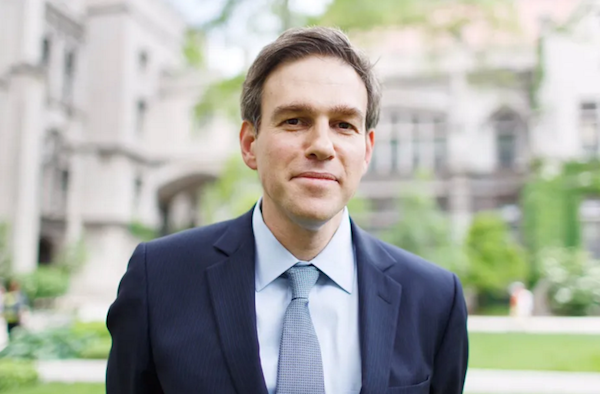
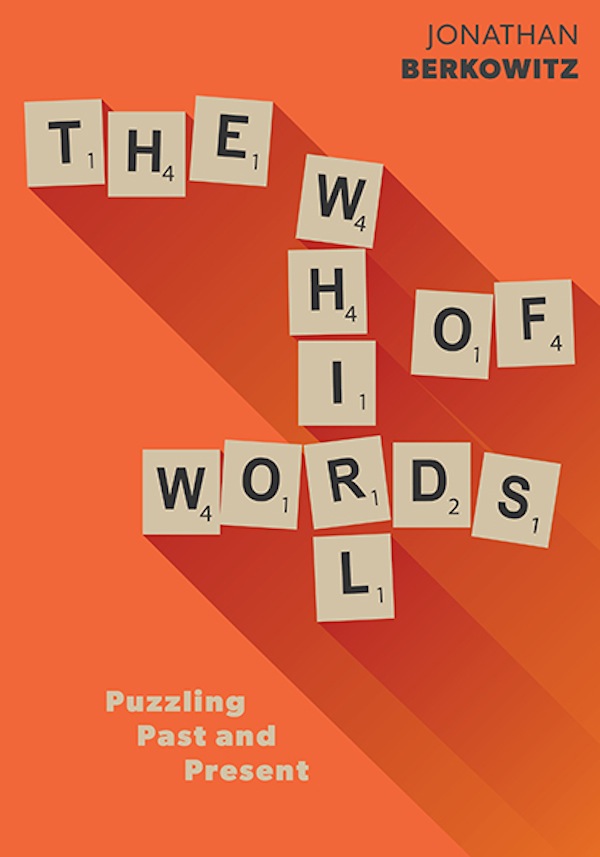
In his recently published book, The Whirl of Words: Puzzling Past and Present (FriesenPress), Berkowitz gets into the nitty gritty – history, philosophy, etymology, mechanics – of puzzle construction and solving in a conversational style that makes for good reading, even if you don’t absorb all the details on the first go. In fact, an ability to give something the once-over and then revisit it is an important aspect of puzzle-solving. It’s the second of eight steps that Berkowitz offers for solving puzzles, which would serve well for any puzzling situation.
Puns, by the way, are a part of wordplay, which, writes Berkowitz, “involves perceiving patterns where none were expected. Pattern matching is a hallmark of intelligence. It is at the root of science and art. Much of thinking is really just finding the underlying pattern.”
Berkowitz is adept at both science and art. He appears regularly on CBC Radio 1, where he is “the Word Guy” on the show North by Northwest. He creates and solves puzzles and is a member of the National Puzzlers’ League. Oh, and he’s a professor of statistics at the University of British Columbia’s Sauder School of Business.
The Whirl of Words is about all kinds of wordplay, the main types of which, Berkowitz explains, “involve letter play (wordplay involving the letters of the alphabet and their usage in words without regard to sound or sense), sound play (wordplay involving the sounds of words without regard to letters or meanings) and meaning play (wordplay involving the meanings of words without regard to letters or sounds).”
There is a chapter on numbers, both as words (one, two, three, etc.) and as mathematical concepts. There are discussions of the potential cognitive and other benefits of puzzle-solving, such as learning about a range of topics, from sports to geography to politics.
“Word puzzles improve vocabulary, grammar, spelling and communication skills, boost memory and enhance cognitive and analytical skills,” writes Berkowitz. “By improving your problem-solving skills, you may also improve your performance at work and in other areas of life. They can be a positive factor for your mental health, because focusing your attention on a puzzle can aid relaxation, ward off anxiety, and keep your emotions under control. After all, how can you think negative thoughts when you’re concentrating on a puzzle? And, doesn’t it feel fantastic when you solve a puzzle?”
Going back to his eight steps, out of context, they could be mistaken for a self-help guide:
“The puzzle is in the details. Read the instructions carefully. Then read them again.”
“Give it the once-over, twice. Assess the challenge.”
“Don’t just sit there, try something.”
“Don’t give up; persist.”
“Open your toolbox.” What approach might lead to a solution?
“Use the force wisely. Be systematic and efficient.”
“Sleep on it…. Like a train, once you are on a track, it is difficult to change tracks. Put the puzzle aside and come back to it with fresh eyes and a refreshed brain.”
“You are not alone. It is perfectly fine to seek help from resources.”
As is also true with general life circumstances, the key to getting better at something is to practise. And Berkowitz provides plenty of puzzles for readers to solve, as well as the answers to them at the end of each chapter.
The Whirl of Words includes a selected biography for those interested in further learning, and a much-needed glossary – most readers will discover many new words and terms while enjoying this book.
To read excerpts from The Whirl of Words and to purchase a copy of it for yourself or a fellow puzzle lover, visit thewhirlofwords.com.
With gratitude to HaShem, mazel tov to Shmuel Hart (King David High School Class of 2016) and Reut Rappoport on their joyous and spirited wedding at Sakoya Gardens (just outside Jerusalem) on June 15, 2021. Elated parents – Alexander Hart and Kathryn Selby of Vancouver, and Rabbi Jason and Meira Rappoport of Alon Shvut, Gush Etzion, Israel – are so very proud of the newlyweds. The couple resides in Jerusalem, Israel, and both are currently studying at Hebrew University.
* * *
Now in its seventh year, the Canadian Jewish Literary Awards recognizes and rewards the finest Canadian writing on Jewish themes and subjects. This year, the awards ceremony, which took place on Oct. 17, was presented on Zoom and is available for viewing on the Canadian Jewish Literary Awards YouTube channel.
The winner in the fiction category was Nothing the Same, Everything Haunted: The Ballad of Motl the Cowboy by Gary Barwin (Random House Canada). It follows a wannabe cowboy, Motl, as he and his mother flee Vilna and the Nazis’ massacre of the Jews. The ensuing events, characters and horror are met by Motl with humorous absurdity in the face of tragedy.
Plunder: A Memoir of Family Property and Nazi Treasure (Houghton Mifflin Harcourt) by Menachem Kaiser, which tells the story of the author’s quest to reclaim a residential building his family owned in Poland before the Shoah, won for best biography.
Lisa Richter won the poetry prize for Nautilus and Bone (Frontenac House). A reimagining of the unconventional life of Yiddish poet Anna Margolin, this collection also won the 2020 National Jewish Book Award for Poetry, the first time a Canadian poet has ever received the American honour.
For children and youth literature, the winner was Osnat and Her Dove (Levine Querido) by Sigal Samuel, with illustrations by Vali Mintzi. It is based on a true story. Although girls in 15th-century Mosul were told, “Reading is for boys,” Osnat convinces her rabbi father to teach her to read. As she grows older, she asks her father to seek a groom who will allow her to study Torah, and she helps run her father’s religious school while raising her own children. After her father’s death and, later, her husband’s, Osnat becomes the school’s leader, making her the world’s first female rabbi.
For scholarship, the awardee was Survivors: Children’s Lives After the Holocaust by Rebecca Clifford (Yale University Press), which is an exploration of the life trajectories of 100 children who were 10 years old or younger at the time of their liberation in 1945. Through archives found in 12 countries, including Canada, and through personal interviews, the author follows the impact the events of the Holocaust had on their lives, and on those who educated them.
In the category of writing about the Holocaust, the winner was In the Lights of Days: The Untold Story of Women Resistance Fighters in Hitler’s Ghettos (William Morrow) by Judy Batalion. The book points out the lack of recognition and the misrepresentation of women’s roles during the war, the actions they took to fight, as well as their crucial importance.
The Canadian Jewish Literary Awards jury for 2021 was Edward Trapunski, Pierre Anctil, Rona Arato, Miriam Borden, Rita Davies, Alain Goldschläger and Adam Sol.
Ben-Gurion University of the Negev student village (photo from CABGU)
Fourteen new buildings have been added to the student village at Ben-Gurion University of the Negev (BGU) in Israel. It will allow more than 1,000 students options from studio apartments to married student housing.
“The student village lets them choose their living quarters in accordance with their personal preference,” said BGU president Prof. Daniel Chamovitz, “while everything they could need is nearby: the north campus and the conference centre, which are in development, a hotel for visiting students and faculty, stores and coffee shops … and the high-tech park, the train station and the university’s country club are just a short walk away.”
The student village offers apartments suitable for religious students and those with disabilities. Any registered student is eligible to apply for a room. The rooms come fully furnished with a smart TV, beds, closets, desks, a full kitchen, a sitting area and a solar water heater. Full maintenance service is offered, as is 24/7 security, a 24-hour service hotline, bicycle rooms, laundry rooms, and more.
“Situated in the country’s southern region, the university is known to be a destination institution,” said Mark Mendelson, chief executive officer of Canadian Associates of BGU. “This means that students who attend the university also live either on campus or in the communities in and around the university, including the city of Be’er Sheva. In addition, almost 60% of the undergraduate student body volunteers in their respective neighbourhoods, which is really something very unique to BGU and has brought outstanding community involvement to the citizens of Be’er Sheva.”
After COVID-19 hit, The Eichmann Project – Terminal 1 evolved into a per- formance directed to a camera. (photo from Pathos-Mathos Company)
Art has many facets, forms and reasons for being. As much as it can be an escape from our daily realities, it can help us process and understand them, sometimes in vastly different ways. The Chutzpah! Festival, which opens Nov. 4 with City Opera Vancouver singers performing to the Marx brothers’ A Night at the Opera, features many examples of entertainment with multiple purposes.
On the face of it, Project InTandem’s dance double bill (Nov. 6-7) might seem to have nothing in common with the theatre work The Eichmann Project – Terminal 1 (Nov. 8). Yet both deal with, among other things, trauma and post-traumatic stress disorder, as well as our ability to change ourselves and even our circumstances.
The Eichmann trial
Lilach Dekel-Avneri and the Pathos-Mathos Company’s Terminal 1 examines the 1961 trial, in Israel, of Adolf Eichmann, one of the main perpetrators of the Holocaust. The books of attorney-general Gideon Hausner, political theorist Hannah Arendt and journalist and poet Haim Gouri, “with their testimonies on the trial, were the inspiration for the three main ‘characters’” of the theatre work, explained Dekel-Avneri. “My dramaturg, Liat Fassberg, and I, like in a Greek tragedy, positioned the two main characters with opposing worldviews, one against of the other. The words by poet Haim Gouri, who was present at the courtroom and reported daily from there, were composed and treated as a chorus. The chorus tries to advance in telling the tale of the trial while providing a dramatic lament on the happenings.
“It is actually a trial of the trial,” said Dekel-Avneri, “dotted with texts from researchers of the Holocaust and post-traumatic stress disorder, poets, philosophers, and performers’ live comments between those three main voices. The COVID-19 epidemic presents itself in the team’s testimonies and actions, erasing all plans and forcing project evolution into a digital performance to the camera.”
Dekel-Avneri refers to the Eichmann trial as “the first reality show in Israel.”
“A lot has been said about the connection between trials and performance,” she explained. “The Eichmann trial was the first trial-show recorded in front of a live audience, that actually bought tickets, and was projected live on the radio, later on television, with the full documentary show now available on the internet.”
Terminal 1 explores the concepts of collaboration and obedience, and asks, “What is our responsibility as citizens, as artists?”
“It’s an extension of Arendt’s brilliant manifest evoking the citizens to think by themselves and not to obey automatically. Not to automatically be part of horrific systems, just because they say: do this and not that,” said Dekel-Avneri. “We are thinking creatures, the least we can do is use our heart and brain, take responsibility for our actions, and not collaborate with demons.”
The show initially was created to be interactive with an audience and then remade for film because of COVID.
“During 2020, at the beginning of the outbreak, the Israel Festival, where we premièred, decided to move online, so I made my choice,” said Dekel-Avneri. “Since I do not believe in shooting a theatre show and screening it, I had to let go of my vision for the full project I was working on for six years, and re-create it as something new, made especially for the camera.
“The Eichmann Project – Terminal 1 is, for me, the first station, like its name,” she continued. “The last station may be completed in the future, or not. It will need to start almost from the beginning. We hope that one day we will find a sponsor or a theatre to collaborate with and fulfil the vision of this Via Dolorosa of 21 live scenes. The trial is not going anywhere and, unfortunately, we, by ‘we’ I mean humanity, do not learn from our past mistakes, so it looks like it will remain relevant for awhile.”
Lilach Dekel-Avneri (photo by Shachaf Dekel)
Dekel-Avneri recently premièred Crowned, which she described as “a performative portrait, broken by the encounter with time, shattered in the prism of the plague, emerging through a web of video and audio testimonies by seven women at different decades of their lives, which coalesce into a course of a lifetime. An attempt to leave a monument to the voice of femininity at the current time, femininity striving, despite everything, to see the opportunity for growth within the crisis and wonder about the intersection between life and art at a time of change. These women take responsibility of their actions, future and well-being,” she said.
“In a way,” she added, “Crowned is a post-traumatic response to what COVID did to The Eichmann Project. After being torn apart from my original vision and separated from the audience, I prepared a show for any situation – we are not afraid from lockdowns or the camera anymore. The camera became a friend, a tool and a partner, to continue creating performative works.”
Struggle, empowerment
Project InTandem – which was cofounded by Calgary-based producers and choreographers Sylvie Moquin and Meghann Michalsky in 2017 – brings two works to the Chutzpah! Festival: Deep END by Michalsky and moving through, it all amounts to something by Moquin.
“This double-bill,” explains the press material, “explores themes of female struggle and empowerment…. Michalsky investigates how movement can accumulate and evolve through set rounds and repetition. Moquin’s work is inspired by the concept of neuroplasticity and the journey of rewiring one’s patterning.”
Project InTandem – Meghann Michalsky and Sylvie Moquin – bring two works to the Chutzpah! Festival. (photo by Tim Nguyen)
The pair met for the first time when they both created short works for a production at the University of Calgary, eventually forming Project InTandem “to share workload, resources, and to create an opportunity for emerging artists to produce evening length work.”
“Having Meghann as a collaborator has always pulled me to a higher standard,” Moquin told the Independent. “I think we work together in a way that elevates us to achieve more than what might be possible on our own. It also makes the journey of being an artist less lonely.”
“Our approaches to dance can sometimes overlap because we have had similar experiences or opportunities, or trained within similar methods,” they said in their email interview with the JI. “All of our accumulated experiences as dancers and movers inform us as creators; those experiences become like an inventory of information.”
Moquin has been a dancer within Michalsky’s choreographic works since 2018, so that also informs their relationship.
“Some of our shared values include creating work with visceral physicality, creating opportunities within our city, elevating the production value of contemporary dance work, and always prioritizing integrity,” they said.
Each has her own interests, though.
“I am really interested in exploring what the body can endure in this work,” said Michalsky. “We push and we push again. As performers, we pass through movements and states and eventually surrender to things that are no longer needed. I am interested in seeing the dancer go through something tangible in real time, something that is honest and showcases risk and vulnerability. As a choreographer, I play with conflict from both internally in the body and externally in the space and I desire for both of these things to be felt by the audience.”
About her piece, moving through, Moquin said, “When creating this work, I was completely immersed with investigating partner work (the way bodies engage and interact) as well as being upside down. I used these primary desires to dig into the concept of neuroplasticity – the way we adapt, the way we can gain governance over our thinking; sometimes even the feeling of being trapped in our own mind and thoughts.
“I am a big believer that we must fail in order to succeed,” she continued. “As a choreographer, I use the sensing body to somatically approach theories I find fascinating in the world. I am especially interested in how bodies interact with one another, how they can support each other to fly, spin, and find themselves upside down effortlessly. I am keenly interested in the effects of the mind, the power of our thoughts, and the ability for change and growth. I would say that my research and choreography seeks to find a sense of hope within a world of chaos.”
The initial vision of moving through included the use of “walls.”
“I couldn’t get the idea out of my mind, and so I finally started looking into building/creating something to fulfil these ideas,” said Moquin. “The material used (a form of Plexiglass) was almost a happenstance. I became fascinated by the translucent quality. I had no way of knowing how this material would have such an impact within our world merely months after creating and premièring the work in March 2020. As I watch this work now, two years later, after a global pandemic, it is almost startling to watch the dancers engaging with these Plexiglass structures.”
The Chutzpah! Festival runs Nov. 4-24. For tickets and the full lineup, visit chutzpahfestival.com or call 604-257-5145.
Bret Stephens (photo from harrywalker.com/speakers/bret-stephens)
Western media have got the narrative of the Israeli-Palestinian conflict wrong, says Bret Stephens, a Pulitzer Prize-winning journalist, editor and columnist who is an opinion writer for the New York Times. But, for a journalist to diverge from that entrenched storyline is almost impossible.
Stephens, a former editorial page editor at the Wall Street Journal and managing editor of the Jerusalem Post, recalled when he first started covering the region, in 2000.
“I went out there purely wearing my journalist’s hat and saw a story that was very different from the story that was being reported by many of my colleagues in the mainstream press,” said Stephens in a Sept. 23 webinar hosted by Honest Reporting Canada.
“I think lots of the Western press have continued to get much of the story dead wrong, most of all on that fundamental question: who is the aggressor?”
An example of media’s inability to diverge from a predetermined storyline came in 2019, he said, when residents of Gaza were protesting against the oppression and economic deprivation brought on by the Hamas regime that governs the seaside enclave. The global media, which tends to focus disproportionately on Palestinian concerns, almost entirely ignored the anti-Hamas activism, Stephens said.
“They wanted the world to believe that Palestinians in Gaza had one problem,” Stephens said, “and the name of that problem was Israel.”
Accurate reporting from Palestine is also a challenge because Western media hire freelancers, or “stringers,” in Gaza and the West Bank who do not operate with the same freedoms that reporters in Israel enjoy.
“They have colleagues in Gaza, where the pressure is not-so-subtle for those stringers to toe a particular ideological line, to not report stories that would be inconvenient for the Hamas narrative,” he said.
Winning the battle of ideas, Stephens said, is a priority for Hamas.
“The field of combat is not the battle they know they’re ultimately going to lose against Israel, but the one they think they’re going to win in the realm of public opinion,” he said.
Stephens clarified that he is a columnist, paid to have opinions. But too many journalists today, he said, either view themselves as activists or cannot differentiate their own opinions from straightforward reporting.
The broader context of societal understanding of what were once considered verifiable truths does not bode well for Jews, he added.
“Race is replacing ethnicity as the defining marker of group and personal identification,” he said. “Now we have this new kind of racialism that is dividing people into people of colour and white people. So Jews find themselves, or the majority who are not Jews of colour find themselves, shunted into a racial classification that they don’t recognize as their own.
“I don’t think of myself as a white guy,” he said. “I don’t feel like I have participated in any system of white supremacy. I am the son of a woman who was a hidden child in the Holocaust. She was hunted down for not being white. A Jew. To somehow pair me in this new scheme with the white mask is an injustice to millions of Jews who feel deeply discomfited by this new racialism.”
He added: “Jews have never, never done well when racialist dogma becomes a defining feature of society.”
Other social trends should alarm Jewish people, said Stephens, a conservative writer who calls himself a “never-Trump Republican.”
“The concept of personal success is now being called privilege,” he said. “There are all kinds of Jews who came to these shores in North America with nothing, or next to nothing, and who achieved, by virtue of hard work, effort, ingenuity, good luck, whatever. But now success is being called privilege and privilege is being seen as a product not of individual merit, but as a system of oppression.”
Further, he said, independent thinkers are now being treated as heretics, “and Jews have a long tradition of independent thinking.”
The widespread acceptance of outlandish lies, exemplified by the so-called “Pizzagate” theory, the group QAnon and the idea that the 2020 U.S. presidential election was unjustly stolen from Donald Trump, are an indication of fringe ideas seeping into the body politic, he said.
“We now have come to a place where, increasingly, we are a nation that can bring ourselves to believe anything and a nation that can bring itself to believe anything … sooner or later, is going to have no problem believing the worst about Jews. This is the moment that we’re in.
“Conspiracy thinking has gone mainstream and there is no bigger conspiracy theory in the world than antisemitism,” he said.
Stephens challenged the rote assertion that “anti-Zionism is not antisemitism” by making a stark comparison.
“What is antisemitism?” he asked. “It is a belief, born in the 19th century, that Jews were imposters and swindlers. They were imposters because they were pretending to be Europeans, whether German or French or Italians or whatever, but they were really Semites; that they are not from Europe, they are from the Middle East. And, it said further, these imposters are swindlers because they are trying to swindle real Europeans out of their financial wealth and culture and heritage or whatever. Now, think of what anti-Zionism has shown us. Anti-Zionism is the view that Jews are imposters and swindlers, that they claim to have a Middle Eastern descent but there is no Jewish connection to the land of Israel – that’s the line. And they’re swindlers – they’re swindling Palestinians out of their land.”
Stephens said he supports a two-state solution, “just not now.”
“In theory, a two-state solution is the ideal outcome,” he said. “We should labour towards that, while knowing that it could take 10 or 50 years.
“The prospect of a Palestinian state today isn’t about where you draw the borders. It’s about whether a self-governing Palestinian state can have enough pluralism, liberalism, democracy, tolerance and, above all, a willingness to live in an enduring peace with its neighbours … because the last thing Israel needs is re-creating what the Gaza Strip has become in the West Bank.”
Demanding Palestinian self-determination now, he said, is like inducing a baby in the 20th week of pregnancy.
“It’s going to result in tragedy. Let’s be mindful of what the long-term goal is, but let’s be practical and thoughtful and sensible about how we get to it.”
Honest Reporting Canada describes itself as an independent grassroots organization promoting fairness and accuracy in Canadian media coverage of Israel and the Middle East. The webinar is available for viewing at honestreporting.ca.
There has been a trend among some pro-Israel people and others to depict the U.S. Democratic party as having fallen prey to a far-left agenda, a wolf of extremism seeking to reinvent the social fabric of the country in the sheep’s clothing of “progressive” values.
There are indeed some voices in the Democratic party that press the party to views that are less mainstream – as there are in the Republican party. There is no Democratic equivalent to the radical Republican misanthropes like Lauren Boebert, Paul Gosar and Marjorie Taylor Greene, who have plumbed the depths of dark web conspiracies. Yet members of the so-called “Squad,” a group of Democrats, have taken positions on Israel and Palestine that reject the traditional bilateral American support for Israel’s security. This was never starker than during the recent vote to fund Israel’s Iron Dome defensive anti-missile shield. Members of the Squad, and a handful of other members of Congress, held up a vote on a massive budget bill until American support for Israel’s defence was removed.
The capitulation by senior Democrats was condemned by many, but the victory of the anti-Israel voices was short-lived. The next day, the House voted by a 420-9 landslide to provide the very funds that had been excised from the bigger bill the day before. The numbers could not be clearer. American leaders remain overwhelmingly committed to the bilateral relationship and to Israel’s defence.
The Iron Dome was depicted by some of the dissenting members of Congress as a tool of Israeli oppression. It is, however, a defensive technological wonder whose sole purpose is to save lives. Opposing American support for the program based on economic concerns could be justifiable – a billion dollars is no small change. But those who voted against it have given no indication of thriftiness. Interested in raising taxes on the wealthiest and spending more on domestic programs, as well as passing the Build Back Better Act, which would increase spending on social programs and infrastructure, lower spending does not seem to be a defining motivation for these congresspeople. President Joe Biden has already said he will approve the funding.
We see plenty of Republicans condemning the more extreme members of the Democratic caucus. And we see Democrats condemning the members of the opposition that the late senator John McCain memorably dubbed “whackadoodles.” But perhaps we should all be looking in our own backyards to get our own houses in order.
Speaking of which, Canada is not immune to offside officials. Jenica Atwin was a Green MP who accused Israel of apartheid before huffing across the floor from the Green party to the governing Liberals, where she was quickly forced to retract her earlier comments. The People’s Party of Canada, while not gaining a seat in the recent election, nevertheless significantly expanded their support base across the country, while advancing intolerant, often conspiratorial ideas. Still, Canadian extremists look like small potatoes next to the American examples.
When winning at any cost becomes seen as crucial – because the other side has been demonized to such a degree that their victory is seen as an existential threat – it is easier to accept the unacceptable if it comes from “our” side and to condemn it with self-righteous indignation when it appears on the other side.
Partisanship is too often preventing us from doing the right thing. This behaviour is self-defeating, put mildly. Ignoring inherent malevolence for immediate gain is a recipe for long-term failure, not only for a party’s political fortunes but, far more gravely, for our democratic, pluralistic society as a whole.
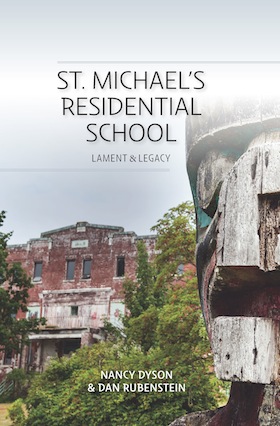
St. Michael’s Residential School in 2013, Alert Bay, B.C. (Courtesy Hans Tammemagi, from the book St. Michael’s Residential School: Lament & Legacy)
In 1970, Nancy Dyson and her husband, Dan Rubenstein, worked for a short time at the Alert Bay Student Residence, previously and most commonly known as St. Michael’s Indian Residential School. Dyson shares their experiences, with a brief section by Rubenstein, in the book St. Michael’s Residential School: Lament & Legacy (Ronsdale Press, 2021).
“This book is a must-read for all Canadians,” writes Chief Dr. Robert Joseph, ambassador for Reconciliation Canada and a survivor of St. Michael’s, in the foreword. “It is honest, fair and compelling. It is a story that screams out for human decency, justice and equality. It also calls for reconciliation and a new way forward! Two recently wed idealists arrive at Alert Bay on Canada’s Pacific central coast to work at St. Michael’s Residential School. They hire on as childcare workers. Little do Dan and Nancy in their youthful enthusiasm know they will be shaken to the core before too long.”
Yet, despite being shaken, the couple did not realize the extent of the abuse and harm being inflicted on their charges, nor that such abuse was being carried out across the country – and had been since the first schools opened in the 1800s to when the last one closed in 1996.
“In 2015, the Truth and Reconciliation Commission (TRC) Reports were released. Like many Canadians, we were shocked by the findings,” writes Dyson in the introduction. “Over a hundred-year span, thousands of Indigenous children had experienced what we had witnessed at St. Michael’s. Especially shocking were the stories of sexual abuse that had occurred along with the emotional and physical abuse we had witnessed. When we read the survivors’ statements and realized the lasting, tragic legacy of the schools, we felt compelled to share our story.”
The couple does so with the intent to bear witness to the survivors’ experience. “In adding our voices to the voices of survivors,” writes Dyson, “we hope that the history of residential schools will not be forgotten or denied.”
Dyson and Rubenstein were married in March 1970 in Rubenstein’s family home, near the campus of Vassar College, in Poughkeepsie, N.Y., from which Dyson graduated in May that year. A brief series of events landed them in Vancouver, where they decided to stay awhile, because Canada “seemed more benign and compassionate than the United States, which was then severely polarized by the Vietnam War.”
While staying with friends, they learned about openings for childcare workers at the residential school in Alert Bay. Along with one of those friends, they applied for the jobs and succeeded in getting interviews. The school administrator explained to them that St. Michael’s, which had been run by the Anglican Church, was taken over by the federal government in 1969 – this was a national change in policy, because of a Labour Relations Board of Canada ruling a few years earlier that school staff had to be paid as much as government employees doing similar jobs. The churches couldn’t afford the increased costs, so the government took over. Though, as Dyson notes – in dialogue given to the administrator – the churches still had “a strong influence.”
At the time that Dyson and Rubenstein joined St. Michael’s staff, the school wasn’t a school anymore, but a residence, with most of the kids attending public school in Alert Bay and the handful that made it to Grade 9 taking the ferry to Port McNeill for their education. Including Dyson and Rubenstein, there were seven childcare workers for 100-plus kids. Dyson was put in charge of 18 teenage girls and Rubenstein the 25 youngest boys, most of whom were 6 or 7 years old.
From the beginning, even before their interview, as they walk up the concrete steps of the residence, and notice the rusty radiators and drab hallways, they have misgivings. Their friend declined the job offer, but they accepted, thinking “it has to be better than living in the States.”
During their brief tenure at St. Michael’s, they witnessed the brutal treatment of the children, in the name of discipline, as well as the poor food, clothing, shelter and, of course, the kids weren’t allowed to learn anything about their own culture. There were suicides, some girls prostituted themselves, some students took their anger out on their peers.
Dyson and Rubenstein tried to support the kids and did indeed connect with a few of them. The couple tried to force some changes, along with other people in Alert Bay, but there was really no way they could improve the situation. Ultimately, Dyson couldn’t take it anymore and quit. Rubenstein, however, still wanted to try and change things from within, despite having been attacked with a knife by a cook who thought that the Jew among the Anglicans was the Antichrist. Rubenstein was fired from his job after he and Dyson shared their concerns about the residence with government inspectors.
The names of people in the book have been changed and the dialogue is based on memory. Dyson inserts excerpts from the TRC reports into her narrative to reinforce not only what she is saying about St. Michael’s but to show that what was happening there was, sadly and disgustingly, happening at residential schools across Canada.
Rubenstein’s story comes as an epilogue, after a section with some of his photos from 1970/71, as well as a few more recent ones, including of the reconciliation ceremony in Ottawa in 2015. Rubenstein writes about the continuing impact of the residential schools and some of his realizations. He speaks candidly of the difficulties he has in reconciling what he witnessed with the image he has of Canada “as a just and compassionate country.” As well, he admits, “I also struggle to reconcile my own sense of decency with my failure to advocate on behalf of the children after I left St. Michael’s. Like other Canadians – former childcare workers, teachers, administrators, principals, clergy and government officials – I remained silent.”
Dyson and Rubenstein have written St. Michael’s Residential School: Lament & Legacy not only to state publicly what they witnessed and did or didn’t do. They want to encourage other Canadians to join in the process of reconciliation, and offer some ideas for entry points, mainly the TRC reports. The book ends with a quote from the TRC’s final report:
“Reshaping national history is a public process, one that happens through discussion, sharing and commemoration…. Public memory is dynamic – it changes over time as new understandings, dialogues, artistic expressions and commemorations emerge.”
St. Michael’s Residential School: Lament & Legacy is available for purchase at Amazon and other booksellers. In the acknowledgements, Dyson and Rubenstein note that a portion of the royalties received for the book “will be donated to Reconciliation Canada and the Indian Residential School Survivors Society.”
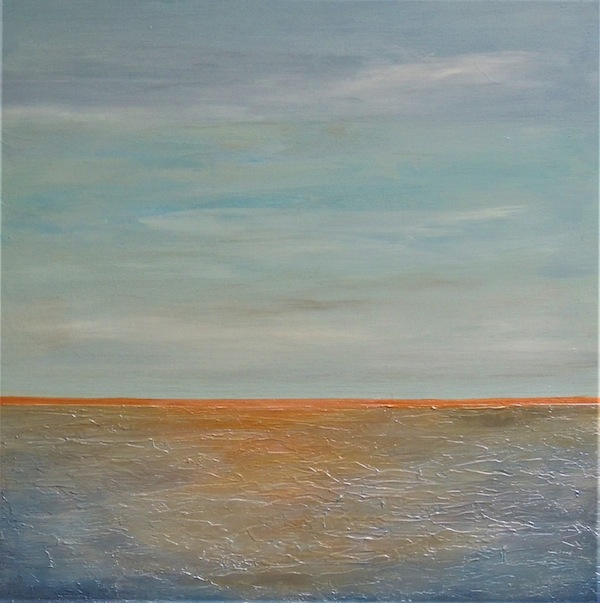
Two of artist Monica Gewurz’s paintings – “Silver Marsh” (above) and “Dawn II” – are featured in the exhibition of the Nature Trust of British Columbia’s Artist of the Year Award. “Silver Marsh” was inspired by a sunset at Addington Point Marsh, one of NTBC’s properties, which aims to conserve waterfowl and fish habitat, and “Dawn II” by a visit to Vaseux Lake in the Okanagan, an NTBC property that protects habitat for bighorn sheep and other threatened species.
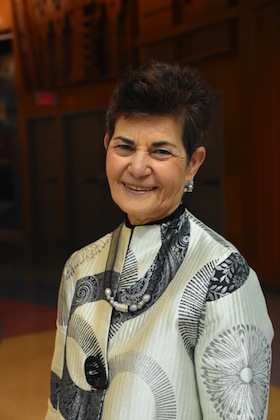
Two of artist Monica Gewurz’s paintings have been selected by a jury to be included in the exhibition of the Nature Trust of British Columbia’s Artist of the Year Award. The joint show of the Federation of Canadian Artists and the Nature Trust opens on Oct. 18 at the Federation Gallery on Granville Island.
Before turning her focus to art in the past several years, Gewurz had worked in both the public and private sectors, in areas from commercial real estate to tourism to aboriginal issues. However, art was an integral part of her upbringing in Peru.
Monica Gewurz (photo from Monica Gewurz)
“For my parents, art was as important as science,” Gewurz told the Independent. “My mother was also an artist, and she exposed me to art at an early age – not just Judaica and Peruvian art but also art from different cultures. We traveled a lot. I always enjoyed visiting museums and art galleries. And I always had my camera with me, always took pictures. Landscapes and close-ups, textures and patterns always fascinated me.”
Upon graduating high school, however, she chose a different path.
“In the early 1970s, I was studying to become a veterinarian in Peru. At that time, South America went through some economic and political unrest,” she said. “Peru had a military government, and antisemitism was on the rise. My university was hit repeatedly with strikes and class closures. Getting an education was becoming difficult and dangerous. That was when I decided to move to Canada. With my parents’ financial support, I came alone to continue my studies at the University of Guelph. My parents immigrated later, in 1985.”
After university, Gewurz worked for the Canadian government, but she couldn’t abandon her art. “My photography, jewelry and painting all started as hobbies. I needed an outlet to balance my hectic and stressful full-time job…. In 2000, I started making tribal and sculptural jewelry. I was successful enough to showcase my pieces in national craft shows and then commercially in some galleries, here in Vancouver and in the U.S.”
She knew that most professional artists had formal art education, so she enrolled at Emily Carr University of Art + Design in 2011. “I could study there part-time while working,” she said. “It would also allow me the opportunity to meet other artists.”
She finished her studies at Emily Carr in 2016. Coincidentally, she couldn’t continue at her government job for much longer. “Due to a life-threatening autoimmune illness, in 2017, I had to retire,” she explained. “That gave me the opportunity to embark on a new career as a professional artist.”
Gewurz’s paintings are mostly abstracts, reflecting the landscapes of the West Coast. “The force and energy of water and its associated reflective light, the interplay of shadows and colours in a landscape, have always drawn me in as a scientist and an artist,” she said. “The endlessly changing skies and the patinas of precious minerals mesmerize me. I am fascinated with the contrasting nature of life. I paint it all to provide an escape to a dream-like place.”
Fractals in nature and stylized figures frequently populate her paintings. She doesn’t strive for photographic correctness. “Painting in abstract challenges me to represent reality in a veiled, mysterious and intriguing way,” she said. “Abstraction and the use of texture allow me the freedom to change what I see and feel into my own expression. The artistic process is, for me, one of constant discovery and conversation. The painting speaks to me, tells me what it needs, and I respond.”
Although initially she used brushes, she said, “Lately, I transitioned to using mainly a palette knife and other unconventional tools. As a result, my art became more abstracted and complex.”
She bases her paintings on her own photographs and on her memory; she never paints on location. “I paint from the heart and intuitively,” she said. “I don’t paint anything specific in a landscape and that’s what I love about it – the process of being able to use the paint any way I want. I leave out a lot of visual information. That allows the viewers to use their imagination, to see and describe every painting in their own way.”
Gewurz gifts much of her art to charities and friends. “It is exciting for me to witness the connection some of my ethereal-looking paintings elicit in viewers,” she said. “It humbles me, when people I’ve never met immerse themselves in the layers, shades and textures of my paintings and then share with me how they are seduced into a visual, tactile and emotional response. When such a connection is made, I feel that I accomplished my mission. Of course, the cherry on the cake is when somebody buys a painting and becomes a collector and, many times, a friend.”
She shared one such a case. In 2014, an interior designer from Singapore saw one of her mixed media paintings at an exhibit and contacted her for a commission. The painting was two by two feet, said Gewurz, “but she wanted a much larger one, measuring seven by four feet, for her client, a new five-star hotel in Hong Kong. That was a turning point in my career and a huge jump in scale for me. That painting still hangs in their lobby.”
Mixed media seems to be Gewurz’s preferred style. She incorporates in her pieces ancient and modern materials, such as textiles, sand, rust, aluminum foil, copper and silver. She paints in multiple layers to seduce viewers in visual and visceral encounters. But, whatever the materials, her theme remains predominantly nature.
“Dawn II” by Monica Gewurz
Gewurz’s love of nature led to her involvement with the Nature Trust of British Columbia (NTBC). “I am a donor and volunteer,” she said.
She is also an active member of the Federation of Canadian Artists (FCA).
“One of the main FCA missions is to outreach and raise awareness about conserving the environment and natural spaces,” she said. “Every year, FCA asks their membership to submit a proposal for a show that deals with social and environmental issues. I submitted the idea to have a joint show with NTBC, as they had a common vision, and also to take the opportunity to celebrate their respective anniversaries. Both director boards reviewed and accepted my proposal.”
Of course, she longed to participate in the show as well, since its underlying purpose – the conservation of British Columbia’s endangered habitats – is close to her heart.
“FCA holds several juried shows every year,” said Gewurz. “I regularly submit and often get juried in to showcase in them. This time, I applied as well. I was thrilled and honoured that two of my paintings were admitted. There was a lot of competition.”
Gewurz’s commitment to environmental issues extends beyond her participation in such shows and groups.
“I use upcycled materials in some of my mixed media art,” she explained. “There is beauty in repurposing materials because of their distinctive uniqueness and imperfect textures. Also, the fact of my using them conveys the message to the viewer about the importance of decreasing waste and minimizing our carbon footprint.”
She added, “Art can certainly open people’s eyes to how much our lifestyles imperil the planet. Art could encourage all of us to make positive changes.”
Jonas Noreika, who was executed by the Soviets in 1947, has been revered in his native Lithuania and by its expatriate community as a national hero and an anti-communist patriot.
This vaunted hero, however, has come under intense scrutiny of late, largely as a result of the findings of his own granddaughter, Silvia Foti. Her research has revealed that Noreika, whose nom de guerre was “General Storm,” was in fact a Nazi collaborator, responsible for the murder of thousands of Lithuanian Jews – sometimes, on his own initiative.
In her new book, The Nazi’s Granddaughter: How I Discovered My Grandfather Was a War Criminal (Regnery Publishing, 2021), Foti documents her path from hearing stories about his almost legendary stature to her discovery of the disturbing truth.
The book, the writing of which had been undertaken to fulfil Foti’s mother’s (Noreika’s daughter’s) dying wish, was intended as a tribute. Foti succeeded in assembling hundreds of documents related to Noreika’s life, including an antisemitic pamphlet that he authored in 1933, and KGB transcripts of his prison interrogations.
At first, Foti did not want to believe the story that was emerging from the various written sources, finding it “too scary, too painful, too shameful.” Nonetheless, as a journalist, she could not ignore the rumours that she encountered during her investigative trips to Lithuania. She pursued the matter, in the hope that an examination of her grandfather’s acts during the Second World War would exonerate him. Ultimately, she found so much evidence about his role in killing Jews that it was impossible to act as though it did not exist.
“I wanted to throw the manuscript away so many times, to just drop the whole project. I kept asking myself, Why me? Why am I the one to discover all this? I finally came to realize that, because I am the granddaughter, I would most likely get the most attention,” Foti told the Independent. “I am a practising Catholic, and I pray over this story constantly. My strength came from believing that this is the truth, and the truth needs to prevail, no matter the cost to me.”
What started out as a journey of discovery has now been the recipient of international attention. Foti’s story has been covered by the Wall Street Journal, the New York Times and the BBC, among others.
“So much seemed accidental, inadvertent. I didn’t mean to discover that my grandfather was a Holocaust perpetrator. I didn’t mean to discover that the government of Lithuania refuses to acknowledge his role in the Holocaust and, instead, has declared him a hero,” Foti said.
In 2018, when she was 18 years into her project and believing it was nearing completion, she learned of a lawsuit by Grant Gochin, who lost 100 relatives in the Holocaust, against the Genocide Research and Resistance Centre of Lithuania. They compared notes and joined forces in getting the story out to the international community.
The revelations about Noreika were, to say the least, not easy for many Lithuanians to accept.
“Today, now that the book is out, I face anger, fear and resentment from many Lithuanians who are still in denial over Lithuanians’ role in the Holocaust. I get hate email and death threats, accusations that I work for the Russians, that I’m a traitor to Lithuania, even that someone else wrote the book instead of me. So many Lithuanians think Grant wrote the book,” Foti recounted.
“Grant has an accounting degree and I have two writing degrees and yet, for Lithuanians, it’s easier for them to think Grant hypnotized me and wrote the book,” Foti added. “Lithuanians still have a lot of superstitions concerning Jews. They just can’t believe a Lithuanian would accuse her own grandfather of such horrors. In some ways though, I understand them, because I was there about 20 years ago – minus the superstitions.”
Foti believes, at present, that Lithuania has backed itself into a corner and needs to admit that the Genocide Centre, “its great arbiter” of what took place in the country during the Holocaust, has made a grave error in deeming Noreika a hero. Nevertheless, she does not think such an about-face will happen anytime soon.
“It would be a hari-kari move that would necessitate that the Genocide Centre fall on its sword. How could a mere granddaughter in Chicago uncover so much information about Jonas Noreika, and how could the nation’s legions of historians under the government’s payroll not?” she asked.
“This was Lithuania’s last graceful chance to own up to its role in the Holocaust,” she said. “It could have saved face if its legal system did its due diligence. Unfortunately, the court systems there have a reputation for being corrupt; holdovers from the Soviet era. Because Grant Gochin has exhausted all legal avenues in Lithuania, he now is able to take it to the European Union’s International Court of Human Rights.”
The Nazi’s Granddaughter was edited by Lisa Ferdman of Vancouver.
Sam Margolishas written for the Globe and Mail, the National Post, UPI and MSNBC.
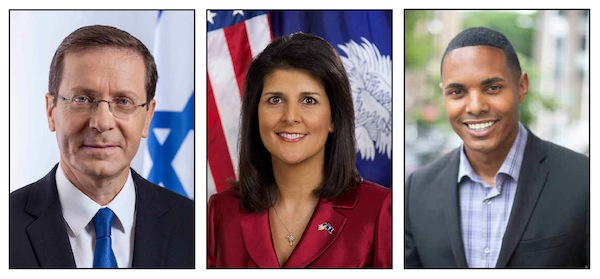
Israeli President Isaac Herzog, left, former U.S. ambassador to the United Nations Nikki Haley and U.S. Congressman Ritchie Torres all spoke on Sunday at the General Assembly of the Jewish Federations of North America. (PR photos)
Antisemitism, community security, caring for the most vulnerable and relations between Jews in Israel and in the Diaspora were among the topics highlighted at the 2021 General Assembly of the Jewish Federations of North America. Normally a multi-day gathering, this year’s conference was a virtual event condensed into 90 minutes on Oct. 3.
Jewish Federations of North America (JFNA) is the umbrella agency representing 146 independent federations and 300 smaller communities across the continent.
Eric Fingerhut, president and chief executive officer of JFNA, credited federations and their supporters for turning a matching grant of $18 million into $62 million to fund frontline Jewish social services organizations during the pandemic.
While the challenges of the pandemic absorbed resources during the past year and a half, Fingerhut addressed a range of issues, noting that it is not easy being an optimist right now.
“We face enormous challenges, which can make it difficult to maintain a positive outlook,” he said. On top of the pandemic and urgent issues of racial justice, Jewish communities across the continent have been confronted by the most sustained and virulent antisemitism in recent memory.
He also addressed the challenges of being an inclusive Jewish community.
“I’m not naïve,” said Fingerhut. “I know that our communities are not now, nor have they ever been, perfect. We have let too many people slip through the cracks unnoticed or unserved. We have not always been there when people needed us the most. We have sometimes struggled to keep up with the ever-changing character of the Jewish community.”
Fingerhut was not the only president to address the truncated assembly. Israel’s President Isaac Herzog emphasized the need to continue building bridges between Israel and the Diaspora, working together to reignite a passion for Zionism among North American youth and instil in Israeli young people awareness of and connections to Diaspora Jews.
“Too many American Jewish youth are disinterested in what being Jewish means and in a complex understanding of the realities and challenges facing Israel,” Herzog said. “Some of them, a very small minority, are too willing to accept distorted labels and libels against the Jewish state. At the same time, on the other side of the ocean, far too many Israelis show too little interest in Jewish life outside of Israel and lack a nuanced understanding of their sisters and brothers in the Diaspora.”
He stressed that, as president of the state of Israel, he makes it his personal mission to strengthen the lines of communication and reinforce the underlying bond and mutual responsibility.
The theme of mutual responsibility was echoed by Mark Wilf, chair of JFNA’s board of directors. When thousands of rockets rained down on Israel last May, he said, federations in North America mobilized to repair and rebuild damaged infrastructure in Israel.
Confronting security issues closer to home was another theme running through the event. Wilf noted that 45 federations have adopted and enhanced community security initiatives and the goal is for every federation and Jewish community on the continent to meet best practices in community safety protocols.
The annual General Assembly events generally attract a raft of Israeli, American and Canadian politicians and elected officials. Due to the unique circumstances, American politicians were limited to one Republican and one Democrat.
Nikki Haley, former governor of South Carolina and President Donald Trump’s appointee as United States ambassador to the United Nations from 2017 to 2019, said the “ancient evil of antisemitism is on the rise.”
“I encountered the sad reality at the United Nations,” she said. “Hateful governments, like Iran, didn’t even bother to hide their hostility toward Jews. I heard it in their words, I saw it in their deeds. Other countries were more subtle. They didn’t go after the Jewish people. Instead, they went after the Jewish state. No other country faces so many insults, no other country is singled out for such attack. Of course, they say, it’s just about opposing Zionism. Well, you and I know the truth. Anti-Zionism is antisemitism.”
She took a swipe at the BDS movement, which seeks to boycott, divest from and sanction Israel.
“While BDS claims to be about justice, it’s a blatant attempt to starve Israel of funding, friends and a future,” she said, noting that she was the first U.S. governor to prohibit public entities in her state from doing business with companies engaged in “discriminatory” boycotts.
She lauded the Abraham Accords, which have led to normalized relations between Israel and the United Arab Emirates, Sudan, Morocco, Oman and Bahrain.
“There were those who said it couldn’t be done,” said the former ambassador and potential Republican presidential candidate. “Now it’s happening before our eyes. Israel is bravely leading the Middle East into a brighter future.”
Also addressing the virtual assembly was Democratic Congressman Ritchie Torres. While a first-term representative elected less than a year ago, the 33-year-old from the south Bronx in New York City has gained attention as a gay, Afro-Caribbean American. Representing the economically poorest district in the country, Torres, a former New York city councilor, is a strong progressive voice on social issues including public housing, predatory loans and gang violence. He has gained notice in the Jewish community and among pro-Israel voters for distancing himself from other progressive Democrats by being an articulate and unapologetic supporter of Israel.
“I feel like all of us in public life have an obligation to speak out forcefully against extremism, no matter what form it takes,” he said. “The rise of a demagogue like [former British Labour Party leader] Jeremy Corbyn is cautionary tale of what could happen when antisemitism infects the bloodstream of a nation’s politics. All of us have an obligation to ensure that extremism is fought at every turn and in every form.”
The idea that it is incompatible to be progressive and pro-Israel is, he said, “a vicious lie.”
He condemned anti-Israel organizations in the United States for co-opting important issues like police violence and immigration and turning them into battering rams against Israel.
Like Haley, he slammed the BDS movement. The contributions of Jewish activists working in partnership with other social justice movements are threatened by litmus tests that seek to prevent pro-Israel Jews from participating in those movements, said Torres.
The antisemitic violence and vandalism that spiked in the spring of this year is “a wake-up call that the Jewish community cannot afford to be complacent about,” he said.
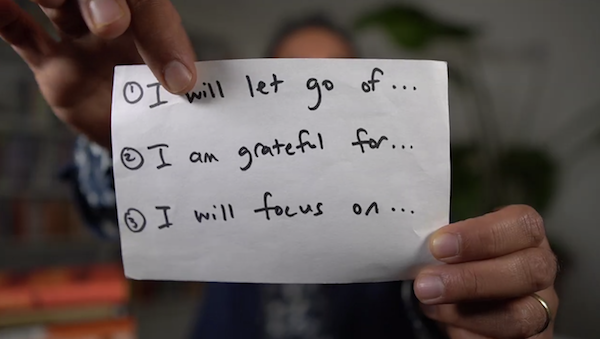
Neil Pasricha, the keynote speaker at Jewish Federation of Greater Vancouver’s The Community of Awesome event Oct. 3, contends that people can be more content in their lives if they take two minutes every morning to finish these three thoughts: “I will let go of … I am grateful for… I will focus on….” (screenshot)
In lieu of the traditional large in-person event that launches the Jewish Federation of Greater Vancouver’s annual campaign, a livestream broadcast from Hillel House at the University of British Columbia Sunday night highlighted the successes and challenges of the pandemic year.
“Donors have given more generously than ever before,” said Lana Marks Pulver, chair of the annual campaign. “Organizations have innovated faster and better. Volunteers have dedicated countless hours pitching in wherever they are needed – that includes more than 200 volunteer canvassers for the annual campaign.
“The pandemic has shown us that we are really good at overcoming challenges,” she said. “We know that, whatever the future holds, we can be there for one another and we will be there.”
Ezra Shanken, chief executive officer of the Jewish Federation, thanked sponsors, in particular Air Canada, which has provided five tickets to anywhere in North America, one for each of the five Jewish day schools in the region, to give to an educator to reconnect with family.
Candace Kwinter, chair of the Federation board, noted that, early in the pandemic, a think tank had predicted that 25% of B.C. nonprofits would not survive the economic and social consequences of the crisis.
“We are very proud that no local Jewish organization has folded,” said Kwinter. “And thank goodness, because demand for their programs and services has only grown.”
A video highlighted the work of Jewish Family Services Vancouver, one of 32 partners supported by the annual campaign. Their services include the Jewish Food Bank, a crisis line and programs for seniors to use iPads to connect with one another.
In the last fiscal year, Kwinter said, Jewish Federation distributed $11.8 million, including $3 million through the Jewish Community Foundation. In addition, the foundation distributed more than $270,000 through their unrestricted grant program, to allow community organizations to adapt.
The Oct. 3 event’s keynote presenter was Neil Pasricha, who is the bestselling author of seven books, including You are Awesome, The Happiness Equation and The Book of Awesome. He is one of the most popular TED Talks presenters. After obtaining his MBA from Harvard, he worked as director of leadership at Walmart for a decade.
Neil Pasricha (photo by Leia Vita)
The Toronto-based speaker focused on how to be happy, noting that the pandemic has resulted in higher rates of anxiety, loneliness and suicide than ever. With the enthusiastic energy of a 1950s disc jockey, Pasricha disputed what he called the assumption that happiness flows from great work, which leads to big success and then to happiness.
“It’s the opposite,” he said. “You have to be happy first, then you do great work and the big success follows.”
Happy people, he said, are 31% more productive, have 37% higher sales and are 300% more creative.
“Happy people get promoted 40% more often,” he added. “More importantly, happy people live an average of 10 years longer.”
He suggests that everybody take two minutes in the morning to write down three commitments.
“When you wake up, I want you to spend two of the 1,000 waking minutes a day doing a little exercise,” Pasricha said. “You write down these three things. I will let go of … I am grateful for… I will focus on.…”
When we consciously think about and write down the things that bother us, he said, we live life with greater contentment and happiness.
“Saying something that is bothering you, writing it down, actually helps you get it off your chest.”


 The Whirl of Words is about all kinds of wordplay, the main types of which, Berkowitz explains, “involve letter play (wordplay involving the letters of the alphabet and their usage in words without regard to sound or sense), sound play (wordplay involving the sounds of words without regard to letters or meanings) and meaning play (wordplay involving the meanings of words without regard to letters or sounds).”