ונקובר העיר חמישית היקרה בעולם מבחינת מחירי דירות ברמה הגלובלית. (Mac9)
חברת הנדל”ן סי.בי.אר.אי פירסמה את הדוח השנתי שבדק את שוקי הנדל”ן בשלושים וחמש ערים לשנה הנוכחית. אסיה בראש הנכסים היקרים כשהונג קונג במקום הראשון שנה חמישית ברציפות, סינגפור שנייה ושנגחאי שלישית. ניו יורק היא העיר היקרה ביותר לשכירות.
אסיה שלטה ברשימה של שווקי הנכסים היקרים ביותר בעולם: אחרי הונג קונג סינגפור במקום השני ושנגחאי במקום השלישי. על פי הדוח המחיר הממוצע של בית בהונג קונג בשנה זו הוא יותר ממיליון ומאתיים אלף דולר. הביקוש הגבוה וההיצע המועט העלו את מחירי הנדל”ן לרמות בלתי אפשריות בשנים האחרונות. ולכן ישנן תכניות ליצירת אי מלאכותי בעלות שמונים מיליארד דולר אשר אמור להקל מעט על מצוקת הדיור.
הערים הסיניות שנזן ובייג’ין נכנסו גם הן לרשימת עשר הערים היקרות ביותר השנה, והגיעו למקומות החמישי והתשיעי בהתאמה. ונקובר בה המחיר הממוצע של בית מגורים עומד על שמונה מאות ושישה אלף אלך דולר – היא העיר הצפון אמריקאית היקרה ביותר במובן זה, והרביעית בסך הכל בעולם. לוס אנג’לס וניו יורק נמצאות גם הן בעשירייה הראשונה. לונדון שהגיעה למקום השמיני ברשימה היא העיר היקרה באירופה. קונים פוטנציאליים בבירת אנגליה יצטרכו לקחת בחשבון הוצאה של ששת מאות ארבעים ושבעה אלף דולר בשנה זו. הערים הזולות ביותר לרכישת בית שנסקרו היו: איסטנבול, הו צ’י מין סיטי ובנגקוק. הערים שראו את העלייה החדה ביותר במחירים הן: ברצלונה, דבלין ושנגחאי.
בכל הקשור לשוק השכירות העיר היקרה ביותר היא ניו יורק, בה שכר הדירה בממוצע הוא אלפים שמונה מאות ארבעים וארבעה דולר (לחודש). אבו דאבי והונג קונג הן שתי הערים היקרות ביותר הבאות, עם שכר דירה ממוצע של יותר מאלפיים ושבע מאות דולר. העלייה החדה ביותר בדמי השכירות לעומת שנה שעברה נרשמה דווקא בליסבון, בה המחירים עלו ביותר מעשרים אחוז. הערים הזולות ביותר להשכרת דירה הן: בנגקוק, איסטנבול ומונטריאול (אם כי מידע במדד זה לא היה זמין עבור חמש ערים שונות).
ככלל אנחנו רואים שהעלייה במחירי הבתים מאיטה בעודנו נעים אל עבר סופו של מחזור נכסי ארוך. כך אמרה ג’נט סיבריטס, ראש מחלקת מחקר של סי.בי.אר.אי בריטניה. לדבריה אנו מצפים ששיעורי הרבית העולים ישפיעו על ערים בארה”ב. ואמצעי הקירור השונים ישפיעו אל האזור הפסיפי-אסייתי.
להלן מחירי דירות ממוצעים לפי דוח החיים הגלובליים: במקום העשירי פריז כשהמחיר עומד על כשש מאות עשרים ושישה אלף דולר (מדובר על התייקרות של תשעה אחוזים בשנה האחרונה). במקום התשיעי בייג’ינג שהמחיר עומד על שש מאות עשרים ותשעה אלף דולר. במקום השמיני לונדון שהמחיר עומד על שש מאות ארבעים ושבעה אלף דולר. במקום השביעי ניו יורק שהמחיר עומד על שש מאות שבעים וארבעה אלף דולר. במקום השישי לוס אנג’לס כשהמחיר עומד על שש מאות שבעים ותשעה אלף דולר (מדובר על התייקרות של שישה וחצי אחוזים בשנה האחרונה). במקום החמישי שנזן כשהמחיר עומד על שש מאות ושמונים אלף דולר. במקום הרביעי ונקובר כשהמחיר עומד על שמונה מאות וחמישה עשר אלף דולר. במקום השלישי שנגחאי כשהמחיר עומד על שמונה מאות שבעים ושלושה אלף דולר (מדובר על התייקרות של אחד עשר אחוז בשנה האחרונה). במקום השני סינגפור כשהמחיר עומד על שמונה מאות שבעים וארבעה אלף דולר. ובמקום הראשון הונג קונג כשהמחיר זהה – שמונה מאות שבעים וארבעה אלף דולר.
“עמדתה של קנדה נותרה ללא שינוי ואנו נמשיך לתמוך בפתרון של שתי המדינות במזרח התיכון”. כך אמר בפרלמנט, ראש ממשלת קנדה, ג’סטין טרודו. דבריו נאמרו על רקע תוצאות הבחירות בישראל, שעל פי הן שוב נבחר לרשות הממשלה, בנימין נתניהו. ראש ממשלת ישראל החדש-ישן הודיע ערב הבחירות, כדי לרכוש לעצמו עוד קולות מהימין, כי ממשלתו החדשה תכריז של סיפוח שטחים באזורי יהודה ושומרון. נתניהו אמר: “אנו דנים בהחלת הריבונות על מעלה אדומים וגם בדברים אחרים. לאחר ההכרה האמריקנית בריבונות ישראל ברמת הגולן, קיימים גם דיונים על סיפוח אזורים ביהודה ושומרון. אני הולך להכיל ריבונות אבל אני לא מבדיל בין גושי ההתיישבות לנקודות היישוב הבודדות. כל נקודת ישוב כזאת היא ישראלית ויש לנו אחריות כממשלת ישראל. כל אחד מבין שהקדנציה הבאה שלנו תהיה גורלית לשני הכיוונים – האם נוכל להבטיח את הביטחון שלנו ועל השטח החיוני של יהודה ושומרון שהוא פי עשרים גדול מעזה”.
לאור תוצאות הבחירות בישראל שאל חבר הפרלמנט הקנדי מטעם המפלגה הדמוקרטית החדשה, גיא קארון, את ראש הממשלה טרודו: “בינימין נתניהו ימשיך בתפקידו כראש הממשלה. בהבטחה של הרגע האחרון הוא הודיע כי יספח התנחלויות בגדה המערבית. אם ממשלת ישראל תעמוד בהבטחתה זו, עשויות להיות לכך משמעויות חמורות על היציבות באזור. עמדתה של קנדה עד היום היתה ברורה שאין ההתנחלויות חוקיות. ומועצת הביטחון של האומות המאוחדות מסכימה עם כך. האם ראש הממשלה יאשר כי קנדה תתייחס לסיפוחם של שטחים אלה כבלתי חוקיים ותפעל בהתאם בנושא?”
טרודו אמר בתגובה לשאלתו של קראון: “עמדתנו נותרה ללא שינוי. אנו תומכים בפתרון שתי המדינות ישראל לצד פלסטין במזרח התיכון. הפתרון הזה אמור להיות מושג באמצעות משא ומתן בין שני הצדדים. פעולות חד צדדיות כגון התנחלויות, אינן לגטימיות ואינן מסייעות בפתרון המצב במזרח התיכון”.
פרופסור קורן שהסתבך בקנדה קיבל תפקיד בכיר בקופת מכבי
פרופסורר גידי קורן, שניהל מעבדה לגילוי שימוש בסמים ובאלכוהול בבית החולים “סיק קידס” בטורונטו והסתבך, מונה לתפקיד מדען בכיר במכון המחקר של קופת החולים “מכבי”. יש שלא מבינים מדוע.
פרופסור קורן נחשב למומחה בעל שם עולמי בפרמקולוגיה, אך הוא הסתבך בפרשייה שהסעירה את קנדה, והובילה לבחינה מחודשת של כמה ממחקריו. וכן לוויתור על רישיון הרפואה שלו במחוז אונטריו. קורן החליט להסביר ראשונה את גרסתו למקרים החמורים ששמו נקשר בהם.
הפרופסור הפך לאחד החוקרים הבולטים בתחום בדיקת שיער לגילוי שימוש בסמים או באלכוהול. הוא הקים את מעבדת “מאת’ריסק” בבית החולים, שהייתה היחידה שהשתמשה בטכניקה הזו. שׁירותי הרווחה הקנדיים נעזרו בבדיקות שלה במשך כמעט שלושה עשורים. שנים עברו עד שוועדות חקירה קבעו כי ערכות הבדיקה שבהן השתמשו במעבדה היו לא תקינות. באותה עת בתי המשפט הסתמכו על הבדיקות שאמורות היו לספק מידע ראשוני – כקביעה חד-משמעית, על מנת להפריד ילדים ממשפחותיהם.
קורן טוען להגנתו: “הבדיקות שעשינו במעבדה לא גרמו לאף ילד לעזוב את ביתו. התפקיד שלי היה לבדוק שהילדים האלה נמצאים באזור בטוח. זאת הייתה מטרת העבודה. יש טעויות בכל מערכת והטיעון שילדים הורחקו מבתיהם זו עלילת דם. בישראל התחילו אותה קבוצה מאוד שמאלנית של רופאים לזכויות אזרח. ובעקבות כך הגשתי קובלנה פלילית. בית המשפט שעסק בסוגיה מצא בין השאר שבשום מקרה לא קרה שילד ניזוק מבדיקה זו או אחרת”.
At the JNF Negev Gala April 14, left to right: comedian Elon Gold, JNF Pacific Region president Bernice Carmeli, Ambassador Ron Prosor, JNF Pacific Region executive director Ilan Pilo and JNF Canada chief executive officer Lance Davis. (photo from JNF Pacifoc Region)
The diplomatic cold shoulder Israel has received from African, Asian and Arab countries has been thawing in recent years, and a former Israeli ambassador to the United Nations says the situation is even more encouraging under the radar screen.
Ambassador Ron Prosor, who was the Jewish state’s representative at the world body from 2011 to 2015, spoke at the Jewish National Fund of Canada’s Negev Gala Sunday night.
The UN General Assembly is a den of hypocrisy, Prosor said, citing the presence of the most oppressive countries on committees dealing with human rights. The UN Human Rights Council has been dominated by states with the world’s worst human rights records. Moreover, the council, which is supposed to be concerned with human rights abuses all over the world, has a specific article that singles out only one country for routine, ritual denunciation.
“Surprise, surprise – Israel,” Prosor said. “The structural and institutional bias against Israel is unbelievable. There is stuff that I can’t even invent. The Saudis chairing the conference on the status of women. The Iranians … they’re deputy chairs on nonproliferation and arms control.
“What is amazing is not the bad guys,” he continued. “The bad guys are easy to explain. What is really difficult to explain is the so-called like-minded countries.”
European nations and some of the other democracies that make up a minority of the countries at the General Assembly routinely side with despotic regimes against Israel. In such a situation, small victories count heavily. Prosor took heart when countries opted to abstain from votes rather than side against Israel.
He shared an anecdote about Pablo, the ambassador of Panama, an apparent reference to Pablo Antonio Thalassinós.
“‘Pablo, are you with us on this vote? Are you going to vote for us?’” Prosor recounts asking. “‘No. How can I vote? The Arabs are threatening me. What do we do?’ I look at Pablo. He looks at me. I say, ‘Pablo, I feel you’re beginning to catch the flu.’” In the story, the Panamanian begins to cough.
Prosor shared stories of similar conversations with other ambassadors, convincing them to abstain or not show up for votes, and even making him their proxy vote in these latter instances.
While a great many votes relating to Israel are still deeply lopsided, he said, ambassadors like him have helped some others understand that abstaining is better than a no vote.
“The United States of America moves the embassy to Jerusalem. The Europeans take the Americans to the General Assembly,” Prosor said. “One hundred and thirty-nine countries vote against, 32 countries vote for and 21 countries have huge navigation problems finding the General Assembly. Huge navigation problems. Not coincidental.”
Behind the scenes, Israel is not the isolated pariah it appears, he contended.
“In essence, Israel talks with everyone,” Prosor told the audience at Schara Tzedeck Synagogue. “The only ones we do not talk to, or I didn’t talk to, are the Syrian ambassador and the Iranian ambassador. We talk to countries that you guys would be amazed. First of all, most of the Arab countries, countries that we don’t have diplomatic ties with. As the Germans would say, we don’t have to kiss each other on the main road.”
For example, Prosor said, India’s relationship with Israel has grown very warm in recent years.
“The ambassador of India loves Israel,” he noted. “India votes against Israel in every committee and every subcommittee. When we hit the atomic reactor in Syria, the ambassador came to me, ‘Ron, amazing work. It’s good that you showed them.’ Then he goes over to the Security Council [and says], ‘We absolutely condemn Israel.…’ So, there is a difference between relations and voting patterns.”
Relations between Israel and the Sunni Arab world are changing dramatically, he said, due to shared concerns over the Shiite theocracy in Iran.
“I can tell you that what you see happening now in the Arab world, the Sunni world, is something that has been prepared for many years,” he said. “What you see now is not because the Sunni world – the Saudis and the others – really give a toss about the Palestinians. They fear that the rope is tightening around their necks because of Iran and they have decided they have coinciding interests with Israel. I don’t care why – this is an amazing opportunity for us to coordinate and cooperate.”
Prosor remains defiant despite the pillorying his country continues to receive at the world body.
“We have nothing to be ashamed of. They have [things] to be ashamed of,” he said of Israel’s critics. “Political structures, attitude toward women, gays … we have nothing to be ashamed of.”
Of the 193 countries at the UN, he noted, only 87 are democracies. Twenty-two are members of the Arab League, 56 are part of the Organization of Islamic Cooperation and 126 countries are part of the so-called nonaligned group. By contrast, Israel is the only country at the UN that is not a part of any regional grouping. This means Israel cannot sit on any committees or subcommittee of the body.
In such a context, he said, humour and sarcasm go a long way. Elon Gold, a comedian who followed Prosor on the bimah Sunday, remarked that the ambassador was funnier than he was. Prosor shared stories of what seem like diplomatic pranks.
“There are six [official] languages at the United Nations,” he said. “One of them is Arabic. I had, on my team, Arab speakers. I decided to tell them that they have to speak and respond in the different committees in Arabic. Suddenly, someone presses the microphone and, in Arabic, bashes the Arabs. Arabs don’t know what’s happening. Europeans are surprised. They don’t know where it’s coming from.”
Overall, the ambassador said, things that are not clearly visible bode well for the future.
“Under the radar screen, there is huge support for Israel,” he said. But, he warned of evolving tactics by Israel’s enemies to weaken it.
“The battle that we are in may be the toughest battle that we’ve been in since the beginning of the state of Israel,” he said. “They tried to take us out with military means and that didn’t work out. They tried economic boycotts. Today, they are trying to put a wedge between Israel and the Jewish communities abroad, going after the mutual values that we all respect, that we all live with. It’s lies, half-truths, Chinese torture – drop, drop, drop – and we have to be out there and call it and fight it and not look away. We have to confront it and work together.
“Inside the United Nations, I saw flags of 193 countries,” he concluded. “I saw 15 flags with a crescent on them, 25 flags with a cross on them but only one flag with the Magen David, and we should all work, every day, to make sure that this flag flies strong, high and proud in the family of nations where it belongs.”
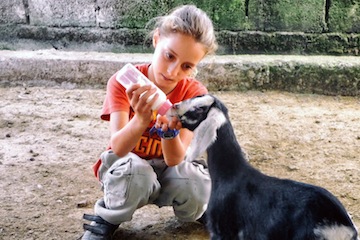
Funds from the Jewish National Fund of Canada’s Negev Gala will support an animal-assisted therapy centre in the city of Sderot. (photo from hanof.kkl.org.il)
In addition to comedian Gold (see story, jewishindependent.ca/jnf-gala-features-comic-gold), the evening featured a few speakers, including Sanford Cohen paying tribute to the philanthropic work of honourary event chairs Bob Markin and Ralph Markin at a gala dinner before the main program, and JNF Pacific Region president Bernice Carmeli offering remarks at the dinner and during the program. Schara Tzedeck’s Rabbi Andrew Rosenblatt spoke about humour in Jewish theology. Actor and writer Josh Epstein emceed. Shannon Gorski chaired the event and Shirley Hirsch was convenor. Ilan Pilo, Jerusalem emissary and executive director of JNF Pacific Region, recognized past president David Goldman.
Funds from the event will support an animal-assisted therapy centre in the city of Sderot, where children and adults live with post-traumatic stress disorder due to years of rocket and mortar attacks from nearby Gaza. The project was described to the audience by Lance Davis, chief executive director of Jewish National Fund of Canada.
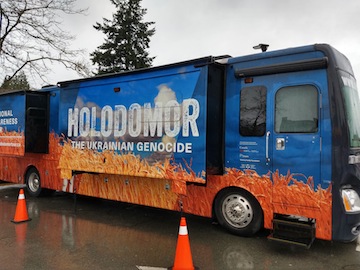
A project of the Canada-Ukraine Foundation, the national educational tour about the Holodomor began in 2015 and has reached about 30,000 Canadian high school students so far. (photo by Pat Johnson)
What constitutes a genocide? How many Ukrainians were murdered by Josef Stalin’s human-created famine in the 1930s? Would you stand up in a situation where lives were at risk – even if it meant you might become targeted?
These were some of the questions confronted by Grade 12 students of King David High School last week. A national educational tour about the Holodomor – the mass murder of Ukrainians by the Soviet regime – pulled into Vancouver, opening the eyes of young people to this chapter of history.
Beginning in 1932, the Soviet government under Stalin began a calculated, systematic famine in Ukraine, seizing all food sources, cutting off escapes for people fleeing starvation and implementing summary execution for the crime of stealing the smallest piece of sustenance. Farming was collectivized, creating catastrophic conditions. Political and intellectual elites were murdered.
Some details, including the number of Ukrainians killed, remain cloaked in uncertainty because, from the start, the Holodomor was deliberately hidden from the outside world through a comprehensive system of censorship and misinformation, as well as the complicity of media and other countries. Estimates of the number of dead range from seven million to 14 million.
Holodomor is a portmanteau made up of holod, starvation, and mor, death, meaning “death by starvation.”
Last week, King David High School Grade 12 students and others participated in the educational tour. (photo by Pat Johnson)
The Holodomor National Awareness Tour consists of a bus-sized repurposed former recreational vehicle. Rather than a static exhibition through which participants walk, the vehicle has been retrofitted with a 30-foot screen down one interior wall and 30 theatre-style seats down the other, with interactive tablets that invite students to study and discuss in small groups before reconvening to share what they’ve learned with the larger group. A project of the Canada-Ukraine Foundation, the tour began in 2015 and has reached about 30,000 Canadian high school students so far.
The Holodomor was not an endeavour to kill an enemy, but an effort to restructure society, a form of social engineering at its most extreme. In September 1932, Stalin wrote to one of his lieutenants that Ukraine was restive. The Soviets perceived Ukrainians as being profoundly religious, individualistic, believers in private property and attached to their plots of land, making them unsuitable for building communism. Addressing these perceived flaws would require, according to Soviet leaders, an action so extreme that a word had not yet been invented to describe the intent.
The entire agricultural sector was upended by collectivization and resisters were murdered or sent to gulags, Soviet concentration camps. At first, remaining supplies of food sustained the Ukrainian people, but those reserves were soon depleted, while the Soviets extracted ever-increasing quotas of grain and Soviet wheat exports to the West grew. As the Holodomor proceeded, NKVD secret police were sent to search for and confiscate any remaining food sources. While those caught stealing or concealing food were executed, for millions more, fate was less sudden.
“Most of the victims died slowly, at home,” according to the narrator of one of the interactive films viewed by students. “Special NKVD units raided people’s homes to collect the dead bodies. They received 200 grams of bread for every dead body they delivered.”
Students examined the forces that allowed the Soviet Union to hide the reality from the world. For the Soviets’ part, there was censorship and the threat of retaliation for those who shared the truth. But their crimes were abetted by Western figures, including New York Times correspondent Walter Durante, who won a Pulitzer Prize for his reporting from the USSR, even as he misrepresented the Holodomor. In one article, titled “Hungry, not starving,” Durante wrote that there is no actual starvation or death from starvation, though he acknowledged there was widespread mortality from diseases due to malnutrition.
Leading journalism figures from the time are brought to life through reenactments. British journalist Malcolm Muggeridge, reporting for the Manchester Guardian, reflected on being raised in a socialist household and how he was enthusiastic about traveling to the Soviet Union to report on the utopia being created there. When he saw the reality, he evaded Soviet censors by sending his dispatches home via the British embassy’s consular pouch.
One of the heroic figures of the story is Gareth Jones, a Welsh journalist who risked his life to bring the truth from Ukraine. He convened a press conference in Berlin, on March 29, 1933. But the timing was terrible. The Soviets were about to launch a show trial against six U.K. citizens, accusing them of espionage in what would become known as the Metro-Vickers Affair.
In order to remain in the USSR and report on what promised to be a trial of global importance, journalists had to stay on good terms with the authorities.
“It would have been professional suicide to make an issue of the famine then,” one reenactor remarked. “So, none of us supported Jones.”
Lauren Shore is a student in King David’s Holocaust and Genocide Studies 12 course. The class, created by teacher Anna-Mae Wiesenthal, is delivered during lunch hour and, while students receive credit, they take the course in addition to their full complement of other classes. A province-wide genocide studies elective course is part of the new B.C. curriculum and will be offered next year at schools that opt-in.
Shore, with a partner, did a project on the Holodomor.
“Since there is a lot of debate on whether it’s a genocide or not, and how it was planned, we decided to focus on that,” she said. “We were focusing on the different steps of genocide [and] people were debating whether it was a genocide or not, since it wasn’t necessarily planned as exactly as other genocides were. As we looked into it, we found that it was planned just as much as the other genocides, just in other, more subtle ways.”
Solly Khalifa, also in Grade 12, was impressed with the interactivity of the Holodomor tour.
“I was astonished at how innovative it is,” he said. “They really get everybody participating and it’s very interesting and an easy way to participate also.”
Classmate Noah McNamara saw parallels between the Holodomor and the Holocaust.
“All genocides are kind of similar, in that it’s a governing body that takes advantage of their power to push a goal,” he said. “In the Holocaust, [it was] the Aryan race that they wanted to push. In this case, it was communism that they wanted to push. I think it’s important for us now to be aware of aggressive governments and governments that are trying to radically push things, because that’s definitely a precursor to genocide.”
Ava Katz, who worked with Shore on their Holodomor project this year, noted that studies of the Holocaust enforce the dictum “never again.”
“But I feel like sometimes that’s overlooked with other genocides,” she said. “Not a lot of people will say that. But when you really study other genocides in-depth and see how severe they are, it’s important that we never let any of them happen again.”
The cross-country tour operates with a shoestring staff. Alexi Marchel leads students though the experience. Kevin Viaene drives the bus and supports the program.
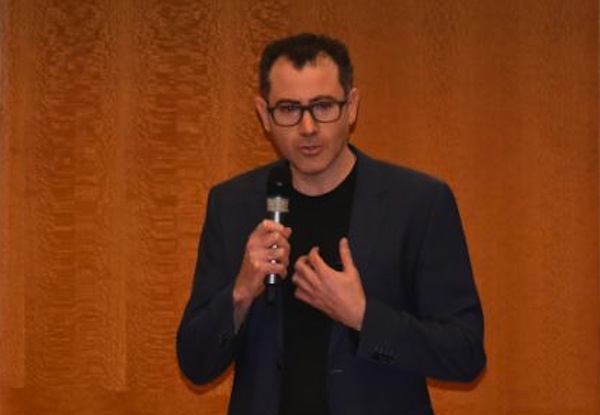
Elan Divon speaks at King David High School earlier this month. (photo from KDHS)
Elan Divon has found his passion and purpose in life – helping people to find their passion and to confidently fulfil a purpose that not only builds their own positive energy but also lets that energy spill out to improve the world in both small and potentially large ways.
On April 8, King David High School’s PAC hosted an evening that featured Divon, founder and chief executive officer of the Divon Academy, which, according to its website, “help[s] students and professionals stand out, and develop skills that are proven to boost their long-term success and well-being.”
He began by sharing the story of avoiding a deadly suicide bombing by sheer coincidence. Twenty years old, a soldier in the Israeli army, he had just returned home and was on a date at a café. The woman wanted ice cream instead, so they left; moments later, they heard three bombs go off, many people were killed, hundreds were injured, in the area they had just been. The experience jolted Divon onto a path of self-reflection and a search for spiritual meaning.
He went to study abroad, later quitting a Wall Street job and then studying archeology and anthropology at Brandeis University, followed by comparative religion at Harvard University.
“Since then,” reads his bio, he “has directed a peace camp for embattled Israeli and Palestinian teens; delivered countless personal development workshops to young professionals around the world, frequently presents before CEOs and business leaders; and, most recently, co-founded the Einstein Legacy Project to inspire the next generation of brilliant minds on the planet.”
Divon explained to the audience at KDHS that he feels he has found his purpose and can, therefore, live his purpose and make every moment count. He wants others to be able to do the same. He spoke about what he called a “stress epidemic” and identified five key aspects that inhibit personal growth and cause poor performance for students and adults alike.
The first factor is how much technology has invaded our ways of behaving and thinking. “Because of technology, people feel that everything needs to happen instantly,” he explained. With smartphones and constant access to the internet and apps, people find the answers they are looking for without really having to search, and they communicate with others without really having to interact.
“Our outer reality works very quickly but our inner reality takes time to develop,” he said about why this causes stress. Using the example of gestation, Divon explained how certain biological functions cannot be rushed – by technology or just because we shower them with attention. It takes time and experiences – both positive and negative – to build the necessary skills for human interaction and resilience, to be a well-rounded and confident person, he said.
The culture of comparison that dominates the internet is the second challenge. Before the advent of the internet, said Divon, a person might compare themselves to their sibling, a neighbour or the most impressive student at school. Today, we see carefully crafted virtual personae online from all over the world, and use those as a totally unrealistic benchmark for self-comparison, he said.
Next, Divon focused on the benefits that can be gained from discomfort. “Parents need to give their children space to solve their problems themselves,” he said, noting that, currently, teens can avoid uncomfortable situations by hiding behind their over-involved parents or their phones.
Social isolation – Divon’s fourth area of concern – can result from living a virtual life. Without direct personal contact, he said, people suffer all kinds of stress. Age-old ways of coping with painful situations or celebrating happy moments are eliminated by text communication. “Studies show that when good news is shared via text, it’s like it didn’t happen, even when the recipient of the text responds. Only through personal contact do people feel supported and connected,” explained Divon.
Finally, he said that overstimulation is damaging everyone. “We are drowning in information but starving for wisdom,” he said.
Divon outlined three ways to enhance happiness and purpose in life.
First, we need to have a proactive rather than a reactive mindset, he said. Using the establishment of the state of Israel as an example, Divon explained how the nascent state was able to turn a rocky beginning into a success. Rather than focus on the paucity of resources and abundance of hostile neighbours, those who established the modern state of Israel were optimistic and counted their blessings. “Being a victor over circumstances rather than a victim of circumstances is what sets people with a positive mindset apart from those with a negative one,” said Divon.
A positive mindset helps build the second key factor: relationships. A strong – real, not virtual – support group is a protection from stress, it helps most people find their jobs and determines and gives meaning to life, said Divon.
The third component to finding contentment and productivity is stress management. “Stress is resisting what is in a present moment,” Divon said. If stress is resistance and 95% of stress occurs in the mind, it is possible to eliminate or manage most of the stress we perceive in our lives, he explained. While the steps needed to manage stress are not easy, Divon said that, with practise, step-by-step, people of all ages can change their habits and develop more effective ways of coping.
Neuroplasticity is the ability of the brain to adapt and change. Divon explained that, although there are many stressors and that technology is often our foe instead of our friend, we can all develop new pathways in our brain. We can enhance the quality of energy we possess and make ourselves and those around us happier.
Michelle Dodekis a freelance writer living in Vancouver, and the mother of a 12- and a 13-year-old.
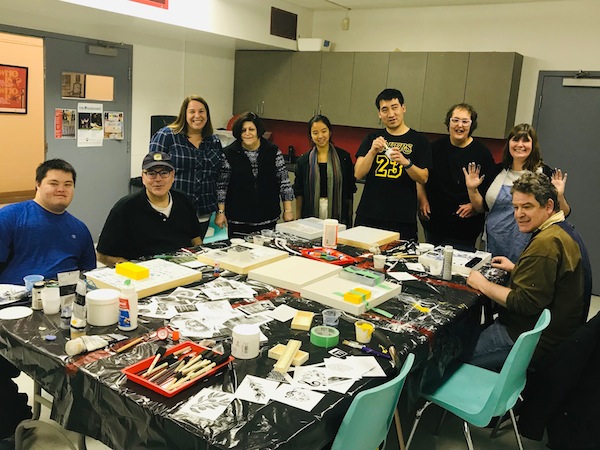
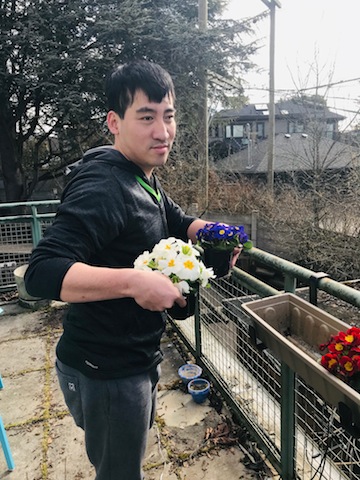
Xianzhi (Paul) Chen, in the Lakers T-shirt, not only led programming at the Jewish Community Centre of Greater Vancouver, but participated in it. (photo from JCC)
Xianzhi (Paul) Chen came to Canada from China in 2011 with his family. He loves outdoor sports, especially basketball, and has always been community-oriented, including providing care for Chinese seniors at a nursing home. But how did he find his way to the Jewish Community Centre of Greater Vancouver?
Paul is pursuing a recreation and leadership diploma at Langara College. Last year, he approached six organizations for an internship, to apply the training and skills of this program to a real-world environment, but was turned away by all the organizations he approached. When he initially interviewed for a position at the JCC with Lisa Cohen Quay, Adult 55+ program coordinator, she also said no. However, the issue was not whether he could do the work required, but rather that the requirements and expectations of the Langara internship were too much for her department to oversee.
Paul is blind in one eye and has limited vision in the other. He requires accommodations. But accommodations were not the issue either. Lisa’s mom lives with extremely low vision. She knew that, with slight adjustments to the work environment and access to a CCTV machine and specialized software like ZoomText, Paul would be able to meet and even exceed expectations. His disability, as so often is the case, was not the barrier.
Fortunately for the JCC, Paul would not take no for an answer. Without an internship, he would have had to delay the completion of his education. So, he wrote Lisa after that first meeting and asked her for a chance to show his skills. Paul – bright, friendly and tenacious – left a powerful impression. Lisa could not stop thinking about his abilities and the challenges he had faced. Determined to provide him with a meaningful and useful internship, she reached out to me, the coordinator of the JCC’s inclusion department, to see if we could create one between our two departments.
We did just that, agreeing to co-supervise Paul’s internship. We decided to provide him with program planning experience and program support experience, while also allowing him to actively participate in some of the JCC’s inclusion programming. Lisa then reached out to the Langara internship coordinator to negotiate a modified internship for Paul. The school agreed to Paul interning between the two departments at a reduced load over a longer, five-month period.
Paul was very nervous at first. He did not know how to set up for events like mah jongg, poker or bridge, how to manage a budget or how to plan programs. But, he took instruction well, was eager to learn and did his best. He demonstrated care in all his interactions with community members and poured his heart into every project in which he participated.
“I oversaw Dumpling Night at the Community Kitchen to share the Chinese New Year with community members,” said Paul by way of an example of how he incorporated his previous experience into his internship at the JCC, and learned more about leading programming.
“I oversaw all aspects of a balcony beautification project, including [doing] the budget by myself,” he added. “I learned how to use my hands to make art during the Art Hive program.”
Paul Chen (photo from JCC)
Paul tried many new activities during his internship and, as a result, made a lot of friends. He learned quickly that friendships are forged through recreation.
Paul said the highlights of his internship were “making three excellent art pieces,” the beautification project and the “terrific relationships with people that I met in this community.”
“Paul has demonstrated a passion for community development through his internship at the JCC, with a focus on diversity and inclusion,” said Erin Wilkins, department chair, recreation studies, at Langara College. “He has also demonstrated how to provide engaging recreation experiences that support diverse community members and build resilience through empowerment.”
She said the department is “so proud of Paul’s accomplishments at the JCC, and thankful for the support he received throughout his internship, which is the final semester of the recreation leadership diploma.”
The JCC is proud to have been part of Paul’s training and professional development. We are happy to have provided him with a meaningful and diverse introduction to recreational programming, to community building and to leadership development. We are equally grateful for what he has given back to our community and us as professionals, and hope that he will continue to participate in our community and lead programming in the future.
Access to opportunity, we are reminded, requires adjustments and flexibility and is always worth the effort.
Leamore Cohenis inclusion services coordinator at the Jewish Community Centre of Greater Vancouver.
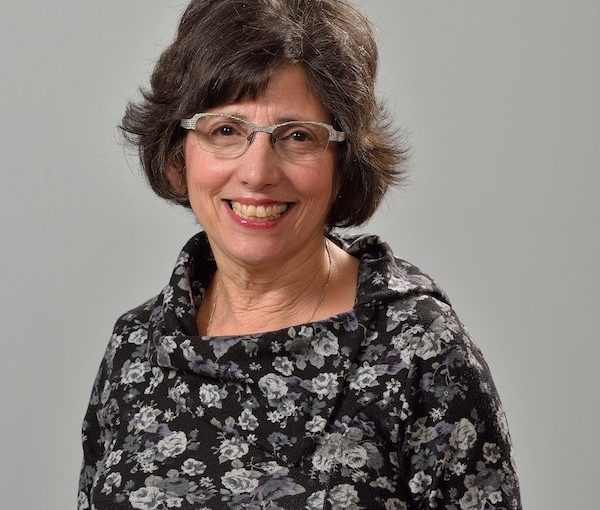
Dr. Cheryl Rockman-Greenberg (photo from Rockman-Greenberg)
In the 1970s, when Dr. Cheryl Rockman-Greenberg was eyeing the budding field of genetics as a career, she had to become a pediatric doctor first. Now, Rockman-Greenberg counts her clinical background as a blessing, one that, today, geneticists no longer require.
“Having a strong background in clinical medicine certainly always helped me in my career, because the kind of genetics I was always interested in was in rare metabolic diseases,” said Rockman-Greenberg. “These are diseases often caused by enzyme deficiencies that go by very elaborate names. Having a good foundation in clinical medicine through pediatrics certainly helped me.”
Rockman-Greenberg, who lives in Winnipeg, was invited to speak at the city’s Congregation Shaarey Zedek Sisterhood Interfaith Luncheon on April 30.
“I learned that the luncheon was spearheaded through the sisterhood in many ways to promote information sharing between the faiths,” she said, noting that a purpose of the event is education and “to look at how we can build bridges between people of different faiths and not build walls.”
“From a global perspective,” she said, “I think it fits the themes of the interfaith luncheon. And, from a Jewish perspective, I’ve certainly been involved over the years, particularly with the National Council of Jewish Women, of increasing awareness of the importance of genes for health, and bringing together some of the advocacy groups in rare genetic disorders.
“I helped the National Council put out a brochure on carrier testing on new genetic disorders in the Ashkenazi Jewish population that has been extremely well-received worldwide. This information is always evolving.”
At the luncheon, Rockman-Greenberg was planning to discuss, among other things, Bill S-201, also known as the Genetic Non-Discrimination Act, which passed into law in Canada in 2017, though it is still being challenged by insurance companies in Quebec.
“This is a remarkable act in the sense that it does protect Canadians from the use of genetic test results outside of medical care and medical research,” Rockman-Greenberg told the Independent. “In other words, genetic test results do not have to be disclosed to insurance companies or employers. We’re one of many countries who have such legislation in place, and many people here have worked for years and years lobbying for similar legislation for Canada.”
Methods of genetic testing continue to advance, said Rockman-Greenberg. Tests that were nonexistent or very complicated to administer as recently as two decades ago can now be done quickly and inexpensively.
“The evolution has dramatically changed over the past 10 years, particularly in the sense that the techniques we use to diagnose genetic disease have dramatically changed – from studying one gene at a time, to being able to sequence the entire genome of an individual,” she explained.
When Rockman-Greenberg refers to “new genetics,” she is referring to the ability to offer state-of-the-art, revolutionary genetic testing that was not possible just 10 years ago. It is this access that Rockman-Greenberg is lobbying for now.
“Everybody doesn’t have the same access to the testing in Canada,” she said. “It’s certainly not uniform from province to province or within provinces. So, many people are very committed to ensuring there are strategies in place to promote fairness.
“Notwithstanding that, the legislation is going to protect people against disclosing information that is already in place. I think we are ahead of the game because we have this in place. But, we are not ahead of the game in making sure people are going to have access to new diagnostic testing and new therapeutics in a way that’s going to be equal across the board.”
Rockman-Greenberg’s focus on rare metabolic diseases means that she has witnessed firsthand the struggles to get specialty drugs approved through a system focused on the big diseases, such as diabetes and cancer.
“You may get a new drug for diabetes that will be approved and available for patients very quickly, whereas some of the new drugs for other diseases I treat can take years and years before they go through the approval process,” she said.
Rockman-Greenberg thought that the topic was an appropriate one for an interfaith gathering, “as everybody having the same chance to be successful is very important to me. I work with families and patient support groups to help remove barriers and help people feel empowered.”
She said, “There are many challenges in dealing with rare diseases and I try to work both sides: the patient side, as well as advocate for changes at the government level, to make sure there is fairness in access to new therapies.”
Silver trophy winner Levi Bitton, 11, and medal winner Mendel Bitton, 14, with their father, Rabbi Binyomin Bitton, director of Chabad of Downtown Vancouver, at the International Chidon Sefer Hamitzvos. (photo from Chabad of Downtown)
Seven months of diligent study came full circle April 7 for Mendel and Levi Bitton of Vancouver and more than 1,200 of their peers at the final round of the annual International Chidon Sefer Hamitzvos in Brooklyn, N.Y. Of close to 10,000 children from more than 150 schools worldwide who participated in this year’s competition, Mendel and Levi earned two of the highest scores on three rigorous exams, qualifying them for a trip to Brooklyn to participate in the final tournament. Also earlier this month, more than 1,400 girls participated in their own similar showdown.
The Lubavitcher Rebbe, Rabbi Menachem M. Schneerson, OBM, encouraged children to thoroughly study all of the Torah’s 613 commandments as enumerated and elucidated by Maimonides in his Sefer Hamitzvot. His followers have taken to his words, hosting an annual chidon (contest) that challenges children to study large volumes of detailed texts delving into the intricacies of each mitzvah, and compete for trophies, medals and prizes.
Organized by Merkos L’Inyonei Chinuch, the educational arm of the Chabad-Lubavitch movement, together with Tzivos Hashem, its children’s division, the Chidon Sefer Hamitzvos sees thousands of children ages 9-13 staying late at their respective schools to study the mitzvot with their classmates and friends. As finalists, Mendel and Levi flew to New York, where they enjoyed four days of trips and competitive games that tested their knowledge, and concluded with a grand on-stage tournament and award ceremony.
In the final moments, the tension rose and the crowd went silent as the emcee opened the long-awaited envelopes and announced the trophy winners and champions of the final exam.
We are proud to report that Levi earned a silver trophy. We are also proud to report that Mendel was among 15 boys, from grades 4 to 8, who completed the entire Chidon curriculum. Mendel earned a medal celebrating his commitment and all those months of hard work.
Mazal tov to Levi, Mendel and all of the competitors!
For more information on the contest, visit chidon613.com.
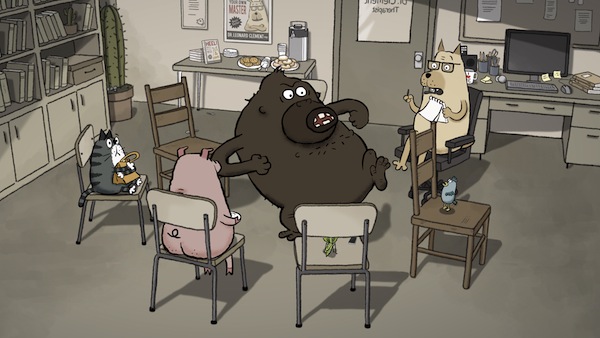
A scene from Alison Snowden and David Fine’s Animal Behaviour: Victor acts out. (image from National Film Board of Canada)
Alison Snowden and David Fine’s National Film Board animated short Animal Behaviour won for best animated short at the Canadian Screen Awards March 31.
The film also was an Academy Award nominee this year. It is the fourth Oscar nomination for the Vancouver-based husband-and-wife animation duo, who took home the Oscar 24 years ago for the NFB-Snowden Fine Animation-Channel 4 co-production Bob’s Birthday. They were also nominated for their 1987 NFB short George and Rosemary, with Snowden nominated before that for her 1984 student film Second Class Mail.
Animal Behaviour takes viewers inside a group therapy session for animals who grapple with issues not unlike our own. (See jewishindependent.ca/animated-therapy-session.) Produced and executive produced by Michael Fukushima for the NFB’s Animation Studio in Montreal, Animal Behaviour is the 75th Academy Award nomination for the NFB – more than any other film organization based outside of Hollywood. The NFB has received 12 Oscars over its 79-year history, including a 1989 Honourary Academy Award for overall excellence in cinema.
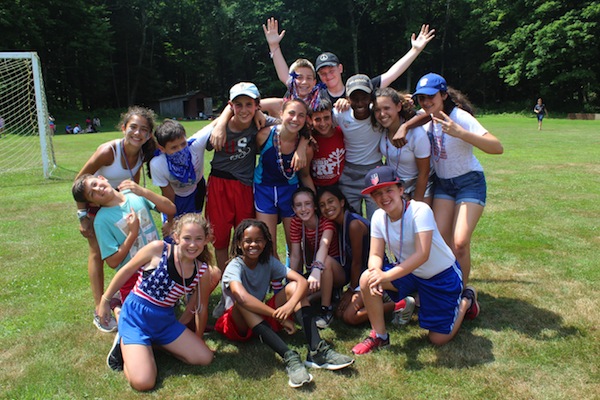
Campers at Pennsylvania’s Camp Havaya. (photo from Camp Havaya)
In Pirkei Avot (Ethics of Our Fathers), Ben Zoma says, “Who is honourable? One who honours others.” The Foundation for Jewish Camp’s Shmira Initiative “aims to make camps safe, healthy and respectful model communities. Shmira, in Hebrew and in the vernacular of Jewish summer camp, means guard duty, embodying the social and individual responsibility every community member has to ensure a safe environment.”
For some camps, the initiative provides practical training that has been needed for some time. But, at Camp Havaya in Pennsylvania, camp director Sheira Director-Nowack told the Independent that they have been operating on the initiative’s principles for many years.
“We have people who go by ‘he,’ by ‘she’ and by ‘they,’ as rabbis, teachers, students, educators, campers and staff,” said Director-Nowack of the camp, which is part of the Reconstructionist movement. “So, for us, the sexual harassment piece is something we’ve always discussed, have always had a policy for. I used to work at a camp that did not have that defined as clearly and they had some real challenges. We don’t have some of those challenges here, because it’s very up front and very clear – how you treat all people, not just insofar as gender, but in all areas of inclusion.”
At Camp Havaya, respect is constantly discussed.
“The name of our camp mascot is Howie Bee,” said Director-Nowack. “We talk about ‘how we be,’ using that as a fairly common statement to talk about how we should treat each other with respect, kindness … better than you’d want to treat yourself, you’d want to treat the other person … and, not just as a Jewish phenomena, but as a human phenomena.”
While Director-Nowack acknowledged that, every so often, they run into power conflicts in a relationship, they try to ensure it never gets near the point of harassment.
At Camp Havaya, she said, flirtation is discouraged. For example, there are strict rules as to what clothing is acceptable. Everyone must wear shirts at all times and clothing should be loose fitting. They also have no boys against girls competitions. Instead, all sports are open to everyone and, while everyone swims together, there are rules about appropriate swimwear.
Language and attitude is another area that is closely monitored at the camp. “We don’t use the word ‘broad’ or ‘chick,’ we don’t use a lot of derogatory terms,” said Director-Nowack. “We don’t make jokes at other people’s expense.
“We want everyone to treat each other how they would treat their own family or themselves…. There’s not a constant need for romance or underlying things that go into that modern love thought and, because of that, we don’t see certain behaviours that other places might see.”
The concepts of the #MeToo movement are discussed at camp, as are other relevant topics, like Black Lives Matter and the Israeli-Palestinian conflict.
“Our constituency is made up of people who are interested in these things … also, things like respect for people with special needs, inclusivity, race, culture and minorities,” said Director-Nowack. “We don’t talk about these things because they’re hot topics. We were talking about them before they were considered cool to talk about.
“We also give the credit to younger people, because it is them who are changing the verbiage, changing ideas. They are bringing them to us and we are bringing them to camp, because, if camp is a microcosm of society, then we want to be part of that.”
If and when the topic of sex comes up, Director-Nowack said she teaches her staff to turn the conversation back to the camper and ask why he or she is wondering about it.
Camp Havaya has a no-sex policy. If inappropriate behaviour is observed, Director-Nowack said, ‘We don’t punish people for behaviour, but I may or may not ask them if camp is the appropriate place for it. I don’t feel like there’s any place at camp where you could be sexual appropriately, and that’s what we talk about.
“We don’t hook up in the middle of the woods – that’s just not what we do. And, we really don’t have a lot of that. I don’t think I’d kick someone out of camp just because they kissed someone. But, I’d say something like, ‘I just walked passed you kissing … not what I want to see, not OK, not cool.’ If it got further than that, it would depend on the kid, the parent, the discussion and the situation. We’re dealing with human beings and we have an environment that’s not constant.”
Still, staff members do talk with campers about consent, in an effort to ensure all of them are comfortable in their own space at all times.
“Our goal is to create young leaders in the Jewish community who are thoughtful and intelligent, and who are, therefore, going to go out and lead a Jewish life and know themselves,” said Director-Nowack. “We love that some people find their love and their relationships at camp. But, I also love that people find their independence at camp … or that they want to lead a more productive Jewish life without a partner…. We want our kids and staff to leave camp as people who are going to make decisions guided by some basic values.”