Israeli Prime Minister Binyamin Netanyahu places a wreath at Yad Vashem on Yom Hashoah. (photo from IGPO via Ashernet)
(photo from IGPO via Ashernet)
On Yom Hashoah, Israel comes to a virtual standstill at 11 a.m., for two minutes, as sirens wail across the country – everyone stops what they are doing and stands at attention, in respect to the memory of the six million Jews who were murdered in the Holocaust.
ממשלת קנדה מתכוננת במלוא המרץ לבחירות הכלליות שייערכו בחודש אוקטובר הקרוב. הממשלה מעוניינת למנוע מעורבות חיצונית כפי שקרתה במערכת הבחירות האחרונות בארה”ב. הממשלה בוחנת את האפשרויות שונות בהן: חקיקה חדשה שתחזק את הפיקוח על הרשתות החברתיות המובילות.
הממשלה הקנדית צופה שקרוב לוודאי יהיה ניסיון של התערבות חיצונית בבחירות הפדרליות שייערכו באוקטובר. ולכן היא שוקלת להגביר את הרגולציה כדי לפקח משמעותית על חברות הרשתות החברתיות. זאת כדי להבטיח חסימה עד כמה שאפשר של התערבות גורמים זרים שמחוץ למדינה, בהליך הצבעה. כך מסרה לאחרונה השרה אחראית על טוהר הבחירות של קנדה, קרינה גולד.
השרה גולד אמרה את הדברים לאחר פרסום דוח מיוחד של סוכנויות ביטחון הקנדיות השונות על פעילות של מדינות אחרות, ברשתות אינטרנט, כדי להתערב בהליך הבחירות במדינה. “להערכתנו יש סיכוי גבוה שהמצביע הקנדי ייתקל במעורבות של גורמים זרים שונים ברשתות האינטרנט, בהקשר של הבחירות הפדרליות באוקטובר השנה”, כך נכתב בדוח של סוכנויות הביטחון. “עם זאת המעורבות בבחירות כאן צפויה להיות בהיקף קטן יותר, לעומת המעורבות הרוסית בבחירות לנשיאות בארצות הברית לפני כשנתיים וחצי”. אגב הדוח לא ציין מי הן המדינות שעשויות לנסות ולהתערב בבחירות של קנדה.
השרה גולד ציינה במסיבת עיתונאים שקיימה באוטווה הבירה: “הבחירות בקנדה הן מטרה לאלו שמעוניינים לערער את יסודות הדמוקרטיה שלנו”. גולד יצאה בדברי ביקורת ישירים נגד ענקי התקשורת השולטים במדיה החברתית: גוגל, טוויטר ופייסבוק. וזאת על כך שהם לא מספקים מידע לממשלת קנדה, כפי שהם סיפקו לממשלות אירופה השונות בחודשים הארונים, על מאמציהם לעצור התערבות זרה בבחירות. “אין לנו שום התקדמות עם גוגל, טוויטר ופייסבוק בנושא זה. החברות מסרבות לעדכן באופן סדיר את הרגולטורים בקנדה, על הפעילות שלהן למניעת התערבות זרה בבחירות הקרובות. שיהיה ברור: החברות צריכות לקחת את הנושא ביותר רצינות”, הוסיפה עוד השרה גולד.
ראש מחלקת המדיניות הציבורית של פייסבוק בקנדה, קווין צ’אם, אמר לאמצעי תקשורת המקומית את הדברים הבאים: “פייסבוק מתכננת להציג חוקים חדשים עבור פרסומות פוליטיות בתשלום”. הוא הדגיש כי פייסבוק עושה כל מאמץ לחסום התערבות זרה בבחירות הקרובות בקנדה. ראש מחלקת המדיניות הממשלתית של גוגל בקנדה, קולין מקיי, אמר את הדברים הבאים: “נציגי גוגל מיוזמתם נפגשו כבר מספר פעמים עם מספר רשויות ממשלתיות כדי לדון בשקיפות, אבטחת מידע וכן אבטחת סייבר”.
השרה גולד מסרה עוד כי ממשלת קנדה בוחנת כיום את שלל החוקים שלה כדי לראות כיצד ניתן להשתמש בהם, כדי לנקוט בכל האמצעים נגד חברות הרשתות החברתיות, כדי למנוע התערבות זרה בבחירות כאן. הממשלה שוקלת אף להתקין חקיקה חדשה בנושא. בנוסף קנדה בוחנת את הצעדים שנוקטות מדינות אחרות בעולם כלפי הרשתות החברתיות. למשל בריטניה שהכריזה על הקמת גוף רגולטורי טשר מפקח על הרשתות החברתיות. ואילו אוסטרליה עומת זאת שינתה את החוקים במדינה כך שבין היתר, מנהלים של רשתות חברתיות עשויים להישלח לכלא, אם הם לא יסירו תוכן אלים מהרשתות החברתיות עליהם הם אחראים.
לסיכום הנושא אמרה השרה הקנדית גולד: “הרשתות החברתיות הצליחו עד כה להימנע מלשאת באחריות לגבי מה שמתרחש בפלטפורמות שלהם. זאת כידוע כבר זמן רב מדי. הממשלה הליברלית הקנדית החליטה כעת לשנות את הגישה כלפי חברות הרשתות החברתיות. בעבר חזרנו אחריהן ומשכנו אותן לכאן כדי לפתוח מרכזי הנדסה ומסחר, ובייחוד בתחום הבינה המלאכותית”.
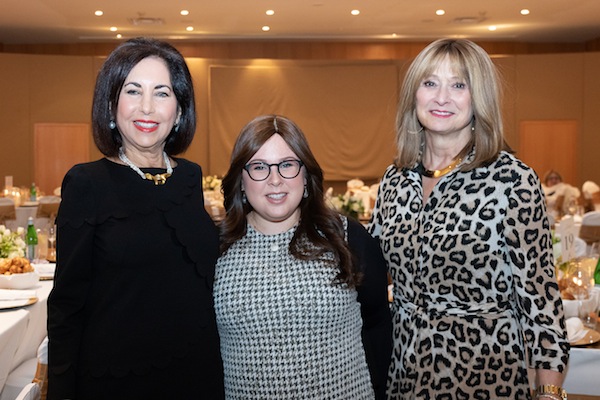
Left to right are gala honouree Anita Silber, Shalhevet Girls High School head of school Meira Federgrun and Shalhevet board president Vivian Claman. (Jocelyne Hallé Photography)
On April 7, Shalhevet Girls High School honoured Anita Silber with the Guardian of the Flame Award.
Vivian Claman, president of the Shalhevet board of directors, described Silber as someone “whose default is set to ‘giving.’”
“Anita leads by example, showing what it means to be charitable,” Claman told the Independent. “She is a woman devoted to her community and to her family.”
Having learned the importance of philanthropy from her father at a young age, Silber said, “It left a deep impression on me.”
When asked what she values most, she said, “Jewish education and philanthropy.” And, as a former educator herself, she said she recognizes the excellent quality of education the girls receive at Shalhevet.
“The amount of attention the students get and the mentoring they receive from their principal and teachers will serve them well in the future,” said Silber, who has followed some of the Shalhevet graduates and their careers and community involvement. “It’s so important to have options like Shalhevet Girls High School in order for our [Jewish] community to flourish and remain sustainable,” she said.
Silber’s background includes a variety of careers and leadership roles: elementary school teacher; marriage, family and child therapist; clinical art therapist; member of the Jewish Federation of Greater Vancouver Israel overseas allocations committee; and member of the Vancouver Jewish Community Foundation board of governors, to name just a few.
In the 1990s, Silber led support groups for people with HIV/AIDS and other life-threatening illnesses. She also led children-of-divorce groups at the Jewish Community Centre of Greater Vancouver for Jewish Family Services. With the Silber Family Foundation, she helped establish an art therapy program at Ronald McDonald House.
Silber’s passion for Israel began just a few weeks after the Six Day War, in 1967, when she visited Israel for the first time, at age 22. While there, she volunteered at a hospital and fell in love with the country. Fast forward several decades and Silber, along with her husband Arnold, support numerous projects in Israel’s Upper Galilee, particularly the Friends of Beit Vancouver fundraising initiative in Kiryat Shmona.
“Beit Vancouver, which opened in 2006, is an amazing centre for at-risk kids and teens from the periphery, who go there after school for all kinds of programs, including educational and music programs, computer training and more,” explained Silber. “The centre also serves kids with disabilities, and offers family counseling and therapy.”
With her high regard for Jewish education, Silber was a fitting choice for Shalhevet’s Guardian of the Flame Award. The school, in existence for 13 years, was originally an extension of Vancouver Hebrew Academy, and then struck out on its own as Shalhevet in 2007. It is the only Orthodox girls high school in Vancouver.
According to Meira Federgrun, head of school, fundamental to the Shalhevet philosophy is “empathy and chesed – feeling for others, and seeking to understand them and their needs.”
Federgrun said Shalhevet’s teachers “instil in our students a passion for leadership, inspiring them to step up and take responsibility. Students are involved in planning and running school programs, Shabbatons, and extracurricular activities.” The teachers have created a real sense of community for the girls, both in and out of school, she said.
According to Claman, “When the girls are all together, they’re like a gigantic family.”
Shalhevet’s enrolment is not large – only 14 girls in grades 8 through 12 this year – yet they offer a full dual curriculum of Judaics and secular studies. Federgrun said it’s a small school, “but we pack a big punch.” The teacher-student ratio and small class size (one to four students) allow for personalized attention and learning.
Shalhevet has also offered some AP (advanced placement) and online classes.
“We definitely cater the curriculum to what the girls want to do. If we have a girl who wants a specific course, we’ll make sure to offer it for her,” said Federgrun. “We’ll also help out any special needs students by collaborating with the family, staff and any service providers to create an IEP (individualized education plan) for each student. That IEP guides our teaching and goal-setting for that student, and it’s reviewed often and adjusted as needed.”
Shalhevet offers a variety of extracurricular programming, including a basketball team, an annual play produced by the girls, holiday events and a student committee. Shalhevet accepts girls from a range of Orthodox Jewish backgrounds, complemented by a staff of teachers that includes secular educators.
Shalhevet graduates have gone on to study at top-notch universities, securing careers in areas such as medicine, speech language pathology, social work and law. Many Shalhevet graduates also have gone on to study in seminary.
“We teach our girls to look beyond themselves and to see others for who they really are on the inside, without fear, and with open hearts. This commitment extends beyond the walls of the classroom and the school. Shalhevet is known for our students’ commitment to volunteering and helping in the community,” said Federgrun in her gala speech. “The students volunteer, tutoring secular Jewish public school students in Hebrew reading, Jewish holidays and Torah knowledge once a week, which is a powerful way for the girls to play a role in the broader, non-religious community. The girls also volunteer at the Louis Brier Home, spending time with seniors, visiting the sick in hospital, and more.”
Shalhevet girls learn solid Torah values, continued Federgrun. “Our Judaics teachers are inspiring role models of devotion to Yiddishkeit, and they engage our students’ minds, hearts and souls through Torah study,” she said.
Claman emphasized that Shalhevet is important for the community, providing religious Jews a place to send their daughters for an Orthodox Jewish education that incorporates a secular education. “There was a big gap in the community because there was no Orthodox girls high school until Shalhevet,” said Claman. With concerns about the Pacific Torah Institute boys high school closing, Shalhevet wants the community to know that they are a strong, thriving school.
Asked what she is most proud of about Shalhevet, Federgrun said, “The warm environment, the girls giving back to our community, strong academics, and the students learning leadership skills.”
She added that many of their students go on to accomplish tremendous things. “We believe in offering a well-rounded education,” she said. “It’s very important to send girls out into the world today, and they need to be prepared.”
Claman said she’s most proud of what the girls do for the community.
More than 200 people attended the soldout Shalhevet gala honouring Silber, which was held at Schara Tzedeck and included entertainment by comedian Ashley Baker. Most of the money raised will go towards student scholarships.
Shelley Civkinis a happily retired librarian and communications officer. For 17 years, she wrote a weekly book review column for the Richmond Review, and currently writes a bi-weekly column about retirement for the Richmond News.
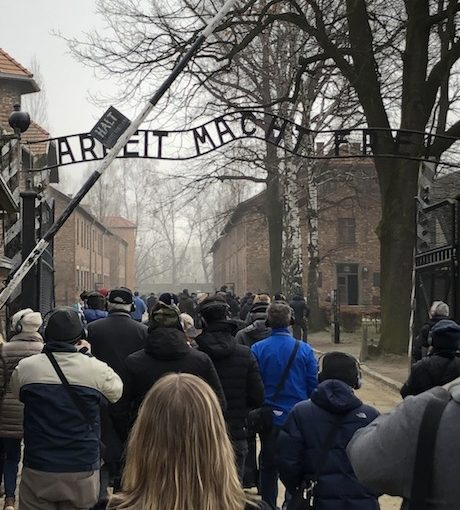
Springfield Collegiate Institute students walking into Auschwitz. (photo by Jim Osler, SCI)
Holocaust education is commonplace in Jewish schools. But, in public schools, discussion about the Shoah is at each teacher’s discretion. Some 14 months ago, teachers at Springfield Collegiate Institute public school in Oakbank, Man., decided they would take 30 Grade 11 and 12 students to see Second World War sites firsthand.
Despite that Oakbank is home to few Jewish families, the school has been inviting Holocaust survivors to speak to students and has been educating its students about the Holocaust for years. Last year, teachers Jim Osler and James Chagnon made the decision to take things further.
“While this was not on a topic brought up in a regular class, we organized activities outside of class time for these students in the evenings and on the weekends to educate them a little more,” said Chagnon of preparing the students for the 12-day trip, which started March 20.
“We visited a synagogue and talked to a rabbi about what it means to be Jewish, because we don’t have any experience with that,” Chagnon told the Independent. “We went and met two Holocaust survivors, who talked about their experiences in the camps. And we went to a conference on antisemitism hosted at the Rady JCC [in Winnipeg]. So, we did a lot of prep work outside of the school with these guys to make sure they’d be ready for what they’d be experiencing.”
Chagnon referred to a recent study that found that only about 30% of Canadian high school students had awareness or knowledge of the Holocaust.
“I had always taught English here in the school in addition to history – novels like The Diary of Anne Frank – and these seem to be getting pushed to the wayside,” said Chagnon. “The younger generations these days, especially in a community like ours that doesn’t have a big Jewish population … it’s just something I don’t think parents have a lot of experience with and, so, it’s not passed onto the kids. So, if they don’t learn about it in school or as part of our programs or clubs, they maybe aren’t going to learn about it at all.”
The school had wanted to take more than 30 students on the March trip, but had to stick to that maximum for logistical reasons. Participating students had to fundraise to pay their way.
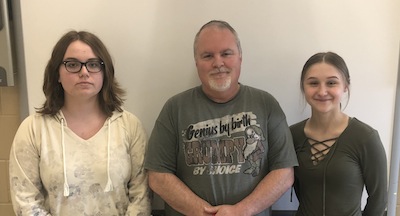
Madison Stojak, in Grade 12, and Anna Palidwor, in Grade 11, were both born and raised in rural Manitoba, and had little knowledge or interaction with Jews prior to attending Springfield Collegiate.
Springfield Collegiate Institute student Ana Palidwor, left, teacher James Chagnon, centre, and student Madison Stojak. (photo by Jim Osler, SCI)
“Hearing Holocaust survivors’ stories and then going to the camps, like Auschwitz and Birkenau … you could remember what the survivors said and picture it, what they must have gone through while they were there,” Palidwor told the Independent. “How we felt while we were there has stuck with everybody after we came back. Also, we’re more aware of the race issues that are out there… That’s definitely stuck with me … realizing it’s still here, wherever we go, the hate.”
While the school group was at the Warsaw Ghetto, a man on a motorbike drove by and gave the middle finger to a group of Israeli students who were standing beside them. “After all that, you’re just more aware of it, anywhere you go,” said Palidwor.
Both Stojak and Palidwor have talked about their experiences with family and friends.
“When I shared it with my family members, it was kind of surreal to them,” said Stojak. “They were like, ‘How could other people treat people like this? How could this happen? How come no one stopped it?’ They were questioning the same things I think all of us were questioning on the trip.”
“One of the strong points we really tried to push on the students, in terms of their learning, to understand, is that this isn’t the first time this has happened,” Chagnon said. “We definitely want it to be the last time, so we can’t just sit by and be passive bystanders anymore. When you see antisemitism, you are now obligated to call it out, draw attention to it, so we can change the way the world works.”
When the students returned from the trip, they were taken aback by some of the reaction they heard from fellow students who did not go.
Stojak said, “I hadn’t heard any comments before the trip like these – until they realized we were there … people started making rude comments … hateful comments. I think they were saying it to get us upset, and I also think that they’re really undereducated and don’t understand how serious it is.
“One comment someone said to me was, ‘Don’t touch me with your Holocaust hands!’ That’s what someone said to me. And, as soon as he said that, I said, ‘What did you just say?’ And he repeated it. I looked at him and said, ‘You didn’t just say that to me. That’s ridiculous. Do you know how many millions of people died there? That’s not something you should be saying.’
“I stood up immediately and shut it down,” said Stojak. “It made me feel sick to my stomach. How could someone make a comment like this? When he said that, I pictured standing there at Auschwitz or Birkenau and thinking, how could someone be so ignorant to say that?”
“These kinds of comments are making us want to be more active,” said Palidwor, “and to explain it to more people who weren’t there and tell them what the Holocaust is.”
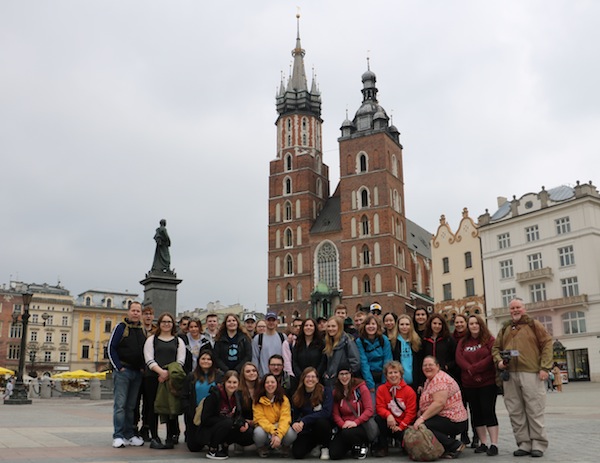
The 30 Springfield Collegiate Institute students, three parent chaperones and two teachers in the old town square in Krakow, Poland. (photo from SCI Students)
One of the things that stuck in Chagnon’s mind from the trip was the incident with the Israeli students. He noticed that there were a dozen security personnel with the Israeli student group but none with the Canadian school group.
“One of my students said, ‘Wow, I didn’t understand how bad it was – that these kids on a school trip from Israel have to be accompanied by security guards,’” said Chagnon. “That kind of struck me and I made sure to point it out to my students. It gives you a bit of perspective for the Jewish community – how scared they must be all the time – that they can’t send students to learn about the history of their people, their culture and religion, without having to send security with them.”
Another thing that stood out for Chagnon occurred when the group was visiting a Jewish cemetery and noticed that locals use the cemetery as a bathroom stop for their dogs.
“I’m a guest in their country, but I was shaking, I was so angry,” he said. “I couldn’t believe people would show such indignity to a group of people who suffered so much already.
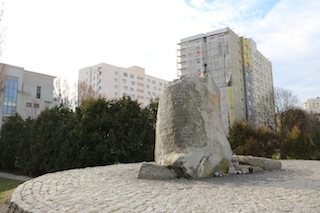
The memorial at Mila 18 Ghetto Uprising site in Warsaw, Poland. (photo by Jim Osler, SCI)
“We had a nightly debrief at the end of every evening,” he continued, “where we sat around and talked about the day, how we felt about it and our reactions to it, and that’s one thing I brought up … that some of this stuff may seem to have gone away … maybe it isn’t as bad as it was, but that doesn’t mean it’s not there, just bubbling under the surface, waiting for an opportunity to pop up.
“For me, that’s the reason we did a trip like this, and I know Jim [Osler] feels the same way.… They say people who don’t study history are doomed to repeat it and, for me, that’s very true. You have to talk about these things, even the ugly things in history, so we don’t let it happen again.”
Ety Siton, left, director of the Kfar Saba branch of ERAN, also oversees the Toronto volunteers. She is pictured with Sigal Almog, co-founder of Toronto’s ERAN project. (photo from ERAN)
Finding enough volunteers in Israel for the night shift of the country’s emotional crisis hotline, ERAN, proved difficult. So, its chief executive director, David Koren, came up with the idea of looking for Israeli volunteers living in North America to help cover this time period.
ERAN is a confidential service, offered over the phone or the internet, which provides free, anonymous emotional support to people in Israel of all ages, in Hebrew, Russian, Arabic and English.
Sigal Almog and Galya Sarner, both former Israelis living in Toronto, were at a conference in Washington, D.C., in 2017 when they heard of Koren’s mission. They sent out a call for volunteers through their network, and further recruited two social workers, Anat Gonen and Sabina Mezhibovsky, to co-found and open a chapter of ERAN in Toronto last year.
“Right now, in Toronto, we have 16 volunteers,” Gonen told the Independent, adding, “We have around 85 volunteers in the four North American branches. I think they are answering, each month, around 800 calls. So, that is 800 calls that, before we had those volunteers in North America, were unanswered, because nobody was there at night.”
“Just think about the message behind it,” said Sarner. “It’s unbelievable, probably saving the lives of so many in need who couldn’t get help, because not enough volunteers were there to give them the minimum support they were asking for.”
All four Toronto co-founders knew of the ERAN helpline prior to becoming involved with it in Canada, though none had used it themselves.
David Koren, chief executive director of ERAN. (photo from ERAN)
“ERAN is part of daily life in Israel,” said Sarner. “It’s a very distinguished project and, when we heard from Koren that he was looking to expand his global networking and to work with the North American community, we didn’t think twice. We knew we’d do whatever it took to launch the branch of ERAN in Toronto.”
Almog, who was also at the 2017 conference, recognized that this was a great opportunity to connect with and help people in Israel from Toronto. Nearly 80 former Israelis came to the initial information session in the city and, after screening them all, the branch accepted around 20 volunteers, who went on to get special training from ERAN and then started taking calls from Israel.
Volunteers do not need to have any particular degree, but they do need to possess specific skills.
“You need to be able to have some kind of empathy and self-awareness to know how to listen, [and to] understand and have a conversation in Hebrew, Russian, Arabic or English,” said Gonen. “One of the things we also found to be a struggle is that some of the people, especially those who’ve been here many, many years, can’t write in Hebrew. This is also a requirement, as they need to write a report in Hebrew. But, mostly what we need are people who are able to listen, to try not to give advice, and to be able to commit to the process,” to take a number of shifts per month.
“Whenever a volunteer answers the phone, they are told to say, ‘Eran, Shalom’ … keeping it very neutral, as, for some people on the line, it’s not a great evening…. It actually can be a pretty bad one,” said Sarner.
When a person in an emotional crisis dials 1201 from anywhere in Israel, they will be connected to a trained volunteer, who will try to direct them to those who can best help them; for example, a soldier with another soldier, or a Holocaust survivor with someone knowledgeable about the issues survivors face.
North American volunteers are taking shifts between 5 and 9 p.m., and 9 p.m. and 1 a.m., EST. Each volunteer signs into the ERAN system from their own computer and takes calls in their home.
“They have to be at home, because they have to be in a quiet room, a closed room, so nobody can hear the conversation they’re having and nobody interferes with what they say,” said Gonen.
Though the volunteers are in Toronto, they are trained to keep that fact out of the conversation. This way, explained Gonen, the caller is more likely to feel comfortable with them, thinking they are in Israel and able to identify with their struggle.
Running the Toronto chapter has been challenging, as the branch does not receive financial support from ERAN Israel or from the Toronto Jewish community. But, they have received some support from private donors and the Schwartz/Reisman Centre (in Vaughan, Ont.) provides space for ERAN volunteer training.
“We don’t have any kind of money that comes from ERAN Israel and everything we do here we pay for from our own pockets,” said Gonen. “The training … Sabina and I are volunteering to do every month. And, when we meet, all four of us will bring snacks for the meeting or things like that, because we want to make sure people feel appreciated for doing this. So, we’re looking for donations to help us run the branch.”
“We’re looking to expand support from our sponsors, because we did receive very touching sponsorships, mainly in the beginning, during the time of the initial training,” said Sarner. “But, in terms of the monthly meeting, it takes place at Schwartz/Reisman JCC. We’re very lucky to have the support of the JCC, but we definitely need to expand and find more sponsors and donors.”
The feeling shared by the co-founders and volunteers is that of gratitude to be able to have a direct impact on the lives of Israelis in Israel.
“We give a lot to ERAN,” said Almog. “We work many volunteer hours, but I feel like each one of the volunteers gets so much out of it. It’s brought a lot of meaning to our lives here, as Israelis who live outside of Israel.
“The volunteers just told us last week, someone who went to Florida and didn’t participate in the last training, that she really missed ERAN. It has become very meaningful in the lives of each one of us.”
“Anything you do in life,” Sarner added, “you have to do with love – with love and respect – and the respect we have among the four of us, it means so much to me. In Toronto, from the volunteers to the sponsors and the support of the community at large, it makes it even more meaningful to me. It has touched my heart and soul to be part of such an important initiative.”
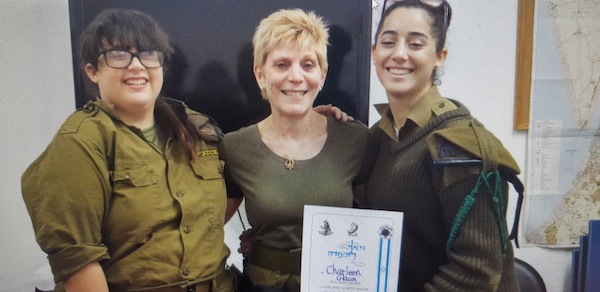
Charleen Glaun, centre, receives her certificate of service from Sar-El from madrichot Inbar, left, and Carmel. Glaun hopes to volunteer with Sar-El annually from here on out. (photo from Charleen Glaun)
At last, I was on the plane to Israel. Was this really happening? I had waited so long for this day and, here I was, after 32 years, finally returning.
Arriving at Ben-Gurion Airport, I proceeded through the security check-in. The first question asked of me was, “What is the purpose of your trip?”
“I’m coming on Sar-El,” I replied.
“What is Sar-El?” the security person asked.
“Volunteers for Israel,” I said, a little surprised he did not know about Sar-El.
I waited for his reaction, but there was silence. I blurted out, “I’ve been away for 32 years and this is my first trip back.”
He looked up from examining my passport and said, “What took you so long? Welcome back!”
I smiled and said to myself, “This is going to be the best adventure of my life! Thank you, G-d, for getting me here safely.”
Once I had my luggage, I found the sunglass stand where volunteers typically meet, and found Sar-El’s facilitator, Pam Lazarus, an expat who made aliyah 17 years ago. Since its founding in 1987 by General Aharon Davidi, volunteers come from around the globe for one- to three-week stints on an army base. Qualifications include a love of Israel, being of sound mind, having a clean bill of health, being physically fit and able to carry your own luggage. You do not have to be Jewish. There is a registration fee and the volunteer is responsible for the cost of the flight to Israel. While on the base, each person is assigned a room, which they will typically share with one or more people, and is given three meals a day. Some bases will even organize a free day trip to somewhere of interest, but individuals must fill their own weekends.
I was assigned to a medical supply base near Tel Aviv. This base does not have soldiers on it but rather reservists and full-time employees.
When I arrived at the base, I was given my army uniform. The correct size is not high on the priority list, I discovered. I spent the next three weeks in a very roomy pair of pants, which I held up with a belt, a khaki T-shirt and shirt, and an army jacket. I felt so proud wearing this uniform!
Army-issue clothing in hand, it was time to see where I was going to live for the next while. I had a roommate for my first four days, but had the space to myself for the remainder of my stay. Women are housed on the upper level of a two-storey building. Both floors have a washing machine. (Apparently, this is quite a luxury and not the norm.) All rooms have an air-conditioning/heating system and basic storage units. Three shower stalls delivered hot water at all times. I was at the Hilton of army bases! (I found out from my representative in Toronto that the living quarters on the base were newly renovated.)
A typical day is as follows. Breakfast in the main dining room is at 7:15 a.m. At 7:45 a.m., we meet up with our 19-year-old madrichot (supervisors) in the courtyard for the raising of the flag and the singing of the national anthem, and we get news from within Israel and abroad. Then, it is off to work until midday, when we make our way to the dining hall for lunch.
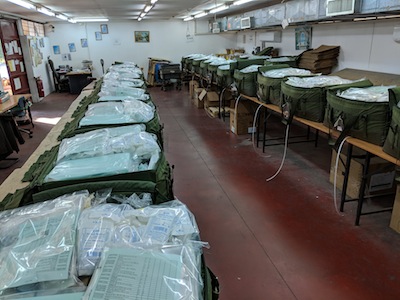
This base is the main military medical base in Israel and also the primary depot. Every 18 months, medical military units drop off complete medical supplies. They then pick up new and replenished supplies for the next 18 months, which are divided between bases. Medical supplies with expiry dates between six and 18 months are used first in hospitals and emergency rooms, while supplies with a six-month expiry date are used for training purposes and donations to developing countries. Medical kits are made up for many applications, such as atomic and biological chemical kits, combat doctors, and combat medics.
Sar-El volunteers at a medical supply base near Tel Aviv make up medical kits. (photo by Vadim Bendebury)
I had a great boss, Israel, who patiently explained exactly how to do things. Israel is a Bukharian Jew, a first-generation Sabra. He never stopped thanking us for our service, as did many Israelis I met off the base. They are grateful for the volunteers’ service. This, in turn, was so gratifying for us, knowing we were making a difference by giving back just a little to the country. It was an even better feeling when medical backpacks were returned to us with medical supplies unused.
The workday ends at 4 p.m., when volunteers are free to do whatever they like within the confines of the base. They are not at liberty to leave it, other than at the end of the workweek. Dinners are eaten early. Thereafter, the madrichot hold discussion groups or show movies. By 9 p.m., most people are ready for bed.
Weekends, volunteers may go anywhere in Israel, as long as we are at Tel Aviv’s main train station on the Sunday morning at 9:30, when we are taken back to our base. At present, there is a hostel in Tel Aviv specifically for Sar-El volunteers’ weekend stays. Accommodation is free, with meals included. This is a great alternative for those who are on a tight budget. It is not fancy, but it is near Tel Aviv’s hub and the beach.
One tends to forget that one is in a country in a constant state of war. The zest for life is unbelievable, which I noticed on my weekends in Tel Aviv. The bustling traffic; people sitting at coffee shops and in restaurants, or shopping at the Carmel Market; youngsters speeding down busy main intersections on their electric scooters; hip-looking men and women walking along the beautiful promenade with their dogs; beachgoers laughing and listening to music; picnickers on lawns with little children frolicking nearby; buskers entertaining the passing throng. What a beautiful, perfect picture it painted in an imperfect world.
Three weeks went by in a flash and soon it was time to return to Toronto. I looked for any reason that would enable me to stay, but, as the saying goes, all good things must come to an end. But it doesn’t have to end permanently. I will return to Israel. In fact, I am already looking at calendar dates.
I would highly recommend Sar-El for anyone who loves Israel and wants to do something worthwhile. Israel will welcome you with open arms and she will thank you.
To learn more about how you can experience your own “do good, feel good” adventure of a lifetime, email [email protected].
Charleen Glaunis a receptionist/caterer for an oil company in Toronto. She made aliyah in 1975 and spent the next 13 years traveling between Israel and South Africa, where she was born. Though aware of Sar-El since 1986, she did not have an opportunity to return to Israel until her December 2018 trip with the organization. Her heart has always been in Israel so, for her, the 2018 trip was “going home,” and she plans on returning with Sar-El before the end of this year, and each year going forward.
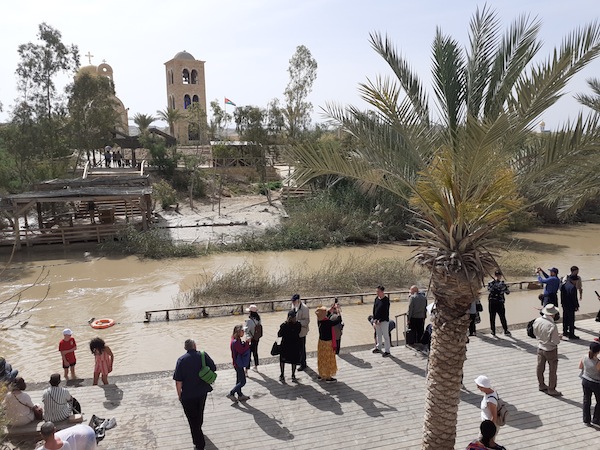
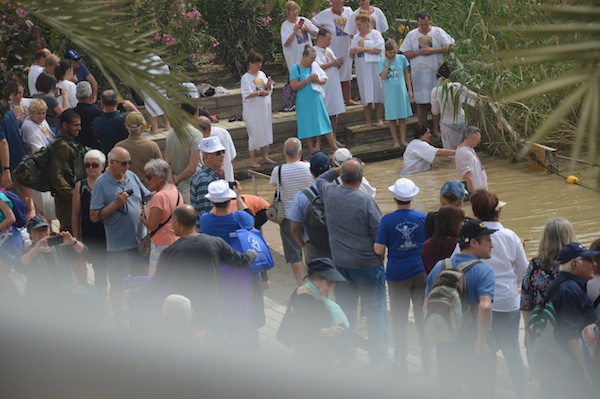
An April 15 press tour took journalists to the Israeli side of the Jordan River. Joshua and the Israelites made their crossing here. (photo by Gil Zohar)
Seventeen bulletproof buses of pilgrims, plus one carrying journalists, spilled their contents April 15 at Qasr al-Yahud (Arabic for the Jews’ Castle) on the muddy banks of the not-so-mighty Jordan River, 10 kilometres east of Jericho. The buses were provided by the Government Press Office in Jerusalem.
The holy site is also called the Land of Monasteries because of the seven Catholic, Greek Orthodox and Ethiopian churches there. Until 2011, it was a fenced-off, closed military zone ringed by minefields. Qasr al-Yahud is revered by Christians as the place where John the Baptist immersed his second cousin, Jesus of Nazareth.
For Jews, the shrine marks where, on Nissan 10, circa 1290 BCE, Joshua bin Nun led the Children of Israel to ford the Jordan River and begin their conquest of the Promised Land. But, with the cold peace prevailing between Israel and Jordan, soldiers of the Hashemite Kingdom’s Arab Legion warily monitored the crowds, making sure that no brave souls crossed to the polluted stream’s east bank to reenact Joshua’s miraculous crossing on dry land.
As Joshua and the 12 tribes approached the river, they were met by the kohanim (priests) carrying the Ark of the Covenant. The Jordan then miraculously split for them – perhaps caused by a landslide in the earthquake-prone region that temporarily blocked the river’s flow – allowing them to cross. After fording the Jordan, Joshua erected 12 stones taken from the river at Gilgal, whose location today is disputed by historians and archeologists.
Symbolizing that the process of the Israelites conquering the Promised Land some 3,289 years ago is still underway, Palestinian teenagers in Jericho pelted the armoured bus in which the journalists were riding, smashing one of the shatterproof windows. No one was injured in the attack.
For this writer, the explosive sound of the thump of the rock on glass brought to mind Joshua’s advice when the Israelites marched on ancient Jericho to begin their conquest: “Be strong and of good courage.” (Joshua 1:9)
Qasr al-Yahud is a corruption of “the Jews’ break,” traditionally the place where the Israelites crossed over, that is, “broke” the Jordan River after their 40 years of wandering in the Sinai Desert: “When the soles of the feet of the priests who bear the ark of the Lord, the Lord of all the earth, shall rest in the waters of the Jordan, that the waters of the Jordan shall be cut off, even the waters that come down from above, and they shall stand in one heap.” (Joshua 3:13)
It was here, too, that Elijah the Prophet ascended to heaven in a fiery chariot after he and Elisha crossed the Jordan: “And Elijah took his mantle, and wrapped it together, and smote the waters; and they were divided hither and thither, so that they two went over on dry ground.” (2 Kings 2:8)
The strategic and diplomatic significance of the Jordan Valley were spoken about by retired Israel Defence Force (IDF) deputy chief-of-staff major general Uzi Dayan, who was elected to Israel’s Knesset (parliament) in the country’s April 9 general election.
Rabbi Yisrael Meir Lau, the chief rabbi of Tel Aviv, and previously Ashkenazi chief rabbi of Israel, spoke of the Land of Israel’s long centuries of foreign occupation, from the Romans to the British.
From 1948 until 1967, Qasr al-Yahud was under Jordanian control, and was a popular destination for tourists and pilgrims. In 1968, following the Six Day War, access to the site was prohibited by the IDF because of its location beyond the border fence in a closed military zone. In recent years, the Israeli Civil Administration – with the assistance of the tourism and regional development ministries – carried out infrastructure and development work at the site, including the clearing of mines. In 2011, the site was opened to visitors on a permanent basis without the need for prior security coordination.
Entering ancient Jericho, with its 8,000-year-old remains at Tel as-Sultan and two Byzantine-era synagogues, is another matter. Large signs at the entrance to the city proclaim in Hebrew and English that entry is prohibited to Israelis. In honour of the Nissan 10 celebration, however, Israelis were allowed to enter the city in Area A, the Palestinian self-rule section of the West Bank, which is off limits the rest of year.
And what of the minefields? One million square metres of land are currently being cleared of approximately 3,000 anti-personnel mines, antitank mines and other unexploded ordinance. The project is being carried out by Israel’s National Mine Action Authority under the direction of the Defence Ministry, together with HALO Trust, an international mine-clearance charity.
Gil Zoharis a journalist based in Jerusalem.
[For more on this press trip to the Jordan River and Jericho, see “Traveling into our past.”]
Christians preparing to be baptized in the Jordan River. (photo by Barry Kaplan)
A few days prior to Passover, the Israeli Government Press Office organized a special field trip to the Jordan River and Jericho. The bus with 40 journalists left the GPO office parking lot at 8:30 a.m. and traveled on Highway #1 to the southern part of the Jordan Valley with a guide. We passed Maale Adumim, now a city with 45,000 residents, and headed through the desert area.
We began the ascent to Jericho, passing the Inn of the Good Samaritan, the sea-level sign and the barren hills. A strip of restaurants and souvenir places seemed to appear out of nowhere. We heard about the history of Kibbutz Bet Arevo, situated in this area from 1939 to 1948, passed a veritable forest of palm trees and, by 9:20 a.m., we were at Qasr al-Yahud, where John the Baptist is said to have baptized Jesus. After it passed through the security fence, the bus parked and we walked down to the Jordan River.
Until 1967, this site was under Jordanian control and, in 1968, access was prohibited. In recent years, the tourism and regional development ministries have carried out various projects, including the clearing of mines, and, in 2011, the site was opened to visitors. The site and facilities are overseen by the Israeli Civil Administration and the Israeli Ministry of Tourism as part of a national park.
Running down the middle of the Jordan River is a metal divider. On the other side of it is Jordan. There were people standing around the river and, behind them, churches were visible on the Jordanian side. On the Israeli side, down more steps, people were wearing white cover-ups and going into the river, presumably to be baptized.
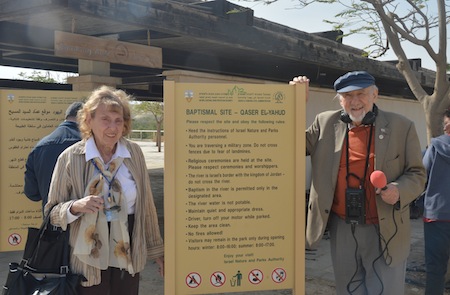
Writer Sybil Kaplan with friend Walter Bingham, who, in his 90s, is the oldest working journalist in Israel. (photo by Barry Kaplan)
In addition to its significance to Christians, two Jewish events took place at this spot.
In the Book of Joshua, we read how the Israelites, after 40 years of wandering in the desert, led by Joshua, crossed the Jordan River as the river became a stream. Supposedly this happened on the 10th of Nissan, this year April 15. Our guide says this could have taken place 4,440 years ago.
The passage in the Book of Joshua reads: “When the soles of the feet of the priests who bear the ark of the Lord, the Lord of all the earth, shall rest in the waters of the Jordan, that the waters of the Jordan shall be cut off, even the waters that come down from above, and they shall stand in one heap.” (Joshua 3:13)
At this point in our trip, we were joined by Uzi Dayan, former major general, national security adviser and Israel Defence Forces deputy chief of staff. According to Dayan, this passage from Joshua describes “the first aliyah to Israel.”
Another biblical text (2 Kings 2:1-2) says Elijah struck the Jordan River water with his cloak. The water parted so that he and Elisha could cross. After Elijah ascended, Elisha again parted the waters with Elijah’s cloak so he could return to Israel. This occurred before Elijah ascended to heaven in a fiery chariot.
Dayan noted that, on the day of our visit, there would be 17 other busloads of people coming to commemorate what has happened here, and that a ceremony would be held that afternoon. We would return for it, but not stay (as I will explain later).
* * *
At 11:10 a.m., we reboarded the bus and became part of a convoy, with IDF soldiers and jeeps leading us and several soldiers inside each bus. On one side of the road are mine fields, still being cleared.
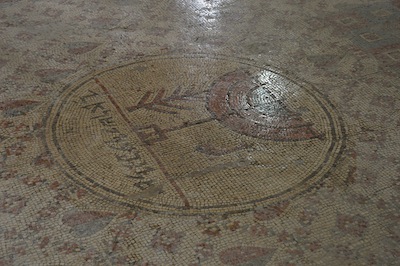
Our next stop was the sixth- or seventh-century CE Shalom Al Yisrael Synagogue. Down some steps, we walked around the 10-by-13-metre mosaic floor that featured a menorah in its centre. It was identified as being the floor of a synagogue because of the images of the menorah, as well as an ark, shofar and lulav. The name stems from a mosaic inscription with the Hebrew words Shalom Al Yisrael.
Shalom Al Yisrael Synagogue mosaic in Jericho. (photo by Barry Kaplan)
The synagogue was probably used for hundreds of years, but then the Jericho Jewish community dissipated, and the synagogue was forgotten. It was revealed in excavations conducted in 1936 by Dimitri Baramki of the department of antiquities under the British Mandate.
After the 1967 Six Day War, the site came under Israeli military control and remained under the administrative responsibility of the Arab owners – the Shahwan family, who had built a house over the mosaic floor and charged admission to visit it. Tourists and Jews began visiting the site regularly for prayers. In 1987, the Israeli authorities confiscated the mosaic, the house and a small part of the farm around it. They offered compensation to the Shahwan family, but it was rejected.
After the 1995 Oslo Accords, control of the site was given to the Palestinian Authority. It was agreed that free access to it would continue, and that it would be adequately protected.
There have been some incidents. For example, on the night of Oct. 12, 2000, the synagogue was vandalized by Palestinians who torched and destroyed most of the building, burned holy books and relics, and damaged the mosaic. For more than eight years, no Jews were permitted in Shalom Al Yisrael Synagogue, but, during that time, it was restored by the Municipality of Jericho. Since 2007, prayer services have been allowed once a week.
* * *
By 12:15 p.m., we were at the tel (hill, or mound), which some journalists climbed. Opposite is a building with restaurants, snacks and a kind of enclosed mall. Israeli soldiers patrol the entire area. Outside, a man was giving rides to people atop a camel, and soldiers sat around and chatted.
The archeological site is about 2.5 kilometres north of modern-day Jericho, on the site of the ancient city, 258 metres below sea level. It was inhabited from the 10th century BCE. Excavations began in 1868 and settlements are known to date from 10000 BCE.
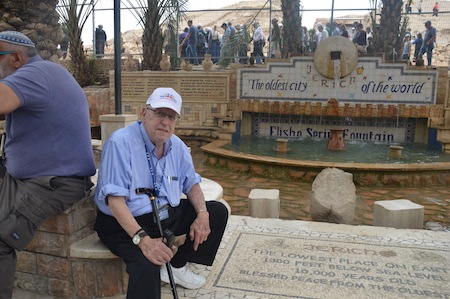
Photographer Barry Kaplan rests by Jericho’s oldest city wall. Tel Jericho can be seen in the background. (photo by Barry Kaplan)
The story in the Book of Joshua relates that, when the Israelites were encamped in the Jordan Valley, ready to cross the river, Joshua, as a final preparation, sent out two spies to investigate the military strength of Jericho. The spies stayed in Rahab’s house, which was built into the city wall. The soldiers sent to capture the spies asked Rahab to bring out the spies; instead, she hid them.
After escaping, the spies promised to spare Rahab and her family after taking the city, if she would mark her house by hanging a red cord out the window. When Jericho fell, Rahab and her whole family were saved, becoming part of the Jewish people.
The biblical battle of Jericho was the first battle that was fought by the Israelites. According to Joshua 6:1-27, the walls of Jericho fell after Joshua’s army marched around the city and blew their trumpets.
* * *
Our second-last stop was Moshav Naama, which is about 45 minutes from the centre of Jerusalem and one-and-a-half hours from Tel Aviv. About 50 families live there. We arrived at 2 p.m.
On the moshav, they grow grapes, dates and organic vegetables. Inon, one of the farmers, grows herbs in greenhouses. In the warehouse, sweet basil and tarragon are packaged for shipping all over the world to supermarkets.
Inon said 95% of the dates grown there are Medjoul and 5% are other kinds. Medjoul dates originated in the Middle East and North Africa, and are one of the most famous varieties. They are well-known for their large size and delicious flavour. The dates from the moshav will be harvested in September and October.
* * *
At 4:30 p.m., above Qasr al-Yahud, the baptismal site, chairs have been set up for the approximately 900 people who will listen to speeches commemorating the Israelites arrival in the Promised Land. However, since most of the journalists do not understand the Hebrew, the GPO bus boards at 5:20 p.m. and travels back to the GPO offices, arriving just over an hour later. Even though we didn’t stay for the whole proceedings, I am still excited to have been a witness to the ceremony.
Sybil Kaplan is a journalist, lecturer, book reviewer and food writer in Jerusalem. She created and leads the weekly English-language Shuk Walks in Machane Yehuda, she has compiled and edited nine kosher cookbooks, and is the author of Witness to History: Ten Years as a Woman Journalist in Israel.
[For more on this press trip to the Jordan River and Jericho, see “Celebrating our history.”]
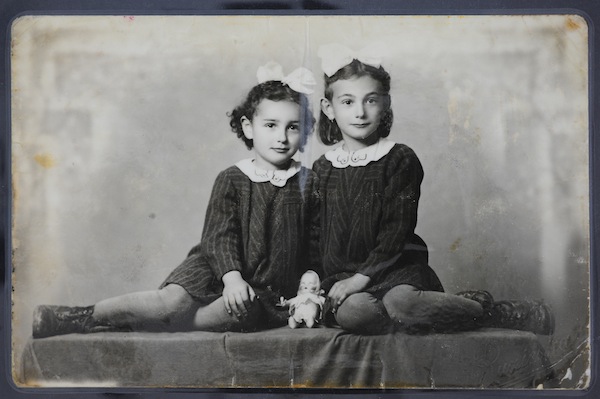
Susan-Zsuzsa and Lili Klein (photo from Yad Vashem via Ashernet)
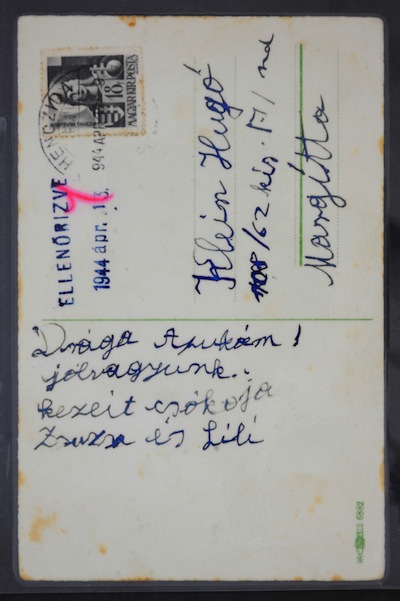
(photo from Yad Vashem via Ashernet)
On April 13, 1944, sisters Susan-Zsuzsa and Lili Klein (in photo) wrote their father Hugo a short letter: “Dear Daddy, We are well – goodbye.” Hugo had been drafted into a forced labour battalion in 1943; his wife Matild had stayed with their two daughters in their hometown of Hencida in the Bihar district of Hungary. Hugo survived the war, but Matild, Susan-Zsuzsa, 9, and Lili, 7, were deported to Auschwitz on May 24, 1944, and murdered shortly after their arrival.
Exactly 75 years later, Susan-Zsuzsa and Lili’s letter is among a dozen last letters included in Yad Vashem’s latest online exhibition, Last Letters from the Holocaust: 1944, presented to mark Israel’s Holocaust Martyrs’ and Heroes’ Remembrance Day. Many of the documents included in the exhibition (yadvashem.org/yv/en/exhibitions/last-letters/1944/index.asp), as well as the photographs, were donated to Yad Vashem as part of its national Gathering the Fragments campaign. Together with the tens of thousands of Holocaust-era artifacts and artworks in Yad Vashem’s collections, these historical testimonies are due to be conserved and stored in the new Shoah Heritage Collections Centre, part of a new campus being built on the Mount of Remembrance in Jerusalem.
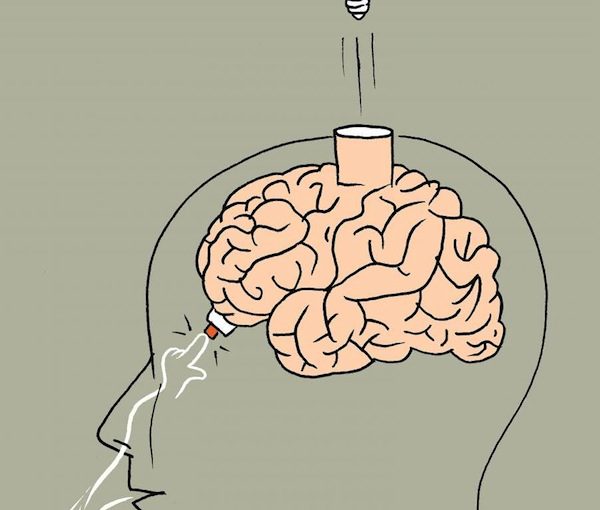
Subjects given problems to solve as they inhaled did better on tests. (image from wis-wander.weizmann.ac.il)
A shot of espresso, a piece of chocolate or a headstand – all of these have been recommended before taking a big test. The best advice, however, could be to take a deep breath. According to research conducted in the lab of Prof. Noam Sobel of the Weizmann Institute of Science’s neurobiology department, people who inhaled when presented with a visuospatial task were better at completing it than those who exhaled in the same situation. The results of the study, which were published in Nature Human Behavior, suggest that the olfactory system may have shaped the evolution of brain function far beyond the basic function of smelling.
Dr. Ofer Perl, who led the research as a graduate student in Sobel’s lab, explained that smell is the most ancient sense. “Even plants and bacteria can ‘smell’ molecules in their environment and react,” said Perl. “But all terrestrial mammals smell by taking air in through their nasal passages and passing signals through nerves into the brain.”
Some theories suggest that this ancient sense set the pattern for the development of other parts of the brain. That is, each additional sense evolved using the template that had previously been set out by the earlier ones. From there, the idea arose that inhalation, in and of itself, might prepare the brain for taking in new information – in essence, synchronizing the two processes.
Indeed, studies from the 1940s on have found that the areas of the brain that are involved in processing smell – and thus in inhalation – are connected with those that create new memories. But the new study started with the hypothesis that parts of the brain involved in higher cognitive functioning may also have evolved along the same basic template, even if these have no ties whatsoever to the sense of smell.
“In other mammals, the sense of smell, inhalation and information processing go together,” said Sobel. “Our hypothesis stated that it is not just the olfactory system, but the entire brain that gets ready for processing new information upon inhalation. We think of this as the ‘sniffing brain.’”
To test their hypothesis, the researchers designed an experiment in which they could measure the airflow through the nostrils of subjects and, at the same time, present them with test problems to solve. These included math problems, spatial visualization problems (in which they had to decide if a drawing of a three-dimensional figure could exist in reality) and verbal tests (in which they had to decide whether the words presented on the screen were real). The subjects were asked to click on a button twice – once when they had answered a question and once when they were ready for the next question. The researchers noted that, as the subjects went through the problems, they took in air just before pressing the button for the question.
The experiment was designed so the researchers could ensure the subjects were not aware that their inhalations were being monitored, and they ruled out a scenario in which the button pushing itself was reason for inhaling, rather than preparation for the task.
Next, the researchers changed the format around, giving subjects only the spatial problems to solve, but half were presented as the test-takers inhaled, half as they exhaled. Inhalation turned out to be significantly tied to successful completion of the test problems. During the experiment, the researchers measured the subjects’ electric brain activity with EEG and here, too, they found differences between inhaling and exhaling, especially in connectivity between different parts of the brain. This was true during rest periods as well as in problem-solving, with greater connectivity linked to inhaling. Moreover, the larger the gap between the two levels of connectivity, the more inhaling appeared to help the subjects solve problems.
“One might think that the brain associates inhaling with oxygenation and thus prepares itself to better focus on test questions, but the time frame does not fit,” said Sobel. “It happens within 200 milliseconds – long before oxygen gets from the lungs to the brain. Our results show that it is not only the olfactory system that is sensitive to inhalation and exhalation – it is the entire brain. We think that we could generalize, and say that the brain works better with inhalation.”
The findings could help explain, among other things, why the world seems fuzzy when our noses are stuffed. Sobel points out that the very word “inspiration” means both to breathe in and to move the intellect or emotions. And those who practise meditation know that the breath is key to controlling emotions and thoughts. This, though, is important empirical support for these intuitions, and it shows that our sense of smell, in some way, most likely provided the prototype for the evolution of the rest of our brain.
The scientists think their findings may, among other things, lead to research into methods to help children and adults with attention and learning disorders improve their skills through controlled nasal breathing.
Sobel’s research is supported by the Azrieli National Institute for Human Brain Imaging and Research; the Norman and Helen Asher Centre for Human Brain Imaging; the Nadia Jaglom Laboratory for the Research in the Neurobiology of Olfaction; the Fondation Adelis; the Rob and Cheryl McEwen Fund for Brain Research; and the European Research Council. Sobel is the incumbent of the Sara and Michael Sela Professorial Chair of Neurobiology.