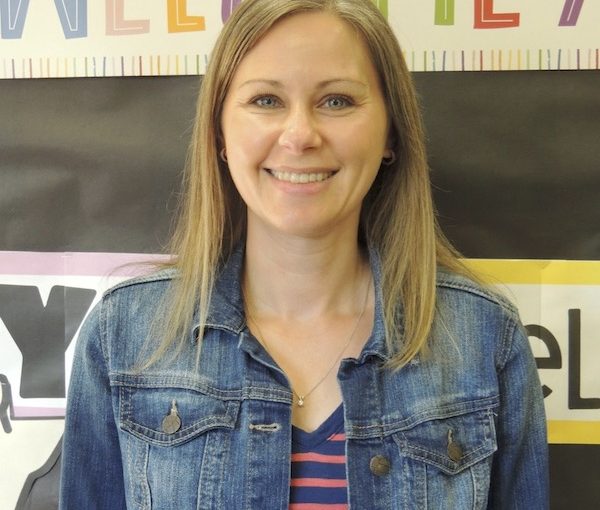
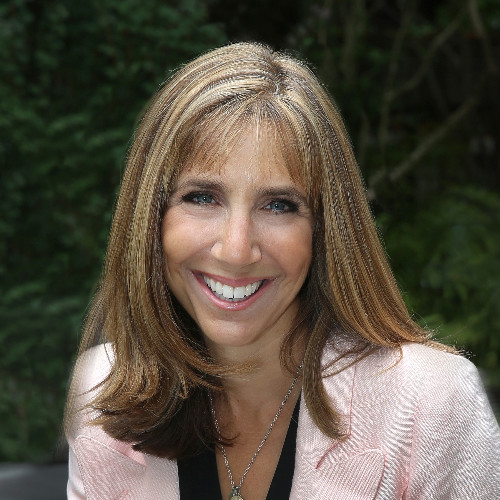
Richmond educator Alisa Magnan is petitioning Richmond city council to create, adopt and publish a truth and reconciliation policy. (photo from Alisa Magnan)
On Sept. 30, the National Day for Truth and Reconciliation, Richmond educator and Jewish community member Alisa Magnan hoped to attend a commemoration event in her home city – but couldn’t find one. Instead, she went into Vancouver for a special naming ceremony, where Trutch Street was renamed Musqueam View Street.
“[Former] Vancouver Mayor Kennedy Stewart spoke about being a settler himself, and about wanting to do more for reconciliation,” she recalled. “On the City of Vancouver’s website, they have a whole policy and framework for reconciliation, but the City of Richmond’s website has nothing, and even their history starts with settlers in 1860. There’s almost no mention of Musqueam except that they came to Richmond to work in the cannery!”
Magnan, a teacher at Spul’u’kwuks Elementary in Richmond for the past 10 years, initiated a petition with her co-worker, Katherine Myers, that she plans to present at a Richmond city council meeting on Nov. 21. The petition requests that Richmond city council adopt a truth and reconciliation policy that includes signage around historically significant places like the midden at Spul’u’kwuks Elementary, a commemorative event in the city for the annual National Day for Truth and Reconciliation, and a policy on the city’s website that shows what Richmond is doing.
Last month, Magnan attended the all-candidates meeting in Steveston, where she asked Richmond Mayor Malcolm Brodie what he did on the National Day for Truth and Reconciliation. She said Brodie’s response was that he had worked on his campaign.
Magnan also reached out to Richmond city councilor Carol Day to ask why there was no land acknowledgment made prior to council meetings. Day responded that the city is in litigation with both the Cowichan and Musqueam First Nations and that, until it has been resolved, making the land declaration would compromise the city’s legal position. Particularly with the litigation with the Cowichan tribe, Day wrote, “it’s very, very serious, affecting private land that regular people own, land owned by the Port of Vancouver and city-owned land. The court case is groundbreaking and, if the Cowichan win, it will set a precedent for the entire country.”
The Richmond School Board has been very proactive on truth and reconciliation, said Magnan, doing land acknowledgment and scheduling professional development days where educators learn about truth and reconciliation and pass that onto their students. “Our kids are learning about this but not their parents,” she noted. “One parent commented that there was so much negative being taught about the residential schools. ‘Aren’t there any positives?’ the parent wondered.
“In order for Indigenous voices to be heard, you have to know what they’re going through. People need to be educated without having to go searching for it,” Magnan said. “Our goal for the petition is to encourage the City of Richmond to create a truth and reconciliation policy that’s public, so we can see what’s being done, or at least to show they’re working towards it. We want to be proud of what Richmond’s doing, not embarrassed that there’s no ceremony on the National Day for Truth and Reconciliation.”
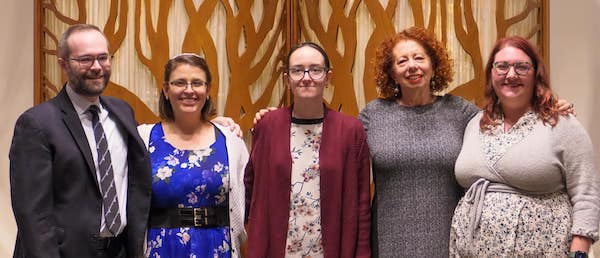
Left to right: Cantor Josh Breitzer, Cantor Shani Cohen, Rabbi Kylynn Cohen, Prof. Joyce Rosenzweig and Cantor Lianna Mendelson at Shani Cohen’s installation as cantor at Temple Sholom the weekend of Oct. 28-29. (photo from facebook.com/templesholom.ca)
Temple Sholom officially installed Cantor Shani Cohen, the first ordained cantor to serve the congregation, on the Oct. 28-29 Shabbat weekend, with services and music throughout to mark the occasion.
Always passionate about music and Judaism, Cohen found a path that combined her interests – and talents – while studying for a master’s of music in vocal performance and pedagogy at the University of Houston in the mid-2010s. There, she started working for Congregation Shma Koleinu.
“Rabbi Scott Hausman-Weiss saw something in me, and invited me to lead High Holy Day services with him. He knew that I would become a cantor before I did. Once I started leading services, I looked into becoming a cantor and what that would mean,” Cohen told the Independent. “What I discovered was that being a Reform cantor encompasses so many different skills: you get to lead the congregation in prayer, teach b’nai mitzvah, introduce new music, and lead lifecycles for the community.”
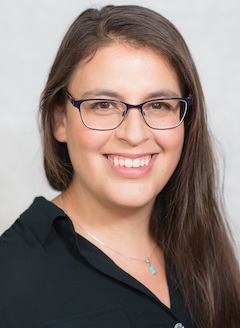
Cantor Shani Cohen (photo from Shani Cohen)
Following her studies in Houston, Cohen enrolled at Hebrew Union College and embarked on a five-year cantorial program, which comprised a first year of study in Jerusalem, followed by four years in New York. “I got to work with the most incredible, groundbreaking cantors and rabbis of our generation, and enter into a diverse community of Jewish clergy around the world,” she said. “The training for cantors centres on Jewish music and liturgy, but many of our courses are in conjunction with the rabbinic students, including pastoral care, Bible, Jewish history and philosophy, and lifecycles.”
As a student, she presented recitals every year on different topics, such as Shabbat, High Holy Days, and Jewish composers. In her final year, she wrote a thesis and presented a recital on the same topic – her research delved into the collaboration between rabbis and cantors, looking into the history of these roles and the way clergy teams function in Reform congregations today.
Cohen was influenced by the cantors of the early to mid-20th century, which is often referred to as the cantorial “golden age.” These cantors included such names as Yossele Rosenblatt, Moshe Koussevitzky, Leibele Waldman and Moishe Oysher.
“I love how they brought their full voices to every piece, whether they were leading services or performing on the concert stage. I am also greatly inspired by the incredible teachers that I had at the Hebrew Union College Debbie Friedman School of Sacred Music (DFSSM), including Chazzan Israel Goldstein, z”l, who I got to work with as my coach my second year.”
Two of Cohen’s mentors, Prof. Joyce Rosenzweig and Cantor Josh Breitzer, were in attendance at her October installation, offering both words and music. Cohen worked with Breitzer as an intern at Congregation Beth Elohim in Brooklyn, where she got “to see firsthand his ability to weave together traditional and contemporary musical styles in an authentic, cantorial way.”
She said, “I too strive to bring the breadth and depth of Jewish music into my cantorial work, showing our community that both new and old music has a place in our synagogues. I think this is what cantors are called to do in order for us to keep this art form alive.”
Cohen delights in both the variety of her job and its interpersonal nature, noting that no two days are alike. “I could go from teaching students and leading prayer with our religious school one day, to officiating a wedding or going to visit one of our home-bound congregants the next,” she said. “Each facet of my work feels meaningful, especially being there for people when they are feeling vulnerable: when someone loses a loved one, gets bad news, or even the excitement and anxiety of preparing for their child’s b’nai mitzvah.”
A native of the Bay Area, Cohen attended the University of Puget Sound in Tacoma, Wash., where she studied music and psychology. “I love being close to the water and, when the sun comes out, you appreciate it so much more because so much of the year is dark and rainy,” she said. “It was definitely a big contrast from where I grew up, but I felt a strong connection to this part of the continent when I was an undergraduate student, and am so grateful to be able to live here now.”
Cohen and her wife Rabbi Kylynn Cohen moved here with their black Lab mix, Trouble.
“The addition of Cantor Cohen to Temple Sholom’s clergy team is a milestone for our growing congregation, having grown from 600 households in 2013 to nearly 950 households just nine years later,” said Rabbi Dan Moskovitz, senior rabbi at Temple Sholom. “Cantor Cohen adds a depth of pastoral skills and Jewish knowledge to her outstanding musical and cantorial abilities.
“She stands upon the shoulders of lay cantorial soloists Arthur Guttman and Naomi Taussig, who together set the tone and tenor for generations of Vancouver Jewish families,” he said.
“It is an honour and a privilege to be part of the Temple Sholom clergy team,” said Cohen, who brings the team to three, joining Moskovitz and Rabbi Carey Brown. “And I am grateful to get to do this work every day.”
Sam Margolishas written for the Globe and Mail, the National Post, UPI and MSNBC.
When George Floyd was murdered by a Minneapolis police officer in 2020, it reawakened awareness about police violence and institutional racism in the United States and beyond. Nearly three years later, many of the anti-racist pledges made during that time remain unfulfilled.
“Do you know that most of those commitments have not been met and there is no accountability for not doing this?” said June Francis, special advisor to the president of Simon Fraser University on anti-racism, director of the Institute for Diaspora Research and Engagement, co-founder of the Black Caucus at SFU and an associate professor in the Beedie School of Business. “Companies said they were going to do X,Y and Z, research shows they’re not doing it. Accountability is everything. If we don’t see change and there are no repercussions … then we get tired, society goes back.”
Francis was speaking Nov. 3 at an event titled From Talk to Action: Challenging Racism in Canada Today. The panel discussion, at Robson Square, was presented by the Simces & Rabkin Family Dialogue on Human Rights in partnership with the Canadian Museum for Human Rights and Equitas, an international human rights education organization.
Francis aimed a particularly sharp critique at academic institutions.
“When students arrive at a university, they are being groomed to become racist people,” she said. “I say this honestly because what they are taught is any ideas worth knowing emanate out of white supremacists. White ideas are the enlightened [ones], the primitive becomes us, our art is considered primitive, our work is always denigrated. It’s only recently that Indigenous knowledge has become a thing, only because we’ve totally destroyed the planet and now we’ve suddenly awakened and, even then, we have a certain category of it as being nonscientific. Universities are founded on these ideas that are meant to create this idea that some people are superior to others and we perpetuate this every day. Then we go on to only fund research that does that. We go on to promote people who do that research. We go on to insist that our students who dare to challenge the system don’t graduate unless they do what we tell them to do.”
Annecia Thomas, who joined Francis on the panel, was mobilized to action in the aftermath of Floyd’s murder, as well as when students at her Kamloops high school made light of the murder in an online post. She was afraid to speak up, she said.
“But, I think, through this fear I gained another fear – that was not speaking up,” she said. “Without speaking up, it would just continue.”
Also on the panel was Daniel Panneton, director of allyship and community engagement at the Friends of Simon Wiesenthal Centre for Holocaust Studies. He addressed online hate and how it can transmute into real-world violence, citing the case of Dylan Roof, the South Carolina man who was radicalized online and, in 2015, murdered nine people in an African-American church.
Concerns about free speech rights, which are sometimes invoked to defend racist, misogynistic or otherwise bullying behaviours online are specious, he argued. These actions effectively deter members of historically marginalized communities from running for public office and participating in the public sphere, he said.
“The tolerance of hate and threatening speech in our society threatens the free-speech rights of vulnerable communities,” said Panneton.
The panel was moderated by Niigaan Sinclair, an Anishinaabe man who is head of the department of Indigenous studies at the University of Manitoba and is a frequent commentator in national media.
“I grew up as a refugee, but I didn’t know it,” he said, referring to Canadian governments who forced his ancestors off their lands. “In every other country of the world, that would be called ethnic cleansing, but in Canada they call it progress.”
He said the ultimate goal of racism is to erase its own history.
“The outcome of violence is always silence, not to talk about it, to make sure that it happens in perpetuity and that it’s somehow legal and justified,” said Sinclair.
Zena Simces and Dr. Simon Rabkin, who launched the annual series four years ago, spoke of their motivations.
“We established the dialogue on human rights because we saw a void in Vancouver with respect to a dedicated program on human rights for everyone in the community, for all groups,” said Simces, a consultant in health, social policy and education and a former leader in the now-defunct Canadian Jewish Congress.
“To combat racism, we first need to understand it, think about the background and understand the history,” said Rabkin, a professor at the University of British Columbia medical school who has provided health care to underserviced areas in northern Canada and in Kenya. “Talk and reflection is not enough, it won’t move us forward. We need a vision of the future in order to provide a guidepost and a goal to aim towards.”
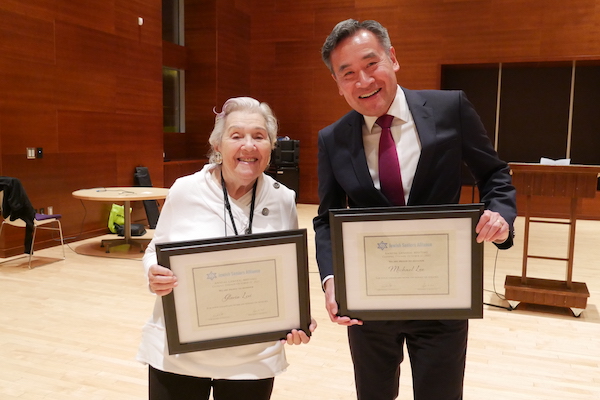
Gloria Levi and Michael Lee were honoured by Jewish Seniors Alliance for their contributions to the well-being of seniors in the community, as was Dolores Luber. (photo from JSA)
When you looked around the room at Congregation Beth Israel on Nov. 27, the pandemic of the last two-plus years would not have crossed your mind. The room was filled with more than 100 happy guests enjoying dinner together.
The occasion was the 15th annual general meeting and gala for Jewish Seniors Alliance of Greater Vancouver. Three people were honoured for their contributions to the well-being of seniors in the community: Dolores Luber, Gloria Levi and Member of the Legislative Assembly Michael Lee.
After welcoming the guests, emcee Rabbi Philip Bregman called upon Beth Israel Rabbi Jonathan Infeld to recite the Hamotzi. JSA board member Tony DuMoulin read an inspiring message from Serge Haber, the founder and visionary of JSA.
Dolores Luber was awarded the first JSA Star. She received a collage made up of covers from Senior Line, a magazine she has edited for 10 years. (photo from JSA)
Then, Ken Levitt introduced Luber, the editor of Senior Line magazine. She is the first winner of the JSA Star for her commitment to enriching the lives of seniors through articles, book reviews, film reviews and news. Luber, who has served as the editor of the magazine for 10 years, emphasized the free hand she enjoyed in choosing the topics of the articles, artists’ profiles and other material for the magazine. Her goal was to enlarge the scope of the publication, so that it included people from many cultures and ethnic backgrounds. She was awarded a collage of select covers of Senior Line, with her and her dog, Kesem, in the centre of all the covers, which reflect JSA’s culture of diversity and support.
Levi was introduced by her friend Jane Heyman, who spoke about Levi’s fascination with seniors at the young age of 30, when she worked with the Golden Age Club. Levi went on to develop provincial programs for seniors. She is also the author of six books, most recently the creative memoir The Hotel Keeper’s Daughter, which was published this year.
Levi thanked JSA for the honour, as she received a standing ovation. She spoke lovingly about Haber, who would never take “no” for an answer.
Lee was introduced by Grace Hann, a trainer for the JSA peer support program. He was honoured for his ongoing work with seniors. Elected MLA for Vancouver-Langara in 2017 and 2020, he, along with Andrea Krombein, has launched the South Vancouver Seniors Network. This network has sponsored more than 100 webinars connecting seniors with various topics of interest and with one another.
Lee met Haber and Levitt in 2016. He was impressed with Haber’s passion and commitment and recognized the JSA as a leader in the development of seniors organizations in Vancouver.
Tamara Frankel, co-chair of the event, presented Gyda Chud and, in absentia, Larry Shapiro, with a gift in appreciation of their leadership as co-presidents of JSA over the last three years. A short video by incoming president Tammi Belfer, who spoke from Israel, was screened.
Following the dinner by Nava Catering, the winner of the 50/50 raffle was announced by Frankel – who was shocked to see that she was the winner. Frankel donated her winnings to JSA; the raffle raised more than $1,000.
Tamara Frankelis a member of the board of Jewish Seniors Alliance and Shanie Levin is a JSA Life Governor. Both Frankel and Levin are on the editorial committee of Senior Line magazine.
Ellen Schwartz, founder of Project Give Back. (photo from LinkedIn)
Jewish Federation of Greater Vancouver’s Choices, the largest celebration of women’s philanthropy in the community, takes place Nov. 3 at Congregation Beth Israel. At the event, featured speaker Ellen Schwartz, founder of Project Give Back, will talk about raising a son with a neurodegenerative disease and how her son Jacob helped her “live a more grounded, purposeful and present life.”
Project Give Back is targeted to elementary students in Ontario. Established in 2007 by Schwartz, a Toronto-based teacher, community advocate and mother of three children, it started as a program she created for her fourth grade classroom and it is designed to teach compassion and concern for community. The program, which selects and trains teachers to deliver its specialized curriculum, runs weekly from October to May in partner schools. In it, students help do the teaching by explaining the value of a worthy cause to their fellow classmates. Since its inception, Project Give Back has helped bring awareness to hundreds of charities.
“The beauty about Project Give Back is children teach us about what matters to them, through their involvement with a charity that they or their family are connected to,” Schwartz told the Independent.
Fifteen years after starting the program, Schwartz said many early participants continue to be actively involved in charitable work as they enter into young adulthood.
“We definitely have seen many of our alumni actively giving and making change in their communities,” she said. “Some of our graduates have published books, with proceeds donated to their chosen and personal causes.”
Some of the many grassroots charities to which Project Give Back has recently brought attention are Sending Sunshine, a program directed at curbing loneliness in the elderly population; Nanny Angel Network, which provides free in-home child care in Canada; and the Super Sophia Project, a group whose goal is to offer hope to children and their families battling cancer.
As Project Give Back bases much of its lessons on personal connection and in-class discussions, it, like many organizations, was affected by the pandemic and had to shift its operations accordingly.
“We had to pivot quickly to online learning. All of a sudden, we looked at the windows of the students and we had family members attending lessons as well as pets, grandparents, etc. That was beautiful to see,” Schwartz recalled.
“Unfortunately, there was a tremendous gap in education and, while many schools were able to continue, almost at the switch of a button, others truly struggled. In these schools, often school was a safe place for many children and many didn’t have the opportunity to reset online quickly. We launched Project Give Back Connects during this time. This was a way to connect powerful messages and resources to classroom teachers, which they could access and share with their students.”
For her Vancouver presentation, Schwartz plans to discuss some of the life lessons she learned from her son Jacob, who died in 2019 at the age of 21. Only months after he was born, he was diagnosed with Canavan disease, which damages the brain’s nerve cells. Jacob wasn’t able to walk, talk or see.
“I will share the best piece of advice I was ever given. It was on a folded note left in my mailbox 25 years ago, [and] I still don’t know who left it there,” said Schwartz. “I will touch on tricks and tips to living a life filled with purpose and meaning as well as shaping grief in a manner that allows us to move forward.”
Currently, Project Give Back only operates in Ontario, but Schwartz is eager to investigate operating in Vancouver schools.
“Our plan is to continue to grow slowly and carefully, never compromising on the quality of our program,” she said. “Sometimes, bigger does not mean better. I would rather teach less children and do it well so that spark becomes a flame, rather than teaching more and hoping to ignite a spark.”
Schwartz also co-founded Jacob’s Ladder, Canadian Foundation for the Control of Neurodegenerative Diseases, with her husband Jeff in 1998. In its 21 years of operation, Jacob’s Ladder raised more than $3 million for research, education and awareness of neurodegenerative illnesses, as well as research into treatments.
Ellen Schwartz has written two books: Lessons from Jacob: A Disabled Son Teaches His Mother About Courage, Hope and the Joy of Living Life to the Fullest and Without One Word Spoken. She has been honoured by the Israel Cancer Research Fund, Ve’ahavta, Aish Toronto, Sick Kids Hospital, and Brilliant Minded Women. And she has been awarded a Queen’s Jubilee Medal, a Meritorious Service Decoration by the Governor General of Canada and a Canada 150 Exemplary Canadian Medal.
“I am hoping to make some new friends and inspire your community with a story I am honoured to be able to share,” Schwartz said, when asked about what she expects from her visit.
The community speakers participating in Choices this year are the daughters of Holocaust survivor Robert Krell: Shoshana Lewis, Simone Kallner and Michaela Singerman. They will share how they honour their father’s experience.
Also part of the Nov. 3, 5 p.m., event will be a marketplace including several local vendors.
Tickets for Choices are $60 and include dinner. However, there is a minimum donation of $154 to support the Federation annual campaign and, for first-time Choices attendees, a minimum donation of $36. Register at jewishvancouver.com/choices.
Sam Margolishas written for the Globe and Mail, the National Post, UPI and MSNBC.
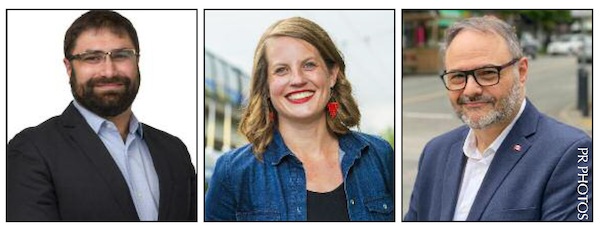
Jonathan Lerner, left, Christine Boyle and Dan Ruimy were among the winners in the recent municipal elections. (PR photos)
Municipal elections across British Columbia brought numerous surprises and a number of defeats for incumbent mayors, notably in both of the province’s largest cities.
Ken Sim defeated Kennedy Stewart, Vancouver’s incumbent mayor while, in a far closer race, Surrey’s mayor Doug McCallum was defeated by Brenda Locke.
Most of the community members featured by the Independent Oct. 7 were not successful in their races, with two exceptions.
Jonathan Lerner, a Jewish community member who has worked with organizations including the Vancouver Holocaust Education Centre, Hillel BC and Jewish Family Services, topped the polls on his first foray into elected office. He was elected to district council in Lantzville, which is north of Nanaimo.
Christine Boyle, who asked to be included in our coverage as part of a mixed family, was reelected to Vancouver city council as the sole successful candidate for the OneCity group, withstanding the onslaught of the overwhelming sweep by Sim’s ABC slate.
Former Liberal member of Parliament Dan Ruimy, a son of Jewish Moroccan immigrants to Canada, was elected mayor of Maple Ridge. He was inadvertently not included in our pre-election coverage.
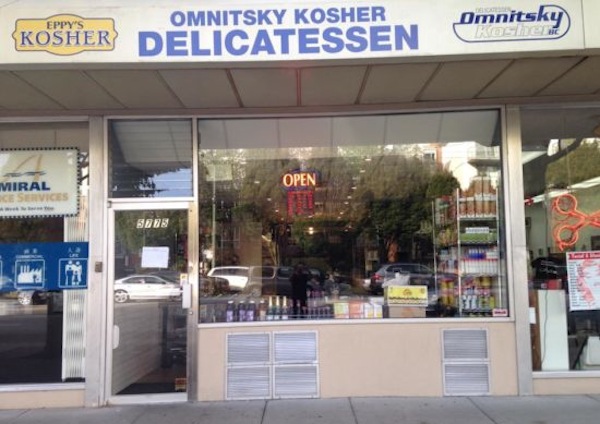
Omnitsky Kosher on Oak Street, just south of 41st Avenue. (internet photo)
There was a time – at least within the lifetime of older readers – when there seemed to be a kosher butcher on every corner of Winnipeg’s old North End. An exaggeration, maybe, but, in the 1930s, there were enough kosher butchers in Winnipeg to form their own shul. The last kosher butcher in Winnipeg – that would be Omnitsky’s – closed in 2008 and, at about the same time, fresh kosher slaughter also came to an end in the region.
Now, Omnitsky Kosher in Vancouver – the offspring of Omnitsky’s in Winnipeg, and the last kosher butcher in Western Canada – is also facing the prospect that the end is near.
“I love my business and the people I am able to interact with,” said Eppy Rappaport, the long-time owner of Omnitsky, “but I am getting tired. I am 65. I would never want to feel that my business is becoming an anchor pulling me down.”
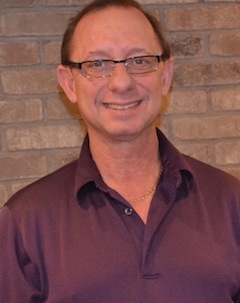
Eppy Rappaport, owner of Omnitsky Kosher, is looking to sell. (photo by Lauren Kramer)
The son of the late Elaine and Rabbi Shalom Rappaport (who is remembered fondly by two or more generations of Rosh Pina Synagogue families) was in Winnipeg the weekend before last for a family simchah and sat down with this reporter to reminisce about growing up in Winnipeg and his career as a kosher butcher, both in Winnipeg and Vancouver.
The Rappaport family arrived in Winnipeg in January of 1967, when Rabbi Shalom Rappaport began his 20-year tenure at Rosh Pina Synagogue.
“I was 10 years old,” Eppy remembered. “We were coming from San Diego. Morley and Shiffie Fenson met us at the airport with parkas, gloves and toques.
“I had been promised that I would have a lot of fun playing in the snow. I was really eager to build my first snowman – but quickly learned that snow in Winnipeg in January was not the right kind of snow for a snowman.”
The third of four siblings, Eppy, on arrival, was enrolled in Grade 4 at the Talmud Torah on Matheson and continued on to Joseph Wolinsky Collegiate at the same location to graduation in 1975.
Eppy has particularly warm memories growing up with members of the Benarroch family. “My brother, Danny, and I were close to all four of the Benarroch brothers – Yamin, Joseph (Yossi), Michael and Albert. They all felt like brothers to us,” he recalled.
“We grew up with the Benarroch kids,” Eppy said of him and his brothers and sister. “Our two families spent a lot of time together because of our shared religious observance. Every Sunday in the spring and summer, the Benarroch clan would spend the day at Birds Hill Provincial Park and we would always be included.
“Generally,” he continued, “I found the Jewish community in Winnipeg to be warm and loving. Even after having been away for 22 years, the social connections I made here remain strong.”
Eppy was studying sociology at university – working on his master’s at the time – when Bill Omnitsky approached Rabbi Rappaport about wanting to sell his kosher butcher shop. “Dad asked me if I would be interested in going into the business,” Eppy recounted. “I was planning on taking a year off from university in any case and decided to give it a try. I never looked back.”
Eppy joined Bill Omnitsky in business in 1973 and bought the store outright in 1983.
“Bill Goldberg was my first customer,” Eppy recalled. “I still have that first dollar from him.”
While the young kosher butcher may have loved Winnipeg, one feature he didn’t like was winter. Thus, in 1995, he turned Omnitsky’s in Winnipeg over to his older brother, Alan, who had previously joined him in business, and moved to Vancouver, where he opened Omnitsky Kosher, the only kosher butcher shop in the city. (Alan Rappaport subsequently ran into health problems and sold the store in 2002.)
“I was ready for my next challenge,” Eppy said of his decision to open a second Omnitsky in Vancouver. “People in Vancouver were welcoming. Many told me how much they appreciated having access to fresh kosher meat.”
While British Columbia’s Jewish population is around 30,000, the religious community, naturally, is much smaller. “Nonetheless,” he said, “people like quality products. Many of my customers aren’t Jewish. There are a lot of Muslims, for example, who shop at our store.”
In 2015, Eppy relocated, moving Omnitsky Kosher to a larger location in what used to be Kaplan’s Deli, which had closed after 55 years in business. In his new premises, Eppy also opened a deli.
While the government-imposed COVID restrictions of the past two years have been challenging for many small businesses, that has not played a role in Eppy’s desire to sell. “Our business actually thrived over the last two years,” he said.
Eppy doesn’t have a timeline yet. He said he doesn’t want to leave his customers in the lurch (that includes some members of the Winnipeg community who have organized to occasionally bring in by truck large orders from the Vancouver butcher shop). However, if he can’t find a buyer, at some point, he will have no choice but to liquidate the business.
While Eppy is contemplating divesting himself from his own business, he is not yet ready to retire completely. “I would like to keep working in the food business in some capacity,” he said. “I may be able to help other businesses from an operational perspective. That I consider my specialty.”
Incidentally, Eppy and his wife Ellen (the daughter of the late Albert and Sheila Lowe) have two daughters, Aviva and Lauren, who are both pursuing careers in the food sector. Aviva, the proud father reported, is working on a second master’s degree at McGill University in the field of dietetics, while Lauren works as a senior scientist for Starbucks in Seattle.
Myron Love is a freelance writer. This article was originally published in Winnipeg’s Jewish Post & News, jewishpostandnews.ca.
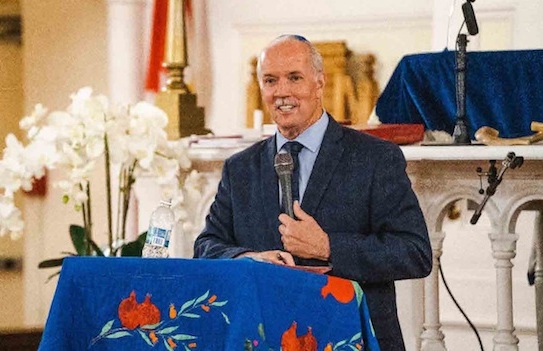
B.C. Premier John Horgan speaks at Congregation Emanu-El Synagogue in Victoria on the evening of Wednesday, Oct. 19. (photo from Jewish Federation of Victoria and Vancouver Island)
The Jewish Federation of Victoria and Vancouver Island and its partners, the Jewish Federation of Greater Vancouver and the Centre for Israel and Jewish Affairs, held a farewell reception to honour B.C. Premier John Horgan for his service. They shared their gratitude for the support, partnership and friendship of Horgan and his government. They commended the premier’s friendship with the Jewish community, and his resolve to fight racism and antisemitism, and to preserve the teachings of the Holocaust.
The Diamond Foundation is leading the way in contributing to JWest, with an historic $25 million gift – and community donors have matched this gift with another $25 million.
The Diamond Foundation’s matching gift is the first philanthropic contribution to the project and it is the largest donation ever made by the Diamond Foundation. Completing the match means $50 million toward the JWest capital campaign target of $125-plus million.
Alex Cristall, chair of the JWest capital campaign, had this response: “I want to thank the Diamond Foundation for this transformational gift. A project of this magnitude will not be possible without the tremendous generosity demonstrated by the Diamond Foundation, as well as philanthropic support from the community at large. It is our hope that the Diamond Foundation’s incredible community leadership will serve as inspiration, and we are now calling on others to work with our team to champion this project in an equally impactful way.”
The Diamonds’ gift will have a significant impact on the plans for JWest, providing a social, cultural, recreational and educational asset for all. This is the most extensive project in the history of the Jewish community in Western Canada and it is estimated to cost more than $400 million. Bringing it to life will require philanthropy, government funding and astute financing.
Gordon and Leslie Diamond, who are honorary JWest campaign co-chairs and members of the Diamond Foundation’s board, shared: “We are pleased to be the first family to make a significant contribution to JWest’s capital campaign. Our family has called Vancouver home for almost a century, and we have always believed in contributing whatever we can to ensure there is a bright future for our children and their children.”
The announcement builds on the $25 million funding provided in 2021 by the B.C. government.
“Mazal tov! I’m so pleased that our government’s shared mandate commitment of $25 million and a $400,000 investment in redevelopment planning has been bolstered with philanthropic support from the Diamond Foundation and community,” said Melanie Mark, Hli Haykwhl Ẃii Xsgaak, minister of tourism, arts, culture and sport. “These generous contributions underscore the importance of a renewed Jewish Community Centre to 22,590 Jews and all people living in this community. It speaks to the power of working together to shine a light on our province’s diversity and inclusion.”
The new space, once complete, will deliver a state-of-the-art community centre, expanded space for the Vancouver Holocaust Education Centre, double the current number of childcare spaces, expanded seniors’ programming, a new theatre, a relocated King David High School and two residential towers that will provide mixed-use rental housing (a portion of which will be below-market rates).
“JWest is the amalgamation of decades of work, and the fact that we saw our gift matched so quickly sends a clear signal that the community stands behind this project,” said Jill Diamond, executive director of the Diamond Foundation. “The Diamond Foundation has had a unifying focus to assist and advocate for initiatives in the Vancouver area that help improve the quality of people’s lives. The impact JWest will have on the Jewish community and the surrounding Oakridge community is undeniable.”
* * *
The Louis Brier Jewish Aged Foundation has added two new members to its board of directors: Mervyn (Merv) Louis and Michelle Karby. They join an impressive group of volunteers, who for the past decades, have donated both their time and funds to care for the elderly of the Vancouver Jewish community.
Mervyn (Merv) Louis (photo from Louis Brier Jewish Aged Foundation)
Louis, a certified public accountant, emigrated with his family from South Africa to Canada in December 1978 and joined a small accounting firm in Vancouver. In the summer of 1979, the firm was acquired by Grant Thornton LLP. In 2016, Louis retired as a partner of Grant Thornton LLP, where he worked for 38 years, of which 33 were as a partner specializing in audit, accounting and business advisory services. Louis advised and worked with clients in many different industries, including manufacturing and distribution, real estate investments and construction, entertainment, and professional practitioners.
After his retirement from Grant Thornton LLP, Louis worked as the chief financial officer of Plotkin Health Inc. and MacroHealth Solutions Limited Partnership until retiring again, in August 2020. During these years, he successfully helped merge a U.S. partnership and a Canadian company to form the parent partnership of MacroHealth Solutions Ltd. Partnership, a medical cost management and solutions provider in North America.
Louis has been married for 46 years and has two sons. He and his wife love to travel and are particularly fond of cruises; they have toured North America, Europe, Asia, Australia and Southern Africa. Louis is an avid sports fan and, while his playing days are over, he loves watching all sports, notably hockey, golf and rugby.
Michelle Karby (photo from Louis Brier Jewish Aged Foundation)
Karby is an experienced wills, estates, trusts and corporate lawyer heading up the wills and estates group at Owen Bird Law Corp. She helps clients plan, build and protect their legacies. Prior to developing her expertise in this area, Karby spent many years in and out of a courtroom honing her skills as a commercial litigator.
While born and raised in Vancouver, Karby’s adventurous spirit and love of travel translated into 18 years studying and working in places that included Montreal, Toronto, Israel, Cape Town, Melbourne and Sydney. Now settled in Vancouver with her husband and two teenage sons, Karby enjoys the beautiful natural environment, being close to her family and giving back to the community that she grew up in.
* * *
Kimberley Berger has joined Jewish Federation of Greater Vancouver as its new outreach worker in the regional communities. In particular, she will focus on White Rock, South Surrey and New Westminster.
Berger has worked in the nonprofit sector for more than 30 years, focusing on community development and family support. She has held many roles, ranging from frontline work to executive director of South Vancouver Family Place. She also dedicates time to supporting parents whose children are undergoing cancer treatment at B.C. Children’s Hospital with the West Coast Kids Cancer Foundation.
Berger believes that a strong sense of connection makes both individuals and communities more resilient. Building relationships is central to her role at Jewish Federation and in her own personal life with her family of four in East Vancouver.
* * *
This year, the Isaac Waldman Jewish Public Library raised more than $30,000 for the library. These funds will help it purchase new books and supplies for programs. Thank you to all of the Friends of the Library, and to the volunteers who helped make the fundraising a huge success.
* * *
Boys Town Jerusalem ranked in the top 10% of 838 high schools examined over the 2021-22 academic year. (photo from Boys Town)
The Israeli Ministry of Education has granted Boys Town Jerusalem an Award for Excellence. The school ranked in the top 10% of the 838 high schools examined over the 2021-22 academic year.
In releasing its findings, the Israel Ministry of Education cited Boys Town Jerusalem (BTJ) for reaching outstanding achievements in the academic and social realms, as well as for instilling crucial ethics and values. BTJ principal Yossi Cohen noted that the prize reflects the ministry’s findings of the extraordinary efforts by BTJ instructors to spur students to reach a high academic level, avoid dropout and advance to Israel Defence Forces enlistment and higher education.
This marks the third time in the past decade that Boys Town Jerusalem has been awarded the prize for excellence, and the first time in which the school has reached the top-echelon rank. The Ministry of Education Award for Excellence includes a monetary reward for teachers among the highest-scoring schools.
In saluting BTJ’s instructors, Cohen stressed the COVID-related hardships over the past two years, which have demanded exceptional efforts to keep students focused and excelling despite the increased illness, poverty and strife they face at home.
* * *
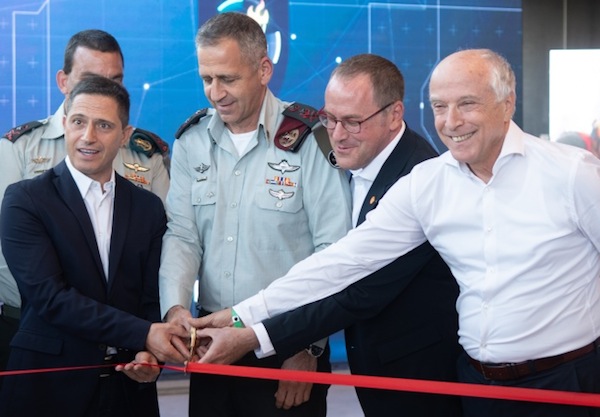
Cutting the ribbon, left to right, are Ruvik Danilovitch, mayor of Beer Sheva, Israel Defence Forces Maj.-Gen. Aviv Kochavi, Ben-Gurion University president Daniel Chamovitz and Avi Jacobovitz, Gav-Yam real estate company director general. (photo from Canadian Associates of BGU)
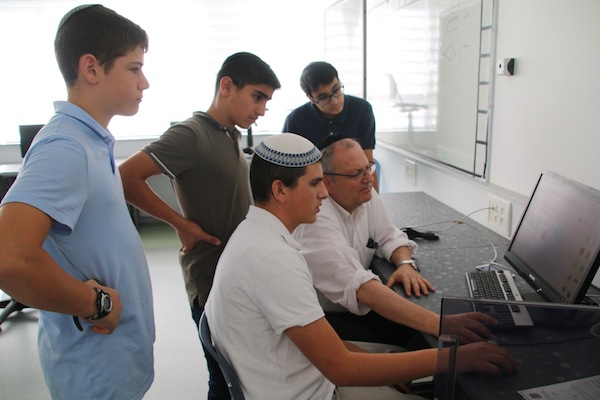
A ceremony dedicating the new home of the Israel Defence Forces (IDF) Communications Branch School for Software and Cyber Security was held in August at the Advanced Technologies Park (ATP) located at Ben-Gurion University of the Negev (BGU).
BGU president Prof. Daniel Chamovitz, IDF chief-of-staff Lt.-Gen. Aviv Kochavi, head of the communications branch Col. Eran Niv, Be’er Sheva Mayor Ruvik Danilovich and other officials and guests were in attendance.
The school’s new location will enable collaboration with BGU and the high-tech companies in the ATP. The school is the first of the communications branch units to move south as part of the national move to strengthen the Negev following the government decision to move the IDF south. The branch’s new main base is under construction alongside the ATP.
The move will assist in the preservation, development and empowerment of the technological human-power in the IDF while creating opportunities and a space for new collaborations in the south.
Adrienne Montani and Landon Pearson were honoured this month by the Janusz Korczak Association of Canada as the 2022 laureates of the Janusz Korczak Awards in Child Advocacy.
Jerry Nussbaum, president of the association, described the legacy of Korczak, a Polish Jewish pedagogue (born Henryk Goldszmit) whose final act was to accompany almost 200 orphans to the Treblinka death camp.
“He was devoted to children’s welfare and was a fierce advocate of loving the whole child,” said Nussbaum. “Dr. Korczak was a pediatrician, an educator, pedagogue, author, orphanage director for over 30 years, and a children’s rights advocate. His holistic approach to children’s well-being was at the time groundbreaking…. Korczak’s vision of child well-being embraced such principles as justice, dignity and equality. Korczak placed respect for the child at the heart of his vision to empower children and give them a voice in their own fate.
Korczak treated children with respect and love. This is what is often missing in the lives of children in government care.… Dr. Korczak’s legacy has never been more relevant than it is today.”
Pearson, a former senator and lifelong advocate for children, was awarded the Janusz Korczak Statuette in the virtual presentation ceremony Oct. 18. Prior to her 1994 appointment to the senate, she volunteered with local, national and international organizations concerned with children, including serving as vice-chairperson of the Canadian Commission for the International Year of the Child, in 1979. From 1984 to 1990, she served as president and then chair of the Canadian Council on Children and Youth. She was a founding member and chair of the Canadian Coalition for the Rights of Children.
In May 1996, Pearson was named advisor on children’s rights to the minister of foreign affairs and, in 1998, she became the personal representative of the prime minister to the 2002 United Nations Special Session on Children. In 2005, she retired from the upper chamber, where she was known as the “Children’s Senator.” The statuette is presented under the patronage of the lieutenant governor of British Columbia, Janet Austin.
Pearson called Korczak a hero of hers and lauded the memory of the man who rebuffed the Nazis’ offer to spare his life at the time when the German occupiers came to liquidate the orphanage he ran in the Warsaw Ghetto. Instead, Korczak walked with the 192 children to the deportation site from which they were transferred to Treblinka, where they were murdered together.
“I’m not sure I would’ve had the courage to do that,” Pearson said.
The former senator, who is to turn 92 on Nov. 16, thanked the Korczak Association of Canada for the honour. “The opportunity to be awarded something like this at the end of my long life is deeply moving for me,” she said.
Montani was awarded the Janusz Korczak Medal, which was presented in partnership with the B.C. Representative for Children and Youth.
Montani is the executive director of First Call Child and Youth Advocacy Society. Previously, she served as the child and youth advocate for the City of Vancouver, and was an elected trustee of the Vancouver School Board for six years, including three as its chair. She has worked extensively on issues of cross-cultural awareness and racism, women’s and children’s rights and the impacts of social exclusion on children and youth in low-income families.
“Elevating children’s rights to the civil and cultural priority they deserve has never been easy,” Montani told the event after she was presented the medal. “Children in B.C. are a declining portion of the population and don’t get to vote. They rely on us to speak up for them, to remember that they do have special entitlements…. The stakes are very high for them if we fail to give them the care and support they need during their childhoods. Of course, if we teach children that they have rights and [teach] society as a whole about child rights, children will be better equipped to exercise their participation rights. Parents and families will be better equipped to play their role as champions for their children and to claim their own rights, which are also in the UN Convention [on the Rights of the Child], to the supports that they need in child-rearing, whether it is adequate income, quality child care, affordable housing [or other] basic needs.”
Montani said Canada and adults elsewhere have too often come up short. “With the best of intentions, we have created a complex and very fragmented system that is full of barriers, such as waitlists and fee structures and referral systems and narrow eligibility requirements,” she said. “It’s hard for a seasoned service navigator to understand it, let alone a parent in need or in crisis. We have done this not because we want to frustrate parents or deny children services, but because we operate in a social and political environment where values other than giving children first call on our collective resources have gained ascendance. As a community, we have not lived up to our commitments in the UN Convention on the Rights of the Child to make the best interests of children a primary consideration.”
Lillian Boraks-Nemetz, a child survivor of the Holocaust and a board member of the Korczak association, emceed the event. She read a poem by Korczak, which she had translated into English, called “A Teacher’s Prayer.”
Boraks-Nemetz recounted her connection with the legendary doctor. They were incarcerated together in the Warsaw Ghetto and her father was friends with Korczak and assisted the doctor to obtain food for the orphans. Boraks-Nemetz visited the orphanage with her father one day and, while Korczak was not present on that occasion, she got to know him later in life through his writings, she said.
Dr. Jennifer Charlesworth, British Columbia’s Representative for Children and Youth, spoke at the event and participated in the awarding of the medal and statuette. She was joined in the presentations by Dr. Christine Loock, Dr. Anton Grunfeld, Ron Friesen and Nussbaum.
Melanie Mark, B.C. Minister of Tourism, Arts, Culture and Sport, who was the inaugural recipient of the Korczak Medal, in 2016, congratulated the honourees. Mark was the first First Nations woman elected to the B.C. Legislature and remains the only First Nations woman to have served in cabinet. She described how both Pearson and Montani had profound impacts on her life through their shared commitment to fighting sexual exploitation, particularly of young Indigenous women.