Skip to content
  • Home
  • Subscribe / donate
  • Events calendar
  • Business Directory
  • FAQ
  • News
    • Local
    • National
    • Israel
    • World
    • עניין בחדשות
      A roundup of news in Canada and further afield, in Hebrew.
  • Opinion
    • From the JI
    • Op-Ed
  • Arts & Culture
    • Performing Arts
    • Music
    • Books
    • Visual Arts
    • TV & Film
  • Life
    • Celebrating the Holidays
    • Travel
    • The Daily Snooze
      Cartoons by Jacob Samuel
    • Mystery Photo
      Help the JI and JMABC fill in the gaps in our archives.
  • Community Links
    • Organizations, Etc.
    • Other News Sources & Blogs
  • JI Chai Celebration
  • JI@88! video

Recent Posts

  • Federation now across BC
  • Israel fighting for its existence
  • Deal strengthens Iran
  • Patriotic belonging diminishes
  • A campaign to engage
  • Upstanders’ first live event
  • Responding to Carney
  • Having your own home
  • Music a family tradition
  • Musical to warm heart
  • Community milestones … June 2026
  • Sharing her passion for Israel
  • Or Shalom reopens its doors
  • JFS from past to future
  • Need holistic approach
  • Sharing stories, advice
  • Journalist shares fears
  • Skills to live together
  • Road to independence
  • Cutting grass with scissors
  • Zionism as a solution
  • Deceit, desire & the divine
  • Reclaiming sacredness
  • Creative project ideas
  • Summer squares and cobbler
  • Thou shalt … summer commandments
  • Legal help for students
  • Revisiting myth of Lilith
  • Wrong person rebuked
  • Canada’s mixed messages
  • Questions for museum
  • Symposium on antizionism
  • Making soccer political
  • CJPAC lauds Pulver’s impact
  • City recognizes Vrba’s legacy  
  • Organ donation saves lives

Archives

Follow @JewishIndie
image - CJN box ad Rockowers 2026

Category: Local

Wosk, Lederman honoured

Wosk, Lederman honoured

ORT Vancouver will honour Rabbi Dr. Yosef Wosk and Shelley Lederman on Oct. 18 at Congregation Schara Tzedeck. (photos from ORT)

For nearly 140 years, ORT has been equipping people around the world with skills to succeed. The history of the organization in Canada is being celebrated at a gala luncheon next month honouring Rabbi Dr. Yosef Wosk and Shelley Lederman.

The Vancouver region of ORT began in the 1970s and was led by Lederman, who served successive terms as president of the local region and later became co-president of ORT Canada. Carrie Katz, who was Lederman’s co-president, will be the keynote speaker at the event on Wednesday, Oct. 18.

ORT (a Russian-language acronym sometimes translated as the Organization for Rehabilitation through Training) is the world’s largest Jewish education and vocational training nongovernmental organization. Beginning in Russia in 1880, World ORT now operates in 37 countries and engages 300,000 students per year. Originally focused on developing skilled trades among the people, the organization now focuses on high-tech education.

It is ORT’s origin and history – and his own family’s roots – that attracted Wosk to support the organization.

“My father’s family is from Odessa, so I felt a personal connection to the history of the organization and the people they help,” Wosk told the Independent. “Also, the appreciation for the memory of the Jewish community who would not abandon others who needed assistance.”

ORT is founded on the axiom that if you give a man a fish he will eat for a day but if you teach him how to fish he will eat for a lifetime. This is another factor that appealed to Wosk.

“What I was impressed with historically was that it’s not just giving funds,” he said. “It was also educating the people, whether in agriculture or trades and other skills, so that they would be able to eventually help take care of themselves and sustain themselves.”

Local regions, like Vancouver’s, raise funds for ORT educational initiatives in Metro Vancouver, in Israel and around the world.

When Lederman was founding president of the region, there were actually three local branches created, including a Hebrew-speaking group and a Spanish-speaking cohort.

“We created a very strong organization here in Vancouver,” said Lederman, adding that local regions support vital initiatives worldwide, projects that change according to needs over time.

“When people were under duress in Europe during the war and they couldn’t sustain themselves, ORT teachers taught them how to survive as tailors, electricians, as plumbers,” Lederman told the Independent. “And then, in Israel, ORT schools continue to do the same thing. They are teaching those who weren’t going to university but who wanted to come out of high school and be able to support themselves and their families. ORT schools provide education plus trade teachings.”

While she herself did not go to an ORT school, she saw the good works the organization does while growing up in Israel. Being honoured by the organization now means a lot, she said.

“It means a lot because being recognized by your friends and fellow members is really a recognition of all of us,” she said. “By recognizing one person, it’s recognizing the many people who contributed to the success of ORT in Vancouver.”

photo - The honourary chair of the Oct. 18 ORT gala is Dr. Saul Isserow
The honourary chair of the Oct. 18 ORT gala is Dr. Saul Isserow. (photo from ORT)

The theme of the gala is Building Minds Through Inspiration. While ORT began as an educational body teaching skilled trades and crafts, it is now a leader in high-technological training and education. Keeping with this commitment, a percentage of the revenue from the gala will support an ongoing Smart Classrooms initiative at Richmond Jewish Day School (RJDS), as well as provide scholarships for students at the Technological College of Beersheva, in Israel.

Smart Classrooms integrate learning technologies that allow increased interactivity. “The investment by ORT is about allowing Jewish day schools and Jewish schools in Israel to keep pace with technology,” said Abba Brodt, principal of RJDS. “It allows us to marry the best of educational practice with the best of technology for the best possible outcome for students.”

Without the Smart Classrooms funded by ORT, he said, “our students will get a great education but would not be as technologically literate as they should or could be, and they would not be keeping up with changes.”

The gala luncheon takes place at on Oct. 18, 11 a.m., at Congregation Schara Tzedeck. Honourary chair is Dr. Saul Isserow. Master of ceremonies will be Howard Jampolsky. Tickets are available from 604-276-9282 or [email protected].

Pat Johnson is on the organizing committee for the ORT gala.

Format ImagePosted on September 29, 2017September 28, 2017Author Pat JohnsonCategories LocalTags education, ORT, Shelley Lederman, Smart Classrooms, technology, tikkun olam, Yosef Wosk
New look for campaign

New look for campaign

(image courtesy of Jewish Federation of Greater Vancouver)

Jewish Federation of Greater Vancouver’s annual campaign has a brand new look this year, one that will hopefully convey an important message to the community.

“We’d exhausted photographic resources we’ve used in past years and things weren’t looking fresh anymore,” said Alvin Wasserman, a volunteer on Federation’s working cabinet.

Past years have featured photography, but finding those photographs had always presented a challenge. “When you’re talking about housing or food security, people are naturally reticent to be shown,” he explained. “Often we were scrambling for stock photography or images that other federations have used, and that wasn’t as representative of our community as we wanted it to be.”

When the cabinet read the campaign brief that Federation put together this year, the group realized the theme was the existential issues our community is facing. “The brief was about people’s inability to connect with Jewish life because of the high cost of living or because they were moving further outside of the core,” Wasserman told the Independent. “It was about Jewish people having to make serious choices about buying groceries or being involved in Jewish life, so we decided the new look for the campaign should be an illustration, which is an allegory through which you can tell stories.”

This is a pivotal year for the community, added Al Szajman, who has served as marketing chair for the past nine campaigns and helped develop the marketing and communications strategy. “Certainly, the different look helps draw attention to our very focused messaging this year.”

The messaging centres on the importance of maintaining our Jewish community, particularly in the face of the cost of living in Vancouver. “Everybody who resides locally understands that, if you’re living in Vancouver, costs are crazy,” Szajman said. “It’s very hard for many in our community to deal with those costs, plus having the incremental costs of trying to live Jewish and be connected to the community through various services and events. This campaign is about finding ways to help our partner agencies provide services to people locally and make opportunities available at lower rates than otherwise might be available.”

He noted that up to half of the Jewish community of the Lower Mainland now lives outside of Vancouver in cities including Surrey, Delta, Langley, Burnaby, Maple Ridge and Coquitlam. “A lot of these areas don’t have easy access to Jewish services, a Jewish connection. This whole notion of affordability and access is critical,” he noted. “If we’re not a community, what are we? We’re nothing.”

Shelley Rivkin, Jewish Federation of Greater Vancouver vice-president, said the campaign exists to fund solutions that keep people connected. “If we want to have a strong community, we need to make it easy for people to participate, whether they’re living in places like Abbotsford or Squamish and come to the programs we and our partners now offer there, or whether they’re overwhelmed by the cost of living in Vancouver and need more robust subsidies. At the heart of it, there is a sense that we as Jews need each other and we are meant to be a part of a community. That’s what we needed to convey this year.”

Illustrator Paul Gill created the illustration, a Star of David comprised of a community where a couple of people are falling off the edge of one of the triangles. “It describes the issue in a really interesting manner,” said Wasserman, who worked with a creative team that included Kelsey Dundon, Camilla Coates and Becky Saegert. The video in honour of Federation’s 30th anniversary, which was screened at the campaign launch Sept. 13, was produced by Eli Gorn. For more information, to watch the video or to donate to the campaign, visit jewishvancouver.com.

Lauren Kramer, an award-winning writer and editor, lives in Richmond. To read her work online, visit laurenkramer.net.

Format ImagePosted on September 29, 2017September 28, 2017Author Lauren KramerCategories LocalTags affordability, Al Szajman, Alvin Wasserman, annual ca, Jewish Federation
Krembo Wings unites

Krembo Wings unites

Members of Krembo Wings’ Kiryat Shmona branch enjoy one of the weekly activities. (photo from Krembo Wings)

Claudia Koby co-founded Krembo Wings, the only youth movement open to all youth, regardless of ability level. It was her son, Kfir, who inspired her – seeing him battle severe disabilities and his intense desire to be part of society at large.

Kfir’s friendship with a girl without disabilities changed his and his family’s life to such a degree that his mother decided to find a way to give other kids with disabilities and their families the same simple but incredible gift.

Krembo Wings was established in 2002, growing to 11 branches serving 300 kids by 2010. That was when Merav Boaz (affectionately nicknamed “Boozy”) joined as vice-president. To date, the movement has 61 chapters.

“I knew I could give a lot from my knowledge and experience, to make the movement known in the public eyes and ears … a new idea that was not in existence in Israeli society before,” Boaz told the Independent. “I wanted everybody to know what the Krembo Wings are doing, to see how well they change the world and society. It was like a fire in my heart.

“When I joined, almost no one knew about Krembo Wings…. Today, the movement has 6,000 kids involved – from the special needs kids to the able kids that help them be part of a life-changing movement.

“It’s the kids who run the branches, guided by adults. We give them the power to do so. It’s a lot of thinking to make it happen – to do the seminars really productively, to make them understand they can create their own reality. I think that, because of the kids, we’ve made this breakthrough, this change. From a local initiative, we became a national youth movement.”

When someone has a child with a disability, said Boaz, one of the parents usually stops working and starts taking care of the child, “they look for treatment and doctors to make things better.”

When the parents take their child to register in kindergarten, she said, “They tell you he doesn’t fit, that he can’t be with other children – the ‘regular,’ ‘normal’ children – because of the disability. From this point on, you have a kid who leads a different life within the shawl of society. They don’t belong and are not a part of the kids’ society – don’t go to school with their brothers and sisters, don’t enjoy the after-school programs…. A lot of the parents don’t take the kids outside to the mall or to cafés because of their different behaviour, like slapping hands or making noises. You feel that it’s not right that you’re there…. All of a sudden, you have a kid who doesn’t have a right to take part.”

Often, children in this situation are sent to a different school. In Israel, the school is usually not in the same neighbourhood or city where they live. So, they do not make many friends and, when they become adults, few people will hire them, because no one knows them.

“Why are we so surprised that no one will hire a person with a disability?” asked Boaz. “They don’t know how, were never shown how. We want to change that one day.

“I think the next school established in Israel will be a school with kids of all abilities. We won’t have special education schools separated…. We want the kids to go to the same school and do after-school programs…. When they grow together, they will live together in the same community and care for one another. Then, it won’t be hard for a hospital, for example, to hire a secretary who is blind.”

The disability does not need to – and should not – define the person, she said. And this is where Krembo Wings helps.

“It’s good for them to know other kids, to know and develop social skills, and be part of society,” said Boaz. “How would they know how to behave in a café or at a playground if they’ve never even tried it, practised it, because they’re separated?”

Boaz shared the story of a dad from Krembo Wings’ summer camp who has twin girls, one of whom was born with cerebral palsy and has difficulty walking, so she uses a wheelchair.

“When they go out together, nobody would even notice or try to talk to the twin in the wheelchair, because – automatically – people think she’s not well in her brain,” said Boaz. “Nobody is patient enough to talk to her. No kid stops to get to know her. But, at Krembo Wings, everyone knows her. She has so many friends now, but never in her life did she have friends before. She says, ‘Krembo Wings is my life. It’s where I’m loved by other kids.’”

When kids come to Krembo Wings once a week, they feel a sense of belonging, they sing songs and play together.

“When you accept, you don’t hate. When you don’t judge, you’re tolerant of others, you become more forgiving.”

“You can see how they don’t judge, they include – not because the teacher told them and not because they read it on the walls of the school,” said Boaz. “They practise it and it becomes a part of their souls, lives and values. When you accept, you don’t hate. When you don’t judge, you’re tolerant of others, you become more forgiving.”

The children without disabilities help ensure that their mentees take part in activities. “They learn to be creative, to work with the ability that each person has,” said Boaz, and this “improves their skills and their school success. They are better friends to … friends, to their parents. It’s amazing. Imagine them as grown adults in society – they will care more.”

Parents of children who aren’t able to communicate at Krembo Wings say how big the impact is – their kids do better at school, have more self-esteem and improved communication – from being in an environment of acceptance.

“I had a 16-year-old counselor, able-bodied, who wrote an email saying that, at school, they asked him to write an essay about the person who has influenced his life the most,” said Boaz. “And, he was thinking of his grandfather, a Holocaust survivor, who was a kid when the Nazis came to Poland. He lost all of his family, but he survived. Then he thought about his mom, who had breast cancer – a survivor, too. But, he decided to write about [another] person who influenced his life, because he learned from him what the meaning of being a hero is – of knowing how to deal with tough situations, to be resourceful, smart, full of life and always positive. That person’s name is Don and he’s 10 years old. He has severe cerebral palsy. He tries every day to get up and walk. He tries to practise how to talk with a speech therapist every day, because he wants to be understood. The 16-year-old said that Don taught him the most how to be a hero – disability or not.”

For brothers and sisters of children with special needs who are in Krembo Wings, Boaz said, “They say that, for them, it’s the first time they’re not ashamed to be the brother or sister of a kid with a disability. One girl wouldn’t invite people to her house. Her brother would make gestures no one could understand. She said she prevented her friends from coming to her house. She didn’t want them to know. With Krembo Wings near her house, the youth came to meet him and she saw two girls her age, able-bodied, good-looking, popular, talking to her brother, communicating. She said she was shocked. When her brother started going to Krembo Wings, he came back so relaxed, so happy, like he had had a break. She felt it – the missing piece in his life was filled…. When she came to Krembo Wings and joined in, she had members to mediate activities and, through her connections to another mentee child, she got closer to her own brother…. She learned how to communicate, to be tolerant, to listen – and that it’s OK if he’s like that…. She now knows he has the right to be a part of society and she has the tools to help change things…. More than they have a right, there’s so much they can give to society.

“We believe this change starts with kids. But, it also changes the parents … these same parents who had problems finding a kindergarten. As one of the mothers shared, for the past 15 years, she has been told how her kid does not fit in anywhere, yet no one could tell her where he does fit. All of a sudden, there are Krembo Wings … kids pleading with her to let them take her son to an activity. We pay for transportation, pick them up for three hours and return him satisfied, happy.

“I saw a mother crying, saying the counselor told her she could go do whatever she wanted to do, that they would take care of her kid. She said, ‘I don’t remember what I like to do, how to be alone without her … I’m always taking care of everything … I don’t have friends anymore.’ It changes [a] parent’s life as well.”

“This platform is not only good with or without special needs, it’s good for any society. If it’s not Jewish and Arab, it’s Bedouin and Christian. The kids get tools and values they need. It just happens. It’s more natural for kids than separation.”

When Krembo Wings wanted to open a branch in Lod, city officials recommended they open two branches to avoid mixing Arabs and Jews, but Krembo Wings refused, saying they do not believe in separation of any kind. The city officials conceded and said they could try, but to not expect it to work.

“We opened one and it was a big success,” said Boaz. “So, this platform is not only good with or without special needs, it’s good for any society. If it’s not Jewish and Arab, it’s Bedouin and Christian. The kids get tools and values they need. It just happens. It’s more natural for kids than separation.”

The Vancouver connection

The Kiryat Shmona branch was started in the nearby mechina (pre-army training program) in kibbutz Maayan Baruch before the Jewish Federation of Greater Vancouver took it under its wing, providing space in Kiryat Shmona’s Beit Vancouver for the branch to run its activities. The Federation has also provided funding of $26,000 a year for the last two years.

“They were so sensitive toward the kids’ needs and really understood,” said Boaz. “When you have donors, sometimes the donor – out of good will – starts interfering with the way you deal with the activity or the money or whatever – but Vancouver never did that.”

According to Candace Kwinter, chair of Jewish Federation’s Israel and overseas committee, “Krembo Wings is an incredible program. It enables every child living with any type of disability to take part in enjoyable social interactions between one another and their able-bodied peers and become part of community life in Israel. As a federation, we’re proud to support this program, which is based in Beit Vancouver, and empower both the participants and the volunteers.”

Kwinter quoted one of the mothers of Krembo Wings in Kiryat Shmona, whose daughter has Rhett syndrome. “When Tom was invited to join Krembo Wings,” said the mother, “I tried to explain to the young counselors that it’s difficult to interact with her…. She doesn’t speak and interactions are complicated…. They continued smiling and said that they believe it will be worth our while, that the activities are fun and there are a lot of other children and youth at the branch, with and without disabilities. I said yes, even though I was confident they would give up quickly.

“Today, after Krembo Wings has been in our lives for almost two years, I can confidently say that, where therapists and professionals failed, a group of motivated youth filled with faith and love have succeeded. They have filled Tom’s life with happiness, friends, laughter and songs – and have made our lives infinitely better…. It is an essential part of our family.”

Even with a budget of 22 million shekels (more than $7.7 million Cdn) and 61 branches, Krembo Wings has long waiting lists and not enough money to open new branches. Half of its revenue comes from the Israeli government and municipalities and the fees they collect from members who are able to pay; they subsidize everyone who cannot pay. The other half of the budget comes from fundraising. For more information, visit e.krembo.org.il.

Rebeca Kuropatwa is a Winnipeg freelance writer.

Format ImagePosted on September 29, 2017September 28, 2017Author Rebeca KuropatwaCategories Israel, LocalTags Candace Kwinter, disabilities, inclusion, Israel, Jewish Federation, Krembo Wings, Merav Boaz
JSA AGM honours volunteers

JSA AGM honours volunteers

Karon Shear was one of the volunteers honoured at the Jewish Seniors Alliance AGM on Sept. 14. (photo by Alan Katowitz courtesy of Jewish Seniors Alliance)

The annual meeting of the Jewish Seniors Alliance was held on Sept. 14 at Congregation Beth Israel. The business meeting was followed by a dinner and awards ceremony.

The business portion of the evening was called to order by JSA president Ken Levitt. Prior to the presentation of committee reports, a number of organizations offered greetings. A d’var Torah was delivered by Beth Israel’s Rabbi Jonathan Infeld, who emphasized that, according to Jewish law, we are not to cast aside seniors as they are at the heart of the community. And both Ezra Shanken, chief executive officer of the Jewish Federation of Greater Vancouver, and Gudrun Langolf, acting president of the B.C. Council of Senior Citizen Organizations (COSCO), also said a few words.

Following the approval of the agenda and the minutes of last year’s AGM, Larry Meyer delivered the treasurer’s report. He outlined the various funding sources of JSA – government, corporate and private grants, as well as the $18 annual fee from members/supporters. He also listed the programs this money supports, such as peer counseling, Senior Line magazine, the fall symposium, the spring forum and the Empowerment Series, as well as the website, jsalliance.org.

Pamela Ottem, chair of the Peer Support Program, outlined the various aspects of the service. Peer counselors are required to take 55 hours of training prior to being assigned a client. They are given ongoing support in their work by Grace Hann, who is also the trainer, and Charles Leibovitch, who is a social worker. It takes 15 hours of training to become a Friendly Visitor. These volunteers visit shut-ins and lonely seniors; another part of the program is friendly phone calls and service information and referral. The peer support program has 56 trained volunteers serving 70 seniors.

The JSA’s Ambassador Program, whose goal is to raise awareness of elder abuse, started with a one-year grant and has been incorporated into the other offerings. Hann, Leibovitch and some of the volunteers make presentations to other seniors groups about their activities.

Binny Goldman reported that JSA has 596 members/supporters, of whom 320 are individual members, 150 are members of the Most Russian Bridge group and 21 are from affiliate organizations.

photo - Debbie Rozenberg, left, and Sylvia Yasin
Debbie Rozenberg, left, and Sylvia Yasin. (photo by Alan Katowitz courtesy of JSA)

In Levitt’s president’s report, he briefly reviewed the activities of the JSA, emphasizing that the organization would not exist if it were not for the active involvement of its volunteers. He pointed out that the peer support program alone, if it were carried out by paid staff, would cost much more than JSA’s total budget. He thanked everyone, both staff and volunteers, who have worked so hard and contributed so much over the past year.

Marilyn Berger presented the report of the nominations committee. She read out the slate for the coming year and moved for acceptance. Two former board members were mentioned, Edith Shier, who has passed away and was the previous editor of Senior Line, and Milton Adelman, who has retired from the board but was for many years the treasurer of JSA. Levitt then called for the adjournment of the business part of the evening and everyone was invited to move to the tables for dinner, volunteer recognition and musical entertainment.

Jazz singer Jill Samycia entertained the approximately 150 dinner guests, after which came the awards presentations to volunteers. As has become JSA’s custom, several organizations were asked to nominate senior volunteers who have spent time and energy enhancing the goals of their organizations.

Karon Shear, who was coordinator and administrator of JSA from 2005-16, was nominated by JSA. Her service to seniors, and enthusiastic marketing, played a vital role in the development and growth of the organization. In presenting her with the award, Serge Haber described her as the heart and soul of JSA. He spoke of the countless hours she spent, off the clock, on weekends, working at home; how she produced the Senior Line magazine basically on her own for a time.

photo - Nassa and Arnold Selwyn
Nassa and Arnold Selwyn. (photo by Alan Katowitz courtesy of JSA)

Sylvia Yasin was nominated by the Jewish Family Service Agency. Yasin has volunteered for many years with the Jewish Food Bank and was instrumental in creating relationships with various groups and individuals and obtaining ongoing donations of supplies for school-aged children. She was presented with her award by Debbie Rozenberg, who noted that Yasin began volunteering while still working full time. Yasin has been involved with the Terry Fox Run and with ORT. Among other things, she organized the gift wrapping in shopping malls that raised funds for ORT. She also helps set up and clear for the seniors lunches at the Kehila Society and is still involved with the Jewish Food Bank.

Nassa and Arnold Selwyn were nominated as a couple for their longtime volunteerism at Congregation Beth Israel. Infeld talked about Arnold’s singing for the congregation and Nassa’s beautiful sewing of the parochet (ark curtain) and the siddur covers. Together they bring holiness into the world, said the rabbi. Both of them act as greeters and have been part of many other committees. They are also active in the general community and are part of Showtime, an entertainment group of seniors.

All of the honourees expressed their thanks and appreciation to JSA and the nominating organizations. The message to all was, volunteer whenever you can and wherever you can – it will bring you feelings of fulfilment and joy.

Samycia performed again, during dessert, and a number of the guests got up and danced to the music. The evening ended with a draw for door prizes.

Barbara Bronstein and Larry Shapiro were co-chairs of the event.

Tamara Frankel is a member of the board of Jewish Seniors Alliance. Shanie Levin, MSW, worked for many years in the field of child welfare. During that time, she was active in the union. As well, she participated in amateur dramatics. She has served on the board of the Jewish Federation of Greater Vancouver and is presently on the executive of JSA and a member of the editorial committee.

Format ImagePosted on September 29, 2017September 28, 2017Author Tamara Frankel and Shanie LevinCategories LocalTags Beth Israel, Jewish Family Service Agency, Jewish Seniors Alliance, JFSA, JSA, seniors, volunteerism
Housing, high-tech, musicals and more – this week in the community

Housing, high-tech, musicals and more – this week in the community

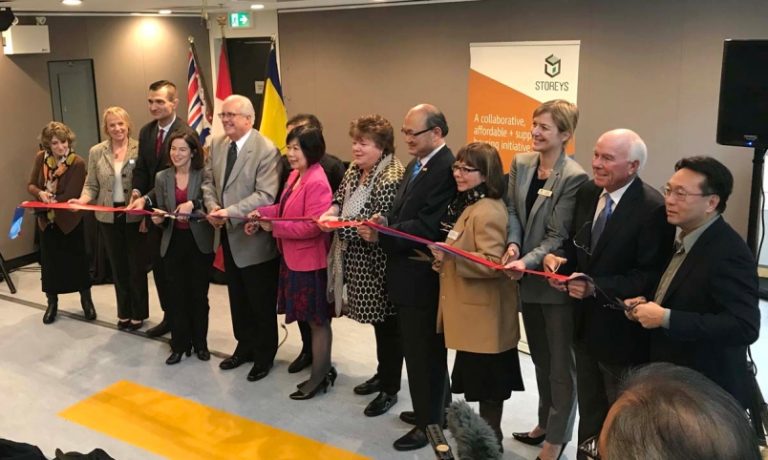
Tikva welcomes residents: The Storeys Complex in Richmond. (photo from facebook.com/tikvahousing)

We are taught from an early age that giving, repairing the world and being kind are the tenets of living a Jewish life. In our community we don’t have to look very far to find people who fit this description. One of the latest projects that has come to fruition is the Diamond Residences in the Storeys complex in Richmond. Thanks to the generosity of the Diamond Foundation, Tikva Housing Society now owns 18 (chai!) units that are being rented at below-market rates to people in the community for whom stable, safe housing was unpredictable and unaffordable, at best.

Tikva Housing partnered with four nonprofit societies and the City of Richmond to build these and other apartments. Tikva worked hand in hand with community agencies such as the Jewish Family Service Agency to place tenants in need in these units, as well as with the Jewish Federation of Greater Vancouver and B.C. Housing. Most of the tenants will have moved into their units by the end of this month.

The Diamond Residences will house six singles and, of those, five are seniors. Also, 12 families and a total of 22 children will be living there. One 83-year-old woman cried when she was told she would be moving into a studio unit, as she has not had a place to live for years and was sleeping on someone’s couch. A single Israeli mother with two children is moving into a three-bedroom unit; her kids have never had their own rooms. Another single mother with three children has been sharing a two-bedroom place and has not had her own room in two years. One family has moved to Greater Vancouver from out of town and can now attend Shabbat services, be close to their family and the Jewish community. There are many more such stories.

 – Courtesy of Tikva Housing Society

* * *

Simon Fraser University recognized four distinguished alumni on Sept. 13 at Four Seasons Hotel. Among them was Gary Cristall, co-creator of the Vancouver Folk Festival.

The annual awards, presented by SFU and the Alumni Association, recognize those whose accomplishments and contributions reflect the university’s mandate of engaging the world. An advocate for the arts and human rights, Cristall has been a cultural groundbreaker, having co-founded the Vancouver Folk Music Festival in 1978. In an industry plagued with an unscrupulous reputation, Cristall has been instrumental in fighting for the rights of artists to be treated professionally and with respect while also defending their rights to fair performance fees and copyright ownership.

Cristall served as acting head of the music section of the Canada Council for the Arts and was the founding president of the Public Service Alliance of Canada, the first union at the Canada Council. Today, Cristall continues to serve as a prominent mentor and educator, assisting artists in building their careers and guiding communities in enhancing dynamic cultural interactions that enrich and benefit a healthy, democratic society.

* * *

After a grueling 33 hours of programming, DragonFruit – Benjamin Segall, Jacy Mark, Viniel Kumar and Pritpal Chauhan – completed StoryTree and demonstrated it live to a panel of judges at Hack the North, an international student hackathon held at the University of Waterloo in Ontario, which this year took place Sept. 15-17.

Canada’s biggest hackathon, Hack the North was founded and is organized by Techyon, a student-run nonprofit organization, in partnership with Waterloo Engineering. The event brings together 1,000 students from top universities across 22 countries in the world. Students collaborate and create impactful new hardware projects or mobile and web applications of their own design for a weekend at the University of Waterloo, all expenses paid.

DragonFruit’s StoryTree was one of the 14 projects chosen out of the more than 250 demonstrated at Hack the North. StoryTree is an online workspace for aspiring authors to collaborate on books together. All you have to do is write a paragraph or a chapter, or even just a sentence, and, as more and more people add or branch off from a story, that story you’ve always wanted to write becomes a reality.

DragonFruit will be continuing the project and are looking for alpha testers for January 2018. If anyone is interested in being a part of this project or for more information on it, contact them via facebook.com/dragonfruitcode or dragonfruitcode.com.

* * *

photo - Swinging Sylvia rehearsals: Advah Soudack and Sky Kao create a whirlwind of action in rehearsal of the second one-act play that comprises Two Views from the Sylvia
Swinging Sylvia rehearsals: Advah Soudack and Sky Kao create a whirlwind of action in rehearsal of the second one-act play that comprises Two Views from the Sylvia. (photo by Sue Cohene)

 Rehearsals have started for Two Views from the Sylvia, a new musical theatre production by Kol Halev Performance Society. This original production – which will be at Waterfront Theatre Nov. 8-12 – tells the story of the iconic Sylvia Hotel and its historic connection to the local Jewish community and the city of Vancouver.

Two Views from the Sylvia comprises two one-act plays.

The first play, Sylvia’s Hotel, is set in Vancouver in 1912. It brings to life the origin of the Sylvia Hotel, named for Sylvia Goldstein (Ablowitz) and the story of the Goldstein family who built it. Young Sylvia Goldstein and the legendary Joe Fortes, the beloved English Bay lifeguard, develop a bond that helps Sylvia realize her dreams.

In the second play, The Hotel Sylvia, the story continues as we meet the characters whose lives and loves became interwoven with the story of the Sylvia over her 100-year history. It includes vignettes revealed to the production’s researchers by Huguette, the front desk clerk who worked at the Sylvia for 35 years.

Jewish community members play key roles in both plays. In the lead roles are Advah Soudack (as Sylvia) and Adam Abrams (as Abraham Goldstein); Anna-Mae Wiesenthal and Joyce Gordon are cast in important supporting roles. Behind the scenes are Sue Cohene (producer) and Heather Martin (associate producer), as well as Gordon (assistant producer) and Abrams (graphic designer and webmaster) and Gwen Epstein (production team). Marcy Babins and Michael Schwartz collaborate in their roles at the Jewish Museum and Archives of British Columbia, which has created an historical photo display to accompany the production.

Two Views from the Sylvia is a project of Kol Halev in partnership with the B.C. Arts Council, Government of British Columbia, City of Vancouver, Granville Island Cultural Society, CMHC Granville Island and the JMABC. For information and tickets ($28), visit sylviamusical.com.

– Courtesy of Kol Halev

 * * *

Bema Productions’ Victoria Fringe Festival play Horowitz and Mrs. Washington was a great success. All seven performances at Bema’s Black Box Theatre at Congregation Emanu-El were sold out and the production company’s work was once again as one of the best dramas in the Victoria Fringe.

photo - Bema Productions’ Victoria Fringe Festival play Horowitz and Mrs. Washington was a great success
Bema Productions’ Victoria Fringe Festival play Horowitz and Mrs. Washington was a great success.  (photo from Bema)

Mrs. Washington is hired to nurse Sam Horowitz, who’s been mugged and had a stroke. She’s a determined tyrant and he’s a bigoted Jewish widower. The two must find a mutually beneficial relationship when his daughter tries to make him leave his home. The play by Henry Denker reflects the attitudes of the 1970s and illuminates the power to be found in ordinary lives.

“The electric performance of the actors enabled the audience to visit uninhibitedly the issues of racism, stroke recovery and aging in place,” reads the review “Bravo Bema!” on Emanu-El’s website.

“For the most part,” said the review, “the actors were provided with a very humorous script that relied on stereotyping but went beyond it for its punchlines. The audience was asked to stretch their imaginations – who would have considered invoking Michelangelo to explain why the naming of a grandson ‘Douglas’ instead of ‘David’ was inappropriate? There were a few moments when the pace flagged but very few.”

While the play “revealed little about the face of contemporary racism,” the “potential disempowering of aging adults by their loving offspring is an issue of contemporary concern.”

The Bema production was directed by Zelda Dean and Angela Henry and was performed by David Macpherson, Rosemary Jeffery, Christine Upright, Alf Small, Cole Deo and Graham Croft.

– Courtesy of Bema Productions

 * * *

photo - Miki Mochkin teaches a class on baking challah
Miki Mochkin teaches a class on baking challah. (photo by Shula Klinger)

Chabad North Shore hosted a challah bake at Mia Claman’s store in West Vancouver on the night of Sept. 6. Miki Mochkin taught a class on baking challah to local women. While the bread was rising, she explained the significance of each ingredient for Jewish women. From the sweetness of the honey to the harshness of the salt, every element serves to remind the baker of its symbolic role in our lives as women and mothers.

– Courtesy of Shula Klinger

* * *

photo - Panelists at Congregation Beth Israel discuss the topic Our Leaders: Are They Above the Law?
Panelists at Congregation Beth Israel discuss the topic Our Leaders: Are They Above the Law? (photo by Cynthia Ramsay)

In the photo, left to right, are Congregation Beth Israel Rabbi Jonathan Infeld, King David High School head of school Russ Klein, Vancouver Catholic Diocese Archbishop Michael Miller, Vancouver Police Chief Constable Adam Palmer, B.C. Court of Appeal Justice Sunni Stromberg-Stein and MLA Andrew Wilkinson. On Saturday night, Sept. 16, at the synagogue, this panel of speakers took on the topic Our Leaders: Are They Above the Law? Infeld framed the contemporary discussion around a talmudic discussion regarding an important rabbi in a community, rumours surrounding his conduct and whether the rabbi should be excommunicated. The panelists took this starting point to talk about their own professions, present-day accountability standards and various other issues.

– Courtesy of Cynthia Ramsay


Format ImagePosted on September 29, 2017September 28, 2017Author Community members/organizationsCategories LocalTags affordability, Bema Productions, Benjamin Segall, Beth Israel, Chabad, Emanu-El, Gary Cristall, Hack the North, Jonathan Infeld, Kol Halev, Miki Mochkin, musicals, SFU, Simon Fraser University, StoryTree, Sylvia Hotel, technology, Tikva Housing, Victoria Fringe
Controversy over Icke’s talk

Controversy over Icke’s talk

David Icke spoke in Vancouver earlier this month at the Orpheum. (photo by Tyler Merbler via cjnews.com)

David Icke – a controversial conspiracy theorist, antisemite and Holocaust denier – spoke in Vancouver at the Orpheum on Sept. 2, despite the city’s civic theatres board’s recommendation to Mayor Gregor Robertson and city council that Icke’s booking be canceled.

In a statement quoted in the Vancouver Sun, the city said that under the Charter of Rights and Freedoms, “the city is not in a position to take action intended to censor speech that is otherwise permissible under Canadian law.”

Icke is a British author and speaker known for his bizarre views. A former football player and sports broadcaster for the BBC, Icke was once also a spokesperson for the U.K. Green Party. All that changed in 1990, when, by his own account, a psychic told him that he had a special mission on earth and would soon begin receiving messages from the spirit world. The following year, he announced on primetime British television that he was “the son of godhead” (also a title of Jesus Christ’s) and predicted global natural disasters to come.

Over the next several years, Icke developed his worldview, which has been called “new age conspiracism.” He described himself as “a full-time investigator into who and what are really controlling the world.” In his 1994 book The Robots Rebellion, he answered the question by singling out Jews. But, he also argued that the really major players in world dominion were an ancient order of shapeshifting, blood-drinking reptilian humanoids called the Babylonian Brotherhood. Their goal, according to Icke, is the creation of a neo-fascist global state, known as the New World Order.

When Icke added Holocaust denial to his worldview in his 1995 book And the Truth Shall Set You Free, his publisher felt he had crossed a line. As a result, that book, and Icke’s subsequent works, were published at his own expense.

Icke combines familiar New Age philosophies with conspiracy theories about public figures being reptilian humanoids and pedophiles. He believes in reincarnation, a collective consciousness that has intentionality and the “law of attraction” (that good and bad thoughts can attract like experiences).

According to a report by Political Research Associates – an American nonprofit research group that studies white supremacist groups and militias – Icke’s ideas are “a mishmash of most of the dominant themes of contemporary neofascism, mixed in with a smattering of topics culled from the U.S. militia movement.” The same report details the support that Icke has gotten from far-right and neo-Nazi groups, including the violent U.K. group Combat 18, which was linked to bombings of minority neighbourhoods in London.

Aiden Fishman of B’nai Brith Canada described Icke’s views as “classic antisemitic ideas” and said the booking should never have been allowed. “It’s totally, totally incompatible with the city of Vancouver’s role as an open and tolerant multicultural municipality to allow Mr. Icke to speak at a city-owned facility after we’ve brought all these concerns to their attention,” Fishman told CBC News.

“You are free to be a racist in Canada, you are free to say so and tell others that they should be, too,” Micheal Vonn, policy director of the B.C. Civil Liberties Association, told the CJN. “But this is not just about Mr. Icke’s rights. Everyone who comes to see him has their Charter rights involved, as well. The government should not be in a position to prevent you from hearing what you would like to hear.”

To those who say that the talk should not have been held at a city-owned venue, Vonn said: “The city does not support this, the city is neutral with regards to the content. Can you imagine if the city could pick and choose who among the public they allowed to make use of the venue? They can’t be cherry-picking what members of the public get that benefit. The city can’t be saying this is available only to people that we like. It is, as it should be, available to all members of the public involved in lawful activity.”

To be unlawful, Icke’s speech would have to constitute criminal hate speech, which has a high burden of proof in Canada. “He would need to be intentionally and explicitly inciting harm,” said Vonn.

An admittedly unscientific Vancouver Sun poll asking whether the event should be canceled, showed that most readers supported Icke’s right to free speech, with more than 81% of respondents saying the show should go on.

Despite significant coverage of the event leading up to the talk, Icke’s lecture, which he claimed would last 10 hours, apparently failed to attract a media presence. Nor have there been any allegations of criminal hate speech.

Matthew Gindin is a freelance journalist, writer and lecturer. He writes regularly for the Forward and All That Is Interesting, and has been published in Religion Dispatches, Situate Magazine, Tikkun and elsewhere. He can be found on Medium and Twitter. A longer version of this article was originally published by CJN.

Format ImagePosted on September 29, 2017September 28, 2017Author Matthew GindinCategories LocalTags antisemitism, David Icke, free speech

Marking memorial’s 30th year

On Sunday, Sept. 24, 11 a.m., at Schara Tzedeck Cemetery in New Westminster, the annual High Holidays Cemetery Service, presented by the Vancouver Holocaust Education Centre, Congregation Schara Tzedeck and the Jewish War Veterans, will mark the 30th anniversary of the Holocaust Memorial. On April 26, 1987, 1,300 numbers of the community, including Holocaust survivors and their families, attended the unveiling of the memorial, on which more than 900 names of family members who perished during the Holocaust were inscribed. Survivor Lillian Boraks-Nemetz wrote the following poem after that unveiling 30 years ago.

The Six Million
Written in dedication of the Holocaust Monument in Schara Tzedeck Cemetery

In this cemetery
far away from where They died
you stand dwarfed by this giant monument
your feet sinking lower and lower into the earth
your soul graining deeper and deeper
into the black granite.

You stand an alien to this earth
a born again human
sixty odd years away from the factories of death
of mercy – pleading voices scattered to deaf winds.

You stand in this cemetery
on the anniversary of the Holocaust
staring with hollow eyes
at simulated graves of strangers finally named
who once went to sleep in a common ditch
souls torn from peace like bones from flesh –

a child’s name upon your lips
a child’s fist pressing upon your breath
to break the granite silence
to speak to shout to scream the truth
to silence forever the mad dogs who
deny the happening of Shoah.

You remember as you stand here
waiting your turn to honour the Dead
how you stood with Them then
in line for death only you didn’t die
running away on all fours
through the contaminated sewers like a rat.

You say Kaddish and for a single moment
become one with the living and the dead.
Then you, the survivor, slip away into an alien world
where your soul must learn to sustain alone,
The Six Million.

Posted on September 22, 2017September 21, 2017Author Lillian Boraks-NemetzCategories LocalTags Holocaust, Jewish war veterans, memorial, Schara Tzedeck, Vancouver Holocaust Education Centre, VHEC
A healing partnership

A healing partnership

Left to right: Bernard Bressler, Bill Barrable, Prof. Yaakov Nahmias, the Hon. Jody Wilson-Raybould, Jonathan Miodowski, Dina Wachtel, the Hon. Bruce Ralston and Rick Glumac. (photo from Rick Hansen Institute)

On Aug. 25 in Vancouver, the Rick Hansen Institute (RHI) announced a new partnership with the Hebrew University’s Alexander Grass Centre for Bioengineering. The first of its kind in the world, this partnership will fast-track the development of products designed to improve the lives of people who have been devastated by spinal cord injuries (SCI).

Bioengineering uses scientific concepts and methods to find practical, cost-effective solutions to problems in the life sciences. Researchers investigate ways to regenerate damaged tissue, grow new organs or mimic the systems and processes of the human body with synthetic tools. In the case of individuals with SCI, this means combating the paralysis caused by a serious injury.

According to the RHI, in British Columbia alone, there are 12,000 people living with an SCI. “The economic burden is an estimated $372 million a year for new traumatic spinal cord injuries: this figure includes direct healthcare (59%) as well as indirect morbidity and mortality related (41%) costs,” says the RHI. “Secondary complications such as pressure ulcers, neuropathic pain, urinary tract infections and pneumonia cost an estimated $70 million in direct costs to B.C.’s healthcare system annually.”

The Grass Centre’s Biodesign program teaches researchers, business and bioengineering graduates how to make medical innovations commercially available. Recent innovations at the centre include a device that inserts chest tubes. The device prevents lung collapse in under a minute and saves lives in the battlefield and the emergency room. The centre also has developed pressure-sensing socks that can tell when patients with diabetes are in pain, prevent foot ulcers and communicate health data to smartphones. More than 130 million people suffer from diabetes-related pain worldwide.

Bill Barrable, chief executive officer of the RHI, described Rick Hansen’s long association and warm relationship with Israel. Hansen traveled there on his Man in Motion tour many years ago and he also received an honorary degree from the Hebrew University. Barrable accompanied Hansen on that latter visit.

Barrable spoke of the new partnership as being designed to “grow the next generation of medical research entrepreneurs.” These entrepreneurs will create intellectual property that can be sold commercially within one year, a goal he described as “extraordinary.” In addition to the profound impact it will have on patients, Barrable sees the project as a way to strengthen innovation in British Columbia.

Prof. Yaakov Nahmias is the director of the Grass Centre. After co-founding the Biodesign program at HU with Hadassah Medical Centre and Stanford University, four new medical devices were launched under his leadership – in the program’s first year. Referencing Israel’s reputation as a “start-up nation,” Nahmias touched on the 2009 book Start-up Nation by Dan Senor and Saul Singer, which explores how it is that a small, embattled country like Israel has more tech start-ups than any other. Speaking of the student body at the Grass Centre, Nahmias described a population that is mature, self-sufficient and has a rich life experience. Having completed school and their mandatory military service, Israeli grads also have traveled the world and worked while pursuing their undergraduate studies. He described a group that did not want to continue their research work as academics, but as entrepreneurs. The Biodesign program enabled them to do this. Its multi-disciplinary, team-based approach to medical innovation is also unique, according to Nahmias, “because it leverages the diversity we see in Israel.” The program is host to groups led by Palestinians from East Jerusalem and ultra-Orthodox rabbis alike, he said. The program’s success, he added, was owed to the creativity and talent of this diverse group.

In concert with the fiery, boundary-pushing Israelis, Nahmias said Canadian researchers would bring “people with vision, people who would set the course and know how to treat patients and solve problems in everyday life. But we also want to have agitators, people who would rock the bridge and say, ‘that’s not good enough!’ These are the people we have in Israel. And this is why this partnership is unique.”

B.C. Minister of Jobs, Trade and Technology Bruce Ralston spoke highly of Israel’s capacity for innovation. Looking forward to seeing stronger ties develop between the technology sectors of Israel and British Columbia, Ralston said he sees this partnership as a way to “restore and bolster our commitment to research in a way that attracts top-flight talent back to B.C.”

Also joining in the announcement, which was made at the Blusson Spinal Cord Centre, at Vancouver General Hospital was the Hon. Jody Wilson-Raybould. In her capacity as federal justice minister, she applauded the new initiative, describing SCI patient care as “a human rights issue.”

Also in attendance was Bernard Bressler, director of the board of Canada-Israel Industrial Research and Development Foundation. Bressler praised the partners for going beyond academic research to make life-altering technologies. “The partnership creates an environment where creative ideas, difficult problems and entrepreneurial mentorship can interact in a structured way,” he said.

Speaking after the event, John Chernesky, RHI’s consumer engagement lead, commented, “What excites me most is the prospect of new devices that allow people with paralysis to complete ordinary tasks, even something as simple as using an arm to manipulate their environment. Spinal cord injuries can affect every part of a person’s body. The implications [of a program like this] are tremendous.”

Dina Wachtel, executive director of Canadian Friends of Hebrew University, Western Region, said the program created “a living bridge upon which a scientist from Canada will spend time in Israel with the start-up nation and, once they trigger the process, as a team, and have the beginning of a device, they can bring it back to B.C. for further development.”

Shula Klinger is an author, illustrator and journalist living in North Vancouver. Find out more at niftyscissors.com.

Format ImagePosted on September 15, 2017September 14, 2017Author Shula KlingerCategories LocalTags British Columbia, CFHU, healthcare, Hebrew University, innovation, Israel, Rick Hansen, spinal research, technology
Israel has some allies

Israel has some allies

Left to right: Stephen J. Adler, Dr. Asher Susser, and Rabbi Shmulik Yeshayahu. (photo © 2017 Alan Katowitz)

In a wide-ranging lecture addressing Israel’s place in a rapidly changing Middle East, Prof. Asher Susser claimed that, without a continued focus on cutting-edge technology and modernization, Israel will not survive in the long run.

Susser, who is a professor emeritus at Tel Aviv University, spoke at the Ohel Ya’akov Community Kollel in Vancouver on Aug. 9. The event was presented by the Kollel, Canadian Friends of Tel Aviv University, Congregation Schara Tzedeck and Vancouver Hebrew Academy.

The professor believes that the key to Israel’s survival is its universities, which he described as the “powerhouses of Israel’s future.”

“Without that basic education, we will not have the wherewithal to withstand the absurdity of the neighbourhood,” he said.

In opening the evening, Kollel director Rabbi Shmulik Yeshayahu noted the “tough neighbourhood” in which Israel lived.

Stephen J. Adler, executive director of the Canadian Friends of Tel Aviv University’s Ontario and Western Canadian division, said that TAU is not only the largest educational institution in Israel, with more than 33,000 students, but that it also houses the largest research centre in the country. He highlighted the university’s affiliations with the Kellogg School of Management at Northwestern University in Evanston, Ill., and also with the Sackler School of Medicine in New York. Adler said TAU alumni have created, among other things, technological innovations like the Iron Dome and the navigation app Waze. Adler invited members of the Vancouver Jewish community to come visit the TAU campus, then introduced Susser, “one of our treasures.”

Susser has taught at TAU for more than 35 years and was director of the Moshe Dayan Centre for Middle Eastern and African Studies for 12 years. In addition to various visiting professorships in the United States over the years, he teaches an online course on the Middle East that has been taken by more than 85,000 students in more than 160 countries, including attendees of the Vancouver event. He is the author of several books, including Israel, Jordan and Palestine: The Two-State Imperative, On Both Banks of the Jordan: A Political Biography of Wasfi al-Tall and The Rise of Hamas in Palestine and the Crisis of Secularism in the Arab World.

Susser discussed the root causes of some of Israel’s past successes – including its ability to modernize and the Arabs’ failure to do so – and remaining challenges. One of those challenges, he noted, is the conflicting narrative regarding the establishment of the state of Israel.

“These narratives are not just slightly different between Israel and the Palestinians, but they are completely contradictory and have virtually nothing in common,” he said. “I would say that this is one of the major reasons why Israel and the Palestinians have such great difficulty coming to terms with each other and the difficulties remain.

“Our narrative,” he continued, “is a heroic story of the self-defence of the Jewish people,” which represents “literally rising from the ashes of Auschwitz to sovereignty and independence from 1945 to 1948, in three very short years.” This was viewed, he said, as “a miraculous redemption and justice for the Jewish people” but is viewed by Palestinians as “the epitome of injustice.”

Susser also noted that the establishment of Israel, wherein “the few against the many” prevailed, is, ultimately, “a monument to Arab failure.” He said, “For the Arabs, when they look at us every day for the last 70 years, it is to look at the monument [of] their failure to modernize successfully.”

He pointed to the Six Day War as a turning point that “proved that Arabism is an empty vessel.” And he listed three reasons why Arab states have failed to advance: a lack of political freedom, a lack of first world education systems and a lack of economic equality and inclusion of women in the workforce.

These weaknesses in Arab civil society, he said, have led to “a human disaster” that has “prevented Arab countries from advancing,” and is worsened by the sectarian divisions that exist in Arab countries. The one exception, he said, is Jordan, which is a stable state in large part due to the fact that its Jordanian and Palestinian citizens are Sunni Muslims.

“Israel’s major challenges now come not from the strength of the Arab states but the weakness of the Arab states,” said Susser. Unlike the period between 1948 and 1967, when Israel was threatened by Arab states like Egypt, Israel is now threatened by non-Arab states like Iran and non-state actors like Hezbollah, Hamas and ISIS. The problem, according to Susser, is that, “You can’t destroy Hamas or Hezbollah in six days.”

“Fighting the non-state actors is a much more difficult prospect,” he said. “These non-state actors are less of a threat to Israel but ending the conflict with them is a lot more difficult.”

The threat from Iran – which he considers to be one of the three principal non-Arab Middle Eastern powers (along with Turkey and Israel) – is “not necessarily that the Iranians will drop a bomb on Israel,” he said. The main problem is “the constraints that a nuclear Iran will pose to Israeli conventional use of military force.”

“If Israel is attacked by Hamas from Gaza or by Hezbollah from Lebanon, or by both of them together, and Israel wishes to retaliate by conventional means against these two Iranian proxies with a nuclear umbrella provided by Iran, will Israel have the freedom of operation to do it?” he asked.

One other challenge Israel faces, said Susser, is demography. He noted there are six million Israeli Jews and an equivalent number of Arabs residing in the area between the Mediterranean and the Jordan River, including the West Bank and the Palestinian citizens of Israel. “Can Israel remain a Jewish democracy with these demographic realities?” he wondered.

Susser concluded on a somewhat optimistic note. The conflict between the Shiites and Sunnis, he said, has allowed Israel to forge alliances with Sunni Arab nations like Egypt, Jordan, Saudi Arabia and other Gulf states, all of which, he said, “have common cause with Israel to block Iranian regional hegemonic design.” In addition, he noted, “We have cooperation with Jordan against ISIS and its allies, so the idea that Israel is against everyone in the Middle East is not the reality.”

David J. Litvak is a prairie refugee from the North End of Winnipeg who is a freelance writer, former Voice of Peace and Co-op Radio broadcaster and an “accidental publicist.” His articles have been published in the Forward, Globe and Mail and Seattle Post-Intelligencer. His website is cascadiapublicity.com.

Format ImagePosted on September 15, 2017September 14, 2017Author David J. LitvakCategories LocalTags Asher Susser, Israel, Kollel, Middle East, Schara Tzedeck, security, Tel Aviv University, Vancouver Hebrew Academy
Feed the hungry

Feed the hungry

(photo from Jewish Family Service Agency)

Each year, Jewish Family Service Agency, in collaboration with Jewish Women International-B.C., operates Project Isaiah – a High Holy Days food drive that assists members of our community in need. A successful response to Project Isaiah is vital to provide 300 people in the community with four months’ worth of provisions from the Jewish Food Bank.

JFSA is grateful for the assistance of local synagogues in distributing bags and collecting items from congregants for this special project. The bags are distributed in September and JFSA asks that people pick one (or more) up, fill it with non-perishable food and return the full bag(s) to their synagogue or wherever they originally collected the bag(s). All donations go directly to the Jewish Food Bank to assist individuals and families.

For more information about Project Isaiah – “… share your bread with the hungry” (Isaiah 58:7) – contact Marnie Greenwald at 604-257-5151, ext. 1-230, or [email protected], or Sara Ciacci at 604-325-4810.

Visit jfsa.ca/donate or call 604-257-5151 to make a direct donation, or buy a Rosh Hashanah tribute card, to support JFSA’s food assistance programs or any of its other funds.

Format ImagePosted on September 15, 2017September 14, 2017Author Jewish Family Service AgencyCategories LocalTags High Holidays, Jewish Food Bank, JFSA, tikkun olam

Posts pagination

Previous page Page 1 … Page 129 Page 130 Page 131 … Page 181 Next page
Proudly powered by WordPress