Skip to content
  • Home
  • Subscribe / donate
  • Events calendar
  • News
    • Local
    • National
    • Israel
    • World
    • עניין בחדשות
      A roundup of news in Canada and further afield, in Hebrew.
  • Opinion
    • From the JI
    • Op-Ed
  • Arts & Culture
    • Performing Arts
    • Music
    • Books
    • Visual Arts
    • TV & Film
  • Life
    • Celebrating the Holidays
    • Travel
    • The Daily Snooze
      Cartoons by Jacob Samuel
    • Mystery Photo
      Help the JI and JMABC fill in the gaps in our archives.
  • Community Links
    • Organizations, Etc.
    • Other News Sources & Blogs
    • Business Directory
  • FAQ
  • JI Chai Celebration
  • JI@88! video

Recent Posts

  • Story of Israel’s north
  • Sheltering in train stations
  • Teach critical thinking
  • Learning to bridge divides
  • Supporting Iranian community
  • Art dismantles systems
  • Beth Tikvah celebrates 50th
  • What is Jewish music?
  • Celebrate joy of music
  • Women share experiences 
  • Raising funds for Survivors
  • Call for digital literacy
  • The hidden hand of hate
  • Tarot as spiritual ritual
  • Students create fancy meal
  • Encouraging young voices
  • Rose’s Angels delivers
  • Living life to its fullest
  • Drawing on his roots
  • Panama City welcoming
  • Pesach cleaning
  • On the wings of griffon vultures
  • Vast recipe & story collection
  • A word, please …
  • מארק קרני לא ממתין לטראמפ
  • On war and antisemitism
  • Jews shine in Canucks colours
  • Moment of opportunity
  • Shooting response
  • BC budget fails seniors
  • Ritual is what makes life holy
  • Dogs help war veterans live again
  • Remain vital and outspoken
  • An urgent play to see
  • Pop-up exhibit popular
  • An invite to join JWest

Archives

Follow @JewishIndie
image - The CJN - Visit Us Banner - 300x600 - 101625

Byline: Cynthia Ramsay

Nurturing love of storytelling

Nurturing love of storytelling

Toronto-based Dana Fradkin will participate in this year’s Yulanda M. Faris Young Artists Program at Vancouver Opera long distance. (photo from Vancouver Opera)

Dana Fradkin is one of six participants chosen for this season’s Yulanda M. Faris Young Artists Program at Vancouver Opera. The multi-talented stage director has multiple interests and occupations: she is an award-winning writer, actor, filmmaker, producer and opera director.

“As a young director in the opera world, I knew I needed more education before I could truly become the director I wanted to be,” Fradkin told the Independent about her desire to become a resident in the program. “Vancouver Opera is the only young company in the country that has a stage director as part of their program, so when I saw the submission breakdown last year, I applied immediately! I had an interview in Toronto a few months later and then got the news shortly after.

“Coming from a background in classical theatre,” she said, “my understanding of classical theatre repertoire is very strong, as is my understanding of the stage, but I am still lacking in my knowledge of opera repertoire. By being part of the Yulanda M. Faris Young Artists Program, I hope to learn more about numerous different classical operas and develop a deeper understanding of the Fach system (the different vocal ranges). I want to practise my leadership and directorial skills in an educational and safe environment and be ready to think on my toes and adapt to any situation.”

Adaptation was necessary for Fradkin to even participate in the program. Based in Toronto, she originally was planning on moving to Vancouver from October 2020 to May 2021. But then came COVID.

“Initially, I was coming to Vancouver as part of the young company to do scene study work with the young singers and assistant direct all three of the main stage shows,” she explained. “I was very excited about this, as the original season consisted of Carmen, Cosi Fan Tutte and Falstaff, and I was to assist a female director on all three of these shows. Now, the program has changed: it’s only from January to May 2021 and it will consist of smaller scale concerts and scene study evenings, as opposed to large-scale productions. Although I am sad to not be part of these large-scale operas, I am very excited to be at the helm of these concert series and to have the creative freedom of working on something completely new.”

Looking at the wide range of Fradkin’s work – which includes being co-producer of ActionCan Films, which specializes in Canadian action films, and co-founder of Keystone Theatre – it seems that she is compelled to try new things.

“They all definitely feed a different part of me, yet, at the same time, they all feel like part of the same thing,” she said about her varied professions and areas of interest. “I chose this world because I love storytelling and what I find fascinating is pondering how to tell a story best. Is it through music, through word, through physical theatre and comedy or through action? As a writer, I ask, do I want to tell this story through cinema or on the stage? I love all types of stories: comedies, horror, romance, war stories, heartbreak, crime, inspiring stories, etc. And what I ask myself is how do I, as an artist, fit best to tell this specific story? I love acting in theatre, writing for film and directing opera, and usually I find the best discipline for myself to fit that story.

“I find cinema and opera quite similar actually, as they are both a very visual medium and it’s so exciting to bounce between the two. I’m inspired by artists like Atom Egoyan, Julie Taymor and others who use different genres to tell a story, using the different mediums to connect most with the audience.”

Fradkin grew up in the Ottawa Jewish community and it was there that her love of performance and storytelling was ingrained.

“I went to Camp Gesher for 10 summers and was deeply active in that community during my high school years,” she said. “The first large productions I was part of were community musicals put on by the Jewish community theatre company called JCC Theatreworks. Between Grade 10 and Grade 12, I did Peter Pan, Bye Bye Birdie, Babes in Arms and Fame with them. This was my first time performing in front of a live audience and I loved it! Connecting with all these Jewish artists at a young age really taught me about community and collective creation and embracing storytelling through community. Many artists I met at JCC Theatreworks are still working in theatre today and are still dear friends.

“I also love telling Jewish stories, and the mini-series I have been writing and working on for years is a six-part series about my father’s time working with war crimes at the department of justice. He [Arnold Fradkin] was the head prosecutor of the first successful case in Canada of having a Nazi war criminal deported and it’s a story I feel very passionately about sharing with the world. I love when I meet other Jewish artists in the industry, as I always feel an instant connection with them.”

Fradkin is joined in this season’s Yulanda M. Faris program by Toronto soprano Jonelle Sills; Cranbrook, B.C., native and mezzo-soprano Amanda Weatherall; tenor Ian Cleary, originally from Chatham, Ont.; Vancouver baritone Luka Kawabata; and Vancouver-based pianist Amy Seulky Lee. The program director is Leslie Dala, who will be part of the Chutzpah! Festival this year – as pianist in choreographer Idan Cohen’s Hourglass, danced by Racheal Prince and Brandon Lee Alley. (See the next issue of the Independent, Nov. 13.)

“I’m very excited and thrilled to be part of the 2021 Vancouver Opera season and I can’t wait to share our work with the community,” said Fradkin, adding a wish that many of us have – “May we all be able to meet and play in person soon.”

For more on the Yulanda M. Faris Young Artists Program and Vancouver Opera, visit vancouveropera.ca.

Format ImagePosted on October 30, 2020October 29, 2020Author Cynthia RamsayCategories Performing ArtsTags Dana Fradkin, film, music, opera, storytelling, Vancouver Opera, Yulanda M. Faris
Highlighting goodness

Highlighting goodness

Grounds for Goodness Downtown Eastside: Adventures in Digital Community Art Making, led by Ruth Howard, is part of the Downtown Eastside Heart of the City Festival, which starts Oct. 28. (photo by Adrienne Marcus Raja)

Tikkun olam, the imperative to repair the world in which we live, is a core influence of the project Grounds for Goodness Downtown Eastside: Adventures in Digital Community Art Making. Led by Toronto-based theatre designer and educator Ruth Howard, the residency is part of the Downtown Eastside Heart of the City Festival.

The festival runs Oct. 28 to Nov. 8, and Grounds for Goodness, which “explores why and how people sometimes do good things towards others,” takes place Oct. 30 to Nov. 12. It comprises participant and audience interactive story-sharing, art-making, workshops and an evolving gallery online, as well as Downtown Eastside window displays. The residency is co-produced by Jumblies Theatre and Arts and Vancouver Moving Theatre.

Howard – who has participated in the festival before (jewishindependent.ca/putting-heart-into-city) – is the founder of Jumblies. She said tikkun olam is an underlying motivator in all her work – “and one of this project’s explicit intents is to connect its themes and questions, my Jewish heritage as a second generation Holocaust survivor and my vocation a community-engaged artist.

“Community arts is predicated on the working belief that bringing people together across differences can foster commonality and understanding,” she explained. “And yet, growing up in the 1960s, as the child of a German Jewish refugee (my mother and family escaped to England in 1938) and an experimental psychologist, I was bred on evidence that groups of people tend to do atrocious things towards others, with goodness being individual heroic exceptions. I was told at a young age about [Stanley] Milgram’s electric shock experiments, and understood the link between such cautionary tales and attempts by survivors to explain the Holocaust. My own uncle – Henri Tajfel, both social psychologist and Holocaust survivor – coined the term ‘social identity theory.’

“Therefore, my attention was grabbed a few years ago when I read some books about the saving of Danish and Bulgarian Jewish populations during the Holocaust by citizens of those countries. The Danish story was slightly familiar to me and the Bulgarian one not at all. I have since become quite obsessed by these and other instances (for example, Albania, the Rosenstrasse protests) that run against the grain of my and other people’s common assumptions about human behaviour and ‘nature.’ I felt compelled to tell these stories and learn more about the reasons behind them. I started to investigate the notion of ‘social goodness’ from many angles: history, psychology, anthropology, philosophy, memory, folk tale, legend, theory.”

With the help of independent research and creation grants, Howard “gradually brought the project into the work of Jumblies, inviting and including the responses of diverse community participants and groups. Now, we have a broad and growing repertoire of stories with which to play.

“However,” she stressed, “it’s important to me to uphold the project’s origins in Jewish perspectives and histories, and my own Jewishness: a complicated mix of darkness, hope and urgency to understand how to cultivate grounds for goodness through never forgetting what can happen in its absence.”

The Jumblies team in Toronto includes Howard’s daughter, web designer and choir conductor Shifra Cooper, and composer Martin van de Ven, also a member of the Jewish community.

photo - Martin van de Ven 
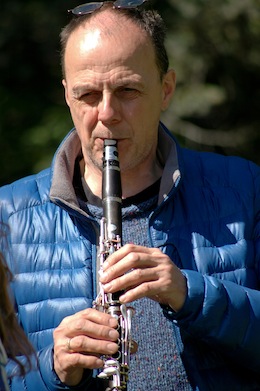
Martin van de Ven (photo from Heart of the City Festival)

In addition to being a composer for film, television, theatre and dance, van de Ven is a music facilitator and educator. He is also a clarinetist and has performed with the Flying Bulgar Klezmer Band, Chutzpah Ensemble, and Beyond the Pale. He has been involved in many Jumblies projects – as musical director, composer and/or performer. “Ruth and I have written several choral works together,” he told the Independent.

“To me, Jumblies is the embodiment of a music and art-making philosophy that believes the arts are there for everyone to create and not just for the well-trained elite,” he said. “Composers such as John Cage and Canada’s R. Murray Schafer talk about this in their writing and both were an early influence on my music education. Jumblies allows me to use my own skills and training to combine the efforts of trained and non-trained performers to create art, and specifically music, that serves the purpose of the moment, whether a stand-alone piece or something that supports a story being told. I think this work is important; it democratizes and decommodifies music-making and breaks down barriers to creation for community members who are otherwise shut out of the creative process. The myth that music-making is the sole purview of the highly skilled, and it is only worthwhile if it is commodified into a product to be consumed, is damaging to the whole idea of ‘homo ludens,’ the idea that a fundamental human attribute is the ability to play, invent and create.”

The community choir that Cooper directs embodies this concept of art being for everyone.

“The Gather Round Singers is an intergenerational community choir, made up of 30-plus mixed-ability, multi-aged singers, from across Toronto and beyond,” she said. “We exist within Jumblies Theatre, and so share their dedication to radical inclusivity and benefit from their experience in creating interdisciplinary work.”

Despite the challenges of COVID-19, the choir has been meeting weekly online since April, said Cooper, “to rehearse and perform new choral works designed or adapted for this new context” – that “[c]horal music is among the more challenging forms to adapt to online gathering, as video calling platforms such as Zoom are designed to reduce vocal overlap, and create latency that makes in-sync singing impossible.”

The Gather Round Singers will perform two new pieces for the opening of the DTES Vancouver residency, said Cooper – “one a world première by Martin van de Ven and one a work-in-progress by Arie Verheul van de Ven, both of which were developed this summer especially to be performed on Zoom. These are both part of Jumblies’ larger Grounds for Goodness project, which continues until a final presentation in June 2021, and will include several other new musical and choral pieces … and other composers (including Andrew Balfour, Christina Volpini and Cheldon Paterson).”

“Grounds for Goodness overall is a multi-year project that includes many partners, places and participants,” explained Howard. “It has been taking place through real-live and virtual activities for almost two years. There have been episodes in Nipissing First Nation (near North Bay, Ont.), Montreal, Brampton, the Ottawa Valley, Algoma Region (northern Ontario), and with various Toronto groups.… We have received funds to tour the project, which have now been adapted to allow for ‘virtual touring.’ The Vancouver iteration is the next big chapter in this project.”

For Grounds for Goodness Downtown Eastside, Martin van de Ven said, “we’ll be premièring a work called ‘Besa.’ ‘Besa’ is an Albanian Islamic concept about hospitality and the need to help and protect guests and those in need within and beyond your community.

“In Albania, during the Second World War (and Italian and then Nazi occupation), this meant that almost all Jewish people living and finding refuge in Albania were sheltered and hidden, and Albania ended up with a larger Jewish population at the end of the war than at the beginning. We created a work based on texts found in writings and interviews with Albanians – from the book Besa: Muslims who Saved Jews During WW II by Norman H. Gershman.

“The COVID-19 restrictions prevented us from developing this piece as we normally would,” he continued, “and so I composed a work that could be performed and rehearsed with everyone being online. It involved researching the technology, experimenting with Zoom meetings and audio programs, as well as writing music that allowed for enough flexibility to deal with internet latency. For our Vancouver residency, we will be presenting this work and sharing our experience of creating an artwork to be performed online with members of the Vancouver art community.”

Those Vancouver artists include Savannah Walling, Olivia C. Davies, Beverly Dobrinsky, Khari Wendell McClelland, Renae Morriseau and Rianne Svelnis, as well as 10 DTES-involved participants.

* * *

Van de Ven started music lessons when he was 6 years old – on recorder. “In elementary school,” he said, “my friends and I decided we wanted to form a circus. As the only one in the group with musical training, I was charged with writing the theme for the circus band. I dutifully started writing down half notes and quarter notes on paper and tried to play them on the recorder. The method worked fine but I soon realized I would need some additional training if I wanted it to sound good.

“I ended up with a musical education partially shaped by my father’s interest and taste for very modern classical and jazz music and eventually formal training at university,” he said. “In my late teens, I realized that my interest in science and engineering paled compared to the excitement I felt for a live performance, whether as an audience member or as a performer.”

In university, in addition to his formal training, van de Ven was involved in various jazz programs and, eventually, studied and performed in free improv ensembles. He also did a short stint in Europe, studying early computer music in electronic sound synthesis.

“Klezmer music has a history deeply rooted in East European and Middle Eastern music traditions. As a clarinetist,” he said, “it provided for me a wonderful vehicle to not only deeply emerge myself into a culture other than my own but also perform a lead role playing in a band.”

photo - Shifra Cooper 
Shifra Cooper (photo by Liam Coo)

For her part, Cooper has loved choral singing her whole life. “And I bring this love to my own work,” she said, “while having always believed that bringing together community arts and choral singing requires a flexibility and a softening of our understanding of the boundaries of what ‘choral music’ can be – this is something that I have always been creatively driven by. In these times, I’m learning a lot more about how far this can go.

“Sometimes, turning things on their head can be revealing of new approaches, considerations or perspectives,” she said. “For example, one young woman who has sung with the choir for many years, said to me the other day: ‘In rehearsal, I always sit in the back row, so I only see the backs of people’s heads. I like on Zoom that I can see the faces of everyone I’m singing and performing with.’ Another choir member told me that she feels more confident and motivated to practise when she has her microphone off and is alone in her room following along – this confidence comes through strikingly in the recordings she shared with me for one of our digital projects. In these ways, sometimes, working online has revealed the limitations of our previously established norms for singing in-person. I think often now about how, whenever we can safely be back together, we might incorporate these learnings.

“Which is not to gloss over any of the challenges of meeting online,” stressed Cooper. “I think I can speak for at least the majority of the choir when I say we all immensely miss singing together – in sync, in harmony, in rhythm. And a digital space, even though full of many possibilities, is also full of boundaries and obstacles to folks joining in, especially those experiencing more precarious housing or financial insecurity. Our team worked closely all summer with members of the choir community to bridge this gap, purchasing and delivering internet-enabled devices to choir members and providing remote and in-person (socially distanced) trainings and trouble-shooting.” They did so with funding from several sources, notably the Toronto Foundation.

“Another part of my work has often included event management and digital design and, in the new reality of virtual art-making, these two often come together in interesting ways,” Cooper added. “I’m delighted to be designing a new interactive website for Grounds for Goodness at the DTES Heart of the City Festival, that will act as an online evolving gallery, showcasing new work created through the community workshops and acting as the container and guide for the culminating virtual event.”

For the full festival schedule, visit heartofthecityfestival.com.


Format ImagePosted on October 9, 2020October 8, 2020Author Cynthia RamsayCategories Music, Performing Arts, Visual ArtsTags arts, choral singing, coronavirus, COVID-19, Downtown Eastside, DTES, Heart of the City, Jumblies, Martin van de Ven, music, Ruth Howard, Shifra Cooper, tikkun olam
Berner part of Heart

Berner part of Heart

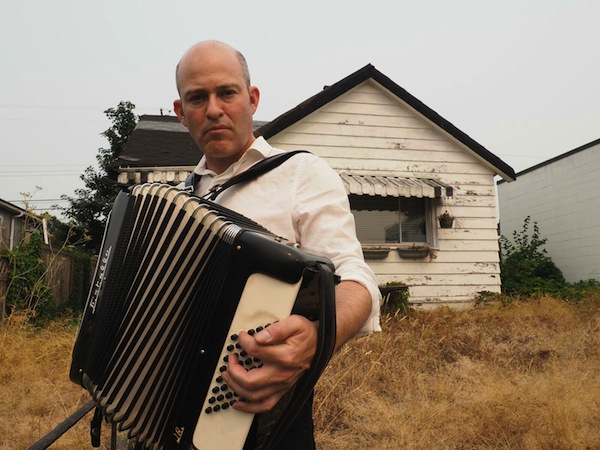
Geoff Berner (photo by Genevieve Buechner)

The theme for this year’s Downtown Eastside Heart of the City Festival is “This Gives Us Strength.” One of the more than 50 events that will take place over the festival’s 12 days is Spotlight on the East End on Oct. 30, 8:30 p.m. Curated by artist-in-residence Khari Wendell McClelland, the online presentation will feature “the compelling creativity and strength of Vancouver’s Downtown Eastside-involved artists and residents who illuminate the vitality, relevance and resilience of our neighbourhood and its rich traditions, cultural roots and music.” Among those artists is klezmer-punk accordionist Geoff Berner, with whom JI readers will be familiar.

JI: You released Welcome to the Grand Hotel Cosmopolis late last year (jewishindependent.ca/honestly-jewish-and-radical) and you also had a new musical, then COVID hit. What have you been doing creatively over this time?

GB: I just finished working on a lovely project for KlezKanada with the great theatre artist Jenny Romaine and a lot of other talented folks. It’s called Vu Bistu Geven? (Where Have You Been?) and it’s about figuring out the history of the land that KlezKanada takes place on. It was commissioned for their 25th anniversary. It felt particularly right to work with Trina Stacey, a Kanien’kéha singer, researcher and teacher. We talked a lot during the making of the piece about the value of recovering our ancestors’ languages, in order to find a way to think outside of capitalism and colonialism.

JI: You were scheduled to perform an outdoors concert in Roberts Creek Sept. 11. Did that happen? In what ways does an in-person audience affect your performance?

GB: Yep, that concert went off nicely. Everyone was outdoors and properly distanced. The folks in Roberts Creek are lovely. I’ve played only two other shows like that since the pandemic, one at a park in Vancouver, for Alan Zisman, and another in Chilliwack at the Tractor Grease. It sure was nice to play live again. It’s been a bit of a strain these past months, not being able to do the thing I’ve devoted my life to doing. I miss that magic human connection that only live music can do.

JI: What inspires you to participate in events like the DTES Heart of the City Festival?

GB: What inspires me is the honour to be invited. I’ve tried to be a friend to folks in the DTES, opposing displacement by City Hall-backed developers, fighting to stop the war on drugs, fighting against legislated poverty, and other stuff. It means a lot that I’m allowed to be part of things.

JI: Chelm is a recurring theme/subject in your work. If you had to offer “advice from Chelm” for people coping right now, what might that be?

GB: Advice from Chelm? Well, Chelm was the “Village of Fools” of Jewish legend, but in fact it was a real place, where the people had to struggle to survive. They weren’t fools at all, just ordinary people trying to live. Several fine Yiddish poets came from Chelm. So the advice from Chelm is, the real fools are people who look down on communities of other human beings.

JI: You helped start the BC Ecosocialist Party. Any opinions on the election you’d like to share?

GB: I have real hopes for the BC Ecosocialists. B.C. voters need to at least have the choice to be able to vote for people who will actually stand up against LNG, Site C, legislated poverty, colonialism and the war on drugs.

* * *

Heart of the City runs Oct. 28 to Nov. 8. For tickets and information, visit heartofthecityfestival.com.


Format ImagePosted on October 9, 2020October 8, 2020Author Cynthia RamsayCategories MusicTags Chelm, Downtown Eastside, DTES, Ecosocialists, Geoff Berner, Heart of the City, politics
Fighting for women’s equality

Fighting for women’s equality

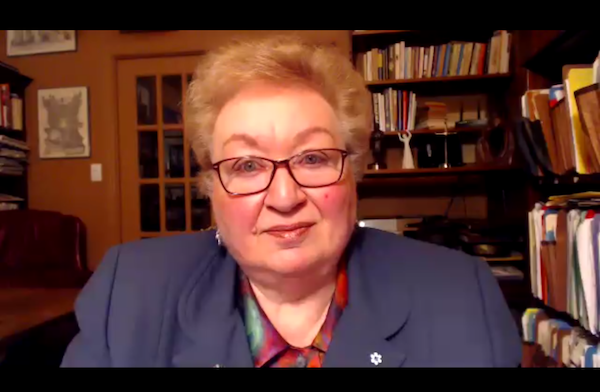
Linda Silver Dranoff kicked off the four-part National Council of Jewish Women of Canada Women and Justice speaker series on Sept. 23. (screenshot)

National Council of Jewish Women of Canada started its four-part Women and Justice Speaker Series on Sept. 23 with retired family law lawyer Linda Silver Dranoff, who lives in Toronto.

The online setting allowed NCJWC members from across the country to be involved. The talk was opened by national president Debbie Wasserman, in Toronto, and closed by co-vice-president Debby Altow, in Vancouver; the question-and-answer period was handled by a committee chair, Bianca Krimberg, in Calgary.

Silver Dranoff’s talk was sobering, explaining how women in Canada have been defined by their subordinate role in the family, in relation to a man. She gave examples of laws that have reinforced this status, but also offered possible solutions, as legal reform has been an important part of her career. Among the books she has written is a memoir, called Fairly Equal: Lawyering the Feminist Revolution.

“Throughout human history, women were unprotected and vulnerable. Husbands controlled the purse strings, all property, any pension and the children,” she said. “A woman did not even own her own clothing, which was called ‘the wife’s paraphernalia.’ Women and children were property, not people. Once a woman was married, she was stuck, even if her husband beat or starved her. What we call domestic violence was considered, until very recently in human history, a private family matter that the state and the community did not get involved in.

“There was no divorce law in Canada until 1968,” she continued. “If a woman was guilty of marital misconduct, such as adultery, she could lose her right to have custody of her children and often even access to visit with them.”

Silver Dranoff became a lawyer in family law in 1974. At the time, she witnessed women staying in abusive marriages because they had little choice – if they left, they could become destitute and lose their children, too. “Marital misconduct ended any right to financial support, even if it happened after separation and divorce,” she said, explaining that settlement agreements often included a dum casta clause, a “while chaste” clause.

If a woman left her abusive husband, she said, anyone helping or harbouring her could be charged as a criminal. “This was an offence in our criminal law until the 1970s – that’s how recently it was. The law permitted a man to disinherit his wife and leave her destitute, no matter how long they’d been married and even if she was the model of a perfect wife.

“The husband controlled the wife’s reproduction. Contraception and abortion were criminal offences. A husband and wife were considered one person in law – the husband. This concept of the legal unity of husband and wife is what allowed a man to control his wife in every respect.” Until 1983, a husband could legally rape his wife – “marriage was considered consent to conjugal relations,” explained Silver Dranoff, who stressed that, of course, many men didn’t take advantage of their power – “but those who did could do so with impunity” and with legal sanction.

In addition to these restrictions, married women were discouraged from working outside the home. “In 1941,” said Silver Dranoff, “fewer than four percent of married women were employed. It wasn’t until 1955 that married women were eligible to be employed in the federal civil service. In any event, there was almost no publicly supported childcare – this actively discouraged women from employment. Even if women worked, usually out of necessity, there were no laws protecting them from discrimination in employment.” This meant that women could legally be paid less, disregarded for promotion consideration and fired if a man needed a job. “There was no law against sexual harassment in the workplace; it didn’t even exist until the early 1980s in law.”

In the public arena, said Silver Dranoff, “women were invisible.” While most women have had the right to vote since 1918 – a right won by the efforts of the first-wave women’s movement – government policy usually overlooked issues of concern to women. “Only five women were elected to Parliament before 1950,” she said. “It wasn’t until 1957 that the first woman ever was appointed as a federal cabinet minister. And a woman lawyer was a rarity – in 1951, there were 197 women lawyers in all of Canada out of a total of 9,000.”

This was the world in which Silver Dranoff grew up, and it energized and impelled her to action, as it did others. “I believe the most significant transformation allowing women a less dependent role in society came about when women could control our reproductive powers,” she said. “The birth control pill was developed in 1961. While contraception and abortion were still criminal offences, the pill gradually became publicly available in the 1960s, and that is when the second-wave women’s movement began.”

Women’s groups proliferated in the 1970s and 1980s. “The National Action Committee on the Status of Women comprised most of the major women’s organizations of the day, totalling, at its height, 700 women’s organizations that all gathered together to promote the rights of women with one voice.”

Silver Dranoff went to law school in 1969. She was a single parent with a 2-year-old and had been out of school for eight years. “Other women were also seeing a life outside the family as a possibility,” she said. “In my law school class, there were 14 women out of 300; we were five percent of the class. Had I attended eight years earlier, when I graduated from history, I would have been the only woman in a law school class in Toronto.”

With more women lawyers, there was more pressure for change and Silver Dranoff spoke about some of the advances that have been made in family law reform, Charter equality rights, abortion, violence against women, childcare, pay equity, and representation and power.

When Silver Dranoff came to the bar in 1974, women had no right to share property accumulated during a marriage, and spousal and child support amounts were “paltry and difficult to enforce.” By the 1980s across Canada, improvements had been made both in multiple laws and in their enforcement. “These changes enabled women to leave bad marriages and live independently,” she said.

However, there is more to be done. Husbands and their lawyers still “use the legal system and its processes and delays as a club to intimidate women.” As well, she added, “It is often too expensive to seek the rights which the law gives, and legal aid is severely underfunded.” Another problem is that mediation and arbitration are replacing the courts in some cases and, “as a result, women may be encouraged to make a deal that doesn’t give them the benefit of the laws we fought long and hard for.”

When the Canadian Constitution was repatriated from Great Britain in 1982, a new Charter of Rights and Freedoms was enacted. Women’s groups lobbied the government of the day, led by then-prime minister Pierre Trudeau, “to include constitutionally entrenched equality rights in the Charter – by the way, a right that American women still don’t have. Our women lawyers provided the wording to protect us, using the lessons taught by the ineffective Bill of Rights passed in the 1950s.”

One of those lessons was the need to make sure the rights were actually protected. “We had to lobby, we had to organize, we had to participate in court cases that would affect our equality rights. So, we founded the Women’s Legal and Educational Action Fund, known as LEAF, in 1985, when equality rights came into effect, to try and ensure that court interpretations of the Charter did not erode, but enhanced and ensured women’s equality rights.”

In the late 1960s, Trudeau, as justice minister under then-prime minister Lester B. Pearson, brought in amendments to the Criminal Code that permitted abortion under defined conditions. The amendments did not legalize abortion, but said the prohibition would not operate if a medical committee deemed a pregnant woman’s life to be in danger if she carried to term. This law did not work, said Silver Dranoff. Among other things, there was inconsistency among hospital abortion committees in rulings and there were no guidelines on what constituted endangerment.

“Dr. Henry Morgentaler became women’s champion,” she said. “He opened a clinic in Montreal and women traveled there from across Canada to be assured of getting and having a safe abortion.”

Morgentaler challenged the medical committee law, she said, and his goal was to get abortion removed as an offence under the Criminal Code; he also challenged provincial laws. “The main challenge was decided in 1988 by the Supreme Court of Canada,” said Silver Dranoff, “which agreed with defence counsel’s constitutional argument that the abortion provisions of the Criminal Code breached the rights of Section 7 of the Charter to life, liberty and security of the person and, therefore, was unconstitutional.”

There is no longer any federal law preventing or criminalizing abortion, or requiring anyone’s consent to the procedure other than that of the pregnant woman. There have been challenges to the change, though, including the federal government under then-prime minister Brian Mulroney, which tried twice – unsuccessfully – to form an anti-abortion law that wouldn’t violate the Charter.

“This shows how important it is to keep vigilant and organized and focused,” said Silver Dranoff. “There’s no such thing as a permanent victory, only a continuing struggle.”

A case in point is the progress that has been made with respect to dealing with violence against women. The courts used to accept the argument that, if a woman had ever had sex before with anyone, she probably consented to the approach by the accused. Victims can no longer be cross-examined on their previous sexual experience, unless the trial judge determines there is some compelling reason to allow it, said Silver Dranoff. However, “victims are still being mistreated by the courts,” she said. “As a result, many women are reluctant to complain.”

In addition to a need for more education of lawyers, police and others in the system before attitudes will change, Silver Dranoff spoke of the need for prevention, offering the example of proactive imprisonment, which is practised in some communities in the United States. Whereas a bail hearing assesses whether an accused is likely to flee before trial, this process assesses how likely an accused is to murder their accuser. If the risk of murder is high, the accused would be imprisoned until their trial and the victim (and their children) would be able to stay at home instead of having to seek shelter and protection, for example.

“I think it’s a plan that’s worthy of consideration in Canada,” said Silver Dranoff. “We also need gun control. In the hands of men who are violent against women, guns are dangerous. And the only way to control violent men using guns is to control guns. Canadian statistics show that access to firearms by an intimate partner increases the likelihood of murder by 500%.”

Childcare is another integral issue, she said. “I personally think that women will never be able to take their full place in our workforce unless we have proper health- and childcare. We need government-paid, government-subsidized childcare centres, regulated places for our children to go and be cared for while women are employed in the paid labour force.”

She said that, 50 years ago, in 1970, the importance of childcare was recognized in the Royal Commission on the Status of Women, “which called for a national childcare plan. The royal commission identified the care of children as the responsibility to be shared by mothers, fathers and society, without which, women cannot be accorded true equality. Just as true today as it was in 1970.”

She pointed to other instances in which a national childcare program had been recommended or dismissed by a federal government. Most recently, on Sept. 23, Prime Minister Justin Trudeau’s government “announced plans for a significant long-term investment in a national childcare and early-learning system, including before- and after-school care, and built on the [publicly funded] Quebec model.”

Silver Dranoff warned that government announcements, and even the making of laws, do not necessarily translate into changes. In Ontario, for example, there have been equal pay laws since 1951, she said, while the Pay Equity Act, which applied to the federal public service, didn’t come until 1984. Changes to the various laws have occurred as a result of complaints from workers, she said, and different governments and employers have either progressed or hindered pay equity.

“Statistics tell the story, too,” she said. “In 1965, women earned, on average, 41% of men’s pay…. Today, Ontario women earn, on average, 70 cents for every dollar a man earns.” While an improvement, it took more than 50 years and it’s not good enough, she said. “These statistics repeat themselves all over the world. Women are still paid less than men in every country in the world, according to research by the World Economic Forum.” And the pay gap is even larger for Indigenous, racialized and immigrant women, she said.

Potential solutions include a law requiring pay transparency, wherein a wage is assigned to a particular job, not the gender of the person filling it, and requiring companies to get equal pay certification from the government or be fined. The latter policy has been implemented in Iceland, she said.

After a few more examples of ways to improve pay equity, Silver Dranoff moved on to her final topic – representation and power. She noted that, in 2013, there were six female premiers, now there is only one (Caroline Cochrane, in the Northwest Territories).

“We need more women in positions of power and we’re having great difficulty in achieving it,” said Silver Dranoff. One deterrent is that women in politics receive significantly more abuse and nastiness than male politicians. Much of this abuse is online in social media and even anonymous; two factors contributing to the fact that few perpetrators are charged or convicted.

She said, “The law could be strengthened in this way: make social media platforms legally responsible for the content they post, just as newspapers have a responsibility to ensure that the content they print is not defamatory.”

She noted there are no provisions in the Criminal Code for online bullying, online criminal harassment, online misogyny. “The Criminal Code only deals with in-person offences,” she said. Of course, to make these types of new laws work, she added, anonymity on the internet must be curtailed or eliminated.

To sustain the advances made by the women’s movement, she said, “Feminists must run for office and be elected. Parties must nominate feminists in electable ridings.”

In Silver Dranoff’s use of the term, feminists can be any gender, just as patriarchs can be any gender. Not every woman, she said, will stand up for the interests of women.

In addition to electoral reform – she believes that proportional representation of the mixed member proportional type is the best bet, “both for society as a whole and for women in particular because it requires consensus decision-making” – Silver Dranoff would like to see changes made in the corporate world, as well. She sees a need for things like mandatory quotas for women on boards, to ensure equal representation. “Voluntary doesn’t work,” she said.

Canada also needs a national women’s organization, she said, “like we had in the early days of the women’s movement. The National Action Committee on the Status of Women represented all of us…. We need that national voice to ensure that women’s issues are monitored and our interests are heard.”

Such an organization should not be dependent on government funding, she said, “which can be, and has been, withdrawn due to the ideology of the day. And, in fact, that’s what happened to NAC in the end. The National Action Committee was relying on government funding and an unsympathetic government removed it.”

Women cannot just accept the status quo, she said, or “that makes us complicit.”

She concluded, “My message to you all is carpe diem, seize the day. There is work to be done. It is, without a doubt, long past time for women to achieve equality and justice.”

***

Note: This article has been amended to make clear that it was married women who weren’t permitted to work in the federal public sector until 1955.


Format ImagePosted on October 9, 2020October 10, 2020Author Cynthia RamsayCategories LocalTags abortion, childcare, divorce, economics, employment, equality, healthcare, human rights, justice, law, Linda Silver Dranoff, marriage, National Council of Jewish Women of Canada, NCJW, pay equity, women
Virtual VIFF now streaming

Virtual VIFF now streaming

Shai Avivi, left, and Noam Imber are excellent as father and son in Here We Are. (still courtesy VIFF)

Understated and poignant are just two of the words I’d use to describe the screeners I watched in anticipation of the Vancouver International Film Festival, which opened Sept. 24 and runs to Oct. 7.

As with most everything these days, much of VIFF has moved online; however, there are still in-person screenings and talks, with audience sizes limited. And, as with other film festivals, online viewing is geo-blocked to British Columbia, meaning that you can only watch the movies if you are physically inside the province. The new format should allow for more access to the festival offerings and, while there will be those who miss dressing up and going out to the movies, there will be many people excited to be able to attend VIFF in their pajamas at home, me being one of them.

Last week, I watched two full-length features and two shorts: the narrative Here We Are, directed by Nir Bergman (Israel/Italy); the documentary Paris Calligrammes, directed by (and about) Ulrike Ottinger (Germany/France); The Book of Ruth, directed by Becca Roth (United States); and White Eye, directed by Tomer Shushan (Israel).

Every year, the Jewish Independent sponsors a selection at VIFF and, this time round, we’ve chosen a wonderfully written, acted and filmed movie. We generally have zero time and little information on which to base our choice, so I feel particularly grateful to have lucked out with this gem.

Here We Are is the story of a father who both will do almost anything for his autistic son, but who also uses his son as an excuse to not deal with the larger world. Aharon (played with incredible delicacy by Shai Avivi) has left his job to care for his son Uri (acted by Noam Imber, who gives an empathetic and strong performance). Aharon and his wife Tamara (played by Smadar Wolfman, who does a wonderful job, too) are no longer together, and Uri’s care has been left in his father’s capable and loving hands.

But Uri is an adult now and, to grow, we need space and the ability to direct our own lives. Tamara recognizes this and has worked hard to find Uri a good home, where he will be able to make friends and participate in activities with his peers. Aharon, however, is unable to let go and, though he also wants the best for Uri, he undermines Tamara’s actions – not only in words, but he takes Uri on the run.

The script by Dana Idisis leaves room for the pauses and emotions that make Here We Are an excellent film. Avivi’s face speaks more than a thousand words and you can see the inner conflict as his character struggles to accept that his son no longer needs him as much. The chemistry between Avivi and Imber makes the father-son relationship believable and compelling. And there are no “bad guys” here, even though mother and father differ in their opinions on parenting.

“I love the characters, the relationships, the way Aharon has reduced his needs to accommodate his son’s, and the transformation they experience throughout their journey,” reads the director’s statement. “I believe that, if I’m able to convey these characters as they are, from the written page to the screen, together with the bittersweet and humorous tone of the script, the audience will also fall in love with them.” Bergman accomplished his goal, and then some.

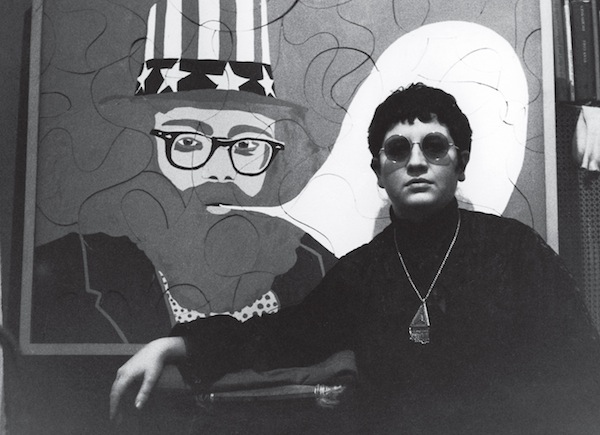
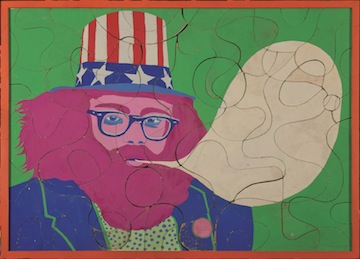
image - Ulrike Ottinger with her portrait of Allen Ginsberg, Paris 1965, and the work in colour (below)
Ulrike Ottinger with her portrait of Allen Ginsberg, Paris, 1965, and the work in colour (below). (©Ulrike Ottinger courtesy VIFF)

Paris Calligrammes is also very watchable and engaging. I’ll admit to never having heard of Ottinger before, so I was looking forward to learning more about her, her artwork, her photography and what eventually inspired her to filmmaking. However, while I thought the documentary was esthetically pleasing and gave a tangible sense of how exciting it would have been to live among the artistic elite in Paris during the 1960s, I couldn’t tell you much about Ottinger herself and what she contributed to the thoughts, images and culture of those turbulent times. But, I guess, perhaps it is assumed that one knows these things already.

image - Allen Ginsberg, Paris 1965
Allen Ginsberg, Paris, 1965. (©Ulrike Ottinger courtesy VIFF)

Ottinger does offers some interesting and valuable commentary – read by British actress Jenny Agutter – but, for whatever reason, I didn’t think it was enough. The film is named after the bookstore Librairie Calligrammes, which specialized in antiquarian books and German literature, and was where Jewish and political émigrés hung out, along with others who we would now call cultural influencers. Ottinger drove to Paris in 1962 from Konstanz, Germany, to become, in her words, a great artist; to follow in the footsteps of her heroes and heroines. She not only follows those footsteps but walks alongside the likes of Tristan Tzara, Marcel Marceau, Raoul Hausman, Jean-Paul Sartre, Simone de Beauvoir and countless others as well known.

Some of the most interesting parts of the film are about Algeria’s years-long war of independence from France (1954-1962) and the situation at the time with respect to the appalling treatment of Algerians living in Paris. Clips are shown of a peaceful demonstration held on Oct. 17, 1961, that was violently broken up by police. According to the film, 200 to 300 people were killed that night alone and, to this day, there has not been an investigation and no one has been held accountable for the deaths; even opposition newspapers didn’t report on it at the time and photos vanished from newsrooms. Ottinger notes that the order for the police to attack was given by then-chief Maurice Papon, who, under the Vichy government, had organized the rounding up of Jews to be murdered during the Holocaust.

This is a film that, I think, would be most appreciated on a big screen, but is still worth watching, for its content, yes, but mainly for its creative use of archival footage and interview clips, photographs and current-day images and filming. The documentary starts with a quote from Conseils au Bon Voyageur by Victor Segalen, advice that Ottinger has “gladly followed”: “Advice to the good traveler – A town at the end of the road and a road extending a town: do not choose one or the other, but one and the other, by turns.” If one needed inspiration to live by the conjunctions “and/both” rather than “either/or,” Paris Calligrammes might offer it.

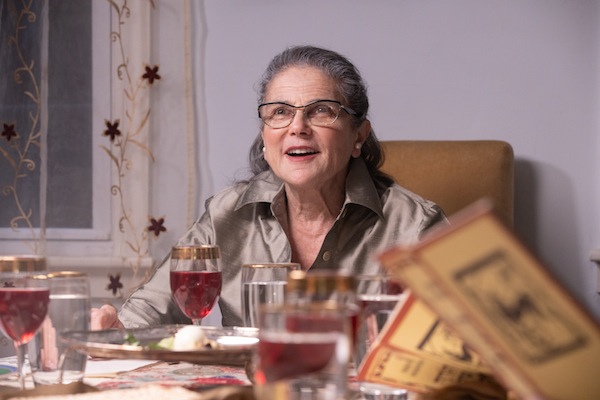
image - Tovah Feldshuh plays a grandmother with a secret past in The Book of Ruth
Tovah Feldshuh plays a grandmother with a secret past in The Book of Ruth. (still courtesy VIFF)

While Paris Calligrammes is the product and vision of a longtime filmmaker, The Book of Ruth comes from the imagination of Chen Drachman, and is the first film Drachman has written and produced. She also co-stars in this exploration of how important it is to have symbols – in this instance, represented by an historical figure – around which to rally or by which to live one’s life.

The short takes place during the happiest, smallest (five people) and shortest seder that I’ve ever seen, and focuses on Ruth – played by veteran actress Tovah Feldshuh – and whether she is really the grandmother her granddaughter, played by Drachman, grew up knowing. While the scenario postulated is unbelievable, Feldshuh offers the gravitas and has the talent to make viewers look beyond that fact and consider the questions raised in the film about the stories we build around some people – their role in a war or a political movement or an artistic endeavour, whatever – and how that story or image can help make us, living in another time, feel less alone, more understood, etc.

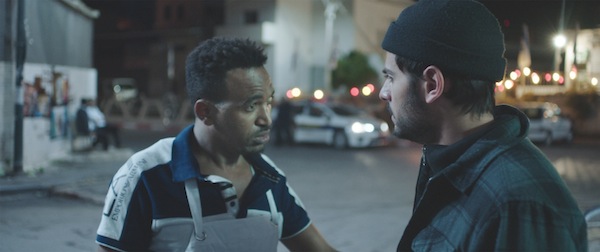
image - Dawit Tekelaeb, left, and Daniel Gad co-star in the short film White Eye
Dawit Tekelaeb, left, and Daniel Gad co-star in the short film White Eye. (still courtesy VIFF)

Symbolism, of course, can be positive and negative. Racist views and bigotry also come from the stories we have learned and tell ourselves. And White Eye, both directed and written by Shushan, does a superb job of illustrating how prejudices and privilege we may not even know we have can lead to disastrous consequences.

The main character of Omer is played by Daniel Gad with convincing stubbornness and obliviousness at first, then quiet shock at what happens as a result of his desire simply to take back what is his. When he comes across his bicycle, which had been stolen, that’s all he wants to do: cut the lock off and take it back. Even after he meets the bike’s new owner, Yunes – actor Dawit Tekelaeb will win your heart with his touching portrayal of a hardworking father and husband who bought the bike so he could take his daughter to kindergarten – Omer wants his property back. Even when Yunes’s boss (Reut Akkerman) argues on her employee’s behalf, Omer refuses to budge even the smallest bit. Only after the police become involved and Yunes, an immigrant from Eritrea whose visa has expired, is taken away, does Omer realize the full implications of his actions. By then, of course, the damage has been done. And it’s much more devastating than having had one’s bicycle stolen.

For the full film festival lineup, schedule and tickets, visit viff.org.

Format ImagePosted on September 25, 2020September 23, 2020Author Cynthia RamsayCategories TV & FilmTags Becca Roth, Chen Drachman, Dana Idisis, Daniel Gad, Dawit Tekelaeb, France, Germany, Israel, Italy, Nir Bergman, Noam Imber, Shai Avivi, Tomer Shushan, Tovah Feldshuh, Ulrike Ottinger, United States, Vancouver International Film Festival, VIFF
Negev campaign goes virtual

Negev campaign goes virtual

In closing the Heart Stirring Negev Event on Zoom, Ilan Pilo, executive director of JNF Pacific Region, talked about the important work done by Save a Child’s Heart, the organization at the centre of this year’s fundraising campaign. (screenshot)

Jewish National Fund of Canada, Pacific Region, held its first virtual Negev campaign event on Aug. 30. The original Zoom was recorded and shown again on Sept. 13 and 16. The object of the fundraising campaign is Save a Child’s Heart (SACH), an Israeli-based global organization with the mission of improving “the quality of pediatric cardiac care for children in developing countries.”

“This year, we’re collaborating with Save a Child’s Heart to build a treatment room in the pediatric surgical wing,” explained Lance Davis, chief executive officer of JNF Canada. “Thanks to your support, JNF can fund the bricks and mortar to house the wonderful doctors and staff who perform life-saving surgeries. JNF will literally fund the foundation of the [new children’s] hospital to provide the necessary facilities to advance this beautiful tikkun olam project. Together with you, our generous donors, we truly are building Israel.”

This tagline – “Building Israel Together” – forms part of the new logo for JNF Canada. The change comes in part because, while JNF Canada continues in its environmental mission, it has become more involved in social infrastructure projects, such as youth centres, playgrounds and healthcare facilities. The current Negev campaign is the latest example of this shift: the treatment room is one of possibly two that JNF Canada will fund (depending how much the campaign raises), which are being constructed in the International Pediatric Cardiac Centre at Wolfson Medical Centre in Holon, Israel.

After Ethan Doctor, a King David High School student, sang O Canada, and Beth Hamidrash’s Rabbi Shlomo Gabay sang Hatikvah, Bernice Carmeli, JNF Pacific Region president, welcomed everyone to the virtual Negev event, which was emceed by JNF Pacific Region past president David Goldman.

Dr. Saul and Lindsay Isserow were honourary chairs of the evening. “Our family became aware of Save a Child’s Heart when my oldest daughter, Jenna, volunteered there one summer,” said Lindsay Isserow. The chance to support an Israeli organization that highlights the contributions Israel makes to the world and to the region is another reason the family was part of this event, said her husband, who specializes in preventive cardiology, among other areas. “The cardiology [aspect] is important to me, obviously, because this is something that’s treatable,” he said.

A video showed some of the work SACH has done – it has saved the lives of more than 5,400 children from 62 countries.

Co-campaign chairs Lana and Doug Pulver first visited Wolfson Medical Centre years ago. “I was moved by the way that this organization takes care of children from all over the world regardless of their background, regardless of where they come from, and ensures that their lives are saved,” said Lana Pulver, who was so taken with SACH that she joined its national board a few years ago.

“Each child that is saved is a whole world – and those worlds learn of the compassion of the Jewish people and the nation of Israel,” said Dr. Lior Sasson, lead surgeon at SACH, in his remarks and thanks.

The remainder of the evening was spent with David Shore, one of the producers of The Good Doctor and of House, interviewing Israeli TV show Fauda’s co-author, Avi Issacharoff, and actor Itzik Cohen, who plays the character of Captain Ayub (Gabi). They talked about many topics, including Fauda’s international popularity; how Cohen, a comedian who does musicals, got his (very serious) part as an interrogator; some of Issacharoff’s and Cohen’s favourite scenes; and, of course, SACH.

Ilan Pilo, executive director of JNF Pacific Region, wound up the program by thanking all those who made the event possible: the donors, the boards, staff and others.

After the Sept. 16 streaming, Pilo spoke with the Independent. About 250 people viewed the event over its three nights, he said, noting that it was just the first of two main parts to the local Negev campaign. The next is called Join Us in the JNF Virtual Sukkah, on Oct. 8, 7pm. “It is a Jewish cardiologist panel,” said Pilo. Isserow will spearhead that conversation, and the cardiologists on the panel with him are Drs. Arthur Dodek, Zach Laksman and Joshua Wenner. For more information and registration, visit jnf.ca/vancouver/campaigns/negev-campaign.

The annual Negev Dinner would have normally taken place in the spring or summer. Looking back to March, when COVID hit in full force, Pilo said, “We had plans, and then we were thinking about doing something in April or May, but we realized that people were not going to leave their homes and we had to reconsider our plans…. We had to do everything very quickly. In a month we had to put together an event. And it’s different. On the one hand, it’s in a way easier because you don’t have to serve dinner. On the other hand, you have to be very creative and prepare everything in advance for the online campaign.

“For instance, we have made videos of local young Vancouverites who had volunteered in the past for SACH,” he said. To do this, the former volunteers had to be tracked down and convinced to record themselves. “This way,” said Pilo, “they became part of the online campaign…. You need to get people’s attention and interest and this was a great way [to do that].”

He hoped that the Heart Stirring Negev events would inspire people to contribute to the SACH’s project, “a cause that brings so much pride to the Jewish people everywhere.” Donations are still being accepted at vannegevdinner.ca, 604-257-5155 and [email protected].

Format ImagePosted on September 25, 2020September 23, 2020Author Cynthia RamsayCategories LocalTags Fauda, healthcare, Ilan Pilo, Isserow, Jewish National Fund Canada, JNF Canada, JNF Pacific Region, Lance Davis, Negev campaign, philanthropy, Pulver, SACH, Save a Child's Heart
Word Vancouver online

Word Vancouver online

Bonnie Nish, executive director of Word Vancouver. (photo by Andrew Bagoly)

“We believe that Word Vancouver is a vehicle for community connection. It is important on so many levels right now to provide a space for collaboration, discourse, and a safe and accessible platform for people to share their stories,” festival executive director Bonnie Nish told the Independent.

Normally, the annual event takes place in Downtown Vancouver and people drop in to see author talks and participate in other activities. This year’s festival will be online, running Sept. 19-27.

“Like most organizations, we knew we had to either cancel or pivot by late March,” explained Nish about the impact of COVID-19. “Our festival takes place in September, so we had more time than others to make this decision.

“Word Vancouver’s mission,” she said, “is to bring readers and writers together to celebrate literary arts. The question was could we make the change from an in-person festival to an online festival and still serve this mission. We decided that, yes, we could, and, in doing so, we might even extend our reach with the in-person barrier removed. We could now seamlessly collaborate with national partners like Word On the Street Toronto and authors who were not physically in Vancouver, while keeping our main focus on local authors.”

Several changes had to be made.

“We needed to get prepared for the new online delivery format,” said Nish. “With the live in-person festival, we would not have any pre-registrations, as people would just walk into the events as they happened at the Vancouver Public Library. Now, we have a complex communications plan, along with a registration system, so our audience can secure their place and be given step-by-step instructions on how and when to participate.”

On the down side, she said, “We were working with a great site management team last year and we are sad we aren’t able to have them on our team for this festival.”

There have been other challenges, as well.

“We have had to prepare for the decrease of revenue from the exhibitor booths by reducing our staffing substantially,” said Nish. “Our board is very supportive of our new situation but they are also very risk averse, as they should be. We have found the most amazing volunteers and, for that, we are truly grateful. Programming is reduced somewhat, but we still have managed to book 140 authors and schedule over 50 events. Our community collaborations are stronger than ever. We have reinvented the exhibitor platform and now offer online exposure both on our website and during the events. It is a hard sell to some, but we honestly think the reach and return for exhibitors will be close to on par with the in-person version.”

Of the 140 authors participating this year, many are members of the Jewish community, and the Independent was able to speak with two of them – Alex Leslie and Rhea Tregebov – in advance of the festival.

image - Vancouver for Beginners coverLeslie writes poetry and short fiction, but is working on her first novel. Her latest collection is Vancouver for Beginners (Book*hug, 2019), and its poems are filled with powerful imagery and strong views about her beloved city, where she was born and raised. Leslie’s unique use of language, infused with obvious passion for her subject matter, is energizing to read. Every one of these poems is political in that they call on readers to think about the way in which they inhabit the world, how they think of ownership, place, community and many other concepts. Most of the entries are short narratives (or microfictions) that, in a page, encapsulate the feeling of being in a certain neighbourhood; what we lose when we normalize poverty alongside great wealth; the opportunities we miss when we forget our past, or the misery in our present.

JI: Could you share a bit about your background, both as it pertains to writing, and to your involvement with the Jewish community?

AL: I’ve wanted to be a writer since I was a very young child. In my early 20s, I started taking short fiction more seriously as a writer and trying to publish in literary journals. It took awhile to place my first story, through a long period of reading, frustration, rejection and editing. From there, I published stories until I had enough to put together a manuscript, and that book, People Who Disappear, came out in my late 20s. I’ve essentially continued in the same way – working on material for long periods of time, attending readings, drilling away at projects around the time I spend on my paid work in the mental health field. I’ve always been a wanderer between fiction and poetry communities.

photo - Alex Leslie brings Vancouver for Beginners to Word Vancouver
Alex Leslie brings Vancouver for Beginners to Word Vancouver. (photo courtesy)

I’m a member of Or Shalom synagogue in Vancouver and co-curate a storytelling series there…. The Jewish side of my family is originally Ashkenazi, from shtetls in Ukraine, in the regions around Lvov and Odessa (when they immigrated they wrote down they were “Russian”). We’re what is called diasporic, as the communities we came from were lost to the Shoah (Holocaust).

JI: Jewish characters have appeared in your writings. What are some of the ways in which our Jewishness informs your political, cultural or other views/actions?

AL: Yes, my book of stories that came out in 2018, We All Need to Eat, centred around a young Jewish woman named Soma, and Jewish identity is a backbone of that book, as she processes the current rise of the alt-right and her family history that’s bound up in fleeing persecution in Eastern Europe.

For me, a core Jewish value is tikkun olam, which translates roughly to “repair of the world/universe.” Tikkun olam influences my work in the mental health field, as there is the prerogative there of contribution and not turning away from difficult areas of the mind and the concept that energy and goodness can be found in dark places. Persistence and dark humour – humour where others may not find humour! – are practices I’ve taken from Jewishness as well.

JI: Do you still co-curate Koreh at Or Shalom? Why is it important for people to have a platform to publicly read their work?

AL: Yes! Our next Koreh is on Saturday, Sept. 12, for Selichot. We have 10 readers! I curate this with Or Shalom’s Rabbi Hannah Dresner. This Koreh is centred on the idea of the pandemic as a crossing or transformation and everyone is welcome to be part of our audience. Here is the link with the Zoom information: orshalom.ca/event/leil-selichot-a-koreh-event-with-high-holiday-melodies.

This is our third year of curating Koreh. I feel it’s a special space for people who may not consider themselves “writers” to share stories, poems and reflections on their experiences and how they relate to the world. We’ve had Korehs focused on the natural world, on repose/restoration, on sanctuary. Rabbi Hannah asked me to co-curate it with her when we started it up. It was really her concept in the beginning and it’s been a pleasure to get to know so many writers and listeners adjacent to Koreh.

JI: What compels you to write and publish?

AL: My love of writing coincided with my love of reading. I’ve honestly wanted to be a writer since kindergarten. I remember writing stories about our neighbours, and my mother copying them out again in her handwriting. As I got older and wrote more and more, publishing emerged as a natural goal.

I read constantly and loved that I could see the world precisely from another person’s emotional perspective. I suppose that I wanted to replicate that experience, and share in it. Also, for me, it was about language, and using and manipulating language as a medium. Selecting, ordering and controlling words is a fascination for me, the way I suppose a mathematician may feel about algebra, or an investor might feel about predicting stocks. It’s a system.

JI: What is the importance to you of words?

AL: I think that words can put you in another person’s mind, so the power here would be empathy, radical transportation. Words also have a power of deep-layered description – so the power would be complex evocation, mixing emotional and physical parts of reality, making something 2-D into something 3-D, like a life-giving power.

Words can also move us to action. During the pandemic, I have been reading a lot. Endless online stuff is tiring and alienating after a long period of time. I’ve read a few extraordinary novels during this time – two are Breasts and Eggs by Mieko Kawakami and Lost Children Archive by Valeria Luiselli. I also read Norman Doidge’s two books about neuroplasticity. I’m grateful for how these books moved me and took me out of this moment and showed me something I couldn’t have imagined on my own.

* * *

Born in Saskatoon and raised in Winnipeg, Tregebov moved to Vancouver from Toronto in 2004 to teach in the creative writing program at the University of British Columbia. Though she retired in 2017, she holds the position of associate professor emerita and continues to teach a bit. She has written several children’s books and is working on her eighth collection of poetry. Rue des Rosiers (Wolsak & Wynn, 2019) is her second novel.

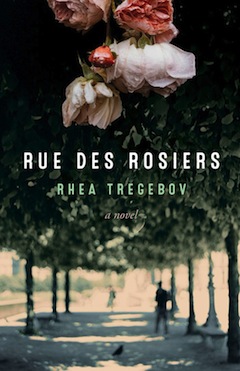
image - Rue des Rosiers coverBased on events leading to the 1982 terrorist attack in Paris on Goldenberg’s Deli, which killed six people and injured many more, Rue des Rosiers is a poignant and lyrical story about two women with vastly different backgrounds but both trying to figure out who they are and their place in the world. Canadian Sarah Levine makes decisions by flipping a penny that she carries with her and, at 25, she is decidedly lost, for a number of reasons. When she has a chance to go to Paris, she does and, while there, her story crosses over with that of Laila, an Arab immigrant living in one of the city’s slum neighbourhoods. In the author’s notes, Tregebov writes that she hopes her novel will “act as a memorial to the six people who died in the attack.” It does that, and more.

JI: Rue des Rosiers has so many layers and motifs, tightly woven, not a phrase seems superfluous. Can you share some of your creative process, from the idea of the novel to its publication last year?

RT: The novel began with two impulses: to explore the relationships among sisters and to understand the impact of terrorism on perpetrators as well as victims. Both are rooted in personal experience. I am one of three sisters, and I was living in Paris in 1982 very near where the attack on Rue des Rosiers occurred. Working through these issues was a long, sometimes joyous, sometimes exhausting process.

JI: Could you speak a bit about how Judaism or Jewish community infuse your work and/or life?

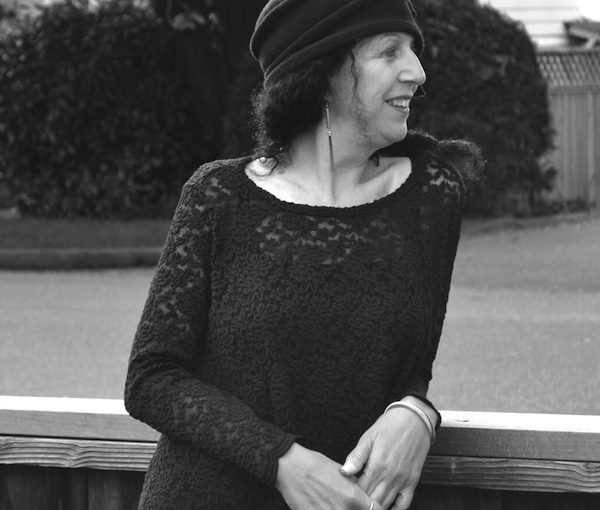
photo - Rhea Tregebov, author of Rue des Rosiers, is one of several Jewish community members participating in Word Vancouver this year
Rhea Tregebov, author of Rue des Rosiers, is one of several Jewish community members participating in Word Vancouver this year. (photo courtesy)

RT: I grew up in the shadow of the Holocaust and the moral issues the Holocaust raises are core. I also grew up in a vital Winnipeg community that modeled ethical commitment and progressive values that I still find of immense value.

JI: Coteau Books, which initially published your novel, has closed. What are some of your thoughts on the future of publishing?

RT: Small presses like Wolsak & Wynn (who, happily, have picked up the novel) are a mainstay of literary publishing. We still have an infrastructure of support that allows these smaller presses. I’m concerned that the consolidation that characterizes the larger presses may contribute to a narrowing of available voices and perspectives.

JI: In an interview, you say, “I’ve said that the book is trying to ascertain the humanity in inhumanity.” Are there any risks in doing this, in finding the humanity in inhumanity?

RT: It can be difficult to attempt to empathically understand behaviour that is anathema to one’s own moral schema. I didn’t want to justify or validate acts or attitudes that dehumanize the Other. But, as one of the characters in the book says, “I’m interested in goodness, the mystery of goodness.” And, to examine goodness, one has to examine evil as its corollary.

JI: In another interview, you mention being “intrigued by the problem-solving involved in writing a novel.” Can you flesh out that idea?

RT: These large projects are so complex and absorbing. In the early stages, you have to hold a world that isn’t yet fully formed in your head. I’ve joked that it felt like wearing a giant hat! I (mostly) love the cut and paste and revision aspects of writing, how solving one small element sometimes acts to realign the entire book in a positive way.

JI: I’m always intrigued by imagery that enriches the storytelling, but is not technically needed for the story to be told. In Rue des Rosiers, you write sentences like, “A scraggly American elm sapling is handcuffed to a post as if it’s committed some crime”; “A gardener in blue coveralls sweeps the sand path, wiping away the traces of pigeon footprints”; “Light is a wave and a particle and so are the bees.” When or how do these types of flourishes enter your writing process?

RT: I think they’re a natural product of my life as a poet. Much of my writing is about looking, and I process looking through words. So having imagery present in the narrative is integral in world-building.

* * *

Word Vancouver is completely free and some events are already full, so visit wordvancouver.ca sooner than later. The festival is welcoming financial support via donations, its Adopt an Author and silent auction programs, information about which also can be found on their website.

Format ImagePosted on September 11, 2020September 10, 2020Author Cynthia RamsayCategories BooksTags Alex Leslie, Bonnie Nish, literature, Rhea Tregebov, Word Vancouver
Stories that explore the mind

Stories that explore the mind

A husband competes with his oldest daughter for his wife’s affections, a man ponders whether he is more attracted to a 10-year-old girl or her divorced older sister, a woman has an abortion she didn’t necessarily want, a young man violently rebels against his abusive father. Jonah Rosenfeld tackles difficult subject matter in his short stories, with no compulsion to solve any particular problem or correct behaviours, but to explore the thoughts and feelings of his characters, and thereby offer insight into parts of humanity that we may shy away from contemplating. English readers can now access these stories and ideas, originally conceived in Yiddish, thanks to a newly published translation by Langara College’s Rachel Mines.

The Rivals and Other Stories (Syracuse University Press, 2020) comprises 19 of Rosenfeld’s stories. Born in Chartorysk, Russia (now, Chortorysk, Ukraine), the prolific writer lived from 1881 to 1944, immigrating in 1921 to New York, where he was a major contributor to the Forverts. In total, he wrote 20 volumes of short stories, a dozen plays and three novels. Rosenfeld’s “stories provide a corrective to the typical understanding of Yiddish literature as sentimental or quaint,” writes Mines in the book’s press materials. “Although the stories were written decades ago for a Yiddish-speaking audience, they are surprisingly contemporary in flavour.”

The first Rosenfeld story Mines read, in Yiddish, was The Rivals (Konkurentn), six or seven years ago. “I’d only been studying Yiddish for a few years at that point and was reading to improve my language skills,” she said. “I was so impressed with the story that I decided, just for practice, to translate it into English. Later on, I found out that an English translation had already been published in [Irving] Howe and [Eliezer] Greenberg’s A Treasury of Yiddish Stories, but, by then, I was hooked on both Rosenfeld and Yiddish translation.”

Mines was a Yiddish Book Centre Translation Fellow in 2016 and The Rivals was her translation project during that fellowship year. “I’d already translated several stories before that, but 2016 was when everything started coming together in terms of improving my skills as a translator,” she said.

The project was her own idea, not work assigned by the Yiddish Book Centre, although the centre did support it.

“I should also mention,” she added, “that Vancouver is a veritable hotbed of Yiddish translation (who knew?), with a number of active translators, all of whom have been helpful at various times. Helen Mintz, in particular, was a huge inspiration and support. Her book of translations, Vilna My Vilna, a collection of Abraham Karpinowitz’s short stories, was published (also by Syracuse UP) in 2017. Helen and I spent several years together on Skype, regularly workshopping each other’s translations and helping each other out with advice and information. We’re still doing that, in fact.”

It is his exploration of the psyche that attracts Mines to Rosenfeld’s work.

“I’m interested in psychology – always have been – and particularly in people’s unconscious, and sometimes counterintuitive, reasons for thinking and behaving the way they do. So Rosenfeld’s insight into the darker corners of the human mind was an instant draw. I should say that his stories stand up very well to many current theories of human thought and behaviour. For example, the protagonist of The Rivals is a classic malignant narcissist – he ticks all the boxes. It’s interesting to note that Rosenfeld’s story was first published in 1909, several years before Otto Rank’s and Sigmund Freud’s theories of narcissism came out. Rosenfeld was an intuitive psychologist, and a very perceptive one.

“Another reason Rosenfeld’s stories appeal to me is that they work very well in a 21st-century, multicultural setting,” she said. “I’ve taught a number of the translations to first-year students at Langara, and students are attracted by his stories’ takes on immigration, women’s rights, male-female relationships, generational conflict, culture clash – this list goes on. Clearly, these ideas are as relevant today as they were when the stories were first written.

“Finally, I like Rosenfeld’s attitudes to his characters, even the less admirable ones. He seems interested in and sympathetic to their dilemmas; as an author, he doesn’t judge or blame his characters – he leaves that up to his readers. I like that Rosenfeld is more interested in exploring his character’s situations and psychology than he is in blaming or moralizing.”

Mines, who is retiring this year, taught in the English department at Langara College since 2001. One of the department’s main offerings has been a first-year class on the short story, she said. “Around the time I started translating, I started introducing stories with a Jewish theme to my classes. A bit to my surprise, despite coming from non-Jewish backgrounds, my students found the stories interesting and engaging, so I gradually added more and more stories with Jewish content. The last few years, I’ve been teaching Rosenfeld’s stories exclusively. My students love the stories and readily identify with (or at least understand) the characters and their predicaments. We’ve had many lively discussions!”

In an introductory chapter to The Rivals, Mines poses several questions she hopes keen PhD students or other researchers will take on, including where Rosenfeld’s place might be in the American literary canon. With the disclaimer that she is “just a lowly translator,” Mines said, “But, if pressed for an answer, I’d have to say it’s Rosenfeld’s psychological insights. He’s not entirely unique – other Jewish and/or American authors of his time were psychologically astute and wrote compelling character studies. But Rosenfeld went a bit beyond, in that his stories are almost Greek tragedies – his protagonists fail in their quests (for love, belonging, security, etc.) not because of external forces, but because of some internal, self-defeating habit of thought that they may not be consciously aware of. Rosenfeld isn’t the only author to explore this type of psychological dichotomy, but he does so very consistently.”

Format ImagePosted on September 11, 2020September 10, 2020Author Cynthia RamsayCategories BooksTags Jonah Rosenfeld, Langara College, psychology, Rachel Mines, translation, Yiddish

Two compelling reads from Simon & Schuster

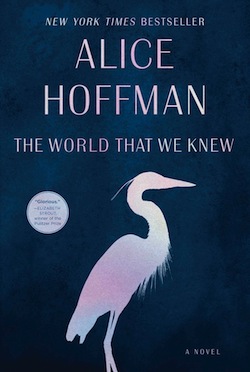
Last year, I requested two books from Simon & Schuster Canada. Both contained strong female protagonists and stories that sounded compelling. While it took the pandemic slowdown before I had time to read them, I enjoyed both and would recommend them, albeit one with a caveat.

image - Woman on the Edge book coverLet’s start with the debut novel, the one I breezed through even though I found the premise tenuous. I wanted to know how Samantha M. Bailey’s thriller Woman on the Edge ended, even as I cursed aloud at the two main characters – Nicole Markham, founder and head of a widely successful athletic wear company, and Morgan Kincaid, a woman who has rebuilt her life after her husband was caught swindling people and then killed himself.

For reasons not revealed initially, Nicole hands her baby to Morgan at a subway stop, then jumps to her death, though video of the incident makes it seem like Morgan may have taken the baby then pushed Nicole onto the tracks. Alternating between Morgan’s attempt to clear her name and how Nicole came to give her baby to Morgan, the read is thrilling, even as it is too obviously contrived. At any point in time, a question or revelation from Nicole or Morgan could have shed light on their respective situations and cleared up critical matters. Yet, both women – unrealistically – keep their suspicions to themselves. The silences are necessary for the plot to work, so I chose to go where I was being led and relish the craziness of it all.

While there is no overt Jewish content in Woman on the Edge, Toronto-based writer and editor Bailey is Jewish. In her first novel, she shows a talent for creating dramatic tension, if not overall story structure. Despite its weaknesses, I found this novel a good escape read.

An absolute pleasure to read, and just as page-turning, is veteran author Alice Hoffman’s latest novel, The World That We Knew, set during the Holocaust. In it, there is magic. It is tangible – the golem Ava, created by Ettie, the precocious daughter of a respected rabbi, to protect Lea – and more abstract, in the loyalty of Ava to Lea and the beautiful friendship that develops between Ava and a blue heron along their journey.

image - The World That We Knew book coverAfter her husband is murdered and her daughter Lea is almost raped, Hanni knows she must get Lea to Paris, but she herself cannot leave Berlin. So, she turns to the rabbi for help, but making a golem is risky business and he won’t do it. Ettie, though, plans to escape with her younger sister, and Hanni’s payment will help her do that. Ettie has observed her father at work, and is able to bring Ava into being. As Ava becomes more seemingly human, however, and forms a bond with the blue heron, the main tension of the novel arises – will her appreciation for her own life and its possibilities outweigh her responsibility to Lea?

Many other tensions and relationships mingle with history, which is sometimes pedantically told but always interesting. The World That We Knew is a well-woven and moving story that offers an understanding not only of the past but of the emotions that motivate us and the connections we make with one another.

Posted on September 11, 2020September 10, 2020Author Cynthia RamsayCategories BooksTags Alice Hoffman, historical fiction, Holocaust, magical realism, Samantha M. Bailey, The World That We Knew, thrillers, Woman on the Edge
About the Rosh Hashanah cover art

About the Rosh Hashanah cover art

I was introduced to the Sephardi and Mizrahi tradition of a Rosh Hashanah seder by a dear friend, at whose home I celebrate most of the Jewish holidays. This New Year’s, given the pandemic and that we are not in each other’s immediate bubble, I will join their seder on the first night of Rosh Hashanah either outdoors, weather permit, I was looking, perhaps, to prepare myself mentally for this year’s socially distanced gathering, and a Zoom with my family in Ontario, when I thought of the idea for the cover, which is created using watercolour and ink (and surprisingly little Photoshop).

image - Jewish Independent Rosh Hashanah issue coverIn a Sephardi or Mizrahi seder, special dishes are served of specific foods whose Hebrew or Aramaic names are linked in a blessing to another word that has the same root letters. Puns flourish. So, for example, the Hebrew word for carrot and that for decree have different vowels but the same root letters – gimel, zayin and resh – and the blessing over the carrots translates as, “May it be your will, Lord our God, that that our bad decrees be torn up and our merits and blessings be proclaimed.” The word for leeks, chives or scallions – karti – is akin to yikartu, cut off, so the blessing over these vegetables is, “May it be Your will, God, that our enemies be cut off.”

Spinach or beet leaves also symbolize the hope that God will make our enemies retreat and we can “beat” a way to freedom. Dates carry the hope that hatred will end; the many seeds of a pomegranate that our mitzvot will be many; an apple that we will have a sweet year; string beans that our merits will increase; a pumpkin or gourd that God will “tear” away all evil edicts against us, while our merits are proclaimed. You get the idea.

For information on the New Year’s seder, I visited, among other sites, theicenter.org/resource/hebrew-and-rosh-hashanah-seder and myjewishlearning.com/article/a-sephardic-rosh-hashanah-seder. Not being adept at puns myself, I will leave you simply with a wish for a happy, meaningful and healthy 5781.

Format ImagePosted on September 11, 2020September 10, 2020Author Cynthia RamsayCategories Visual ArtsTags art, coronavirus, COVID-19, High Holidays, Judaism, Mizrahi, Rosh Hashanah, seder, Sephardi, tradition, Zoom

Posts pagination

Previous page Page 1 … Page 38 Page 39 Page 40 … Page 84 Next page
Proudly powered by WordPress