Skip to content
  • Home
  • Subscribe / donate
  • Events calendar
  • News
    • Local
    • National
    • Israel
    • World
    • עניין בחדשות
      A roundup of news in Canada and further afield, in Hebrew.
  • Opinion
    • From the JI
    • Op-Ed
  • Arts & Culture
    • Performing Arts
    • Music
    • Books
    • Visual Arts
    • TV & Film
  • Life
    • Celebrating the Holidays
    • Travel
    • The Daily Snooze
      Cartoons by Jacob Samuel
    • Mystery Photo
      Help the JI and JMABC fill in the gaps in our archives.
  • Community Links
    • Organizations, Etc.
    • Other News Sources & Blogs
    • Business Directory
  • FAQ
  • JI Chai Celebration
  • JI@88! video

Recent Posts

  • Story of Israel’s north
  • Sheltering in train stations
  • Teach critical thinking
  • Learning to bridge divides
  • Supporting Iranian community
  • Art dismantles systems
  • Beth Tikvah celebrates 50th
  • What is Jewish music?
  • Celebrate joy of music
  • Women share experiences 
  • Raising funds for Survivors
  • Call for digital literacy
  • The hidden hand of hate
  • Tarot as spiritual ritual
  • Students create fancy meal
  • Encouraging young voices
  • Rose’s Angels delivers
  • Living life to its fullest
  • Drawing on his roots
  • Panama City welcoming
  • Pesach cleaning
  • On the wings of griffon vultures
  • Vast recipe & story collection
  • A word, please …
  • מארק קרני לא ממתין לטראמפ
  • On war and antisemitism
  • Jews shine in Canucks colours
  • Moment of opportunity
  • Shooting response
  • BC budget fails seniors
  • Ritual is what makes life holy
  • Dogs help war veterans live again
  • Remain vital and outspoken
  • An urgent play to see
  • Pop-up exhibit popular
  • An invite to join JWest

Archives

Follow @JewishIndie
image - The CJN - Visit Us Banner - 300x600 - 101625

Byline: Cynthia Ramsay

Freedom and friendship

Freedom and friendship

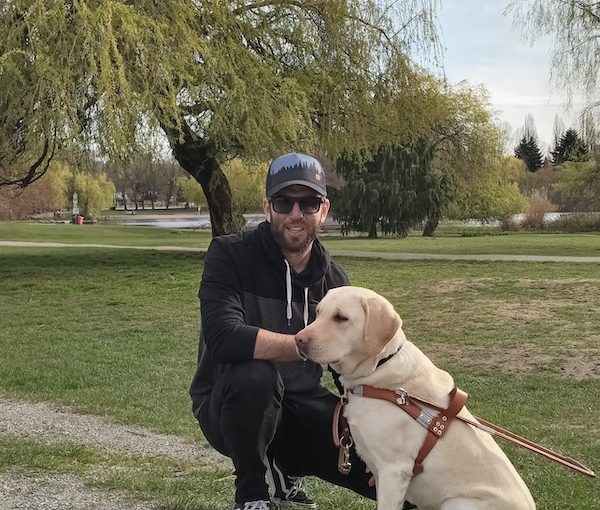
Achiya Klein and Joy at Trout Lake Park in Vancouver April 4. Klein and Joy were brought together by the Israel Guide Dog Centre for the Blind. (photo by Cynthia Ramsay)

“The Israel Guide Dog Centre is not just a centre,” said Achiya Klein. “It’s like a family.”

Klein and his assistance dog, Joy, came to Vancouver from Toronto earlier this month with Atarah Derrick, executive director of Canadian Friends of the Israel Guide Dog Centre for the Blind. The Independent met with them at Trout Lake Park April 4.

It was an educational experience to see Klein and Joy interact, like a unit. Even when Joy was off leash, clearly enjoying the freedom of running around on her own, meeting other dogs, she would respond to Klein’s occasional check-in whistles or calls. Being a Hebrew-speaking dog, one wonders what she had to say to her Canadian compatriots. Only once, enticed by the lake, did Joy hesitate to return to Klein, but she did – and before taking the plunge she so obviously wanted to take. On our walk, Derrick explained that all the 

Israeli guide dogs have English names so that the animals will know it’s them being called – imagine, she said, if a client called out a name like Yossi in an Israeli market, for example.

Klein has had Joy since the end of last October, since his first guide dog, Night, passed away at the age of 8.

“Having a guide dog is my way to get my independence again,” said the Israel Defence Forces veteran, who was injured in 2013. “I can do whatever with a guide dog because I can walk alone, with no fear, and being comfortable.”

Klein has serious visual impairment. “I have some sight,” he said, “but it’s minimal.”

A team commander in Yahalom, a special unit of the IDF that deals with the handling of dangerous ammunition and weapons, Klein was injured in a Gazan tunnel. “I was on a mission to demolish the terror tunnel that crossed into Israel,” he explained, “and, when we were walking in the tunnel … there was a booby-trap, and I got injured from that when it exploded.”

Klein moved to Canada with his wife, who is Canadian, in 2023. Noach Braun, the founder of the Israel Guide Dog Centre, personally brought Joy to Klein, where he worked with the pair for 10 days. The training period was shorter than usual because Klein had already had a guide dog. Normally, after matching a client with a dog, the pair train together for a few weeks at the centre, which then provides more training in the client’s home environment.

“It’s not like they just give you a dog and say, ‘OK, good luck,’” said Klein. “It’s more than that, and I think that one of the best examples is, after Night passed away, even though I was in Canada and I was supposed to go to Israel to receive a new dog, because of Oct. 7, I couldn’t make it to Israel, so Noach … came here during the war. He came here with Joy and I think that’s a beautiful story, to show what it means to be a part of the family.”

According to Derrick, who has been leading the Canadian Friends of the Israel Guide Dog Centre for the Blind since 2021, the centre has placed 796 guide dogs, 39 post-traumatic stress disorder (PTSD) dogs and 442 emotional support dogs, for a total of 1,277 since its founding in 1991. In 2023, there were 176 puppies being raised by centre volunteers, she said.

“The IGDCB (as it is known in Israel) serves Israel’s blind community by providing them with mobility, independence, self-confidence and companionship through the faithful assistance of guide dogs specially trained in Hebrew to meet Israel’s rigorous and challenging environment,” Derrick explained in an email. “We also breed and train service dogs for IDF veterans who have service-related PTSD and provide emotional support dogs for children on the autism spectrum.”

Canadian Friends of the Israel Guide Dog Centre for the Blind was established almost 20 years ago and Canada accounts for 6.6% of donations, according to its 2022 annual report. It is one of Derrick’s goals to increase that amount.

“I have always been passionate about community service and working in the charity sector, raising funds for vulnerable communities,” she said. “I’m a real dog person and, when the opportunity opened at Canadian Friends of the Israel Guide Dog Centre, it was the perfect match for my skills, interests and passions – helping people, Israel and dogs!”

Last year, Derrick and Braun visited Vancouver to visit donors and meet others interested in the centre’s work. “Everyone asked us to come back soon, preferably with a client and their dog, so they could see our work in action,” said Derrick, which was why she came this spring with Klein – who has become, she said, since being injured, “a Paralympic rower, a dedicated skier, a father and an asset to the IDF” – and Joy.

“We visited Vancouver Island first, with a meeting in Ladysmith to meet new friends there,” said Derrick. “We then headed south to Victoria, specifically Chabad of Vancouver Island. Then we moved east to Vancouver, where we met with Schara Tzedeck, the Kollel, and held a parlour meeting at the home of new friends. It was such a lovely visit, and we got to meet terrific people with whom our work really resonated.”

Initially, former Jewish National Fund shaliach (emissary) to Vancouver Mickey Goldwein, his wife Lili and her dog, Zita, were to accompany Derrick on the BC visit. Unfortunately, they couldn’t make the journey from Israel.

Lili Goldwein was partnered with Zita in 2018, explained Derrick, “because Lili’s vision had significantly deteriorated. Mickey joined the Israel Guide Dog Centre for the Blind’s board in 2022.”

The need for the centre and its services has increased since Oct. 7.

“Due to this war, we altered the criteria for receiving an emotional support dog to provide an immediate response to those injured or suffering due to the war,” said Derrick. “Since then, we have provided our emotional support dogs to children and adults with special needs whom the war has immensely impacted. Some of these people fought on Oct. 7 and were discharged immediately because of the trauma they endured. Some are widows of fallen soldiers. Some have been afraid to leave the house for months. 

“We are aware of some soldiers who have lost their vision in this conflict, and we need to be ready for them when they need us. This is in addition to the current clients on the waitlist,” she said.

The war also has disrupted the centre’s training, which may impact the number of guide dogs it can provide this year. “But we are doing our best to meet the challenge,” said Derrick.
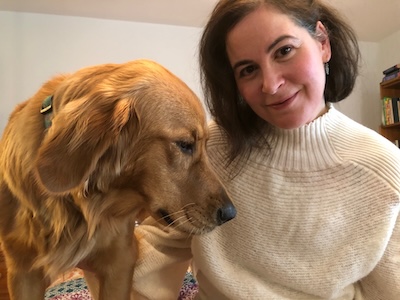
photo - Atarah Derrick, executive director of Canadian Friends of the Israel Guide Dog Centre for the Blind, with Cookie
Atarah Derrick, executive director of Canadian Friends of the Israel Guide Dog Centre for the Blind, with Cookie. (photo from Atarah Derrick)

And they are meeting the challenge while still feeling the effects of the pandemic.

“COVID had two major impacts on our training,” said Derrick. “The first was in the socialization of our puppies. In their first year, it’s crucial to expose them to as many environments as possible. The office or university, the mall and the train station are all places where our pups get to experience lots of people, noises and smells and become more comfortable navigating those environments. Because of the lockdowns, most were cut off from those experiences, and many were not ready to take on service work. So, our success rate through COVID dropped, and our clients had to wait longer periods for their dogs. This was the case worldwide. 

“The second was that we were not able to open our residences to clients in guide dog courses. When a person is partnered with a guide dog, they live in residence with us for two weeks while they train together with our professionals. This was impossible during COVID, so our trainers went to the clients and worked with them at home, one-on-one, to complete the course. We put a lot of mileage on our vans during those years.”

Now, it is hospital visits that account for some of the mileage being put on the centre’s vans, with puppies and guide-dogs-in-training traveling to offer comfort to injured soldiers and civilians across Israel. 

“As the war rages on, we’re committed to continuing this mission of love and compassion,” reads the centre’s latest blog. “Because no matter the circumstances, a little bit of puppy love can go a long way in healing hearts and bringing people together.”

Seeing Klein and Joy together at Trout Lake Park and getting a glimpse of what having a guide dog has meant to Klein, the importance of the IGDCB’s work seems clear.

“They provide you with one of the most basic tools that you use every day,” Klein said. “But it’s not just a tool, it’s also a friend.”

To learn more about the Israel Guide Dog Centre for the Blind, visit israelguidedog.ca. 
Format ImagePosted on April 26, 2024April 26, 2024Author Cynthia RamsayCategories Israel, LocalTags Achiya Klein, Atarah Derrick, COVID, dogs, health care, IDF, Israel Defence Forces, Israel Guide Dog Centre for the Blind, Israel-Hamas war, mental health, pandemic, terrorism, veterans
Eat well, while helping Leket

Eat well, while helping Leket

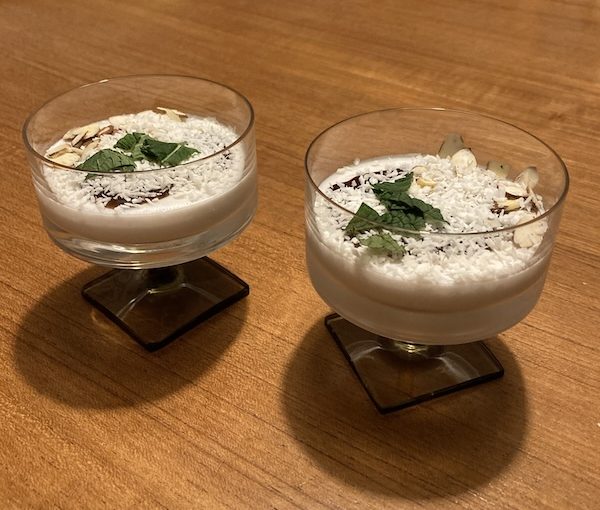
My new favourite dessert: Inbal Baum’s Coconut Cream Malabi. Baum is one of the contributors to June Hersh’s new digital cookbook, Cooking for a Cause. (photo by Ingrid Weisenbach)

I have a new favourite dessert: malabi. At least Inbal Baum’s Coconut Cream Malabi. Baum is one of more than 70 cooks, bloggers and others who have contributed to June Hersh’s new digital cookbook, Cooking for a Cause. All proceeds from the book’s sale support Leket Israel, whose focus is “rescuing healthy, surplus food and delivering it to those in need through partner nonprofit organizations.”

“By purchasing this digital cookbook,” notes Leket’s promotional material, “you will not only be supporting Leket Israel’s routine food rescue operations, distributing fresh, nutritious, surplus food to over 330,000 people in need each week, but you will also be part of Leket’s emergency relief campaign, providing much needed assistance to displaced Israelis throughout the country as well as to the Israeli farming community who has been significantly impacted by the ongoing war.”

Hersh has written several cookbooks “with a charitable flavour,” supporting various causes. She contributes to food blogs and magazines, appears on radio and TV, and gives talks on the importance of preserving Jewish food memory. Cooking for a Cause is a response to the Oct. 7 terror attacks, and Hersh and Leket Israel “reached out to everyone we could think of who has made an impact in the world of Jewish food,” writes Hersh in the introduction. “Additionally, we approached those incredibly outspoken Jewish and non-Jewish supporters who have taken a stand and used their moral compass to point the way. The response was overwhelming!”

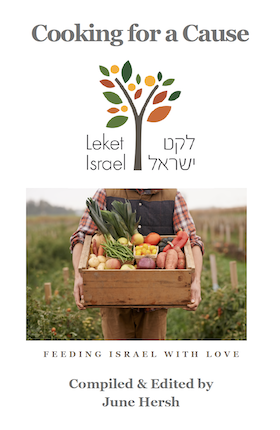
image - Cooking for a Cause book coverThe result is a unique cookbook that is interesting both for its recipes and its stories – each entry tells users a bit about the contributor and/or the food being presented, and there are eye-catching colour photos throughout. The cookbook “is not arranged from starters to desserts and it is not consistent in its format,” writes Hersh. “I say this not as an apology but with pride, as this book is deliberately different. It reflects a cacophony of voices that have come together to support Leket and the people of Israel. Each contributor presents their connection to Jewish food and expresses it with a different perspective, writing style and point of view. You, the reader, benefit from diverse cooking techniques, interpretations of Jewish cuisine and fresh commentary with each recipe.”

Recipes that caught my eye as I skimmed through the book included Vegetarian Stuffed Cabbage Rolls (Holishkes) by writer Joe Baur; Pandora’s Chicken with Artichokes, Oregano, Olives and Sundried Tomatoes by Joan Nathan, “award-winning ‘godmother’ of Jewish food”; Aunt Rini’s Tahini Cookies by Elise Addlem, founder of Feminists Against Antisemitism; and Olio Egg Salad by Ben Poremba, who “infuses his Israeli-Moroccan heritage into all his restaurants.”

I have bookmarked these recipes for future cooking/baking sessions, and will certainly try others as well. Between the Jewish Independent’s Passover and Israel special issues, I only had time to try out three recipes. In addition to Coconut Cream Malabi, which Baum writes was inspired by “Our Chef Sevim [Zakuto], with her Turkish-Jewish roots, [who] shared the cherished recipe from her grandmother,” I made Rachel Simons’ Fennel and Herb Salad (Simons is a co-founder of the company Seed+Mill) and award-winning chef and restaurateur Jonathan Waxman’s Steelhead Trout with Vermouth, Baby Sorrel, Chanterelles and Fingerlings.

The salad was as big of a hit as the malabi, and I enjoyed the meal part of the trout recipe but wasn’t so keen on the sauce, which contained vermouth. Not being a lover of vermouth, I had put the sauce on the side, and I thought the food was better without it. When I make the fish again, I’ll try to halve the vermouth or reduce it on the stove to see if that makes it taste less sharp.

COCONUT CREAM MALABI
(by Inbal Baum)

1 can coconut cream (fat content should be greater than 14% for the best results)
3 tbsp sugar
3 tbsp cornstarch
1/3 cup of water
1 tsp of vanilla extract, or rose or orange blossom water
crushed (or chopped) nuts, to taste
desiccated coconut, for serving
pomegranate molasses and/or silan, for serving
optional toppings: chopped seasonal fruit (strawberries, apricots, mango)

In a small saucepan, combine the coconut milk and sugar. Bring to a gentle boil. Meanwhile, in a small bowl, mix the cornstarch and water until well combined. Slowly add the cornstarch to the saucepan, continuously stirring.

Over medium heat, continue stirring until the pudding thickens – this may take 3 to 5 minutes. If needed to thicken, add additional cornstarch in small amounts until the mixture begins to thicken.

Mix in the vanilla extract, orange blossom or rose water, then pour or ladle into four small bowls.

Allow to cool before serving (approximately one hour, but can be less).

When ready to serve, top with a layer of pomegranate molasses or silan (date honey), desiccated coconut and ground nuts.

FENNEL AND HERB SALAD
(by Rachel Simons; 4 servings; 30 minutes to prepare)

1 fennel bulb, very thinly sliced crosswise
juice of 1 lemon
1 cup cold water
1/2 cup fresh mint leaves, roughly chopped
1/2 cup fresh parsley leaves, roughly chopped
1 tbsp white wine vinegar
2 tbsp extra virgin olive oil
1 tsp flaky sea salt
1/8 tsp ground black pepper
1 cup parmesan cheese, thinly shaved (optional)

Place the sliced fennel into a bowl with the lemon juice and cold water. Let sit for about 10 to 15 minutes. Drain the fennel. 

In a large bowl, mix the fennel, mint leaves, parsley leaves, white wine vinegar, olive oil, salt, pepper and parmesan (if using). Mix to combine well. Serve the salad cold.

STEELHEAD TROUT WITH VERMOUTH, BABY SORREL, CHANTERELLES AND FINGERLINGS
(by Jonathan Waxman; serves 4)

4 x 4.5-ounce skin-on, boneless steelhead trout fillets
1/2 cup white vermouth
2 tbsp butter
2 tbsp olive oil
1 cup baby sorrel
1 cup cream
1 cup sliced raw fingerling potatoes
1 cup button chanterelle mushrooms

Season steelhead with sea salt and fresh ground white pepper.

Cook the potatoes in simmering salted water for 12 minutes. Set aside.

Wash mushrooms.

In a sauté pan, add 1 tbsp olive oil and 1 tbsp butter, heat to sizzling, add the trout, skin side down and sauté for 2 minutes.

When skin is crispy, turn over and add remaining olive oil and butter. Then add the potatoes and chanterelles to pan. Cook over medium heat for 5 to 8 minutes.

Remove steelhead to a warm platter. Ensure potatoes and chanterelles are cooked, add them to the fish platter.

Add the vermouth to pan and then add the cream. Turn off heat and add the sorrel leaves.

Taste sauce for seasoning and gently coat the potatoes and chanterelles with sauce. Serve hot.

* * *

To purchase Cooking for a Cause, go to chef.leket.org. For more on Leket Israel – including how you could join the organization’s approximately 54,000 annual volunteers “in gleaning, sorting and packaging rescued food for the Israelis in need” – visit leket.org. 

Format ImagePosted on April 26, 2024April 26, 2024Author Cynthia RamsayCategories Books, IsraelTags baking, cooking, Cooking for a Cause., fundraising, June Hersh, Leket Israel, recipes, tikkin olam
Camp celebrates a lifetime at 70

Camp celebrates a lifetime at 70

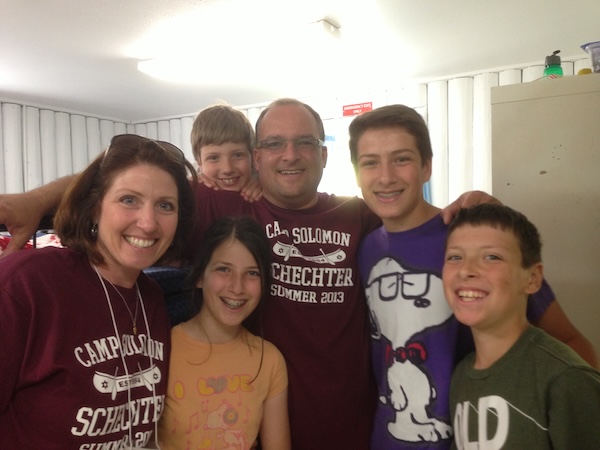
Lisa and Andrew Altow with their family on visitors day at Camp Solomon Schechter in 2013. (photo from the Altow family)

On May 5, Camp Solomon Schechter will honour four long-time relationships that were built at the camp. Part of its 70th-anniversary celebrations, there will be three separate events in three different cities – Portland, Seattle and Vancouver – on the same day. Those being honoured include Vancouverites Lisa and Andrew Altow, and Yvonne Rosenberg.

“One of the most special things about camp is the lifelong friendships that it creates and the geographic area that it spans,” Zach Duitch, executive director of Camp Solomon Schechter, told the Independent. “We say camp friends are forever friends and we know that having Jewish friendships throughout your life is one of the most significant and important relationships we have. This is what builds Jewish community.”

Of this year’s honourees, he said, “We have a friendship that has spanned three generations and two countries, from Portland to BC, Yvonne and Sharon [Stern] – they went to camp together, their children went to camp together, their grandchildren go to camp together. We have two relationships that are marriages from camp, the Korches [Melissa and Matt] and the Altows. And we have a beautiful friendship of four friends from four different communities who have stayed friends throughout their lifetime”: Eva Corets, Rochelle Huppin, Wendy Rosen and Karen Twain.

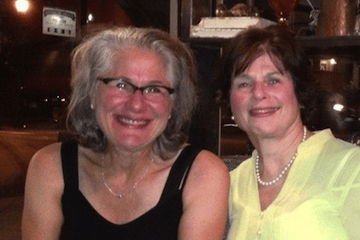
photo - Sharon Stern, left, and Yvonne Rosenberg met in the early 1960s at Camp Solomon Schechter and have been friends ever since
Sharon Stern, left, and Yvonne Rosenberg met in the early 1960s at Camp Solomon Schechter and have been friends ever since. (photo from CSS)

In previous years, Camp Solomon Schechter has awarded the Migdal Or Award to individuals who have provided a “spark of light that guides the way for others to follow.” The inspiration for the award and its first recipients, in 2020, were camp founders Rabbi Joshua and Goldie Stampfer (z”l). While an award won’t be given out this year, the 70th anniversary Schechter Spark will reflect the Stampfers’ “legacy, virtue and commitment to Jewish life and camping.”

Camp Solomon Schechter started in 1954, near Echo Lake, in Washington. The first year, 25 campers attended a one-week session; the next year, 40 campers attended a two-week session. 

The camp moved to Whidbey Island in 1958 but outgrew that space within 10 years. With the help again of Seattle Rabbi Joseph Wagner, one of the camp’s founders, as well as Harry Sherman and Rabbi Zev Solomon from Vancouver, BC, a camp property in the Olympia area was found, and it was for sale.

“Rabbi Stampfer immediately called the number and spoke with the owner, Helen Shank,” reads the Our History page of the CSS website. “And, for $300,000, the 200-acre property could be owned by Camp Solomon Schechter. Each of the rabbis from the major cities (Portland, Seattle and Vancouver) committed to raising $100,000 from their communities, and they were able to accomplish the goal in time for summer 1969.”

CSS is still located at the site near Olympia, with some 600 campers and more than 100 staff attending annually, in addition to the Stampfer Retreat Centre and OSPREY Camp (an outdoor education program).

Seventy years is a special anniversary in Judaism.

“The number 70 is considered a lifetime, so much so that 13 years into the second lifetime, at the age of 83, many Jews will have a second bar or bat mitzvah,” explained Duitch. “Where does that number come from? A midrashic tale tells us that there was an old man planting a carob tree by the side of the road when a traveler walked by. The traveler asked the man, ‘Why are you planting that tree? It will never bear fruit in your lifetime.’ The man responded, ‘I’m doing it for the next generation.’ And so, the legend goes, it takes a carob tree 70 years from seed to fruit and that’s where we get that idea of a lifetime. So, this year, at Schechter Spark, we are celebrating our first lifetime and raising funds for our next lifetime.”

“We are looking forward to being at the event with many of our good friends and all our kids,” Andrew Altow told the Independent. He and Lisa attended CSS in the mid-to-late-1970s. “I was a camper,” he said. “Lisa was a camper and, later, a counselor.”

After their first year at CSS, Andrew said there were a couple of reasons for wanting to return for another summer. “First, all our Jewish friends from all the cities – Vancouver, Seattle, Portland, Spokane – that went every year. Second, the ruach [spirit], the amazing sense of Judaism and fun together.”

Looking back now some 50 years later, Andrew said, “CSS played a massive role for us. Because of our CSS lifelong camp friendships, we met in our 20s at a party in Bellevue [Washington] and fell in love and got married a few years later – Lisa was from Bellevue and I was from Vancouver. Because of CSS, we maintained a meaningful connection with camp and eventually each of our four kids attended CSS and have made their own lifelong friends.”

Andrew and Lisa have each, at one time or another, served on the CSS board or a board committee.

“CSS has been a Jewish string that has connected us to our Judaism and to Israel in a positive and meaningful way, for which we are extremely grateful,” said Andrew. “Mostly, it’s been the amazing people involved with CSS, whether they be staff or volunteers, each one amazing in their passion for CSS and their genuine love for this magical camp, its mission, its values.”

It was “incredibly important” that their kids also go to Camp Solomon Schechter, said Andrew. “Each child – Josh, Lynne, Joey and Ari – got something different out of camp but their experience reinforced their Judaism and their connection to Israel.

“One summer, it was very special to have all four kids and my nephew from Toronto to attend in the same summer session – five Altows at one session. We were so proud to see how close they all were and continue to be. We believe CSS was an incredible positive influence on all of them.”

Humbled to be one of the Schechter Spark 24 honourees, Andrew said, “In a world today full of hate, full of antisemitism, full of turmoil worldwide, CSS is an oasis of safety for Judaism to shine through our children and teach them the beautiful tenets of Judaism so our children, and future children, can continue to repair the world as our faith illustrates.”

To read about the other Schechter Spark 2024 honourees and to RSVP for the (free) local May 5 event at Tap & Barrel in Olympic Village, go to campschechter.org/spark-24. Vancouver co-chairs are Elana Bick and Sheldon Franken, and the special guest will be camp director Manda Graziel. 

Thanks to CSS’s 2024 Matchmakers, any new donation to the camp will be matched dollar-for-dollar, up to $218,000. Visit campschechter.com to donate. 

Format ImagePosted on April 26, 2024April 26, 2024Author Cynthia RamsayCategories LocalTags Andrew Altow, anniversary, Camp Solomon Schechter, fundraising, Judaism, Lisa Altow, Schechter Spark, Vancouver, Yvonne Rosenberg, Zach Duitch
Art transcends our lives

Art transcends our lives

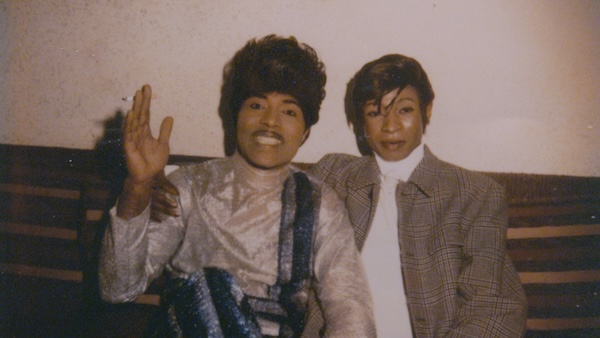
Little Richard, left, and Jackie Shane. A still from the film Any Other Way: The Jackie Shane Story, which closes the DOXA Documentary Film Festival on May 11. (image from NFB and Banger Films)

An incredible voice, a charismatic performer, a unique human being. Yet, most of us have never heard of Jackie Shane, a rising R&B star in the 1950s and ’60s, who appeared to disappear in 1971.

Michael Mabbott and Lucah Rosenberg-Lee’s feature-length documentary Any Other Way: The Jackie Shane Story closes the DOXA Documentary Film Festival on May 11 at Simon Fraser University’s Djavad Mowafaghian Cinema. In addition to Toronto Jewish community member Rosenberg-Lee, who may attend the festival, Winnipeg Jewish community member Toby Gillies is coming to Vancouver with co-director Natalie Baird for the May 10 screening of their short, Don’t Let the Sun Catch You Crying, which also takes place at SFU’s Djavad Mowafaghian Cinema.

An R&B legend

A Banger Films and National Film Board of Canada co-production, Any Other Way mixes animation and real-life footage, using Shane’s music, recorded phone conversations between Mabbott and Shane, as well as other interviews, photos and the sole recorded performance of Shane to tell the transgender artist’s story. And it’s a fascinating story, from her leaving her home of Nashville, because of safety concerns, as a queer person, to being a musician in a traveling carnival, to leaving the carnival for Montreal, then leaving Montreal for Toronto, where she immediately felt at home. 

By 1963, Shane was a sensation. Her recording of “Any Other Way” was a hit, even though radio stations in Toronto at the time generally did not play Black music – people called CHUM Radio so much they had to play the song and it rose to #2. Shane was invited onto The Ed Sullivan Show but turned them down because they wouldn’t let her perform with makeup, dressed as she wanted; she didn’t do American Bandstand, saying it was a racist show. Shane chose not to do other shows or tour. She recorded her one live album in Toronto.

But not being able to be her true self took its toll and Shane walked away from her success in 1971, changed her name and moved. “I chose Los Angeles because I wanted to feel something else,” she says in the film.

For family reasons, she eventually had to return to Nashville, where she became a recluse, only emerging in 2016 for a reissue of her songs. Nominated for a Grammy in 2018, she was ready to tour, but died in 2019, before that could happen.

Among the treasures found in Shane’s storage unit was an autobiography she had handwritten, as well as unreleased recordings. 

“Those discoveries … were incredible,” said Mabbott in an interview on the NFB website. “After Jackie passed away, we started working with her family, who didn’t know that Jackie existed, and then inherited her incredible archive. As they were discovering who Jackie was, we were understanding her through her jewelry and tapes. What was also born out of that is the family’s story, which was a slightly unexpected creative approach.

“Hearing the family talk about her, learn about her legacy and describe what it meant to them was obviously very personal but also really universal. This is a family that lived blocks away from her, didn’t know she was there and missed out on having her. I think that a lot of us feel that loss and that translates in all sorts of ways.”

Happy imaginings

image - A still from the short Don’t Let the Sun Catch You Crying, co-directed by Toby Gillies and Natalie Baird, which screens May 10 at SFU’s Djavad Mowafaghian Cinema, as part of this year’s DOXA festival.
A still from the short Don’t Let the Sun Catch You Crying, co-directed by Toby Gillies and Natalie Baird, which screens May 10 at SFU’s Djavad Mowafaghian Cinema, as part of this year’s DOXA festival. (image from NFB)

The NFB short film Don’t Let the Sun Catch You Crying also explores loss. The PR material describes the seven-minute work as a “meditation on love, grief and imagination,” which “celebrates life and the transformative ability of art to elevate and transcend us.” 

Featuring Edith Almadi, the short uses Almadi’s artwork and words to spur contemplation of the bonds people form, and what it’s like to lose a loved one. In this case, Almadi is recalling her son, who recently died. 

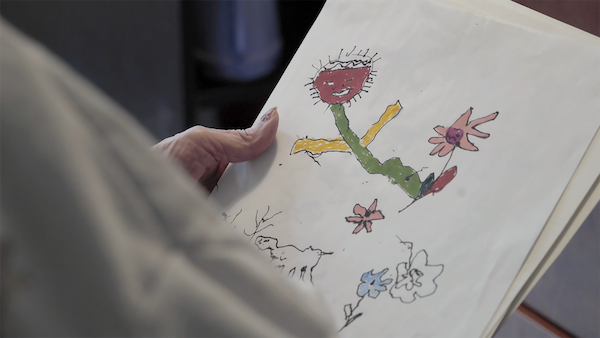
“I fly with him,” she says, and she feels happiness. In the animation of Almadi’s artwork, we see her son fly to the moon and beyond, with fairies, butterflies and other creatures. Not only is she with her son in her art, but also with everyone she loves. In her imagination, she is totally free.

“Our initial motivation for interviewing Edith was to save memories for ourselves – we find the way she speaks fascinating and poetic,” write Gillies and Baird in a directors’ statement. “When Edith looks at her drawings, she sees her memories and fantasies. She is able to escape her physical circumstance, through entering her marker and watercolour worlds.”

Gillies and Baird have led an art program at Winnipeg’s Misericordia Health Centre since 2014, and that’s where they met Almadi, a Hungarian immigrant in her late 80s, who uses a wheelchair.

“In our time knowing Edith, she has always loved sharing her outlook publicly,” the directors write. “As we have developed the film, we have shown Edith our progress along the way. She says, ‘That’s me’ and ‘That’s all I have to give’ proudly. Facilitating art-making in this personal care home has allowed us to meaningfully connect with many people in their last stages of life. As directors, this film gives us the opportunity to share this one particular experience of intimacy found through collaborative art-making.”

DOXA runs May 2-12. For tickets and the full festival lineup, visit doxafestival.ca. 

Format ImagePosted on April 26, 2024April 26, 2024Author Cynthia RamsayCategories TV & FilmTags aging, Banger Films, death, documentaries, DOXA, Edith Almadi, history, imagination, loss, Lucah Rosenberg-Lee, Michael Mabbott, Natalie Baird, National Film Board, NFB, R&B, Toby Gillies
Waldman’s 2024 Human Library

Waldman’s 2024 Human Library

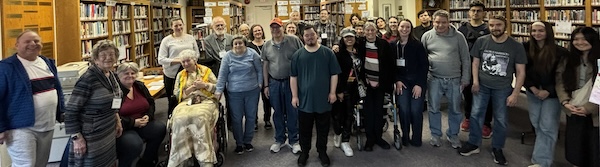
Participants in the Human Library event at the Isaac Waldman Jewish Public Library on April 7. (photo from Waldman Library)

photo - Jewish Independent publisher Cynthia Ramsay (inset, middle) was one of the “books”
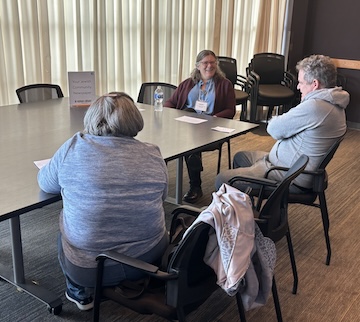
Jewish Independent publisher Cynthia Ramsay (inset, middle) was one of the “books.”  (photo from Waldman Library)

The Human Library event at the Isaac Waldman Jewish Public Library on April 7 drew a diversity of “human books” (volunteers who shared some of their life experiences) and readers (people who came out to learn about those experiences). Titles included Police Officer; Coping with Dementia: A Mother/Son Story; More than just MS; Brain Cancer Survivor; Your Jewish Community Newspaper; and Partners in Care. Books and readers gathered at the library, had snacks and shmoozed, before participating in three separate reading sessions over the course of the afternoon. The purpose of the event is to connect one-on-one or few-on-one with individuals from different cultural backgrounds and lifestyles, celebrating our differences and fostering understanding.

Format ImagePosted on April 26, 2024April 26, 2024Author Cynthia RamsayCategories LocalTags education, Human Library, Waldman Library
Diverse & happy show

Diverse & happy show

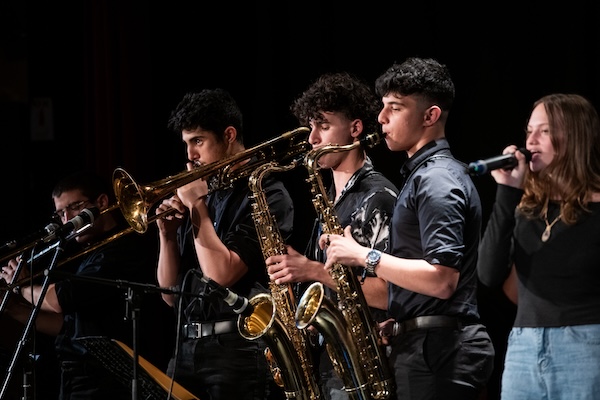
Members of the Clore & Roll Ensemble will perform in Vancouver on May 13. (photo from Clore Centre)

Every year, it is sobering to experience the transition from Yom Hazikaron, the day of remembrance for Israel’s fallen soldiers and victims of terrorism, into Yom Ha’atzmaut, the celebration of Israel’s Independence Day. This year, it will be even more so. And it will be especially poignant, given that the musical group headlining the local community gathering on May 13 is an ensemble from Kfar Blum, a kibbutz in the Galilee Panhandle, in northern Israel, where some 60,000 people have been evacuated because of the threats posed by Hezbollah in Lebanon.

The Clore & Roll Ensemble is an initiative of the music school of the Clore Centre for the Performing Arts, which also has a dance and theatre school. The centre was established in 1996 and approximately 1,000 students (which include adults) study there. They come from kibbutzim and moshavim in the area, as well as Druze and Arab towns.

“I’m glad to say that the conflict doesn’t get inside the centre,” Telem Chorin, chief executive officer of the Clore Centre and director of the ensemble, told the Independent. “Music is an international language and also an emotional language that connects people,” he said.

While the Clore Centre’s offerings remain afterschool programs, the centre has played a more important role in students’ lives since the Oct. 7 terror attacks that led to the current war.

“For some kids, the Clore is like a second home,” said Chorin. “Because, for some students, it is a more stable place than the hotel they were evacuated to, or the school that is currently closed or working partially.”

Despite being displaced, ensemble members have been coming together weekly to practise for the show in Vancouver. Rehearsals are at the centre.

“Last week, we had matriculation exams in dance and, during April and May, we will have matriculation exams in music playing,” said Chorin. “It is interesting to see how committed the students are to performing arts subjects even in such a period, and how much effort they have to invest – time, long journeys, sometimes even risking [their safety] and coming to Kfar Blum, even though it is relatively more dangerous here than in their homes or the hotels they have moved to. This shows how important it is to them and how much they don’t give up on it despite everything, and maybe even this is what keeps them ‘sane’ amidst all the chaos currently prevailing in the north.”

Some members of the ensemble have been playing together for more than five years in different capacities, but the group that is coming to Vancouver has only been playing together for the past three months, said Chorin. Due to the war and the evacuations, the group had to rebuild. “We’ve added additional musicians to the band so that you will have an amazing show!” he said.

Coming to Vancouver are Menachem Ofri (17, singer), Yaron Shir (18, singer), Kachtan Aviv (17, flute), Maman Moria (17, alto saxophone), Moyal Ido (17, tenor saxophone), Shem Tov Ido (19, trombone), Kovesh Gil (24, drums), Primor Adi (17, electric guitar), Fitzer Tal (16, piano) and Deutscher Goni (16, bass guitar). Also coming are Ziv Greenberg (music director), Ferry Stefan (dance teacher and dancer), Malki Smadar (administrative manager) and Kashri Noam (technical manager). 

“Ofri, Ido Shem-Tov, Aviv and Noam were evacuated from their homes, and they are coming from all over the country to the rehearsals at the centre – sometimes, under rocket attacks!” said Chorin, who will join the band in the performance, on clarinet. 

“Some of the students have already appeared in Edmonton and Calgary,” he said. “I have performed in Edmonton, Calgary, Windsor and Hamilton, but this is my first time in Vancouver and I am very excited! Some of the students were in Vancouver on student exchanges with their schools in Israel.”

Of what it means for the Clore & Roll ensemble to play a Yom Ha’atzmaut concert in the diaspora, Chorin said, “It is a great pride and honour to represent the state of Israel in general, and the Upper Galilee in particular, in such a show, on the eve of Independence Day, in a challenging time like now.”

The ensemble will present a wide-ranging repertoire.

“We are going to play modern Israeli songs (Idan Raichel, Mizrachit [Israeli pop]), classic Israeli songs and also some songs in English,” said Chorin. “A very diverse and happy program.”

“Bringing the Clore ensemble serves as a reminder of the unbreakable bond we share across borders,” said Dafna Silberstein, associate director of Israel connections and partnerships at the Jewish Federation of Greater Vancouver. “It is also an amazing opportunity for the ensemble of teens and young adults to take a break from what they have been through for the past six months. And, for us, it feels like it is exactly what we need this year: coming together as a community united for and with our brothers and sisters in Israel.”

Jewish Federation has supported the Clore Centre as part of the Coast-to-Coast Federations’ Collective and independently, “as the centre is in our partnership region of Kiryat Shmona and the Galilee Panhandle,” explained Silberstein.

“We have wanted to bring the Clore ensemble for awhile now, to showcase the impact our support has had on its students and have been waiting for the right opportunity,” she said, noting that it is “with mixed emotions” that Oct. 7 created that opportunity.

“This year, the commemoration of Israel’s 76th Independence Day holds an even deeper meaning and significance,” said Silberstein. “It is an opportunity to stand together in solidarity and celebrate our shared values. Considering the spike in antisemitism, the need for community unity has become more important than ever.”

For tickets ($18) to the May 13, 7:30 p.m., concert at Congregation Beth Israel, as well as information about other Israel@76 activities, visit jewishvancouver.com/israelhere. 

Format ImagePosted on April 12, 2024April 11, 2024Author Cynthia RamsayCategories LocalTags Clore & Roll, Clore Centre, conert, ensemble, Israel Independence Day, Jewish Federation of Greater Vancouver, music, Yom Ha'atzmaut
Ed Asner shines in final role

Ed Asner shines in final role

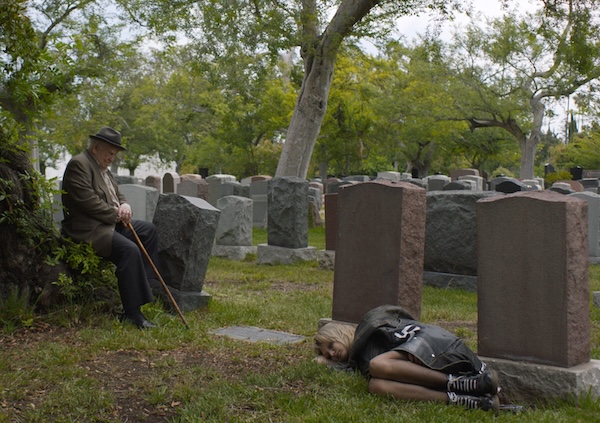
Ed Asner gives a remarkable performance in Tiger Within, which is part of the online Vancouver Jewish Film Festival, April 15-19. (tigerwithin.info/press-photos)

I had the privilege of interviewing Ed Asner several years ago. It was an experience I (and my mother, who also got to speak with him) won’t forget. So, it was with some sentimentality that I watched his last film, Tiger Within, which can be screened online April 15-19, as part of the Vancouver Jewish Film Festival, which has other movies being presented at the Rothstein Theatre April 12-14.

Asner, who died in 2021, gives a wonderful, understated performance in Tiger Within, as widower and Holocaust survivor Samuel, who takes a troubled young woman under his wing, and changes her life for the better. His performance is the main reason to watch this film. People old enough to know Asner will understand when I say Tiger Within would have fit perfectly into the ABC Afterschool Special lineup. Well-intentioned, it is not well written and, with the exception of Asner, the acting is middling.

Casey, played by Margot Josefsohn, is a rebellious teenager with a struggling mother who prefers to keep her nasty boyfriend happy than care for her daughter. Casey’s father has started a new family and their suburban life isn’t a place for the mouthy, punk-loving, artistic teen. Another highlight of Tiger Within is Casey’s art, which makes appearances throughout, further communicating her frustrations and other feelings.

Out on her own, Casey is lucky to meet Samuel, who sees her inner light and inherent worth, even if she doesn’t. He manages to see beyond the swastika someone spray-painted on her jacket, which she didn’t bother to wash off, and her antisemitic opinions, including that Jews made up the Holocaust, which were taught to her by her mom and others. He gives her the unconditional love, snippets of wisdom and space to “tame the tiger within” and make her place in the world.

The movie has a timely and important message. And a younger audience might be just the one to receive it in the manner it was intended. 

“One of the biggest tragedies is the misuse of love, the most powerful force there is,” writes director Rafal Zielinski on the movie’s website (tigerwithin.info). “Loving oneself, family, group, race, country (narcissism) and being incapable of loving the other equally, as oneself, is the misuse of love, it breeds hate.

“That is the message, I feel, in this film – Samuel overcomes hate for this girl and shows her unconditional love. 

“It’s the greatest gift anyone can receive on this earth, and he keeps his promise, he once made to his wife – ‘to forgive all before he dies.’”

For tickets to Tiger Within and other festival films, visit vjff.org. 

Format ImagePosted on April 12, 2024April 10, 2024Author Cynthia RamsayCategories TV & FilmTags Ed Asner, Tiger Within, Vancouver Jewish Film Festival, VJFF

About the 2024 Passover issue cover

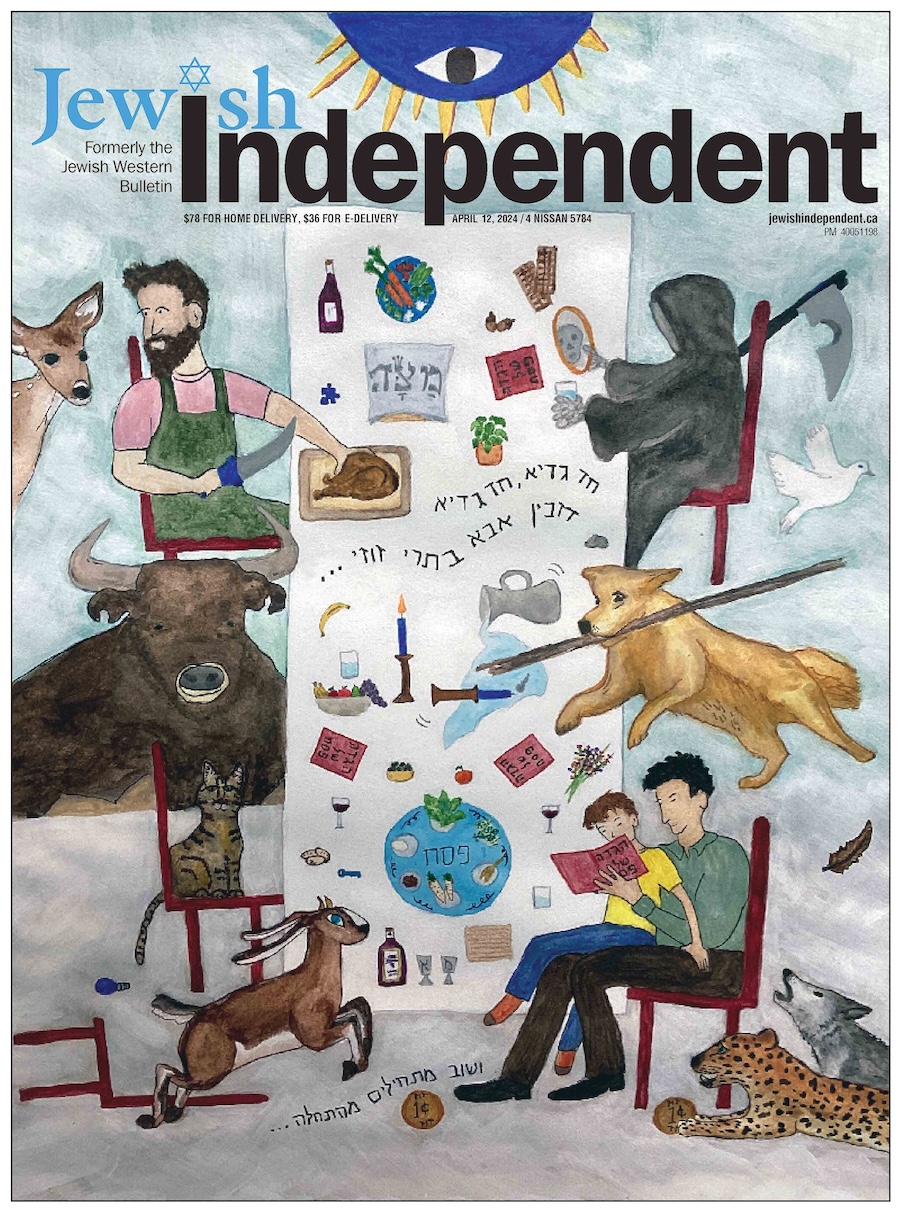
image - JI Passover cover April 12 2024There are numerous interpretations of Chad Gadya (One Little Goat), which ends the Passover seder. A cumulative song, like “There Was an Old Lady Who Swallowed a Fly,” it starts with Father buying a goat, which is then eaten by a cat. Because it’s easier to summarize from the end, the last verse is, depending on your translation: then came the Holy One, Blessed be He, and slew the angel of death, who killed the butcher, who slaughtered the ox, that drank the water, that quenched the fire, that burnt the stick, that beat the dog, that bit the cat, that ate the goat. The Hebrew on the table in the cover image is the beginning of the song: Chad gadya, chad gadya, d’zabin Aba bitrei zuzei (that Father bought for two zuzim).

Often sung with different seder participants making the sounds of the succeeding aggressors, Chad Gadya is a cheerful song despite its violent imagery. With the numerous conflicts that mark human history and our present, I imagined the song’s characters, animate and inanimate, sitting down for a seder and what that might look like. This idea forms the centre of the cover scene.

While specifically about the Israeli-Palestinian conflict, Chava Alberstein’s 1989 version of Chad Gadya has always spoken to me more personally than politically. I have “been” the deer and dove of her song in my more empathetic and hopeful moments; her wolf and leopard in my more angry, fearful and hurt moments. As she sings – I, too, sometimes “don’t know who I am” in this world that can be so incredibly harsh. I, too, have thought, as Alberstein sings, and which I’ve written on the bottom of the cover art in Hebrew: “And we start again from the beginning …” each time one of us attacks another, with words or actions.

But giving up is not an option. So, while the characters of Alberstein’s song lie at the periphery of the seder image I created, 16 other symbols that might appear on a modern seder plate are scattered throughout. They represent what each of us can do to make ourselves better humans and the world a better place. They are not my ideas. I completely lifted all of them from “Beyond Bitter Herbs: Contemporary Additions to the Seder Plate” by Beverley Kort (with Leland Bjerg), which we ran in the Jewish Independent’s Passover issue last year.

Kort explains the meanings behind the fruit, acorns, chocolate, coloured light bulb, key, mirror, potatoes, banana, olives, basil, whole wheat matzah, vegetables, dried flowers, feather, rock and puzzle piece. For all the explanations, visit jewishindependent.ca/the-modern-seder-plate. Highlighting some of them: the acorns at the top of the picture represent an acknowledgement of Indigenous land rights; the rock above the dog’s head is symbolic of resilience; the key by the seder plate is about unlocking doors, embracing change; on the left side, the coloured lightbulb symbolizes the creative spirit; and the feather wafting off to the right is a reminder of the importance of kindness and compassion.

Chag Pesach sameach.

Posted on April 12, 2024April 10, 2024Author Cynthia RamsayCategories Celebrating the HolidaysTags Beverley Kort, Chad Gadya, Chava Alberstein, Passover, Pesach, seder plate, symbolism
Tasty plant-forward recipes

Tasty plant-forward recipes

Chef and dietitian Micah Siva’s new cookbook, NOSH: Plant-Forward Recipes Celebrating Modern Jewish Cuisine, proves that plant-forward meals can be bursting with flavour and colour. (photo by Hannah Lozano)

“This is really good,” said my wife, as she tasted the steaming hot Spiced Cauliflower Chraime I had made from the new cookbook NOSH: Plant-Forward Recipes Celebrating Modern Jewish Cuisine (The Collective Book Studio) by chef and dietitian Micah Siva.

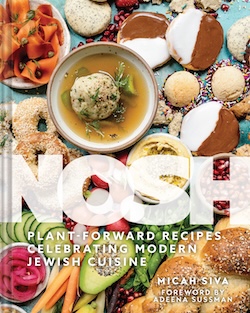
image - NOSH book cover“‘Plant forward’ is a way of cooking and eating that emphasizes plant-based foods without limiting one’s diet to being vegetarian or vegan,” writes Siva. “This book is meant for anyone who follows a plant-based diet or is looking to adopt a plant-forward way of eating.”

It’s also for anyone who appreciates delicious food, from what I can tell from the plates I tried. Nonetheless, Siva does offer solid advice for meat-eaters wanting to become more plant-forward. In that regard, she talks about getting enough protein and iron, what can be substituted for eggs, etc.

On the Jewish side, she gives milk and butter substitutions to make a recipe pareve (permissible for observant Jews to eat with milk or meat dishes) and offers sample holiday menus. I found the Shabbat Matrix interesting – the cooking time required (little, more and lots) is on one axis and the effort involved (low and high) is on the other. Siva offers some ideas to think about 

depending on the time and effort you can put into the meal. So, you can buy store-bought challah or make your own, make spritzers or just buy a bottle of wine and/or grape juice, for example.

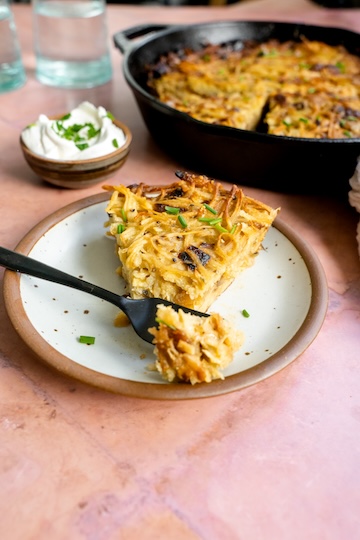
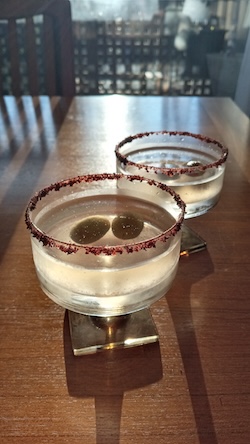
Given that Passover is approaching, I focused on a few of the recipes Siva highlights for the holiday. Her list comprises Turmeric Vegetable Matzo Ball Soup, Vegan “Gefilte” Cakes, the aforementioned Spiced Cauliflower Chraime, Herbed Horseradish Salad, Cast-Iron Potato and Caramelized Onion Kugel, Passover Black and White Cookies and Passover Coconut Macaroons. In addition to the chraime, I made the kugel and the macaroons. For fun, and because I have a huge bag of sumac from another cooking experience, I also made two Olive and Sumac Martinis – though neither my wife nor I are hard-liquor folks, we enjoyed our sips.

The production quality of this cookbook is high. The layouts are beautiful, with lots of colour photos and easy-to-follow instructions, which are supplemented by dietary labels (ex. vegan, gluten-free, Passover-friendly), the time required to get the food or drink on the table and clearly listed ingredients, as well as a brief introduction to each recipe and notes about certain ingredients that may be new to some cooks, or variations that could be used, possible substitutions.

NOSH includes a glossary and I learned a lot perusing it. Amba, for instance, is a “tangy, spicy, pickled mango-based condiment or sauce of Indian-Jewish origin” and toum is a “garlic sauce, similar to aioli, made of garlic, oil, salt, and lemon juice.” Siva gives some hints about measuring, choosing ingredients and shopping efficiently. There is an index at the back of the book, plus conversion charts for liquid and dry measures, and a Fahrenheit-Celsius temperature table. Acknowledgements and a bit about the author round out the publication.

In the few recipes I tried – and Passover-friendly ones at that – the expansive flavour palette on offer was evident.  I look forward to making some of the 80+ other recipes in this cookbook, which illustrates the global diversity of Jewish culture. Siva may have grown up in Calgary, but her repertoire travels well beyond, to the Middle East, India, Africa, Europe and elsewhere Jews live or have lived. Her blog, at noshwithmicah.com, is worth checking out.

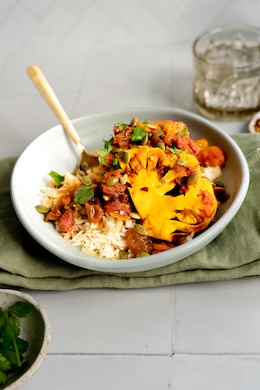
The cauliflower chraime was packed with spices – all of which I miraculously had in my cupboard! – and I will definitely make this dish again, as it was not only tasty but also easy to put together. According to Siva, it “is typically made with a whitefish poached in a tomato broth” and is often served in Sephardi families instead of gefilte fish during Passover. The recipe suggests serving it with couscous or rice, neither of which observant Ashkenazi Jews can eat during the holiday, so I plated it with mashed potatoes, which are OK for all Jews on Passover, and the two paired well. 

It is worth sharing Siva’s note in the cookbook, acknowledging that the recipes “that are ‘Passover Friendly’ will have kitniyot,” even though “Ashkenazi Jews typically prohibit kitniyot, which includes rice, corn, millet, and legumes (beans), as they look too similar to grains. While customarily left out of Passover menus, it is not technically prohibited by the Torah.” So, “[i]f a recipe is listed as suitable for Passover, please use your discretion, and do what feels more comfortable for you and your family.”

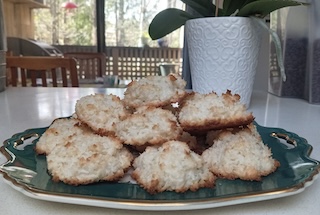
In the recipes that follow, all of which I recommend, I don’t include (for space reasons) the informative introductions that appear in the book. I made only one adaptation, choosing not to dip the coconut macaroons into chocolate, my personal preference being to just enjoy the richness of the coconut, brightened by the splash of lime juice and zest.

SPICED CAULIFLOWER CHRAIME
(serves 4, on the table in one hour)

photo - The Spiced Cauliflower Chraime from NOSH
The Spiced Cauliflower Chraime from NOSH will be an immediate favourite. (photo by Micah Siva)

2 tbsp extra-virgin olive oil
1/2 medium white onion, cut into 1/2-inch pieces
3 garlic cloves, finely chopped
3 tbsp tomato paste
4 tsp smoked paprika
2 tsp ground turmeric
1 tsp ground coriander
1 tsp ground cumin
1 tsp ground ginger
1/4 tsp ground cinnamon
1/2 tsp red chili flakes
1/4 tsp sea salt
juice of 1 lemon (about 2 tbsp)
1/2 cup canned diced tomatoes
1 1/4 cups vegetable broth (low-sodium, if preferred)
1/2 cup golden raisins
1 small head cauliflower, cut into 6 wedges (if using a large cauliflower, cut into 8 wedges)
2 tsp date syrup or maple syrup
1/2 cup chopped fresh cilantro,  for serving
Cooked couscous or rice, for serving (I used mashed potatoes)

Heat the olive oil in a deep skillet over medium heat. Add the onion and cook until it begins to soften, 5 to 6 minutes.

Add the garlic, tomato paste, smoked paprika, turmeric, coriander, cumin, ginger, cinnamon, chili flakes, and salt, stir until combined, and cook for 2 to 3 minutes. Pour in the lemon juice, canned tomatoes, broth and raisins and stir to combine.

Place the cauliflower in the pan, cut side down in a single layer. Bring the liquid to a boil, decrease the heat to a simmer, cover and cook until the cauliflower is tender, 15 to 20 minutes.

Drizzle with the date syrup and garnish with the cilantro. serve with cooked couscous or rice.

Note: Store in an airtight container in the fridge for up to 5 days.  Reheat in a pan, oven, or microwave until warmed through.

Variations: Substitute chopped dried apricots or figs instead of raisins. Looking for more protein? Add a can of drained and rinsed chickpeas along with the canned tomatoes and/or crumble some feta cheese on top.

CAST-IRON POTATO AND  CARAMELIZED ONION KUGEL
(serves 10 to 12, on the table in 2 hours)

photo - Micah Siva’s Cast-Iron Potato and Caramelized Onion Kugel
Micah Siva’s Cast-Iron Potato and Caramelized Onion Kugel can be a side or a meal. (photo by Micha Siva)

5 tbsp extra-virgin olive oil, divided
2 medium yellow onions, cut into 1/2-inch pieces
1 1/2 tsp salt, divided
2 pounds (3 or 4) russet potatoes
4 large eggs
1/2 tsp black pepper
1/4 cup matzah meal
sour cream, coconut yogurt, crème fraîche or labneh, for serving (optional)
fresh chives, chopped, for serving

In a 9-inch cast-iron pan, heat 2 tablespoons of the olive oil over medium heat until the oil is hot but not smoking. Add the chopped onions, spreading them evenly over the bottom of the pan. Decrease the heat to medium-low and let cook, undisturbed, for approximately 10 minutes. 

Sprinkle the onions with 1/2 teaspoon of the salt and cook, stirring occasionally, until browned and broken down, 30 to 45 minutes. Once golden and caramelized, transfer the onions to a large bowl. 

Preheat the oven to 350°F.

Add the remaining 3 tablespoons of olive oil to the cast-iron pan and place it in the oven to heat up while you prepare the potatoes.

Fill a large bowl with ice water.

Using a food processor fitted with the shredding disk, or a box grater on the largest hole, grate the potatoes. The potatoes will oxidize, so be sure to shred right before use. 

Add the potatoes to the bowl of ice water. Let sit for 10 minutes to remove excess starch.

Drain the potatoes, transfer them to a clean kitchen towel, and wring out any excess liquid. The more liquid you can remove, the better! Add the potatoes to the bowl with the caramelized onions.

Add the remaining 1 teaspoon of salt, eggs, pepper and matzah meal and stir to combine. 

Carefully remove the cast-iron pan from the oven and spread the potato mixture in the pan, pushing it down to compact the potatoes. It should sizzle on contact with the pan. Return the pan to the oven and bake for 1 hour, or until deep golden brown on top.

Serve with sour cream and chopped chives.

Note: Prepare this kugel up to 4 days in advance and store in an airtight container in the fridge.

Variation: Add 1/2 cup chopped parsley to the kugel along with the matzah meal.

Substitution: This recipe uses russet potatoes, but you can use Idaho potatoes instead.

PASSOVER COCONUT MACAROONS
(makes 12 [large] macaroons, on the table in 45 minutes, including 10 minutes resting time)

photo - Lime juice and zest make Micah Siva’s Passover Coconut Macaroons specia
Lime juice and zest make Micah Siva’s Passover Coconut Macaroons special. (photo by Cynthia Ramsay)

2 cups unsweetened shredded coconut
1/2 cup sugar
1/3 cup potato starch
1/2 cup canned full-fat coconut milk
1 tbsp lime juice
1/2 tsp lime zest
1/4 tsp sea salt
6 ounces (about 1 cup) dark chocolate chips
1 tbsp coconut oil

Preheat the oven to 325°F. Line a sheet pan with parchment paper.

In a medium bowl, combine the coconut, sugar, potato starch, coconut milk, lime juice, lime zest and salt until well combined. 

Using a cookie scoop or ice cream scoop (large enough to fit approximately 2 tablespoons), scoop up some of the coconut mixture and pack it very firmly into the scoop. Use your fingers or the back of a spoon to press it into the scoop. Gently remove the coconut mound from the scoop and place it onto the prepared sheet pan. Tap the back of the cookie scoop to release it, if needed, and reform the mounds after placing them on the pan. Repeat with the remaining coconut mixture.

Bake for 22 to 25 minutes, or until golden. Let cool on the sheet pan. Once cool, remove them from the pan and place them on a plate. Line the sheet pan with wax paper.

While the macaroons are cooling, combine the chocolate chips and coconut oil in a microwave-safe bowl and microwave in 30-second increments, mixing well between each increment, until smooth.

Once the macaroons are cooled, dip the bottoms into the melted chocolate and place them on the prepared sheet pan. Refrigerate the macaroons until the chocolate is set, about 10 minutes.

Note: Once the chocolate has set, store the macaroons in an airtight container at room temperature for up to 5 days or in the refrigerator for up to 2 weeks. Store them in the freezer for up to 3 months.

Variation: Add 1 teaspoon of vanilla extract or 1/4 teaspoon of almond extract to the mixture in place of the lime zest and lime juice. Fold in 2 tablespoons of rainbow sprinkles and dip them into melted white chocolate.

OLIVE AND SUMAC MARTINI
(serves 1, on the table in 10 minutes)

photo - An Olive and Sumac Martini is one of the unique drink options in NOSH
An Olive and Sumac Martini is one of the unique drink options in NOSH. (photo by Cynthia Ramsay)

1/2 ounce olive juice, plus more to rim the glass
1/2 tsp sumac, plus more to rim the glass
2 1/2 ounces gin or vodka
1/2 ounce dry vermouth
ice
2 or 3 olives, pitted

Pour a little olive juice into a shallow dish. Place some sumac in another shallow dish. Dip the rim of a cocktail glass into the olive juice and then into the sumac. Gently shake off any excess sumac and set aside.

In a cocktail shaker or a jar with a lid, combine the gin, vermouth, 1/2 ounce olive juice and 1/2 teaspoon sumac and fill with ice. Stir or seal and shake until well chilled, 20 to 30 seconds. Strain the liquid into the rimmed cocktail glass and garnish with olives. 

Format ImagePosted on April 12, 2024May 2, 2024Author Cynthia RamsayCategories Books, Celebrating the HolidaysTags baking, cooking, Micah Siva, NOSH, Passover
Movies that offer optimism

Movies that offer optimism

Stay With Us (still from the film)

Healing. Of body and soul. Of self, community, family, friends. This year’s Vancouver Jewish Film Festival offers many poignant films – dramas sprinkled with humour that invite contemplation, and hope that we flawed humans are capable of change and loving one another, despite our insecurities and differences.

Of the films the Jewish Independent reviewed this week, Stay With Us and Rose are among the films that will be screened at Fifth Avenue Cinemas in the main portion of the festival, April 4-12, which is followed by various screenings at the Rothstein Theatre April 13-14. No Name Restaurant will be both at Fifth Avenue, as well as online during that portion of the festival, which runs April 15-19.

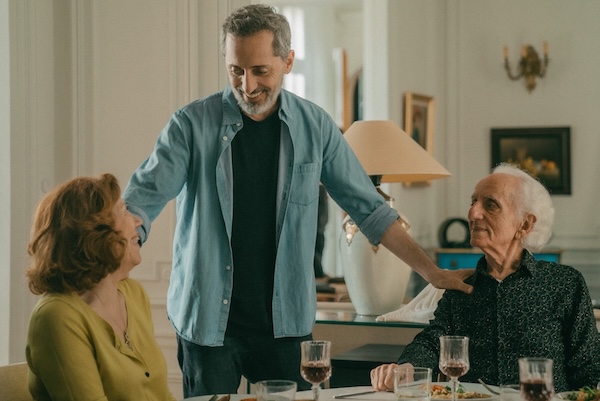
Stay With Us is a sensitively written and well-performed movie that is based on Moroccan-born Canadian comedian Gad Elmaleh’s real-life fascination with the Virgin Mary. In the movie, he returns to Paris to visit his family, not sharing with them that he is in the process of converting to Catholicism. Perhaps because he’s dealing with his own actual emotional journey (though he co-wrote the script with Benjamin Charbit), Stay With Us delicately and thoughtfully explores some of the roles religion has in life and the effects a potential conversion can have on a family. 

Despite being an immensely personal film – Elmaleh’s real parents and sister play his family in the film and most of the cast are people close to him – Stay With Us will resonate with anyone who has questioned their purpose in life, or been curious about other religions and cultures. Elmaleh doesn’t disparage religion or the religious. Thankfully, he chooses to tackle the subject seriously, with well-timed comedy, his own stand-up act as part of the story, as well as other natural-seeming, unforced funny moments – the reaction of his parents when they find a statue of the Virgin Mary in his suitcase is hilarious, for example.

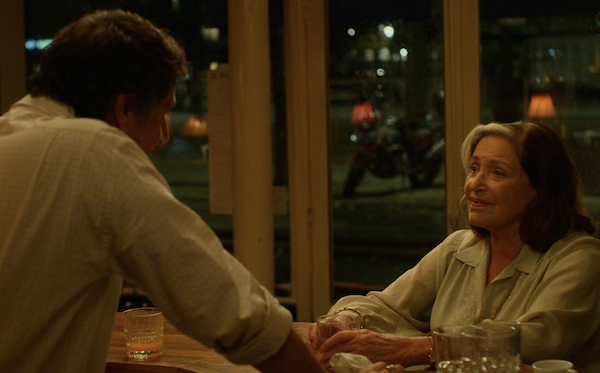
The movie Rose is similarly satisfying – serious but also light and amusing. In the first minutes, set at Philippe’s rocking, festive, friend-filled 80th birthday party, we learn that Rose and Philippe are still madly in love after decades of marriage, that their three adult children each have their own personal challenges and rivalries (between themselves and for their parents’ affection), and that Philippe is fatally ill.

Understandably, after Rose loses the love of her life, she grieves. Her children worry that she doesn’t answer the phone, that she’s not taking care of herself. When 78-year-old Rose does start to take care of herself, to focus on her needs, to rediscover herself after years of being a wife, mother and grandmother, her children worry even more.

image - a still from the film Rose
Rose (still from the film)

Written by Aurélie Saada and Yaël Langmann, Rose is a charming, heartwarming film about how we choose to experience life, its happy, sad and other moments – and how it’s never too late to find joy. Saada is the film’s director, and she also composed original music for the film, which has a notably wonderful soundtrack. The movie is infused with her Tunisian Jewish background.

“It was important for me to put my first film in this setting because I didn’t want to cheat,” Saada says in the press material. “I wanted this film to resemble me and not to borrow anything from cultures that I hadn’t sufficiently mastered. Also, Eastern Judaism is often caricatured in French cinema. I wanted to show its more complex face, far from the clichés. But it remains a setting, a costume, a perfume because the heart of the subject is not there. This film may be imbued with Judeo-Eastern culture, but a friend of mine from Corsica, a Christian, told me a short while ago: ‘It’s crazy, it’s like home.’ I believe that we humans are much more alike than we imagine.”

This notion pretty much encapsulates the film No Name Restaurant as well. Written and directed by Stefan Sarazin and Peter Keller, the idea for the story apparently came from Sarazin’s “numerous travels to the Middle East” and was “inspired by an abandoned boat in the desert and the friendship to an elderly Bedouin.”

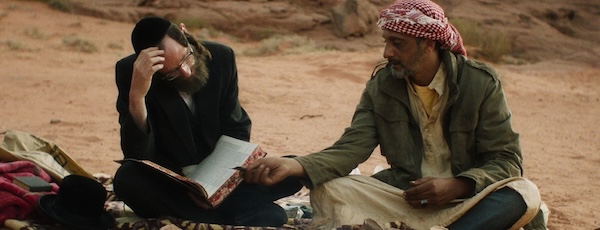
Ben, an ultra-Orthodox Jew from Brooklyn, has yet to marry. Within hours of arriving in Jerusalem, both to visit family but mostly to meet the matchmaker – who he purposefully misses by taking his time to get to his uncle’s shop from the airport – Ben eagerly agrees to Uncle Yechiel’s request to head right back to the airport to catch a flight to Egypt.

image - still from the film No Name Restaurant
No Name Restaurant (still from the film)

The Jewish community of Alexandria, the president of which is Yechiel’s brother-in-law, needs a 10th man to form a minyan before Passover. If they can’t observe the holiday, according to some written agreement, all the community’s property and possessions will have to be turned over to the state.

Ben seizes the chance to save the ages-old synagogue, but misses his plane and then is kicked off the bus to Alexandria by fellow passengers, putting the whole plan in jeopardy. Luckily, he is picked up in the Sinai Desert by Adel, a Bedouin searching for his lost camel. Unluckily, Adel’s truck breaks down and the two men must head out on foot. Short on water – much of which had been used by Ben for ritual handwashings along the way – and going only on Adel’s memory of a well his family had frequented when he was a kid, the journey is fraught with existential concerns, including what other Arabs might do to a Jew in their midst and to the Bedouin who is helping him.

No Name Restaurant is a buddy movie that delivers all that one would expect from such a movie and more. With respect and humour, it brings together Jews, Muslims and Christians in a novel way to optimistic effect. 

For the full Vancouver Jewish Film Festival lineup, go to vjff.org.

Format ImagePosted on March 22, 2024March 20, 2024Author Cynthia RamsayCategories TV & FilmTags Vancouver Jewish Film Festival, VJFF

Posts pagination

Previous page Page 1 … Page 15 Page 16 Page 17 … Page 84 Next page
Proudly powered by WordPress