Skip to content
  • Home
  • Subscribe / donate
  • Events calendar
  • News
    • Local
    • National
    • Israel
    • World
    • עניין בחדשות
      A roundup of news in Canada and further afield, in Hebrew.
  • Opinion
    • From the JI
    • Op-Ed
  • Arts & Culture
    • Performing Arts
    • Music
    • Books
    • Visual Arts
    • TV & Film
  • Life
    • Celebrating the Holidays
    • Travel
    • The Daily Snooze
      Cartoons by Jacob Samuel
    • Mystery Photo
      Help the JI and JMABC fill in the gaps in our archives.
  • Community Links
    • Organizations, Etc.
    • Other News Sources & Blogs
    • Business Directory
  • FAQ
  • JI Chai Celebration
  • JI@88! video

Recent Posts

  • Story of Israel’s north
  • Sheltering in train stations
  • Teach critical thinking
  • Learning to bridge divides
  • Supporting Iranian community
  • Art dismantles systems
  • Beth Tikvah celebrates 50th
  • What is Jewish music?
  • Celebrate joy of music
  • Women share experiences 
  • Raising funds for Survivors
  • Call for digital literacy
  • The hidden hand of hate
  • Tarot as spiritual ritual
  • Students create fancy meal
  • Encouraging young voices
  • Rose’s Angels delivers
  • Living life to its fullest
  • Drawing on his roots
  • Panama City welcoming
  • Pesach cleaning
  • On the wings of griffon vultures
  • Vast recipe & story collection
  • A word, please …
  • מארק קרני לא ממתין לטראמפ
  • On war and antisemitism
  • Jews shine in Canucks colours
  • Moment of opportunity
  • Shooting response
  • BC budget fails seniors
  • Ritual is what makes life holy
  • Dogs help war veterans live again
  • Remain vital and outspoken
  • An urgent play to see
  • Pop-up exhibit popular
  • An invite to join JWest

Archives

Follow @JewishIndie
image - The CJN - Visit Us Banner - 300x600 - 101625

Byline: Cynthia Ramsay

BCTF’s Nakba motion

“An important part of our work as teachers is to create safety for our students within our classrooms and schools. Globally and locally, we are hearing how increasing rhetoric and hate speech in communities are threatening safety and belonging. With this in mind, a motion was brought forward, and passed by delegates at the BCTF annual general meeting in March,” writes BC Teachers’ Federation president Clint Johnston in the May/June 2024 issue of Teacher magazine.

He goes on to share the motion, which was: 

“That the Federation:

“1. continuously lobby the Ministry of Education and Child Care to include, where applicable, the following as part of the Grades 6-12 Socials and History curricula until it gets added to the elaborations:

“a. The Nakba 

“b. The 1948 Arab-Israeli War

“c. Military occupation of Gaza and the West Bank. 

“2. have the Federation president acknowledge through the next Teacher magazine that these events are essential to understanding the history of Palestine and Israel in the President’s Message.”

In fulfilling his part of the motion, Johnston writes in Teacher about classrooms being “where students develop or question their understandings of world events. Starting these conversations and teaching complicated histories is a difficult task. Teachers need support to approach the historical context of present-day conflicts in their classrooms. It’s important that the Ministry of Education and Child Care, school districts and community partners come together with teachers to create the supports and resources we need to teach challenging world events.”

At press time, none of the President’s Message that deals with the AGM motion could be found on the Teacher website. There, only the first half of the message was posted – in which Johnston talks about the edition’s feature on “societal attitudes toward disability justice and excellence,” and inclusion in schools.

The BCTF did not respond to multiple emails and phone calls from the Jewish Independent for comment on the motion, which was passed at the BCTF’s AGM March 16-19 at the Hyatt Regency Hotel. While the organization’s communications person briefly added the JI to the BCTF’s media list, the paper apparently was removed from that list after inquiring if the receipt of a press release on an unrelated topic meant that answers to the JI’s questions about the AGM would be answered. There was no response, nor has the JI received any further BCTF press releases.

The Jewish Independent found out about the BCTF motion in early April not from the BCTF, but from two other sources: a group called Parents for Palestine, claiming the vote a victory for their own campaign to have the Nakba (Catastrophe) – the term used by many Palestinians and others to describe the creation of the state of Israel and the 1948 war – added to the BC curriculum, and from a Jewish parent, asking people to “Reject political propaganda in schools’ curriculum.”

Parents for Palestine and the groups Teachers 4 Palestine BC, Independent Jewish Voices (Vancouver, Victoria and University of British Columbia), Canada Palestine Association-Vancouver, BDS Vancouver-Coast Salish Territories, Samidoun Palestinian Prisoner Solidarity Network (which in 2021 was designated a terror group by Israel for its ties to the Popular Front for the Liberation of Palestine), Labour for Palestine Vancouver & Victoria, Palestinian Youth Movement Vancouver, and Freedom from War Coalition have started a petition on the Action Network called “Demand That the Nakba Be Added to the BC Curriculum.” Those groups (minus BDS Vancouver-Coast Salish Territories) also have online an open letter to Minister of Education and Child Care Rachna Singh, where organizations and individuals can add their name.

“As a Jewish parent whose grandparents were Holocaust survivors, I believe my children need an education that equips them with the knowledge and tools to build a future where genocide is no longer possible,” says parent Tamara Herman, a member of Independent Jewish Voices, in the Parents for Palestine press release. “Our kids will be confronted with the future impacts of the genocide that Israel is currently committing in Gaza. Receiving a partial history of the creation of Israel that includes the Holocaust but erases the Nakba robs them of the knowledge and tools they need now and in the future.” 
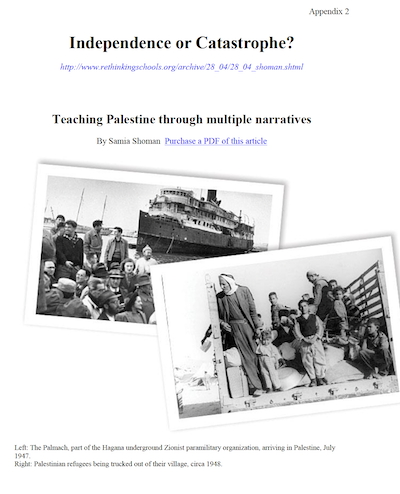
image - A page from the BC Teachers’ Federation Israel-Palestine classroom resource, called The Israel-Palestine Conflict: Searching for a Just Peace
A page from the BC Teachers’ Federation Israel-Palestine classroom resource, called The Israel-Palestine Conflict: Searching for a Just Peace.

Vancouver parent Masha Kleiner’s petition on change.org reads, in part, “The role of a teacher in a child’s life is paramount and should not be used to advance any political agenda. By introducing such a change to the curriculum, it has the potential to increase targeted hatred of specific children thus creating an unsafe learning environment.”

In the press release she sent to the Independent, Kleiner, who was born in the Soviet Union, writes, “It is not a coincidence that I chose to raise my children in Canada. I wanted my children to grow, internalize and embrace the fundamental Canadian values of safety, diversity, tolerance and freedom. These values are core to Canadian society and they stem from all orders of life, first and foremost, education.

“This is why, as a parent, I couldn’t remain silent when I encountered the motion to add teaching of ‘Nakba and occupation’ to the school curriculum in BC. This motion goes against everything that Canada stands for. This motion is not only harmful on many different levels, but it also exposes dangerous manifestations in the existing curriculum.”

Kleiner is concerned that the BCTF motion and “the polarizing and isolating political agenda it brings into classrooms will create an unsafe and even hostile environment. This motion is not educating students about specific historical events and perspectives; it introduces a one-sided, politically motivated, biased narrative that is being used to target and marginalize particular students or groups.

“The history and the conflict in the Middle East is one of the most complex and multifaceted topics in the history of modern conflicts,” she continues. “Its roots are grounded in millennia of history as well as religious and cultural bedrocks of numerous societies. It is deeply intertwined with recent and modern political and military powers and other conflicts. What’s more, it is a highly sensitive, controversial and even disruptive topic that affects people’s lives all over the world.” 

The original motion presented at the BCTF AGM had only two points: 

“That the Federation: 

“1. acknowledge that the Nakba and the Israel war of independence are significant historical events that are essential to understanding the Israel-Palestine conflict.

“2. make a recommendation to the Ministry of Education and Child Care to include the Nakba and the Israel war of independence as part of the social studies and history curricula.”

The amendments were added on the day of the vote, which took place March 18. A 56-44 majority passed the amended motion, according to a teacher who was at the AGM.

This teacher, who asked to remain anonymous, questioned the value of the motion, noting that teachers could already include the subject in lessons. They said that, while the Nakba could be added to the list of sample topics in the curriculum, that still wouldn’t make the teaching of it mandatory.

image - The Israel-Palestine Conflict: Searching for a Just Peace coverThere is a resource available for teachers already, which was developed by the BCTF in 2016. Called The Israel-Palestine Conflict: Searching for a Just Peace, several sections are objectively biased, notably regarding the history of the region. Just two examples: Jews’ right to the land isn’t acknowledged, only that Palestinians lost their homeland; and the fact that hundreds of thousands of Jews were forced to flee Arab countries isn’t mentioned, only that “700,000 Palestinians were driven or fled from their homes and became refugees and many villages were destroyed.”

The teacher thought that the AGM motion was made, in part, as a reaction to the provincial government having made Holocaust education a mandatory part of the curriculum. At this point, the province has no plans to follow suit with the Nakba.

“I’m leaving it to the teachers,” Singh told CBC in a May 2 interview. “I feel that they are fully equipped and they have the professional judgment on how to assess their student population and how to impart these lessons. This is what my expectation is, that every child is feeling safe in their schools.” 
Posted on June 14, 2024June 13, 2024Author Cynthia RamsayCategories LocalTags antisemitism, BC Teachers' Federation, BCTF, Clint Johnston, education, Israel-Palestine conflict, Masha Kleiner, Nakba, Tamara Herman
Rise and fall of a hacktivist

Rise and fall of a hacktivist

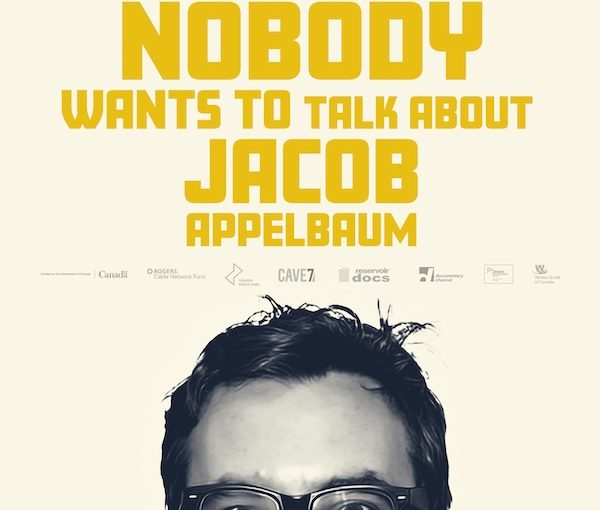
Nobody Wants to Talk About Jacob Appelbaum opens at VIFF Centre June 14.

Jacob Appelbaum was an influential internet freedom, privacy and free speech activist. He collaborated with Julian Assange and WikiLeaks, which Assange founded in 2006 to publish leaked documents and information. He helped the journalists with whom whistleblower Edward Snowden shared documents make the stories public. And he was prominent in the TOR Project (aka “the dark web”). Then, suddenly, Appelbaum took himself out of the spotlight.

Writer, director and producer Jamie Kastner wanted to know why. He also wanted to know more about this well-known yet little-known “hacktivist” and the subculture in which Appelbaum operated. The result is the documentary Nobody Wants to Talk About Jacob Appelbaum, which screens at VIFF Centre June 14-17 and June 20.

“I first saw Appelbaum in another documentary about WikiLeaks, in which he was playing a supporting role,” Kastner told the Independent. “He jumped off the screen both for his charisma and his clear-eyed and apparently fearless political commitment. I learned about the broad strokes of the scandal in which he was later involved, became intrigued not only by what had happened with him, but by this whole activist community about which I had known little.”

After being accused of sexual abuse in 2016, Appelbaum left the United States for Germany. It is there, reads the documentary’s PR material, that Kastner “finds him, adamant that he is the victim of government black ops, ‘canceled’ without legal process or recourse, punished for who he is, and for what he represents.”

“Though I’m sure even he would not claim that all the work he has done has been flawless,” said Kastner, “to me there remains at least an aspect to the work he’s done, regardless of what may or may not have come later, that represents a fearless standing up to authority, taking significant personal risks to expose abuses of power and to help improve people’s lives by making them better informed about governments and surveillance.”

He continued, “As lawyer Margaret Ratner Kunstler explains in the film, in an era in which journalism has shrunk and become ever more controlled by government and/or large corporations, the significance of so-called leakers and hackers has grown to become one of our last sources of unfiltered news and information.”

Kastner gave the examples of WikiLeaks having “released Chelsea Manning’s leaks, including the ‘Collateral Murder’ video of American drones killing civilians and journalists in Iraq in 2007, and a trove of Hillary Clinton’s emails in 2016, among many other controversial releases.”

In 2013, Snowden, “a former contractor for the National Security Agency, America’s cyber-intelligence gathering service … leaked a vast trove of documents revealing the information gathering practices of the US and its ‘Five Eyes’ allies countries, including how data was gathered covertly on their own citizens,” said Kastner.

With Snowden, the filmmaker added, Appelbaum “helped the journalists to whom Snowden leaked his documents both manage the technology involved, and investigate and disseminate stories arising from Snowden’s leaks, including penning a cover story in German newsmagazine Der Speigel revealing that the US was spying on Chancellor Angela Merkel’s cellphone.”

Nobody Wants to Talk About Jacob Appelbaum was about five years in the making. 

“It was a slow and wary process, once contact was made, of gaining access to Appelbaum and establishing trust on both sides,” explained Kastner. “I knew he was a controversial, brilliant and at times troubled figure, but I approached the story with an open mind. It struck me as a fascinating story in which one person’s trajectory tracked the rise and fall of a movement that, for a time, was rocking the world. 

“I worked with a team of researchers to gain necessary context and try to build relationships within this very wary community. I worked extensively – features, in my experience, take six months or so in editing – with my collaborator Michael Hannan in the edit suite, to try to craft a film that would make the audience experience the real-life spy quality I experienced in entering into Appelbaum’s world, in which things, at times, seem too fantastical to be true – but sufficient evidence is there to suggest they are not false.”

Kastner’s many credits – through his and wife Laura Baron Kastner’s Cave 7 Productions – include The Skyjacker’s Tale (2016), There Are No Fakes (2019) and Charlotte’s Castle (2023). Cave 7 documentaries have not only garnered award recognition but inspired action. There Are No Fakes, for example, helped launch “a criminal investigation into widespread fraudulent production of and distribution of Indigenous art,” leading to “eight arrests, 40 charges laid and 1,000 paintings seized,” notes the company.

As a documentarian, Kastner is especially aware of the evasiveness of “the truth” and its often-subjective nature. While he said, “I still admire the same qualities about Appelbaum that first drew me to the subject, his political spirit and work,” the making of the documentary took him to all sorts of places he hadn’t expected.

“Learning about the community from which he and Assange sprung made me realize the film was about a larger story, larger issues which the narrative of Appelbaum’s life raises,” said Kastner. “You don’t have to like him, the film is not an apologia or a hagiography. I investigate the accusations as extensively as possible. Ultimately, as the title suggests, the film equally became about the people who don’t want to talk about him, and the many reasons for that. I don’t think I had fixed ideas about the ‘truth’ going into this film. I don’t pretend the film leaves with any one conclusion, but rather hopefully, is the jumping-off point for further discussion.”

For tickets to a screening, visit viff.org/whats-on/nobody-talk-jacob-appelbaum. The documentary will start streaming on CBC Gem on June 26. 

Format ImagePosted on June 14, 2024June 13, 2024Author Cynthia RamsayCategories TV & FilmTags documentaries, hacktivism, Jacob Appelbaum, Jamie Kastner, WikiLeaks
Traditional yet contemporary

Traditional yet contemporary

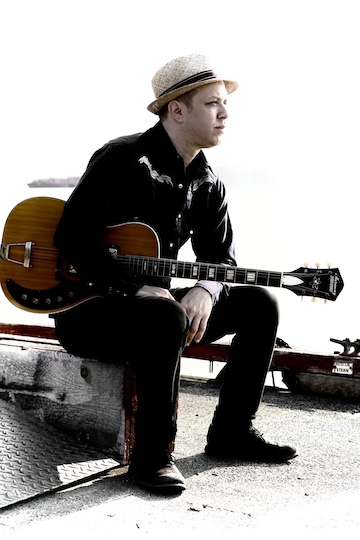
Boris Sichon, above, and Jesse Waldman return to this year’s Mission Folk Music Festival, which takes place July 26-28 at Fraser River Heritage Park. (photo from missionfolkmusicfestival.ca)

“I know that people are going to find that new-to-them artist that changes their world. I know that new friendships will be forged among volunteers. And I know that people will just enjoy being together in the park in community,” said Michelle Demers Shaevitz, artistic and executive director of the Mission Folk Music Festival, about the upcoming weekend-long event. “That’s what I look forward to the most.”

Joining Demers Shaevitz at this year’s festival, which takes place July 26-28 at Fraser River Heritage Park, will be fellow Jewish community members Boris Sichon and Jesse Waldman. Both musicians are returning artists to the festival, but will be performing new material.

Sichon will be leading the interactive Recychestra, an orchestra that uses musical instruments made from recycled objects. The performance is the last part of an instrument-building program offered through the City of Mission next month.

The idea for Recychestra came from a meeting with Mark Haney, a composer and musician working for the City of Mission, said Sichon. The program comprises seven sessions between July 6 and 26 at the Mission Leisure Centre, culminating in the July 28 performance at the Mission Folk Music Festival – though Sichon would like the program to carry on.

“I hope we’re going to continue this project after the festival,” he told the Independent.

Anyone who is interested in participating can do so via mission.ca/culture or by emailing [email protected].

“We don’t know yet who’s going to sign up,” Sichon said. “Kids love to create musical instruments more than playing instruments, while adults enjoy both activities. It would be great to have some musician friends from the Mission community.”

Even if someone hasn’t attended the program, they will be welcome to join the orchestra at the festival performance, said Sichon. “We will have enough recycled instruments. It will be a very friendly atmosphere, joyful. Play and dance!”

Waldman is also looking forward to performing at the Mission Folk Music Festival.

“We’ve got some great new songs to share and a couple tricks up our sleeves, too!” said Waldman, who will perform in several music sessions, including in concert with Beau Wheeler on the Sunday afternoon of the festival. The collaboration with Wheeler has been a long time in the making.

“I’d seen Beau perform at an art space in East Van nearly 20 years ago and was blown away,” said Waldman. “Many moons passed, until 2018, where I was performing in the Monica Lee Band and we shared a bill with Beau at Pat’s Pub. Beau caught our set with Monica and invited the band to stay on stage and join him and it was a magical moment. We decided we should get together again and that’s how it all started. We have a lot of the same taste in music and are both very emotional players. I try and add memorable and atmospheric parts to fit the feeling of Beau’s amazing songs.”

Waldman has been busy since the Independent spoke with him in advance of last year’s Mission folk festival. Among the highlights, he said, are “[t]he completion of a new full-length album entitled The Shimmering Divide, set for release September 2024 [and an] outstanding full band performance at Or Shalom Synagogue featuring a rendition of ‘Papirosen,’ where the band played along with my grandmother’s voice from a tape from 1957.”

The video of that performance can be viewed at youtube.com/watch?v=5F5GNRMf1fQ. For more about the song, visit jewishindependent.ca/a-great-grandmothers-song.

photo - Jesse Waldman
Jesse Waldman (photo from jessewaldmanmusic.com)

Following Waldman’s first album, Mansion Full Of Ghosts, The Shimmering Divide “sees an even more introspective songwriting exploration by Waldman with lyrics that are both confessional and poetic, vulnerable and hopeful, spanning the personal and the universal,” notes the PR material.

“For me, the title The Shimmering Divide represents the age-old battle between good and evil, which path to take to do the right thing in your life – those points in your life are charged with possibilities that can change it forever,” said Waldman.

In all, some 30 artists from around the world will be participating in this year’s Mission Folk Music Festival. In selecting performers, Demers Shaevitz tends to focus on a theme. 

“This year,” she said, “I was digging into this idea of tradition and looking for artists that are grounded in their tradition. What that means for me is finding artists who can emphasize a through line in their music. Who can take the best parts of their culture, genre, community or language, for example, and bring it to audiences in new and or exciting ways. This is key to me when I consider folk traditions: I want contemporary takes on this heritage artform. We’ll hear that in Moira & Claire and their Maritime song tradition. We’ll hear that in how PIQSIQ presents Inuit throat singing in a contemporary context. And we’ll hear (and dance) to how Kobo Town takes traditional Trinidadian sounds and modernizes them for today’s audiences.”

For more information about the festival, including the schedule and tickets, visit missionfolkmusicfestival.ca. 

Format ImagePosted on June 14, 2024June 13, 2024Author Cynthia RamsayCategories MusicTags Boris Sichon, Jesse Waldman, Michelle Demers Shaevitz, Mission Folk Music Festival, Recychestra
Community gathering place

Community gathering place

Many community events, lessons and celebrations take place in the Jewish Community Centre of Greater Vancouver’s Wosk Auditorium. (photo from JCC)

A sense of family and community, somewhere to be physically active and mentally stimulated, a haven in which to socialize and relax, to have a nosh, a lifeline during the pandemic and a place to be with like-minded people after Oct. 7. The Jewish Community Centre of Greater Vancouver – “the J” – “is a warm and welcoming place for Jews and the community in general,” offered JCC executive director Eldad Goldfarb.

The Jewish Independent spoke with Goldfarb and others recently, to see how the centre has fared since the Hamas terror attacks on Israel, the Israel-Hamas war and the rise in antisemitism around the world, including in Metro Vancouver.

“The level of security has seen a noticeable increase,” said Goldfarb. “The initial shock had an effect on our entire community, which felt insecure and somewhat afraid to venture out and into Jewish community facilities. This fear quickly changed into a desire to congregate, be with fellow Jews in safe spaces, and the JCC is a place where everyone feels safe and welcome.”

He praised the Vancouver Police Department and its role in allowing the community to gather safely.

“The VPD is amazingly supportive of the Jewish community and the JCC,” he said. “They are doing above and beyond within their limited resources to provide both physical as well as emotional safety at this very difficult time for our community. The JCC staff team is very vigilant and pays close attention to anything out of the ordinary.”

Goldfarb has been the J’s executive director for 11 years, and was assistant executive director for the six years prior to that. He said the centre has “expanded its programs and services, providing substantially more scholarships and subsidies to families and individuals.” And he and the JCC board “have been involved in the conceptualization, visioning and creation of JWest, an exciting innovative community project for generations to come.”

“The JCC has been working diligently on expanding our capacity, we have made investments in recruiting top-notch staff, replacing and transforming our technology systems in order to improve customer experience, ease the registration process and create efficiencies in the organization,” said Goldfarb.

“We’re always trying out new programs,” Hila Olyan, senior director of programs, told the JI. “I’m especially excited about programming for new families, which ramps up this coming fall: pre- and post-natal yoga, baby sign and sing, stroller fitness, storytime in the library. We’re also trying out some new children’s programming over the summer. Music, Music for Littles and Music, Music for Babies will be offered on Sundays. I can say from personal experience that my toddler loves the program. He’s been taking it since April.”

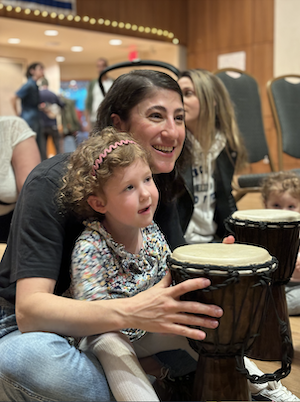
photo - The J's many programs include ones to introduce toddlers and their families to the joys of music
The J’s many programs include ones to introduce toddlers and their families to the joys of music. (photo from JCC)

While the programming hasn’t changed much in response to Oct. 7, Olyan said “the interest in being part of programs has increased. I think, for many people, myself and my family included, the opportunity to participate in Jewish and non-Jewish programming, but in a safe space surrounded by like-minded people, is more important than we previously realized.

“We’ve also tried to be thoughtful as we plan and host our community events like the recent Festival of Israeli Culture. We are thinking about how we can honour the challenging times we are living in, but also celebrate the beautiful culture we all know and love.”

She pointed to significant participation in events such as seniors luncheons, the J’s annual Purim Party and other activities.

“The people of our community want to be around other community members and I think it’s a great thing,” said Olyan. “The atmosphere has shifted a few times. We’ve moved from shock and devastation to strength and resilience. I think it’s a real testament to the spirit of our community.”

“The JCC has and will always be a safe place for me and my family and the entire community,” said Michael Averbach, who has been going to the J since he was a kid himself. “Oct. 7 didn’t change my frequency of visits or how I feel about being at the JCC, nor should it for any current member, but my message to those considering joining – there’s no greater feeling of family than being at the J. It’s the only place where we can truly interact with all sectors of our community, from the non-observant, to the Reform, to the Orthodox and everyone in between. Furthermore, the JCC was built on the foundation where everyone is welcome, regardless of religion or race.”

In addition to being a J member, Averbach has chaired the centre’s main fundraising event, the RBC JCC Sports Dinner, for many years. Attesting to his family’s generations of involvement with the JCC, the welcome desk everyone passes on their way into the centre is called the Betty and Louis Averbach Membership Desk, named after Averbach’s grandparents. And the next generation is also involved. 

“We’ve had our kids in day camp and swimming lessons over the years and, personally, I enjoy boxing sessions with Alexei to keep me sharp and on my toes and to complement my regular fitness routine,” said Averbach. “I also try and get to the J in the later evenings up three to four times a week to enjoy the sauna and steam in the men’s spa.”

photo - Working out at the J
Working out at the J. (photo from JCC)

When asked what keeps him coming back to the centre all these years, Averbach said, “The warm feeling and sense of community walking through the doors.”

This is an aspect that also appeals to J member Cathy Paperny and her family, who joined the JCC in 2006 when their children began the 2-year-old program. 

“I appreciate being surrounded by a Jewish community,” she said. “I have a good relationship with Eldad and we often have good talks about various topics, including the war in the Middle East. During these challenging times, it’s especially important to be surrounded by like-minded people. I feel I have that at the JCC.”

The social aspect is one of Olyan’s favourite parts of her job.

“I like the combination of interacting with members, program participants and administration. I like thinking about how we can make our programming stronger and then having the opportunity to put plans into action and see the results. Every single day I meet and talk with interesting people who are all here at the J for their own unique reason – a workout, childcare drop-off, gymnastics, music lessons, a holiday or festival.”

For Paperny, that reason was the program for 2-year-olds. She said the J was the only place that offered it. “I liked that my children were attending with other Jewish children, some of whom became lifelong friends. It was close to VTT [Vancouver Talmud Torah] for afterschool programs and convenient for me when I was working at the Holocaust Centre,” she said.

Paperny worked at the Vancouver Holocaust Education Centre, which is on the lower level of the centre, until 2019, for about four years as the symposia coordinator and as a docent for more than 10 years.

In addition to the 2-year-old program, Paperny said, “Yaelle went to ballet classes when she was young and did Israeli dancing through Talmud Torah and then performed at the Festival Ha’Rikud events at the JCC until Grade 7. Both of my children attended Camp Shalom for a couple of years.  One of my children did the leadership-in-training program at Camp Shalom. They also attended other sports camps, like soccer.

“I did personal training there for years and attended some of the fitness classes, including circuit training,” she continued. “Now, I swim, do private pilates with Camila, attend yoga twice a week and attend many fitness classes.”

She also attends Jewish Book Festival events and, often, Israeli dancing on Wednesday nights.

These types of activities are exactly what the JCC mission entails.

“For our Jewish community, we continue to be committed to our mission to provide programs to enhance positive identification with Jewish life and Israel,” said Goldfarb. “This can be seen in our children’s camps, early childhood education programs (daycare and out-of-school care) and with our Israeli dance classes – to name a few.”

Nava Creative Kosher Cuisine is also on site. A popular spot to have a coffee or lunch, it is hard not to run into fellow community members when you’re there: members of the J, people visiting the latest exhibit at the Zack Gallery or going up to the Waldman Library, staff from the various Jewish organizations housed in the centre, participants in different programs, parents picking up their kids, students from King David High School, which is located across the street from the centre, and others.

“The JCC, while not without its challenges, is a place of growth and potential,” said Averbach. “I am aware of the high staff turnover and the need for building upgrades and, together, we are actively working on raising the necessary funds to address these issues. If there’s one key area for improvement, it is staff training for those with special needs and neurodiversity. By properly implementing this training, we can ensure that all our children feel comfortable and welcome.”

And it seems that the J is committed to continually improving. For example, staff review its programming often.

“Every participant in a registered program receives an email link to a quick survey,” said Olyan. “We also look at our mission statement and consider how we can continue and better meet our mission and the needs of our community. Are we offering social, educational, recreational and cultural programs for every demographic? Finally, we consider what are the emerging trends and interests within and outside the Jewish community and is the JCC the right place for [such programs]. We really try to listen to our members and find out if there are particular programs they would like to see.”

As for her feedback, Paperny said, “During COVID, the J was a lifeline for me when virtual programs were available, and then when it opened up to in-person programs. My physical health is so integral to my emotional, mental and spiritual health. The J has always been there for me.” 

Format ImagePosted on June 14, 2024June 13, 2024Author Cynthia RamsayCategories LocalTags Cathy Paperny, Eldad Goldfarb, Hila Olyan, identity, JCCGV, Jewish Community Centre of Greater Vancouver, Judaism, Michael Averbach, Oct. 7
Windows into the shul

Windows into the shul

The Beth Israel Mural Project goes beyond the synagogue’s parkade, with a website that features each artwork, as well as information about the holiday depicted, and more. (screenshot)

Windows into the synagogue, windows into Judaism. The Beth Israel Mural Project features 13 works of art, each based on a Jewish holiday. Adorning the shul’s parkade, they welcome visitors.

“During COVID, Sy Brown started the Good Times Club at the BI. The goal was to bring in new programming into the shul for the over-50 crowd,” explained project manager Reisa Schwartzman. “We have had blood drives, book clubs and walking clubs. I came up with the idea to do a mural in the garage.

“At first, the idea was to do one large mural. The challenge was that there are parking signs that could not be removed so it motivated us to think out of the box a bit. The smaller framed murals allowed it to have the effect of being windows into the shul.

photo - Ramona Josephson was the lead artist on one of the two murals portraying Shabbat
Ramona Josephson was the lead artist on one of the two murals portraying Shabbat. (photo from Beth Israel Mural Project)

“The next steps were to call out to the congregation to see who would like to participate. At this time, all meetings were held on Zoom due to COVID. Once the committee had the members, we then went out to the congregation – we wanted the entire membership to feel included, to see what they wanted to see in the garage. The overwhelming feedback was the holidays.”

Volunteers were assigned a holiday and the committee helped with each image. “This is when the real work began,” said Schwartzman. “But, up to this point between COVID and summer holidays, it was two years.

“With Peter Sarganis, an amazing artist himself but also an art teacher, he guided us on the steps required to take our wonderful images through the multiple steps to get each image on the boards. Once the boards were ready to go, we met each Sunday afternoon for painting for several months. There were committed painters who would come in during the week to work as well. This was a labour of love! The energy in the room when we were painting was fabulous. Focused artists and painters working together to bring these works to fruition.”

Sarganis answered the callout to members because, he said, “As an artist, I thought it would be a creative way to combine my love of Judaism, the Beth Israel Synagogue, collaboration and painting.”

Sarganis became the project’s art director and a lead artist and designer of one of the two Shabbat works.

“I love Shabbat. From Friday evening family dinners; to Shabbat morning services; to the candles, wine, challah and artifacts used – I can simply say I love it,” Sarganis said of his choice of holiday to portray. “The Shabbat panel I designed and painted is an abstracted representation of our family’s candle holders, Kiddush cup and challah cover.”

About the project, he said, “We had a wide range of expertise, from those who don’t paint at all to those who paint a lot. The common thread that kept us going and made this a beautiful group to be a part of was everyone’s passion for the project. 

“As a professional artist and someone who has taught at a fine arts school for the past 29 years, it seemed the role of me becoming art director happened organically, it was not something that was there at the start of the project,” he added. “This included helping the designers of the panels with their designs, bringing in tools and equipment to help facilitate the transferring of the designs onto the large panels, advising the groups of painters on the painting process and/or techniques, figuring out (with Reisa) the placement of the panels in the parkade.”

“I really believe that we can beautify the most simple areas to make them more impactful,” said Schwartzman. “Having these windows in the garage makes the experience of going to the BI start right from parking your car. But we didn’t stop there. Krystine McInnes came up with the idea that we should add QR codes to each image so that people could open their phones and learn more about each holiday, the customs and history. We hope we can use these to fight antisemitism as well, or just to help educate. We decided to paint on boards rather than the wall itself so, if needed, we could have them traveling.

“One thing different about our art is that none of the pieces are signed. This was with the commitment that the works were collective, designed and inspired by several artists and painted by the community we built. It is a community effort for our shul.”

While the lead artists aren’t indicated on the murals in the garage, they are credited on the project’s website, bethisraelartproject.com: Beryl Israel (Purim and Tu b’Shevat), Sheila Romalis (Hanukkah), Ramona Josephson (Rosh Hashanah, Sukkot and Shabbat), Debby Koffman (Simchat Torah), Janice Masur (Shavuot), Luca Carati (Yom Hashoah and Yom Yerushalayim), Nassa Selwyn (Pesach and Yom Kippur) and Adele Lewin (Simchat Torah). In addition to the QR code integration, McInnes designed the project website, which features information on the holidays, their history and customs from several sources, including work done by Jean Gerber and Jonathan Berkowitz and a dozen or so websites.

The paint was donated by Benjamin Moore Paint and the boards and framing by Burton Mouldings, said Esther Moses, Beth Israel executive director. Ralph (z’l) and Elaine Schwartzman donated to help make the project possible, she said.

“My parents believe in supporting our community and have always been supporters of several Jewish agencies here and abroad,” explained Schwartzman. “Once they heard about what I wanted to do, my mom called the shul and made a donation to make sure we could complete the project. Supporting the shul, the arts, community and engagement for people are all reasons they stepped forward.”

image - Beryl Israel was the lead artist on the Tu b’Shevat mural
Beryl Israel was the lead artist on the Tu b’Shevat mural. (photo from Beth Israel Mural Project)

“I am so proud of Beth Israel and our members who worked on the murals. They are strikingly beautiful,” said Rabbi Jonathan Infeld, the synagogue’s senior spiritual leader. “They bring light to our congregation and are a great educational tool. They brought people together for an important common cause. The murals are another way that we help bring Jews closer to God, Torah and Israel at Beth Israel.”

While he helped, for example, with the Hebrew on one of the works, Infeld admitted, “I am involved in many different aspects and programs of the synagogue, this is one that I did not play a large role in though. Yes, I helped with some of the Jewish content. But anyone who knows my artistic abilities knows why I left this project to others to accomplish.”

The project – which took a total of three years from conception to installation – “was a great way to add colour to our parkade in a meaningful and Jewish way,” said the rabbi. “The murals are educational and exceptionally beautiful. But, most importantly, they created community amongst people of all ages.”

Overall, it has been a huge success, he said. “People love seeing [the murals] when they enter the parkade. They love looking at them and learning from them. I know that the participants loved making them.”

“This project was really a labour of love by all who participated,” agreed Schwartzman. “Peter was incredibly supportive with his knowledge and guidance. There were so many amazing artists that we all learned from each other, helped each other and celebrated together. We really hope that these images bring the shul much enjoyment and support them in any of their programming when possible.”

“This project took a lot of time and work – and was worth every moment,” said Sarganis. “I met some wonderful people, and got to know people I already knew even better. A beautiful community project.” 

Format ImagePosted on June 14, 2024June 13, 2024Author Cynthia RamsayCategories Visual ArtsTags Beth Israel Mural Project, Jonathan Infeld, Judaism, murals, painting, Peter Sarganis, Reisa Schwartzman
A new generation of leaders

A new generation of leaders

Howard Kallner is being honoured at Schara Tzedeck’s MOSAIC gala on June 4 (photo by kenneth88/wikimedia)

“I have been very lucky in my life to be surrounded by lifelong volunteers and builders of community, both my parents, my in-laws and multiple other role models, and it just seemed natural to volunteer and be involved,” Howard Kallner told the Independent.

Kallner is being honoured by Congregation Schara Tzedeck at MOSAIC, the synagogue’s annual gala, on June 4.

“The first thing that came to my mind was discomfort,” said Kallner about finding out he was being recognized. “I was hesitant to accept because there are so many long-time shul volunteers, donors and community-builders who would be deserving of being honoured.”

Kallner has been a part of the congregation since he was 13 years old.

“My family had emigrated from South Africa when I was very young and their synagogues in South Africa were very similar to Schara Tzedeck,” he explained. “My parents, and now my family, have been members for over four decades. On my wife’s side, her great-grandfather, David Davis, was a founding member of Schara Tzedeck, and her grandfather, Charlie Davis, was a past president.”

photo - Howard Kallner
Howard Kallner (photo from Howard Kallner)

For his part, Kallner was on the board for seven years before becoming president. He served three years as president and three more as past president, for a total of 13 years. He was serving as president when the pandemic hit.

“When the COVID pandemic hit, we needed to pivot immediately to online programming, online services where applicable, continue live services with restrictions and make sure our community members, particularly our vulnerable ones, were connected and taken care of,” he said of how his role was affected. “One of the programs that came out of this was Shabbat in a Box. We recognized a need amongst our members and others in our community and delivered over 450 meals a week at the height of the pandemic. For the Jewish holidays, we were delivering over 650 meals accompanied by holiday-specific items so they could celebrate the holidays.

“Additionally, Schara Tzedeck, being an Orthodox synagogue, could not have Shabbat services online,” said Kallner. “With the exception of a few weeks when the government would not allow any public gatherings, we continued services in person with some significant modifications. When limited to 50 people per gathering, we moved services outside, in a tent in our parking lot. At times, services were held in sub-zero temperatures, with most attendees wearing ski jackets, toques and gloves. For the High Holidays that year, we had nine services a day for a maximum of 50 people. We had to find three sets of Torah readers, shofar blowers and leaders of the services.

“While, during COVID, it was undoubtedly the hardest I worked as president of the shul, it was also the most rewarding,” he said.

Now officially “just” a member and supporter of the synagogue, Kallner continues to be part of the Schara Tzedeck Cemetery Board and is a governor of the Jewish Community Foundation, as well. 

“Giving back to a community that has given me and my family so much was very important,” he said. “With different experiences in my life and my relatives’ lives, including immigrating to a new country with little means and losses during the Holocaust, strong Jewish institutions ready for whatever the world would throw at them seemed crucial, and I wanted to do my part.”

Schara Tzedeck’s senior spiritual leader, Rabbi Andrew Rosenblatt, described Kallner as representing the beginnings of a new generation of leadership. At the time Kallner was getting involved, said the rabbi, “There weren’t a lot of people in their 40s who were stepping up to the highest levels of leadership at Schara Tzedeck.”

Kallner helped take the synagogue from being a 20th-century organization into being a 21st-century organization, said Rosenblatt. 

”The backbone of an Orthodox synagogue, certainly in the Pacific Northwest, certainly in Vancouver, is people who have come from much more traditional Jewish communities,” he explained. “For example, Schara Tzedeck has a lot of Holocaust survivors. These are people who came from very traditional Eastern European communities, but you could also have people from Winnipeg or Toronto or Montreal, New York, those places you associate with very traditional, very committed Jewish communities. For a long time, we were able to be a community of people who grew up in that kind of tradition, but there was a recognition at Schara Tzedeck that we needed to be able to be a place which translated to people who did not have that kind of traditional upbringing.”

Kallner had the analytical, organizational and people skills to help the synagogue do that, said Rosenblatt, highlighting Kallner’s leadership during the pandemic. 

“He was practically a paid member of the staff at that point, in terms of generating and developing policy,” said the rabbi. “He was involved in helping us make sure that we were operating on the next level. And he also understood that our organization had to be structured in a way where we could have the manpower to be able to do that, and that outreach. Part of that was that the information technology had to be updated.”

Describing Kallner as “a very humble person but also very hard working,” Rosenblatt said, “one of the things that he was strongest at was helping us transition into a place where we were reaching out more…. One of the programs we developed under his watch was Shabbat in a Box. There were some pre-iterations before that, but it came to its full maturity under him.”

Among the other programs that will benefit from the funds raised at MOSAIC are the synagogue’s education initiatives, some of which reach beyond the shul to the broader Jewish community, such as the series Rosenblatt gave on the history of the Marranos.

“I recognize,” he said, that “one of the great sources of inspiration in Jewish identity is Jewish history.”

Since the Oct. 7, 2023, terror attacks and the subsequent war, his education efforts have been more focused on Israel.

“When Oct. 7th hit, and people started to hear immediately just garbage about colonialization, I realized that there was just so much that people didn’t know or understand,” he said.

The Zionist story most of us have been taught is the inspirational one, he said. “Not that it’s wrong, it’s just not complete, and all histories have complexities. I didn’t want people to be caught flat-footed on these things and be surprised by them.”

He gave the example of a sign he saw on an overpass on the way into Whistler Village recently.

“It says there can be no peace on stolen land. And I’m thinking to myself who stole the land from whom? At what point do you decide that the land belongs to someone? Are you willing to say that 638 is where we’re going to start everything, when Omar ibn al-Khattab conquered Jerusalem, is that the right time? Should we ask ourselves when the Abbasids or the Fatimids or the Umayyads, which one of them? Were the Ottoman Turks? Which one becomes the real owner? At what point do you decide that these things happen? People don’t know – maybe now they do more, but certainly on October the 8th they didn’t know – when was Israel first called Palestine, when did Muslims come to Jerusalem, when were Jews forced out, which empires conquered it … what really happened at Deir Yassin, what were the stages of the War of Independence, what happened? These things, there are a lot of resources on them … and, I thought, Jews didn’t know these things – not to mention that there are libraries full of evidence on Jewish indigenous life in Israel that is far, far older than anything having to do with the name Palestine, and I wanted Jews to be able to know that. I wanted Jews to be able to articulate it. I want Jews to understand a stronger connection to Israel. And I think that has been something that has been a real value added to people’s knowledge base.”

The congregation has several individuals who have gone to do military service in Israel. “They are primarily Israelis who are here for various purposes, as shlichim [emissaries] or for educational reasons, and we’ve had real success in having them share their experiences and stories over the past number of months,” said the rabbi.

These types of programs have been a priority, said Rosenblatt, “to make sure that our community really stays close and understands the nuances and the issues. Every time we have the opportunity to give further insight, we do that.”

One of the people from Schara Tzedeck who has gone to serve was Assistant Rabbi Ishay Gottlieb. “He’s a major in the reserves in the IDF, and he left on Oct. 9th and wasn’t really back until the beginning of January,” explained Rosenblatt. “You’re essentially funding a staff member, like many Israeli organizations [are having to do], but there’s lots that had to be compensated for in that context.

“In some ways,” added Rosenblatt, “we’ve doubled our programming – run a regular program plus an Israel program. Not that we’re that different from the other synagogues [in that respect] but everything costs money and this is part of a case for giving. Since Oct. 7th, we really have been prioritizing the connection with Israel.”

He said, “When you walk into Schara Tzedeck, we want you to feel like you’re in a little embassy of Israel in this building. And participating in MOSAIC means that’s what you’re doing, you’re helping to support that – you’re helping to support a branch of Am Yisrael that is in Vancouver.”

To attend MOSAIC, RSVP by May 28 to 604-736-7607 or [email protected]. 

Format ImagePosted on May 24, 2024May 23, 2024Author Cynthia RamsayCategories LocalTags Andrew Rosenblatt, COVID, education, fundraiser, fundraising, history, Howard Kallner, Israel, leadership, Mosaic, Schara Tzedeck, volunteerism
Highlighting seniors’ issues

Highlighting seniors’ issues

Berlin’s Nana Schewitz brings her show Florida! Ya Kill Me! to Vancouver May 31-June 2. (photo from Nana Schewitz)

Florida! Ya Kill Me! is a “love letter to aging,” says Berlin-based drag artist Nana Schewitz, who created the show with Josh Walker. But it’s also a “wakeup call,” she warned, about the systems we have in place for aging.

Florida! Ya Kill Me! comes to Vancouver for three nights, opening May 31 at the Dusty Flowerpot Cabaret.

“JQT is so excited to bring Nana Schewitz to both Toronto and Vancouver, as part of our JQT [Jewish Queer Trans] Mental Health Support Series in partnership with JFS Vancouver, a series supported by the 

Jewish Community Foundation of Greater Vancouver,” said Carmel Tanaka, executive director of JQT Vancouver, noting that the shows are being sponsored in both cities by Goethe-Institut Toronto, which is part of a global network that works to foster understanding of Germany’s cultural diversity.

“The content of her show addresses the challenges of Jewish queer trans seniors, which is a very near and dear topic to JQT,” Tanaka said of Nana’s Florida! Ya Kill Me! “We hope that, through drag and comedy, we will be able to raise awareness of the work our JQT Seniors Initiative is doing to create safer long-term care homes and spaces, so our aging JQT community members can proudly celebrate all their identities into their twilight years.”

Florida! Ya Kill Me! is a theatrical retelling of Nana’s 2021 trip to Florida in search of a final resting place, Nana told the Independent. The character is a feisty 96 years old.

“Josh and I traveled up and down the state in search of retirement paradise, visiting every bingo hall, craft fair and 55-and-up pool we could find along the way,” she explained. “We met some incredible seniors who really opened up to me about their experiences with aging, finding love, losing love, accepting change and finding joy. I have the privilege to share these words through both my own retelling, and some filmed interviews we took. You’ll meet Josie, the 109-year-old bingo master. You’ll meet Doris, born and raised in Berlin (my current home) who lives in Florida’s largest retirement city (with over 100,000 residents). You’ll even meet my dead Cuban grandmother!

“The ability to tell these often-overlooked stories and cement the legacies of some of my favourite friends is my favourite thing about what this show is,” said Nana. “It’s a love letter to aging, but also a wakeup call to its effects. The systems in place around aging are crumbling quickly while our average life expectancy is getting higher and higher. I don’t want us to have to sacrifice our quality of life as we age, and this show is a call to action to make that happen!”

The name Nana Schewitz was inspired by Manischewitz, perhaps after a few glasses of its sweet kosher wine. The 96-year-old – who doesn’t “look a day over 69” – was brought to life by almost-30-something Bryan Schall, who studied at Philadelphia University of the Arts and graduated in performance design and production.

She emerged as an entity “out of a little hole-in-the-wall disco in Philadelphia. She stayed dormant for awhile, as her ‘style’ didn’t really fit in my idea of what drag in the US was. When I got to Berlin, however, I said, ‘Ooooohhh!!! Nana totally could work here!’

“The drag scene of Berlin was very different,” explained Nana. “It was quirky, brash, silly – all the things I wanted out of a drag performer. And I found myself really missing this very specific branch of Ashkenazi-Americana Judaism that I took for granted at home. I didn’t realize how much I missed it until moving to Berlin.

“Being Nana really allowed for space to connect with my Judaism, while also allowing me to rewrite Judaic tradition in a way that serves queer people,” she added. “I’ve hosted Passover seders, Hanukkah shows, Rosh Hashanah events and more in Berlin, and it’s been a beautiful connective tissue to bring the Jews of Germany (yes, we’re here!) together in a meaningful and unexpected way.”

Nana moved to Berlin in 2016 and says she hasn’t looked back.

“I grew up in South Florida, and just could not do one more winter of beautiful, it was just getting to be unbearable,” she said. “I couldn’t take the beaches and the sunshine of Florida anymore. Call me a masochist, I guess.”

Berlin has her heart, Nana said, “But all cities change, and the Berlin I moved to looks very different than the city I currently live in. I’ve learned here how precious community is, but it is something that requires maintenance and care, and cannot be taken for granted. I’m able to live my most authentic life here, but that is not a forever guarantee…. I worry about the future of this city, especially as a Jew. Your life can be taken very quickly if you stop paying attention and take things for granted.”

Describing herself as “50% lighting designer and 50% drag queen,” Nana said, “I studied lighting design and do it professionally, but doing drag gives me the outlet and access to say and do the things that are really meaningful to me. The lighting design definitely pays for the drag, but I love to light up a room nonetheless. I actually just came off tour doing lights for Canadian-Jewish icon Peaches around the US and Canada! It was a blast, but I really feel the most myself when I’m dressed up as a 96-year-old Jewish grandmother, singing sexually perverse parodies of Barbra Streisand songs in a dark smelly bar.”

Joining Nana in the Vancouver performances will be co-creator Josh Walker.

photo - Josh Walker is an integral part of Florida! Ya Kill Me!
Josh Walker is an integral part of Florida! Ya Kill Me! (photo from Nana Schewitz)

“I’m always so grateful to have my life partner/grandson by my side,” she said. “I’ve been working on Nana with Josh Walker for almost 10 years now. He is my most treasured collaborator, and we actually just came back from another two-month trip to Florida where we (along with my new grandson, filmmaker Lucky Marvel) just filmed the Florida! You Kill Me! documentary. We’re in production now after having visited and filmed in different Jewish and queer retirement homes, RV parks, assisted living facilities, etc., around the Sunshine State. The show me and Josh are about to put on in Canada is just a small taste of the incredible shenanigans we got up to around the state. You can catch Josh playing some classic Jimmy Buffett tunes on the banjo during this show.”

Nana exudes confidence, but that doesn’t mean she doesn’t have concerns about people’s reactions.

“I’ve had to stop being afraid, it wasn’t doing anything for me! When we went to Florida, I was extremely nervous,” she admitted. “A lot of what Nana is about is being out on the streets, very public and very vocal. I’m not sure if you know this, but there was recently a drag ban in Florida, as well. I’m not exaggerating, ‘adult live performances featuring sexual content’ were banned in Florida. I’m not sure if you’d consider my matzoh ball titties to be sexual content, but that’s beside the point. So, I went there with my guard up, worried for my safety and for the safety of my team. We had an ‘in case Nana gets arrested’ plan and everything. I’m proud to say, the ban eventually got overturned due, in part, to the relentless work of some of the drag queens of Fort Lauderdale (my hometown). But the damage had been done.

“I came in expecting bigotry,” she said, “but I really believe in my heart of hearts that is not our human nature. I think a lot of people are confused these days. There’s a lot of anger and hurt in the world and lot of information, and people are looking for where to place it and what to do with it all. This ‘drag queens bad’ narrative is political propaganda, but people will think what they want to think. Lucky for me, this Nana can move fast. When some of these Floridians see me, they’re not sure if they should pull out a gun and shoot me dead on the street, or give me a five dollar bill! By the time they’ve made up their mind, I’m gone. Whoosh!”

All jokes aside, Nana and Florida! Ya Kill Me! have a serious message.

“A new friend told me this as I was filming my documentary, and I think about it all the time so wanted to share it here as well,” said Nana. “She worked at the McArtor senior centre [in Florida], taking care of LGBT+ patients with Alzheimer’s and dementia. She told me, ‘If I can get you to do one thing after speaking to me, it’s call an older loved one in your life. A parent, a grandparent, an aunt, whoever. There will come a day when you call them and they won’t remember who you are anymore. Don’t wait for that moment to reach out. Enjoy every interaction you can, while you still can.’”

For tickets ($18) to Florida! Ya Kill Me!, visit jqtvancouver.ca. 

Format ImagePosted on May 10, 2024May 8, 2024Author Cynthia RamsayCategories Performing ArtsTags cultural commentary, drag, Florida! Ya Kill Me!, LGBTQ+, mental health, Nana Schewitz, seniors
BI celebrates building’s 10th

BI celebrates building’s 10th

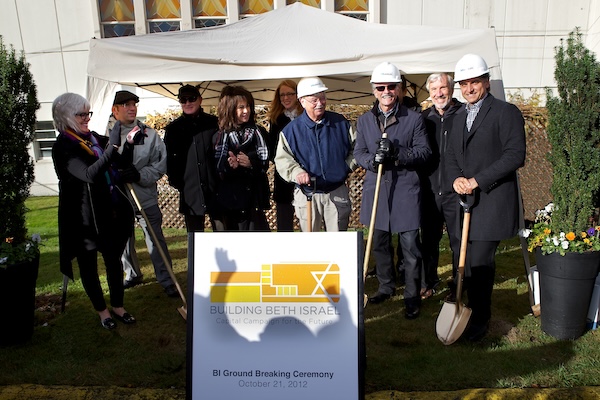
At the 2012 groundbreaking, left to right: Catherine Epstein, Rabbi Jonathan Infeld, Stuart Gales, Sylvia Cristall, Michelle Gerber, Gary Averbach, Sam Hanson, Shannon Etkin and Alfonso Ergas. Obscured from view is Elliot Glassman. (Robert Albanese Photography)

On June 9, Congregation Beth Israel will celebrate the 10th anniversary of its new building at the sold-out Gerry and Ruby Gales Be the Light Gala. The event will honour the synagogue’s visionary leaders – the Lutsky, Gales, Averbach, Cristall, Glassman and Porte families – and the capital campaign’s co-chairs, Gary Averbach, the late Lorne Cristall and the late Hershey Porte, as well as building chair Alfonso Ergas, Burn-the-Mortgage chair Lee Simpson and former BI executive director Shannon Etkin.

“This new building will be built as a place for our synagogue community to grow and thrive,” Lorne Cristall told the Independent in a 2010 interview, as the capital campaign was starting up. 

The new building, designed by Acton Ostry Architects Inc., would give the synagogue an east-facing sanctuary (towards Jerusalem), where it used to face north, and allow the congregation to host High Holiday services under one roof. The plan was to raise enough money that there would be little or no mortgage.

“The campaign began for $10 to $12 million plus about $2 to $3 million for an available piece of land on the southeast corner of the property that Shaughnessy Hospital had expressed a strong interest in purchasing,” Gary Averbach told the Independent in an interview earlier this week. “Even then, while running the numbers, it became quite difficult to see how … we could reach the $10 million mark, let alone the $12 million one.”

That became even more concerning, he said, once the designs were costed out, and the final tally was going to be closer to $18 million.

But the visionary donors being honoured, and many others, gave “unexpectedly generous gifts,” said Averbach, thanking Simpson and Bette-Jane Israels for their help raising the funds, and to Etkin, “who took over after we got the initial pledge.”

Averbach said, “Although we had been incredibly successful in our fundraising, having reached close to $20 million on the day we opened, the final price tag looked to be just over $25 million, and the lot had still not been sold.”

Etkin had found a potential buyer, but, when that deal looked as if it would collapse, Averbach called Gordon Diamond, who had earlier expressed interest in buying the land for possible Vancouver Talmud Torah expansion. It was a long process, said Averbach, “but, finally, thanks to Gordon and Leslie Diamond’s insisting that they find a way, the deal was done.

“There was a final Burn the Mortgage campaign with Lee, Bette-Jane and me. And, under Shannon’s leadership, we were able to pay off all but a little over a million dollars of the final cost of just over $25 million. I believe all that debt has been paid off now.

“An important note is that, of the almost $22 million raised, only two donations, totaling $118,000, came from non-members – and both those had a family history at the BI,” added Averbach.

“I suppose I could talk about all the important roles the Beth Israel synagogue, our shul, my shul, plays in our community, in our personal lives and in our spiritual lives,” Gerry Gales told the Independent about why he and his wife Ruby stepped up. “The answer is not complicated. There was a need. I was asked. I said yes. There was never a second thought in my mind. I do believe we are all here to help one another, to do what we can with what we have.”

He said, “Ruby and I find great comfort in being in our house of worship, our shul…. We know that we are a part of a great tradition, with roots that were planted thousands of years ago. It’s a tradition that will continue long after we are gone. When I think of all the people who have gathered together under this roof, I feel that I am but a small part of something so much larger than me and I feel that I am never alone.

“Then there is the practical role the shul plays in the unfolding of our lives,” he added. “The shul is a place where we come for prayers and to pray, the shul is the place where we can send our children to learn all our traditions and to be educated, the shul is a place where we come to celebrate, where we come to mourn, where we launch our children into adulthood.”

Simpson agrees. “I believe all synagogues play an important part in our Jewish lives. They are a place to gather, pray, gain spiritual renewal, comfort and peace. All so important to our mental and, therefore, physical being – even more important in our world today,” she said. “Plus, they give a sense of community. Seeing familiar faces, sharing a lunch or meal after services, all so important. They are also a place of learning and expanding our knowledge, answer our questions, gain wisdom from others.”

She said it was an honour for her and her husband Bernie to support Beth Israel.

“Beth Israel has been our synagogue for all of our married life – we were married there by Rabbi [Wilfred] Solomon,” she said. “Our children were named there, bat and bar mitzvahs were there and our grandchildren were also named and our grandson’s bar mitzvah has been there, and more to come. I was twice chair of the board of directors and involved in the building campaign.”

As for her involvement in the campaign, Simpson said, “For me, the final straw was at my son’s aufruf [being called to the Torah the Shabbat prior to the wedding]. The auditorium filled with family and friends was also filled with buckets to catch the rain coming in from the roof and windows. We needed more than Band-Aids.”

At the new building’s groundbreaking in 2012, Etkin cited a report from 1988 about a renovation being one of the shul’s “very important priorities.” He spoke about several efforts to move redevelopment forward, with the one that resulted in the new building starting eight years before construction was completed in 2014.

photo - Then Beth Israel executive director Shannon Etkin lifts the Torah during the dedication of the new building in 2014
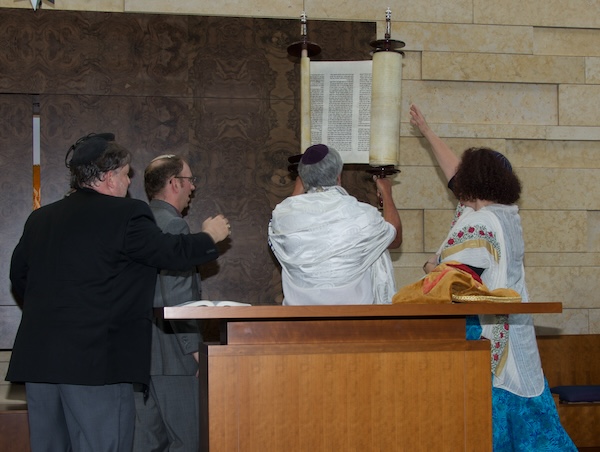
Then Beth Israel executive director Shannon Etkin lifts the Torah during the dedication of the new building in 2014. (Adele Lewin Photography)

Acknowledging that he stood on the shoulders of Cristall and Porte, who “had been involved as co-chairs in various incarnations of the rebuilding of the Beth Israel Synagogue since at least the early 1990s,” Averbach said, “I had always taken an interest in the project, but it wasn’t until I joined the board around 2008 that I started to take an active interest. My interest was based on the fact that the existing building, besides being arguably halachically incorrect, was also in very sad disrepair.”

Cristall and Porte took Averbach out to lunch and asked him to deal with donors under the age of 55.

“After a few days, I agreed, and a couple of weeks later, Hershey passed away, and the ‘triumvirate,’ with me as junior partner became Lorne and me as co-chairs,” said Averbach. “Given Lorne’s serious illness, I knew my job had expanded many times.”

With the help and work of many people, and with the commitment of the congregation, the redevelopment finally happened.

“Since we opened our doors to our new and very beautiful building 10 years ago, we have seen significant increases in every aspect of synagogue life. Our membership is growing, and our program participant numbers have increased,” BI Senior Rabbi Jonathan Infeld, told the Independent. The clergy now includes Assistant Rabbi Adam Stein, Ba’alat Tefillah Debby Fenson and youth director Rabbi David Bluman.

“Since our new building project was completed, it has literally opened many doors for our congregation,” said Infeld. “We have had the blessing of hosting many large community events including this year’s Yom Ha’atzmaut celebration. We have had the flexibility to do many great programs that utilize all our spaces and meet the needs of many different age groups. The High Holidays are a perfect example of when we use almost every inch of the building. We have nearly 2,000 people come to our various High Holiday services each year and the space is a true blessing for all of us.” It also allows for more varied services and programs on Shabbat, said the rabbi.

“We are really looking forward to our sold-out gala this year, which will celebrate a decade of success because of the hard work and dedication of the people who helped make the dream of a new building possible,” he said. “I am so happy that there will be so many people present to say thank you to our visionaries and builders. Jacci Sandler and the gala committee have done a fabulous job already.”

The gala committee is Jennifer Apple, Kerry Benson, Samara Bordan, Chana Charach, Shannon Ezekiel, Shannon Gorski, Carol Konkin, Samantha Levin, Juliette Sandler, Paige Swartz and Leatt Vinegar. Sandler, head of development at Beth Israel and the creator of the Be the Light Gala, spoke with the Independent about this year’s event, which will feature, among others things, a concert by American-Israeli rapper/singer Nissim Black and a menu created by Israeli Chef Yaniv Cohen, owner of restaurant Jaffa Miami, and the Perfect Bite. Howard Blank will be the auctioneer and Sandler’s husband, Brett, will be master of ceremonies – he has a long history of fundraising in the community and chaired the JCC Sports Dinner twice.

For the main act, Jacci Sandler wanted an internationally known Israeli artist. Black fit the bill, and more.

“Not only are Nissim’s songs all about Judaism but they are filled with messages of spirituality, about hope, victory, friendship, belief, admiration, being lifted and much more,” said Sandler. “At the time we are in now, the Jewish community wants to be lifted and, at the Be the Light Gala, Nissim, with his beautiful words, will do just that. I received approval of this concept by my outstanding gala committee and executive director Esther Moses.

“With the occurrences in Israel this year, we wanted to celebrate the 10th year with an Israeli meal,” Sandler continued. “But we wanted a concept out of the box from the traditional options in Vancouver. Ricci Smith teamed up with Yaniv Cohen to do a Miami-style version of our Israeli meal… Our meal will be incorporating seven Israeli spices that represent kindness, strength, beauty, perseverance, splendour, foundation and royalty.”

Shannon Chung, with whom Sandler has worked before, will perform at the donor reception, which will be hosted at the house of Mark James.

“Beth Israel Synagogue is an essential part of who we are,” said Gerry Gales. “It serves the spiritual and human needs of us, the congregants. It is a focus for our Jewish community that allows us to come together and share our lives, for better or for worse, with each other. And our synagogue plays a role in making us a visible part of our larger community, the Vancouver community.

“In these stressful times, with war in our homeland and revival of old evils and antisemitism around us, we need a place where we can come together, where we can stand together. This is that place. The synagogue needs funding to be what we need it to be, and it needs our participation. If we do not fund it, if we do not make it work, who will?”

Averbach had a message for BI’s future generations.

“Just as I and many others worked long and hard at the renovation of the JCC between 1988 and 1995 and, just over 20 years later, we need to rebuild, so it will be with the BI,” he said. “Maybe it’ll be 30 years, but just remember – never underestimate the generosity of Greater Vancouver’s Jewish community!” 

Format ImagePosted on May 10, 2024May 8, 2024Author Cynthia RamsayCategories LocalTags Beth Israel, Gary Averbach, Gerry Gales, history, Jacci Sandler, Jonathan Infeld, Lee Simpson, milestone
Festival unites sparks of light

Festival unites sparks of light

The Options Israeli music cover band closes the Festival of Israeli Culture on May 26. (photo from the JCC)

This year’s Festival of Israeli Culture takes place May 21-26, with the main event at the Jewish Community Centre of Greater Vancouver the afternoon of Lag b’Omer, May 26.

Falling on the 33rd day of the counting of the Omer, between the second night of Passover and Shavuot 49 days later, Lag b’Omer is a celebration amid tragedy. It commemorates the end of a plague that is said to have killed 24,000 of Rabbi Akiva ben Yosef’s students during the Bar Kochba rebellion against the Roman Empire in the second century. Only five students survived, one of whom was Rabbi Shimon bar Yochai, the sage who wrote the Zohar, among other things. Jewish tradition states that, after Rabbi Shimon offered his last kabbalist teaching, he died, on Lag b’Omer, having requested that his death not be mourned. For Rabbi Shimon, death means a soul has taken its place with God.

Among the traditions of Lag b’Omer are bonfires (perhaps in remembrance of fires the Bar Kochba rebels lit to relay messages), weddings, a boy’s first haircut, singing and dancing.

“I felt that it is so sensitive to be celebrating when there is such a complex and sad situation going on in Israel,” Nomi Zysblat, organizer of the annual JCC festival this year, told the Independent. “But, after researching the meaning of Lag b’Omer, I really see it as our community coming together with our individual sparks of light, a way of staying together, of communicating, a collective medura [bonfire or campfire] of strength and warmth.”

This year’s festival will be on the quieter side.

“We thought about this a lot,” said Zysblat. “Is it OK to ‘celebrate’? Is it safe? After many conversations, we decided that we need a gathering, we need to feel safe, we need to remember and we also need to be proud. We aren’t having a huge event, it’s going to be slightly more intimate … more gatherings and community enjoyment rather than huge events, both for the general feeling and also for security reasons. We aren’t flaunting but are also still wanting to enjoy being together.”

On May 21, there will be a dance party, kibbutz-style, at the Anza Club (tickets, $15). The night will be hosted by DJ Guy Hajaj, who will showcase modern and alternative Israeli music.

“He’s had a show for 10 years on Israeli radio and also a popular music blog, among other things,” explained Zysblat. “He DJs at events in Israel throughout the year but has been based in Vancouver for six years.”

photo - On May 23, Moshe Bonen performs a sing-along-style show with festival organizer Nomi Zysblat
On May 23, Moshe Bonen performs a sing-along-style show with festival organizer Nomi Zysblat. (photo from the JCC)

On the afternoon of May 22, the JCC parking lot will become an arts space where kids/teens can participate in a collaborative mural project led by Zohar Hagbi, a local Israeli artist. And, on the evening of May 23, the JCC atrium will come alive with music in a sing-along-style show led by musician and former Israeli radio broadcaster Moshe Bonen with Zysblat (tickets, $10, include a glass of wine).

“I have a music degree from Berklee College of Music in Boston and used to write and perform my own folk/rock music back in the day,” said Zysblat. “But, my favourite thing in the world to do when I was living in New York was to go up to the Bronx to Moshe’s loft and sing while he played his grand piano. He is an amazing player and accompanist.”

Zysblat’s professional background is both in music management and in the food industry. She started her own company 12 years ago – Paletas, which makes and sells natural popsicles. She got the idea while living in New York, discovering the icy Mexican treat at a grocery store. 

“After she brought the idea to the restaurant where she worked as a cook in Brooklyn and created unique desserts for the restaurant’s menu, she realized that it could be a lot of fun to make them in Israel,” it says on the company’s website. “Naomi went on a trip to Mexico to learn from local paleteros, their method and tradition, and get inspiration for special and different flavours, then came back and opened her small business here in Tel Aviv.”

“I was born in Jerusalem to Canadian-born parents – my dad was from Calgary and my mom is from Vancouver,” Zysblat told the Independent. “We grew up visiting our grandparents and aunts and uncles and cousins every summer in Canada so it’s like a second home to me. I even spent a few sabbatical years my parents took here in Vancouver, and attended school here. I knew this was an experience I wanted for my kids as well and, after Oct. 7, realized there’s no better time to come here. My husband Adi always loved BC because he was a mountain biker and beer brewer, so it was a win-win.”

It’s not surprising then that a nature walk is also part of this year’s festival. On the morning of May 25 at Central Park in Burnaby, there will be a walk led by young community madrichim (leaders). The terrain is suitable for all ages and abilities. There will be songs, stories, snacks.

At the festival’s main event at the JCC on May 26, there will be food trucks (Planted and Meet2Eat), a marketplace (jewelry, glass work, flower arrangements, photography, home decor, Israeli popsicles and jachnun, a Yemenite Jewish pastry), DJ’ed Israeli music, Israeli dance shows (troops from across Metro Vancouver, including Or Atid youth dancers), a drum circle, wine-tasting, arts and crafts, a gaga pit, face-painting, and dance, art and hummus workshops. In the Zack Gallery, the Tikun Olam Community Art Installation is already on display. The day closes with a performance by the Options, a group of local Israelis who cover Israeli rock and other songs. 

For more information, visit jccgv.com/ event/festival-of-israeli-culture. 

Format ImagePosted on May 10, 2024May 8, 2024Author Cynthia RamsayCategories Music, Performing Arts, Visual ArtsTags arts, culture, Festival of Israeli Culture, Israel, JCC, Jewish Community Centre of Greater Vancouver, Lag b'Omer, Nomi Zysblat

Ways to tackle anxiety

“Our thoughts are influenced by our core belief system. Our opinions are shaped from things we have seen and heard in the past and those opinions affect what we see. The problem is our thoughts are not always necessarily true,” writes Michelle Biton in her new book, The Instant Anxiety Solution (Hatherleigh Press).

“Our own thoughts and beliefs often cause us more anxiety than the actual emotion itself,” she writes. “And sometimes our beliefs are faulty or inaccurate. In order to get to the facts, it’s important to question your thoughts and not always believe everything you think.”

But this is jumping ahead to Step 5 of Biton’s five-step program ALARM, which starts with ways in which we can get our bodies “out of ‘the acute stress’ stage and into a calmer state so you can think properly” (activating the parasympathetic nervous system). It moves to labeling what you’re feeling, then acknowledging that emotions are temporary. Step 4 is about how to remember to avoid building narratives around your thoughts and emotions, and Step 5 is how to move forward and take action.

image - The Instant Anxiety Solution book coverOriginally from Vancouver, Biton is a Los Angeles-based coach, author and health educator. She has a master’s in holistic nutrition, a bachelor’s in psychology and a certificate in kinesiology, health and fitness studies. Her reasons for writing The Instant Anxiety Solution are personal.

“I had been trying to deal with anxiety as if it was logical, but anxiety is not logical. It’s primal and cannot be rationalized. My best friend helped me realize that, in order to manage mine and my daughter’s anxiety, we were going to have to look it in the eye and go through the discomfort of it,” writes Biton. “Going through the anxiety was the only way out of the vicious cycle.”

Biton’s own experiences with anxiety inform her approach. “You are re-learning ingrained patterns and behaviours that will take time to unlearn,” she acknowledges, “so be easy on yourself and give yourself time to go through the process.”

The Instant Anxiety Solution comprises a foreword by marriage and family therapist Nadine Macaluso; an introduction in which Biton lays out some of her reasons for writing the book; an overview of what anxiety is and its effects; a chapter for each of the ALARM steps; a brief conclusion; many exercises readers can do to learn how to better manage anxiety; and 20-plus blank pages for the purposes of journaling.

There are many causes of anxiety, including biological makeup, learned behaviour, lack of sleep, trauma, not eating properly, financial difficulties.

“When we get triggered by an event, our amygdala gets activated, causing the impulsive fight or flight response, and the prefrontal cortex, the logical thinking part of the brain, shuts off,” writes Biton. Our bodies focus on one thing: survival. The sympathetic nervous system is activated, “causing your heart rate, breathing and blood pressure to rise dramatically…. You’ll likely even feel shaky and nauseous.

“Many people make the mistake of trying to problem solve when anxiety hits, but it is absolutely impossible to do,” she writes. We can’t think until we have calmed down, and Biton offers many ways to shock the body out of its anxious state, such as splashing cold water on our face or putting a cold pack on the back of our neck; intense exercise, like a sprint to the end of the block or some push ups; and humming or singing.

There are ways a person can semi-instantly calm themselves, but the crux of tackling anxiety is self-awareness and, for that, there is no quick fix. Biton offers advice on how to identify and deal with feelings, but a main takeaway is to train ourselves to not act in those first moments. Apparently, an emotion lasts seven minutes max, then runs out of steam. It’s “the additional energy that is added in the form of our ‘extra’ thoughts and emotions that we ‘attach’ to the original emotion that keeps the feeling alive and the suffering occurring,” writes Biton.

“Do not act on impulse,” she warns, “you will only regret it afterwards.” But don’t numb yourself either. If you feel like crying, cry. Notice and acknowledge your emotions without judgment. When you’re calm, you can figure out what is really going on, consider both sides of the situation – what happened or was said and your reaction. 

We all have pain, she notes: “It is how we ‘react’ to the pain that determines our ‘suffering.’” Suffering, she says, is a sign that you’re not accepting the here and now. Some clues that you might be fighting against reality are that you’re feeling bitter or resentful, or you’re regularly unhappy or frustrated.

“A major reason that many of us suffer from anxiety today is because we have ‘felt unheard’ or ‘dismissed’ in our lives,” she writes. “We were told that we ‘weren’t good enough’ or that we ‘shouldn’t feel a certain way.’ This negative environment taught us not to trust ourselves, and not to trust our emotions. As a result, we have a lot of self-doubt and anxiety.

“On top of that, many of us project fears from the past into the future. Very rarely do we go into a situation without the ‘baggage’ and ‘opinions’ that we have carried from past experiences.”

Biton believes it possible to “become unstuck from the past.” The advice and exercises in The Instant Anxiety Solution may not result in instant results, but they do offer tangible steps to a solution. 

For more information, visit michellebiton.com.

Posted on May 10, 2024May 10, 2024Author Cynthia RamsayCategories BooksTags anxiety, health, mental health, Michelle Biton

Posts pagination

Previous page Page 1 … Page 14 Page 15 Page 16 … Page 84 Next page
Proudly powered by WordPress