Skip to content
  • Home
  • Subscribe / donate
  • Events calendar
  • News
    • Local
    • National
    • Israel
    • World
    • עניין בחדשות
      A roundup of news in Canada and further afield, in Hebrew.
  • Opinion
    • From the JI
    • Op-Ed
  • Arts & Culture
    • Performing Arts
    • Music
    • Books
    • Visual Arts
    • TV & Film
  • Life
    • Celebrating the Holidays
    • Travel
    • The Daily Snooze
      Cartoons by Jacob Samuel
    • Mystery Photo
      Help the JI and JMABC fill in the gaps in our archives.
  • Community Links
    • Organizations, Etc.
    • Other News Sources & Blogs
    • Business Directory
  • FAQ
  • JI Chai Celebration
  • JI@88! video

Recent Posts

  • Sharing her testimony
  • Fall fight takes leap forward
  • The balancing of rights
  • Multiple Tony n’ Tina roles
  • Stories of trauma, resilience
  • Celebrate our culture
  • A responsibility to help
  • What wellness means at JCC
  • Together in mourning
  • Downhill after Trump?
  • Birth control even easier now
  • Eco-Sisters mentorship
  • Unexpected discoveries
  • Study’s results hopeful
  • Bad behaviour affects us all
  • Thankful for the police
  • UBC needs a wake-up call
  • Recalling a shining star
  • Sleep well …
  • BGU fosters startup culture
  • Photography and glass
  • Is it the end of an era?
  • Taking life a step at a time
  • Nakba exhibit biased
  • Film festival starts next week
  • Musical with heart and soul
  • Rabbi marks 13 years
  • Keeper of VTT’s history
  • Gala fêtes Infeld’s 20th
  • Building JWest together
  • Challah Mom comes to Vancouver
  • What to do about media bias
  • Education offers hope
  • Remembrance – a moral act
  • What makes us human
  • המלחמות של נתניהו וטראמפ

Archives

Follow @JewishIndie
image - The CJN - Visit Us Banner - 300x600 - 101625

Month: November 2023

Studio 58 presents 1933 play

Studio 58 presents 1933 play

Left to right, Caylen Creative, Michelle Avila Navarro and Terrence Zhou co-star in Studio 58’s production of Blood Wedding. (photo by Emily Cooper)

Studio 58, the professional theatre training program at snəw̓eyəɬ leləm̓ Langara College, brings flamenco dance to the stage with Federico García Lorca’s Blood Wedding Nov. 23-Dec. 3.

Recognized for his surreal and socialist works, Lorca’s Blood Wedding is a tragedy of love, repression and duty. Set in rural Spain, a bride is torn between her fiancé and her former lover, and must balance feuds between the families. Blood Wedding is a poetic play that explores the isolation of loyalty versus personal freedom.

“Federico García Lorca’s Blood Wedding premièred in 1933, three years before he was assassinated by the fascists during the Spanish Civil War for being a socialist and a gay man,” explains director Carmen Aguirre in the press release. “This play is about forbidden love, resistance to oppressive societal norms and a foreshadowing of the war. I have set the play in an Andalucian bar on the eve of that war, where a group of flamenco dancers, musicians, actors and cantaores tell us this tragic story.”

The Studio 58 production creative team includes lighting designer Itai Erdal, who is a member of the Jewish community.

Blood Wedding will have 3 p.m. and 7:30 p.m. showtimes. New this season will be a relaxed performance, on Dec. 2, 3 p.m. The show is at Studio 58 at Langara College, 100 West 49th Ave. Tickets (from $10) are available at studio58.ca.

– Courtesy Studio 58

Format ImagePosted on November 24, 2023November 23, 2023Author Studio 58Categories Performing ArtsTags Federico García Lorca, flamenco, Langara College, Studio 58

Double book launch

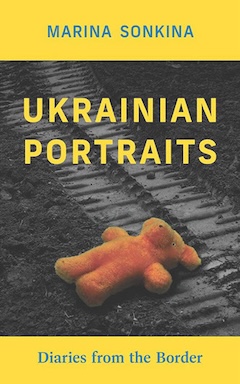
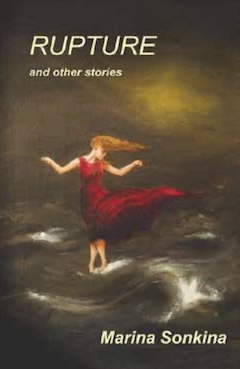
image - Ukrainian Portraits book coverJoin writer Marina Sonkina in celebrating the release of her two new books: Ukrainian Portraits: Diaries from the Border and Rupture and Other Stories. About Ukrainian Portraits, she writes: “At the end of March of 2022, I traveled to the Ukrainian-Polish border to volunteer at a refugee evacuation centre. Much as I tried to prepare myself psychologically, what I encountered face-to-face didn’t fit any of my expectations: I saw a disaster on a massive scale. I went to volunteer as someone who speaks Russian, Ukrainian and other languages; someone who had been a refugee herself.

image - Rupture book coverI soon realized that what the Ukrainian refugees needed most (apart from practical advice) was to talk about their experiences. They needed to be heard.”

The double book launch takes place Sunday, Dec. 10, 1:30 p.m., in the Aceman Seniors Lounge at the Jewish Community Centre of Greater Vancouver. Nibbles and light refreshments will be provided.

– Courtesy Marina Sonkina

Posted on November 24, 2023November 23, 2023Author Marina SonkinaCategories BooksTags Marina Sonkina, memoir, short stories, Ukraine
Art that makes people think

Art that makes people think

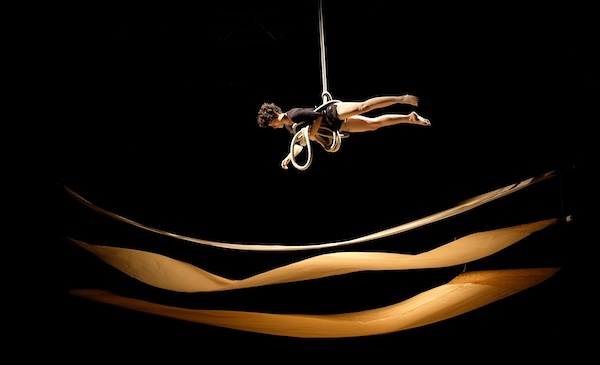
Domitille Martin in Pli, part of the PuSh International Performing Arts Festival, which runs Jan. 18 to Feb. 4. (photo by Lucie Brosset)

PuSh International Performing Arts Festival returns to Vancouver Jan. 18-Feb. 4. The mid-winter event that delivers innovative, contemporary works asks the questions, “Can a live art festival be a ritual for social change? A cultural strategy? A means to rethink history while imagining possible futures?” Participating artists include Jewish community members and a production presented with Chutzpah! Festival.

Vancouver’s Vanessa Goodman (Action at a Distance) is co-creator with Tangaj Collective (Simona Deaconescu, from Romania, and Gaby Saranouffi, from Madagascar) of BLOT, Body Line of Thought: “Our bodies are strong and fragile. BLOT redefines how we see our physical selves and their relationship to the world. In a stark set reminiscent of a science lab, two dancers observe the intricacies of the body and using salt, microbiome and physiology demonstrate how interconnected we truly are.”

BLOT will be presented Jan. 22-23, 7:30 p.m., at Left of Main, with a post-show talkback after the Jan. 22 production.

PuSh, with SFU Woodward’s Cultural Programs & Touchstone Theatre, presents Toronto-based theatre company Human Cargo’s The Runner, Jan. 24-26, 7:30 p.m., at SFU Goldcorp Centre for the Arts. The play description reads: “When Jacob, an Orthodox Jew, makes a split-second decision of who to help, his world comes crashing down. Urgent, visceral and complex, The Runner invites us into a nuanced exploration of our shared humanity and the value of kindness.”

In Pli, by France’s Les Nouvelles Subsistances (Inbal Ben Haim, Domitille Martin and Alexis Mérat), “paper becomes a playground. This visually stunning, philosophical work considers risk and transformation, as told through a circus artist moving through a set made entirely of paper – like a vast, changing sculpture. The relationship between body and paper offers a new conversation about the relationship between strength and vulnerability.”

Presented with Chutzpah! Festival, the circus/dance Pli runs Feb. 2-3, 7:30 p.m., at Vancouver Playhouse and Feb. 2-4 online.

In all, PuSh features 17 original works from 15 countries, including four world premières and seven Canadian debuts. The works presented offer personal accounts of resistance and acts of vulnerability, and push us to examine our relationship to themes such as migration, displacement, labour, injustice and artificial intelligence.

Events include Club PuSh, a casual atmosphere where people can connect with artists and party with fellow festival-goers; the PuSh Industry Series, which, in partnership with Talking Stick, stimulates dialogue with attendees during the second week of the festival; youth programming for participants aged 16 to 24; and, in partnership with Playwrights Theatre Centre, free artistic consultations with visiting dramaturgs representing diverse artistic points of view and cultural contexts.

Tickets for PuSh range from $16.75 to $39, with a top-tier seating option of $69 for Pli at the Playhouse, and PuSh passes for people who want to see multiple shows. To buy tickets, visit pushfestival.ca or call the festival audience services line at 604-449-6000.

– Courtesy PuSh International Performing Arts Festival

Format ImagePosted on November 24, 2023November 23, 2023Author PuSh FestivalCategories Performing ArtsTags Chutzpah! Festival, circus, dance, Human Cargo, Les Nouvelles Subsistances, PuSh International Performing Arts Festival, theatre, Vanessa Goodman

Community milestones … Fedoruk & Lederman

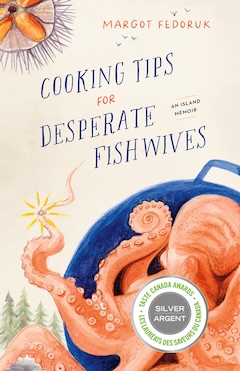
Cooking Tips for Desperate Fishwives: An Island Memoir by Margot Fedoruk (Heritage House Publishing) won a silver in the Culinary Narrative category at the 2023 Taste Canada Awards.

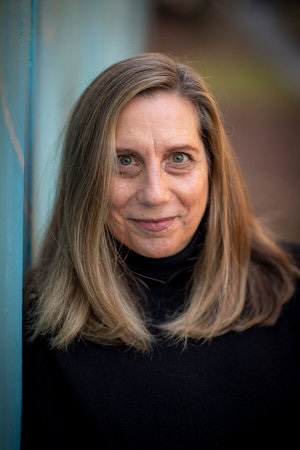
photo - Margot Fedoruk won a silver in the Culinary Narrative category at the 2023 Taste Canada Awards for Cooking Tips for Desperate Fishwives: An Island Memoir
Margot Fedoruk won a silver in the Culinary Narrative category at the 2023 Taste Canada Awards for Cooking Tips for Desperate Fishwives: An Island Memoir. (photo by Vital Image Photography)

On Oct. 30, Taste Canada announced the winners of the 26th annual prizes during a soirée at the Fairmont Royal York in Toronto, hosted by Ali Hassan. The shortlists were announced in June, listing finalists in five categories in both French and English. Taste Canada is Canada’s only national, bilingual food writing awards.

Cooking Tips for Desperate Fishwives has been featured in the Jewish Independent(jewishindependent.ca/reading-expands-experience), Stir Vancouver, Winnipeg Free Press, BC BookWorldand other outlets. Fedoruk participated in the Cherie Smith JCC Jewish Book Festival in February 2023.

Part love story, part survival story, part meditation on family dysfunction, Fedoruk’s offbeat memoir chronicles the unpredictable life of a young wife and mother on a tiny BC island.

image - Cooking Tips for Desperate Fishwives book coverTrue to its title, the memoir is infused with recipes, from the hearty Eastern European fare of Margot’s childhood to more adventurous coastal BC cuisine. The narrative follows 23-year-old Margot when she left Winnipeg and her volatile Slavic-Jewish family for the wilds of British Columbia and fell in love with a sea urchin diver. Determined not to repeat the same mistakes as she had witnessed during her parents’ marriage, Margot paints a portrait of a modern-day fishwife left behind to keep the home fires burning.

Fedoruk is a writer, book reviewer and entrepreneur, whose work has been published in the Globe and Mail, Quill & Quire, BC BookWorld, Ormbsy Review and Portal. She holds a BA from the University of Winnipeg and a BA from Vancouver Island University, where she majored in creative writing. She was awarded the Barry Broadfoot Award for creative nonfiction and journalism and a Meadowlarks Award for fiction, both from Vancouver Island University.

Visit heritagehouse.ca for more information about Cooking Tips for Desperate Fishwives, Fedoruk or Heritage House. For more details about the Taste Canada Awards, visit tastecanada.org.

* * *

photo - Journalist Marsha Lederman won a 2023 Webster Award for “Arts in the Crosshairs"
Journalist Marsha Lederman won a 2023 Webster Award for “Arts in the Crosshairs.” (photo by Ben Nelms / Penguin Random House)

Western arts correspondent for the Globe and Mail Marsha Lederman received the Excellence in Arts and Culture Reporting Award for the article “U.S.-style book bans could happen in Canada too, if we’re not careful,” or “Arts in the Crosshairs,” at the 2023 Webster Awards.

The winners in the 14 categories of the 2023 Webster Awards were announced Nov. 15 during a live in-person event hosted by CHEK TV’s Paul Haysom and Gloria Macarenko from CBC Radio, who also conducted a fireside chat with the featured guest, veteran anchor/journalist Lisa LaFlamme. To see who the finalists and winners were of the 2023 Webster Awards, and to view the finalists’ work, visit jackwebster.com.

Posted on November 24, 2023November 23, 2023Author Community members/organizationsCategories LocalTags Jack Webster Awards, Margot Fedoruk, Marsha Lederman, Taste Canada Awards
A fresh take on Hanukkah

A fresh take on Hanukkah

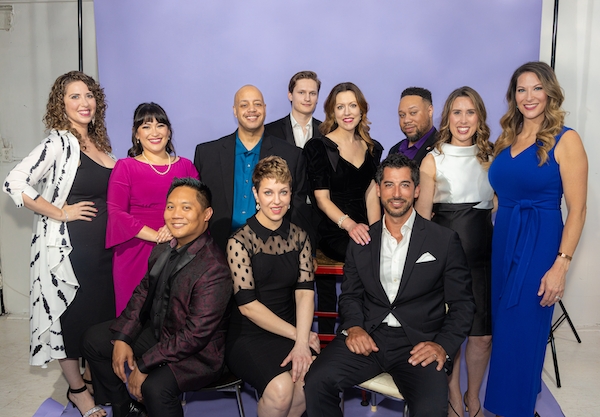
Chicago a cappella in June 2022. The ensemble released Miracle of Miracles: Music for Hanukkah last month. (photo by Kate Scott)

The CD Miracle of Miracles: Music for Hanukkah arrived at the Jewish Independent unsolicited. The album, released last month by Cedille Records, features a range of songs from the American Jewish musical tradition, performed by Chicago a cappella vocal ensemble. As someone who spent a good portion of her teenagehood in a choir at a Conservative synagogue and about a decade singing in another Conservative synagogue choir later in life, I have been happily singing along to this recording, enjoying the fresh take on songs with which I am mostly quite familiar.

Miracle of Miracles will appeal most, I think, to someone like me, who grew up in a Conservative Judaism milieu where a cantor and choir formed a large part of the service, or someone who appreciates classical music, as Chicago a cappella are classically trained A-listers, who perform a repertoire of music from the ninth to the 21st centuries. The current artistic director is John William Trotter, and Miracle of Miracles was recorded over a few days last January at Northeastern Illinois University in Chicago.

image - Chicago a cappella CD coverThe CD opens with an arrangement of “Oh Chanukah / Y’mei Hachanukah” by Robert Applebaum that the liner notes describe as “modern versions of the song form from the confluence of at least two streams, the first springing from Hebrew lyrics, the second flowing together from Yiddish and English sources. Turning again to [composer] Harry Coopersmith’s mid-20th-century collection … to create something of a mash-up of ‘Oh Chanukah’s’ popularity.”

There are several Applebaum arrangements. His “Haneirot Halalu” (“These Lights We Light”) mixes English translation and commentary into the traditional Hebrew lyrics, and his “Maoz Tzur” is a cantor-choir interplay that comprises elements most of us will recognize and be able to join initially, but then becomes more complex. His finger-snapping arrangement of Samuel E. Goldfarb’s well-known “I Have a Little Dreidl” – called “Funky Dreidl” – is in English with the Hebrew “nes gadol haya sham,” “a miracle happened there,” as a kind of chorus. It’s followed on the CD by a lively rendition of Mikhl Gelbart’s Yiddish “I Am a Little Dreidl (Ikh bin a kleyner dreidl).”

Other Yiddish offerings are Mark Zuckerman’s arrangement of “O, Ir Kleyne Likhtelekh” (“O, You Little Candle”), the lyrics of which were written by poet and lyricist Morris Rosenfeld, and an arrangement by Zuckerman of “Fayer, fayer” (“Fire, Fire”) by Vladimir Heyfetz, about burning the latkes while frying them.

Applebaum’s jazzy “Al Hanism” (“For the Miracles”) is one of three versions of the song on this recording. There is also an arrangement by Elliott Z. Levine that is the traditional, fast-paced version I’ve sung countless times and love, and the expansive, movie soundtrack-sounding arrangement by Joshua Fishbein.

Levine also contributes “Lo v’Chayil” (“Not by Might”), based on text from the Book of Zechariah, which is not a Hanukkah song per se, but, as the liner notes say, “rather the more transcendent spirit that underlies the commemoration of Hanukkah.” Translated from the Hebrew, the verse is: “Not by might nor by power, but by My spirit, saith the Lord of Hosts.”

Other composers/arrangers whose work is featured on this CD are Steve Barnett (“S’vivon” / “Little Dreydl”), Gerald Cohen (“Chanukah Lights”), Daniel Tunkel (four movements of his “Hallel Cantata”), Jonathan Miller (“Biy’mey Mattityahu” / “In the Days of Mattityahu”).

Two bonus tracks are included: an arrangement by Joshua Jacobson of Chaim Parchi’s Hanukkah tune “Aleih Neiri” and Stacy Garrop’s take on the prayer for peace “Lo Yisa Goy”: “Nation shall not lift up sword against nation, neither shall they learn war any more.”

In the program notes, Miller, who is Chicago a cappella’s artistic director emeritus, talks about the limited number of Hanukkah songs that are appropriate for an ensemble to perform, commenting that “Jewish choral music is a recent phenomenon, begun in earnest only about 200 years ago in Berlin, so there’s a simple quantity issue: we have much less repertoire to peruse than in other choral traditions. Given all of this, we are especially grateful for the composers and arrangers whose persistence and skill have given us the works found here.”

photo - Chicago a cappella artistic director John Trotter
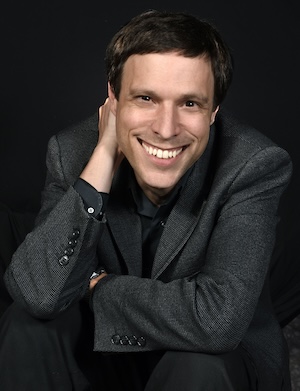
Chicago a cappella artistic director John Trotter. (photo from Cedille Records)

Despite the dearth of Hanukkah choral music, Trotter, the ensemble’s current artistic director, observes that the CD comprises “a sprawling variety of styles.”

“There are at least two reasons for this breadth,” he writes. “On the one hand, we are in debt to the fertile imaginations of our composers, who envisioned so many different sound worlds and so many different ways to clothe these texts. But there is also the nature of Hanukkah itself, which offers so many different modes of personal, social and spiritual practice. Consider just three of these. Hanukkah offers the chance to reflect on the historical significance of the Maccabean revolt, with its consequences echoing through to the present day. It invites quiet contemplation of the candle flames, set aside from any utilitarian purpose. And it provides an opportunity to gather with family and have a really great party with really great food.”

Miracle of Miracles would provide a perfect acoustic background for a Hanukkah gathering. To purchase a CD or buy or stream the music digitally, visit cedillerecords.org/albums/miracle-of-miracles.

Format ImagePosted on November 24, 2023November 23, 2023Author Cynthia RamsayCategories Celebrating the Holidays, MusicTags Cedille Records, Chanukah, Chicago a cappella, choral music, Hanukkah

טרודו מבקר את ישראל ומפגינים תומכי פלסטינים יוצאים נגדו

ראש ממשלת קנדה, ג’סטין טרודו, מתח ביקורת קשה על פעילות צה”ל ברצועת עזה וטען כי הרג נשים, ילדים ותינוקות חייב להיפסק. טרודו קרא לממשלת ישראל לנהוג באיפוק מרבי. העולם צופה, בטלוויזיה וברשתות החברתיות. אנחנו שומעים עדויות של רופאים, בני משפחה, ניצולים, ילדים שאיבדו את הוריהם, הוסיף עוד אמר טרודו במסיבת עיתונאים שקיים לפני מספר ימים במחוז קולומביה הבריטית

מאז מתקפת הטרור בשבעה בחודש אוקטובר קנדה הבהירה כי לישראל יש את הזכות להגן על עצמה מפני חמאס. במסיבת עיתונאים טרודו אף הפציר בארגון הטרור להפסיק להשתמש באזרחים חפים מפשע בעזה כמגן אנושי, כלשונו. ובמקביל על חמאס לשחרר את החטופים המוחזקים בשבי החמאס זה חודשיים ימים. עם זאת, ראש ממשלת קנדה כאמור לא חסך ביקורת על התקיפות הקשות נמשכות של ישראל ברצועת עזה

העולם עד להרג הזה של נשים, של ילדים, של תינוקות. זה חייב להיפסק לדברי טרודו. הוא קרא לאחרונה לא פעם להפסקה הומניטרית משמעותית. וזאת כדי לאפשר את שחרור החטופים ולספק סיוע הומניטרי לאזרחים ברצועת עזה, כך שניתן לתת מענה לצרכים אזרחיים. ראש הממשלה, בנימין נתניהו מיהר לגנות את דבריו של טרודו, וצייץ ברשת החברתית טוויטר: לא ישראל תוקפת בכוונה אזרחים, אלא חמאס שערף ראשים, שרף וביצע טבח באזרחים, בזוועות הקשות ביותר שבוצעו נגד יהודים מאז השואה

לדברי נתניהו, בעוד ישראל עושה הכל כדי להרחיק אזרחים מאזורי התקיפות, חמאס עושה הכל כדי לשמור עליהם שם. ישראל מספקת לאזרחים בעזה מסדרונות הומניטריים ואזורים בטוחים, בעוד חמאס מונע מהם לעזוב באיומי אקדח. נתניהו סיכם את דבריו: החמאס, ולא ישראל, הוא שצריך להיות מואשם על ביצוע פשע מלחמה כפול והוא פגיעה באזרחים תוך הסתתרות מאחורי אזרחים. על כוחות הציוויליזציה לתמוך בישראל בהשמדת הברבריות של חמאס. טרודו ציין כי קרוב לארבע מאות אזרחים קנדיים ובני משפחותיהם פונו כבר מעזה

בדברי הביקורת שלו על ישראל מצטרף איפוא טרודו לנשיאה של צרפת, עמנואל מקרון, שאמר בראיון לרשת הטלוויזיה הבריטית הבי.בי.סי. כי על ישראל להפסיק להרוג נשים וילדים ברצועת עזה. ביקורתו של של מקרון עוררה סערה קשה וזכתה אף לגינויים פומביים רבים מחברי הממשלה בישראל בראשות נתניהו שהעיר, כי המדינה לא צריכה הטפות מוסר מאף אחד

חבר קבינט המלחמה של ממשלת ישראל השר בני גנץ שוחח עם טרודו לאור דבריו, עדכן אותו בהתפתחויות במלחמה והדגיש בפניו את המשך השימוש של חמאס בתושבי עזה כמגן אנושי. בשיחה ציין טרודו את תמיכתו ארוכת השנים בישראל, זכותה להגן על עצמה וכן את הצורך לפעול להשבת החטופים באופן מיידי. טרודו הוסיף כי המשך הסיוע ההומניטרי לתושבי הרצועה הוא בעל חשיבות לשמירה על אפשרות לעתיד טוב יותר לאזור כולו

בינתיים דווקא תומכי הפלסטינים יצאו נגד טרודו ומשטרת ונקובר נאלצה הגן עליו בפני המפגינים. טרודו הגיע למסעדה בוונקובר באחד הערבים האחרונים. קרוב לשלוש מאות מפגינים תומכי הפלסטינים ששמעו על כך הגיעו למקום וקיימו הפגנה מול המסעדה. משטרת ונקובר הגיעה למקום עם כמאה שוטרים. לדברי המשטרה שניים מהמוחים אף נעצרו, ואחד מהם חשוד שהיכה את אחד השוטרים שנזקק לטיפול רפואי. במשטרה מציינים עוד כי המפגינים התאספו ללא התראה מוקדמת ליד המסעדה, החזיקו דגלי פלסטין, וקראו שיש לבצע הפסקת אש מיידית ברצועת עזה. המפגינים צעקו לטרודו כי יש לו דם על הידיים

Posted on November 22, 2023Author Roni RachmaniCategories עניין בחדשותTags Benny Gantz, Binyamin Netanyahu, Canada, Emmanuel Macron, France, Gaza Strip, IDF, Israel, Justin Trudeau, police, protesters, Vancouver, war, בני גנץ, בנימין נתניהו, ג'סטין טרודו, וונקובר, ישראל, מלחמה, מפגינים, משטרת, עמנואל מקרון, צה"ל, צרפת, קנדה, רצועת עזה
Students to learn of Holocaust

Students to learn of Holocaust

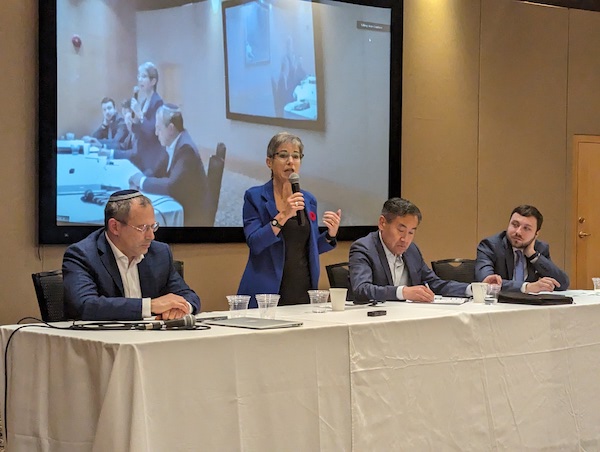
BC cabinet minister Selina Robinson speaks Nov. 5 at Schara Tzedeck Synagogue. Other panelists at the B’nai Brith Canada event that day were, left to right, Schara Tzedeck’s Rabbi Andrew Rosenblatt, BC United MLA Michael Lee and Aron Csaplaros, BC regional manager for B’nai Brith. (photo by Pat Johnson)

British Columbia is to become only the second province in Canada to mandate Holocaust education in the school curriculum. In a surprise announcement at the Jewish Community Centre of Greater Vancouver on Oct. 30, BC Premier David Eby was flanked by Jewish community leaders and survivors of the Holocaust when he said that Grade 10 students will be required to learn about the Holocaust, beginning in the 2025-26 school year.

Until now, it was possible for a student to graduate from the school system in British Columbia without ever having encountered the subject. Teachers have discretion to include the Holocaust in social studies classes and an elective on genocide is available in some schools, but there was no universally mandated requirement for learning about the Shoah. Ontario recently instituted mandatory Holocaust education at the Grade 6 level, becoming the first province in the country to make the subject compulsory.

Speaking at an event on Nov. 5, BC cabinet minister Selina Robinson recounted how the milestone decision unfolded. She credits former BC education minister (now minister of transportation and infrastructure) Rob Fleming with launching the idea in 2018. Fleming came to Robinson and asked if she knew that Holocaust education was not mandatory.

“Just like many, many others, I was surprised to learn that,” said Robinson. “He started the ball rolling.”

The COVID pandemic derailed the plans, as educators and administrators struggled to simply deliver learning to kids.

It was while reading Vancouver author Marsha Lederman’s book Kiss the Red Stairs that Robinson, who is the province’s minister of post-secondary education and future skills, wondered what had happened with Fleming’s idea.

“So, I picked up the phone and I called Rachna [Singh, the current minister of education] and then I called Rob Fleming and then I called a couple of my other colleagues who had an interest in seeing this move forward,” she recounted. “And then I called the premier and I said, David, this project that we started is moving at a snail’s pace and this needs to get done. We cannot wait any longer. I want to give kudos to our premier, to David Eby. He said, I’m on it.”

Robinson was speaking at Schara Tzedeck Synagogue on Sunday as part of a panel on antisemitism and Holocaust education organized by B’nai Brith Canada. Numerous members of the legislature, as well as mayors, councilors and school trustees from around the province joined the event virtually. Robinson’s fellow panelists were BC United MLA Michael Lee and Schara Tzedeck’s Rabbi Andrew Rosenblatt. Aron Csaplaros, BC regional manager for B’nai Brith Canada, moderated, with senior leaders from B’nai Brith beaming in from Eastern Canada.

From Robinson’s post-COVID jumpstarting of the Holocaust education planning, things leapt forward, she said.

“It really moved, I would say, from June until probably the beginning of September, at lightning speed – and anyone who’s ever had to work with government knows that nothing ever moves at lightning speed,” Robinson said. “So, I want to give kudos to our partners at the Vancouver Holocaust Education Centre and CIJA [the Centre for Israel and Jewish Affairs] and [the Jewish Federation of Greater Vancouver] for coming together and working in partnership. I know that B’nai Brith is new on the scene [in BC] and this is a very important piece, but I also think it’s really important to recognize those that have been working … for a number of years to make this happen.”

The timing of the announcement, in the weeks after the Oct. 7 terror attacks in Israel and in the midst of a massive spike in antisemitism worldwide, was coincidental. The issues, though, are related.

Robinson said the provincial government has been vigilant in monitoring antisemitism and potential for violence in British Columbia. She credited Minister of Public Safety and Solicitor General Mike Farnworth for spearheading the response.

“He called me every single day from Oct. 7 for about 10 days, to report in to me about what was happening on the ground,” she said. In addition to her official role with advanced education, Robinson said she is known among colleagues as “the Jew in the crew,” as the provincial elected official who is most publicly visible in her Jewishness.

On Nov. 1, Robinson convened a meeting of the heads of the 25 post-secondary institutions in the province.

“I got agreement from all 25 presidents that they would do everything within their power to make sure that everyone felt safe on their campuses,” she said. “I don’t think solving that is going to be an easy task, but it’s absolutely a requirement of all of them, because, in this province and in this country, we believe that everybody has the right to be who they are and to feel safe and, if it’s not happening, then we need to fix it.”

A bipartisan love-in that has been going on between Robinson and Lee, who represents Vancouver-Langara (the provincial constituency that includes many of Vancouver’s Jewish institutions and residents), continued Sunday in the obvious respect and affection between the two MLAs despite party lines. Lee made the news last week after rising in the house to give a personal tribute to Robinson’s strength as a leader who is Jewish in this challenging time and Robinson reciprocated kind words at the B’nai Brith event.

“Michael Lee has been a steadfast supporter, not just in this particular situation,” she said. “But also [to me] as a Jewish person who is having her own experience as a Jew around what is happening.”

Robinson spoke emotionally about the impacts of current events on her family, which includes her Israeli soon-to-be son-in-law, who became a permanent resident of Canada at the end of September.

Making Holocaust education a mandatory part of the province’s education curriculum has been a dream of the people at the Vancouver Holocaust Education Centre since the organization was founded, in 1994, according to Nina Krieger, the VHEC’s executive director.

“I think stars aligned and David Eby acknowledged Selina Robinson as being a key driving force in this initiative,” Krieger told the Independent.

A process of consultation will now begin and Krieger expects her agency will be central to that work, identifying and providing resources to help craft the new curriculum, which is likely to be a component of the Social Studies 10 learning outcomes.

“Certainly we bring a wealth of experience and a roster of programs and resources and best practices that will be relevant to the curriculum development process,” she said. “We are also poised to work with the minister of education to play whatever role is needed for that process. Also, we know the implementation and resource tools and training that teachers are going to need will be really important as well, so we’re looking forward to supporting the province and the teachers directly with that.”

The Jewish Federation and CIJA will continue to be engaged with the planning for mandatory Holocaust education. Both organizations issued statements after the announcement Oct. 30.

“When left unchecked, antisemitism culminates in some of the darkest chapters in human history. By learning from the Holocaust, we honour the memories of its victims and, we hope, contribute to preventing future tragedies,” said Ezra Shanken, Federation’s chief executive officer. “Today’s announcement shows the BC government’s commitment to creating a safer society for all.”

“Education is key to ensuring that our children learn to combat hate and that the Jewish community can live in a safer province,” said Nico Slobinsky, CIJA’s vice-president for the Pacific Region. “We look forward to working with the BC government on implementing mandatory Holocaust education in our province’s K-12 curriculum.”

At Sunday’s event, Marvin Rotrand, national director of B’nai Brith’s League of Human Rights, speaking virtually from Montreal, noted that 15 US states have some form of mandatory Holocaust education – and early indications from studies in those jurisdictions indicate a decrease in hate crimes not only toward Jews but other groups as well.

Format ImagePosted on November 10, 2023November 9, 2023Author Pat JohnsonCategories LocalTags B’nai Brith Canada, Centre for Israel and Jewish Affairs, CIJA, David Eby, education, Holocaust, Jewish Federation of Greater Vancouver, Michael Lee, Nina Krieger, politics, Selina Robinson
United against antisemitism

United against antisemitism

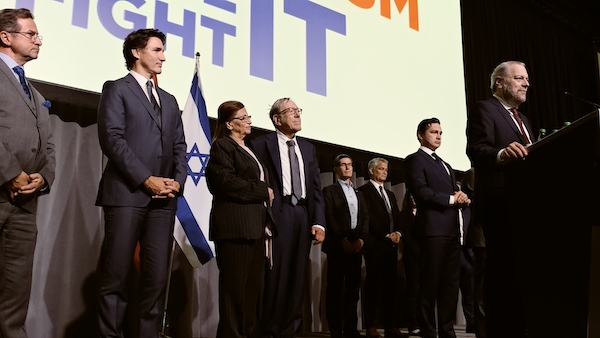
Among those on stage as Irwin Cotler received a lifetime achievement award from the Centre for Israel and Jewish Affairs last month were, left to right, Yves-François Blanchet (Bloc Quebecois leader), Prime Minister Justin Trudeau, Ariela and Irwin Cotler, David Posluns (one of the event co-chairs), Steven Kroft (one of the event co-chairs), Pierre Poilievre (Conservative Party leader) and Shimon Koffler Fogel (head of CIJA). (photo by Dave Gordon)

It was a conference months in the making, but Antisemitism: Face It, Fight It took on heightened poignancy in light of the Oct. 7 Hamas terror attacks on Israel and the subsequent spike in Jew-hatred globally.

Produced by Centre for Israel and Jewish Affairs (CIJA), the conference took place in Ottawa Oct. 16 and 17. Speakers included activists, politicians, experts and analysts on antisemitism. In attendance were 250 student leaders and some 600 others, Jews and non-Jews, according to organizers.

Shimon Koffler Fogel, chief executive officer of CIJA, noted there was an outpouring of support from the major political party leaders, as well as from minority, faith and other groups – “a uniform conclusion about Hamas and their actions, and we should embrace that.”

This message was echoed throughout the two days of the conference.

“It can’t just be Jews who talk about the rise of antisemitism. It can’t just be Muslims that talk about anti-Muslim hate,” said Farah Pandith, senior advisor to the Anti-Defamation League. “It can’t be. Whether we are talking about LGBTQ or issues of heritage or gender, we’ve had to stand up for each other. As a Muslim, it’s what my religion tells me I must do for the other.”

Former premier of Alberta Jason Kenney, who was elected as an MP in 1997, said he became a supporter of the Jewish people after the “unravelling of the Oslo process,” and learning of the antisemitism coming from Palestinian mosques and leaders.

“Do not take for granted the positions being expressed here in Ottawa today,” said Kenney. “You must redouble your efforts intelligently to build coalitions across the pluralism of this country, and to be a voice of clarity and courage with our political leadership.” Citing examples of possible coalitions, he told the JI that “the Jewish community has to continue to reach out to Muslim and other communities, find allies.”

“I know we can best tackle what we are seeing when we work together, when we are not siloed,” said Minister of Justice and Attorney General of Canada Arif Virani, an Ismaili Muslim, in his speech. “Hatred and intolerance against any minority community is a risk to every minority community. That’s why groups promoting equity have to have each other’s backs.”

Emily Schrader, digital strategist and senior correspondent of Ynet News, observed, “We see now that all over the world there are Iranians organizing and participating in rallies to support Israel … despite knowing that the Iranian regime is the biggest supporter of Hamas. The Iranian people have a complete rejection of the regime.”

Canadian human rights advocate Irwin Cotler received a lifetime achievement award from CIJA “in recognition of his enduring commitment to the pursuit of justice” and “the advancement of human rights for the world’s most vulnerable and oppressed.”

In his acceptance speech, Cotler applauded the multi-partisan groups standing up against antisemitism, “who heed this call to action, where we act in concert on behalf of our common humanity.”

Cotler was a parliamentarian from 1999 to 2015 and is a former minister of justice. Over the course of his legal career, he represented clients such as Natan Sharansky and Nelson Mandela. Until recently, he was the government’s special envoy on antisemitism. He said “2023 is not 1943” and “there is a Jewish state as an antidote to Jewish powerlessness.”

“In 1943,” he said, “the Jews could not get a meeting with the president of the United States, and, in 2023, the president has been a leader in calling out this [Hamas’s] moral evil.”

Cotler told the JI that young Jews should bravely step forward to “call out antisemitism when they see it, unmask it, expose it.”

Prime Minister Justin Trudeau called out Hamas as a “terrorist organization that launched an attack of unspeakable brutality” and said “Canada supports Israel’s right to defend itself in accordance with international law.” He said the only thing Hamas stands for is “more suffering for Israeli and Palestinian civilians.”

In addressing “scary rising antisemitism,” Trudeau said “families are worried about what they face if they go to synagogue, and I’m sure you are all seeing hateful rhetoric online.” He ended by saying, in Hebrew, “gam zu l’avor” – “this too shall pass.”

Opposition leader Pierre Poilievre, head of the Conservative Party, vowed that his party would stand with Israel, and acknowledged the fears of many Jewish Canadians. About Oct. 7, he said, “the terrorists that carried out this attack did so as part of a deliberate agenda: to maximize bloodshed not only of the Jewish people, but actually to maximize the bloodshed of Palestinians and Muslims as well. These are the actions of sadistic, criminal terrorists who can only be defeated and not negotiated with.”

Poilievre added that, especially in light of Iran’s fingerprints being on the attacks, governments must “respond with crippling sanctions – the strongest legal action – and by criminalizing the Islamic Revolutionary Guard Corps.”

Jagmeet Singh, leader of the New Democratic Party, said, “These are horrific attacks and we strongly condemn them. There is no place in our world for terrorism. The international community must work together to ensure that there is an end to terrorist organizations like Hamas and Hezbollah.”

Singh acknowledged that Jews in Canada are “deeply afraid” and “worried about their safety.”

“It’s wrong and I’m deeply sorry it’s happening,” he said.

In noting pro-Hamas rallies around the world, Singh said, “We’ve seen horrible celebrations for the attacks on Israelis civilians. This is abhorrent. This is antisemitism. Violence against civilians is never justified.”

He concluded: “I know that not everyone will agree with our position on a ceasefire, but I believe the only way to peace is to talk to each other.”

Historian and author Gil Troy encouraged the audience to not forget the courage of “our citizen’s army, our plainclothes commandos, our kibbutzim Rambos and our army,” who saved innocents from much worse.

“When I heard these stories, I shift[ed] from the victim mentality to the Zionist mentality. The Zionist is one that says ‘yes, we sometimes suffer,’ but we are not passive and we are not victims. The Zionist story says we are not alone. We can’t let them win.”

Calgary-based communications consultant Emile Scheffel, who is not-Jewish, told the JI: “History shows that those who threaten the Jewish people are enemies of freedom and dignity for the rest of us as well. I stand with Israel because the Jewish state embodies the values of freedom, democracy and pluralism that are important to me.”

He added, “the conference was an important call to action for non-Jews to stand with our Jewish friends and neighbours in opposing hatred and discrimination. A united front is essential to making sure that antisemitism doesn’t gain any more ground in Canada, and that Jewish Canadians can live in peace and security.”

Attendee Nika Jabiyeva, member of the Network of Azerbaijani Canadians, said she was proud to “stand against hate, shoulder to shoulder with our friends in the Jewish community and many multifaith allies.”

“Our voices carry more weight when we speak up for one another,” she said, “especially during trying times.”

Dave Gordon is a Toronto-based freelance writer whose work has appeared in more than 100 publications around the world. His website is davegordonwrites.com.


Format ImagePosted on November 10, 2023November 9, 2023Author Dave GordonCategories NationalTags antisemitism, Arif Virani, Centre for Israel and Jewish Affairs, CIJA, Emile Scheffel, Emily Schrader, Farah Pandith, Gil Troy, Hamas, Irwin Cotler, Jagmeet Singh, Jason Kenney, Justin Trudeau, Nika Jabiyeva, Pierre Poilievre, politics, Shimon Koffler Fogel, terrorism

Consume responsibly

It is said that “truth is the first casualty of war.” There are two aspects to this truth – that the chaos of conflict makes it difficult to discern exactly what is happening, leading to what we might now call “misinformation” and, additionally, the tendency of governments to deliberately mislead their citizens and others for strategic reasons, better known as “disinformation.” Both aspects are very much in play in the current conflict between Israel and Hamas.

There was a time when it was easy for governments to control information. At that time, also, there were editors and fairly clear and stringent (if imperfect) journalistic standards in place before a story would reach its audiences. The internet, among its good and bad characteristics, has eliminated almost all oversight.

Today, anyone with access to the internet has the potential to reach wider audiences than the most powerful person of a century or two ago – and to do so instantaneously. As a result, we are swimming in information.

In principle – in the utopian idea some may have had a few short years ago – this access to virtually unlimited resources would make every citizen capable of consuming the most information possible and empowering us to make informed decisions. This principle seems to have proved disastrously wrong. Instead of weighing the balance of opinions in the most vibrant marketplace of ideas ever imagined, many of us seek out only that information that reinforces our preexisting prejudices and fast-held opinions.

Moreover, bad actors – including governments – and unwitting innocents are purveying false information. We are manipulated by lies that are difficult to discern from fact and most of us are guilty of sharing false information without intending to do so.

We are facing the possibility of a “post-truth world,” exacerbated by technological changes and advances in artificial intelligence. Even given incontrovertible evidence, significant parts of populations choose to believe demonstrable fallacies – the most obvious one in our geographic neighbourhood being the “Big Lie” that Donald Trump won the 2020 US presidential election. Even the universal availability of contrary proof does not preclude people from coming to the wrong conclusions.

Google News and many other agencies, to their credit, have begun aggregating fact-checks from verified sources that now appear at the bottom of many news feeds. Of course, these cannot vet the things that come through our email inboxes.

The advent of artificial intelligence is going to turn what had been trickle and is now a flood of misinformation and disinformation into an absolute deluge. In this issue of the Independent alone, by coincidence, multiple stories address the risks of what is occurring and the need for media literacy and critical thinking.

All of this relates, in a very specific if not immediately obvious way, to a more positive news story in this issue. British Columbia is set to become the second Canadian province to mandate compulsory Holocaust education in the school curriculum.

Ensuring that young citizens complete their education with knowledge of the Holocaust is vitally important. The Holocaust, since well before the internet age, has been the subject of both misinformation and disinformation. Comprehensive education may help people emerge from the school system with a baseline of shared information around a seminal event in human history.

But more is needed. The problem is so vast, a broad approach is required to ensure that most of us, young and old, can discern fact from fiction.

A “supply-side” response is not going to work. There is simply no possibility of stanching the burgeoning amount of lies and misleading content online (and elsewhere). Critical thinking, media analysis, information literacy – these are crucial skills for individuals and society at large. We are way behind the curve in delivering these through our institutions.

Confronting the tsunami of misinformation and disinformation is an intractable challenge. It seems, though, that democratic countries are on the right track: we are acknowledging that it is a problem. There are individuals and organizations – in the public, nonprofit and private sectors – working to bring reliable and trustworthy news and information to the fore. But we must do our part – think twice before you forward a link or email, do your own fact-checking, subscribe to a wide variety of respected publications or channels, be civil in your discussions. It may be a cliché, but it’s appropriate here: be a part of the solution not the problem.

Posted on November 10, 2023November 9, 2023Author The Editorial BoardCategories From the JITags AI, artificial intelligence, critical thinking, disinformation, media literacy, misinformation
Identifying the victims

Identifying the victims

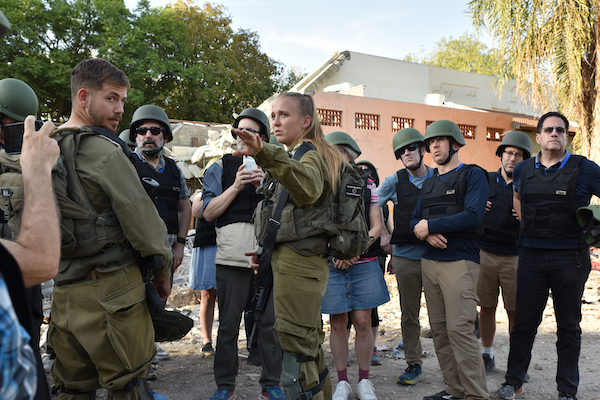
On Oct. 31, among the ruins of Kibbutz Be’eri, Israel Defence Forces personnel brief a delegation of Conservative rabbis and lay leaders from the United States, Canada and Britain, which was on a three-day solidarity mission organized by the Fuchsberg Jerusalem Centre. (photo by Boaz Pearlstein)

WARNING: Extremely graphic reporting.

Since Hamas’s Oct. 7 cross-border assault on multiple army bases, kibbutzim, cities and a music festival in the Gaza Strip periphery, staff at the Israel Defence Forces’ Shura base have been working around the clock to identify the remains of the 1,100 civilians and 315 IDF soldiers, reservists and police officers massacred by jihadi terrorists. With so many bodies, the victims were initially kept in refrigerated milk trucks in the morgue’s parking lot. Plain wooden coffins are stacked in the corridors, waiting for a positive identification so the remains may be released to their families for burial at a military or civilian cemetery. Only then can Judaism’s seven-day period of mourning begin.

A month on, the sickly smell of death lingers. Pathologists at this normally quiet IDF logistics centre and home base of the military rabbinate corps – located on the outskirts of Ramla, a mixed Jewish-Arab city not far from Ben-Gurion Airport – continue their painstaking, harrowing but holy forensic mission.

Dismembered limbs and badly decomposed bodies continue to be delivered. The human remains are sniffed out under the rubble of destroyed buildings by IDF canine units, staff told a 33-person Oct. 31 delegation of Conservative rabbis and lay leaders from the United States, Canada and Britain.

Initially, it is often impossible to determine if the remains are those of victims or perpetrators, Col. Rabbi Haim Weisberg, head of the IDF’s rabbinic division, told the religious leaders. Many are mutilated with limbs and heads dismembered, making the ghoulish jigsaw puzzle even more complex.

“We are in an abnormal situation and that is why it is taking so much time to identify the bodies. In most cases, we have had to identify people via deep tissue DNA or dental records because there is nothing left,” he explained.

The complex identification process has been compounded because so many of the victims were not Israeli residents.

Pathologists can take several hours to assess a body, photograph it and document the fatal wounds. Out of respect for the dead and their families, the IDF is not releasing those photos.

Weisberg spoke not only about whole bodies but also about charred and incomplete remains, including what in one case turned out to be a corpse so severely burned that only a CT scan revealed it was a mother and baby bound together in a final embrace.

The grisly job is complicated by uncertainty over the tally of victims. According to constantly updated data from the IDF, more than 1,400 Israelis and foreigners were murdered. Some 238 people are believed to be held hostage by Hamas inside the Gaza Strip and the fate of dozens of others is unknown. Some may be held inside Gaza by other terrorist groups, like Palestinian Islamic Jihad, or even by individuals. Others may still be among the dead, yet to be identified by the staff at Shura.

When drafted, all IDF recruits provide samples of their DNA and fingerprints, and have their teeth X-rayed. The army does not rely exclusively on identification made through a soldier’s twin dog tags kept in their combat boots and worn on a chain around the neck.

According to halachah (Jewish law), fallen soldiers are buried in a coffin in their blood-soaked uniform. They are not ritually washed in the tahara ceremony – the Jewish tradition of purification of the dead – nor are they wrapped in shrouds. The intention is that God should be angered by witnessing the fallen defenders among his Chosen People. Personal effects like a cellphone, watch or wallet are washed of blood and then returned to the family of the deceased. Artifacts that cannot be cleansed of blood are buried with the deceased.

By contrast, civilian dead are ritually washed and wrapped in shrouds. Generally, in Israel, they are interred directly in the ground without a coffin.

While dental records can allow straightforward identification of dead soldiers, that information is often unavailable for civilians. Many dental offices in the city of Sderot near Gaza were destroyed, and with them their files.

Ritual washing is tasked to male and female reservists who have volunteered for the mitzvah (commandment) of chesed shel emet (true kindness).

Women soldiers perform tahara for the hundreds of girls and women who were murdered. The team is working in shifts around the clock. Among them is Shari, an architect living in Jerusalem whose surname may not be released under IDF security regulations. She volunteered for the unit when it was established more than a decade ago to ensure that the modesty of female recruits killed in action was protected.

“We saw evidence of rape … and this was also among grandmothers down to small children,” she stated.

Shari said she and the other volunteers received specialized training from the IDF, which prepared them practically and mentally to care for the bodies of the dead. Until Oct. 7, she had not been called for active duty.

“I’ve seen things with my own eyes that no one should ever see,” she said, describing how she took care of the dead women. Many were still dressed in their pajamas. Their bodies had been booby-trapped with grenades, and the remains bore evidence of extreme brutality.

Shari’s duties begin with opening the body bags to remove the dead person’s clothes, jewelry and any other personal possessions in order to return them to the families.

“The only colour among the blood and dirt was their nails, beautiful manicures, painted the brightest colours,” Shari said, adding, “Their nails made me weep.”

“We gathered this group of 33 Jewish communal leaders from across North America to witness the horrors our brothers and sisters have suffered,” said Dr. Stephen Daniel Arnoff, chief executive officer of the Fuchsberg Jerusalem Centre – a home for Conservative and Masorti Judaism in Israel, which organized the three-day solidarity mission. Located in Jerusalem, the centre offers opportunities to study, pray and explore within an egalitarian and inclusive setting, creating multiple pathways for finding personal and communal meaning.

The solidarity group included the first civilians to tour the devastated remains of Kibbutz Be’eri, where terrorists went house to house slaughtering the inhabitants. Wearing flak vests and helmets, the clergy and communal leaders recited the El Male Rachamim and Kaddish prayers for the dead as soldiers continued their search for human remains.

“We literally saw the blood of our people crying out to us from the ground,” said Arnoff.

“It is our moral obligation to make sure that the world knows what happened there.”

Gil Zohar is a writer and tour guide in Jerusalem.

Format ImagePosted on November 10, 2023November 9, 2023Author Gil ZoharCategories IsraelTags Fuchsberg Jerusalem Centre, Haim Weisberg, halachah, Hamas, IDF, Israel Defence Forces, Jewish burial, Judaism, Kibbutz Be’eri, Oct. 7, Shura base, terrorism, terrorist attacks

Posts pagination

Previous page Page 1 Page 2 Page 3 Page 4 Next page
Proudly powered by WordPress