Skip to content
  • Home
  • Subscribe / donate
  • Events calendar
  • Business Directory
  • FAQ
  • News
    • Local
    • National
    • Israel
    • World
    • עניין בחדשות
      A roundup of news in Canada and further afield, in Hebrew.
  • Opinion
    • From the JI
    • Op-Ed
  • Arts & Culture
    • Performing Arts
    • Music
    • Books
    • Visual Arts
    • TV & Film
  • Life
    • Celebrating the Holidays
    • Travel
    • The Daily Snooze
      Cartoons by Jacob Samuel
    • Mystery Photo
      Help the JI and JMABC fill in the gaps in our archives.
  • Community Links
    • Organizations, Etc.
    • Other News Sources & Blogs
  • JI Chai Celebration
  • JI@88! video

Recent Posts

  • Federation now across BC
  • Israel fighting for its existence
  • Deal strengthens Iran
  • Patriotic belonging diminishes
  • A campaign to engage
  • Upstanders’ first live event
  • Responding to Carney
  • Having your own home
  • Music a family tradition
  • Musical to warm heart
  • Community milestones … June 2026
  • Sharing her passion for Israel
  • Or Shalom reopens its doors
  • JFS from past to future
  • Need holistic approach
  • Sharing stories, advice
  • Journalist shares fears
  • Skills to live together
  • Road to independence
  • Cutting grass with scissors
  • Zionism as a solution
  • Deceit, desire & the divine
  • Reclaiming sacredness
  • Creative project ideas
  • Summer squares and cobbler
  • Thou shalt … summer commandments
  • Legal help for students
  • Revisiting myth of Lilith
  • Wrong person rebuked
  • Canada’s mixed messages
  • Questions for museum
  • Symposium on antizionism
  • Making soccer political
  • CJPAC lauds Pulver’s impact
  • City recognizes Vrba’s legacy  
  • Organ donation saves lives

Archives

Follow @JewishIndie
image - The CJN - Visit Us Banner - 300x600 - 101625

Images

Organ donation saves lives

Organ donation saves lives

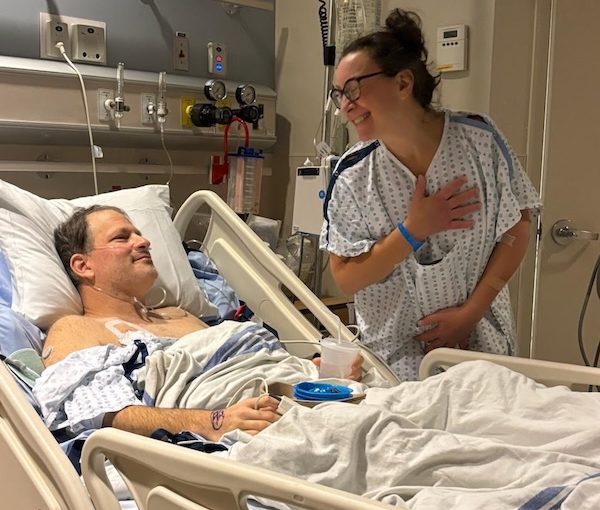
Jordan Zwicker and Debbie Litvack after Zwicker’s kidney transplant last November. Litvack donated the organ. (photo from JMABC)

When Debbie Litvack found out her longtime friend Jordan Zwicker needed a kidney, her decision was instant.

“Jordan needed one. I had two. It felt like the right thing to do and not a big deal. Every single donor I speak to feels the same way,” Litvack said. “I have such good fortune with my health, that I wanted to share it.  In addition, the community has been very kind to my family over the years. It’s a case of what goes around comes around.”

Litvack found out her friend was in need of a transplant shortly after she noticed his medical alert bracelet. He explained he is a Type 1 diabetic and, as a dialysis social worker, knowing the link between Type 1 DM and kidney disease, she asked about his kidney function. He denied any concerns although later learned he was in kidney failure and needed a transplant.

Zwicker is a “good guy” and someone who has had an outsized impact in the Vancouver Jewish community, said Litvack. As a DJ, he has mentored many of the community’s teens by hiring and training them in the event and DJ business.

Litvack said some people, like her, donate to someone they know. Others donate to family members. Others give the gift of life to someone they don’t even know. Either way, she sees it as pikuach nefesh, an active, sacred duty per halachah (Jewish law) to save a life. If you save one life, you save an entire world.

It took a battery of tests over the course of a year, including multiple and repeat blood tests, X-rays, mammogram, CT, renogram and more. There were also meetings with a nephrologist, a urologist and an anesthesiologist, as well as a comprehensive social work assessment. These assessments are vital to ensure both Litvack’s health and that she was a match. In fact, the transplant team had never seen such a strong match between a recipient and an unrelated donor.

“From the moment I decided to donate, I knew we would be a match,” she said. “It wasn’t a question of if I would donate, it was when.”  

A potential donor and recipient go through the process separately. Because Litvack and Zwicker are  friends, they shared a lot of their journey that is not normally shared. They also spoke often and at length about the “what ifs” in case the transplant was unsuccessful and about advanced care planning.

The transplant went ahead on Nov. 24, 2025, at Vancouver General Hospital, where Litvack works. The experience was quite different than being a professional at work and it has helped her connect in different ways with patients. She and Zwicker realized that there was an entire community of support that made the whole donation process possible.

Zwicker summed up his experience as life-changing.

“It’s given me the opportunity to continue my passion of working with people, an opportunity to be there for my son and family and a real opportunity to have the next 30 years of quality of life,” he said.

Litvack’s life-saving donation inspired the Jewish Medical Association of BC to highlight their member’s story by partnering with Temple Sholom, King David High School, BC Transplant, the Kidney Foundation of BC/Yukon and the Jewish Federation of BC to host an event that will look at organ donation from multiple angles – religious, ethical, medical, as well as personal perspectives from Litvack and Zwicker and other donors and recipients. The session will include information on how to become a donor.

The Gift of Life: Organ Donation from a Jewish Perspective takes place June 17, 7:15 p.m., at Temple Sholom. Registration is required for the free event: templesholom.ca.

Litvack encourages everyone from the Jewish, medical and local community with an interest to attend. “I really hope we will inspire someone at our event to donate,” she said. “And give the gift of life.” 

– Courtesy Jewish Medical Association of British Columbia

Donors needed

There was an organ donation awareness and swab drive held at Beth Tikvah Synagogue May 25. It highlighted the work of Renewal Canada, which helps match people in kidney failure with donors to save their lives. An inspiration for the event was Jewish community member Robert Moutal’s need of a living donor kidney transplant. If you or someone you know is interested to learn how to be a living donor, visit transplant.bc.ca/organ-donation/living/kidney-donation, email [email protected] or call 604-806-9944. You can also contact Renewal Canada for more information: renewalcanada.org/moutal.

Other community members are also in need.

Temple Sholom member Libby Goszer has been diagnosed with end-stage renal failure requiring a kidney transplant. Her blood type is A+, which corresponds to an ideal donor of A+ or O blood type. Even if you do not have these blood types, it is still possible to pursue donation through the Living Donor Paired Exchange Program, where you donate to another person in exchange for a matched kidney for the recipient. If you or someone you know is interested in investigating being a living donor, go to renewalcanada.org/libbygoszer.

Additionally, last year, Daphne was diagnosed with myeloproliferative neoplasm (MPN), a rare blood cancer, and her only hope for a cure is a stem cell transplant from a matching donor. All that’s needed is a simple cheek swab to see if you are a match. To order a kit, go to blood.ca/en/stemcells/donating-stemcells/stem-cells-questionnaire (ages 17-35) or giftoflife.org/dc/daphne (ages 36-60).

– from various community organization enewsletters

Format ImagePosted on May 29, 2026May 27, 2026Author Jewish Medical Association of British ColumbiaCategories LocalTags Debbie Litvack, health care, Jordan Zwicker, medicine, organ donation, pikuach nefesh, speakers
A healing Shabbaton

A healing Shabbaton

Or Shalom hosts Rabbi Tirzah Firestone for a Shabbaton in Vancouver June 12-13. (photo form tirzahfirestone.com)

A community Shabbaton featuring teacher, author and psychotherapist Rabbi Tirzah Firestone will take place June 12-13, offering participants the opportunity to explore ancestral healing, resilience and spiritual transformation through the lens of Jewish wisdom.

Drawing from the insights of her book Wounds into Wisdom, Firestone guides individuals and communities in transforming inherited pain into sources of strength, compassion and clarity. Through storytelling, guided meditation, embodied practice and real-life case studies from around the world, Shabbaton participants will engage in an experiential journey of healing across generations.

Jewish tradition has long recognized that we inherit not only the blessings of our ancestors, but also the residues of their unhealed wounds. While these inheritances can offer resilience and meaning, they can also shape us in ways that keep us reactive rather than reflective. This Shabbaton invites participants to approach these inheritances with awareness, tenderness and courage, transforming what has been carried unconsciously into wisdom and renewed possibility.

Over the course of the weekend, Firestone will explore what Viktor Frankl described as humanity’s “uniquely human potential to transform personal tragedy into triumph.” The Shabbaton will include a community dinner and Kabbalat Shabbat June 12, 6 p.m. (registration required); morning services with Firestone June 13, 10 a.m.; and a beachfront gathering focused on sacred stories and teachings June 13, 8 p.m. (registration required, after which location will be disclosed). To register and for more information, contact [email protected].

– Courtesy Or Shalom

Format ImagePosted on May 29, 2026May 27, 2026Author Or ShalomCategories LocalTags education, healing, Judaism, Or Shalom, Shabbaton, spirituality, Tirzah Firestone
Supplying healthy food

Supplying healthy food

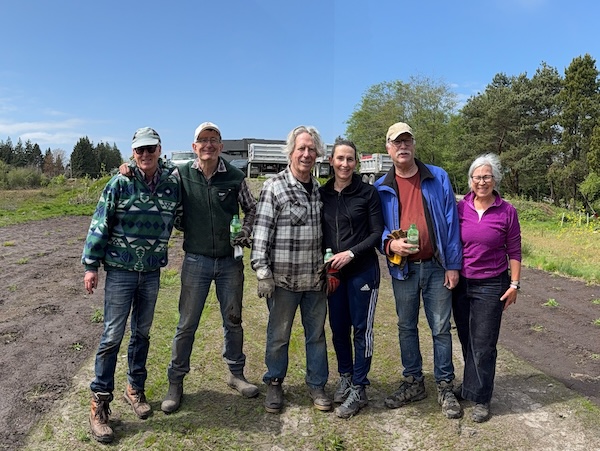
Left to right: Larry Vinegar, Stan Shaw, Lloyd Baron, Michelle Dodek, Steve Schacter and Marcy Schwartzman. (photo from Marcy Schwartzman)

There are roughly 1,200 people who rely on Jewish Family Services food hubs in the Greater Vancouver area, and much of the fresh produce they receive is due to the efforts of Larry Vinegar and Marcy Schwartzman.

Each month, JFS delivers approximately 2,500 bags of groceries to its clients, which include families with children, seniors, new immigrants, people with disabilities and other individuals in need. In 2021, during the pandemic, JFS established the food hubs, in partnership with synagogues and other organizations. The food is collected and distributed, with the help of a team of volunteers, at a central hub in Vancouver on 3rd Avenue called the Kitchen. 

photo - JFS hubs, situated in various parts of Greater Vancouver, offer fruit and vegetables
JFS hubs, situated in various parts of Greater Vancouver, offer fruit and vegetables. (photo from Marcy Schwartzman)

The hubs, situated in Vancouver, the North Shore, Burnaby, Surrey, the Tri-Cities and Richmond, offer fruit and vegetables. The program does not provide any meats, poultry or shellfish, and ensures that items are available for clients who follow a kosher diet.

“Most of the clients are people who are struggling to make ends meet, and your rent has to get paid. It often takes primary resources to pay your rent, and then food and other necessities come second. A lot of people are at a point where, at the end of the month, they don’t have money to put food on their tables, so they’re looking for assistance for that,” Schwartzman said.

She added that, if people do not have enough money, they choose the least expensive options, which are often not the healthiest. Thus, a community kitchen that supplies nutritious produce can be vital to a person’s well-being, she said.

The Independent caught up with Schwartzman and Vinegar on a spring afternoon. They were about to prepare the ground for planting on a Lower Mainland farm, the produce from which would be distributed by JFS.

photo - Maxwell (Moishe) Vinegar
Maxwell (Moishe) Vinegar. (photo from Marcy Schwartzman)

On Dec. 31, 2020, the couple suffered a tragedy, losing their 31-year-old son, Maxwell (Moishe) Vinegar, in a skiing accident. Prior to his passing, the family had had a conversation about food security, which reflected on a period when their son was young, and the family would deliver food for the food bank for Hanukkah.

“We had a lot of conversations with our kids about what it means to be a member of your community and be responsible and look out for our other community members,” Schwartzman said. “That December, around Hanukkah time, we were saying to him, ‘Hey, you should go help at the food bank.’ And he said, ‘I’m busy working, Dad, you’re retired, you should go do it.’”

In trying to come out of their grief, Vinegar and Schwartzman started their food efforts with donations people made after Max’s death, which they requested be directed to JFS. A friend of theirs who owned a farm in the Okanagan planted an acre of squash – a sign notes that all the squash growing on the acre is for JFS in Moishe’s memory.

photo - A friend of Larry Vinegar and Marcy Schwartzman, who owns a farm in the Okanagan, plants an acre of squash for JFS in memory of their son, Maxwell (Moishe) Vinegar
A friend of Larry Vinegar and Marcy Schwartzman, who owns a farm in the Okanagan, plants an acre of squash for JFS in memory of their son, Maxwell (Moishe) Vinegar. (photo from Marcy Schwartzman)

“We went up to help look after that for a couple of weekends that first summer, and that sort of got us thinking that maybe we can find somewhere to grow food to provide it to Jewish Family Services,” Schwartzman said.

The next summer, Vinegar spoke to a blueberry farmer in Richmond, who put the couple in touch with a family that lets them use their half-acre backyard, at no cost, to grow vegetables for the food bank.

“We’ve grown a variety of things over the years, but what grows the best there is zucchini and squash, butternut and acorn, and we also have green beans,” Schwartzman said. “We’ve been generously supported by West Coast Seeds.”

Further efforts include growing 300 plants at Richmond Jewish Day School last year, building relationships with local farmers, and spreading the word about tax benefits for those who donate excess crops to bolster food security.

“Larry has been quite instrumental and not afraid to go talk to different farmers around the Lower Mainland, just at the end of the season, to say you didn’t sell your crop, we’ll be happy to come pick it up,” Schwartzman said.

Vinegar has also developed a relationship with Costco after he walked into one of their stores and spoke with a manager about supplying unsold goods to food banks instead of disposing of them. All Costco stores give away food that is getting close to its stale date, said Schwartzman. “They donate to a different organization each day.”

In 2024, Vinegar and Schwartzman were recipients of the inaugural JFS Lighting the Way Award. At the presentation, they were described as “embodiments of JFS’s values, demonstrating innovation in their commitment to social good.”

“We are grateful for the help of many friends and volunteers who help us plant, tend and harvest,” said Schwartzman. “We couldn’t do what we do without their help!” 

For more on JFS’s food and other services, go to jfsvancouver.ca. 

Sam Margolis has written for the Globe and Mail, the National Post, UPI and MSNBC.

Format ImagePosted on May 29, 2026May 27, 2026Author Sam MargolisCategories LocalTags food security, Jewish Family Services, Jewish Food Bank, JFS, Larry Vinegar, Marcy Schwartzman, Maxwell (Moishe) Vinegar, remembrance, tikkun olam, volunteerism

A chime of metal tags

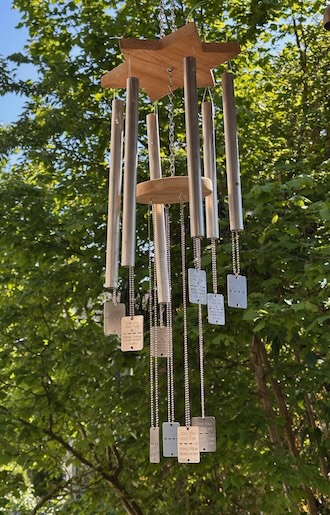
photo - This wind chime with metal tags holds the energy of the people who wore them, and the hostages who we still remember in our hearts
This wind chime with metal tags holds the energy of the people who wore them, and the hostages who we still remember in our hearts. (photo from Rina (Lederer) Vizer)

It seems so long ago, but it was only on Jan. 27, after 843 days, 12 hours and six minutes, that all our hostages returned home; the living and the dead. Finally, the  clock at Hostages Square in Tel Aviv was turned off.

A lot of forces played into this “miracle” of living up to the Israeli ethos of freeing our people, but, in my view, the main force was the power of the people: the hundreds of thousands that flooded the streets, week after week, in Israel and in cities around the world. Here in Vancouver, we echoed the outcry for their return, every Sunday, for almost two-and-a-half years.

As an artist, I thought that I should find a new role for the metal tags we wore during that period, one that would reflect the spirit of our people; a spirit with a force that can move and sway: a wind chime! The word in Hebrew for “wind” is ruach, the same word used for “spirit.”

I turned to my friends in the circle of Israeli folk dance, who had been dancing with the tags on their chests for those almost two-and-a-half years. I asked them to donate their tags to the project.

Glenda Leznoff, who was part of the creative design, and I collected the tags, and Glenda’s son-in-law, Dave Smith, built the chime. The result: a beautiful wind chime with metal tags that holds the energy of the people who wore them, and the hostages who we still remember in our hearts.

The chime will be offered to the highest bidder in a silent auction this weekend, during the annual BeLev Echad Israeli Dance workshop at the Jewish Community Centre of Greater Vancouver. (“BeLev echad” means “With one heart,” in Hebrew.) The proceeds will go to the Vancouver Israeli Folk Dance Society, a charitable organization that promotes Israeli dance here. 

Rina (Lederer) Vizer is a Vancouver artist who has exhibited her work many times over the years. In October 2024, she curated, as well as participated in, the exhibition Memory and Hope, at Temple Sholom, which commemorated the terror attacks of Oct. 7, 2023. Her art is displayed in Temple Sholom, which commissioned from her 10 panels depicting Israel’s views from north to south.

Format ImagePosted on May 29, 2026May 27, 2026Author Rina (Lederer) VizerCategories Visual ArtsTags art, Oct. 7, remembrance, terrorism
Yellowknife seder a first

Yellowknife seder a first

Yellowknife held its first community-wide Passover seder, with support from the Jewish Federation of British Columbia, at the Sundog Trading Post on April 1. (photo from Jewish Federation Facebook page)

Yellowknife held its first community-wide Passover seder, with support from the Jewish Federation of British Columbia, at the Sundog Trading Post on April 1. Now, the small Jewish community in the Northwest Territories capital is planning more events.

Jewish celebrations are not unknown in the Northwest Territories, of course. Rosh Hashanah dinners, Hanukkah gatherings and seders have been held in various homes over the years. Yet, according to a community member interviewed by the Independent, there has never been an effort to identify and bring together the larger community in a more formal way. That changed in December 2025, when seven Yellowknifers formed the NWT Jewish Cultural Society.

“We are still in infancy and working to create a website, but right now we have a WhatsApp group with 30 adults in town. People have been added in from word of mouth,” said a Yellowknife organizer who wished to be identified by only her first name, Sari.

When the group thought about hosting the first community seder, there were talks of having it at a home; yet, in the end, due to the growing interest, that option was not possible. Two weeks before Passover, in an effort to find a venue, they reached out to Sarah Mackenzie, associate director of community engagement at the Jewish Federation, for support, which came through shortly after the request.

The seven-member board scrambled to organize everything, bringing in seder plates and setting up the tables. They used the PJ Library Haggadah. For food, there was a potluck. Decorations were ordered, Passover crafts were arranged for the children, and wine and juice were placed on each table.

“All the Jewish people I’ve met in town grew up with a connection to their culture. I think it has just fallen to the wayside without the opportunities to gather,” said Sari.

“One Jewish person hadn’t been to a seder in decades. This was my second in the 18 years I’ve been in Yellowknife. It was definitely the first seder for some of the young kids and probably only the second or third for some non-Jewish partners.”

Sari added that several people in Yellowknife are part of multi-faith households. After the Oct 7, 2023, terror attacks on Israel, she explained, there had been feelings or questions from parents of how are we going to share Jewish identity with our kids here?

A crucial moment for the more formalized Jewish community in Yellowknife happened earlier though, in August 2023, when an out-of-control wildfire caused the city to be evacuated. At the time, Sari was in Edmonton, where she visited Temple Beth Ora and picked up a copy of the Alberta Jewish News. In it, she found an article about another Jewish resident of Yellowknife.

“While I was evacuated, PJ Library reached out to me and asked me if I needed anything and provided a bunch of support. You can always count on the Jewish community,” said Sari.

“When I returned home, I had a new Jewish connection in town, and having another person to connect with nearby was a lifesaver. In the months that followed, we knew we needed more community. Our Jewish identity, which was a small piece of ourselves, suddenly skyrocketed to a top concern in our lives.”

They decided to take part in a one-week Momentum Canada trip to Israel. This presented a challenge because, typically, one must do so through a Jewish organization, but there were none in Yellowknife.

In her efforts to raise funds for the trip, Sari emailed contacts who had supported her during the evacuation in Edmonton, and they suggested reaching out to the Jewish Federation in British Columbia.

“There, Sarah Mackenzie took it upon herself to become a champion for our little community. We just happened to reach the right person,” Sari said. “She related to the experience of being disconnected from large cities with high numbers of Jewish people. She offered to take Yellowknife under her wing and do the same for us in the Northwest Territories.”

For her part, Mackenzie said, “Jewish Federation … is honoured to come alongside the Yellowknife Jewish community in alignment with our mission of creating vibrant, caring and inclusive communities, together.”

Looking to the future, the goal of the NWT Jewish Cultural Society is to organize community gatherings for the Jewish holidays. They have started an informal Hebrew school that meets once a month; it is currently in members’ homes, but they are looking for a space.

“We hope to also do small things – maybe a Purim mishloach manot (Purim basket) exchange. It will depend on capacity and resources,” said Sari, noting that many of the people who live in Yellowknife are transient. 

“Two of our board members will be leaving this summer,” she said. “Grassroots events definitely depend on the efforts of a small group of determined people.”

In his weekly message on April 17, Jewish Federation chief executive officer Ezra Shanken had this to say about the Yellowknife seder: “For those involved, it was described simply as a powerful beginning for Jewish communal life in a place where opportunities to gather are few and deeply appreciated.” 

Sam Margolis has written for the Globe and Mail, the National Post, UPI and MSNBC.

Format ImagePosted on May 29, 2026May 28, 2026Author Sam MargolisCategories Celebrating the Holidays, LocalTags Jewish Federation, Judaism, liefstyle, Northwest Territories, NWT Jewish Cultural Society, Passover, Sarah Mackenzie
Ishai energizes, unifies

Ishai energizes, unifies

Anat Ishai, aka Challah Mom, energizes the crowd at Beth Israel Synagogue June 13, at an event spearheaded by National Council of Jewish Women of Canada, Vancouver chapter. (photo from NCJWC Vancouver)

Anat Ishai swept into the hall at Beth Israel Synagogue the night of May 13 in a twirl of silver, dancing exuberantly as Israeli music played loudly on speakers. The room, filled with 300 Jewish women and children of all ages, exploded with sound and energy as Ishai enticed onlookers onto the dance floor.

Ishai, known on social media as “Challah Mom,” was in town at the invitation of the National Council of Jewish Women of Canada’s Vancouver chapter. Attendees gathered around tables to bake challah using Ishai’s recipe, to reflect on the meaning of challah-making and to hear her story.

Ishai describes herself as a digital content creator and blogger who “shares her Jewish life through challah, dance, hair-wrapping tutorials, Israel and Jewish wisdom.” Born in Israel to Russian-Israeli parents, she grew up in a secular home and the family moved to Toronto when she was 5 years old.

Ishai – who is now married and has kids – started the Challah Mom social media account during the COVID lockdown. It was an attempt to find happiness during a sad time, she said. To date, Challah Mom has a global platform with 300,000 followers across Instagram, Facebook and TikTok.

Ishai and her family made aliyah in September 2023, but she flies all over the world for Challah Mom events in different Jewish communities. In May alone, she appeared in Toronto, Winnipeg, Washington, DC, and Vancouver. 

“I allow my Challah Mom community to enter my world and to see Judaism and Israel through my eyes,” writes Ishai on her website. “I share my insights, my perspective and my thoughts about Judaism, growth, Israel and everything in between. In courageously showing up as a proud Jewish woman, I hope to inspire my community to unleash their Jewish soul within.”

Jordana Corenblum, president of NJCWC Vancouver, said the goal of the recent event was “to create a community-wide, grassroots gathering, free and accessible, where women and children from different backgrounds could come together in a warm, inclusive environment.”  

The event was supported by many Jewish community partners, including Congregation Beth Israel, Congregation Schara Tzedeck, Chabad Lubavitch of BC, Chabad Richmond, Community Kollel, Congregation Beth Tikvah, Temple Sholom, Or Shalom, PJ Library and Bitachon, a Jewish Federation of BC security volunteering initiative.

Yamila Chikiar, a member of the local NJCWC board and a Jewish Federation staff member, said the Challah Mom event was incredibly moving. “It was filled with energy, music, and a real sense of togetherness,” she said. “There was such diversity in the room, women and children from different walks of life, ages and levels of connection to Jewish practice, all coming together with a shared openness. 

“That translated quickly into a sense of belonging,” she added. “What might have started as a large gathering very quickly felt intimate, connected, and a moment of genuine community-building. Through baking, music and storytelling, Ishai creates an experience that feels joyful, nonjudgmental and unifying.”

While NCJWC Vancouver has hosted impactful programming in the past, this event stood out for its scale, accessibility and cross-community collaboration. “It reflects the kind of programming the organization hopes to continue building,” Corenblum said. 

“This event was a reminder of what is possible when community is built intentionally, when it is open, collaborative and grounded in shared values. It brought together people from different backgrounds in a way that felt both simple and meaningful,” she continued. “At its heart, it wasn’t just about baking challah. It was about connection, inclusion and creating space for people to come together.” 

Lauren Kramer, an award-winning writer and editor, lives in Richmond.

Format ImagePosted on May 29, 2026May 28, 2026Author Lauren KramerCategories LocalTags Anat Ishai, baking, Challah Mom, education, Jordana Corenblum, Judaism, lifestyle, National Council of Jewish Women, NCJW, women, Yamila Chikiar
A Lag b’Omer to remember

A Lag b’Omer to remember

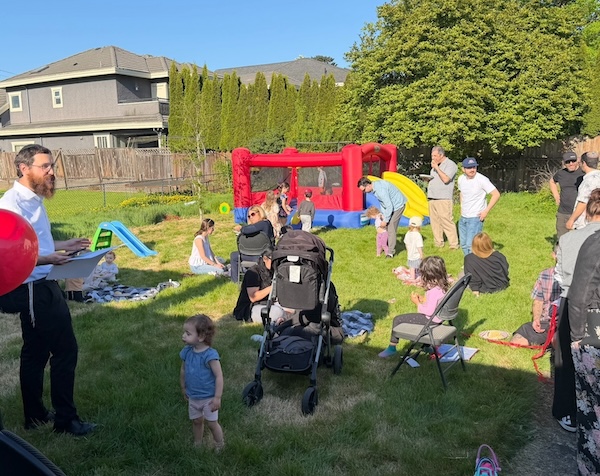
Chabad Richmond hosted a barbecue on Lag b’Omer, May 5. (photo from Chabad Richmond)

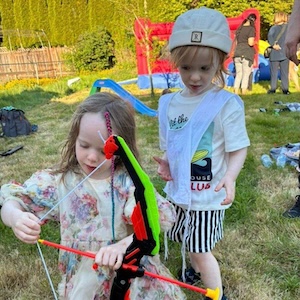
Families in Richmond gathered on May 5 for a Lag b’Omer barbecue organized by Chabad Richmond. Fun for the kids included a bouncy castle, archery, crafts – and s’mores. It was an afternoon of community, connection and celebration. It was especially meaningful to celebrate the upsherin (first haircutting) of local community member David Safonik.

photo - Kids playing at Chabad Richmond's Lag b'Omer BBQ
Kids playing at Chabad Richmond’s Lag b’Omer BBQ. (photo from Chabad Richmond)

Lag b’Omer is a festive day, honouring Rabbi Shimon bar Yochai, author of the Zohar, the primary text of kabbalah (Jewish mysticism). The numerical value of the Hebrew letters lamed and gimmel (Lag) is 33, and b’Omer means “of the Omer,” the 49-day counting period from the second day of Passover to Shavuot. The 33rd day of the count falls on the 18th of the Jewish month of Iyar, the day of the rabbi’s passing, which he had instructed his followers to mark as “the day of my joy.” 

photo - A photo-op at the Lag b'Omer party
(photo from Chabad Richmond)

“The Chassidic masters explain that the final day of a righteous person’s earthly life marks the point at which all their deeds, teachings and work achieve their culminating perfection and the zenith of their impact upon our lives,” explains Menachem Posner on chabad.org. “So, each Lag b’Omer, we celebrate Rabbi Shimon’s life and the revelation of the esoteric soul of Torah.

“Lag b’Omer also commemorates another joyous event. The Talmud relates that, in the weeks between the Jewish holidays of Passover and Shavuot, a plague raged among the disciples of the great sage Rabbi Akiva (teacher of Rabbi Shimon bar Yochai), ‘because they did not act respectfully towards each other.’ These weeks are, therefore, observed as a period of mourning, with various joyous activities proscribed by law and custom. On Lag b’Omer, the deaths ceased. Thus, Lag b’Omer also carries the theme of loving and respecting one’s fellow (ahavat Yisrael).”

photo - Party-goers at Chabad Richmond's Lag b'Omer BBQ
(photo from Chabad Richmond)

Last August, Chabad Richmond welcomed shluchim (emissaries) Rabbi Menachem and Esther Miriam Wolf (née Golomb). The Wolfs work alongside Rabbi Yechiel and Chanie Baitelman, founders of Chabad Richmond, who have led the community for more than 25 years. The couple leads Shabbat meals, weekly classes and holiday programs geared toward young adults and families, as well as CTeen Richmond and the Hebrew school, which is a partnership of Chabad Richmond and the Bayit. 

– Courtesy Chabad Richmond & chabad.org

Format ImagePosted on May 29, 2026May 28, 2026Author Chabad Richmond & chabad.orgCategories Celebrating the HolidaysTags Chabad Richmond, Judaism, Lag b'Omer, Richmond
Expanding the healing

Expanding the healing

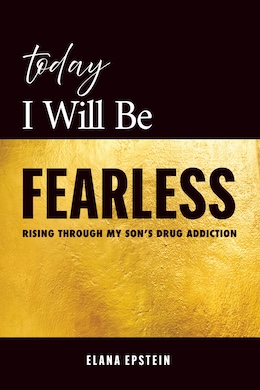
Elana Epstein shares her family’s narrative of recovery in Today I Will Be Fearless. (photo from Elana Epstein)

When Elana Epstein and her husband, David, confronted the reality that their son, Noah, was an addict, her life shifted on its axis.

In her emotional, practical, moving book, Today I Will Be Fearless: Rising Through My Son’s Drug Addiction, Epstein shares her family’s narrative of recovery, while digging into complex related issues like intergenerational trauma, societal silence and stigma, and finding purpose, resilience and power in the darkest moments of life. In the process of writing and sharing her story, Epstein has found new meaning and mission for her life.

“Writing the book was how I got better, deepened into my own recovery and saw the pattern of what recovery asks of us,” the Vancouver mother of three adult sons told the Independent. “And, the deeper I went into the story, the deeper I uncovered the gems of the why I was doing things. 

“This is happening for more than just my own son’s healing,” she said. “It’s my healing.”

She took her son’s recovery as an opportunity for her own self-understanding and improvement. The book, though, intends to expand the healing.

“It’s for a wider community,” Epstein said. “I was determined to be a channel for whoever needed support and a companion along this journey because people do this alone.”

Epstein, a yoga teacher, reiki master and spiritual practitioner, had long understood the language of healing. But addiction, she said, stripped her of any illusion of mastery. 

“It felt as if everything I had learned was a waste because I did not know my son was struggling with addiction,” she said. “It felt as if the tools were more of a hindrance than a help. But quickly my spirit reminded me the tools I had were the ones that would support me to get through this if only I could go deeper with them. That was the pivotal moment of my knowing I could and would get through this.”

She also realized that Noah was not the only one who needed to adapt to changing realities.

“I took the lens of recovery and turned it onto me and took the opportunity to delve into the 12 steps and see where I needed to release myself from the clutches of my ego and some of my ancestral teachings or just threads that were hanging around,” she said, adding that she began to see the impacts of intergenerational trauma. 

“I needed to peel back the layers and see that I was codependent and I was a people-pleaser and I didn’t know how to love myself well enough – all while my son is learning to do the same thing.”

Several months into Noah’s recovery, Epstein broke her leg while skiing. She took it as a sign from the universe to step back, focus inward and accept help.

“Maybe four days after surgery I was at home. I was sitting on the couch and I was feeling really sorry for myself. What has happened to my life? Isn’t it enough? How many more things … COVID and Noah and the war. And then I break my leg and I hear immediately, ‘You are going to write your book.’”

image - Today I Will Be Fearless book coverThere has always been a book in her, Epstein said. She just didn’t know what it was going to be about. Now, it became clear.

“This is my story, how I got through the journey of loving my son through his own addiction,” she said. “So, I started just journaling, and one thing led to the other and, a year later, I had a blueprint.”

As the book came together, she realized the writing process was no longer just for her own healing. “This was how I was going to show up for people,” she said.

Among the self-doubts she had to overcome was the realization that she has wisdom to share.

“I would say things like, ‘in my opinion’ and ‘in my humble experience,’” she said. “That was classic Elana. I started to accept that I actually do know what I’m talking about and there’s no reason to hold back and let’s go and let’s be authentically who we are.”

It turns out there was a demand for the wisdom of someone who has been through what Epstein’s family has.

“Although I had a desire that this would be a companion, I couldn’t have imagined it would be this well received … not just by families who are wading in the waters of addiction and recovery, but by people who are curious,” she said. “People are telling me this is a blueprint and a companion for life. One woman just said to me yesterday, ‘I keep you by my night table and, every once in awhile, I just pick it up and I read a sentence and it’s my teaching for what I’m struggling with in my own life.’”

Finding light in darkness is a recurring theme in the book.

“When bad things happen, people look for the reasons and they look for the why. And they definitely want to blame something or somebody,” Epstein said. “You don’t have to do that. You can accept what happens as a gateway to becoming and connecting to a version of yourself that is more beautiful than you can ever imagine and stronger that you can ever imagine. Stop being afraid of the potential things.”

Her family’s Jewishness infuses the book.

“My message to the Jewish reader is this book is filled with mystical wisdom that can guide you to a more peaceful existence one day at a time with what is coursing through our blood and bones,” said Epstein. “I had the vision early on that I was going to be a part of bringing more awareness into the Jewish community because we have lost too many. Many children and too many people suffer in silence.”

When Rabbi Josh Corber took over the Jewish Addiction Community Service and Jewish Family Services took the group under their umbrella, Epstein discussed how she might contribute to the work.

She took the lead on running a group for families navigating a member’s addiction or recovery. She said she hopes that the book might land in the right place, just when an individual or family needs to hear her message.

“If that person can pick up my book, then we’re living that old adage that the Talmud teaches: if you save one life, it is as if you are saving an entire world,” she said, “And I truly believe that.” 

Format ImagePosted on May 29, 2026May 28, 2026Author Pat JohnsonCategories BooksTags addiction, Elana Epstein, health care, JACS, Judaism, mental health, recovery
Hannah Senesh – a unique hero

Hannah Senesh – a unique hero

Douglas Century signs copies of his book Crash of the Heavens at the JCC Jewish Book Festival earlier this year. (photo by Tova Kornfeld)

Douglas Century’s Crash of the Heavens: The Remarkable Story of Hannah Senesh and the Only Military Mission to Rescue Europe’s Jews During World War II is a meticulously researched and spell-binding narrative of Senesh’s life, and pre- and postwar Europe and Palestine.

Senesh, born in 1921, grew up in a middle-class family in Budapest until the Nazis came to power in the 1930s. The rise of antisemitism drove her to join a Zionist youth group and she became obsessed with emigrating to British Palestine. In 1938, she made aliyah to a northern kibbutz, and part of her metamorphosis was to Hebraize her identity, changing her name from Aniko Szenes.

As word of the atrocities perpetrated by the Nazis started to leak out, Jews in Palestine (numbering about 600,000) sought ways to rescue their European brethren. British Intelligence MI9, tasked with assisting the escape of thousands of Allied POWs, needed people with local language skills and area knowledge. In 1943, Senesh was recruited, one of three Jewish women in a cohort of 37, to be trained as a paratrooper and radio operator. She made her first jump – into Yugoslavia – in March 1944, where she liaised with Partisan groups to carry out sabotage missions. Her hope was to cross into Hungary to save her family and others, but she was captured by Hungarian gendarmes, imprisoned, tortured, tried for treason and executed by firing squad on Nov. 7, 1944. 

Sharing details from her diary, which Senesh kept from the age of 13, Century takes readers into her pains, her joys. Her poetry is part of her legacy: “A Walk to Caesarea” is almost a second national anthem in Israel, where many streets, parks and schools bear her name. Ironically, Hungarians know little about her.

The Independent interviewed Century by email.

JI: How did you first become interested in Senesh?

DC: I first learned about Hannah when I was about 8 years old at the I.L. Peretz Shul in Calgary. Our principal was a Holocaust survivor – he’d lived through the Shoah as a boy in Poland. He told us the story of Hannah’s courage, her refusal to give up her secret British radio codes despite months of horrific physical and psychological torture at the hands of the Gestapo. 

At that age, I’m sure it was just the broad strokes of the story: she wouldn’t betray her people, she was sentenced to execution by firing squad when she was 23 years old.

Who could understand the concept of martyrdom at the age of 8? Certainly not me. But I did understand that this was a brave young woman who went to her death and wouldn’t beg for mercy “from hangmen and murderers” – those were her exact words.

She refused to wear a blindfold as she faced the firing squad, daring the Hungarian soldiers with rifles to look her in the eyes as shot.

To hear that story age 8 – well, it was amazing. It was also terrifying. Clearly, it’s haunted me since childhood. 

JI: This is the first time you are writing about a woman. Was that decision purposeful? 

DC: I never thought about it that way. I’ve tended to write books with male protagonists. Technically, though, the first book I ever published – when I was in my mid-20s – was a young adult biography of the Nobel-laureate novelist Toni Morrison.

I conceptualized this book as a military rescue mission – most of the action takes place between late 1943 and late 1944, with a “ticking-clock” thriller pacing – and, yes, in the book proposal, I consciously chose to focus on the three women Palmach commandos and parachutists: Hannah Senesh, Haviva Reik and Surika Braverman.

As I was writing … it became clear that the central storyline needed to be Hannah’s. To a lesser extent, I write about the other parachutists’ missions in Slovakia, Romania and Yugoslavia.
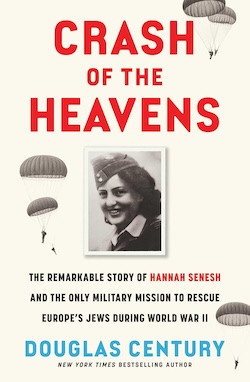
image - Crash of the Heavens book coverJI: What research did you do for the book?

DC: There are so many primary source documents available. All of Hannah’s poetry, diaries, letters and photographs are in the National Library of Israel archive. There are also many memoirs – most of them out of print – by the various parachutists. There are invaluable oral histories in the U.S. Holocaust Museum and at Yad Vashem. For four years, I felt like I was basically living in archives and military libraries, but I knew that I’d never do this story justice solely on previously published research.

I flew to Tel Aviv in the summer of 2023 to do what we used to call “shoe-leather reporting.” I spent weeks in Israel, retracing the footsteps of Hannah Senesh and the other parachutists. That summer of 2023, I met David Senesh – Hannah’s nephew – a renowned psychotherapist specializing in treating trauma. David was himself a POW and tortured by the Egyptians in the 1973 Yom Kippur War. 

I’ve become close friends with David and his wife…. They really gave me some valuable personal insights into the family dynamic – and I learned things that have never been in other books.

JI: Was there a particular demographic you were trying to capture?

DC: I set out to write this book for one reader – my daughter, Lena. She’s studying English and wants to be an author. My daughter was 22 when I finished the book; Hannah was 22 when she embarked on her paratrooper mission in March of 1944. My daughter said, “Thank God you’re not writing about another complex, sociopathic antihero! Hannah is a courageous and talented woman who the reader can actually admire.” 

JI: How did you arrive at the book’s title?

DC: When I was pitching the idea to my literary agent, I was already writing about Hannah, but it was about to be the centenary of her birth in July 2021 and 150 IDF paratroopers were recreating her jump in a mission called Operation Crash of the Heavens. The title comes from Hannah’s most famous poem, “A Walk to Caesarea,” better known by its musical adaptation, “Eli, Eli.” It’s a very short poem, and Hannah’s next-to-last line in Hebrew is “barak hashamayim.”  The literal translation is “the lightning in the sky,” but, to me, the most artful translation is, “the crash of the heavens.”

JI: What has the reception to the book been like? 

DC: It’s been wonderful, warm and very appreciative. Even people who know about Hannah Senesh – especially people from Israel – tell me that I introduced stories and things they never knew before.

I’ve spoken at a few schools: the Hannah Senesh Community Day School in Brooklyn, King David High School in Vancouver, Yeshiva University in New York. When I’m talking to teenagers, I try to contextualize the story by stressing how assimilated the Jews of Hungary were, especially in Budapest. They felt fully Hungarian. But then the series of so-called “Jewish Bills” came into effect, limiting the number of Jews in the professions, setting quotas for university – Hannah had wanted to study education and become a schoolteacher but that became impossible. Ultimately, Jews couldn’t own property, couldn’t have a telephone. They were stripped of all civil rights – by the Kingdom of Hungary, of course, not by Nazi Germany.

I ask high school kids and university students: Do you guys feel Canadian? You’re proud of Canada? Cheer for Canada in the Olympics? What if, overnight, the government said: “You’re not Canadian. Turn in your passport. You can’t go to university. You need to move out of your house – you can only live on certain streets in houses marked with a yellow star. You can’t be out in public past noon.” Why? Because Parliament passed a new law that says you’re no longer a Canadian – you’re a Jew. That means you’re an alien living among Canadians without the rights or privileges of a citizen. How would you feel? What would you do?

JI: You started this book before Oct. 7, 2023. Did that tragic event and its aftermath affect the way you wrote the narrative?

DC: Absolutely. I was deep into the writing process before Oct. 7, 2023. I knew that words like Zionism, Israel and Palestine were hot buttons when I started writing the book, but after Oct. 7, they became third rails.

I tried not to let it affect the way I was writing the book. Of course, seeing all the anti-Israel protests exploding on campuses and in city streets the past couple of years, hearing all the outright distortion of history, it affects a writer’s psyche. As we were designing maps for the book, for example, I insisted that they said, “British Mandate for Palestine” as well as “Eretz Israel.”… While writing the first draft, I had non-Jewish friends asking me, “Doug, what is Zionism?” and I realized that, in the post-Oct. 7 world, it was a critical question. I felt I should let Hannah define what Zionism meant to her. On Oct. 27, 1938, she writes in her diary: “I don’t know if I’ve already mentioned that I’ve become a Zionist. This word stands for a tremendous number of things. To me, it means, in short, that I now consciously and strongly feel I am a Jew, and am proud of it.” Full stop.

JI: If you would have been able to interview Senesh, what would you have asked?

DC: I have so many questions. I don’t want to give any plot spoilers, but there’s one story which hasn’t been told before in previous books. In the summer of 1944, Hannah helped a young Slovakian-Jewish woman named Matilda Glattstein to escape from the Gestapo prison in Budapest. Hannah learned that Matilda was pregnant and devised a complicated escape plan, which means she knew exactly how to break out of the prison and yet she herself didn’t. She saved another woman’s life – but not her own. I’d ask Hannah this question: “If you could rescue Matilda Glattstein, a pregnant woman with no military training, why didn’t you rescue yourself?” I’ve got my own theories, but I would love to ask Hannah. 

JI: Why should people read your book?

DC: On the most basic level, I hope they want to read a compelling, exciting and emotional story of heroism during the darkest days of World War II. In hindsight, I didn’t write the book just for my daughter, or just for young Jewish women, or for anyone who aspires to do what Hannah did – become a poet or author and leave her mark on the world. Within the story, I’m asking some more universal questions: What do we mean by courage? Where does moral conviction come from?

We’re living in a crazy era, and it’s worth remembering that there are some causes for which it might be necessary to make the ultimate sacrifice….

JI: Tell me about your collaboration with Kosha Dillz?

DC: Kosha Dillz is someone I’ve known for years and years. His real name is Rami Even-Esh. [He’s] an Israeli-American rapper, filmmaker, social media personality and influencer. I sent him an ARC [advance reading copy] of Crash of the Heavens last October and we just started bouncing around ideas. 

We agreed that, with this terrifying rise in antisemitism, it’s the perfect time to make the name Hannah Senesh – poet, paratrooper, Palmach commando – known to all the millions of people in their teens, 20s and 30s who are too busy “doom scrolling” to read the book. I figured, what better way to reach them than to have a gifted modern-day poet like Kosha Dillz breathe fresh energy and inspiration into her story? He wrote some amazing lyrics based on my book and we shot a video on the streets of New York for his song called “Hannah Senesh.”… You can find it on all the streaming platforms like Spotify and Apple Music. 

JI: Are there any plans to use your book as the basis for a film or play?

DC: Yes, people have been talking about an adaptation, but the world of TV and film adaptations is so mercurial. Right now, we’re working on an adaptation of my previous book, The Last Boss of Brighton, about the life and times of a Soviet-born Jewish mobster – the aforementioned “complex, sociopathic antihero.”… At the same time, one of my earlier books – also about the Mafia in New York City – is being developed for a series…. But we’ll see what happens. Stay tuned. 

Tova Kornfeld is a Vancouver freelance writer and lawyer.

Format ImagePosted on May 29, 2026May 28, 2026Author Tova KornfeldCategories BooksTags Douglas Century, Hannah Senesh, heroism, history, Holocaust, Second World War
Multiple Tony n’ Tina roles

Multiple Tony n’ Tina roles

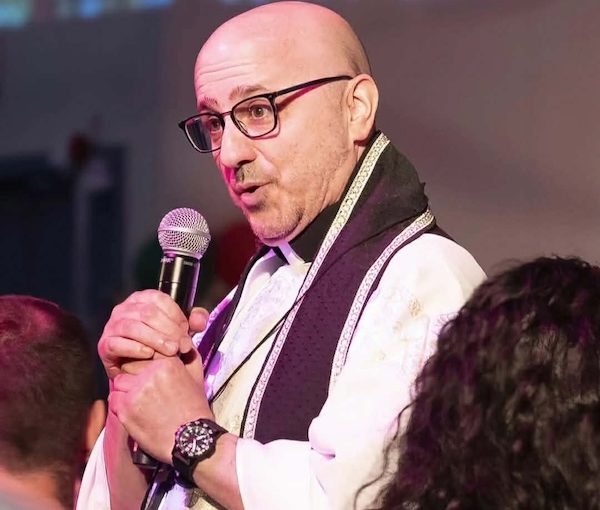
Marc Gelmon as the priest in Tony n’ Tina’s Wedding. Gelmon has played several roles in the production, which will be at Legion #179, on Commercial Drive, May 22-23. (photo from Marc Gelmon)

The priest is drunk and sleeping it off at our table. The bride is slow dancing with her former boyfriend and the caterer is highly recommending that I eat my bun by dipping it in the chicken sauce. The nun keeps chatting me up and, by now, I’m thinking she has a crush on me. 

Welcome to Tony n’ Tina’s Wedding (TNT), an interactive, comical dinner theatre production starring, among others, Jewish community member Marc Gelmon. The night I attended in April, he was playing the caterer and emcee.

In one scene, he ran around the large, decorated hall wrapped in an Italian flag. In another, he joked about the 10 things you will never hear from an Italian husband. The almost 100 audience members laughed or groaned in appreciation.

Gelmon has played several different characters in TNT, first with Hoarse Raven Theatre Etc. from about 1995 to 2005 and, in the last year, with Hammer Up Productions. You never know, but he might be playing the priest when you arrive on May 22 or 23 at 6:30 p.m., upstairs at Legion #179 on Commercial Drive. 

“For the show’s purpose and for my fun of pretend, I take each role seriously and immerse myself as much as I can into that world and character,” Gelmon told the Independent. “In doing so, I have had many audience members ask if I’m really a priest!”  

In real life, Gelmon works in the health sector, including having been a mental health worker. He says that TNT does wonders for both his and his audience’s mental health.

“It’s just a great way to escape for a few hours amongst the mishigas [craziness] that goes on,” he said. “There’s always somewhere to look and someone saying or doing something ridiculous. The cast and production team are all really great people who want nothing more than to ensure the audience has a good time.”

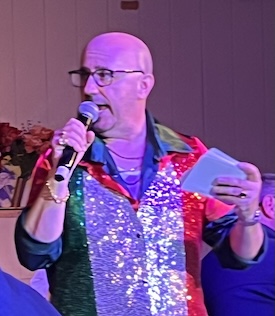
photo - Marc Gelmon as the emcee in Tony n’ Tina’s Wedding
Marc Gelmon as the emcee in Tony n’ Tina’s Wedding. (photo from Marc Gelmon)

Gelmon has had many adventures with TNT, including one time where the Vancouver Police showed up to break up a pretend altercation between Tina’s ex-boyfriend and the groom and groomsmen.

“I can recall when we’d have the final fight scene and, at that time, we ran outside the restaurant, and around to where there were these big windows, so audience members could see us outside against the windows in this fight. I’m aware of at least two times when the VPD happened to be in the vicinity and ran after us to stop the ‘fight.’ We also had an audience member decide to strip during the end of the show.”

Incidents like this are rare, though, Gelmon insisted.

“My experiences with both shows have been really wonderful. Michael Fera and Tanja Dixon-Warren were the first ones to bring Tony n’ Tina’s to Vancouver and they gave me the room to grow and develop as a performer, as well as becoming lifelong friends. I hold them in the highest esteem, as they have been a source of love and support for decades.

“Director and producer Jeff Laurin has taken this production and infused it with his love, care and devotion,” Gelmon continued. “Plus, our stage manager, Chellé Tanner, and the loving and funny cast have really made this second time around so good for my soul!”

Gelmon said he has been influenced by watching actors on SNL and SCTV. His favourite comics today include Gary Gulman, Jon Stewart, Sarah Silverman and Gianmarco Soresi.

“These are my favourite comics because they’re all really smart, make me laugh, especially Gary Gulman, and they all talk about their Jewish experiences, and I love that,” said Gelmon, whose big break was performing in the children’s play Puss in Boots at the Shadbolt Centre for the Arts in 1994, where he played a lord and the king’s assistant.

“I was absolutely terrified, as this was my first actual play and I had two parts in it,” he said. “All I can tell you is that I loved it. I loved the costumes, makeup, being on stage, and camaraderie. That gave me a bit of confidence that I was really lacking, when I saw an advert in the Georgia Straight for Tony n’ Tina’s Wedding.”

Gelmon also loves the stories of Yiddish theatre and how many people in the early days of music, theatre and TV were often Jewish.

“I always feel that I have a Jewish sensibility to life and that always adds to my performance, even when playing a Catholic priest!” he said.

Over the years, Gelmon has been part of a few different community events.

“I think I’m most proud of participating in the Hanukkah convoy, which I first heard about over Facebook a few years ago,” he said. “I am not someone who people know I’m Jewish unless I tell them, so this was a great feeling of pride to drive, alongside many other cars, with these big electric menorahs on the tops of our cars, driving through downtown. 

“The first time I did this, the folks at Chabad let me keep the menorah on my car for the remainder of the holiday. At that time, I was working at an elementary school and the teachers loved it, and a couple asked me to come and talk about Hanukkah to their classes. Also, someone left a note on my car. At first, I was worried, but then I read it and smiled. Whoever wrote the note described being thankful for seeing other people’s traditions and it made them feel good to see the menorah on the roof of my car.”

TNT runs for close to four hours, so you might want to bring a cushion if you have a sensitive tush like mine. If you have mobility issues, you can sit on the legion’s stairlift all the way to the festivities. Dress up and put on your dancing shoes because you are going to a wedding!

For tickets, go to linktr.ee/Tntweddingshowvancouver. 

Cassandra Freeman is a Vancouver storyteller and improviser.

Format ImagePosted on May 8, 2026May 7, 2026Author Cassandra FreemanCategories Performing ArtsTags dinner theatre, Marc Gelmon, theatre, Tony n' Tina's Wedding, weddings

Posts pagination

Previous page Page 1 Page 2 Page 3 Page 4 … Page 495 Next page
Proudly powered by WordPress