Skip to content
  • Home
  • Subscribe / donate
  • Events calendar
  • Business Directory
  • FAQ
  • News
    • Local
    • National
    • Israel
    • World
    • עניין בחדשות
      A roundup of news in Canada and further afield, in Hebrew.
  • Opinion
    • From the JI
    • Op-Ed
  • Arts & Culture
    • Performing Arts
    • Music
    • Books
    • Visual Arts
    • TV & Film
  • Life
    • Celebrating the Holidays
    • Travel
    • The Daily Snooze
      Cartoons by Jacob Samuel
    • Mystery Photo
      Help the JI and JMABC fill in the gaps in our archives.
  • Community Links
    • Organizations, Etc.
    • Other News Sources & Blogs
  • JI Chai Celebration
  • JI@88! video

Recent Posts

  • SFU honours Gloria Gutman
  • Lifting people’s spirits
  • Wedding a ray of light
  • Indigeneity and Zionism
  • Rule of law broken: councilor
  • Football and its roles
  • The burden of defence
  • Fish Café returns after fire
  • All right in what goes wrong
  • Nuns & mermaids at TUTS
  • Camp offers holiday retreat
  • Students and mentors inspire
  • Once-in-a-lifetime trip
  • 100 dancers, one heart
  • Money for the sciences
  • What “Jewish food” means
  • Have a cookie, schnitzel too
  • Federation now across BC
  • Israel fighting for its existence
  • Deal strengthens Iran
  • Patriotic belonging diminishes
  • A campaign to engage
  • Upstanders’ first live event
  • Responding to Carney
  • Having your own home
  • Music a family tradition
  • Musical to warm heart
  • Community milestones … June 2026
  • Sharing her passion for Israel
  • Or Shalom reopens its doors
  • JFS from past to future
  • Need holistic approach
  • Sharing stories, advice
  • Journalist shares fears
  • Skills to live together
  • Road to independence

Archives

Follow @JewishIndie
image - CJN box ad Rockowers 2026

Tag: women

What is the worth of work?

Recently, I’ve had numerous encounters with middle-aged women. This isn’t strange. I’m talking to women who are a lot like me: dealing with school-aged kids, piano lessons, finding childcare, etc. What’s remarkable is that the same conversation pops up – about work.

One friend, an author and artist, said that she does the math every time she’s invited to do a workshop or a special event. Will the cost of travel, supplies and teaching preparation be worth the return? She’s often told, “Well, we can’t afford to pay you to teach” but, when she shows up for the single event she agreed to do for payment, what happens? People surround her, saying, “Well, if we’d only known you were coming, we would have paid for you to do a multi-day workshop!”

Another woman explained that she is only now, after years of staying at home, getting back to very part-time work in her field. Why? The cost of childcare would have canceled out anything she would have earned with part-time work.

Among women who juggle a full-time job with conventional hours, there’s an acknowledgement that it’s extremely hard to manage. In some cases, their partners step up to do the childrearing and run the household. In others, there are moms who are obligated to work full-time, be “on call” as the primary caretaker and either do, or hire someone to do, all the household chores. For many, this works because everyone’s healthy and they have support from extended family. In case of illness or lack of family support? Forget it. Of course, since these women do manage it, anyone who struggles is seen as “not as capable” as a woman who “has it all.”

This is a big topic, and it’s also (surprise!) a Jewish topic. We’ve been wrestling with it forever. In Exodus, the Israelites flee Egypt and slavery. Yet, in Exodus 14:12, the Israelites are afraid and they actually suggest to Moses that it would be better to return to Egypt and slavery (work without being paid) than to die in the wilderness. Lacking faith, they struggle with how they will be fed, and manna appears for them.

The first question is, what is the value of our work? For the Israelites, they were willing to live for nothing more than food and housing, as Egyptian slaves, rather than cope with being tossed out into the unknown. They didn’t value their work, and perhaps didn’t have the confidence that things could be different. Yet, when they take that risk, miraculously, their basic needs are met.

There are no guarantees. We can offer up our work for free – in whatever professional fields we’re qualified to do so – but there’s no surety that, at the end, we’ll have any offer of full-time, paying work. I see women doing this all around me. There’s an expectation that you’ll volunteer to offer your presentation, and you’ll also tack on free teaching, writing, editing, professional-level creative work or even childcare for others’ children. (Yes, I’ve been asked to do all these things for free.)

Here’s the second question. Is the Israelites’ manna in the desert the ancient equivalent of the “guaranteed minimum income” or “basic income” concept? At what point in modern society do we decide that everyone should get enough to eat? When is it acceptable to say, “Everyone should have a warm place to live, no matter what you earn or your special needs or other health challenges”?

In the Talmud, in Berachot 17a, the sages of Yavneh say that we are all G-d’s creatures, those who learn Torah in the city and those who labour in the fields. That both kinds of people rise early. Neither one is superior. Their work has equal merit as long as they “direct his heart towards Heaven.” This includes the idea that the labourer doesn’t presume to do the Torah scholar’s work and the scholar doesn’t presume to do the labourer’s. In this gendered ancient world, this leaves out women. Then Rav Hiyya acknowledges that women are offered “ease and confidence” because they do an enormous amount to sustain Jewish learning through raising their kids Jewishly and supporting their husbands who study Mishnah.

So, even in talmudic times, work was valuable and considered important, no matter what you did. Further, a woman who is doing “traditional” things like taking care of her children’s education or her husband is owed “ease and confidence” for her efforts.

Our work has meaning. It has important economic and social value. However, sometimes, when we compare our resumés, we feel lacking; certainly if we are being asked to do work for free. It turns out that we shouldn’t be expected to work for free, because our work, no matter what it is, is equivalent and necessary.

A more modern reminder: Martin Luther King, Jr., preached that all work is crucial and deserves fair pay. He supported the Memphis Sanitation Workers’ strike. To be healthy, we need trash collection. Garbage collectors matter.

There’s also no such thing as being out of the workforce. That dinner you cooked, the snow shoveled, the cleaning you did to keep someone healthy, the child you kept safe – according to the rabbis, if you do your work with the right intention, it’s all equally important.

I was recently invited by a favourite undergrad professor of mine to submit a short bio for the Cornell University Near Eastern studies department’s alumni page. I read some previous ones – doctors, rabbis, professors and others – and felt out of my league. Then I talked about it with my husband and thought about it. Being asked to share my work experience on that forum means, like the rabbis’ view of work, mine is valuable too – and so is yours.

Joanne Seiff has written regularly for CBC Manitoba and various Jewish publications. She is the author of three books, including From the Outside In: Jewish Post Columns 2015-2016, a collection of essays available for digital download or as a paperback from Amazon. Check her out on Instagram @yrnspinner or at joanneseiff.blogspot.com.

Posted on February 7, 2020February 6, 2020Author Joanne SeiffCategories Op-EdTags Judaism, lifestyle, Torah, women, work
Women and education

Women and education

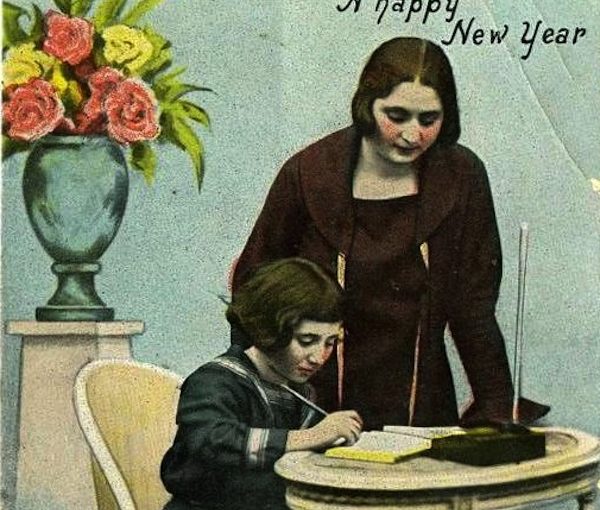
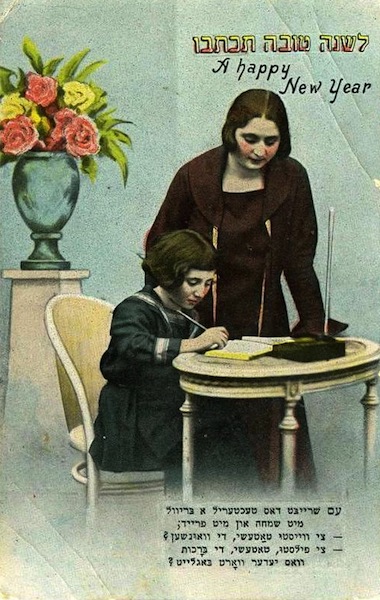
One of the family cards, produced 100 years ago, that is currently on long-term loan in the folklore department of the Hebrew University of Jerusalem, on Mt. Scopus. It is from the Chaya and Chana Gitelman Collection.

Not too long ago, I was flipping through a collection of old family cards, all of which were produced 100 years ago in Eastern Europe. On the cover of one card, a young girl sits at a table writing in a notebook. Her mother stands over her, looking on. From a modern perspective, there is nothing unusual about a woman knowing how to read and write. But less than 200 years ago, this would have been considered somewhat revolutionary.

Just how revolutionary? In the article, “The History of Jewish Women in Early Modern Poland: An Assessment,” Prof. Moshe Rosman reported that, at the end of the 19th century, more than half of all Jewish girls could not read, not even in Yiddish. Rosman noted that not only was limited attention given to educating Jewish women, but that those who first wrote the history of this period, deemed it hardly worth dealing with the subject.

In early modern Poland, education for Jewish girls and women was largely designed to make them into faithful Jews who would keep female rituals. For the most part, their education was informal and conducted in Yiddish. Brenda Socachevsky Bacon states that a learned woman was an aberration and considered outside the norm. In analyzing Shmuel Yosef Agnon’s story “Hakhmot Nashim” (“The Wisdom of Women”), which was published in 1943, Socachevsky Bacon says a woman’s very presence in the beit midrash causes the men to be uncomfortable. “They view the realm of Torah study as their own, even as their own hypocritical behaviour belies their dedication to it,” she writes. “The men will not allow this discomfort to continue, even if it involves transgressing the Torah’s commandment not to embarrass another person publicly.”

Fortunately, this was not the whole story of this period. Rosman explains there were secularized school settings in which Jewish girls learned both Yiddish and European languages. The objective of these schools was modernization and general knowledge. Girls read classic European literature. In this instance, the scorn was sometimes transferred, with traditional Jewish literature viewed contemptuously.

According to Prof. Eliyana Adler (“Rediscovering Schools for Jewish Girls in Tsarist Russia”), private schools for Jewish girls were a crucial ingredient in transitioning Russian Jewry into modernity. She reports that, from 1844 to the early 1880s, well over 100 private schools for Jewish girls opened in cities, towns and shtetlach throughout the Pale of Jewish Settlement.

The educators who opened and ran private schools for Jewish girls pragmatically balanced their ideological motivations with very real concerns about funding and retaining communal goodwill. Thus, those who ran private schools offered a variety of student tracks. Rich Jews (like their wealthy Christian neighbours did elsewhere) could pay to board their children. Many schools offered weekly instruction in both music and French as paid electives.

Adler goes on to say, “at the same time, families of modest means were offered tuition payments on a sliding scale. Noteworthy, poor students were actively recruited for scholarship positions. Other schools offered less sophisticated fee scales, but clearly worked within the same framework. The rewards for having a robust student body became clear as both the government and certain private and communal bodies began to award subsidies to successful private schools.”

These private schools for Jewish girls designed Jewish studies curricula to meet the expectations of the Russian Jewish communities from which they drew their students. The curricula had to be modern and useful without being radical. Thus, efforts were made to introduce training in practical crafts; that is, crafts that could be put to use in the marketplace. In 1881, the first trade school for poor Jewish girls opened in Odessa. Thereafter, both trade schools and sections within other schools that offered more in-depth training in such skills as sewing opened with increasing frequency.

image - One of the family cards, produced 100 years ago, that is currently on long-term loan in the folklore department of the Hebrew University of Jerusalem, on Mt. Scopus. It is from the Chaya and Chana Gitelman Collection
One of the family cards, produced 100 years ago, that is currently on long-term loan in the folklore department of the Hebrew University of Jerusalem, on Mt. Scopus. It is from the Chaya and Chana Gitelman Collection.

By the end of the 1890s, in Odessa alone, more than 500 girls studied in four communally funded vocational schools for Jewish girls. Jewish educators responded to the growing interest in interaction with the surrounding society by opening their private girls schools to Christian girls and by offering to teach courses in the Jewish religion in Russian schools. Prayer served as the common denominator of religious courses – the major focus of religious education was on prayer.

The teaching of Jewish history rather than simply the Torah allowed for an unprecedented degree of interpretation and even mild biblical criticism. Hebrew reading was also offered in many of the schools. Almost all Jewish girls schools offered penmanship and arithmetic.

Every private school for Jewish girls in the Russian Empire required extensive instruction in the Russian language. It was not uncommon for all general studies subjects to be taught in Russian.

Examples of the above educational transformation may be found in the bigger cities of Eastern Europe. In Plonsk (located some 60 kilometres from Warsaw), for example, toward the end of the 19th century, organizations such as Kahal Katan (literally, Small Community), educated the poorer strata of society. Also during this period, the city (which had a Jewish majority) opened a primary school for Jewish children, where some 80 pupils, mostly girls, studied in Russian. (See yadvashem.org/yv/en/exhibitions/communities/plonsk/jewish_education.asp.)

Vilna is another example. In 1915, the Association to Disseminate Education established three schools – one for boys, one for girls and one mixed – whose language of instruction was Yiddish. Also in 1915, Dr. Yosef Epstein established the Vilna Hebrew Gymnasium (high school), which was later renamed after him. The informal educational system included literature, drama, music, industrial arts and other courses. (See yadvashem.org/yv/en/exhibitions/vilna/background/20century.asp.)

According to Dr. Ruth Dudgeon (“The Forgotten Minority: Women Students in Imperial Russia, 1872-1917”), Russian women, aided by sympathetic professors, created educational institutions that evolved into universities and medical, pedagogical, agricultural and polytechnical institutes for women. Moreover, in 1916, the Ministry of Education overcame its bias against preparing women for public activity, rather than the home, and mandated the equalization of the curricula in the boys’ and girls’ gymnasia.

In the 1870s and 1880s, Jewish-Russian enrolment in the courses for women was between 16% and 21%. The imposition of quotas in the 1880s, however, reduced the number of Jewish students. But, in places where the quota was lifted, the number of Jewish women in the courses soared.

In the restricted Pale of Settlement, young Jewish women wanting to study did everything to establish residency elsewhere. The “everything” included registering as a prostitute. According to Dudgeon, one brother found out about his sister’s actions and then drowned himself in the Neva; the grieving sister, in turn, ended her life by taking poison.

As circumstances for Jews in the Russian Empire deteriorated in the 1880s, those Jews who stayed in that part of the world came to embrace new ideological solutions to the situation. In an atmosphere of violence, deprivation and brutally strict quotas in education and professions, Russian-Jewish parents wanted their children enrolled in schools where the course of study offered some hope for the future.

By the turn-of-the-century period, educators were no longer opening private schools for Jewish girls based on the old model. The schools they opened – whether they were trade schools where Zionism was taught, religiously mixed schools devoted to full acculturation, or Yiddishist schools committed to inculcating socialism – promised more than basic literacy.

In Poland, Gershon Bacon writes, “the education of Polish Jews in the interwar period was characterized … [as] the ‘victory of schooling.’ The compulsory education law of the reborn Polish republic had brought about in one generation what had eluded generations of prodding by tsarist officialdom and preaching by Jewish maskilim (people versed in Hebrew or Yiddish literature). Whether in the public schools or in the various Jewish school networks, Jewish children in Poland were educated according to curricula that deviated in almost every respect from that of traditional Jewish education. [Notably,] religious families had no objections to sending daughters to secondary schools, even though they objected to exposing sons to secular education.

“What is most striking,” continues Bacon, “are the differences in enrolment figures in institutions of higher learning. There was a much larger proportion of Jewish women students among female students as a whole (36% in 1923/1924), as distinct from the percentage of Jewish men among male students (22% in 1923/1924). It would seem that we have here but another example of a phenomenon observed in other countries, where Jewish women entered institutions of higher learning earlier and in greater proportion than their non-Jewish counterparts.” (See jwa.org/encyclopedia/article/ poland-interwar.)

So many factors about these educational statistics still need to be explored. Nevertheless, one can observe that an outcome seems to have been the creation of a modern Jewish Eastern European woman who “opened her mouth with wisdom.” (Proverbs 31:26)

Deborah Rubin Fields is an Israel-based features writer. She is also the author of Take a Peek Inside: A Child’s Guide to Radiology Exams, published in English, Hebrew and Arabic.

Format ImagePosted on December 13, 2019December 12, 2019Author Deborah Rubin FieldsCategories WorldTags education, history, Judaism, women, Yiddish

You take care now, y’hear?

I just realized that, lately, I had unconsciously changed the way I say goodbye, particularly when I am speaking with women. As a younger person, it wouldn’t have occurred to me to say “Take care!” when parting with people. What’s more? It’s happening even when I have casual interactions. I started thinking about where my new-to-me phrase comes from and where I’d heard it before.

I was out walking my dogs when one of them (the young, spry Setter mix) kicked me in the shin. I looked down, in pain, when I saw that she, too, was surprised. She’d slipped on the slick sidewalk and certainly hadn’t meant to hurt me. A man at the bus stop remarked how icy it was, and I agreed. I said, “Take care!”

Later, my household was in bed when we heard an ominous thump outside. My husband made a joke, we laughed and went to sleep. In the morning, I saw a thoroughly smashed car, its front end bashed in. It faced the wrong way on a busy street near our home. Across the intersection, there was a truck, also facing the wrong direction, somehow wedged into someone’s yard. It was slippery, indeed.

Often the habit of suggesting people take care is aligned with another statement though, something like, “Things are more dangerous these days.” However, our Torah readings from this time of year, in Genesis, remind us that things have always been dicey out there, particularly for women and for those in positions of less power in society.

For instance, when the three strangers tell Abraham that Sarah will have Isaac, she laughs (Genesis 18:12-15). However, this is quickly followed by Abraham’s question about why she laughed and she says, “I didn’t laugh.” Why? “Because she was frightened.” Why did she lie? Well, she was an old woman. Strangers told her something ridiculous and then she was asked to take it seriously. She was afraid. Sarah wouldn’t be the first or last woman to feel threatened and unsafe. If something like this situation happened today, I wouldn’t leave until I’d said, “Take care.”

Not much further along in Genesis, Abraham bargains with G-d, asking how many people in Sodom have to be righteous for G-d to save the city. Abraham has some power here. He feels emboldened to speak out, but he also gets to stay home rather than go to Sodom to try and fix things. Instead, two angels go to Sodom.

Lot takes the angels in as his guests, but when a crowd gathers to do the visitors harm, Lot suggests an unsettling exchange. He says that, rather than let the crowd “be intimate with them,” he’ll send out his two young daughters instead. He will sacrifice his daughters to be violated by the crowd (Genesis 19:8) rather than let his male guests be endangered.

Reading Genesis, I am reminded by how these dangerous situations, and particularly ones that threaten women, are not at all new. These are issues of power, control and sexuality. In a modern political comparison: we act as though the MMIWG (missing and murdered indigenous women and girls) report and its findings are new or different. In fact, violence against women, and specifically minority women in vulnerable situations, is a bad news story played on repeat. These threats are close to home, and they remain frightening.

When I hear myself telling a friend – a single mom whose father just died – to take care, I realize who I am echoing in my head. I hear older African-American women in my Virginia neighbourhood saying goodbye to me: “You take care now, y’hear?” I hear my mom sighing as she hung up the phone (it was avocado green, with a long cord so she could cook while talking) at home when I was younger. She said goodbye with a worried expression that her friend couldn’t see, saying “Bye! Take care.”

This is the closing comment of women, all over, who know that the world can be dangerous. We’re sending out our concern to those we love. We’re acknowledging that, sometimes, we must depend solely on ourselves, because it doesn’t look like anyone (including G-d) is stepping up to keep us safe.

Sometimes, Bereishit (Genesis) offers stories to dig into. I enjoy their meaty narrative. I love interpreting what it all means. Other sections cause me to sigh just as my mom did. In a world where women still don’t have any assurance of safety from war, crowds and violence, and where those who have less power are at the mercy of the powerful, it’s hard not to feel sadness. How little things change.

This also is a continuing opportunity for social justice. We can fight for a better place for everyone. We can seek out and care for those around us, rather than choosing to discriminate or discard lives, as Lot would have done to his daughters. In the meanwhile, I’m often slipping down the icy street, worrying and wondering over how I can spread a sukkat shalom (a shelter of peace) over those I love and care for. So, I’ll say what many wise women have said before me. You take care now, y’hear?

Joanne Seiff has written regularly for CBC Manitoba and various Jewish publications. She is the author of three books, including From the Outside In: Jewish Post Columns 2015-2016, a collection of essays available for digital download or as a paperback from Amazon. Check her out on Instagram @yrnspinner or at joanneseiff.blogspot.com.

Posted on December 6, 2019December 3, 2019Author Joanne SeiffCategories Op-EdTags #MeToo, abuse, Genesis, harassment, Judaism, Torah, women
Jewish war brides talk

Jewish war brides talk

At the University of British Columbia on Nov. 21, Prof. Robin Judd will speak on What’s Love Got to Do With It? Jewish War Brides and North American Soldier Husbands after the Second World War. (photo from Robin Judd)

Prof. Robin Judd noticed that a significant number of the earliest Holocaust memoirs written by women were penned by “war brides” who had married American, Canadian or British soldiers.

In the course of teaching about the Holocaust at Ohio State University, the coincidence struck her and, as happens in research, led her onto a new topic. She is nearing completion on a book about the experiences of Jewish women – and a few men – in Europe and North Africa who married Allied service personnel and moved to Canada, the United States or Britain. She will give a guest lecture on the subject at the University of British Columbia next week and the public is welcome to attend.

The lecture is titled What’s Love Got to Do With It? Jewish War Brides and North American Soldier Husbands after the Second World War, and Judd told the Independent that love certainly played a key role, but some of the other factors at play also interest her.

“What prompts individuals from radically different cultures, who may not necessarily speak the same language, what prompts them to create relationships with one another and long-lasting relationships, relationships that are going to result in marriage and then bring the civilians to Canada, Britain or the United States?” she asked.

Most of the soldiers that Judd is studying were Jewish themselves, though there are exceptions to the rule.

In some cases, the wives would arrive in the new country before or otherwise apart from their new husbands or fiancés. An entire infrastructure was in place to accommodate and integrate them.

“The war brides, particularly if you come to the United States or to Canada as a war bride, first you live with other war brides at least temporarily in a kind of war bride home or war bride camp and you travel on a war bride ship and there are particular Red Cross workers who teach English and show films and cooking classes,” she said.

If the fiancés or husbands were not yet decommissioned or were traveling with their units, the brides may have found themselves in the position of living with their new in-laws.

“These were not the spouses they were planning for their sons,” Judd comments. “And all of a sudden here you have this woman show up. You are processing stories that you are hearing about the war and all of a sudden here comes this person and you might not be able to communicate, you might not have a shared language, you might not know how to even ask questions about what this person had experienced.”

Feeling isolated and foreign, some of these women used the opportunity to express their experiences privately, to themselves, in writing.

“Some of the women that I’ve spoken to have told me that they used that time to write out their story, to put it to paper, because they needed to kind of get it out and there was no one with whom they could talk, literally,” she said. “But then, as they began to create networks, make new connections, maybe by that point their now-husbands have returned to Canada, Britain or the U.S., a number of them tell me that they then destroyed them.”

By an apparent coincidence, though, Judd concluded that it was disproportionately the women who had married soldiers who were among the first to publish English-language Holocaust memoir narratives for general readers in the 1970s and ’80s. She has a theory about this, but admits she could be wrong: these may have been some of the first women who were asked to speak about their early life and Holocaust experiences to Jewish women’s groups, federations and other community audiences, acclimating them to become among the first to put them on paper for general readers.

“But, again, I could be completely wrong,” she said.

Judd’s lecture is supported by a Holocaust education fund in UBC’s department of history to support undergraduate education on the Holocaust. The fund supports a biannual lecture, alternating years with the Rudolf Vrba Memorial Lecture, and is incorporated into an undergraduate course, History of the Holocaust, taught by Prof. Richard Menkis, who is also chair of the committee that manages the fund. The public is welcome to attend on Thursday, Nov. 21, 5-6:15 p.m., at Buchanan D217 at UBC.

Format ImagePosted on November 15, 2019November 13, 2019Author Pat JohnsonCategories LocalTags Holocaust, Robin Judd, Second World War, UBC, war brides, women, writing
Turning FOMO into JOMO

Turning FOMO into JOMO

Adrienne Gold is a participant in this year’s international Shabbat Project, Nov. 15-16. (photo from Shabbat Project)

FOMO: fear of missing out. Four letters that encapsulate the human hankering for absolute control, and the profound anxiety we suffer from knowing we will simply never satisfy it.

FOMO is an impulse exacerbated by social media, by scrolling through the Facebook, Instagram and Snapchat lives of others, consciously and unconsciously measuring ourselves up to their non-existent standard of living. Comparing our brats to their seraphs, our tiresome drudgery to their idyllic island getaways, our 1980s-style kitchens to their gleaming open-plan masterpieces. And, while social media does not itself cause narcissism, it certainly can help flick the switch of those tendencies latent within us. Especially those of us who suffer from FOMO by nature.

When I was a young girl, I constantly worried that I had missed something, anything that would change the tone and balance of my carefully curated life. In our family, kids came in for the night “when the lights went on” in the street. Many of my neighbourhood friends could stay out later than that, and I remember like it was yesterday sitting in my room fretting over the potential new allegiances that would be formed without me; the stories and games and fun that I would not be privy to. I would be gripped by a terror that things would not be “as I left them” and that the next day would begin leaving me in the dark.

This mindset remained with me through my teens. Wherever I was, I wondered what was happening somewhere else. Whoever I was speaking with, at whatever party, my eyes roved the room to see what else was happening, who else was there? It was as though I had internalized that whatever I was engaged in could not possibly be where the “action” was; that I was missing something that could only happen if I were not there. And this unease continued into my dating life and well into my 20s. There was no me without my agitating the universe, without my scrambling and “hustling for worthiness.”

So, imagine my horror when, many years later, I learned about Shabbat. No phone. No computer. No car. No shopping. No way! What possible benefit could there be in living 24/6 in a 24/7 world? And what if someone needed to reach me? What would I fill those gaping 24 hours with? I was a human doing, with no clue how to be. Or who to be.

Yet, in that struggle with the very idea of Shabbat came the deep epiphany that radically changed not just my world, but my psyche. In advance of this year’s international Shabbat Project, which will be taking place in cities around the world Nov. 15-16, I’m inspired to share this journey.

I was 40 when I started to keep Shabbat. (How that came about is too lengthy and labyrinthine a tale for this space.) Married with two children, deep into my career and as afflicted by FOMO as ever. Nevertheless, I was determined to do this. While the anxiety clung in the early stages of my “disconnecting in order to connect,” it was less than a year before I began to understand something that had eluded me my entire life – apparently, the world turned and ran quite nicely without my help. The control I was seeking could be found by relinquishing it. The Mishnah tells it straight when it says, “Who is rich? He who rejoices in his lot.” I learned to be still, to rejoice in my lot, to be in the moment. I felt rich.

In short, Shabbat forced me to stop trying to play God, to stop long enough to recognize that He did just fine without me. I discovered that “letting go and letting God” gave me the freedom to find value and purpose, and even joy – not in productivity but in simply being. I felt in touch with my soul and grasped in a deep sense its primacy over the body.

Over 20 years have passed since the therapeutic benefits of Shabbat first liberated me from my FOMO and gifted me perspective and clarity on what it means to be a human being; since I first tasted the indescribable spiritual delights of the Jewish day of rest.

Today, I have the pleasure and the privilege of introducing thousands of women every year to Shabbat and more. Momentum – formerly known as the Jewish Women’s Renaissance Project – has, to date, taken more than 18,000 women from 27 countries on an eight-day journey to Israel to grow as people, connect to Jewish values, engage with the Jewish homeland, foster unity not uniformity, and return to take action as leaders in their communities.

As a leader on these trips, I have seen thousands of women try to make Shabbat more meaningful in some way or another. These women saw the power of what disconnecting in order to connect might do for their families, and for themselves.

Shabbat is the only mitzvah described in the Torah as a “gift.” Tragically, it’s a gift that too many of us never take the time to unwrap. I was one of them. What I didn’t understand was that ceasing to create would make me more creative, that not exerting myself would give me more strength, that being where I am, limited, constrained, here and nowhere else, has alerted me to the joy in my heart and in my life.

You were wondering about that pesky FOMO? It has become JOMO: joy of missing out.

Adrienne Gold, a participant in this year’s international Shabbat Project, was a fixture on Canadian television for more than 15 years, hosting her own daily fashion and beauty program. Today, she is a trip leader for Momentum (formerly, the Jewish Women’s Renaissance Project).

Format ImagePosted on November 8, 2019November 6, 2019Author Adrienne GoldCategories Op-EdTags Judaism, lifestyle, Shabbat Project, women
Mystery photo … Sept. 27/19

Mystery photo … Sept. 27/19

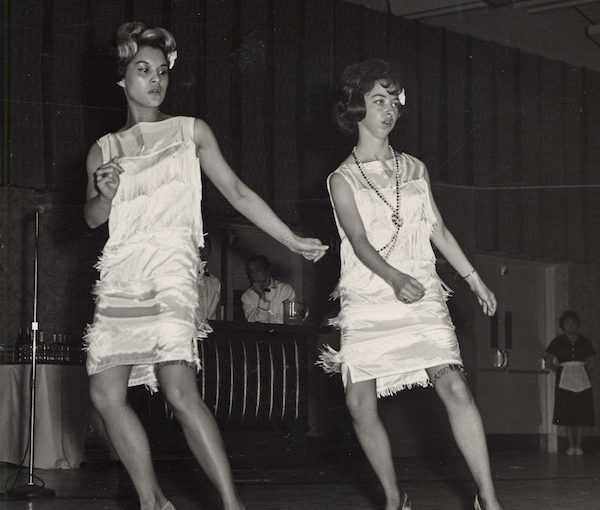
Two women dancing, 1965. (photo from JWB fonds, JMABC L.13986)

If you know someone in these photos, please help the JI fill the gaps of its predecessor’s (the Jewish Western Bulletin’s) collection at the Jewish Museum and Archives of B.C. by contacting [email protected] or 604-257-5199. To find out who has been identified in the photos, visit jewishmuseum.ca/blog.

Format ImagePosted on September 27, 2019September 24, 2019Author JI and JMABCCategories Mystery PhotoTags history, Jewish museum, women
NCJW Vancouver fall update

NCJW Vancouver fall update

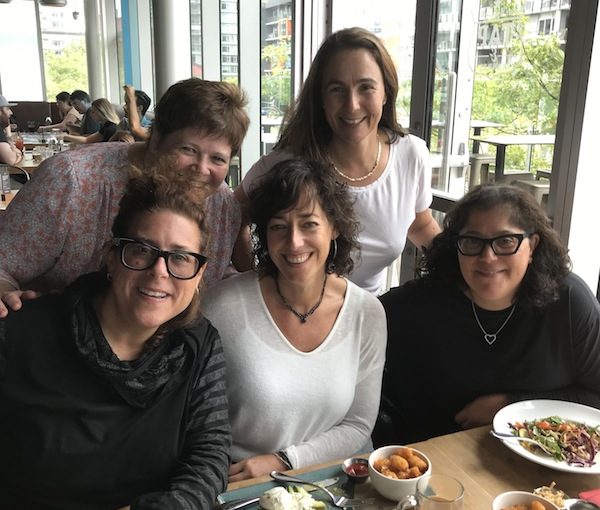
National Council of Jewish Women of Canada, Vancouver section, members. Seated, left to right, are Lisa Boroditsky, Jill Kipnis and Sandi Hazan Switzer. Standing are Heather Sirlin, left, and Jane Stoller. (photo from NCJWC Vancouver)

Members of National Council of Jewish Women of Canada, Vancouver section, have been busy close to home, not only supporting various initiatives for disadvantaged children in local schools – Books for Kids, HIPPY, Operation Dressup, and hygiene and nutrition school programs – but learning more about the Jewish history of the city.

photo - Newcomers to Vancouver, Guillermo and Debby Castillo from Mexico, who joined the NCJWC walk Sunday morning
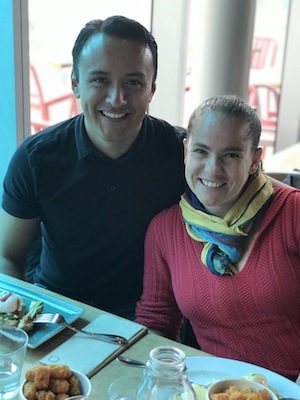
Newcomers to Vancouver, Guillermo and Debby Castillo from Mexico, who joined the NCJWC walk Sunday morning. (photo from NCJWC Vancouver)

On Sept. 8, more than 25 people participated in a sold-out walk through the “old city” of Vancouver, organized by Lisa Boroditsky, Jane Stoller and Sandi Hazan Switzer. Participants were enthralled by the stories of Harry Hammer, by the geographical and architectural details, to say nothing of the oral history of horse-drawn carts, family stores and tales of running to the bus for cheder.

NCJWC members also worked nationally, supporting successful efforts by CIJA (Center for Israel and Jewish Affairs) to get Parliament to adopt the International Holocaust Remembrance Alliance’s definition of antisemitism; and internationally, issuing a call to action to participate in the campaign to free human rights lawyer Nasrin Sotoudeh, who has been imprisoned in Iran’s Evin prison since June 2018.

In May of this year, Prof. Irwin Cotler, chair of the Raoul Wallenberg Institute in Montreal, addressed the executive of the International Council of Jewish Women on the issue of human rights. He made a compelling case for participation in the campaign to free Sotoudeh, sentenced to 38 years and 148 lashes in Iran because of her work defending women’s rights. She has been imprisoned four times since 2010.

Freedom of expression and peaceful assembly are integral to ensuring rule of law and the functions of democracy; they are fundamental principles clearly defined in international law and they are the inherent right of all people. These two democratic themes were betrayed in 2018 when, as part of peaceful protests, some women removed their hijabs and waved them like flags and then were prosecuted for this behaviour. For defending these women, Sotoudeh has been unjustly imprisoned.

The International Council of Jewish Women executive voted to support Cotler’s recommendation and Debby Altow, vice-president for Canada on this executive, circulated a backgrounder and sample letter of protest for 33 affiliates worldwide. Both email and postal addresses for United Nations Secretary-General António Guterres and UN Commissioner Michelle Bachelet, were distributed, making such protest letters easier to submit. For more about Sotoudeh and NCJW Vancouver section, visit ncjwvancouver.org.

Format ImagePosted on September 20, 2019September 17, 2019Author NCJW VancouverCategories LocalTags history, human rights, Nasrin Sotoudeh, NCJW, philanthropy, tikkun olam, volunteering, women
Feminine aspects of repentance

Feminine aspects of repentance

At Rosh Hashanah, the new moon is revealed.

The Zohar, that classic mystical text from the 13th century, describes the High Holidays as a developmental process of female empowerment, which culminates in Yom Kippur.

According to the Zohar, the place we return to when we repent is our supreme mother, the Sephira, and we receive understanding from the Tree of the Ten Sephirot. Returning to our mother means to be gathered to the mother’s womb, a sort of death in order to be reborn, a self-nullification for gaining a new life.

This inversion has to do with the complex relationship between a mother and her children: she gives them life and they establish her motherly essence; she gives them life and they mark the beginning of her end, as “one generation passes and another generation comes.” Children return to their mother to understand their origin, and thus reveal their future.

Thanks to these paradoxical relationships between the generations, the mother has the power to heal, to sweeten and to explain every question and shattering in our lives.

“Returning to the mother” is not always an absolute, unequivocal and affixed teshuvah (repentance). It is a teshuvah that is coming into being, the same way that the world to come is coming into being, and the status of which is always (a world) “to come.”

According to Shaarei Orah by Rabbi Joseph ben Abraham Gikatilla, “the world to come” is also another name of the sephira (kabbalistic attribute) Understanding. Understanding is constantly giving birth to souls and, thanks to her, we are renewed and recreated every day, especially at the beginning of the year, at Rosh Hashanah.

At Rosh Hashanah, the new moon is revealed. The year begins with coverage and concealment, due to a cloud that covers the sun. In the kabbalah, the sun is the male. The moon, which is usually identified as the Shechinah (divine presence) and is also the lowest sephira, called Malchut (kingship), gets her light from him. When the sun is not shining, the Shechinah is hidden as well, and our world is in darkness. How can the light of Genesis be lit? The Zohar says:

“… Through teshuvah and the sound of the shofar, as it is written: Happy the people who know the blast. Then, O YHVH, they will walk in the light of Your presence (Psalms 89:16).

“Come and see: on this day, the moon is covered and does not shine until the 10th day, when Israel turns back in complete teshuvah and Supernal Mother returns, illumining Her. On this day, Mother embarks on Her journey and joy prevails everywhere.

“Thus it is written, Yom ha-kippurim hu, it is the Day of Atonement (Leviticus 23:27) … the verse should read Yamim Kippurim, Days of Atonements … because two radiances shine as one, Upper Lamp illumining Lower Lamp. This day, She shines from the upper light, not from light of the sun; so it is written, ba-keseh le-yom haggenu, on the covering until our festival day.”

The Zohar emphasizes that the only way to cleave the cloud is with the sound of shofar and teshuvah – both mental and supernatural ways to reach the supreme source and attract new life out of it. The Zohar teaches, symbolically, that this task is assigned on every New Year: to cleave the cloud with repentance, to cancel the decree by the voice of the shofar.

Only then, after the 10 days of repentance, will the light illumine Yom ha-Kippurim. It is a double light: that of the supernal mother (Understanding) which illumines her daughter (Shechinah), and the two will reunite into one. That is why this day is called Yom ha-Kippurim, the day of two feminine lights illumining together, without the aid of any masculine light from the outside.

According to another commentary in the Zohar, unlike at Rosh Hashanah, when the masculine God appears, exposing and lifting His left hand in a gesture of sentence and vengeance, on Yom ha-Kippurim, we realize that this same hand is meant to support Shechinah and lift her from the dust, as is written in the first part of Song of Songs: “Let His left hand be under my head.” (2:6) On this day, Shechinah, the female hero, appears as a bride and we all are her bridesmaids, accompanying her to “Mother river” of the sephira Understanding, to immerse in it and clean her from our sins.

Finally, after being atoned, the dance of sephirot culminates in Sukkot, and the celestial couple is united. The second part of the verse – “and His right hand embrace me” – is implemented, and light and happiness fill the world. At Rosh Hashanah and Yom ha-Kippurim, we pray facing Shechinah and Understanding, and their light envelops and shields us after the cloud is cleaved.

***

The Book of Zohar sees King David as “The Hero with a Thousand Faces”: the archetypal sinner, the court jester and, eventually, also the partner of teshuvah herself. In Psalms 130, King David says: “Out of the depths I cry to you, Lord / Lord, hear my voice / Let your ears be attentive / to my cry for mercy / If you, Lord, kept a record of sins / Lord, who could stand? / But with you there is forgiveness / so that we can, with reverence, serve you / I wait for the Lord, my whole being waits / and in his word I put my hope / I wait for the Lord / more than watchmen wait for the morning / Yea, more than watchmen wait for the morning / Israel, put your hope in the Lord / for with the Lord is unfailing love / and with him is full redemption / He himself will redeem Israel / from all its sins.”

This psalm begins with calling to God out of the depth, continues with asking God’s forgiveness, ends with yearning and anticipation that grow out of God’s absolution, and reaches the point of redemption and salvation. There are hidden words of praise to God and, as in other psalms, David’s ability to turn his supplications into poetry and to converse with his soul, so bound up with the divine soul, is outstanding.

According to King David, forgiveness is possible only when we are “with God,” and the mercy and redemption are in Him and “with Him” and, therefore, are in us, when we are attached to Him. The space that enables us to undergo the process of “making teshuvah” is created, and we are able to “return to the place” that is our origin and the root of our soul.

King David is not only a great poet, but also the archetypal sinner who, according to our sages, was born to set up “the yoke of repentance.” The sages deal a lot with David’s sins, justify him and even declare radically: “Whoever says that David sinned is merely erring.” (BT Shabbat 56a)

At one point, a scene is described in which David enters the Beit Midrash during a dispute about the world to come, the scholars taunt him about Batsheva and he reproaches them about a flaw in their morality: “… when they are engaged in studying the four deaths inflicted by beit din [court], they interrupt their studies and taunt me [saying], ‘David, what is the death penalty for he who seduces a married woman?’ I reply to them, ‘He who commits adultery with a married woman is executed by strangulation, yet he has a portion in the world to come. But he who publicly puts his neighbour to shame has no portion in the world to come.’” (BT Sanhedrin 107a)

It is evident that our sages were deeply engaged with questions of evil inclination, reward and punishment and, mostly, they identified with King David’s image. This colourful hero – the fighter, the fallen, the worldly, the dancer, the poet – seems to them the most likely to repent and to be fully pardoned either by men or by God. In fact, it might be said that each generation has its own King David. They see him in a different light and cast upon him their own personal traits, their fractures and their hopes to be redeemed.

The Zohar regards David as the hero with a thousand faces. David of the Zohar is poor and deficient, empty and, therefore, filling up and being a penitent (ba’al teshuvah). He knows how a man’s bruised and low soul can be elevated from the depths to a level of joy and thankfulness.

According to the Zohar, the place we return to when we repent is our Supreme Mother, the Sephira, and we receive understanding from the Tree of the Ten Sephirot. Returning to our mother means to be gathered to the mother’s womb, a sort of death in order to be reborn, a self-nullification for gaining a new life.

And what has King David to do with this feminine process? Surprisingly, the Zohar identifies King David as the Shechinah, the same Shechinah that seemingly has nothing of her own, even though the other sephirot depend on her, and she is the most concentrated and colourful of them all. David is like a hero returning from a voyage, radiating myriad lights collected from all his sins and fractures. Had they remained in the form of fractures alone, darkness would have prevailed in the world. Thanks to Understanding – the mother and the wife – they have turned into a spectacular kaleidoscope of lights.

David refuses to hide his sins. After having confessed, acknowledging his deeds and admitting them, the sin loses its form, returns into its raw essence and finally turns into praise to the Lord. God, on his part, forgives our sin and gathers us to Him. Thus, David turns his soul into a lever of teshuvah out of love. Precisely these factors – his feminine side, his majestic quality and his skill to turn a confession into praise – enable David to ascend to mother Understanding and immerse us in the river of forgiveness.

Dr. Ruth Kara-Ivanov Kaniel is a research fellow at the Shalom Hartman Institute and was ordained as a rabba by the Hartman-HaMidrasha at Oranim Beit Midrash for Israeli Rabbis in 2016. These articles are based on her originals in Hebrew and are meant to be read together. For more articles from the SHI, visit hartman.org.il.

Format ImagePosted on September 20, 2019September 17, 2019Author Dr. Ruth Kara-Ivanov Kaniel SHICategories Celebrating the HolidaysTags Judaism, kabbalah, Rosh Hashanah, women, Yom Kippur, Zohar
Marriage no fairy tale

Marriage no fairy tale

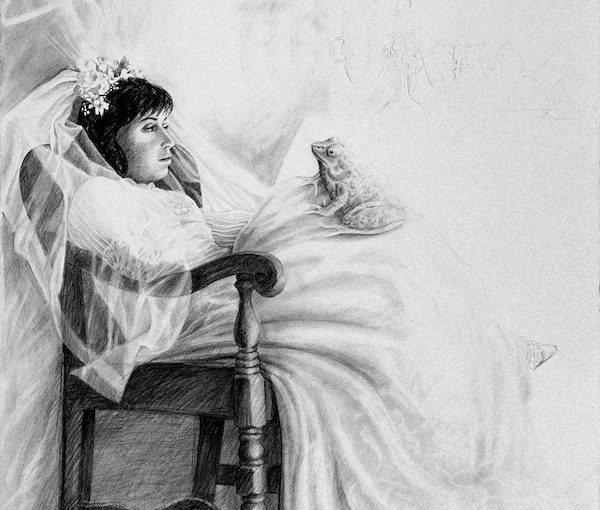
“Kiss! Kiss! Kiss!” by Lilian Broca is part of the exhibit Brides: Portrait of a Marriage, which is at the Italian Cultural Centre’s Il Museo until Sept. 30.

In most romance novels and fairy tales, a love story ends in a wedding and the couple lives “happily ever after.” In real life, it’s not that simple. Marriage has its challenges.

The show Brides: Portrait of a Marriage, which opened at the Italian Cultural Centre’s Il Museo in Vancouver this summer, examines some of the aspects of marriage that fairy tales purposefully omit. The show incorporates the works of several local artists in different media: textile art by Linda Coe, photography by Grace Gordon-Collins, drawings by Jewish community member Lilian Broca and a tapestry by fellow Jewish community member Barbara Heller.

“I always wanted a show about brides,” Angela Clarke, curator and director of Il Museo, told the Independent. “We have weddings at the centre almost every week. There is so much energy, so many emotions. But the Roman goddess of marriage, Juno, was not a happy woman. Hers was not a happy marriage, and the controversy attracted me.”

Brides is part of the museum’s Gendered Voices series, and looks at marriage from a woman’s perspective.

“This exhibition places the institution of marriage under the looking glass,” said Clarke. “Each participating artist tackles the deep psychological complexity and immense social pressure involved in a traditional marriage. Historical perspectives and family dynamics, personal reflections and the impact of feminism are explored in the show.”

Each artist contributed her own personal outlook. Coe’s fabric panels belong to her Dirty Laundry series. Colourful and sophisticated-looking hangings were all created from fabric snatches that were once parts of women’s dowries, used and reused for several generations before they ended up in the artist’s stockpile.

“The eight fabric panels represent eight stages of a woman’s life,” explained Clarke. “Each one incorporates relevant texts from Renaissance romance novels and etiquette manuals. In the 16th century, such manuals were very popular in Italy, especially among the middle classes. They were written to instruct young brides in the proper comportment, in the ways to become a successful bride and mother.”

In addition, those eight panels reference the eight requisite parts of a romance novel, from the Middle Ages to the modern Avon romances. “Those stages have names, the same names as the panels,” Clarke said. “No. 1, Stasis (infant). No. 2, Trigger (young girl). No. 3, Quest (betrothal). No. 4, Surprise (courtesan). No. 5, Critical Choice (bride). No. 6, Climax (wife). No. 7, Reversal (matron). No. 8, Resolution (widow). Every love story published these days must follow this structure.”

Heller’s tapestry and Gordon-Collins’s photographs explore wedding dresses and the commodification of weddings. The tapestry shows a bride in a beautiful dress, but her face is blurry, unimportant, and the dress becomes the focal point, a uniform, a symbol.

The photos, in the photogram or X-ray style, lack faces altogether, only the wedding attires of four generations of women of the artist’s family can be seen.

“Grandmother’s wedding tunic was modest, especially in comparison to the artist’s daughter’s wedding dress, much more opulent and sensual, and designed for one-time use only,” said Clarke. “Here, we can trace how, through the generations, the weddings grow into an industry, and the wedding accessories become commodities.”

While neon-bright colours dominate Gordon-Collins’s images and Coe’s collages shimmer with the patina of gold, Broca’s contribution to the show is a sequence of stark black and white lithographs, all from her Brides series.

“My mother passed away in 1989,” Broca said, as she explained the roots of her series. “I was devastated by her death, although it was a blessing after suffering for years from cancer. Soon after her passing, I started dreaming about her as a young bride. I decided to draw my dreams.”

Her drawings reflect the dichotomy between the happily-ever-after concept and the fact that most marriages in the past were arranged, and not unions of love.

One of the drawings, “Kiss! Kiss! Kiss!” depicts a bride sitting in a chair, regarding a frog in her lap. A few more frogs – potential princes? – wait at her feet, expecting her to choose between them.

“I knew my bride would not kiss that frog,” said Broca. “So I added several other potential grooms. Some small, others big…. Still, I had a feeling she would resist them all.”

The work “Upon Reflection” is even more powerful. It shows a bride in a gown and veil looking into a full-length mirror. The image in the mirror depicts the bride, face and posture serene, as befits the occasion, but Broca has left the image of the bride herself white and, from within it, there is the drawing of a woman, the bride, trying to escape.

“That woman, upon reflection, discovers how much she doesn’t wish to be married, to be tied down. What happens next is up to the viewer’s imagination,” said the artist.

For Broca, black and white was the only possibility for the series. “It was the most appropriate way to describe what I felt…. After the first two or three drawings, I began to realize that many brides were not happy at the altar – I showed them. Only a very few happy brides appear in my drawings. Not because happy brides are a minority, but because happy brides are difficult to portray without slipping into a less-than-powerful mode. I may be wrong, I may be able to do it today, but, at that time, it didn’t seem possible.”

Clarke knew about Broca’s series and wanted to include it in its entirety in the show, but that wasn’t possible. “We couldn’t include so many that Angela wanted because they had been sold,” said Broca. “We couldn’t borrow them. The owners live in the U.S. and Eastern Canada. As it is, the two works in the exhibition were borrowed from local owners.”

Brides is at the Italian Cultural Centre until Sept. 30.

Olga Livshin is a Vancouver freelance writer. She can be reached at [email protected].

Format ImagePosted on September 13, 2019September 10, 2019Author Olga LivshiCategories Visual ArtsTags Angela Clarke, art, Barbara Heller, Brides, Il Museo, illustration, Italian Cultural Centre, Lilian Broca, tapestry, women
Kolot Mayim installs rabbi

Kolot Mayim installs rabbi

Rabbi Lynn Greenhough represents a series of firsts for the Victoria Jewish community. (photo from Kolot Mayim)

When Lynn Greenhough is officially installed as rabbi of Kolot Mayim Reform Temple in Victoria tonight, Sept. 6, she will bring with her a series of firsts to the city’s Jewish community: its first rabbi born on Vancouver Island, its first Canadian-born rabbi, its first full-time female rabbi with her own congregation and its first rabbi who was not born into Judaism.

A stalwart in Victoria’s Jewish life for nearly 30 years, Greenhough has been Kolot Mayim’s spiritual leader since 2017, while simultaneously completing her rabbinical studies at the program offered by the Jewish Spiritual Leaders Institute (JSLI) in New York.

For someone born and raised in Happy Valley – 15 kilometres west of Victoria – at a time when the area was still a farming community, the rabbinate was not a calling many in the community, or indeed on the Island, might have considered.

Her first taste of Judaism, and some of the recent history of the Jewish people, came in Grade 5, when she found a copy of William L. Shirer’s The Rise and Fall of the Third Reich in her schoolroom library, and her curiosity and sense of connection to Judaism ensued. She recognized that justice had tragically failed Jews during the Holocaust and she felt a need to be part of rebuilding a world where such a failure could never happen again.

“I consciously gravitated towards Judaism because of its inherent sense of justice,” Greenhough told the Independent. “At that early point, I realized, I would be a Jew.”

Life, jobs and family followed. She finished school, married and had a son, helped open Everywoman’s Books in Victoria and then worked for Canada Post as a truck driver for 20 years.

In the 1980s, Greenhough attended a few Jewish events at Victoria’s Congregation Emanu-El. She began to light candles and tried to build a sense of Shabbat into her week. She also looked for a Jewish partner who could help her build a Jewish home. Yet, it wasn’t until she was in her late 30s that she was determined – accompanied by now-husband Aaron Devor – to convert. Devor grew up in a Jewish neighbourhood on Long Island, but was not a regular synagogue attendee. Along the way, the couple became deeply engaged in Jewish life.

By 1992, Greenhough’s conversion was complete and, from then, it was full-on immersion to the point where she became a leader and educator. At Emanu-El, she guided historical tours, joined the board of directors, led services, including chanting Haftarot and Torah, joined the Chevra Kadisha (Burial Society) and served as a funeral officiant.

In 1996, she served as an instructor at the synagogue’s Hebrew school and then began teaching and coordinating b’nai mitzvah classes. In 1998, she began to teach Torah and Haftorah studies for adults and, in 1999, taught an introduction to Judaism course for those interested in conversion.

However, it was the Chevra Kadisha that became her passion. In 2000, Greenhough completed her master’s degree at Royal Roads University under the supervision of Dr. Rabbi Neil Gillman, z”l, from the Jewish Theological Seminary in New York. Her thesis – We Do the Best We Can: Chevra Kadisha in Small Jewish Communities in North America – looked at both the history of Jewish models for care of the dead, and present-day practices and training models from 16 different small Jewish communities.

This work led to further connections. Greenhough, along with Rena Boroditsky of Winnipeg, Man., and David Zinner of Maryland, worked together to organize the first of now 16 international conferences dedicated to learning about these burial practices.

Greenhough has also taught Judaism in the University of Victoria’s religious studies program (2007-09), was scholar-in-residence at Temple Beth Shalom in Phoenix, Ariz. (2009) and taught courses in academic writing at Royal Roads (2012-16).

In 2014, she joined Kolot Mayim as a member and led Torah studies and Shabbat and holiday services as needed, before becoming its spiritual leader in September 2017. Synagogue members are glowing in their praise of Greenhough as their choice.

“She brings a richness of experience as a born and raised ‘Island Girl.’ Indeed, she has attracted, and continues to attract, new members through her wisdom, spirituality, empathy, knowledge and quirky sense of humour,” said Sharon Shalinsky, president of Kolot Mayim.

Kolot Mayim was founded in 1998 by a small group of individuals and families, initially meeting monthly at the Victoria Jewish Community Centre. As the congregation grew, the frequency of services increased, ultimately to a weekly schedule. The synagogue has struggled to find a permanent rabbi and has, at times, been challenged in terms of membership recruitment and retention. The past year, though, it has seen a 70% increase in membership.

To mark the installation of a new rabbi at its westernmost location, Dr. Pekka Sinervo, the head of the Canadian Council of Reform Judaism, will be on hand at the ceremony, as will Rabbi Allan Finkel, who, along with Greenhough, is a 2019 graduate of the JSLI program and now leads services at Temple Shalom in Winnipeg.

Ahead of the occasion, Greenhough reflected, “This was not a career move, but the fulfilment of a dream.”

Sam Margolis has written for the Globe and Mail, the National Post, UPI and MSNBC.

Format ImagePosted on September 6, 2019September 4, 2019Author Sam MargolisCategories LocalTags Judaism, Kolot Mayim, Lynn Greenhough, synagogue, Victoria, women

Posts pagination

Previous page Page 1 … Page 7 Page 8 Page 9 … Page 15 Next page
Proudly powered by WordPress