After the Israelites escape from Egypt and the Sea of Reeds has returned to its normal flow, with the enslavers either drowned or on the opposite side, Miriam leads the women in singing a song of praise. Apparently, it is the only time in the Torah where women are recorded as seinging their own song.
They did so with instruments they had brought along with whatever necessities one takes when fleeing a bad situation. The women had such a strong belief that they and their people would be free, that there would be occasions to celebrate with song, music, dance, that they made room among their provisions for instruments.
Miriam is older than her brothers Moses and Aaron. “Having been born at the time when the bitter enslavement began, her parents named her ‘Miriam’ (from the Hebrew word meaning ‘bitterness’),” explains an article on chabad.org. However, she was anything but bitter. She was extraordinarily hopeful, continually thinking of the future and how it would be better.
“Miriam was about 6 years old when Pharaoh decreed that all Israelite baby boys be killed,” notes another chabad.org article. “Hearing this, Miriam’s father, Amram, divorced his wife, Yocheved, because he couldn’t bear the possibility of having a son who would be killed. Seeing the actions of Amram, one of the leaders of the generation, all of the other Israelite men followed and divorced their wives as well.
“Miriam told her father, ‘Your act is worse than Pharaoh’s! He decreed that only male children not be permitted to live, but you decreed the same fate for both male and female children!’ She then predicted that her parents would give birth to a son who would save Israel from Egypt.”
The young girl convinced her father to remarry her mother; the other men remarried their wives, as well. Moses and Aaron would not have been born, the Israelites would not have been freed, if not for Miriam.
She also looked over Moses after Yocheved placed him in a basket in the Nile to save him from Pharaoh’s decree. Miriam made sure that Pharaoh’s daughter, Batyah, who rescued Moses, chose Yocheved as his wet-nurse.
There are other stories of Miriam’s courage. Another translation of her name is “rebellion,” and she lives up to this interpretation in many ways. She and her mother were among the midwives who defied Pharaoh’s order to kill any Hebrew boys born, for example, and Miriam is said to have spoken up to Pharaoh when she was only 5 years old.
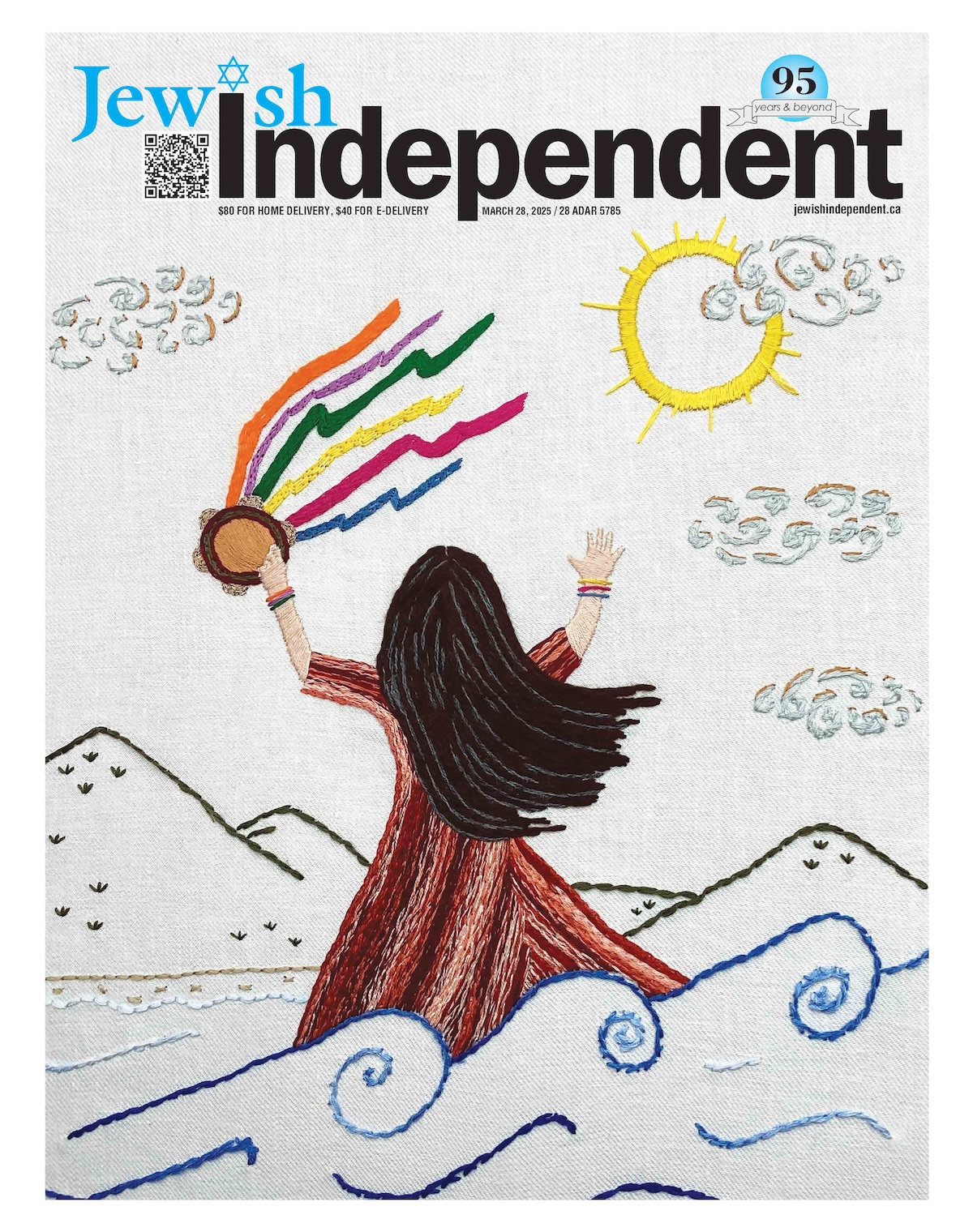
The multiple symbolisms of Miriam and the often-overlooked importance of women throughout history seemed to call for a medium of similar complexity with roots as ancient. And so, I chose embroidery as the means to express the image of Miriam, timbrel in hand, optimistic about her people’s future, the Sea of Reeds and their lives as slaves behind them.
My kids were volunteering at the Purim carnival, helping younger kids do games and offering other support. My husband was there to help. I went home early “for a break.” Meanwhile, I receive “helpful” warnings from Jewish websites and other moms on social media. “Passover is coming!” they mention with cheerful purpose. Perhaps this fills some people with glee. Mostly, I feel doom in the pit of my stomach.
Following influencers who run their large observant Jewish households like a well-oiled machine actually has been useful, to some extent. Oh, if she started making chicken broth or cleaned her pantry, maybe it’s time for me to do it, too? By following these tips, sometimes I feel I can manage better.
Then, however, the system fails me. Many of these capable influencers live in large Jewish centres, surrounded by kosher grocery stores, take-out and supportive extended families. They also have the finances to travel with their families to Passover resort vacations. If they travel, they don’t have to clean their houses or cook for the holiday. If they stay home, some use catering or even disposable plates for the whole holiday, which produces mountains of trash. My environmentally conscious household would never go for that.
For those who lack a large Jewish community infrastructure, or financial and family supports, making holidays happen can feel overwhelming. We hover in between, operating in a weird middle ground that is both freeing and isolating. Our families live far away. Since public school and work don’t stop for Pesach, we don’t travel for this holiday. We care about keeping Pesach. I cook and clean for weeks in advance, but I can’t do it all. I gave up on changing the dishes the year I gave birth to twins. While I may feel some guilt, I haven’t looked back.
Facing the next holiday’s prep feels exhausting. Maybe that’s because I just finished baking dozens of cookies (hamantashen and palmiers) for our Purim mishloach manot treat bags.
I’m thinking about how successful businesses and governments work. A business that runs smoothly depends on internal systems, competent managers to keep things working and other staff at various levels. A functional government also relies on an efficient bureaucracy. Right now, we’re hearing of how President Trump’s government is “cutting bureaucracy” and creating “efficiency.” However, what has followed is chaos.
Yes, there are always cases of bloated bureaucracy or waste, but, in many contexts, efficiency can mean that only one person knows how to do something essential. If that person has an accident or falls ill or is fired? Bad things happen.
I think of this while trying to keep my Jewish household on track through our holidays and the secular calendar. It takes mental energy and organizing skill to get kids through homework, afterschool extracurriculars, volunteering, and planning for summer activities in advance. Meanwhile, the dog needs grooming and her teeth brushed. Our house could use a good vacuuming.
Running a home is historically a Jewish woman’s domain. It’s a lot of work. There are Jewish literary references to a balabusta (Jewish housewife) and even Eishet Chayil, a Woman of Valour, from the book of Proverbs, which is traditionally recited to some women on Shabbat.
Many liberal households long ago ditched the tradition of reciting Eishet Chayil on Friday nights. Neither my childhood household nor my married one has everincluded this. Instead, like many other Jewish households where women are professionals, in my family, women work alongside household management. So, the historic celebration of a “women’s place” at home got scrapped, but the expectations increased.
Last night, I stayed up late after the whole household watched the movie Barbie together. Although I’m no Barbie fan, I enjoyed the subversive, witty tricks of this movie’s plot. Yet, I still had to place a grocery order afterwards. My husband was folding laundry. My twins changed their bedding before their bedtime, too. The exhaustion reminded me of one of the elements of a functional bureaucracy.
When things run smoothly, it’s because everyone has jobs – and no one’s job requires them to do everything. There is necessary duplication at work. More than one person knows how to do something, so that if a person goes away or gets sick, the system doesn’t collapse. Overlapping work roles and slack in a system are necessary. When an emergency happens, there’s extra capacity when systems overload.
Running a household smoothly, so that everyone’s well fed, valued and has their needs met, is a complicated endeavour. In the Babylonian Talmud, Tractate Sanhedrin, pages 86-88, there’s a lengthy conversation about what it means to be a “rebellious elder” and whether there are ever times when one must be executed for teaching inappropriate information. The rabbis suggest there are three different courts of appeal for these cases. Yet, there is also an understanding that some rebellious elders teach rulingsbased on tradition, from their teachers, and, other times, they offer a reasoned argument, based on what is “the correct understanding in my eyes.”That is, using logic, texts and real-life examples to draw conclusions.
Historically, women oversaw their households, that’s what our texts say, but times change. Now, we also expect women to be, at least theoretically, equals in the workplace. But the research indicates that women still bear the brunt of household chores, and the mental gymnastics and emotional work related to keeping everything afloat.
It’s time to rethink business models that preach that any duplication is redundant. If we want our homes to run smoothly, we must expect that more than one person be responsible for making Passover, or even afterschool carpools, happen. We moms cannot keep this schedule up any longer.
As I wrote this, one of my children rang the doorbell. He has a key but expects me to open the door for him anyway. That same child went out this afternoon to shop for Passover foods with his dad, who also picked up the weekly grocery order and did a lot of laundry today. Like Barbie’s weird movie world, or the topsy turvy Purim story, we must keep turning things around or even upside down. We cannot expect even “women of valour” to do everything. It’s time for everybody to learn more of the jobs to make our households function. Over here in Winnipeg, this mom is tired. It’s time for everybody to pitch in.
Joanne Seiff has written regularly for the Winnipeg Free Press and various Jewish publications. She is the author of three books, including From the Outside In: Jewish Post Columns 2015-2016, a collection of essays available for digital download or as a paperback from Amazon. Check her out on Instagram @yrnspinner or at joanneseiff.blogspot.com.
From 1925 to today, Na’amat volunteers across Canada and the United States continue to empower women and children in Israel and abroad. (photo from Na’amat Canada)
At a time when charities are fighting to survive, an organization that’s been helping women and children in Israel and North America is celebrating its 100th anniversary.
Na’amat Canada and Na’amat USA, which began as a North American chapter in 1925, will mark the centenary at a gala conference in Toronto in May with delegates from across Canada and the United States.
“It’s a huge deal. It’s a milestone,” said Vivian Reisler, executive vice-president of Na’amat Canada. “We’ve come a long way from Golda Meir sending a message that we need $100 to build X, Y, Z.”
The forerunner of Na’amat was founded in 1921, in what would later become the modern state of Israel, to empower women, including providing vocational training and advocating for improved working conditions and equal pay.
Four years later, a North American branch was born and Na’amat chapters were formed across Canada and the United States over the ensuing decades. Today, thousands of volunteers are continuing to empower women and children in Israel and abroad.
“The success of the organization is due to the dedication of the members, volunteers and donors – because, without them, we wouldn’t be where we are today,” said Reisler.
Na’amat Canada president Susan Inhaber, a member of the organization for 25 years, agrees.
“We just want to keep building, get our name out there, build the membership and thank all the donors, supporters and members who are making everything possible,” she said. “This is an exciting time for us to be together. It’s nice that we have an organization that’s lasted so long.”
While the North American branch of Na’amat (a Hebrew acronym for “Movement of Working Women and Volunteers”) began in 1925, Na’amat Canada and Na’amat USA became two autonomous divisions in 1965.
“We were together, we split, and now we’re back together (informally, at the Toronto conference) celebrating 100 years,” said Reisler.
Na’amat is the largest women’s organization in Israel. It provides a wide variety of services, including a daycare network for thousands of children, legal aid centres, technological high schools for students who have trouble succeeding in other classroom settings, boardingschools for underprivileged students, and the Na’amat Canada Glickman Centre for Family Violence Prevention.
Na’amat Canada members at the Glickman Centre for Family Violence Prevention. (photo from Na’amat Canada)
Established in 1993 in Tel Aviv, the Glickman Centre was the first women’s shelter in Israel. It has three distinct sections: the shelter, a counseling and treatment area, and the Rhodie Blanshay Benaroch Children’s Centre wing, a haven for children living in the shelter.
The Rhodie Blanshay Benaroch Children’s Centre houses a computer room, baby nursery, kindergarten, audiovisual education corner, library, learning centre and outdoor playground, named in honour of Rhodie’s granddaughter, Rho Schneiderman. A musical playground was built in honour of Rhodie’s two granddaughters. Blanshay Benaroch was a dynamic third-generation Na’amat member who was committed to building a safe, loving environment for children who needed it most.
Recently, Na’amat Canada was instrumental in building a new middle school at Kanot Youth Village. More than 300 students will now have a state-of-the-art school to enhance their education.
In the aftermath of the Israel-Hamas war, Israel needs Na’amat’s help as much – or even more – than it did a century ago, said Doris Wexler-Charow, past national president of Na’amat Canada.
“I think that Oct. 7 changed everything,” she said of the deadliest attack against Jews since the Holocaust.
Everyone in Israel is suffering from PTSD, said Wexler-Charow, a retired social worker. “Everybody’s been traumatized,” she said,explaining that Na’amat is providing more counseling services than ever. “Israel needs us. It’s important for us to keep going. The cause is a good one and I think we need our young people to continue where we leave off.”
Rabbi Elyse Goldstein delved into the impact of women’s evolving roles in Judaism during a webinar hosted by Kolot Mayim Reform Temple on Dec. 8. Her talk – Open Doors, Open Hearts: How Women Have Enriched Judaism – was part of the Victoria synagogue’s 2024-25 lecture series.
Using her own journey, the rabbi emerita of City Shul in Toronto explored how women’s leadership and scholarship have not only enriched the Jewish community but also transformed it for the better.
From her vantage point as a (recently) retired rabbi, Goldstein asserted that Jewish feminism has been a lifeline to Judaism over the past several decades. She referred to the profound changes within Judaism regarding the involvement of women as “disruptions” in the positive sense of the word: namely, “a societal thought pattern that profoundly changes everything around it.”
Rabbi Elyse Goldstein (photo from cityshul.com)
For Goldstein personally, a disruptive point arrived during her bat mitzvah. When it was time for her speech, she announced to the congregation – to the widespread gasps of those assembled and the dismay of her rabbi – that she, too, wanted to become a rabbi.
“I never really thought when I was 13 that women becoming rabbis would shake the very foundations of Judaism,” she said. That women “would question every assumption of Jewish life, which was based on patriarchal power, that they would challenge what it means to be a Jew altogether. I didn’t realize that I was in the middle of a quiet revolution that would not remain quiet.
“One of the biggest disruptions of Jewish feminism to Jewish life is that people who identify as female are going to lead not in spite of being female but because of it. In other words, that’s a big part of who they are. That is part of their self-identity and they’re going to lead from within that identity – not push it aside.”
The changes brought about by women becoming leaders appear, Goldstein said, in the pages of prayer books, in seminaries, in the boardrooms of Jewish organizations, yeshivot and the Israeli government.
“Our liturgy would change to not only include the matriarchs,” Goldstein said. “We would use neutered language for God and start singing songs of Miriam in summer camp. We would learn Talmud from Orthodox women. We would feel empowered to create midrashim (interpretations of the Bible).”
She referred to the first stage of Jewish feminism as “equal access Judaism,” or the idea that women should be given the same religious opportunities and responsibilities as men.
The second stage, Goldstein said, went further by questioning notions, not simply behaviours.
“It challenged the way we think and our theological language in describing God,” she said. “It began to shake the foundational assumptions about women and men, Jewish tradition and Jewish law. We didn’t just have women rabbis – those rabbis made us rethink not so much about what a rabbi looks like but what a rabbi is.”
We are in the third stage of Jewish feminism, one that considers if there is more that can be done, she said. “We have to ask about violence against women in the Jewish community and if that’s ended. We have to examine the court system in Israel, where women are still routinely denied Jewish divorces. We have to talk about the ordination of Orthodox women and how that is happening … and we’re not paying attention to it.”
Goldstein went on to talk about what are, in her view, four disruptions to Jewish life brought on by Jewish feminism: the ordination of female rabbis, starting in 1972; Jewish rituals that speak more directly to the experiences of women; changes in religious garb, with, for example, women in a congregation wearing tallitot (prayer shawls); and the reshaping of the gender-related language pertaining to God.
In addition to being the founding rabbi of City Shul, Goldstein started Kolel: The Adult Centre for Liberal Jewish Learning. An award-winning educator, a writer anda community activist, she has lectured across North America, Israel and the United Kingdom. Her works include ReVisions: Seeing Torah through a Feminist Lens and, as editor, The Women’s Torah Commentary.
Ben M. Freeman will present the next lecture in the Kolot Mayim series, on Jan 12. The author of the Jewish Pride trilogy, Freeman will discuss his latest book, The Jews: An Indigenous People, which will be released in February. Visit kolotmayimreformtemple.com to register for upcoming talks.
Sam Margolishas written for the Globe and Mail, the National Post, UPI and MSNBC.
BC members of Team Canada U16 Junior Girls Volleyball sell donuts to raise funds to travel to Israel next summer. (photo from Maccabi Canada)
Young volleyball players and their families are calling on the community for assistance to send their team to Israel for the 2025 Maccabiah Games next July.
Team Canada U16 Junior Girls Volleyball includes 10 athletes, including four from Vancouver, five from Toronto and one from Winnipeg. The team is fundraising to cover the expenses, which amount to almost $10,000 per participant.
“These girls are devoting themselves to bringing their best game to the Maccabiah Games next summer,” said Roman Pereyaslavsky, the team manager. “It is not only a powerful goal for them, but the celebration of international athletic competition in Israel next year is also a huge message of solidarity with the people of Israel at this time of unprecedented challenge.”
The girls and their parents do not underestimate the hurdles they face in raising the funds to make the trip to Israel possible.
“Traveling to Israel and competing as Canadian representatives with Jewish girls from around the world is a massive dream,” said Liel Lichtmann, a Richmond Grade 10 student and member of the national volleyball team. “We are fundraising every way we know how and we are confident we can make this happen. We hope our community will make our dream a reality.”
On the International Day for the Elimination of Violence Against Women, Rolene Marks had a heartrending plea to the hundreds of people who attended a virtual event titled Stop the Violence.
“As our hostage plight fades from the minds of the world, we plead to you, be the voices of our hostages,” she said. “We know what our women and girls are enduring – they’ve been sexually violated and continue to be violated. The impact on their mental health is unfathomable. Don’t let your government or the world forget that there are 101 hostages and we need them home now. We are a devastated nation, deep in trauma. Unless we get them home, this will be a wound that will never, ever heal.”
Marks, a South African-Israeli consultant and journalist, was one of two panelists interviewed by Dana Levenson on Nov. 25 in a virtual event organized by CHW (Canadian Hadassah-WIZO), Na’amat Canada, Momentum Canada, Canadian Women Against Antisemitism and National Council of Jewish Women of Canada. She was joined by Jay Rosenzweig, a lawyer dedicated to advancing safety for women, in speaking out about violence and femicide.
Globally, in 2023, a woman was killed every 10 minutes. In 2022, 133 women or girls were killed daily by someone in their own family. And one in every three women experiencesphysical or sexual violence in their lives. But statistics don’t resonate, Marks insisted. People remember stories, not numbers.
Both panelists said the silence from the United Nations and the media with respect to the sexual violence perpetrated by Hamas against women in Israel is – and continues to be – deplorable. Marks said that, in October 2024, when members of the foreign press visited the sites decimated by Hamas terrorists, she saw a complete lack of empathy. “It was like they were ticking something off their to-do list by being there. They’ve completely lost any impetus to report and tell the truth,” she said.
But it’s possible to “fell an elephant with a mosquito,” she continued, citing an African proverb. “We’re not powerless or voiceless. We need to become that mosquito, to demand that journalists employ the ethics of good journalism. We’ve got the law and ombudsmen there to adjudicate, and we need to make use of the tools available to us, remembering that every one of us has power.”
Rosenzweig said members of the Jewish community need to do more in leveraging technology to confront injustice.
“We can do better when it comes to communicating online, because technology and the digital world can be a neutralizer,” he said. “Dialoging outside of our community can also help turn the tide, so we should be reaching outside the Jewish community to find commonality with other communities, for example the Indigenous community. We can find common cause with them by speaking as one indigenous people to another.”
Marks suggested participants host screenings of the documentary Screams Before Silence. She encouraged younger members of the community to get involved by “adopting a hostage” or a victim of the Oct. 7, 2023, attacks and becoming familiar with their lives.
“By making those stories very personal, it is easier to share with others and to connect with peers from other communities,” she said. “Tell the stories of Naama Levy, Daniella Gilboa and the other girls being held hostage. They are stories of teenagers who went to dance for peace, and our teenagers can connect to these people. These stories help to humanize us as a people at a time when dehumanization is so pervasive.”
Left to right: Haleema Sadia, Emily Schrader, Christine Douglass-Williams and Goldie Ghamari formed the panel of the Dec. 4 event in Toronto called The Head of the Snake, the Islamic Republic of Iran. (photo by Dave Gordon)
American-Israeli journalist Emily Schrader believes it took years for Canada to designate the Islamic Revolution Guard Corps a terror group, as it did in June, because of “moral cowardice.”
She said other Western countries have “refuse[d] to stand up for moral values and their countries and civilizations” and that is “all the reason to vote for those who will protect democracies and freedoms in Canada.”
Schrader spoke in Toronto at the Lodzer Centre on Dec. 4. She was part of a panel with cofounder of TAG TV Haleema Sadia, Iranian-born Ottawa-area Member of Provincial Parliament Goldie Ghamari, and journalist Christine Douglass-Williams, in a talk called The Head of the Snake, the Islamic Republic of Iran.
Schrader is an anchor on ILTV in Israel, co-hosts a panel show on Jewish News Syndicate, and is a contributor to ynetnews.com. In her opening remarks, she spoke of growing up “nominally pro-Israel” until her time at the University of Southern California as an undergrad student. “I didn’t realize how much people passionately hateIsrael and Jews until I went to university,” she said.
Her first time “really seeing this visceral, irrational obsession with the Jewish state, which really is an obsession with Jews,” was during an Israel Apartheid Week, held by Students for Justice in Palestine. She said she was “irritated” by the “lies they spread across campus.” She joined Students for Israel in response to “this obsessive hatred towards Israel.”
“I always joke that Students for Justice in Palestine – the best thing they ever did was make me the biggest Zionist in the world,” said Schrader. “I would not be Israeli today if it was not for Students for Justice in Palestine. So, I guess I have them to thank for that.”
It was only after making aliyah that Schrader became aware of the historical connection between Iranians and Jews, going back to Cyrus the Great (circa 590 – 529 BCE), who allowed the Jewish exiles to return to the Holy Land. Iranians and Israelis are “really fighting the same evil,” she said.
American-Israeli journalist Emily Schrader spoke in Toronto on Dec. 4. (photo by Dave Gordon)
In 2024, Schrader founded the Israeli Iranian Women’s Alliance (IIWA) to promote women’s advancement and democratic values.
She said Iran’s human rights violations have gotten worse. “There are more restrictions and gender apartheid than we have ever seen before.” She added: “The world is not paying attention because of everything else that’s been going on.”
Ghamari said Canada has been “courting the Hamas votes,” meaning immigrants from countries with “fundamentally different values than Canada.”
Schrader added that “the left overestimates the values of these voters” and “they are against the West – whether it’s a right or left government – so courting them is a fundamental mistake.”
“One of the best ways to support Iranians is to support our king,” Ghamari said of exiled Crown Prince Reza Pahlavi – son of the late, deposed shah – who visited Israel in April 2023. “He is the one true voice of the Iranian people. He has 90% support,” she said.
A way to battle the anti-Israel forces is to build connections with like-minded allies, said Douglass-Williams. “They want the outreach just as much as the Jewish community.”
Ghamari seconded that: “All your support gave me the motivation to speak out and speak up.”
Sadia’s advice to win hearts and minds was to “multiply the voices” on social media.
Douglass-Williams alerted the audience that Venezuela has now sold a million hectares of land to the Iranian regime. “The IDF says they are developing weapons there that could reach America and Israel,” she said.
The Dec. 4 talk was organized by the Canadian Antisemitism Education Foundation, OneGlobalVoice, Allied Voices for Israel, Tafsik, and Canadians for Israel.
In an exclusive interview with the Jewish Independent, Schrader said the new Trump administration will be “excellent” on cracking down on Iran. She believes that moral-minded countries need to “de-recognize” the Islamic regime and ramp up sanctions. “It’s going to be a tall order,” she said of countries who have economic ties.
As for the wave of anti-Israel protests, they are primarily concerned with “support for terrorist organizations and an attempt to infiltrate and undermine Western values and the West,” Schrader told the JI.
If they cared about Palestinians, she said, they would protest the estimated 4,000 Palestinians killed in Syria by the Assad regime during that country’s civil war, she said. The Islamic regime’s “vast majority of the victims” are Arab and Muslim, but again, these protesters are silent.
Law enforcement, she believes, is to blame for allowing “multiple antisemitic assaults and attacks,” because “there’s zero accountability for these crimes that are being committed with a racist, hateful, pro-terror agenda.”
“You have to deter it, or it will only grow,” said Schrader. “And we see that happening. It’s a year after Oct. 7 and, I would argue, that it’s worse.”
Dave Gordonis a Toronto-based freelance writer whose work has appeared in more than 100 publications around the world. His website is davegordonwrites.com.
Most of us could benefit from a little more chutzpah, as defined by Julie Esther Silverstein and Tami Schlossberg Pruwer, authors of Chutzpah Girls: 100 Tales of Daring Jewish Women (The Toby Press, 2024).
According to Silverstein and Pruwer, chutzpah is: “ A Jewish superpower: the daring to speak when silenced, to take action when others won’t, to try when they say it’s impossible, to persevere in times of doubt, to be yourself when it’s easier to conform, to stand tall when made to feel small, to believe when it all feels hopeless, to shine your light in the face of darkness.”
With Chutzpah Girls, Silverstein and Pruwer “hope to power up a generation of knowledgeable and confident Jewish kids by zooming in on Jewish women with extraordinary stories across the diverse Jewish experience.”
Chances are that many of the adults reading these stories will also be inspired, learning about several, if not a dozen or more, Jewish women they’d never heard of before: brave and action-oriented women from all over the world, from ancient Israel (1500-587 BCE) to the 21st century.
Prophetess Abigail, from Ancient Israel, whose portrait was created by Rinat Hadar.
The 100 are listed alphabetically by first name, rather than chronologically, which gives a timelessness to the feats of each woman. Whether one is a prophetess in ancient Israel, a philanthropist in the early modern era, a trade unionist in the emancipation era, a human rights activist in the 20th century or an intelligence and cybersecurity official in 2024 is mostly irrelevant to the courage one can show.
There is a timeline at the beginning of the book that outlines the eight time periods into which each of the 100 Chutzpah “girls” is placed. Near the end of the book is a map, showing their global and historic presence: Argentina, Bahrain, Ethiopia, Germany, Kurdistan, Mesopotamia, Persia, Russia, Ukraine, the United States, Yemen, and others.
There are three Canadians who made it into Chutzpah Girls: Judy Feld Carr, Lori Palatnik and Rosalie Silberman Abella. And they illustrate how people who are just like us can do impressive things and step up when need be.
Carr was a musicologist, she had a young family. Then, she read an article about Syrian Jews who, after Israel won the Six Day War against its Arab neighbours, were suffering. “Although she was far away, she wanted to help,” write Silverstein and Pruwer. “She reached a rabbi in Syria’s capital city of Damascus by telegram and began sending boxes of needed supplies, including religious books.”
Even after the sudden death of her husband left Carr a single mother, she continued to help, recruiting volunteers from her synagogue. “Using religious terms as coded messages, they started a secret communication system with the Syrian Jewish community. Judy’s home turned into the hub of an underground escape network to help the Syrian Jews flee to safety…. She negotiated ransoms, planned elaborate escapes, and even smuggled people across heavily guarded borders.”
Carr helped save more than 3,000 Jews.
Palatnik is founding director of Momentum, a global organization that connects women to Jewish values and to Israel, and encourages them to take action to promote unity that embraces difference.
“One day, Lori was asked if she’d donate her kidney to a stranger,” write Silverstein and Pruwer. “Hesitant at first, she drew on her sense of achrayut, the responsibility we have for one another. ‘For someone I don’t know?’ she wondered hesitantly. ‘But someone knows her. This is someone’s wife, mother, daughter, friend. Why would I pass up this mitzvah just because I don’t know her?’” (Years earlier, Palatnik had been willing to donate a kidney to a friend, but hadn’t been a match.)
Abella (née Silberman) was the daughter of Holocaust survivors. Born in a displaced persons camp in Germany, she was 4 years old when the family “immigrated to Canada with little more than hope for a better future.” She became “the first Jewish female judge in Canada and the youngest in the country’s history,” never trying to hide that she was Jewish to succeed, write Silverstein and Pruwer.
“In her career, Rosalie worked tirelessly to eliminate the disadvantages faced by people with disabilities, women, people of colour, and the native aboriginal community. After 25 years as a champion of human rights and equality, Justice Rosie became the first Jewish woman to sit on the Supreme Court of Canada.”
Written in a concise, clear manner, there is a lot to learn about some amazing people in Chutzpah Girls. Every entry comprises the name of the woman, her era, when she was born and in what country, her job or title, a writeup about one of her chutzpah aspects, and a quote from the woman that reflects what she did or general words of wisdom.
Jewish defenders Zivia Lubetkin, who helped command the Warsaw Ghetto Uprising, and her granddaughter, Roni Zuckerman, an Israeli fighter pilot, as envisioned by Shiri Algor.
Alongside the text for each woman is a beautiful, colourful, expressive portrait created by one of the dozen-plus illustrators and graphic artists that Silverstein and Pruwer enlisted for this book. The styles are so varied, but all are bold and capture the essence of the woman portrayed.
The last story and portrait in the book are left blank for the young (or old) reader to add their tale of chutzpah and a drawing of themselves.
But the book isn’t the end of it. Readers are encouraged to let Silverstein and Pruwer know who you’d like people to know more about – “a favourite figure from the Torah, a changemaker in your local community, or a leading lady in your own family. It’s even possible our next Chutzpah Girl is you!”
Therese Joseph’s solo show at the Zack Gallery opened Oct. 12, but the official opening reception, which she will attend, takes place Oct. 30. (photo from Therese Joseph)
The new solo show at the Zack Gallery – Women, Words and Wisdom: Therese Joseph – celebrates the power of women in our lives.
Artist Therese Joseph’s mixed media paintings combine imagery and words in her depictions of women she admires. Not any specific woman, but all of them, a symbolic woman, and what she means to the artist. On the walls of the gallery, Joseph’s women are sad or sleeping, doubting or searching, traveling or dancing, but they all represent the artist’s interpretation of “woman,” in all her multifaceted complexity.
Joseph grew up in Switzerland, and her road to Vancouver and an artistic career was a round-about one. When she was in her early 20s, she traveled to England to study English. There, she met a young engineer from Borneo. They fell in love and stayed in touch. A few years later, after he found work in Vancouver, he invited Joseph to join him. She had never been to Canada before.
“At first, I came for three months,” Joseph told the Independent. “I loved it here. Everyone was so open and friendly. I felt free here, felt that I could do anything I wanted. Life here was much less structured, not as many rules as back home in Switzerland. It felt like there could be more than one way to do stuff, and that freedom attracted me.”
Like many others, she was captivated by the nature of British Columbia.
“The mountains, the sea, the forest. It was like Switzerland, but more – more open, more generous,” she said.
Of course, it took time for every document to be signed and she could finally settle into her married life in Canada.
“Home in Switzerland, I had an education as a kindergarten teacher, but my diploma wasn’t accepted here in Canada,” Joseph said. So, she opened an after-school art club for local children.
“Wear Your Words” by Therese Joseph. (photo from Therese Joseph)
“I’ve always loved doing art, loved being creative,” she said. “I was involved in several community art projects with my young students in North Vancouver. We painted balconies, murals, created some street banners.”
But, eventually, she wanted to dedicate herself to art full-time, and she felt she needed more education in this regard.
“At about the same time – year 2000 – a couple of my family members in Switzerland died, and it was hard for me. I couldn’t be there with my family as much as I wanted,” she shared.
Creating art felt like a necessity for her then, a balm to her grieving heart. She sold her art studio business and enrolled in art-related continuing education classes at Emily Carr University of Art + Design and Langara College.
“I took many classes and workshops in the next few years,” said Joseph. “Whenever I liked an artist, I found a way to learn from them. Among my mentors were Jeanne Krabbendam, Don Farrell, Lori Goldberg, Nurieh Mozaffari, Steven Aimone and more. I’d call it a self-directed art education.”
She emerged from that time an accomplished artist and art teacher. She exhibited widely in Canada and abroad. She taught both children and adults.
“I love teaching art,” she said. “At first, I preferred teaching children, but, as my own children grew older, I gravitated towards teaching adults and seniors. Everything has its time.”
Through all the changes in her life, Joseph kept making art. She paints figures and faces, flowers and feathers in her Dandelion Art Studio in North Vancouver.
“Women are my predominant subject,” she said. “They inspire me. They embody how strength and resilience can coexist with vulnerability, and how setbacks are merely steppingstones on the path to achieving one’s goals.”
Her technique is often mixed media. “I collect old magazines, newspapers, cards. People bring them to me, too. I rip them to pieces – never cut with scissors – and glue those text fragments to my canvases to see what could emerge. I love the process of creation, love the empty canvas that becomes an image with a meaning and a message. I never know what the current painting is about until it is done. The painting itself guides me.”
At the beginning of this year, Joseph learned about the Zack Gallery’s call for artists and submitted her proposal for a solo show.
“I had enough paintings with text and letters to fill a gallery,” she said. “I wanted to emphasize the texts, so I started searching for quotes from famous women to attach to each painting. I read thousands of quotes on the internet before I made my selection for each painting. It was very interesting and amusing.”
Her palette is colourful and her compositions sophisticated.
“None of them depict a specific woman,” she said. “They all come from my imagination. I wanted to paint something about perfume, and my painting ‘Fragrant Rain’ was the result.” The woman in the painting saunters under her umbrella, while the rain hides the details, though one can make out a perfume bottle in her bag. Coco Chanel’s tongue-in-cheek quote accentuates the painting.
“Wear Your Words” boasts three female figures, in red, pink and orange, their clothing decorated with disjointed texts. We don’t know what the women are doing. Are they dancing? Are they passing each other on the street? The letters filling their clothing jump at the viewers. “Words are the clothes your thoughts wear,” says the quote by Amanda Patterson that accompanies this painting.
“Shadows in Motion” by Therese Joseph, whose exhibit Women, Words and Wisdom is at the Zack Gallery until Nov. 18. (photo from Therese Joseph)
Most of the works on display are full of colour, so the one in black and white draws the eye. “Shadows in Motion” is actually a diptych. Joseph explained its roots.
“I’ve always loved traveling, and we traveled a lot. When, after 37 years of happy marriage, my husband passed away, I wanted to prove to myself that I could travel alone, too. I went to Mexico. I walked on the beach and watched my shadow. After awhile, I started posing, jumping and photographing my shadow in every awkward position. My hands were here and there, up and to the sides. I bent. I stretched. The sun was strong and my shadow seemed to dance. I wanted to capture every nuance. The painting was born out of those photos.”
Another travel destination – Amsterdam – inspired a couple of paintings. “Strength Becomes Her” and “Moving On” both have the word “BISON” in them.
“I was in Amsterdam and visited an art show about bison,” Joseph explained. “It was in a warehouse – a huge building with many different artists. They had a catalogue as large as a newspaper, and I asked for two catalogues. When I came home, I tore those catalogues into shreds and used the ripped words in the paintings.”
Both paintings employ bold, punchy colours. Both are rather large.
“The bison is huge and powerful, and I wanted my paintings to reflect that,” said Joseph.
Women, Words and Wisdom opened Oct. 12 and will run until Nov. 18. The official opening reception, with the artist in attendance, will be held on Oct. 30, at 6 p.m. To learn more about the artist, visitthereseljoseph.com.
Olga Livshinis a Vancouver freelance writer. She can be reached at [email protected].
CHW Vancouver Centre’s opening luncheon on Sept. 22 honours longtime members and contributors Bev Corber, left, and Dolly Jampolsky. (photos from CHW)
This year’s CHW Vancouver Centre opening luncheon on Sept. 22 will honour Bev Corber, a past CHW Vancouver Centre president, and recognize the volunteer efforts of Dolly Jampolsky.
“I have had the pleasure of knowing both women for a long time,” CHW Vancouver Centre president Toby Rubin told the Independent. “During Bev’s tenure as CHW Vancouver Centre president, I ran the annual campaign, and I have worked on other committees with her. I am excited for her to finally be recognized for all she has done and continues to do to support CHW and all its projects.
“Dolly is the Energizer bunny in my opinion,” continued Rubin. “At the age of 90, she continues to be our number one volunteer for both obtaining silent auction items and canvassing – no one seems to be able to say no to Dolly. Both Bev and Dolly exemplify strong women and are role models for myself and the rest of the community.”
Rubin has been a supporter of CHW for more than 30 years, Corber has been a member of CHW for almost 40 years, while Jampolsky joined the group more than 60 years ago.
“I had just moved to Vancouver and was seeking friendship and community,” Jampolsky said. “It was also very important for me to do something in support of Israel. CHW seemed to be a good choice.
“Early on, I was very involved with the bazaar. I recall that I would reach out to the better hotels in the city and ask for donations of linens. I also did the pickups of these donations. One time, I was at a very exclusive hotel in downtown Vancouver and I loaded up the elevator with a huge donation of linens. I stepped inside and pushed the button to go down and I got stuck.I was there inside the elevator for one or maybe two hours; no phones at the time. All I could do was press the emergency button and wait and wait.”
Stephanie Rusen, immediate past president of CHW Vancouver Centre, recalled Jampolsky’s involvement with the Hadassah Bazaar, including that her chapter had the clothing booth, then moved to linens.
“After the bazaar,” said Rusen, “Dolly switched to Pro-Am [golf tournament] and the silent auction. She has continued with the silent auction, expanding it to the Aviva Games Day and then to the openings. For a number of years, she sold the entertainment books.”
According to Rusen, “Dolly said that I was the one to get her calling donors, first for annual campaign, then end-of-year, and finally SOS. Give her a list of 20 names to call and a day later she wants more names. Three years ago, when she asked for yet another list, I only had one with 100 names and told her to call just the first 20. She called them all!”
Corber also joined CHW after moving to Vancouver and, in her decades with the organization, she has contributed in many capacities, including helping create CHW’s Legacy Circle, which allows donors of varying incomes “to create a philanthropic legacy for a cause they care deeply about.” She was active in the Hadassah Bazaar, has served as chapter and centre president, been convenor of multiple fundraisers and events, and participated in different committees, among other things. In 2021, she completed her role as CHW Vancouver Centre’s immediate past president.
“Over the years, I have made lasting friendships with women of all ages,” she said. “I value the opportunity to work with others to support our projects in Israel. With each additional commitment I have made to the organization, I have found that I have been amply rewarded for my efforts. I have particularly enjoyed the opportunity to make a difference (tikkun olam) while connecting to others in the Jewish community.”
For Jampolsky, CHW has met all the goals she had when joining.
“I was able to form many wonderful and lasting friendships that I still treasure to this day and to fulfil the promise I made to myself to support my community and Israel,” she said. “Joining CHW gave me the satisfaction that I could lend my time, energy and creativity to support Israel and set an example for my friends, my community, my children and grandchildren.”
One of the reasons Rubin was attracted to CHW was that it was a women’s organization, “bringing together like-minded women and supporting causes close to women’s hearts.
“It is an organization whose projects in Israel are not only about things that are important to all women – helping at-risk children, empowering women and providing vital health care – but also supports our local community here in Canada,” she said. “CHW looks at what the current needs are, finds the gaps in support and fills them. I am proud to stand strong with CHW and all it does to proudly support Israel and Canada.”
Rubin, who is beginning her third year as CHW Vancouver Centre president, writes on the CHW website: “Since coming in as CHW Vancouver Centre president in the fall of 2022, we have held an almost sold out Games Day, heard World WIZO chairperson Anita Friedman and cookbook author Adeena Sussman, have held SOS (Starting Over Safely) Walks, surpassed expectations on our campaigns, and we continue to try and grow the under-40 chapter.”
She also notes that there have been some tough times, notably Oct. 7.
“I think Oct. 7 has done the complete opposite of what Hamas and other terror groups thought – it has brought Jewish people together, not pulled them apart,” Rubin told the Independent. “I have found that people want to be together more than ever and are not afraid to attend meetings/events at the JCC, shuls or public places. We are always showing people how CHW is not the same organization it was when our grandmothers were involved and, since Oct. 7, more people are looking to belong to a community like CHW.”
In addition to honouring Corber and Jampolsky, the CHW opening will feature remarks and a Q&A livestreamed with Idit Shamir, consul general of Israel in Toronto and Western Canada. CHW chief executive officer Lisa Colt-Kotler will talk about her recent trip to Israel, where she visited CHW projects and bore witness to the atrocities of Oct. 7. Proceeds from the luncheon will benefit CHW partner Michal Sela Forum (MSF).
“MSF uses technology and innovation to improve the lives of victims of domestic abuse and helps them and their children take back their lives,” explained Rubin. “MSF is about keeping at-risk women safe in their homes instead of relying on shelters. The safety programs, like Michal Sela Canines, also allows women to return to their daily lives without fear of violence – this is so important. Also, everything MSF does, creates and establishes are things their CEO, Lili Ben Ami, wants to share with the world!”
For tickets to the Sept. 22, 11 a.m., opening lunch at Richmond Country Club, go to chw.ca/luncheon.