Skip to content
  • Home
  • Subscribe / donate
  • Events calendar
  • Business Directory
  • FAQ
  • News
    • Local
    • National
    • Israel
    • World
    • עניין בחדשות
      A roundup of news in Canada and further afield, in Hebrew.
  • Opinion
    • From the JI
    • Op-Ed
  • Arts & Culture
    • Performing Arts
    • Music
    • Books
    • Visual Arts
    • TV & Film
  • Life
    • Celebrating the Holidays
    • Travel
    • The Daily Snooze
      Cartoons by Jacob Samuel
    • Mystery Photo
      Help the JI and JMABC fill in the gaps in our archives.
  • Community Links
    • Organizations, Etc.
    • Other News Sources & Blogs
  • JI Chai Celebration
  • JI@88! video

Recent Posts

  • SFU honours Gloria Gutman
  • Lifting people’s spirits
  • Wedding a ray of light
  • Indigeneity and Zionism
  • Rule of law broken: councilor
  • Football and its roles
  • The burden of defence
  • Fish Café returns after fire
  • All right in what goes wrong
  • Nuns & mermaids at TUTS
  • Camp offers holiday retreat
  • Students and mentors inspire
  • Once-in-a-lifetime trip
  • 100 dancers, one heart
  • Money for the sciences
  • What “Jewish food” means
  • Have a cookie, schnitzel too
  • Federation now across BC
  • Israel fighting for its existence
  • Deal strengthens Iran
  • Patriotic belonging diminishes
  • A campaign to engage
  • Upstanders’ first live event
  • Responding to Carney
  • Having your own home
  • Music a family tradition
  • Musical to warm heart
  • Community milestones … June 2026
  • Sharing her passion for Israel
  • Or Shalom reopens its doors
  • JFS from past to future
  • Need holistic approach
  • Sharing stories, advice
  • Journalist shares fears
  • Skills to live together
  • Road to independence

Archives

Follow @JewishIndie
image - CJN box ad Rockowers 2026

Tag: VHEC

Marazzi at VHEC helm

Marazzi at VHEC helm

Hannah Marazzi is the new executive director of the Vancouver Holocaust Education Centre. (photo by Alina Ilyasova)

The Vancouver Holocaust Education Centre, which is marking three decades of educating about and commemorating the Shoah, has a new executive director: Hannah Marazzi. She is the first person of non-Jewish background to hold the role.

Barry Dunner was the first executive director of the Vancouver Holocaust Centre Society for Education and Remembrance, the not-for-profit organization that operates the VHEC. Ronnie Tessler then helmed the centre, followed by the late Dr. Roberta Kremer, then Frieda Miller. Nina Krieger served more than a decade as head of the institution before successfully running for the British Columbia legislature last fall. (See story, jewishindependent.ca/krieger-takes-on-new-roles.)

Marazzi had been the VHEC’s director of communications and special projects for about 10 months before being appointed interim executive director. Her permanent appointment was announced on June 17, at the annual general meeting of the society.

The organization’s president, Al Szajman, credited Marazzi’s background as a good fit.

Formally announcing Marazzi’s appointment, Szajman noted her role as “Irwin Cotler’s right-hand person” and her existing relationships with partner groups like the International Holocaust Remembrance Alliance, and with various foundations, government leaders and influencers locally, nationally and internationally.

“In short, we’ve come to recognize Hannah as a leader, someone with passion, vision and maturity. Her Italian-Mennonite background reminds everyone that you don’t have to be Jewish to stand against antisemitism and advance the lessons that everyone should have learned about the Shoah,” he said.

Marazzi has an undergraduate degree in history, political science and government from Trinity Western University and a master’s degree in public policy from Cambridge, where she served as an assistant editor of the Cambridge Review of International Affairs. 

Early in her career, she was working on Parliament Hill when Cotler reached out to her boss, then-MP for West Vancouver-Sunshine Coast-Sea to Sky Country John Weston, to become involved in the case of a woman sentenced to death in Iran. Through the Cotler connection, Marazzi went on to help organize the Nuremberg Legal Symposium. The gathering, which was co-created by March of the Living and the Raoul Wallenberg Centre for Human Rights, in 2016, educated legal professionals and the next generation about the lessons of Nuremberg and how to apply them today, especially as the legal sector addresses hate, denial and incitement. Marazzi became administrative coordinator for the event.

She went on to work for the Cardus Institute, a Christian think tank, and then for United Nations Volunteers, in Amman, Jordan, before Cotler coaxed her to join him when he was appointed to inaugurate the office of Canada’s Special Envoy on Preserving Holocaust Remembrance and Combatting Antisemitism.

Marazzi returned to the West Coast – she grew up in the Fraser Valley – to be closer to her family when her father faced a health crisis.

Addressing the VHEC annual meeting, Marazzi paid tribute to the founders of the organization, who opened the doors to the centre 30 years ago, including Dr. Robert Krell, the founding president, who was present at the meeting.

She reflected on her first visit to Auschwitz, at age 22, 10 days after graduating from university.

“I did not know then that I would return to places like Auschwitz, Treblinka and many other sites of memory and begin learning in my own country at places like the Vancouver Holocaust Education Centre,” she said. “I feel strongly in my bones that we must not allow the lessons of the Holocaust to fade from memory. As my mentor Irwin Cotler says, ‘No one can say that we did not know. We knew. But we did not act.’ This is why I believe so resolutely in the power of Holocaust education to awaken us to the reality of what happens when a society, through silence and inaction, allows evil to flourish unchecked.”

The VHEC has become Western Canada’s leading Holocaust museum dedicated to the promotion of social justice, human rights and genocide awareness. It is at a turning point in its history, as all such facilities prepare for an era when there are no longer eyewitnesses to the events who can share their narratives.

Holocaust museums have increasingly used technology to capture and immortalize those stories – and Marazzi credited Krell as a pioneer in that field, having begun one of the world’s earliest archives of video-recorded survivor testimonies, beginning when the technology was fresh.

Broader developments in the community will have a profound impact on the VHEC. The centre is slated to double in size and attain a new visibility thanks to JWest, the redevelopment of the Jewish Community Centre of Greater Vancouver, where the VHEC is located.

Marazzi emphasized the importance of partnerships in the VHEC’s success, including local connections, such as with the Roma and Rwandan communities. After the Russian invasion of Ukraine, the VHEC partnered with the University of British Columbia to bring to Vancouver 

Dr. Nataliia Ivchyk – an expert on Holocaust studies in Ukraine and East-Central Europe, focusing on gender, memory politics and the experiences of Jewish children during the Holocaust – who was identified as a scholar-at-risk. At the VHEC, Ivchyk took on the Russian-Language Holocaust Testimony Project, conducting interviews with Russian-speaking survivors in the Lower Mainland.

Internationally, World Jewish Congress has reached out to borrow the centre’s current exhibit, Age of Influence, which focuses on how the Nazi regime used propaganda specifically targeted at raising and indoctrinating young Germans. Demand for this exhibit, an original VHEC creation, has led to the creation of traveling versions. 

Marazzi acknowledged that, when she tells people where she works, they sometimes suggest it must be a depressing daily grind.

“It’s actually the most hopeful place you can be at this time,” she said. “You have the survivors who have experienced unimaginable horrors and yet not only are they here with us contributing to society in extraordinary ways, they are willing to dig deep into what was the worst experience of their life and share it to educate students.”

The VHEC has never been busier, she added. Hundreds of kids, teachers and adults, including elected officials and diplomats, law enforcement, groups of coworkers, unions and others, attend the exhibits every week. At national and international conferences, Marazzi has discovered this is not the case in all such institutions. Security fears and possibly other factors have seen attendance drop in many Holocaust education institutions, she said, even amid a flourishing of antisemitism and intolerance, the phenomena they are intended to address.

Marazzi credits the trajectory of success with the work that the VHEC has done for the past 30 years in creating relationships based on trust and mutual respect with other communities, school districts and educators across the province. 

“We are completely inundated and it’s exhausting but it’s delightful,” she said.

The confluence of events – Marazzi’s appointment, the impending expansion of the VHEC and the global increase of antisemitism – place the organization at a moment of challenge and opportunity, said Szajman.

“The moment is – I was going to say big, but it’s huge,” he said. “In my lifetime, I’ve never seen the kind of antisemitism that I’m witnessing now. It sounds horrible, but I’m glad my father, a Holocaust survivor who passed away a few years ago, doesn’t have to see it. I think there’s been a very overt and visible right-wing antisemitism for decades. What we’ve witnessed over the last few years in particular is this explosion of left-wing antisemitism, sometimes overt, sometimes veiled – and thinly veiled at that.” 

The organization’s work has never been more important, he said.

While the eventually expanded VHEC will accommodate more visitors, Szajman noted that the centre has always reached beyond its walls, going to audiences where they are – both in-person and through virtual technologies even before these became everyday tools during COVID.

Szajman used to call the VHEC “the little engine that could.”

That’s not true, though, he said.

“It’s the little engine that does. It’s remarkable. This tiny little group of people who bust their butts every day putting in incredible hours, are so committed, including not just Jewish staff. It’s non-Jewish staff, too, that are so committed to this that, as a board member and as president, I couldn’t be any more motivated if you paid me,” he said, adding with a trademark laugh: “And they don’t.”

Editor’s note: This article is different than the print version that ran July 25, 2025, to reflect more fully the list of executive directors who helmed the VHEC.

Format ImagePosted on July 25, 2025August 19, 2025Author Pat JohnsonCategories LocalTags Al Szajman, antisemitism, education, Hannah Marazzi, museums, Vancouver Holocaust Education Centre, VHEC

Community milestones … for July 2025

photo - David Bercovici-Artieda’s The Fast Runner was nominated for six Leo Awards, with Bercovici-Artieda taking home the award for cinematography
David Bercovici-Artieda’s The Fast Runner was nominated for six Leo Awards, with Bercovici-Artieda taking home the award for cinematography. (photo © David Bercovici-Artieda)

The short film The Fast Runner, which was shot in the Greater Victoria area, won a 2025 Leo Award in cinematography for David Bercovici-Artieda. Bercovici-Artieda was also nominated for best direction, and the piece had six nominations in total.

The Leo Awards are a Project of the Motion Picture Arts & Sciences Foundation of British Columbia. This year, there were more than 1,300 eligible entries in 16 different program categories. 

In addition to nominations for direction and cinematography, The Fast Runner was nominated for screenwriting (Michael Adams), production design (Sarah Monteith), costume design (Constance Moerman and Josie Saldat) and make-up (Teia Dumaresq, Akina McCrea, Lindsay Pilkey, Donia Nikoo, Naomi Burnell and Mayhanna Haslam).

“It’s not just about telling a story,” Bercovici-Artieda, the son of a Holocaust survivor, told the Independent earlier this year. “It’s about honouring the memory of those who lived through unimaginable horrors, including my own father. Every frame, every scene and every creative choice carries the weight of history – my family’s history.” (See jewishindependent.ca/balancing-education-and-art.)

For more about Bercovici-Artieda, the film and the many other awards and recognition it has received, visit thefastrunnerfilm.com.

* * *

At its annual general meeting last month, the Vancouver Holocaust Centre Society for Education and Remembrance presented its annual Life Fellow Award to Sidi Schaffer and Keith Morgan. The award is given to individuals who have made exceptional contributions to Holocaust education and remembrance.

Sidi is a Holocaust survivor and talented artist whose life and work are powerful testaments to resilience and remembrance.

photo - Sidi Schaffer
Sidi Schaffer (photo from VHEC)

Born in northern Romania, Sidi was just a child when she and her family were forced into the Czernowitz ghetto in 1940, and later deported to the Djurin concentration camp in what’s now Ukraine. They endured unimaginable hardship for four years before returning to Romania in 1945. Sidi later moved to Israel, where she earned her degree in art education, and eventually settled in Canada with her husband David and their three sons.

After completing a bachelor of fine arts at the University of Alberta, Sidi continued to use art as a way of processing and sharing her experience. Her piece “Earth, Don’t Cover Their Blood” (featured in the VHEC’s 1998 Gesher Project) remains a moving tribute to those lost – and a powerful educational tool.

Sidi continues to share her story and use her art to bear witness as a long-time member of the VHEC’s Child Survivor Group. 

Keith, a best-selling author and award-winning journalist, has dedicated his work to preserving Holocaust memory.

photo - Keith Morgan
Keith Morgan (photo from VHEC)

Born in Blackpool, England, in 1954, he moved to Vancouver in 1980, where he became a columnist on cars and motoring for the Province and Sun newspapers.

In 1997, he wrote a newspaper feature about Ruth Kron Sigal and her community impact. Moved by Ruth’s family story and motivated by his own limited knowledge of the Holocaust in the Baltics, Keith collaborated with Ruth, the eldest daughter of Meyer and Gita Kron, on her memoir, Ruta’s Closet (Shavl Publishing, 2008), about the murder of 200,000 Lithuanian Jews during the Holocaust and the Kron Sigal family’s survival during the Nazi occupation of Lithuania.

Keith worked on Ruta’s Closet while working as a journalist, researching daily, conducting interviews and using his holidays to travel across Europe, Israel and North America. Since its publication in 2008, the book has become a vital educational resource. According to historian Sir Martin Gilbert, it is “one of the finest Holocaust memoirs.”

* * *

Wendy Cocchia, lieutenant governor of British Columbia, has accepted to serve as honorary patron of the Holocaust Theatre Production Society’s Survivors program. Patronage, in the spirit of supporting and encouraging meaningful initiatives, is a role of the Office of the Lieutenant Governor, rooted in the Crown’s tradition of recognizing and uplifting worthy endeavours. 

The play Survivors, by Wendy Kout, is an hour-long educational drama that enacts the story of the Holocaust through eyewitness testimony of 10 survivors. Young and diverse audiences relate to the young and diverse cast, who are guides on the perilous journey of their ever-changing world. The survivors in the play also provide life lessons and encouragement to speak up and act up against hatred and bullying today. Suitable for young adult and adult audiences, this play about the past is a warning and a wakeup call for the present and the future.

As of June 30, Survivors was booked for more than 30 performances across Vancouver Island, bringing the society’s Holocaust education program to middle and high schools, both public and private, as far north as Campbell River.

Thank you to the Victoria Foundation for their support, which will ensure that the program can be delivered to Victoria schools in October.

Visit holocausttheatre.com for more information and to watch the trailer. 

* * *

Last month, the Vancouver Holocaust Education Centre presented the 2025 Meyer and Gita Kron and Ruth Kron Sigal Award for Excellence in Holocaust Education to Chantel Parsons. Chantel has consistently demonstrated an exceptional commitment to Holocaust education throughout her career, significantly impacting her students, colleagues and the broader school community.

photo - Chantel Parsons
Chantel Parsons (photo from VHEC)

Chantel is a geography and history teacher at Mark R. Isfeld Secondary School in the Comox Valley. The teacher’s Genocide 12 course, which centres on the Holocaust, remains one of the most popular senior-level electives at her school, drawing students eager to engage deeply with this critical history.

Chantel’s approach to Holocaust education is marked by historical precision, critical inquiry and meaningful impact. Her students explore complex issues around historical responsibility and the roles of perpetrators, victims, bystanders and resistors, challenging simplified narratives and examining the complexities of human behaviour during the Holocaust.

The lasting influence of her teaching is reflected in the words of a former student: “You were probably one of the best teachers I had. The focus you put on the atrocities in WWII, and the effort you put into teaching us how to recognize the patterns that lead up to events like this made me question a lot of things I probably wouldn’t have otherwise…. I often think back to things I learned in your class.”

A distinctive feature of Chantel’s teaching is her focus on Holocaust denial and distortion – topics often underrepresented in high school curricula. Her students study landmark Canadian legal cases concerning Holocaust denial, and benefit from guest speakers and witnesses connected to these cases. 

Despite teaching in the smaller community of Courtenay, Chantel’s students access extensive enrichment opportunities through VHEC’s online programs. This year, her class participated in multiple live Zoom workshops, survivor speaker presentations, virtual exhibition tours and accessed a wealth of online teaching materials. 

The Kron Sigal Award was established in memory of Meyer and Gita Kron and their daughter Ruth Kron Sigal, Lithuanian Jewish survivors of the Holocaust who reestablished their lives in Vancouver. Through their lifelong involvement with education and community, the family touched the lives of thousands of students. The award in their name is presented annually to British Columbian teachers who have demonstrated excellence and commitment to teaching students about the Holocaust and its important lessons for humankind.

* * *

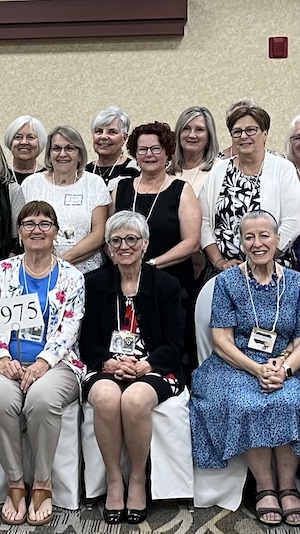
photo - Gerri Klein (centre, seated) with some of her graduating colleagues at the 50th anniversary of the Winnipeg Health Science Centre School of Nursing
Gerri Klein (centre, seated) with some of her graduating colleagues at the 50th anniversary of the Winnipeg Health Science Centre School of Nursing. (photo from Gerri Klein)

Gerri Klein recently celebrated 50 years as a nurse! She was part of the first nursing class from the Winnipeg Health Science Centre School of Nursing.

During her career, Gerri, who now has a master’s in nursing (2003, University of British Columbia), has been honoured with the Canadian Diabetes Educator of the Year Award in 2020 and a Nurses and Nurse Practitioners of BC 2023 Nursing Award of Excellence: Excellence in Advancing Nursing Knowledge and Research. She currently works as a diabetes educator at BC Diabetes in Vancouver.

* * *

photo - Dr. Aaron Klein
Dr. Aaron Klein (photo from Gerri Klein)

Aaron Klein graduated from the University of Toronto with a doctor of philosophy, aerospace studies, department of mechanical and industrial engineering, on June 17, 2025. Aaron, who is working and living in Toronto, stays busy raising his young family with his wife Carolyn.


Posted on July 25, 2025July 24, 2025Author Community members/organizationsCategories LocalTags anniversaries, Chantel Parsons, David Bercovici-Artieda, Gerri Klein, Holocaust, Holocaust Theatre Production Society, Keith Morgan, Kron Sigal Award, Leo Awards, Life Fellow Award, milestones, Sidi Schaffer, survivors, Vancouver Holocaust Centre Society, VHEC, Wendy Cocchia, Winnipeg Health Science Centre School of Nursing
A childhood spent on the run

A childhood spent on the run

Survivor Miriam Dattel, right, with the Vancouver Holocaust Education Centre’s Ellie Lawson at the Yom Hashoah commemoration April 23. (screenshot)

Miriam Dattel was born Branka Friedman, in September 1940, in the Croatian city of Zagreb, then part of Yugoslavia. She was about six months old when the Nazis invaded and her family began a life in hiding. Fleeing ahead of the Nazis and their collaborators, the family survived together through a series of close calls, lifesaving tips from compassionate officials, luck, determination and exhausting treks through the wilderness in search of refuge.

Dattel shared her family’s story at the annual Yom Hashoah commemoration at Temple Sholom on April 23.

Upon invading Yugoslavia in April 1941, the Nazis, aided by their Croatian fascist Ustaše collaborators, immediately instituted the Nuremberg Laws and set up the first concentration camps in Yugoslavia. Dattel’s father and uncle were thrown out of the university and all Jews were forced to don the yellow star – including on young Branka/Miriam’s baby carriage.

The family was set to flee to Budapest, where they believed they would find refuge with family. When the day came, the baby Branka was ill, so her grandmother, Irma Stern, was sent on ahead. It was the last time the family saw her. 

In her haste, the grandmother left behind her prayer book, which was her ubiquitous companion. Branka’s mother viewed the holy book as a fortuitous omen that all would be well in the end. At the commemoration last month, Dattel held the prayer book, now more than a century old and suffering the inevitable evidence of time. 

Eventually, the family fled – but not to Hungary. Branca/Miriam, her parents, Andor and Margita Friedman, and her aunt and uncle, Lili and Fritz, were transported with the help of a friend of her uncle’s southwest to the Croatian city of Split on the Adriatic coast. Sections of the city were controlled by the Italian fascists and others by the Croatian regime. 

One day, her father was tipped off by a high-ranking Italian officer that the Croatians were preparing to deport Jews from the areas of Split they controlled. He returned home in the middle of the night and evacuated the family to the Italian side. Eventually, the family’s race against fate continued, with a journey under false identities by ship to northern Italy.

“In 1943, when eventually Mussolini was finished, the Germans took over,” Dattel said in a video at the ceremony. Again, her father was tipped off by an Italian official, who warned him to disappear. 

“From then on, from what I saw in my father’s diary, we went through 18 different hiding places,” she said, noting assistance from underground operatives.

As a child forced to race from one place to another, few distinct memories remain. However, in various barns where they took refuge, people would roast chestnuts and that remains an evocative taste-memory for her.

Ovaltine is another. And it is a flavour from the very moment that may have saved the life of Miriam and her family.

The group – now six with the addition of her newborn cousin Gerardo – had made their way through northern Italy, around Lake Como and toward the Swiss border. After walking for hours, crossing under fences and trudging through difficult terrain, they came to the frontier of Switzerland.

“There were two Swiss border guards there,” said Dattel. “They said the border is closed. And my father said, impossible, you are not going to let two kids be killed. My recollection is this Swiss soldier [with] a German Shepherd coming towards me, lifting me up and carrying me to the station, to the border house.”

There, the guard gave her Ovaltine and, while she has tried to recreate the flavour, it has never tasted the same.

The family members were placed in refugee camps, Miriam separated from her parents. In Switzerland, the family lived out the war, returning to Zagreb afterward before Miriam and her parents made their way to Israel. 

About 1.5 million Jewish children were murdered in the Holocaust. Miriam was one of an estimated six to 11% who survived. In addition to the video screened at the event, Dattel spoke on stage with Ellie Lawson, the Vancouver Holocaust Education Centre’s education manager.

Claire Sicherman, a granddaughter of survivors, was the third-generation descendent speaker. She spoke of being consumed by grief in early life and growing up in a family filled with silences. (Sicherman shared her story of trauma and recovery earlier this year. See jewishindependent.ca/healing-trauma-possible.)

Hannah Marazzi, acting executive director of the VHEC, noted that this year marks the 82nd anniversary of the Warsaw Ghetto Uprising, a symbol of defiance in the face of annihilation. In addition to remembering the millions of lives lost and the resilience of survivors, she said, “We remember the young Jewish fighters who rose up against the Nazis and whose courage continues to inspire us to stand against oppression in all of its forms.”

Rabbi Carey Brown, associate rabbi of Temple Sholom, welcomed attendees to the synagogue and reflected on the past’s lessons for the present.

Dr. Abby Wener Herlin, associate director of programs and community relations for the VHEC and a member of the third generation, introduced survivors, who lit candles of remembrance.

Cantor Shani Cohen chanted El Moleh Rachamim, the memorial prayer for the martyrs.

Wendy Bross Stuart was responsible for musical direction and arrangement, and played piano. Eric Wilson played cello. Cantor Michael Zoosman, Erin Aberle-Palm, Matthew Mintsis and Lorenzo Tesler-Mabe sang.

As is traditional, the annual ceremony ended with the singing of “Zog Nit Keynmol,” “The Partisan Song.” 

Format ImagePosted on May 9, 2025May 8, 2025Author Pat JohnsonCategories LocalTags Claire Sicherman, history, Holocaust, Miriam Dattel, second generation, speakers, survivors, VHEC, Yom Hashoah
Healing trauma possible

Healing trauma possible

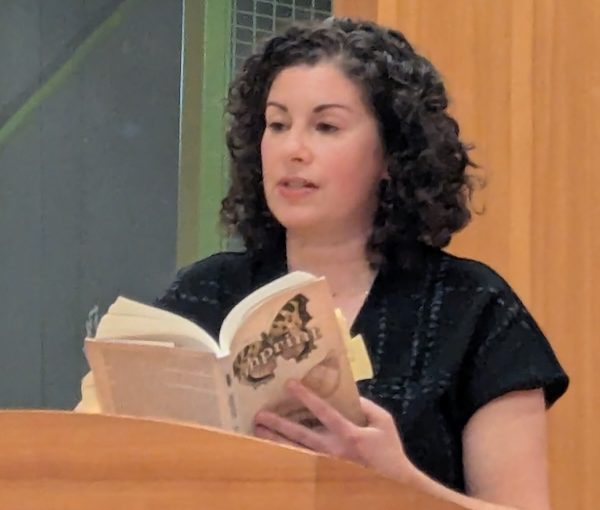
Claire Sicherman read from her book Imprint, about intergenerational trauma, at UBC Hillel on Jan. 21. (photo by Pat Johnson)

Understanding of intergenerational trauma has expanded in recent decades. Two granddaughters of Holocaust survivors discussed the larger phenomenon and their personal experiences recently at the University of British Columbia’s Hillel House, part of Hillel’s Holocaust Awareness Week. 

Claire Sicherman, author, workshop facilitator and trauma-informed somatic writing coach, shared her experiences and read from her book, Imprint: A Memoir of Trauma in the Third Generation, which was published in 2017. She was in conversation with Dr. Abby Wener Herlin, associate director of programs and community relations at the Vancouver Holocaust Education Centre, which co-sponsored the Jan. 21 event with Hillel BC.

Sicherman attributed to psychologist Dr. Arielle Schwartz the definition of intergenerational trauma as the ways in which the unresolved experiences of traumas, losses and griefs of one generation can become a legacy that is passed down to the next generation. 

“In other words,” said Sicherman, “the experiences of my grandparents are passed down through my parents to me.”

In addition to the “nurture” component of family legacies, there is the “nature” component of epigenetics, which Sicherman described as “the study of how genes turn on and off in response to environmental change.”

“I’ve heard it talked about like it’s sort of like light switches switching on and off in the body,” she explained. “Whatever switches switched on for my grandparents would then be switched on, passed down to my parent, passed down to me.” 

Experts in the field say it’s not a biological prison, Sicherman said. “They are actually malleable, so what you’re born with, you are not necessarily stuck with. We do have the ability to change certain things. There is hope in that.”

Growing up, Sicherman knew little or nothing about inherited trauma.

“When I started reading about it, I began to understand that what was going on with me wasn’t really my fault or that it wasn’t really something wrong with me,” she said. “It was just that I was carrying this huge thing.”

Reading excerpts from her book, Sicherman recounted being “disconnected from my body.” The inherited trauma manifested as a nervous system on overdrive and a tendency to hypervigilance. She was always ready to bolt out the door, looking for exit signs, aware of potential dangers, unable to fully rest, and prone to stress and anxiety.

She said that untold stories often pass more powerfully from generation to generation than stories that are recounted.

“When you think about that,” said Sicherman, “it’s what we don’t talk about that has more weight. It’s the silence. It’s the secrets.… That’s why it’s also important to me to speak out about these things, because it’s healing that goes across generations.”

Her survivor grandparents thought they were protecting their children through silence, Sicherman said. In response, the second generation learned not to ask questions.

There were other silences. In addition to the limited discussion around the Holocaust, Sicherman did not learn until well into her own adulthood that, when she was 4 years old, her grandfather had taken his own life, and not died of a heart attack, as she had been led to believe.

As someone who writes about and works with others on issues of healing intergenerational trauma, she urges people to embrace the totality of what they have inherited.

“Aside from trauma, what are the legacies that your ancestors bring to you?” she asked. “What are the gifts? What are the strengths? That’s also an important question to ask yourself, and a way of connecting with Jewish heritage. What are the strengths of your lineage? Is it survival? Is it tenacity? Is it humour? Is it creativity? Those are questions that you can ask yourself.”

Her son, Ben Sicherman, a UBC student, was present and also spoke of his family’s legacy of trauma. He described struggling with anxiety when he was younger and learning mechanisms for addressing issues through his parents’ modeling. He also spoke of carrying the legacy of his ancestors in ways like choosing 18 as his hockey number, not only because it represents chai, life, but because the numbers on his great-grandmother’s Auschwitz tattoo added up to the number 18.

Intergenerational trauma is a major component of her life’s work, said Sicherman.

“I do feel a sense of obligation, as a third generation,” she said. “But I also feel like this is part of my calling, too. It’s very meaningful. It’s an obligation that is not homework. It’s part of what I was set out to do.” 

Format ImagePosted on February 14, 2025February 13, 2025Author Pat JohnsonCategories LocalTags Claire Sicherman, health, Hillel House, Holocaust, Holocaust Awareness Week, Imprint, intergenerational trauma, mental health, second generation, survivors, third generation, trauma, VHEC
New podcast launched

New podcast launched

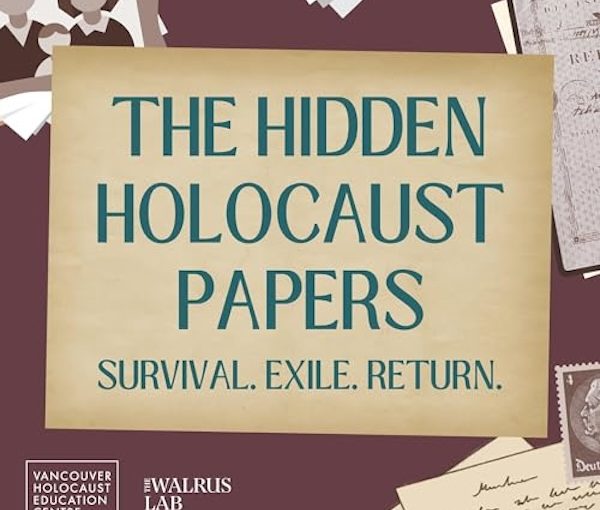
On International Holocaust Remembrance Day, Jan. 27, the Vancouver Holocaust Education Centre (VHEC) and the Walrus Lab launched The Hidden Holocaust Papers: Survival. Exile. Return.  The six-part documentary podcast, hosted by best-selling Canadian author Timothy Taylor, offers a personal exploration of his family’s hidden Holocaust history. 

Through the series, VHEC furthers its mission of Holocaust education and remembrance by supporting stories that bring the realities of the Holocaust to new audiences. Taylor’s journey of discovery is not only an act of personal reconciliation but also a vital contribution to preserving the memory of Holocaust victims and survivors for future generations.  

As Taylor unpacks long-forgotten family archives, the series takes listeners on an emotional journey from his home in Vancouver to Germany, revealing a tapestry of stories about survival, resilience and loss. Alongside his search for answers, Taylor reflects on the universal lessons of justice, remembrance and identity in the face of historical atrocities.  

“The Holocaust isn’t just a chapter in history – it’s a call to action to remember, educate and prevent future acts of hatred and genocide,” said Hannah Marazzi, acting executive director of VHEC. “We are honoured to work with Timothy Taylor to amplify his family’s story and underscore the importance of safeguarding these narratives.”  

In conjunction with the podcast, Taylor’s accompanying feature article, “Paper Trail,” will be published in The Walrus in May; it was made available online on Jan. 27. The article is an account of Taylor’s journey to instal Stolpersteine memorial stones for his family members who suffered under Nazi persecution. 

For more information and to listen to the trailer, visit lnkfi.re/thehiddenholocaustpapers. 

– Courtesy Vancouver Holocaust Education Centre

Format ImagePosted on February 14, 2025February 13, 2025Author Vancouver Holocaust Education CentreCategories LocalTags history, Holocaust, International Holocaust Remembrance, podcasts, The Walrus, the Walrus Lab, Timothy Taylor, Vancouver Holocaust Education Centre, VHEC
Krell families give to JWest

Krell families give to JWest

The Krell, Lewis, Kallner and Singerman families are excited their gift will help in the creation of an expanded Vancouver Holocaust Education Centre. (photo by Rachel Topham)

The JWest capital campaign cabinet is grateful to Dr. Robert and Marilyn Krell and their families, Shoshana and Shawn Lewis, Simone and Howard Kallner, and Michaela and Matthew Singerman, for supporting the redevelopment of the Jewish Community Centre of Greater Vancouver site. The individual gifts from each of the four couples reflect two generations equally committed to building a strong Jewish future in Vancouver.

The Krell family has deep roots in Vancouver. Marilyn’s Polish grandfather, David Davis, who arrived in 1909, was one of the founding members of Congregation Schara Tzedeck. Robert, born in Holland, was hidden during the Holocaust and, after reuniting with his parents, arrived in Vancouver at age 10, in 1951. Both Robert and Marilyn were influenced by their parents’ involvement in the synagogue and a variety of Jewish organizations.

“Vancouver is where I became a Jew,” said Robert, who participated in Habonim as a child and became actively involved with the Canadian Jewish Congress as an adult. In 1971, he and Marilyn were married by Rabbi Marvin Hier, who was Schara Tzedek’s rabbi at the time. The couple raised their three daughters, Shoshana, Simone and Michaela, in a traditional Jewish home where Shabbat was always celebrated. The Jewish values that began at home were reinforced at Vancouver Talmud Torah, Camp Hatikvah and at the JCC. 

Robert, a founder of the Vancouver Holocaust Education Centre (VHEC), mobilized the survivor community from a concept in 1983 to a reality in 1994, when the centre opened as a museum and educational institute that ignited Shoah learning in British Columbia and beyond. The Krell daughters grew up witnessing the VHEC board meetings in their living room and attending award ceremonies that recognized their parents’ contributions to a variety of Jewish organizations.

“Through their actions and deeds, they taught us that you give when you can and volunteer when you can,” Simone said.  

Now with children of their own attending local Jewish institutions, the Lewis, Kallner and Singerman families have assumed leadership roles in the VHEC, VTT, Schara Tzedeck, Jewish Family Services, Jewish Federation of Greater Vancouver and the Jewish Community Foundation. As they saw their parents’ commitment to support JWest, they knew they were also ready to answer the call to help build a new infrastructure to support the future of the region’s Jewish community.

“We are excited to contribute to such an important and pivotal project that will be utilized and cherished not just by future generations of our Jewish community, but of the greater community as well,” said Michaela.

Her sisters expanded that idea by saying, “The JCC has played a role for five generations of our family and it shapes many of our fondest memories.”

The family is excited that their gift will also assist in the creation of an expanded Vancouver Holocaust Education Centre, an institute close to their hearts and lives. Founded with a mandate of Holocaust-based anti-racism education, the VHEC welcomes more than 25,000 students, educators and members of the public each year.

While it plays a crucial role in conveying the ongoing relevance of the Shoah, this teaching museum has long been challenged by a small footprint and its limited visibility in the lower level of the JCC. JWest will protect the legacy of the VHEC by significantly increasing its square footage and visibility. The new VHEC will be visible from West 41st Avenue and will feature state-of-the-art exhibit space for permanent and rotating exhibits. It will also have dedicated research and programming space to facilitate workshops that enhance learning and engagement. Its prominent location in the JWest campus’s Arts & Culture Centre will ensure that the VHEC remains a vital presence in the community well into the future.

“The VHEC was at the forefront of our upbringing and experience and it’s a highlight to see it being incorporated as an important component of JWest,” Simone said.

Shoshana echoed those sentiments. “It’s exciting to envision the future JCC as a hub that will encompass so many important institutions,” she said. “We want a safe space to house our next generation of Jewish institutions, so there’s an urgency for us to support this project as a commitment to the future of our children, our grandchildren and the community at large.” 

Alex Cristall, chair of the JWest capital campaign, had this response to the gift: “With five generations of active involvement in Vancouver’s Jewish community, the Krell, Davis, Kallner, Lewis and Singerman families continue to demonstrate the depth of their commitment through their gifts and volunteerism. Their generous gifts to JWest will secure and revitalize our Jewish institutions and we are deeply grateful for their support of this project.” 

As one of the largest capital projects underway in Vancouver, JWest is only possible with the support of donors and the encouragement of the community. In the coming months, the JWest capital campaign cabinet will continue to update and advise community members on the campaign’s progress and on opportunities to contribute to its philanthropic goal of $161 million.

For a full list of JWest donors, visit jwestnow.com. 

– Courtesy Jewish Federation of Greater Vancouver

Format ImagePosted on December 13, 2024December 15, 2024Author Jewish Federation of Greater VancouverCategories LocalTags capital campaign, fundraising, JWest, Kallner, Krell, Lewis, philanthropy, redevelopment, Singerman, Vancouver Holocaust Education Centre, VHEC
Children in the Shoah

Children in the Shoah

Left to right: Abby Wener Herlin, Lise Kirchner, Dr. Nataliia Ivchyk, Prof. Richard Menkis and Al Szajman at the community commemoration of Kristallnacht Nov. 7. (photo by Rhonda Dent)

The experiences of three Vancouver women who survived the Holocaust as children in Ukraine were highlighted at the community commemoration of Kristallnacht Nov. 7.

The event, which took place at and was co-presented by Congregation Beth Israel, marked both the 86th anniversary of the Kristallnacht pogrom and the 30th anniversary of the founding of the Vancouver Holocaust Education Centre (VHEC), which presents the annual commemoration. The Jewish Federation of Greater Vancouver and the Robert and Marilyn Krell Endowment at the VHEC were co-presenters.

The keynote address was by Dr. Nataliia Ivchyk, associate professor in the department of political science at Rivne State University for the Humanities, in Ukraine. Ivchyk is a visiting scholar at the University of British Columbia and has been studying the narratives of child survivors in the province.

About 1.5 million Ukrainian Jews were murdered in the Holocaust, while another million managed to flee before or near the beginning of the German-Soviet war, Ivchyk said.

“Genocide is ruthless, regardless of age or gender, and children are a special group of its victims,” she said. “Since children cannot fight back against their killers, they become a helpless and vulnerable group. The Holocaust claimed six million Jewish lives, 1.5 million of which were tragically children. Age became a vital marker of life or quick death for children during World War II and the Holocaust. Children were not seen as a separate group of victims, they were dependent on their parents, fathers, mothers and relatives, and so suffered and died with them too.”

Ivchyk quoted Malka Pischanitskaya, who was 10 years old when the Germans invaded her town of Romanov (now Romaniv), in Ukraine.

“I was brought into this world not by chance but I believe by destiny,” Pischanitskaya has said. “My destiny was to be born, to endure the sufferings that were yet to come.”

“During the genocide,” Ivchyk said, “Malka had no choice but to become an adult in order to survive.”

Another local survivor whose story Ivchyk told is Ilana, who asked that her last name not be shared. Ilana was born in 1938, just two years before Germany invaded the Soviet Union. Her father managed to evacuate the family, including Ilana, her sister, her mother and her maternal grandparents, to a Central Asian republic of the Soviet Union.

“Unfortunately, my father’s parents stayed in Kyiv and perished in Babyn Yar,” Ivchyk quoted Ilana, referring to the mass killing site that has become synonymous with the genocide in Ukraine. On Sept. 29 and 30, 1941, more than 33,000 Ukrainian Jews were killed, part of the genocide in eastern Europe known as the “Holocaust by bullets.”

Ilana has only fragmentary memories of the evacuation years. However, she remembered her sister, who cared for her, and her mother, who tirelessly worked to provide food, said Ivchyk. 

A third local woman who survived is Esfira Golgheri.

“Esfira does not recall the journey from one ghetto to another, but she remembers her mother feeding her, which was crucial for her survival as an infant,” Ivchyk said.

“There is something that the Holocaust could not take away: memory, personal memories and stories of relatives and friends and our collective memory [that] remind us by honouring the memory of those who are no longer with us. Those who lost their lives and those who fought to defend us, we keep them alive in our hearts,” Ivchyk said. “The stories of these women are stories of childhood, family and survival in the face of genocide and displacement. Each narrative is unique and personal, yet the memories of Esfira, Malka and Ilana … are like pieces of a puzzle that help reconstruct this tragedy. In addition to piecing together the events of the war in Ukraine during the Holocaust, we have the chance to understand the tragedy through the eyes of these adult child survivors. We can touch their memories and experience their truth for ourselves.”

At the commemoration, Taleeb Noormohamed, member of Parliament for Vancouver Granville, brought greetings from the federal government.

“The fight against antisemitism is not one for Jews alone,” said Noormohamed. “Quite the opposite. It is a fight that all of us have to take on together.”

Nina Krieger, until recently the executive director of the VHEC and elected as member of the BC Legislature on Oct. 19, brought greetings from the provincial government. 

“I know the premier of British Columbia and my colleagues in government join me in gratitude for the Vancouver Holocaust Education Centre and Congregation Beth Israel for presenting this evening’s program to mark the 86th anniversary of Kristallnacht,” Krieger said.

Vancouver Mayor Ken Sim, accompanied by Councilor Lenny Zhou, presented a proclamation from the city marking Kristallnacht Commemoration Day.

Sim spoke of how his home had been recently vandalized and how many people at that evening’s event had expressed sympathy. 

“The Jewish community sees this all the time and I should really be asking you how you are doing,” he said. “I obviously loved the community before, but you’ve captured my heart even more.”

He said his presence at Jewish community events is not about politics.

“If everyone was against us, we would still have your back. We are still here because we stand for what’s right,” Sim said.

Lise Kirchner, director of education at the Vancouver Holocaust Education Center, spoke on behalf of acting executive director Hannah Marazzi, who was out of the province, read greetings from Prime Minister Justin Trudeau and acknowledged elected officials from all levels of government, including incoming and outgoing members of the BC Legislature.

“As we come together this evening to commemorate the 86th anniversary of the Kristallnacht pogrom, we contemplate the dangers not only of state-instituted persecution and violence, but maybe more importantly the dangers of indifference,” said Kirchner. “We are reminded of the consequences of antisemitism which is not publicly condemned, especially at a time when we have seen the proliferation of this most pervasive and pernicious form of hatred around the world, across the country and in our own backyards.”

Prof. Richard Menkis, associate professor of Jewish history at the University of British Columbia, contextualized Kristallnacht as a turning point between the legislated antisemitism of the Nazi regime, notably the Nuremberg Laws of 1935, and the murderous violence of the Holocaust.

“The persecutions during and immediately after Kristallnacht resulted in the deaths of at least 90 Jews, the destruction of hundreds of synagogues, the vandalization of thousands of Jewish businesses and the imprisonment of over 30,000 Jewish men in concentration camps and elsewhere,” said Menkis.

Al Szajman, president of the Vancouver Holocaust Centre Society board, emceed the evening. Abby Wener Herlin, associate director of programs and community relations at the VHEC and granddaughter of survivors, introduced Ivchyk. Rabbi Jonathan Infeld thanked Ivchyk and reflected on her remarks. Cantor Yaacov Orzech chanted El Moleh Rachamim. Holocaust survivors lit candles at the beginning of the commemorative event.

Ivchyk spoke movingly of being welcomed into the community during her time in Vancouver.

“Coming from a wartorn country myself, you accepted me, understood me, opened the doors of your community and your homes, creating an incredibly warm and family-like environment that gave me a home away from home,” she said. “You have entrusted me with your history and the history of your families and your childhood experiences that you have kept in silence for many years. Every time you shared your stories, I could feel the sadness and pain in your eyes. You still feel for those who were taken by the Holocaust.” 

Format ImagePosted on November 29, 2024November 28, 2024Author Pat JohnsonCategories LocalTags Beth Israel, commemoration, history, Holocaust, Kristallnacht, memorial, Nataliia Ivchyk, Ukraine, Vancouver Holocaust Education Centre, VHEC
Community milestones … Cowens, Federation, Doctor, Lane, Wolthuizen & Wosk

Community milestones … Cowens, Federation, Doctor, Lane, Wolthuizen & Wosk

Rabbi Dr. Eytan Cowen, his wife Rabbanit Caroline Sarah Bitton-Cowen and their family will take up the mantle of spiritual and rabbinic leadership at Congregation Beth Hamidrash. (photo from Beth Hamidrash)

Rabbi Dr. Eytan Cowen has agreed to become the next rabbi and spiritual leader of Congregation Beth Hamidrash and leader of the Vancouver Sephardi community.

The congregation is excited for Rabbi Cowen, his wife Rabbanit Caroline Sarah Bitton-Cowen and their family to join them and take up the mantle of spiritual and rabbinic leadership. The start date is yet to be determined, to best enable the family to navigate the challenges of moving to Vancouver from Toronto.

Cowen served as rabbi of Tiferet Israel Sephardic Congregation in Toronto from 2014 to 2017. He returned to his hometown, Toronto, from Indianapolis, where he served for two years as full-time rabbi of Etz Chaim Sephardic Congregation, a 100-year-old community.

Cowen pursued and completed his rabbinical studies at Rabbi Isaac Elchanan Theological Seminary of Yeshiva University and the Sephardic Rabbinical College of Rosh Kollel. In addition, he is a graduate of the University of Toronto with a double major in microbiology and Jewish studies, as well as four years of postgraduate study at the Canadian College of Naturopathic Medicine. He is a licensed naturopathic doctor, practising integrative medicine for the past 20 years, and endeavours to combine Torah and health.

Bitton-Cowen was born in Paris, France, with Sephardi heritage from Morocco and Tunisia. She is a graduate of Stern College and Sy Syms School of Business. She enjoys teaching others, sharing wisdom with women of the congregation, and is an accomplished certified professional accountant.

The rabbi and rabbanit are the proud parents of Eliyahu-Yaacov (23), Nissim-Nahum (21), Simcha-Mazal (20), Rivkah-Chaya (16), Efrayim-Menashe (13), Tehila-Adelle (9), Batsheva-Esther (6) and Batya-Emunah (4). They have one granddaughter, Sofia Adina (14 months).

* * *

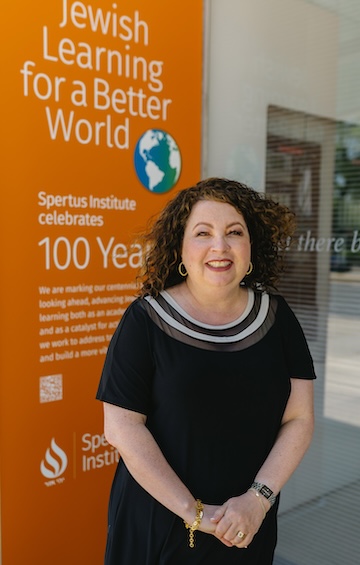
photo - Alexis Doctor received her master of arts in Jewish professional studies at Spertus Institute
Alexis Doctor received her master of arts in Jewish professional studies at Spertus Institute. (photo by Maggie Russo)

On May 5, Chicago-based Spertus Institute for Jewish Learning and Leadership awarded master’s degrees to 18 graduates who embody the vital Jewish tradition of learning, which grounds us in our history and equips us to face contemporary challenges.

Vancouver resident Alexis Doctor, director of member and guest services at the Jewish Community Centre of Greater Vancouver, is among this year’s graduates. She received a master of arts in Jewish professional studies, completing a creative leadership-building program designed to advance careers and strengthen the organizations students serve. 

“It’s something I will take with me for the rest of my life – the program has given me fresh new ideas to take back to my team,” said Doctor. “This has been one of the most challenging things I’ve ever done, but it’s also one of the most rewarding.”  

Spertus Institute, which was founded in 1924, is an institution of higher Jewish learning dedicated to real-world action. At its core are degree and certificate programs in which students engage with Jewish ideas in the service of personal growth, community leadership and professional advancement. These offerings, which merge theory and practice, educate Jewish professionals, community leaders and those who seek quality, reflection-driven scholarship. Those interested in becoming a future Spertus Institute graduate should visit spertus.edu for program and application information or contact assistant director of recruitment Amie Barrish at [email protected].

* * *

The Jewish Federation of Greater Vancouver’s 2023 annual campaign generated $10.3 million for the community, thanks to the generosity of some 2,500 donors.

As a result of this year’s $10.3 million total, Federation will be able to provide crucial stability to its more than 30 partner organizations by ensuring that they can count on funding that helps fuel their important front-line work. Plus, they will be able to access additional funding through grants for programs and services that deliver on the strategic priorities for the community.

An additional $1.25 million in funding directed to special projects was also raised, as was $20.4 million through Federation’s Israel Emergency Campaign (IEC).

In addition to addressing immediate needs after the Oct. 7 Hamas attack on Israel, the IEC allocation committee, chaired by Stephen Gaerber, is committed to addressing the medium- and long-term needs of Israelis who continue to be affected by the ongoing war and hostage situation.

* * *

The Vancouver Holocaust Education Centre has presented the 2024 Meyer and Gita Kron and Ruth Kron Sigal Award for Excellence in Holocaust Education to Ben Lane (Collingwood School) and Mike Wolthuizen (Rutland Senior Secondary School). Both have demonstrated exceptional commitment to Holocaust education throughout their careers and have significantly impacted their students, colleagues and school communities.

The Kron Sigal Award was established in memory of Meyer and Gita Kron and their daughter Ruth Kron Sigal, Lithuanian Jewish survivors of the Holocaust who re-established their lives in Vancouver. Through their lifelong involvement with education and community, the family touched the lives of thousands of students. 

photo - Ben Lane
Ben Lane (photo from vhec.org)

During his tenure at Collingwood School in West Vancouver, Lane led the development of a comprehensive Holocaust education program at the school. He created classroom resources and lesson plans and implemented school-wide events, commemorative programming and co-curricular opportunities for students, colleagues and the community to engage with the history of the Holocaust.

An alumnus of Yad Vashem’s International School for Holocaust Studies, Lane’s approach to Holocaust education demonstrates creativity, depth of knowledge in subject matter and pedagogical quality. This is reflected in his bespoke lesson plans and robust teaching materials, which combine engaging history lessons with innovative project-based learning. These allow students to navigate complex issues of antisemitism, genocide and the legacies of the Holocaust with accuracy, sensitivity and a sense of responsibility for the subject matter.

Exposing students to primary sources of Holocaust history has been a priority for Lane, and he regularly incorporates VHEC programs into his curriculum through exhibition tours, workshops and survivor outreach speaker engagements. As well, he has facilitated a co-curricular student group to participate in the Dora Love Prize, a Holocaust education program sponsored by the University of Essex. For the past three years, this student group has engaged with scholars and survivors internationally and produced innovative projects annually to raise awareness of the Holocaust and human rights.

photo - Mike Wolthuizen
Mike Wolthuizen (photo from vhec.org)

Wolthuizen teaches Genocide Studies 12 and Social Studies 10 at Rutland Senior Secondary School in Kelowna. He has been instrumental in advancing Holocaust education in the Central Okanagan School District, where he recently co-developed Holocaust 12: Beyond the Shoah, a social studies elective course to be introduced into classrooms in September 2024.

Colleagues, administrators and students attest to Wolthuizen’s thoughtful and innovative teaching approach, which creates a supportive environment for students to express their thoughts and critically analyze events in Holocaust history. He fosters meaningful discussions and ethical reflections on human choices. Through exposure to survivor testimony and primary sources, he cultivates in his students an appreciation for the stories of the individual. One student shared:

“Because of his teaching, one of my key takeaways from the course was the importance of the stories of individuals that were impacted by the Holocaust and other genocides, rather than just statistics. When learning from him, it became very evident that he cares so much about each individual and their rights, and that their stories hold an immense amount of power and importance when discussing the Holocaust.”

Also an alumnus of Yad Vashem’s International School, Wolthuizen has attended dozens of workshops and conferences, locally and internationally, to enhance his knowledge of Holocaust study. He has shared this knowledge and expertise beyond his own community, leading professional development programs and teaching in multiple school districts as a guest lecturer on Holocaust history.

* * *

photo - Becky Wosk is the winner of the 2024 Earl Parker Award for Jewish Film, an honour given by the Edmonton Jewish Film Festival
Becky Wosk is the winner of the 2024 Earl Parker Award for Jewish Film, an honour given by the Edmonton Jewish Film Festival. (photo from Becky Wosk)

Becky Wosk is the recipient of the Edmonton Jewish Film Festival’s 2024 Earl Parker Award for Jewish Film. The $1,500 award will go towards Wosk’s production of a documentary on Jewish identity and how we are all connected.

Wosk is a directing student at Langara College in the film arts program. She has been immersed in the arts since a very young age and is a multidisciplinary artist and performer – her band Hollow Twin recently released a new LP on vinyl and digitally.

Wanting to gain more technical skills and hands-on experience in directing, to make music videos for her and other bands, as well as documentaries and shorts, Wosk applied to the Langara film program. It was her instructor who sent her the application to the Earl Parker award for a Jewish-related film project. Wosk’s pitch was One Thread.

One Thread is a documentary-style short that will be filmed in Vancouver. Interviewees will range from age 18 to 99+, including Holocaust survivors.

“I see this potentially becoming a series that can eventually be all tied together spanning globally to see how, regardless of where we live, our backgrounds, we are one people – a tribe of resilient humans who have overcome all odds to be here today. A look at the diversity of the diaspora and how we all have one common thread,” wrote Wosk in her submission. “The participants will not be limited by religious sect, as I want the overarching theme to be our DNA, not necessarily religion – but I would like to touch on customs and traditions within the interviews.”

Wosk is hoping to incorporate klezmer music and archival photos from various sources into the film. She will be putting a call out soon for interviewees of all ages, genders and backgrounds who identify as Jewish. The filming will take place this fall.

Format ImagePosted on June 28, 2024June 27, 2024Author Community members/organizationsCategories LocalTags Alexis Doctor, annual campaign, Ben Lane, Beth Hamidrash, Caroline Sarah Bitton-Cowen, Eytan Cowen, Jewish Federation, Kron Sigal Award, Mike Wolthuizen, Spertus Institute, Vancouver Holocaust Education Centre, VHEC
Victoria’s Walk to Remember

Victoria’s Walk to Remember

On May 25, members of the Rwandan community in Victoria held a Walk to Remember, in memory of the victims and in solidarity with the survivors of the 1994 Rwandan genocide. (photo from Victoria Rwandan community)

This spring, members of the Rwandan community in British Columbia have been commemorating the 30th anniversary of the Rwandan genocide. On May 25, a group in Victoria held the Walk to Remember in memory of the victims and in solidarity with the survivors of the 1994 genocide, also known as the genocide against the Tutsi. 

Afterwards, a ceremony was held at Camosun College’s Gibson Auditorium. Throughout the event, called Kwibuka30, speaker after speaker, most of whom told their stories in Kinyarwanda, the national language of Rwanda, recalled members of their immediate families who were killed during that horrific period. (Kwibuka is the word for “remember” in Kinyarwanda.)

In the organizers’ words, the event was intended to offer “blessings for continued courage and resilience to remember and unite,” and express their desire to “renew our resolve to pursue the transformation of tragedy into triumph.”

Anselme Hategekimana, one of the leaders of the Rwandan community in Victoria, stressed the importance of remembering. “Remembering is an expression of an enduring love for those we’ve lost during the genocide against the Tutsi. Remembering makes us better citizens, as we do everything we can to combat hate speech, exclusion and any type of discrimination.”

Among those in attendance were the children – many of whom are now in their late teens and early 20s – of Rwandan genocide survivors. Hategekimana said he and other survivors were encouraged to see young people take leadership in the march and commemoration.

“Due to social media, young people are now more informed and can understand the consequences of bad governance and intolerance,” he said. “These young people are the leaders of tomorrow, and we are pleased to see more and more engaged young people for the cause of peace and understanding.”

From April 7 to July 19, 1994, Hutu militias in Rwanda killed members of the Tutsi minority. Hundreds of thousands of people were massacred – estimates vary from 500,000 to more than one million – in a 100-day period, which also included the killing of moderate Hutus and members of the Twa population.

The killings were preceded by decades of stigmatization, marginalization and dehumanization and fueled by hate speech. By the early 1990s, Rwanda’s population was 85% Hutu and 14% Tutsi. At the time, Hutu extremists within Rwanda’s governing elite blamed the Tutsis for the country’s social and economic problems. 

In October 1990, civil war broke out when a Tutsi rebel group, the Rwandan Patriotic Front, invaded the country from Uganda. Extremist Hutus held the Tutsis in Rwanda responsible for supporting rebel forces from another country.

The civil war, which ended with the signing of a peace agreement in August 1993, did not appease the anger of extremist Hutus, who took to the airwaves to dehumanize the Tutsis further, referring to them as “cockroaches.”

In April 1994, a plane carrying Rwanda’s president, Juvénal Habyarimana, a Hutu, was shot down by a missile as it tried to land in Kigali, the country’s capital. Though it is unknown which group fired the missile, extremist Hutus used the downing of the plane as a reason to massacre Tutsis. Militias, equipped with machetes and trained by the Rwandan government, launched a killing spree – which to this day still shocks because of its rapidity and size – taking the lives of thousands of people each day.

Though some schools in British Columbia cover the Rwandan genocide, Hategekimana believes it would be beneficial to incorporate the subject in the high school curriculum to educate youth to be more tolerant and learn from the tragedy.

“Having a memorial monument dedicated to the victims of the genocide against the Tutsi will also help educate more Canadians,” he said.

Thirty years later, Rwanda, geographically one of the smallest countries in Africa, stands out as a model of prosperity, with one of the fastest-growing economies on the continent. A post-genocide government pursued a policy of “unity and reconciliation” and maintained a focus on economic growth.

As Hategekimana sees it, Rwanda had hit its lowest conceivable point and the only choice was to rebuild and rise. He credits Paul Kagame, the president of Rwanda since 2000, for being a visionary leader who came at a crucial time.

“Paul Kagame has been God-given. You may like him or not, but what he has done for Rwanda is indisputable: the empowerment of women, free health care, anti-corruption measures, peace and economic prosperity. Rwandans see themselves as capable citizens able to take their future in their own hands,” Hategekimana said.

Today, tourism in the country is booming, including luxury hotels, and the #visitrwanda hashtag even appears on the jersey of English soccer powerhouse Arsenal. Kigali boasts a new convention centre and a new stadium to host professional basketball games.

Tech startups have also abounded, as has collaboration with Israeli companies. Netafim, a Tel Aviv-based precision irrigation firm, has teamed with the Rwandan government to develop farming in land that was previously unsuitable for agriculture. In 2014, Israel’s Energiya Global invested in a solar power plant project in Rwanda. 

Regarding the horrors of 1994, Nina Krieger, the executive director of the Vancouver Holocaust Education Centre (VHEC), offered these words to the Independent, “As we mark the 30th anniversary of the genocide against the Tutsi in Rwanda, we reflect on the significance of bearing witness to atrocities and the enduring power of survivor testimony. 

“At the VHEC, we understand the critical role these narratives play in educating future generations and preventing such horrors from reoccurring. The resilience and courage shown by the survivors of the Rwandan genocide inspire us to continue our mission of Holocaust education, underscoring the universal necessity of compassion, remembrance and the commitment to justice.” 

In the 2022 commemoration of Kristallnacht presented by the VHEC at the Jewish Community Centre of Greater Vancouver, keynote speaker Liliane Pari Umuhoza, a child survivor of the Rwandan genocide, told the crowd it was important to remember what happened, to preserve the memories of victims and survivors for future generations. 

Umuhoza added it was crucial to learn from history and create awareness. Yet, she continued, it was not enough.

“What matters the most is how we use that history to create a better world,” she said. “It’s our duty, not only to remember but also to remember with purpose.” 

Sam Margolis has written for the Globe and Mail, the National Post, UPI and MSNBC.
Format ImagePosted on June 14, 2024June 13, 2024Author Sam MargolisCategories LocalTags Anselme Hategekimana, commemoration, education, genocide, genocide against the Tutsi, Nina Krieger, Rwanda, Rwandan genocide, Vancouver Holocaust Education Centre, VHEC, Victoria
Danish rescue at 80

Danish rescue at 80

At the Nov. 9 Kristallnacht commemorative event, left to right: Dr. Janus Møller Jensen, Nina Krieger, Prof. Chris Friedrichs and Abby Wener Herlin. (photo by Rhonda Dent)

The rescue of Danish Jews during the Holocaust – an operation that mobilized almost the entire strata of Denmark’s population – is one of the bright lights in the history of that dark era. That extraordinary event, which took place 80 years ago last month, is one of the reasons Denmark had one of the highest survival rates of any country during the Shoah. Even this uplifting story, though, has its “shadows,” according to an expert who spoke in Vancouver Nov. 9.

Dr. Janus Møller Jensen, an historian and director of the Danish Jewish Museum, was the keynote speaker at the annual community-wide Kristallnacht Commemoration, presented by the Vancouver Holocaust Education Centre and held at Beth Israel Synagogue.

Denmark has an unusual history in the context of Nazi occupation. After the Nazis invaded the country with minimal opposition, in April 1940, politicians and the king, Christian X, surrendered, but managed to negotiate terms that allowed the Danish democratic system of government to continue in a so-called “peace occupation.” Importantly, one of the Danish demands was that no Dane be singled out according to their race or faith, said Møller Jensen.

This status quo fell apart in 1943, after a series of strikes and uprisings around the country. Amid the Nazi crackdown came rumours at the end of September that an action against Danish Jews was imminent. At the same time, word spread that Sweden was prepared to accept Danish Jews as refugees. A mobilization of fishing boats began – as did the Nazi mobilization – in early October. Up and down the coast of Denmark, small and larger boats carried their cargo of Jewish Danes across the straight to neutral Sweden. In all, an estimated 7,220 Jews and 686 non-Jewish spouses were transported. Of all Danish Jews, 472 were captured by the Nazis and transported to Theresienstadt, in present-day Chechia, a waystation to the extermination camps. Of these, all but 53 survived the war, in part because the Danish government persuaded the Nazis to allow food and medicine packages to be delivered to the Danish inmates.

Another stunning reality was that, when the Danish Jews who survived – estimates of survival range from 95% to 99% – returned to Denmark, almost all found their homes and possessions intact – a stark difference from what Jews elsewhere in Europe discovered if they returned to their places or origin.

Not all of Danish history is so bright for Jews, said Møller Jensen. A long history of Catholic and Lutheran theological antisemitism permeates Denmark, and immigration policies before the Second World War prevented many Jews from elsewhere from reaching refuge.

“We have letters of refusal in our collection, of people who we know later died in the camps,” said Møller Jensen.

In addition, Danish companies and agricultural producers provided materials to the German war effort, although this was required of all occupied countries, he noted.

Not all rescuers acted on altruistic motives, either, Møller Jensen added. Some fishers took money to transport Danish Jews, but he also noted that, while hindsight suggests the Nazi occupiers turned something of a blind eye to the rescue operation, those involved at the time did not know this and would likely have assumed they were risking their lives.

photo - BC Premier David Eby spoke at the Kristallnacht event
BC Premier David Eby spoke at the Kristallnacht event. (photo by Rhonda Dent)

In addition to the hands-on rescue, Danish society rose up against the Nazis’ action. “Organizations from the entire strata of society – doctors, professors, students, lawyers, industries, working unions – protested,” he said. “The Danish church promulgated a so-called ‘Shepherd’s Letter’ to be read aloud in all of the churches in Denmark the following Sunday, stating that this was an unchristian act, that all people were the same in the eyes of God and that this was wrong and the congregation should assist and protect their fellow human beings…. One of the priests remembered, having read the letter aloud, that the entire congregation spontaneously rose to its feet and shouted ‘Yes!’”

Beth Israel’s Rabbi Jonathan Infeld thanked Møller Jensen and reflected on his words.

“The Danish people,” he said, “did exactly the opposite of what happened in Poland. When the Jews came back to Poland, they were murdered and their property was stolen, and when the Jews came back to Denmark, dinner was waiting for them on their tables. That is righteousness.”

BC Premier David Eby spoke at the Kristallnacht event, saying he wanted to provide assurances that all parties in the Legislature are committed to ensuring that the Jewish community in British Columbia is protected from antisemitism and feels safe. He acknowledged the proximate anniversaries of Kristallnacht and Remembrance Day, and noted that his government had just announced that Holocaust education will become mandatory in the BC school system.

“The thing about remembering is you can’t remember something you’ve never learned, you can’t remember something you were never taught,” Eby told the audience. “I’m proud to stand with you, to support your community, to stand against antisemitism, to stand against Islamophobia, to stand against all forms of hate, for British Columbia to be a beacon of hope in the world of what is possible at a time when those who want to promote division and hate seem to be on the rise just about everywhere. We have lots to be proud of in this province and part of what I’m incredibly proud of is the strength of our Jewish community here and I’m very honoured to be with you here this evening.”

Before the keynote address, Prof. Chris Friedrichs, emeritus professor of history at the University of British Columbia, contextualized Kristallnacht and called the Danish rescue “the most spectacular episode of rescue in the entire history of the Shoah.”

The Kristallnacht gathering was presented in conjunction with Congregation Beth Israel and funded by the Jewish Federation of Greater Vancouver, with support from the Robert and Marilyn Krell Endowment Fund of the VHEC. Møller Jensen’s visit was facilitated by Norman Gladstone and Birgit Westergaard.

Corinne Zimmerman, president of the board of the VHEC, introduced a procession of Holocaust survivors, who carried memorial candles. Nina Krieger, executive director of the VHEC, opened the event and read greetings from Prime Minister Justin Trudeau. Cantor Yaacov Orzech recited El Moleh Rachamim. Councilor Sarah Kirby-Yung read a proclamation from the City of Vancouver. Taleeb Noormohamad, member of Parliament for Vancouver Granville, sent video-recorded greetings from Ottawa. BC cabinet ministers Selina Robinson and George Heyman were in attendance, as was Michael Lee, member of the Legislative Assembly for Vancouver-Langara.

The event drew a record crowd, according to organizers, of 420 in-person attendees and an additional 120 watching via livestream, including groups at the Louis Brier Home and Hospital and the Weinberg Residence.

Format ImagePosted on November 24, 2023November 23, 2023Author Pat JohnsonCategories LocalTags Denmark, history, Holocaust, Janus Møller, Kristallnacht, Vancouver Holocaust Education Centre, VHEC

Posts pagination

Previous page Page 1 Page 2 Page 3 … Page 10 Next page
Proudly powered by WordPress