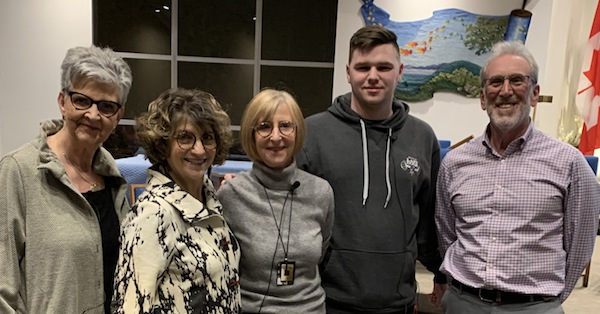
Community milestones … Roadburg Foundation supports Tikva Housing, Community Garden & more

Tikva Housing Society is thrilled to share that the Ronald S. Roadburg Foundation has provided a grant of $255,000 to support Tikva’s mission to offer affordable housing solutions to the Jewish community.

“A gift of this magnitude provides help and hope at a time when economic uncertainty is definitely impacting housing insecurity,” said Anat Gogo, executive director of Tikva Housing Society. “The Ronald S. Roadburg Foundation’s tremendous generosity means that we will have the financial resources to build capacity on an operational level. Tikva is on an unprecedented growth trajectory and this gift is critical to support our growing housing portfolio, allowing us to say ‘yes’ to a number of new opportunities on the horizon.”

The need for affordable housing continues to be first and foremost on the minds of many in the Jewish community. This gift will be put to work, empowering individuals and families by providing affordable housing – allowing them to build long-term change in their lives and beyond.

Tikva Housing Society is grateful to the Ronald S. Roadburg Foundation for its partnership in addressing the issue of housing insecurity. Tikva appreciates the foundation’s focus on strengthening the capacity of the community’s organizations and its commitment to tikkun olam, repairing the world.

* * *

Vancouver Talmud Torah, Congregation Beth Israel and Jewish Family Services are elated to share with the community that a gift of $100,000 has been received from the Ronald S. Roadburg Foundation to support the Vancouver Jewish Community Garden. This gift enables the building of the garden to begin in earnest and it is anticipated that construction will begin this fall. Thanks to the Jewish Federation of Greater Vancouver’s Transformation Grant and the Diamond Foundation, the garden will be located and built above the shared BI and VTT parkade.

The garden aspires to positively impact many members of the local Jewish community and to be a hub for celebrating and honouring nature, imparting Jewish teachings and values, promoting collaboration, and enhancing the community’s well-being. Studies show that spending time outdoors in nature has been directly linked with lessened anxiety and depression for adults and children alike and helps people better manage stress.

“It is exciting and encouraging to see several important communal institutions come together collaboratively to advance such a positive new opportunity. The Vancouver Jewish Community Garden will be an opportunity to teach community members of all ages about agriculture and the importance of a healthy earth, to enable volunteers to contribute to our community and to help feed those in need. The Ronald S. Roadburg Foundation is pleased to help advance the project towards completion,” noted Bernard Pinsky, Roadburg board chair.

* * *

Jewish Federation of Greater Vancouver is delighted to welcome two new members of its team: Gayle Morris and Alisa Farina.

Morris is the new director of the Federation annual campaign, the community’s central fundraising initiative. Building relationships is central to this role, and Morris brings an incredible depth of experience in that area, and so much more. She is an accomplished and multifaceted sales, marketing and business development leader who has extensive experience in both innovative startups and not-for-profit organizations. She is also an active member of the community with extensive volunteer involvement.

Farina has been hired as the child, youth and young adult mental health worker, and Federation is grateful to the Mel and Gerri Davis Charitable Trust for the support to enable the creation of the new position.

Farina holds a bachelor’s in child and youth care and comes to the job from a 25-year career with the Burnaby School District, the last 10 of which she focused on working with high-risk, vulnerable youth and their families. Farina is currently completing her master’s degree in clinical counseling. She grew up in the Lower Mainland and was involved with BBYO and Camp Miriam.

Tikva builds in accessibility

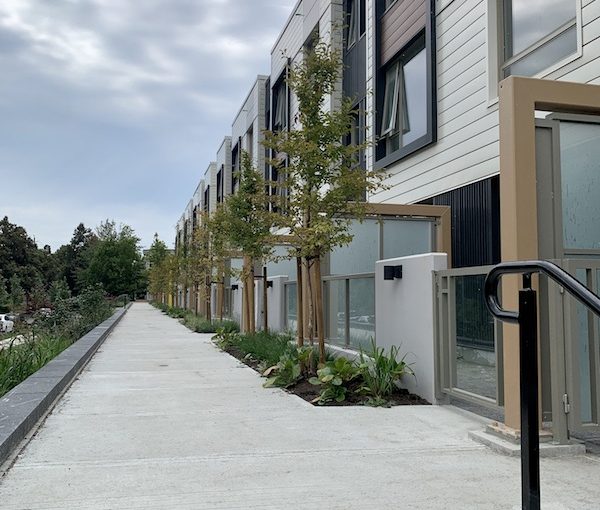
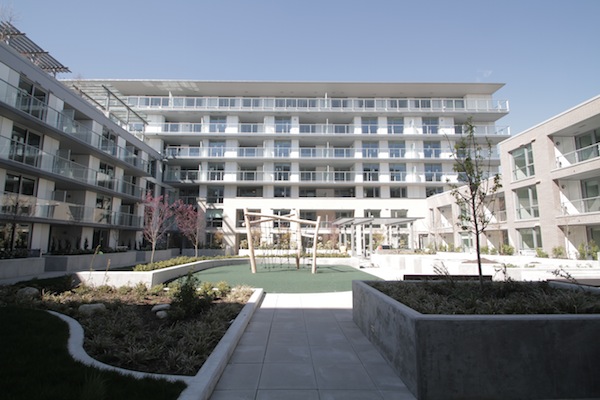
Dogwood Gardens, which is due to open later this year, features an open garden space with shading that is set off from the street. (photo by Lior Noyman Productions)

In October last year, Tikva Housing Society, in conjunction with YMCA Metro Vancouver and the Association of Neighbourhood Houses, opened Kerrisdale’s newest affordable housing project at Arbutus Centre. Named xwƛ̓əpicən (pronounced “hook la’pitzen,” Musqueam for “the Hollow”), the 125-unit project is designed to meet a vital need in one of Vancouver’s most exclusive and high-priced residential areas: affordable housing that is also universally accessible to anyone with a disability.

“[The new project] includes nine adaptable units that are designed for people with mobility challenges who do not need a wheelchair or walker,” explained Anat Gogo, who serves as Tikva’s manager of programs and donor relations. The nonprofit finds creative ways to increase affordable housing, primarily for Jewish low- to moderate-income families and individuals.

Adaptable units mean that individuals who have accessibility needs are able to have the unit modified to meet their individual requirements, whether it’s grab bars in the hallway, structural adaptations that make it easier to cook or special lighting for low-vision needs. Many apartment buildings don’t allow tenants to make structural modifications, even to accommodate disabilities. By offering a limited number of adaptable units, fully accessible apartments can be reserved for individuals who require a wheelchair-adapted unit. Tikva manages five such rentals at the Arbutus property.

photo - The Arbutus Centre project has units in which the kitchen counters and appliances are lowered to accommodate wheelchairs and walkers
The Arbutus Centre project has units in which the kitchen counters and appliances are lowered to accommodate wheelchairs and walkers. (photo from Tikva Housing)

Projects like the one at Arbutus Centre are reflective of Tikva’s vision of affordable housing. “We are committed to fostering inclusive housing that serves all populations within the community,” said Gogo. It’s a mission that continues to adapt to the increasing demand for affordable housing in Greater Vancouver’s Jewish communities.

One of the drivers for finding new ways to increase accessible housing is Vancouver’s aging population, noted Gogo. “It’s important to recognize that our aging baby boomers will benefit from enhanced accessibility for those with mobility challenges.”

But it also benefits families and individuals of all ages who face barriers in their day-to-day living, she added. According to Statistics Canada (2017), more than six million Canadians live with one or more types of disability. Invisible disabilities are among the most frequent conditions noted, with housing options constricted by accessibility barriers, discrimination and employment limitations.

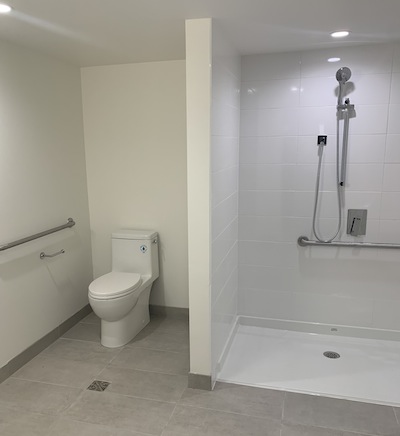
photo - An accessible bathroom features a roll-in shower and open design to accommodate walkers, wheelchairs and other mobility considerations
An accessible bathroom features a roll-in shower and open design to accommodate walkers, wheelchairs and other mobility considerations. (photo from Tikva Housing)

As a result, the B.C. Building Code now requires new and renovated buildings to be accessible to anyone with a disability, which includes “a person who has a loss, or a reduction, of functional ability and activity and includes a person in a wheelchair [or] a person with a sensory disability.” Adaptable housing that can be modified economically and at a later date is British Columbia’s newest technology to meeting that growing and variable demand.

According to Gogo, Tikva is exploring ways to ensure that accessible housing addresses all needs, including those associated with invisible disabilities, such as autism spectrum disorder, vision disorders, and autoimmune conditions like multiple sclerosis and rheumatoid arthritis. She said Tikva actively seeks partnerships with other organizations that can support that expanding effort. “We have a great partner in the Jewish Family Services that is open to this initiative,” she noted.

The society also regularly networks with builders to explore new ways of meeting that goal. She said improved designs include features like “well-ventilated spaces, soundproof walls, signage that makes all tenants and visitors to the building know that this is an inclusive building.”  Tikva also holds workshops and training for staff to help them engage with residents and stakeholders in the community.

The demand for accessible housing has also created new funding incentives that in turn will increase the amount of inclusive housing on the market. “Canada Mortgage and Housing Corporation is responsible for delivering [Canada’s] National Housing Strategy,” Gogo explained. The program offers reduced financing rates for nonprofits and developers whose housing developments comprise at least 20% of fully accessible units or universal design throughout the project.

“We take advantage of opportunities to advocate to all levels of government for special features to be included in design requirements that would improve quality of life for residents, including push-button door openers for accessible suites and amenity rooms, grab bars in all bathrooms, and wheelchair access to all outdoor amenity spaces,” said Gogo.

And Tikva is exploring ways to address other types of invisible disabilities, such as those triggered by environmental conditions. Gogo said the housing society is in the process of retrofitting one of its older buildings and is actively participating in the design stages. “We’re still in the very early stages of this planning,” she said, “but all considerations are on the table to create a living environment that would benefit our tenants no matter what their medical condition may be.… More research and public education would help build the case for those with invisible disabilities. Inclusive communities are those that recognize the diversity of our population, and that everyone deserves to have access to services, recreation and civic engagement.”

At the present time, three of the six properties Tikva operates have accessible housing. Dogwood Gardens, on 59th Avenue in the Marpole community, is due to open later this year, managed in joint cooperation with SUCCESS. For more information about available rentals, go to tikvahousing.org.

Jan Lee is an award-winning editorial writer whose articles and op-eds have been published in B’nai B’rith Magazine, Voices of Conservative and Masorti Judaism and Baltimore Jewish Times, as well as a number of business, environmental and travel publications. Her blog can be found at multiculturaljew.polestarpassages.com.

Accessibility seems improved

(image from flickr / Province of British Columbia)

Last November, the American advocacy organization Respect Ability announced some good news. New research it had conducted in 2021 suggested that disability awareness and inclusion was improving in Jewish communities across North America and Israel. According to its most recent survey, more synagogues, Jewish community centres, schools and private institutions are designing programs that consider the needs of people with disabilities. And more individuals are able to find Jewish organizations that support individuals with invisible disabilities like autism and attention-deficit/hyperactivity disorders.

Respect Ability’s goal for the survey was to determine the health of disability rights in diverse Jewish communities, particularly in countries where there were laws against employment and housing discrimination. Its last survey had been in 2018, and researchers wanted to know whether accessibility and acceptance had improved in the past three years.

There were just over 2,000 respondents in total, primarily from Canada, the United States and Israel. The overall message was that inclusion and accommodation was expanding. Accessibility for wheelchairs and improved opportunities for individuals with sight or hearing challenges were on the rise, as were outreach efforts for individuals with disabilities in general.

What is more, the number of faith organizations hiring rabbis and staff who had disabilities and, therefore, understood firsthand the challenges of a physical or cognitive disability, had increased by more than 73%. More than half (57%) of the survey-takers also said that the organizations had made public commitments to support diversity.

But the survey also identified a key obstacle: many community leaders wanted to help expand opportunities for inclusion, but “didn’t know how.” Roughly one-fifth of all respondents said that expanding opportunities in their faith communities was limited by leaders’ lack of knowledge or experience in making settings more accessible. This meant, in some cases, that members with invisible disabilities like autism or ADHD didn’t have access to resources or were turned away from programs and activities.

Most of the responses to the survey came from Respect Ability’s home base: U.S. states like California and New York, where laws and advocacy initiatives are different from those in Canada. Only about 7% of the responses came from Canada, where disability rights are protected by the federal Charter of Rights and Freedoms. The survey also did not reveal how much, or if any, of the Canadian data came from the Vancouver area. So, are the survey’s findings reflective of diversity inclusion here?

The last three years have been challenging for many, but particularly for organizations that rely on in-person community participation. The 2020 shutdown of schools, synagogues and community centres due to COVID forced many organizations in the Vancouver area to suspend programs that offered disability-inclusive services. Still, the Jewish Independent found that a number of organizations were able to develop creative ways to maintain their inclusive classes and programs.

Trying to inspire inclusion

In 2018, the Jewish Federation of Greater Vancouver launched its Inspiring Inclusion grant program to assist community organizations in designing or improving inclusive programs. The grant competition was created as part of its 2020 Strategic Priorities, and it offered up to $2,500 to organizations that developed a new program or idea that would expand disability inclusion.

Four one-year grants, which were awarded in 2020, went to Vancouver and Richmond applicants. Each offered a unique way for engagement, ranging from new educational strategies that catered to individual learning approaches to special equipment that helped expand creative participation in the classroom.

The Jewish Community Centre of Greater Vancouver’s Family Yoga Fundamentals program was designed to appeal to a variety of abilities and offered options for in-person family participation. It later gave rise to a virtual format that attendees could link up with from home. According to the JCC’s adult programs coordinator, Lisa Cohen Quay, Family Yoga Fundamentals integrates adaptable exercises that are non-stigmatizing and fit a variety of abilities. Quay said the program has also been shown to help with pandemic stress and loneliness.

Richmond Jewish Day School turned to music as a way to inspire inclusion. According to principal Sabrina Bhojani, the grant provided funding for specially adapted Orff percussion instruments, or xylophones that could be used by students with special needs. “Music education is an integral component of both our B.C. and Hebrew curriculum at RJDS,” Bhojani said. “Weaving music into [the] curriculum is a meaningful way to help our students develop their Jewish identity and better understand their culture.”

Congregation Beth Tikvah used the funding to help develop Kavod. According to Rabbi Susan Tendler, the program aims to ensure that the synagogue’s services and activities are open to everyone, “regardless of personal physical, financial, or accessibility limitations.” Kavod’s development is ongoing.

Congregation Beth Israel received a grant to create new Hebrew school programming. Beth Israel’s director of youth engagement, Rabbi David Bluman, said the funding helped make the Hebrew reading program more inclusive to children with learning challenges. “We always strive to be [as inclusive] as we can,” he said, adding that many of Beth Israel’s youth programs are adaptable to students’ abilities, such as the use of “shadow” companions who function as a “big brother or big sister” for a child during activities and lessons. The shadow program can be used for age levels. “We want our teens to be as independent as possible,” Bluman said.

B’nai mitzvah programs

Both Beth Israel and Temple Sholom tailor their b’nai mitzvah programs to meet the specific abilities of the child. Temple Sholom School’s principal, Jen Jaffe, said about 10% of the student body have varying needs.

“All b’nai mitzvah-aged children are given the opportunity to have a b’nai mitzvah, and the clergy works with each family to make sure expectations and goals are feasible and met. Each child is given the chance to shine regardless of any disabilities,” Jaffe said. The school also trains madrachim, or helper students, to support students with invisible disabilities.

Beth Israel is also known for its inclusive b’nai mitzvah program, which is led by ba’allat tefilla Debby Fenson. She said the program is designed to ensure that a child, irrespective of ability, can participate in the service: “I think that the expectation is that every child should be called up to [the bimah]. It’s not about how well they read the Torah, it’s about welcoming them into the community.”

Fenson said the community has celebrated more than one b’nai mitzvah in which a child’s medical challenges needed to be considered. In one case, the child, who was nonverbal, was aided by his mother in saying the Shema. “There was clear understanding on his part,” Fenson said. “His mother helped him in forming the words and saying along with him. He was welcomed into the community.”

Leadership by inclusion

Respect Ability’s survey of North American and Israeli Jewish communities highlighted two factors that are often important to creating inclusiveness: the top-down commitment to diversity and a leader’s personal experience. All of the above synagogues, schools and community services – as well as others – benefit from clear initiatives that attract families with accessibility needs and see inclusion as an expanding mission. In some cases, they also benefit from leadership that is open about their own health challenges as well.

Beth Israel Rabbi Jonathan Infeld said he is aware that his willingness to talk openly about his own challenges can help create a supportive environment for others. Infeld was born with a congenital heart defect.

“Unfortunately, I have firsthand experience with health issues that I am happy to share with people about, certainly because I want to be transparent about who I am as a human being…. I would hope, had I been born with a whole heart and not a hole in it, that I would still have a whole heart,” he said, noting that when we’re forced to reflect on our own abilities and limitations, it can inspire empathy for others faced with similar challenges.

One area that was not addressed in the survey was accessible housing, which helps expand disability inclusion. Tikva Housing Society’s very first housing project in 2008 contained accessible units. The organization’s third inclusive property, Dogwood Gardens, opens this year in the West End. This will be the subject of a future story in the Jewish Independent.

Jan Lee is an award-winning editorial writer whose articles and op-eds have been published in B’nai B’rith Magazine, Voices of Conservative and Masorti Judaism and Baltimore Jewish Times, as well as a number of business, environmental and travel publications. Her blog can be found at multiculturaljew.polestarpassages.com.

xwƛ̓əpicən’s fall open house

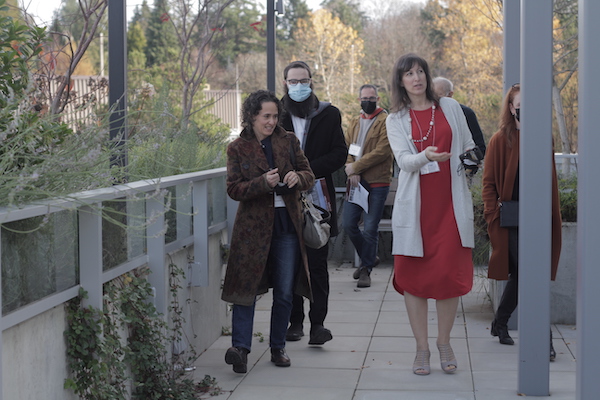
Anat Gogo, manager of programs and donor relations, Tikva Housing Society, leads a tour at the xwƛ̓əpicən (Arbutus Centre) open house Nov. 21. (photo from Tikva Housing)

Tikva Housing Society held an open house at the Arbutus Centre – xwƛ̓əpicən, pronounced “hook la’pitzen”) – on Nov. 21. The name in the Musqueam language means “Hollow,” which represents safety and warmth. Showcased last month were some of the 37 new one-bedroom and studio suites that Tikva Housing operates, providing homes to people in the Jewish community who need affordable, safe and stable housing.

The project is the result of a collaboration between the City of Vancouver, the YWCA, Association of Neighbourhood Houses and Tikva Housing. The building as a whole has 125 new units of affordable homes.

The open house, hosted by Tikva board members and staff, greeted more than 40 people, at various times, to accommodate the COVID-19 protocols. By all accounts, those who participated in the day-long event were “blown away” by the quality and attention to detail of the units, which all include washer and dryers; some are totally accessible for mobility devices such as wheelchairs. There is an amenities room for community gatherings, a central courtyard shared by all tenants and a rooftop patio.

After a process of identifying people who qualified, and then help with “move-ins” over the past two months, all the Tikva units are filled. The society is grateful to the many donors who make its work possible and especially to the Diamond Foundation, who gave Tikva the initial donation to assist with rent subsidies for new tenants, for the first five years.

For more information about Tikva Housing Society, visit tikvahousing.org.

– Courtesy Tikva Housing Society

Help increase affordable housing

I recently was appointed board chair for Tikva Housing Society. When I was asked to join the board three years ago, I knew nothing about Tikva or their invaluable work. However, as a real estate professional, I did have a keen understanding of the housing affordability crisis in the Lower Mainland, and knew that our Jewish community was not immune to the crisis. Hence, I understood the importance of Tikva Housing, which is why I joined the board.

Tikva is a charitable, nonprofit society providing access to affordable housing for low- to moderate-income Jewish individuals and families. Every year, in March, the society turns to the generosity of the community to support its mission and now, more than ever, Tikva needs that help.

The widespread effects of COVID-related job loss have placed many members of our Jewish community at risk of homelessness. Tikva offers short-term rent subsidies for those living in market rental housing who are facing a temporary crunch and are unable to afford their rent. The demand for this kind of assistance has increased greatly in the last 12 months. The amount of subsidies that we can provide is directly in correlation to the amount that we can raise from private donations and foundations, and donations are urgently needed to help people stay in their homes. There are already more than 200 Jewish people on a waitlist for affordable housing, and the demand is only growing.

With all levels of government focused on affordable housing in general, we are seeing numerous initiatives being considered and Tikva is in conversation with government agencies and housing developers to explore new partnerships. Currently, Tikva owns and/or operates 61 affordable housing units in the Lower Mainland: 11 units at Dany Guincher House in Marpole; 18 units at the Diamond Residences (Storeys) in Richmond; and, thanks to the Ben and Esther Dayson Charitable Foundation, 32 townhomes were added last summer. The Ben and Esther Dayson Residences in Vancouver’s River District form a family-oriented community with more than 60 children.

This coming summer will see Tikva tenants occupying 37 units at the Arbutus Centre on Yew Street. The cost to Tikva will be a nominal $1,500 per unit annually, and the Diamond Foundation has pledged to cover this expense for all 37 units for the first five years.

In 2022, 20 units on the third floor of a five-storey building will be home to Susana Cogan Place. In partnership with Polygon, BC Housing will provide full financial support for this project, which is named in memory of Tikva’s founder and affordable-housing trailblazer, Susana Cogan, z’l.

Expanding Tikva’s affordable housing portfolio means that more low- to moderate-income Jews can stay close to their synagogues, schools and the multitude of Jewish community amenities. While Tikva Housing will operate a total of 98 units by the end of summer 2021 and 148 by the end of 2022, it’s still not enough to meet the needs.

Housing is the cornerstone and foundation of a dignified life. The Hebrew word tikva means hope. Please support Tikva Housing Society’s current campaign, which runs to March 22, and help us bring hope – and housing – to those most in need in our Jewish community.

Visit tikvahousing.org or call 778-998-4582 to donate and for more information.

Rhonda Sacks is board chair, Tikva Housing Society.


Jewish Housing Registry live

The Ben and Esther Dayson Residences, located west of the River District, is one of the residences managed by Tikva Housing, which is responsible for long-term housing solutions in the Jewish community, while Jewish Family Services works with those who require immediate assistance in finding a place to live. (photo from Tikva Housing)

On Dec. 2, Jewish Family Services (JFS), in partnership with Tikva Housing, announced the launch of the first-ever Jewish Housing Registry.

There are six agencies involved in the project: JFS, Tikva Housing, Vancouver Jewish Building Society, Yaffa Housing Society, Haro Park Centre Society and Maple Crest Apartments, each playing a role in addressing the issues of homelessness in the Jewish community in a variety of ways, including advocacy, financial aid and subsidies, and housing placement. Each agency has their own application processes, manages their own wait lists, and collects and stores their client data independent of one another even though their work often crosses over. Consequently, housing needs in the community are difficult to determine accurately. For applicants, a lot of time is spent completing similar applications for different housing providers.

The idea for the registry sprouted from a conversation almost 10 years ago among leaders of the Jewish community, including JFS, Jewish Federation of Greater Vancouver and spearheaded by Tikva’s executive director at the time, Susana Cogan (z’l). With the housing registry in British Columbia not set up to collect data on cultural background, and tenant selection priorities based primarily on the housing needs of applicants, a gap focused on community building was missing. The purpose of this new registry is to improve operational efficiencies and also fill that gap – addressing specific cultural needs of our community, which can be fostered within Jewish housing developments; a priority not currently being addressed through any other agencies in the province.

“It’s exciting to see the partnership between different agencies come to fruition,” said Tanja Demajo, JFS chief executive officer. “This is a unique opportunity for us to use the database as a tool to integrate data, help us meet clients’ specific needs and have a better understanding of the issues of homelessness in our community. Having an opportunity not just to house clients, but also support them by building a Jewish community, is what it means for people to ‘create a home.’”

Tikva’s director of operations and housing development, Alice Sundberg, added, “It is commonplace for applicants to register with multiple housing agencies in the Jewish community, resulting in duplicate records, leaving the JFS housing coordinator having to complete a number of similar application forms from each agency. By having this centralized database, that step only has to be completed one time. We look forward to having up-to-date information available in real-time. It will be a huge improvement administratively and will help us better meet the housing needs of applicants.”

Phase I of the registry launched on Dec. 1 for JFS and Tikva to use, and Phase II will launch shortly for Yaffa Housing, Haro Park Centre Society, Maple Crest Apartments and the Vancouver Jewish Building Society.

“We also want to acknowledge that this registry was made possible because of a grant from the Jewish Community Foundation. With their support, JFS and all the other agencies using this software will be better positioned to serve those in need in a timelier manner. Having more accurate data will also serve us in future projects related to housing advocacy and assistance,” said Demajo.

Tikva Housing is responsible for long-term housing solutions in the Jewish community, while JFS works with those who require immediate assistance in finding a place to live. JFS also provides emotional support and assistance to clients residing in buildings managed by Tikva Housing.

For more information about the registry, contact Maya Dimapilis, JFS director of development and communications, by email at mdimapilis@jfsvancouver.ca or by phone at 604-637-3306.

A shidduch like none other

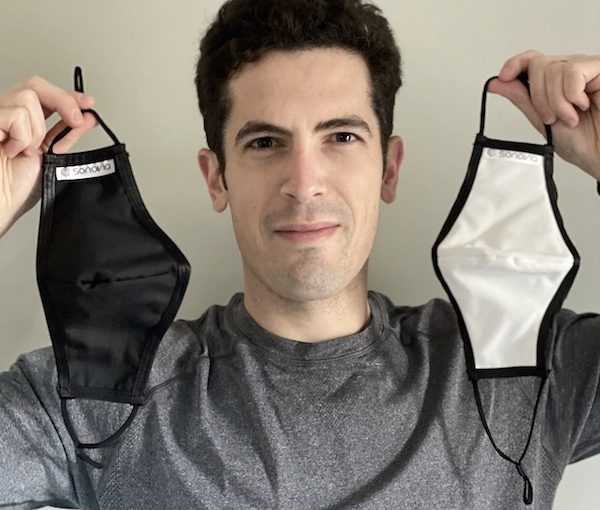
Brad Chenkis shows off a couple Sonovia masks. (photo from Tikva Housing)

It all began when Boris Chenkis, owner of After Five Fashions, was watching Israel Daily TV (ILTV) and saw an interview with Liat Goldhammer, the chief technology officer of an Israeli startup called Sonovia. She was talking about a new fabric-finishing technology for textile manufacturing developed at Bar-Ilan University, explaining that the technology could repel and kill bacteria located on clothing. Because it was in early January, a few weeks before COVID-19 became a worldwide pandemic, Chenkis just listened with interest.

On ILTV March 18, Dr. Jason Migdal, a microbiology researcher in Israel, discussed how the Sonovia technology mechanically impregnates metal nanoparticles into masks that destroy microorganisms in fabric. This was verified by two independent labs. It was also durable and washable. Now Chenkis was very interested.

With COVID becoming widespread, Sonovia had positively impacted Israeli doctors and health professionals by providing them with the technologically advanced masks. On May 12, Chenkis saw another interview about the Sonovia mask technology on ILTV – and an opportunity to get involved.

During his teenage years, Chenkis lived in Israel, studying and working at Kibbutz Rosh Hanikra. With this connection to Israel that never left his heart, he wanted to support an Israeli startup and so he purchased some masks to keep his family, friends and community safe. Soon after, he received an email from Sonovia, offering him an opportunity to help distribute the masks in Canada. Chenkis said yes. The masks were shipped from Ramat Gan to Vancouver and, within days, he was delivering hundreds to friends and family.

One of those who received the Sonovia mask was Yosef Wosk. Being both pleased and impressed with the technology, Wosk, like Chenkis, saw an opportunity to help not only the community here but also Israel. Wosk wondered how the masks could be made available locally to community members who might not be able to afford them, as they cost $65 each.

Wosk spoke with Shelley Karrel, chair of Tikva Housing, who contacted Tanja Demajo, chief executive officer of Jewish Family Services Vancouver. The need for the masks was confirmed and the shidduch almost complete.

Working with Chenkis’s son, Brad Chenkis, and with Wosk’s help, Tikva has acquired and will distribute 500 masks to residents of Tikva Housing, as well as clients of Jewish Family Services. It’s a win, win and win – tikkun olam, tzedakah and chesed.

For more information about the Sonovia masks, contact Brad Chenkis directly at inquiry@afterfivefashion.com.


Talking helps reduce stigma

Left to right: Peggy Allen, Shelley Karrel, Shelley Rivkin, Jordan Bowman and Howard Harowitz. (photo from JACS Vancouver)

The capacity for transformation and healing was front and centre at the event Optimism and Hope: Erasing Stigma of Mental Illness, Addiction and Homelessness.

Co-sponsored by Jewish Family Services (JFS), Tikva Housing and Jewish Addiction Community Services (JACS) Vancouver, the panel discussion on Feb. 26 was held at Temple Sholom. It featured Shelley Rivkin of the Jewish Federation of Greater Vancouver, Abbotsford entrepreneur and volunteer Peggy Allen, and Jordan Bowman of Last Door treatment and recovery centre in New Westminster.

Temple Sholom’s Rabbi Dan Moskovitz welcomed those gathered by talking about the Aleinu prayer, which, he said, asks us “to go out into the world and do what we’re praying for. And so, if I can make a request of all of us, myself included, it’s to go out from this room and to do and to share what we’ve learned and what we’ve heard tonight with our families and with our broader circle. That’s our shlichut, that’s our sacred mission, beyond just coming here today to get what we need for ourselves.”

JACS Vancouver board chair Howard Harowitz briefly described the missions of each of the event sponsors before introducing the night’s speakers, beginning with Rivkin, who shared the stories of a few community members who have been impacted by the risk of homelessness. She prefaced her remarks by saying homelessness is not limited to people living on the street or who live in shelters. Rather, the growing concern in our community is “relative homelessness, the lack of suitable, consistent and predictable housing,” she said.

She also noted that “it is not a natural equation that addiction, mental health and homelessness are faced by all people” in need. “Each person has to be approached individually and uniquely,” she said, then listed six sources of support in our community: JFS, Tikva Housing, Yaffa Housing, JACS, the Kehila Society of Richmond and the community’s synagogues.

Originally from Regina, Sask., Allen has lived in Abbotsford for a long time. She lives in an area where homeless people have gathered since the Salvation Army moved into the neighbourhood in 2004. A wife and the mother of two children, the situation was very difficult initially. She shared stories of her young granddaughter witnessing people having sex and shooting up, and of being chased out of her home by a crack addict.

“I was quite a happy person and then the homeless moved in and I changed forever,” she said. “I got angrier and angrier and angrier and I ended up making, in 15 years, I made 463 calls to the police. And they came every time and did nothing, because what are they going to do?”

Allen said she became very depressed. Then, she was invited to a meeting at city hall about the homeless. She challenged attendees to come and see the extent of the problem for themselves, and two women from Fraser Health took her up on it. Over coffee, Allen shared with them her concerns and, despite her self-described antagonism to them, they invited her to speak at a meeting of the Drug War Survivors, a peer-based user group that participates in the development of harm-reduction policies, among other things.

Reluctantly, she agreed. Expecting an audience of maybe 10 drug addicts, “there were 110 of them,” she said. “I look around and I open my mouth and I just let it all out. I don’t know what happened, it was a miracle, really. I talked about my father and I talked about him beating my mother so desperately,” waking Allen’s sister, who was told to return to bed by their mother, and did. “That’s what we were raised with,” said Allen. “I had never spoken about it, and I just let it all out,” including how she was kicked out of a school in her teens for selling drugs.

After her remarks, audience members lined up, but she didn’t know why, so she started to leave. “As I’m walking out, the first guy comes up and hugs me. They were all standing there to hug me,” she said, holding back tears.

One of the men recognized Allen from secondary school. He shared with her that he was raised with such anger that he went down the path of drugs, whereas she – who his family warned him about as a teen, since she sold drugs – did not. He said to Allen, “I see now that I, too, can change my life.”

This interaction, she said, changed her life. “I went home, and I was walking up the driveway to get the mail and this crazy lady that lived on the street and was a huge drug addict and was nasty and did not like me, she came running up my driveway swearing and yelling at me with this other guy. I was so emotional, I went running at her, I don’t know what I was going to do, and I stopped. I changed my mind. I turned around and I went home. And my life changed. Everything on our street is still happening and nothing has changed much there, except me.”

Allen started giving to the homeless. She joined the city’s Business Engagement Ambassador Project, which works to build relationships between Abbotsford residents, business owners, homeless and others to strengthen the sense of community. “What I do is I speak all over the place and raise money to help them help themselves,” she said of those who are homeless.

The project is a year-and-half old and she described it as a success. One aspect in particular that is working, she said, is that the program pays homeless people to clean up area businesses and parks.

The last speaker, Bowman, now 22 years old, has been clean for just over four years. He is a youth program support worker at Last Door, the centre at which he was set on the path of recovery.

Bowman said he had a good upbringing, went to Jewish summer camp and day schools, was into sports, has lots of friends and has a great family. Having lost his mother to cancer when he was 10, he said, “That was obviously tough, but by no means do I point my finger at that and say, ‘that’s when I started using drugs.’”

He described his life as normal, living with his dad and brother. There were no indications, he said, that he would become an addict. Addiction does not discriminate, he said, and people need to know that. His family, he said, were completely surprised to find out about his drug use and were “unversed in the topic of addiction.” Luckily, he had a cousin who works as a drug and alcohol counselor and “she saved the day” when it came to him seeking help.

At age 14, Bowman started to experiment with marijuana. He couldn’t say exactly why he started using harder drugs, but perhaps he had just gotten in with the wrong crowd. He described the process as progressive. “It went from using once in awhile to using every day, to doing whatever it takes,” he said.

“I’m not going to get too much into the things I did to get to get high every day but it definitely involved a lot of stealing from the people very close to me. It didn’t matter if you would love me, if you would hate me, if you were older, if you were younger, if I had the chance, I would try and rip you off if I was with you, and that was the reality of my life.”

From age 16 to 18, he was using opiates every day, while still going to school, while still trying to cover up that he was an addict. “I wanted help, but I didn’t,” he said. “I wanted help because I knew in my mind that I could be a better person than I’m being right now but, in the other part of my mind, I was scared and I wanted to keep getting high.”

The breaking point came when he stole a significant amount of money from his brother. From that day, when his brother reacted with love rather than anger – Dec. 22, 2015 – the efforts at recovery began, with the help of his father, brother, cousin and others. There were a few false starts, a couple of detox and treatment centres, before he landed at Last Door in mid-January 2016. He has not used drugs since.

Waiting times and the cost of treatment were among the topics discussed in the question-and-answer period. Giuseppe Ganci, director of community development for Last Door Recovery Society, was in the audience. He explained some of the different levels of care, ranging from assisted living residences, for which there are minimal guidelines, to treatment centres, which will have psychiatrists and other professionals on site. The definitions of the levels differ between regions in the province, he said, making the system hard for people to understand and, therefore, access.

“The problem is,” he said, “you always hear there are not enough beds in British Columbia. That’s actually a myth. There are so many beds. Last Door runs probably at 80% capacity every day [and has] for years. We have about 100 beds and only 35 of them are funded [by government]; the rest, there’s no funding for them, so it’s a shortage of funding for treatment, it’s not a shortage of beds.” This means that people who can afford it are able to get treatment within 24 hours, rather than join the queue of six to eight weeks or longer, he said.

After a couple more questions, Harowitz wrapped up the event. Addiction is not a choice, he stressed, citing JACS speaker Steve Whiteside. “It’s not a weakness of character, it’s not anything other than any other kind of disease that people have,” he said, challenging the audience “to keep the conversation going.”

Election views diverge

The Independent spoke with people in the Jewish community to gauge attitudes as the federal election approaches. What we found was a diversity of views and a lack of consensus.

An informal focus group of residents at the Weinberg Residence raised issues of out-of-pocket expenses for medical treatments and a lack of available doctors.

“You lose your doctor, you can’t get another one,” said one senior voter.

There was not great enthusiasm for any of the party leaders. One participant said she had lost respect for Liberal leader Justin Trudeau long before the recent brownface and blackface issue emerged.

“I was disappointed in him way back when he went to India and there was this whole thing of dressing up in Indian costumes. I felt it wasn’t very statesmanlike.”

“I feel that he’s had his chance and I don’t want to vote for him because he showed us what he can do. I don’t think he’s got what it takes,” said another voter.

“I expected nothing from Trudeau and I got it,” said another.

But there was no groundswell of support for Conservative leader Andrew Scheer.

“I’m disappointed,” said one. “I haven’t heard anything that’s promising.”

Some voters said NDP leader Jagmeet Singh comes across as sincere, but one said he has a lot of repair work to do with the Jewish community after his party’s positions against Israel in the past.

Elizabeth May, the Green leader, was viewed positively, but not seen as prime minister material.

“She’s very good at her subject, but I can’t envisage her really understanding what’s going on in the economy, in foreign affairs,” one resident said.

Among more than a dozen participants, the vast majority had a positive view of their incumbent MP, Jody Wilson-Raybould.

“I think she deserves better than she’s had,” said one person, while a Conservative supporter said she wishes Wilson-Raybould was running for her party, because she’d like to vote for her.

A show of hands indicated well more than half are undecided about who to vote for.

“Everybody’s confused,” said one, to laughter all around.

* * *

Alice Sundberg, director of operations and housing development for Tikva Housing Society, would like to see the federal government get back into funding nonprofit housing.

“We think that there is a really significant role for the federal government in making rental housing more affordable,” she said. Rather than subsidies to renters, which go into the pockets of landlords and don’t create new housing, she would like to see either capital grants to reduce mortgages for nonprofit or co-op housing, thus reducing the rental costs, or ongoing operating subsidies to organizations like hers that develop new housing.

“We don’t have enough supply,” said Sundberg. “Back in the ’90s, when the federal government withdrew from funding new affordable housing, it was really the beginning of our homelessness crisis.”

Housing is also a topic for Eldad Goldfarb, executive director of the Jewish Community Centre of Greater Vancouver. The centre’s redevelopment will include at least 300 units of affordable rental housing. His team has spoken to many federal officials, including MPs, but, so far, he said, “No commitments, no confirmations, lots of good feedback and great understanding of the project, support for it, but nothing has translated into actual commitments, funding, promises, nothing of that sort.”

Support for the housing component might include financing from the Canada Mortgage and Housing Corporation, rather than grants, though he hopes for federal cash for the new JCC building. He credited the federal government for stepping up with funding for security infrastructure for communities at risk, but added there is always need for more.

* * *

The rise of hate-motivated rhetoric and violence leads some community leaders to call for more federal action and leadership.

“With the rise of antisemitism, racism and far-right extremism, particularly in the online space, the Vancouver Holocaust Education Centre would welcome a comprehensive strategy to tackle hate in all its forms,” said Nina Krieger, executive director of the VHEC.

Russ Klein, principal of King David High School, would like to hear party leaders and candidates address how they are demonstrating moral and ethical leadership that creates trust and inspires Canadians, especially young people.

“How will they work to ease a society which seems quick to feel fear and seems overly stressed and anxious?” asked Klein. “I want to know how they will support a kinder, more inclusive society that offers hope and opportunity for all but especially to young people and to the most vulnerable in our society. How will they work to maintain affordable housing, livable wages and allow people to manage a balanced lifestyle in cities like Vancouver, where young families cannot afford to live in their current community? We live in extremely concerning times globally and I want Canada to lead in decreasing world tensions – how will they do that?”

* * *

Similar broad topics arose among a handful of University of British Columbia students who met at Hillel House to discuss issues that are important to them. All agreed that there has not been enough discussion of foreign affairs and there is a lack of substantive difference between the parties on issues like immigration.

“I don’t see any candidate that has a clear foreign policy vision, even though I think Chrystia Freeland is, personally, a great minister of foreign affairs,” said Adam Yosef Dobrer, a third-year political science student who is volunteering on Zach Segal’s Conservative campaign in Vancouver Granville.

Dobrer also wants Canada to return to the Conservative policy of defunding the United Nations Relief and Works Agency for Palestine Refugees in the Near East (UNRWA), which he called the greatest obstacle to peace between Israelis and Palestinians.

“In the last four years, I found it very difficult to understand where Canada as a nation lies in foreign affairs,” said Nika Perel, a fourth-year psychology student from Ontario who plans to vote Conservative. She credited the previous Conservative government with more clarity on Israel and Palestine and on Russia and Ukraine. “Stephen Harper made it very clear that he took a position supporting Ukraine.”

Jake Reznik, a nursing student with an undergraduate degree in kinesiology who remains an undecided voter, said Canada is not adequately standing up to China over its treatment of the Muslim-minority Uygher population or its other human rights violations. He added: “There is a lot of influence that the Chinese government does have in Canada that goes under-recognized.”

Matt Perzow, an NDP supporter who plans to vote strategically for Joyce Murray, the Liberal candidate in Vancouver Quadra, to prevent a Conservative government, emphasized health care, including mental health services. Defending Canadian values like multiculturalism and care for the most vulnerable are also things he wants to see party leaders prioritize.

All the students agreed that supporting Israel is an important consideration in their vote, but also said it will not be the deciding factor.

“I wouldn’t vote for any party that I thought would jeopardize the future of the Jewish people, whether it’s in Canada, in Israel or in another place,” said Perzow. “I’m not voting for somebody because of that issue, but, if I thought that something compromised the well-being of the Jewish people, I wouldn’t support them.”

Dobrer, whose family migrated to Canada from Israel when he was an infant because of the Second Intifada, said he has a “very resonant emotional connection” to Israel “but I am a Canadian first.” He is concerned about some election candidates, including Green party MP Paul Manly, who Dobrer says has a “long and sordid history of antisemitism and 9/11 ‘trutherism’ and delving into conspiracy theories.” (After being elected in a by-election this year, Manly denied he supports 9/11 conspiracies after the CBC reported on statements he had made in 2007 and 2011.)

The students all agreed that the environment and climate change are top issues for them and their peers, but expressed nearly universal hopelessness that anything substantive would change.

“I have no doubt that it will not be addressed,” said Reznik. “I know personally I’m not going to be willing to sacrifice my own standard of living and, at the same time, I think it is tremendously insulting on my part to tell someone else that they can’t attain my standard of living that we have here.”

“A lot of people are standing up and screaming about things, but they’re not going to do anything about it,” said Perel.

A hint of hope came from Dobrer: “From the government, I’m very skeptical. But from young intellectual minds, from the not-for-profit sector, from the private sector, every day there is more and more innovation, technological advances and more intellectual capital devoted to dealing with climate change.”

Wonderful night of honours

Jewish Seniors Alliance’s first silent auction, which offered a selection of close to 30 items, from gift certificates from local businesses to paintings and prints. (photo by Susan Curtis)

How do you say thank you to individuals who strive to better the lives of people in the community? Jewish Seniors Alliance’s answer is an appreciation dinner, part of its annual general meeting, which comprises a tribute to three conscientious community personalities. As well, at this year’s AGM on Sept. 19, thanks were given to outgoing JSA president Ken Levitt and new co-presidents Gyda Chud and Larry Shapiro were welcomed.

Levitt’s leadership was praised by Shapiro, who noted the outgoing president’s “ever-present love of life, which inspires everyone and brings out the best in each person whom he meets.”

Chud read a poem, “Captain Ken,” written by JSA honourary life member Binny Goldman. It noted: “You listened with your ear and understood with your heart. Your experience, knowledge and judgment always saw us through successfully – you are a leader, a man above most men.”

Anne Kang, MLA for Burnaby-Deer Lake, spoke about the ongoing efforts of the B.C. government on seniors’ issues, including improved long-term care assistance and training of care workers, and the overseeing of buildings and streets, to ensure that they are accessible and safer for seniors.

Emcee Jack Altman began the honouree ceremony with a tribute to Tzvia Estrin, who was nominated by Yaffa House.

Estrin’s son Avie, who is the current president of Yaffa House, recounted the efforts of his mother and late father Aaron, who worked for 10 years to establish Yaffa House. It opened in 2001 as Western Canada’s first home dedicated to housing community members with mental illness in the context of a Jewish living environment, including kosher food. He said his mother continues full-throttle, being at Yaffa House every day, usually at 6:30 a.m. And he emphasized that “nobody could have achieved what Tzvia has attained and continues to do for the most vulnerable segment of our own community.”

Yaffa House presently oversees four homes across the city, including a newly opened women’s facility. Its mandate is to provide permanent non-transitional housing and has in-house support. It takes people off the streets and tries to keep them off the streets.

Tzvia Estrin thanked everyone and read the poem “Don’t Turn Your Back,” which emphasizes the importance of taking the time to compassionately listen to others’ needs and to help them as lovingly as one is able.

Cindy Charkow, a director of Yaffa House, noted the outstanding, much-needed service that the facility provides and stressed that, “without Tzvia, there wouldn’t be a Yaffa House.”

The second honouree, Jack Wizenberg, was recognized for his work with Tikva Housing Society, which helps lower-income Jewish people find affordable housing. He said, “Seeing Jewish individuals and families who are alone, struggling and having to rely on social insurance and the food bank to survive, touches my heart.”

Wizenberg served on the Tikva board for six years, bringing to the position his 41 years’ experience in property management, as well as a lifelong involvement in a range of Jewish organizations and causes in Calgary, Edmonton and Vancouver.

He said he felt “extremely moved” when reading a Jewish Federation of Greater Vancouver housing needs study indicating that, in 2015, 16% of the Jewish population in Greater Vancouver were living below the poverty line “and, in all likelihood, those numbers have increased over the last four years.” He emphasized that things beyond their control prevented these people from working and, in a blink of an eye, they found themselves in need and relying on social assistance to survive.

Wizenberg began his service at Tikva helping with maintenance and tenant issues at Dany Guincher House. Since the first 11-suite apartment building in Marpole was purchased in 2008, he said, Tikva has made available 18 units of mixed single and family housing in the Diamond Residences in Richmond and another 32 family townhouses will be available in the Ben and Esther Dayson Residences in Vancouver’s Fraserview area. Last year, 100 individuals were helped by the Esther Dayson Subsidy Program, which provided those in need with adequate funds to allow them to continue living in their current accommodations.

Tikva president Shelley Karrel said Wizenberg seemed to have a passion for property management and often joined the property management and/or fire-safety group when doing walkthroughs to evaluate building conditions and the need for repairs. His positions have included treasurer, building committee head and acquisitions committee head.

“He was always seeking to ensure the best for Tikva, the buildings and its tenants,” said Karrel. “He is a person who respects others, is very organized and is a great team player. We are blessed to have Jack as a board member and friend.”

Evening honouree , whose tenor singing voice has brought joy to countless individuals and organizations throughout the Jewish and general communities for more than six decades, was introduced by JSA president emeritus Serge Haber.

“We’re honouring people who love community,” said Haber. “Maurice has helped seniors so very much by enthusiastically and nobly giving his special talents, his outstanding voice to the community, and particularly to seniors. Your father, George Moses, a celebrated rabbi/cantor in Bangalore, India, would have been most proud of you. Without question, you are most deserving of this honour.”

Moses spoke of the pleasure he receives by entertaining, and especially in doing so for senior citizens, emphasizing that “our precious seniors should not be ignored and they should be entertained and respected for their countless contributions to life in the community. The only way that I can thank seniors for all they have done is through my singing. It gives me great satisfaction to see their smiling faces, their faces lighting up when I see them react to a song familiar to them.”

Moses shared some of his many religious/concert participations for seniors, including singing for 17 years at Shabbat services at Louis Brier Home and Hospital. He has sung with the Jewish Community Centre Choir, the Shiron Singers, with Elizabeth Wolak and Muriel Morris, and the Rinat Ensemble, all of which performed for seniors. He also has produced a Vision TV show, Let’s Sing Again, which featured a popular tunes sing-along aiming to revive seniors’ nostalgic memories.

He has sung and danced for the past 10 years with the seniors’ concert group Showtime, which is produced by Beryl Israel, as well as with the Vancouver Jewish Men’s Choir (VJMC), the Kol Simcha Choir (composed of members from all synagogues), at Temple Sholom services with Cantor Emeritus Arthur Guttman, at Beth Hamidrash, at Beth Tikvah Synagogue and at Chabad Richmond with Cantor Steve Levin. He is an active participant with the Choir of the Performing Arts Lodge (PAL), which stages a variety of special shows for community seniors.

Moses said his enduring love for seniors was developed by his interactions with the late Beth Israel Cantor Murray Nixon, who constantly stressed the importance of treating older people with respect.

“I am so pleased,” said Moses, “that this evening is taking place at Beth Israel, truly ‘my home away from home,’ where I served in the synagogue’s choir for 66 years under seven different cantors and six different rabbis – and with Pucky Pelman, my mentor for 45 years.”

Moses expressed appreciation to his “guest of honour,” his daughter Melissa, “who has been by my side through three bouts of cancer, making me drink lots of water, eat healthy foods, and go on long walks at the Southlands.”

He gave “a most sincere thank you” to a number of people: Arnold Selwyn, his “35-year wonderful partner in song”; Morris, a pianist with whom he has performed for 55 years; Miriam Breitman, with the Rinat Ensemble and now the PAL chorus, and PAL co-founder Bill Harvey; Binny Goldman, for her help at Louis Brier services; Stan Shear, VJMC musical director; Cantor Yaacov Orzech with the Kol Simcha Choir; and Jonathan Berkowitz of BI’s Purim Shpiel.”

He ended by singing “Let’s Sing Again” and, with Selwyn, Adon Olam.

A video on JSA’s outreach and peer support activities, produced by Cory Bretz of Heirloom Films, was screened, followed by the JSA’s first silent auction, which offered a selection of close to 30 items, from gift certificates from local businesses to paintings and prints.

The event was co-chaired by Tammi Belfer and Larry Shapiro, with committee members Tamara Frankel, Helene Rosen, Marshall and Marilyn Berger, and JSA staff Elizabeth Azeroual and Rita Propp. Catering was provided by Nava Creative Cuisine; the photographer was Susan Curtis.


Bob Markin is a longtime Jewish Seniors Alliance supporter.