Community milestones this February

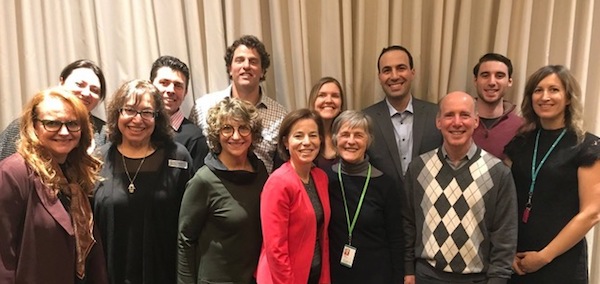
Left to right, back row, are Rory Richards, Kasimir Kish, Gord Kushner, Sarah Ann Chisholm (Jewish Family Services liaison), Daniel Bar Dayan, Jeremy Berger and Anat Gogo. In the front, left to right, are Rhonda Sacks, Marcela Manes, Shelley Karrel, Selina Robinson (guest speaker at the recent AGM), Alice Sundberg and Eric Fefer. (photo from Tikva Housing)

Tikva Housing had its annual general meeting Dec. 13, 2018. Two new directors were elected at the AGM, and another has joined since, to be appointed at the next board meeting.

The new directors elected in December were Jeremy Berger, a commercial property manager with Porte Realty, and Rhonda Sacks, a realtor with Sutton Group. Both have demonstrated a keen interest in Tikva’s work and have been actively engaged since joining. The new director to be appointed at the Feb. 28 board meeting is Rory Richards, who brings marketing and communications expertise, as well as strong links in the Jewish community.

Continuing board members are Shelley Karrel (chair), Gord Kushner (treasurer), Heather Sirlin (secretary) and directors-at-large Dan Granirer, Marcela Manes, Kasimir Kish and Mike Grudman.

Alice Sundberg, Tikva Housing’s director of operations and housing development, describes the Tikva board as a dynamic group of professionals who share a passion for providing affordable housing in an expensive region. In a meeting last October, they made a plan for Tikva’s next three years. The key strategic goals are engaged and committed board members and active committees; an endowment fund to provide stable and predictable funding for the rent-subsidy program; an expanded housing portfolio; closer ties with other Jewish nonprofit housing providers; and adequate human resources to manage all these goals.

Housing administrator Anat Gogo noted that the demand for rent subsidies is constant. Currently, Tikva is assisting approximately 30 families to be able to stay where they are, without worry of eviction for failure to pay their rent. For more information or to get involved with Tikva, contact the office at 604-998-4582.

***

photo - Tanya Paz
Tanya Paz (photo by Belle Ancell)

National Council of Jewish Women of Canada, Vancouver, welcomes Tanya Paz as executive director. Paz volunteered for NCJWC in the 1990s, subsequently served on the board of directors and was Council’s liaison to Canadian Jewish Congress (now Centre for Israel and Jewish Affairs).

Both Paz’s background as development director for the first car-sharing organization in British Columbia (Modo) and her involvement with the Vancouver Jewish Film Festival and other organizations, make her a valuable addition to the community of volunteers that is NCJWC. She also brings a wealth of experience in municipal affairs, in environmental initiatives and in social activism. And her expertise in community development and her commitment to women’s and children’s issues ensure a strategic approach to the goals of Council.

Working with the board of directors, Paz will help bring the goals of NCJWC – advocacy, education and social action – to both the Jewish and general communities throughout the region, with a focus on women and children experiencing poverty.

***

Nina Krieger, executive director of the Vancouver Holocaust Education Centre, is among those who have been appointed to the National Expert Committee on Countering Radicalization to Violence.

The Canada Centre was officially launched in 2017. Located at Public Safety Canada headquarters in Ottawa, its work includes the National Strategy on Countering Radicalization to Violence and the role of the expert committee is to help the centre meet the strategy’s three priorities: building, sharing and using knowledge; addressing radicalization to violence in the online space; and supporting interventions.

Krieger, who previously was education director and curator at the VHEC, is highly regarded for developing educational programs and exhibits that challenge audiences to probe the difficult historical, cultural and ethical issues raised by the Holocaust. She is also a member of the Canadian delegation to the International Holocaust Remembrance Alliance and past chair of the Memorials and Museums Working Group.

Joining Krieger on the expert committee are Dr. Ghayda Hassan (co-chair), a clinical psychologist and professor of clinical psychology at the Université du Québec à Montréal: Peter John M. Sloly (co-chair), a former Toronto police service deputy chief and currently a partner at Deloitte Canada; Bob Rae, a professor of public policy at both the Munk School and Victoria College at the University of Toronto, who also serves as senior counsel at Olthuis Kleer Townshend LLP; Dr. Jaspreet Khangura, an emergency physician at Royal Alexandra Hospital and Northeast Community Health Centre in Edmonton; Dillon Black, a gender-nonconforming feminist anti-violence and LGBTQ+ rights advocate and current PhD student with the eQuality Project in the department of criminology at the University of Ottawa; Max FineDay, executive director of Canadian Roots Exchange, an organization that builds bridges between indigenous and non-indigenous youth in Canada, among other things; Rizwan Mohammad, a Canadian Muslim civic engagement coordinator; Irfan Chaudhry, a hate crimes researcher and the director of the Office of Human Rights, Diversity and Equity at MacEwan University; and Dr. Shelly Whitman, executive director of the Roméo Dallaire Child Soldiers Initiative, who is considered a subject matter expert on the issue of child soldiers.

***

photo - Ten Bnei Menashe immigrants to Israel celebrated their bat mitzvah on Jan. 28
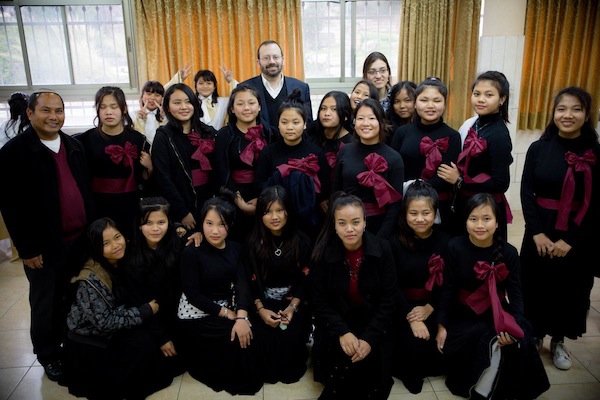
Ten Bnei Menashe immigrants to Israel celebrated their bat mitzvah on Jan. 28. (photo from Shavei Israel/Laura Ben-David)

On Jan. 28, 10 recent Bnei Menashe immigrants brought on aliyah from India by Shavei Israel, celebrated their bat mitzvah at a gathering of family and friends hosted by Girls Town Jerusalem, where they are enrolled as students.

“We were delighted to attend this very special and moving bat mitzvah celebration, which symbolizes the right of passage that the girls and their families have undergone in returning to the Jewish people,” said Shavei Israel founder and chair Michael Freund.

“We are determined to continue with our efforts until all the remaining 7,000 Bnei Menashe still in India are able to return to Zion,” he added.

The Bnei Menashe are descendants of the tribe of Manasseh, one of the Ten Lost Tribes exiled from the Land of Israel more than 2,700 years ago by the Assyrian Empire. So far, some 4,000 Bnei Menashe have made aliyah with Shavei Israel over the past 15 years, including more than 450 last year.

Trying to meet needs

Left to right: Anat Gogo, Tikva Housing administrator; Philip Dayson, donor; Shirley Barnett, donor; Heather Kenny, Tikva board member; Alice Sundberg, Tikva director of operations; Eric Fefer, Tikva development committee member; Shelley Karrel, Tikva board chair; and Kasimir Kish, Tikva board member. (photo from Tikva Housing)

There is so much in the news about Vancouver’s housing crisis – unaffordable rents, no vacancies and reno-viction notices. Having a safe, secure and affordable home is one of the most basic needs, which helps people to feel a sense of belonging and well-being. Many in our community lack this basic right.

On a daily basis, Tikva administrator Anat Gogo hears about people looking for affordable housing.

“It might be because they are in an abusive situation and need to make a change, or they are paying almost 50% of their monthly income on housing,” she said. “Whatever the reason, we do what we can.”

Thanks to the generosity of donors, Tikva has two residences that are fully occupied – Dany Guincher House and the Diamond Residences – and soon to open is the Ben and Esther Dayson Residences in the Fraserview district. These 32 new townhomes include two-, three- and four-bedroom units and, in adjacent towers, there is a common room where tenants will be able to gather for special events like Shabbat dinners and holiday celebrations.

In addition, more than 35 individuals and families are supported through the Esther Dayson Rent Subsidy Program.

Alice Sundberg, director of operations and housing development at Tikva, said the need to continue to increase “inventory” is constant.

For more information and to find out how you can help, contact Tikva Housing at 778-998-4582 or visit tikvahousing.org.

Menkis awarded, Sundberg hired

Prof. Richard Menkis (courtesy)

The University of British Columbia’s Prof. Richard Menkis has received two honours recently: the 2018 Louis Rosenberg Canadian Jewish Studies Distinguished Service Award and the 2018 Switzer-Cooperstock Prize for the best essay in Western Canadian Jewish history.

The Association for Canadian Jewish Studies established the Rosenberg Award in 2001 to recognize the significant contribution by an individual, institution or group to Canadian Jewish studies. In announcing Menkis as this year’s honouree, the association noted his “long and very distinguished career as a strong advocate for and practitioner of the scholarship and teaching of Canadian Jewish studies.”

Menkis won this year’s Switzer-Cooperstock Prize for the essay “Two Travelers and Two Canadian Jewish Wests,” which emphasizes the multiple expressions of interwar Jewish life in the Canadian west, and studies how two rabbis – Chief Rabbi J.H. Hertz and Rabbi Y. Horowitz – traveled through the region to promote their different visions. Hertz offered a modern acculturated Anglo-orthodoxy, while Horowitz promoted a traditionalist orientation shaped by Chassidism.

The Switzer-Cooperstock Prize, donated by members of the Switzer family to honour their parents and grandparents, is awarded biennially by the Jewish Heritage Centre of Western Canada. Past winners of the prize are Theodore Friedgut (Hebrew University), Lynne Marks (University of Victoria), Chana Thau (Winnipeg independent scholar), David Koffman (York University) and Esyllt Jones (University of Manitoba).

Menkis received his PhD from Brandeis University in 1988 and for many years held a position in the department of classical, Near Eastern and religious studies with a cross appointment to the department of history at UBC. He is currently associate professor of medieval and modern Jewish history in the history department at UBC. In addition to the surveys of medieval and modern Jewish history, he has taught advanced undergraduate courses on the Holocaust; Canadian Jewish history; fascism and antifascism; the historiography of genocide; and Jewish identity and the graphic novel. He continues to supervise both MA and PhD student theses at UBC and has served on PhD committees at other institutions.

Menkis has published widely on the cultural and religious history of Canadian Jewry. His articles have appeared in American Jewish History, American Jewish Archives, Canadian Ethnic Studies, Canadian Jewish Studies and in a number of edited volumes. Menkis was co-author, with Harold Troper, of More Than Just Games: Canada and the 1936 Olympics (University of Toronto Press, 2015), a seminal work in the field that presents an investigation of the responses and reactions of both Jewish and non-Jewish Canadian athletes and their communities to participation in the games. He is continuing the research for a publication, begun with Gerald Tulchinsky (z”l), on an aspect of the Canadian Jewish garment industry.

Appointments

Tikva Housing has hired Alice Sundberg as director of operations and housing development. Sundberg has more than 30 years of nonprofit housing experience, including housing development, organizational and project management, and sector leadership. Most recently, she was involved with the development of the Co:Here Housing Community and the creation of Home Front, a collaborative initiative to make homelessness in Metro Vancouver rare, brief and one-time. Her knowledge of and contacts with both provincial and federal levels of government will assist Tikva Housing greatly as the organization moves forward with current and new project developments.

Sundberg is excited to be joining Tikva Housing and is already busy with the upcoming opening of the Ben and Esther Dayson Residences in Vancouver’s Fraser district. For information about Tikva’s upcoming projects, you can reach her at a.sundberg@tikvahousing.org, or housing administrator Anat Gogo, at a.gogo@tikvahousing.org.

Tikva has a lead role to play

Left to right: Linda Thomas (Tikva), Shirley Barnett, Shelley Karrel (Tikva) and Eldad Goldfarb (Jewish Community Centre of Greater Vancouver) at Tikva Housing’s annual general meeting on Dec. 7. (photo from Tikva Housing)

The following remarks have been slightly modified from the original talk given at the Tikva Housing Society annual general meeting on Dec. 7, 2017, which took place at the Jewish Community Centre of Greater Vancouver.

I am sure some of you, if not most of you, are wondering, “Why has Shirley been asked to speak tonight?” I wondered the same thing. So, with some trepidation, I accepted the invitation to say a few words, but will start off with a few disclaimers.

First of all, I really don’t know much about housing. I have never been a part of any task force on housing. I have never attended a conference on housing. Experts in the field are in the media every single day, exploring solutions and dealing with options to solve Vancouver’s escalating housing crisis. Ideas range from adding back the 13th floor of high rises, using that floor for public amenities, to establishing a $100 million fund to speed up development applications. Other ideas have surfaced that call for a complete change in our zoning regulations.

Today, I was at a luncheon and sat next to two women who live at the Performing Arts Lodge (better known as the PAL Housing complex), which is across from the Westin Bayshore. They live under an arrangement I had previously heard about, called a life lease, which sort of bridges renting and ownership. You pay an entry fee for the right of a lifetime lease or for a fixed long-term period. That’s your equity. The society invests the money and you get your money back when you leave.

I have also heard about SAMs, shared appreciation mortgages, where mortgages are granted in exchange for sharing in the profits when the property is sold. This idea has been used to make down payments. The City of Calgary in a partnership with the Province of Alberta established a program whereby forgivable interest-free loans are provided through a housing society they started, and owners remit some of the equity when they leave or sell.

In Vancouver, no matter what the underlying causes are of the “affordability” issue, the very word conjures up the image of ownership as a priority. If we can, let’s discard that vocabulary for a minute and look at some alternative models because the one thing the experts agree on is that there is a need to think differently. Recently, I read there is no “housing crisis” but that there is a “housing supply myth” and we are building beyond our population numbers. In light of this, the City of Vancouver has stated they are now looking at the demand and not the supply.

What is the demand for housing in our own Jewish community?

Time and time again, people have expressed concern about members of our community moving away from the Oak Street corridor. This is already a reality and it will continue. So, instead of talking about people moving out, let’s talk about people moving into new neighbourhoods.

During the 2017 annual campaign, Jewish Federation of Greater Vancouver’s theme was to connect people who live in other municipalities or cities near Vancouver to Jewish programs and services. Their slogan for this was, “We can’t afford to lose them.” I have learned that Federation has hired a community development worker to liaise with emerging Jewish communities and that they are contacting many Jewish people who live in Langley, Maple Ridge, Abbotsford and so on, to ascertain what Jewish components residents in these places want in their lives and in their children’s lives; what initiatives they want to start or enhance or with which they need help.

We know that when an initiative comes from the grassroots, it becomes an emotional experience and, when there is emotion in a group of stakeholders, there is motivation, action and progress. This is how the Burquest Jewish Community Association started, which now has more than 70 families drawn from Burnaby, New Westminster, Coquitlam, Port Moody and further east. The Chabad Centre for Judaism of the Lower Fraser Valley in Surrey started very small and also has grown tremendously. Closer to home, Or Shalom on Fraser Street, which used to be on the outskirts of Vancouver, is now in the city centre and is thriving. East Side Jews, a Temple Sholom initiative, recently had 80 people turn out for an event. And, last summer, 60 kids in outlying areas went for the first time to a Jewish summer day camp run by the Jewish Community Centre of Greater Vancouver. So, we know that Jewish communities can begin and grow outside of Vancouver’s “traditional” neighbourhoods.

If there were an incentive for 10 Jewish families to move somewhere, maybe there could be resources to help them – rental subsidies for house-sharing, help to start a new daycare centre or to open a satellite shul in someone’s basement. Maybe the next development for Tikva Housing should be in one of the smaller communities that is growing a new Jewish population.

But let’s return for a moment to the situation in Vancouver. And let’s explore the availability of the existing housing inventory. Dozens of Jewish families own hundreds of condos in this city. If one unit per building or even one unit per owner were made available for Tikva to manage, this would create an inventory of housing. Tikva manages the inventory; it becomes a clearinghouse for rentals. And Tikva’s rental subsidy program could kick in – it would ensure that these units remain affordable, while providing owners with rental income at market rates. Alternatively, the owners of these rental or condo buildings could donate a unit to Tikva or become major donors to the Esther Dayson Rental Subsidy Program. So many more families could be helped by the above ways – like interest, the success would be compounded so many times.

What about incentives to families willing to create new suites from their unfinished basements and assign those new units to Tikva to manage, again creating new rental stock? I am not sure if you need a permit to finish off your basement but you may need some financial help. Perhaps that is an area of lending for the Hebrew Free Loan Association.

With the major redevelopment of Oakridge Centre and across the street from the Vancouver JCC at the former transit centre and all along 41st Avenue, as well as the need to redevelop both the current JCC and the Louis Brier Home and Hospital, we are in for an exciting time. The entire area will be repurposed and densified, whether we like it or not, and we need to do our part in a new, different way.

This should be the time when Tikva works together with Yaffa Housing, with the Vancouver Jewish Building Society that, together with the Netherlands Association, has 133 units, and with the Shalom Branch of the Canadian Legion that has 102 units. It boggles the mind (or, at least, my mind) that, for a community as small as ours, there are four Jewish housing societies that, for the most part, do not work together. Imagine the benefits that could be accomplished if these agencies were merged or formed loose partnerships or even a central registry. Why should someone in need in our community have to deal with sorting out the various agencies and options? But that’s a topic for another meeting.

There are more and more newspaper articles about redoing the concept of single-family zoning areas. There is much discussion about how large homes can be repurposed. How many people really want or need a home in Shaughnessy, on Marine Drive or in Richmond with eight or nine bedrooms and the same number of bathrooms? Should the city allow the change of dozens of these homes into four or six units for purchase or rental? Of course. What about financial incentives for young Jewish families, empty nesters or seniors who would like to share a large home but can’t afford the renovations to do so?

There is a philosophy about “aging in place,” staying in your own home until such time as your health requires you to leave. What about when your finances require you to leave because you can’t afford to pay your taxes or for the home’s upkeep? A recent article in the Vancouver Sun stated that one-third of the senior population, mostly women, live alone, and many suffer from depression, financial need and social isolation. We need to rethink what it means to live at home. Many people have said they don’t want to live in complexes built only for people their own age. This is a huge factor in senior living.

The same Sun article quotes a study published by the Gerontologist Society of America, which argues we have to broaden our meaning of “place” from an individual home to mean a neighbourhood. It continues, “Home is a refuge, but it is as much the background of the home, the familiarity with the places and contacts around it that provide security, as any emotional attachment to the home itself.”

We know people can feel as isolated and as disconnected living in a condo as they would living alone in a house. Not only do we need amenities in buildings but inviting spaces, not just gyms but places where the coffee and the lights are always on, lobbies where people can meet and chat – a community within a building within a neighbourhood.

Let me illustrate this point with a great example of building a new neighbourhood without cost. Those of us who live in condos know that the key fobs to enter our units usually cannot be used on other floors; you can’t visit someone on another floor without going down to the lobby and buzzing back up. We know that the intention is greater security and preventing unwanted visitors, but Tikva used an innovative approach. When the 18 units of the Diamond Residences in Richmond were being built, the fobs to the units on the Tikva floors – floors 12, 13 and 14 – were calibrated to give access to all the Tikva floors. You don’t have to go outside the building and buzz someone to get back in to visit them or borrow a cup of sugar. Families can visit other residents on the other Tikva floors. Children can go back and forth from their own apartments to their friends or relatives. That’s building a new neighbourhood.

As I mentioned before, I have no experience in solving these types of issues but I do know that the solutions will take much more creativity than we have ever seen, creativity at many different levels, including from within our Jewish community. One of my favourite quotations is from Albert Einstein, who said, “No problem can be solved by the same level of consciousness that created it.”

I believe Tikva not only has a role in community development but also an expanded role. Our family feels good about this. We think we have chosen wisely to support the initiatives of Tikva because of their potential in being a leader in this area: affordable housing using many different models, but together with community development. My brother Philip Dayson and I are privileged to be able to participate in Tikva’s new project on Marine Drive – imagine 32 family homes in a new Jewish community in a land trust implemented by a group of nonprofit organizations together with the City of Vancouver. And we are very proud to say this complex will be named after our parents.

I cannot close without remembering the brilliance of Susana Cogan, z”l, and, thinking of her, we will recommit our support to Tikva Housing with the expectation that this organization will lead us down new pathways and, like Susana, show imagination, strength and leadership outside of anyone’s box.

***

More about Tikva Housing’s AGM

Tikva Housing had its annual general meeting on Dec. 7, 2017, at the Jewish Community Centre of Greater Vancouver, with approximately 50 people in attendance. The society provided an overview of its current housing capacity, the ongoing need for affordable housing and the challenges facing the Metro Vancouver Jewish community with regards to housing.

Tikva has 18 units in the Diamond Residences, in Richmond, which opened in September 2017; 11 units at the Danny Guincher Residences; and 32 units will be available at the Esther and Ben Dayson Residences, in Vancouver, opening in summer 2018. The society has the Esther Dayson Rent Subsidy Program, which supports approximately 40 recipients.

Tikva’s main partners are the Jewish Federation of Greater Vancouver, which maintained annual funding for Tikva’s operations for 2017/18; Jewish Family Services, which refers people who are in need of affordable housing; and Kehila Society, which links tenants living in the Diamond Residences with events and services in Richmond.

The units at Diamond Residences range from studios to three-bedrooms. Because of the Diamond Foundation, as well as the Irving and Phyliss Snider, Lohn and Zalkow foundations, which contributed to the capital costs, it is posible to offer rents set at 30% of household income.

The Esther and Ben Dayson Residences is a partnership of Tikva Housing with the Community Land Trust Foundation and City of Vancouver. Its townhouses, ranging from two- to four-bedrooms, will offer 16 units for families on income assistance and 16 units renting at 30% of household income. The Ben and Esther Dayson Charitable Foundation have committed to fund Tikva’s equity loan to the Vancouver Land Trust project.

– Courtesy of Tikva Housing Society

 

Storeys is now officially open

Cutting the ribbon at the official opening of Storeys on Dec. 1. (photo from Shelley Karrel)

“Those involved in Storeys feel like a family,” said Brenda Plant, executive director of Turning Point Housing Society, speaking at the opening gala of the rental housing development in Richmond on Dec. 1. “We’ve been working on this together for eight years now.”

Storeys, on Granville Avenue, provides 129 units of affordable rentals, which have on-site supportive services. The project is managed by five nonprofits. The Jewish community’s Tikva Housing Society has three floors of housing for low-income families: 18 units in total with rents at 30% of a household’s income – known as the Diamond Residences at Storeys. The other organizations involved are Coast Mental Health, providing units for low-income clients who need mental health supports; SUCCESS, which provides units for low-income seniors; Pathways Clubhouse Society of Richmond, which provides supportive environments for individuals working towards mental wellness; and Turning Point Housing Society, which provides units for individuals in recovery from addiction.

Richmond Mayor Malcolm Brodie spoke of the importance of the new building, pointing out that the City of Richmond contributed $19.4 million to the project, or one-third of the construction funding. “Some of you here may remember this site as a former KFC and a small office building,” he noted. “Eight years later, here we stand.”

photo - Left to right, MLA Selina Robinson, Richmond Mayor Malcolm Brodie and Shelley Karrel
Left to right, MLA Selina Robinson, Richmond Mayor Malcolm Brodie and Shelley Karrel. (photo by Matthew Gindin)

“The housing units provided in this unique project will make such a difference in the lives of those who benefit from them,” said Selina Robinson, B.C. minister of municipal affairs and housing, during her address. To the nonprofits who made it happen, she said, “You guys rock.”

The event also featured remarks by MP Joe Peschisolido (Steveston-Richmond East); Kathleen Kennedy-Strath, chair of the board of Coast Mental Health; Jessica Berglund, president of the board of Pathways Clubhouse; Queenie Choo, chief executive officer of SUCCESS; Gord Argue, board chair of Turning Point Housing; and Shelley Karrel, co-chair of Tikva Housing.

The provincial and federal governments contributed just over $5 million and donors almost $2 million. BC Housing was key in assisting with providing the construction loan and will help organizations in securing their long-term mortgages at favourable rates.

Tikva’s involvement in Storeys was initiated under the leadership of Susana Cogan, who passed away before it was completed, and Linda Thomas, executive director of Tikva Housing, attended the opening with the society’s administrator, Anat Gogo, who led the Independent and others on a tour of the building. The suites are modern and well-designed, many with great views.

Tikva is supported by the Jewish Federation of Greater Vancouver and worked with Jewish Family Services to place the tenants. The Diamond Foundation gave Tikva the equity to be able to be at the table with the other Storeys project partners. Tikva’s 18 units are now home to families and individuals, from children through seniors.

“What has happened is that we have created a real community within a community,” explained Tikva Housing’s Karrel of the Diamond Residences at Storeys. “At one point, when the elevator wasn’t working because of a power outage, one of the tenants offered to go check on everyone to make sure they were OK. We hope to have communal Shabbat dinners and holiday events for the tenants,” she told the Independent.

Storeys is located near Garden City Bakery, Brighouse Park, Richmond Public Library, and many other resources. The Bayit’s Rabbi Levi Varnai recently visited to put mezuzot on the doors of the Jewish homes.

“In order to honour everyone’s commitment, I have a little present,” said Turning Point’s Plant midway through her presentation. She then handed out Staples’ “that was easy” buttons – “because I want you all to know that we’re going to do this again.”

Matthew Gindin is a freelance journalist, writer and lecturer. He writes regularly for the Forward and All That Is Interesting, and has been published in Religion Dispatches, Situate Magazine, Tikkun and elsewhere. He can be found on Medium and Twitter.

Sukkah more than symbolic

As we celebrate Sukkot this week, we’ll be thinking about many things – notably, how lucky the vast majority of us are to have a solid roof over our heads. For most of us, the sukkah is but a symbol of our wandering in the desert all those years ago, a symbol to remind us to be humble, empathetic, grateful. However, for many living in Metro Vancouver, including members of our own community, homelessness is a reality.

Last week, we ran a good news story from Tikva Housing Society – residents were moving into the recently completed Storeys complex in Richmond. The Diamond Residences at the Storeys will house six singles (five of whom are seniors) and 12 families. Tikva Housing is also working with various partners on the development of 32 townhouses in Vancouver, and they anticipate accepting residency applications by early 2018. These new projects are in addition to Tikva’s Dany Guincher House, in Vancouver – which has 11 units for people with low-income, people with disabilities who are independent and families fleeing abuse – and the Esther Dayson Rent Subsidy Program.

There is a lot of which to be proud. However, there is much more to do. Last year, Tikva Housing reported a decrease in donations to its rent subsidy program of more than $15,000. As a result, the organization had to decrease the monthly subsidy it provided to singles, couples and families.

According to Tikva, more than 16% of Jewish Vancouver residents – more than 4,200 people – are low-income and at least 450 Jewish children under the age of 15 in Vancouver are “living in households that depend on income assistance.” Its 2015 report on housing in Metro Vancouver concluded a need for 1,827 affordable housing units in the Jewish community, including for “those under 65, low-income singles, couples and families.” Calling this “an unreachable goal,” the report nonetheless suggests some solutions, most of which the Jewish community is already pursuing, such as rent subsidies and partnering with other agencies to develop new projects.

Yet, the problem remains. And, of course, it is not a problem unique to the Jewish community. On Sept. 26, the final report on Metro Vancouver’s 2017 Homeless Count was released. On the night of March 7, more than 1,200 volunteers conducted surveys throughout the region, on the streets and at shelters, “to obtain a 24-hour snapshot” of the situation. The final report confirmed the preliminary results – 3,605 were homeless in the metro area.

While there were four percent fewer homeless youth in 2017 as compared to 2014, there were five percent more homeless 55 and older. Overall, there was a 30% increase in homeless since 2014, “and the highest number since 2002, when the first metro-wide count occurred.”

According to the report, “The three most cited barriers to finding housing were the high cost of rent (50%), a lack of income (49%) and the lack of availability of housing that suits their needs (30%).” More than 80% of respondents reported having “at least one health condition, including addiction, mental illness, physical disability or a medical condition/illness. More than half of the respondents (52%) have two or more health conditions.” More than 40% of respondents received income assistance, 28% a disability benefit; 22% were employed.

Following the local Walk for Reconciliation on Sept. 24, where some 50,000 people – including an organized Jewish contingent – gathered downtown to join in a “call to action,” it is sobering to learn that 34% of the respondents of the Homeless Count self-identified as indigenous/aboriginal. “Indigenous people continue to represent about one-third of the homeless population in the region,” states the report, noting that it’s the highest proportion found to date in a regional count and “constitutes a strong over-representation compared to the total population, where two percent identify as aboriginal as per the 2011 Census.”

In a statement of the obvious, Mike Clay, chair of the Metro Vancouver Housing Committee, said, “In order to stem growing homelessness, it is clear we need more affordable housing options.”

But additional solutions are also needed, given the systematic discrimination that still exists for First Nations people and the health conditions many of the homeless are facing – and not only the homeless. Just last week, the Independent ran an article on the impact of addiction in our community. Jewish Addiction Community Service (JACS) Vancouver estimates that as many as 5,000 Jews in our community need support, “whether grappling with their own addiction issues or the addiction of a loved one.”

The Homeless Count’s findings most likely underestimate the problem. The report references the “hidden” homeless, which includes people “who do not have a regular address of their own where they have security of tenure, and who may be staying temporarily in another household – often called ‘couch surfing.’” The Tikva Housing press release about the new tenants at Storeys noted, “One 83-year-old woman cried when she was told she would be moving into a studio unit, as she has not had a place to live for years and was sleeping on someone’s couch.”

Then there are the tens of thousands of people at risk of becoming homeless. Apparently, housing shouldn’t account for more than 30% of a person’s or family’s gross income, yet the Homeless Count report notes there were 56,000 Metro Vancouver households in 2006 that spent more than 50% of their income on shelter, and the number had increased to 62,355 by 2011. (More recent data weren’t available but, based on skyrocketing housing costs, we can guess that the number of households spending 50% or more of their income on shelter has also increased.)

There is much to contemplate as we gather in our sukkot this week. And, once the holidays are over, once we celebrate Simchat Torah, thankful for the Jewish texts and traditions that have shaped the moral compass of even the most secular of us in some way, there is a lot of work to be done.


Housing, high-tech, musicals and more – this week in the community

Tikva welcomes residents: The Storeys Complex in Richmond. (photo from facebook.com/tikvahousing)

We are taught from an early age that giving, repairing the world and being kind are the tenets of living a Jewish life. In our community we don’t have to look very far to find people who fit this description. One of the latest projects that has come to fruition is the Diamond Residences in the Storeys complex in Richmond. Thanks to the generosity of the Diamond Foundation, Tikva Housing Society now owns 18 (chai!) units that are being rented at below-market rates to people in the community for whom stable, safe housing was unpredictable and unaffordable, at best.

Tikva Housing partnered with four nonprofit societies and the City of Richmond to build these and other apartments. Tikva worked hand in hand with community agencies such as the Jewish Family Service Agency to place tenants in need in these units, as well as with the Jewish Federation of Greater Vancouver and B.C. Housing. Most of the tenants will have moved into their units by the end of this month.

The Diamond Residences will house six singles and, of those, five are seniors. Also, 12 families and a total of 22 children will be living there. One 83-year-old woman cried when she was told she would be moving into a studio unit, as she has not had a place to live for years and was sleeping on someone’s couch. A single Israeli mother with two children is moving into a three-bedroom unit; her kids have never had their own rooms. Another single mother with three children has been sharing a two-bedroom place and has not had her own room in two years. One family has moved to Greater Vancouver from out of town and can now attend Shabbat services, be close to their family and the Jewish community. There are many more such stories.

 – Courtesy of Tikva Housing Society

* * *

Simon Fraser University recognized four distinguished alumni on Sept. 13 at Four Seasons Hotel. Among them was Gary Cristall, co-creator of the Vancouver Folk Festival.

The annual awards, presented by SFU and the Alumni Association, recognize those whose accomplishments and contributions reflect the university’s mandate of engaging the world. An advocate for the arts and human rights, Cristall has been a cultural groundbreaker, having co-founded the Vancouver Folk Music Festival in 1978. In an industry plagued with an unscrupulous reputation, Cristall has been instrumental in fighting for the rights of artists to be treated professionally and with respect while also defending their rights to fair performance fees and copyright ownership.

Cristall served as acting head of the music section of the Canada Council for the Arts and was the founding president of the Public Service Alliance of Canada, the first union at the Canada Council. Today, Cristall continues to serve as a prominent mentor and educator, assisting artists in building their careers and guiding communities in enhancing dynamic cultural interactions that enrich and benefit a healthy, democratic society.

* * *

After a grueling 33 hours of programming, DragonFruit – Benjamin Segall, Jacy Mark, Viniel Kumar and Pritpal Chauhan – completed StoryTree and demonstrated it live to a panel of judges at Hack the North, an international student hackathon held at the University of Waterloo in Ontario, which this year took place Sept. 15-17.

Canada’s biggest hackathon, Hack the North was founded and is organized by Techyon, a student-run nonprofit organization, in partnership with Waterloo Engineering. The event brings together 1,000 students from top universities across 22 countries in the world. Students collaborate and create impactful new hardware projects or mobile and web applications of their own design for a weekend at the University of Waterloo, all expenses paid.

DragonFruit’s StoryTree was one of the 14 projects chosen out of the more than 250 demonstrated at Hack the North. StoryTree is an online workspace for aspiring authors to collaborate on books together. All you have to do is write a paragraph or a chapter, or even just a sentence, and, as more and more people add or branch off from a story, that story you’ve always wanted to write becomes a reality.

DragonFruit will be continuing the project and are looking for alpha testers for January 2018. If anyone is interested in being a part of this project or for more information on it, contact them via facebook.com/dragonfruitcode or dragonfruitcode.com.

* * *

photo - Swinging Sylvia rehearsals: Advah Soudack and Sky Kao create a whirlwind of action in rehearsal of the second one-act play that comprises Two Views from the Sylvia
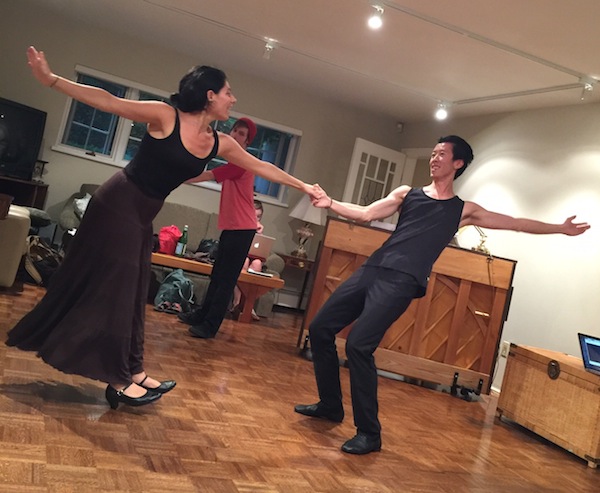
Swinging Sylvia rehearsals: Advah Soudack and Sky Kao create a whirlwind of action in rehearsal of the second one-act play that comprises Two Views from the Sylvia. (photo by Sue Cohene)

 Rehearsals have started for Two Views from the Sylvia, a new musical theatre production by Kol Halev Performance Society. This original production – which will be at Waterfront Theatre Nov. 8-12 – tells the story of the iconic Sylvia Hotel and its historic connection to the local Jewish community and the city of Vancouver.

Two Views from the Sylvia comprises two one-act plays.

The first play, Sylvia’s Hotel, is set in Vancouver in 1912. It brings to life the origin of the Sylvia Hotel, named for Sylvia Goldstein (Ablowitz) and the story of the Goldstein family who built it. Young Sylvia Goldstein and the legendary Joe Fortes, the beloved English Bay lifeguard, develop a bond that helps Sylvia realize her dreams.

In the second play, The Hotel Sylvia, the story continues as we meet the characters whose lives and loves became interwoven with the story of the Sylvia over her 100-year history. It includes vignettes revealed to the production’s researchers by Huguette, the front desk clerk who worked at the Sylvia for 35 years.

Jewish community members play key roles in both plays. In the lead roles are Advah Soudack (as Sylvia) and Adam Abrams (as Abraham Goldstein); Anna-Mae Wiesenthal and Joyce Gordon are cast in important supporting roles. Behind the scenes are Sue Cohene (producer) and Heather Martin (associate producer), as well as Gordon (assistant producer) and Abrams (graphic designer and webmaster) and Gwen Epstein (production team). Marcy Babins and Michael Schwartz collaborate in their roles at the Jewish Museum and Archives of British Columbia, which has created an historical photo display to accompany the production.

Two Views from the Sylvia is a project of Kol Halev in partnership with the B.C. Arts Council, Government of British Columbia, City of Vancouver, Granville Island Cultural Society, CMHC Granville Island and the JMABC. For information and tickets ($28), visit sylviamusical.com.

– Courtesy of Kol Halev

 * * *

Bema Productions’ Victoria Fringe Festival play Horowitz and Mrs. Washington was a great success. All seven performances at Bema’s Black Box Theatre at Congregation Emanu-El were sold out and the production company’s work was once again as one of the best dramas in the Victoria Fringe.

photo - Bema Productions’ Victoria Fringe Festival play Horowitz and Mrs. Washington was a great success
Bema Productions’ Victoria Fringe Festival play Horowitz and Mrs. Washington was a great success.  (photo from Bema)

Mrs. Washington is hired to nurse Sam Horowitz, who’s been mugged and had a stroke. She’s a determined tyrant and he’s a bigoted Jewish widower. The two must find a mutually beneficial relationship when his daughter tries to make him leave his home. The play by Henry Denker reflects the attitudes of the 1970s and illuminates the power to be found in ordinary lives.

“The electric performance of the actors enabled the audience to visit uninhibitedly the issues of racism, stroke recovery and aging in place,” reads the review “Bravo Bema!” on Emanu-El’s website.

“For the most part,” said the review, “the actors were provided with a very humorous script that relied on stereotyping but went beyond it for its punchlines. The audience was asked to stretch their imaginations – who would have considered invoking Michelangelo to explain why the naming of a grandson ‘Douglas’ instead of ‘David’ was inappropriate? There were a few moments when the pace flagged but very few.”

While the play “revealed little about the face of contemporary racism,” the “potential disempowering of aging adults by their loving offspring is an issue of contemporary concern.”

The Bema production was directed by Zelda Dean and Angela Henry and was performed by David Macpherson, Rosemary Jeffery, Christine Upright, Alf Small, Cole Deo and Graham Croft.

– Courtesy of Bema Productions

 * * *

photo - Miki Mochkin teaches a class on baking challah
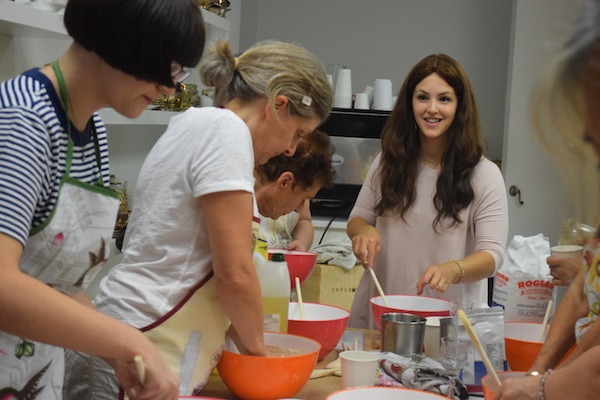
Miki Mochkin teaches a class on baking challah. (photo by Shula Klinger)

Chabad North Shore hosted a challah bake at Mia Claman’s store in West Vancouver on the night of Sept. 6. Miki Mochkin taught a class on baking challah to local women. While the bread was rising, she explained the significance of each ingredient for Jewish women. From the sweetness of the honey to the harshness of the salt, every element serves to remind the baker of its symbolic role in our lives as women and mothers.

– Courtesy of Shula Klinger

* * *

photo - Panelists at Congregation Beth Israel discuss the topic Our Leaders: Are They Above the Law?
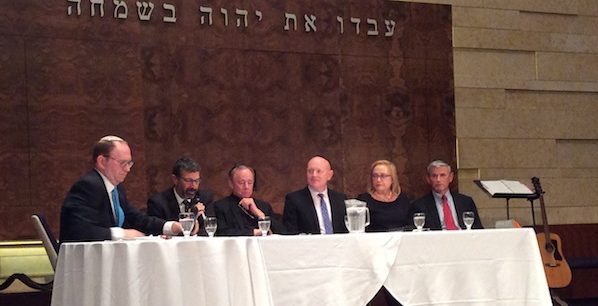
Panelists at Congregation Beth Israel discuss the topic Our Leaders: Are They Above the Law? (photo by Cynthia Ramsay)

In the photo, left to right, are Congregation Beth Israel Rabbi Jonathan Infeld, King David High School head of school Russ Klein, Vancouver Catholic Diocese Archbishop Michael Miller, Vancouver Police Chief Constable Adam Palmer, B.C. Court of Appeal Justice Sunni Stromberg-Stein and MLA Andrew Wilkinson. On Saturday night, Sept. 16, at the synagogue, this panel of speakers took on the topic Our Leaders: Are They Above the Law? Infeld framed the contemporary discussion around a talmudic discussion regarding an important rabbi in a community, rumours surrounding his conduct and whether the rabbi should be excommunicated. The panelists took this starting point to talk about their own professions, present-day accountability standards and various other issues.

– Courtesy of Cynthia Ramsay


Necessary for people to act

Left to right, emcee Yael Dirnfeld with panelists Penny Gurstein, Tom Davidoff and Michael Geller, who discussed the Metro Vancouver real estate market. (photo by Lior Noyman)

Few topics in Vancouver are debated more intensely than real estate. “It is now possible to use the words ‘housing crisis’ without being labeled an alarmist,” noted Michael Geller at the Ohel Ya’akov Community Kollel’s Stunning Views: Vancouver Real Estate panel discussion last month.

Held on June 28 by the Barry & Lauri Glotman Kollel Business Network, the event was the second meeting hosted by the Kollel to look at the situation in the Metro Vancouver real estate market and its impact on the Jewish community. This second session focused on practical, grassroots solutions, featuring once again presenters Tom Davidoff, Michael Geller and Penny Gurstein and emcee Yael Dirnfeld.

Davidoff is an associate professor at the University of British Columbia’s Sauder School of Business and incoming director of the Sauder Centre for Urban Economics and Real Estate, and Geller is an architect, real estate consultant and property developer, president of the Geller Group and an adjunct professor in Simon Fraser University’s Centre for Sustainable Community Development. Gurstein is a professor and the director of the School of Community and Regional Planning and the Centre for Human Settlements at UBC, while Dirnfeld is director and team lead in private banking with Scotia Wealth Management.

Each of the three presenters brought differing but complementary perspectives. Davidoff spoke in rapid-fire witticisms and big picture sketches, focusing on the international picture and willing to offer speculative answers and predictions about the future. Geller was more cautious, and drew on his extensive knowledge of Vancouver history and urban planning to weigh different possible futures and suggest options for buyers and investors. Gurstein spoke of political solutions, emphasizing the importance of both legislative changes and broad community organization and activism to effect change and provide more housing, increased diversity of housing and a sustainable real estate economy.

Davidoff discussed different possible ways forward. Should the city build more housing to drive down prices? Should the province raise taxes? Should the federal government intervene? Davidoff said the situation is authentically worrisome and there are possibilities of the market undergoing “a nasty correction.” He argued that legislative changes were the most effective long-term solution, and that the tax on vacant houses being discussed by Vancouver Mayor Gregor Robinson is a good start.

From where will change come? asked Davidoff. Quoting George Orwell’s book 1984, he said, “If there’s hope, it’s from the proles,” the proletariat, or the common people. Pressure needs to be put on government from people other than wealthy homeowners, investors and developers, said Davidoff.

Geller warned the audience that everything being discussed should be taken “with a grain of salt.” He said, “None of us up here know very much but, since we are sitting up here and you down there, we are obliged to be sage.”

Geller pointed to the impending crackdown on unscrupulous real estate agents as a positive development, as well as the federal government’s allocation of $150 million for affordable housing in British Columbia, the utility of which Davidoff doubted. Geller emphasized the cyclical nature of markets and the likelihood that the boom would not go on much longer. “I think it will peak, but I am not sure it will crash,” he said. “I am inclined to think the correction will not be severe.”

Gurstein also thought that there have been positive developments in the last few months. “We need a government intervention,” she stressed. But, she said, “… there is a fear that, if they intervene, it could have a serious impact. This points to the need for a serious, wide-ranging economic strategy: we cannot be dependent on global capital coming in and generating a whole real estate industry from that.”

Gurstein emphasized the need for large-scale diversification, as well, pointing out that Vancouver needs different kinds of housing to meet everyone’s needs, as opposed to a market-driven fixation on condos and detached single-family dwellings.

photo in Jewish Independent - Panelists Tom Davidoff, second from the left, and Michael Geller, third from the right, mingle with the crowd at the Community Kollel on June 28
Panelists Tom Davidoff, second from the left, and Michael Geller, third from the right, mingle with the crowd at the Community Kollel on June 28. (photo by Lior Noyman)

The audience’s questions were directed to future developments and which investments are best. “Michael,” an attendee asked, “where are things going, what will prices look like in five to 10 years?”

“You’re going to have as many people saying prices will go up as go down,” replied Geller. “Some will say it will go up because of Brexit, or matters in China, or the stable Canadian economy. Other people will say it simply cannot continue and, if you look at the history of Vancouver, we have seen bubbles like this before that burst. Some of the remedies that people have been asking for – taxing foreign investment and vacant homes, government money for affordable housing, taxing BnBs, building more houses, all of those things – will have some impact in dampening things a little bit but, again, I don’t see a severe crash coming.”

Geller also spoke about the subjective nature of assessments. “Will things drop or stabilize? … After Brexit, the market dropped 200 points, then 200 points more, then it was 150 points up again because some people said Lloyds Bank is down 40% and it has to be a good time to buy! So, now it’s going up. Why did it drop at first? Fear. Then it comes up because of hope. It’s all so psychological.”

Geller and Davidoff agreed that investing in central Vancouver real estate is unlikely to pay off at this point, but looking farther afield to New Westminster, Squamish, the Sunshine Coast and other developing communities is a good bet. Asked whether one should rent or buy, Geller suggested, “Why not rent somewhere near a shul and buy a property elsewhere you can rent out for income?”

Gurstein spoke about Tikva Housing Society, which was formed to address the needs of working families, single people and others having difficulty finding affordable housing. “What they’ve done is work with other nonprofit housing societies and the Jewish community and they are now building housing,” she said. “They have one development in Richmond with 10 units, they have [one with] 32 units in Vancouver, and they are amazing and beautiful.”

Gurstein cited Tikva Housing’s work as an example of proactive, effective action. “We need to be supporting these kinds of institutions because they are going and making connections with other nonprofit housing societies to really address this,” she said. “Forty-two [new] units doesn’t solve the problem, but it begins to address it.”

Geller added that Tikva is not the only Jewish housing society and advised that people should take a close look at what’s on offer.

Asked what was the most effective activism for change, Geller emphasized the importance of going to town hall meetings, writing editorials and otherwise making it clear to government that there is a sizable, active constituency desiring intervention. All three presenters agreed that, absent such public activism, the only voices likely to be heard by government are the ones that have prevailed so far: those of wealthier homeowners, developers and foreign investors.

Matthew Gindin is a Vancouver freelance writer and journalist. He blogs on spirituality and social justice at seeking her voice (hashkata.com) and has been published in the Forward, Tikkun, Elephant Journal and elsewhere.