Skip to content
  • Home
  • Subscribe / donate
  • Events calendar
  • News
    • Local
    • National
    • Israel
    • World
    • עניין בחדשות
      A roundup of news in Canada and further afield, in Hebrew.
  • Opinion
    • From the JI
    • Op-Ed
  • Arts & Culture
    • Performing Arts
    • Music
    • Books
    • Visual Arts
    • TV & Film
  • Life
    • Celebrating the Holidays
    • Travel
    • The Daily Snooze
      Cartoons by Jacob Samuel
    • Mystery Photo
      Help the JI and JMABC fill in the gaps in our archives.
  • Community Links
    • Organizations, Etc.
    • Other News Sources & Blogs
    • Business Directory
  • FAQ
  • JI Chai Celebration
  • JI@88! video

Recent Posts

  • Sharing her testimony
  • Fall fight takes leap forward
  • The balancing of rights
  • Multiple Tony n’ Tina roles
  • Stories of trauma, resilience
  • Celebrate our culture
  • A responsibility to help
  • What wellness means at JCC
  • Together in mourning
  • Downhill after Trump?
  • Birth control even easier now
  • Eco-Sisters mentorship
  • Unexpected discoveries
  • Study’s results hopeful
  • Bad behaviour affects us all
  • Thankful for the police
  • UBC needs a wake-up call
  • Recalling a shining star
  • Sleep well …
  • BGU fosters startup culture
  • Photography and glass
  • Is it the end of an era?
  • Taking life a step at a time
  • Nakba exhibit biased
  • Film festival starts next week
  • Musical with heart and soul
  • Rabbi marks 13 years
  • Keeper of VTT’s history
  • Gala fêtes Infeld’s 20th
  • Building JWest together
  • Challah Mom comes to Vancouver
  • What to do about media bias
  • Education offers hope
  • Remembrance – a moral act
  • What makes us human
  • המלחמות של נתניהו וטראמפ

Archives

Follow @JewishIndie
image - The CJN - Visit Us Banner - 300x600 - 101625

Tag: tikkun olam

Together on path to freedom

Passover is coming! As we prepare, we think of what it means to be enslaved and to be free. Some seders focus on human rights. Others read and discuss Jewish texts about how to understand the holiday. Every year, we re-examine not only how good the foods are, but the ideas around slavery and redemption.

At one of my first Jewish events in Winnipeg, 10 years ago, I heard racist comments about indigenous Canadians. I was really upset by the incident. I was so uncomfortable that I still remember the experience in detail, even though I’ve forgotten a lot of other things over time.

I recently attended some of the lectures in an extremely worthwhile series put on by Westworth United Church called Interfaith Dialogue on Truth and Reconciliation. Each year, in the springtime during Lent, this church offers some of the best adult education programming I’ve ever attended and they welcome the entire community. The topics are thoughtful but, even more important, participants come ready to wrestle with hard intellectual and emotional ideas. I was introduced to it because Dr. Ruth Ashrafi has been a speaker as part of this programming more than once, and I’m hooked.

This year, the series was held in four different locations throughout the community, including Congregation Etz Chayim, Westworth United Church, as well as at one of the mosques and at a Buddhist Temple. It was so well attended that it filled the pews – wherever it was held.

Each session, a religious leader spoke, but he or she spoke at the lectern of a different congregation. Dr. Shahina Siddiqui spoke at Etz Chayim. Ashrafi spoke at Westworth United. It was powerful to see people of different faiths take to different pulpits. These leaders spoke, in the context of their religious traditions, on their status as Canadians or newcomers to a place with a heavy past of racism toward and discrimination and neglect of its indigenous people.

The most shattering part of the series was to hear from indigenous elders. I only attended two of the events, and heard Theodore Fontaine and Chickadee Richard speak. I cried while I listened to them. Their powerful personal, political and religious stories shook me.

These were bright, strong leaders with absolutely valid points about how they and their communities have been affected and mistreated by Canadian law and society. Their beliefs and prayers – about caring for Mother Earth, about protecting water and guarding the lives of those they love – are no different than those of other religious traditions in Canada. Yet, there are still indigenous communities who are forced to live in terrible conditions, without access to clean water and without adequate education or health care. How can people of faith accept this dichotomy? How is it that the first people in Canada don’t have access to the basic human rights that most of the rest of us enjoy?

After each set of lectures, we were sorted into random discussion groups. In the first event, we were asked to imagine what it might have been like to experience residential school and how we felt we would have reacted. What would that have been like?

All around me, I heard older Canadians mention how they didn’t know, and that their history classes didn’t teach them what had happened. They struggled with this part of Canadian history. It’s a denial that seemed familiar from German accounts of the Second World War, when people said “they didn’t know” what was happening to the Jewish people in their communities.

I could see many parallels between the stories Theodore Fontaine told, of “going to the moon” and escaping the abuse by disassociating and going somewhere else in his mind, and the novel The Painted Bird, by Jerzy Kosinski, which describes the horrors experienced by a Jewish child during the Holocaust. Trauma causes us (humans) to do many of the same things, even if our religious and ethnic identities differ.

Many of us know that the trauma of the Holocaust doesn’t go away in one or two generations. Those indigenous Canadians who were sent away from their families to residential schools, where they were abused, fed poorly and otherwise mistreated – their trauma has affected their families for generations. Jerzy Kosinski dealt with his childhood Holocaust trauma through substance abuse and, eventually, suicide. It’s no wonder that many indigenous survivors do the same.

Passover is a time of year, like the High Holidays, where we throw off wrongs and bitterness in the hope of embracing new growth and change. We can throw off the bondage of old biases or ideas that have enslaved us. Prejudice against indigenous people, their traditions and the burden of past abuses needs to be addressed – by all of us.

At the end of the lecture series, the facilitators asked variants of this question: “What will you do in the next year to address reconciliation, promote diversity and inclusion, and to make change?” My commitment was to be brave in speaking out about these issues.

Now, I’m turning over the question to you. What will you do, as a person of faith, to make change? Start by reading the 94 recommendations of the Truth and Reconciliation Call to Action. Write to your politicians to protect the water, the earth and the peoples who came to Canada first. Go to a powwow or a reconciliation discussion. Look others, no matter who they are, in the eye and greet them with loving kindness. In short – do more. It’s the Jewish thing to do.

Remember – we were slaves in the land of Egypt and now we’re free. Free to step up, speak up and help others along the path to equal rights, respect and freedom.

Joanne Seiff has written regularly for CBC Manitoba and various Jewish publications. She is the author of three books, including From the Outside In: Jewish Post Columns 2015-2016, a collection of essays available for digital download or as a paperback from Amazon. See more about her at joanneseiff.blogspot.com.

Posted on April 12, 2019April 10, 2019Author Joanne SeiffCategories Op-EdTags First Nations, Passover, racism, reconciliation, tikkun olam
A story of survival and safety

A story of survival and safety

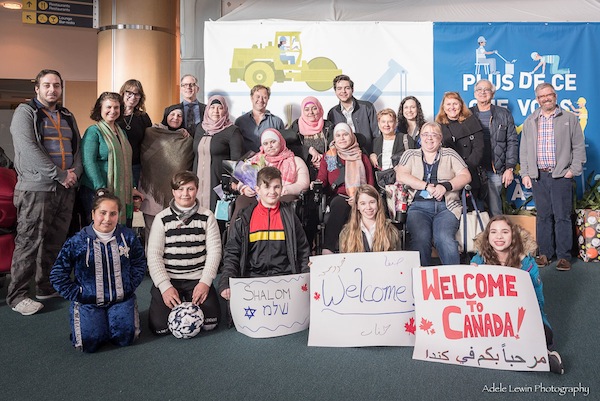
Welcomers of the Alsedawe family at Vancouver International Airport Jan. 21. (Adele Lewin Photography)

More than three years ago, Hanan Alsedawe’s family story of survival began as a waiting game on both sides of the ocean. But, on Jan. 21, 2019, the wait became a welcome as Hanan and her children stepped foot on Canadian soil.

In early 2015, congregations Beth Israel and Beth Tikvah began the long process of sponsoring and reuniting a Syrian refugee family with family who already lived in Vancouver. We worked with the government-approved sponsorship agreement holder – the Anglican Diocese – to prepare and submit our private sponsorship application to the Canadian government. It was a journey requiring perseverance by our coordinating committee, and patience and understanding from the many donors of both synagogues who demonstrated belief in our efforts regardless of the length of time it was taking.

On the Jordanian-Saudi Arabian border, in the Azraq Refugee Camp, Hanan and her two children – Mahros and Safa – shared limited resources with more than 55,000 refugees. Their extended family had made their way to Canada under government sponsorship, but Hanan had stayed behind, in Duma, Syria, because her husband, Raslan Abdulmalik, had been taken away by Syrian government forces and she had no idea of what had happened to him. She waited, she hoped, she prayed, but, eventually, with no sign of Raslan being alive, yet with no confirmation that he was either in prison or dead, Hanan decided to escape from Duma. She made her way with her two young children to Amman, Jordan, and eventually was placed in the Azraq refugee camp. There, she waited for a miracle.

Sept. 2, 2015, was a watershed moment that captured the hearts of people around the world and galvanized Canada into accepting 25,000 Syrian refugees into the country. Hanan’s mother and five siblings came to our shores under those auspices. But it would take years of work and hope to bring the last of Fayzeh Alsedawe’s daughters, with her children, to join the family here.

More than three years after initiating the sponsorship, Beth Israel and Beth Tikvah fulfilled Hanan’s dreams of joining her mother and siblings in Vancouver. On Jan. 21, representatives of both synagogues were on hand at Vancouver International Airport to welcome their sponsored family.

On any given day, at any given time, the international arrivals hall at YVR is a kaleidoscope of colours. On that Monday in January, the full spectrum was visible, augmented by the cacophony of diverse languages and a blending of bodies. Clearly, Canada is at its most multicultural in an airport setting.

photo - Members of the Alsedawe family at YVR: Fayzeh, Hanan, Mahros and Hanadi
Members of the Alsedawe family at YVR: Fayzeh, Hanan, Mahros and Hanadi. (Adele Lewin Photography)

Also palpable was the range of emotions. There was the full gamut of human feelings on display among those awaiting families, friends and strangers to enter the hall. Contrasts abounded: joy competed with sadness, anticipation with angst, relief with uncertainty. Each person arriving searched for familiar faces, welcoming arms and handwritten signs, indicating that someone was there for them.

In this swirl of humanity were representatives of Beth Israel and Beth Tikvah, their dream to sponsor a refugee family from Syria finally reaching fruition. Sharing this moment – indeed, at the centre of this moment – was the local family: the mother, Fayzeh, and her five adult children, Hanadi, Huda, Maha, Hatem and Mohammed, who had arrived in Canada three years ago and had waited anxiously to be reunited with the remainder of their family.

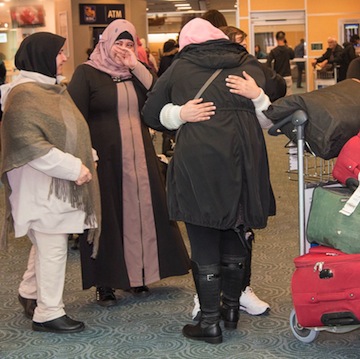
There was something so surreal, yet so tangible and in the moment at that airport reunion. Words are inadequate to describe the outpouring of relief and love when Hanan and her children emerged in the arrivals hall. An invisible bubble enclosed the family, as they looked at each other for the first time in more than four years. And then, quickly, the bubble grew, as our delegation surrounded the family with our own contributions of hugs, gifts and welcome. One gift in particular seemed to unite the new family with our Canadian sponsors – a Whitecaps soccer ball given to 13-year-old Mahros. Soccer, a universal language for children and adults alike!

Every family has a history, a story that captures the essence of their character and experiences. The Alsedawes’ story is one of courage and hope. Their life in Syria was destroyed by war but their determination to escape, under circumstances almost impossible for us to comprehend, means that, today, their story is one of hope and gratefulness. In Hanan’s own words to the committee, “I thank God and I thank you.”

Settlement requires patience. Never has the Hebrew word savlanut meant so much to our small committee. Patience was required in the very lengthy process from application to arrival. Patience is required as we work to settle the children in school, the mother in English-as-a-second-language classes and the family into a way of life totally foreign to them. Within weeks of their arrival, the family had visited a family physician, dental appointments were booked, the children were enrolled in public school, bank accounts were set up and, important in this day and age, cellphones and tablets were provided to them.

Our year of sponsorship has only just begun, but this journey has been undertaken with the generosity of many people. Our donors have compassion and commitment, and understand that, “There but for the grace of God go I.”

Rosalind Karby is co-chair, with Miranda Burgess, of Beth Israel Congregation’s Committee for the Syrian Refugee Sponsorship Initiative.

Format ImagePosted on April 12, 2019April 10, 2019Author Rosalind KarbyCategories LocalTags Beth Israel, Beth Tikvah, immigration, refugees, Syria, tikkun olam
Educating rabbinical students

Educating rabbinical students

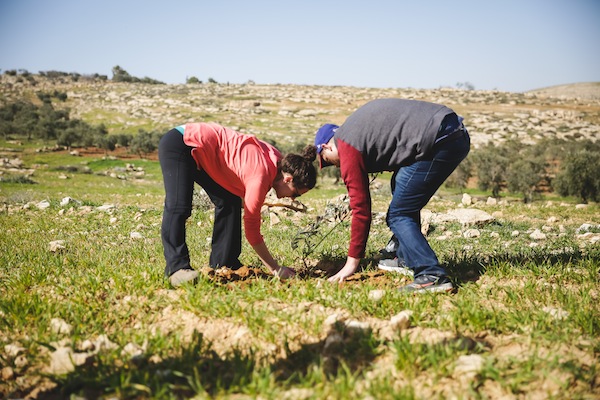
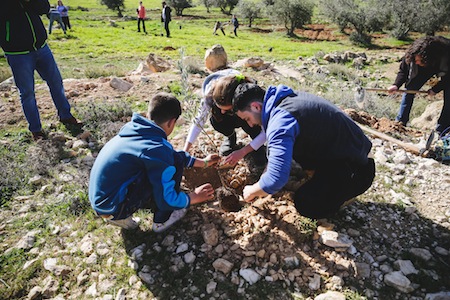
T’ruah students help plant trees in the Hebron Hills. (photo from T’ruah)

U.S.-based T’ruah: The Rabbinic Call for Human Rights works in Jewish social justice circles in Israel and North America.

“We work with human rights of both Israelis and Palestinians…. We’ve also worked on introducing rabbis and rabbinical students, and also congregations, to what’s happening in West Bank and more,” executive director Rabbi Jill Jacobs told the Independent.

T’ruah, which supports a two-state solution, offers the Year-in-Israel program for rabbinical students.

“Students study in Jerusalem at various institutions,” said Jacobs, “but they don’t necessarily get to see human rights issues up close. We take them once a month to see a human rights issue on the ground, either in the West Bank with Palestinians, in Bedouin Israeli communities in the Negev, asylum seekers, etc.”

At these sessions, students meet with Israeli human rights and other leaders on the ground. The program is held during students’ free time, separate from their regular studies.

“The goal of the program is to help them develop a rabbinic moral voice,” said Jacobs. “As rabbis, they’re going to be called on to speak about Israel. The question is, how do they talk about Israel as a rabbi? Rabbis talk out of their values, and also are generally dealing with politically diverse communities…. So, the question is, how can a rabbi speak in a way that will push people to listen to perspectives they might not otherwise listen to, [based on] Jewish texts and Jewish values?”

Jacobs recognizes that the information they provide is not comprehensive. Their focus is to give students the opportunity to interact with human beings – to meet Palestinians, Bedouins and others and learn from them what their life experience is like.

“It’s also crucial to us that they are meeting with Israeli human rights leaders,” said Jacobs. “Very often, there’s a dichotomy that suggests that being pro-Israel means supporting the right-wing government of [Binyamin] Netanyahu and that being pro-Palestinian means being against Israel. We’re pro-human rights and we want them to meet Israelis working every single day to push for human rights in their own country because they love their country. We want them to see that there are actually people who are changing the situation.

photo - T’ruah students planting trees
T’ruah students planting trees. (photo from T’ruah)

“We hear a lot from the students that our program gives them hope. Sometimes, they are so hopeless about what is happening in Israel and then they meet people, both Jewish and Palestinian communities, who are trying to change their situation.”

One T’ruah graduate is Rabbi Philip Gibbs, spiritual leader of Congregation Har El in West Vancouver.

“During my year in Israel, during my second year of rabbinical school, I had the opportunity to then be a fellow with T’ruah for their rabbinical student program,” Gibbs told the Independent. “I really appreciated the opportunity, both because, at least the year I was doing it, there was clearly a huge focus on the Israeli-Palestinian conflict. But, also because the way, in terms of educating about social justice issues in Israel, they were able to show some of the other issues happening – whether it was meeting with Bedouins, talking to some asylum seekers from Africa … really seeing what their home-grown needs are and seeing how it developed into a strong sense of the how they were fighting for many of those needs through the legal systems in Israel.”

Gibbs met with Palestinians who had been displaced from the Jerusalem area after the 1967 war. “We had the chance to hear their narrative,” he said, “highlighting how their status as refugees during that conflict had really come into question because of both the policies of Jordan, as they were occupying the area, as well as some of the motivations of different settler organizations in their attempt to create a much stronger Jewish presence behind the Green Line… I felt like that was more educating us in understanding the way that the nature of a lot of these neighbourhoods had been going back and forth.

“For the Israeli settlers, they felt they were reclaiming a neighbourhood that was Jewish. For the Palestinians that had been living there, their legal status was caught up in layers of legal confusion of having that area under control of many different authorities over the past 150 years.”

Gibbs has not yet had an opportunity to bring this part of his rabbinical education to his congregation directly, but it has definitely played a role in how he shares his perspective regarding, for example, the upcoming Israeli election.

“I’m making sure there’s a deeper sense of having the recognition that a lot of these questions that are coming up, some of these issues are on the minds of most Israelis … but that, no matter what, a lot of the work that human rights organizations are doing, a lot of that is going through the overt legal system of Israeli government.”

Regarding the many Israelis he has met who work for human rights organizations, Gibbs said he appreciated the way their main motivation was a deep sense of trying to make their country the best it can be, noting that every government needs to be transparent in their treatment of their citizens, allowing for a certain amount of criticism.

“That’s something coming from a place of love and it’s the most ideal way to get things done in a constructive way,” said Gibbs. “People can debate about how much people living outside of Israel are supposed to be making any sort of direct intervention, which happens on both sides of the political spectrum, but, I think, there’s absolutely nothing that we should hide in terms of understanding the full array of political work happening in Israel.”

Rebeca Kuropatwa is a Winnipeg freelance writer.
Format ImagePosted on April 12, 2019April 10, 2019Author Rebeca KuropatwaCategories WorldTags Diaspora, Har El, Israel, Judaism, Philip Gibbs, rabbis, T'ruah, tikkun olam
Awarding tikkun olam

Awarding tikkun olam

Sam Albert, above, and Liana Gerber are co-winners of this year’s Temple Sholom Teen Tikkun Olam Awards. (photos from Temple Sholom)

The Dreamers and Builders gala event May 5 provides Temple Sholom the opportunity to present its third annual Tikkun Olam Awards. The awards are the dream child of Rabbi Dan Moskovitz, and are funded by Michelle and Neil Pollock.

In addition to highlighting exemplary dreamers and builders like honourees Susan Mendelson and Jack Lutsky, this year’s gala will recognize two among the many amazing teens in the community. These youth see the needs in the world and work hard to address those needs, with creativity and compassion.

The application process for the 2019 Tikkun Olam Awards produced eight applicants and two co-winners: Sam Albert and Liana Gerber.

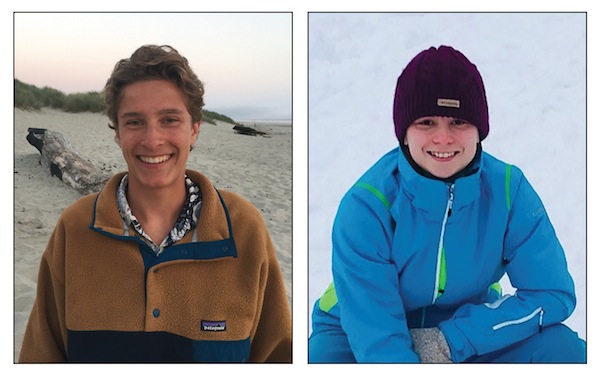
Sam, 17, is in Grade 11 and already recognizes the power of the pen – he plans to study journalism. His parents, Jennifer Tater and David Albert, have encouraged his devotion to community involvement. He is the youngest of three and has two older sisters. His interest is protecting the planet and preventing climate change. He is involved in many local organizations and has spent a lot of his spare time working to clean Metro Vancouver’s beaches. He is so well-known in the world community that he has been invited to attend a climate change conference in Bonn, Germany, this summer.

Liana, also 17, is a Grade 12 student. The daughter of Michelle and Martin Gerber, Liana has a twin and a younger sister. Next year, Liana plans to start studying interior design and also hopes to become a paramedic one day. For several years, on a volunteer basis, she has baked for the kids who enter Ronald McDonald House. In the process of doing this, she has spoken with and persuaded the manager of her local grocery store to provide reduced prices for the grocery items required. She also has fundraised to ensure that meals are provided for families when they enter the home, so that they may focus on the needs of their child and not worry about feeding themselves. While traveling in the United States, Liana found a Ronald McDonald House and baked for the residents there. How basherte it is that Liana is a co-winner the year that Temple Sholom recognizes Mendelson, a founder of the Lazy Gourmet catering company, among other accomplishments, for all of her work and devotion to tikkun olam.

Temple Sholom is proud and honoured to recognize excellence among its teens. On June 7, at the Shabbat evening service at the synagogue, all of the Tikkun Olam Award candidates will be acknowledged and celebrated with a special presentation. The entire community is invited to participate.

For more information about and tickets to the Dreamers and Builders gala, which is almost sold out, visit templesholom.ca/dreamers-and-builders.

Format ImagePosted on April 12, 2019April 11, 2019Author Temple SholomCategories LocalTags Liana Gerber, Sam Albert, Temple Sholom, tikkun olam
Teens bake for others

Teens bake for others

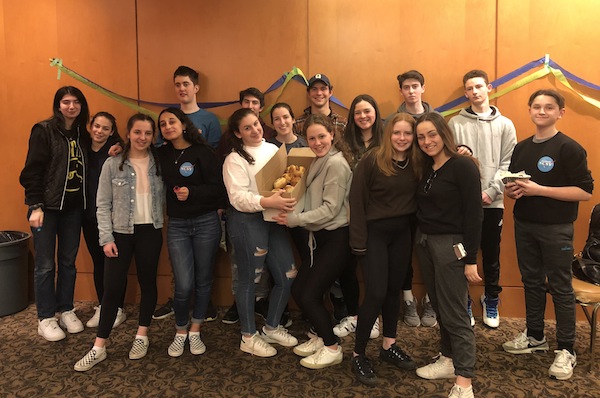
Teens from CTeens, NCSY and BBYO joined together for the Not Your Bubbies’ Babka Bake at Congregation Schara Tzedek on March 7. (photo from CTeens)

On March 17, teens from three local organizations – CTeens (Chabad Teens), NCSY (National Conference of Synagogue Youth) and BBYO (B’nai B’rith Youth Organization) – joined together for a mitzvah. Around 30 teens from Richmond and Vancouver gathered for the Not Your Bubbies’ Babka Bake at Congregation Schara Tzedek, where they learned how to braid challah and make chocolate babka.

This wasn’t an ordinary get-together, it was a mitzvah event, timed to help celebrate Purim. The challot went to seniors in the Light of Shabbat Program, and the teens took the babkas home.

The Light of Shabbat Program is run by Chabad Richmond, in partnership with the Kehila Society. Every other week, a group of volunteers makes and delivers full kosher meals, along with Shabbat candles and grape juice, to Richmond seniors who are alone on Friday nights. To find out more about the program, visit chabadrichmond.com/lightofshabbat. Part of the meal is homemade challah, which was made by these teens as part of the mishloach manot (also referred to as shalach manot), or Purim food baskets, given on the holiday.

It’s a mitzvah and tradition for adults to send a gift basket of ready-to-eat foods to at least one friend during the day of Purim. The baskets should include at least two foods, often hamantashen, chocolate, fruit, cookies or candy. The source of mishloach manot is the Megillah, or Book of Esther, which talks about “sending portions one to another, and gifts to the poor.” The idea of sending gifts of food on Purim is to strengthen our bonds of friendship with fellow Jews, as one theme of Purim is friendship and unity.

Aiden, a 15-year-old CTeen, said the reason he joined the Not Your Bubbies’ Babka Bake event was to meet other Jewish teens, and help out. “I love to bake,” he said, “and it makes me feel good knowing that the challahs we’re baking are going to seniors in our community.”

A CTeen for two years, Aiden wanted to feel more connected to the Jewish community, so he started going to shul at Chabad Richmond. Then he met Rabbi Chalom Loeub, who leads the CTeen program. Among other things, the CTeens get together every Sunday to bake cookies and cakes for seniors. Aiden also mentioned going to the CTeen International Shabbaton in New York, which he said was “incredible.” He’s now trying to get other Jewish teens involved in CTeen, too.

Jillian Marks, 17, was another participant in the challah and babka bake. She came to the event through her involvement with BBYO. As a youth leader for the Vancouver chapter, she wants to create “a pluralistic environment for everyone who wants to meet other Jews and feel safe and be whoever they want to be.” BBYO holds different events, all of which have some Jewish element to them. For this particular event, BBYO joined with CTeens and NCSY to “work together, not compete. You can be in all of the groups, not just in one of them,” said Marks.

Each of the youth groups emphasizes leadership skills, and many of their events are teen-run initiatives. Marks added that “the purpose of this challah/babka bake was not just to meet other Jewish teens, but also to volunteer and help out the community.”

All the teens echoed the same sentiments – that making challah for seniors is a mitzvah and that it feels good to volunteer. It’s a nice perk, they said, that they also get to meet other Jewish teens, adding that they would “get the word out” to their friends.

Several teens from NCSY, including Neer, 16, Jessie, 17, and Romy, 16, also attended the challah and babka bake. They run Live to Give, a social action outreach program for the local NCSY chapter. One of their projects is to take homemade baking to Louis Brier Home and Hospital residents. One of the teens said, “For seniors who have no family, or very little, it’s special for them, and it brings a lot of light to their life.”

Members of the NCSY chapter also make and deliver food to people in Oppenheimer Park. “It’s a great opportunity to help out in the community and it’s very rewarding,” said the teen.

Format ImagePosted on April 12, 2019April 10, 2019Author CTeensCategories LocalTags baking, BBYO, CTeens, Judaism, NCSY, Purim, tikkun olam, youth
The runway to healing

The runway to healing

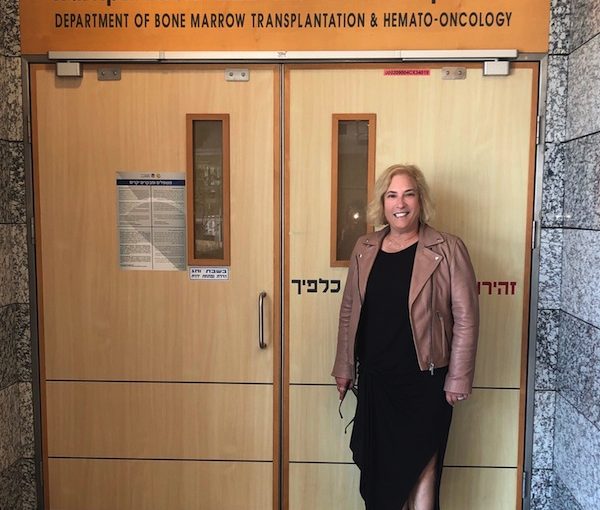
The writer at the bone marrow transplant ward at Ichilov Hospital in Israel. (photo from Ariella Stein)

Fashion is one of my many passions, as regular readers of the Jewish Independent will know by now. So, when I turned 50 this year, a milestone birthday, I decided to pursue a longtime dream – to create a fashion tract for bone marrow transplant survivors.

When I was 17 years old, I was diagnosed with Hodgkin’s lymphoma. At the time, I was in Grade 12, studying in Israel. My parents’ first reaction was for me to return to Vancouver, where they felt I should start my treatments. There was no time to waste, as it was at an aggressive stage. However, after much persuasion, I convinced my parents that I should stay in Israel. As part of the deal I made with them, I was to head back to Vancouver upon graduation and resume the next cycle of treatments.

I started chemotherapy. I had the most loving care from the staff at Tel Hashomer Hospital. I was on the road to recovery when I returned home.

After a few more bouts with chemo and some courses in radiation, however, we were given the devastating news that I had to undergo an autologous bone marrow transplant. The procedure had to start immediately. I lost the little hair I had left in just one day, couldn’t hold down any food or drink, and was separated from any ounce of humanity because I had no immunity. But I was getting better, thanks to the staff and doctors at the British Columbia Cancer Agency.

During the horrifying three-month stay in my isolated hospital room I was, paradoxically, injected with the poisonous chemo cocktail expected to cure me and the benevolent rays of light and love of my family. The support made me stronger and gave me courage. I had so much to look forward to. My two older sisters had countless discussions on having children for me if I couldn’t conceive, my father tried to grant me not just one star but the whole galaxy, my mother never left my side and my then-boyfriend-now-husband showered me with tenderness. The love in my room spread throughout the ward. Through the tears, we remembered to laugh and dream.

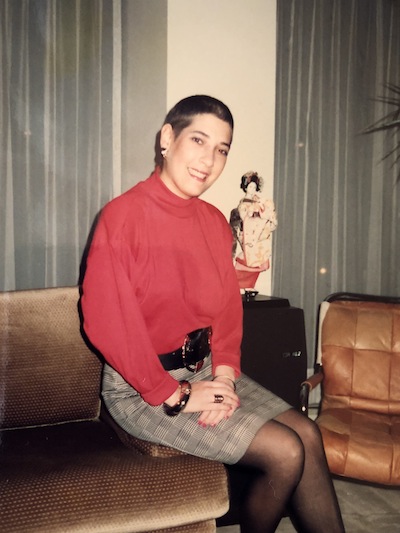
photo - The writer, at 18 years old, two months after being released from the hospital for treatment of Hodgkin’s lymphoma
The writer, at 18 years old, two months after being released from the hospital for treatment of Hodgkin’s lymphoma. (photo from Ariella Stein)

When it was time to go home, I was nervous about leaving my protected environment but full of excitement to start my new life. All I wanted was to feel and look healthy again. I bade farewell to my dull uniform of pajamas and welcomed my new outfit, especially chosen for me. On the door, it was waiting for me, as if knowing how I was craving to look like a girl again. I fondly remember stepping out in my blue leather mini skirt, black cashmere sweater and black knee-high boots, handpicked with care by my mom, a true fashionista. I looked fabulous and felt euphoric on the 10-minute ride home, the only place I was headed for the time being.

Fast forward some 30 years, and I am the mother of two miraculous children, Daniel and Natalie, who bring me the greatest happiness and naches, spoken like a true Yiddishe Mame. I am grateful every day for my blessed life. There have been bumps along my journey, of course. I have often wondered if other women had the transformational experience I did leaving the ward. I knew the day would come for me to help other survivors in my own way. Splitting my time between Israel and Canada, I chose to initiate a fashion project in Israel.

I reached out to the head of the bone marrow transplant unit in Ichilov Hospital (Tel Aviv Sourasky Medical Centre) and, to my astonishment, within minutes was told they were on board. My dream was becoming a reality.

My mission is to offer patients, upon their release, an outfit of their wishes to raise their spirit, as my mother’s fashion choices had raised mine. I wrote letters to as many clothing stores as I could, looking to find sponsors, hoping they would donate new outfits to recipients. I received a few replies saying nice idea, good luck; some never replied. But some did reply with open hearts, willing to contribute to the project.

Getting started has been challenging, one step forward and a few back. Frustrating as it is, I understand that it will take time but, among the obstacles, I will not give up. As the writer Paulo Coelho said, “When you want something, all the universe conspires in helping you achieve it.” I have named my project Lalas Wings. Lala is a nickname, dubbed by my niece and nephew 35 years ago.

I was taught to dream big by my mentor, my father, Karl Stein. Hopefully, by sharing my dream, I can make a significant contribution to many bone marrow transplant patients, starting in Israel and eventually reaching hospitals in more and more places. My experience leads me to believe that the seemingly externally focused gift of clothing is part of a perfect beginning to the complex healing process.

If anyone has any questions about Lalas Wings, I can be reached by email at [email protected].

Ariella Stein is a mother, wife and fashion maven. A Vancouverite, she has lived in both Turkey and Israel for the past 25 years.

Format ImagePosted on April 12, 2019April 10, 2019Author Ariella SteinCategories IsraelTags Ariella Stein, cancer, fashion, health, Israel, Lalas Wings, philanthropy, tikkun olam
Memory still debated

Memory still debated

Dr. Laura Beth Cohen (photo from Dr. Laura Beth Cohen)

Although the Srebrenica genocide – the killing of more than 8,000 Bosnian Muslims by Bosnian Serb forces in July 1995 – occurred more than 20 years ago, it still affects the people of Bosnia and Herzegovina every day, according to Dr. Laura Beth Cohen, director, Kupferberg Holocaust Centre, Queensborough Community College, City University of New York.

Cohen was in Winnipeg on March 8 to speak as part of the Mauro Centre for Peace and Justice: Brown Bag Lecture series. She spoke on the topic Conflicted Walls: Untangling Transitional Justice and Traumatic Memories at Bosnia’s Memorial.

“There was an opportunity to participate in the first fellowship called Summer University Srebrenica and so I decided to go,” Cohen told the Independent. “I learned very quickly – that was in the summer of 2010 – that, to really understand Bosnia, it was not enough to take a course and learn about it from books. It’s very important to understand what’s actually happening there, and the best way to do that is to actually go there. It’s a place with intense beauty, legacy and a wonderful history of different ethnic groups coming together, living in harmony.”

But, the legacy of the last war, which lasted from 1992 to 1995, is still very much present. In fact, she said, the current government is debating about it.

“Here, in America, we talk about the Second World War as if it’s confined to the past,” said Cohen. “But, in many places in Europe, the Second World War, that memory, is very much alive. And, once you’re in an environment like that, it really starts to help you, not only sort out what has taken place, but you can see … because you’re not part of that country, or you don’t belong to that population … you can start to see different ways that those memories of the past are interacting in contemporary life, and are incredibly problematic.”

When Cohen was in Srebrenica, she was taken by how much the memory of the genocide affects the surviving population, how much it is fought over. The country and government are split into two ethnic entities that are a result of the Dayton Accord, which was signed after the massacre in Srebrenica. One side was deemed the perpetrator; the other, the victim.

“It is not a big surprise there are very different perspectives between the sides over what happened in Srebrenica,” said Cohen. “The RS [Republika Srpska] government in the last month has created a new commission on Srebrenica to, once again, reexamine the facts and evidence to determine whether or not genocide took place … even though genocide took place and was proven multiple times, and especially in the international criminal tribunal. So, this debate over what happened and denial over what happened is still occurring within Bosnian society, as well as, particularly, in Srebrenica.”

This, of course, makes it very difficult for the residents of Srebrenica and the region to move forward, she said.

“It’s a place that would really benefit from having a lot of people just step away … and allowing the population to just live, move forward, and gain attention for things that they really need support with – economic relevance, additional support for education, and rebuilding parts of the community,” said Cohen. “But, with the memory so volatile and kept alive, it really overshadows what’s taking place there. You can imagine trying to raise your family, regardless of your ethnicity, in a place where the past is constantly looming, and it’s a grotesque past. How do you bring your children up in that world?”

According to Cohen, the constant and continued fight over the politics and memory of what happened at Srebrenica does not allow people to learn about what happened or why, and that this is preventing coping mechanisms from being put into place; mechanisms that could help stop other massacres from happening.

“We only focus internationally once a year – on July 11, during the annual commemoration of the Srebrenica genocide that takes place at the memorial – so we often don’t understand what’s taking place there the other 364 days of the year,” said Cohen.

“People visit the 9/11 memorial in downtown Manhattan. They visit Auschwitz-Birkenau in Poland. They visit Kigali Genocide Memorial [in Rwanda]. These memorials serve as an educational component. For local residents and national citizens of these countries, they also serve as places of memory making,” she said.

In Srebrenica, Cohen hopes to eventually see ways of involving the local community in dialogue initiatives that facilitate the creation of memorials, ones that speak to the locals, helping them repair their communities.

“While we, as Jews, have a view of what Auschwitz-Birkenau is, to the people of Poland, it’s a German extermination camp on Polish soil,” said Cohen. “And, to the local people in Oswiecem, which is the Polish name of the town that the camp was built by, they struggle with having that kind of site in their community.”

When it comes to Srebrenica, she said, “We get stuck in the conversation of the politics over the genocide and what happened. What then happens is, a lot of these issues play out at the memorial. Part of this conversation is theoretical, but part of it is to help us understand that these are not static locations. They are very much interactive places, where memories are not only being promoted, but shaped by the larger discourse where they are situated.”

Cohen said the part of Bosnia, Herzegovina and Srebrenica that has always drawn her is “not only the friends I’ve made, but a vibrancy of life in Bosnia that gets lost in the discussion. The culture is beautiful, the people are beautiful, the relationships that people have with each other are beautiful. And, despite all of the horror of the last war, and despite all the history, and the Second World War and before that, it’s a place where there’s a lot of love and a lot of hope. That’s something that keeps, especially, international activist scholars engaged in what’s taking place there … and that, we can’t lose sight of when we talk about all the politics and things that aren’t going well.”

Rebeca Kuropatwa is a Winnipeg freelance writer.
Format ImagePosted on April 12, 2019April 10, 2019Author Rebeca KuropatwaCategories WorldTags Bosnia, genocide, Herzegovina, Laura Beth Cohen, memorials, Srebrenica, tikkun olam
Making change her business

Making change her business

Elisa Birnbaum, centre, with Laura Zumdahl of Bright Endeavors, left, and Maria Kim of Cara Chicago. (photo from Elisa Birnbaum)

Toronto-based Elisa Birnbaum, editor-in-chief of SEE Change magazine, aims to inspire and give hope in many ways. Her book In the Business of Change: How Social Entrepreneurs are Disrupting Business (New Society Publishers, 2018) is but one of those ways.

“I’m a lawyer by training, but was always a writer on the side, enjoying writing and storytelling,” said Birnbaum, who was born and raised in Montreal in an Orthodox Jewish family. “I decided to try writing out for a little bit and to go back to law after. That was 15 years ago. I never went back to it.

“I was writing a lot about the nonprofit and charitable sector in Canada, as well as in the U.S., and I was also writing a lot about business, a strong interest of mine, too. I noticed how there was a melding of the two – how a lot of challenges in the nonprofit and charitable sector … how they could be helped through business and through business savvy…. So, when I saw what social enterprise was all about and how it was using business to solve social challenges, I realized the importance of that. I became really intrigued and interested. It was an area that, I thought, ‘Hey, this is something I really want to explore further.’”

Birnbaum started pitching stories about social enterprises to any editor who would listen. While some of her work went out via mainstream media, Birnbaum felt more was needed, so she co-founded SEE Change, which is devoted to telling the stories of social and environmental enterprises.

“I thought they symbolized a new way at looking at business,” she told the Independent. “I really felt this was the future, with how we work with business and how communities can tackle social challenges through business, and these types of savvy-ness and skills.”

After years of publishing the magazine, Birnbaum wanted to put together a book of such stories, both to delve more deeply into the phenomenon and, hopefully, to inspire and teach readers how to take on the task of starting a social enterprise.

“A lot of times, I’d get some young people or even older people who were interested in social entrepreneurship themselves, and they’d like advice and tips, and were constantly looking for more information from anyone who’d done it before,” she said. “So, I thought, I could also provide lessons learned, tips, advice and resources … so, a bit of storytelling, as well as a resource for those who are starting up or looking to start their own.”

As far as the response to the book so far, Birnbaum said she has been asked by schools and organizations to speak about the topic. “There were people who had never heard about it before and are now really inspired by the storytelling, which is great,” she said. “There are other people…. I was at a couple of universities recently, and some students there said they picked up the book and were now interested in starting their own social enterprise.”

According to Birnbaum, a very broad definition of a social enterprise is a business, whether nonprofit or for-profit, that has a social or environmental mission at its core, as opposed to a business that has profitability and sustainability at its core. The unique aspect of social entrepreneurship, she said, is that it approaches business in a new way.

In her book, Birnbaum makes a point of highlighting a large array of social enterprises from around the world, including a few in British Columbia. For example, Saul Brown’s Saul Good Gift Co. (itsaulgood.com) creates gift boxes filled with locally made artisan food that people can give their loved ones across Canada, and Reena Lazar’s Willow (willoweol.com) helps with end-of-life planning.

photo - Fresh Roots offers students experiential learning opportunities.
Fresh Roots offers students experiential learning opportunities. (photo from Fresh Roots)

Marc Schutzbank, director of Fresh Roots (freshroots.ca), grew up in the United States and moved to Vancouver to finish his education at the University of British Columbia 10 years ago on a Fulbright scholarship, looking at the economic viability of urban farming. This line of study led him to an organization called Plant to Plate, in Pittsburgh, Penn., where he attended University of Pittsburgh.

“As part of my research, I was looking at urban farms in Vancouver – if they were growing, how much food they grow, who they’re sharing it with,” Schutzbank told the Independent. “I have a finance degree, so I was looking at if they were making any money. As I was doing that, there were a couple of people who were doing work in the social space. So the goal wasn’t to grow and sell food; the goal was to share it or to reduce barriers to employment. And so, as I was getting to know them, Fresh Roots was moving from backyards into school grounds.”

One particular backyard caught Schutzbank’s attention. He wanted to know how much food was being grown in such a small space. He discovered, to his amazement, that this one backyard could feed three families. As they expanded to eight backyards, they could feed 35 families.

One of those backyards was adjacent to an inner-city elementary school with a rundown garden plot. The school invited Fresh Roots to develop the plot. As they did, the students, teachers and parents became increasingly interested. The teachers began using the garden as part of their curriculum, as a place to build learning capacity.

“It turns out that, when kids are outside growing food, their academic confidence increases,” said Schutzbank. “They are able to find some success, and this is often in places with kids that are having a hard time finding success inside the classroom [in straight rows]…. Learning like that doesn’t work for everyone.”

photo - Marc Schutzbank, director of Fresh Roots
Marc Schutzbank, director of Fresh Roots. (photo from Fresh Roots)

Another benefit of this was that bullying decreased at the school, as kids had a positive physical outlet. As well, Schutzbank found that, as the saying goes, “If you grow it, you eat it.”

Other schools picked up on what was happening and asked Fresh Roots to do the same at their schools. Fresh Roots is now at four high schools and one elementary school.

Fresh Roots also started a salad bar program for students – twice a week, all of the students get to eat the produce from the garden.

“In Canada, we are the only G7 nation that doesn’t have a federal meal program,” explained Schutzbank. “It’s a bit crazy that Canada doesn’t have that. All those kids without lunches are hungry, regardless of how much food is at home. It’s really critical for learning, to have food…. So, at Fresh Roots, our vision is good food for all – so everybody has access to healthy land, food and community.”

In addition to the food they grow, Fresh Roots supports and encourages teachers to have classes outside in the garden. “They need to touch, taste and feel,” said Schutzbank of the students. “Those are really critical parts of our senses and a really important way of learning.”

As well, Fresh Roots provides employment – especially in the summer – for youth who are struggling.

Schutzbank said you can’t grow food without eating and sharing it, so Fresh Roots’ philosophy is “around sharing all the food back through the programs and everything we are doing.”

Rebeca Kuropatwa is a Winnipeg freelance writer.
Format ImagePosted on April 12, 2019April 10, 2019Author Rebeca KuropatwaCategories Books, WorldTags business, Elisa Birnbaum, Fresh Roots, Marc Schutzbank, social enterprise, tikkun olam
Dreamers and builders fêted

Dreamers and builders fêted

Temple Sholom pays tribute to Susan Mendelson and Jack Lutsky at its Dreamers and Builders event next month. (photo from Temple Sholom)

When Temple Sholom members and friends come together May 5, they will celebrate decades of community-building by two honourees. They will also catch a glimpse into the future, as an annual award is presented to two young people with big dreams.

Dreamers and Builders is a biennial event, the first of which was held two years ago, with renowned landscape

architect Cornelia Oberlander being honoured. This year’s honourees are Susan Mendelson and Jack Lutsky, a couple whose lives and careers have focused on building successful businesses and making philanthropic contributions.

At the same event, the annual Temple Sholom Teen Tikkun Olam Awards will be presented to young people with visionary plans for making the world better. This year, the co-winners are Sam Albert and Liana Gerber, and they will be featured in an upcoming issue of the Jewish Independent.

Mendelson is best known for the culinary empire she has built over years as a founder of the Lazy Gourmet and as a food commentator, caterer, author and business leader. Her husband, Jack Lutsky, has an equally stellar resumé as an architect and businessperson.

Lutsky, who was born and raised in Edmonton, attended the Technion, in Haifa, Israel, and completed his studies at the Architectural Association School of Architecture, in London, England. He moved to Vancouver to begin his career and soon opened an eponymous architecture firm.

“My first clients actually were from the Jewish community,” Lutsky recalled in an interview with the Independent. “People I knew, that I could approach. I did work at the Jewish Community Centre and I did work at Schara Tzedeck Synagogue.”

An addition to Temple Sholom in the 1990s, in which classrooms and flexible meeting spaces were added above the driveway, was designed by him. In addition to a few churches and other institutional projects, Lutsky’s portfolio includes many commercial and retail projects. He was also the architect for the Holocaust memorial located in Schara Tzedeck Cemetery.

Lutsky’s philanthropic work includes serving as chair of the board of Jewish Family Services, involvement in Jewish Federation of Greater Vancouver, serving on the Temple Sholom board and heading or co-leading many fundraising campaigns, including a retirement event for Cantor Arthur Guttman that raised more than $100,000 for the synagogue. Lutsky was also on the transition committee when the synagogue’s Rabbi Philip Bregman retired and current Rabbi Dan Moskovitz assumed the post, and helped raise funds to ensure that Vancouver’s high cost of housing would not affect the synagogue’s ability to hire the ideal candidate.

Mendelson’s life has been devoted to food and philanthropy. Born in Toronto, she came to Vancouver for university and began baking treats for sale at intermissions at the Vancouver East Cultural Centre. This was the genesis of Mendelson’s professional food career. A co-founder of the Lazy Gourmet, an iconic local caterer, she has been a regular media commentator on food, is the author of 10 cookbooks and has mentored countless up-and-comers in the sector. Her community work includes serving as honourary board chair of Big Sisters BC Lower Mainland, chairing Federation’s women’s campaign, serving on the dean’s advisory board at the University of British Columbia and being founding chair of Arts 149, whose mandate is to present contemporary performing arts that innovate and inspire new professional community arts practices. Already famous locally, Mendelson was featured last month in the New York Times, which credited Mendelson in part for the popularity of the Canadian dessert Nanaimo bars.

The couple joined Temple Sholom in the 1990s and they agree it is a relationship they are thrilled to nurture.

“It’s been a good move for us and we really love the congregation,” Lutsky said.

Agreeing to be honoured at this event is really a chance to strengthen Temple Sholom, added Mendelson.

“It’s been an incredible opportunity to bring so many people together to become part of this event,” she said. “When we were approached, we just thought this was a great opportunity for us to be able to find a way to help Temple Sholom using our network, our friends, our family and our passion for Temple…. They’ve honoured us with donations and participation and sitting on committees. It’s been a pretty joyous experience all around.”

The couple promises some unexpected components of the event, which is envisioned as more laid back than a typical formal gala.

“I’m not going to give out any secrets, but we want our event to be a fun event,” said Lutsky. “We are designing it so that it will be very enjoyable.”

Mendelson is especially excited about the tie-in with successive generations through the Teen Tikkun Olam Awards, which was envisioned by Moskovitz and is funded in perpetuity by Michelle and Neil Pollock.

“That’s a wonderful opportunity – to reach out and find young people in this community, the next leaders in the community,” Mendelson said. “We want other people to be inspired, as well, by these brilliant young kids who are out there doing remarkable acts of kindness and tikkun olam in the world. It really is about looking to the next generation and honouring them at the same time.”

To encourage a younger audience, the event offered half-price tickets for people 30 and under.

Helen Heacock-Rivers who, with Karen Gelmon, is co-chairing Dreamers and Builders, said the event was almost sold out.

“It is a testament to how much Susan and Jack are loved; also Temple Sholom, but Susan and Jack in particular,” she said. “They are a perfect example of people who should be honoured.”

Heacock-Rivers lauded Mendelson and Lutsky for being hands-on in promoting and planning the event.

“They are the honourees, they don’t have to do anything,” she said. “But they are very invested in making sure this is successful for Temple Sholom, to make sure that we can have the means to support the programs that they have earmarked for the monies that come in.”

Because many younger members are moving outside of the city proper, outreach programs to suburban congregants and potential members will be funded with revenue from Dreamers and Builders. Upgraded security at the synagogue is another project earmarked for funds.

Format ImagePosted on April 5, 2019April 4, 2019Author Pat JohnsonCategories LocalTags Jack Lutsky, Susan Mendelson, Temple Sholom, tikkun olam
Milestones … Shapira, Or Shalom, Baumel Joseph, Respitz & Krug

Milestones … Shapira, Or Shalom, Baumel Joseph, Respitz & Krug

Adi Shapira brought home a silver medal for British Columbia in the 2019 Canada Winter Games. (photo by Peter Fuzessery Moonlight Canada)

From Feb. 15 to March 3, Red Deer and central Alberta hosted the 2019 Canada Winter Games. Among those taking home a medal was Adi Shapira.

Winning the silver in the archery recurve, individual female event, Shapira said in a Team BC article, “It is an amazing reward for all the training I have been doing and it is just an amazing accomplishment.”

photo - Adi Shapira prepares for a shot
Adi Shapira prepares for a shot. (photo from Team BC)

According to the Canada Winter Games website, Shapira, “who had taken up archery following a school retreat in grades 8 and 9, fought hard in the gold medal match, but Marie-Ève Gélinas, came back to win the gold for Quebec.”

Shapira, 16, is part of the SPARTS program at Magee Secondary School, which is open to students competing in high-performance athletics at the provincial, national or international level, as well as students in the arts who are performing at a high level of excellence. Last November, she won the qualifying tournaments against other female archers ages 15 to 20 to represent the province of British Columbia in the February national games.

* * *

photo - The 2019 Stylin’ Or Shalom fashion models
The 2019 Stylin’ Or Shalom fashion models. (photo from Or Shalom)

Stylin’ Or Shalom on Feb. 20 was not just a beautiful evening: the event raised $1,600 for Battered Women’s Support Services so that they can continue their important work.

Models for the fashion-show fundraiser were Ross Andelman, Avi Dolgin, Val Dolgin, Carol Ann Fried, Michal Fox, Dalia Margalit-Faircloth, Helen Mintz, Ana Peralta, Avril Orloff and Leora Zalik. About 50 people attended and, between cash donations and purchases from the My Sister’s Closet eco-thrift store, this year’s show raised about $600 more than did the inaugural Stylin’ Or Shalom event held in 2017. In addition, many people brought clothing donations, which will be sold at the store, generating further funds for the organization.

* * *

The Association for Canadian Jewish Studies has announced that Dr. Norma Baumel Joseph is the 2019 recipient of the Louis Rosenberg Canadian Jewish Studies Distinguished Service Award. Joseph brings together the highest standards of scholarship, creative and effective dissemination of research, and activism in a manner without rival in the field of Canadian Jewish studies, as well as being a respected voice in Jewish feminist studies more broadly.

photo - Dr. Norma Baumel Joseph
Dr. Norma Baumel Joseph

Joseph’s scholarship is remarkable for her mastery of both traditional rabbinic sources and anthropological methods. Her work on the responsa of Rabbi Moses Feinstein, including an award-winning article published in American Jewish History 83,2 (1995), is based on a close reading of some of the most technical and difficult halachic texts. Her mastery of these sources is also apparent in articles on women and prayer, the mechitzah, and the bat mitzvah. She has used her knowledge of halachah in her academic work on Jewish divorce in Canada, including an article in Studies in Religion (2011) and is a collaborator in a recently awarded grant project, Troubling Orthopraxies: A Study of Jewish Divorce in Canada.

As a trained anthropologist and as a feminist, she realizes that food is also a text and she has made important contributions to both the history of Iraqi Jews in Canada and to our understanding of the history of food in the Jewish community. Her Social Sciences and Humanities Research Council of Canada (SSHRC)-funded research has resulted in recent essays such as “From Baghdad to Montreal: Food, Gender and Identity.” Her ongoing reflections on Jewish women in Canada, first appearing as early as 1981 in the volume Canadian Jewish Mosaic, are foundational texts in the study of Jewish women in Canada.

Joseph has chosen to disseminate her research and wisdom in a variety of ways. Her undergraduate and graduate students at Concordia praise her innovative student-centred teaching. Recently, she instituted a for-credit internship at the Alex Dworkin Canadian Jewish archives, which has been beneficial to both the student and the archive. She is in demand as a lecturer in both professional and lay settings. Her work in film has reached a wide audience. In Half the Kingdom, a 1989 NFB documentary on Jewish women and Judaism, she explores with sensitivity the challenges – and rewards – of being both a feminist and an Orthodox Jew. She served as consultant to the film, and was a co-author of the accompanying guidebook.

Since 2002, Joseph has also committed herself to public education by taking on the task of writing a regular column on Jewish life for the Canadian Jewish News. Her views are based on a deep understanding of Judaism and contemporary Jewish life and are worthy of anthologizing.

Joseph is a founding member of the Canadian Coalition of Jewish Women for the Get and worked for the creation of a Canadian law to aid and protect agunot. As part of her Women for the Get work, she participated in the educational film Untying the Bonds: Jewish Divorce, produced by the Coalition of Jewish Women for the Get in 1997. She has also worked on the issue of agunot, as well as advocated for the creation of a prayer space for women at the Western Wall among international Jewish organizations.

Joseph helped in the founding of the Institute for Canadian Jewish Studies at Concordia, and convened the institute from 1994 to 1997, when a chair was hired. She was also a founder and co-director of Concordia University’s Azrieli Institute for Israel Studies. In 1998, she was appointed chair of the Canadian Jewish Congress National Archives Committee, and has remained in the position since then, under the new designation of chair of the advisory committee for the Alex Dworkin Canadian Jewish Archives (CJA). In this capacity, Joseph has been a forceful and effective advocate for protecting and promoting the preservation of Canadian Jewish archival material and for appreciating the professionalism of the staff. She has lent her time and experience to multiple meetings and interventions at various crucial junctures in the recent history of the CJA, during which she has balanced and countered arguments that would have led to the dissolution or extreme diminishing of the archives as we know it. Her work on behalf of the archives has drawn her into diverse committees and consultations. Notably, she contributed her expertise to the chairing of a sub-committee convened by Parks Canada when their Commemorative Places section was in search of Canadian Jewish women-related content. Her suggestions made during the 2005 meetings have resulted in several site designations over the course of the past 12 years.

Joseph has had a unique role in Canadian Jewish studies and Canadian Jewish life, and is richly deserving of the Louis Rosenberg Award.

* * *

photo - Janie Respitz of Montreal won the prize for best interpretation of an existing Yiddish song at the final Der Idisher Idol contest in Mexico CityIn February, Janie Respitz of Montreal won the prize for best interpretation of an existing Yiddish song at the final Der Idisher Idol contest in Mexico City. She performed “Kotsk,” a song about a small town in Poland, which was the seat of the Kotsker rebbe, the founder of a Chassidic dynasty in the 18th century. The win included $500 US.

Respitz holds a master’s degree in Yiddish language and literature and, for the past 25 years, has performed concerts around the world. She has lectured and taught the subject, including at Queen’s University and McGill University, and is on the faculty of KlezKanada, the annual retreat in the Laurentians.

Respitz was among nine finalists, both local and foreign, who were invited to perform at Mexico City’s 600-seat Teatro del Parque Interlomas before a panel of judges and a live audience.

The competition is in its fourth edition, but Respitz only heard about it last year. She submitted a video of her performing “Kotsk” in September and received word in December that she was in the running.

A Yiddish song contest in Mexico City may seem odd, but the city has a large Jewish community, many with roots in eastern Europe, much like Montreal. The winner for best original song was Louisa Lyne of Malmo, Sweden, who’s also a well-established performer of Yiddish works.

– Excerpted from CJN; for the full article, visit cjnews.com

* * *

On March 14, at the New School in New York, the National Book Critics Circle (NBCC) announced the recipients of its book awards for publishing year 2018. The winners include Nora Krug, who was given the prize in autobiography for Belonging: A German Reckons With History and Home (Scribner). “Krug creates a stunningly effective, often moving portrait of Krug’s memories and her exploration of the people who came before her,” said NBCC president Kate Tuttle.

image - Belonging book coverKrug’s drawings and visual narratives have appeared in the New York Times, Guardian and Le Monde diplomatique. Her short-form graphic biography Kamikaze, about a surviving Japanese Second World War pilot, was included in the 2012 editions of Best American Comics and Best American Nonrequired Reading. She is the recipient of fellowships from the Maurice Sendak Foundation, Fulbright, the John Simon Guggenheim Memorial Foundation, the Pollock-Krasner Foundation, and of medals from the Society of Illustrators and the New York Art Directors Club. She is an associate professor at Parsons School of Design in New York and lives in Brooklyn with her family.

The National Book Critics Circle was founded in 1974 at New York’s legendary Algonquin Hotel by a group of the most influential critics of the day. It currently comprises 750 working critics and book-review editors throughout the United States. For more information about the awards and NBCC, visit bookcritics.org.

Format ImagePosted on March 29, 2019March 27, 2019Author Community members/organizationsCategories Local, WorldTags ACJS, Adi Shapira, archery, art, Association for Canadian Jewish Studies, books, Canada Winter Games, Janie Respitz, music, National Book Critics Circle, NBCC, Nora Krug, Norma Baumel Joseph, Or Shalom, sports, tikkun olam, women, Yiddish

Posts pagination

Previous page Page 1 … Page 14 Page 15 Page 16 … Page 30 Next page
Proudly powered by WordPress