Skip to content
  • Home
  • Subscribe / donate
  • Events calendar
  • Business Directory
  • FAQ
  • News
    • Local
    • National
    • Israel
    • World
    • עניין בחדשות
      A roundup of news in Canada and further afield, in Hebrew.
  • Opinion
    • From the JI
    • Op-Ed
  • Arts & Culture
    • Performing Arts
    • Music
    • Books
    • Visual Arts
    • TV & Film
  • Life
    • Celebrating the Holidays
    • Travel
    • The Daily Snooze
      Cartoons by Jacob Samuel
    • Mystery Photo
      Help the JI and JMABC fill in the gaps in our archives.
  • Community Links
    • Organizations, Etc.
    • Other News Sources & Blogs
  • JI Chai Celebration
  • JI@88! video

Recent Posts

  • Legal help for students
  • Revisiting myth of Lilith
  • Wrong person rebuked
  • Canada’s mixed messages
  • Questions for museum
  • Symposium on antizionism
  • Making soccer political
  • CJPAC lauds Pulver’s impact
  • City recognizes Vrba’s legacy  
  • Organ donation saves lives
  • Theodore’s March premiere
  • A healing Shabbaton
  • Supplying healthy food
  • A chime of metal tags
  • Yellowknife seder a first
  • Ishai energizes, unifies
  • A Lag b’Omer to remember
  • Expanding the healing
  • Hannah Senesh – a unique hero
  • Community milestones … May 2026
  • Sharing her testimony
  • Fall fight takes leap forward
  • The balancing of rights
  • Multiple Tony n’ Tina roles
  • Stories of trauma, resilience
  • Celebrate our culture
  • A responsibility to help
  • What wellness means at JCC
  • Together in mourning
  • Downhill after Trump?
  • Birth control even easier now
  • Eco-Sisters mentorship
  • Unexpected discoveries
  • Study’s results hopeful
  • Bad behaviour affects us all
  • Thankful for the police

Archives

Follow @JewishIndie
image - The CJN - Visit Us Banner - 300x600 - 101625

Tag: tikkun olam

Good Abroad: Promoting pluralism in Israel

Good Abroad: Promoting pluralism in Israel

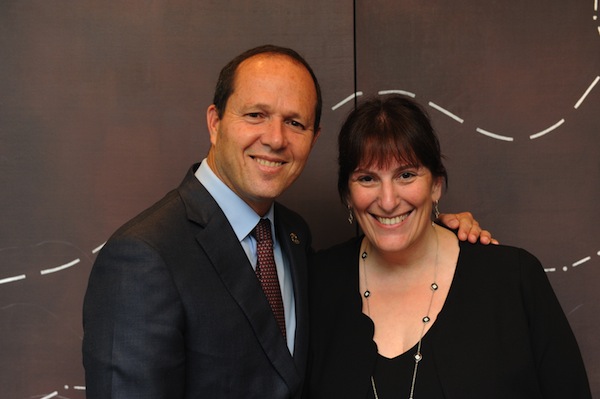
Then-mayor of Jerusalem Nir Barkat and Nomi Levin Yeshua at the Jerusalem Foundation of Canada gala in Toronto in 2014. (photo from Nomi Levin Yeshua)

This article is the first in an occasional series about people with British Columbian roots having positive impacts in Israel and elsewhere.

When Nomi Levin Yeshua went to Israel in 1990, she wasn’t committed to staying there. Almost three decades later, the Vancouver-born and -raised woman can look back on a career that has impacted the face of Jerusalem and Israel.

Thanks to a chance meeting over Shabbat lunch with her grandmother’s former neighbour’s sister – “You know Israel,” she said, laughing – Yeshua had barely arrived in Israel when she got a job as assistant to the assistant to Teddy Kollek, Jerusalem’s mayor – but the job was more than that.

Shula Eisner, Yeshua’s new boss, had been working for Kollek since 1965, just before he began his 28-year run as mayor. Kollek was chairman of the Israel Museum and, before that, had served 11 years as director general of the prime minister’s office under David Ben-Gurion. In that role, Kollek effectively created almost all of the government agencies in the new state.

“One of the things he believed was that there had to be a national museum,” Yeshua told the Independent recently while in Vancouver for a milestone birthday of her mother, Shanie Levin. “He went around raising money to start the Israel Museum. He had an office there and [Eisner] was originally hired there to work with him with all the foreign donors. Then he was elected mayor and he kept to the Israel Museum office.”

In 1966, Kollek founded the Jerusalem Foundation, where Yeshua now works.

“That was his way of creating a forum for supporters of Jerusalem around the world, to be part of creating a new vision for Jerusalem. Then, a year after that, with the Six Day War and the reunification of the city, suddenly everything was just multiplied,” she said.

Yeshua acknowledged that Kollek’s multiple roles as mayor, head of the national museum and leader of a major foundation would probably not be sustainable today, but that was a different time.

“For him, it was all fluid,” she said.

To accommodate his different hats in the era before email or even fax machines, there was a driver who shuffled between offices, taking papers back and forth.

When Eisner moved over to another foundation, she handed her baton to Yeshua, who worked with Kollek through his last years as mayor and continued until a few months before he passed away, in 2007. She continues to run all donor relations for the Jerusalem Foundation and she personally handles Canadian fundraising for the organization.

The Jerusalem Foundation was started by Kollek because he saw that Jerusalem was a very poor city.

“A lot of religious institutions that don’t pay taxes at all are in Jerusalem, so he knew that it was always going to be a challenge for the city to have a balanced budget, to expand the city, to develop the city, to provide for the citizens of the city, so he knew that he was going to need to raise money,” she said.

Kollek pioneered a fundraising model that is now almost universal across Israeli and Jewish philanthropy.

“He connected every donor to a specific project and they knew that their money went to that project and they could come – and now their grandchildren come – and see those projects. To this day, they can still track the money. The Jerusalem Foundation was really at the forefront of that movement of changing the way people were giving to Israel. Now, it’s taken for granted, but it wasn’t back in the late ’60s and early ’70s at all. That was Teddy,” she said. “He wanted people to feel personally connected to the city, to the project, to the place.”

The foundation emphasizes “shared living” and is now focused on a vision for 2030.

“This is a city that is completely about how to exist together in this space that we share. It’s not just Arabs and Jews. It’s also secular and religious, it’s poor and rich, it’s all kinds of divisions that exist in the city,” she said. “But how do we share and how do we understand each other better?”

One major project is Hand-in-Hand School for Bilingual Education.

“Bilingual education is something that Canadians completely understand but Israelis less so. This is a school that teaches in Arabic and in Hebrew, in mixed classrooms. The rest of the Israeli education system is – we don’t like to use this word but it’s the truth – segregated,” she said. “There are Jewish schools, there are Arab schools and then, even within the Jewish schools, there are religious and nonreligious. This school brings together all of the different population groups and at all times there is an Arabic-speaking and a Hebrew-speaking teacher in the classroom.” There are now six such schools around the country.

Another area of the foundation’s work is helping the most vulnerable populations in the city, through projects such as Springboard, which develops programs primarily through the education system to push gifted kids into opportunities their financial situation might not otherwise permit.

The Jerusalem Foundation is also the city’s second-largest funder to the arts, after the municipality.

“We really believe that a modern and thriving city should have a good cultural scene. Culture is not just for one population group. All members of the community should be cultural consumers. But you have to create culture that is appropriate for those people,” she said. “For example, there is a dance troupe for ultra-Orthodox women. They only perform for women, of course, because otherwise that wouldn’t work for them. But they’re really doing amazing stuff and giving these ultra-Orthodox women who want to dance an opportunity to have a really high-level, professional dance troupe within the system that works for them.”

The foundation is also building a new Hassadna Conservatory of Music.

“They help kids ages six all the way through high school with classical music education and they also provide a special program for children of Ethiopian descent who don’t necessarily have the financial means to get musical training and they have a special program for special needs kids that’s integrated,” she said.

Yeshua credits her Vancouver upbringing as foundational to her worldview and accomplishments. She grew up in the Habonim Dror Zionist youth movement and was a camper, counselor and camp director at Camp Miriam. At home, her Jewishness was nurtured in a pluralistic way.

“In terms of how my mother brought us up, Jewish identity wasn’t limited to our religious identity,” she recalled. “National identity was something that was acceptable, cultural identity was very much encouraged. I think growing up in the very open community of Vancouver – to me it always seems that way, at least – it allowed me to be Jewish in a way that I felt good with and it wasn’t only one way to be Jewish.”

Yeshua acknowledged that “many people feel somewhat alienated from Israel today.”

“I want people to understand that there is a way to engage with Israel, to support Israel, and not contradict your own value system or what you think is acceptable,” she said. “What we do with the Jerusalem Foundation is something that people can respond to, relate to, understand – to protect Jerusalem as a city that is for everyone.”

Format ImagePosted on July 19, 2019July 18, 2019Author Pat JohnsonCategories WorldTags identity, Israel, Jerusalem, Nomi Levin Yeshua, tikkun olam, Vancouver

Managing theft and loss

We’ve seen a huge rise in neighbourhood property crime. We’re still driving a car without a back window (yup, two windows vandalized). We also lost a flower planter in June.

We realized the flowers were gone on Shabbat. We were on our way to services when we saw that we only had one and not two matching flowerpots. This matters for two reasons. First, we use the pots to keep people from parking illegally and blocking our gate. Sometimes, the planters get moved because a truck is parked to do work at our house or at a neighbour’s. Sometimes, big trucks or strangers just run over our planters so they can turn around or park illegally at our house. Despite multiple “private parking” signs, we struggle with these issues frequently. After each run-over or blocked gate, we’re scooping up the soil and repotting the flowers, trying to keep the planters going.

Two weeks after the pot went missing, when I was helping my twins walk their bikes to the schoolyard so we could safely practise cycling without training wheels, we stopped to look at our neighbours’ yards. My kids planted the flower pots themselves as part of their birthday celebrations at the beginning of June (reason #2 for their importance). They knew exactly which colours they’d put in each planter. And – surprise – our planter was firmly ensconced in a neighbour’s front yard, a block away from home.

We tried knocking but no one was there. When we returned home, we couldn’t put it out of our minds. My husband filed a supplement to our police report, asking if the cops could help invite these folks to return our flowers. So far, nothing has happened.

One of my kids has taken to doing the early morning walk with me and our two dogs now that it’s summertime. He reflects on the stolen/lost flowers every morning we pass them. On one of these walks, he brought up another story: he’d encountered a lost dog at day camp. Others shooed it away from the grass, into the parking lot, where he feared it would be run over. No one, in his view, helped it get home.

When I mentioned it to adults at camp, I was reassured that someone had found the dog’s owner. It was also pointed out to me that many kids were afraid of dogs; perhaps that’s why it was shooed away. I responded that, even if no one taught kids how to behave around animals, that dog was a “lost item.” Jewish tradition teaches us that it is a mitzvah, a commandment, to return lost items to their owners.

Jewish tradition is full of stories and rabbinic instructions for how we are to manage theft and loss. How we should address theft, punish thieves and figure out the motivations of those who do harm are part of what we should learn and teach as Jews. It’s our responsibility to return things and to help others find that order and closure in the world.

The rabbis recognize this commandment is complex. In some cases, hungry or suffering people may steal, borrow or “find” a lost item that they need to survive. However, we shouldn’t assume that the person who lost something can always make do or be fine without it. If we budget in our household to fill two planters with flowers – so the twins can each plant one – and someone steals one? Our kids feel that one planter is clearly not the same as two. There’s no food involved in this but, aside from contacting the police or directly confronting the neighbours, we run the risk of being seen as the crooks if we “steal” it back.

We have public services – police, courts, animal services – to solve some conflicts. Yet, if public services are delayed or unresponsive, we’re left with the same moral issues. How do we solve these problems without timely intervention or help? What can we do to practise tikkun olam, repair of the world?

We rely on voting in a democratic society, as well as a responsive civil service, to make sure our public services work. (This is a hint – please vote in the next election.) On a personal level, though, my kid suffers when he worries about a missing person, a dog or a flowerpot. He is the same kid who knows what the Red Dress installations mean: I have an 8-year-old who knows these commemorate the loss of missing and murdered indigenous women and girls. It’s hard to see a kid learn about this. It’s harder yet to live with loss. Imagine the huge pain of losing a person. For a kid, losing a beloved animal or giving up on something that was stolen seems hard enough.

The rabbis give ways to respond to challenges of theft or loss and it’s up to us not just to study the sources, but to live in a way that carries out their teachings. We must call others to account when they fail to do what’s right. If someone steals, promises to pay for something and doesn’t, or “loses” someone or something, it’s our obligation to ask them to honour their commitments.

It’s not OK to take a loved one, an animal, a kid’s flowerpot or to skip paying the bill. We have limited funds in our household, school and government budgets. Yet, our tradition also teaches a compassionate compromise – if a person truly cannot survive, we must help. The question we’re left with is how to find closure when the world fails us. If no one returns a missing child or animal, if we do not honour our commitments to others, what kind of a place is this?

We have a stake in making this world a better place. It starts with practical steps like helping get a lost person, dog or belongings home safely. Let’s at least honour our obligations.

Joanne Seiff has written regularly for CBC Manitoba and various Jewish publications. She is the author of three books, including From the Outside In: Jewish Post Columns 2015-2016, a collection of essays available for digital download or as a paperback from Amazon. See more about her at joanneseiff.blogspot.com.

Posted on July 19, 2019July 18, 2019Author Joanne SeiffCategories Op-EdTags crime, Judaism, justice, liefstyle, tikkun olam
Local woman inspires chesed

Local woman inspires chesed

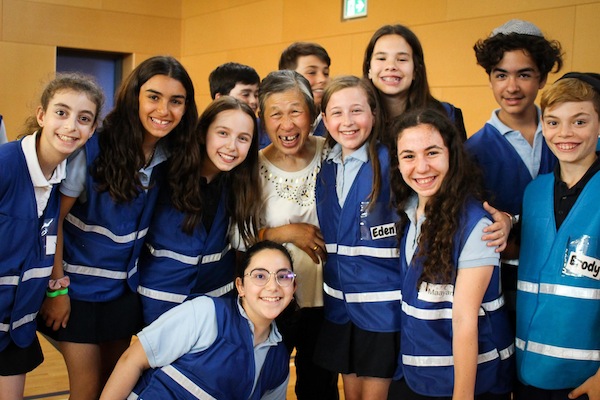
Members of Vancouver Talmud Torah’s Grade 7 chesed club with Gia Tran, a local woman who raises money for cancer research by taking refundable containers to a bottle depot. (photo from VTT)

Since 2014, Vancouver Talmud Torah has offered a chesed (kindness) program to students in grades 3 and 6. Following requests from parents, the school introduced a mandatory chesed program for Grade 7s this year, which nurtures a commitment to volunteering and social justice.

And, this year, the initiative was pursued with a particular dedication, as students mourned the recent passing of Rose Dupaya, who worked as a custodian at VTT. She took ill last fall with cancer and died suddenly, which was a tremendous shock to the school community. In response, the students – who would often greet Rose with hugs – turned their grief into action.

When the Chesed Leadership Club heard about local woman Gia Tran, who takes refundable containers to a bottle depot every day to raise money for cancer research – more than $15,000 in 22 years – they were inspired. Following in Tran’s footsteps, the kids raised $2,000 from a bottle drive for cancer research.

VTT student Julia Andison expressed her gratitude to Tran for teaching her about personal agency. “Gia taught me that even a small act like collecting cans can make a big impact on others. And, as a chesed leader, I was able to communicate this to the younger students in our school, that every little bit counts.”

Students in the chesed club do not follow a curriculum. Unlike with subjects like math or language arts, the club was founded for students to explore their values and lead a program on their own initiative. As a consequence, the program’s success lies in the development of student ideas, teamwork and leadership.

“The minute you offer something optional and student-driven, it takes on a life of its own,” said Shoshana Burton, director of Hebrew (grades 5-7) and chesed programming at VTT.

Students are not admitted automatically to the chesed club. Instead, they submit applications and sign contracts. If they do not follow up on their commitment to leadership, they can be dropped from the program, which is both an opportunity and a challenge to the students’ organizational skills and a way to exercise their moral and management muscles.

All of the students volunteer as part of the program. Some do so once a week while others volunteer their help every day. Many organizations and communities have benefitted from the support of VTT students, including the Muslim Food Bank and residents of the Downtown Eastside.

According to their teacher, the success of the club is in its spontaneous, natural development. “You can’t know the end result when you start. You can’t plan in advance,” said Burton. “The students learn how to work as part of a team, learning to commit to a project.”

Student Celia Joffe spoke of the club’s impact on her. “Helping others gives us a sense of pride and responsibility,” she said. “The project with Gia was amazing because we ended up not only helping the cancer foundation and the environment, but we also made Gia feel special and acknowledged.”

Shula Klinger is an author and journalist living in North Vancouver. Find out more at shulaklinger.com.
Format ImagePosted on July 12, 2019July 10, 2019Author Shula KlingerCategories LocalTags cancer, chesed, Gia Tran, philanthropy, recycling, tikkun olam, tzedakah, Vancouver Talmud Torah, VTT
Inspired by a fellow activist

Inspired by a fellow activist

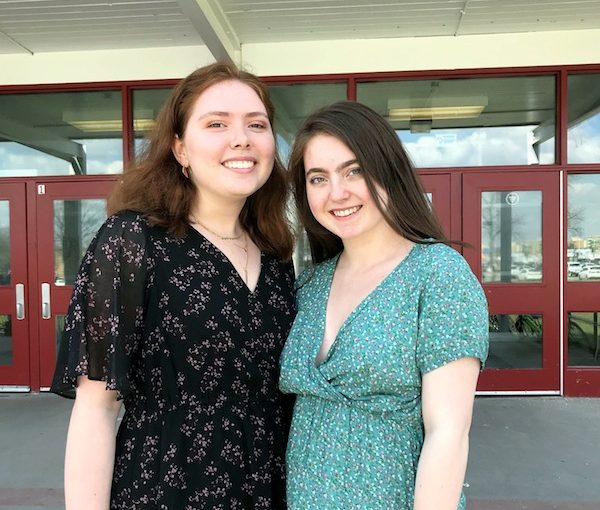
Katie Delay, left, and Sunny Enkin Lewis are co-presidents of Grant Park High School’s Students for Social Justice. (photo from Sunny Enkin Lewis)

Earlier this year, Winnipeg Grade 12 student Sunny Enkin Lewis won first prize for her age group in A&E network’s contest Lives That Make a Difference. The contest receives hundreds of submissions from all over Canada.

“The prompt [for the contest] is along the lines of, ‘Write an essay about someone who has made a significant contribution to Canada in 2018,’” Enkin Lewis told the Independent. “So, I wrote about Autumn Peltier, who – I believe she’s 15 now, around there – is an indigenous water keeper. She’s an activist for clean water in indigenous communities in Canada. She’s spoken at the UN, she’s spoken to Prime Minister Justin Trudeau. So, she’s done a lot of amazing activism.”

Peltier is Anishinaabe and is from the Wikwemikong First Nation on Manitoulin Island in northern Ontario.

“I chose her for a couple reasons,” said Enkin Lewis, who was born in Toronto, but has lived in Winnipeg for the past 10 years. “First of all, I think her cause is really important in Canada. I’ve always been really upset with Canadian society and government, because we tend to look at ourselves as pretty flawless in terms of human rights. And, it is true that the quality of life for Canadians, overall, is really good. Yet, there are people, a lot of people, who don’t have the most basic of their needs met – water and shelter … and I think she has brought more awareness to that.”

In her essay, Enkin Lewis points out that Peltier not only stands up fearlessly for this cause, but that she does so from a unique worldview as an Anishinaabe person.

“She thinks of water as deserving of rights,” said Enkin Lewis. “That’s not something we would generally think of and I think it’s a really strong statement – that someone can stand up and speak of things in a way that contrasts the common logic of general Western ideas. I think that helps validate indigenous worldviews in a Western context a little more. Also, I was just inspired by her, as a young woman. I think it’s so important that young people’s voices are heard and that’s how I believe change will happen the fastest – if young people are given a platform and are accepted and respected – and she really embodies that.”

As for as why Enkin Lewis’s essay may have been chosen, she said, “I think my choice of person was really relevant in Canada today, especially since, now, I think, there’s a big focus on indigenous rights, and I think it was maybe a bit refreshing to see someone like that. I haven’t read the other people’s essays, and they didn’t tell me why mine was specifically chosen … just that they thought it stood out.”

Growing up, Enkin Lewis learned that “a big thing in Judaism is valuing life over everything, and knowing the value of human life. And, I think a big part of Judaism is also just respect for people and … everyone should have a good quality of life.

“The fact that, here, in Canada, there are people who don’t have their basic needs met, I think that’s not OK in Judaism. I think it’s important for other cultures to listen to each other, just as I think it’s important for Christian people to listen to Jewish people. And, I think it’s important for Jewish people to listen to indigenous perspectives. As a European Jew, I’m not native to this land … and it’s important to respect the people who are the caretakers of this land and who have been for thousands of years.”

Last year, Enkin Lewis led the organizing of a social justice conference at Grant Park High School, which, in turn, led to the development of a student social justice club at Grant Park. Enkin Lewis and co-president Katie Delay created the club and, because they and the teacher involved in helping to form the group will have left the school by the start of the next school year, Enkin Lewis hopes the younger members will pick up the ball.

“I think our club is very student-centred, very much about what we care about right now, and it gives me and other people an opportunity to get involved in a safe and constructive way,” she said.

As Grant Park has many newcomer Yazidi students, events organized by the club have been focused on building community awareness of the Yazidi situation.

“We did a drive for school supplies for underprivileged students in Winnipeg, and the biggest thing we’ve done is organize a coffeehouse and a couple other events for Yazidis with the help of a local organization called Operation Ezra. We had a bake sale where we sold traditional Yazidi foods, a Yazidi dance class to educate people about the culture, etc. I find that people are not really aware of what’s happening to the Yazidi people.

“We had a coffeehouse in the evening and invited community members, students, parents, anyone to come. There were student performers and a speaker talking about what’s happening, and a Yazidi performer.”

Enkin Lewis’s essay win comes with a $3,000 cheque for her and a $1,000 cheque for her school. She plans to follow her family’s Jewish custom of donating a portion of everything they earn. “I haven’t narrowed it down to a specific organization yet,” she said, “but I’m going to donate it basically to her [Peltier’s] cause – water in indigenous communities. Other than that, I will probably put it toward my education.”

Rebeca Kuropatwa is a Winnipeg freelance writer.

Format ImagePosted on June 28, 2019June 26, 2019Author Rebeca KuropatwaCategories NationalTags A&E, activism, Autumn Peltier, First Nations, human rights, Sunny Enkin Lewis, tikkun olam, water, writing, youth
Kehila celebrates 20th

Kehila celebrates 20th

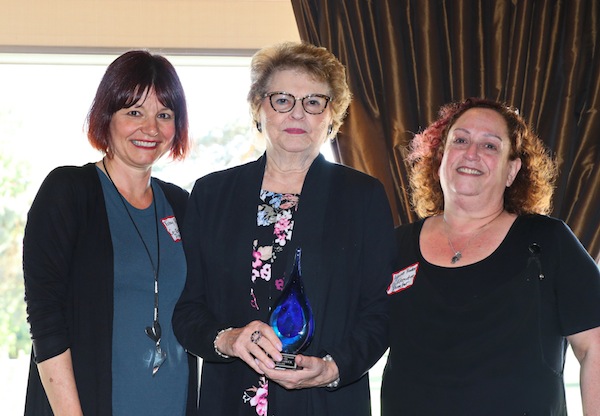
Left to right are Toby Rubin, Marie Doduck and Lynne Fader. (photo by Lianne Cohen)

On May 5, the Kehila Society of Richmond celebrated its 20th anniversary. The society honoured Marie and Sid (z”l) Doduck for the support and guidance they have given to the society since its inception, and celebrated members of its first board of directors. The special annual general meeting, which took place at the Richmond Country Club, also saw the initiation of Kehila’s current board and the event featured speaker Dr. Sherri Wise, who shared her story of surviving a terrorist attack in Israel. More than 90 people attended the AGM.

“The difference that Kehila has made for our Jewish community in Richmond … for the quality of living for those residing here – we continue to be an integral part of the Richmond community at large and are partners within it, making a difference every day,” said Lynne Fader, co-executive director with Toby Rubin.

“Kehila’s weekly seniors program on Mondays is an essential service for most of our attendees,” said Rubin. “We are meeting so many of their needs: from free ESL programming to food sustainability and socialization and education. We are very proud of our program and its vitality.”

photo - The Kehila Society of Richmond’s 2019/2020 board of directors
The Kehila Society of Richmond’s 2019/2020 board of directors. (photo by Lianne Cohen)

The 2019/2020 Kehila Society of Richmond board of directors is Sherri Barkoff (co-president and treasurer), Mark Babins (co-president), Keziah Selles (secretary), Ruth Singer (seniors’ representative), Shauna Osten (community outreach), Shelley Morris (human resources), Courtney Cohen (community outreach) and Harley Godfrey (finance committee), with directors Rabbi Levi Varnai (the Bayit representative), Lu Winters (Richmond Jewish Day School), Jeff Rothberg (Beth Tikvah) and Sanford Cohen (Chabad Richmond).

“I am proud of the collaboration that we do with all the organizations in Richmond to help those in need, seniors, families and youth,” said Barkoff.

Kehila’s partnerships include the Multifaith Richmond Food Aid Delivery Program, a faith-based group of organizations working to feed the homeless, isolated, low-income and frail in the general population. Kehila assists with deliveries, cooking and, when viable, food vouchers and items of warm clothing. Kehila has facilitated a partnership with the Richmond SPCA and Tysol Pets to assist with these community members’ animal companions.

Kehila also participates in Light of Shabbat, with Chabad of Richmond. This biweekly, by-donation program has volunteers of all ages doing the cooking, packaging and delivering of kosher Shabbat meals to 30-plus individuals.

The Len Babins Nutritional Subsidy Program is a donor-sponsored initiative focused on RJDS but not exclusively. It provides hot lunches twice a week for children in need at the school; children are screened discreetly through the school counselor. Approximately 254 meals per term per student are provided, with a total of 17 children from 12 families accessing the service. But the number of children served is higher than this because, additionally, Kehila funds a healthy lunch for these same children who, on days of no hot lunch program, do not have lunches.

Chabad of Richmond and Kehila also partner in the Richmond Community Seder, an annual, by-donation event that has been held for numerous years. Generally, about 70 people attend the seder and many take food home for a second seder or out of need. This year, for the first time, a full seder meal and supplies were delivered to those who were unable to attend.

Lastly, Kehila spearheads Rose’s Angels, an annual outreach program that provides warm clothing, hygiene products, children’s books and more to local community agencies whose clients are in need of assistance. This year, more than 1,100 individuals benefitted from the program, which is run through donations of many kinds.

Cory Bretz has made a video of Kehila Society’s work and Lianne Cohen photographed the 20th anniversary event – the video and photos can be found on Kehila’s Facebook page (facebook.com/113139405408718).


Format ImagePosted on June 28, 2019June 26, 2019Author Kehila Society of RichmondCategories LocalTags Kehila Society, Lynne Fader, Marie Doduck, Richmond, Sherri Barkoff, tikkun olam, Toby Rubin
Community milestones – Silber Theatre, RJDS-Pawer tzedakah, Rudolph wedding, Pawer and Baitelman grads

Community milestones – Silber Theatre, RJDS-Pawer tzedakah, Rudolph wedding, Pawer and Baitelman grads

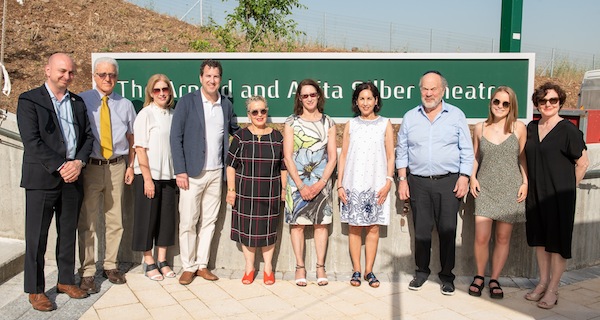
The Arnold and Anita Silber Theatre at Tel-Hai College officially opened last month. (photo from Jewish Federation of Greater Vancouver)

Last month, Jewish Federation of Greater Vancouver chief executive officer Ezra Shanken, as well as board members Karen James, Alex Cristall and Candace Kwinter, and Jewish Community Foundation executive director Marcie Flom were in Israel for the official opening of the Arnold and Anita Silber Theatre at Tel-Hai College. This new 1,200-seat outdoor theatre will be a hub of activity for the university and surrounding area. The theatre is located at the centre of the Tel-Hai campus, and is a key component in the college’s long-term development plan.

The Silbers have long supported Federation’s partnership region of the Galilee Panhandle, and its work there. They have supported a number of projects and established the Friends of Beit Vancouver, a donor-recognition program for supporters of Beit Vancouver. Anita Silber serves on Federation’s Israel and overseas affairs committee, and has for several years. Recognizing that Tel-Hai is a significant economic driver in the region led the Silbers to fund this legacy project and lend their name to it.

The official opening of the theatre began with a welcome reception with Tel-Hai’s board of trustees, followed by a ribbon cutting. The Silbers were joined by their granddaughter, Samantha Addison, and family members from Israel. In reply to the address honouring them that was delivered by Tel-Hai’s president, Prof. Yossi Mekori, Arnold Silber stressed that the students were the primary motivation for this investment. They are the ones to whom the future of the region is entrusted, and it is they who will take it to the next level.

A number of families and individuals from our community agree, and they are funding scholarships, which were awarded to students at the ceremony by James and Cristall: the Coleman Family Scholarships, the Krell Family Scholarships, the Evelynne Loomer z”l Scholarships, the Bernard Lotzkar Scholarships and the Zalkow Family Scholarships.

* * *

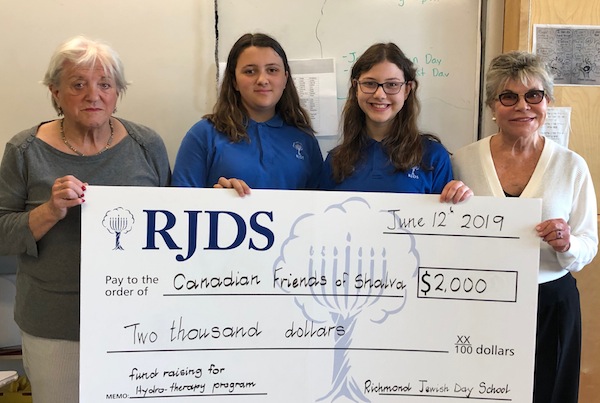
photo - Left to right are Lola Pawer, RJDS students Maya Bernal and Penina Berger, and Leslie Diamond
Left to right are Lola Pawer, RJDS students Maya Bernal and Penina Berger, and Leslie Diamond.

Over the course of the 2018/2019 school year, the Student Council Committee of Richmond Jewish Day School took it upon themselves to raise money for the Shalva Centre Hydrotherapy Program in Israel.

With the support of families, the school raised $1,000, which was generously matched by Lola Pawer. Pawer and Leslie Diamond, who is a board member of the Shalva Centre, came to RJDS to teach students about the work Shalva provides for children with disabilities.

The students presented a cheque to Diamond in the amount of $2,000. For anyone wanting to learn more about Shalva or make a donation, visit shalva.org.

* * *

photo - Brett and Caro Rudolph
Brett and Caro Rudolph

Brett and Caro Rudolph have fun at their wedding in Syracuse, Sicily. Brett is the son of Les and Anita Rudolph of Vancouver (previously from South Africa) and Caro is the daughter of André and Svetli Wanne of Vienna. The wedding was officiated by Rabbi Paul Chaim Eisenberg of Vienna and was thoroughly enjoyed by family and friends. Brett and Caro live in Israel.

* * *

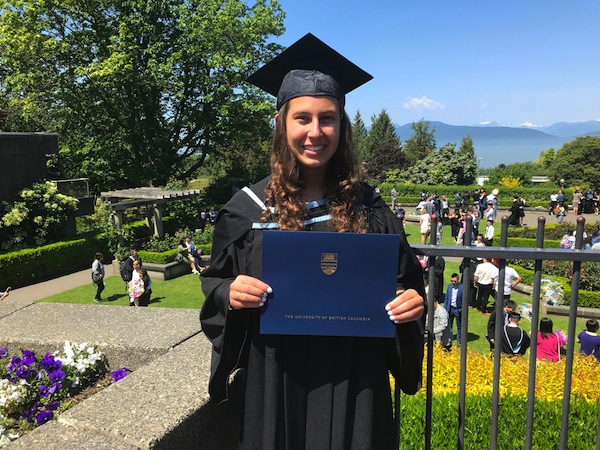
photo - Samantha Pawer
Samantha Pawer

On May 25, 2019, Samantha Pawer was conferred the degree of bachelor of science honours in integrated sciences with distinction from the University of British Columbia. Samantha is an alumna of Richmond Jewish Day School and Hugh Boyd Secondary School. Proud are parents Jeff Pawer and Beverly Pawer and big brother Brayden Pawer.

* * *

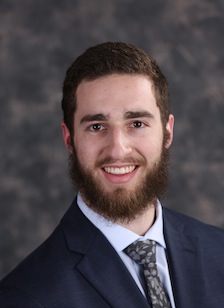
Moshe Baitelman decided to become a doctor when he took his first biology class in high school. On May 26, 2019, the Vancouverite graduated as valedictorian at Touro’s Lander College of Arts and Sciences in Flatbush, Brooklyn, N.Y. He will begin medical school in the fall.

photo - Moshe Baitelman
Moshe Baitelman

Baitelman chose Touro because it offered a strong Jewish environment as well as academic rigour. He majored in honours biology and minored in computer science. Along the way, he built strong relationships with his professors. “They all pushed me to be my best,” he said.

Living in Brooklyn, Baitelman found support for his career goals via the Gedaliah Society, a local network of Chabad men and women in the healthcare profession who offered advice and shared their own experiences in preparing for medical school. He also served as executive editor of Touro’s science journal and president of the Touro Science Society.

“Moshe has distinguished himself as a gifted, multitalented student with outstanding leadership skills. We are confident that he will become a respected physician, who will create a Kiddush Hashem in all his patient and professional interactions,” said Dr. Robert Goldschmidt, vice-president and executive dean of the Lander College.

Prior to Touro, Baitelman attended Vancouver Hebrew Academy for elementary and then the Pacific Torah Institute. Both schools imparted a strong Torah education with Jewish morals and values, and a first-class education. Baitelman’s education in Vancouver was the solid foundation for a life of strong Jewish identity and commitment to Jewish observance and learning, as well as enabling him to pursue further career education.

Baitelman credits his parents for his drive; they instilled a strong work ethic and have continued to encourage him. He offers similar advice to students getting ready to start college: “Be proactive. It will be the difference between just passing through and actually gaining from college. Find activities that will be conducive to your professional and educational growth – use your network of professors, advisors and other students.”

Format ImagePosted on June 28, 2019July 3, 2019Author Community members/organizationsCategories LocalTags Anita Silber, Arnold Silber, Baitelman, education, graduations, Israel, Jewish Federation, Lander College, Leslie Diamond, Lola Pawer, Pawer, philanthropy, Richmond Jewish Day School, RJDS, Rudolph, Shalva Centre, Tel-Hai College, tikkun olam, Touro, UBC, weddings
Try to make the world better

Try to make the world better

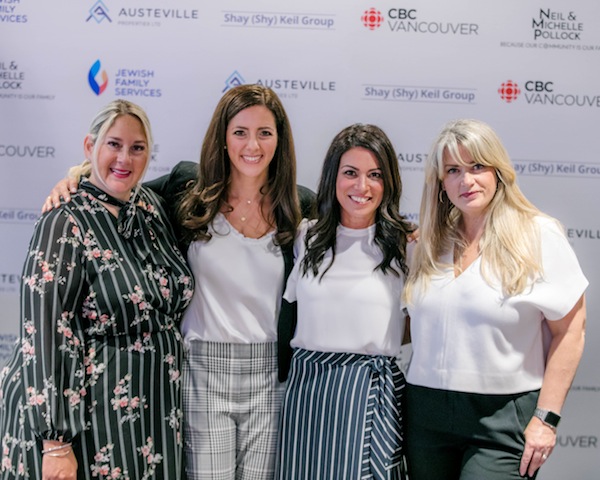
Jewish Family Services Innovators Lunch committee, left to right: Sherri Wise, Tamar Bakonyi, Candice Thal and Shannon Ezekiel. (photo from JFS)

On May 14, Jewish Family Services held its 15th annual Innovators Lunch at the Hyatt Regency downtown. The sold-out event was hosted by CBC broadcaster Gloria Macarenko and featured keynote speaker Lane Merrifield of CBC’s Dragons’ Den. Attended by 620 donors, partners, sponsors and volunteers, it raised an unprecedented $380,000 towards programs and services designed to improve quality of life for 2,000 Lower Mainland residents.

This year’s theme at JFS is “community.” At the luncheon, Richard Fruchter, the agency’s chief executive officer, spoke of JFS’s mission to provide life’s necessities: “food, shelter, accessibility and emotional stability.”

The audience was shown a video presentation created by Michael Millman, which revealed the wide-ranging benefits of JFS’s work. A single mother spoke candidly and with feeling about her struggles. “Before I reached out to JFS, I struggled with everything. We lived on almost nothing,” she said. JFS staff provided housing, food and food vouchers, as well as trauma counseling. JFS partner agency Tikva Housing provided the family with a townhouse in a new development. “It’s a beautiful place, right on the Fraser River … a lovely home for us to have for many years,” she said, adding, “JFS has given us a life. A way to be happy. It’s just been a huge blessing for us.”

A senior with disabilities spoke about how a spinal cord injury felled him at the age of 36. JFS has helped him remain independent with its Better at Home program. In the video, Cindy MacMillan, director of senior services at JFS, explained that a grant from the United Way made it possible for the senior to remain at home. Now he has a housekeeper come in to look after his home, and also enjoys companionship with weekly visits from a JFS volunteer. “It’s working out, I look forward to them!” he said.

photo - JFS board member Jody Dales spoke about her own family’s struggles
JFS board member Jody Dales spoke about her own family’s struggles. (photo from JFS)

“It’s helped him realize that people in his community care about him,” said MacMillan. “It’s really Jewish values in action, in the broader community. Those values of caring and healing happen every time we make a match with a volunteer.”

JFS board member Jody Dales gave a passionate speech about her own family’s struggles. Dales saw her grandmother turn away help when she was struggling with poverty. Having survived the Holocaust, her grandmother still felt that others needed the help more than she did, Dales explained. As a result, Dales said she applauds anyone who comes forward to seek support. Rather than being a sign of weakness, she said, “Only the courageous are able to say, ‘Help me.’” She acknowledged that people tend to experience “a sense of shame in asking for help. But nothing is certain. It could be any of us at any time.”

Dales also explained how big a difference can be made by even a small donation and told the audience, “Let your empathy guide your decisions.”

Merrifield, co-creator of Club Penguin, an online community for kids, spoke about building community in the business world. Designed to be a safe, collaborative environment for play and learning, Club Penguin is founded on an ethos of mutual reliance and philanthropy. Eventually sold to Disney for $350 million, Disney recruited Merrifield to lead the project, ensuring that Club Penguin maintained the integrity of its original goal, “inspiring change in the world.”

Merrifield urged people to work towards social entrepreneurship, where human concerns guide business decisions. Rather than focusing on capital investment, he advised the audience to “invest in people because that’s what keeps us healthy. Revenue is not what you chase for its own sake,” he said. “It is the by-product of creating a great product with a great team.”

photo - Keynote speaker Lane Merrifield, left, and JFS chief executive officer Richard Fruchter
Keynote speaker Lane Merrifield, left, and JFS chief executive officer Richard Fruchter. (photo from JFS)

Right from the beginning, the business plan for Club Penguin was based on philanthropy. A portion of subscriptions went to families that live on less than $51 per day, he said. But “there was no fanfare,” said Merrifield. “We didn’t want this to look like a gimmick.” In the first year, the company gave away hundreds of thousands of dollars.

Merrifield spoke of the need to galvanize the community of kids, teaching them to invest in their community with a “coins for change” program. This virtual fundraiser even allowed children to “ring bells” to attract the attention of other subscribers. Over one billion digital coins were donated annually, for a range of humanitarian causes. Self-organizing kids formed virtual marches, becoming activists in their own right; held candlelit vigils and themed parties.

Merrifield brings the same spirit of social responsibility to his work on Dragons’ Den. He and his fellow panelists (“dragons”) hear pitches by entrepreneurs who are looking for investment and choose which ones to support. Merrifield said he looks for companies that “use recycled materials, hire disabled applicants, plant trees, and make an effort to reduce waste in their packaging and lower their fuel costs.” So far, he has not been disappointed. “Most companies have pretty good answers and that gives me hope,” he said.

On the subject of giving back, Merrifield encouraged people to consider donations – such as those to JFS – not as losses to oneself, but as “investments in the future, to individuals who continue to pay it forward.”

He also asked the audience to engage everyone they could to further the cause of fearless generosity. “Use your collective strength and influence to create change for good,” he said.

He advised, “Pool your talents and leave this world far better than it was when we came into it.”

Shula Klinger is an author and journalist living in North Vancouver. Find out more at shulaklinger.com.
Format ImagePosted on June 21, 2019June 20, 2019Author Shula KlingerCategories LocalTags CBC, fundraising, Innovators Lunch, Jewish Family Services, JFS, Jody Dales, Lane Merrifield, philanthropy, Richard Fruchter, tikkun olam
Teens bring Israel to Vancouver

Teens bring Israel to Vancouver

Israelis Ofir Gadi and Or Aharoni are rounding up their year of volunteering in Metro Vancouver. (photo from Jewish Federation of Greater Vancouver)

In Israel, high school graduates can go straight into the Israel Defence Forces (IDF) or opt to do a shnat sherut (year of service, for which the acronym is shinshin). The vast majority of 18-year-olds who do a shnat sherut do so inside Israel, volunteering with a variety of social welfare and other nonprofit organizations throughout the country. But, through the Jewish Agency, approximately 100 teens do their year of volunteering in Jewish communities around the world.

Vancouver began to take part in the program in 2015. In August of that year, Jewish Federation of Greater Vancouver brought three young women to split their time between Vancouver Talmud Torah, Richmond Jewish Day School, King David High School, Beth Israel, Temple Sholom, Beth Tikvah and the Jewish Community Centre of Greater Vancouver. The final quarter of the year was spent volunteering at camps Hatikvah and Miriam and the JCC day camp. Each agency contributed a portion of money to cover the expenses needed to bring the shinshiniot (female plural for shinshin) here from Israel and to contribute to a small monthly stipend. Host families, who welcomed an 18-year-old Israeli into their family for a period of three months, took care of living arrangements and meals.

Nearly four years later, all of the original host organizations continue to participate in the program. Shinshin coordinator Dan Stern helps make the connections between the organizations and the volunteers as smooth as possible. The main challenge continues to be finding host families. While it is a significant responsibility, the fact that many host families have hosted volunteers multiple times speaks to the rewards of doing so.

This year, for the first time, Vancouver picked one male and one female shinshin. Ofir Gadi and Or Aharoni arrived in early September and settled in right away. They spent two days each week at VTT, interacting with students through activities including song, dance, multimedia presentations focusing on Israel, Israeli-style Jewish holiday celebrations, and Hebrew. RJDS had them once a week for similar activities and the pair helped at the JCC with teen programming. On Sundays, they split up to give a special Israeli flavour to various synagogue religious schools. Federation also has had them working at many community events and its outreach program, Connect Me In, which services Squamish, Langley and Burquest. Additionally, the two have helped make other community-wide celebrations special, including making a presentation at this year’s Yom Ha’atzmaut celebration at the Chan Centre for the Performing Arts.

Gadi and Aharoni have proven to have complementary personalities. They have worked together, smiling through the challenges they have faced and thoroughly enjoying almost everything they’ve encountered here.

“Vancouver is my favourite city in the world,” said Aharoni with her typical warm smile. “The weather is much better than what the other Canadian shinshinim have and the people we have met here have been so welcoming and amazing. Also, being here, I’m not the only one saying thank you on the bus!”

Gadi has also had terrific experiences. “We have worked a lot in many areas of the Vancouver Jewish community and the good thing about that is we have met so many wonderful people,” he said.

While they were prepared to a certain degree about what to expect, both Aharoni and Gadi have said being in Vancouver has exceeded their expectations. “We both love it here and plan to return,” said Gadi.

The biggest surprise for Aharoni was that she felt at home as soon as she arrived. “I didn’t know that it would be such a good fit,” she said. “I was positive coming in but I have found the energy and the vibe of the students amazing and the community, host families and friends I’ve made have been so special.”

Although she has traveled outside of Israel, she said she didn’t know anything about what it is like to live as a Jewish person outside of Israel. She comes from a secular Israeli family and, she said, living here has brought up questions about Jewish identity that had never been an issue before.

“Firstly, I am an Israeli. Secondly, I feel fully Jewish even though I am not at all religious,” she said. “I see that it’s important to live the Jewish life the way you want. I also understand that going to synagogue is important here in order to be part of something, and being part of a community is very special.”

Both teens have stayed with families with whom they have deeply connected. “It’s been great to be part of a different family every few months,” said Gadi. “I have enjoyed my host siblings and I hope our connection will continue and my family in Israel will have a chance to host my families from here.”

Gadi is from a small community near Modi’in called Reut and Aharoni’s family lives on a moshav called Aviel, near Caesarea. Both shinshinim expect visitors, as host families and friends of past shinshiniot have kept in touch and visited when in Israel.

“The connections with people makes this experience more powerful and meaningful. Both Ofir and I have made so many special connections with students, families and the Vancouver Jewish community,” said Aharoni.

Up next for both shinshinim is summer camp. Aharoni will help augment the Israel programming at Camp Hatikvah and Gadi will be at Camp Miriam lending an additional Israeli vibe to the camp.

For more information about the shinshin program or how to host one of the two shinshinim who will arrive in September, contact Jewish Federation at 604-257-5100.

Michelle Dodek is a freelance writer living in Vancouver.

Format ImagePosted on June 21, 2019June 20, 2019Author Michelle DodekCategories LocalTags Diaspora, Israel, Jewish Federation, Ofir Gadi, Or Aharoni, shinshin, tikkun olam, youth

See the light inside everyone

Lately, I’ve been thinking about Elijah the Prophet, or Eliyahu Hanavi. He’s that guy who somehow travels worldwide, to drink all the wine at every Passover seder every year. (What a hangover he must have!) Elijah is also supposed to attend every Jewish boy’s circumcision (brit milah or bris). We sing about him during Havdalah, the short service that separates the Sabbath from the rest of the week. This guy’s all over the place!

Well, he’s both all over the place in Jewish tradition and shrouded in mystery. This is the quirky prophet that never actually died, but instead ascended to heaven. He’s got three separate roles in Jewish tradition.

1) He’s a zealous prophet, reminding people how to behave properly and to remember G-d.

2) He’s known to appear and help those in distress.

3) He’s supposed to announce the coming of the Messiah or the Messianic Age.

(There’s more to Elijah’s roles, depending on what text you study.)

I hadn’t thought much about Elijah as an adult. I’m not big into worrying over the coming of a man on a white donkey (from Babylonian Talmud, Sanhedrin 98a) or the Messianic Age. However, he makes an appearance in ways that capture my kids’ interest. There’s that mysterious cup on the seder plate, and the song that we sing hoping that this week will be the one where Eliyahu Hanavi shows up to bring about the Messiah’s coming. Even if a kid doesn’t attend a bris too often, he might ask questions about Elijah.

There are a lot of stories that retell rabbinic traditions about Elijah. The most powerful are ones I never forgot from childhood, and which may still be helpful today. The stories seem to align directly with those points above, that adults are already supposed to know.

From the Prophets, we know that Elijah reprimanded others, threatened them with scary stories and told them to shape up. It’s essentially “putting the fear of G-d” into them. Apparently, he was good at this role, as he was sent to do it multiple times. In Jewish folklore, Elijah is the stranger who appears and helps the poor and reminds the wealthy of their failings. It’s this combination of the stranger who appears when you least expect it and the coming of the Messianic Age that I think about most often. Why?

I was taught to try to treat everybody with respect and empathy – because that person might be Elijah. That Elijah could appear at any time, looking like an old lady or a child, a homeless person or an older person with dementia. How we treat people indicates how we’re doing on bringing about a better age, or a Messianic one. When this idea was introduced to me, I remember thinking it sounded weird.

As an adult, it makes more sense because, well, life is weird. Life offers us many opportunities to practise conscious kindness, to do mitzvot (commandments) that help make the world a better place. If we keep doing this “fixing the world” (tikkun olam), well, we might just hear from Elijah.

There was that time when we had a stranger knock at our door. My husband answered it and then told me what happened. It was an indigenous man who didn’t look well. He looked like he had been doing some traveling through back lanes, but he came to the door with our dog’s collar in his hand.

I was immediately anxious. Our dogs are never without their collars and ID tags. However, this man came along, saw the collar in the back lane, clearly beyond the fenced yard. He was worried for the dog. The good news? We called her, and our dog was happy and safe inside. She’d somehow managed to shed her collar and leave it in the back lane without anyone noticing. This kind act made me wonder: Was this Elijah, known for his affinity with dogs? In the Sefer HaAggadah, it’s said that, when dogs are happy for no reason, it’s because Elijah is in the neighbourhood.

Sometimes, one of my kids carefully saves the seat beside him at services for what appears to be an imaginary friend. We joke that he knows Elijah is coming. Instead, it ends up being the friend on her own who needs just one spot or maybe even a stranger, who we then get to welcome to synagogue.

It’s the extra granola bar in my “mom bag,” when I thought someone might need a snack – and, indeed, a hungry person turns up. He needs it to continue onwards. Who knows what that person’s potential will be? That stranger gets a granola bar because, well, he might be Elijah.

This is all mystery and whimsy, if you take a purely Western and scientific view of the world. Yet, most of us acknowledge that we can’t explain why we’re lucky or when misfortune befalls us. Is it because of our behaviour or our efforts to do good in the world? Is it because some people “deserve” misfortune? I think not.

There are amazing people, all around us, who have struggled. Some were homeless, were put in foster care as children, or had addictions. Perhaps they suffered through wars or trauma. This childhood lesson about Elijah has stood me in very good stead because, if you remember that every person has value, every soul is important, it doesn’t matter how the person’s body presents itself. Whatever their clothes or hair look like, that person could be Elijah. Better yet, every person is someone important. It’s up to us to see that light inside, the potential waiting there, and to acknowledge the “other,” as Martin Buber would say. Be ready to offer something, with love and hope, when needed. It could be welcoming someone and offering a seat, a kind word, a thank you for returning a lost item, or a granola bar. Anybody can do this. Remember, that person across from you may be Elijah. The rest? It’s up to you.

Joanne Seiff has written regularly for CBC Manitoba and various Jewish publications. She is the author of three books, including From the Outside In: Jewish Post Columns 2015-2016, a collection of essays available for digital download or as a paperback from Amazon. See more about her at joanneseiff.blogspot.com.


Posted on June 7, 2019June 5, 2019Author Joanne SeiffCategories Op-EdTags Elijah, Judaism, lifestyle, tikkun olam
Teen wins for speech

Teen wins for speech

Deema Abdel Hafeez placed third in the Friends of Simon Wiesenthal Centre for Holocaust Studies’ annual speech contest. (photo from Janet Lee Elementary School)

Every year, the Friends of Simon Wiesenthal Centre for Holocaust Studies puts out a call to Ontario students in grades 6 to 8 to submit a speech reflecting on a quote of Holocaust survivor Simon Wiesenthal, z”l. This year, the quote selected was, “I believe in the good in people,” and students were encouraged to think about how to make the world a better place.

Deema Abdel Hafeez, a Grade 8 student at Janet Lee Elementary School in Hamilton, Ont., entered the contest, the first round of which was in February. Hafeez comes from a Palestinian family who moved to Canada 20 years ago.

“When I heard the quote, I didn’t want to just base it on the good in people … unicorns, rainbows,” Hafeez told the Independent. “I, more so, attacked the quote. I was like, you cannot believe in the automatic good in people, because it takes time to find the good in people.

“I wrote about my Islamophobic experiences. I was saying that you have to define the word ‘good’ to believe in the good in people. And, you have to become the good yourself before you can assume the good in other people.”

Hafeez shared that, while her school is pluralistic, with students of many different faiths, racism still very much exists.

“All the racist slurs and things like that, that’s how I attacked the quote,” said Hafeez. “I talked about how my family can’t go out without [experiencing it] … how my mom is being told to go back to her own country, or how anyone wearing religious clothing … is attacked in social standing … and how things are at a disadvantage for people like us. Obviously, it’s not as bad as it used to be, but, as a world, we need to try to change more.”

Hafeez said one of her Muslim neighbours had been badly beaten, to the point that he had almost died, just because he is a Muslim.

In the classroom, Hafeez has witnessed hate. “People mention jokes on social media and like things like that, and they talk about different colours of skin as if following a stereotype… and it’s, like, you’re funny, but you’re not … it’s just rude.”

When asked about how her parents felt about her entering the competition, Hafeez said she had entered without their knowledge. “It wasn’t because they wouldn’t have allowed me to,” she said. “But, I kind of just entered without telling anyone. At home, we talk about the Palestine-Israel conflict a lot, because we have a lot of family in Palestine. We can’t hate a whole group of people, because that’s hypocritical and we’re nice people … so, we don’t hate Israeli people. I have a lot of Israeli friends and I’m Palestinian. It’s cool, because, I feel like, with the Palestinian-Israeli conflict, there’s a way we can live in harmony, both nations living in the same land.”

Hafeez is a member of the school group Making a Difference.

“We do a lot of fundraisers and things like that,” she said. “I volunteer my time while making projects for my school and having the whole school getting involved in these projects. That’s how … I think I’ve become ‘the good,’ in my opinion. I find good as not seeing other people as objects and not labeling them and things like that … becoming the good is more mental to me. You can’t judge anyone. You can’t say, this person is good or bad. You can define yourself and, if you believe you’re doing the best you can at being good … if everyone did that in the world, then we’d live in a better place.”

Hafeez said she watches the news a lot and feels there is far too much violence that results from people judging others.

“I’m not talking about politics,” she said. “If everyone just stopped judging other people based on their religion, colour, sexual orientation … if everyone just focused on themselves, then our world wouldn’t be as hateful a place as it is right now.”

Hafeez practised her speech with her eight siblings.

“I feel like the hardest part for me was just managing my time and how I was supposed to practise my speech, and do all the things for my speech while I also have school, sports, classes … that was the hardest part,” said Hafeez. “The speech itself came easy for me. It is my own thoughts and is everything I’d thought about before. I stayed up late at night thinking these thoughts. I already knew what I wanted to say, so, on the stage, I wouldn’t be reading off a paper. I’d be talking about what I’ve been thinking about.”

The practise paid off. Hafeez was among 10 students chosen to attend a workshop and have their speeches taped as part of the semifinals on March 3 at the Friends of Simon Wiesenthal Centre in North York, a suburb of Toronto. A panel of judges then selected five students for the finals on March 28 at the Toronto Centre for the Arts. Hafeez placed third, winning an iPad.

Hafeez and her school have sent the Simon Wiesenthal Centre a grant application in the hope of organizing a peace summit, incorporating some anti-Islamophobic and anti-discrimination workshops for area schools.

Hafeez is already thinking about what types of activities she would like to undertake in high school, next year, such as starting up a group for change.

“I feel like, when I do that, I’ll be introduced to everything else I can do at my high school,” she said. “I have a lot of siblings, know a lot of teachers. I feel like it won’t be hard, to use my voice to reach people in high school.”

Meanwhile, Hafeez will find good use for her new iPad.

Rebeca Kuropatwa is a Winnipeg freelance writer.

Format ImagePosted on June 7, 2019June 5, 2019Author Rebeca KuropatwaCategories NationalTags Deema Abdel Hafeez, Islamophobia, racism, Simon Wiesenthal Centre, tikkun olam, writing

Posts pagination

Previous page Page 1 … Page 13 Page 14 Page 15 … Page 30 Next page
Proudly powered by WordPress