Skip to content
  • Home
  • Subscribe / donate
  • Events calendar
  • News
    • Local
    • National
    • Israel
    • World
    • עניין בחדשות
      A roundup of news in Canada and further afield, in Hebrew.
  • Opinion
    • From the JI
    • Op-Ed
  • Arts & Culture
    • Performing Arts
    • Music
    • Books
    • Visual Arts
    • TV & Film
  • Life
    • Celebrating the Holidays
    • Travel
    • The Daily Snooze
      Cartoons by Jacob Samuel
    • Mystery Photo
      Help the JI and JMABC fill in the gaps in our archives.
  • Community Links
    • Organizations, Etc.
    • Other News Sources & Blogs
    • Business Directory
  • FAQ
  • JI Chai Celebration
  • JI@88! video

Recent Posts

  • Sharing her testimony
  • Fall fight takes leap forward
  • The balancing of rights
  • Multiple Tony n’ Tina roles
  • Stories of trauma, resilience
  • Celebrate our culture
  • A responsibility to help
  • What wellness means at JCC
  • Together in mourning
  • Downhill after Trump?
  • Birth control even easier now
  • Eco-Sisters mentorship
  • Unexpected discoveries
  • Study’s results hopeful
  • Bad behaviour affects us all
  • Thankful for the police
  • UBC needs a wake-up call
  • Recalling a shining star
  • Sleep well …
  • BGU fosters startup culture
  • Photography and glass
  • Is it the end of an era?
  • Taking life a step at a time
  • Nakba exhibit biased
  • Film festival starts next week
  • Musical with heart and soul
  • Rabbi marks 13 years
  • Keeper of VTT’s history
  • Gala fêtes Infeld’s 20th
  • Building JWest together
  • Challah Mom comes to Vancouver
  • What to do about media bias
  • Education offers hope
  • Remembrance – a moral act
  • What makes us human
  • המלחמות של נתניהו וטראמפ

Archives

Follow @JewishIndie
image - The CJN - Visit Us Banner - 300x600 - 101625

Tag: tikkun olam

Drugs and teens

When we hear the word addiction, it often conjures up negative images or stereotypes. We might think someone has made poor choices, is down and out, or weak-willed; we might think that it’s a problem confined to the Downtown Eastside. Rarely do we think of the word disease or think of addiction as a mental health issue.

Jewish Addiction Community Services (JACS) is committed to providing opportunities for the community to learn together and, on April 4, JACS and the Jewish Community Centre of Greater Vancouver youth department are presenting a community forum called The Fentanyl Crisis: How It Affects Our Teens. This free event, geared to parents, teens and youth workers, is designed to help build awareness of illicit drugs, specifically fentanyl, and to teach how these drugs affect the teenage brain, and how to talk to teens about drugs.

According to a B.C. Coroners Services report, which was published last month, 86% of fatal illicit drug overdoses in 2018 occurred inside (i.e. not on the street) – 58% in private residences. The majority of these deaths were men between the ages of 19 and 59.

While the problem of addiction in British Columbia is well known, what is less well known or acknowledged is how our Jewish community is affected. In fact, denial that the problem exists is more the reality. Rabbi Shais Taub, a specialist in addiction and spirituality, who visited Metro Vancouver in 2012, said one in 10 people are touched by addiction – whether directly or through a close family member. It makes sense that those statistics are similar in our community.

Compare the reaction of when you hear about a friend who has recently been diagnosed with cancer, or another debilitating disease. While we may not know how to help, when a loved one is affected with a life-altering illness, we are usually motivated to offer assistance, whether it is making meals, visiting or giving money to a cause. In sharp contrast, addiction tends to push us away and we tend to blame the person who has a substance use disorder, instead of wanting to rally around and help them.

Why does a family feel shame and the need to shield others from knowing their loved one is affected by the disease of addiction? Why does the person themselves feel the need to hide? Clearly, the answers are complex. In a recent visit to an emergency department, a patient pleaded with a nurse that “no one in my community must know I am here.” That person was a member of our Jewish community. Not only are people struggling with an illness, but they often can’t reach out for help or don’t know where to turn.

We must and can work to reduce the stigma of addiction so that both families and people with addiction are supported. It begins with awareness of resources and education, with fostering a culture of being less judgmental, of being curious and open, and being willing to talk about how someone may have found themselves suffering from addiction. We also need to remind ourselves of the Jewish values of teshuvah (repentance), tikkun olam (repair of the world), community and chesed (loving kindness). People knowing that there are resources available, when they are ready, is key to recovery.

The April 4 community forum includes panelists Dr. Alana Hirsh, a physician working in the Downtown Eastside; Lee Gangbar, a registered nurse who works both at St. Paul’s Hospital’s emergency department and as an outreach healthcare nurse; and Anne Andrew, a parenting coach and author. To attend the forum, RSVP at eventbrite.ca (Fentanyl Crisis). For more information on the program or JACS, email [email protected].

Shelley Karrel is the manager of counseling and community education with JACS. She has her master’s in clinical counseling, is a registered clinical counselor and also has a private counseling practice. She can be reached at [email protected].

Posted on March 22, 2019March 20, 2019Author Shelley KarrelCategories Op-EdTags addiction, education, fentanyl, healthcare, JACS, JCC, tikkun olam
JNF gala features comic Gold

JNF gala features comic Gold

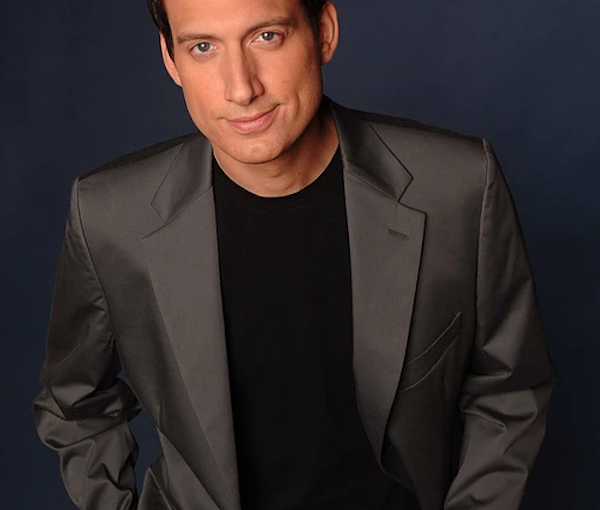
Elon Gold performs in Vancouver on April 14 at the JNF Negev Gala. (photo from elongold.com)

Comedian Elon Gold loves doing charity events, especially Jewish ones. The Independent caught him for a phone interview as he was on the road – with his family – to Las Vegas from Los Angeles to do gigs for the Adelson Education Campus and then the Israeli-American Coalition. On April 14, he will be in Vancouver to co-headline, with Ambassador Ron Prosor, the Jewish National Fund, Pacific Region, Negev Gala. The event raises funds for Sderot Animal-Assisted Therapy Centre.

“I feel like I’m doing a mitzvah by making my people laugh. And I’m also helping this cause that’s really important, and Israel is really important to me,” said Gold. “And we’re living in a highly antisemitic time, it’s dark out there, so anything I can do to bring light into our world and make my fellow Jew happy, I’m there for it.”

Gold’s resumé is impressive. He starred in the television series Stacked and In-Laws, had a recurring role on Bones and on The Dana Carvey Show. He guest starred just recently on HBO’s Crashing and, longer ago, on shows including Frasier and The Mentalist. He has appeared in films, his one-hour Netflix special, Elon Gold: Chosen and Taken, is available on Amazon and his show Elon Gold: Pro-Semite premièred at the Montreal Comedy Festival. He has made multiple appearances on The Tonight Show and his July 2018 segment on The Late Late Show With James Corden – how, like everyone else, Jews love sex, money and food, but just in a different order – has been watched and shared by countless people on the internet, as has his routine on why Jews shouldn’t have Christmas trees and so many others.

Despite all of his accomplishments and his years in the business, Gold still gets excited about his work, and he shared what he described as a “wow” moment, one of the best days of his life, almost immediately when talking with the JI.

“Yesterday,” he said, “I was filming a scene of Curb Your Enthusiasm with Larry David…. It was really, truly a dream come true.”

But Gold didn’t take his being hired by David as a sign that he had “made it.”

“The truth is, I have been a guy with lucky breaks and hard breaks for the last 20 years,” said Gold. “This is another achievement, and one that’s beyond anything I would dream of…. I’m gratified in the sense that I finally feel like I’m in a place, not where I’ve made it, but where I actually have fans, and my clips are viral and people are sharing my bits on Facebook, WhatsApp or whatever. I did the James Corden show and, again, that doesn’t mean I’ve arrived … but what’s cool to me is that I did that set and then everyone’s sharing it, especially Jews. My biggest fans are my people.”

It’s been a 25-year journey, said Gold of his career, “with all sorts of great highs, like yesterday, and huge lows, like having a sitcom that you pitched and created and started get canceled. There are so many lows, and then there is the daily rejection that is show business. And that’s why I’m so glad I’m a comedian and an actor. I get rejected all day in Hollywood at auditions, but then, at night, I’ll go to the Laugh Factory comedy club and I’ll have 300 people roaring, and that will validate [me] – I knew they were wrong! I knew I could do this. See, I’m funny. These people think so, at least.”

Gold said his resilience, his ability to keep trying, likely comes from stand-up. “Because stand-up is all about bombing and killing, and the killing is so worth it that even the terrible, dejected feeling of bombing [is manageable].”

As far as his career, he said, “I have no other choice. I don’t love doing anything else and I’m not good at anything else.”

Known for his impressions, he said, “I used to impersonate my teachers in eighth grade.” His goal wasn’t to ridicule people, he said, but to make even the teachers laugh.

He enjoyed making people laugh, and writing comedy. One of the first things he wrote, he said, was a Purim shpiel. “And I’ll never forget the feeling of having the entire high school laughing, and thinking, there has never been anything more gratifying than what I just did, I want to do this more. Everybody says it’s like a drug…. It’s so addictive. Once you get a taste of it, that’s it, you’re hooked. And very little can discourage a comedian [so much that they get] out of comedy; certainly not a bad set, because we all know that we all have them.”

A combination of things drives him.

“It’s probably disingenuous to say that I do this because I love to make others laugh,” he admitted. There is a selfish aspect to it, he said. While making people happy is a “key component” of why he does comedy, he said, “I also love everything about it… I love the process of having an observation and then writing it and tinkering with it and working on it. I love doing it and I love the fact that I have so much freedom in my days because I don’t have that nine-to-five job most people have…. I’m always working. At the same time, I’m always on vacation.”

Gold loves getting the laughs, and said that’s probably 70% of the reason he does comedy; the other 30% is making people happy.

“There is so much misery in the world,” he said, “to make people happy is a great thing, but it’s only a part of it.”

On the acting side, Gold said his favourite kind of acting is for sitcoms “with a live studio audience because you’re still getting the laugh but now you’re not looking at the audience and talking to them, you’re looking at your fellow actor … and, peripherally, you hear and see these people cracking up.”

Ultimately, he said, “I just love performing.”

The only “grueling part,” he said, is the memorizing “and the pressure of 200 people staring at you, saying, ‘You better know your lines, pal, because we’re all here and we all want to go home…. Acting is challenging, but it’s also just fun…. It’s fun to get into a character and just play.”

Gold, who is from the Bronx originally, recalled his first open-mic night at the Comic Strip Live in Manhattan; he was 16 years old. “Fortunately, I had beginner’s luck because I was doing impressions – my early act was all impressions – and impressions are like magic tricks, they just wow the audience.”

Despite being a touring comedian by university (he got a bachelor’s in economics at Boston U), it took years, he said, to develop his own voice, to figure out what he wanted to talk about and how to talk about it.

“I’m obsessed with Jewish stuff because I live such a Jewish life,” he said. “I’m an observant Jew, I keep Shabbos and all that stuff, keep kosher. So much of my life is in the Jewish world, I can’t help myself but to come up with observations about our traditions, our holidays, our rituals. A lot of what I talk about is what I live…. The other part of my life is being married, being a dad, so I talk about that.”

Gold and his wife, Sasha, have four kids, two sons and two daughters, ranging in age from 9 to 18. The couple is coming up to their 25th anniversary in June.

As he stopped to fill up his car with gas on the way to Vegas, he told the JI about why he likes performing at Jewish events, while simultaneously directing his kids to be quick about heading into the gas station, as they were running late.

“There are not a lot of comedians out there that will go that deep into the Jewish experience and, for me, there are not a lot of audiences I can share my Jewish experiences with,” he said. “I can’t do lulav and etrog jokes on James Corden…. At the same time, we’re raising money, we’re raising awareness for incredible organizations…. It’s all win-win for me – I’m raising money, I’m making money, I’m getting laughs, I’m getting to do material I don’t do anywhere else…. And I love Jewish audiences; I love connecting on more than just a human level…. We’re connecting about a shared experience that is almost indescribable to anyone else.”

For tickets to the JNF Pacific Region evening event on April 14, which will be held at Schara Tzedeck, call 604-257-5155.

Format ImagePosted on March 22, 2019March 20, 2019Author Cynthia RamsayCategories Performing ArtsTags animals, comedy, Elon Gold, fundraising, Israel, Jewish National Fund, JNF, Negev Gala, philanthropy, Sderot, tikkun olam
Jewish fraternity at 20

Jewish fraternity at 20

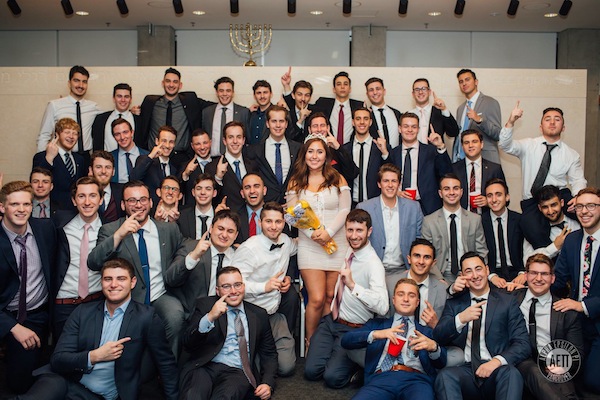
Alpha Epsilon Pi chapter members with the fraternity’s “sweetheart,” Rachel Meadow. A “sweetheart” is elected every year at the chapter’s formal. (photo from AEPi)

The Vancouver chapter of Alpha Epsilon Pi, the traditionally Jewish fraternity, is 20 years old this year. So is Benny Stanislawski, the chapter’s president, who will help oversee the anniversary celebrations next month.

AEPi, as it is commonly known, was not the first Jewish fraternity at the University of British Columbia. Another frat operated on campus in years past but eventually disbanded. In the summer of 1999, the former longtime international executive director of the fraternity contacted Jeff Waldman, a student at UBC, suggesting he consider founding a chapter. A group of eight “founding fathers” came together and Adam Propp, a high school friend of Waldman, also a UBC student, was chosen as the first president, or “brother master,” as the role is called internally.

Hillel has been on the UBC campus since 1947 and provided an avenue for Jewish fellowship and involvement for many students. But the founders of the fraternity saw advantages in creating the male-only society.

“I think all of us had different reasons,” Propp recalled. “For me, to be able to have an impact on the university experience for young Jewish men like myself was important. When I look back at it, Hillel appealed to many, but not all. [The fraternity] just appealed to a different set of people who might not have been attracted to Hillel right away. It was a way to get more people more active and involved in a Jewish experience on campus, especially since UBC is such a commuter school.”

Propp became philosophical reflecting on the chapter’s founding two decades ago, noting that, in the next few years, some sons of the original brothers will likely be pledging to the fraternity. In recent days, Propp has been reconnecting with many of the original brothers, as they plan to gather for the 20th-anniversary celebration with a series of events over the weekend of April 5-7.

photo - Benny Stanislawski, president of the Vancouver chapter of Alpha Epsilon Pi
Benny Stanislawski, president of the Vancouver chapter of Alpha Epsilon Pi. (photo from AEPi)

The relationship between AEPi and Hillel differs from campus to campus and, at UBC, it has generally been extremely strong, sometimes highly symbiotic.

Gabe Meranda, who was executive director of the Vancouver Hillel Foundation at the time the chapter formed, admits he had some trepidation about a Jewish fraternity, not having had any experience with what is called “the Greek system.”

“I was skeptical at first, since I was cautious about fraternities. But these first few guys were so excited about launching the chapter in B.C. that I decided I must get behind it,” Meranda recalled. “I remember the night of their first party at Hillel. I didn’t know what to expect, but all seems to have gone well and it’s taken off from there.”

The chapter made Meranda an honorary brother and he still proudly has the pin, he said.

While fraternities have a reputation for certain excesses, Canadian campuses tend to be a little more low-key, in part because the lower drinking age in Canada means access to booze is not a motivator to joining a frat. What is less obvious to the general public are programs of leadership development, philanthropic ventures and, in the case of AEPi, Jewish cultural activities and, to varying extents, Israel programming or education.

Stanislawski stressed that AEPi has no political or religious orientation. Jewish young men, as well as non-Jewish ones who want to pledge – of which there are usually a few each year – are welcome without concern for their religious affiliation (or lack of affiliation) or their approach to Zionism.

The chapter’s main annual philanthropic event is Hoops 4 Health, an all-day, three-on-three basketball tournament that takes place this year on March 31 at War Memorial Gym. The chapter’s charity beneficiary used to be different health causes, but the Heart and Stroke Foundation has a special meaning to the brothers. A couple of years ago, an AEPi member, Nitai Weinberg, suffered a stroke at the age of 18. Now fully recovered, he and his brothers raised $8,000 for the cause last year, and this year have significantly upped their goal to $25,000.

As an example of the range of programs, the chapter recently hosted a presentation on sexual assault awareness, led by the UBC Mental Health Network. They also host “Greek Shabbats” at Hillel House, where members of all the university’s fraternities are invited.

Fraternities, in general, are a place to nurture leadership.

AEPi has an added mission, noted Stanislawski: “Developing leaders for the Jewish community.”

Founded in 1913, the fraternity now serves 190 campuses in seven countries; it claims 90,000 living alumni. The UBC branch, officially called the Beta Chi chapter, welcomes students from Langara, Simon Fraser, Emily Carr, Capilano and all post-secondary institutions in the region. The chapter usually has 40-plus brothers in any given year, peaking last year at 49.

“I’d love to see the organization get into the 70s,” said Stanislawski. But, given the limited number of Jewish students on campus, slow, steady growth is the realistic goal.

Samuel Heller, the current executive director of Hillel at UBC, congratulated the fraternity and thanked them for their contributions.

“Both the Hillel community and wider campus community are enriched by this brotherhood of young men who exemplify leadership and champion Jewish values,” said Heller. “Brothers of AEPi are a positive force on campus … by creating a group of young leaders who are changing the face of UBC and who, in turn, will change the world.”

Pat Johnson is an honorary brother of Alpha Epsilon Pi Beta Chi chapter.

Format ImagePosted on March 15, 2019September 8, 2025Author Pat JohnsonCategories LocalTags Adam Propp, AEPi, education, fraternities, Gabe Meranda, Judaism, milestones, Sam Heller, tikkun olam, UBC
Helping Rose’s Angels

Helping Rose’s Angels

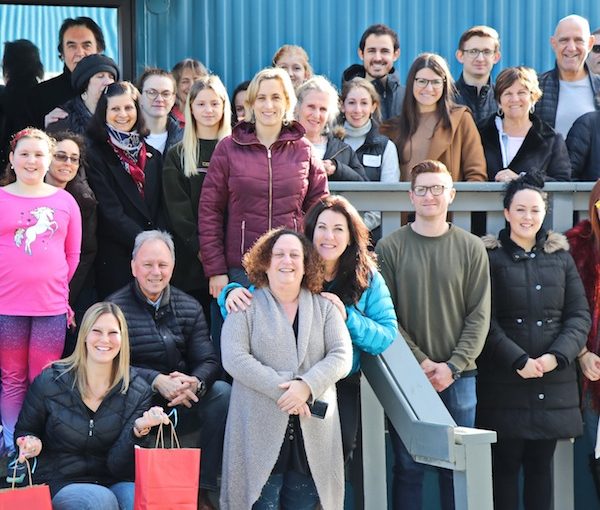
Some of the 70 volunteers who helped out at Rose’s Angels Feb. 17. Event founder Courtney Cohen is holding the bags and Kehila Society executive director Lynne Fader is standing in the front, with the long sweater. (photo by Lianne Cohen Photography)

For most people, getting out of the house and being somewhere by 9 a.m. might be no big deal. For me, especially on a weekend morning, it’s a challenge. But, at least once a year, it’s a challenge I enjoy.

As the owner and editor of the Jewish Independent, I’ve known of Rose’s Angels since it launched six years ago, but only first participated last year in the packing of the more than 1,000 care packages for Metro Vancouverites in need. Courtney Cohen, who created the annual event in honour of her grandmothers, Rose Lewin and Babs Cohen, with longtime friend Lynne Fader, was among the 18 Jewish community members under the age of 36 who were honoured by the Jewish Independent with a JI Chai Award in December 2017 for doing good. Having made the personal connection, I headed out to Richmond Jewish Day School a couple of months after the JI Chai Celebration to help out. It was such a fun experience that I went again this year.

The atmosphere at RJDS is like “Old Home Week.” This time around, I drove there with a friend – she brought the muffins and I made the coffee. As before, I ran into several people that I don’t see often. A well-organized venture, Rose’s Angels, which is run under the auspices of the Kehila Society of Richmond, provides coffee and pastry for those who can wait till they get to the school for their fix. Lists taped onto the wall tell volunteers at which station they’ll be working.

I must have done an OK job last year because I was once again assigned to putting together glove and sock bundles, wrapped in ribbon, colour-coded to indicate whether the bundle was for men, women or children. So absorbed was I in the work and conversation that I can’t say what others were doing, but there was much bustling about and, by noon, a big truck and several cars were stuffed with boxes to be delivered.

photo - Volunteers put together 1,200 care packages, which were distributed to those in need by various social services agencies and programs
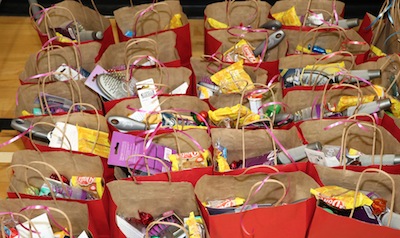
Volunteers put together 1,200 care packages, which were distributed to those in need by various social services agencies and programs. (photo by Lianne Cohen Photography)

This year, said Cohen, 70 volunteers put together 1,200 packages, filled with necessities from toiletries to books to food to warm clothing, thanks to donations of items and money. The packages were distributed by a couple dozen organizations, including Turning Point Recovery Society, Heart of Richmond AIDS Society, Light of Shabbat program, Jewish Food Bank, Richmond Food Bank, United Way, Tikva Housing, Richmond Centre for Disability, Touchstone Family Services, St. Alban’s Drop-In Centre, Richmond Mental Health Society and Richmond Food Aid.

Scheduled to happen around Valentine’s Day, this year’s Rose’s Angels took place Feb. 17.

“Watching firsthand our community come together to give back on a long weekend, with family and friends is quite amazing,” Cohen told me when I asked her what was the most fun aspect of the day for her. “Seeing people of all ages working together to help package the care packages in such an organized manner is really something to behold.”

Fader, who is co-executive director of the Kehila Society, also enjoys the communal feel, as well as the diversity of the group that gathers to help. “It is always a fun, well-spirited, well-oiled machine that puts months of hard work gathering all the items together to produce a beautiful bundle of items,” she said.

In looking to the future, Fader would like to see the annual event become “bigger, better,” serving “more recipients in our community,” referring to Richmond as a whole, not only its Jewish community. “Although Rose’s Angels is an annual project,” she added, “the Kehila Society is daily working with our community agencies and partners to assist on a daily basis.”

“I see the success of Rose’s Angels growing from year to year with the involvement of the community partners and individuals,” said Cohen. “Personally, I already see the success and fulfilment that Rose’s Angels has given our community at large. Receiving thank you phone calls, emails and messages from the recipient agencies reminds me of the impact that Rose’s Angels is making to so many individuals.”

Format ImagePosted on March 8, 2019March 6, 2019Author Cynthia RamsayCategories LocalTags Courtney Cohen, Kehila Society, Lynne Fader, Rose’s Angels, tikkun olam
World’s craze for sand

World’s craze for sand

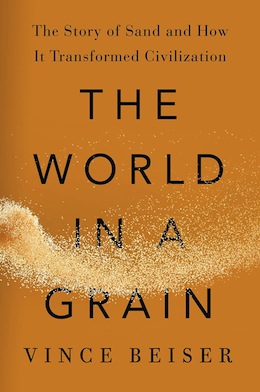
The World in a Grain: The Story of Sand and How It Transformed Civilization by Vince Beiser is a finalist for the 2019 PEN/E.O. Wilson Prize for Literary Science Writing. The award is given to a “book that exemplifies literary excellence on the subject of the physical or biological sciences and communicates complex scientific concepts to a lay audience.”

At the core of PEN America is the ideal of freedom of speech, “recognizing the power of the word to transform the world.” For his entire career, Beiser has been trying to change the world with his writing and, with The World in a Grain, he educates readers about the phenomenal importance of sand in making thousands of things, from concrete to glass to fibre-optic cables, and how dependent on it we are. So valuable is sand that people steal it and even kill for it, and our unbridled use of it, in concrete in particular, might just kill the planet.

To bring these harsh realities to light, Beiser adeptly and engagingly – sometimes with humour – mixes empirical evidence, scientific explanations, interviews with people directly connected to or affected by sand mining, profiles of relevant historical figures and his own commentary, as well as some factoids, which he calls “Interludes.” He comes to the not-surprising-but-disheartening conclusion that there’s only one solution: “human beings have to start using less sand. For that matter, we have to start using less of everything.”

Beiser dedicates the book to his wife, Kaile, and their children, Adara and Isaiah. While they live in Los Angeles, he grew up here. The Jewish Independent interviewed him about his upbringing, his career and, of course, his book.

JI: Could you tell me where you were born, how you ended up in Vancouver, and how your parents’ involvement in social causes influenced your choice of profession?

VB: I’m from a venerable Vancouver family, though I wasn’t born there. My grandfather’s family – the Landos – came over from England around the turn of the 20th century, first to Prince Rupert and then to Vancouver, where they worked in the fur business, of all things. My mother [Roberta] and her siblings were all born and raised in Vancouver – mostly in the same house where she still lives! My brothers and I were all born in the U.S. (myself in New York City), where my father [Morton] was working. We moved to Vancouver when I was 10, and I grew up there until I took off to college in California. I come back just about every summer.

My parents were always very engaged with the world, and the idea of trying to make it a better place – my father as a mental health researcher, and my mother mainly through her work with all kinds of arts and cultural organizations. We did a lot of traveling as well, which really opened my eyes to just how lucky we were and how much less so are so many other people. Meanwhile, I also had an uncle, Vancouver native Barry Lando, who was a highly decorated producer at 60 Minutes, so I grew up watching his shows and hearing about his adventures all over the world. I never consciously thought that I wanted to have a job like that, but it certainly made an impression.

JI: What role does Jewish culture and/or Judaism play in your life and work?

VB: I’m proud to be a Jew, and that heritage has definitely had an impact on my professional life. Knowing our long and brutal history of oppression helped sharpen my desire to work for social justice, to do what I can to help right, or at least bring attention to, wrongs wherever I find them. I started my career in Jerusalem, covering the First Intifada as a freelancer for both Israeli and Palestinian publications. Later, I wound up working for an Israeli magazine, The Jerusalem Report, first in Eastern Europe covering the wars in the former Yugoslavia, and later as their New York correspondent. I’ve probably written more about Jews and Jewish issues than anything else except sand!

JI: What took you from Vancouver and how did you establish yourself in Los Angeles?

VB: I went to college at the University of California at Berkeley – I really wanted to get to the States, which I thought was a much more exciting place than then-sleepy little Vancouver. From there, I spent years traveling and working all over the world, first as a hitchhiking backpacker, and later as a freelance journalist (there’s often not a lot of difference between the two lifestyles). I spent several years in the Middle East and then Eastern Europe, then came back to the U.S., where I bounced around from New York to San Francisco to Las Vegas (that’s right, I lived in Las Vegas). I was living in San Francisco when I met a delightful young woman living in L.A. I was doing a lot of work in L.A. at the time, writing for the L.A. Times Magazine and other places, so had an excuse to visit her often and, well, 17 years later we’re married, with two kids and a mortgage and the whole package.

JI: In an interview you did with David Simon, you talk about journalism, fiction and film, and Simon comments that no one reads anymore. What are your thoughts on that, on the state of journalism and your decision to write a book?

VB: These are dark days for the business of journalism, of course, with local newspapers dying off en masse and money drying up for those that are left, thanks to the internet. Most of my career has been spent writing for magazines, and a terrifying number of the ones that I’ve written for over the years have disappeared or been reduced to emaciated shadows of their former selves – The Village Voice, Spin, Rolling Stone, US News & World Report, and on and depressingly on.

book cover - The World in a Grain
The World in a Grain can be purchased on Amazon and at other bookstores.

But, contrary to what everyone expected with the advent of the internet and the Twitterization of discourse, people do still read, at length and in numbers. There are plenty of long, deep articles published online that attract hordes of eyeballs – the trick no one has cracked yet is figuring out how to make money off of them. Oddly, the book industry is still doing relatively well; most people still seem to prefer physical, paper books to reading something of that length on a screen. So, moving from magazines into book writing is not only something I’ve always wanted to do – it’s also a tactical move aimed at keeping me solvent. I’m branching into movies and TV for the same reason. If you’re going to survive as a freelance journalist in the 21st century, you’ve got to tell your stories and get paid every which way you can.

JI: Can you describe how the topic of sand first came to you, why it piqued your interest and about the path to the book’s publication?

VB: I’m a full-time freelancer, so I’m always hustling for stories, which involves trawling through a lot of obscure publications. One day in early 2015, I stumbled across a story on a little environmental website from which I learned two things. One, sand is the most-consumed natural resource on earth after air and water; that alone made me sit up and take notice. Two, that there is so much demand for the stuff that we are inflicting tremendous environmental damage all over the world to get it, stripping bare riverbeds and beaches and, in some places, people are even being murdered over sand. Like most people, I had never even thought about sand as a commodity, let alone one so important people might be killed over it.

I thought this all sounded crazy but, with a little research, I found it was true. The violence, I discovered, is by far the worst in India. So, I convinced Wired magazine to send me to India, where I reported a feature on the murderous ‘sand mafias’ that bedevil that country. The piece came out in spring of 2015 and got a great response from readers. I knew by then there was much, much more to the story – a book’s worth, I figured. That summer, I spent a few days alone on a tiny property we own on Gabriola Island pounding out a book proposal. My agent in New York sold it almost right away to the folks at Penguin Random House, and I was off to the races.

JI: How would you describe your level of optimism about the future?

VB: Really depends on the day, or hour. But I’ve got kids growing up in this world, so I don’t have much choice but to hope for the best!

Format ImagePosted on February 8, 2019February 7, 2019Author Cynthia RamsayCategories BooksTags environment, journalism, politics, sand, tikkun olam, Vince Beiser

Jewish way to lend

This Shabbat (Feb. 2), in parashat Mishpatim, the Torah commands, “If you lend money to my people … do not act toward them as a creditor; you may not charge them interest.” This law, along with Maimonides’ teaching that the greatest level of tzedakah is to support a fellow Jew by endowing them with a gift or loan to strengthen their hand, are the guiding principles of the Hebrew Free Loan Association of Vancouver (HFLA).

HFLA provides interest-free loans to help Jewish individuals from British Columbia overcome financial challenges and build better lives. HFLA fosters economic stability and opportunity among low- and moderate-income members of the community by providing access to affordable credit in the form of a no-interest loan.

Over the years, the types of loans the organization has given out have evolved greatly. In the 1980s and ’90s, with a wave of immigrants from the former Soviet Union, the majority of HFLA’s loans went to helping immigrants finance vocational training. While HFLA still helps many new immigrants, its focus now also includes helping people with the rising costs of living in the Lower Mainland.

“With the bulk of people’s income going towards housing costs, many people have very little left over when unexpected bills arise,” said Joanna Wasel, executive director of HFLA. “We are able to be there for people during times of financial stress. A loan from us can help cover things like emergency dental work, physical therapy and short-term home care.”

HFLA is also here to help members of the community when they need support to start a Jewish family through fertility treatments or adoption, host a bar or bat mitzvah, finance university or start a new business. The goal of these loan programs is to help community members build better lives and avoid falling into high-interest debt.

HFLA recently unveiled a new webpage, hfla.ca. The new site is clear, concise and includes a step-by-step guide to applying for an HFLA loan. Potential borrowers can complete and submit an application online.

“We really want to make the process as easy as possible for our borrowers. Every step has been designed with great care to ensure that people’s dignity and confidentiality are respected and protected,” said Wasel.

In the past 40 years, HFLA Vancouver has made more than 1,900 loans. There is no other organization like it in the community and those in need, or with friends in need, are encouraged to seek more information about HFLA’s services by visiting its website or calling 604-428-2832.

Posted on February 1, 2019January 29, 2019Author Hebrew Free Loan AssociationCategories LocalTags Hebrew Free Loan Association, HFLA, Jewish life, loans, tikkun olam
A rewarding trip to Siberia

A rewarding trip to Siberia

Several Vancouverites traveled to Siberia to see members of the Jewish community, which the Jewish Federation of Greater Vancouver helps support. (photo from Michael Moscovich)

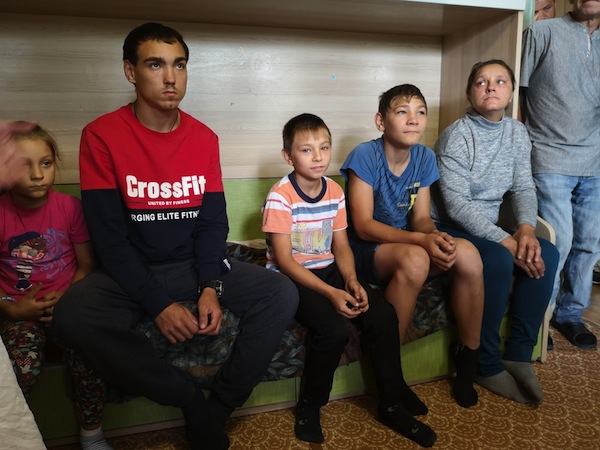
Last September, a group of seven travelers representing the Jewish Federation of Greater Vancouver set off on an expedition to the far east of Siberia. Jews going to Siberia? Had to be a very good reason. And there was.

For more than a decade, the Jewish Federation, in partnership with the American Jewish Joint Distribution Committee (JDC), has been contributing to the support of Jews in need, wherever they may live in the world. Federation’s Israel and overseas committee chose to help the closest Jewish communities in abject poverty and those are in Siberia’s far east. Khabarovsk is the main city in the area and Birobidzhan is the capital of the Jewish republic, or oblast, of Russia. Jewish republic! Long story.

photo - The Russian city of Khabarovsk
The Russian city of Khabarovsk. (photo from Michael Moscovich)

Khabarovsk is about the size of Winnipeg and the winters are about the same, only a little colder – when we were there in the fall, it was generally above 20°C. Birobidzhan has a population of only about 75,000 and both cities are located by very large rivers. Each has a new synagogue/community centre.

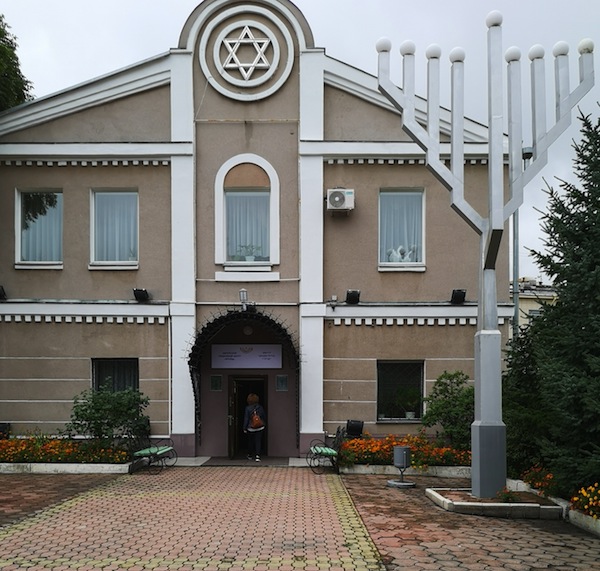
photo - The synagogue in Birobidzhan
The synagogue in Birobidzhan. (photo from Michael Moscovich)

In Siberia, the younger people have jobs and seem to do well, but the pensioners are lost. Their pensions may have been adequate 20 years ago but the ruble has fallen to two cents. Their income is maybe $20 to $40 a month. Their choice is to feed themselves, heat their home or buy their medicines. Through the JDC, Federation makes it possible to do all three by supplementing their monthly income. It also supports people with disabilities who are unable to work.

I am a founding member of Federation and its Israel and overseas committee, and have visited Jewish communities in Poland, western Russia, Austria, Morocco and Cuba. No Vancouver representative had visited our Siberian partners before to see what we’re helping to accomplish. The trip was very rewarding. We saw signs of the rebirth of Siberian Jewish life.

The Russian city of Khabarovsk. (photo from Michael Moscovich)
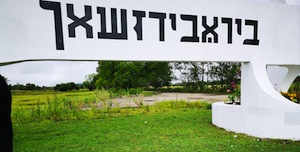
photo - Biribojan, in Yiddish
Biribojan, in Yiddish. (photo from Michael Moscovich)

Most of the people we met were not English speakers, but we had enough interpreters that language was never a problem. We were also bonded by Yiddishkeit, though the community had had no Jewish education or ceremonies for decades, since Stalin decided to ban the Jewish part of the Jewish republic. No one even spoke a word of Yiddish – this in a place where there was a thriving Yiddish-based culture until the 1950s. But the street signs in Birobidzhan are still written in Yiddish and there are other symbols of Jewish life, such as a menorah on the monument at the train station.

During our visit, we joined in baking challot and delivered them to elderly widows. Upon entering one home, our hostess staggered and almost collapsed. Subsequently, whenever she looked at me she blanched and teared up. I asked what was the matter and she said I looked so much like her father it was like seeing a ghost. She showed me pictures of him and, indeed, he was a handsome devil and doppelgänger.

There are maybe 15,000 Jews left in the area. All have the option of relocating to Israel and most have. However, one guy returned, as there was no ice fishing in Israel. Another returned as a Chabad rabbi to lead the Birobidzhan congregation. A young woman came back to be with her grandmother. So many stories.

The elderly spoke to us of the war and survival. I asked what happens to the non-Jewish people in similar circumstances with no outside support. They just died, was the reply. We are truly saving lives.

Format ImagePosted on January 11, 2019January 9, 2019Author Michael MoscovichCategories WorldTags former Soviet Union, FSU, JDC, Jewish Federation, Joint Distribution Committee, philanthropy, Siberia, tikkun olam
Good neighbours, good work

Good neighbours, good work

Students in grades 6 and 7 hand out sandwiches on the Downtown Eastside Nov. 15. (photo from RJDS)

On Nov. 15, 60 students from Richmond Jewish Day School and Az-Zahraa Islamic Academy went to the Downtown Eastside to meet the people in the neighbourhood and hand out food that had been prepared earlier.

photo - Students in grades 6 and 7 hand out sandwiches on the Downtown Eastside Nov. 15
Students in grades 6 and 7 hand out sandwiches on the Downtown Eastside Nov. 15. (photo from RJDS)

“The students, staff and administration of Richmond Jewish Day School have always been committed to doing what we can to improve the lives of those less fortunate among us,” said Reesa Pawer, student life coordinator at RJDS. “One of the ways we have done this is by actively participating in a week of Random Acts of Chesed.”

As part of Random Acts of Chesed Week, Grade 6 and Grade 7 RJDS students worked together with their neighbour school, Az-Zahraa, to put together 700 bags of food and more than 500 sandwiches.


Format ImagePosted on November 30, 2018November 29, 2018Author Richmond Jewish Day SchoolCategories LocalTags Az-Zahraa Islamic Academy, education, interfaith, multiculturalism, RDJS, Richmond Jewish Day School, tikkun olam
Creating their own changes

Creating their own changes

Blake Mycoskie, founder of TOMS, with Hannah Alper. Mycoskie is one of the role models Alper features in her book Momentus: Small Acts, Big Change. (photo from callmehannah.ca)

In Momentus: Small Acts, Big Change (Nelson Trade, 2017), Toronto-based teen activist Hannah Alper profiles people who are doing humanitarian work. Each chapter is devoted to a person who is doing significant tikkun olam (repairing the world) in any number of areas, from the environment to indigenous rights to mental health.

Alper uses a specific formula to describe what her book is essentially about: issue + gift = change. The issue is something an individual is passionate about, whatever the cause might be. The gift is something a person is blessed with or a hobby they might enjoy or want to pursue. With just these two aspects, individuals can change the world.

In the introduction of Momentus, Alper briefly talks about how she got involved in humanitarian work. She and her parents were coming back from a Digital Family Summit, which is a conference to help young individuals use the internet safely. Blogging was never something she had envisioned herself doing, but this conference changed her mind. While still there, she began her own blog, titled “Call Me Hannah.”

Initially, she did not know what she would write about. Then, her parents gave her some encouraging words. They told her to write what she was passionate about. Being 9 years old at the time, Alper was learning about the environment and the problems animals were facing because of habitat loss and deforestation. It especially bothered her because these were problems caused by humans.

Alper began to receive comments from people who were actually trying to do what she advised in her writing. She herself became involved in the World Wildlife Fund and Environmental Defence. But, even though she enjoyed helping these organizations, she felt that something was still missing.

Because of her blog, Alper was invited to WE Day as media. WE was founded by Canadian brothers Craig and Marc Kielburger, and WE Days across North America, the United Kingdom and the Caribbean bring thousands of change-minded people together to celebrate their contributions and be inspired by one another and by well-known speakers. Alper explains that people cannot buy a ticket to a WE Day, but earn an invitation to it through their work.

image - Momentus book coverTwo years after her first WE Day, Alper helped promote the event as a representative of the organization. During her first tour, she shared the story of Nobel Prize winner Malala Yousafzai. On the second, she co-hosted a social empowerment section and, in Momentus, she briefly talks about her time meeting other young people during a WE Day tour in 2014. She says that seeing others who were also trying to create change was refreshing to witness.

Role models in different categories have been a main inspiration for Alper’s work and each chapter of her book focuses on one of these mentors and the work they are doing. She hopes that, by highlighting such role models, readers will come to understand that they, too, can make a difference, no matter how old they are, or where their interests and passions lie.

The Kielburgers, Yousafzai, Lilly Singh and Brad Montague are among the change-makers included in Momentus, as is one of Alper’s biggest role models, Severn Cullis-Suzuki, whose father is David Suzuki. Watching a 1992 video in which Severn spoke at the United Nations Earth Summit made Asper realize that she had the ability to take a stance on environmental issues – and that her voice could be heard and make a difference.

“My greatest hope from this book is that people finish it and believe that they have the fullest power and capacity to make a difference,” writes Alper on her blog. “Then, they go out into their community [and take] action. I cannot tell you how excited I am to see how people create their own change.”

One voice can impact so many that a chain reaction can occur when it comes to solving problems. Reading about young people who are passionate about fixing or improving deep-rooted problems is inspiring. As the proverb says, “If you want to go fast, go alone. If you want to go far, go together.”

Chloe Heuchert is a fifth-year history and political science student at Trinity Western University.

Format ImagePosted on November 30, 2018November 29, 2018Author Chloe HeuchertCategories BooksTags Hannah Alper, Momentus, tikkun olam
Courage ride sells out

Courage ride sells out

Courage in Motion 2018. (photo from Beit Halochem Canada)

More than 100 Canadian cyclists participated in the recent Courage in Motion (CIM). The fundraising ride, now in its 11th year, has grown steadily in popularity over its first decade and, this year, like many before, was sold out.

The CIM initiative of Beit Halochem Canada, Aid to Disabled Veterans of Israel, welcomed cyclists from across Canada, joined by some Americans and Israelis. From Oct. 22-26, the visiting cyclists rode alongside Israeli veterans with disabilities on four fully supported routes, taking them through southern Israel’s archeological landmarks and its landscapes.

With the fundraising drive open until Dec. 31, it is expected that Courage in Motion 2018 will raise approximately $850,000. Cyclists’ efforts enabled members of Zahal Disabled Veterans Organization/Beit Halochem to participate in the ride and will also fund programming at Beit Halochem Centres in Beer Sheva, Haifa, Jerusalem and Tel Aviv, which provide individualized therapies, specialized sports rehabilitation training and cultural arts and family-oriented programming.

Lisa Levy, an avid cyclist and national executive director of Beit Halochem Canada, is the founder of Courage in Motion. “I’m pleased that the ride was, once again, sold out,” she said. “It’s evident that our cyclists embrace the aspect of riding alongside those who are directly helped by their efforts. This year, we’re incredibly proud that more than 120 wounded Israeli veterans participated due to the fundraising by our 110 Canadian riders. We are also gratified that many of our Canadian participants feel that they get more out of the experience than the disabled veterans.”

While many cyclists return year after year, several others were new to Courage in Motion 2018. Two of these first-time participants are internationally renowned sports figures.

Toronto-born Keith Primeau was a National Hockey League centre, playing 15 seasons (1990–2005) with various teams. He co-wrote Concussed! Sports-Related Head Injuries: Prevention, Coping and Real Stories (2012) and is now based in New Jersey.

CIM also welcomed cycling champion Eon D’Ornellas. Born in Guyana and having immigrated to Canada, D’Ornellas represented both countries during his career, winning numerous medals. He has owned D’Ornellas Bike Shop in Scarborough, Ont., for 30 years and, in 2011, he suffered a stroke during a club training ride. Like Beit Halochem members, he knows the challenges in reclaiming his life after serious medical trauma.

All Courage in Motion participants enjoyed group activities following each day’s ride, including a night walking tour of Jerusalem and an evening with members of Beit Halochem, who shared their personal stories of tragedy and triumph. Next year’s CIM takes place in Israel Oct. 27–31. Registration is expected to open in March.

Format ImagePosted on November 23, 2018November 28, 2018Author Beit Halochem CanadaCategories IsraelTags Beit Halochem Canada, cycling, disabilities, tikkun olam, travel, veterans

Posts pagination

Previous page Page 1 … Page 15 Page 16 Page 17 … Page 30 Next page
Proudly powered by WordPress