Skip to content
  • Home
  • Subscribe / donate
  • Events calendar
  • News
    • Local
    • National
    • Israel
    • World
    • עניין בחדשות
      A roundup of news in Canada and further afield, in Hebrew.
  • Opinion
    • From the JI
    • Op-Ed
  • Arts & Culture
    • Performing Arts
    • Music
    • Books
    • Visual Arts
    • TV & Film
  • Life
    • Celebrating the Holidays
    • Travel
    • The Daily Snooze
      Cartoons by Jacob Samuel
    • Mystery Photo
      Help the JI and JMABC fill in the gaps in our archives.
  • Community Links
    • Organizations, Etc.
    • Other News Sources & Blogs
    • Business Directory
  • FAQ
  • JI Chai Celebration
  • JI@88! video

Recent Posts

  • Sharing her testimony
  • Fall fight takes leap forward
  • The balancing of rights
  • Multiple Tony n’ Tina roles
  • Stories of trauma, resilience
  • Celebrate our culture
  • A responsibility to help
  • What wellness means at JCC
  • Together in mourning
  • Downhill after Trump?
  • Birth control even easier now
  • Eco-Sisters mentorship
  • Unexpected discoveries
  • Study’s results hopeful
  • Bad behaviour affects us all
  • Thankful for the police
  • UBC needs a wake-up call
  • Recalling a shining star
  • Sleep well …
  • BGU fosters startup culture
  • Photography and glass
  • Is it the end of an era?
  • Taking life a step at a time
  • Nakba exhibit biased
  • Film festival starts next week
  • Musical with heart and soul
  • Rabbi marks 13 years
  • Keeper of VTT’s history
  • Gala fêtes Infeld’s 20th
  • Building JWest together
  • Challah Mom comes to Vancouver
  • What to do about media bias
  • Education offers hope
  • Remembrance – a moral act
  • What makes us human
  • המלחמות של נתניהו וטראמפ

Archives

Follow @JewishIndie
image - The CJN - Visit Us Banner - 300x600 - 101625

Tag: religion

How we can live after death

It is the instinct of all living things to try to stay alive, humans among them. Most religious doctrines pay a great deal of attention to this issue. And many people, whether part of an organized religion or not, believe that a spirit leaves the body after death. Where viewpoints vary mainly is what happens then.

In many belief systems, we stay alive in some form or another even after death. Hindus, like Buddhists, believe that a departing spirit is reincarnated into some other life form. Buddhists believe there is no guarantee that the life form will be human; they believe that liberation from the cycle of life is the only desirable objective, a state they call nirvana.

The monotheistic religions all have some concept of an afterlife, with outcomes based on our behaviour during our life on earth. Indeed, both Christianity and Islam see the afterlife as the most desirable state, at least for the righteous, compared with our life on earth, the current one being a “a vale of tears.” Judaism also sees a reward for the righteous, with a resurrection when the Messiah arrives to usher in the “End of Days” and heaven on earth. But Jews, in contrast, are urged to live the fullest possible life while alive, every life being precious.

Without entering into discussions on this issue as to the merits of one position or another, I have drawn some conclusions as to their relevance on the question of staying alive. Empirical evidence from religious enthusiasts is meagre, relying on faith rather than hard facts, or reports of a life, or lives, after death from thousands of years ago. These form the basis for the promise underlying the religious thesis.

The realization of a positive outcome in the religious sphere depends on an unblemished life experience. I cannot count on being among those judged as sufficiently righteous and deserving. That leaves me with the task of doing the best I can to extend the life I know about, the one I am living now. Having past the four-score mark is evidence that I have done some things right, having already survived many of “the slings and arrows of outrageous fortune.” I must have good DNA.

Chance has favoured me in my encounters with accident, disease and body-systems breakdowns. I have survived my encounter with “the big C” up to this time. I have diabetes under apparent control, but one never knows, as it works its damage asymptomatically.

I take pills in abundance to ward off the evils of sugar, high blood pressure and stroke. I quit smoking in my early forties and drink alcohol sparingly. My food habits are not outrageous, without denying myself the favourites that make life worth living. I exercise religiously when not on holiday. I have given up driving on the promise it will increase my life expectancy. Best of all, I pass my life with the woman of my dreams. Life is grand.

The other night, I spent some time with family. We found ourselves talking about our experiences with forbearers who had gone before us. For a short while, it appeared to me almost as if those ancestors were there with us, alive and sharing our good times. Like a lightning bolt, it struck me that that was truly another way of staying alive. The people in our lives who are important to us, those who have marked us in our life experience, they continue to be alive for us as long as they remain in our memories. They never disappear for us as long as we live; they go on being a part of our lives.

So, that’s the secret. We must continue to be important in the lives of the people who surround us. As long as we do that, we will stay alive even after we are physically gone. We have to cherish those we care for while we have them, in part so they will continue to cherish us.

But this does not apply to family only. It is true for all the people in our lives to whom we reach out, to all those we touch and those who touch us. If we want to stay alive, we have to do the reaching out.

Moses and Jeremiah and Isaiah and Jesus can thus be alive for us as well, if they have touched us and touched our lives. Shakespeare and da Vinci are alive for me. Spinoza is alive for me. Danny Kaye and Sid Caesar are alive for me, as is Beethoven.

They are all alive for me because they are a part of who I am. All the people who have made me what I am are alive for me every day of my life. I am surrounded by a crowd. Sometimes, they speak through me. You can’t spend much time with me without getting to meet some of them.

If I write something and it touches another soul, then I may still be alive for them whether I am physically there or not. Even for the people who no longer remember my name, I may still be alive for them in some cranny of their consciousness. That’s not so bad. If we can believe in that, in our own minds we have a future beyond our temporal experience of life.

So, now you know the secret. Go out there and talk to the people around you. Phone them. Write an email. Hug or kiss them if you can get away with it. You may get to live forever if they tell their children about you. If you know what you have done, if you have faith in it, as I do, regardless of your other beliefs, this can be your “promised land.”

Max Roytenberg is a Vancouver-based poet, writer and blogger. His book Hero in My Own Eyes: Tripping a Life Fantastic is available from Amazon and other online booksellers.

Posted on May 17, 2019May 16, 2019Author Max RoytenbergCategories Op-EdTags health, lifestyle, philosophy, religion

Quebec’s underlying goal

Sometimes in complex or far-reaching events, a small, seemingly less significant factor can illuminate a larger understanding. Successive efforts by Quebec governments to enforce laïcité, a policy of compulsory secularism in the delivery of public services, have included a minor exception that really speaks to the inequality such efforts seek to create.

Since 1936, a not-at-all-subtle crucifix has hung above the speaker’s chair in the legislative chamber of the Quebec National Assembly. A week ago, the Quebec government voted to take down the crucifix as part of a much broader policy against religious symbolism in the province’s public life. Even as they proposed policies that would ban religiosity in the forms of Muslim, Sikh and Jewish head coverings and other items, such as pendants with stars of David or crucifixes, previous governments have contended that the legislature’s cross is exceptional. In the narrative advanced across a decade of this debate, the cross represents an indisputable aspect of Quebec history. Reading between the lines of this argument, the crucifix – the definitive symbol of Christianity – transcends its religious particularity, presumably on the idea that Christianity was an inherent part of Quebec’s history and development.

The message of this exceptionalism is clear as a bell: this place was founded on Christian principles and those of other religious traditions, despite whatever contemporary contributions they might make to Quebec society, rank below the founding religion even as we seek to erase all of them from the public eye. Christianity, in other words, is a first among unequals.

To their credit, the government of Premier François Legault is not excepting the crucifix from this latest bill aiming to impose secularism. The bill, which was introduced last week by the centre-right Coalition de l’avenir du Quebec government elected last year, has all the characteristics that have been discussed in recent years by various governments intent on erasing outward appearances of religious difference. In the provision of government services in which an employee has “coercive” influence – including police, prison guards, judges and teachers – kippot, chadors, turbans, kirpans, crucifixes and anything else that speaks to an individual’s religious affiliation will be banned.

The decision on the National Assembly’s crucifix at least pays lip service to the idea of equanimity in the crushing of religious identity. But it cannot erase the foolishness and inherent injustice of the move. The Quebec government makes absolutely no defence against the charge that the bill contravenes Canada’s and Quebec’s constitutional protections of individual and religious rights. In introducing the new law, the government stated it would use the notwithstanding clause, exempting the law from those constitutional safeguards.

The injustice is a matter of principle. The government – backed, according to public opinion polls, by most Quebecers – is fully prepared to infringe on the rights of people who heed obligations to display certain outward evidence of religiosity. Depending on interpretation and levels of observance, Jewish, Muslim, Sikh and other people are required to wear identifiably religious objects. Lay Christians, by contrast, are not. A crucifix necklace is a choice, not a requirement. For observant Jewish men, a kippah is not optional.

On a related front, it is illuminating to hear non-Muslims discuss whether a chador, hijab or niqab is a cultural or a religious requirement. Over the years, some who have justified banning head coverings have contended that Muslim law does not require them. The fact that many or most of those making this case are non-Muslims adds insult to injury: not only will we argue that we don’t want you wearing your religious garb, we will go so far as to argue that you can’t even interpret your religion correctly.

Aside from the principle of the matter, the nuts and bolts of the proposed law guarantee confusion and offence. The bill grandfathers existing employees, meaning that a currently employed teacher who wears some form of religious accoutrement will be free to continue doing so, but a new hire would not. More bizarre is that, if they were to receive a promotion – from teacher to vice-principal, say – the grandfather clause would be removed, and so would the religious article. The opportunities for mayhem abound.

Ostensibly, the bill, which is really the culmination of years of discussion around “reasonable accommodation” and similar concepts in Quebec society, is intended to preserve the importance of Quebec culture. Understandably, as an undeniably distinct cultural and linguistic minority vastly outnumbered by anglophone North Americans, Quebecers are vigilant in preserving their uniqueness. But it is tough to discern any substantive advantages this bill will grant to Quebec’s distinct culture other than to underscore assumptions of intolerance and insularity. The genuine intent of the law – and the larger ideology that drives it – is to encourage assimilation into a dominant (French, nominally Christian) population. In a visit to France last year, Legault didn’t mince words. He wants a Quebec that is more “European.”

Many Canadians outside Quebec accept that some accommodations are necessary to save what makes Quebec unique. We see this as something apart from the xenophobic nationalisms sweeping Europe. But what is inherent in Quebec society that would not also be found in Swiss or Finnish or Hungarian society to justify banning symbols of different cultures? If Quebecers have a right to “protect” their cultural identity through admittedly discriminatory laws, why wouldn’t Polish and Ukrainian people?

Ultimately, a law preventing religiously observant people from displaying the evidence of their faith will not strengthen or save pur laine Quebec society, unless by doing so it discourages such people from coming to Quebec in the first place. And there’s the key to understanding this bill.

One of the first steps Legault took as premier was to reduce Quebec’s share of immigrants by 20%. This was about the same time he went to Paris and declared he wanted more migrants who are European. With this in mind, the secularism bill is probably less about the people who are already in Quebec than about sending a message to those considering a move there. The bill says stay away, Quebec does not welcome you.

Posted on April 5, 2019April 2, 2019Author The Editorial BoardCategories From the JITags Charter of Rights and Freedoms, discrimination, immigration, politics, Quebec, religion
Unique coming of age

Unique coming of age

Richard Newman and Gina Chiarelli in Bar Mitzvah Boy, at Pacific Theatre until April 14. (photo by Damon Calderwood)

The number 13 means different things to different people. To a baker, it’s that extra pastry that he adds to a dozen; to the superstitious, it’s considered bad luck to the extent that some buildings do not have a 13th floor. To a Jewish boy, it means his right of passage into manhood, a journey fraught with both angst and joy.

But what if you missed that momentous occasion, for whatever reason, and now, as a grandfather, as your grandson’s bar mitzvah approaches, you have an urgent need to have a bar mitzvah ceremony? This premise forms the basis of local playwright Mark Leiren-Young’s Bar Mitzvah Boy, a two-hander being staged at the intimate Pacific Theatre in Vancouver until April 14. It won the American Jewish Play Project’s prize for best new Jewish play last year, with successful staged readings in New York, Boston and Charlotte, N.C.

Joey Brandt (Richard Newman) is a successful Vancouver divorce lawyer who wants to study privately with Rabbi Michael (Gina Chiarelli) in order to have his bar mitzvah before his grandson’s big day. He is surprised to learn that she is female, and even more surprised when she refuses him as a student, suggesting that he join Cantor Rubin’s bar mitzvah class instead. Joey is obviously a man used to getting his way and, not surprisingly, his stint in Rubin’s class turns into a fiasco, as Joey disrupts the class and takes all the boys out for Hawaiian pizza (you know, the kind that has ham on it). The rabbi eventually relents, in light of both Joey’s advocacy skills and a big donation to the synagogue’s renovation fund.

The chemistry between the two actors is palpable. The audience is led through a witty pas de deux, and both teacher and student experience personal metamorphoses through their weekly interactions. Joey – who has not been to shul for 52 years – learns to put on tefillin, as well as studying the liturgy and history of his people, in a crash course in Judaism. Meanwhile, the somewhat bohemian rabbi (she jogs and smokes marijuana – for “medicinal purposes” only) works through her own demons, which include an almost-12-year-old daughter with cancer and a husband who cannot cope with the illness. In an engaging twist, the professional roles reverse as the players grapple with the existential question of whether G-d is a metaphor or a real entity on which to base our faith.

Newman, who says that he is “Jewish on both sides” is stellar in his role as Joey (and his Hebrew is not too bad, either) but it is Chiarelli who steals the show with her sublime portrayal of a working mom having to deal with a sick child and an unsupportive husband. Kudos to Chiarelli, who is not Jewish, but who has mastered the dialogue and rituals of the script.

The set design is sparse but effective. One side is a backlit bimah with a lectern and a dove-shaped eternal flame hanging above. The other side does double duty as the rabbi’s study (replete with a library that includes Kosher Sex by Rabbi Shmuley Boteach and the Kama Sutra) and Joey’s office. The costumes are simple and the music – klezmer, what else.

Leiren-Young peppers the play with local references that will resonate with some of the community audience – names like Cantor Rubin, Rabbi Solomon, Schara Tzedeck, the astronomical prices of the real estate – some contemporary quips about the Broadway musical hit Hamilton and singer Kenny Rogers, and a multitude of Jewish clichés. He is the master of witty repartee, as anyone will know who has seen his play Shylock, which was, most recently, at Bard on the Beach last year.

“I had a truly crazy bar mitzvah at the Beth Israel,” said Leiren-Young when asked in an email interview by the JI about his own bar mitzvah experience. “There was a snowstorm and my mom’s car was hit en route to the shul for Friday night services. After that, standing at the bimah

and singing was easy! I drew a lot of inspiration for this play from real experiences – a mix of my own and stories from friends – but I just realized I left out the snowstorm. Maybe that’ll go in the movie.”

As to whether or not you have to be Jewish to get the play, he said, “No more than you have to be Catholic to ‘get’ Doubt or Mass Appeal or Sister Mary Ignatius (three ‘Catholic’ plays I love). But there are definitely moments that will hit harder for a Jewish audience and, I suspect, there will be jokes only Jewish audience members will laugh at.”

It is somewhat ironic that the world première of this play is being held in the basement of an Anglican Church, but that is part of its cachet.

The audience take-away from any play is deeply personal but, as Joey says in his bar mitzvah speech at the end of this journey into his faith: today, I am a man here to honour my family and ancestors, to celebrate being a Jew and becoming a member of a community with all the rights and responsibilities that go along with that membership. And, to that, we say, amen.

For tickets, visit pacifictheatre.org or call the box office at 604-731-5518.

Tova Kornfeld is a Vancouver freelance writer and lawyer.

Format ImagePosted on March 30, 2018March 29, 2018Author Tova KornfeldCategories Performing ArtsTags Judaism, Mark Leiren-Young, Pacific Theatre, religion, Richard Newman, theatre
Healing after tragedy

Healing after tragedy

Mishelle Cuttler has the challenge of supervising the musical elements of The Events, which features a different community choir every show. (photo from Pi Theatre)

In 2011, while he was out with his son, who was then 12 years old, writer David Greig read the news that Anders Breivik had killed 77 people in Norway – eight using a car bomb in Oslo, which also injured more than 200 other people, and then traveling to the island of Utøya to a summer camp for teens, where he shot and killed another 69 and injured more than 100.

“My son saw I was very affected and, because he was wondering why, I began to try and tell him what the news was and its implications,” said Greif in an interview with BBC Writersroom. “He just kept repeating the question why? why? why? and I found the discussion quickly became very profound, about the nature of evil and whether it is ever possible to understand someone who shoots children for a political reason. I found trying to answer these questions became a compulsion I had to try and understand.”

The result was The Events, which came into being when Greig met producer Ramin Gray at the Edinburgh Fringe. Gray had been having similar thoughts, said Greig. “That meeting made me know it had to be a play.”

It’s a play that has been staged around the world, and presenting it in Vancouver are Pi Theatre and the PuSh International Performing Arts Festival. After every performance, there will be a post-show discussion and, after the Jan. 17 preview, Rabbi Laura Duhan Kaplan, director of inter-religious studies at Vancouver School of Theology, will speak about various aspects of the play.

While its initial questions came from the terrorist attack in Norway, The Events centres on Claire, a priest who works and lives in her community, including leading a community choir. When The Boy attacks that choir, Claire survives the shooting, setting her on a quest similar to Greig’s – and that of most of us, when such a horrific act is committed. She needs to know, why?

There are only two actors in the production. In Vancouver, Luisa Jojic will play Claire, while Douglas Ennenberg will play six characters opposite her, including The Boy, a grief counselor, the shooter’s father, a school friend of the shooter, Claire’s lover, and various others to whom Claire speaks in her effort to find understanding. A unique aspect of this play is that the choir is “played by” real community choirs, who have practised the music (score by John Browne), sing some songs from their own repertoire, and have some lines to read, but are not given the script.

Jewish community member Mishelle Cuttler has the challenge of being the musical supervisor and accompanist for the local show, which is directed by Richard Wolfe.

“The great thing about The Events is that the choirs are given ownership of the music,” Cuttler told the Independent. “We’ve provided each choir director with the material they need to learn, and my job is to facilitate their integration into the show each night…. I’ll be visiting each choir during their regular rehearsals and hearing how they’ve interpreted the music. I’ll talk them through how they will fit into the play, but they don’t ever see the full script. There will certainly be a lot of variables onstage each night, and that’s what makes this piece so exciting. The singers will be witnessing the show for the first time along with the audience.”

And the focus will be on the dialogue and music, without many other distractions.

“There will be a very small amount of recorded sound in the show,” said Cuttler, “but the majority of the aural experience will come from the singers, the actors and one upright piano.”

Pi Theatre has spent several months planning the logistics. “Essentially,” notes the press material, “more than 220 community members from 12 different choirs will participate over the show’s run.”

It also notes that, while Claire “struggles to understand the event that changed her life, we are asked to decide whether love and hope can survive in the wake of an inexplicable act of violence.”

The Events previews Jan. 17 and runs Tuesdays to Sundays until Jan. 28, with evening and matinée performances, at the Russian Hall, 600 Campbell Ave. Tickets ($31/$26) are available from pitheatre.com/the-events.

Format ImagePosted on January 12, 2018January 10, 2018Author Cynthia RamsayCategories Performing ArtsTags hope, music, religion, terrorism

Lifelong Jewish relationships

Awhile back, I was talking on the phone to my mom in Virginia. Oh, she said, your dad is busy. He’s out at the cemetery. It turned out that he had taken one of my brothers with him. The two of them used their fix-it skills to mend a broken gravestone. The next time I visited the Jewish cemetery in Alexandria, Va., my dad pointed out the neatly mended marker. The person had died 100 years before. Despite good records, they couldn’t find any surviving family to maintain the gravestone. So, my dad and brother stepped up to the job.

Reading the Torah portion for this Shabbat, Chayei Sarah (Sarah’s Life), Genesis 21:1-25:18, makes me think about this cemetery story. This week’s portion is full of family lifecycle events. Here’s a quick summary from the ReformJudaism.org website:

  • Abraham purchases the cave of Machpelah in order to bury his wife Sarah. (23:1-20)
  • Abraham sends his servant to find a bride for Isaac. (24:1-9)
  • Rebekah shows her kindness by offering to draw water for the servant’s camels at the well. (24:15-20)
  • The servant meets Rebekah’s family and then takes Rebekah to Isaac, who marries her. (24:23-67)
  • Abraham takes another wife, named Keturah. At the age of 175, Abraham dies, and Isaac and Ishmael bury him in the cave of Machpelah. (25:1-11)

There is so much in this portion that it’s lucky we reread it every year. The first thing I noticed is how the Hittites, who owned the land around Machpelah, honoured Abraham. They valued him so much that they tried to give him the burial land for free – but Abraham honoured them back, and made an effort to pay for it. This exchange reminded me of how careful we need to be in managing Jewish burial sites. My mom has often had the opportunity to help families who need a cemetery plot and don’t have one. “Real estate” in Jewish cemeteries can be expensive. Sometimes it’s hard to get a spot when there’s an unexpected family death. The bottom line? Nobody comes out of this alive, so let’s help each other when dealing with death.

Next issue: finding the right life partner. Abraham works hard to find Isaac the right wife. Although love matches are usual these days, your family’s opinion is often pretty useful in making such a big choice. Rebekah makes a good impression.

Abraham then remarries. Rashi indicates that Keturah is actually Hagar, although other commentators disagree. In any case, this brings up another issue. Some people vilify Hagar, but here it seems that some believe she and Abraham are actually a likely couple. They go on to have several more children. How does that work? When one marries again and has more children, does parenting differ? Do religious differences work themselves out? How is it that some people outlaw intermarriage, and refuse to incorporate kids from intermarried families, when it was clearly prevalent in the Bible?

When Abraham dies, Ishmael helps Isaac bury him. However, Isaac’s name is mentioned first. Why? Some rabbis indicate this is because Ishmael repented and acknowledged Isaac’s superiority, even though Ishmael is older. Others indicate that, since Sarah was Abraham’s wife, her son should go first, before Hagar’s. While this sort of discussion about whose name is first seems out of date, we need only look at the succession of the British (Commonwealth) monarchy to acknowledge that we still look at birth order with some importance. How has our view of this changed over time?

Also, if Ishmael is the father of Islam, was this an interfaith funeral? Or just two brothers who loved their father?

This week’s portion also relates to Remembrance Day. How do we dal with profound issues of life and death? How do we confront mortality, embrace issues of loyalty and honour, while embracing our family responsibilities to the living? What are our priorities? Why?

As my family walked through that old cemetery in Virginia, we passed familiar names on gravestones. My dad told stories about the different family friends he knew during their lives. My uncle, visiting from Boston, chimed in. The conversation continued. We also celebrated another important milestone in life with my uncle. He and his high school friend Don were celebrating 50 years of friendship this year, too.

Someone recently said that my newspaper columns are about relationships. I’d suggest that the primary relationship I explore here is with Judaism. Many of us associate our religion with other people, in a sort of club or tribe mentality. However, what if we saw it as a tool? Imagine Judaism as a tool that helps us navigate life’s events and how to behave with others.

If so, we can often use a Torah portion as a guide – just as we might do with other kinds of literature or non-fiction – on how to respectfully bury our dead, and maintain meaningful relationships with family members and also in the wider Jewish and non-Jewish communities. We can offer support, as the Hittites did, in a time of grief. We can build new or rekindle relationships, as Abraham did with Keturah.

Sometimes, doing the right thing might mean repairing a gravestone for someone who is long gone. Maintaining long relationships with friends or with communities takes a different kind of work – emotional as well as physical upkeep. Do we put the same amount of effort into our relationship with understanding Judaism as well?

Joanne Seiff writes regularly for CBC Manitoba and is a regular columnist for Winnipeg’s Jewish Post and News. She is the author of the book From the Outside In: Jewish Post Columns 2015-2016, a collection of essays available for digital download or as a paperback from Amazon. See more about her at joanneseiff.blogspot.com.

Posted on November 10, 2017November 9, 2017Author Joanne SeiffCategories Op-EdTags Judaism, relationships, religion
Atheism has a long history

Atheism has a long history

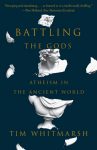
The title of a book review in Biblical Archaeology Review caught my eye, “Ancient atheism.” I read, “A common assumption is that atheism – a lack of belief in gods and the supernatural – is a recent phenomenon, brought on by the advent of science during the Enlightenment.” I ordered the book immediately: Battling the Gods: Atheism in the Ancient World by Tim Whitmarsh (Alfred A. Knopf, 2015).

Bumbling, staggering, veering and lurching: these are the words that come to mind when I think of my path towards a Jewish identity. As the product of a secular household, my only contact with Judaism was my brother’s bar mitzvah and a yearly Passover seder at a family friend’s home. I was born in 1939, the beginning of the Second World War, yet the word “Holocaust” was never mentioned during my childhood or adolescence. The topic of God was not broached. The exception to the rule was that my brother and I were sent for seven summers to a Jewish camp in the Adirondacks, in New York state. There, we became familiar with Friday night services, which included singing Jewish songs and a few prayers in Hebrew.

Fast forward to 1970, after 12 years of marriage, the birth of four sons and a sincere attempt at keeping a kosher home (it lasted three years), creating Passover seders and Chanukah parties and the decision to prepare our sons for bar mitzvahs, my husband and I divorced.

I enrolled immediately in courses at Concordia University. English and French literature introduced me to the Hebrew Bible and the New Testament. This led to a bachelor’s in French literature, which was followed by many courses in a master’s program called The History and Philosophy of Religion.

My search was on. I was determined to find out what religiosity and devotion to God entailed. I studied Judaism (modern and medieval), Jewish mysticism, Christianity, Buddhism and Hinduism. I wrote scholarly papers on these subjects. Later, I would take up the study of Modern Hebrew at McGill University. Upon moving to Vancouver, I studied Biblical Hebrew for three years and enrolled in the Judaic studies program at the University of British Columbia. Jewish law, Jewish ethics, Proto-Hebrew, I loved it all; but I was no closer to feeling comfortable during the High Holiday services at any synagogue.

I tried Conservative, Reform, Reconstructionist and Jewish Renewal congregations. I could not make that leap of faith required to pray to God. The secular humanist group had replaced Hebrew with Yiddish. I wanted my Hebrew! The result is that, every year, during Rosh Hashanah and Yom Kippur, I felt uneasy, out-of-step and different.

I continued studying Modern Hebrew. I became editor of Jewish Seniors Alliance’s magazine, Senior Line. Studying, writing, volunteering and participating in the Jewish community were rewarding and gratifying activities, yet I felt like a second-class Jew. Was there something wrong with me?

Then along came Battling the Gods: Atheism in the Ancient World. As the May/June 2017 Biblical Archaeology Review notes, “In clear prose, Whitmarsh explores the history of atheism from its beginnings in ancient Greece in the eighth century BCE through the fourth century CE, when Christianity was adopted as the state religion of the Roman Empire. Whitmarsh says up-front that he is not interested in proselytizing atheism – but rather in studying its first thousand years. He argues that the history of atheism is an issue of human rights because denying the history of a tradition helps to delegitimize it and paint it as ‘faddish.’”

In reading this book, I came to understand, as Stephen Greenblatt is quoted on the back cover as saying, that “atheism is as old as belief. Skepticism did not slowly emerge from a fog of piety and credulity. It was there, fully formed and spoiling for a fight, in the bracing, combative air of ancient Athens.” And I agree with Susan Jacoby’s comments – also cited on the back cover – that it “is a pure delight to be introduced to people who questioned the supernatural long before modern science provided physical evidence to support the greatest insights of human reason.”

I devoured Battling the Gods, relishing the research and the historical insights. Homer’s epic poems of human striving, journeying and passion were ancient Greece’s only “sacred texts,” but no ancient Greek thought twice about questioning or mocking his stories of the gods. Whitmarsh states that “this book thus represents a kind of archaeology of religious skepticism.…This loss of consciousness of that classical heritage [the long history of atheism] is what has allowed the ‘modernist mythology’ to take root. It is only through profound ignorance of classical tradition that anyone ever believed that 18th-century Europeans were the first to battle the gods.”

Whitmarsh writes, “The Christianization of the Roman Empire put an end to serious philosophical atheism for over a millennium. The word itself, indeed, acquired an additional meaning, which was wholly negative: rather than the rational critique of theism as a whole, it came to mean simply the absence of belief in the Christian god.”

With Whitmarsh’s sentence, “The conclusion seems inevitable that the violent ‘othering’ as atheists of those who hold different religious views was overwhelmingly a Judeo-Christian creation,” my self-respect was restored. I now understand that I come from a longstanding tradition of atheists. My beliefs have history and credulity behind them. I will continue to study Hebrew, write, volunteer and participate in the Jewish community. In accepting my skepticism, I join the minds and hearts of the ancient Greek and Roman skeptics and atheists who came before me.

Dolores Luber, a retired psychotherapist and psychology teacher, is editor of Jewish Seniors Alliance’s Senior Line magazine and website (jsalliance.org). She blogs for yossilinks.com and writes movie reviews for the Isaac Waldman Jewish Public Library website.

Format ImagePosted on September 8, 2017September 5, 2017Author Dolores LuberCategories BooksTags atheism, Battling the Gods, history, Judaism, religion, spirituality, Tim Whitmarsh

Express your opinion

The good news is we’re again debating “who is a Jew.” This is good news, of course, only because it’s a topic that divides Jews mostly when external threats abate enough to allow the luxury of pilpul around denominational rights and definitions.

We can only assume that the state of the world – the Iranian threat, the unhinged American administration, Syria in collapse – looks fine enough from the Israeli prime minister’s office that we have the freedom to indulge in family squabbles.

A year-and-a-half ago, the Israeli government finally agreed to create an egalitarian prayer space at the Western Wall. The Charedim who legally control Israel’s Jewish religious character, including practices at the Wall, have imposed a strict gender division on prayer and ritual at the holy site. This has sent the message to Conservative, Reform and other non-Orthodox Jews that the holy site is not wholly theirs and, by extension, that their forms of Judaism are not authentic or proper. The creation of an egalitarian section was hailed as putting an end to a painful and divisive aspect of Israeli-Diaspora relations.

An egalitarian space would permit families to visit the Kotel together, allow girls to read from the Torah during their bat mitzvahs and give women the right to pray out loud, rather than following the existing rules by which women must pray quietly so that their voices may not be heard by men on the other side of the divided plaza. The agreement for a new egalitarian space would not alter the existing men’s and women’s areas, but rather add a new, third space, south of the traditional prayer areas.

At the time the agreement was reached, Anat Hoffman, chair of the board of Women of the Wall, a group that has been at the fore in advancing the goal of an egalitarian space and whose members are routinely arrested for praying at the Kotel with prayer shawls, said the decision by Israel’s cabinet was an acknowledgment “that there is more than one way to be Jewish.”

Last week, the Netanyahu government changed its mind and decided there is not.

Bending to pressure from the ultra-Orthodox members of his coalition, the proverbial tail that so often wags the dog in Israel’s political system, Netanyahu called a snap vote on whether the decision taken in January 2016 to create the egalitarian space should indeed proceed. Ministers who last year voted in favour last week voted against.

In for a penny, in for a pound, the government at the same time advanced a bill that would reinstate the Orthodox monopoly on conversions and lifecycle events, including marriage and burials. Among the implications is that Jews not converted under the auspices of the Chief Rabbinate – in other words, by Conservative, Reform or other non-Orthodox rabbis – would not be recognized as Jews.

On most issues, Israel should take Diaspora concerns into consideration only secondarily to what is right for Israel. We have said in this space before, for instance, that Israeli defence policies should be determined with the security of Israelis as the priority, not the comfort of Diaspora Jews who have to live with the political consequences, but not the life-and-death consequences facing Israelis.

This is different. Rules regarding prayer at the Western Wall – who, where and how – should be made with the interests of the Jewish people – not just Israelis – foremost in mind. Of course, if the rules were made with the majority of Israelis in mind, they would reflect the diversity of religious observance both in Israel and in the Diaspora. Instead, what we have is a narrow reflection of ultra-Orthodox priorities that is more a result of political realities in the Knesset than religious reality anywhere outside that chamber.

Ultimately, these decisions are a result of political, not religious, considerations. The political needs of the Netanyahu government’s coalition appear to be superseding the Jewish state’s respect for diversity and pluralism within the global Jewish peoplehood.

“We believe in Jewish unity, not uniformity,” states a letter to Netanyahu signed by scores of Canadian rabbis. “The spectrum of Jewish practice is diverse, but it need not lead to divisiveness. Our differences are eclipsed by all that unites us: millennia of shared history and a shared future. What happens to Jews today – no matter where they live or where they attend synagogue – invariably affects us all.… We are an indivisible people, which is why we are deeply concerned by these and any other actions that unnecessarily foment division within amcha.”

Most of us do not have a vote in Israel, but each of us has a voice. The Centre for Israel and Jewish Affairs is urging each of us to contact the Israeli embassy to express our views on this vital matter. Please do.

Posted on July 7, 2017July 5, 2017Author The Editorial BoardCategories From the JITags Centre for Israel and Jewish Affairs, CIJA, Conservative, Diaspora, discrimination, equality, identity, Israel, Kotel, Netanyahu, non-Orthodox, Reform, religion, ultra-Orthodox, women
Jewish Buddhists in Halifax

Jewish Buddhists in Halifax

Isaac Greenberg grew up speaking Hebrew, and he was raised with Shambhala, as well. (photo by Alex Rose)

With his lean frame folded behind a small coffee table at Just Us Café in Halifax, with his large wire-frame glasses and thinning hair, Michael Chender looks somewhat like Larry David. But although Chender shares David’s sense of humour and perhaps some of his neuroticism, the soft-spoken and measured Chender embodies little else of the Curb Your Enthusiasm star’s notorious annoyance and impatience with other people. That is not a coincidence.

Chender is a Jewish Buddhist, or Jew-Bu, one of a number who call Halifax home. Most of the Jew-Bus in Halifax follow a tradition called Shambhala.

In Tibetan folklore, Shambhala is a mythical kingdom that represents a just and good society. It is also the inspiration for a worldwide movement, which has its headquarters in Halifax.

The movement was started by Tibetan Buddhist Chögyam Trungpa Rinpoche (Rinpoche is a Tibetan honorific). He escaped Chinese-occupied Tibet in 1959 at 19 years old, already a renowned sage. According to Chender, in Tibet, older teachers would come and ask the teenage Trungpa questions.

By the 1970s, Trungpa had settled in Boulder, Colo., where his Western following began to develop in earnest. He wanted to teach meditation in the West in a secular language. He taught that everyone was possessed with a fundamental goodness, and that life is worth living. A central philosophy of Shambhala is spiritual warriorship, which is accomplished by living a life of fearlessness, gentleness and intelligence.

Trungpa was known for both his incredible mind and for being an eccentric. He encouraged his followers to take pride in their heritage, so on Robbie Burns Day he would dress up in a kilt and celebrate with his Scottish disciples, and he would work Yiddish phrases like “oy vey” into his lectures. In 1986, Trungpa moved the headquarters of the Shambhala community to Halifax. In 1987, he died there of liver failure at the age of 48.

“He decided that Colorado was too speedy, materialistic, flashy, and that we should move to a simpler, more peaceful, calm place,” said David Greenberg, a former Jew-Bu and current Christian. He was raised outside Boston as an atheist Jew, and is conversant in Hebrew. He is the grandson of Rabbi Simon Greenberg, the founder of the University of Judaism at Los Angeles, a branch of the Jewish Theological Seminary of America.

When Greenberg was 17, he started reading Trungpa’s teachings, and joined the Shambhala community for the first time at 22. He met his wife through Shambhala and, together, they had four children. Eventually, the couple divorced and, in 2009, Greenberg converted to Christianity. Nonetheless, he said he felt more Jewish when he became a Buddhist, and even more Jewish now as a Christian; it’s allowed him to appreciate his Jewishness and not just take it for granted. For example, he said, he explains the Hebrew meanings of Bible verses to his fellow churchgoers.

photo - Michael Chender knows what he likes about Judaism and what he wants to take from it
Michael Chender knows what he likes about Judaism and what he wants to take from it. (photo by Alex Rose)

Chender feels similarly.

“I began to feel much more Jewish after I became a Buddhist,” said Chender. “My being Jewish … it’s deep in the bones, an ethnic thing. I’m very proud of my people.”

Chender calls himself an Upper West Side Manhattan product of the late 1960s – a Woody Allen-type kid who was high-strung and philosophical, the kind who was worried about the world ending millions of years in the future. For him, being Jewish meant viewing the world through Allen’s lens, not beneath a phylactery on his forehead. Religion was never a key component of his Jewish identity – he only knew one observant family growing up – but the culture and heritage always were. He is proud of the Jewish intellectual and moral tradition.

Chender knows what he likes about Judaism and what he wants to take from it. Not every Jew-Bu has such a concrete self-identity.

Isaac Greenberg is David Greenberg’s son, and a university student in Halifax. He grew up speaking Hebrew, and he was raised with Shambhala, as well. After his parents divorced, his mother moved him and his three siblings to Halifax. He was 11 at the time, and he lost his connection with Judaism for almost a decade. When his mother left Shambhala, when he was 17, he lost touch with that community, too.

“After first year of university, I kind of lost my mind … I just became totally untethered. I broke up with the person I was dating for a year-and-a-half, which set off this total spiral of insecurity and not figuring myself out. And then you just grasp the things that you know,” said Greenberg, noting that Judaism and Shambhala are his “foundations.”

Towards the end of his second year, he wanted to reconnect with Judaism. He was dating a Jewish woman, he said, “and she invited me to a seder and she was talking all about Judaism. And I was like, ‘Oh, I remember these things, and they were really great times.’”

Since then, he has been making a conscious effort to become more involved in the local Jewish scene. But he’s not entirely sure how.

“I kind of feel like an outsider,” he said.

As to why some Jews find their way to Buddhism, Chender said there are three common links between Judaism and Buddhism. The first one is appreciation for the critical mind, of inquiry and analysis. The second one is the importance of humour. The third is the truth of suffering.

“As my grandmother said to me when I was telling her about Buddhism, ‘You’ve gotta tell me this?’ We kind of know the truth of suffering in our bones,” said Chender. “So, it was like really coming home to some long-lost cousins who, actually, whatever they’ve been doing the last few thousand years, they had figured some sh*t out…. I wouldn’t go so far as to speculate where the lost tribes went or came from, but, you know.”

Alex Rose is a master’s student in journalism at the University of King’s College in Halifax. He graduated from the same school in 2016 with a double major in creative writing and religious studies, and loves all things basketball. He wrote this article as part of an internship with the Jewish Independent.

Format ImagePosted on June 30, 2017June 29, 2017Author Alex RoseCategories NationalTags Buddhism, David Greenberg, Halifax, Isaac Greenberg, Jew-Bu, Judaism, Michael Chender, religion, Shambhala
Interfaith efforts recognized

Interfaith efforts recognized

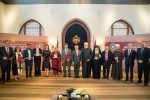
The winners of the 2017 King Abdullah II World Interfaith Harmony Week Prize with King Abdullah, centre, at Al Husseiniya Palace in Amman, Jordan. (photo from worldinterfaithharmonyweek.com)

On April 30, the leaders of the Calgary Interfaith Council were in Amman, Jordan, to receive the 2017 King Abdullah Award for World Interfaith Harmony’s first prize from the king himself.

The council’s co-chairs – Rabbi Shaul Osadchey of Beth Tzedec Congregation, Debra Faulk of the Unitarian Church of Calgary and Imam Fayaz Tilley, a chaplain at the University of Calgary and board member of the Muslim Council of Calgary – were invited to attend the ceremony at the Royal Hashemite Palace. They were presented with the award by King Abdullah II. It included a cheque for $25,000 US to put toward their continuing work in Calgary.

Osadchey described the experience as “memorable, momentous, impactful.”

“The Calgary Interfaith Council (CIC) was reconstituted in February as part of the launch of the United Nations World Interfaith Harmony Week program,” Osadchey told the Independent. “The CIC is now the amalgamated body of five or six other smaller interfaith organizations in Calgary. It was launched as the central voice of the interfaith community here, so we decided to première that with the United Nations World Interfaith Harmony Week.

“We organized a week of programs that highlighted interfaith cooperation and strength of the community. We did a program that began with an opening ceremony at city hall. The mayor had issued a proclamation for the city that designated the week of Feb. 1st to the 7th as UN World Interfaith Harmony Week in Calgary, and he personally came and spoke.”

They had 15 different religious communities involved in the festivities, which included interfaith breakfasts, a weekend open house, and people were welcomed into various congregations for workshops and tours. There were also two “build days,” where participants volunteered to build a house with Habitat for Humanity.

“We raised $15,000 for the Habitat project,” said Osadchey. “It was a program with depth.”

The Calgary Interfaith Council submitted what they did to the website that oversees the worldwide program of activities, said Osadchey. “There were over 1,000 events worldwide and we were selected as the outstanding program for 2017 and won first prize, the gold medal. What that meant was that they asked us to send three representatives to receive the award in Jordan, along with the second- and third-place winners – the second-place winners were from Bosnia and the third-place winners were from London, England. We were flown to Jordan and spent three days there.”

According to the prize’s press release, the International Forum Bosnia’s Centre for Interfaith Dialogue was honoured “for their efforts toward dialogue and cooperation among ethnic and religious groups in Bosnia and Herzegovina” and the London-based nonprofit PL84U Al Suffa for “providing meals and services to the homeless, elderly and others in need in an atmosphere of interfaith respect and cooperation.”

At the Sunday morning awards ceremony, both King Abdullah II and Prince Ghazi ibn Muhammad were in attendance, with the latter giving a talk. Osadchey was asked to give a three-minute speech on behalf of the winning delegation.

Osadchey was the first Jew and rabbi to be part of one of the award ceremonies. “They were very respectful, very interested and engaged in the conversation about Judaism and about the Jewish experience in the interfaith arena,” he said. “Both the king and the prince were pleased to have me as a delegate and acknowledged that the interfaith dimension of the program had taken a significant expansion by having Jews included.

“I was looking forward to being able to convey some comments to the king. I began by reciting the brachah [blessing] that is said when you’re in the presence of the king or head of state. I recited it to the king in Hebrew and then translated it into English. And my comments were about how religious literacy is a necessary component for creating interfaith harmony.

“I suggested to the king that the World Interfaith Harmony Initiative develop a youth component that would focus on religious literacy among the youth of the world. And, when I received the medal from him and we had a few moments to exchange some words, he asked me to follow up on that proposal, as did the prince.”

Osadchey said he is in the process of writing a proposal to create this youth component, and added that he is looking forward to running a youth interfaith harmony week in Calgary. He hopes that others will use his model and do likewise in their communities.

“I think it’s important that not only adult leaders engage in creating relationships, but that we begin developing those among the next generation,” he said. “If we can do that, then the road to true harmony will be a lot easier to create.”

Since the world interfaith award was created in 2010, said Osadchey, there have been two other Canadian cities that have won awards – Toronto and Halifax, both achieving third place in their respective years.

The Calgary Interfaith Council is hoping to inspire a national designation of Feb. 1-7 as World Interfaith Harmony Week across the country and to bring other Canadian cities and communities into the picture. They are starting with their home province, encouraging their leaders to issue a proclamation designating it throughout Alberta. “We’re pretty close to getting that done,” said Osadchey. “Then, we’ve got an MP that’s working in Ottawa to do the same.”

Osadchey returned from Jordan full of hope and was impressed by the respect, interest and welcoming response of the Jordanian people he encountered. Nonetheless, he thought that, while interfaith activity might take place among the upper echelons of Jordanian society, he suspected that the general population is likely not as open or accepting. “That would have to do with probably lower levels of literacy, education, just in general,” he said.

He added, “The fact that their neighbour is Israel – and even though they have a fairly good relationship with Israel – it is still tinged with the Palestinian issue as well. I don’t think the ‘man on the street’ really cares about interfaith relationships in Jordan, but the leadership and the king certainly are trying to push the country more toward an acceptance of that.”

In Jordan, dialogue is mainly with the Christian world and does not seem to have any links with the Jewish world, but Osadchey is hopeful it may happen as a consequence of his visit.

“We’ll see how that takes place, but they’re reaching out,” he said. “The fact that the king of Jordan is the one responsible for this initiative…. They are trying to project a different image internationally.

“It’s really been very positive…. It’s had a positive effect on the Calgary community, both Jewish and non-Jewish, seeing this as a great recognition of our efforts in the interfaith community. It’s garnered a lot of recognition locally and spurred people to get more involved in our program, so that’s been a really positive benefit.”

For more information and to see more photos from the ceremony in Jordan, visit worldinterfaithharmonyweek.com/2017-prize-awarding-ceremony.

Rebeca Kuropatwa is a Winnipeg freelance writer.

Format ImagePosted on June 9, 2017June 7, 2017Author Rebeca KuropatwaCategories WorldTags Calgary, interfaith, Jordan, King Abdullah, religion, Shaul Osadchey, tikkun olam
Hand for Hand to God

Hand for Hand to God

Oliver Castillo plays both the human, Jason, and the puppet, Tyrone. (photo by David Cooper)

Supplementary education programs, or “afternoon schools,” as they’re commonly referred to, instil teens with an understanding of their Jewish heritage, including Hebrew language teaching, Judaic curricula, social activities and an opportunity to connect meaningfully with other Jewish teens. While Hand to God does not take place in a Jewish-oriented environment (in fact, it’s in the basement of a church), it still addresses the common issues of how to teach teens the value of their religion and heritage – and it does so hilariously.

Teacher Margery (the wonderful Jennifer Lines) tries to get three students – Jason, Timothy and Jessica – to pull together a hand-puppet show based on stories of the Hebrew Bible. The play starts with the youths creating their puppets and, at first, all things appear normal, but the disruptive bunch has other ideas.

The brash Timothy has little interest in the puppets but attends the classes because he has a crush on Margery (and is not shy about expressing his feelings) and Jessica seems relatively engaged with the concept. The timid and introverted Jason, Margery’s son, not only embraces the use of puppets but creates a second persona – Tyrone – within his doll.

Margery’s husband has recently died and Jason uses Tyrone to express the feelings of anger and abandonment he has toward his mother. While this dual identity seems rather innocuous at first – and Margery even pleads with Jason to support her in the puppet idea – it gets out of hand. Tyrone’s personality begins to overwhelm that of Jason’s until the unruly mannequin takes over entirely. At times, Jason’s extroverted alter ego is a benefit, helping him convey his attraction to Jessica. At other times, it becomes a raving maniac capable of serious destruction.

As the children deal with their own issues, Margery is dealing with hers. Devastated by the loss of her husband, she feels rudderless and alone. She hopes to find some fulfilment and pleasure in her work with the teens, but that disintegrates quickly as Timothy’s advances and Jason’s/Tyrone’s shenanigans descend into chaos and violence.

Meanwhile, the minister also has feelings for Margery, which puts her in an awkward position, feeling manipulated and lacking support from the one person she feels should be understanding.

Lines gives a credible performance as the confused Margery; and Oliver Castillo is amazing as he carries out the simultaneous roles of Jason and Tyrone.

The play is somewhat autobiographical in that playwright Robert Askins lived in a small town of conservative and religious family values. His mother actually did have an after-school puppet theatre in which Askins participated until his mid-teens, when his father died, after which he turned his back on his faith and became cynical about all things religious.

Though the production will have you laughing from the start, it tackles serious issues, such as the loss of loved ones, the loss of faith, feelings of betrayal and resentment, love and forgiveness. The subject matter will have you wondering how you might deal with similar situations, such as how far do you let a child go in creating a second personality? Is it harmful or helpful, and how do you know when to draw the line?

Hand to God runs at BMO Theatre Centre until June 25. Visit artsclub.com for tickets and showtimes. Warning: there is serious offensive language.

Baila Lazarus is a Vancouver-based freelance writer and photographer. She teaches businesses how to get coverage in mainstream media. More information can be found at phase2coaching.com.

Format ImagePosted on June 9, 2017June 7, 2017Author Baila LazarusCategories Performing ArtsTags religion, theatre

Posts pagination

Previous page Page 1 Page 2 Page 3 Page 4 Next page
Proudly powered by WordPress