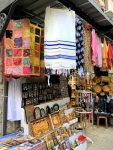
Knowing that, in any one day, hundreds of visitors will pass their shops, usually on the way to the Kotel (Western Wall), shopkeepers in Jerusalem’s Old City stock as many items as possible to appeal to all religions. Prayer shawls, rugs, crosses and ritual items of every size and description are available, as are religious paintings and carvings, key holders and the like. (photo from Ashernet)
Tag: religion
End-time visions
Are we living in the “end times”? Many would agree that, some days, it feels like it. Vancouver School of Theology’s Inter-Religious Studies program will host an apocalyptically themed conference this month called Visions of the End Times. Presenters will invite attendees to explore their fears and hopes for the future.
As part of the conference, which runs May 23-25, the keynote speaker, psychologist Dr. Lionel Corbett, will give a free public lecture. In the May 23 talk, Corbett will discuss the psychology of apocalyptic thinking and religious violence.
On the mornings of May 24 and 25, more than a dozen regional scholars will speak about concepts of the “end times” found in sacred texts, film, popular music and contemporary culture. Afternoon activities will include a multifaith panel of local religious leaders and a creative writing workshop.
The conference had its genesis about three months before the U.S. election in a conversation between Rabbi Laura Duhan Kaplan, the director of Inter-Religious Studies at VST, and Harry Maier, professor of New Testament and early Christianity studies. The two professors contemplated why zombies are such a popular motif in contemporary culture. Are they a metaphor for soul-less humanity, for consumer culture consuming itself or a political world that has no awareness or conscience? This led to a discussion of the possibility of an academic conference on zombies in popular culture.
“Then,” Duhan Kaplan explained to the Jewish Independent, “we remembered we’re faculty at a theology school, and that zombies sort of appear in the Bible, in Ezekiel’s prophecy about the resurrection of the dead. So, we broadened the topic to Visions of the End Times and made the conference a VST project.”
Duhan Kaplan said she expects the conference will yield lively discussion. “My prediction for the thread that runs through the conference [is that] we will debate whether the world is getting worse or better, or heading in any direction at all.”
She said speakers will address topics such as extremism and religious violence, visions of the end times articulated by religious traditions, the meaning of end-times themes in music and film, the nature of utopian thinking, and a deeper look at end-times teachings in Jewish, Christian and Muslim scriptures. There will also be an open mic Tuesday evening featuring music and poetry of the end times, which Kaplan hopes will be “whimsical and fun.”
“I do believe that eschatological concepts [ideas resulting from the study of the end times] are helpful metaphors,” she said. “They place even terrible events into a hopeful vision. When something bad happens, they say, ‘Don’t worry, it’s just a blip on the way to a good end.’ For example, when something bad happens, many Jews say, ‘These are the footsteps of Mashiach.’ Personally, I take great comfort in Isaiah’s vision that ‘the lion will lie down with the lamb.’
“I don’t think human beings will ever make a [peace] treaty that holds indefinitely,” she continued. “But, while peace holds, people do experience a bit of ‘the World to Come,’ as we sometimes call the end times in Jewish thought.”
Corbett’s public talk is at 7 p.m. on May 23 at Chapel of the Epiphany on the University of British Columbia campus. For more information, visit vst.edu/event/vision-of-the-end-times-an-inter-religious-conference.
Matthew Gindin is a freelance journalist, writer and lecturer. He writes regularly for the Forward and All That Is Interesting, and has been published in Religion Dispatches, Situate Magazine, Tikkun and elsewhere. He can be found on Medium and Twitter.
Blessings of love, religion
Once a month, my husband (a secular humanist Jew) and I (Roman Catholic) join the Fraytik tsu Nakht at the Peretz Centre for Secular Jewish Culture. At the Friday night secular humanist Shabbat celebration, we sing songs, light candles, eat challah bread, and sing in Yiddish and Hebrew. But what I am also learning is the humanistic approach to Jewish cultural heritage.
At the celebrations, they give a great deal of importance, as it says in the text that we read, “to human dignity and the human power to make a better world … and gratitude for the wonders of the world.” Being from a Latin American country, I do not know Yiddish or Hebrew, but I have memorized the lyrics to songs like “Daylanu Shalom” and “Hineh Ma Tov,” so I can sing along with the other people.
When I married Carl, I enjoyed imagining that I was married to a relative of Jesus Christ, since I am practising Catholicism and Jesus is Jewish. We found out that we have more things in common than we imagined. We really enjoy seeing all the similarities and sharing them. For instance, I go with Carl to his Jewish events, where we light candles “to reflect on our own light and the light of others, we praise the healers, the builders and the dreamers. We celebrate the peacemakers, those who teach, who nurture, who love, who share, and those who create for humanity.” At the same time, I have an altar in our room, where I spend time praying the rosary, lighting candles and meditating. Carl comes with me on Sunday to listen to Mass, and is curious for something new, like listening to Mass in Latin, hearing the sermon or just listening to the beautiful music from the pipe organ at Holy Rosary Cathedral, where I belong. Our relationship is based on respect and acceptance, so we can both learn from each other without judgment. Together, we discover that hope is bright and love fills our hearts.
This past year, like every year, we received a phone call from one of Carl’s friends inviting us to his home to celebrate Passover. For me, this means learning more about his culture and imagining how was the Last Supper that Jesus had with his disciples. I love the prayers, the singing and being with good friends who accept me and welcome me, even knowing that I am Catholic, but, above all, I enjoy it because I’m taking part with my husband, who I love.
Carl and I married in a civil ceremony, a Jewish ceremony and in the Catholic Church. We learned that celebrating our differences has made us closer and that religion, far from being a barrier, is a blessing from our Higher Power, however we understand It.
Delta Vazquez Leon has worked part time for Holy Rosary Cathedral for almost four years as an administrative assistant-receptionist. Her mother tongue is Spanish, and she helps Spanish-speaking parishioners in their needs. Some Sundays she assists in the distribution of Holy Communion, and participates in any way she can in Cathedral activities. In her spare time, she likes to write, draw and paint.
Mixing of cultures, religions
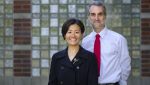
Helen Kim and Noah Leavitt, authors of JewAsian, will be at the Jewish Book Festival on Nov. 28. (photo by Matthew Zimmerman Banderas)
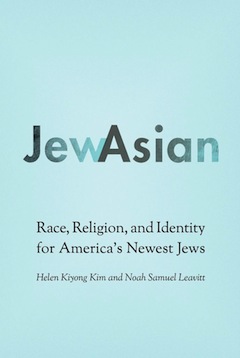
The recently published book JewAsian: Race, Religion and Identity for America’s Newest Jews by Helen Kim and Noah Leavitt was crafted out of a seven-year study of 39 mixed couples, as well as their own successful marriage. The couple will be in Vancouver later this month to share their findings at the Cherie Smith JCC Jewish Book Festival.
For Kim, who was born a few years after her parents moved from Korea to the San Francisco Bay Area in the late 1960s, finding a Korean guy to date was a virtual mission impossible, so looking outside the community was accepted.
“My mother was totally fine with it, in large part because she’d thrown away her expectations that I marry somebody Korean a long, long time ago,” said Kim of her marriage with Leavitt. “I think, in part, because I grew up in a community that was predominantly white with very few people of color, I think she quickly realized that, demographically speaking, it was probably going to be unlikely I’d meet, date and eventually marry someone of the same ethnic background as me.”
Leavitt, who is of American Jewish origin, said, “My mom was super-excited about the fact I had met somebody I was so smitten with. She and Helen, early on, established a great rapport that has continued ever since. I think my mom just had an expectation that I’d settle down with somebody I really loved, who I was challenged and inspired by, and saw that in Helen … so she was excited.”
Leavitt grew up in a household that was somewhere between the Reform and Conservative denominations. He went to a Jewish community Sunday school growing up that was housed at Cornell University and he had his bar mitzvah at Ithaca College through their Hillel.
Kim and Leavitt met in 1997 and both were drawn to the complexity of their Jewish-Asian mix, an interest that increased with the births of their children.
“This was the era where, I think, we started to see a lot of interracial pairings, dating and marriages,” said Kim. “And it was also right before the U.S. census gave multiracial individuals the option of choosing more than one race on the census … really, an interesting time, demographically speaking, where the context around us was contributing to our thinking about how common are pairings like ours and maybe other interracial or Jewish-not Jewish pairings.”
Leavitt and Kim contacted a number of universities that were repositories of large-scale demographic studies. They were aware that the study of intermarriage to that time had been focused on interfaith marriage, but had not delved into how interracial marriage factored into the larger picture.
The couple reached out to the Institute for Jewish and Community Research. Through this connection, they were able to do an initial recruiting of couples with whom to speak for their book. In the end, their study included 39 couples from the San Francisco Bay Area, Los Angeles and Orange County, and from the New York and Philadelphia metropolitan areas.
“We focused there, in part, because of the high percentages of individuals who identified as Jewish and Asian,” said Kim. “Then, there was the likelihood and demographic reality that interracial marriages are taking place predominantly in those areas … with the West Coast having, by far, the highest rates of interracial marriages.”
“We had a lot of people volunteer to be part of the survey and what we made a decision to do was to try to find the most expansive look at Jewish-Asian combination that we could,” said Leavitt.
Within the 39 couples, one was gay and three were lesbian, with the remainder being heterosexual. The study also included a second set of interviewees who were young adults that were children of Jewish-Asian households.
“The first thing by far that I think was quite surprising that we found was that, for the couples as well as the adult kids, they are definitely Jewish – not just in terms of the self-identification perspective, but in terms of some strikingly traditional religious practices,” said Kim. “So, the couples we interviewed were in the midst of or had created homes where there was a lot of traditional Jewish religious practice – everything from observing Shabbat consistently, to consistent synagogue attendance, to kids becoming bar or bat mitzvah, to children going to Jewish day schools.
“Then, for the adult kids we interviewed, they affirmatively claimed they were Jewish. But, they also talked about having been raised in traditionally religious households and communities that, to a great extent, mirrored what we were finding with the couples we interviewed.”
While only six of the racially Asian individuals had converted to Judaism, the overwhelming majority of couples celebrated Jewish religious events and cultural tradition alongside Asian ethnic traditions.
“There was neither a conflict of religion nor a blending of religions,” said Kim. “It was more of a cultural hybrid, but steeped in Judaism as the religion of the household.”
“I would go broader and say that, for the most part … we didn’t really hear too many stories about conflicts related to religion overall,” added Leavitt. “There were a few examples where the non-Jewish partner had a religious or spiritual practice that they adhered to, but it was something they did on their own and didn’t bring into the household.”
Both Kim and Leavitt said the findings were representative of their own Jewish-Asian mix. “Judaism, for me, is a religion and a cultural tradition that is easier for me to instil in my family,” said Kim. “I, as a second-generation child of an immigrant family, did not grow up with a lot of Korean ethnic and cultural traditions.
“Through the adult kids [in the study], it was reinforced repeatedly that you have to expose [them to the culture], no matter what your comfort level as a parent, no matter your knowledge as a parent. The kids really appreciated when the parents went all out in terms of trying to expose them to a particular culture or ethnicity, though they themselves as parents were afraid they might not do it right.
“So, I think just hearing from the kids and imagining my own kids in 10 to 15 years was kind of affirming to me, [that I just need to] try as much as I possibly can. The kids will end up picking up things here and there and will then, on their own, become curious and want to learn on their own. That was reassuring for me.”
“I had a lot of the same reactions,” said Leavitt. “For me, when Helen and I decided to make a commitment to this project, it was fairly close in time to when we were also starting to think about having our own family. When we got this investigation underway, our son Ari arrived. As a first-time parent, I had a lot of worry and anxiety about a household that seemed to combine so many different kinds of traditions, cultural heritage markers and, to some extent, religious differences. I think I had a lot of worry about the ability of all those things to be in a household together … in part, because I didn’t have an upbringing where there were lots of differences within the household. So, I had a lot of fear about that.
“One of the things I’ve been liberated by, in working on this project and having two children arrive, is there is a lot of flexibility and resilience in households. Where even something may seem like a long list of differences, the people inside that household are able to find ways where things can come from different directions, but meet at the same point.”
Kim is excited about coming to Vancouver, especially to have the opportunity to speak with a non-American audience, “to understand how it is that they think about these different dimensions of identity, tradition, culture and religion, as a way of getting out of our predominantly U.S.-focused lens. I’m really looking forward to that comparative perspective.”
Leavitt said, “I think the chance to be in as diverse, global and multicultural a city as Vancouver … maybe there are lots of households coming together with this mix of Jewish-Asian backgrounds in Vancouver. I think this may propel us to continue researching more in this international comparative way.
“Helen and I feel very fortunate to have been working on this project at a time in the U.S. when the exploration about the diversity of the Jewish community in our country is really something that is front of mind for so many congregations, synagogues. We aren’t the same people we were years ago.”
“If we are acknowledging that this is what American Judaism looks like,” added Kim, “what then is the responsibility we have in regards to action based on the changes in the demographic and how do we act based on how we’ve changed?”
Kim and Leavitt are on a panel with Daniel Kalla on Nov. 28, 6 p.m., at the Jewish Community Centre of Greater Vancouver. For more information, visit jccgv.com/content/jewish-book-fest.
Rebeca Kuropatwa is a Winnipeg freelance writer.

Soul-opening retreat experience
Let me start by saying that I grew up a secular Jew. As I’ve gotten older, my desire for more Yiddishkeit has increased tenfold. Long story short, I went from being a “High Holidays-only Jew” to someone who lights candles every Friday night, attends shul every Shabbos and goes to Torah classes regularly.
My latest quest to embrace Judaism took the form of the 2016 National Jewish Retreat. Sponsored by the Rohr Jewish Learning Institute and Chabad, this six-day retreat took place in Palm Desert, Calif. More than 1,400 Jews from all over North America settled in to the enormously lavish JW Marriott for Jewish learning and fun.
I’m stopping here because I know that when I got to Chabad, many of you shut down and/or entertained a plethora of preconceived notions and stereotypes: black hats, long coats, lots of rocking and davening, strict Shabbos rules. Think again.
Even I was skeptical, wondering whether I’d be judged for my “immodest” clothing, my limited Jewish observance and my lack of Torah knowledge. But, no sooner did I get there, than a variety of religious and not-so-religious folks introduced themselves and welcomed me warmly. From that point on, I was hooked.
The programs comprised 150 lectures and 75 speakers. Keep in mind the retreat was only six days long, so I had to choose my topics wisely. All told, I attended 29 lectures. And I even had time to go the washroom once or twice. From 9 a.m. till late into the night, I had the honor of learning from world-renowned speakers, listening to radio talk-show host Dennis Prager, attending a Dudu Fisher concert, viewing the stunning art of Barbara Hines, and enjoying Jewish comedian Robert Cait.
The main event, the retreat sessions, covered a wide spectrum of topics including practical lessons from the Tanya; discovering purpose and mission in life; Jewish medical ethics; the pursuit of happiness and gratitude; the relevance of G-d in 2016; handling personal struggles, pain and suffering; a challah bake; a talk about why bad things happen to good people; Jewish law; living with faith; the legacy of the Lubavitcher Rebbe; Israel’s inclusive army; the miracle at Entebbe; wine tasting; the historical relationship between Jews and Muslims; antisemitism; how to pray with passion and purpose; the future of Israel and Zionism; Jewish history and mystical prophesies; the feminist challenge of 2017; a farbrengen for women; and leadership. And that’s just the tip of the iceberg.
Focusing on the personal more than the political, historical or global, the sessions I attended were nothing short of awe-inspiring. Never having experienced intense spiritual Jewish learning like this, I was a human sponge. It sparked something visceral in me and my emotions ran wild. (Read: I’m emotionally incontinent and my tears overflowed early and often.)
My favorite sessions included a class on the Tanya, which is an early work of Chassidic philosophy and a “one size fits all” life manual. It’s basically the “GPS for life” and encourages us all to live with purpose and meaning.
I also attended a couple of sessions on the Rebbe and the secret of Chabad. While some people consider Chabad a radical sect of Judaism, it has actually become the mainstream, because of the Rebbe’s focus on outreach to Jews around the world. He considered outreach the key to continuing Yiddishkeit. The Rebbe was without doubt the most influential rabbi in modern history. A revolutionary figure and an inspiration, he created an “army” of shluchim (emissaries), who set up Chabad houses around the world to inspire Jews in Jewish traditions and education. As a result, Chabad is considered a “vanguard of change” and leaders in the community.
A session called The Pursuit of Happiness reinforced the idea that happiness and blessings are directly correlated. And, since happiness is a choice, we should direct our emotions towards positive things. In essence, we’re really products of our choices, not our circumstances.
Pain and Suffering was a session about transforming pain into growth. The speaker made a poignant observation about grief having “energy.” He posited that, when a person can harness that energy, they can change the world. He also pointed out, from studies, that people with faith have more resilience and strength. In his words: “You don’t know the power of faith until you have nothing left but faith.”
There were lots of social events at the retreat, too. I got particularly emotional during the challah bake, while lighting Shabbat candles with 600 other women, and singing and dancing after Havdalah with more than 1,400 Jews from my new Jewish “family.”
And then there was the gourmet kosher food. When I heard about the 24/7 tea room, I expected a small room with maybe some Danish and coffee, then I saw the football-field-length foyer with fruit, candy, chips, cookies, sandwiches and various beverages. That was during the weekdays. On Saturday night, at around 11 p.m., I experienced my first melaveh malkah meal: a lavish buffet that symbolically escorts the departing Shabbat queen. Imagine vegetarian burger sliders, innumerable cheesecakes, pastries, a crepe station, a pasta station, lox and bagels, an ice cream station, and more. At midnight, I thought to myself, “Do I keep eating or do I sleep?”
I came back bubbling with enthusiasm, anxious to tell my husband Harvey all about it. When the descriptions and tears of joy were done, he said: “So, I guess you drank the chicken soup.” You bet I did. And boy was I thirsty!
A huge thank you goes to Rabbi Yechiel Baitelman of Chabad of Richmond for encouraging me to attend the retreat. I could never have imagined how it would alter how I think and feel about being Jewish. Truly, it was a soul-opening experience.
Every single day was a blessing of inspiration and spiritual holiness for me. Sharing my stories from the National Jewish Retreat is my way of sharing the blessings. I only hope that you get to experience it for yourself one day.
Shelley Civkin recently retired as librarian and communications officer at Richmond Public Library. For 17 years, she wrote a weekly book review column for the Richmond Review, and currently writes a bi-weekly column about retirement for the Richmond News. She’s also busy exploring her Yiddishkeit.
Should God be put second?
For Donniel Hartman, putting God second is a way of maintaining a religious life and faith in God, but without God undermining our responsibility to our fellow human beings. (photo from Donniel Hartman)
Donniel Hartman, an Orthodox rabbi and president of Jerusalem’s Shalom Hartman Institute, an educational powerhouse dedicated to invigorating Judaism, has recently published his second book. It is called Putting God Second: How to Save Religion from Itself (Beacon Press, 2016).
“Religious people very often argue that religion is fine and that the only problem is that religious people are flawed and are distorting our religious life,” Hartman told the Independent. “Yet, the people who harm, maim and hurt in the name of religion come armed with chapter and verse. They seem to be quite accurate about their religious life. And atheists make similar arguments. The only problem with atheists is they seem to get something wrong as well; they argue that there’s nothing valuable in religion.”
Hartman thinks there is something missing in this discourse, which he explores in this book: queries like, what about religion can be powerful, profound and constructive, and might the issue simply be that people are getting it wrong?
“The idea that I was testing for 10 years – that was researched, taught about and thought about – was that religion suffers from an internal autoimmune disease wherein it attacks its own goals,” said Hartman.
“Religion has noble goals,” he contends, and is not only a source for evil, as some atheists say. “I think religion is, in fact, trying to produce kind individuals. There’s something inherent within the system, which can cause it to underachieve and fail to meet its aspiration. In short, the cause of that autoimmune disease is God – in particular, when God is put first.
“The idea is that monotheism creates a being of such transcendence and scope that when God enters the room, it shifts the human consciousness away from their moral responsibility for other people.”
For Hartman, putting God second is a way of maintaining a religious life and faith in God, but without God undermining our responsibility to our fellow human beings.
“This one transcendent God is something that I feel human beings have great difficulty assimilating into their system, into their lives, and that God has a potential to warp our consciousness,” said Hartman. “I call it ‘God intoxication,’ wherein everything else becomes unimportant.
“It’s the encounter with God that can create this distortion. Who is more important, a human being or God? Human beings will again distort that message because, when it gets instilled into their minds, what can possibly be more important?
“We see religious people, in the name of faith, harming, judging and insulting people, showing a lack of tolerance, pluralism – the same people who could, in their everyday lives, act decently, kindly. The minute religion is in the equation, there’s potential for it to get distorted,” he said.
“God intoxication is not a flaw within religion, it’s embedded in the idea of monotheism. Some people argue we should get rid of God. My book tries to reestablish a life of faith. It doesn’t say to get rid of God or to put God 14th or 15th. At the end of the book is when you put God second, but you put God’s will first toward developing a religious life with God that immunizes us from this autoimmune disease.
“One of the essential concepts in the book,” he continued, “is how you treat other human beings – this being the core of how we assess the value of our lives. I think there is a very profound spreading of faithlessness precisely because of the consequences of what God seems to bring to humankind. My goal in putting God second is to help more people establish a deeper relationship with God, one with a God they can respect…. If God needs to be first, people feel it’s a God they don’t want to believe in. I believe that the language of putting God second is what will enable a language of faith to be far more pervasive within our modern community and the modern world.”
Hartman hopes that Putting God Second will reach a diverse readership. “The target audience,” he said, “is thoughtful people searching for a decent world and a meaningful religious life, and I hope this book will be conducive to moving us in the right direction. Most importantly, I like to help people and, if this book is too upsetting for you, just put this book second, it’s not meant for you…. I hope there’s a broad range of people that, through this book and this religious language, can try connecting with it, both with God and with their tradition.”
Hartman, who was born in the United States and spent 11 years in Montreal, is currently working on a Hebrew translation of the book.
Rebeca Kuropatwa is a Winnipeg freelance writer.

Affirming transgender rights
Citing both changing social practice and traditional Jewish values, the international association of Conservative rabbis passed a resolution on May 22 calling on Jewish institutions and government agencies to embrace the full equality of transgendered people.
The Rabbinical Assembly’s Resolution Affirming the Rights of Transgender and Gender Non-Conforming People begins, “Whereas our Torah asserts that all humanity is created b’tzelem Elohim, in God’s divine image….” It discusses historical evidence of “non-binary gender expression” in Jewish texts dating back to the third-century Mishnah. It calls on synagogues, camps, schools and other institutions affiliated with the Conservative movement to meet the needs of transgender people and to use the names and pronouns that people prefer. It also encourages Conservative institutions to advocate for national and local policies on behalf of transgender people. In light of its passing, the Jewish Independent spoke with several local rabbis from across denominations about the resolution and about transgender inclusivity in their communities.
“The statement feels comprehensive and as positive and embracing as it should be,” said Rabbi Hannah Dresner of Or Shalom, which is part of the Jewish Renewal movement. “We need always to try to get to the heart of what the halachah (Jewish law) and the mitzvot are trying to do for us. The way they were concretized in another century does not limit them for all time. Halachah is a process. I think it is beautiful when any part of the community pulls up a chair at table and says we are participating in the ongoing evolution of halachah. This is at the heart of what it means to continually create Torah, to turn Torah over and over, to continually participate in the exchange between the Holy One and human beings, which is God giving the written Torah and our response by taking it in and answering in the voice of our humanness. This is at the heart of what the halachic process is and should be in any sphere.”
LGBTQ people are fully welcomed at Or Shalom, and people are called to the Torah by their preferred gender identification. Or Shalom is currently working on infrastructural and ritual changes to be more explicitly and fully inclusive of LGBTQ people in all spheres. “There are alternatives that are easy and sweet,” said Dresner. “We just have to do our work.”
When asked what he thought of the Conservative resolution, Rabbi Dan Moscovitz of Temple Sholom, a Reform congregation, replied with typical humor: “Great, welcome to the party.” He said he views the resolution as a return to the deep values of the tradition, not a departure. “This is at the core of who we are commanded to be as human beings – to find the tzelem Elohim (image of God) inside of each individual and to not be confused or distracted by outside appearances, generalizations or labels,” he said.
The resolution is largely the same as that passed by the Reform movement in November 2015. As early as 1965, the Women of Reform Judaism called for the decriminalization of homosexuality. In 1977, Reform’s Central Conference of American Rabbis adopted a resolution calling for legislation decriminalizing homosexual acts between consenting adults, and an end to discrimination against gays and lesbians. In the late 1980s, the primary seminary of the Reform movement, Hebrew Union College-Jewish Institute of Religion, changed its admission requirements to allow openly gay and lesbian people to join the student body. In 1990, gay and lesbian rabbis were officially affirmed and, in 1996, so were same-sex civil unions. In 2000, a resolution followed fully affirming sanctified Jewish unions for same-sex couples and, in 2003, there was a resolution affirming the full acceptance of trans- and bisexual people, a stance confirmed and elaborated in the 2015 resolution.
“We have trans members, both adults and children, who we embrace and welcome fully,” said Moscovitz. “We call up to the Torah by preferred gender and gender-neutral pronouns which are present on our gabai [person who calls people to the Torah] sheet…. All bathrooms are multi-gendered or non-gendered.”
Moskovitz cited the case of a bar mitzvah boy who now identifies as a female and was offered a mikvah ritual as a transitional symbol, as well as a new Hebrew name and the reissue of the bar mitzvah certificate as a bat mitzvah.
The Conservative movement has been slower to change its position on LGBTQ sexuality than the Reform. In 1990, the Rabbinical Assembly’s Committee on Jewish Law and Standards (CJLS), which sets halachic policy for the movement, stated their desire to “work for full and equal civil rights for gays and lesbians in our national life.” Nevertheless, the CJLS maintained a ban on homosexual conduct, the ordination of homosexuals as rabbis and same-sex marriage unions until 2006, when LGBTQ people were first admitted for rabbinical ordination; in 2012, the Israeli Masorti (Conservative) movement followed suit. In 2012, the CJLS allowed same-sex marriages, with the U.K. Masorti movement following in 2014. The 2016 resolution is a milestone for the Conservative movement.
Rabbi Jonathan Infeld of Congregation Beth Israel, which is part of the Conservative movement, applauds the new document. “Kevod ha’ briyot [the dignity of all created beings, cited in the CJLS resolution] is very important…. For me, the over-arching concept of respecting all human beings and making them feel welcome, bringing them into the Jewish community is vitally important and is the keystone of the resolution.”
Infeld said the resolution is an expression of foundational Jewish values. “It is critically important to recognize the humanity and holiness of every person and that’s the essence of the resolution,” he said.
Beth Israel has private, non-gender-specific washrooms available, and calls to the Torah for an aliyah are done on the basis of the gender with which the person identifies, he noted. “We don’t loudly announce our stance so much as we are very happy to have trans and gay people in our synagogue as a natural part of the social fabric of our shul, by being warm and welcoming to everyone who walks in the door,” he said.
Speaking to the JI only days after the mass shooting at the Pulse nightclub, Infeld said, “The Orlando massacre is another reminder of the need to fight discrimination on every level and recognize the humanity of every person.”
Unlike non-Orthodox denominations, Orthodox Jews maintain traditional rabbinic stances against homosexual conduct, and behaviors such as cross-dressing or identifying with a gender aside from one’s birth gender. Nevertheless, there are a number of Orthodox rabbis and Jewish groups that are openly LGBTQ and/or call for greater inclusivity in Orthodox communities. And, in recent years, a number of Orthodox statements have been issued – mostly from within the Modern Orthodox world but also from others – calling for the expression of love, support and inclusion of LGBTQ people without condoning LGBTQ behaviors.
“We do not judge anyone here,” said Chabad Rabbi Shmulik Yeshayahu of Ohel Ya’akov Community Kollel. “We love and welcome everyone. We follow the Orthodox halachah that the Torah only allows union between a man and a woman, but gay, lesbian and transgender people are welcomed in our community and no one will judge them or condemn them. We do not ask questions about people’s behavior or police them. We love people, and we do not make everything they do or don’t do our business. We have had and do have gay and lesbian couples here and, in the past, even one Orthodox gay couple, and they were not judged, no one is saying anything to them. Everyone is welcome here.”
Matthew Gindin is a Vancouver freelance writer and journalist. He blogs on spirituality and social justice at seeking her voice (hashkata.com) and has been published in the Forward, Tikkun, Elephant Journal and elsewhere. He has written more on the Rabbinical Assembly resolution on forward.com (“Jewish values tell us to back equality for transgender people – it’s in the Torah”), medium.com (“Repentance in the wake of Orlando”) and hashkata.com (“All a horrible mistake: The Bible’s supposed condemnation of homosexuality”).
Religions meet at VST
Dr. Marc Gopin of George Mason University and Rabbi Dr. Laura Duhan Kaplan of Vancouver School of Theology at the VST event Encountering the Other: An Inter-Religious Conference. (photo from Laura Duhan Kaplan)
Encountering the Other: An Inter-Religious Conference took place at the Vancouver School of Theology (VST) May 15-17. The initiative of Rabbi Dr. Laura Duhan Kaplan, director of Inter-Religious Studies and professor of Jewish studies at VST, the conference examined how religious traditions can deal with difference and meet one another in a pluralistic society.
Thirty scholars and artists gathered for the two full days of learning about approaches to the “other” in Christianity, Judaism, Islam, indigenous traditions, Buddhism, Sikhism and Hinduism.
The conference opened with the keynote address The Journey Toward Less Violence and More Empathy: A Scientific and Spiritual Convergence by Dr. Marc Gopin, director of the Centre for World Religions, Diplomacy and Conflict Resolution at George Mason University. Gopin has long been a leader in analyzing obstacles and opportunities for religions to be peacebrokers.
Over the course of the conference, there were talks on such issues as the ongoing encounter between indigenous peoples and Christianity; the Sufi poet Rumi and his views of other religions; universalistic resources from the Hindu tradition; the interaction of Buddhism, Confucianism and Shinto in Japan; relations between the three Abrahamic religions; and the portrayal of Christianity in the Quran.
Kaplan offered a presentation on what she views as the “deep ecumenism” of Chassidic teacher Rabbi Nachman of Breslov (1772-1810). According to Rebbe Nachman, “no place in the circle of the universe is empty of God, all wisdoms express divinity,” she explains in her talk. “All are unique frequencies of Divine music that emanate from a single source. The source flows like a river between banks of polarized opinion. The biblical villain Pharaoh represents the stubborn seeker whose extreme opinions separate people. Only someone like the biblical hero Moses, who can be silent in the face of conflict, can stand up to Pharaoh.” Among other questions, she asked attendees to consider how this spiritual reality behind ordinary life could be helpful in inter-religious conflict resolution.
Another talk of particular interest to Jews was Searching for the Sacred Other in the Palestinian-Israeli Conflict by Lynn Mills. Mills, a Christian speaker, spoke of the numerous peace activists and conflict resolution organizations that are refusing to give up on finding peaceful resolutions to the conflict. She argued for the strength of approaches based on the thoughts of Jewish philosopher and early Zionist Martin Buber (1878-1965); specifically, Buber’s concept of “I and Thou,” which stresses direct, reverent meetings between people, free of intellectual and emotional baggage. According to Mills, this idea is “threaded throughout non-violent peacemaking initiatives in the region” and, she writes in her abstract, that “it is only when we cease to view the other as an enemy and instead see them as a sacred other that a true and lasting peace can be achieved.”
Kaplan said Mills’ talk was notable for the lack of controversy it engendered among listeners, as well as the sense of hope and optimism it offered.
On the Monday evening, the conference featured a presentation by Fossil Free Faith – a panel discussion on religious activism and climate change led by a Quaker, an Eastern Orthodox Christian and a Jew. And, on the Tuesday, three different bands took the stage for a world music concert – the Jewish group Sulam, the Indo-Japanese group Naad and Franco-Arabic musician Emad Armoush.
Matthew Gindin is a Vancouver freelance writer and journalist. He blogs on spirituality and social justice at seeking her voice (hashkata.com) and has been published in the Forward, Tikkun, Elephant Journal and elsewhere.
A people or a religion?
Ludicrous as it may sound, it is difficult for some people to understand what Jews are. To be Jewish is to be part of a peoplehood. To adhere to Judaism means one practises the religion of the Jewish people. Yet one can be Jewish and not practise Judaism. This may be called variously humanistic Judaism, cultural Judaism or any number of other imaginative descriptors.
At root, Jewishness is both a peoplehood and a religious identity, sometimes overlapping, sometimes not. This is problematic because it means Jews do not fit neatly into the categories the world likes to assign people. This becomes increasingly difficult as the world moves further toward communicating even complex ideas in 140 characters or less.
Writing in Haaretz Monday, Joel Braunold, executive director for the Washington, D.C.-based Alliance for Middle East Peace and a former leading member of Britain’s National Union of Students, says the antisemitism being exhibited by members of the U.K. Labor Party and the NUS stems at least in part from leftists’ refusal to see Jews as a national group and instead narrowly defining Jews as adherents of a religion.
Braunold makes some insightful observations about how self-identified anti-racism activists can treat Jews differently. In one instance, he writes, an ostensibly anti-racist group distributed flyers lamenting the Holocaust’s toll on Roma, homosexuals and members of other groups, while not mentioning the Shoah’s Jewish victims. They are doing Jews a favor, Braunold says some have told him, by not falling into the Hitlerian trap of defining Jews through racial categorization.
Dejudaizing the Holocaust, obviously, is appalling. Yet there is a far more common approach employed almost universally by people condemning antisemitism. It is the seemingly well-intentioned habit of condemning antisemitism and then carrying on to list many other forms of discrimination. In other words, while it is fully acceptable – as it should be – to condemn anti-black racism when it occurs in the United States or elsewhere without numerating a laundry list of other forms of racism that are unacceptable, it seems almost impossible for many people, including some elected officials, to condemn antisemitism without subsequently providing an exhaustive list of other bigotries that deserve denunciation.
It is hard to argue that this is a sign of ill will. After all, every opportunity to condemn discrimination of every kind is a good opportunity. But when it seems anti-Jewish animus is the only one that cannot be singularly condemned, it should raise questions. We can condemn Islamophobia, misogyny, historical and contemporary treatment of indigenous Canadians, inequality of minorities in Western societies, the historical wrongs perpetrated on Chinese and Indian immigrants (or would-be immigrants who were prevented from entry) to Canada and all range of other victims, yet condemnations of antisemitism seem to need qualifiers.
It may be precisely that Jewishness is confusing to some – is it a religion or is it a national identity? – that allows people to behave the way they do toward Jews. I can’t be racist, one might say, because Judaism is a religion and I should be free to criticize religion.
There is also, in contemporary Canada, a stream of anti-religiosity. “Imagine there’s no countries … and no religion too,” John Lennon sang in an anthem of a generation of dreamers.
In addition to antipathy toward religion, there is a stream of anti-nationalism at play. Some of the criticism of Israel stems from the dream of a post-national world, where, to quote Lennon again, there is “nothing to kill or die for.”
And yet, many who subscribe to some variation of this quest for an ideal post-nationalistic world by targeting for elimination the one state of the Jewish people, a people whose statelessness was the primary reason six million were able to be murdered seven decades ago, should be an obvious indicator of misplaced priorities. Especially when many of these same activists support Palestinian national self-determination, but not the Jewish version.
In his Haaretz piece, Braunold posits a unique motivator for some of the attitudes we see on the left toward Jews. It may not be the magic key that explains it all, but it is a part of the puzzle.