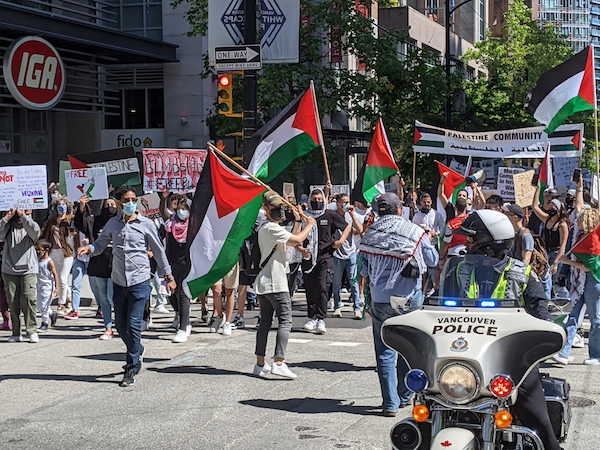
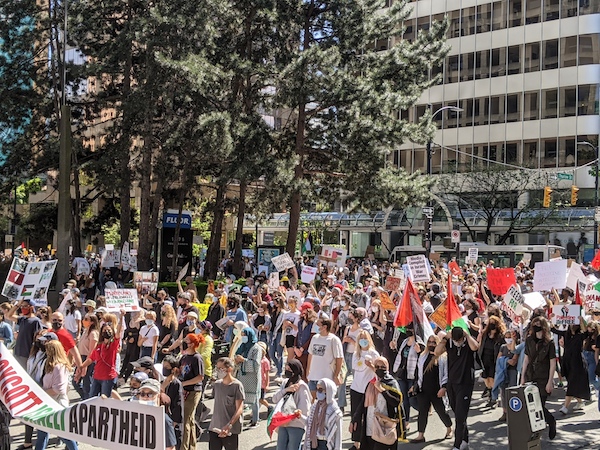
המפגינים צועדים ברחוב רובסון מלווים בכוחות המשטרה שסגרה את הכבישים הסמוכים בדאון טאון ונקובר (רוני רחמני)
הסכסוך הקשה במזרח התיכון בו מעורבת ישראל בימים אלה כולל ארגון הטרור החמאס, ישראלים יהודים וערבים בישראל ופלסטינים וכוחות הביטחון בשטחים – הגיע כצפוי גם לקנדה. הפגנות רבות משתתפים נערכו בימים האחרונים מצד תומכי הפלסטינים ומצד תומכי ישראל, בערים המרכזיות של קנדה. במרבית הפגנות נשמר השקט והסדר בצורה מכובדת, אך במספר אירועים בעיקר באלה שבטורונטו ומונטריאול, הותקפו אזרחים יהודים תומכי ישראל על ידי אזרחים מוסלמים שתומכים בצד הפלסטיני. המשטרה ביצעה כבר מספר מעצרים והיא מנהלת חקירה מואצת לעצור חשודים נוספים באלימות הקשה שהופנתה נגד אלו שתומכים בישראל.
בחלק מהפגנות התמיכה בפלסטינים החזיקו המפגינים כרזות עם דברי נאצה ושנאה מבישים נגד ישראל והיהודים בכלל, בהם: צלבי קרס, “ישראל פעלת נכון, היטלר יהיה גאה בך”, ישראל=נאצים”, “מוות לישראל”, “מה ההבדל בין ישראלי לנאצים” ועוד.
ההפגנה הגדולה ביותר התקיימה על ידי תומכי הפלסטינים בטורונטו ונכחו בה למעלה מחמשת אלפים משתתפים. באותה הפגנה נעצרו כבר על ידי המשטרה המקומית שלושה אזרחים מוסלמים, שתקפו קומץ של מפגינים יהודים שעמדו מולם, וכאמור מעצרים נוספים צפויים בימים הקרובים. המפגינים היהודים ספגו אבנים ובקבוקים, ואחד מהם אף הוכה במקלות, הוא נפגע בראשו ונזקק לטיפול רפואי דחוף. ואילו בהפגנה של תומכי ישראל במונטריאול נאלצה המשטרה המקומית להפעיל גז מדמיע לפזר בכוח אזרחים מוסלמים, שביקשו לפגוע באזרחים יהודים שהפגינו בעת שנערכה הפגנה בעד הפלסטינים.
ההפגנות של שני הצדדים בעד ונגד ישראל נערכו בין היתר בערים הבאות בקנדה: טורונטו, מונטריאול, ונקובר, קלגרי, אדמונטון, אוטווה, ויניפג, הליפקס וסנט ג’ונס.
המפגינים פונים מרחוב ג’ורג’יה לרחוב טרלו בדרכם למשרדים של הקונסוליה האמריקאית בדאון טאון ונקובר (רוני רחמני)
אני עקבתי מקרוב אחרי הפגנה של תומכי הצד הפלסטיני שנערכה בוונקובר ביום שבת האחרון. כחמש מאות מפגינים בהם אזרחים מוסלמים, ילידי קנדה, אינדיאנים, תומכי המרקסיזם ואפילו קבוצה של ארגון שמאל יהודי קיצוני “הקול היהודי העצמאי” – השתתפו בה. תחילה התכנסו מאות מפגינים בכיכר שממול האולפנים של רשת השידור הציבורית הקנדית הסי.בי.סי, ברחוב המילטון בדאון טאון. לאחר סדרה של נאומים וקריאות נגד ישראל שנמשכה למעלה מחצי שעה, החלו המפגינים לצעוד באישור המשטרה כמובן, אל עבר הקונסוליה האמריקנית בעיר, שנמצאת ברחוב פנדר בדאון טאון. רחבות שלמים נסגרו על ידי השוטרים הרבים שנכחו במקום, והצועדים ללא התפרעויות עשו את המסלול מאולפני הסי.בי.סי, אל רחוב רובסון, משם לרחוב ג’ורג’יה ומשם המשיכו בהמוניהם עד לבניין בו שוכנת הקונסוליה האמריקנית.
בין סיסמאות הרבות של המפגינים בעד הפלסטינים, לאור פעולת צה”ל בעזה, שנאמרו בהפגנה או שהופיעו על שלטים בהם החזיקו הצועדים: “אין צדק אין שלום”, “לשחר את פלסטין”, “פלסטין תקום בין הנהר לים”, “הפסיקו את שפיכות הדם”, “הפסיקו את ההפצצות”, “הפלסטינים הם מפלסטין”, “יש לעצור את המלחמה”, “יש להציל את שייח’ ג’ראח'”, “רציחת ילדים איננה נחשבת להגנה עצמית”, “הגידו במפורש את השם פלסטין”, “שתיקה היא אלימות”, “יש לחקור את פשעי המלחמה שמבצעת ישראל”, “יש לתת הגדרה עצמית לפלסטינים”, “יש להחרים את ישראל”. על הדלת הכניסה לקונסוליה האמריקנית שהייתה סגורה בעת ההפגנה, נכתבה הסיסמה באדום: “יש לשחרר את פלסטין, יש להפסיק את רצח העם וכן יש להפסיק את הכיבוש”.
בתגובה לתקיפת המפגינים היהודים בטורונטו, ציינו בארגון המרכז לענייני ישראל והיהודים בקנדה: “אנו מגנים בחריפות את ההתקפה והשנאה שהופנתה נגד יהודים. אין הצדקה לאלימות פוליטית ואלה ששונאים את ישראל שונאים גם את קנדה”.
Reports from eyewitnesses to the catastrophe at Mount Meron last week, on Lag b’Omer, recount a horrifying crush of humanity propelled as if by an external force. The tragedy of 45 lives lost and scores of seriously injured will be investigated by authorities after allegations that the potential for such a disaster had been foretold.
The investigation into Israel’s worst civilian disaster will likely look at structural factors that led to the stampede and the inability of attendees to escape as the throng converged into a choke point at the site.
A small silver lining in the horrific incident was the mobilization of Arab Israelis in villages near the mountain, who set up help stations to provide water and food to attendees as they gathered in the aftermath.
But the tragedy itself was exacerbated when some among the survivors turned on female Israel Defence Forces soldiers arriving to help. The event was attended almost exclusively by religious men and boys. When female soldiers arrived to deliver first aid and evacuation assistance, some were spit on, kicked and punched as they attempted to help the wounded and remove the bodies of the deceased.
Such misogynistic extremism will probably not be within the parameters of a government inquiry. And perhaps that is fine, because this is a symptom of a much larger societal problem and one that should be confronted thoroughly by the entire country. Interfering in the life-saving work of first responders is not only reprehensible, it is an abrogation of a foremost tenet of Judaism, pikuach nefesh, the saving of life. Most of the victims and survivors are shomer negiah, adhering to a religious principle that restricts or forbids contact between members of the opposite sex. In a deeply distorted interpretation, a number of men in the situation chose to elevate shomer negiah above pikuach nefesh. By spitting on rescue workers, the perpetrators were spitting on the very sacredness they imagined themselves to be defending. That is something that deserves serious consideration by religious people and by secular authorities as the country – and Jews worldwide – grapple with the aftermath of the entire incident.
Another tragic byproduct of the disaster has been reactions to the news among people who gravely lack humanity. Within hours of being posted, a story on Al Jazeera’s website about the tragedy was met with more than 10,000 comments celebrating the deaths. Among the representative comments: “Drinks on me, y’all,” “about time we got some good news on our media,” “I feel so happy, actually” and “May God ensure the bodies pile high.”
It is difficult to fathom that we live in a world where people would respond to a mass casualty event in this manner. It is also nearly impossible to imagine such a response if the tragedy had happened to anyone other than Jews.
For years, a robust discussion has occurred around whether, if or when anti-Zionism crosses a line into antisemitism. Did the callous, sadistic comments reflect a political statement about the right of Israel to exist? Were they even more base, a celebration of dead Jews just because they were Jews? Was it anti-Zionism that drove these depraved commenters, or was it antisemitism?
These questions throw a spotlight on the fundamental foolishness of the dichotomy. A semantic discussion about the motivations of people who would behave in this way gives far too much credence to their actions, as if there could, in some convoluted moral universe, be a justification for their cruelty.
Was it anti-Zionism? Was it antisemitism? At this point, does it really matter what we call it?
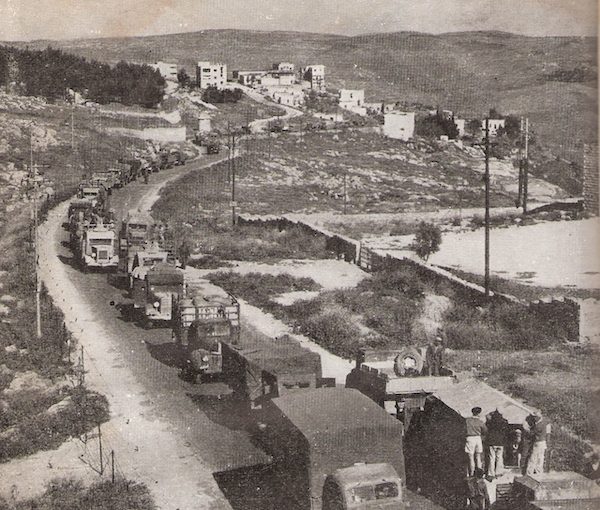
A supply convoy entering Jerusalem, 1948. (image from Shaar Hagai Heritage Museum)
Having just marked Yom Hazikaron and Israel’s 73rd anniversary, it is an appropriate time to recall a piece of Israel’s foundational history, and a new museum that commemorates it.
Seventy-four years ago, the road to Jerusalem was a site of easy ambush. Probably no part of the road was more treacherous than the area around Shaar Hagai. This spot, called Bab el Wad in Arabic, translates into English as the Gate of the Valley. As far back as 1868, French explorer Victor Guerin recognized and commented on this weak spot: he pointed out that the track was so narrow that “a determined band of men could stop an army in it with little difficulty.”
Admittedly, as you today drive on a smooth, paved, two-way, divided Jerusalem/Tel Aviv highway, it is hard to appreciate this reality. But, on Nov. 29, 1947 – the day after the vote on the United Nations Partition Plan, enabling the establishment of the Jewish state – Arab forces began blocking the route to Jerusalem. Not only were Jewish forces shot at, but, because the road curves, drivers couldn’t see where the road was blocked until they were trapped basically.
In David Dayan’s book Roadblock at Shaar Hagai: Creating a State (title translated from the Hebrew), Amos Kochavi recalled one such incident: “The time was approximately two in the afternoon. The long line entered the narrow and dangerous part. They could be anywhere…. We continued to climb … and there was a mighty explosion. The bomb under the road left a huge hole and the convoy stopped. Immediately, terrible shooting began…. We returned fire, but we couldn’t advance. Some of the drivers went into shock…. One driver with shell shock, screamed, ‘I can’t handle it anymore. I’m leaving.’ We yelled back: ‘Don’t move! You won’t come out alive!’ He didn’t hear, jumped from the car and was instantly killed.
“They tried to come down from the hills to get close to the cars, but our fire stopped them. They fire, we fire and the hours go by. No cars have air left in their tires. The number of injured grew. Shalom volunteered … he lay on the road, rolling – to avoid snipers – for a long hour … directing the drivers, one by one, until he had rescued all the cars…. An Australian captain ordered tanks that escorted us back to Gezer. The time was already two at night – 12 hours from when we entered Shaar Hagai.”
Jerusalem was under siege. Essential supplies could not reach the civilian and military population of the city. Jerusalem was dependent on supplies from the rest of the country, and was threatened with being totally cut off from the rest of the country. The only way to reach Jewish Jerusalem was to travel in convoy. (For more information, visit the National Library of Israel website, nli.org.il/en.)
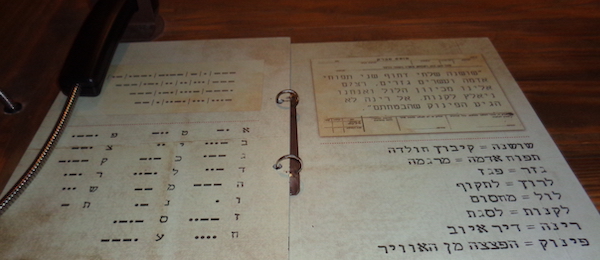
A codebook for sending messages in the time of the siege of Jerusalem, on display at Shaar Hagai Heritage Museum. (photo from Shaar Hagai Heritage Museum)
According to the late Sir Martin Gilbert, by the spring of 1948, “Fewer and fewer Jewish food convoys were able to get through to Jerusalem. Towards the end of March, a food convoy failed, for the first time, to get through at all. One food convoy that did get through in March had taken 10 days to do so. By the end of the first week of April, there was only enough flour in Jewish Jerusalem to last for 30 days. Meat, fish, milk and eggs were unobtainable, except in small quantities, for children. The shortage of vegetables was such that children were sent into the fields to collect a weed … known as halamith, it tasted somewhat like spinach, and could be made into soup.” (See Jerusalem in the 20th Century.)
There was also a severe shortage of water. Three days before the state of Israel officially came into existence, the Palestine Post reported that “Jerusalem was still without water yesterday. The two pipelines from Ras el Ein, which were blown up by Arabs between Latrun and Bal el Wad on Friday, have still to be repaired. Crews are scheduled to leave under army escort this morning to continue repair work and, barring further trouble, repairs may be completed today. Water may be pumped into Jerusalem within a few days, according to one municipal official.” So grim was Jerusalem’s situation that archival photos show residents standing in long lines waiting to get their water ration and others rummaging through garbage, in the hopes of finding scraps of food.
Palmach fighters and, even more remarkable, simple truck drivers decided to do whatever they could to keep Jerusalem from being blocked. One now quite senior man, who drove a truck full of live fish for the Sabbath, was interviewed. He recalled looking out his side mirrors to see water streaming from the sides of the vehicle. The truck had been shot in numerous spots. Somehow, he managed to get to Kiryat Anavim, a kibbutz in the Jerusalem Corridor. There, women plugged up the bullet holes with rags. Probably, many of us would have considered giving up at this point, but this driver continued the slow climb to Jerusalem.
The fighters were mostly young people. A significant number were under the age of 18 (today’s conscription age). They came from all backgrounds, religious and non-religious, and from all parts of the country; some were Holocaust survivors. As a number of the fighters had been assigned the task of digging gravesites at Kiryat Anavim, they probably realized they might not survive on the road to Jerusalem.
It was crucial to find a different route for the convoys. Palmach soldiers discovered a detour that went through a hidden valley south of the heavily fortified fortress at Latrun and joined a path descending from Jerusalem. Using heavy tractors, the Palmach slowly cleared a path for vehicles. A water pipeline was also installed along it. The lifeline to the Jews in Jerusalem was secured, providing vital water and other supplies, in the summer months of 1948.
At the point where the road was most unsafe, there is a 19th-century Turkish-built travelers’ khan or inn. On March 23, 2021, Israel’s last election day, a memorial museum was opened at this historic location. The Shaar Hagai Heritage Museum is dedicated to the men and women who prevented Jerusalem from being disconnected in the days leading up to and even following Israel’s independence.
The museum deals less with the chronology of the battles and more with the physical and emotional difficulties convoy members faced, such as confronting dilemmas like whether the trucks should carry guns or food to besieged Jerusalem. There are displays of items used by the convoys, such as codebooks, handguns and rifles. And there are interviews with people who took part in the convoy operations, and part of the exhibit is animated.
Once we are again allowed to travel, the museum is worth a visit on your next trip to Israel. Allow at least an hour-and-a-half for the whole tour, which is recommended for viewers 10 years of age and older. The new museum requires visitors to make advance online reservations, and there are admission fees.
Deborah Rubin Fieldsis an Israel-based features writer. She is also the author of Take a Peek Inside: A Child’s Guide to Radiology Exams, published in English, Hebrew and Arabic.
Hagit Yaso, who was part of Metro Vancouver’s celebration of Yom Ha’atzmaut in 2014, is among the Israeli performers who will be joining the online event this year. (photo from hagityaso.com/en/home)
The Jewish Federation of Greater Vancouver and its 46 community partners, which includes the Jewish Independent, will be marking Israel’s 73rd birthday with a virtual celebration April 14 at 7:30 p.m. This year’s special hour-long event will include performances by both Israeli and local artists, as well as some surprises.
For the past 17 years, Federation has joined forces with Eti Lam, a Tel Aviv producer who specializes in bringing Israeli artists to Jewish communities around the world.
“Producing an event like Israel’s Independence Day requires lots of work and long-term collaboration between the community and myself,” Lam told the Independent. “It usually starts with searching for the right artist that is happy to come to Vancouver on this special date, building a suitable show, rehearsing it back in Israel, and many more activities. And, as with everything, the price should be right to the budget.”
This can take time, she confessed. “Some years, it took the Federation team and me a whole year to find and deliver the right show.”
With the pandemic, things are even more challenging, but the situation also offers a unique opportunity.
“Considering the COVID-19 limitations, we couldn’t meet in the concert hall,” said Lam. “Still, the show must go on. We approached multiple artists that performed in Vancouver in the past and the responses were amazing, so we’ll get to celebrate together this year, too. The performance will be broadcast online, without compromising the uniqueness and festivity of Israel’s Independence Day.”
Lam lauded the Vancouver audience, calling it “truly one of a kind, special and unique.”
“Every year,” she said, “1,200 people gathered together to celebrate Israel’s Independence Day with an Israeli artist. Being able to produce this event year over year for the last 17 years has been a great privilege. It’s been successful thanks to the close relationship with the incredible people in the Federation and in the community. Whenever I arrived in Vancouver, I felt that I had returned to celebrate with a close group of my friends, part of a warm and loving community. I’d like to take this opportunity to thank all the Federation and community members for their help, support and partnership over the years.”
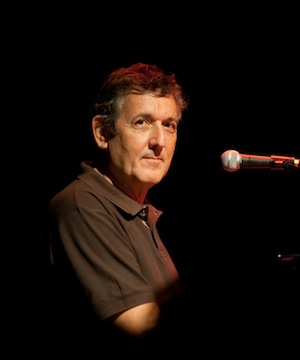
Yoni Rechter was part of Metro Vancouver’s 2019 celebration of Yom Ha’atzmaut, and he will be part of this year’s online event, as well. (photo by Gilad Avidan)
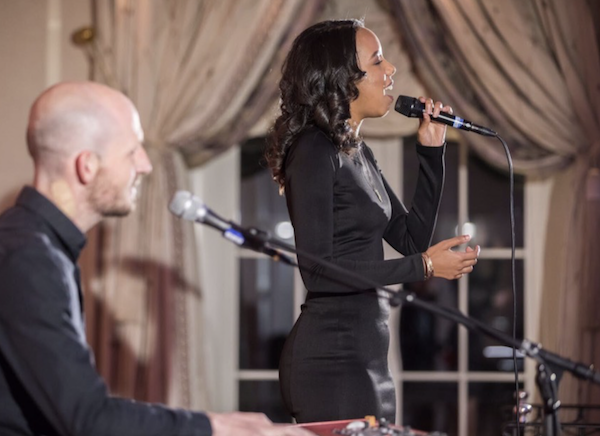
The evening lineup is set to include various dance groups and artists, as well as students from Richmond Jewish Day School (RJDS) and Vancouver Talmud Torah singing the Canadian and Israeli national anthems. Local talents Orr Chadash, Orr Atid, Duo Orr and Grade 6 dancers from RJDS will join Israeli artists Yoni Rechter, Nurit Galron, Hagit Yaso, Micha Bitton and Shlomit Aharon for the broadcast. This year’s event will also feature a community Koolulam-style video, a version of “Bashana Haba’ah” in which different members of the community sing a line, a verse or the chorus.
Yom Ha’atzmaut celebrations go back a long way in Vancouver, though prior to 2002 they were done at a slightly smaller scale, with the exception of Israel’s 50th anniversary in 1998 at the Orpheum. This year, because a plethora of virtual (and worldwide) programs, events and webinars have led to “Zoom fatigue,” Federation decided to “go local” and highlight community talents.
To even localize the Israeli component, Federation invited the Israeli artists, who have performed here before in person on Yom Ha’atzmaut, to dedicate a song to the community. Additionally, organizers have promised a surprise that they feel confident will go down well with the community.
Emceeing this year’s event will be JCC sports coordinator Kyle Berger, who also is a stand-up comedian, and King David High School counselor Lu Winters.
“Once we realized COVID restrictions weren’t going to allow Seth Rogen and Sarah Silverman to do it, we were hoping we’d be asked,” said Berger. “The fact that it’ll be on Zoom means they’ll be able to make us look fitter and younger than we actually are, which is another awesome perk.”
Berger and Winters, along with a handful of staff and crew, will be filming and streaming the show from a production studio in Burnaby. “But, when we close our eyes, we will be live from Israel,” said Berger.
“Thankfully, we will both be there doing the show together and will be able to feed off of each other’s energy and nerves. Of course, we will still be 6.13 feet apart while filming,” assured Berger, who has worked with Winters before, as co-delegation heads for the JCC Maccabi Games.
He vowed that “everyone should expect an incredibly fun evening celebrating our community’s special connection with Israel, especially our unique relationship with our partnership region in the Galilee Panhandle. Think Dick Clark’s New Year’s Rockin’ Eve meets the Academy Awards – produced by the same number of Jews, but with less famous hosts.”
Nava, Omnitsky and the Perfect Bite are all offering special Yom Ha’atzmaut menus for April 14. Register at jewishvancouver.com/yh2021 to join the celebration.
Also on April 14, the Jewish Federation of Victoria and Vancouver Island will be hosting a small program via Zoom with an Israeli-themed picnic. Registrants will be able to pick up their meal (drive-through) and enjoy it while participating in the Zoom program. To register, send an email to jewishfederationvictoria@gmail.com.
Sam Margolishas written for the Globe and Mail, the National Post, UPI and MSNBC.
With 13 parties in the Knesset – and several of those umbrellas encompassing a variety of factions – patching together a coalition will be a challenge. It may not be possible at all, meaning Israelis would see their fifth election within a little more than two years.
Whatever pileup of strange bedfellows eventually manages to form a government, one particular possibility should be especially disconcerting.
To enhance their chances of passing the electoral threshold, three far-right parties united under the banner of Religious Zionism and succeeded in taking six Knesset seats. The Religious Zionist party, led by Bezalel Smotrich, seeks to annex all (or part, depending on which faction you listen to) of the West Bank and adheres to a familiar litany of Israeli far-right policies.
For this round of elections, they partnered with another small faction, called Noam, whose platform ostensibly seeks to create a halachic theocracy. In practical terms, the party is obsessed with homosexuality and seeks to delegitimize LGBTQ+ Israelis and roll back legal protections and equality. In addition to attacking gay people, the party has equated Reform Jews with Nazis and Palestinian terrorists who “want to destroy us.”
The third rail in this extremist triumvirate is Otzma Yehudit (Jewish Power), which is a descendant of the outlawed racist party Kach, led by the American-born fanatic Rabbi Meir Kahane, who was assassinated in 1990.
When Kahane was in the Knesset, before a law was passed to bar overt racists from elected office, all other members of the assembly would walk out when he rose to rant against Arabs. In an eerie echo of the Nuremburg Laws, Kahane sought to legally prohibit sexual relations between Jews and non-Jews, among other far-reaching extreme positions.
An indication of the shifts in Israel’s body politic over the decades is evidenced by the fact that the incumbent prime minister, Binyamin Netanyahu, worked behind the scenes to get these small extremist factions to cooperate in order to reach the electoral threshold. While previous prime ministers – and every other member of the Knesset at the time – refused to listen to the hateful rhetoric of Kahane, this prime minister helped ensure his ideological successors would be represented in the Knesset.
It is bad enough that these ideas will be given a legitimacy they do not deserve by mere dint of their advocates being members of the Knesset. As a small rump of crazed zealots, they should be ignored and shunned. Instead, they will play a central role in the determination of who (if anyone) forms the next government.
It is worth recalling an incident in Austria, in 2000, when the xenophobic, racist and arguably neo-fascist Freedom Party, led by Jörg Haider, entered into a governing coalition in that country. The government of Austria to which Haider belonged was sanctioned and condemned by governments worldwide and other member-states of the European Union ceased cooperation with Austria’s government.
While the Abraham Accords have reduced Israel’s diplomatic isolation dramatically, the country still faces unjust judgment in the court of global opinion. If a new governing coalition includes a segment of enthusiastic homophobes, misogynists, racists and ethno-religious supremacists, a universe of denunciation would rain down on the country. And rightly so.
In what may be an irony of historical proportions, that ugly scenario could be prevented by another stunning development on the other end of the political (and ethno-cultural) spectrum.
A new Arab party, called Ra’am, has bolted from the conventions of the Arab political sector and adopted a pragmatic approach. Rather than the purely oppositional stands taken by the other Arab parties for decades, Ra’am seems prepared to play the game that small Jewish parties have excelled at. In a fractured political culture, the tail often wags the dog. Ra’am, led by Mansour Abbas, seems to understand the opportunity this presents. Strangely, this Arab religious party could find common cause with Jewish religious parties on issues like funding for parochial education and other community needs (as well as its apparently virulent hatred of homosexuality).
As the horse trading begins in earnest this week to patch together a quilt of some ideological consistency in the Knesset, Ra’am is sitting in one of the most enviable positions of potential power, possibly able to extract all sorts of treasures out of a leader desperate for their crucial four votes. The only thing they have explicitly ruled out is any situation that would enable groups like Religious Zionism, Otzma Yehudit and Noam.
How ironic it would be if Israel were saved from its own worst angels by an Arab political party that learned its capacity for power from watching the fringe elements on the other side of the Knesset.
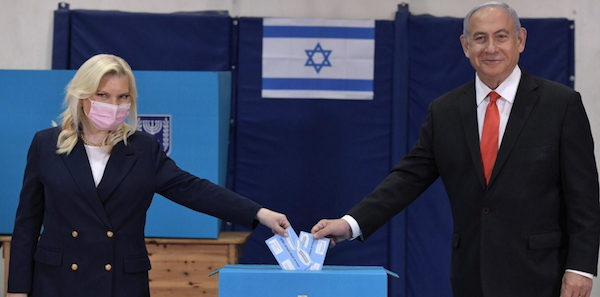
Israeli Prime Minister Binyamin Netanyahu and his wife, Sara, vote on March 23. While the prime minister’s party won the most number of seats in the Knesset, he will still struggle to form a government. (photo from IGPO)
Israeli Prime Minister Binyamin Netanyahu makes a stunning deal with lawmakers to abandon his post and replace Reuven Rivlin as president of the country when the president’s term expires later this year. An agreement to pardon Netanyahu around corruption charges he currently faces is part of a deal that leads to Netanyahu ending his run as the country’s longest-serving leader. With “King Bibi” finally in a sinecure of symbolic eminence, the polarized Knesset manages to cobble together a coalition and stave off the fifth round of elections in two years.
This was one of the most fantastical possibilities mooted in a webinar presented by the Centre for Israel and Jewish Affairs (CIJA) March 25, just two days after Israelis voted in the fourth of a series of elections during a two-year period of instability.
The panelists were CIJA’s chief executive officer Shimon Koffler Fogel and Adir Krafman, the agency’s associate director for communications and analytics. They sifted the entrails of the convoluted election outcome.
While ideological schisms divide Israeli politics, as does the secular-religious divide and other fractures, Fogel and Krafman concurred that the elephant in any discussion of the next Knesset is Netanyahu. CIJA is a nonpartisan organization and Fogel emphasized that the panelists, and moderator Tamara Fathi, were not advocating any outcomes, merely commenting on possibilities.
And the possibilities are almost endless. The vote sent 13 parties into the 120-seat Knesset. Some of these are not even parties, so much as umbrellas under which different factions coalesced for electoral purposes, so the mosaic of the chaotic chamber could refract in countless ways. But, while there are myriad permutations of possible coalitions and strange bedfellowships, Fogel, Krafman and most commentators in Israel and abroad think the most likely outcome is a fifth election. That is how difficult it would be for either side to patch together 61 members of the Knesset to govern.
Krafman presented graphic evidence of the challenges the pro- and anti-Netanyahu factions face in reaching that magic number. The pro-Bibi side likely has 52 dependable seats; his opponents probably have 57. That means an anti-Netanyahu coalition could form with the support of Naftali Bennett’s Yamina party, which holds seven seats. For Netanyahu to eke out 61 seats would require the backing not only of Bennett but also of the four seats won by the Arab party Ra’am. Such a partnership would be historic and would have been almost unthinkable in the recent past. But Netanyahu of late has been making amenable noises toward Arab Israelis in general and to the Arab parties in particular. However, even if the prime minister and his unlikely allies in the Arab sector made a deal, it could upend the consensus on the other side, as some on the right would probably balk at joining a coalition that includes Ra’am.
Ra’am is one of the big stories of the election. Exit polls indicated the party would not make it over the 3.25% threshold to win any Knesset seats. That created a scenario where Netanyahu and his probable allies were seen as almost certain to form a government.
But, as actual counting took place through the night and into the morning, it became clear that Ra’am would cross the minimum support for representation. Instantly, the calculations shifted.
If Ra’am were to enter a coalition government, or even if it merely supported a government from the sidelines, it would be a turning point in the role Arab parties play in Israeli politics. Ra’am has already upended conventional Arab approaches to politics. The umbrella of Arab parties, recently running under the banner of the Joint List, has always played a spoiler role. They are oppositionist and anti-Zionist groups that are as much protest movements as conventional political parties.
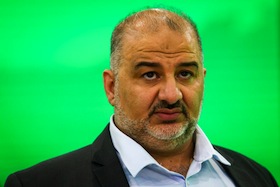
Ra’am leader Mansour Abbas has put his party into a potentially advantageous position. (photo from hamodia.com)
Perhaps learning a lesson from the outsized power of small, right-wing and Jewish religious parties, Ra’am adopted a more pragmatic and transactional position than their former allies in the Arab bloc. The leader, Mansour Abbas, has not ruled out supporting a coalition or playing a role in government. Like smaller Jewish parties, he would be expected to come to coalition discussions with a shopping list of demands, such as more funding for projects and programs that benefit his constituents.
Ra’am’s success makes it an unqualified winner in the election sweepstakes. Fogel and Krafman discussed other winners and losers.
“The first loser, I think, is Netanyahu,” said Fogel. “Despite his party winning the most number of seats, 30 seats out of 120 in the Knesset, [he] is still not able to form a government.”
That might have been survivable if other parties that are Netanyahu’s likely backers did not also come up short.
“The other two losers are other right-wing parties,” Fogel added. Naftali Bennett, whose Yamina took seven seats, and Gideon Sa’ar, whose New Hope party took six, had hoped to siphon off a larger chunk of Likud’s votes.
“Both of them really failed to do that, winning only a handful of seats,” said Fogel.
It is a profound statement about tectonic changes in Israel’s ideological fault lines that the Labour party, which took seven seats, and another left-wing party, Meretz, which took six, are viewed as having had a good night. In the days leading up to the vote, there were questions whether either party would overcome the minimum threshold. The Labour party was the indomitable establishment political party for the first three decades of Israel’s existence.
Another loser, Fogel said, was Avigdor Lieberman and his Yisrael Beiteinu party. Lieberman is a right-wing but avowedly secularist politician. He ran a campaign promoting separation of religion and state and against Charedi privileges. His message may have backfired: while turnout was down overall from the last election, Charedi voters turned out in greater numbers, possibly in reaction to Lieberman’s message.
The discussion turned again to what may be the most likely path for a right-wing government, which could be the exit of Netanyahu. There are centrist parties, Fogel said, that do not have issues with Likud policies so much as they do with the prime minister personally. With him gone, a bloc of anti-Bibi members might engage with Likud under a new leader and form a centre-right coalition.
As unlikely as this scenario might be, it would stave off another unsavoury development.
Any hope of forming a Netanyahu-led coalition probably depends on support from the extremist grouping called Religious Zionism. This new umbrella of racist, misogynistic and homophobic extremists, which holds six seats, would taint any coalition as the most far-right government in Israel’s history. (Click here to read this week’s editorial.)
Whatever happens – whether someone can manage to hammer together a government, or whether exhausted Israelis will trudge to the polls for a fifth time – there are serious issues facing the country.
“There are some pretty daunting challenges out there,” Fogel said. “Most especially on the economic side. We see that some other countries have already begun to emerge [from the pandemic] with a fairly robust recovery. Israel isn’t there yet…. There is a sense of urgency that they do have to get an Israeli government in place that is going to be able to effectively address these issues and it’s not clear that the election result will offer that to Israelis, so I think it makes a situation, if anything, more desperate.”
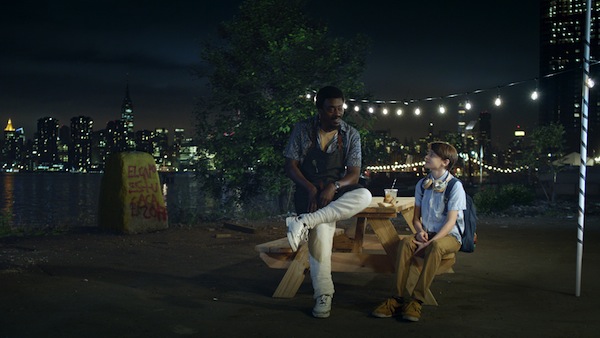
Seu Jorge, left, and Noah Schnapp in a still from Abe. (image from Reel 2 Real)
The upcoming Reel 2 Real International Film Festival for Youth is not just for youth, though younger viewers are its target audience. There are entertaining and engaging films for all ages among the 18 features and 45 shorts that will be available for streaming online April 14-23.
The focus of this year’s festival is “films that explore the impact of social media, racism and discrimination, with a focus on Germany.” While many of the offerings will interest Jewish community members, at least four cover topics of specific relevance.
The American feature Abe was part of the recent Vancouver Jewish Film Festival. It is carried by the impressive acting of Noah Schnapp as 12-year-old Abe and that of Seu Jorge as Chico, the Brazilian-American chef that Abe idolizes. The food, glorious food, is an added bonus.
While the writing of Abe’s family dynamics is clunky and without nuance – his father’s side is Muslim, his mother’s Jewish, and never the twain shall meet on religion or the Palestinian-Israeli conflict – Abe himself is charming. He puts his heart into trying to bring everyone together, in part, by creating a fancy dinner that comprises several of his grandmothers’ traditional recipes. The grumpy but caring Chico helps, having reluctantly taken Abe in, first as a dishwasher then as one of his prep cooks.
Food doesn’t turn out to be the way to his family members’ hearts but the disastrous fusion meal, which ends in a big fight and Abe running away, does push his family to at least reconsider their priorities.
***
Mouize and Ranin become friends over popcorn and a shared love of cinema in Cinema Rex. (image from Reel 2 Real)
In another charming film, the young also show the adults the possible way to some form of peace. In the Israeli animated short Cinema Rex, the Jewish boy Mouize and the Arab girl Ranin become friends over popcorn and a shared love of cinema.
Set in Jerusalem in 1938, a new movie theatre opens, “In the heart of the city, on the seam line between the Jewish side and the Arab side, and adjacent to the British police.” It is “co-owned by partners from both sides of [the] divided city” and Mouize’s dad is the projectionist. When Mouize catches a glimpse of someone peeking into the projection room, he follows the trail of popcorn to Ranin, who shares it with him in exchange for a seat beside him in the best seats in the house. The two imagine themselves as the heroes in Robin Hood, as actors in a Laurel and Hardy film, dancers in a Fred Astaire and Ginger Rogers movie, and more.
Ranin’s mother is non-plused to find her daughter hanging out with Mouize, and Mouize’s dad tries to tell him, “Someday, you’ll understand why you and she can’t be friends.” But the kids have none of it.
Beautifully drawn and a story simply told – in Arabic, English and Hebrew with English subtitles – this short is highly recommended viewing.
***
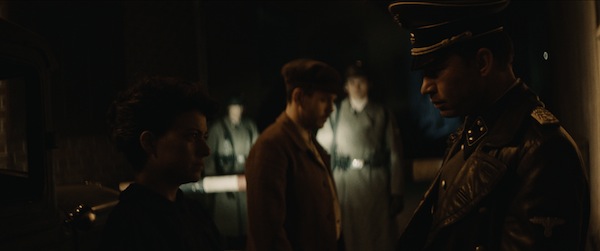
Alina is a tension-filled short film. (image from Reel 2 Real)
A more serious and nerve-wracking short is the tension-filled American film Alina. For 25 minutes, breathing will be more difficult, as the fate of a three-month-old baby lies in the hands of Alina (played by Alia Shawkat). The non-Jewish woman is part of a group of women (and men, as her brother helps) who are smuggling Jewish children out of the Warsaw Ghetto during the Holocaust.
Inspired by factual events, but fictional, the film opens as Nazi soldiers kick their way into a building and make their way up each floor, searching every room for children, with orders to seize them. Alina must escape from an upper-level apartment with the baby through the bathroom window, using a makeshift rope of tied sheets. She must then meet her brother, make it through a checkpoint and even face Nazi soldiers in her own home, as a Nazi captain accompanies her there from the checkpoint, so convinced is he that she is hiding something from him.
Alina is a multiple-award-winning film for many reasons. And it precedes the fascinating feature-length documentary The Lesson, which sees its Canadian première at Reel 2 Real.
The Lesson director Elena Horn. (image from Reel 2 Real)
Through the lens of German filmmaker Elena Horn, who herself grew up in Fröndenberg and went to Fröndenberg Comprehensive School, The Lesson is a personal look at how students in Germany are taught about the Holocaust. Over a five-year period, Horn followed a handful of students through their classes on the topic, their projects and field trips. She juxtaposes this perspective with archival footage from the 1930s, showing children doing paramilitary exercises, learning about what makes a good German and other propaganda. She also includes current-day nationalism and how some of the students deal with the differences between what they’re being taught in school about the Holocaust and what their families have told them about that period in time.
Horn frames the content in the context of overarching questions such as, could the Holocaust have been initiated by other countries just as easily as in Germany, or is there something inherent about Germany that allowed it to start there? She wonders if history is repeating itself, and she continues to struggle with the question, “What would I have done?” She highlights some of the efforts of those who refused to be bystanders to genocide, and she hopes to inspire some viewers to be courageous if, God forbid, they ever face such a choice.
***
For the full festival schedule and tickets, as well as information on Reel 2 Real’s several youth programs and workshops, visit r2rfestival.org.
I met my husband long ago at Cornell University Hillel events. One event celebrated what looked like the success of the Israel-Palestinian peace process. It was part of the Oslo Accords and, in October 1994, the Nobel Peace Prize was awarded to Yasser Arafat, Yitzhak Rabin and Shimon Peres. It was a sunny, warm day, but things have shifted often since then. These are thorny political issues, but one can hope.
I recently completed studying the talmudic tractate of Pesachim. When finishing a tractate, one says a prayer called Hadran. It ends with Kaddish, much like what’s said at any Jewish service. It ends with praying for peace. We have lots of prayers for peace.
Meanwhile, my husband, now a biology professor, asked me to look at a motion from his faculty union. It claimed a deep concern with academic freedom. The motion proposed rejecting the IHRA’s definition of antisemitism. (The IHRA stands for International Holocaust Remembrance Alliance.) This motion theoretically responded to a student union motion that supported the IHRA’s definition. Many countries, including Canada, have adopted the IHRA’s working definition.
The politics behind this are tangled. Many on the political left suggest that to truly support truth and reconciliation and BIPOC (Black and Indigenous People of Colour), one must support all Indigenous movements worldwide. According to this argument, Palestinians must be supported as the sole true Indigenous people – against the colonial-settler narrative of Israel. There are issues with this position. One is that Britain is the colonial power whose actions helped lead to the creation of Israel. Also, Jews have been indigenous to, or lived in what is now, Israel for thousands of years.
There are practical consequences when universities debate these topics. North American Jews are a minority. This vote, which affects us, is one where we have no majority voting power. We rely on non-Jews to advocate for us and support anti-discrimination guidelines. We often must confront those who feel these definitions threaten them intellectually – while we’re feeling threatened in reality.
Jewish students on campus feel attacked. Jewish academics are forced to step up and speak out. In some cases, Jewish professors and students face discrimination as a result of this advocacy.
Just before Passover this year, at a special meeting, the faculty union put forth its agenda. The meeting agenda was to consider this motion that opposes the IHRA’s working definition of antisemitism. Those attending the meeting wouldn’t approve the agenda. (Note that approving the agenda is usually not a big deal.) Without an agenda, the motion couldn’t go forward. There was no vote.
Some attendees suggested that the entire union membership should vote. First though, they said, this motion should be considered by the cultural diversity and academic freedom committees. In the end? This meeting’s outcome just puts off the problem for the Jewish community.
Multiple professors in relevant fields spoke out against this motion, which opposed using a working definition of antisemitism. Behind the scenes, the local Jewish federation got involved. The motion was problematic – and it’s still out there. It could be voted on at another meeting, potentially one with even less notice or publicity.
It’s particularly troublesome that those voting on whether one can use the IHRA definition at this university in teaching or research aren’t all relevant experts. Most aren’t professors in religious studies, Jewish studies, Holocaust studies, Near Eastern studies. Most of the voting representatives won’t be Jewish. In their argument to maintain “academic freedom,” they’re proposing to limit the freedoms of colleagues. This limits others’ right to use whatever definitions they prefer when they speak about anti-Jewish discrimination.
There’s a bigger argument here. If Canadian universities want to show ally-ship with Indigenous communities and to be partners in truth and reconciliation, the way is clear. It starts much closer to home. Stand with Canada’s Indigenous peoples on the issues that matter to them. For instance, pressure the government to provide all Canadians with clean drinking water. Support Indigenous students at universities. Hire and appoint Indigenous peoples (First Nations, Inuit and Métis) to academic positions. The list is long. To start, read the Truth and Reconciliation Commission of Canada’s 94 calls to action.
None of these feuds are new. My husband and several other Jewish professor friends spent a lot of time on how to address this motion. This is “their” problem because they’re Jewish, but not because this is in their fields of research.
This gut-wrenching position is familiar. Does supporting academic freedom mean that antisemitism is up for discussion? It shouldn’t mean this, but antisemitic incidents are on the rise. Freedom of speech shouldn’t mean danger to minority students and professors.
Complexity isn’t resolved easily. Delving into these issues without lots of prior knowledge reflects badly on this faculty union and, by extension, the university. Smart people know there aren’t easy answers to entrenched political problems. Motions such as this one show a lack of rigour.
Canadian university professors should be sophisticated enough to know that complex issues aren’t resolved by simply opposing a working definition. It’s useless virtue signaling. Just as it shouldn’t be up to Black people or Indigenous people to fight every battle without allies, we, as Jewish people, shouldn’t have to keep fighting these battles alone over how to define antisemitism.
My husband and I met with a hope for peace. We care about human rights, but this union issue just seems to be wasting time during a pandemic. Opposing this working definition that protects a minority population, because it could possibly affect free speech? This really isn’t what a biology professor wants to be doing at work – even if he’s Jewish.
If Canadians care about peace, truth and reconciliation, and about the well-being of all people, we shouldn’t be attacking one group to elevate others. We shouldn’t have to keep fighting over definitions about discrimination against minorities.
Perhaps, we can leave the global political issues and their definitions up to the relevant experts. For us, it might be simple: we should show up to care for one another with respect instead. Advocate for better conditions close to home: safety without discrimination, fresh food, clean water, housing security, and economic and social supports. Even at their preschool, my children learned about key Jewish concepts like “Shalom Ba-bayit.” In other words, peace and tolerance start at home.
Joanne Seiffhas written regularly for CBC Manitoba and various Jewish publications. She is the author of three books, including From the Outside In: Jewish Post Columns 2015-2016, a collection of essays available for digital download or as a paperback from Amazon. Check her out on Instagram @yrnspinner or at joanneseiff.blogspot.com.
On June 25, 2019, the Liberal government of Justin Trudeau adopted the International Holocaust Remembrance Alliance (IHRA) definition of antisemitism, as part of Canada’s anti-racism strategy. Widely proposed around the world, the definition has evoked fierce debate.
In Canada, the NDP will consider a resolution against the definition at its national convention this month, one penned by B.C. former MPs Libby Davies and Svend Robinson. Meanwhile, a coalition of 100 Canadian Jewish organizations has objected to the NDP resolution.
Wherein lies the controversy with the IHRA definition?
The definition, though vague, is not, in itself, controversial: “Antisemitism is a certain perception of Jews, which may be expressed as hatred toward Jews. Rhetorical and physical manifestations of antisemitism are directed toward Jewish or non-Jewish individuals and/or their property, toward Jewish community institutions and religious facilities.” IHRA has promoted it as a “non-legally binding working definition.”
As is so often the case, the devil is in the details, and the details here are found in the 11 examples of what the definition considers actionable antisemitism: seven of them concern the state of Israel.
Those who defend the definition argue that Israel is treated unfairly in the media and in international political discourse and see antisemitism as the root of this discriminatory treatment. Yet Israel is a country whose founding wars and subsequent military occupation of the West Bank and Gaza have meant displacement of millions of Palestinians followed by the occupation and policing of that same population. The circumstances of the displacement and occupation are such that even the most generous interpretation of Israeli actions should recognize that an ongoing critical scrutiny of the Israeli state is a moral duty. Voices within and without Israel – and especially the voices of Palestinians and their allies – must be free to speak their experience and, yes, their accusations.
This is exactly the freedom that the IHRA definition would curtail. The burden should not be on those who criticize the Israeli state to prove that their statements are not antisemitic. Rather, the Israeli state, like any other, should bear the burden of demonstrating that criticisms of it are discriminatory, made in bad faith and nonfactual.
The definition’s history
The International Holocaust Remembrance Alliance was initiated in 1998. In 2016, it adopted a definition drafted by Kenneth Stern, director of the Bard Centre for the Study of Hate, to aid in the collection and sorting of possible instances of antisemitism. Stern has acknowledged that the definition has been misappropriated and is being “weaponized” against critics of Israel and has warned against the definition “being employed in an attempt to restrict academic freedom and punish political speech.”
In Canada, the adoption of the definition has been opposed by the B.C. Civil Liberties Association and the Ontario Civil Liberties Association. More than 450 Canadian academics have signed on to an open letter opposing its adoption by governing bodies. In 2021, the New Israel Fund Canada, which had previously urged Ontario to adopt the definition, reversed its position, citing concerns over free speech and academic freedom.
There have already been unjust consequences. Lives, livelihoods and reputations have been damaged, particularly in universities where academics have been harassed, censured and dismissed for teaching about the Israeli-Palestinian conflict or scheduling speakers on that topic – instances where the definition is acknowledged to be in play. The definition also has created what some argue is a limiting of speech critical of the Israeli state on social media platforms like Zoom or Facebook.
In one example, law professor Faisal Bhabha was accused of antisemitism by B’nai Brith Canada for his remarks in a debate that was sponsored by the Centre for Free Expression at Ryerson University. A petition was launched using the IHRA definition, calling for Bhabha to no longer teach human rights classes. The professor’s allegedly antisemitic act was to argue that Zionism as practised today in Israel amounts to “Jewish supremacy,” an opinion shared not only by many human rights organizations and Palestinian activists, but also by many Jews. Yet for those wielders of the definition the question cannot even be debated.
Similar incidents have been reported in the United States. To get a sense of the extreme rhetoric involved, consider that, in 2020, the U.S. State Department announced its intentions to declare the advocacy groups Oxfam, Amnesty International and Human Rights Watch antisemitic and to withdraw U.S. support for these groups. If only advocacy groups in Canada and the United States could find a way to declare criticism of the genocidal actions of the Burmese state to be merely anti-Asian prejudice, what a coup for Myanmar’s military junta that would be.
Not only is the speech of Jews not immune to these accusations, but even Jewish Holocaust survivors are not immune. When survivor Marika Sherwood attempted to give a talk at Manchester University called You’re Doing to the Palestinians What the Nazis Did to Me, Mark Regev, Israeli ambassador to the United Kingdom, intervened. The embassy claimed the title breached the definition and accused the Holocaust survivor of hate speech towards Jews.
Incredibly, the Simon Wiesenthal Centre listed the European Union’s insistence that products made in Israeli settlements must be so labeled as the third most serious antisemitic incident in 2015.
These examples, which are only a sample of many more, should be enough to convince anyone that there are few limits to the measures that Israel’s absolute defenders will take to use the IHRA definition to silence criticism of the Israeli state.
Opinions in Canada
Can the centuries-old hatred of Jews be redefined as criticism of the state of Israel or is this an unacceptable slippage of meaning? A recent (2020) poll indicated that a strong majority of Canadians believe that criticism of Israel is not antisemitic. Considering the importance of holding the state of Israel up to criticism, it must be demonstrated that said criticism is rooted in antisemitism, not assumed.
One of the examples in the IHRA definition states that referring to Israel as a “racist endeavour” is antisemitic, because it denies the Jewish people their right to self-determination. But surely there are methods of national self-determination that can be judged to be racist.
The definition claims that holding Israel to a higher moral standard than other countries is antisemitic. Considering the fact that every government on the planet receives vitriolic criticism, together with the previous claim that calling Israel a “racist endeavour” is antisemitic, one gets the sense that what is sought for Israel is a higher level of exemption from criticism than any other nation receives. We are perfectly free to call Canada a “racist endeavour,” after all. This happens frequently, often by the main victims of Canada’s very real history of racism, Indigenous peoples. Would we want to criminalize such speech in Canada as somehow a form of racism against Anglo-Saxons, or the French? Obviously not, yet our prime minister is willing to penalize the speech of Palestinians calling out Israel’s structural racism.
Most Jews live outside of Israel. Some are not Zionists or do not identify with the Israeli state as part of their Jewish identity. Yet, since Israel was founded as a reclamation of the ancient Jewish homeland and seeks to identify itself as “the Jewish state,” obviously those who hate Jews may hate the Israeli state and attempt to attack it. Yet states are prone, by their very nature, to all kinds of ethical challenges and must be held open to free and vociferous criticism. Again, the burden should be on the Israeli state to demonstrate that criticism of its actions is unfair and rooted in antisemitism. The claim that criticism of Israel is antisemitic should not be the first assumption but rather the last, after the criticisms – or, in the case of the recent investigation of Israel launched by the International Criminal Court, the legal allegations – have been fairly assessed.
Matthew Gindinis an independent journalist, writer and teacher of Jewish studies. You can follow his writing at matthewgindin.substack.com. Marty Roth is a retired professor of American literature and film studies, a freelance writer and member of Independent Jewish Voices.
Synagogues damaged. Community centres defaced. Children bullied. Threats of violence online. Hate targeting Jewish Canadians is growing. When it comes to hate crime, the Jewish community is the most frequently targeted group. According to Statistics Canada, an anti-Jewish hate crime occurs, on average, once every 24 hours.
We in British Columbia are not immune. The Vancouver Police Department reports that, in 2018, there were 141 hate crimes, of which Jews were the most targeted.
This rising threat is either unseen or misunderstood by most Canadians, which is why the International Holocaust Remembrance Alliance (IHRA) definition of antisemitism is so important. It can empower our political leaders, judges, educators, and others to recognize and address rising antisemitism. After all, if you cannot identify the problem, you will not solve it.
Grounded in decades of research by experts in Holocaust remembrance, antisemitism and Holocaust denial, IHRA, an international group comprising 34 member countries, including Canada, adopted – by consensus – a working definition of antisemitism.
The definition includes 11 illustrative examples that help Canadians understand the evolving nature of antisemitism. In all, the IHRA definition is a vital, non-legally binding instrument to combat antisemitism, one that provides flexibility, consistency and understanding of its many manifestations.
Since its publication in 2016, the IHRA definition has become the most widely supported definition of antisemitism for organizations and governments at home and abroad. It is an important instrument in the coordinated, consistent response to a grave international threat.
In Canada, support for the IHRA definition is widespread – backed by almost every Canadian Jewish organization, including the Canadian Rabbinic Caucus and rabbis and lay leaders of the Canadian Reform movement. The definition is a foundational part of the federal government’s national anti-racism strategy and is supported by the Canadian Human Rights Commission, the Canadian Race Relations Foundation, the Province of Ontario, and many municipalities.
Internationally, the definition has received extensive backing. From the European Union, to the United Nations Secretary General, to the Special Rapporteur on Freedom of Religion or Belief, to governments throughout the world, the IHRA definition of antisemitism is supported by leaders of every political stripe.
Notwithstanding the IHRA definition’s widespread recognition, there is a small but vocal cadre of detractors, unrepresentative of the Canadian Jewish community, who reject the IHRA definition, claiming it is a conspiracy to stifle criticism of the state of Israel. This contention is false.
The IHRA definition states explicitly that, “criticism of Israel similar to that leveled against any other country cannot be regarded as antisemitic.”
Here, the IHRA definition distinguishes between political expression on Israeli policies and hate targeting Israel as a Jewish collectivity. The IHRA definition describes manifestations of antisemitism, such as denying Jewish self-determination and characterizing Israel or Israelis with classic antisemitic images or symbols.
For nearly all Jewish Canadians, a connection with Israel is central to their Jewish identity. For 86% of Jewish Canadians, caring about Israel is an essential or important part of being Jewish, according to the 2018 Study of Jews in Canada. This link cannot be ignored or denied, nor can the link between anti-Zionism and antisemitism. Those denying the Jewish right to self-determination are, in essence, rejecting the heart of Jewish identity: peoplehood – a right to control our own destiny.
This tiny group of detractors also criticizes the IHRA definition as too vague. The IHRA definition is not a checklist. Context is critical. The real world is rarely black and white. When read together with the 11 examples, the IHRA definition provides a nuanced understanding that allows the specifics of a situation to be duly considered.
This unrepresentative faction goes on to assert that “real” antisemitism is rooted exclusively in white supremacy. This one-sided, dangerously narrow view erases Jewish experience, history and identity. While antisemitism is undoubtedly a prominent feature of white supremacy, antisemitism is not confined to any single position on the political spectrum. There is as much antisemitism on the extreme left as on the extreme right.
Antisemitism is not limited to a place, a time, or a specific political ideology. That is precisely one of the reasons that the IHRA definition is important. It is a tool to identify antisemitism wherever it may root, breaking through the subterfuge and identifying antisemitism in a thoughtful and context-specific manner, so that we can stand together as a society against antisemitism, building a better tomorrow.
Visit cija.ca/ihra to learn more about the IHRA definition of antisemitism and how you can get involved.
Geoffrey Drukerchairs the Centre for Israel and Jewish Affairs (CIJA) Pacific Region Local Partnership Council. CIJA is the advocacy agent of the Jewish Federations of Canada, including the Jewish Federation of Greater Vancouver. CIJA is a national, non-partisan, nonprofit organization dedicated to protecting Jewish life in Canada through advocacy. It represents hundreds of thousands of Jewish Canadians affiliated with Jewish federations across Canada.