Skip to content
  • Home
  • Subscribe / donate
  • Events calendar
  • News
    • Local
    • National
    • Israel
    • World
    • עניין בחדשות
      A roundup of news in Canada and further afield, in Hebrew.
  • Opinion
    • From the JI
    • Op-Ed
  • Arts & Culture
    • Performing Arts
    • Music
    • Books
    • Visual Arts
    • TV & Film
  • Life
    • Celebrating the Holidays
    • Travel
    • The Daily Snooze
      Cartoons by Jacob Samuel
    • Mystery Photo
      Help the JI and JMABC fill in the gaps in our archives.
  • Community Links
    • Organizations, Etc.
    • Other News Sources & Blogs
    • Business Directory
  • FAQ
  • JI Chai Celebration
  • JI@88! video

Recent Posts

  • Sharing her testimony
  • Fall fight takes leap forward
  • The balancing of rights
  • Multiple Tony n’ Tina roles
  • Stories of trauma, resilience
  • Celebrate our culture
  • A responsibility to help
  • What wellness means at JCC
  • Together in mourning
  • Downhill after Trump?
  • Birth control even easier now
  • Eco-Sisters mentorship
  • Unexpected discoveries
  • Study’s results hopeful
  • Bad behaviour affects us all
  • Thankful for the police
  • UBC needs a wake-up call
  • Recalling a shining star
  • Sleep well …
  • BGU fosters startup culture
  • Photography and glass
  • Is it the end of an era?
  • Taking life a step at a time
  • Nakba exhibit biased
  • Film festival starts next week
  • Musical with heart and soul
  • Rabbi marks 13 years
  • Keeper of VTT’s history
  • Gala fêtes Infeld’s 20th
  • Building JWest together
  • Challah Mom comes to Vancouver
  • What to do about media bias
  • Education offers hope
  • Remembrance – a moral act
  • What makes us human
  • המלחמות של נתניהו וטראמפ

Archives

Follow @JewishIndie
image - The CJN - Visit Us Banner - 300x600 - 101625

Tag: inclusion

We all have our limitations

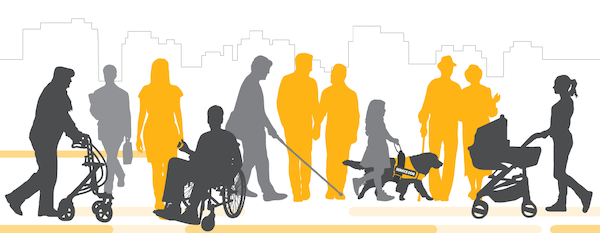
This month, Jewish communities across North America take time to recognize and celebrate one of the world’s largest and often overlooked minorities: persons with disabilities. Jewish Disability Awareness and Inclusion Month (JDAIM) was launched by a Jewish educational consortium in February 2009. It’s no surprise that its call to action resonates loudly with Canadians – Canada is believed to be the only country in the world that has disability rights enshrined in its constitution.

As someone with disabilities, I can see why a cold and often blustery month was chosen to mark the need for better inclusion. February weather often comes with its own navigational challenges. For the more than 6.2 million Canadians who live with disabilities, icy streets, cold, rain, snow and dismal skies can be even greater impediments to independence.

As I discovered one winter, however, an inclusive community can also play a significant role in easing those challenges. In 2015, my husband and I were in Idaho caring for his mother when I received word that my mom was in the hospital. I needed to come back to Vancouver.

Returning home wasn’t an issue for me. I had traveled to Vancouver many times to visit and care for family members. Attending Shabbat services at my local synagogue had become a ritual each trip that helped provide balance and focus. The Isaac Waldman Jewish Public Library, which afforded me a place to write, had been my other essential refuge.

But this time there was a problem: I couldn’t make the trip alone. As is true with many people diagnosed with an autoimmune disease, my symptoms were multi-factorial and differed according to the time of year. In this case, my biggest adversary was the ups and downs of winter weather and their impact on my circulatory system. This year, the flares were worse. I knew Happy, my trained service dog, would be needed in order to make the trip. Weighing 50 kilograms and hip-high, my King shepherd was strong enough not only to provide support when I walked, but help me up when I fell.

Judaism has never been terribly comfortable with the idea of an animal stepping inside a synagogue, even a professionally trained service dog. In my grandparents’ time, such considerations would have been unheard of. The prospect of a guide dog inspired lengthy debates by 20th-century rabbis who held wildly differing views about the appropriate accommodation for community members with disabilities. As I picked up the phone to call the synagogue, I readied myself for the possibility that I wouldn’t be attending Shabbat services that trip.

There was an understandable pause on the other end of the line when I asked if I could bring my mobility service dog to services. I was told to hold on; she would ask the rabbi. The answer came almost instantaneously: the congregation would be pleased to welcome us to shul.

If there is anything that these last two years of COVID precautions have underscored, it’s the irreplaceable value of community. Sitting in synagogue and having access to the community resources I cherished during my times in Vancouver helped provide a sense of normalcy while I dealt with my mother’s illness. Happy’s stoic, quiet strength not only gave physical support when I needed it, but a heightened sense to unfamiliar territory. Research has found that service dogs can detect changes in heart rate with a range of medical challenges, including heart conditions and diabetes. More than once, Happy guided me back to a point of safety when he sensed my legs weren’t able to navigate the cold.

To educate the library’s many young visitors about its unusual working visitor, the head librarian at the time, Helen Pinsky, informed patrons of Happy’s visit. The Jewish Community Centre of Greater Vancouver did its part to make us feel welcome as well. Most surprising were the parents’ reactions. Many saw our presence as an opportunity to teach children about respecting the role of a service dog and the person at his side. One mother confided that her little boy, who struggled with his own physical disability, was uplifted when he met Happy.

This issue’s article on disability explores the many ways that Vancouver Jewish institutions are working to increase disability awareness and inclusion. (Click here to read.) The examples are paired against research that suggests that while U.S., Canadian and Israeli Jewish communities continue to make remarkable strides in this area, there’s more that can be done. Building a disability-inclusive community is most successful, the research found, when leadership reflects the society it leads. We spoke with one rabbi who is using his own medical challenges to uplift and inspire those with differing abilities in his community.

I have come to realize over the years that a truly inclusive community is one that sees no limitations in how it defines capacity. We all have our limitations, and our unique gifts. We all have our dis-abilities. By bolstering diversity and inclusion in the society in which we live, we not only lift up those beside us, we lift those who will follow after us.

Jan Lee is an award-winning editorial writer whose articles and op-eds have been published in B’nai B’rith Magazine, Voices of Conservative and Masorti Judaism and Baltimore Jewish Times, as well as a number of business, environmental and travel publications. Her blog can be found at multiculturaljew.polestarpassages.com.

Posted on February 25, 2022February 23, 2022Author Jan LeeCategories Op-EdTags disability awareness, inclusion, JDAIM
Artwork of belonging

Artwork of belonging

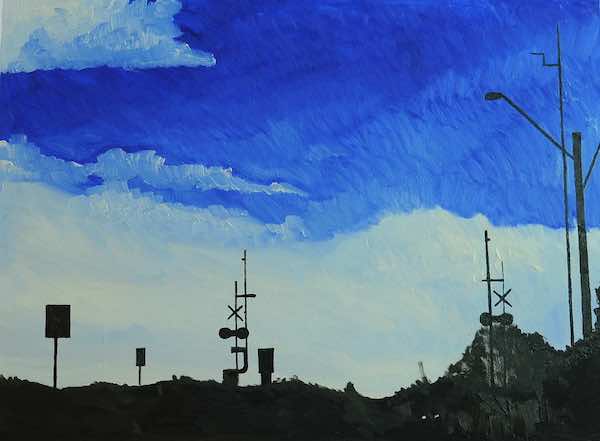
Mike Levin’s “Waiting for the Train.”

Community Longing and Belonging is a community art show in celebration of Jewish Disability Awareness and Inclusion Month. It opened at the Zack Gallery on Feb. 14.

Curated by Leamore Cohen, inclusion services coordinator at the Jewish Community Centre of Greater Vancouver, the fourth annual exhibit once again considers the questions, How do we make meaning of the concept of community, the real and the imagined spaces we inhabit? What does community longing look like and what are the possibilities for belonging in an ever-changing world?

Many of the pieces on display were made by artists from JCC Art Hive, a free and low-barrier program for artists with diverse needs. The collection comprises the work of diverse artists, with different levels of experience, perspective, faith and social location.

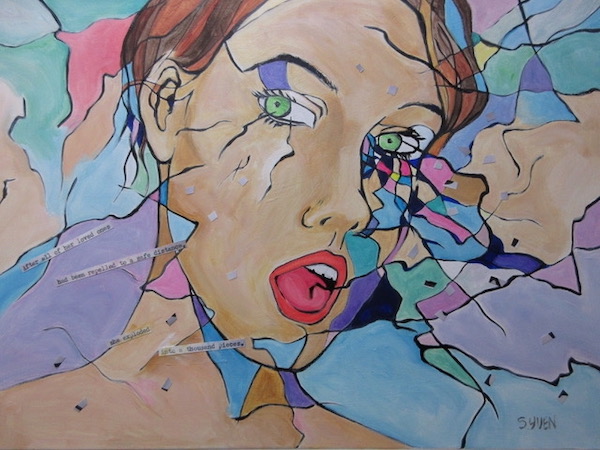
One of those featured is award-winning artist and writer Sandra Yuen, who is a member of Kickstart Disability Arts and Culture. Her piece, “Exploded,” is based on the prose of Derrick Bauman, an artist and writer, and influenced by pop art, Roy Lichtenstein, and graphic design. In her artist’s statement, Yuen writes, “As a person with schizophrenia, I wanted to express the fractured mind, the cut edges, the shattering of my life experience because of mental illness. However, this rendition is more a poetic image versus the cruel reality of living in madness, paranoia, hysteria and anger. The colours are sweet, the black lines clean and sharp, creating a mythological or romanticized view of insanity. I try to whitewash my life, sanitize the pain out of it, deny the diagnosis, but the illness remains, the weakness, the flaws, the humanity.”

photo - “Exploded” by Sandra Yuen
“Exploded” by Sandra Yuen

Mike Levin’s “Waiting for the Train” is about being shrouded in darkness, yet feeling the abundance of sunshine not far away. It is a metaphor for the continued longing for COVID to end so that we can get back to normal living.

Levin’s paintings are often abstractions of nature or city life that conform to structure of composition. They are amalgamations conjured from his imagination, photos he has taken and memories of his experience of exploring.

Growing up in Calgary, Levin has practised art from a young age, and also plays clarinet and saxophone. He attended the University of Calgary’s fine arts and urban studies programs and, after moving to Vancouver, completed his bachelor’s degree in fine arts at Emily Carr University of Art + Design in 2020.

For the past 20 years, Levin has lived with schizo-affective disorder, which he controls through medication and being active in the arts and mental health communities. He has taught drawing and painting at Vancouver General Hospital, the Art Studios, Gallery Gachet and privately within the community; he also works part-time in carpentry. His art has been sold in Canada and the United States to more than 70 private collectors.

Mark Li is a Vancouver-based visual artist whose narrative-focused work creates a whimsical world filled with colour and imagination, as his untitled work in this exhibit shows. Every painting is a tale of friendship and acts of kindness: a bear might be best friends with a cat; a T-Rex smiles with shy humour and sweetness at the viewer; a lady bug and a cat might go dancing in the sunlight; a simple walk in the park with a friend and his dog is a delightful adventure – anything could happen and they could meet anyone.

photo - “Untitled” by Mark Li
“Untitled” by Mark Li

Rickie Sugars’ “Like Minded” is an example of his unique style of painting in abstract cubism expressionism, using bold colours and black outlines.

A seasoned professional artist, Sugars had his first gallery showing, and sold his first painting, at the age of 17. Since then, he has displayed and sold his art in several galleries and art shows throughout British Columbia.

Sugars is a classical animation graduate from Vancouver Film School. He started creating animated characters well before graduation, resulting in a partnership in an animation company that went on for many years. Continuing his artistic path, he began tattooing in 2004 and has his own tattoo shop. He also designs sculptures created from broken toys.

A few years ago, during an attempt to assist a woman who was being attacked, Sugars received a traumatic brain injury. He had to re-learn everything, including how to talk – however, it did not stop his artistic endeavours. Today, you will find Sugars painting on canvass (or any surface, really), crafting stickers, postcards, wall murals, sand and wood sculptures, and interior/exterior commissioned graffiti.

“My artwork is influenced by media, fads, plus social, political and cultural issues,” he writes in his artist statement. He wants viewers “to look past the obvious, to treasure and celebrate the unique, the unconventional, the familiar: and to be nonjudgmental. Respect others and support them for who they are. Find the beauty in broken toys, an old door, a broken guitar – take time to look more carefully at things around you and you’ll discover beauty in unusual places.”

Another of the artists contributing to the Community Longing and Belonging exhibit is Adrianne Fitch.

Born in Kew Gardens, Queens, N.Y., Fitch studied English and writing at Pennsylvania State University and has traveled all over the world, including living and studying in Israel. She has lived in Vancouver since 2008 and pursues a number of other art forms. She is also a writer and desktop publisher.

“Having lived with a hearing disability and also struggled with depression all my life,” she writes, “I definitely know what it means to feel isolated. As hearing loss is invisible, people frequently make assumptions about me (e.g. they think I’m stupid, stoned or purposely ignoring them). As I did not begin learning ASL until adulthood, I occupy that grey area between the hearing and deaf worlds. I miss a great deal of communication, both spoken and signed, and have often felt as though I don’t belong anywhere.

“That’s why this art show’s theme, Community Longing and Belonging, is so significant and meaningful to me. Indeed, I have always longed for community and belonging. The Jewish community, with its wonderful heritage and incredible diversity, is very precious to me. In creating these three ceramic menorahs, I have tried to express this diversity, as well as my love for the Jewish people.”

Community Longing and Belonging is at the Zack Gallery until March 17. There is a virtual meet-and-greet with the artists on March 2. Visit jccgv.com/art-and-culture/gallery or email Cohen, [email protected], for more information.

– Courtesy Jewish Community Centre of Greater Vancouver

Format ImagePosted on February 25, 2022February 23, 2022Author Jewish Community Centre of Greater VancouverCategories Visual ArtsTags Adrianne Fitch, art, disability awareness, diversity, graphics, inclusion, JDAIM, Leamore Cohen, Mark Li, Mike Levin, painting, Rickie Sugars, Sandra Yuen, sculpture, Zack Gallery
Accessibility seems improved

Accessibility seems improved

(image from flickr / Province of British Columbia)

Last November, the American advocacy organization Respect Ability announced some good news. New research it had conducted in 2021 suggested that disability awareness and inclusion was improving in Jewish communities across North America and Israel. According to its most recent survey, more synagogues, Jewish community centres, schools and private institutions are designing programs that consider the needs of people with disabilities. And more individuals are able to find Jewish organizations that support individuals with invisible disabilities like autism and attention-deficit/hyperactivity disorders.

Respect Ability’s goal for the survey was to determine the health of disability rights in diverse Jewish communities, particularly in countries where there were laws against employment and housing discrimination. Its last survey had been in 2018, and researchers wanted to know whether accessibility and acceptance had improved in the past three years.

There were just over 2,000 respondents in total, primarily from Canada, the United States and Israel. The overall message was that inclusion and accommodation was expanding. Accessibility for wheelchairs and improved opportunities for individuals with sight or hearing challenges were on the rise, as were outreach efforts for individuals with disabilities in general.

What is more, the number of faith organizations hiring rabbis and staff who had disabilities and, therefore, understood firsthand the challenges of a physical or cognitive disability, had increased by more than 73%. More than half (57%) of the survey-takers also said that the organizations had made public commitments to support diversity.

But the survey also identified a key obstacle: many community leaders wanted to help expand opportunities for inclusion, but “didn’t know how.” Roughly one-fifth of all respondents said that expanding opportunities in their faith communities was limited by leaders’ lack of knowledge or experience in making settings more accessible. This meant, in some cases, that members with invisible disabilities like autism or ADHD didn’t have access to resources or were turned away from programs and activities.

Most of the responses to the survey came from Respect Ability’s home base: U.S. states like California and New York, where laws and advocacy initiatives are different from those in Canada. Only about 7% of the responses came from Canada, where disability rights are protected by the federal Charter of Rights and Freedoms. The survey also did not reveal how much, or if any, of the Canadian data came from the Vancouver area. So, are the survey’s findings reflective of diversity inclusion here?

The last three years have been challenging for many, but particularly for organizations that rely on in-person community participation. The 2020 shutdown of schools, synagogues and community centres due to COVID forced many organizations in the Vancouver area to suspend programs that offered disability-inclusive services. Still, the Jewish Independent found that a number of organizations were able to develop creative ways to maintain their inclusive classes and programs.

Trying to inspire inclusion

In 2018, the Jewish Federation of Greater Vancouver launched its Inspiring Inclusion grant program to assist community organizations in designing or improving inclusive programs. The grant competition was created as part of its 2020 Strategic Priorities, and it offered up to $2,500 to organizations that developed a new program or idea that would expand disability inclusion.

Four one-year grants, which were awarded in 2020, went to Vancouver and Richmond applicants. Each offered a unique way for engagement, ranging from new educational strategies that catered to individual learning approaches to special equipment that helped expand creative participation in the classroom.

The Jewish Community Centre of Greater Vancouver’s Family Yoga Fundamentals program was designed to appeal to a variety of abilities and offered options for in-person family participation. It later gave rise to a virtual format that attendees could link up with from home. According to the JCC’s adult programs coordinator, Lisa Cohen Quay, Family Yoga Fundamentals integrates adaptable exercises that are non-stigmatizing and fit a variety of abilities. Quay said the program has also been shown to help with pandemic stress and loneliness.

Richmond Jewish Day School turned to music as a way to inspire inclusion. According to principal Sabrina Bhojani, the grant provided funding for specially adapted Orff percussion instruments, or xylophones that could be used by students with special needs. “Music education is an integral component of both our B.C. and Hebrew curriculum at RJDS,” Bhojani said. “Weaving music into [the] curriculum is a meaningful way to help our students develop their Jewish identity and better understand their culture.”

Congregation Beth Tikvah used the funding to help develop Kavod. According to Rabbi Susan Tendler, the program aims to ensure that the synagogue’s services and activities are open to everyone, “regardless of personal physical, financial, or accessibility limitations.” Kavod’s development is ongoing.

Congregation Beth Israel received a grant to create new Hebrew school programming. Beth Israel’s director of youth engagement, Rabbi David Bluman, said the funding helped make the Hebrew reading program more inclusive to children with learning challenges. “We always strive to be [as inclusive] as we can,” he said, adding that many of Beth Israel’s youth programs are adaptable to students’ abilities, such as the use of “shadow” companions who function as a “big brother or big sister” for a child during activities and lessons. The shadow program can be used for age levels. “We want our teens to be as independent as possible,” Bluman said.

B’nai mitzvah programs

Both Beth Israel and Temple Sholom tailor their b’nai mitzvah programs to meet the specific abilities of the child. Temple Sholom School’s principal, Jen Jaffe, said about 10% of the student body have varying needs.

“All b’nai mitzvah-aged children are given the opportunity to have a b’nai mitzvah, and the clergy works with each family to make sure expectations and goals are feasible and met. Each child is given the chance to shine regardless of any disabilities,” Jaffe said. The school also trains madrachim, or helper students, to support students with invisible disabilities.

Beth Israel is also known for its inclusive b’nai mitzvah program, which is led by ba’allat tefilla Debby Fenson. She said the program is designed to ensure that a child, irrespective of ability, can participate in the service: “I think that the expectation is that every child should be called up to [the bimah]. It’s not about how well they read the Torah, it’s about welcoming them into the community.”

Fenson said the community has celebrated more than one b’nai mitzvah in which a child’s medical challenges needed to be considered. In one case, the child, who was nonverbal, was aided by his mother in saying the Shema. “There was clear understanding on his part,” Fenson said. “His mother helped him in forming the words and saying along with him. He was welcomed into the community.”

Leadership by inclusion

Respect Ability’s survey of North American and Israeli Jewish communities highlighted two factors that are often important to creating inclusiveness: the top-down commitment to diversity and a leader’s personal experience. All of the above synagogues, schools and community services – as well as others – benefit from clear initiatives that attract families with accessibility needs and see inclusion as an expanding mission. In some cases, they also benefit from leadership that is open about their own health challenges as well.

Beth Israel Rabbi Jonathan Infeld said he is aware that his willingness to talk openly about his own challenges can help create a supportive environment for others. Infeld was born with a congenital heart defect.

“Unfortunately, I have firsthand experience with health issues that I am happy to share with people about, certainly because I want to be transparent about who I am as a human being…. I would hope, had I been born with a whole heart and not a hole in it, that I would still have a whole heart,” he said, noting that when we’re forced to reflect on our own abilities and limitations, it can inspire empathy for others faced with similar challenges.

One area that was not addressed in the survey was accessible housing, which helps expand disability inclusion. Tikva Housing Society’s very first housing project in 2008 contained accessible units. The organization’s third inclusive property, Dogwood Gardens, opens this year in the West End. This will be the subject of a future story in the Jewish Independent.

Jan Lee is an award-winning editorial writer whose articles and op-eds have been published in B’nai B’rith Magazine, Voices of Conservative and Masorti Judaism and Baltimore Jewish Times, as well as a number of business, environmental and travel publications. Her blog can be found at multiculturaljew.polestarpassages.com.

Format ImagePosted on February 25, 2022February 23, 2022Author Jan LeeCategories LocalTags b'nai mitzvah, Beth Israel, Beth Tikvah, Debby Fenson, disability awareness, health, inclusion, JCC, JDAIM, Jen Jaffe, Jewish Community Centre of Greater Vancouver, Jewish Federation, Jonathan Infeld, Lisa Cohen Quay, music, Respect Ability, Richmond Jewish Day School, RJDS, Sabrina Bhojani, survey, Susan Tendler, Temple Sholom, Tikva Housing

Turning tragedy to hope

The year 2016 was a milestone for Kalman and Malki Samuels. It marked the inauguration of a dream years in the making – the opening of the Shalva National Centre, one of the largest centres of disability care and inclusion in the world. Built not far from the entrance to Jerusalem, the 12-storey world-class complex features an auditorium, a gymnasium, hydrotherapy and semi-Olympic pools, a virtual reality therapy suite, a research and study institute, a café, some of whose workers have developmental disabilities, and accommodations for 100 respite sleepovers per night.

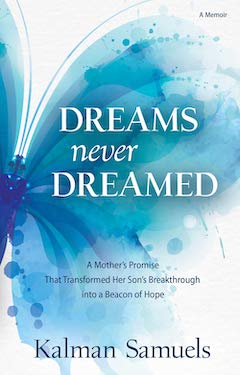
How was it that Kalman and Malki Samuels came to create this extraordinary organization that assists 2,000 children with disabilities each week, while empowering families and promoting social inclusion? The answer lies in the subtitle of Vancouver native Kalman Samuels’ Dreams Never Dreamed: A Mother’s Promise That Transformed Her Son’s Breakthrough into a Beacon of Hope (Toby Press, 2020) – it was a mother’s promise.

In 1977, the couple’s healthy, lively baby boy, two weeks short of his first birthday, was checked by a doctor at a Jerusalem clinic before receiving his second DTP inoculation; and all his developmental milestones were fine, so the nurse gave him the shot.

But Malki knew the same day that something was wrong. “I took Yossi home and followed the instructions they’d given me at the clinic…. I bathed him, gave him baby paracetamol and let him sleep. The moment he woke, I knew my baby was gone. He looked up at me with shiny eyes as if to say: ‘What have you done to me?’”

Only later did the couple discover that, on that October afternoon, “Israel’s health authorities had already known for almost five months that the vaccine batch they were using … was dangerously flawed.” The defective pertussis (whooping cough) component was from the Connaught Laboratories of Canada. The diphtheria and tetanus components were from the Israeli company Rafa, which had combined the three.

Thus began a saga of almost 40 years of anguish, faith, research, perseverance, legal battles and, ultimately, the realization of dreams, not only for the injured Yossi, but for thousands of other children with disabilities.

image - Dreams Never Dreamed book coverDreams Never Dreamed is written chronologically, beginning with Kalman’s personal story of visiting Israel as a college student in the 1960s, eventually becoming Orthodox, making aliyah and marrying his life partner. He writes his family’s spellbinding story with an honesty and openness that opens and pierces our hearts as well.

Yossi was ultimately diagnosed as legally blind – though he loved to wear glasses because it helped him feel more competent – and legally deaf. He is also severely hyperactive.

The Samuels left their home in Israel for New York, following every medical lead in search of help for their son. While her son was attending the Lighthouse – a famous specialized school for the visually impaired – Malki made a pact with God: “… I promise You this. If You ever decide to help my Yossi, I will dedicate my life helping so many other mothers of children with disabilities whom I know are crying with me for their children.”

Some challenges were especially painful, like when children teased Yossi, or when an important Jerusalem rebbetzin, visiting New York, said to Malki, “It’s not fair to yourselves or your healthy children…. You should consider moving this child out of the house, so you can get on with your lives.” Malki answered her: “You have no faith in God.” She invited the rebbetzin to wait 20 minutes, till Yossi came home from school. She saw a child nicely dressed, with glasses and hearing aids, carefully navigating the steps and hugging and kissing his mother, happy to see her. The rebbetzin cried and asked forgiveness.

A few years later, the couple learned that a lawsuit could only be filed in Israel, since that was where the vaccination had been administered. They found an excellent Israeli lawyer and doctors willing to testify, and the family returned home. Samuels describes the legal battles in excruciating detail. In October 1983, five years after the vaccination and after exhaustive paperwork and research, the couple filed suit against the Canadian Connaught Laboratories, the Israeli Rafa pharmaceutical company, the city of Jerusalem and the State of Israel. (The lawsuit ended in a settlement that, even according to the judge, was less than they deserved, but would save them more years of expensive and aggravating legal action.)

At the age of 8, Yossi experienced a “Helen Keller” moment, when Shoshana Weinstock, a warm and loving teacher who was deaf herself taught him his first word – shulchan (table) – using finger spelling. “All of a sudden, he lit up and he got it,” Kalman is quoted as telling the Jerusalem Post. “She taught him the 22 letters of the Hebrew alphabet. Another speech therapist taught him how to speak Hebrew and, slowly, he began to talk.” After that, Yossi was unstoppable. He learned to type on a Braille typewriter, to pray and to speak to those who were able to understand him.

Spurred on by their son’s breakthrough, in 1988, the couple wrote the first proposal for an outreach program that would help other families with children with disabilities. In 1990, that proposal became Shalva, the Israel Association for the Care and Inclusion of Persons with Disabilities, which began as an afterschool program for six children in the Samuels’ Har Nof apartment. The name Shalva is derived from Psalm 127 and means serenity, but, like any new enterprise, the road to success was challenging. The book is filled with anecdotes about how chance meetings on airplanes, or through conversations with a friend or a neighbour, Kalman reached donors who kept Shalva going and led to its development and expansion.

In addition to giving her life and creativity to making sure the professional programs would be the best they can be, Malki, the powerhouse engine behind Shalva, was involved in every aspect of the design and building of the Shalva National Centre, right down to the tiles. She was determined that it feel like a home, not an institution. Renowned Israeli artist David Gerstein, deeply moved by the Shalva story and appreciating Malki’s vision, created a magnificent 20-foot-high mobile of metallic butterflies that hangs in the Shalva atrium.

Around 2005, a gifted young musician, Shai Ben-Shushan, offered his services to Shalva. He had been a member of the Duvdevan special forces unit in the Israel Defence Forces and suffered severe injuries from a grenade attack while pursuing terrorists. He told Kalman, “Like a baby, I had to learn again to eat and to talk. My life was destroyed … I learned what it was like to be helpless and dependent on others  … and I began to think about going back to music and sharing it with others who have similar challenges.”

By the end of a year, Shai had created the now world-renowned Shalva Band, signaling to all that having disabilities does not mean one cannot reach for the stars and make dreams come true.

In 2020, Shalva graduated its first program of young men who entered the IDF as soldiers in the Home Front Command unit. Israel’s Ministry of Foreign Affairs brings heads of state and diplomats to Shalva, just as they take them to Yad Vashem: World Holocaust Centre and to Mount Herzl, the burial place of soldiers who died defending the state of Israel.

Dreams Never Dreamed is alternately inspiriting, infuriating, funny and enlightening, but, for me, Malki’s voice and her photograph are missing. If you want to “meet” her, you can watch a mesmerizing Shalva-produced film on YouTube, About Yossi – A Film About Yossi Samuels.

The Yossi of today is smart, learned, eloquent and brave, with a sharp sense of humour. He can type, read, and daven in Braille, and particularly enjoys high-level Torah literature and magazines. He has traveled the world, met with celebrities and presidents (in Israel and America), is a horseback rider and a certified wine connoisseur. Kalman writes, “[Yossi’s] close friends number in the hundreds and acquaintances in the thousands.”

As his walking ability and balance worsened, Yossi eventually required a wheelchair. “Our blind and deaf son said, ‘For the first time in my life, I feel handicapped,’” writes Kalman. “Yossi had never referred to himself as blind or deaf, but rather ‘low vision’ and ‘hard of hearing.’”

Kalman recalls in the book how his daughter, Nechama, told him that he was like Forrest Gump: “Mommy had her dream and told you, ‘Run, Kalman, run!’ You’ve never stopped; it has coloured your life and all of ours.”

And the lives of thousands more.

Toby Klein Greenwald is an award-winning journalist, the artistic director of Raise Your Spirits Theatre, a poet, a teacher and the editor of wholefamily.com. This review first appeared in the Fall 2021 issue of Jewish Action.

Posted on February 11, 2022February 10, 2022Author Toby Klein GreenwaldCategories BooksTags aliyah, health, inclusion, Israel, Kalman Samuels, Malki Samuels, memoir, Shalva Centre, Yossi Samuels
ADI Race for Inclusion

ADI Race for Inclusion

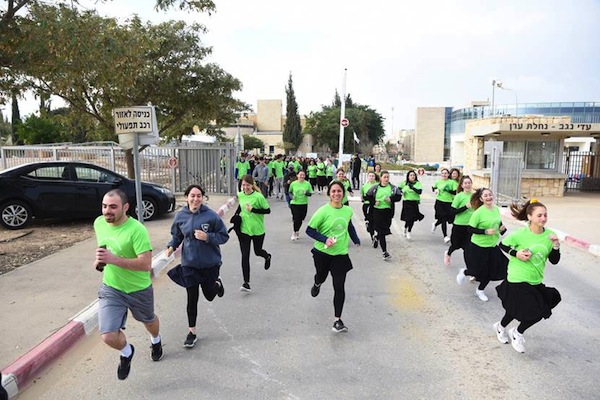
Vancouverite Vida Sussman (centre) was among those who pounded the pavement at ADI Negev-Nahalat Eran rehabilitation village to raise disability awareness at ADI’s first annual Race for Inclusion, which took place Dec. 29. (photo from ADI)

On the morning of Dec. 29, following a week of gloomy weather, the clouds gave way to sunshine as ADI, one of Israel’s most comprehensive providers of residential and rehabilitative care for individuals with severe disabilities, hosted its first annual Race for Inclusion. The 2.5-kilometre fun run highlighted the importance of disability inclusion while also raising more than $14,000 US to enhance ADI’s respiratory therapy and hydrotherapy programs.

More than 250 runners of varied ages, backgrounds and levels of ability ran together along a fully-accessible track that encircled ADI Negev-Nahalat Eran, the 25-acre rehabilitation village. This newest iteration of ADI Fleet – the organization’s inclusive running team – featured ADI residents, special education students and international volunteers, as well as nearly 180 North American gap year students studying at Israeli yeshivot and seminaries, including Mechinat Ruach HaNegev, Torah Tech, Tiferet, Yeshivat Ashreinu, Yeshivat Torat Shraga and Amudim. Among the runners was Vancouverite Vida Sussman, who is studying at Amudim this year.

Elie Klein, ADI’s North American director of development, said, “There is something very special and wonderfully symbolic about others coming to meet our residents and special education students where they are. ADI works so hard to ensure that every man, woman and child has tangible opportunities for encountering disability and promoting acceptance, and moments like these prove that we are on the right track and making serious strides for inclusion.”

At the conclusion of the race, all of the runners gathered in the village’s amphitheatre for a celebration featuring food, live music and speeches from special guests and ADI’s leadership. Three finalists from Israel Ninja Warrior received cheers after calling those assembled “heroic.”

“We thought we were strong,” said Israeli athlete Gur Arad. “But after seeing all of you running together today, we know that you are the strong ones.”

Sussman, one of eight Canadians who participated in the event, also volunteers one day a week at ADI Jerusalem, the organization’s residential and rehabilitative centre in Israel’s capital.  She describes the atmosphere as “loving, familial and an incredible learning experience,” noting that she jumped at the opportunity to do more for the organization.

“I feel very lucky to be volunteering at ADI, and I was so excited to participate in the Race for Inclusion. The energy that everyone brought to the event was incredible, and it made me so happy to see all the participants from different levels of ability having so much fun together,” said Sussman.

“This amazing event highlights exactly why supporting ADI is so important to me,” she added. “Not only are they committed to providing the best medical and rehabilitative care for their residents and special education students, but they do everything possible to advocate for them and infuse their lives with joy. I look forward to continuing to be a part of the ADI family and supporting the important work they do for years to come.”

Maj.-Gen.  (Res.) Doron Almog, the founder and chair of ADI Negev-Nahalat Eran, closed out the event by thanking the gap year students for raising disability awareness and encouraging them to continue “carrying the message of inclusion and love.”

“Always remember that we are all just temporary creatures. We come one day and we pass the next, and we need to give meaning to our lives in between. We do that by taking responsibility for one another, especially those with severe disabilities who need extra love and care,” said Almog. “By coming here today to participate in ADI’s Race for Inclusion, you fulfilled the most noble of responsibilities, to truly ‘care for your neighbour as yourself.’”

To learn more about ADI, visit adi-israel.org.

– Courtesy ADI


Format ImagePosted on January 28, 2022January 27, 2022Author ADICategories IsraelTags ADI, disability awareness, Doron Almog, fun run, inclusion, Israel, tikkun olam, Vida Sussman
Fun and safety during pandemic

Fun and safety during pandemic

In these uncertain times, JCC Camp Shalom set out to continue to be a constant source of fun and a safe environment for the whole community. For the second year, the exceptional circumstances of the COVID-19 pandemic demanded that the camp’s plans be reevaluated and adapted, as it partnered with King David High School to move the majority of its operations to the school’s building for last summer.

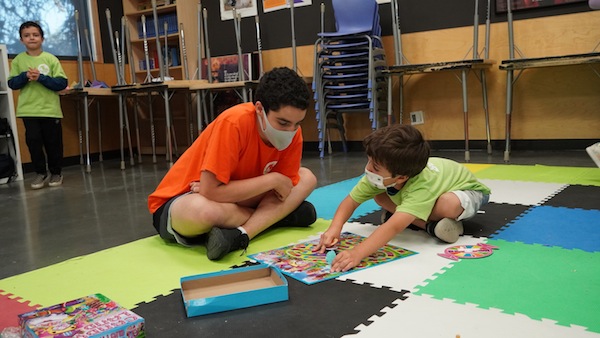
Camp Shalom is an inclusive Jewish day camp serving children, youth and teens from ages 3 to 18 years old, year-round, during school breaks and professional development days. Since the inception of the Inclusive Summer Camp Experience program in 2009, more and more children with diverse needs have attended Camp Shalom and participated in group activities, including overnight camping trips.

The number of children with diverse needs who attend Camp Shalom has grown from a handful to more than a dozen per summer – and the range of assistance provided for families has grown as well. Families are able to access more camp sessions and the camp can now support a wider range of ages and needs. Huge improvements have been made in accommodating campers in a true inclusion model and in providing opportunities for more Jewish programming beyond the summer, including Sunday Hebrew schools for those who did not have access to them prior to their experience with Camp Shalom.

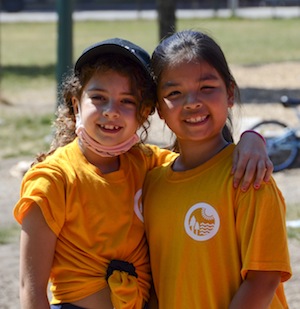
photo - Camp Shalom offers an inclusive setting for all ages, abilities
(photo from JCC Camp Shalom)

Thanks to the contributions of the Diamond Foundation and the Snider Foundation, Camp Shalom is able to support more campers and staff with diverse needs by providing special training sessions, mentorship programs and one-on-one support for those campers who need it. Campers who were part of the first inclusive camp experiences are now teenagers and young adults who are still connected to Camp Shalom, and some are now camp staff. This past year’s biggest achievements included engaging about two dozen children, youth and teens with diverse needs and successfully integrating them into the general camp program alongside 120 to 150 other campers in the camp’s preschool, school-age and teen programs.

JCC Camp Shalom likes to think of all youth as being in transition. It pays special attention to campers transitioning from childhood into teenagehood and those teens who are about to become counselors. Work experience is a huge milestone as they enter high school. At camp, they go from being campers to participating in the teen programs, to joining the staff team.

Regardless of their developmental stage and/or maturity level, and taking into consideration their diverse needs, these teens need more support and adaptations than any other group with which the camp works. Careful planning and consideration of their needs has resulted in a successful program that provides them with social and organizational education that will benefit them in the future, as they look for employment, as well as in other areas of their lives.

JCC Camp Shalom is the largest summer Jewish day camp for youth in Vancouver, but its responsibility continues, as the engagement with youth extends beyond summer camp to throughout the year. As teens develop, Camp Shalom recognizes their need for adults with whom they can connect, that they can trust and who can be positive role models. Staff from the summer teen camp programs are educated and qualified to sustain positive and appropriate relationships with youth as they age. The inclusion model of camp programming allows campers with diverse needs to have an unforgettable Jewish experience at Camp Shalom.

For more information about the Inclusive Summer Camp Experience or Camp Shalom’s teen programs, contact Ben Horev, camp director, at 604-813-4236 or [email protected].

– Courtesy JCC Camp Shalom

Format ImagePosted on January 14, 2022January 13, 2022Author JCC Camp ShalomCategories LocalTags Alliance for Jewish Renewal, Camp Shalom, COVID, day camp, inclusion, JCC, Jewish camp, Judaism, kids, pandemic
Bringing community together

Bringing community together

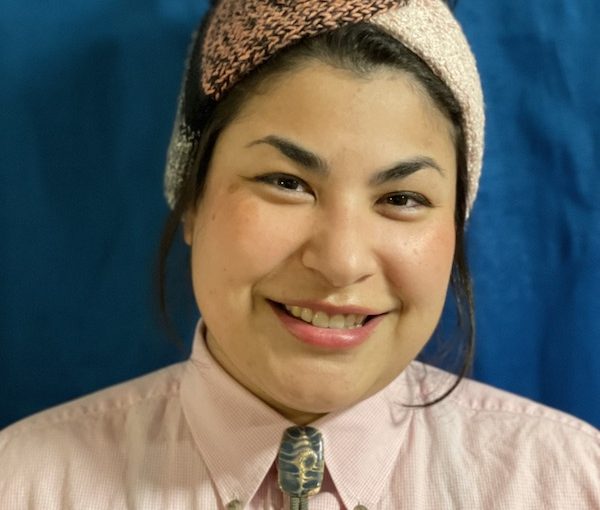
Carmel Tanaka has many diverse community projects on the go. (photo by Heather McCain)

Community engagement professional Carmel Tanaka gave a talk entitled A Day in the Life of a Queer, Neurodivergent, Jewpanese Millennial to a Zoom audience on Dec. 5. The lecture was part of Kolot Mayim Reform Temple’s 2021-22 speaker series Building Bridges: Celebrating Diversity in Jewish Life.

Tanaka, who founded and helms Vancouver’s JQT (pronounced J-Cutie), a nonprofit that advocates for the Jewish queer and trans community through dialogue and education, began her presentation by discussing her Jewish and Japanese heritage and the generational impact of both the Holocaust and the Japanese internment camps in Canada.

She introduced her family through numerous photographs going back two generations; her mother is a first-generation Ashkenazi Jewish Israeli from Haifa and her father is a third-generation Japanese Canadian.

Though she had an opportunity to meet three of her grandparents, they all passed away when she was relatively young. “I was definitely at an age when I was not nearly old enough to ask them the questions that I would desperately want to ask them now, particularly what they went through in the Holocaust, and Japanese Canadian internment,” Tanaka said. “The traumas of those two periods have greatly affected my family and informed the social justice work that I do.”

Fast-forwarding to December 2020, the screen shifted to the scene around the table during her father’s 75th birthday party. On what she described as a “completely normal to me” dining room table were doriyaki (Japanese steamed, sweet-filled pancakes), Jewish coffee cake, Japanese tea and Chanukah candles.

“Perhaps many of the tables in the local community have a similar melding of traditions as well,” she mused.

The offspring of two gifted cooks, Tanaka became a foodie in her own right. Many of her recipes – these include miso maple steelhead trout for Rosh Hashanah and matcha cheesecake for Shavuot – can be found on the internet, on such sites as My Jewish Learning.

With her recipes available online, many people of mixed Jewish and Japanese descent from around the world have reached out to Tanaka, making her realize that the global Jewpanese community is larger than she first thought it was.

Tanaka segued to the importance of names, and how her name differs depending on which group she may be addressing. For example, she uses Carmel in Jewish settings and Aya in Japanese setting because the name Carmel can be difficult to pronounce for Japanese speakers.

She then discussed JQT, which dedicates itself to creating connections and seeking space to celebrate the intersectional identities of Jews of all ages, diverse sexual orientations, as well as gender and sex identities, by “queering” Jewish space and “Jewifying” queer space.

One of the ways she queers Jewish space is through food. A pre-pandemic photo featured her selling community-donated rainbow challot glazed with apricot jam and rainbow sprinkled hamantashen at the Jewish Community Centre of Greater Vancouver.

JQT is also a partner organization of a project called Prism, a North American initiative that brings together Jewish artists of colour and is a place where, Tanaka said, she can celebrate all of her identities.

Another JQT venture is the B.C. Jewish Queer and Trans Oral Project, a collection of oral histories conducted in partnership with the Jewish Museum and Archives of British Columbia, and the first project of its kind in the province. Its objective is to make the archives more complete by providing the stories of older queer and trans members of the community. The first phase of the project was to conduct the interviews from May 2020 to July 2021. The second phase, now underway, is to use the material for a public online exhibit to give a voice to “a marginalized community within a marginalized community.”

Lastly, and fitting for the time of year, Tanaka spoke about JQT’s Hanukkah Hotties initiative, a daily set of Facebook livestreams throughout the holiday, in which a different guest lights their chanukiyah or shares another tradition. Guests chat about their life, art, activism and intersecting Jewish, queer, trans identities for the duration of the candles’ burning. This year’s lineup included, among others, Karen Newmoon, an Indigenous Jew-ish farmer; the Klezbians, “a band of unruly, chutzpah-licious musicians from the Isle of Klezbos”; and the Empress Mizrahi, a nonbinary/queer Persian Jewish Instagram content creator and activist in Los Angeles.

The pandemic has clearly not slowed Tanaka down by any means. She continues to be involved in another group she founded, Genocide Prevention BC, a cross-cultural collective of provincial representatives committed to the prevention of genocide and crimes against humanity.

She also works on her initiative, the Cross Cultural Walking Tours, a grassroots endeavour celebrating the multicultural history of Vancouver’s Downtown Eastside. These tours build awareness of the contributions of early immigrant communities and take place in May, which, in Canada, is both Asian Heritage Month and Jewish Heritage Month.

Tanaka, who once served as Hillel director at the University of Victoria, was recently named one of seven LGBTQ+ Jews of Colour You Should Know by Be’chol Lashon, a group that gives voice to cultural diversity in the Jewish community. She was also one of four local leaders featured in the article “The Push for Progress,” which was in the Fall/Winter 2021 issue of BCAA magazine.

Tanaka sees herself as well positioned to bring communities together. “As a mixed-race person, I have felt what it’s like to not be fully accepted by my own community. The art of bridging communities and bringing people together is my humble craft,” she said.

On Dec. 19, 6 p.m., Tanaka will take part in a discussion with Sara Yacobi-Harris from the Toronto-based group No Silence On Race, hosted by Victoria’s Temple Emanu-El, called Let’s Talk About Diversity, Equity and Belonging in the Victoria Jewish Community. For more information, visit congregationemanuelnews.wordpress.com/2021/11.

As for Kolot Mayim’s Building Bridges series, Rivka Campbell, co-founder of the organization Jews of Colour Canada, is the next speaker. On Jan. 9, Campbell will talk on the topic Harmony in a Divided Identity: A Minority within a Minority. To register, visit kolotmayimreformtemple.com.

Sam Margolis has written for the Globe and Mail, the National Post, UPI and MSNBC.
Format ImagePosted on December 17, 2021December 16, 2021Author Sam MargolisCategories LocalTags Building Bridges, Carmel Tanaka, community engagement, diversity, genocide prevention, inclusion, JQT, Kolot Mayim, LGBTQ+, oral histories, Victoria, walking tour
JQT’s 2021 Hanukkah Hotties

JQT’s 2021 Hanukkah Hotties

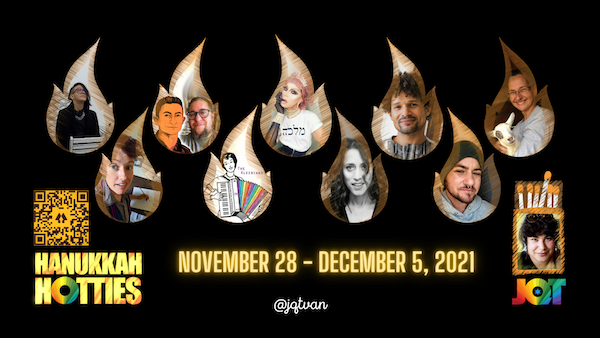
(image from JQT)

JQT Vancouver has a sizzling lineup of Hanukkah Hotties this year. Tune in to daily livestreams on Facebook with each Hanukkah Hottie, as they light their chanukiyah or share another tradition, and chitchat with JQT about their life, craft, activism and intersecting Jewish queer trans identities for the duration of the candles’ burning.

Hosted by Carmel Tanaka, founder and executive director of JQT Vancouver, who identifies as a queer, neurodivergent, Jewpanese woman of colour, the scheduled guests are:

Candle 1 (Nov. 28, 7 p.m.): Karen Newmoon, an Indigenous Jew-ish land dyke and subsistence farmer in Johnsons Landing, B.C.

Candle 2 (Nov. 29, 7 p.m.): Jersey Noah, a Jewish (Sephardi/Ashkenazi) transgender, autistic stoner in Oakland, Calif.

Candle 3 (Nov. 30, 7 p.m.): Adam W. McKinney / LaShawnah Tovah, a gay, Black, Native Jewish artist, and co-director of DNAWORKS in Fort Worth, Tex.

Candle 4 (Dec. 1, 1 p.m.****): Aviva Chernick, a queer, Jewish artist, and voice and meditation teacher in Toronto, Ont.

Candle 5 (Dec. 2, 7 p.m.): The Empress Mizrahi, a nonbinary/queer Persian Jewish Instagram content creator and activist in Los Angeles, Calif.

Candle 6 (Dec. 3, 7 p.m.): The Klezbians, a band of unruly, chutzpah-licious musicians from the Isle of Klezbos in Victoria.

Candle 7 (Dec. 4, 7 p.m.): Saul Freedman-Lawson and S. Bear Bergman. Freedman-Lawson is a student and illustrator in Toronto and Bergman is trans writer and educator from Toronto.

Shamash candle (Dec. 5, 9 a.m.): Tikva Wolf, a cartoonist in Asheville, N.C. (Cherokee territory).

Candle 8 (Dec. 5, 7 p.m.): Ari Fremder, a nonbinary, autistic, Latinx artist/animator and JQT Dream Team member in Vancouver.

During the livestream, closed captioning will be provided by Facebook’s AI bots, and JQT volunteers aim to post edited closed captioning videos on both Facebook and YouTube two to three days after each interview.

This series is supported by Creating Accessible Neighbourhoods (canbc.org), an organization that advocates for and educates about people with disabilities and/or chronic health conditions who have multiple intersecting identities.

For more on the participating artists and JQT, visit facebook.com/jqtvan.

**** NEW TIME!

– Courtesy  JQT Vancouver

Format ImagePosted on November 19, 2021November 21, 2021Author JQT VancouverCategories Celebrating the HolidaysTags Chanukah, diversity, Facebook, Hanukkah Hotties, inclusion, Jewish Queer Trans Vancouver
Discussing Jewishness

Discussing Jewishness

Maxine Lee Ewaschuk, in a still from the documentary Periphery, which premièred last month at the Prosserman Jewish Community Centre in North York, and is available to view online.

On Oct. 28, the Prosserman Jewish Community Centre in North York hosted a hybrid launch for Periphery, a newly produced documentary film and photo exhibit that explores the lives of multiracial and multiethnic Jews within the Greater Toronto Area.

The 27-minute film features interviews with several individuals who might be considered as existing on the fringes of a homogenous, stereotypical notion of the Jewish world – a world that, in reality, is multifaceted and ever-evolving.

“What Periphery does for us is bring together a diverse view of our community,” said Andrew Levy, one of the event’s organizers.

From the outset, the film asks, “What makes a Jew? What do you have to know to be a Jew?” Implicit in those questions is another question, how can the Jewish community extend its tent to include those who might feel left out of the broader mishpachah, family? Notably, those whose parents are not both Jewish.

“There becomes a question of, can I say I am Jewish? When can I say I am Jewish? Is it ever OK for me to say I am Jewish before I complete my conversion, even if I am functioning very Jewishly in my day-to-day life. Sometimes, I say I am a Jew-in-progress,” shared dancer Maxine Lee Ewaschuk.

“Maybe I don’t know everything about what it is to be Jewish, but I am fiercely, proudly Jewish. It’s my experience and my experience is valid,” said actor Nobu Adilman, whose heritage is Jewish and Japanese.

“I knew my Indian grandparents super well, but I never knew where my Jewish grandparents came from,” said author Devyani Saltzman, who recounted a trip to Russia with her father to look into the roots of the paternal side of her family.

Saltzman also remembered an observation she had as a child of looking at other classmates who came from solely Hindu or Jewish families and thinking, non-judgmentally, “that must be really nice to know one’s place and space so clearly.”

In the cases of both Adilman and Saltzman, their parents married out of a love that transcended religious, cultural and geographic barriers.

“My father put a lot of his energy into my mother’s culture. He didn’t talk a lot about his upbringing. He was proudly Jewish, but he didn’t want to impose it on us,” Adilman said.

Adilman, too, related a kinship he has with other Jewish people who have gone through the same sorts of questioning that he has.

Ariella Daniels, Daniel Sourani and Sarah Aklilu each spoke of connections to places far removed from the GTA.

Daniels, who descends from Bene Israel Jews of India, explained that, for her, being a Jew represents several layers of identity – cultural, religious and national – and that the perspective she has of the world comes through being Jewish.

Sourani, who identifies as a gay, Iraqi Jew, focused on the importance of family – and the gatherings around Shabbat, holidays and lifecycle events – to his Jewish experience.

Aklilu, meanwhile, sees herself as Jewish, Ethiopian and Canadian.  She told of the many times her Jewish identity has been called into question and, as a result, she has questioned who she is. Ultimately, she asserted, “I know I am Jewish and I feel that I don’t need to explain to people that I am.”

Tema Smith, a Jewish community professional and daughter of a Black father and Jewish mother, outlined the odd experiences she has had because people often assume she has two European Jewish parents.

“People say things that they would never say if a Black person were in the room. I feel completely unseen in those moments,” Smith said. “I feel trapped in these weird moments of having to swallow what just happened.”

For Asha, a Black and Jewish woman, her connection to Judaism is one that she described as developing and expanding. “I think, if you look Black, like I do, then you go through life as a Black person,” she said. “I don’t know if you have to choose internally, but it is chosen for you in the wider world. So, people don’t look at me and think I am Jewish.  I don’t think that’s ever going to happen. If it did, it would be weird.”

While the experiences in Jewish spaces of those interviewed were frequently frustrating and alienating, it was also pointed out in the documentary that there are positive aspects to having a multiracial background. There is richness and happiness in belonging to different cultures and this, in itself, can be invigorating.

The screening was followed by a conversation with director Sara Yacobi-Harris, cinematographer Marcus Armstrong and film participants. Periphery was produced by No Silence on Race, an organization that seeks to establish racial equity and inclusivity within Jewish spaces in Canada, in partnership with the Ontario Jewish Archives. To view the film, visit virtualjcc.com/watch/periphery.

Sam Margolis has written for the Globe and Mail, the National Post, UPI and MSNBC.
Format ImagePosted on November 19, 2021November 18, 2021Author Sam MargolisCategories TV & FilmTags art, diversity, film, inclusion, Judaism, No Silence on Race, Periphery, Prosserman JCC
The lights of allyship

The lights of allyship

This Chanukah, kindle the light of liberation, not just for you and your loved ones, but for all people whose freedom of expression is threatened. (photo by Robert Couse-Baker / flickr.com)

In a time of identity searching, introspection and anticipation, Chanukah can be an inviting space to reflect and refract the light before us. From the Chanukah that was to the Chanukah we arrive at, the world has shifted and we are not the same. This holiday of chocolate, oil and games of dreidel beckons us into a moment of contemplation.

Chanukah expresses a language of novelty, innovation and a miraculous expansion from what we thought was possible. The ease and accessibility, the simplicity of candles, the sense that Chanukah is predictable and performative belies the very creative, radical nature of the Festival of Lights.

The annual Chanukah experience, at its core, is an opportunity to receive new insight, empowerment and opportunity to overcome the forces that oppress, debase and deny our most essential identities. Had the few Maccabees not searched to provide that light for the many, none of us would have a miracle to celebrate today. Even though we are privileged to be able to publicly observe our traditions, Chanukah reminds us that our work is not complete until everyone can safely and freely express their identities.

Visibility and proximity

One of the unique aspects of Chanukah is that it is the only festival that occurs in two different months. It is literally positioned between Kislev and Tevet to help us be aware and adapt to changing times. In the light of the candles, it is possible to see our roles anew, clarifying our commitment to ensuring that the privilege and expression of being is available to everyone.

When the Talmud explores modalities of the mitzvah of lighting the chanukiyah, it says that each and every person should have a candle. It continues to explain that an even greater beautification of the mitzvah is when everyone is able to increase the light with each additional day. When everyone has their own chanukiyah, when everyone is able to light all the candles on each night, then everyone is bringing the fullest light possible. This is the hope: with so much light, the world is relieved of darkness.

Our rabbis teach that this attribute of adding is connected to Joseph, whose story we read on Shabbat Chanukah. Joseph’s name means to increase, and his story reveals the relationship between proximity and visibility. The Talmud, Shabbat 22a, juxtaposes the narrative of Joseph being thrown into a pit with the laws detailing the proper placement of the menorah and the limits on how far off the ground it can be.

In Genesis 37:18, Joseph’s brothers “saw [Joseph] from afar … and they conspired against him.” They throw him into a pit, which Genesis 37:24 says “was empty and didn’t have water.” But the rabbis disagree, arguing that, while “empty” implies that the pit didn’t have water in it, it was not without venomous pit-dwellers. There were snakes and scorpions that the brothers didn’t know about, because they were not close enough to the pit to see.

Moreover, the distance at which the brothers first saw Joseph approaching made it easy for them to plot against him. In not one, but two cases, the brothers’ lack of proximity leads to actions that degrade and humiliate. If only they waited to see their little brother up close before acting, they might have changed their plan. If only they approached the pit to look inside, they might have seen the snakes and scorpions. The Torah is clear: proximity and visibility lead to responsibility.

It is for that reason the Talmud instructs us that we cannot place a menorah too far off of the ground – we must be close enough to see and be affected by the candles. If the menorah can’t be seen, we miss the message of the miracle, and the opportunity to take responsibility is lost.

The Hasmoneans were descendants of Aaron, who, the Mishnah tells us, was a lover of peace, pursuer of peace and lover of peoples.

Judaism is a religion of action, and we must be practitioners of our tradition’s wisdom by taking responsibility.

Today, even with technologies that keep us connected across oceans and continents, we understand the challenge and, more so, the threat of being too distant. Jews have a response to prevent the dehumanization that often comes when we are distanced from the lived experience of others – draw in close.

A great miracle happens with allyship

The Hebrew words behind the story of Chanukah and Joseph also reaffirm the holiday’s charge to increase visibility, to be an ally. The rabbis saw our world as created through speech and language and, thus, all Hebrew letters represent hidden truths. Just like the story of Joseph in the pit, the closer you look, the more that is revealed.

The mystics teach that the Hebrew letters for Greece (Yavan is spelled yud, vav, nun) are three lines that descend as the word progresses. The great and mighty culture that claimed elite thought and refinement was in fact a culture that debased and denigrated. Greek leadership prioritized the body over the spirit; what was seen on the outside was of greater value than that which was within. Thus, it could be said that Greece, by elevating the external, actually debases it, a message hidden within the descending letters: yud, vav, nun.

The Hebrew word for Joseph, Yosef, begins with the same first two letters. But the third letter is where the comparison is stark. Instead of a nun sofit (a nun at the end of a word), which is a straight line going down, we have the round letter samech, a symbol for equality. Unlike the hierarchy of the nun, the circle of the samech allows every point on its circumference to be equidistant to the centre. Joseph chooses to chaver (friend) up and stops the descent by treating others as equals.

The nun and samech form the word miracle, nes. The first letter, nun, is the only letter in Hebrew that doesn’t appear in the alphabetical acrostic of the prayer Ashrei. Our rabbis explain that this letter stands for nefela, falling, and, therefore, is omitted. The next letter in the alphabet is the samech and it starts the Ashrei verse, “samech l’chol hanoflim,” “supporting all those who have fallen.” Jews in those days, as in ours, had a choice between the “nun” and the “samech” – to align with the oppressors and feel secure or to ally with those who needed support. In choosing the latter, a great miracle (nes) happened there.

Kindling the light

As the story and words of Chanukah convey, the Jewish response to oppression is not just to be free but to dismantle the system of oppression and provide equality for others. Today, we place a menorah in the window in order to publicize our engagement in the ancient and ongoing story of this struggle. We stand up in broken places of despair and hopelessness to rededicate ourselves and our institutions to this cause. Now, when we see an injustice, when we are proximate to the dehumanization of a child of G-d, we not only see the unholy act itself but also we recognize the imperative to respond.

This Chanukah, kindle the light of liberation, not just for you and your loved ones, but for all people whose freedom of expression is threatened. Kindle a light to banish the darkness of hatred, racism, transphobia and misogyny. Kindle a light that signals to outsiders that you are a home (or an organization) committed to rededication and the recreation of holy space, particularly in the most broken of places.

Chanukah was not immediately established as a holiday. The Talmud teaches that the rabbis waited until the following year to institute a permanent commemoration. When they realized that the miracle could be replicated – that, in every generation, Jews could learn to take the little they had and turn it into something miraculous – they created the holiday. That is the holy ask of Chanukah: to be the light that can extend and expand, to be the miracle that someone else needs.

Michael Walzer writes that “wherever we go, it is eternally Egypt,” but that there is a Promised Land, and the only way to make it across the wilderness is by “joining hands, marching together.” The story of oppression and liberation is also a story of allyship. We will not survive without hands to support and guide us, to hold and elevate us. This year, on Chanukah, be the light and bring the light out of the closet and into the world.

Rabbi Mike Moskowitz is scholar-in-residence of trans and queer Jewish studies at Congregation Beit Simchat Torah in New York and Rabbi Dara Frimmer is senior rabbi at Temple Isaiah in Los Angeles. This article was originally published in the Jewish Journal and articles by other Shalom Hartman Institute scholars can be found at shalomhartman.org.

Format ImagePosted on November 19, 2021November 18, 2021Author Rabbi Mike Moskowitz and Rabbi Dara FrimmerCategories Celebrating the HolidaysTags allyship, anti-Judaism, diversity, inclusion, Judaism, Shalom Hartman Institute

Posts pagination

Previous page Page 1 Page 2 Page 3 Page 4 … Page 8 Next page
Proudly powered by WordPress