New inclusion classes

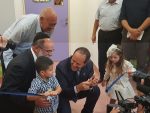
Shalva founder Kalman Samuels, left, and Mayor of Jerusalem Nir Barkat, centre, help youngsters cut the ribbon at the grand opening of the new Shalva National Children’s Centre. (photo from IMP)

Dozens of smiling preschool and kindergarten youngsters recently filed into a revolutionary new inclusion class, which integrates both special needs and other children in the same classroom environment. The opening of the inclusion class was attended by Mayor of Jerusalem Nir Barkat, who has championed the needs of special education since he took office nearly eight years ago.

Housed in the new $55 million dollar Shalva National Children’s Centre – built on seven acres near Shaare Zedek Hospital – this class is part of the wider umbrella of services for the special needs community in Jerusalem. The new state-of-the-art National Children’s Centre provides services to the Israeli community, as well as serving as a research facility focusing on special needs.

Shalva has been the leading Israeli institution providing programs to children with special needs since it was founded by Canadian immigrant Kalman Samuels, along with his wife Malki, in 1990. The land on which the campus was built was donated by the municipality.

Barkat praised the Samuelses for their selfless dedication to the community.

“Shalva was a jewel when it originally opened in Har Nof. Now, it’s a bigger and more expensive jewel, but it’s worth every shekel and every dollar invested in this place,” said Barkat.

“It’s overwhelming. After 10 years getting the land, working to get all the permits, all the challenges we faced, the battles we had to fight to build this centre, the people that tried to stop us. It’s a complete miracle,” said Kalman Samuels, with tears welling up in his eyes, as the children and their parents filed into the building.

Sara Chana Wolff, the mother of Avraham, a 5-year-old child with special needs who will be participating in the educational program, was effusive.

“I just feel endless gratitude towards Shalva,” she said. “When they see that there is something else they can do to help the kids, they turn the world upside down to make it happen. It’s very humbling and inspiring when I look at what Shalva and the Samuels family has done for the community.”

Gal Katzir, whose 3.5-year-old son Sahar will be attending kindergarten classes at Shalva and helped cut the ribbon with Barkat, remarked, “We are so happy with our choice. We thought this would be a special opportunity for Sahar to get to know kids that are different from him. Also, they have so many resources that aren’t in any other kindergarten that we know Sahar will benefit from. Sahar was just great on his first day, he didn’t cry or anything, he just said, ‘Bye-bye, Mommy.’ I was the emotional one!”

Great in Uniform sees potential

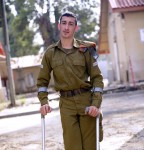
Cpl. Ben Levi is a participant in the Great in Uniform program. (photo from Israel Defence Forces)

The program Great in Uniform aims to integrate young Israelis with special needs into the Israel Defence Forces. To date, some 200 youths have been successfully integrated through the program into administrative and logistical positions in the IDF’s air force and home-front command.

The program was founded by Lt. Col. (Res.) Ariel Almog, who became disabled while serving in the IDF when responding to a terror attack. Eventually, he began looking for a way he could return to the army. He then realized that he would like to help make this a reality for others with disabilities, too.

Typically, Israeli teens with special needs are granted an exemption from obligatory military service. By opening a window and creating a support system for those wanting to volunteer to join the army, the IDF is making it possible for these young Israelis to be integrated into the army with their peers. The teens begin as volunteers, serving in various roles. In some cases, they can get advanced training and even become officers.

This has been the case with Ben Levi. Levi was diagnosed with cerebral palsy (CP) when he was born. He has learned to live with his disability and the 21-year-old longed to join the army and follow in the path that many in his family have taken: he wanted to serve in a fighting unit.

Levi said he currently works “in the storage room, which is part of the logistics force in the home command. When I have trouble, people help me, but I don’t feel I’m a volunteer. I feel I am a solider for all intents and purposes. I try to do what I can. I am disabled and it’s not obvious at all that I would have gotten as far in the army as I have.

“I can tell you a secret,” he added. “I’m actually interested in going for the officer’s course.

“I’m really happy I got to draft and that I get to serve the country,” he said.

Levi said he feels like a soldier just like any other, and has many friends on the base. When he runs into difficulty, he knows he has his family’s support. In fact, Levi’s family has gotten involved in the IDF program.

“It’s fantastic to wake up every morning and know that I am serving my country, have a job and a way to contribute – it proves to me that CP can’t limit me,” said Levi. “You come into the army as a child and you come out as a full grown person.”

Levi’s commander, Ariana Goldsmith, 18, is originally from Long Island, N.Y. She has been living in Ra’anana for the past seven years after making aliyah with her family.

Goldsmith’s becoming a commander of special soldiers was her own “dream come true,” she said.

“I’ve been volunteering for many years with people with special needs [with] Yachad. My cousin is special needs, I grew up with him, and I’ve been volunteering since I was younger for different organizations.”

Although Goldsmith only joined the IDF four months ago, she was given the title of commander to allow her to do her job – escorting special needs soldiers on base.

“Since I heard about this program, this job has been my dream,” said Goldsmith. “There’s no other job I want to do. So, I ended up getting in contact with the head of the program … it took a long time, about a year and a half, and a lot of working it out with the army, but it ended up working out.

“This is an unbelievable program – to see these kids … they just want to do it so bad. There are so many soldiers in the army who aren’t that into [serving]. You know, everyone has to [serve].” Those with disabilities, however, “don’t have to do the army,” she continued. “They want to, to give back, and they are unbelievable.”

Goldsmith is the only escort in the program at the moment, but that is not stopping her from blazing a trail for future escorts. “With my experience, I can give back to the program and make it more of an official job … so that, after me, more people can go into the army and become a commander for this program.”

Goldsmith feels most units in the army would benefit tremendously from incorporating special needs soldiers, and that the benefits of the program are greater for able-bodied soldiers than they are for special needs soldiers. “I think the base and soldiers get so much out of seeing these [special needs] soldiers being volunteers, and that all they want to do is work. They gain so much from seeing them, they learn a life lesson. Some of these soldiers have never seen special needs people before…. By seeing them and working with them, they gain so much patience and they make connections with them…. This really raises the morale on base in general.”

Rebeca Kuropatwa is a Winnipeg freelance writer.

Research into access issues at Jewish overnight camps

The field of Jewish camp has become increasingly aware of and responsive to the numbers of children with special needs and physical disabilities in recent years. As a first step towards initiating field-wide changes in this arena, Foundation for Jewish Camp (FJC) is engaged in a research project mapping current, potential and desired services available to children with emotional, intellectual and physical disabilities at nonprofit Jewish overnight camps across North America.

Laszlo Strategies recently delivered the results of the research (conducted in early 2013), the first of its kind in the Jewish community. The survey garnered results from 170 camp staff members (from 124 camps), 262 parents and 141 campers.

FJC is pleased to share that the majority of those involved in camp – including staff, campers and parents – care about this issue and agree that every Jewish child, regardless of a disability or special need, should be able to attend a Jewish camp. Most involved prefer an inclusion model, with clear recognition that not every camp is able to serve every need and that, in some cases, a separate program might be preferable.

While the field is making progress in the types and amounts of services offered, there is still more to be done. Below are the highlights from the survey. The full findings are available at jewishcamp.org/research.

About the campers served

  • The field of Jewish camp is serving 2,340-2,590 children with special needs – more than originally estimated.
  • The majority of the special needs population in Jewish camp have neurological disabilities. Few camps are equipped at this time to properly serve children with more significant/complicated disabilities.
  • 43 percent attend public school, four percent of these children attend Jewish day school, and 24 percent attend a specialty school for children with disabilities. Forty-three percent attend a synagogue-based religious school and 47 percent had attended a Jewish day camp.
  • 93 percent of parents were satisfied/extremely satisfied with their child’s experience at Jewish overnight camp.

About camp staff and programming

  • 36 percent of camps offer special programs for this population.
  • 55 percent of camps have a designated staff member (part-time or full-time) to oversee campers with special needs. This staffer engages with the family during the intake process, selects and trains camp staff, acts as a support during crisis situations, communicates with parents and other outside supports, creates and evaluates individual camper plans.
  • Inclusion camp staffs appear to want the non-inclusion staff and campers to have a better understanding of their population.
  • Parents of special needs campers are extremely satisfied with the way camps are infusing Jewish values/learning for this population of campers.

Barriers and perceptions

  • The biggest barriers to serving more children with specials needs are not attitudes or wheelchair ramps – rather lack of training and knowledge followed by funding.
  • 47 percent of parents report the cost of overnight camp as a barrier.
  • It is not as important as previously thought that siblings attend the same camp. Forty-three percent of parents report, “it would be nice, but it is more important that they go to the camp that best serves their individual needs.”
  • Parents report that the biggest factors in choosing a camp for a child with special needs are that the camp offers good supports and accommodations for children with a disability like my child (43 percent), and it is a Jewish camp, where my child can connect to our heritage and community (34 percent).
  • More camps are serving children with disabilities/special needs than are advertising it to the public through their websites and marketing materials.

Next steps

FJC is currently creating a plan of action to advance the field of Jewish camp in this arena. Sound research and solid data are required in order to make the informed decisions that will move FJC closer to achieving its goal: increasing the number of children attending nonprofit Jewish overnight camp.

FJC commissions its own research, and also draws on the wealth of knowledge that Jewish sociologists and researchers have contributed toward the understanding of camp and its long-term effects. All FJC-commissioned research and a selection of external studies are available for download at FJC’s website.


Inclusivity is a priority at Camp Shalom

Working side by side with the inclusion services department at the Jewish Community Centre of Greater Vancouver, the Camp Shalom team is looking at a modified version of its counselor-in-training program, as several of the campers have stated they would be interested in participating. Camp Shalom is determined to keep committed Jewish youth engaged, and help them develop and grow in the community.

Camp Shalom has been providing a unique and memorable experience for all campers that come through its doors, including those campers living with special needs. As Camp Shalom has grown in size over the last few years, so has its inclusion program, now serving approximately 10 families. The Camp Shalom inclusive program integrates campers with special needs into the general camp program alongside other campers each week. This would not be able to happen without the dedication of the staff members.

“I was fortunate enough to work with three girls over the summer. From sharing our stories to sharing laughs, they taught me a lot of things about life. They taught me to be patient and to live my life to the fullest. The bond we created is a bond that can never be broken,” said one staff member after her first summer with Camp Shalom.

Ensuring that all campers get to participate in activities fully and receive a robust camp experience is the goal of the inclusivity program. Before each camp session begins, the camp director team and specific counselors meet with families so that children with special needs have a chance to meet their counselors and familiarize themselves with the JCCGV prior to the first day at camp.

The program has an effect not just on the campers, but the counselors, as well.

“Working with Tal this summer was one of the most rewarding experiences of my life,” said Mischa Smolkin. “His positive energy and joy made every single day at camp special. Tal made a hugely positive impact on my life and has changed my perspective. Overall, working with him so closely created a bond that I have yet to experience in a summer camp setting and will treasure for years to come.”

The Camp Shalom inclusive program is possible thanks to the contributions of the Snider Foundation, Diamond Foundation, Lohn Foundation and Jewish Federation of Greater Vancouver.

Win for inclusion

The Ramah Camping Movement and the Ruderman Family Foundation have announced the winners of TIPTOE (The Inclusion Project: Through Our Eyes), an inclusion-themed video contest for participants from Jewish camps. The goal of TIPTOE is to increase awareness of the inclusion work happening at Jewish camps across North America. The Ruderman Family Foundation has awarded cash prizes to the top three winners and is making donations to the inclusion program at the winners’ camps.

Campers and college-aged staff members who participated in a North American Jewish summer camp program in 2014 submitted videos that showed their view of inclusion of children with disabilities at their Jewish camp. Representatives from the Ruderman Family Foundation and the Foundation for Jewish Camp selected the winners based on three criteria: demonstrating inclusion, creativity and visual appeal.

The top three winners are:

  • First place ($1,000): Simone Rotman, Oakland, Calif. A $1,750 donation is being made to Ramah California.
  • Second place ($500): Jenna Freeman, Los Angeles, Calif. A $1,000 donation is being made to Ramah California.
  • Third place ($250): David Sharif, Los Angeles, Calif. A $500 donation is being made to Camp JRF.

“This contest proves that the people who really get the importance of inclusion are the ones who experience it firsthand,” said Jay Ruderman, president of the Ruderman Family Foundation. “The wonderful videos submitted by Jewish campers across the country show that the inclusion of children with disabilities makes the camping experience a better one for all campers.”

According to Rabbi Mitchell Cohen, national Ramah director, “We received many inspirational and creative videos that clearly demonstrate the importance of inclusion at Jewish camps across North America. As we share these videos with the larger Jewish community, we hope that they will promote further discussion, raise awareness, and encourage all of our camps to become more inclusive.”

The top 10 videos can be viewed on the contest website or by searching social media for #TIPTOE2014.

Ramah is the camping arm of Conservative Judaism. The Ramah Camping Movement is a pioneer in the field of inclusion for Jewish campers with a wide range of disabilities. Tikvah, Breira B’Ramah and Camp Yofi comprise the National Ramah Tikvah Network of programs. For more information, visit campramah.org.