Israeli Prime Minister Binyamin Netanyahu places a wreath at Yad Vashem on Yom Hashoah. (photo from IGPO via Ashernet)
(photo from IGPO via Ashernet)
On Yom Hashoah, Israel comes to a virtual standstill at 11 a.m., for two minutes, as sirens wail across the country – everyone stops what they are doing and stands at attention, in respect to the memory of the six million Jews who were murdered in the Holocaust.
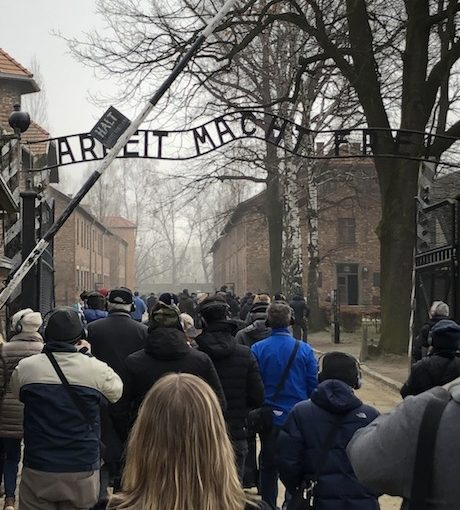
Springfield Collegiate Institute students walking into Auschwitz. (photo by Jim Osler, SCI)
Holocaust education is commonplace in Jewish schools. But, in public schools, discussion about the Shoah is at each teacher’s discretion. Some 14 months ago, teachers at Springfield Collegiate Institute public school in Oakbank, Man., decided they would take 30 Grade 11 and 12 students to see Second World War sites firsthand.
Despite that Oakbank is home to few Jewish families, the school has been inviting Holocaust survivors to speak to students and has been educating its students about the Holocaust for years. Last year, teachers Jim Osler and James Chagnon made the decision to take things further.
“While this was not on a topic brought up in a regular class, we organized activities outside of class time for these students in the evenings and on the weekends to educate them a little more,” said Chagnon of preparing the students for the 12-day trip, which started March 20.
“We visited a synagogue and talked to a rabbi about what it means to be Jewish, because we don’t have any experience with that,” Chagnon told the Independent. “We went and met two Holocaust survivors, who talked about their experiences in the camps. And we went to a conference on antisemitism hosted at the Rady JCC [in Winnipeg]. So, we did a lot of prep work outside of the school with these guys to make sure they’d be ready for what they’d be experiencing.”
Chagnon referred to a recent study that found that only about 30% of Canadian high school students had awareness or knowledge of the Holocaust.
“I had always taught English here in the school in addition to history – novels like The Diary of Anne Frank – and these seem to be getting pushed to the wayside,” said Chagnon. “The younger generations these days, especially in a community like ours that doesn’t have a big Jewish population … it’s just something I don’t think parents have a lot of experience with and, so, it’s not passed onto the kids. So, if they don’t learn about it in school or as part of our programs or clubs, they maybe aren’t going to learn about it at all.”
The school had wanted to take more than 30 students on the March trip, but had to stick to that maximum for logistical reasons. Participating students had to fundraise to pay their way.
Madison Stojak, in Grade 12, and Anna Palidwor, in Grade 11, were both born and raised in rural Manitoba, and had little knowledge or interaction with Jews prior to attending Springfield Collegiate.
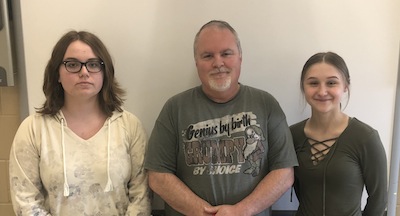
Springfield Collegiate Institute student Ana Palidwor, left, teacher James Chagnon, centre, and student Madison Stojak. (photo by Jim Osler, SCI)
“Hearing Holocaust survivors’ stories and then going to the camps, like Auschwitz and Birkenau … you could remember what the survivors said and picture it, what they must have gone through while they were there,” Palidwor told the Independent. “How we felt while we were there has stuck with everybody after we came back. Also, we’re more aware of the race issues that are out there… That’s definitely stuck with me … realizing it’s still here, wherever we go, the hate.”
While the school group was at the Warsaw Ghetto, a man on a motorbike drove by and gave the middle finger to a group of Israeli students who were standing beside them. “After all that, you’re just more aware of it, anywhere you go,” said Palidwor.
Both Stojak and Palidwor have talked about their experiences with family and friends.
“When I shared it with my family members, it was kind of surreal to them,” said Stojak. “They were like, ‘How could other people treat people like this? How could this happen? How come no one stopped it?’ They were questioning the same things I think all of us were questioning on the trip.”
“One of the strong points we really tried to push on the students, in terms of their learning, to understand, is that this isn’t the first time this has happened,” Chagnon said. “We definitely want it to be the last time, so we can’t just sit by and be passive bystanders anymore. When you see antisemitism, you are now obligated to call it out, draw attention to it, so we can change the way the world works.”
When the students returned from the trip, they were taken aback by some of the reaction they heard from fellow students who did not go.
Stojak said, “I hadn’t heard any comments before the trip like these – until they realized we were there … people started making rude comments … hateful comments. I think they were saying it to get us upset, and I also think that they’re really undereducated and don’t understand how serious it is.
“One comment someone said to me was, ‘Don’t touch me with your Holocaust hands!’ That’s what someone said to me. And, as soon as he said that, I said, ‘What did you just say?’ And he repeated it. I looked at him and said, ‘You didn’t just say that to me. That’s ridiculous. Do you know how many millions of people died there? That’s not something you should be saying.’
“I stood up immediately and shut it down,” said Stojak. “It made me feel sick to my stomach. How could someone make a comment like this? When he said that, I pictured standing there at Auschwitz or Birkenau and thinking, how could someone be so ignorant to say that?”
“These kinds of comments are making us want to be more active,” said Palidwor, “and to explain it to more people who weren’t there and tell them what the Holocaust is.”
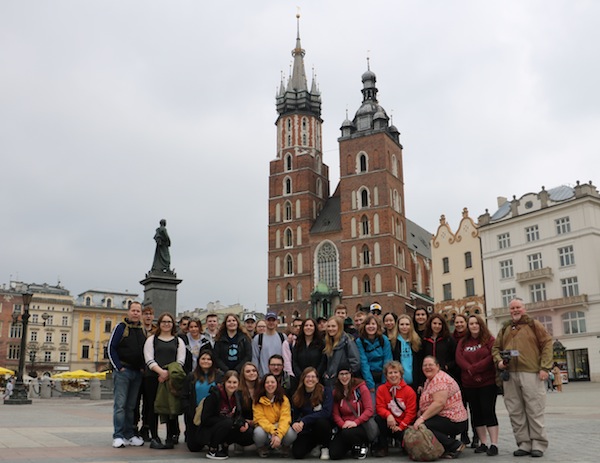
The 30 Springfield Collegiate Institute students, three parent chaperones and two teachers in the old town square in Krakow, Poland. (photo from SCI Students)
One of the things that stuck in Chagnon’s mind from the trip was the incident with the Israeli students. He noticed that there were a dozen security personnel with the Israeli student group but none with the Canadian school group.
“One of my students said, ‘Wow, I didn’t understand how bad it was – that these kids on a school trip from Israel have to be accompanied by security guards,’” said Chagnon. “That kind of struck me and I made sure to point it out to my students. It gives you a bit of perspective for the Jewish community – how scared they must be all the time – that they can’t send students to learn about the history of their people, their culture and religion, without having to send security with them.”
Another thing that stood out for Chagnon occurred when the group was visiting a Jewish cemetery and noticed that locals use the cemetery as a bathroom stop for their dogs.
“I’m a guest in their country, but I was shaking, I was so angry,” he said. “I couldn’t believe people would show such indignity to a group of people who suffered so much already.
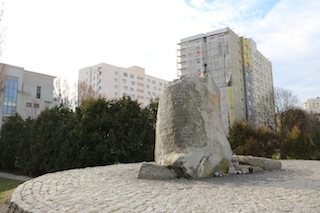
The memorial at Mila 18 Ghetto Uprising site in Warsaw, Poland. (photo by Jim Osler, SCI)
“We had a nightly debrief at the end of every evening,” he continued, “where we sat around and talked about the day, how we felt about it and our reactions to it, and that’s one thing I brought up … that some of this stuff may seem to have gone away … maybe it isn’t as bad as it was, but that doesn’t mean it’s not there, just bubbling under the surface, waiting for an opportunity to pop up.
“For me, that’s the reason we did a trip like this, and I know Jim [Osler] feels the same way.… They say people who don’t study history are doomed to repeat it and, for me, that’s very true. You have to talk about these things, even the ugly things in history, so we don’t let it happen again.”
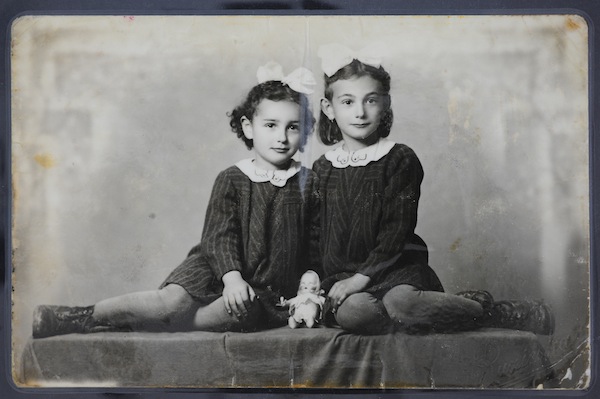
Susan-Zsuzsa and Lili Klein (photo from Yad Vashem via Ashernet)
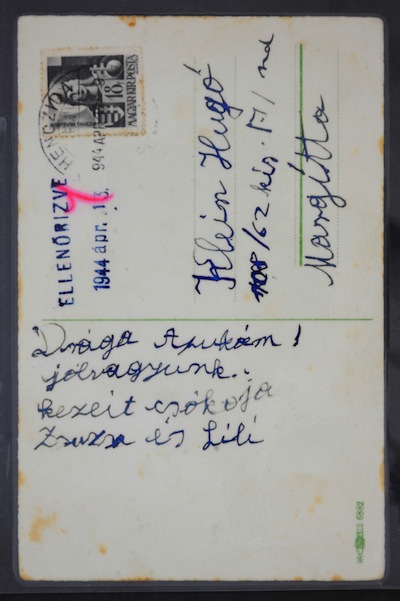
(photo from Yad Vashem via Ashernet)
On April 13, 1944, sisters Susan-Zsuzsa and Lili Klein (in photo) wrote their father Hugo a short letter: “Dear Daddy, We are well – goodbye.” Hugo had been drafted into a forced labour battalion in 1943; his wife Matild had stayed with their two daughters in their hometown of Hencida in the Bihar district of Hungary. Hugo survived the war, but Matild, Susan-Zsuzsa, 9, and Lili, 7, were deported to Auschwitz on May 24, 1944, and murdered shortly after their arrival.
Exactly 75 years later, Susan-Zsuzsa and Lili’s letter is among a dozen last letters included in Yad Vashem’s latest online exhibition, Last Letters from the Holocaust: 1944, presented to mark Israel’s Holocaust Martyrs’ and Heroes’ Remembrance Day. Many of the documents included in the exhibition (yadvashem.org/yv/en/exhibitions/last-letters/1944/index.asp), as well as the photographs, were donated to Yad Vashem as part of its national Gathering the Fragments campaign. Together with the tens of thousands of Holocaust-era artifacts and artworks in Yad Vashem’s collections, these historical testimonies are due to be conserved and stored in the new Shoah Heritage Collections Centre, part of a new campus being built on the Mount of Remembrance in Jerusalem.
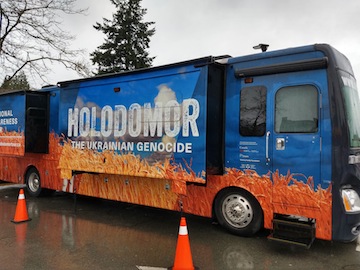
A project of the Canada-Ukraine Foundation, the national educational tour about the Holodomor began in 2015 and has reached about 30,000 Canadian high school students so far. (photo by Pat Johnson)
What constitutes a genocide? How many Ukrainians were murdered by Josef Stalin’s human-created famine in the 1930s? Would you stand up in a situation where lives were at risk – even if it meant you might become targeted?
These were some of the questions confronted by Grade 12 students of King David High School last week. A national educational tour about the Holodomor – the mass murder of Ukrainians by the Soviet regime – pulled into Vancouver, opening the eyes of young people to this chapter of history.
Beginning in 1932, the Soviet government under Stalin began a calculated, systematic famine in Ukraine, seizing all food sources, cutting off escapes for people fleeing starvation and implementing summary execution for the crime of stealing the smallest piece of sustenance. Farming was collectivized, creating catastrophic conditions. Political and intellectual elites were murdered.
Some details, including the number of Ukrainians killed, remain cloaked in uncertainty because, from the start, the Holodomor was deliberately hidden from the outside world through a comprehensive system of censorship and misinformation, as well as the complicity of media and other countries. Estimates of the number of dead range from seven million to 14 million.
Holodomor is a portmanteau made up of holod, starvation, and mor, death, meaning “death by starvation.”
Last week, King David High School Grade 12 students and others participated in the educational tour. (photo by Pat Johnson)
The Holodomor National Awareness Tour consists of a bus-sized repurposed former recreational vehicle. Rather than a static exhibition through which participants walk, the vehicle has been retrofitted with a 30-foot screen down one interior wall and 30 theatre-style seats down the other, with interactive tablets that invite students to study and discuss in small groups before reconvening to share what they’ve learned with the larger group. A project of the Canada-Ukraine Foundation, the tour began in 2015 and has reached about 30,000 Canadian high school students so far.
The Holodomor was not an endeavour to kill an enemy, but an effort to restructure society, a form of social engineering at its most extreme. In September 1932, Stalin wrote to one of his lieutenants that Ukraine was restive. The Soviets perceived Ukrainians as being profoundly religious, individualistic, believers in private property and attached to their plots of land, making them unsuitable for building communism. Addressing these perceived flaws would require, according to Soviet leaders, an action so extreme that a word had not yet been invented to describe the intent.
The entire agricultural sector was upended by collectivization and resisters were murdered or sent to gulags, Soviet concentration camps. At first, remaining supplies of food sustained the Ukrainian people, but those reserves were soon depleted, while the Soviets extracted ever-increasing quotas of grain and Soviet wheat exports to the West grew. As the Holodomor proceeded, NKVD secret police were sent to search for and confiscate any remaining food sources. While those caught stealing or concealing food were executed, for millions more, fate was less sudden.
“Most of the victims died slowly, at home,” according to the narrator of one of the interactive films viewed by students. “Special NKVD units raided people’s homes to collect the dead bodies. They received 200 grams of bread for every dead body they delivered.”
Students examined the forces that allowed the Soviet Union to hide the reality from the world. For the Soviets’ part, there was censorship and the threat of retaliation for those who shared the truth. But their crimes were abetted by Western figures, including New York Times correspondent Walter Durante, who won a Pulitzer Prize for his reporting from the USSR, even as he misrepresented the Holodomor. In one article, titled “Hungry, not starving,” Durante wrote that there is no actual starvation or death from starvation, though he acknowledged there was widespread mortality from diseases due to malnutrition.
Leading journalism figures from the time are brought to life through reenactments. British journalist Malcolm Muggeridge, reporting for the Manchester Guardian, reflected on being raised in a socialist household and how he was enthusiastic about traveling to the Soviet Union to report on the utopia being created there. When he saw the reality, he evaded Soviet censors by sending his dispatches home via the British embassy’s consular pouch.
One of the heroic figures of the story is Gareth Jones, a Welsh journalist who risked his life to bring the truth from Ukraine. He convened a press conference in Berlin, on March 29, 1933. But the timing was terrible. The Soviets were about to launch a show trial against six U.K. citizens, accusing them of espionage in what would become known as the Metro-Vickers Affair.
In order to remain in the USSR and report on what promised to be a trial of global importance, journalists had to stay on good terms with the authorities.
“It would have been professional suicide to make an issue of the famine then,” one reenactor remarked. “So, none of us supported Jones.”
Lauren Shore is a student in King David’s Holocaust and Genocide Studies 12 course. The class, created by teacher Anna-Mae Wiesenthal, is delivered during lunch hour and, while students receive credit, they take the course in addition to their full complement of other classes. A province-wide genocide studies elective course is part of the new B.C. curriculum and will be offered next year at schools that opt-in.
Shore, with a partner, did a project on the Holodomor.
“Since there is a lot of debate on whether it’s a genocide or not, and how it was planned, we decided to focus on that,” she said. “We were focusing on the different steps of genocide [and] people were debating whether it was a genocide or not, since it wasn’t necessarily planned as exactly as other genocides were. As we looked into it, we found that it was planned just as much as the other genocides, just in other, more subtle ways.”
Solly Khalifa, also in Grade 12, was impressed with the interactivity of the Holodomor tour.
“I was astonished at how innovative it is,” he said. “They really get everybody participating and it’s very interesting and an easy way to participate also.”
Classmate Noah McNamara saw parallels between the Holodomor and the Holocaust.
“All genocides are kind of similar, in that it’s a governing body that takes advantage of their power to push a goal,” he said. “In the Holocaust, [it was] the Aryan race that they wanted to push. In this case, it was communism that they wanted to push. I think it’s important for us now to be aware of aggressive governments and governments that are trying to radically push things, because that’s definitely a precursor to genocide.”
Ava Katz, who worked with Shore on their Holodomor project this year, noted that studies of the Holocaust enforce the dictum “never again.”
“But I feel like sometimes that’s overlooked with other genocides,” she said. “Not a lot of people will say that. But when you really study other genocides in-depth and see how severe they are, it’s important that we never let any of them happen again.”
The cross-country tour operates with a shoestring staff. Alexi Marchel leads students though the experience. Kevin Viaene drives the bus and supports the program.
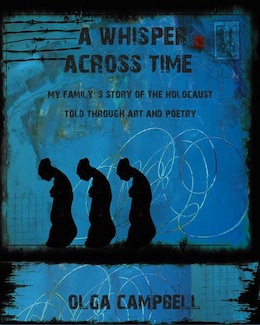
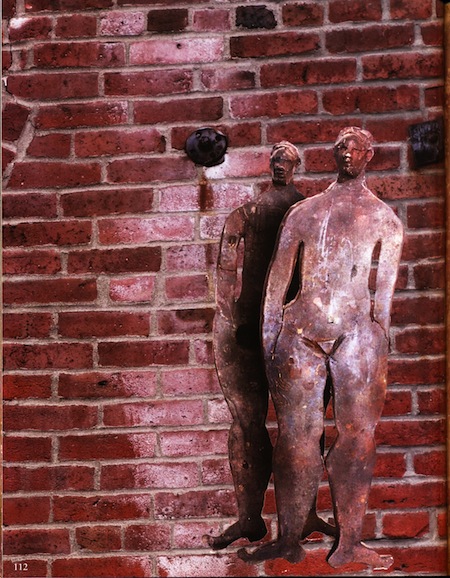
Olga Campbell’s acrylic painting “Remembering,” above, and bronze sculpture “Twins II” are just two of many artworks she includes in A Whisper Across Time.
Grief is many-faceted. Sometimes, we’re not even aware for what we’re grieving. One of the most beautiful passages in Olga Campbell’s A Whisper Across Time: My Family’s Story of the Holocaust Told Through Art and Poetry (Jujabi Press, 2018) is the following poem:
“I was born with a very deep sadness / a sadness and an anger / as a child I didn’t question this / it was the way it was / when I got older my mother had cancer / she died when I was twenty-two / I thought that my sadness was caused by her death / I had no idea that it was caused by her life.”
“A Whisper Across Time is a heart-warming, emotional journey that reminds us of the suffering and pain that war, intolerance and persecutions create, not only for those who had to endure atrocities but also for the children of the survivors,” notes Dr. David Lee Sheng Tin, author of two books on spiritual health and growth, in the foreword.
In A Whisper Across Time, Campbell gives clear voice to the whispers in her ear, “whispers across time.”
“This is the story of one family out of millions of families who went through the Holocaust,” writes the artist, whose mother lost all of her family during the Second World War. It is “the story of survival and death,” “of how trauma of such magnitude is passed from one generation to another to another….” It is also an ardent call for readers to remember Rwanda, Rohingya, Bosnia, Syria, Afghanistan, Sudan, Iraq, Cambodia…. “[O]ne of every 113 people on the planet is a refugee,” writes Campbell, noting, “by the end of 2016, there were 65.6 million refugees, asylum seekers and internally displaced people in the world” and that “racism, antisemitism and ultra-nationalism are on the rise.” She pleads, “eighty years ago, the world looked away / we must not look away now.”
In an interview with the Jewish Independent last November about the exhibit of the same name that helped launch the book, Campbell updated that statistic. “Our world is a chaotic place right now, somewhat reminiscent of the period before the war,” she told writer Olga Livshin. “There are over 68 million people around the world that are refugees or displaced. My book is not only about my family. It is a cautionary tale. It is about intergenerational trauma and its repercussions across time.” (See jewishindependent.ca/whisper-across-time.)
In 2005, Campbell mounted the exhibit Whispers Across Time. “This art show dealt with memories and losses,” she writes in the book. “Many of the pieces in the show were fragmented, partial in appearance, reflecting both a presence and an absence.”
“Twins II” by Olga Campbell.
The exhibit featured masks, rusted metal figures, ceramic sculptures, photographs, mixed media and texts that, explains Campbell, “echoed the same theme of loss and regeneration – a life spirit which emerged from the devastation of the past.” Even reduced in size to fit on the pages of a book and taken out of a gallery setting, this artwork is powerful.
In A Whisper Across Time, Campbell shares some of what she has discovered about her mother, Tania, and father, Klimek Dekler, as well as about her maternal grandmother, Ola Akselrod, and her mother’s identical twin sister, Mania, and brother-in-law, who was also an identical twin, but Campbell hasn’t been able to determine which brother – Manasze or Efraim Seidenbeutel – her aunt married. Campbell recounts how her parents met, the atmosphere leading up to the war, and how her parents survived. Her father’s family also survived. There are no records, says Campbell, of what happened to her grandparents or her aunt during the Holocaust; the Seidenbeutel brothers were murdered at Stutthof concentration camp, a few days before it was liberated.
“My mother must have been completely traumatized by her experiences and her losses,” writes Campbell. “She lived and worked and loved, she still danced … sometimes. But the joy in her heart was not so big. The light inside was dim. And, at night, when she was alone in her room, she cried.”
In A Whisper Across Time, Campbell also talks about preparing for the 2005 exhibition, and some of the strange happenings that occurred, such as how multiple attempts to photograph the art failed – a broken camera, saved images that wouldn’t open on the computer. Her use of language, both in poetry and prose, is emotive without being overly sentimental. And her artwork evokes an emotional reaction, often involving some sadness and always demanding contemplation.
For more on Campbell and to purchase A Whisper Across Time, visit olgacampbell.com.
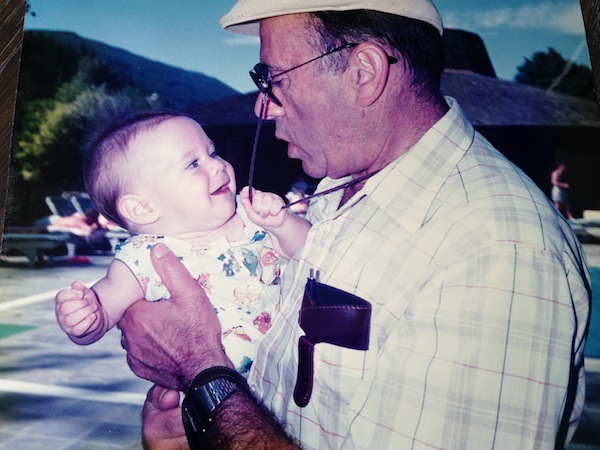
The writer with her grandfather, George Wertman. (photo from Becca Wertman)
I believe it was in Grade 6 at Vancouver Talmud Torah that we had to do a project about a “Jewish hero.” I remember other students wrote about Theodor Herzl, the founder of modern Zionism; Golda Meir, the first female Israeli prime minister; and Hannah Senesh, the Palmach paratrooper who was executed by Nazis while attempting to save Hungarian Jews. I wrote about my zaida.
My zaida, George Wertman, was born on May 17, 1921, in Lwów, Poland (now Lviv, Ukraine), and passed away on March 25, 2019, in Vancouver. He was a Holocaust survivor, yet that alone is not why I consider him my hero – it is because of how he survived and what he managed to accomplish in his life.
In fall 1941, Zaida was taken to a forced labour camp, Camp Winniki, where he became an assistant steamroll engineer, enslaved to build roads for the Nazis.
Zaida always marched in the first group of three during the 12-to-14-kilometre trek from the camp to the work site. One day, he lined up in the third group and, on that same day, two individuals escaped the camp. As was the “camp policy,” three people were shot for every person who escaped. The SS officer selected the first two rows and took them into the forest to their deaths. Zaida survived by sheer luck.
On other occasions, it was more than just luck that saved his life – it was his reputation as being a hard worker. In his second year in the camp, Zaida became ill with typhoid and was taken to the camp’s infirmary. An SS officer and a Ukrainian policeman came to the infirmary to select sick Jews to be shot for, as Zaida explained to me, why would Nazis spend scarce resources on healing sick Jews? The SS officer yelled to my zaida, “Out!” but the Ukrainian insisted that Zaida was his best worker and to save him.
In July 1943, Zaida’s determination to live motivated him to run when an SS officer came to his barracks in the middle of the night and told him to get dressed and, again, “Out!” Zaida preferred dying on his own terms – while doing everything he could to survive – and, therefore, jumped out of the window and ran. He ran through puddles to trick the scent dogs and eventually outsmarted the Nazis, managing to escape to “safety.” The rest of the camp was liquidated and sent to their deaths.
“Safety” meant reuniting with my great-grandfather in his hiding spot in a secret room located in a building where German officers lived. For one year, Zaida spoke in whispers and did not see the sun.
Zaida was liberated in summer 1944, but his story of survival by no means ended there. He met my grandmother (my baba, who I call Babi), and she, Zaida and my great-grandfather began a “business” of necessity – smuggling goods across one European border and the next. They would hollow out suitcases, fill the frames with gold and give them to my 20-year-old grandmother to carry across the border.
They eventually made enough money to get visas to Canada and, in July 1949, arrived in Vancouver.
The money they had made in Europe was invested in property, including a piece of land bought from the Canadian Pacific Railway that became my dad’s childhood (and current) house and a property that housed George Wertman Ltd., Zaida’s coat hanger factory.
Zaida worked extremely hard to succeed in Canada, making wire coat hangers and doing everything to ensure that his three children and eight grandchildren would never have to suffer.
His retirement largely consisted of wining, dining and drinking coffee throughout Vancouver. From the age of 91 to 96, he could be found daily at the Hotel Georgia’s Bel Café sharing a grilled cheese sandwich with Babi.
As the granddaughter of Holocaust survivors, I have unique childhood memories. I remember my family parking at least a 15-minute walk away, usually more, from the best restaurants in Vancouver in order to not pay for parking and to “save a buck”; of eating chicken soup in bowls of gold-rimmed china that my grandparents brought from Allied-occupied Germany; and of always asking Zaida to tell me stories, like the ones above.
In Zaida’s Holocaust survivor testimony to the University of Southern California Shoah Foundation, he explains that his philosophy is that you “have to work to get somewhere” and that he believes in “honesty, hard work and, once in awhile, if you can do a mitzvah,” do it. Indeed, hard work saved his life and being an honest businessman in Canada allowed him to give his family everything they needed.
As Zaida also instructs in his testimony, “Try to make a better world. If you cannot make a better world, do not make it worse.”
This is why he was, is, and will always be, my hero and my inspiration for how I live. I hope his story, summarized here, will inspire others as well. May his memory be a blessing.
Becca Wertmangrew up in Vancouver and currently lives and works in Jerusalem.
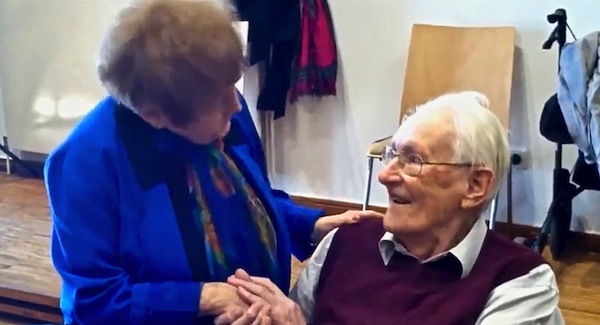
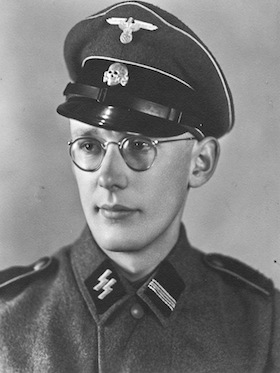
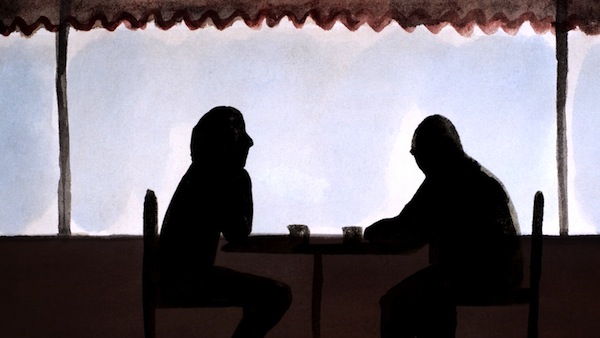
Auschwitz survivor Eva Kor forgives former SS officer Oskar Gröning. (photo from TLNT Productions)
The Accountant of Auschwitz is more than the latest documentary to successfully convey the horrors of antisemitic genocide to an audience 75 years removed from those events. It exemplifies the emergence of a coterie of young filmmakers eager to tell the stories of the Holocaust to their peers and to future generations.
For Toronto director Matthew Shoychet and producer Ricki Gurwitz, the trial of nonagenarian SS officer Oskar Gröning in his Lower Saxony hometown in 2015 provided the entry point to explore an ambitious array of historical, legal and moral concerns. The approach they chose for their debut feature documentary, however, was as important as the facts and the message.
“The way we put it together with the editors, we knew we didn’t want to play it chronologically,” the 32-year-old Shoychet explained. “The film opens with fast-paced, happy music with animation, then right into the trial, then back. You’re challenging the audience, but in a fresh, exciting way. You don’t see many Holocaust films that are told that way.”
The Accountant of Auschwitz screened at the Vancouver Jewish Film Festival last fall and is part of the Seattle Jewish Film Festival, which opens March 23.
Shoychet’s path to The Accountant of Auschwitz was unusual in that his family was not directly affected by the Holocaust. He was interested in films about the Holocaust, but he wasn’t instilled with the kind of painful personal history that was (and still is) the catalyst for many filmmakers.
In 2013, Shoychet went on the March of the Living to Poland and Israel, where he received his first close-up exposure to the Final Solution and Holocaust education. A friend he made on that trip went to work for the Neuberger Holocaust Education Centre in Toronto, and that contact led to Shoychet directing the short film Anne Frank: 70 Years Later (2015), which screened at Auschwitz-Birkenau and the University of Warsaw.
Shoychet joined that year’s March of the Living as a chaperone, where he met Bill Glied, a Serbian native who’d been deported from Hungary to Auschwitz in 1944. When Glied remarked that he was going to Germany to testify at Gröning’s trial, Shoychet and Gurwitz put a pitch together to the Government of Ontario, the Rogers Documentary Fund, CBC’s Documentary Channel and a couple of private investors.
“It came together fast,” said Shoychet, who arrived on the scene in Lüneburg, Germany, in the midst of the trial.
For Toronto director Matthew Shoychet, the trial of SS officer Oskar Gröning in 2015 provided the entry point to explore an ambitious array of historical, legal and moral concerns. (photo from TLNT Productions)
Gröning’s job, as The Accountant of Auschwitz makes clear, wasn’t loading Zyklon B into the gas chambers or machine-gunning Jews. Thanks to a change in German law, it is no longer necessary to prove that a Nazi pulled the trigger. His presence at the scene and involvement in crimes is sufficient to decide guilt.
“Oskar was on the ramp [when the trains arrived and where selections occurred], taking suitcases and calming chaos,” Shoychet said. “But it was all part of the mass murder operation.”
Among the issues that The Accountant of Auschwitz takes on is the purpose and value of trying a 94-year-old man for war crimes. The film makes a convincing argument on multiple grounds, beginning with the extent of the cover-up that took place in Germany after the war.
“Ninety-nine percent of the judges in West Germany from 1945 to 1967 were members of the Nazi party,” Shoychet noted. “Hardcore believers. Of the 800,000 SS officers, 100,000 were investigated between 1945 and today, just over 6,000 were brought to trial and 124 received life sentences.”
That paltry number minimizes the scale of the crimes and serves to bury the past. The film asserts that Gröning’s confirmation under oath of his work at Auschwitz was a public and irrefutable rebuttal to Holocaust deniers and other antisemites.
“Even if you say he’s too old – and even the survivors say they don’t care if he goes to prison – for history’s purposes, the fact that a Nazi perpetrator is sitting in a German courtroom with German judges, saying, ‘Yes, these things happened, I was there,’ that makes the trial worthwhile,” Shoychet said.
A loquacious interview subject, even on the phone from Israel, where he had presented The Accountant of Auschwitz at the Jerusalem Jewish Film Festival a few months ago and was presently working on a project of the One Family Fund (he’s a board member), Shoychet confided that the process of making his feature doc debut was one of learning as he went. For example, until he went to Germany, he had never heard of John Demjanjuk, a Ukrainian who had been convicted of crimes at Sobibor yet consistently denied any involvement. Demjanjuk’s tangled tale, which, among other things, raises the subject of putting an elderly man on trial, ended up being a 20-minute segment in the film.
The Accountant of Auschwitz is rife with revelations and messages, but one gets the sense in talking with Shoychet that his main goal was conveying his own experiences of discovery, discussion, inspiration and outrage – with respect to Nazis and survivors, as well as contemporary justice-seekers and neo-Nazis – to viewers his own age.
“There may not be an ISIS fighter who will be deterred by a 94-year-old Nazi being prosecuted,” Shoychet allowed. “It’s making the connection of the past to the present. Trying to take a younger person and put them in the shoes of the survivors.”
Shoychet’s affinity for provoking questions and debate among the audience bodes well for his next efforts behind the camera.
“I never actually thought I would make a documentary,” he said with a trace of bemusement. “My passion is scripted narratives.”
Historical ignorance has been in the news recently, with polls indicating widespread lack of awareness of the Holocaust, especially among young people in North America and Europe. (See jewishindependent.ca/much-work-left-to-do.) Some media reports got the story wrong, however, claiming that many people “don’t believe” six million Jews died in the Holocaust. The reality is that many people “don’t know” this fact, and there is a big difference between not knowing and not believing. Then there is a different phenomenon altogether: denial.
Plenty of well-informed but ill-intentioned people know the truth of the Holocaust but, for various reasons, take a position that the facts are falsified. The notorious Holocaust denier David Irving is reportedly again making the rounds in Britain, promoting his ahistorical ideology. In a nice contrast, Irving’s nemesis, Prof. Deborah Lipstadt, is back in the news promoting her new book, Antisemitism: Here and Now.
Lipstadt went from respected Emory University professor to a sort of global superstar when Irving sued her for libel in a British court in 1996 for correctly characterizing him as a Holocaust denier. Although Lipstadt is an American, she and the book’s U.K. publisher were targeted because Irving apparently thought that country’s libel laws might serve his cause. In the United Kingdom, libel law places the burden of proof on the defendant instead of the plaintiff. As a result, the trial played out as a public history lesson, with Lipstadt’s legal team forced to prove the historical truths of the Holocaust. They did, of course, and won the case. Nonetheless, Irving’s career as a provocateur and historical revisionist continues.
More serious than a nasty British gadfly is the Holocaust denial taking place in Poland right now, a phenomenon that has led to a collapse in Israeli-Polish relations.
Until recently, Poland was one of Israel’s closest allies on the world stage. While Polish society has never undergone the self-reflection that Germany did after the Holocaust, Polish governments developed excellent relations with the Jewish state. After the fall of the communist regime, relations between the two countries grew quite warm. Trade and diplomatic relations at the highest levels flourished.
With the election of the right-wing nationalist Law and Justice party, in 2015, things began to change. Last year, the Polish government passed a law criminalizing speech that references Polish collaboration with the Nazis during the Holocaust.
Canadian Prof. Jan Grabowski, who spoke in Vancouver last fall, heads a team of researchers, most of them in Poland, who are scouring archives throughout that country amassing what is probably the most comprehensive assessment ever compiled on the subject of Poles’ complicity in the Holocaust. Without Polish collaboration – frequently offered willingly and without compulsion, the research indicates – the Nazis could not have succeeded nearly so completely at their murderous destruction of Polish Jewry, Grabowski insists.
Politicizing this history – that is, criminalizing the truth – has put the Polish government on a trajectory of institutionalized denial. Unlike masses of young North Americans and Europeans, the Polish leaders know very well what transpired in their country during the war. As Grabowski notes, it is not the collaborators and their descendants who are today ostracized in small communities across Poland but rather those families whose members helped their Jewish neighbours.
It was inevitable that Poland’s approach would have repercussions in the Polish-Israeli relationship. It happened dramatically in recent days. The Visegrád Group, which is a cultural and political alliance of the Czech Republic, Hungary, Poland and Slovakia, was slated to meet with Israeli leaders at an extraordinary summit in Israel this week.
A week ago Friday, Prime Minister Binyamin Netanyahu was visiting the Museum of Polish Jews, in Warsaw, when he stated, in a meeting with Israeli reporters where recording devices were not permitted, that Poles had aided the Nazis. A flurry of confusion followed as the prime minister’s office clarified that he had said “Poles,” and not, as some media had reported, “the Poles” or “the Polish nation.”
Polish Prime Minister Mateusz Morawiecki decided to snub Netanyahu by withdrawing from the summit and sending his foreign minister instead.
Yisrael Katz, on his second day on the job as Israel’s foreign minister, dumped fuel on the simmering conflict in a TV interview. Ostensibly sent to smooth over the matter, Katz used the opportunity to quote the late Israeli prime minister Yitzhak Shamir to the effect that “the Poles imbibe antisemitism from their mothers’ milk.”
Suffice to say the summit is off. The leaders of the three other countries are still slated to travel to Israel for bilateral meetings but Polish-Israeli relations are on the rocks.
The conflict illuminates a strange dichotomy. The government of one of the countries most affected by the Holocaust tries to blot out what they certainly know to be the truth. Meanwhile, a generation of young people look on, unaware of even the barest details of what is at the root of the uproar.
A still from Éléonore Goldberg’s animated short film My Yiddish Papi (Picbois Productions/NFB).
On Jan. 25, the National Film Board of Canada released Éléonore Goldberg’s animated short film My Yiddish Papi (Picbois Productions/NFB). It can be streamed free of charge across Canada on nfb.ca, as well as on NFB’s YouTube channel and Facebook page.
The online release of the film marked the International Day of Commemoration in Memory of the Victims of the Holocaust, which is observed on Jan. 27. With My Yiddish Papi, Goldberg has made a personal short film about filial love, duty and the transmission of memory by honouring a promise made long ago: that of illustrating the adventures of her grandfather, a resistance fighter during the Second World War.
Produced by Karine Dubois (Picbois Productions) and Julie Roy (NFB), the film was presented as a world première at the 2017 Ottawa International Animation Festival, and was also selected for the Sommets du cinéma d’animation de Montréal and the London International Animation Festival, among others.
Goldberg is an award-winning Franco-Canadian filmmaker, animator and cartoonist. In My Yiddish Papi, using ink-on-paper animation, she relates the story of her grandfather, Georges (Josek) Goldberg, who became a resistance fighter at age 20 during the Second World War. “He saved many lives and he and his family narrowly escaped Auschwitz,” said Goldberg in an interview on the NFB website. He died, in Paris, in July 2009.
“He would sometimes share his wartime memories when we dined together during the time I lived in Paris,” Goldberg told the NFB. “He never bragged; he was a humble, shy person. He would have liked me to make a graphic novel or film about his resistance adventures, and I had committed to doing it. But time passed and I did nothing. At his death, my promise came back to me.”
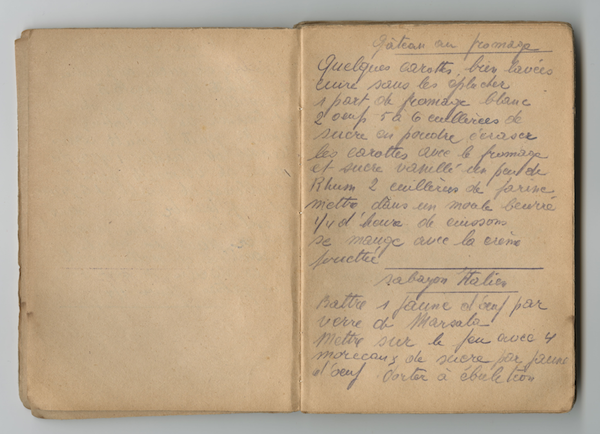
Rebecca Teitelbaum’s recipe book was compiled in Ravensbrück concentration camp, Germany, circa 1940s. It is from the Teitelbaum, Buckman family fonds, VHEC Collections.
This article is based on remarks delivered at the screening of the film Who Will Write Our History on International Holocaust Remembrance Day.
The Vancouver Holocaust Education Centre (VHEC) was honoured to partner with the Vancouver Jewish Film Centre and the Peretz Centre for Secular Jewish Culture for the screening of Who Will Write Our History (2018, directed by Roberta Grossman) that took place on Jan. 27 at the Peretz Centre.
Jan. 27 marked the 74th anniversary of the liberation of the death camp at Auschwitz-Birkenau. This date was first commemorated in 2005 by the United Nations General Assembly as International Holocaust Remembrance Day.
Around the world, thousands of individuals observe International Holocaust Remembrance Day to honour the six million Jewish victims of the Shoah and millions of other victims who were brutally murdered by the Nazis and their collaborators. Many organizations worldwide take this day as an opportunity to raise awareness of the Holocaust and to offer educational programs to help prevent future genocides.
The VHEC also gathered with local survivors of the Holocaust a few days prior to the film screening to commemorate the victims of the Shoah. The survivors remembered their beloved mothers, fathers, brothers, sisters and other family members who perished during the Shoah, as they lit candles and said prayers.
When students from all over the Lower Mainland visit the VHEC, they frequently ask about resistance against the Nazis during the Holocaust. We all know too well what the consequences of resistance were in the Nazi-occupied countries. But what exactly did resistance in the context of the Holocaust mean or look like? When people hear the word resistance, often, they think of physical, armed resistance, as it occurred, for instance, during the Warsaw Ghetto Uprising in 1943, or by brave partisan fighters, who fought the Nazis and their collaborators and blew up Nazi train tracks and other infrastructure. However, there were forms of defiance that were more subtle.
Let me give you two examples of defiance that one may call cultural or spiritual resistance during the Holocaust.
Rebecca Teitelbaum (born 1909), from Belgium, was kept in Ravensbrück, a concentration camp for women. In secret and at great risk, she stole small pieces of paper and a pencil from the Nazi office of the camp. She also traded food for a needle and thread. At night, together with other women from her barrack, she wrote down her favourite recipes and filled 110 pages with what reminded her of better times with her family. She then sewed together the pieces of paper into a book. Upon its completion, the women took comfort reading the recipes out loud.
Sarah Rozenberg-Warm (born 1923), from Poland, was a slave labourer at a Nazi munitions factory in Skarzysko-Kamienna, Poland. Living conditions in the camp were terrible. One day, a fellow inmate stole pieces of metal and, instead of creating munitions for the Nazis, he created a mirror, a ring and a comb for Sarah, risking his life to do so. Perhaps, he wanted to make Sarah feel like a human being again as she looked in the mirror, in times when she was treated in the most inhumane way imaginable. Perhaps, through the seemingly small gesture of creating these gifts for Sarah, the inmate succeeded in giving Sarah hope for better times, and strength to carry on.
Both Rebecca Teitelbaum’s recipe book and Sarah Rozenberg-Warm’s mirror are currently on display at the Vancouver Holocaust Education Centre as part of the exhibition In Focus: The Holocaust Through the VHEC Collection and serve as examples to students and the general public about cultural and spiritual defiance.
Jewish defiance was also expressed through efforts to perpetuate Jewish culture and maintain humanity in the face of attempted annihilation. Spiritual resistance in ghettos and camps included clandestine prayers and the creation of artistic works and books. In some ghettos, underground schools were formed, and secret archives were established to document the Holocaust.
The film Who Will Write Our History gives us the opportunity to learn more about an extraordinary example of Jewish defiance during the Holocaust through the attempt of preserving diaries, documents and papers in the secret Oyneg Shabes Archive created by Dr. Emanuel Ringelblum and his fellow inmates. It is a film worthwhile seeing.
Dr. Ilona Shulman Spaar is the education director at the Vancouver Holocaust Education Centre and the curator of the exhibition In Focus: The Holocaust Through the VHEC Collection, on display at the VHEC until June 2019. Find out more at vhec.org.