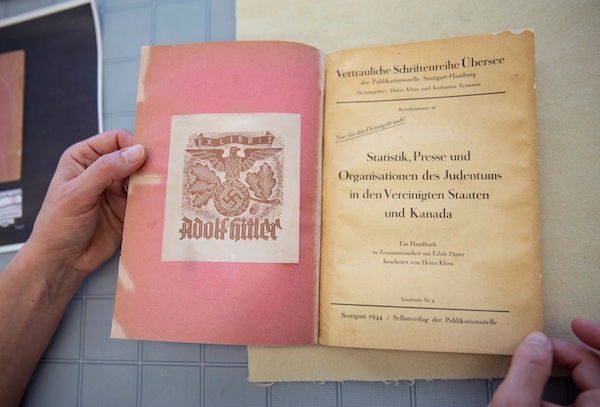
Library and Archives Canada recently acquired this 1944 book previously owned by Adolf Hitler. (photo from Library and Archives Canada)
Library and Archives Canada recently acquired a rare 1944 book previously owned by Adolf Hitler. The 137-page German-language report Statistik, Presse und Organisationen des Judentums in den Vereinigten Staaten und Kanada (Statistics, Media and Organizations of Jewry in the United States and Canada) was compiled by Heinz Kloss. The data contained within it provides details on population statistics in certain cities, as well as key organizations and presses of Canadian and American Jewish communities. The bookplate bears a stylized eagle, swastika, and the words “Ex Libris Adolf Hitler,” indicating it came from Hitler’s personal library.
Kloss, who visited the United States in 1936-1937, was a noted German linguist whose specializations included German speakers living in the United States. He was the head of the Publikationsstelle Stuttgart-Hamburg, which dealt with research on nationality issues, particularly in the United States, and this book was part of a confidential series and for official use only.
The work hints at the story of what might have happened in Canada had the Allies lost the Second World War. It also demonstrates that the Holocaust was not a purely European event, but rather an operation that was stopped before it reached North America. The book adds many insights worthy of reflection for Canada about the Second World War, and is an important tool to fight Holocaust denial.
“It is fundamental for a national institution like Library and Archives Canada – and other memory institutions around the world – to acquire, preserve and make available documents no matter how controversial or contentious they could be,” said Guy Berthiaume, librarian and archivist of Canada. “It allows us to educate and to advocate for the most complete historical record possible. The truth of history is woven from many sources, and it is only when history is presented in its entirety that it can support the free exchange of ideas that lies at the heart of a democratic society.”
This book by Kloss was likely brought to the United States as a war souvenir, as thousands were taken by American soldiers from the Nazi leader’s alpine retreat outside Berchtesgaden in the spring of 1945. The library acquired it from a reputable Judaica dealer who had obtained it as part of a collection owned by a Holocaust survivor, and it will be preserved in the Jacob M. Lowy Collection, where other important items related to Holocaust remembrance reside.
The acquisition of this book highlights the library’s mandate to acquire material that reflects the published record of Canada, as well as to preserve the memory of the Holocaust. It is also a way to let us reflect on what would have happened in Canada had the Second World War ended differently.
“This invaluable report offers a documented confirmation of the fears felt so acutely and expressed by so many Canadian Jews during the Second World War: that the Nazis would land on our shores and, with them, the annihilation of Jewish life here,” said Prof. Rebecca Margolis, department of modern languages and literatures and Vered Jewish Canadian Studies Program, University of Ottawa, and president, Association for Canadian Jewish Studies. “While these fears may seem unfounded given the geographic distance of Nazi Europe to Canada, this handbook offering detailed statistics of Jewish populations across North America underlines their nightmarish potential.”
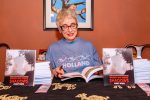
Janet Wees at a book signing for her
novel When We Were Shadows, which
she’ll be bringing to the Cherie Smith JCC Jewish Book Festival on Feb. 10. (photo
by Jack Cohen)
Ze’ev Bar was 5 years old in 1937, when his
family fled Germany to the Netherlands, where they lived in safety for a few
years. But, in 1940, as the Nazis extended their hold on Europe, the family had
to go into hiding, managing to survive the Holocaust with the help of members
of the Dutch Resistance.
Calgary-based educator and writer Janet Wees
tells Bar’s story of survival in the book When We Were Shadows. She will
present the novel for younger readers (ages 9-13) on Feb. 10, 10 a.m., at the
Jewish Community Centre of Greater Vancouver as part of the Cherie Smith JCC
Jewish Book Festival, which runs Feb. 9-14. Wees and five other authors – Leo
Burstyn, Miriam Clavir, Arnold Grossman, David Kirkpatrick and Helen Wilkes –
will briefly introduce their works at the event A Literary Quickie.
“My reasons for writing this book were
twofold,” Wees told the Independent. “One, to help relieve Ze’ev from
having to repeat his story over and over to schoolchildren because it was so
upsetting for him, yet he felt it needed to be told so they would know what
happened during the Second World War in their country. Hopefully, having had
the book translated into Dutch in Holland, that might be happening. I have had
letters from mothers of children who are reading the book in Dutch for book
reports.
“My other reason was to expose North American
children to the plight of children during war, to the bravery of the people who
helped save lives at risks to their own.”
Among the real-life members of the resistance featured in the novel are Opa Bakker, Tante Cor, and Edouard and Jacoba von Baumhauer, all of whom have been recognized as Righteous Among the Nations by Yad Vashem. Wees said, “I made a promise to von Baumhauer’s son that I would honour the people who risked their lives helping to build the Hidden Village [near Vierhouten] and hide, assist and feed the people who were fleeing the Nazis.”
Wees visited the memorial site of the Hidden
Village in 2005, and again in 2007. She interviewed Bar in Amsterdam in 2008.
“We spent three to four days in his dining
room, talking, crying, laughing; I taped and wrote,” she said. “Once home, I
poured it all out on computer and began to sort and edit and change, and
watched it take shape. Of course, life interfered, and sometimes it was so
intense, hearing his wavering voice on tape, that I would have to take a break.
By 2011, it felt ready for an editor. After that, I submitted it, naively
giving myself 12 rejections – apparently J.K. Rowling had 12 rejections before
Harry Potter was accepted – before I reconsidered my direction.”
A change in direction did occur. In 2014, Wees
was accepted into a mentorship program and, with that guidance, realized that
the novel “needed a boy’s voice and an empathetic setting, where children could
identify with the protagonist.”
Over some four months, Wees said, “I
essentially rewrote the book using a different format and incorporating a boy’s
voice. At the end, there was a reading and the book was so enthusiastically
received that I knew I was on the right track.
“It felt like I had kind of lost perspective,
as I was so close to the story and, even though I would have times of ‘Wow! Did
I write that?’ seeing it through others’ eyes really gave me a boost. I began
submitting again and, this time, the 11th publisher contacted was the one!”
The book was accepted by Second Story Press in
2017.
“I always wanted Second Story Press to be my
publisher because of their Holocaust Remembrance Series for Young Readers. I
read other books in that series and felt this was a good fit,” said Wees.
While When We Were Shadows is Wees’
first book, she has published articles in educational journals and in news
magazines. In addition to other literary projects, she has written drafts for
two children’s books, she said, “based on something I did growing up in
Saskatchewan, and one based on my pen pal’s granddaughter’s activity with her
Oma in Holland.”
The 60-something Wees first started writing her
pen pal when she was 12 years old.
“My pen pal Henk had to find a pen pal in an
English-speaking country for his English class in school. He put an ad for a
pen pal in the Regina Leader-Post and I saw it and responded,” she
explained. “He told me, on my first visit, as we were looking over all my
letters he’d saved, that my letter was the funniest so he chose me as his pen
pal.
“We wrote constantly but lost contact for a few
years during which we both got married and started families. I reconnected, in
1972 or thereabouts, and, knowing how families in Europe usually stay in their
family homes, I wrote to the old address. Lo and behold! There they were! After
that, it was letters with Henk’s wife because she was better at that point with
written English, but we telephoned and, upon the onset of computers, we emailed
and then FaceTimed.
“I went to visit them for the first time in
1991, and have been back 10 times since…. On one of the trips where I stayed
one month on the island (Terschelling), Hennie (Henk’s nickname) and Loes took
me to see the memorial site of the Hidden Village and the urge to learn more
about this site was palpable.
“Two years later,” said Wees, “we went again,
and I sat for longer in the replica huts and tried to imagine what went on. It
smelled like our dirt basement in Togo, Sask., and just thinking about living
in that basement for 18 months gave me a bit of an idea of the sense of being
confined; the smells, the dark, the cold. And I decided that I had to write a
book, if not for my former students who were now in university, for their
children. Sadly, Hennie passed away this past April without seeing the
published book, but I used his name (with his permission) for one of my
characters, so he lives on through the book. If not for him, this book may
never have existed.”
In their first discussions about the novel,
Wees said she and Bar had “talked about making it an ‘adventure’ of a boy
during wartime.” The original title was Boy of the Forest. “But,” she
said, “as I was writing, I realized this was not an ‘adventure’ as we perceive
adventure, and he concurred, so I changed my title to Whatever It Takes.
My publisher chose the final title, When We Were Shadows, and I love
it because it personifies the whole concept of living in the shadows – unseen,
and unable to see.”
In revising the original manuscript to be from
a young boy’s perspective, she said her focus was on “the emotional being of
Walter [Ze’ev changed his name as an adult] and how he perceived what was
happening, being sheltered and wanting desperately to know and to do something,
and about the selflessness of others. I wanted it to be about the people in his
world, what was happening inside his head and heart, more than what was
happening outside.”
Wees said the character of Walter took over
“and his voice flowed through so eloquently and so quickly that there were many
days I never budged from my computer for hours, missing lunch and working until
dark. I ‘heard’ him in my head. I could ‘see’ what was happening. Until I
actually was writing, I always thought that was bunk when I heard other authors
say that their characters take them on their own journey. But now I know it
happens.
“I also discovered that what I’d taught my
students about editing, I had to follow as well, so I did most of my editing by
reading the book aloud. I found errors that way in facts, such as tents not
having zippers in the 1940s but pegs instead. I was able to find correct
weather for dates in the letters by searching online.”
This diligence no doubt contributed to When
We Were Shadows being nominated for the Forest of Reading Red Maple
non-fiction award of the Ontario Library Association, which describes the award
program’s aim as getting young readers (ages 12 to 13) to engage “in
conversation around the books and … to use critical thinking while reading.”
The awards will be presented in May.
In the writing of When We Were Shadows,
Wees said, “I have become friends with von Baumhauer’s grandson and wife. While
writing this book, I also found out that my grandmother lost sisters-in-law to
the death camps and her brother was killed on the Russian front. Until then, I
had no idea how our family was affected by the Holocaust, as I was unaware of
family still living overseas. I am now in touch with the great-granddaughter of
one of those women.”
The Princess Dolls by Ellen Schwartz,
with illustrations by Mariko Ando, takes place in Vancouver in 1942. Esther and
Michiko are best friends. They dream that one day they will be princesses
together; in games, Esther is Princess Elizabeth and Michi is Princess
Margaret. When they spy dolls fashioned after the real-life princesses in the
toy store window, the girls dare to hope that they’ll each get their favourite for
their birthday, something else they shared, both having been born on the same
day.
However, when Esther gets her royal doll as a
gift, but Michi doesn’t, the girls’ friendship is strained. Before they have a
chance to patch it up, Michi and her family – ultimately along with more than
21,000 other Japanese-Canadians – are forced to leave the West Coast, losing
their home, business and possessions. Michi ends up in Kaslo, B.C.
A story thread throughout The Princess Dolls
is Esther’s family’s worry over family members in Europe, as the Nazis round up
Jews and send them to transit camps, about which Esther’s parents and
grandmother know little.
The Princess Dolls is kind of a companion novel to Schwartz’s Heart of a Champion, in which 10-year-old Kenny Sakamoto dreams of being as good at baseball as his older brother, who is the Asahi team’s star player. Also set in Vancouver in 1942, the Sakamoto family’s neighbours and good friends, the Bernsteins, are Jewish. As she told the Independent when that book was released, “I wanted to point out that the treatment of Japanese-Canadians, although obviously not nearly as lethal or horrific, was comparable to that of Jews in Europe,” said Schwartz. “In both cases, a minority was being persecuted simply because of their religion or nationality. Giving Kenny a Jewish best friend would make both characters sympathetic about this issue.” (See jewishindependent.ca/uniquely-b-c-baseball-story.)
Schwartz will talk about The Princess Dolls on Feb. 10, 11 a.m., at Richmond Public Library, as well as at Vancouver Talmud Torah later that week as part of the Cherie Smith JCC Jewish Book Festival. For the festival schedule and tickets, visit jewishbookfestival.ca.
Robbie Waisman and Dr. Uma Kumar
spoke Jan. 24 at UBC’s Hillel House. (photo from Hillel BC)
History’s resonance in the present was a
recurring theme at a commemoration of International Holocaust Remembrance Day
last week.
The event at Hillel House on the University of
British Columbia campus, featured Holocaust survivor Robbie Waisman speaking
about his experiences in Buchenwald concentration camp and his life before and
after the Shoah.
Thirteen survivors of the Holocaust lit
yahrzeit candles, after which Hillel’s Rabbi Philip Bregman chanted the
Mourners’ Kaddish.
Before Waisman’s presentation, the audience
watched a 1985 video from CBC television’s national program The Journal,
which followed Waisman as he traveled to Philadelphia to meet Leon Bass, the
American soldier who had liberated him from the camp 40 years earlier.
Bass, an African-American, was the first black
person Waisman had ever seen. At the age of 13, Waisman thought Bass and his
fellow American soldiers must be angels.
“Indeed, they were,” he said.
At the event Jan. 24, which was co-sponsored by
the Vancouver Holocaust Education Centre, Hillel BC, the Centre for Israel and
Jewish Affairs and UBC’s department of Central, Eastern and Northern European
Studies (CENES), Waisman said the thing that kept him and his fellow survivors
alive was the hope of being reunited with family.
“The enormity of the Holocaust was not yet
known to us,” said Waisman. When it did become known, he said, “we had to find
a way to deal and cope with the huge loss of all our loved ones.… How are we
going to live with all these horrors?… Has anyone survived? If not, what is the
point of my own survival?”
He and his father had seen one of Waisman’s
brothers murdered, and his father died later in the same camp. He would learn
that his mother and his other three brothers were also murdered, as were his
uncles, aunts, cousins and friends. Of the family, only Waisman and his sister
survived.
“I search for answers,” he said. “I only find
more questions. How could anyone remain sane and functioning as a human being
when humanity was destroyed in front of our eyes? Worst of all, how do you come
to terms with the tragic loss of all our loved ones, fathers, mothers,
brothers, sisters, friends that we grew up with, all innocent – everything gone
– how is it possible? We started questioning the existence of God. How could
this happen to us?… Before the war, we all came from Orthodox homes, rich in
heritage and traditions. After coming out of the terrible abyss, the darkness,
we questioned angrily. But what we learned in the home, from our parents, was
not lost. The sense of humanity slowly returned to us. Our faith was shaken
yet, in spite of it all, we remained true to it.”
Waisman said his experience in the Holocaust,
and the experience of other survivors, has taught that “evil must be recognized
and that we all have a responsibility to make sure that it never happens again
to anyone. And yet … what is the world doing about it now?”
He reflected on the concept of “Never again.”
“Noble, thought-provoking words, but only if we
act upon them,” he said. “Today, over 70 years after my liberation, the promise
of never again has become again and again. There have been a number of
situations that have tested the world’s resolve, in Cambodia, the former
Yugoslavia, in Darfur and in Syria – I could go on and on.
“When I speak at high schools, I try to convey
to students the pain of my experience in order to inspire them to prevent such
events from occurring again,” he said. “The world must learn from the past in
order to make this a better place for now and the future. We must teach
compassion, we must eradicate racism and religious persecution. We must teach
ourselves, teach our children, each generation must learn.”
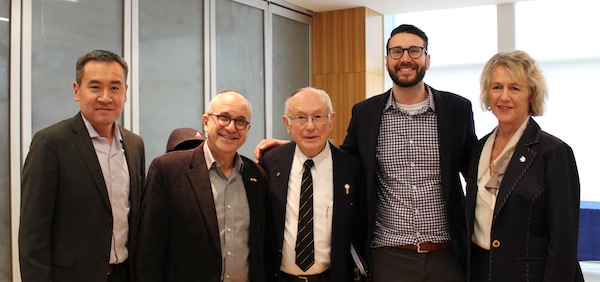
IHRD at Hillel, right to left, Michael Lee, Rabbi Philip Bregman, Robbie Waisman, Sam Heller (Hillel BC), Joyce Murray. (photo from Hillel BC)
Also at the Jan. 24 event, Dr. Uma Kumar, a
lecturer with CENES, noted recent reports that indicate many Canadians and
others are ignorant of the most basic facts of the Holocaust.
“Nearly half of Canadians cannot name a single
concentration camp or ghetto that existed in Europe during the Shoah,” she
said. “However, there is a positive point: 85% of the respondents of the study
said that it was important to keep teaching about the Holocaust so that it does
not happen again. Hence, there is a pressing need for more and better Holocaust
education at schools and universities in Canada. We, as Holocaust educators,
still have a lot of work to do.”
Joyce Murray, member of Parliament for
Vancouver Quadra, brought greetings on behalf of the federal government and
also reflected on her visit last year to Auschwitz.
“The Holocaust reality, for me, shifted from
being a part of history that I thought I understood and regretted to a reality
that I feel in my body and in my heart,” she said. “Commemorating mass atrocity
and genocide in the continued sharing of the story of survivors is a vital part
of prevention. These stories serve as a reminder of the dangers of hate,
prejudice and discrimination, the dangers of seeing human beings as ‘us’ and
‘them,’ the dangers of excessive nationalism to the detriment of others that is
stalking so many nations today.”
Murray also mentioned the Canadian government’s
recent apology for refusing admission to passengers on the MS St. Louis in 1939
and reminded the audience that Canada is not immune to bigotry.
Michael Lee, member of the B.C. legislature for
Vancouver-Langara, was also present.
International Holocaust Remembrance Day was
officially marked worldwide on Jan. 27, the date when Allied forces liberated
the Auschwitz-Birkenau concentration camps in 1945. Another ceremony and a film
screening took place Sunday at the Peretz Centre.
One
of the displays in the exhibit Canada Responds to the Holocaust, 1944-1945,
which was at the Vancouver Holocaust Education Centre in 2016. (photo by Cynthia Ramsay)
Nearly half of Canadians are not able to name a
single Holocaust concentration camp. A large number of Canadians do not know
that six million Jews died in the Shoah, offering up numbers like two million,
with nearly one in four admitting outright that they just don’t know. Among
millennials, those aged 18 to 34, the numbers are particularly disturbing: 22%
have not heard of the Holocaust or are not sure whether they have (which seems
like much the same thing). One in three Canadians thinks that this country had
an open immigration policy for Jewish refugees in the 1930s, unaware that very
few Jews were permitted into Canada in the lead up to genocide.
These are some of the details found in a survey conducted on behalf of the Azrieli Foundation and the Claims Conference. The study was based on 1,100 interviews of Canadians to coincide with International Holocaust Remembrance Day Sunday. (See story, “Emerging from terrible abyss. ”)
On the positive side, 85% of respondents said
it’s important to keep teaching about the Holocaust in order to prevent such a
thing from happening again, while 82% said that all students should learn about
this part of history.
In reality, it is unlikely that all Canadian
students will learn about the Holocaust. In British Columbia, for example, the
Holocaust only became part of the core curriculum with the overhaul of the
entire provincial curriculum three years ago – and only if the teacher chooses
to include it. The history of genocide is one module that teachers are able to
select from a range of subject components at particular grade levels.
Therefore, it is still a crapshoot whether a student graduating from the
British Columbia education system will have much or any knowledge on the
subject.
It is extraordinarily unlikely that the
curriculum will be revised again any time soon to make Holocaust education
mandatory across the system. Educators complain, with good reason, that they
are expected to teach more content than there are hours in a day. Competing
needs, including career preparation and life skills, contend with subjects like
history for class time.
In Canada, where the educational curriculum is
determined by every province, similar discussions take place across the country
and a patchwork of curricula exist.
At the same time, a massive shift in the larger
culture has taken place, eliminating what had been, until the last few decades,
a largely shared body of knowledge. In the days when there were only a couple
of television networks, and hard copy newspapers were most people’s sources of
information, everyone would generally be aware of similar issues and events.
Half of all televisions in the United States in 1978, for example, were tuned
in to the nine-and-a-half-hour miniseries Holocaust (a program that was
admittedly not without its critics among Jews, historians and others).
The internet and the proliferation of cable TV
channels has refracted our attention in unlimited directions. People now
largely self-select the information they receive and that can blind us to
matters outside of our spheres.
In a better world, knowledge of the Holocaust
would be universal. In the world we live in, it remains vital to continue to
focus attention on the subject whenever possible – and to use this history to
educate about other genocides and violations of humanity while not diminishing
the uniqueness of the Shoah itself.
Organizations devoted to the critical work of
Holocaust education, including the Vancouver Holocaust Education Centre, are
carrying a heavy burden for the larger society and depend on public support to
meet their mandate. The Azrieli Foundation, which undertook this study,
publishes survivor memoirs and funds a variety of Holocaust-related projects
across Canada. Other groups, to varying degrees, share the burden of teaching
this history, including universities, synagogues, Hillels, book publishers and
authors, and so forth.
Unquestionably, the most powerful form of
Holocaust education is firsthand testimony from survivors and witnesses.
British Columbians who are survivors of the Holocaust have spoken to tens of
thousands of students but, in a handful of years, this method of transmitting
history will no longer be possible. Innovative strategies are being developed,
such as the New Dimensions in Testimony oral history project, a collaboration
involving Steven Spielberg’s USC Shoah Foundation, which includes holographic
representations of survivors with whom students and others can interact
virtually. This project recognizes that the issue is not only to continue
educating, but to find ever-advancing means of doing so effectively.
The breadth of the challenge was underscored by Prof. Jan Grabowski,
who delivered the Rudolf Vrba Memorial Lecture at the University of British
Columbia last November. He and a team of scholars and researchers are visiting
town and city archives across Poland, doing primary research on the events that
led to the murder of three million Jews in that country. In other words, we’re
still compiling the most basic facts of that history and, it may be safe to
say, we are just as far away as ever as to understanding the larger moral
questions – How? Why? – the Holocaust raises. Much work remains to be done.
The author’s maternal aunt, Sara Basson (at age 23). (photo from Libby Simon)
It was the long, cold winter nights in Winnipeg
that made me do it. With my husband working late and a preschooler asleep in
her room keeping me housebound, what else could I do? I finally tackled the
onerous task of sorting seemingly hundreds of musty, dusty family photos that
lay scattered inside battered cardboard boxes saved by my parents, their lives
obviously too busy living the moments.
Who were these people in these tattered and
torn brown photos? Some, I had been told, were Aunt Lorna or Cousin Sylvia.
Others were total strangers. The clothing and hairstyles against an unfamiliar
backdrop told of another time and place in history. Places I had never seen nor
been, yet vague memories from childhood floated in my mind. Some pictures had
writing on the back in a foreign language I could not read or understand.
Nonetheless, I carted these decaying remnants along with all the important
household belongings wherever we moved. Why had I not discarded them?
I now painstakingly placed these memories of
bits and bytes under protective sheets in photo albums, one by one. Organizing
them in some fashion was just too daunting a task. For the moment, preserving
them was the goal – for whom I did not know. That question wouldn’t be answered
until many years later, when I received a letter that launched an unexpected
personal journey.
Bold, black type on unfamiliar letterhead
demanded my attention – Lois Feinberg, Financial Consultant, Hollywood,
Florida. I was about to toss out what I thought was spam sent by snail mail
when one short sentence leaped out at me: “I’m your second cousin on your
mother’s side,” it read. “My grandmother and your grandfather were siblings.”
Maybe it was more scam than spam but I had to
pay attention. What did she want? Credit card numbers? Bank account numbers?
Transfer a million dollars out of some remote African country? I read further
with guarded skepticism.
“In the process of my genealogical research,”
she wrote, “I found our mutual cousin, Sylvia, who gave me your contact
information. I would like the names and birth dates of your family in order to
register this information with the Yad Vashem in Israel.”
Yad Vashem. I knew it as the memorial centre
for the murdered six million Jews and a symbol of the ongoing confrontation
with the rupture of families engendered by the Holocaust. My doubts began to
dissipate as the letter took on a flavour of authenticity. After confirming its
legitimacy with Sylvia, I provided Lois with the information she requested. I
did not pursue further personal contact, however, because, frankly, I have not
been blessed, or cursed, with the need to search out relatives who could be
more of a blemish than a blossom on my family tree.
But things were about to change.
Circumstances arose the next winter that would
take my husband and me to Florida. I contacted Lois and invited her for lunch.
When I greeted this pretty, dark-eyed, dark-haired lady, we hugged each other
warmly. She appeared similar in age, slim, well-dressed and refined in manner.
Lois had been a teacher turned financial consultant, divorced from her doctor
husband, with two grown children.
“I discovered two other cousins who live in
Florida whose grandparents are also siblings of our grandparents,” she said. I
was stunned. Two more family members – right here!
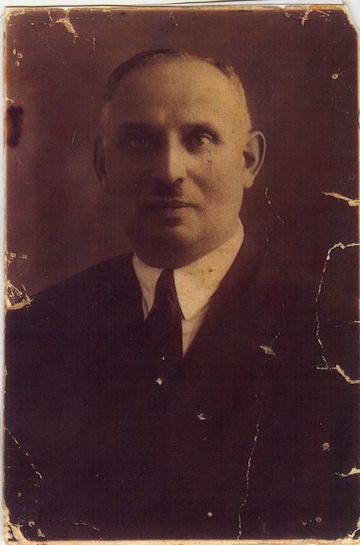
The author’s maternal grandfather, Abraham Basson (at age 60). (photo from Libby Simon)
“I’ll arrange a brunch at my home so you can
meet them,” she promised with a smile. And, true to her word, the cousins all
gathered at her home the following week.
A strange mix of emotions coursed through me as
the past and present began to meld. Until recently, we were totally unaware of
one another’s existence. Suddenly, we had a common thread tying us together –
our grandparents.
Lois told me that the grandparent siblings,
including my maternal grandfather, had all come to the United States in the
1930s to escape Hitler’s rise to power, but he was the only one sent back,
because of a leg deformity. Not from disease, mind you, but the result of an
accident. In the course of operating his paper company business, a heavy object
had fallen on his leg yet he continued to run a successful business. I was told
he and several other relatives were among the six million Jews murdered in the
Holocaust.
Like a seismic jolt of lightning, the brown
pictures flashed across my mind. For the first time, my grandfather became more
than a lifeless face on a faded old photo. Sadness and anger pulsed through me.
He was my mother’s father – a living, breathing person whose life had been cut
short. Not by a natural disaster like a tsunami, a flood or earthquake, but by
a human-made catastrophe, the Holocaust. Nature’s cataclysmic events kill
randomly but humans ravaged and murdered with deliberation and purpose. While
we had been spared the agony of their deaths, history had changed the lives of
those who lived, splintering family shards across the globe, many of which will
never be repaired.
Yet it was heart-warming to meet Marty, the
supervisor IRS lawyer in south Florida; Arnie, a retired businessman; and their
wives. After a four-hour brunch came to a pleasant end, plans were discussed
for “The Brunch” next winter, ensuring a future for this fractured family.
These images gradually transcended time and
geography and were now transplanted into my world in the 21st century. They
were channeled from a dismal and distant past to live again in the present. In
fact, in April 2012, I learned the names of six of my maternal relatives who
were murdered in the Holocaust. My Israeli family had listed their names at Yad
Vashem in Israel. I have now added them to Winnipeg’s Holocaust memorial on the
grounds of the Manitoba Legislature to further ensure they will never be
forgotten.
The exciting promise of a journey of discovery
still lies ahead, as traces of life continue to sprout new branches on this
family tree – blemish or blossom. I knew now for whom these pictures were
preserved. I preserved them for me and for future generations of Jewish
history. L’dor v’dor.
Libby Simon, MSW, worked in child welfare services prior
to joining the Child Guidance Clinic in Winnipeg as a school social worker and
parent educator for 20 years. Also a freelance writer, her writing has appeared
in Canada, the United States, and internationally, in such outlets as Canadian Living,
CBC, Winnipeg Free Press, PsychCentral and Cardus, a
Canadian research and educational public policy think tank. She wrote this
piece with International Holocaust Remembrance Day (Jan. 27) in mind.
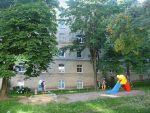
One of the apartment buildings at the
HKP complex. (photo from Richard Freund)
Nearly three-quarters of a century after the Shoah ended, we are still learning about aspects of what happened. For example, the documentary The Good Nazi tells the little-known story of a Nazi from Vilna who tried to rescue more than 1,200 Jews. It airs on VisionTV Jan. 21, and again April 29.
In 2005, Dr. Michael Good sought out Prof.
Richard Freund of the University of Hartford to tell him about Maj. Karl
Plagge, a Nazi who oversaw a military vehicle repair complex that was used as
cover for 1,257 Jews in Vilnius (Vilna). Good described how his father, mother
and grandfather were saved within this complex, and later wrote about it at
length in his 2006 book The Search for Major Plagge: The Nazi Who Saved Jews
(Fordham University Press).
While interesting to Freund, who works within a
department known for its Holocaust studies, nothing further came of that
meeting. That is, until 2015.
By then, Freund had directed six archeological
projects in Israel and three in Europe on behalf of the university, including
research at the extermination camp at Sobibor, Poland. In 2015, he was in
Lithuania doing research on a Holocaust-era escape tunnel, adjacent to the
Great Synagogue of Vilna. He and his team had brought with them specialized
equipment that enabled non-invasive examination of the ground and walls, and
they offered it to anyone wanting to do such research. The Vilna Gaon State
Jewish Museum came calling, and brought Freund to a site on the outskirts of
Vilna, where he was told about Plagge.
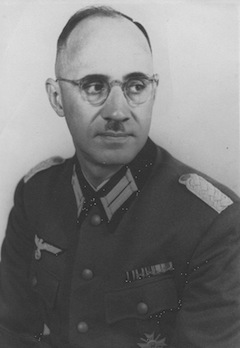
Nazi Maj. Karl Plagge oversaw a military vehicle repair complex that he used to try and save 1,257 Jews in Vilnius. (photo from Richard Freund)
Of that moment, Freund told the Independent,
“I’m sitting there and I say, ‘Karl Plagge? I know that name!’”
Freund connected with survivor Sidney Handler,
who was 10 years old when he hid from the Nazis in the work camp. After the
Nazis left in July 1944, Handler was forced to move dead bodies, and could
point out decades later where 400 Jews were buried.
“We could have gone through the entire 20 acres
and not located exactly where that was,” said Freund.
Using scanners, thermal cameras, radar and
other methods, Freund’s team discovered and recorded the various hiding places,
also called malinas. Under Plagge’s plan, Jews had built malinas in building
crevices, behind the walls, to keep out of sight when Nazis came to “liquidate”
the complex.
The garage (repair shop) was dubbed HKP. It was
on Subocz Street and is likely the only Holocaust-related labour camp left
completely intact. Until recently, people had been living in the two six-floor
buildings, which comprised 216 apartments.
Freund reached out to filmmaker Simcha Jacobovici, telling him how important it was to document the site, the story, and reveal it to the world. Things were made all the more pressing when Freund and Jacobovici discovered that developers were going to demolish the site. Fortunately, before this happened, Jacobovici took a film and photographic crew to HKP, in January 2018.
The Turning of Plagge
In 1941, Karl Plagge was placed in command of
the HKP 562, a unit responsible for repairs of military vehicles damaged on the
eastern front. Plagge experienced something of a pang of conscience – he hadn’t
signed on to genocide. He made the decision to leverage his position and use
Jews as “slave labour” for HKP, pleading the case to his superiors that, if
Jews didn’t work there, there would be no one to fix the vehicles.
Virtually none of the 1,200 Jews was knowledgeable
in fixing cars; they were accountants, lawyers, hairdressers, academics, cooks
and others. They all learned various HKP tasks on the job, and Plagge somehow
convinced the Nazi SS that every single one of them was necessary for HKP.
Even though the entire charade was met with a
barely tolerated wink and nod by Nazi brass, Plagge had a deep (and correct)
hunch that their patience would eventually wear thin.
Heinrich Himmler, the head of the SS,
announced, in the summer of 1943, that he wanted every Jew in Eastern Europe
eliminated, irrespective of whether they were contributing to the war effort in
a work camp. So, with Plagge’s approval, his workers carved out malinas in the
walls of the buildings and in attic rafters.
As the Soviet Red Army approached the outer
edge of Vilnius in June 1944, it was a sign that the Allies were nearing
victory. In this context, on July 1, 1944, Plagge made an impromptu
announcement in front of an SS commander and the Jewish workers, who gathered
to listen. He explained that his unit was being transferred westbound and,
though he requested his labourers be allowed to join, his superiors wouldn’t
permit it. All of this was code for the Jewish prisoners to take cover. Roughly
half of the workers – some 500 of them – hid away in malinas or ran from the
camp, while others decided to stay.
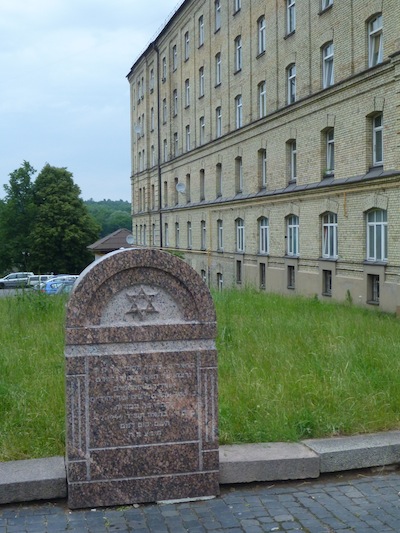
A monument placed recently at the complex to honour Karl Plagge and memorialize the Jews who were killed at HKP. (photo from Richard Freund)
When Nazi troops took over the camp two days
later, 500 Jewish workers appeared for roll call, and were killed. It took the
Nazis three more days to comb the camp and the surrounding area for any
survivors, eventually finding roughly 200 Jews, all of whom were shot.
When the Soviets finally took over Vilnius
later that week, approximately 250 of HKP’s Jews in hiding emerged.
When the war was over, Plagge returned home to
Darmstadt, Germany, where, for the next two years he lived quietly, until he
was brought to court as a former Nazi. Somehow, word traveled to a displaced
persons camp in Stuttgart, a three-hour drive away, where many survivors of HKP
had ended up. In Plagge’s defence, the survivors sent a representative to
testify to the court in the hopes the charges would be overturned.
The testimony resulted in a favourable judgment, and Plagge received the status of an exonerated person. In 2005, after evidence and survivor testimony, Yad Vashem: The World Holocaust Remembrance Centre posthumously bestowed the title Righteous Among the Nations on Plagge.
The Good Nazi was produced in Canada for VisionTV by Toronto-based Associated Producers. Jacobovici was writer and executive producer, Moses Znaimer executive producer, Bienstock producer and co-director, Yaron Niski co-director and Felix Golubev line producer/executive producer.
Dave Gordonis a Toronto-based freelance writer whose work has appeared in
more than 100 publications around the world.
A recent poll determined that a large number of
Europeans hold views that are antisemitic and, at the same time, awareness
about the Holocaust is decreasing.
More than 7,000 people were polled on behalf of
the news network CNN. In each of seven countries – Austria, France, Germany,
Hungary, Poland, Sweden and the United Kingdom – 1,000 people were surveyed.
One-third of those surveyed – and one in two
respondents in Poland – stated that Jews exploit the Holocaust to advance their
goals and that Israel uses the Holocaust as a tool to justify its policies.
One in 20 Europeans have never heard of the
Holocaust. In Austria, 12% of respondents said they had never heard of it,
while 40% admitted they know little about it.
About 40% of respondents in Poland and Hungary
claim that Jews have too much influence on business and finances. One-third of
Poles and Hungarians think Jews exert too much influence on global politics.
Other findings in the poll deliver a mixed bag.
Half of respondents in all countries claimed to know “quite a lot” about the
Holocaust, with 20% claiming to have “extensive knowledge.” Two-thirds of
Europeans agree that commemorating the Holocaust helps ensure similar
atrocities do not happen in future and half believes that Holocaust
commemoration helps combat antisemitism today.
While Jewish people constitute about 0.2% of
the total world population, 25% of Hungarians and 20% of Polish and British
respondents believe that more than 20% of the world is Jewish.
The poll says that 54% of Europeans believe
that Israel has a right to exist as a Jewish state. (One almost wishes they had
been asked if France has a right to exist as a French country, or Poland as a
Polish country.)
One-third of Europeans, according to the poll,
believe that criticism of Israel is symptomatic of antisemitism, while 20%
believe that it is not.
Deflecting blame for antisemitism away from its
perpetrators and onto its victims, 28% of respondents contend that antisemitism
in their respective countries is a direct response to Israel’s actions. Fully
18% of Europeans blame antisemitism on the behaviour of Jews themselves.
Polls like these are an important barometer of
opinion. There is little in the results that will surprise anybody who has been
paying attention to European developments in recent years. Previous surveys
have indicated that Europeans (as well as North Americans and others) have what
we would consider an inadequate grasp of the realities of the Holocaust.
Likewise, nobody needed a survey to know that antisemitism in Europe is at a
level unprecedented in recent decades. However, it is important to have empirical
evidence like this, especially a survey that is both cross-national and
includes enough respondents to make it statistically significant.
It would be no help at all to throw up one’s
hands and declare Europe lost, as some people have done in recent days. But
neither do we, in Canada, have all that much influence over what happens there.
We do, however, have the ability to influence
things closer to home and we should redouble our efforts to ensure that trends
in Europe are not transmitted to our shores. We are, by no means, immune to
this kind of thinking. A similar study done in Canada or the United States
would indicate some parallels with the European results, albeit, we hope, not
to the deeply concerning degree that this study has indicated.
We must continue to support every area ofHolocaust education possible. The work being done at the Vancouver HolocaustEducation Centre and by organizations across Canada must be supported andstrengthened. As Prof. Jan Grabowski said in delivering the annual Vrba lecture(jewishindependent.ca/revealing-truth-elicits-threats), there is still verymuch primary research left to do about the Holocaust, unearthing basic detailsthat are still not recorded about that time in history.
On the front of combating antisemitism here,
the Jewish community must continue being vigilant and raising alarms whenever
antisemitic ideas or actions emerge because this work has fallen primarily to
Jewish Canadians. We must continue to build strength through our allies in all
the multicultural communities in the country. This is the surest method to
combat the growth of antisemitism – and this has to be a two-way street. As a
community, we must stand with other groups and individuals when they are
unjustly targeted if we are to expect others to stand with us.
While the last lights of Chanukah our now
extinguished, we still have the season of winter before us and it is our
responsibility to continue bringing light where there is darkness.
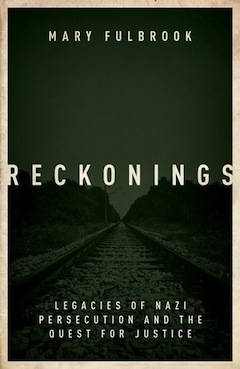
The theme of Reckonings: Legacies of Nazi Persecution and the Quest for Justice (Oxford University Press, 2018), the new book by eminent English historian Mary Fulbrook, is justice. Or, rather, injustice, as she exposes how ex-Nazi perpetrators, and bystanders to their murderous policies, have evaded (and continue to evade) due process and acknowledgment of moral responsibility for their (in)actions.
Every level of strategy open to these criminals and cowards is exposed in Reckonings. Fulbrook reveals all the political, psychological, pragmatic, legal (and illegal), scapegoating, self-serving, self-exculpatory, “we were victims too”-type excuses by which the morally corrupt and unconscionable avoid due process and personal liability.
Fulbrook rightly says, at the end of Reckonings, “there can be no answer to the questions of why and how cruelty on this scale was possible.” So, what, she asks, can the “honest” historian do? Her answer sums up the well-realized objective of this magisterial new book: “Historians can clarify patterns of involvement in and responsibility for Nazi persecution and explore the implications both for those who lived through it and those who came after.”
Nazi criminality is, of course, a hugely complex historical issue, but Fulbrook’s strategy is simple and direct: it is to “reconstruct the ways in which wider social and political developments intersected with individual lives” such that “large numbers of people were mobilized in service of a murderous cause.”
Reckonings is rich with such exploration of “individual lives,” both of persecutors and bystanders, and it rings also with the agonizing accounts of dozens of victims, among whom Fulbrook gives frequent and welcome voice to the rarely referenced persecuted sub-groups of homosexuals, and victims of Nazi euthanasia policies.
Fulbrook’s central focus is, however, justice: justice failed and justice delayed, delayed by silence, by endless rationalization, by foot-dragging, by the pollution of the legal system by former Nazis (described as “themselves swimming in a sea of guilt”) and, no less disturbing, by the pragmatics of (primarily American) Cold War strategists, anxious not to offend a potential ally against the Soviet Union.
Reckonings is unusual history in its welcome lack of “normal” arm’s-length objectivity: Fulbrook is uncompromisingly fierce in her condemnation of those who were responsible for this “maelstrom of murder.” Throughout the book, she remains directly and openly angry, and determined to “nail down” these murderous ignoramuses, just-following-orders immoralists and “I knew nothing” liars. One feels the heat of Fulbrook’s grit and determination: each page rings out with a loud, “they will not get away with this as long as I can help it.”
Reckonings is divided into three parts. Part One, the most “traditional” part of the book, explores the various sites of this “maelstrom of murder,” beginning with Auschwitz, but moving carefully beyond, to less and less better-known killing centres, especially in southern Poland – where there were many forgotten violent “microcosms of violence,” as she calls them.
Part Two is, as Fulbrook’s title suggests, the heart of the book: here, the focus shifts to the attempts to bring perpetrators (both men and women) to justice. She lays out the proceedings of the various major trials – Auschwitz, Sobibor, Belzec, Dachau, Hadamar, the Einsatzgruppen trial, etc., right up to the present – but also includes trials relating to perpetrators of euthanasia and other crimes. She outlines, in fascinating detail, the differences between the ways that East and West Germany approached bringing Nazis to justice: the former being famously more diligent than the latter, leading to a flood of ex-Nazis to the more “tolerant” West in the early years after the war. This flood included all the euthanasia personnel, who left their families behind in the GDR to escape justice. (The West accepted the “just following orders” defence; the East did not. About 400,000 people benefited from this and similar lax standards in the West.)
The third part, “Memories,” is about how survivors remember, and how Nazis forget. It combines a plangent exploration of the personal experiences of individuals living around the world who have survived persecution – most of whom have never received compensation or recognition – with accounts of how perpetrators and their minions managed (and still manage) to cover their tracks, and how this evasion affects their children and grandchildren.
The most memorable chapter of this final part is called “The Commemoration of Shame.” She notes here how the “shame” of the perpetrators is almost always buried in the sea of guilt-ridden commemoration throughout Germany, as is the pain of forced and slave labourers, the acknowledgement of which would still have legal (compensation) ramifications for German industry. Fulbrook also notes here that it wasn’t until 2014 that the first memorial appeared for the victims of Nazi euthanasia policies.
Reckonings ends in despair. “So few perpetrators brought to account; so little justice.”
Ian Kershaw has written that “the road to Auschwitz was built by hate but paved by indifference.” Fulbrook reveals that the road from Auschwitz is not a whit less hateful and, certainly, no less met by indifference.
Graham Forst, PhD, taught literature and philosophy at Capilano University until his retirement and now teaches in the continuing education department at Simon Fraser University. From 1975 to 2010, he co-chaired the symposium committee of the Vancouver Holocaust Education Centre.
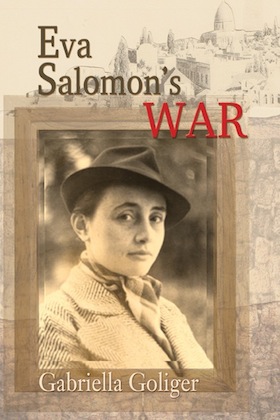
Gabriella Goliger’s Eva Salomon’s War is an intriguing novel. (photo by Ben Welland))
Award-winning Canadian author Gabriella Goliger has written Eva Salomon’s War (Bedazzled Ink Publishing, 2018), an intriguing novel set between the rise of the German Nazi state and the founding of the state of Israel – two complex historical phenomena whose aftershocks we are still experiencing. But, for Eva Salomon, those huge events are mainly engines moving her own story forward from timid German-Jewish adolescent to courageous Israeli young woman. The novel takes us through many intricacies of the competing historical strands that form the background of Eva’s life. Readers familiar with various bits and pieces of the history can connect the dots through her eyes.
Written as a first-person bildungsroman, the book opens as the Nazis close in on the Jews, who are wondering which of the many possible responses to embrace. Should they stay and resist? Stay, pray and keep their heads down? Should they emigrate, and, if so, where? Should they join the movement to build a Zionist workers’ state in Palestine? So many choices, so many unknowns, and so much peril attached to each decision.
Eva’s beloved older sister, Liesel, immigrates to a socialist kibbutz in the Galilee. Sixteen-year-old Eva and her embittered, widowed father migrate to Tel Aviv. We know what happens to the relatives who feel too old to make the trip.
The character of Eva is loosely based on Goliger’s own aunt. Letters between Eva and Liesel give us many illustrative details of Jewish life in Palestine in those years. In Breslau, they had enjoyed middle-class lives. In Palestine, they quickly have to learn working-class skills and they have to adapt to their shabby new realities among people with no time for pity or introspection.
Kibbutz life is physically harsh but relieved by the high level of ideological commitment between the comrades: “I sleep in a tent and the food is plain, but I never have to think about where my next meal is coming from. Everything is communal and allotted to me, down to my shoes and socks.” Eva flees the misery of life in her father’s tiny flat and finds a place to live with Malka, a Hungarian Jewish seamstress who helps her accommodate to her reduced circumstances.
Malka transforms Eva from a ragged miserable waif to a well-dressed young woman who can make her way in the vibrant, uncertain Jewish Palestinian world. Eva learns the meaning of “ein breirah” – no choice – a theme resonating not only throughout the novel but throughout the decades to the present day as one formative part of Israeli Jewish culture.
Eva finds work as an ozerit (cleaning lady) and starts putting together a life of sorts. She finds a music shop that affords her a bit of pleasure – “my refuge, my paradise” – phonograph records feeding her delight in classical music and her longing for romance. Fittingly, it is where she meets Constable Duncan Rees of His Majesty’s Palestine Police. Their romance encapsulates many conflicting layers of identity, culture, desire and belonging.
Throughout the novel, most of the characters are rent by doubts and competing loyalties. Only the fanatics of all stripes know certainty. The portrayal of Eva’s unbending Orthodox father, seemingly bereft of feeling for his wayward daughter, I found puzzling. We never see anything through his eyes, never understand his inner realities.
Eva is at war with her father, with all rigid religious and political belief systems, with her situation of loving the wrong person, and with her own competing claims of duty. Her personal war intersects with the fighting in Europe, the fighting between Arabs and Jews, the infighting between the various Zionist factions and, crucially, with the growing resistance to the British presence in Palestine.
Eva is a Jewish refugee. Duncan is charged with upholding British laws controlling Jewish immigrants. Despite the growing cultural-personal-political tensions, Eva enjoys their romance. She experiences pleasure and the delights of physical intimacy, which she keeps secret as much as possible. “The more he was my secret, the tighter, I felt, was our bond.” Their emotional intimacy is harder to sustain. One feels it can’t last and I wondered throughout how Goliger was going to handle it (no spoiler here).
The British White Paper on Palestine brings it all to a head. Tensions explode into violence all over the land, from many different directions, aimed at “traitors” to all the intersecting causes. For each faction, “we” are highly individuated and the others are an undifferentiated “they.” Eva, essentially an apolitical person, is helplessly caught up in the sectarian brutality.
One can’t help but read the novel through the prism of the tragic unfolding of events since 1948. Goliger vividly illustrates the human urgencies propelling Arabs and Jews in all directions, and the emotional realities behind all the ideologies.
Near the end, I was reminded of Anne Frank’s “In spite of everything, I still believe people are good at heart.” Eva reflects, “I believe a better world is dawning because … because ein breirah. I must.”
Deborah Yaffe lives in Victoria, where she formerly taught in the women’s studies department of the University of Victoria. An active secular Jewish feminist since reading Elana Dykewomon and Irena Klepfisz in the 1980s, she is grateful for the many Israeli individuals and organizations working against Jewish persecution of Arab Israelis and Palestinians.
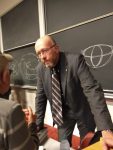
University of Ottawa’s Prof. Jan Grabowski delivered the Rudolf Vrba Memorial Lecture at the University of British Columbia Nov. 15. (photo by Pat Johnson)
Jan Grabowski, a University of Ottawa professor who is a leading scholar of the Holocaust, delivered the annual Rudolf Vrba Memorial Lecture at the University of British Columbia Nov. 15 – the same day he filed a libel suit against an organization aligned with Poland’s far-right government.
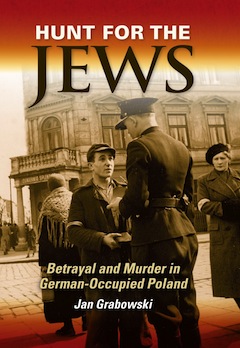
The Polish League Against Defamation, which is allied with the country’s governing Law and Justice Party, initiated a campaign against Grabowski last year, accusing him of ignoring the number of Poles who saved Jews and exaggerating the number of Jews killed by their Polish compatriots. Grabowski’s book, Hunt for the Jews: Betrayal and Murder in German-Occupied Poland, won the 2014 Yad Vashem International Book Prize for Holocaust Research. An English translation of an even more compendious multi-year analysis undertaken by a team of researchers under Grabowski’s leadership will be published next year. His Vrba lecture provided an overview of some of the findings in the new work. It is a harrowing survey that brought condemnation from Polish-Canadians in the Vancouver audience.
The new book, which does not yet have an English title, is a work of “microhistory,” Grabowski said. Holocaust studies is one of the fastest-growing fields of historical research, he said, partly because it got off to a slow start and really only picked up in the 1980s. Much of the written work being completed today is in the area of survivor memoirs, second- and third-generation experiences, including inherited trauma, and “meta-history,” the study of the study of the Holocaust.
“This assumes that we actually know what has happened,” he said. Grabowski maintains there is still much primary research to be done. “We are still far away from knowing as much as we should about this, one of the greatest tragedies in human history.”
There are millions of pages of relevant historical documentation almost completely untapped – primarily in provincial Polish archives, police records and town halls – that spell out in detail the often-enthusiastic complicity of Poles in turning on their
Jewish neighbours. By combing through these previously ignored records, Grabowski and his co-authors have amassed evidence of widespread – and eager – involvement of Polish police and other Poles in assisting Germans to identify, hunt down and murder Polish Jews.
The work has been met with official condemnation. Earlier this year, the Polish government adopted a law that would expose scholars involved in the study of the Holocaust to fines and prison terms of up to three years. The criminal component of the law, including imprisonment, was rescinded after international backlash, but the atmosphere around Holocaust inquiry in Poland remains repressive.
Grabowski said that the “explosion of right-wing extremists, xenophobia and blatant antisemitism” in Poland is related to the “undigested, unlearned and/or rejected legacy of the Holocaust” – the fact that Polish society has, by and large, refused to acknowledge the wounds of the past or to deal with its own role in the extermination of three million of its Jewish citizens between 1939 to 1945.
The concept of microhistory, which is the approach Grabowski’s team uses, is not local history, he said, “it is an attempt to follow trajectories of people.” He instructed his researchers to focus on the exact day, often hour by hour, when liquidation actions took place in hundreds of Polish shtetls and ghettoes. To do so upends a conspiracy of silence that has existed for decades.
“Why the silence?” he asked the audience. “There were three parts to the silence. One was the Jews. They were dead. They had no voice … 98.5% of Polish Jews who remained under German occupation, who never fled, died. You have a 1.5% survival rate for the Polish Jews. So, the Jews couldn’t really, after the war, ask for justice, because they were gone.”
The communist regime that dominated Poland for a half-century after the war was viewed not only as a foreign power inflicted on Poles from the Soviet Union, Grabowski said, “but, more importantly, as Jewish lackeys – that was a term that was used.
“So, it wouldn’t really stand to have trials of those accused of complicity with the Germans for murdering the Jews,” he said. “That would only confirm the widespread accusations that the communists were here doing the Jewish bidding.”
The third factor in the silence were the interests of Polish nationalists, whose ideology is inherently antisemitic, and who are the dominant political force in the country today.
Hunt for the Jews won the 2014 Yad Vashem International Book Prize for Holocaust Research.
While clearly not all Poles were collaborators, it would have been impossible for almost anyone in the country to claim ignorance of what was happening.
“Mass killing was taking place in the streets,” the professor said. Researchers found bills of sale charging city officials for the sand municipal workers needed to cover the blood on sidewalks.
“When you say that blood was running in the streets, it’s not a metaphor, it’s just a description of what really happened,” he said.
In some ghettos, as many as half the Jewish population was killed on the day of the action, with massive participation from Polish society.
“One area more, one area less,” he said. “Usually between 10 and 20% of Jews were slaughtered simply in order to frighten the remaining 80% to go to the trains, to be herded to the trains,” said Grabowski.
In Poland’s smaller communities, centuries of Jewish and Polish social, commercial and civic interactions did not result in camaraderie – on the contrary.
“The deadliest places of all [were] small shtetls, small towns, where anonymity was not available when the authorities were not far away,” he said. In one instance, a Jew in hiding heard his neighbour assure the Nazis he would return with a hatchet to help them break into the hiding place seconds before the door was axed down.
In another example, Grabowski described in minute detail the atrocities committed by Germans, Poles and Ukrainian recruits in Węgrów, a town in eastern central Poland with a Jewish population of about “10,000 starving Jews who have been terrorized for nearly three years and now the final moment has come.”
Rumours of liquidation swirled for months, as Jews fleeing neighbouring communities brought narratives of destruction. In the day or two before the liquidation, wives of Polish military and other officials rushed to their Jewish tailors, shoemakers and others craftspeople to obtain the items they knew would soon become unavailable.
“With mounting panic, people started to prepare themselves for a siege,” said Grabowski. “They built hideouts to survive the initial German fury, they started to seek out contacts on the Aryan side of the city, looking for help from former neighbours, sometimes friends and former business partners.”
On the eve of Yom Kippur in 1942, Polish officials in the town were instructed to assemble horses, wagons and volunteers. A cordon of Nazis and collaborators surrounded the city at intervals of no more than 100 metres.
The mayor of the town wrote: “Jews who woke up to the terrible news ran like mad around the city, half-naked, looking for shelter.” The same leader noted that, when the Germans demanded he produce volunteers to help with the task of rounding up their Jewish neighbours, he feared he would not be able to meet their needs.
“Before I was able to leave my office, in order to assess the situation and issue orders for the removal of the bodies,” the mayor testified, “removal of the bodies had already started. There were carts and people ready. They volunteered for the job without any pressure.”
For Jews, the Germans were to be feared, but their Polish neighbours were also a threat.
“The greatest danger was not associated with the Germans, but with the Poles,” said Grabowski. “Unlike the former, the latter could easily tell a Jew from a non-Jew by their accent, customs and physical appearance.”
Poles were rewarded with a quarter-kilo of sugar for every Jew they turned in.
“The searches were conducted with extreme brutality and violence … the streets were soon filled with crowds of Jews being driven toward the market square, which the Germans had transformed into a holding pen for thousands of ghetto inmates,” he said.
On the streets, “the cries of Jews mixed with the shouts of the Germans and the laughter of the Poles,” according to an eyewitness.
“All of this was done in a small town where everybody knows each other,” said Grabowski. “It’s not only the question of geographic proximity, it’s social proximity. These people knew each other.”
People were taking clothes, jewelry and other possessions from the dead bodies. A husband would toss a body in the air while the wife pulled off articles of clothing until what was left was a pile of naked cadavers.
“They even pulled out golden teeth with pliers,” said Grabowski. A court clerk responded defensively to accusations that the gold he was trying to sell was soaked in human blood. “I personally washed the stuff,” he protested.
The prevalence in the Polish imagination of a Jewish association with gold partly accounted for the actions.
“This betrayal, due to widespread antisemitism and hatred of the Jews, was combined with the seemingly universal conviction that Jewish gold was just waiting to be transferred to new owners,” Grabowski said. “The myth of Jewish gold was so popular and so deeply rooted among Poles that it sealed the fate of [many Jews].”
The historical records indicate many Poles saw no need to cover their collaborationist tracks. Police and others who took it upon themselves to aid the Nazis without pressure defended their actions.
One policeman, after the war, depicted the killing of Jews as a patriotic act, one that saved Polish villagers from the wrath of the Nazis, who would have learned sooner or later about Jews in hiding and who then, he claimed, would have burned down the entire village.
As efficient as the Nazi killing machine was, Grabowski contends it could not have been as effective without the enthusiastic complicity of so many in Poland and other occupied countries.
“It was their participation that, in a variety of ways, made the German system of murder as efficient as it was,” he said.
With trepidation, Grabowski and his fellow researchers followed the documents and met with people in the towns. They would review documents from a 1947 trial, for instance, then go to the village in question.
The entire village would be conscious of its war-era history, he said. And the people who are, decades later, ostracized by their neighbours are not those who collaborated in the murder of Jews.
“The person that is ostracized is the family who tried to rescue the Jews, because they broke a certain social taboo and it still visible 75 or 76 years after the fact,” he said.
“Every time I present a speech to a Polish audience, the question of Polish righteous is presented as if it is a fig leaf behind which everyone else can hide.”
In the question-and-answer session, Grabowski shut down a persistent audience member who identified as Polish and who took exception with Grabowski’s research, arguing that Poland has more Righteous Among the Nations at Yad Vashem than any other country.
“Every time I present a speech to a Polish audience, the question of Polish righteous is presented as if it is a fig leaf behind which everyone else can hide,” said Grabowski, who was born and educated in Warsaw. “The thing is, do you know how many Jews needed to be rescued? Poland had the largest Jewish community and using today Polish righteous as a universal and, let’s say, fig leaf behind which situations like I described here can be hidden is absolutely unconscionable. I protest against any attempt to overshadow the tragedy of Jewish people [with] the sacrifice of very, very few Poles.”
While Poland’s far-right government removed the mandated jail sentence for anyone found guilty of “slandering” Poland or Poles with complicity in Nazi war crimes, acknowledging the participation of Polish collaborators in the Holocaust remains a civil offence and Holocaust scholars in the country – and in Canada – face death threats and intimidation.
In introducing Grabowski, Richard Menkis, associate professor in the department of history at UBC, paid tribute to Rudolf Vrba, a Slovakian Jew who escaped Auschwitz and brought to the world inside information about the death camp, its operations and physical layout. Vrba, with fellow escapee Albert Wetzler, warned in 1944 that Hungarian Jews were about to face mass transport to the death camps. The news is credited with saving as many as 200,000 lives.
Vrba migrated to Canada and became a professor of pharmacology at UBC. He died in 2006.
The Vrba lecture alternates annually between an issue relevant to the Holocaust and an issue chosen by the pharmacology department in the faculty of medicine.