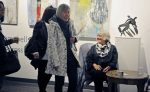
Olga Campbell (seated) takes a break from signing books at the opening of her exhibit A Whisper Across Time, which also served as a launch of her book by the same name. (photo by Gordon E. McCaw)
The impacts of the Holocaust continue to reverberate. Even though most of the first-generation survivors have passed away, the next generations, the survivors’ children and grandchildren, remember.
Local artist Olga Campbell belongs to the second generation. Her parents survived the Holocaust, but her mother’s entire family was murdered by the Nazis. The need to give those family members a voice was Campbell’s driving force in writing her new book, A Whisper Across Time: My Family’s Story of the Holocaust Told Through Art and Poetry. Her solo exhibit with the same name, co-presented with the Cherie Smith JCC Jewish Book Festival, opened at the Zack Gallery on Nov. 15. The night also served as a book launch.
“The art in this show are mostly prints from the book,” she said in an interview with the Independent. “There are also some pieces that are offshoots on the same theme, even though they aren’t in the book.”
Campbell has always known that her mother’s family didn’t survive the war, but the emotional impact of their deaths built slowly over the years. It took decades for this book to emerge.
“In 1997,” she said, “I heard a program on the radio about the second-generation survivors. Their words about the trauma being passed between generations resonated with me.”
She embarked on an artistic journey, and she is still following a path of exploration. Her art reflects her emotional upheaval. Her paintings and statues are fragmented, with broken lines and distorted figures, evoking feelings of loss and anguish. One look at her paintings and a disquiet tension washes over the viewer. It is apparent that a huge tragedy inspired her work.
In 2005, Campbell had a show at the Zack, called Whispers Across Time. “Even then,” she said, “I knew I had to write about my family. The art show was not enough. I had to say more, but, at that time, I couldn’t. I was too raw, too emotional. But my family kept tugging at me. I needed to tell their story. I was compelled to write this book.”
Unfortunately, she knew only the bare bones of her mother’s life. So she plunged into a deep and long research period, surfed the internet, contacted Yad Vashem and other sources. After several years, the book crystallized.
“My book is a tribute to my family, the family I never knew,” she said.
“Of course, it is only one family of the millions of families killed during the Holocaust.”
Campbell spoke of the relevance of her book in today’s political climate. “Our world is a chaotic place right now, somewhat reminiscent of the period before the war,” she said. “There are over 68 million people around the world that are refugees or displaced. My book is not only about my family. It is a cautionary tale. It is about intergenerational trauma and its repercussions across time.”
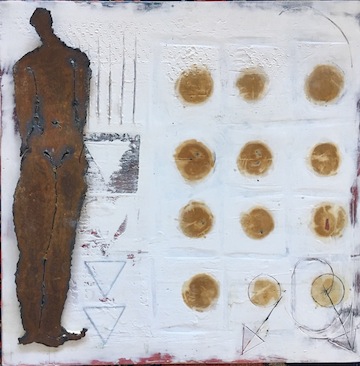
(artwork by Olga Campbell)
She created new art for the book, wrote poetry to supplement the imagery, and also included an essay on her family members and their lives, destroyed by the war. The paintings in the book and on the gallery walls are powerful but melancholy, even distressing.
“My work always had this darkness, the sadness, but also a bit of hope,” she said. “I never know what will happen when I start a piece. I’m very intuitive. I would throw some paint on an empty canvas and let my emotions and the art itself guide me through the process. I use photos in my works and digital collages. My finished pieces always surprise me.”
When the book was ready, Campbell applied for another show at the Zack, to coincide with the book launch.
“I wanted to give it the same name as the previous show, Whispers Across Time,” she said, “but I checked the internet, and there are a couple other books already published with the same title. I decided to change it.” The book and the show are called A Whisper Across Time. “I feel a lot lighter now, after the book is finished and published,” she said.
A Whisper Across Time is Campbell’s second publication. In 2009, she published Graffiti Alphabet. She has been doing art for more than 30 years, but that is not how she started her professional career. She was a social worker until, in 1986, she took her first art class. That year changed her life.
“It was such fun. I loved it,” she said. “I went back to work afterwards but it didn’t feel as much fun. I decided to get an art education. I enrolled in Emily Carr when I was 44.”
Campbell finished the art program, continued working part-time as a social worker, and dedicated the rest of her time to painting, sculpture and photography.
“I’ve been a member of the Eastside Culture Crawl for 22 years, since its beginning,” she said. “I participated in the Artists in Our Midst for many years, too. At first, when people asked me, I would say I do art. Now, I say, I’m an artist. I must be. That’s what I do. I’m retired now, but I did art when I was working, too, and it was always very healing and rewarding – still is…. If, for some reason, I don’t paint for awhile, I feel as if something is missing.”
The A Whisper Across Time exhibit continues until Dec. 9. For more about her work and books, visit olgacampbell.com.
Olga Livshin is a Vancouver freelance writer. She can be reached at olgagodim@gmail.com.
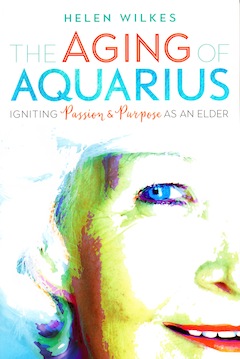
At risk of universalizing a book with a particular theme, The Aging of Aquarius: Igniting Passion and Purpose as an Elder is valuable not just for those who are retired or pondering it – though it has plenty of age-specific content for that demographic. At root, it is a book about living well, and that makes it a valuable volume for people of any age.
Author Helen Wilkes, a Vancouverite and member of the Or Shalom community, has penned an optimistic, uplifting book. But let that not deceive the reader, she warns early on, into misjudging who she is.
“Lest you think I was born with a silver spoon in my mouth or that I am one of those insufferably cheerful people,” she writes in the preface, “permit me to introduce myself.”
She talks about being born to Jewish shopkeepers in a village in the Sudetenland, part of Czechoslovakia that was among the first places occupied by the Nazis in advance of the Second World War.
“Our village fell to Hitler when I was still in diapers and, as a consequence, I have spent a lifetime with fear and negativity as my constant companions,” she writes.
Her childhood was lonely and her parents uncommunicative. Her marriage ended when her daughters were 3 and 4 years old.
“Divorce at the time was still so shameful that it took my mother several years to accept what she and her friends labeled as my ‘failure as a woman.’”
Yet Wilkes pivots to optimism.
“If, despite a childhood in the shadow of the Holocaust, and if, despite a lifetime of experiencing myself as an outsider with little sense of self-worth, I have found cause to hold my head high and to face the future with optimism in my retirement years, there is reason for others to hope,” she writes.
This is not a handbook on aging so much as an illustration by example of how to do it right. She does acknowledge, though, that a person has to make the effort to age well. Each section of her book ends with ideas and actions that might help on the path to success.
“Everywhere, there are opportunities to meet new people, yet surveys indicate that social isolation is a major problem despite the fact that simply joining a club is as good for your health as quitting smoking, exercising or losing weight,” writes Wilkes, who has a PhD in French literature. “The Vancouver Foundation reports ‘a precipitous decline’ in how many people made use of libraries, community or recreation centres in 2017, that only about one in four people took part in any kind of community or neighbourhood project.… And that, in a city as diverse as ours, only about one in four people attended an ethnic or cultural event put on by an ethnic or cultural group different than their own.”
Finding joy in the simple things – again, good advice for people of any age – is one of her key findings.
“Aging has made me a connoisseur of life,” she writes. “It has taught me to savour not what is rare or high-priced, but what is ordinary. The small moments that sometimes overwhelm me with heart-stopping joy. An incredible blue-sky day. The first sip of my morning coffee. The laughter of family and friends. Whenever I am walking in the woods with a boisterous dog, whenever I sit on a log at the beach while the sun dips slowly below the horizon and paints the sky with hues no artist could capture, whenever I stroll through a harvest market where farm-fresh produce overwhelms with its rich ripeness, whenever my grandchildren burst through the doorway to give me a hug, or whenever I am engaged in any number of absorbing activities, I so often have an overwhelming sense of not wanting to be anywhere in the world except exactly where I am at this moment.”
While she challenges the conceptions some people have of retirement as a time to sit in a hammock with a fancy drink, she does also acknowledge that, as Danny Kaye said, “to travel is to take a journey into yourself.”
She talks about an eye-opening trip to China, where she went as a chaperone to her 10-year-old twin grandsons. Having heard of the panoply of human rights abuses in China, she was shocked to see an English-language newspaper with a headline asking “How dare they?” above an article cataloguing racism and human rights abuses in the United States and other “free world” countries. Having heard about China’s reputation as a major contributor to global warming, she was pleased to see solar panels and wind turbines throughout the country. The rapid transit system they used to get everywhere contrasted with what she is familiar with in Vancouver.
“China held up a mirror that led me to reexamine the history I had been taught in high school and university,” she writes. “Day by day, it became more difficult to view the West as having brought enlightenment to backward Asians.”
Wilkes acknowledges that not everyone can travel to foreign countries and says there are ways to experience some of that diversity without getting on a plane.
“Next week, I anticipate attending a Hindu baby-naming ceremony to which I’ve been invited. Last week, I was invited for dinner at the home of a Muslim family from Pakistan. Being at their table, sharing our limited knowledge of one another’s culture, these to me are opportunities for much more than just personal enjoyment or emotional enrichment. They are occasions where it is possible to create a gram of kindness in a world where political and regional and religious differences tend to divide rather than link. I never fail to feel uplifted by experiencing our common humanity writ large. When I can no longer travel, I hope I will still reach out to people from other lands as graciously as people elsewhere have reached out to me,” she writes.
She speaks about another trip – this one to Berlin, for the launch of the German translation of her previous book, Letters from the Lost: A Memoir of Discovery, which explored her survivor’s guilt as she discovered, in adulthood, a cache of letters from family left behind in Czechoslovakia after she and her parents fled just after Nazi occupation of the Sudetenland.
“In Berlin, forgetting is impossible,” she reflects. “Over the years, Germany has made remembering an art as well as an official policy. Germany tells the world that it is only by remembering the past that we have any likelihood of avoiding similar mistakes in the future. The reminders are unavoidable. In Berlin, history is omnipresent. Even the sidewalks are studded with Stolpersteine, raised stumbling blocks inscribed with the names of Jews who once lived in the adjacent buildings.”
Since so many people’s identities are entwined with their profession, she writes, moving into retirement, for many people, can demand a complete reinvention of self. She proceeds to ask a litany of questions about what identity means, and even, as a member of a particular culture, what culture means.
“Such questions and many more continue to haunt me as I age,” she writes.
And, while she turns to books for answers, the process of asking questions may be an end in itself when addressing the existential issues the book confronts.
Among everything else it is, The Aging of Aquarius is also a very Jewish memoir. Both in her personal history and in the theological exploration she discusses near the end of it, her Jewish identity and experiences play central roles in the story.
At a book launch at Or Shalom on Nov. 4, Wilkes said she approaches the later years of life with many unanswered questions. But, as difficult as finding answers may be, she suggested responding affirmatively.
“I know it’s not easy, but if the answer to how is yes,” she said in conclusion, “let us all say yes to life. Yes to aging. L’chaim.”
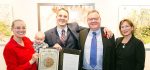
On Nov. 7, members of the Kalkman family – left to right are Danielle, Victoria, Matthew, Peter and Bonnie – received the Righteous Among the Nations award from the consulate general of Israel in Toronto and Western Canada and the Canadian Society for Yad Vashem, on behalf of Dirk and Klaasje Kalkman. (photo by Rhonda Dent Photography)
One night in the Dutch village of Moordrecht, the call went out: the Nazis were doing a round-up. In a round-up, the Nazis would surround a neighbourhood and then search house by house for those they hunted: Jews, resistance fighters and others they deemed enemies. Wim Kalkman’s family rushed to prepare for their arrival: two Dutchmen who refused to work as forced labour building battlements for the Nazis were taken through a trap door under the carpet in the living room. The really dangerous guest of the family, however, was hidden in plain view. Tanta Ina, they called her, saying she was an aunt who had fled the battle zone on the coast to find refuge with the family.
Tanta Ina was not related to the Kalkmans, however. She was a Jewish woman, the widow of a Dutch-Jewish nobleman who the family had been urged to protect by Reverend Henk Post, the brother of Dutch resistance fighter Johannes Post and a fellow clergyman to Wim’s father, Dirk.
Dirk Kalkman, a pastor in the Dutch Reformed Church, and his wife Klaasje, had taken Catharina Six tot Oterleek-Kuijper in and given her a new identity. They hid her, with the help of their four children, from 1943 to 1945, at great personal risk. On that fearful night, the Nazis did not discover the two Dutchmen or Tanta Ina, who sat on the couch with the rest of the family while they were all interrogated. When a Nazi soldier asked young Wim if the family was hiding anyone, he broke into a gale of nervous laughter, which confused the Nazis, who also began laughing. Fearful of Wim’s sister, who was suffering from diphtheria, the Nazis rushed their search and left.
This was the story that was told to Wim’s son, Peter, and his grandson, Matthew, both of whom were in Vancouver Nov. 7 to receive the Righteous Among the Nations award from the consulate general of Israel in Toronto and Western Canada and the Canadian Society for Yad Vashem, on behalf of Dirk and Klaasje Kalkman.
Righteous Among the Nations are non-Jews who assisted or sheltered Jews during the Holocaust, often at the risk of great peril for themselves and families. The project was established by Yad Vashem in 1963 and to date has granted the award to more than 26,000 people. It had been Wim Kalkman’s lifelong dream to see his parents honoured for their heroism, as Matthew Kalkman told those gathered at the Rothstein Theatre for the ceremony.
After Peter Kalkman read his father’s account of that terrifying night and told the story of his grandparents’ protection of Tanta Ina, Matthew Kalkman gave an emotional speech, often through tears, about the importance of his great-grandparents’ actions to his own life. He said he had first connected with the reality of what his great-grandparents had done when he visited the Anne Frank Museum in Amsterdam.
When his grandfather Wim died in 2014, they discovered a note expressing his dying wish that Wim’s father be honoured. Matthew took up the task personally and, together with researchers in the Netherlands, was able to find definitive evidence of what happened in the Kalkman household so many years ago.
The award was given to the Kalkmans by Consul General Galit Baram on behalf of the state of Israel and by Josh Hacker on behalf of the Canadian Society for Yad Vashem. Liel Amdour, a classical guitarist born in Israel, played two pieces of music that embodied hope and rebirth, and Dr. Ilona Shulman Spaar, education director of the Vancouver Holocaust Education Centre, and Salomon Casseres, president of the Jewish Community Centre of Greater Vancouver, also spoke, as did Karen James, the chair of the Jewish Federation of Greater Vancouver board. All of the speakers touched upon the importance of remembering the heroes of the Holocaust as inspirations in the current times of resurgent nationalism, racism and xenophobia.
Casseres, who has Dutch ancestry, also stressed the relevance of the Kalkmans’ story for himself, as a descendant of Dutch Jews who survived the Holocaust. “In Hebrew,” he said, “we say kol hakavod, which means ‘all the respect.’” In Dutch, he added, “A hearty thank you for your family’s deeds of heroism.”
Matthew Gindinis a freelance journalist, writer and lecturer. He is Pacific correspondent for the CJN, writes regularly for the Forward, Tricycle and the Wisdom Daily, and has been published in Sojourners, Religion Dispatches and elsewhere. He can be found on Medium and Twitter.
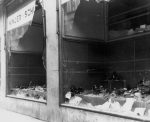
Kristallnacht, which took place 80 years ago this month, saw hundreds of synagogues burned, Jewish-owned businesses destroyed, 100 Jews murdered and 30,000 incarcerated. (photo from commons.wikimedia.org)
Kristallnacht, which took place 80 years ago this month, was the “Night of Broken Glass” that saw hundreds of synagogues burned, Jewish-owned businesses destroyed, 100 Jews murdered and 30,000 incarcerated. The state-sanctioned pogrom was staged to look like a spontaneous uprising against the Jews of Germany, annexed Austria and occupied Sudetenland. It is frequently seen as the beginning in earnest of the Holocaust. According to Prof. Chris Friedrichs, who delivered the keynote address at the annual Kristallnacht commemorative evening Nov. 8, global reaction to the attack, which took place on the night of Nov. 9-10, 1938, sent messages to both Nazis and Jews.
“The world was shocked,” said Friedrichs, professor emeritus of history at the University of British Columbia. “Newspapers in the free countries of Europe and all over the Americas reported on these events in detail. Editorials thundered against the Nazi thugs. Protests took place. Demonstrations were held. Opinion was mobilized – for a few days. But soon, Kristallnacht was no longer front-page news. What had happened was now the new normal in Germany, and the world’s attention moved elsewhere. And this is what the Nazis learned: we can do this, and more, and get away with it. Nothing will happen.
“And the Jews of Germany learned something too,” said Friedrichs, himself a son of parents who fled the Nazi regime. “By 1938, many Jews had emigrated from Germany – if they could find a country that would take them. But many others remained. Much had been taken away from them, but two things remained untouched: their houses of worship and their homes. Here, at least, one could be safe, sustained by the fellowship of other Jews and the comforts and consolations of religious faith and family life. But now, in one brutal night, these things, too, had been taken from them. Their synagogues were reduced to rubble, their shops vandalized, their homes desecrated. Nothing was safe or secure. The last lingering hopes of the Jews still living in Germany that, despite all they had suffered at the hands of the Nazis, they might at least be allowed to live quiet private lives of work and worship with family and friends, collapsed in the misery of fire, smashed glass, home invasions, mass arrests and psychological terror on Nov. 9, 1938.”
Friedrichs’ lecture followed a solemn procession of survivors of the Holocaust, who carried candles onto the bimah of Congregation Beth Israel. The evening, presented by the Vancouver Holocaust Education Centre (VHEC) and Beth Israel, was funded by the Jewish Federation of Greater Vancouver annual campaign, with support from the Robert and Marilyn Krell Endowment Fund of the VHEC and the Azrieli Foundation, which provided every attendee with a copy of Dangerous Measures, the memoir of Canadian Joseph Schwartzberg, who witnessed Kristallnacht and fled Germany with his family soon after.
“We are gathered tonight in the sanctuary of a synagogue,” said Friedrichs, who retired in June, after 45 years of teaching and researching at UBC. “A synagogue should indeed be a sanctuary, a quiet place where Jews can gather, chiefly but not only on the Sabbath, for prayer, worship and contemplation. Recent events have reminded us only too bitterly that this is not always the case.
“Our minds are full of mental images of what happened in Pittsburgh less than two weeks ago, but I invite you to call up a different mental image,” he said, taking the audience back to the time of Kristallnacht. “Think of a synagogue. Just a few days earlier, on the Sabbath, Jews had gathered there, as they have gathered in synagogues for 2,000 years, for prayer, worship and fellowship with other Jews. But now, suddenly, in the middle of the night, a firebomb is thrust through a window of the synagogue. As the window glass shatters to the floor, the firebomb ignites a piece of furniture. Within minutes the fire spreads. Soon the entire synagogue is engulfed in flames. It is an inferno. The next morning, the walls of the synagogue are still standing, but the interior is completely gutted. No worship will ever take place there again.”
Friedrichs paused to note that some in the audience would recall a similar attack that destroyed Vancouver’s Reform synagogue, Temple Sholom, on Jan. 25, 1985. He recounted the reaction of police and firefighters, civic leaders and the general public, who rallied around the Vancouver congregation at the time, and compared that with the reactions of non-Jews in Germany and the territories it controlled at the time of Kristallnacht.
“Police and firefighters are on the scene,” Friedrichs said of the situation during Kristallnacht. “But the firefighters are not there to put out the blaze. They are there only to make sure the fire does not spread to any nearby non-Jewish buildings. The police are there only to make sure no members of the congregation try to rescue anything from the building.
“The next morning, crowds of onlookers gape at the burnt-out shell of the synagogue. Some of the furnishings and ritual objects have survived the blaze, so they are dragged out to the street and a bonfire is prepared. But first, the local school principal must arrive with his pupils. Deprived of the opportunity to see the synagogue itself in flames during the night, when they were asleep, the children should at least have the satisfaction of seeing the furnishings and Jewish ritual objects go up in smoke. Most of those objects are added to the bonfire, but not all. Not the Torah scrolls – the Five Books of Moses, every single word of which, in translation, is identical to the words found in the first five books of every Christian Bible. No, the Torah scrolls are not added to the bonfire. They are dragged out to the street to be trampled on by the children, egged on by adult onlookers, while other adults rip apart the Torah covers to be taken home as souvenirs.
“And now consider this: events like this did not happen in just one town,” Friedrichs said. “The same things took place in hundreds upon hundreds of cities and towns throughout Germany and Austria, all on the very same evening and into the next morning. There were minor variations from town to town, but the basic events were exactly the same, for it was a nationwide pogrom, carefully planned in advance.”
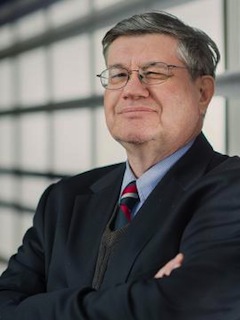
Prof. Chris Friedrichs (photo from VHEC)
Friedrichs, who devoted 25 years to serving on the organizing committee of the Kristallnacht commemorative committee, including eight as president, reflected on the history of Holocaust remembrance in Vancouver, including the decision to single out this date as one of the primary commemorative events of the calendar.
“Why should we commemorate the Shoah at this particular time in November?” he asked. “Consider this: 91 Jewish men died on Nov. 9th and 10th, 1938. Yet, on a single day in the busy summer of 1944, up to 5,000 Jewish men, women and children might be murdered in the gas chambers of Auschwitz on one day. Why not select some random date in August 1944 and make that the occasion to recall the victims of the Shoah? Why choose Kristallnacht?”
The earliest Holocaust commemorations in the city, he said, citing the work of local scholar Barbara Schober, was an event in 1948 marking the Warsaw Ghetto Uprising.
People who had founded the Peretz School in Vancouver, in 1945, hoped to preserve the memories and values of the East European Jewish culture, which had been almost totally wiped from the map, he said. “Yet, rather than focus on the six million deaths, their intention was to honour those Jews who had actually risen up to fight the Nazi menace – the hopeless but inspiring efforts exemplified above all by the heroic resistance of the Warsaw Ghetto fighters who used the pathetically meagre supply of weapons they could find to resist the final liquidation of the ghetto by the Nazis in the spring of 1943,” said Friedrichs. “That effort failed, but it was not forgotten.”
This event continued, with the support of Canadian Jewish Congress, into the 1970s, he explained.
“There was an emerging concern that Jews should not just recall and pay tribute to the victims of the Shoah,” said Friedrichs. “The increasing visibility of the Holocaust denial movement made it apparent that Jews should also make their contribution to educating society as a whole – and especially young people – about the true history of what had happened. Prof. Robert Krell and Dr. Graham Forst undertook to establish an annual symposium at UBC at which hundreds of high school students would learn about the Holocaust from experts and, even more importantly, from hearing the first-person accounts of survivors themselves. It was in those years, too, that the Vancouver Holocaust Education Society was established to coordinate these efforts. The survivor outreach program, through which dozens of survivors of the Shoah in our community spoke and continue to speak to students about what they experienced, became the cornerstone of these educational efforts. Their talks are always different, for no two survivors ever experienced the Shoah the same way, but the ultimate object is always the same – not just to teach students what happened to the Jews of Europe between 1939 and 1945, but to reflect on the danger that racist thinking of any kind can all too easily lead to.”
But this was education, he noted, not commemoration.
“With the decline of the Warsaw Ghetto event in Vancouver, the need to commemorate the Shoah came to be filled in other ways. One of those ways was the emergence of the Vancouver Kristallnacht commemoration. The origins of this form of commemoration lie right here in the Beth Israel congregation. In the late 1970s, members of the Gottfried family who had emigrated from Austria in the Nazi era, now members of Beth Israel, proposed that their synagogue host a commemoration of Kristallnacht.”
Friedrichs spoke of the burden carried by each of the survivors who carried candles onto the bimah moments earlier.
“You might think that a candle is not very hard to carry, but, for each one of these men and women, the flame of the candle has reignited painful memories stretching back 70 or 80 years, to a dimly remembered way of life before their world collapsed,” he said. “These men and women survived, and sometimes a few of their relatives did as well, but all of them, without exception, you’ve heard this before, had family members – whether parents, grandparents, uncles, aunts, siblings, or cousins – who were murdered. One could not reproach these men and women if they had chosen to stay home on a night like this. But, instead, they are here.
“Many of these men and women have done more, even more, as well,” he continued. “For many of them have done something for years and continue to do so even now: to speak of their experiences to students in the schools of our province. To stand in front of two or three or four or five hundred students of every race and every heritage and describe life in the ghetto or the camp or on the death march or the anxiety of living in hiding and being pushed into a basement or a closet every time some unwanted visitor arrived – this is not easy. But there is a purpose. The young people of our province are barraged with images and messages and texts telling them that people of certain religions or races or heritages are inferior and unwanted members of our society. They must be told just what that kind of thinking can lead to. No textbook, no video, no lecture can do the job as powerfully as hearing a survivor describe exactly what he or she experienced during the Shoah.”
Corinne Zimmerman, vice-president of the VHEC, welcomed guests and introduced the candlelighting procession. Cantor Yaacov Orzech chanted El Moleh Rachamim, the memorial prayer for the martyrs. UBC Prof. Richard Menkis delivered opening remarks and Helen Pinsky, president of Beth Israel, introduced Sarah Kirby-Yung, a Vancouver city councilor who read a proclamation from the mayor. Nina Krieger, executive director of the VHEC, introduced Friedrichs. Beth Israel’s Rabbi Jonathan Infeld provided closing remarks, and Jody Wilson-Raybould, minister of justice and member of Parliament for Vancouver Granville, sent greetings on behalf of the Government of Canada.
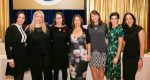
Left to right are Megan Laskin, Sherri Wise, Karen James, Jane Stoller, Jeannie Smith, Alyssa Schottland-Bauman and Sharon Goldman. (photo from Jewish Federation)
For the past 14 years, the Jewish Federation of Greater Vancouver has organized a women’s philanthropy event called Choices. The evening is meant to inspire women to understand the power of their tzedakah and to feel part of the community. On Sunday, Nov. 4, in Congregation Beth Israel’s Gales Family Ballroom, the informal consensus in the room of more than 500 women was that Choices exceeded its objectives.
One of this year’s achievements, according to event co-chair Jane Stoller, was that there were 50 first-time attendees. Stoller explained that a table of Hillel BC students had been sponsored and there were new faces from Federation’s young adult program, Axis, in the crowd. In addition, she said a record number of Israeli women were among the new attendees.
As for the featured speakers this year, both not only spoke movingly, but they also tied in Federation as an important component of their respective stories.
Sherri Wise is a dentist who lives and works in Vancouver. She survived a triple bombing on Ben Yehuda Street in Jerusalem on Sept. 4, 1997.
Wise described the sequence of events that led her to be at a café on a beautiful sunny day and what transpired after three Palestinian terrorists each blew themselves up in the immediate vicinity. Wise was seriously injured, with more than 100 nails embedded in her limbs and second- and third-degree burns on many areas of her body. After recounting the details of this tragedy, Wise was able to focus on some of the positives that arose from the horror. “Someone from Jewish Federation in Vancouver contacted Federation in Jerusalem and a kind woman named Trudy came every day to visit me.… I never even learned her last name,” she said.
Wise said she has managed to get on with her life not only with the help of her parents and the Jewish community, but also by making a decision not to harbour anger or hatred toward those who injured her, killed seven and injured 200 others. “Those men were born innocent babies and they were taught to hate – what chance did they have?”
Wise has since helped craft, advocate for and see enacted the Justice for Victims of Terrorism Act. This bill includes deterrents to those who would support terrorist organizations financially and materially, and grants rights to Canadian victims of terrorism. Wise imparted a message of healing, gratitude and finding a way to make a positive difference.
Jeannie Smith, the daughter of Irene Gut Opdyke, was the second speaker. Opdyke, who passed away in 2003, saved the lives of 12 Jews in Poland during the Holocaust and was recognized by the Israeli Holocaust Commission as one of the Righteous Among the Nations. Smith recounted many details of her mother’s story to a captivated crowd.
At the age of 17, Gut was forced to work in, among other places, the home of a high-ranking German officer stationed in Poland near her hometown. Prior to “keeping house” for this officer, she had worked in a laundry facility at a German officer’s camp. When she learned that she would be relocated to a villa in the town and that the Jews of that town would be liquidated, she managed to smuggle the group of Jews she had worked with in the camp’s laundry into the basement of the villa.
Eventually, the officer discovered the hidden Jews but, for a variety of reasons – none of them altruistic – he did not turn them in. As the Soviets approached and the Germans fled Poland, the 12 Jews, one of whom was pregnant, fled to the forest and joined the partisans.
There are many more twists and turns to Gut Opdyke’s story, but she ended up in California, where she married an American man who was the only person in the United States who knew anything about her painful and heroic past. Gut Opdyke was moved to begin speaking about her experiences only after she received a random call from a Holocaust denier. For the rest of her life, she was a Holocaust educator who shared the story her daughter, Smith, shared with the women at Choices.
Smith expressed gratitude toward the Jewish Federation of Portland because they paid for her father to live out his life in the Jewish seniors home once he developed Alzheimer’s. Commenting about Federation, she said, “One person can make a difference, and an organization can make a mighty difference.” She concluded with what she said her mother used to end her speeches with as well: “Every day we have an opportunity to be kind, to stand up for what is right and to go against what is wrong. We can be the difference in someone’s life.”
Both Wise and Smith received standing ovations for their heartfelt stories of love and resilience.
Leanne Hazon was one of the first-time attendees at the event. Having lived in Toronto for the last 18 years, the Richmond native returned to Metro Vancouver earlier this year for work.
“I thought the whole event was amazing!” she said. “It had such a nice vibe and feeling of community, very warm and welcoming. And the speakers were exceptional…. Sherri Wise’s message of forgiveness was so powerful and Jeannie Smith’s story about her mom was very moving.”
For more information on Jewish Federation and its annual campaign, visit jewishvancouver.com.
Michelle Dodekis a freelance writer living in Vancouver.
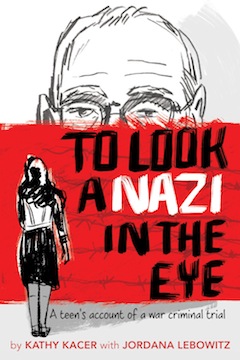
In spring 2015, at Luneburg Regional Court in Germany, the trial of Oskar Groening, “the bookkeeper of Auschwitz,” began. Nineteen-year-old Torontonian Jordana Lebowitz, a granddaughter of Holocaust survivors, was among those who witnessed the proceedings. The young adult book To Look a Nazi in the Eye: A Teen’s Account of a War Criminal Trial (Second Story Press, 2017), written with award-winning author Kathy Kacer, is about what Lebowitz experienced before, during and after the trial.
The book has different components and is not structured like a usual biography or historical account. It includes Lebowitz’s recollections as told to Kacer, as well as selections from Lebowitz’s blog, which the then-teen wrote for the Simon Wiesenthal Centre in Toronto about the trial. Numerous Holocaust survivors, now living in Canada, speak about their experiences at Auschwitz. They also traveled to Germany for Groening’s trial.
Lebowitz shares her concerns about going to Germany and readers learn how she made the trip come about. After almost every chapter, there are excerpts of Groening’s testimony that Kacer has based on news articles and interviews, as there were no transcripts from the trial itself. These sections allow readers to know what Groening was thinking as his claims were being assessed by the court. Charged with being complicit in the deaths of more than 300,000 Jews, he was eventually found guilty.
Lebowitz epitomizes how individuals from my generation should act. Her main goal was to ensure that the experiences of Holocaust survivors would be recorded so that future generations would be able to access them, and learn from them. Her main purpose in going to the trial was to witness this history and make sure that future generations would know it, too.
Lebowitz had been to Auschwitz on a March of the Living trip. The program takes students from around the world to Poland and Israel, so they can see firsthand and learn about the Jewish communities that once existed in Europe and the tragedy of the Holocaust that wiped almost all of them out. It was on March of the Living that Lebowitz met Holocaust survivor Hedy Bohm, with whom she became close friends. Bohm was imprisoned in Auschwitz for three months and testified in the trial against Groening.
As the bookkeeper at Auschwitz, Groening not only witnessed many Jews coming off the trains, but confiscated their possessions as they arrived. He was not tried for being a murderer, but for helping the Nazis murder Jews. The German government wanted Groening’s trial to occur, as they wanted Nazis who were still living to be brought to justice, even if it was many decades later.
Lebowitz heard about the trial from Bohm, and then set to figure out how she could attend it. The Simon Wiesenthal Centre agreed to fund the trip if she would blog her experience in the courtroom for others to read and follow as the trial was taking place. She managed to convince her parents she could handle what she would face on the trip during the trial, and Thomas Walther, the prosecutor, helped Lebowitz find a place to stay in Germany and procured a pass to allow her into the courtroom.
To Look a Nazi in the Eye is powerful in part because it reveals the compassion Lebowitz initially felt for Groening, in his frailty, sitting in the courtroom each day. He recounted heartbreaking stories of what had transpired in the camp. But, while Lebowitz believed at the start of the trial that he was truly sorry for what he had done, Groening’s stories began to change, and not for the better. He also said he was not guilty because he did not personally hurt or exterminate Jews.
As her daily accounts progress, there are humourous moments that balance out the horrific stories about Auschwitz. For example, purses and paper were not permitted in the courtroom. In order to blog, however, Lebowitz needed a notepad and pen. So, she snuck toilet paper and a pen that was hidden in a place the security guards would not find during a body search. Her persistence paid off, and Lebowitz managed to take notes each day. That her family and others read her blog posts gave her some assurance that she was succeeding in her mission of helping keep the history alive and relevant.
One part of To Look a Nazi in the Eye that is amazing is how Lebowitz interacts with the Holocaust survivors. Bohm, Bill Glied and Max Eisen were among the survivors who attended the trial and were brave enough to recount their experiences at Auschwitz. For them, and others, it was a duty to their family and themselves to ensure that some form of justice was achieved. At first, they seem pretty hesitant of a younger individual being at the trial, but later open up to Lebowitz more. Seeing a person from a younger generation advocating for this cause made them happy, in a sense.
Since returning to Canada, Lebowitz has remained involved in Holocaust remembrance. As the book’s website notes, she “came to understand that, by witnessing history, she gained the knowledge and legitimacy to be able to stand in the footsteps of the survivors who went before her and pass their history, her history, on to the next generation.”
Chloe Heuchert is a fifth-year history and political science student at Trinity Western University.
“I wanted to leave,” replied Groening again in a voice that had grown increasingly hoarse. “I asked for a transfer to the front.”
Was it Jordana’s imagination or was Groening faltering under the strain of the trial and the intense cross-examination? She hadn’t noticed it before, but he looked decidedly weaker at this point in the proceedings than he had looked in the beginning. His face was haggard, his shoulders slumped, and his hands trembled.
Finally, Thomas [Walther] gathered his notes together and stood in the centre of the courtroom. “Behind me sit the survivors who are here to testify, along with their descendants,” he said. “I ask you, Herr Groening, did you ever think when you were in Auschwitz that the Jewish prisoners might stay alive and eventually have their own children?”
Groening shook his head and closed his eyes. When he finally responded, his voice was faint. “No. Jews did not get out of Auschwitz alive.”
Today, Nov. 9, is the 80th anniversary of Kristallnacht. Seen by some historians as the moment when the Nazis’ legalized discrimination against Jews turned irreversibly toward genocide, the date has been marked by the Vancouver Jewish community for several decades.
Jews view the present and the future through a lens of the past. This has its advantages and disadvantages. Unable to see the future clearly, a keen awareness of the past can lead us to reasonably project expectations. But the memory of Kristallnacht and what came after it instils a rightful and necessary caution in interpreting current events. History tells us that vigilance is crucial and that complacency can be fatal.
Of course, no two moments in history are identical. Are we overreacting by drawing too instructive an historical parallel when we experience traumas like the mass murder at the Tree of Life synagogue on Oct. 27? We can’t be certain. It is probably wise to err on the side of caution and respond with vigilance.
The reaction from so many faith groups and other allies, including at a “solidarity Shabbat” last weekend that filled synagogue seats throughout Metro Vancouver and across North America, is not only a reassuring phenomenon. These demonstrations of intercommunal friendship are underpinned by the awareness that, while some might dismiss the events in Pittsburgh as the deranged act of a single madman, historical consciousness places the terrible act within a larger context.
History is important, too, because we live busy lives and a lot of things are slammed into our consciousness every day. Stepping back and placing contemporary events in a larger context helps us assimilate our place in society, individually and collectively. This is being demonstrated particularly well this week, as Remembrance Day (Nov. 11) approaches.
The Government of Canada’s apology for the 1939 refusal to accept the imperiled Jewish refugees aboard the MS St. Louis comes as part of a long line of apologies for historic wrongs. A cynic could look at the litany of regret and see political expediency. We prefer to look at it as a progressive, healthy way of not only addressing the past but of improving the future.
The journey of the MS St. Louis saw just 29 of the 937 passengers allowed to disembark in Cuba, the intended destination and presumed final refuge for the passengers fleeing the imminent Holocaust. The ship then sailed to the United States and on to Canada, where, in both places, xenophobic and antisemitic attitudes among the general public and the governing elites prevented the asylum-seekers from disembarking. Forced to return to Europe, 254 of the passengers would be murdered in the ensuing genocide.
At a time when many Jews are looking at the news with trepidation, the prime minister’s statement represents the voice of a country facing the antisemitism of its past and, more importantly, committing to face and combat similar sentiments today and in future.
Presaging the prime minister’s formal apology this week, Canada’s ambassador to Israel, Deborah Lyons, speaking at the General Assembly of the Jewish Federations of North America last month (see “Interdependent communities” and “GA pitches softballs at Bibi”) spoke movingly about the importance of applying historical knowledge to the present. She quoted a 17-year-old from Hamilton, Ont., who, after completing the March of the Living, observed that, “as our hearts were breaking, our hearts were also growing.”
Said Lyons: “We need to acknowledge these difficulties, we need to acknowledge these injustices. It may break our hearts, but it will teach our hearts to love again and to grow.”
A scene from Who Will Write Our History, about the secret Warsaw Ghetto archives that were hidden from the Nazis. The film screens Nov. 1 at the Rothstein Theatre. (photo by Anna Wloch / Katahdin Productions)
One of the better known documents of the Oyneg Shabes Archive is written by David Graber, who was 19 at the time. In his will, he wrote: “What we were unable to cry and shriek out to the world, we buried in the ground…. I would love to see the moment in which the great treasure will be dug up and scream the truth at the world…. May history attest for us.” While Graber did not survive Holocaust, his words did. As did the words and tens of thousands of pages of material collected by historian Emanuel Ringelblum and the 60 Oyneg Shabes members in Warsaw from 1940 to 1943.
The documentary Who Will Write Our History, written, produced and directed by Roberta Grossman, highlights the story of the archive and some of the Oyneg Shabes members, only three of whom survived. It will be screened by the Vancouver Jewish Film Centre on Nov. 1, 7 p.m., at the Rothstein Theatre and Grossman, along with executive producer Nancy Spielberg, will be in attendance.
The film is based on the book of the same name by Samuel D. Kassow.
“When I read Sam’s book, I was just absolutely shocked that I didn’t know the story because I’ve done a lot of work and been very engaged in learning about this period of time my entire life and, to me, it seemed like a travesty that it was so little known outside of academic circles and it seemed that it really should be known,” Grossman told the Independent. “To my mind, it is the most important unknown story of the Holocaust.”
Being a filmmaker, Grossman said, “I felt that the best way to help Ringelblum and the other members of the Oyneg Shabes achieve what they wanted, which was to tell the story of the war from the Jewish point of view and to be remembered as individuals,” was through film, that the “medium is the best way to tell stories that will reach a lot of people and not just scholarly circles.”
Grossman optioned Kassow’s book in 2012.
Roberta Grossman, writer, producer and director of Who Will Write Our History. (photo from Katahdin Productions)
From that time to the finished film, she said, “The goal and the vision for the film stayed the same, it just took a long time to figure out how to achieve that because you need to set the story of the Oyneg Shabes Archive in the historical context. You need to know what’s going on between the wars [and] during the war; you need to know the story of the Warsaw Ghetto; you need to know the story of the Oyneg Shabes and how they operated; and then you need to know the individual story arcs of the people that we chose to highlight…. It’s a lot to pack in, so the challenge was in figuring out the pieces of that puzzle.”
Of the three caches of material hidden by the Oyneg Shabes, two have been found, in 1946 and 1950. They contained more than 35,000 pages of material, including letters, artwork, photographs, circulars, posters and so many other documents, which are housed at the Jewish Historical Institute in Warsaw. In 2008, the Vancouver Holocaust Education Centre mounted the exhibit Scream the Truth at the World: Emanuel Ringelblum and the Hidden Archive of the Warsaw Ghetto, which presented parts of that extensive collection to Vancouver. But the exhibit must have been a relative rarity because Spielberg also hadn’t heard of Ringelblum – who was among those murdered by the Nazis (in 1944) – and the archive.
“We worked together on Above and Beyond,” Spielberg told the Independent about how she came to work with Grossman on the documentary. “I came to Vancouver with that film and showed it in the [2014 Jewish] film festival there…. She had just bought the rights to Who Will Write Our History? and she left the project to come on board to direct Above and Beyond. We were spending time together, we were in the car, we were driving to locations, [and] I’m listening to her on the phone talking about this other project, and then she started telling me the story, and I knew nothing about this.”
Grossman eventually asked Spielberg if she’d be interested in joining the project and, having worked with Grossman before, Spielberg said, “We’re a wonderful balance and I loved this story. And we did [the film] with the idea that someone could come out of their immediate misery and sit down and do something with eyes to the future when it looks like there’s no tomorrow for you.”
“We know about people who, against all odds, rose up to the best of their ability militarily against the Nazis,” said Grossman, “but we haven’t spent a lot of time necessarily paying attention to and giving honours to people who resisted in other ways and, to me, this is an incredible example of spiritual resistance. They saw themselves as being literally engaged in a battle of humanity versus barbarism and I think that, especially now, the idea of or the question, who writes our history, and what is true and what is false, and what is propaganda and what is truth, and who controls the narrative is as important today as it’s ever been.
“In an era,” she continued, “where truth is not particularly valued in some of the most powerful corners of our world and a lot of lies and hateful propaganda is being propagated, especially vilifying the other, whether they be immigrants or Muslims or whoever ‘the other’ of the moment is, we know from history, if we pay attention, that’s an extremely dangerous – very powerful and, therefore, dangerous – way to operate. It’s important for people who are victimized or marginalized to tell their own story.”
The upcoming screening here of Who Will Write Our History is part of a tour of the film. Both Grossman and Spielberg have been attending various screenings, sometimes together, sometimes not.
“I think that the most common reaction is twofold,” said Spielberg. “One is of gratitude that the story was told. That may come in many ways, first of all, from people who are hungry for more knowledge and didn’t know anything about this … and also, of course, from survivors and their children; keeping these stories alive and honouring these people so that their lives would not have been in vain.
“And the other response is ‘I didn’t know that, how come I didn’t know that?’… Then you know you’ve unearthed a gem, that you were able to teach somebody another aspect of the Holocaust, just when we thought we’ve heard it all. Getting this out to the general populace will be really, really important, Jewish and non-Jewish.”
“I feel very proud to have fulfilled in some small way the wishes of the members of the Oyneg Shabes to tell the story from the Jewish point of view and to be remembered as individuals,” said Grossman. “I get the feeling, when I watch the film with audiences, that there is a way in which people sitting in the audience feel as if they’re honouring those people just by watching the film, and that’s really exciting.”
Tickets to the Vancouver screening of Who Will Write Our History are $72 and can be purchased via vjff.org.
The Vancouver Holocaust Education Centre has developed a collections management system (CMS) that integrates the components of the centre’s diverse holdings into an online platform featuring educational resources aligned with the B.C. secondary curriculum to support teaching with primary source materials.
The CMS allows visitors to the VHEC and online users to explore the various holdings in a way that eliminates divisions between the museum, archives, library and audio-visual testimony collections.
“When you search for a keyword term, it will return records from each collection,” said Caitlin Donaldson, the VHEC’s registrar, who was on the project team that coordinated the development of the system. “We worked collaboratively to design the metadata so that catalogue records are fulsome and so that users will get really rich relationships between items.”
The user-centred design approach prioritized the needs of the centre’s educational mandate and community.
“The VHEC’s system has some administrative modules and features that can track conservation, storage location, loans, accessions and donations,” said Donaldson. “So it’s a really powerful tool for us as a nonprofit organization with a small staff.”
A researcher, student or visitor to the VHEC can view the video testimony of a survivor, then easily see all the centre’s holdings that relate to the individual, such as books written by or about them, documents or artifacts donated by them and broader information about their place of birth, their Holocaust experiences and the camps, ghettoes or other places they survived.
The VHEC is committed to assisting teachers to use primary sources effectively in the classroom to teach about the Holocaust and social justice broadly. The centre has created materials to guide students through searching the CMS and analyzing artifacts. Lightbox is a tool within the CMS through which users can create, manage and share collections of items from the catalogue. Students can use this digital workspace to collaborate on projects and further independent research.
The CMS was developed using Collective Access, an open-source collections management and presentation software created by Whirl-i-Gig, which provided development services for the VHEC. Collective Access is also used locally by the Vancouver Maritime Museum and the newly opened Indian Residential School History and Dialogue Centre at the University of British Columbia.
“The open-source software allowed us to benefit from the collected knowledge of other institutions and to also contribute back to that base of knowledge through the development of some modules that were created just for our needs,” said Nina Krieger, executive director of the VHEC. “This collections management system allows us, our visitors, researchers, students and anyone in the world unprecedented access to our collections, with the opportunity to contextualize artifacts and information in ways that were not remotely possible when the centre was created two decades ago.”
The VHEC is continually adding records and digitized items to the catalogue. Researchers are encouraged to contact VHEC collections staff to inquire about its full holdings and to access non-digitized materials.
The development of the online catalogue and CMS was made possible through a gift from the Paul and Edwina Heller Memorial Fund of the Jewish Community Foundation of Greater Vancouver. To explore the VHEC collections online, visit collections.vhec.org.
A version of this article was published in Roundup, Spring 2018, issue 272, by the B.C. Museums Association.
The JDC’s Zoya Shvartzman is part of the FEDtalks lineup Sept. 16. (photo from JFGV)
In returning to Vancouver, Zoya Shvartzman is retracing the route that has seen the Moldova-born woman help “write the next chapter of the history of European Jewry.”
Those words, while spoken by Shvartzman, are not about herself – she was crediting North Americans and others who support the American Jewish Joint Distribution Committee (JDC) with helping revivify communities that were almost annihilated under Nazism and then suppressed by communism. But the work Shvartzman does in her role at the JDC means she could rightly claim to be among a number of authors altering the future for Jews in Europe.
Shvartzman and her parents made aliyah from the East European nation when she was 8 years old. At 15, she and her mother migrated to Vancouver. Here, the family had some hard times and they turned to the Jewish community.
“The Jewish community welcomed us with open arms and gave us almost a second home,” she recalled recently in a phone interview with the Independent. “It was a very, very fond memory of my time there and it has a lot to do with the Jewish community that became our family.” She will speak about this time when she presents as one of four speakers at FEDtalks, the opening event of the 2018 Jewish Federation of Greater Vancouver annual campaign, Sept. 16.
Shvartzman chose to pursue a degree in international development studies and political science at McGill University and so, after four years on the West Coast, she and her mother decamped for Montreal.
“After that, I decided to move to Budapest to pursue my master’s in political science because I was focusing on Eastern European politics and transitions from communism to democracy,” she said. “Because I’m from that part of the world, it made sense to go back and be there, be where it’s taking place.”
She completed her studies at Central European University, which was founded and funded by the democracy philanthropist George Soros, and, after graduation, worked for the Canadian embassy in Budapest. In 2007, she was offered a position at the JDC, where she is now director of strategic partnerships.
Shvartzman’s role is to identify on-the-ground needs of Jewish communities in Europe and convey those needs to potential funders, primarily in North America. Federations, foundations and philanthropists then contribute to help the JDC complete its projects.
“In Europe, basically, our main mission is that we build resilient communities,” she said. “We help build communities where they were shattered after the Holocaust and after communist regimes.
“In Eastern and Central Europe, we help poor Jews with basic services like food and medicine and winter relief, help to pay their utilities,” she explained. “Most of the elderly are Holocaust survivors. We work extensively with Holocaust survivors together with the Claims Conference funding. In the last 10 years or so, we developed services for children and families, modeled on the JFS [Jewish Family Services] model that you’re familiar with in Canada and the U.S., addressing the needs of poor children and families.”
Examples of projects that the JDC has spearheaded or supported include a Jewish community centre in Warsaw and a summer camp in Hungary, where children from 25 countries come to strengthen – or, in some cases, learn about for the first time – their Jewish identity. But the work is not limited to Eastern and Central Europe.
In France, the JDC has opened a “resilience centre,” to help Jewish schools, social workers, teachers, children and families respond to threats experienced by Jews in the country. Several acts of anti-Jewish terror in recent years in France have compounded existing anxieties about the security of its Jewish population and institutions.
The decade-plus that Shvartzman has been with the JDC has been a time of challenge for Jews and others across the continent.
“Especially the last four or five years have been particularly tumultuous for Jews in Europe,” she said. “There are different threats – external, internal threats. We see communities that have nearly collapsed, like the community in Greece, in terms of the economic crisis that really, really shattered it.”
In addition to the generalized economic challenges experienced by people in many countries, Jews have faced particular difficulties. Rising antisemitism and political extremism in places like Hungary and Poland have stoked once-dormant apprehensions.
Even so, Shvartzman is bullish about Jewish life in Europe and plans to share her enthusiasm with Vancouverites.
“There are many causes for optimism,” she said. “When you look at the revival of Jewish life in Europe and how these communities have gone from survival to really thriving Jewish communities, I think that’s a big cause of optimism.
“This is quite remarkable when you consider the history and some of the deep, deep traumas that this community has suffered and, today, Jews are reclaiming their heritage and are proud to be Jewish,” she continued. “All of this gives us great causes of optimism that Jewish life in Europe is thriving.”
Shvartzman’s Moldovan childhood and her current work both reflect and embody the JDC’s mission to save and build Jewish lives, said Michael Geller, the JDC’s North American director of communications.
“In her professional life and her personal life and in her life’s journey, she understands quite deeply the importance, the critical importance, of the work we do every day to ensure that needy Jews have the basic needs to continue to live their lives and, in addition, to have a strong Jewish identity, one that is their own, that they make themselves, and one that we help strengthen and empower through the kind of work that we do,” he said.
Returning to the theme of writing the next chapter of European Jewish history, Shvartzman credits overseas allies with making possible all of the achievements she and the JDC have realized.
“It’s only possible because of the support of the North American communities, North American Jewry, that chose to invest in that part of the world over the past 20, 25 years,” she said. “If I had to underline one message, it would be that: North American Jewry helping to write the next chapter of the history of European Jewry.”
FEDtalks features keynote speakers Rabbi Irwin Kula, Pamela Schuller, Arik Zeevi and Zoya Shvartzman. The event takes place at the Vancouver Playhouse on Sept. 16, 7 p.m. Tickets ($36) are available from jewishvancouver.com.