Skip to content
  • Home
  • Subscribe / donate
  • Events calendar
  • News
    • Local
    • National
    • Israel
    • World
    • עניין בחדשות
      A roundup of news in Canada and further afield, in Hebrew.
  • Opinion
    • From the JI
    • Op-Ed
  • Arts & Culture
    • Performing Arts
    • Music
    • Books
    • Visual Arts
    • TV & Film
  • Life
    • Celebrating the Holidays
    • Travel
    • The Daily Snooze
      Cartoons by Jacob Samuel
    • Mystery Photo
      Help the JI and JMABC fill in the gaps in our archives.
  • Community Links
    • Organizations, Etc.
    • Other News Sources & Blogs
    • Business Directory
  • FAQ
  • JI Chai Celebration
  • JI@88! video

Recent Posts

  • Sharing her testimony
  • Fall fight takes leap forward
  • The balancing of rights
  • Multiple Tony n’ Tina roles
  • Stories of trauma, resilience
  • Celebrate our culture
  • A responsibility to help
  • What wellness means at JCC
  • Together in mourning
  • Downhill after Trump?
  • Birth control even easier now
  • Eco-Sisters mentorship
  • Unexpected discoveries
  • Study’s results hopeful
  • Bad behaviour affects us all
  • Thankful for the police
  • UBC needs a wake-up call
  • Recalling a shining star
  • Sleep well …
  • BGU fosters startup culture
  • Photography and glass
  • Is it the end of an era?
  • Taking life a step at a time
  • Nakba exhibit biased
  • Film festival starts next week
  • Musical with heart and soul
  • Rabbi marks 13 years
  • Keeper of VTT’s history
  • Gala fêtes Infeld’s 20th
  • Building JWest together
  • Challah Mom comes to Vancouver
  • What to do about media bias
  • Education offers hope
  • Remembrance – a moral act
  • What makes us human
  • המלחמות של נתניהו וטראמפ

Archives

Follow @JewishIndie
image - The CJN - Visit Us Banner - 300x600 - 101625

Tag: Holocaust

Elaborating on real history

The Middle East is awash in virulent antisemitism, from the battlefield to the classroom. An Anti-Defamation League global survey of anti-Jewish sentiment last year pinpointed the West Bank, Gaza and Iraq as the world’s most antisemitic lands in the world. More than 90% of those who took the survey in those areas expressed anti-Jewish views.

Some Middle East observers link the blind hatred of Jews in the Middle East to the work of Islamic preachers and Arab leaders who perpetuate the ideology of Nazi Germany. They say that antisemitism is the driving force behind the endless cycle of wars and that nothing that Israel does matters. They maintain that Israel’s enemies will fight until the Jewish state is wiped out and all Jews in the Middle East have been killed.

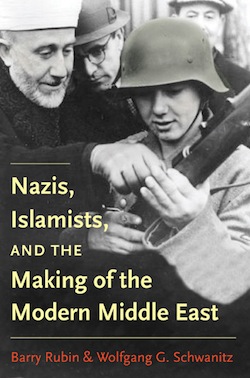
image -Nazis, Islamists and the Making of the Modern Middle East book coverBarry Rubin and Wolfgang G. Schwanitz, in Nazis, Islamists and the Making of the Modern Middle East (Yale University Press), provide ammunition for those who argue that peace is impossible with antisemitic Palestinian and Arab leaders. Rubin, who died before the book was published, was a prolific writer and leading Middle East scholar at the Global Research in International Affairs Centre in Israel. Schwanitz, an accomplished German-American Middle East historian, was a visiting professor at GRIAC at the time of the book’s publication.

In their richly researched book, Rubin and Schwanitz document the ancestry of antisemitism in the Middle East over the past century, connecting some of the contemporary Arab and Palestinian leaders to the vitriolic antisemitism of the Nazi collaborator, the Grand Mufti of Jerusalem Amin al-Husseini.

Backed up by new archival material and previously published research, Rubin and Schwanitz maintain that profound doctrinal hatred for Jews remains the core reason for the Arab-Israel conflict’s enduring and irresolvable nature.

Take a look at Israel’s partners for peace. Heads of state who were once Nazi sympathizers ran regimes that lasted 40 years in Iraq, 50 years in Syria and 60 years in Egypt. An echo of the antisemitism of the 1930s reverberated through speeches of Egypt’s Gamal Abdel Nasser, Iraqi’s Saddam Hussein, Iran’s Ayatollah Ruhollah Khomeini, Libya’s Muammar al-Qaddafi and Saudi Arabia’s Osama bin Laden. A Nazi sympathizer educated Yasser Arafat.

However, Rubin and Schwanitz in this book undermine their own credibility by mixing well-documented historical accounts with sweeping pronouncements that seem to be driven by a narrow ideological bias. At times, they sound more like polemicists than historians. They focus on an extreme interpretation of Islam, painting 1.2 billion Muslims with one brush. They ignore history that does not fit easily into their portrait. And their perspective does little to shed light on the contemporary Middle East, where Muslims fight Muslims.

The most provocative assertion in the book is that the grand mufti was responsible for the Nazi gas chambers and crematoria.

Rubin and Schwanitz portray al-Husseini as the most powerful leader of the Arabs and Muslims around the world in mid-century. At the height of his power, he promised Adolf Hitler that the entire Arab people would rally around the Nazi flag and wage a war of terror against Britain and France if Germany would stop all Jewish immigration to Palestine and guarantee independence to countries in the Middle East.

Rubin and Schwanitz maintain that Hitler decided to kill all the Jews only after al-Husseini insisted that they not be deported to Palestine. None of the European countries would accept Jewish refugees. If Palestine would not accept them, the reasoning goes, Hitler had no choice but to build gas chambers.

But their theory has a few holes in it. Historians have never discovered any Nazi plans to transport all the Jews of Eastern Europe and Russia to Palestine. Britain was already restricting immigration. Hitler’s support for al-Husseini’s demand to stop deportations to Palestine was an empty gesture.

Most historians regard al-Husseini as a minor historical figure. Al-Husseini was part of the Nazi war effort and played a role in the death of thousands of Jews. But he was not as powerful or influential in the

Middle East as he is portrayed here. As Rubin and Schwanitz point out, al-Husseini had no plan for actually staging insurrections in support of Nazi Germany. He recruited only 1,000 soldiers outside of Iraq, although he promised 100,000 for the Nazi cause. It is hard to imagine that the Holocaust would not have happened without al-Husseini’s intervention.

Regardless, Rubin and Schwanitz do a good job of placing al-Husseini in the context of the Middle East’s historic ties to Germany. They begin the tale with Max von Oppenheim, an advisor to Kaiser Wilhelm II in the early 1890s, who urged the German ruler to use Islam to inspire a Muslim revolt in the colonies of Germany’s enemies. At that time, Britain, France and Russia controlled the Middle East, India and North Africa. Zionism was not relevant.

The kaiser made a formal pact in 1898 with the Ottoman Empire’s sultan, Abdul Hamid II. Germany anticipated the alliance would lead to an Islamic jihad throughout Muslim lands, but the righteous call to jihad had little impact. Muslims, Turks and Arabs saw themselves as divided by religion, ethnicity, regional interest and self-interest. They paid little attention in their daily lives to the sultan’s belligerent proclamations.

During the First World War, von Oppenheim ran Germany’s covert war in the Middle East, reinvigorating the policy of Islamic jihad. Germany pushed Sultan Mehmed V to trigger a pan-Islamic revolt, as well as attack Russia’s Black Sea ports, and established activist groups in Arab communities dedicated to spread jihad in Russia-ruled Caucasus and in Arab-populated lands. However, once again, the pan-Islamic revolts never materialized. Tribal leaders took the money from Germany and did nothing.

By the late 1930s, the dynamics had reversed. Al-Husseini sought out the support of Nazi Germany. Hitler was initially cool to an alliance, believing the dark-skinned people of the Middle East were inferior to his blond-haired, blue-eyed Aryan nation, but he soon realized the Nazis and Muslims confronted common enemies – Britain, France and the Jews.

A strident antisemite who had been fighting Zionism since 1914, al-Husseini claimed the mantle of leader of transnational Islamism after Turkey, in 1924, abolished the Islamic Caliphate. He solidified his position within the Arab and Muslim communities through violence and murder.

Under his leadership, militancy became mainstream and moderation was regarded as treason. He turned Palestine into the defining issue of the Middle East. Anyone who did not support him or his views was a Zionist and imperial stooge. In the 1930s, he attracted attention for making passionate nationalist speeches in Jerusalem while crowds chanted “Death to Zionism,” rioted and killed Jews. His work clearly set the stage for Arab and Muslim leaders who followed his lead.

Meanwhile, in Germany between the wars, militant Islamists, backed by the disciples of von Oppenheim, solidified their control over mosques in Berlin and elsewhere, espousing an ideology that Rubin and Schwanitz say can be heard today from the pulpits. They cultivated relations with the leadership of Egypt’s Muslim Brotherhood, Iraq’s Ba’ath Party and radical factions in Syria and Palestine. By the time the Nazis looked to the Middle East, they found a ready-made network of radical antisemitic Islamists from Morocco to India, led by al-Husseini, with similar ideology, worldviews and interests. But the Islamic jihad failed once again to materialize.

Nazi ideology collapsed in 1945. However, a radical Arab nationalism, accompanied by a form of al-Husseini Islamism steeped in hatred of the Jews, flourished after the war. Little has changed despite the passage of decades, events and generations. Rubin and Schwanitz say al-Husseini’s legacy can been seen in the words and actions of Hamas, Hezbollah, Iran, Muslim Brotherhood and al-Qaeda. For them, as for the Nazis and al-Husseini, Jews are the villains of all history, the eternal enemy without whose extinction a proper world would be impossible.

Rubin and Schwanitz say the Arabic-speaking world’s historical connection with Nazi Germany was not solely responsible for the terrorism, conflict with Israel and anti-Jewish hatreds. However, they say, the historical relationships, along with the ideas and motives prompting it, help explain what has happened over the past 70 years. The forces that forged the partnership between al-Husseini and Hitler returned to help shape the course of Middle East history ever since. And it was not just the Nazi doctrine. In many cases, the individuals responsible for the Middle East’s post-1945 course had direct links to the Nazi era, they say.

“Comprehending this fact is the starting point for understanding modern Middle East history, its turbulence, tragedies and its many differences from other parts of the world,” Rubin and Schwanitz say.

Yes, they make a fascinating case for a starting point in trying to make sense of relations between Germany and the Middle East. But in this book they do not examine the record of contemporary Arab and Muslim leaders in much detail. They leave out other influences and other leading players that contributed to the making of the Middle East. Also, Rubin and Schwanitz seem to ignore that the antisemitism of the radical Islamists preceded their embrace of Nazism.

Rubin and Schwanitz have illuminated one diabolical aspect of a complex state of affairs – but much more remains to be said for a full understanding of the modern Middle East.

Robert Matas, a Vancouver-based writer, is a former journalist with the Globe and Mail. This review was originally published on the Isaac Waldman Jewish Public Library website and is reprinted here with permission. To reserve this book or any other, call 604-257-5181 or email [email protected]. To view the catalogue, visit jccgv.com and click on Isaac Waldman library.

Posted on October 30, 2015October 28, 2015Author Robert MatasCategories BooksTags Amin al-Husseini, antisemitism, Barry Rubin, Holocaust, jihad, Middle East, Nazi, Wolfgang G. Schwanitz
Filmmaker as subject

Filmmaker as subject

Henrik Gawkowski, as seen in Shoah, directed by Claude Lanzmann. (photo from Les Films Aleph/Why Not Productions)

The French intellectual who created what many view as the definitive documentary of the Holocaust is himself the subject of a documentary, called Claude Lanzmann: Spectres of the Shoah.

Commentators in the film are unanimous that Shoah, Lanzmann’s nine-and-a-half-hour study of the Holocaust, is a masterpiece. They also agree that Lanzmann is himself a piece of work.

A former friend calls him a megalomaniac. Another commentator says he is “a very challenging individual.” Through interviews with Lanzmann, the viewer gets a sense of what they are talking about.

Over a 12-year odyssey of interviewing and filmmaking, what Lanzmann set out to create was a film, in his words, “not about the Shoah, but a film that would be the Shoah.”

His first challenge was how he would approach a topic so enormous and distressing.

“What is my theme?” he asks during interviews for the documentary. “The heart of the Shoah, what is it?”

On this he concludes: “Shoah is not a film about survival. And, as it is not a movie about survivors … the survivors are not in Shoah, Shoah is a film about death.”

He recounts an incident that left him hospitalized for a month after a former SS officer’s wife discovered a hidden camera in his bag and Lanzmann and his female assistant were chased, beaten and bloodied by thugs associated with the war criminal. In another instance, Lanzmann relates how he almost drowned while swimming off the coast of Israel. He recalls that he had no gratitude to the individual who saved him and speculates that perhaps he had intended suicide because he knew he could not finish the film in the two years he had been given, with the instruction to keep it under two hours.

As Lanzmann goes on at length about his artistic struggles and the terrible toll the project took on his spirit, a viewer’s empathy may fade. Considering the subject matter of Shoah, lamentations on the difficulties of making a film – however monumental – come across as startlingly self-absorbed. Given the advance billing of Lanzmann’s character with which the documentary begins, the film comes full circle, providing a character sketch of a difficult individual who has done a remarkable thing.

Claude Lanzmann: Spectres of the Shoah double bills with What Our Fathers Did: A Nazi Legacy at the Vancouver Jewish Film Festival (vjff.org) on Nov. 11, 3:30 p.m.

Format ImagePosted on October 30, 2015October 28, 2015Author Pat JohnsonCategories TV & FilmTags Claude Lanzmann, Holocaust, Vancouver Jewish Film Festival, VJFF
Shuls, past to present

Shuls, past to present

Left to right: Nico Slobinsky of Centre for Israel and Jewish Affairs, Pacific Region; His Excellency Balint Odor; Ezra Shanken of Jewish Federation of Greater Vancouver; and Andre Molnar, Hungarian honorary consul. (photo from Beth Israel)

On Oct. 15, Congregation Beth Israel hosted an exhibition of Eastern European synagogues, sponsored by the Hungarian government. In his welcoming address at the opening, His Excellency Balint Odor, Hungarian ambassador, explained that Hungary is currently heading up the International Holocaust Remembrance Alliance (IHRA).

“IHRA is very relevant today in fighting spiraling antisemitism across Europe and around the world,” he said. “The mandate of IHRA is to combat all forms of racism, hate incitement and antisemitism, as well as promoting Holocaust education. This year, IHRA has focused a great deal of effort on illustrating the depth of Jewish culture in the region, in particular the synagogue.”

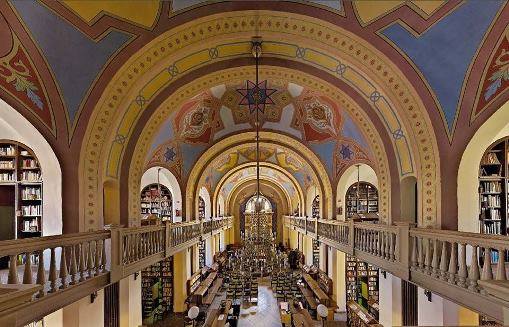
photo - The synagogue in Baja, Hungary
The synagogue in Baja, Hungary. (photo from exhibit catalogue by Rudolf Klein)

The traveling exhibit showcases renovated synagogues throughout East-Central Europe, from 1782-1944, some of which are still in use. Unlike in Germany and Austria, where the majority of synagogues were destroyed, many survived in Eastern Europe. From the 1970s onward, local municipalities restored and renovated synagogues. This work escalated following the fall of the Berlin Wall and the influx of foreign financial support.

The panels show a variety of different styles, ranging from cottage shuls to “palatial” synagogues. The richness and diversity of these places of worship are reminders of how vibrant Jewish life was in Europe prior to the Shoah.

The role of the presidency of IHRA offers Hungary the opportunity to confront its history and look back at the role the Hungarian state played in the genocide. Close to half a million Hungarian Jews perished during the Holocaust. Most of these people died in 1944 following the occupation of Hungary. At that time, every third victim in Auschwitz was a Hungarian Jew. Today, the Hungarian Jewish community is the largest in East-Central Europe. Most Hungarian Jews live in the capital, Budapest, which has some 20 working synagogues.

As Rabbi David Bluman said in his welcome of the ambassador: “The synagogues we see in this exhibit are not just the past, they are also the present for those who worship in them, and will be the future for European Jewry. This is very relevant for us here in our beautiful new synagogue – our present, our future.“

The exhibit was at Beth Israel from Oct. 15-20.

Format ImagePosted on October 30, 2015October 28, 2015Author Congregation Beth IsraelCategories LocalTags Balint Odor, David Bluman, Eastern Europe, history, Holocaust, Hungary, synagogues
Showcasing life’s complexity

Showcasing life’s complexity

In The Singing Abortionist, Dr. Henry Morgentaler comes across as an enigmatic figure. (photo from Vancouver Jewish Film Festival)

This year’s Vancouver Jewish Film Festival will entertain, inform and challenge viewers, from its opening event – YidLife Crisis, a film all in Yiddish (with English subtitles), and its Yiddish-speaking stars/writers Jamie Elman and Eli Batalion as guests – to its final screening, the French film Once in a Lifetime, based on the true story of an inner-city high school in Paris. This week, the Jewish Independent gives you a glimpse into the festival, which runs Nov. 5-12 at Fifth Avenue Cinemas.

A difficult national hero

There are few surnames in Canada that can evoke such visceral and opposite reactions as Morgentaler. Henry Morgentaler is the name most associated with abortion – with providing abortion services to women, with fighting abortion laws, and for eventually leading a case to the Supreme Court of Canada that resulted in the permanent overturning of Canada’s abortion statute.

To allies, he is a hero. To enemies, he is “Hitler,” as countless people scream at him in footage in the documentary The Singing Abortionist. (He was known to hum or sing a few lines while performing abortions, including one he performed on CTV’s W5 program, which ran the procedure in its five-minute entirety.) Yet even to allies – including his children – he is, as one biographer described him, a “difficult hero.”

In interviews before his death in 2013, Morgentaler acknowledged that everything he did in life was with the aim of earning the love of women. This guided him in becoming the foremost advocate in the country for women’s reproductive choice, but it also led to his reputation as a “womanizer.”

Morgentaler was a relatively unknown doctor when he felt morally bound to begin offering abortions, a crime that carried a potential life sentence for the doctor and two years in prison for the patient. Across 20 years of legal battles, including a stint in prison, Morgentaler led the legal and PR battle for choice, which culminated in his case before the Supreme Court of Canada that, in 1985, struck down Canada’s abortion law.

In this one-hour film, Morgentaler comes across as an enigmatic figure. He admits to megalomania, albeit with a guffaw. His children speak about their own conflicted relationships with him. His lawyer says Morgentaler was an easy target for anti-abortion forces to caricature as a “strange-looking, hook-nosed Jew.” Morgentaler is both introspective about his motivations but clearly suppresses, according to those around him, his experiences as a Holocaust survivor.

But Morgentaler’s career – particularly his lifelong devotion to the fight for abortion rights – is a direct result of his suffering under Nazism. He was a forced laborer in the Lodz Ghetto before it was liquidated and its residents sent to Auschwitz. The film follows Morgentaler on his only return to the place where he lost his mother, and where he and his brother survived. The experience, he tells the filmmaker, taught him that, “Just the fact that something is law does not necessarily mean it is good or justified or it’s rational.”

– PJ

Monumental reconstruction

Before the Holocaust, Poland had about 200 wooden synagogues, a richness of liturgical architecture that one expert said “rivals the greatest wooden architecture anytime in history, anywhere in the world.” All were lost.

That American expert, Rick Brown, began a project to painstakingly reconstruct from photographic and other records a prime example of that lost history. Working, first, with his students at the Massachusetts College of Art, the project eventually expanded to include more than 300 people, mostly students, from 46 universities and 11 countries.

photo - Raising the Roof tells the story of how a team of hundreds recreated the painted roof and ceiling of Gwozdziec Synagogue in Poland
Raising the Roof tells the story of how a team of hundreds recreated the painted roof and ceiling of Gwozdziec Synagogue in Poland. (photo from VJFF)

The undertaking was monumental. Using only the tools that were available at the time, and working on site over successive summers in Poland and Ukraine, the team recreated the intricately constructed and painted roof and ceiling of Gwozdziec Synagogue. (Gwozdziec is actually in Ukraine, but was part of the greater Polish territory during the heyday of synagogue architecture and its synagogue is both one of the most dramatic and one with the most information available to aid the team in recreating it.)

Brown and his group didn’t know what they would do with the to-scale project when it was completed, but fate intervened. The POLIN Museum of the History of Polish Jews had been designed to accommodate exactly such a replica. After years of tree-felling, lathing, metalworking, complex joinery and scrupulous research on building techniques and paint colors, the roof and ceiling were raised into place at the Warsaw museum.

Raising the Roof, the film that tells the story of the project, is fascinating on multiple fronts. It involves many people with divergent motivations, including Jews, non-Jews, Americans, Poles, artists and even volunteers with no particular skill beyond enthusiasm. There are poignant reflections on the meaning of the original architecture, its loss and regeneration. Underpinning the entire project is the memory of the lost civilization of Polish Jewry, from which 70% of today’s Jews have ancestry, and whose architecture and culture can be reclaimed, but whose existence cannot.

– PJ

Being high and low in Haifa

If you can hand yourself over to filmmaker Elad Keidan and immerse yourself in the sights of Yaron Scharf and especially the sounds created by Aviv Aldema, Afterthought is a worthwhile journey.

photo - Uri Klauzner as Moshe, left, in Afterthought, Elad Keidan’s first feature
Uri Klauzner as Moshe, left, in Afterthought, Elad Keidan’s first feature. (photo from VJFF)

The Israeli film’s Hebrew title, Hayored Lema’ala, “down up,” basically sums up what happens on the outward level. Moshe, whose name and story we don’t find out till almost the very end, goes off in search of his wife’s lost earring, which leads to other discoveries about his wife and their relationship. As he starts his exploration up the stairs to the top of Mount Carmel in Haifa, Uri begins his descent to the port, where, we eventually find out, he is planning on catching a freighter abroad, both to finish writing a book and to avoid army reserve duty, as well as to run away from mistakes he has made. The two men pass the same sights, sounds and people at different points in the day, and they encounter each other, stopping for a brief chat – Moshe was Uri’s third-grade teacher, it turns out.

The English title for the film comes from a conversation Moshe overhears in a coffee shop. A man tells his friend about how he wishes that, after a talk with his mother, for example, he could call his mom and leave a message with everything that he actually wanted to say, or meant to say.

Afterthought is Keidan’s first feature, and it is a solid debut despite the slow pace. Viewers are ultimately rewarded by the internal ups and downs of the main characters, the men’s reflections on life, friends and family, and the people they meet along the way. Aldema’s radio snippets, machine and human noises, music selections and other sound effects are a character in and of themselves, and are worth the price of admission alone. These, together with Scharf’s cinematography – which is not flashy, but subtly effective – and the acting of Itay Tiran as Uri and Uri Klauzner as Moshe make for a movie that will not only have you thinking of it afterwards, but of your own life, the choices you have made, and the people you hold dear.

– CR

For the film schedule, tickets and information on all the festival’s offerings, visit vjff.org.

Format ImagePosted on October 23, 2015October 22, 2015Author Pat Johnson and Cynthia RamsayCategories TV & FilmTags Afterthought, Gwozdziec, Holocaust, Morgentaler, Vancouver Jewish Film Festival, VJFF
Korczak’s legacy now

Korczak’s legacy now

Left to right, keynote speaker Irwin Elman and panelists Rachel Malek, James Copping and Jess Boon. (photo by Cynthia Ramsay)

“Children are not the people of tomorrow but are people of today. They have a right to be taken seriously, and to be treated with tenderness and respect. They should be allowed to grow into whoever they are meant to be.”

Polish doctor, educator, writer and orphanage director Janusz Korczak’s philosophy and writing laid the foundation for the United Nations Convention on the Rights of the Child (UNCRC). Murdered in 1942 at Treblinka with the almost 200 children in his care, Korczak’s work and life remain relevant to this day.

Jerry Nussbaum, president of the Janusz Korczak Association of Canada (JKAC), was one of the many speakers on Sept. 29 to remind the approximately 70 people in attendance of this fact. “We hold this lecture series in his honor,” said Nussbaum, “because we seek to follow his example of respecting children and honoring the whole child.”

“How to Love a Child”: The Janusz Korczak Lecture Series is co-organized by the JKAC and the faculty of education at the University of British Columbia, with contributions from other faculties, universities, activists and advocates. The first of six lectures was called Keeping our Promise to Children: The Relevance of Korczak’s Legacy for Children Today. It featured as keynote speaker Irwin Elman, provincial advocate for children and youth of Ontario, and president of the Canadian Council of Child and Youth Advocates.

Other speakers included moderator Dr. Charles Ungerleider, director of research and managing partner of Directions Evidence and Policy Research Group, LLP; Marni Point, who welcomed attendees to the traditional and unceded Musqueam territory; Dr. Krzysztof Olendhi, ambassador titulaire, consul general of the Republic of Poland in Vancouver; and. Dr. Blye Frank, dean and professor, UBC faculty of education. The most poignant tribute came from child survivor Lillian Boraks-Nemetz, board member of JKAC, author and UBC instructor.

“Korczak has been my hero all my life,” she said. Both she and Korczak were among those held in the Warsaw Ghetto. She spoke of going to school secretly until one day two Nazis came in and pushed the teachers around (they were sent to prison) – “we children sat there frozen in fear for quite some time, then the teachers sent us home. The next day, the school was boarded up. And that is what I remember, clutching my father’s hand ever so tightly while looking into the cellar through a little window at the now-empty grey room, where once there was life, color and learning. I had lost my right to education.”

Her father took her to Korczak’s orphanage. Even though the doctor was not in, they were welcomed, and she saw the children reading and doing artwork, seemingly happy “inside this space, as if the horror of the ghetto and the threat of the always-impending danger didn’t exist. This was Dr. Korczak’s world…. I had the impression that the doctor also tried to raise the children’s spirits during the terrible times in which they lived.”

She described the deportations; she, her mother and little sister narrowly missing the transport cars to Treblinka when a commotion distracted the guards and her father managed to save them out of the line. “We were lucky, not so Dr. Korczak and his children, who were destined to walk along the same route.”

On Aug. 5, 1942, the Nazis came for the children of the orphanage. While he was offered a reprieve, “Korczak refused, saying I hate desertion and besides, my children need me.

“Father often spoke of that day and how Korczak’s 200 orphans were ordered out of the building and made to march through the Warsaw Ghetto with Korczak at the helm, holding a small child in his arms and one little one by the hand. They were carrying the green banner of King Matthew, the character in his [Korczak’s] popular book for children about a child king who fought for children’s rights…. No survivor who was there at that time can forget the long procession. Many wrote about it.”

Boraks-Nemetz said her father often spoke about Korczak and taught her his principles, principles she followed in raising her own children. She concluded her remarks with the poem “And Still They March” by Yala Korwin, before presenting the first JKAC scholarship award to UBC PhD student Matthew Lee for his work on children’s social and emotional development.

When Elman began his keynote address, he admitted that he only learned about Korczak about 15 years ago, on a trip to Japan, where he was invited to “help them learn about children’s rights and to help teach them to elevate the voice of children.” When visiting a children’s home – an institution that can have as many as 200 children living in it – a staff member mentioned Korczak and was amazed when Elman, a Jewish educator who had worked with children for 20 years at that point, did not know the name.

Elman has since learned enough to know that Korczak’s work and life are relevant. “In Canada today, there are approximately 350,000 children connected to care in one way or another…. Some say that there are as many as two million former Crown wards … in this country.”

Speaking of his home province, he said there were 23,000 kids in Ontario living in some form of care, 8,000-10,000 permanently (ie. Crown wards, which, in British Columbia, are called continued custody orders) – and they are not doing well. Of those, more than 18% are aboriginal; in British Columbia, it’s 60-65%; in other provinces even higher. “It’s not hard to understand and listen to and hear the echoes of the Truth and Reconciliation Commission’s report, and the need to address this over-representation of First Nations children across the country in our systems of care.”

In Ontario, he said, children can only come into care if a social worker (or somebody in such a capacity) has deemed the child in need of protection – from abuse or neglect – and a court has agreed. The children have not done anything wrong.

When the state takes children into care, said Elman, “You’re making a promise to them. The first thing, obviously, is, you’re protected now. The second thing is … if you’re permanently in our care, we’re going to take care of you … we’re going to ensure that you’re going to live to your full potential. And, when that child is brought into care, what do they hear? Maybe we don’t say it, but they hear, we’re going to love you, it’s OK now.”

But, he said, only 40% of children in care in Ontario graduate from high school, and that percentage doesn’t vary much between provinces; 43% of the homeless population of Canada have had an in-care experience. Young people connected to care are over-represented in the justice and mental health systems.

Elman shared many stories of his work as the province’s advocate. When somebody steps up for a child, he said – whether it be a community, foster parents, a group home, adoptive parents, anyone – “the government needs to say thank you, we’ve got your back, what do you need? We’ll do whatever is necessary, because we owe our children a home in which they are nurtured and loved…. That takes a whole different way of thinking about child welfare.”

He has been told, “We can’t legislate love.” His response is, “I don’t think you can legislate love, but I do think you can create conditions in which love can flourish. The government should be all over that… And, to do that, they need to ask young people and they need to ask children and they need to ask their caregivers in whatever form that is…. We owe that to children.”

If we took that approach, he said, if children in care were listened to, they would feel in charge of their own lives. If they knew what was in their files and had a say in what was written there, they would contribute to making policy, they would have a say in where they lived. Social and child-care workers would be trained differently, including respecting all the different cultures from which children in care come. “Many practical, revolutionary things … would happen in the way in which the system is run if children felt listened to.”

Panelists Rachel Malek, Jess Boon and James Copping – all members of the Federation of B.C. Youth in Care Networks – joined Elman on stage for a 35-minute Q&A. Questioners wanted to know more about the criteria for a child going into care, how to create a sense of belonging for a child and ensure their safety, how to reduce the number of children in care, the impact of poverty, and which programs in Canada reflect Korczak’s philosophy.

As the final question, the consul general asked the young panelists, all of whom had experienced the care system, “What does it mean to you to love a child?” Boon spoke of commitment, being there for the serious and fun times but also investing in your own education to give back to the community. Copping mentioned consistency in home, support for school, having someone on whom to rely through thick and thin. For Malek, it is to be vulnerable – to open your heart, to recognize that it’s a two-way street, to be willing to go the extra mile for a child.

The next lecture in the Korczak series takes place Oct. 29, 7 p.m., at UBC Robert H. Lee Alumni Centre. Registration is required via jklectures.educ.ubc.ca.

Format ImagePosted on October 16, 2015October 14, 2015Author Cynthia RamsayCategories LocalTags children's rights, education, Holocaust, Irwin Elman, Janusz Korczak, JKAC, Lillian Boraks-Nemetz
Survivors living in squalor

Survivors living in squalor

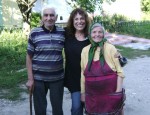
Survivor Mitzvah Project’s Zane Buzby, centre, in 2012 with Abramas and Malka Dikhtyar, the last two Jews in Bazaliya, Ukraine, the birthplace of Buzby’s grandfather. (photo from Survivor Mitzvah Project)

It is officially autumn and British Columbians are nesting, settling in for the cozier, slower season to come. For impoverished Holocaust survivors living in shocking squalor in eastern Europe, the impending winter is a time of danger and scarcity.

Like most people, Zane Buzby initially had no idea that there were thousands of destitute, aged survivors of the Holocaust living in subhuman conditions across the former Soviet Union. After she first encountered some of the poorest of the poor, she returned to her California home and searched for organizations that help them.

“I thought a lot of them must be doing this, even the big organizations that have Holocaust survivor programs,” she recalled recently. “I called every single one of them, [asking] specifically what are you doing? It’s nothing. They’re not helping people financially. No one was doing with this.”

The Claims Conference, which was created by the German government to aid survivors of the Holocaust, has proven useless to most of these individuals.

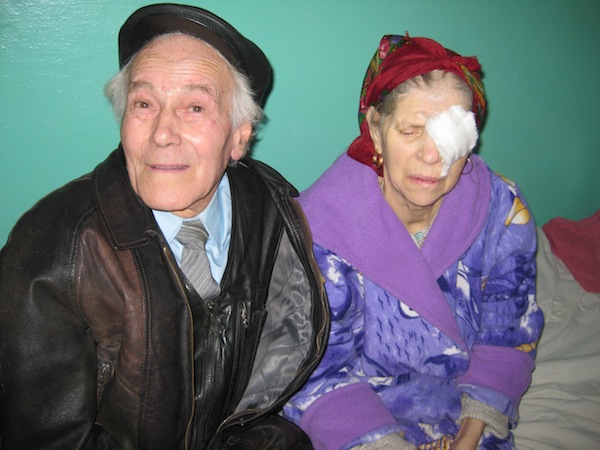
photo - Survivors Isak and Galina in hospital
Survivors Isak and Galina in hospital. (photo from Survivor Mitzvah Project)

“If you were in a concentration camp – and the Germans kept really good records – if you survived Auschwitz, they have your name … [even so], most people have to hire an attorney,” Buzby said. The survivors she helps don’t have records, partly because the Holocaust in the east was typified by on-the-spot mass murder by Einsatzgruppen killing squads rather than concentration camps. And the few survivors in eastern Europe today do not have the resources to apply.

“They don’t have computers, they don’t have people advocating for them, there’s no lawyers out there,” said Buzby.

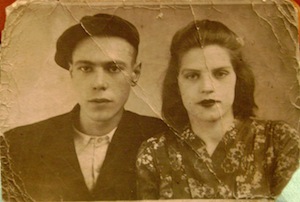
photo - Survivors Isak and Galina in their younger days
Survivors Isak and Galina in their younger days. (photo from Survivor Mitzvah Project)

In many cases, they also don’t have the money to pay for heating fuel, let alone medications or doctors. Some may have a pension of $10 a month, others have no income whatsoever. Food can be very scarce and many of the survivors are the last, or among the last, Jews in their villages, making their final years bleak and lonely.

Buzby took it upon herself to help. She formed the Survivor Mitzvah Project in 2001 and has helped thousands of the most desperate, destitute survivors. (See also jewishindependent.ca/oldsite/archives/may08/archives08may02-01.html.)

“This is the last generation of Holocaust survivors and we are the last generation who can say that we helped,” she said. “Everyone turned their back in 1939 but today we can do something to help them and we should.”

The Survivor Mitzvah Project (SMP) doesn’t try to create the infrastructure of social services or initiate major projects. The goal is simple. Get some money into the hands of the most destitute Holocaust survivors as quickly as possible.

“We try to give them between $100 and $150 a month to get food, heat and medication, so it comes out between $1,800 and $2,000 a year per survivor,” she said. “Of course, we don’t have the money, we don’t bring in enough money, we don’t have enough donors to help everyone every month and that’s the sad part. That’s why this is really a call to action. There is no tomorrow for these people. They need money now.”

Buzby, an actor and TV director before she became obsessed with helping destitute survivors, finds recipients through word of mouth, traveling to villages and asking around for Jews or looking for signs of Jewish life. Often, she said, survivors lead her to others. She recalled a particular example.

photo - Some survivors are living in huts – “no running water, no heat, broken windows.”
Some survivors are living in huts – “no running water, no heat, broken windows.” (photo from Survivor Mitzvah Project)

“When I went there, to this little village, it was in such poverty, it was unimaginable, unbelievable poverty. No bathroom, no running water, no heat, broken windows,” she said. “A lot of these people made the huts they live in themselves out of mud and straw bricks after the war. It needs to be refurbished every year but now in their old age they can’t do it, so ceilings fall in. I gave [a woman] $800 and, on the way out, she pulls on my jacket and says to me through a translator, ‘Can I split this was someone?’ And I said, ‘Who are you going to split it with?’ ‘There is a woman down the road who is much worse off than I am.’ And I thought, how could anybody be worse off than you are, so I said come with us and take us to this woman. So we went to see the second woman and she was very bad off, so she was put on the list, and that’s how it goes.”

The Jews in these villages are often surrounded by non-Jews who are also destitute, said Buzby.

“There’s always poor people to help, God knows,” she said. “But for the Jewish people who survived the Holocaust, not only were their families decimated and murdered, their communities were obliterated, especially if they were in the east, they were burned to the ground. There’s no community, there is no rabbi, there’s no Jewish community, there is no shul, there’s no sister, brother and uncle, there is no support system. So, these [non-Jewish] villagers, even though they are also poor, they have large families, they have maybe a church, they have community. These [survivors] have no community. There is absolutely nothing supporting them.”

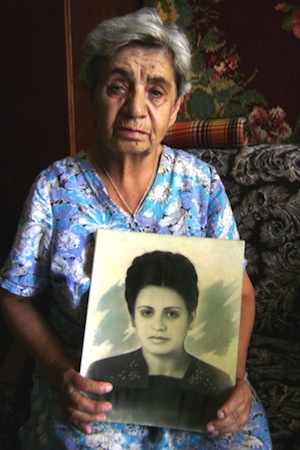
photo - Basya Kreyn with her prewar photo, Belarus
Basya Kreyn with her prewar photo, Belarus. (photo from Survivor Mitzvah Project)

Holocaust survivors in eastern Europe have one thing in abundance, Buzby clarified. Antisemitism.

“Rampant. Terrible,” she said. “There’s more antisemitism now than there’s ever been.”

In places, neo-Nazis march openly on the streets. Fascistic parties are gaining strength across eastern Europe. In Vilnius, Lithuania, kids dress up as “Jews” in masks with exaggerated features that are perceived as Jewish and trick-or-treat, demanding money. War-era Nazi collaborators are being rehabilitated as national heroes, she said.

The relationships between the few surviving Jews and their neighbors is additionally fraught because of the high levels of collaboration between the Nazi invaders and the native populations in the east. The almost complete destruction of the Jewish communities of Lithuania – an estimated 95% of the Jews there were killed – is credited to the assistance of Lithuanians. The Simon Wiesenthal Centre has said that Ukraine, for example, has never initiated any investigation into collaboration or prosecuted a perpetrator.

The Survivor Mitzvah Project gets almost no institutional help. Buzby said she routinely contacts major foundations but they demur, saying they support various organizations that assist survivors. But the survivors Buzby has tracked down have fallen through the cracks of whatever institutionalized assistance might be available.

What they do get is support from some of Buzby’s show biz colleagues. Buzby’s acting career includes turns in some of the classic comedies of the 1970s and ’80s, including Up in Smoke, National Lampoon’s Class Reunion and This is Spinal Tap. As a director, she worked on sitcoms including The Dick Van Dyke Show, Golden Girls, Newhart and Blossom. She has brought entertainment figures together for emotional events in which luminaries including Valerie Harper, Ed Asner, Frances Fisher, Elliott Gould, Lainie Kazan and Chris Noth read letters from survivors SMP has helped, who speak about their hardships and the difference the assistance has made in their lives. A powerful video of one of the events is online at survivormitzvah.org.

SMP has hit the $1 million a year mark, but Buzby estimates she needs $2.5 million to meet demand.

“This is an opportunity for people to change the course of history for the survivors,” she said. “Everybody has monuments and raises money for and builds museums for remembrance of those that perished, which is absolutely as it should be. But what about those that survived?”

The coming of the cold winter adds urgency to Buzby’s work. So does the obvious march of time, she said, as the remaining survivors near the end of their lives.

“It’s a time that’s never going to come again,” she said.

For more information or to donate, visit survivormitzvah.org or canadahelps.org.

Format ImagePosted on October 16, 2015October 19, 2015Author Pat JohnsonCategories WorldTags Holocaust, SMP, Survivor Mitzvah Project, survivors, Zane Buzby
Ullmann’s last work

Ullmann’s last work

Viktor Ullmann, 1924. (photo from Arnold Schoenberg Centre Los Angeles)

The memories of City Opera Vancouver’s production of The Emperor of Atlantis in 2009 still resonate. Written by Viktor Ullmann (composer) and Petr Kien (librettist) in 1943-44 at Theresienstadt concentration camp, its stirring score and lyrics, both of which, remarkably, reflect hope for a positive future, stay with you. No doubt, Project Elysium’s Cornet: Viktor Ullmann’s Legacy from Theresienstadt will have a similar effect.

In two public performances (and one private), the group Elysium will present Cornet, the last work that Ullmann finished before he was deported to Auschwitz on Oct. 16, 1944, and killed there two days later. Set to excerpts from Rainer Maria Rilke’s The Lay of Love and Death of Cornet Christoph Rilke, it tells the “tale of a young soldier who experiences love and death in a single night.”

Combining recitation and piano, the piece will be performed by pianist Dan Franklin Smith, who is also music director of Elysium, with Gregorij H. von Leïtis, who is the group’s founder (in 1993) and artistic director, among other things. The evening will include Ullmann’s Piano Sonata No. 6, Op. 49, written in Theresienstadt in 1943, and a lecture by Michael Lahr, Elysium program director and executive director of the Lahr von Leïtis Academy and Archive. Project Elysium was created by Vancouver performer and producer Catherine Laub to bring Elysium to Canada.

“In honor of the 70th anniversary of the end of WWII, Elysium – an organization focused on performing music of composers persecuted during the Nazi regime – is coming to Canada for the first time to present a concert of Viktor Ullmann’s music. One of the concert dates will be the actual date 71 years ago that Ullmann arrived in Auschwitz from Theresienstadt and was immediately put to death,” Laub told the Independent. “The focus of the endeavor is not to dwell on the suffering and death of this artist but to celebrate a man who created beauty during an intensely painful time, and be uplifted by artistry that justly survives his shortened lifespan. In Michael Lahr’s words, ‘The adamant will to live, the unshakable hope that good will prevail no matter how horrible the attempt to crush it – this is the message of Ullmann’s music from Theresienstadt. Elysium offers Ullmann’s music as a powerful symbol of hope.’”

In addition to being a performer, composer and teacher, Laub has been a concert producer since she moved to Canada from the United States in 2006. She founded the Erato Ensemble, with William George, and has been involved on the production side with various other ensembles. Since the creation of the monthly Sunday concert series at Roedde House Museum in 2012, of which she is artistic director, she said, “I have started to focus more energy on being aware of which artists and which projects are poised to bring important gifts to audiences and communities in Vancouver. Project Elysium is the largest-scale project I’ve been involved with from an organizational standpoint, and it’s unique in that I’m not wearing my performance hat at all.”

The Project Elysium concerts, she said, “have been in the works since December 2013, when I reconnected with Gregorij von Leïtis and Michael Lahr on a trip to Munich. I first worked with them when I was fresh out of graduate school and participating in their young artist program. In the years since, I had become more familiar with the second part of their mission statement: ‘… fighting against discrimination, racism and antisemitism by means of art.’ It inspired me that here were people with a clear artistic mission as well as a humanitarian focus. In today’s world, where we all expect quick sound bites and instant gratification, it has to be clear why live performance and the arts – beyond big-budget Hollywood – are relevant and important. This seems like a clear answer to me, and it’s never been more important to be reminded of what happens to the world when we don’t listen to such messages.”

image - Drawing of composer Viktor Ullmann by Petr Kien, graphic artist, Theresienstadt inmate and librettist of The Emperor of Atlantis
Drawing of composer Viktor Ullmann by Petr Kien, graphic artist, Theresienstadt inmate and librettist of The Emperor of Atlantis. (image from project-elysium.org)

“Never forget.” This was one of the reasons that City Opera Vancouver decided to produce The Emperor of Atlantis.

Artistic director Dr. Charles Barber first encountered Ullmann’s music when he was in graduate school at Stanford. “I had made friends with Lotte Klemperer, daughter of the great conductor Otto Klemperer,” Barber told the Independent. “She and her father knew his work, and she introduced me to Ullmann’s broken life and unbroken promise. We listened to recordings together, and Lotte told me about his music and its time.”

Barber also knew Ullmann’s work through violin teacher Paul Kling. “He had played Ullmann’s music, knew it intimately, and was imprisoned with him at Theresienstadt. Prof. Kling considered Ullmann one of his teachers, and strongly believed in his genius.”

While Ullmann and Kien did not survive the Holocaust, Kling did, and, said Barber. “I felt an obligation to help maintain, in his name, the music that might have been.”

The choice of Atlantis, said Barber, had to do with “its unique story, its historical context and its relevance today.” City Opera presented it “in partnership with the Vancouver Holocaust Education Centre, and they were wonderful collaborators in bringing this British Columbia première to the Rothstein Theatre.

“City Opera specializes in chamber opera: the small forms, the intimate eloquence, the affordable advantage. Atlantis met all of these criteria, and more. The music is wonderful, the libretto is bold and vivid, the voice is favored and the audience was moved. It’s what we hoped to achieve, and it’s what we tried to honor.” (For more on the 2009 production, visit jewishindependent.ca/oldsite/archives/feb09/archives09feb06-01.html.)

While Barber, unfortunately, won’t be able to attend Elysium’s Cornet concert – he will be in Quebec City with COV, conducting its opera Pauline – he put the program into context. He said, “It highlights Ullmann’s gifts: concision, wit, superlative technical accomplishment, daring, and a strong foundation in European musical traditions.

“Ullmann’s significance in musical history is, alas, limited. He was one of the great lights in a musical generation destroyed by the Nazis. We will never know what his place would have been; we only know what it might have been. In his 46 years, he seems to have composed as many works. Only 13 survived him after he was killed at Auschwitz.

“His music works for me, and I think will for the audience coming up, because of its eclecticism. Ullmann was an authority on many sources, he drew widely upon them, but found a voice that was unlike others of his day. He was not an academicist. He wrote for real people, and presumed in them a shared awareness of musical and cultural traditions, and a desire to advance them – playfully, skilfully and imaginatively.”

“While it isn’t possible to rewrite history,” said Laub, “this project functions as a kind of musical ‘rescue mission,’ bringing recognition to a brilliant composer whose work was nearly lost to us. His story and his music allow us to make a more personal connection to a time that is almost too overwhelming to contemplate. This connection is essential as it helps us not only mourn but learn.”

Echoing these comments, Barber said, “These concerts will not be a funeral procession. Ears will be challenged, knowledge will be deepened, and awareness will be empowered.

“According to my teacher Paul Kling, the real Ullmann was a witty and profoundly learned man who delighted in sharing knowledge and in jolting listeners. What an irresistible combination.”

Cornet will take place Oct. 16, 8 p.m., at the Cultch’s Historic Theatre, and Oct. 17, 8 p.m., at Pyatt Hall. Tickets ($30/$20) are available from the Cultch box office, 604-251-1363, and tickets.thecultch.com/peo.

Format ImagePosted on October 9, 2015October 8, 2015Author Cynthia RamsayCategories MusicTags Catherine Laub, Charles Barber, Cornet, Elysium, Emperor of Atlantis, Holocaust, Viktor Ullmann
Memorials to millions

Memorials to millions

Ian Penn’s exhibit at the Zack Gallery, Pole, “isn’t happy but it’s genuine.” (photo by Olga Livshin)

The poignant tale behind Pole, Ian Penn’s new multimedia exhibit at the Zack Gallery, is a bleak travelogue detailing his recent journey to Poland.

Although Penn’s family came from Poland – his parents were lucky to have escaped the Holocaust and settled in Australia – he never wanted to visit the country of his ancestors. “My mother said she would never set a toe in Poland,” he told the Independent.

Growing up in Australia, Penn moved to Vancouver, where he worked as a cardiologist for many years. He is mainly retired now but still teaches at the University of British Columbia and works as a medic with the emergency-response ski patrol in Whistler.

“When I retired, I enrolled in Emily Carr,” he said. “I graduated in 2010 with a bachelor’s in fine arts but I’ve always kept a visual diary, since university. I have hundreds of little albums at home. Wherever I am, wherever I go, I draw and write in them. It’s how I explore the world.”

He paints regularly, landscapes and figurative images. “For me, painting is a way of telling a story, one of many. There are other ways, too: words, sculpture, video, photography. I used the multimedia approach for this show because I wanted to bring all those ways together, see how they fit. The show is a story of Jewish soul.”

Penn found his subject in Poland. He had resisted making the trip for a long time, until a couple years ago. “My daughter said to me then, ‘It’s time to visit your history,’ so I made the decision to go,” Penn explained. “I have a friend in Australia. We have known each other for a long time. He is a Pole, he speaks Polish, and he wanted to take me. He said we should both read a few books first to prepare ourselves, books about the plight of Jews in Poland during the war, but written by Poles, not Jews. We didn’t want to go as tourists. We wanted to understand.”

Nonetheless, Poland shocked him. “There are almost no Jews left there, and the ones who remain don’t know anything about Jewish culture. I went to a synagogue and I had to say Kiddush because nobody there could speak Hebrew. But the Poles – they exploit Jewish history. They charge 23 euros for a trip to Auschwitz. They have those happy golf carts all around Krakow and they take you to the Schindler’s factory and to the ghetto. They sell Jewish souvenirs, but who made them? Not Jews. This is not how you engage in history. They made a commodity out of our tragedy, of the Jews killed by the millions. It’s like Horror Disneyland. I couldn’t stay there more than one week.”

Penn found most of the Jews of Poland in the cemetery. “There, every stone has a name written on the tombstones, remembered, while those who died in Auschwitz are just dust. I learned that Nazis burnt 1,000 people an hour in the ovens in Auschwitz. I tried to wrap my head about the number. That’s why I did this show. It’s about those thousands of souls.”

All of the works displayed in the show bear the same name, “1000 Marks.” By creating the paintings, Penn wanted to visualize his non-memories, remember something he had never witnessed. Five paintings are similar: dead trees, brown and dreary, wooden poles striving to reach the sky, one pole for every Jewish soul that didn’t have their name written somewhere. Together, they form a memorial.

A couple other paintings have a subtitle: “From the Village to the Ramp.” They are painful to view, powerfully evoking the horrors of the Holocaust. So does the entrance to the gallery, decorated with two real wooden poles, with bark still on in some places, unpolished and branchless. The “Welcome Back” mat underneath them doesn’t look particularly welcoming either. There was a sign at the entrance to Auschwitz, too, and the correlations reverberate in the air.

“This show isn’t happy but it’s genuine,” said Penn. “It’s my response to the entertainment industry they made of the catastrophe. Their tourist trips have nothing to do with our dead families.”

The show also includes a few short videos, two of them filmed at the Jewish cemetery. The screens are mounted to the walls like paintings, continually running loops of footage. “I shot them myself,” said Penn. “There is serenity at the cemetery. And lots of greenery, living trees. I saw a man restoring the text on one of the tombstones and filmed him. I didn’t talk to him, didn’t ask him anything. He was doing a holy job. That was enough.”

A few more wooden poles, also part of the exhibition, are placed outside of the Zack Gallery. They are suspended above the atrium, where the stairs lead down to the Vancouver Holocaust Education Centre.

“They are uprooted, like all of us whose parents left Europe,” said Penn. “The poles come from the UBC Endowment Lands and from the Whistler area. They remind me of the trees in the Jewish cemetery but they are also my connection to this place, to Canada.”

The show Pole opened on Sept. 10 and continues until Oct. 11.

Olga Livshin is a Vancouver freelance writer. She can be reached at [email protected].

Format ImagePosted on September 18, 2015September 17, 2015Author Olga LivshinCategories Visual ArtsTags Holocaust, Ian Penn, Poland, Zack Gallery
Adler amends bio, posters

Adler amends bio, posters

The photo tweeted Aug. 16 by Walrus editor Jonathan Kay of Mark Adler’s original campaign office sign. (photo from @jonkay)

Conservative MP Mark Adler has removed a reference in his online biography in which he described himself as the first child of a Holocaust survivor to be elected to Parliament.

The move came after an Aug. 17 Canadian Jewish News story revealed that Raymonde Folco, a Liberal who served as a Montreal-area MP from 1997 to 2011, preceded Adler in that distinction, and that Folco was herself a child survivor of the Holocaust.

The Adler campaign also changed a large building sign outside his campaign office that contained a reference to the candidate being the son of a Holocaust survivor, which was removed and replaced with a message about “keeping our taxes low.”

The York Centre MP found himself at the centre of controversy after Walrus editor Jonathan Kay tweeted a picture Aug. 16 of Adler’s original campaign office sign containing his claim about being the son of a survivor. “And who needs Yad Vashem when Holocaust awareness is now being promoted on partisan Conservative signage?” Kay tweeted with the photo.

Adler’s current online biography continues to describe him as “a child of a Holocaust survivor … [who] has passionately dedicated his time to raise awareness about discrimination and antisemitism throughout the world.”

In a prepared statement, Adler said, “Throughout my life, I have advocated for Holocaust remembrance – so that all Canadians will remember the great evil of the Second World War and never forget. My father came to Canada after surviving the horrors of a Nazi death camp, and chose Canada based on the values that continue to unite us: democracy, freedom, human rights and the rule of law.

“I am proud to serve our country and deliver on the priorities of residents in York Centre – including advocacy for the security of the state of Israel and the promotion of democratic values abroad. I share the concern of many residents who are alarmed by the global campaign to isolate and denounce Israel, and the moral relativism that was embraced by past governments who equivocated on the defence of the Jewish state.”

Adler’s NDP opponent, Hal Berman, a palliative care physician, criticized the MP on his own Twitter feed, saying, “Shame on you using #Holocaust for political gain. #yorkcentre deserves better – I am in this for voters.”

Ironically, Berman is also the child of Holocaust survivors. In his own web bio, the Montreal-born Berman points out his “grandparents and mother arrived to start a new life after the Holocaust.”

Meanwhile, Folco said she found it “disgusting” for Adler “to use the Holocaust in this way, for personal ends.” As an MP, she never publicized her status as a child of Holocaust survivors, while Adler is “profiting” from it.

“Whether he is the first or 15th, I should think it is your record that matters: what you’ve done and what you intend to do for Canadians, when elected,” she told the CJN.

Adler is far from the first politician to draw attention to unique circumstances in their personal background.

In Vancouver, Liberal candidate Harjit Sajjan, who served in the Canadian Armed Forces and received the Order of Military Merit, noted in his web biography that he “is the first Sikh to receive this award and continues to be a role model for youth across the country as he prepares to serve his country in new ways.”

Retired senator Vivienne Poy, a Liberal, is described on the parliamentary website as the “First Canadian of Chinese origin appointed to the Senate.” She notes on her own website that she “was the first Canadian of Asian descent to be appointed to the Senate of Canada.”

High-profile NDP candidate Olivia Chow mentions her unique circumstances in her online biography, as well: “Olivia was born in Hong Kong and moved to Toronto with her parents when she was 13. In 1991, Olivia became the first Asian-born woman elected as a Metro Toronto councilor.”

And, south of the border, Hillary Clinton, the front-running Democratic Party presidential candidate, in a statement designed to appeal to new Americans, said during the campaign that her grandparents had immigrated to the United States. However, that comment was inaccurate. Three of her grandparents were born in the United States and the fourth immigrated to the country as a young child.

– For more national Jewish news, visit cjnews.com.

Format ImagePosted on August 28, 2015August 27, 2015Author Paul Lungen CJNCategories NationalTags Conservatives, federal election, Holocaust, Mark Adler, Raymonde Folco

Adler’s action unseemly

The memory of the Holocaust is frequently misused and abused. Enemies of Israel exploit the memory and imagery of the Shoah, using it against Zionists to deliberately cause pain. Many people unintentionally diminish this history by nonchalantly throwing around terms associated with the Nazi era.

Earlier this year, Project Democracy, a group that aims to convince Canadians to vote for the candidate in their riding most likely to defeat the Conservative candidate, produced a meme with a picture of Prime Minister Stephen Harper and the words: “Canadians fought fascism from 1939 to 1945. Why vote for it now?” This from an organization that has as the first line on its Facebook page: “Our objective … is to *raise* the bar of Canadian political discourse, not *lower* it.” Fail.

It may be especially bewildering to see those who, of all people, should know better, exploit tragic history. Recently, there was a tempest involving Ontario Conservative MP Mark Adler (again).

Adler was the MP who embarrassed himself, his party and the prime minister while on a trip to Israel last year. Harper was praying at the Western Wall when Adler, in perfect proximity to a media microphone, urged one of the PM’s handlers to let Adler get in the picture.

“This, it’s the reelection,” said Adler, whose riding has a significant concentration of Jewish voters. “This is the million-dollar shot.”

The incident undermined the Conservative party’s insistence that its support for Israel is principled, not political.

Last week, Adler was criticized for appearing to exploit his family’s own history when he advertised himself as a son of a Holocaust survivor.

This is not irrelevant information. Being Jewish and being a son of a Holocaust survivor almost certainly has an impact on the manner in which Adler’s worldview has been shaped. It was pointed out, in his defence, that other people have proudly declared their own unique heritage such as, in one instance, being the first Canadian of Asian heritage appointed to the Senate. Fair enough.

But Adler’s fault here is twofold. First, he proclaimed himself the first child of a Holocaust survivor elected to Parliament, which was quickly corrected by former Liberal MP Raymonde Folco. Folco, who represented a Montreal-area riding from 1997 to 2011, is not only a child of Holocaust survivors but a child survivor herself. She told Canadian Jewish News (see story on page 4) that it was “disgusting” for Adler “to use the Holocaust in this way, for personal ends.” She did not publicize her family’s experience before, she said, accusing Adler of “profiting” from his.

Ouch. But being incorrect on whether he was the first or second child of survivors pales when compared with the form of his use of this family history. On a large banner printed for the window of his campaign office – which has since been changed – there were four points he wanted voters to take away: “Son of a Holocaust survivor” topped the list. This was followed by “Raising my family in Bathurst Manor” (a heavily Jewish neighborhood), “Strong supporter of Israel” and “Keeping our community and the economy strong.” On another banner, the wording and order varied, but the messages were the same.

We get it. You like us. You’re one of us. But this is just unseemly.


Posted on August 28, 2015August 27, 2015Author The Editorial BoardCategories From the JITags federal election, Holocaust, Mark Adler, Project Democracy, Raymonde Folco

Posts pagination

Previous page Page 1 … Page 38 Page 39 Page 40 … Page 43 Next page
Proudly powered by WordPress