Going from brokenness to wholeness

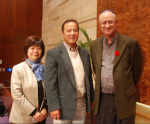
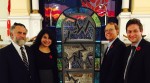
From left to right, Julius Maslovat, Carmel Tanaka, MP Murray Rankin and MLA Rob Fleming at the Victoria Holocaust Remembrance and Education Society’s annual Kristallnacht Commemoration on Nov 9. (photo from Victoria Hillel)

The following remarks have been slightly modified from the original welcoming and closing addresses given at the Victoria Holocaust Remembrance and Education Society’s annual Kristallnacht Commemoration, which took place at Congregation Emanu-El on Nov 9.

Shalom and welcome. Thank you all for coming to share in this evening of remembrance and resiliency. It is a dark Monday night in November, but you have chosen to be here. That is a statement in itself, and we thank you for taking part in tonight’s program.

We are remembering Nov. 9, 1938, a tragic night of destruction that carried on into the next day and was a portent of things to come. Remembering events such as these, as painful as they are, is vital. We don’t need to dwell on them so much as we need to draw on them for the lessons they can offer us.

Rabbi Harry Brechner of Congregation Emanu-El reminded me recently that one of our congregants, Steffi Porzecanski, may her memory be forever blessed, was a witness to the Night of Broken Glass. She lived in Berlin at the time. She would talk about how you couldn’t walk on the streets afterwards without feeling and hearing pieces of glass crunching under your feet. By the end of the destruction, some 1,000 synagogues had been burned, windows smashed, Jewish property damaged, ritual objects and cemeteries desecrated and some 30,000 Jews sent to concentration camps.

Sometimes, words are not sufficient in the face of epic horrors. Rabbi Leo Baeck, who also lived in Germany during this period, and who was eventually sent to Theresienstadt concentration camp in 1942 but did ultimately survive, wrote a prayer some years before for Jews to read at Yom Kippur. This prayer was eventually banned by the Nazis. Near the end of the prayer, he says: “We are filled with sorrow and pain. In silence, will we give expression to all that which is in our hearts in moments of silence before our G-d. This silent worship will be more emphatic than any words could be.”
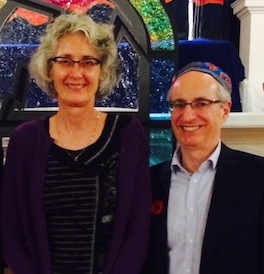
photo - Elisheva Gray, left, and Micha Menczer
Elisheva Gray, left, and Micha Menczer. (photo from Victoria Hillel)

This is where we would like to begin tonight – allowing the silence to speak. I ask you to join me in just looking around our sanctuary and at our windows. All of the colors and nuances of our magnificently crafted windows can’t be fully appreciated at night, but they are, nevertheless, beautiful windows. At our early morning service on Thursdays, those of us who come are often treated to an extraordinary light show, as the soft, morning light gently begins touching on the blue glass.

We have all experienced the sound of breaking glass. Can we even begin to imagine the quiet and tranquility being shattered by the sound of window glass suddenly crashing to the ground and breaking into a thousand pieces, as happened in synagogues throughout Germany and Austria, beginning on that November night in 1938. The only reason? Because we were Jews. How would we feel if we witnessed that happening here, in our sanctuary, in our community, to these very windows?

As a symbol of our desire to work together in unity, to respect one another’s differences and to strive for a community that has tolerance and respect at its centre we will rebuild a window together tonight, a window resembling one of our very own windows.

While we are blessed to live somewhere where we haven’t had to witness an event like Kristallnacht, we also must be realistic of the need to remain vigilant and caring for one another in a world where such events have taken place and could, potentially, take place again. The more fractured and fragmented our world becomes, the more vital it is for us to come together, to put our differences aside and see each other on that most human level, stripped of labels and roles and categories. We may all pick our fruit from different trees, but we all share the same garden.

Tonight, as we commemorate the tragic events of that fateful November night and all that followed in its wake, we also recognize the strength and resilience of our people, the courage of the survivors, and we look towards the future with hope for a world where no group is targeted for attack, as the Jews were on the Night of Broken Glass and in the years that followed.

We are truly honored to have Holocaust survivors with us tonight, as well second- and third-generation descendants, representatives of political leadership, law enforcement agencies, faith groups and persons targeted for their sexual orientation, religious or political beliefs, participating in this symbolic reconstruction and in our candlelighting ceremony.

Our candlelighters will light seven candles. Six of them represent the six million lives lost in the Shoah. The seventh candle represents the many other persecuted victims of the Shoah. It is also our candle of hope.

Closing remarks

I’d like to thank our wonderful planning committee, our readers, volunteers and musicians for their hard work and dedication. Thank you, as well, to Rabbi Harry for his help and for his words. We are, again, especially honored and deeply grateful to our survivors, descendants of survivors and everyone who helped us with our candlelighting and our window building, especially Julius Maslovat (child Holocaust survivor), the b’nai mitzvah children from Congregation Emanu-El, local grandchildren of Holocaust survivors, MP Murray Rankin, Rabbi Harry of Congregation Emanu-El, Very Rev. Ansley Tucker, Constable Rae Robirtis from Victoria Police Department and Carmel Tanaka (Victoria Hillel director, granddaughter of Holocaust survivors and interned Japanese-Canadians).

The many problems out there in the world sometimes seem too big and too overwhelming for us to solve. Rebuilding our window here tonight may seem small in comparison to the challenges that face us in the wider world. But tonight, as we gathered to remember a difficult chapter from our past, it is our hope that, together, we injected a little more shalom into the world.

In Hebrew, every word has a three-letter root from which other words are formed. From the same root for the word shalom, peace, comes the word shalem, whole, and shlemut, wholeness. Each time we inject more shalom into the world, we are, in essence, diminishing brokenness and creating more wholeness. A little shalom goes a long, long way.

Our window may be fragile, but it is full of possibility. The cracks are a necessary reminder of our vulnerability. They are the scars that must be there, reminding us of our past, reminding us of the Night of Broken Glass.

A window allows us to look in – in this case, looking into the past, back to Nov. 9, 1938. And a window allows us to look out. What is that world that we, as individuals and as a community, want to see when we look out? A window also shows us our reflection. Who do we see looking back at us? Who do we want to see?

Elisheva Gray is a member of the Victoria Holocaust Remembrance and Education Society and is on the planning committee for the Kristallnacht Commemoration in Victoria.
Denkmal

This is not about Dachau, although
these things happened there.

When my son and I visited the Denkmal,
as the Germans refer to Dachau,
it was late afternoon,
and it was deserted.
The weather was rainy and cool.
Vancouver weather: warm for
December in Bavaria,
I was told.

We walked around, peering
curiously into the barracks
where the living dead stared with eyes
like those of African night mammals
at the stunned American cameramen,

and then we stepped into the “Duschbad,”
and then into the crematorium
and then back outside into
the drizzle –

Finally, I stopped to look at the bronze memorial
to the “Unknown Prisoner”: a stooped, skeletal
Muselmann
in rags, ashy and green from the wet Bavarian winters;

leaving a pebble on the pedestal, as I had been taught,
I turned to leave.

My son had lingered behind.

Fifteen, tough and big;
standing quietly in front of the pitted bronze,
his black football jacket dripping rain,
sloppy, untied Adidas hightops
and blue/white acid-dyed jeans soaking through –

he slowly reached up
to his soggy old Detroit Tigers
baseball cap,
and politely

between wet thumb and forefinger,

tipped the brim.

Graham Forst, PhD, taught literature and philosophy at Capilano University until his retirement and now teaches in the continuing education departments at Simon Fraser University, University of British Columbia and Banff School of Fine Arts. From 1975 to 2010, he co-chaired the symposium committee of the Vancouver Holocaust Education Centre.

Canada’s 1936 Olympic decision

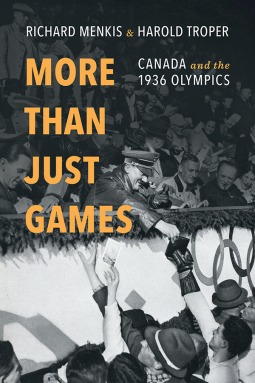
Rarely has a book worked me up as much as More Than Just Games: Canada and the 1936 Olympics by professors Richard Menkis (University of British Columbia) and Harold Troper (University of Toronto).

book cover - More Than Just Games: Canada and the 1936 OlympicsMore Than Just Games was published by U of T Press in the spring. I got my copy from Menkis, who, biases known, I consider a friend. Even so, it took me months to open. The cover image is of members of Canada’s 1936 Olympic team vying for Adolf Hitler’s autograph. Other than some high-quality archival images grouped in the centre of the book, the text is academic, looking almost as imposing as the topic itself. So I was surprised that, when I finally did start reading, I pretty much couldn’t stop. In just over a week, I had read the 230ish-page book, not counting the notes, bibliography and index.

That the scholarship of academics with the credentials of Menkis and Troper would be impeccable I had no doubt. What I hadn’t anticipated was the immediacy they could evoke with their writing. The amount of detail they provide, though on rare occasion overwhelming, serves to bring readers into the period leading up to Canada’s decision to send athletes to the Olympic Games in Berlin in 1936, when there could be no doubt as to the Nazis’ actions and intentions.

Through ample use of citations from letters, articles and speeches of the pro- and anti-Olympic forces, readers witness almost firsthand the debates that took place prior to the Games, they get a glimpse of the almost dizzying number of internal conflicts within the boycott movement, and they get an idea of the amount of propaganda that was being disseminated by Germany in Canada (and other countries). They even learn of some of the differences of opinion between the German Olympic Committee and the Nazi party as to the value of hosting the Games, when the event’s ideal – no discrimination on “grounds of race, religion, politics, gender or otherwise” – ran contrary to the Nazis’ belief in the superiority of the Aryan race, and their efforts to annihilate those they considered inferior.

There were a few outspoken people who tried to waken Canadians to the reality of the Nazi regime – notably journalist Matthew Halton and Rabbi Maurice Eisendrath – but their voices couldn’t rise above the Games’ advocates nor break through the apathy of most of the population. Canada, we are reminded, had closed the doors to Jewish immigration in 1923 – “In distinguishing Jews from non-Jews of the same citizenship, Canada predated Nazi regulations denying Jews and non-Jews equal status under the law by more than 10 years,” write Menkis and Troper.

This is one of the principal reminders of this book, which came out of an exhibit that the professors put together at the behest of the Vancouver Holocaust Education Centre, and which opened several months before the 2010 Winter Olympics were held in the city. Canada might have become a model of multiculturalism, but it was not always so.

Another reminder that stands out is that it doesn’t necessarily take evil people for bad things to happen. Many of the supporters – including athletes – of sending Canadians to the 1936 Games sincerely believed in their position on the importance of sport above all, and seem to have been genuinely confused as to why anyone would disagree. Canada’s position was that of a good colony, following the lead of Britain, which saw no reason not to send competitors. It’s not even obvious in hindsight as to whether Canada’s absence at those Games would have made a difference to the Nazis’ progression of violence to war, to genocide.

Sensibly, Menkis and Troper don’t try to examine the issues with the benefit of hindsight. They present numerous viewpoints and historical facts, mostly without judgment. Their opinions, however, pop out here and there via their choice of adjective or use of sarcasm. I found this comforting because they generally reflected my mood at those points in the book. I would be getting all worked up about what was being said at the time and their jibe would make me smile, and not feel like the crazy one. Because that’s what it felt like reading about it – I can only imagine how people like Halton and Eisendrath felt, actually being there, trying to fight against such ignorance, selfishness, pettiness, narrow-mindedness, greed and indifference.

More Than Just Games is an important contribution to Canadian history, and it is not only a must-read but a very good read.

Tales of courage and sacrifice

Serious topics are at the fore of the books for younger readers reviewed by the Jewish Independent this Chanukah. From the story of a Russian dancer whose life is cut short by pneumonia to Canadian teenagers who must work 13-hour days for little pay to young Danes who take on the Nazis, these recent publications respect the intelligence of their audience and, through the combination of entertaining narratives and compelling images, broaden their understanding and knowledge of the world.

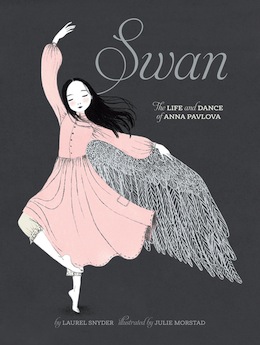
Swan: The Life and Dance of Anna Pavlova (Chronicle Books) is intended for readers ages 6-8. It is truly a work of art that writer Laurel Snyder and illustrator Julie Morstad (who happens to live in Vancouver) have created. The illustrations are stunning and the placement of the text is also artistically done.

book cover - SwanAs Snyder explains at the end of the book, Anna Pavlova was born in 1881. Her mother was a laundress, “and Russia under the czars was generally a world where the poor stayed poor. Anna’s life should have been dismal.” But then her mother took her to the ballet. Onstage, “A sleeping beauty opens her eyes … and so does Anna. Her feet wake up! Her skin prickles. There is a song, suddenly, inside her. Now Anna cannot sleep. Or sit still ever. She can only say, dip and spin….”

The story follows Anna as she practises and practises, until finally accepted into ballet school. After which, more practising, “Until one night she takes the stage … Anna becomes a glimmer, a grace.” She becomes world famous, traveling the globe, though never forgetting her humble beginnings, and becomes a ballet teacher when she can no longer perform. “Until a chill finds Anna, hunts her down alone, without her boots and mittens. A wind. A cough beside a stopped train. A rattle she can’t shake.” In the book, as she apparently did in real life, Anna asks for her swan dress from her sick bed. One last performance, if only in her mind. She died in 1931.

For readers interested in knowing more about Anna Pavlova, Swan includes a nine-book bibliography.

* * *

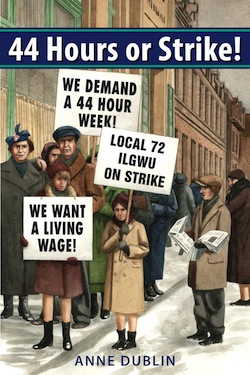
While change may take awhile in coming, it can be achieved. Take, for instance, working conditions in Canada. The title of Anne Dublin’s 44 Hours or Strike! (Second Story Press) comes from one of the unmet demands that led to the Toronto Dressmakers’ Strike of 1931: a 44-hour work week.

book cover - 44 Hours oor Strike!After their father is laid off, Rose must leave school to work in a dress factory. When their father dies from tuberculosis and their mother becomes ill from an unknown ailment (at least at first), 14-year-old Sophie must join her 16-year-old sister at the factory. The working conditions are appalling and they include a lecherous foreman.

When the workers go on strike, there is little empathy. Immigrants (especially Jews) are resented and not trusted, and the Depression has left many people in dire poverty. In an altercation 10 days into the strike, Rose – who did nothing wrong – is arrested with some other strikers and, without due process, is sentenced “to 30 days at the Mercer Reformatory for Women or a $100 fine – as if she had ever seen that much money in her life!”

Sophie must continue her strike duty, as well as care for her mother. She receives some comfort from the friendship of Jake, a paperboy who, unfortunately, is not Jewish.

44 Hours or Strike! – aimed at readers 10 to 14 years old – covers a lot of issues in its 124 pages. The archival photos really help put readers in 1931 Toronto, and brief biographies of some of the labor activists at the time are included at the back of the book. Dublin also lists many options for further reading on the topic.

* * *

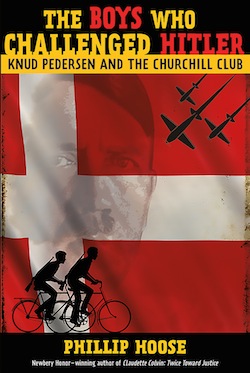
The incredible true story of a group of Danish teenagers who, during the Second World War, fought against the Nazis through acts of sabotage is told by Phillip Hoose and Knud Pedersen in The Boys Who Challenged Hitler: Knud Pedersen and the Churchill Club (Farrar, Straus and Giroux).

This book is comprised of Hoose’s narrative and excerpts from his nearly 25-hour interview with Pedersen in 2012, as well as photos, illustrations, scans of documents and sidebars. At times, it’s hard to know where to look on a page and what to read first. But that shouldn’t be a problem for the 12-to-18-year-olds for whom the book is written.

book cover - The Boys Who Challenged HitlerPedersen was in Grade 8 when, on April 9, 1940, Germany attacked both Norway and Denmark. The Norwegians put up a valiant, if short-lived, resistance. “Jens [Pederson’s brother] and I, and our closest friends, were totally ashamed of our government,” Pedersen says. “At least the Norwegian victims had gone down in a country they could be proud of. Our small army had surrendered to the German forces within a few hours on April 9…. One thing had become very clear: now any resistance in Denmark would have to come from ordinary citizens, not from trained soldiers.”

The brothers with a few others started their rebellion in Odense, where they were living. They called themselves the RAF Club, after the British air force. They would do things like change or damage road signs and cut telephone lines.

When their father was posted to Jutland and the family moved, the brothers organized the Churchill Club; named, of course, after Winston Churchill. They continued their acts of resistance, which came to include blowing up train cars full of material the Nazis needed. Eventually, after about a year, all of the Churchill Club boys were discovered and sent to jail in 1942. The brothers spent two years in prison. Hoose lets readers know what happened to them and their co-saboteurs. There is a selected bibliography and author’s notes on each chapter. This book would be great as the basis of a school project.

Holocaust memorial music

Musical memorials to the Holocaust tread on sensitive ground. On one hand, they perform a crucial function for humanity’s collective memory. On the other hand, there is significant risk of belittling the topic in the name of artistic expression. Two composers who have successfully navigated the risky waters of this endeavor to produce musically significant works with dignity and veneration are Charles Davidson and Sheila Silver. Released by the Milken Archive of Jewish Music earlier this year, Out of the Whirlwind: Musical Reflections of the Holocaust gives both works their rightful place in the archive’s pantheon of music of the American Jewish experience (milkenarchive.org/volumes/view/19).

Davidson’s I Never Saw Another Butterfly cantata is based on the 1960s publication (of the same name) of poems written by children interned at Terezin, a ruse camp set up by the Nazis to throw off the scent of those who suspected the mass murder of Jews under Hitler’s reign. Though it was simply a waypoint en route to the Auschwitz death camp, Terezin depicted a scenario where prisoners enjoyed relative freedom and produced significant artistic output.

Davidson’s tribute to the child poets comprises nine poem-settings for children’s choir and piano, performed here by the San Francisco Girls Chorus. From touching beauty to foreboding, despair and all points in between, his composition gives unique expression to the range of emotions contained in the poems while conveying its own identity as a work of art. I Never Saw Another Butterfly has been performed more than 2,500 times, including in 1991 at Terezin, in the presence of former Czech president Václav Havel.

Silver’s string trio To the Spirit Unconquered was inspired by the writings of Italian poet and Holocaust survivor Primo Levi. Silver uses a variety of techniques to convey different aspects of the concentration camp experience described in Levi’s writings: fear, through dark string tremolos and crashing, dissonant piano chords; memory, through floating piano lines and swooning strings; barbarism, through quick, syncopated rhythms, staccato stabs, and angular melodies; transcendence, through the soaring melodies of the final movement. In a 1998 interview with the archive (milkenarchive.org/videos/view/112), Silver claimed To the Spirit Unconquered as her most successful piece, stating that it had been widely performed and won over audiences skeptical of modern music. In her own words, it is “about the ability of the human spirit to transcend the most devastating of circumstances, to survive and to bear witness.”

Though both of these works can be appreciated on their artistic merits alone, their grounding in the maxim to never forget imbues them with an inescapable urgency. They command listeners of all faiths and backgrounds to approach them with undivided attention.

Survivor helps others

On Nov. 18, Robbie Waisman spoke at the Jewish Museum and Archives of British Columbia. (photo by Pat Johnson)

The head of Canada’s Truth and Reconciliation Commission is crediting Robbie Waisman, a Vancouver man and a child survivor of Buchenwald concentration camp, with making a significant impact on the work of the landmark national initiative.

Justice Murray Sinclair, the first Aboriginal judge appointed to the Provincial Court of Manitoba, headed the commission that handed down its report earlier this year. It is a compendious study of the legacy of Indian residential schools in Canada, with recommendations for redress. Over the course of a century, an estimated 30% of Aboriginal children in Canada were taken from their family homes and placed in residential schools. Funded by the federal government and run by Christian churches, the schools forbade children from speaking their native languages. Countless numbers were physically and sexually abused, even murdered, starved to death or died from lack of medical attention. Of the estimated 150,000 children who went through the system, 4,000 are believed to have died. Survivors have struggled for decades with the legacies of the experience. The Truth and Reconciliation Commission (TRC) was the first comprehensive nationwide effort to address the history.

Sinclair told the Independent that Waisman made a crucial suggestion that informed the work of the commission. It can be extremely difficult for survivors to tell their stories directly to their children, Waisman told Sinclair. He himself did not tell his own children about his experiences in the Holocaust; they learned some of the details by witnessing their father tell his history to others. The commission took this advice to heart, said Sinclair.

“Based on that, when we go to a community, we bring all the [residential school] survivors in and we always make a point to bring their children in so that when the survivors are talking to us, the children are hearing them,” Sinclair said. “That proved to be an exceptionally strong piece of advice for us to open the lines of communication within families. From the perspective of residential school survivors, often the most important process of reconciliation that they wanted to engage in, that they needed to engage in, was to apologize to their own families for how they behaved after residential schools and to be given an act of forgiveness by their children, their spouses, their family members.”

Waisman participated in the entire TRC process, traveling to every part of Canada to speak with residential school survivors about his own story of survival and about creating a life after experiencing the most unimaginable horrors.

“I told them that I am one of the 426 teenagers that was liberated at Buchenwald,” Waisman explained. “We couldn’t go home, we went to France and, in France, the experts that analyzed us told the French government that these kids, first of all, won’t amount to anything because they’ve seen too much and they’ll never rehabilitate. Get a Jewish organization to look after them, they told the French government. Number two, they won’t live beyond 40. So here we are. Six years ago, I phoned [Nobel laureate and fellow Buchenwald survivor] Elie Wiesel, who wasn’t going to amount to anything, and I wished him a happy 80th. And little Lulek [Yisrael Meir Lau], who became chief rabbi of Israel. This is what I related to them. You see what we have achieved? So, then I quote [Barack] Obama: ‘We did it … yes you can.’”

On Nov. 18, Waisman spoke at the Jewish Museum and Archives of British Columbia about his experience in the Holocaust and about participating in the TRC.

Waisman has been involved with First Nations communities for years. He was first contacted by Canadian Jewish Congress when David Ahenakew, a former national chief of the Assembly of First Nations, uttered antisemitic comments in 2002. CJC engaged with First Nations leaders and brought Waisman to meet with them. Waisman’s relationship with CJC goes back further – as an orphaned child survivor, he was sponsored to come to Canada by CJC.

Because of his effectiveness as a speaker, Waisman was invited to speak to residential school survivors in the Northwest Territories. As he spoke, he noticed maybe a dozen people in booths, speaking into headphones. It turned out his words were being translated into local dialects and broadcast across the territories. A trip that was supposed be a daylong in-and-out turned into a four-day sojourn as residential school survivors came from surrounding villages to meet him.

“They figured that nobody cared,” said Waisman. “Many of them have begun to talk about their horrors after they listen to me.”

Sinclair is full of warm words for Waisman. “He’s a stalwart supporter and a warm and kind and loving man who always understood what the survivors were talking about and let them know that,” said the judge.

Refugees painted village blue

“Running Again” by Joyce Ozier, part of her current exhibit at Fazakas Gallery. (image from fazakasgallery.com)

Chefchauen is a village in Morocco. Founded in 1471, it was home to many Jewish refugees escaping the Spanish Reconquista during medieval times. No Jews live in this village now and haven’t since the late 1940s, but this little tourist town in the Rif Mountains was the inspiration for Vancouver artist Joyce Ozier’s latest exhibit, Blue Refuge.

“I discovered Chefchauen by accident,” Ozier told the Independent. “Last year, while I was getting ready for my show at the Zack Gallery, I received lots of emails and newsletters. One of them mentioned Chefchauen, a blue town in Morocco, and included a few photographs. I was knocked out by the magic of its blue colors, but my first response was purely esthetic. I imagined how these different shades of blue – blue stucco walls, blue doors, blue roofs – would change throughout the day in the strong Mediterranean sunlight.”

photo - Joyce Ozier
Joyce Ozier (photo by Pink Monkey Studios)

After her initial fascination wore off, she became curious. What was the reason for the town being blue? “There was a one-line explanation for the unusual color: a group of Jews running from the Nazis in the ’30s painted the town blue in gratitude for it being a safe haven. After I read that line, I wanted to know their story,” she said.

Ozier started researching the history of those Jews who gave the town its charming blue attire, while simultaneously creating her own visual narrative – the nine abstract panels reflecting their intriguing story. But, while her artistic endeavors were successful, her research path was littered with disappointments. Nobody knew much or even anything about Chefchauen and its Jewish history.

Determined to learn all she could about the people who made the town blue, she embarked on a quest to understand those long-gone Jews. After various online searches, she tried the Isaac Waldman Jewish Public Library, but to no avail. “Then I found a Jewish tour company in New York that specialized in Jewish Morocco,” she said. “I called them, thinking that they would be able to answer my questions, but they had no idea either. Their advice was to try the Jewish museum in Casablanca, Morocco.”

She made the call and spoke with the museum’s curator, but still no luck. “By this time,” she said, “I decided to imagine my own version of what had happened, how those Jewish refugees got to Chefchauen, what they went through, why they decided to paint everything blue, and what happened after. Over the years, I’ve read many personal accounts of the Holocaust and, based on those, I wrote the texts for my show, the short write-ups on each of the nine panels that comprise the show.”

Ozier wrote about the hardships the refugees would have encountered on their flight from the Nazis, about their joy at finding a safe haven, and about why they painted the town blue.

“Blue is the symbol of divinity in Judaism, being the color of sky and ocean,” she explained. “Observant Jews are required to have a blue thread in their prayer shawls, so when they pray, they are enveloped in divinity. To express their appreciation for being alive, for being able to reach Chefchauen, the refugees painted the whole village in shades of blue. The divine blue created an environment that gave them the hope they needed to go on. It helped them stay positive in a terrifying and insecure political situation. It prodded them to resume relatively normal lives once they had settled in.”

Unfortunately, as soon as the Vichy government took over Morocco, the persecution of Jews started there, too. “Their safe haven was a dream,” Ozier wrote, and her panels follow the rest of the story, as most of the Jewish citizens of the blue town left. Nobody knows what happened to them, but Ozier hoped they had headed for Israel.

“My show was almost ready, but then I panicked,” she recalled. “I needed a confirmation for my fictional story. Was it based on fact, or even a possibility of fact, or was it just my imagination?” The Vancouver Holocaust Education Centre came to her rescue.

“Phillipa Friedland, the centre’s education coordinator, was wonderful,” said Ozier. “She had not heard of Chefchauen and its blue world but she was visibly excited to see the photos and hear my story. She suggested that I contact Yad Vashem, the Israel Museum in Tel Aviv, the Museum of Jewish People in Tel Aviv, the Leo Baeck Institute in Jerusalem and the Museum of the Diaspora at the University of Tel Aviv.”

One by one, Ozier contacted each of the leads Friedland gave her, but most of the institutions couldn’t help. Some only did family research. Others specialized exclusively in the war years. “I wrote an official request for information to Yad Vashem and got a response from them much sooner than I expected. Timorah Perel from their reference and information services explained to me that most of their testimonials are written in languages other than English and would require translation. She sent me the only English testimony that came up in her search in English. It was very interesting but it did not mention Chefchauen.”

Eventually, Ozier’s persistence paid off. She contacted Tel Aviv University. “The receptionist who answered the phone told me that they had a professor who specialized in the Jews of Morocco, Dr. Yaron Tsur. She gave me his university telephone number and his email address. Excited to have a real lead after all the dead ends, I immediately wrote Dr. Tsur a long email, explaining my upcoming show and including all my photos and my texts. I asked him whether he thought my story could be based on reality or it was a total fantasy.”

She received no reply, and no response to several phone calls. “Frustrated, I called the receptionist again, thinking perhaps I’d written down the wrong number. This time, she told me Prof. Tsur was in America. He was on sabbatical this year.”

Ozier finally was able to reach him. And Tsur confirmed her story, saying in an email that “the story of the Jewish refugees that you relate and the asylum that some of them found in Morocco is historically true.” She could go ahead with her show.

“They still paint the town blue,” Ozier said, “even though no Jews live there any longer. It’s a tourist attraction now, and the local government pays for the paint, so they could retouch it annually. One more little factoid I found in my research: the blue changes during the day, resembling running water. It repels mosquitoes.”

Blue Refuge is at Fazakas Gallery, at 145 West 6th Ave., until Dec. 17.

Olga Livshin is a Vancouver freelance writer. She can be reached at olgagodim@gmail.com.

Co-opting history

Tonight, the Canada Palestine Association, BDS Vancouver, Canadian Boat to Gaza, Independent Jewish Voices and a few other groups will come together to address the topic Stolen Land: First Nations and Palestinians at the Frontline of Resistance. The obvious intention is to equate the history of colonial settlement in North America, Canada in particular, with the actions of Israel toward Palestinians.

The concept is flawed at its core, of course, because, as the Palestinian narrative often does, it portrays the Jews as colonial occupiers of Arab land, while denying the legitimacy of ancient and modern claims to the Jewish homeland. The logical failure here is that such a narrative recognizes the legitimacy of a 200-year-old land claim, but not a 2,000-year-old land claim, which seems like an arbitrary position.

Nevertheless, there is a larger issue here. The anti-Israel movement insists on appropriating the historical experience of other people and using it in an attempt to fortify their narrative. The most obvious example is the apartheid libel, which tries to paint Israel as the ideological descendant of South African racism. This is offensive not only to Israelis. It debases the experience of black South Africans who suffered from genuine apartheid.

Even more egregiously, the anti-Israel movement routinely uses the imagery of Nazism and the Holocaust against Israel, attempting to equate the victims of the Third Reich with its perpetrators. This deliberate rubbing of salt in Jewish historical wounds is common and, as we discussed in this space last week, the objective is clearly to inflict pain rather than to resolve grievances.

This is a deliberate strategy of the anti-Israel movement, which apparently finds its difficult to make a legitimate case of their own and, therefore, co-opts the historical experiences of others. As another example, last summer, when people in Ferguson, Mo., and elsewhere in the United States were protesting police shootings of young African-Americans, the “pro-Palestinian” movement attempted to infiltrate that movement as well, trying to portray Israeli soldiers and police in the same light as American killer cops.

The event this week has a similar purpose. Not satisfied to let Canada’s First Nations people tell their stories and have their experiences validated, the “pro-Palestinian” activists want to elbow their way in and demand that Palestine get equal time (at least).

An infinitely more constructive approach can be seen in the remarkable story of a Jewish survivor of the Holocaust who traveled across Canada as part of the Truth and Reconciliation Commission, sharing his story of survival and accomplishment after tragedy. (See the story “Survivors helps others.”)

There are ways to positively advance First Nations experiences, the Palestinian experience and the Jewish experience in order to create a more understanding and tolerant world. The organizers of this week’s event – and the anti-Israel movement more broadly – do not seem interested in that sort of progress, in that sort of world.

Consuls save thousands of lives

Consul General of Japan Seiji Okada, centre, Yasuko Okada and Dr. George Bluman. (photo from Vancouver Holocaust Education Centre)

There are Vancouverites who owe their lives to the wartime actions of the then-obscure Japanese diplomat Chiune Sugihara. The mid-level official, vice-consul in Lithuania for the imperial government of Japan, disobeying explicit and repeated orders, in 1940 issued Japanese transit visas to Jewish refugees fleeing the advancing Nazi onslaught.

Two of the people who received the visas were Nathan and Susan Bluman. Their son, Dr. George Bluman, delivered the keynote address Sunday at the 33rd annual Kristallnacht commemoration event, presented by the Vancouver Holocaust Education Centre in partnership with Congregation Beth Israel.

Bluman recounted the story of Sugihara’s life and the motivations for his actions, then addressed the magnitude of those events on his own family.

“There are thousands of stories like my parents’,” said Bluman, noting that this one family’s story is barely a footnote in the Sugihara narrative, but it means “the entire world for me and my family.”

Bluman, professor emeritus of mathematics at the University of British Columbia, said his parents were two of about 2,100 people who received life-giving visas from the Japanese consular official. Approximately another 600 individuals were aided by being included in the visas of others, mostly their parents, and perhaps 25% more were helped in their survival by forged versions of Sugihara visas.

Bluman explained that, after Germany invaded Poland and divvied the country up with the Soviet Union, many Jews fled to the Soviet-occupied portion. Unable to flee to the west, and having been denied entry by most Western countries, Jews were effectively trapped.

Nathan Bluman and his fiancée Susan lived in Warsaw, which was occupied by the Nazis. Nathan fled to the Soviet-occupied east and prevailed upon Susan to join him, which she did, though her father forbade them from marrying without his permission.

“She would never again see any of her parents or siblings,” Bluman said.

While Germany had occupied the Netherlands, Dutch embassies and consulates worldwide remained loyal to the Dutch government-in-exile, located in London. Jan Zwartendijk, the Dutch consul in Lithuania, began issuing visas to Curaçao, the Dutch colony in the Caribbean. Jewish refugees, including many Polish Jews like Nathan and Susan Bluman, made their way to Lithuania in hopes of obtaining a ticket to safety.

When the Soviet Union occupied Lithuania in 1940, all foreign embassies and consulates were ordered closed. In the short window available, the Dutch consul, with the support of his superiors in the government-in-exile, issued visas for Jewish refugees to enter Curaçao.

However, while Polish and Lithuanian Jewish refugees were free to travel in the Soviet Union, they could not go further without a visa to another country. That made a Japanese transit visa priceless.

While there is no evidence that Zwartendijk and Sugihara ever met, it was their combined actions that are credited with saving thousands of lives. While Zwartendijk acted with the authority of his superiors, Sugihara ignored explicit orders not to issue transit visas, an act of extraordinary disobedience for a mid-level Japanese bureaucrat and an action that not only put his job on the line, but threatened the lives of himself and his family.

Sugihara handwrote the visas day and night, issuing the equivalent of an average month’s worth of visas every day in the weeks before the consulate was forcibly closed by the Soviets.

The combination of a Dutch visa to Curaçao and a transit visa for Japan allowed refugees to make the arduous journey on the Trans-Siberian Railway to Vladivostok, board a ship to a Japanese port, take a train to Kobe and, in various ways, survive the war. In many cases, the refugees became stateless people, interned first in Japan and then in Japanese-occupied Shanghai.

Bluman’s parents managed to get on one of the last two ships heading to North America before the Japanese attack on Pearl Harbor launched Japan and the United States into a state of war and made passage impossible.

The Bluman family’s fate was influenced by one of those fortunate flukes that occurs in history. While in Japan, Nathan Bluman ran into an old professor from school in Warsaw, who told him that a ship, the Hei Maru, was to leave for Vancouver the next day. Bluman raced to the Canadian consulate to request one of the 25 visas being offered to skilled workers and it was granted. There were no provisions for spouses but Susan Bluman, using some sort of extraordinary persuasive power, managed to get the Canadian official to include her on her husband’s visa and they boarded the ship the same day, arriving in Vancouver on July 9, 1941.

That single transit visa was responsible for 17 lives, including Nathan and Susan Bluman, their children and grandchildren and three great-grandchildren born this year.

George Bluman estimates that, in all, 30,000 people worldwide owe their lives to Sugihara. Yet, it was not until 1968, when a survivor contacted him, that Sugihara began to understand the magnitude of what he had done during the war. In 1985, he was named by Yad Vashem as one of the Righteous Among the Nations.

Sugihara died in 1986, as did Nathan Bluman. But the Bluman and Sugihara families have had a long association and friendship that remains strong today to the third generation.

The event Sunday night at Beth Israel began with a solemn candlelight procession of local survivors of the Holocaust.

The annual event commemorates Kristallnacht, the “Night of Broken Glass,” a government-initiated pogrom across Germany and Austria on the night of Nov. 9-10, 1938. Hundreds of synagogues were burned, Jewish-owned businesses were destroyed, nearly 100 Jews were killed and 30,000 were sent to concentration camps.

Prof. Chris Friedrichs, a member of the commemoration’s organizing committee, noted that the Holocaust ended 70 years ago with the Allied defeat of the Nazi regime. But when did it begin? Kristallnacht is often cited as the moment when the increasingly repressive policies of the Hitler dictatorship turned into the violence that would culminate in the “Final Solution.”

But Friedrichs said that the Holocaust was not so much a direct result of events of that fateful night.

“It is what did not happen in the days that followed,” he said. After a day or two of headlines worldwide, said Friedrichs, there was nothing more. The world’s reaction, or lack of it, was the signal the Nazis needed to be assured that their policies of eliminating those “deemed unworthy of life” would meet with no resistance from the world community.

Referring to the procession of candle-bearing survivors that had just preceded him, Friedrichs said, “a candle may not seem very heavy to you.” But each of the survivors who mounted the bimah, said Friedrichs, belonged to a family, many of whom were almost completely destroyed, and the candles represent not just their families or hundreds or thousands of people, but millions.

Vancouver City Councillor

Andrea Reimer, deputy mayor of the city, broke down in tears while reading the mayor’s proclamation after telling the audience how the history of the Holocaust tests for faith in humanity.

Beth Israel’s Rabbi Jonathan Infeld thanked Bluman and expressed gratitude that Bluman is a member of his congregation.

“You are a key component of maintaining the history of the Holocaust in our community,” Infeld said.

Arthur Guttman, cantor emeritus of Temple Sholom, chanted El Moleh Rachamim, the memorial prayer for the martyrs. Ed Lewin, president of the Vancouver Holocaust Education Centre, introduced the survivors. Gary Miller, president of Beth Israel, introduced Reimer. Bluman was introduced by Prof. Richard Menkis, a member of the Kristallnacht commemoration organizing committee.

Survivors’ immense impact

Holocaust survivors who came to Canada after the Second World War remade this country’s Jewish community.

Before survivors arrived in numbers, beginning in 1947, Canada’s Jewish community had a few poorly resourced social service agencies. The demands created by thousands of new arrivals – many with significant emotional and physical challenges – spurred the growth of Jewish communal organizations across the country. In turn, those survivors have had an impact on the community in the successive seven decades that is incalculable. The impact of the Holocaust – and the arrival of its survivors – is perhaps the defining factor in the development of Canada’s Jewish community.

photo - Adara Goldberg
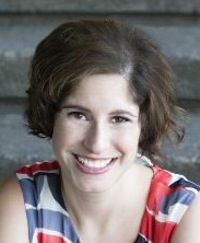
Adara Goldberg (photo from Cherie Smith JCC Jewish Book Festival)

“The Holocaust is a watershed moment and the scale of this watershed resettlement was unprecedented,” said Adara Goldberg, a Vancouverite and author of Holocaust Survivors in Canada: Exclusion, Inclusion, Transformation, 1947–1955. “Many of the agencies across Canada only came to be as a result of the Holocaust. Jewish Immigrant Aid Services [JIAS] did exist, but this was a small organization that only dealt with small numbers up to this point. Having some 35,000 people come in, in less than a 10-year span, really trampled the organizations.”

Survivors who moved to the United States joined a vibrant Jewish community already in progress, while those who came to Canada found a Jewish community with little infrastructure. What exists of the Jewish community and its social service agencies today was built, in large part, for the survivors and, subsequently, by them.

To an extent, there was an unwillingness among Canada’s existing Jewish community to address the Holocaust experiences of the newcomers – those who did not experience the Holocaust may have been afraid of opening wounds or been unwilling to hear the horrors others experienced. There was also a history in Canada of immigrants getting off the boats and throwing themselves instantly into building a new life, leaving the past behind.

Still, Goldberg said, there was a recognition by people like the head of JIAS that these immigrants had some very particular needs.

“The problem was availability,” she said. “This is uncharted territory. Social workers themselves and the Canadian Jewish community were only learning with the survivors about how to treat victims of trauma … the idea of post-traumatic stress didn’t really exist.”

Getting the newcomers integrated was not only a matter of meeting social needs, she added.

“There is also a legal element to that,” Goldberg said. “The fact is, refugees who came to Canada under the auspices of either the Canadian Jewish Congress, or who received support from JIAS or who had relatives sponsor them, were liabilities. If they didn’t find work, if they didn’t have a home, if they became dependent, they risked deportation. They risked becoming a drain on the existing Jewish community, which was already really reaching its max in terms of what they could do.”

A symbol of success is that very few fell through the cracks, although many of the case studies in the book indicate that some survivors were miserable in their assigned living conditions or workplaces.

There was a realization after the war, as the magnitude of what would come to be called the Holocaust dawned, that Canada had failed the imperiled Jews of Europe in the 1930s, when there was still time.

“After the war, relationships changed and there was significant international pressure on Canada to help do its part in relieving the postwar refugee crisis of Jewish and also non-Jewish displaced persons,” Goldberg said. “On the one hand, we can say this was a humanitarian gesture.… There’s also a practical element that we can’t overlook in that Canada stood to gain something from allowing in the Holocaust survivor refugees. There was a need for skilled laborers and this is how most survivors did come in, they came in for skilled labor posts, so Canada benefited.”

The equation of immigration and Canada’s need for labor is underscored by the fact that there was no ministry of immigration at the time – until 1950, Canada’s immigration policy was administered by the ministry of mines and resources. The influx of Jewish and non-Jewish refugees postwar familiarized the Canadian government and public to the concept of receiving refugees on humanitarian grounds. The first major instance of this reconsideration came in 1956 after the Soviet Union crushed the democratic uprising in Hungary. Canada admitted 37,000 refugees in the course of a year.

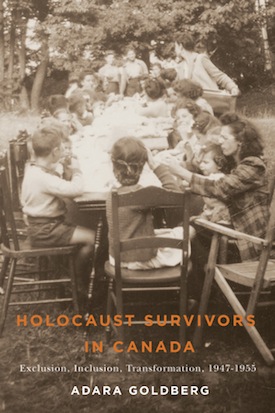
book cover - Holocaust Survivors in Canada: Exclusion, Inclusion, Transformation, 1947–1955Goldberg’s book begins with a refresher on Canada’s abominable record in the prewar period. Chapters then take on topics such as the unique requirements of young orphaned refugees; the double-edged sword of interned “enemy aliens” – Jews from enemy states, mostly Germany and Austria, whose nationality, in the eyes of Britain and its Canadian dominion, trumped their status as endangered victims of Nazism; the various programs under which refugees were admitted to Canada and how established Jewish communities, especially their women’s organizations, cared for refugees’ personal needs; the creation of social clubs and synagogues by and for survivors; the development of an ultra-Orthodox and Chassidic community here; and “transmigrants,” those who came to Canada after a sojourn elsewhere, often in Israel. She has included the stories of survivors who didn’t want to be found; those whose experiences in Europe led them to hide their Jewishness and their past as they began a new life in Canada. It is a monumental work.

A Toronto native, Goldberg wrote the book in fulfilment of her PhD at Clark University in Massachusetts and, while there are differences between the dissertation and the book, which was published in September by University of Manitoba Press, the book avoids the academic jargon that can exclude ordinary readers.

“As a social history that was created with the research that I did both in archives as well as through interviews and other sources, it was written with a wide readership in mind,” she said.

Goldberg eschews statistics in favor of personal case studies both from in-person interviews and records of social service agencies from decades past. The result is an introduction to hundreds of individuals and their stories, as well as a testament to the resilience of the survivors and the history of a small Jewish community rising – not always flawlessly – to the challenge of welcoming tens of thousands of co-religionists who had suffered unspeakable horrors.

The dissertation took about three years to complete and, after Goldberg moved to Vancouver, where she worked for three years as education director at the Vancouver Holocaust Education Centre, she took the opportunity to do additional research that incorporates more local content. The book is enriched by her background as a trained social worker, which underpins a deep analysis of the successes and failures of social service agencies in those early years.

Refugees are the top global news story today and Goldberg sees lessons for the present in her book.

“It’s a very different crisis,” she said. “I think what we can do is, without trying to compare individual experiences, to remember the risk of nativist attitudes and what happened when Canada had very discriminatory, restrictive immigration policies 75 years ago. Canada accepted the fewest number of Jewish refugees of any country in the Western world … Canada had an opportunity at that time to distinguish itself, to take a very restrictive policy and widen the gates. They could have done this and they elected not to. What we can do now is reflect on the result of this inaction. History does not need to repeat itself. Canada can distinguish itself as a world humanitarian leader.

“Similarly,” she continued, “Holocaust survivors have contributed to all aspects of Canadian society. I imagine that so, too, do other refugees to Canada and so will other waves that come in the future. There is so much that we can gain.”

The Vancouver launch of Adara Goldberg’s book takes place on Nov. 25, 5:30 p.m., at the Vancouver Holocaust Education Centre, as part of the Cherie Smith JCC Jewish Book Festival. Admission is free.