Skip to content
  • Home
  • Subscribe / donate
  • Events calendar
  • Business Directory
  • FAQ
  • News
    • Local
    • National
    • Israel
    • World
    • עניין בחדשות
      A roundup of news in Canada and further afield, in Hebrew.
  • Opinion
    • From the JI
    • Op-Ed
  • Arts & Culture
    • Performing Arts
    • Music
    • Books
    • Visual Arts
    • TV & Film
  • Life
    • Celebrating the Holidays
    • Travel
    • The Daily Snooze
      Cartoons by Jacob Samuel
    • Mystery Photo
      Help the JI and JMABC fill in the gaps in our archives.
  • Community Links
    • Organizations, Etc.
    • Other News Sources & Blogs
  • JI Chai Celebration
  • JI@88! video

Recent Posts

  • Legal help for students
  • Revisiting myth of Lilith
  • Wrong person rebuked
  • Canada’s mixed messages
  • Questions for museum
  • Symposium on antizionism
  • Making soccer political
  • CJPAC lauds Pulver’s impact
  • City recognizes Vrba’s legacy  
  • Organ donation saves lives
  • Theodore’s March premiere
  • A healing Shabbaton
  • Supplying healthy food
  • A chime of metal tags
  • Yellowknife seder a first
  • Ishai energizes, unifies
  • A Lag b’Omer to remember
  • Expanding the healing
  • Hannah Senesh – a unique hero
  • Community milestones … May 2026
  • Sharing her testimony
  • Fall fight takes leap forward
  • The balancing of rights
  • Multiple Tony n’ Tina roles
  • Stories of trauma, resilience
  • Celebrate our culture
  • A responsibility to help
  • What wellness means at JCC
  • Together in mourning
  • Downhill after Trump?
  • Birth control even easier now
  • Eco-Sisters mentorship
  • Unexpected discoveries
  • Study’s results hopeful
  • Bad behaviour affects us all
  • Thankful for the police

Archives

Follow @JewishIndie
image - The CJN - Visit Us Banner - 300x600 - 101625

Tag: Holocaust

First edition Frank diary

First edition Frank diary

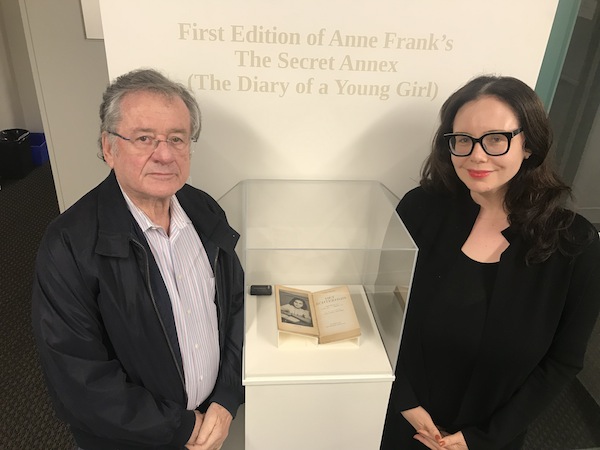
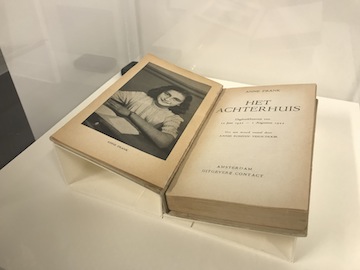
Dr. Robert Krell and VHEC executive director Nina Krieger at the display case for Het Achterhuis, a first edition of Anne Frank’s Diary of a Young Girl. (photo by Shula Klinger)

In November 2017, the Jewish Independent published the story of a first edition of Anne Frank’s Diary of a Young Girl, that had come to light in North Vancouver (jewishindependent.ca/retribution-and-restoration).

The edition had been purchased by bookbinder Richard Smart from an estate sale in Holland. The book was badly damaged. The front cover had come apart and the spine had broken away from the bound pages. Inside the binding, pieces of another book had been used to pad the spine. It was common practice at a time when paper was scarce, but, in this case, the paper fragments came with a message. Taken from a German volume, the original bookbinder had positioned the title of the book, Die Vergeltung, where it could easily be seen. Its meaning: retribution.

Smart planned to sell the book but not to a private collector. He wanted it to remain in the public eye and be kept within the Jewish community.

A few weeks after the article was published, I received an email from Dr. Robert Krell in Vancouver. A survivor himself, he is a founder of the Vancouver Holocaust Education Centre. He wanted to know if the book was still for sale and could be purchased for the VHEC.

I passed Krell’s message to Smart at the Old English Bindery, and a conversation began about its possible sale. Two weeks later, I drove Smart and Emilie Crewe, the bindery’s administrator, to a meeting at Krell’s home. Krell and his assistant, Joy Fai, welcomed us, and we talked over coffee.

Krell explained his position on the sale, talking about the book’s precious legacy and his own feeling for history. It was deeply moving when he held the book for the first time and opened the cover to see the printed words in the spine.

For any lover of history, a volume like this can take a pretty firm hold on one’s imagination. When the volume is a treasure of this kind, in the hands of a Dutch Holocaust survivor, and – just possibly – with its own, private message of solidarity for those who perished, the power of this moment is immeasurable.

It took a few minutes to finalize the administrative aspects of the sale. Krell gave me a moment alone with the book, then I put it back in the decorative box Smart had crafted, wished Anne goodnight and closed the lid.

Het Achterhuis is now on display at the Vancouver Holocaust Education Centre. The case is situated next to the classroom where all school students begin their tours. It is, said Krell, “a high-traffic area,” so the children cannot fail to pass the book. And, while the centre’s artifact-driven exhibits include many extraordinary items, he said, “the symbolism of Anne reaches far more children than we can.”

photo - Housed at the VHEC, Het Achterhuis will be a teaching tool
Housed at the VHEC, the book will be a teaching tool. (photo by Shula Klinger)

Having said that, Krell added, “It’s symbolic for all the wrong reasons. It’s a lovely story of a bright girl who saw so much more than anyone else could, from that tiny room. The Dutch use this photo of a smiling adolescent girl as an example of Dutch resistance, but they have not yet apologized for what they did, the 100,000 Dutch Nazis.”

Krell spoke of the many ties between Holland and Canada, describing liberation day on May 5, 1945, by Canadian troops. Even now, Holland celebrates this day with a gift of tulip bulbs to Ottawa.

Asked why the first edition should be housed here, at the VHEC, Krell said, “Why not? We have been teaching students since 1976. We have earned the right to have a precious book to show our students and loyal teachers.”

Krell emphasized the educational role of the book – artifacts make history real for children, he said. And, “to continue our teaching, we have to use artifacts that survivors have left us. They are evidence of what happened and we have to show what they represent. A skipping rope, a toy, a tin cup, a utensil – that is the difference between life and death.”

Even more importantly, he said, “we’re in a phase of succession to the next generation, to carry the legacy of survivors. These include memories and warnings because we’re facing incredible racism and antisemitism in the world today.”

Contemplating the importance of remembering and teaching about the Holocaust, Krell offered a sombre analogy. At Auschwitz, he said, when prisoners were robbed of their last possessions, they were stockpiled in a spot they named “Canada,” the land of plenty. “Canada was in Auschwitz,” said Krell. “We must be careful not to bring Auschwitz back to Canada.”

Shula Klinger is an author and journalist living in North Vancouver. Find out more at shulaklinger.com.

Format ImagePosted on June 7, 2019June 5, 2019Author Shula KlingerCategories BooksTags Anne Frank, Auschwitz, Die Vergeltung, Het Achterhuis, Holocaust, Richard Smart, Robert Krell, Vancouver Holocaust Education Centre, VHEC
Awards all round

Awards all round

Each year, the Eric Hoffer Award presents the da Vinci Eye (named after Leonardo da Vinci) to books with superior cover artwork. Cover art is judged on both content and style and, among this year’s winners is Olga Campbell’s Whisper Across Time: My Family’s Story of the Holocaust Told Through Art and Poetry (Jujabi Press). The book is still being considered for category, press and grand prizes.

Whisper Across Time also won the Ippy Award for independent self-published authors. Campbell’s book was selected as one of the 2019 Independent Publisher Book Awards’ Outstanding Books of the Year under the freedom fighter category. Campbell planned on attending the May 28 gala event in New York.

(For a review of the book, see jewishindependent.ca/a-story-told-in-art-and-poetry.)

* * *

Julia Ivanova’s National Film Board documentary Limit is the Sky saw its Toronto première on May 2 in the retrospective of the largest documentary film festival in North America, Hot Docs. Ivanova is one of only three directors from British Columbia who have received a Focus On retrospective at Hot Docs since 2002 – the others are John Zaritsky and Nettie Wild.

photo - Julia Ivanova
Julia Ivanova (photo from NFB)

Ivanova, the director, cinematographer and editor of Limit is the Sky is a Russian-Canadian filmmaker. She came to Canada at the age of 30, became a filmmaker in Vancouver and captured Canada from within but with the ability to look at the country from a distance. She has made documentaries for the NFB, CBC, Knowledge Network, played Sundance and won many awards for her films.

The screening of Limit is the Sky, the NFB film about the Fort McMurray boom-bust-fire circle and the winner of the Colin Low Best Canadian Feature Award at DOXA 2017, commemorates the third anniversary since the worst wildfire and the worst natural disaster in Canada’s history devastated the capital of the oil sands. (See jewishindependent.ca/diverse-doxa-festival-offerings.)

The Hot Docs Focus On retrospective of her work includes the world première of her new film, My Dads, My Moms and Me, a film about the joy and turmoil of parenting in the modern family, including same-sex partners, surrogates, adoption and combinations that break the old conventions. The film follows three families, filmed twice, 12 years apart – in 2007 and in 2019.

* * *

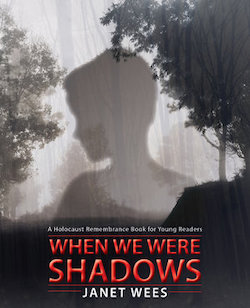
image - When We Were Shadows book coverMore than 250,000 children participated in the Ontario Library Association’s annual Forest of Reading program and have helped choose the best Canadian authors and illustrators. On May 14 and 15, thousands gathered at the annual Festival of Trees, an annual rock concert of reading, hosted at the Harbourfront Centre, where winners of the 2019 Forest of Reading program were announced. Among the books awarded honours was When We Were Shadows by Janet Wees, published by Second Story Press. (For more on Wees and the book, visit jewishindependent.ca/saved-by-dutch-resistance.)

* * *

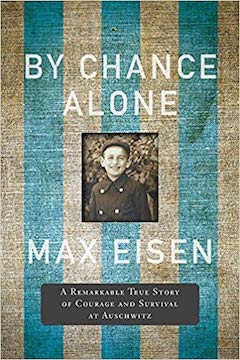
By Chance Alone: A Remarkable True Story of Courage and Survival at Auschwitz by Max Eisen (HarperCollins) won Canada Reads 2019. The book was championed by TV host and science broadcaster and author Ziya Tong, and was chosen by the five panelists as the book for Canadians to read in 2019. This year’s title fight asked the question: What is the one book to move you?

image - By Chance Alone: A Remarkable True Story of Courage and Survival at Auschwitz book coverAfter four days of debate in front of live audiences, Tong and By Chance Alone survived the final vote to be crowned this year’s winner. The runner-up was Homes by Abu Bakr al Rabeeah and Winnie Yeung (Freehand Books), which was defended by Simple Plan drummer Chuck Comeau. Audiences can catch up on all of the debates on demand on CBC Gem or by downloading the Canada Reads podcast from CBC or iTunes.

“Before 2016, I don’t remember seeing swastikas, but these days I see them often – in the news and on social media. But here’s something even more shocking: one in five Canadian young people have not even heard of the Holocaust. They don’t know what it is, ” said Tong.

This year’s debates took place March 25-28 and were hosted by actor, stand-up comedian and host of CBC Radio’s Laugh Out Loud, Ali Hassan.

Format ImagePosted on May 31, 2019May 30, 2019Author Community members/organizationsCategories NationalTags art, books, Canada Reads, CBC, documentaries, Holocaust, Janet Wees, Julia Ivanova, Max Eisen, memoir, National Film Board, NFB, Olga Campbell, Ontario Library Association
Artistic tribute to Shoah survivors

Artistic tribute to Shoah survivors

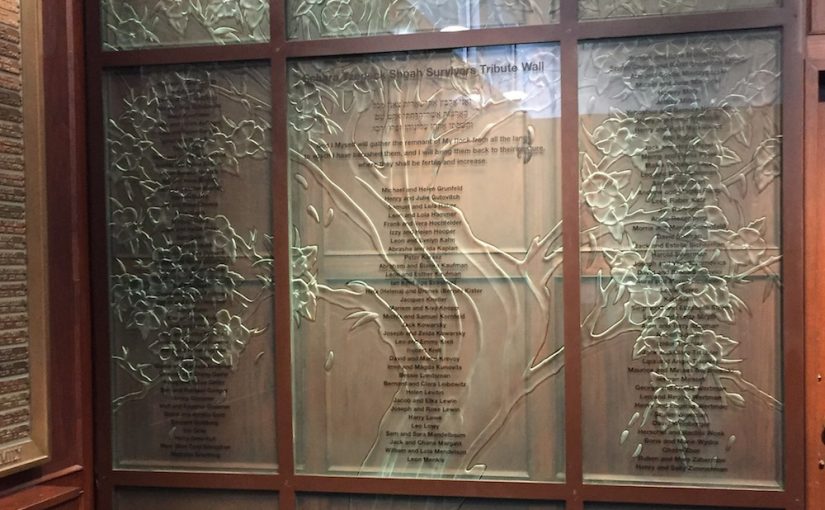
The Schara Tzedeck Shoah Survivors Tribute Wall was created for the congregation by John Nutter. The sculpture, which includes the names of 230 survivors, was dedicated May 3. (photo from John Nutter)

Congregation Schara Tzedeck has a new art installation in its main sanctuary. The Schara Tzedeck Shoah Survivors Tribute Wall – a Tree of Life rendered in sandblasted glass – includes the names of 230 survivors. It was dedicated May 3.

Full of shared memories and friendship, the pre-Shabbat dedication ceremony featured several speakers: the synagogue’s spiritual leader, Rabbi Andrew Rosenblatt; its executive president, Howard Kallner; younger family members of the survivors; Ed Lewin, co-chair of the project with Hodie Kahn; and the man who started the entire project, Dr. Robert Krell, a child survivor.

“We wanted to honour the Holocaust survivors who found their way to Canada, before and after the war, and wound up as members of this shul,” Lewin told the Independent. “Most of them came here in 1948. Their names are all there, on the wall. My parents’ and grandparents’ names are among them.”

Explaining how the project started, Lewin said, “We had this empty space, and Krell suggested a tribute to Holocaust survivors. It was several years ago. It took us awhile to find the talented glass artist, John Nutter, who transformed our ideas into a sculpture.”

The synagogue is publishing a commemorative book about the installation, as well. While the Tribute Wall features survivors’ names only, the book also contains photographs of the survivors; there are family and group photo pages. Together, the book and the wall serve as a memorial to those who not only survived the Shoah but contributed greatly to Schara Tzedeck and to the development of Greater Vancouver and the province over the past seven decades.

One page of the book is dedicated to Nutter, who has created numerous art installations for churches and synagogues, mostly in New York. His works decorate many institutions in the United States and Canada: hotels, museums, hospitals. He collaborated with local artist Bill Reid on a glass sculpture at the Vancouver International Airport. A few years ago, Glass Magazine named Nutter one of the top three architectural glass artists in the country.

About how he came to design the Tribute Wall, Nutter said, “A few years ago, I did a small glass sculpture for the Louis Brier Home, a collaboration with a wonderful artist and friend, Diana Zoe Coop. Camille Wenner, Diana’s daughter, works for Schara Tzedeck. I’ve known Camille since she was a young child. She contacted me about this project and, of course, I said, yes.”

He explained his work process. “They knew exactly what they wanted – a Tree of Life, made like a Vancouver cherry tree in bloom. Usually, I start with a small draft, show it to my clients, make changes until they’re satisfied, before I transfer the design to glass. But the people from Schara Tzedeck were very nice. They approved my first draft of the design.”

The first step in making the sculpture was creating a life-size drawing out of the small-scale draft. “I hire a company for that,” said Nutter, “give them my small drawing, and they blow it up to the size I want.”

Once he has the full-size paper draft, he starts working on the glass. For this sculpture, he used nine separate glass panels. The three bottom panels are roots. “The words ‘Schara Tzedeck’ are carved among the roots, to symbolize the Jews who had set their roots with the congregation,” Nutter explained.

The middle panel is the trunk, and the five panels around it are carved with leaves and flowers. “I sandblasted each petal of each flower individually,” Nutter said. “It gives more depth to the sculpture.”

The work is made of 15-millimetre laminated glass; two layers joined together. The carving is on the back, and the names of the survivors are written on the front, in black, which adds to the visual depth.

Nutter has been working with architectural glass for decades. “I started as an architecture student at the University of Manitoba,” he recalled. “A couple years into my studies, I took a summer job with a stained glass company. I loved it so much, I left my schooling and stayed with the company for several years, before I founded my own company. I never finished my architectural degree, but I taught stained glass making at the same faculty years later.”

He loves architecture, and most of his works are large-scale glass. “Sometimes,” he said, “my background in architecture helps me to win the contracts. I often build small-scale models of my proposed installations when I bid for a job. I like the details and hardware used in the models. I learned that during my years of architectural studies.”

Frequently, Nutter’s sculptures and windows tell a story, like the one he created for Schara Tzedeck. “In the past, when artists made glass installations in churches and other religious institutions, it was always to tell a story, as most of the population were illiterate,” he said. “Now, people can read, so the art became more decorative, but it still tells a story.”

To learn more about the artist, visit johnnutterglassstudio.com or visit his studio on Granville Island. For those interested in purchasing the hardcover, full-colour commemorative book ($54), visit scharatzedeck.com/event/-shoah-survivors-tribute-book-order.html; the order deadline is June 30.

Olga Livshin is a Vancouver freelance writer. She can be reached at [email protected].

Format ImagePosted on May 24, 2019May 25, 2019Author Olga LivshinCategories Visual ArtsTags Ed Lewin, Holocaust, John Nutter, remembrance, Robert Krell, Schara Tzedeck, sculpture
Memories and miracles

Memories and miracles

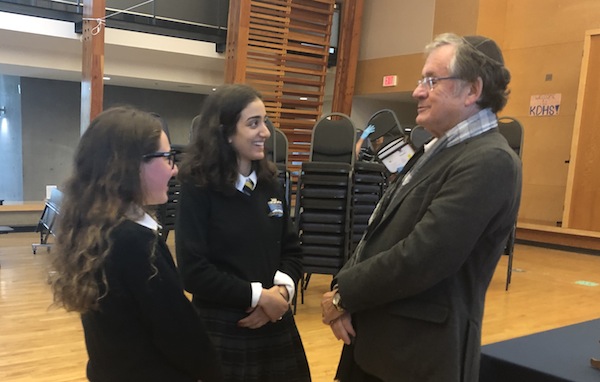
Dr. Robert Krell with Grade 12 King David High School students Gali Goldman, left, and Edden Av-Gay. (photo by Shula Klinger)

On May 2, King David High School marked Yom Hashoah at its annual assembly commemorating those lost in the Holocaust. This year, for the first time, the school hosted Grade 10 students from Alpha Secondary School in Burnaby.

The morning began with prayers for the victims of the recent Poway shooting in San Diego. After a minute’s silence, the assembly commenced with a procession led by child Holocaust survivor Dr. Robert Krell. Each of the five KHDS students in the procession carried a candle.

Originally from The Hague, Krell is founding president of the Vancouver Holocaust Education Centre and an educator and advocate for the centre’s programs. He is also professor emeritus, department of psychiatry, University of British Columbia, and distinguished life fellow of the American Psychiatric Association. He was introduced by KDHS students Estie Kallner and Mattea Lewis, his granddaughters. They spoke of their grandfather, thanking him for the “privilege” of hearing firsthand stories of the Holocaust.

Krell began his talk holding up a black and white photograph of himself as a baby. “Who was the enemy of the Third Reich?” he asked the audience. “This,” he said.

Krell was born when Holland was already occupied by Nazi forces. Indeed, the hospital he was born in was already partially confiscated by the Gestapo. He described how restrictions were imposed rapidly, every mundane aspect of Jewish life being placed under more and more stringent rules. Deportations began in 1942. Speaking of the local Jewish population being assembled for the euphemistically named “resettlement in the east,” he said, “No one panicked sufficiently.”

Krell went on to describe how, as family friends began to disappear, his “rather astute” parents fled their home, taking few possessions. “What would you grab?” he asked. His parents abandoned their photo albums because, in enemy hands, they would give away too much personal information.

Placed in the care of a local Dutch Christian family, Krell learned to call the parents Mother and Father. He described them as “the most wonderful people on earth.” With them, he said, his life was “comparatively normal.” That said, with the ever-present risk of betrayal, as a dark-haired child in a sea of blond heads, he was very noticeable. He was not allowed to look out of the apartment windows; there were Dutch Nazi sympathisers living within sight of his adoptive home.

One of the most powerful aspects of the lecture were Krell’s insights on human memory and identity under conditions of extreme stress. He described his recollections as “fragmented, not fully formed” and, while his young mind didn’t appreciate the extent of the horrors being committed outside, he said, “I knew something was wrong because I was part of another family.” His mother, he explained, remembered nothing of that period. Having given her young son over to a Dutch Christian, he said, “She was in shock for three months.” He spoke in the present tense of how his real identity vanished in hiding. “I melt into the family.”

As an adult, his adoptive sister, Nora, also buried some memories, which led to a conflict with Krell. He recalled being taken to visit his mother by Nora but Nora said she had never done that. This was a way of “denying me my memory,” he said, adding that this denial causes grievous harm to the psyche. Even though we have fragmented memories, he said, “we don’t want to give them up because they are part of who we are.”

In the end, the disagreement was resolved. Nora had indeed taken Krell to see his mother. Twice, he was nearly discovered and twice he narrowly escaped, first by covering his head with a blanket and, the second time, by hiding under a bed.

His years in hiding were characterized by unease, a looming sense of fear and constant hyper-vigilance. After the war, his family moved to Vancouver, leaving behind Holland, which he said he viewed as “a place of death.” He described himself as “the most eager immigrant-in-waiting that ever existed.”

Once in Canada, Krell reinvented himself, hiding his shyness behind outward charm and sociability. He said he became resilient, ignoring illness and pain, striving to forge a new life, a family and career for himself.

He spoke of the medical advice he received when dealing with overwhelming feelings – “You should get rid of your obsession with the Holocaust.” Instead, he helped found the Holocaust Symposium for high school students and facilitated the recording of 140 testimonies from survivors.

Following the lecture at KDHS, Krell answered questions from students, concerning Holocaust education today, as well as why it is that some people hid Jews and put their own lives at risk. Krell referred to “common decency,” adding that his own rescuers “didn’t know the precise nature of the unfolding danger, but once they had me, they were committed.” He told the students that, in spite of the “showcase” of the Nuremberg trials, “there is no justice.” And, are we at risk today? “Massively.”

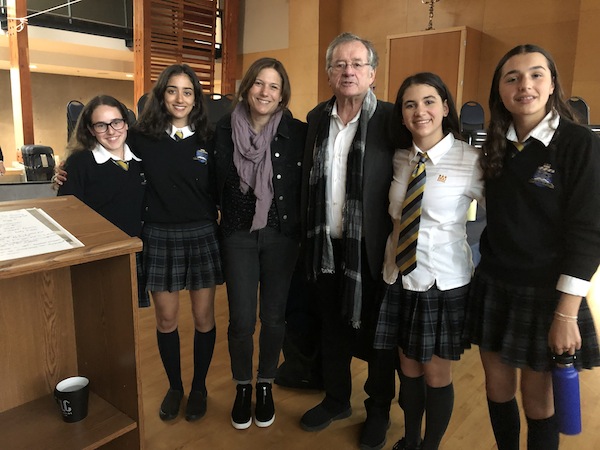
photo - Left to right: KDHS students Gali Goldman and Edden Av-Gay, Dr. Robert Krell’s daughter Simone Kallner, Dr. Robert Krell and his granddaughters Estie Kallner and Mattea Lewis
Left to right: KDHS students Gali Goldman and Edden Av-Gay, Dr. Robert Krell’s daughter Simone Kallner, Dr. Robert Krell and his granddaughters Estie Kallner and Mattea Lewis. (photo by Shula Klinger)

In his closing comments, Krell shifted from storyteller to teacher, using the narrative of his life to guide the students in theirs. “Learn your history,” he said. “In it lies everything to secure the safety of your children and grandchildren.”

He said, “Without engaging with the Holocaust, you are at great risk of becoming an under-educated person, and that makes you vulnerable. This mass murder took doctors, lawyers. Physicians were killing children in 1938. It was the doctors, engineers, architects. Each of the professions we trust for our safety. They all worked in the service of mass murder. Safeguard your professions from sliding into the abyss. It happens so quickly.”

Grade 12 students Edden Av-Gay and Gali Goldman spoke with Krell after his talk. Av-Gay was struck by how “one person could experience so many miracles in his life, especially someone born into such hardship” and said, “His story is truly amazing.”

Goldman, who had recently given a class presentation on youth movements during the Holocaust, had heard Krell tell his story before. She said she was still touched by how “he lost so much but he has devoted his life to teaching about what he went through, even though it was horrific. He can still find parts of his story that were miracles.”

Asked about Krell’s decision to speak about his past, Av-Gay said, “I think it’s not a matter of him being comfortable telling his story, I think he feels obligated to do it, to share his past, to show what happened to six million Jewish people.”

Alpha Secondary Grade 10 student Amy Ricker said she found Krell “motivating and inspiring.” Ricker, who hopes to become a humanitarian lawyer, said she “teared up because he showed me how in the dark I have been, and how much I want to help people.”

One perhaps surprising message in his talk was a warning about tolerance.

“If Jews were ‘tolerated’ in Holland, and the result was the deaths of over 80% of the Jewish population,” he said, “then we have to do much better than just tolerance.”

As he finished his lecture, he said, “Realize what you have. Thank your parents and tell your irritating siblings that you love them. I urge you – be kind.”

Shula Klinger is an author and journalist living in North Vancouver. Find out more at shulaklinger.com.

Format ImagePosted on May 24, 2019May 23, 2019Author Shula KlingerCategories Celebrating the HolidaysTags Alpha Secondary, child survivor, education, Holocaust, KDHS, remembrance, Robert Krell
D-Day: heroism, horror

D-Day: heroism, horror

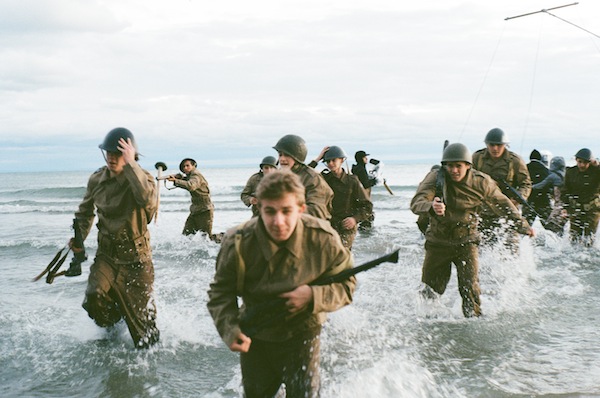
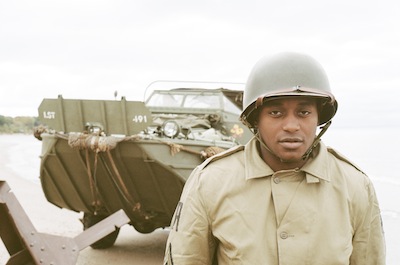
The fear, bloodshed and massive loss of life in the cause of freedom are illustrated through remarkable – and convincing – dramatic reenactments in D-Day in 14 Stories. (photo from YAP Films and the History Channel)

The horrors and heroism of D-Day took place 75 years ago June 6. A remarkable new documentary, with distinct Canadian and Jewish connections, will air on the History Channel June 1. D-Day in 14 Stories includes firsthand recollections from Allied and German soldiers and French civilians – many of them kids or teenagers at the time of the conflict.

The massive battle of the Second World War saw more than 150,000 Canadian, American, British and other Allied soldiers storm the beaches of France, marking the turning point of Nazi – and Allied – fortunes.

D-Day in 14 Stories is a social history of D-Day, a joint production of YAP Films and the History Channel. The events on that long-ago day in 1944 are illuminated by eyewitness accounts from some of the few remaining veterans of that historic battle.

On D-Day alone, 359 Canadian soldiers were killed. More than 5,000 Canadian soldiers died during the succeeding weeks of fighting in Normandy. The fear, bloodshed and massive loss of life in the cause of freedom are illustrated through remarkable – and convincing – dramatic reenactments, visual effects and historical footage, including a trove of colour film taken by a soldier using an early Bell and Howell handheld movie camera.

Many soldiers on both sides were just following orders but, as Morton Waitzman recounts in the documentary, some Jewish soldiers felt a particular motivation.

“Being of the Jewish faith myself, and so many of my comrades, we knew we had to get over there as soon as possible to do whatever we could to stop this terrible curse,” he said. As a communications specialist, he connected American and British forces with members of the French Underground to help coordinate the battle.

photo - D-Day in 14 Stories makes the effort to capture the particular experiences of African-American and First Nations soldiers
D-Day in 14 Stories makes the effort to capture the particular experiences of African-American and First Nations soldiers. (photo from YAP Films and the History Channel)

The Germans were anticipating an attack, but had no idea when, where or how large a force the Allies would assemble. The documentary follows a wall of soldiers parachuting through a cascade of tracers. In all, 13,000 Americans dropped inland by air to support the amphibious landing and undermine the German response.

While one Allied soldier says, “Anybody who says they weren’t afraid is not telling the truth,” a German soldier recounts, tellingly: “We had no fear. We were convinced that we would win.”

Until D-Day, the British Air Force had strafed the Normandy coast, but returned to their island redoubt. French residents of the area were familiar with the routine: take shelter when the alarms go off and come back out when they ring again.

Bernard Marie was a 5-year-old child in Normandy at the time.

“The big difference is that, on June 6th, the siren never came back,” he said.

In all, 7,000 vessels embarked from Britain to the French coast. The Allies had no illusions about the cost of the operation. Casualties were anticipated to reach 25 to 30%.

Emotionally powerful dramatizations follow 16- and 17-year-olds as they face the life-and-death moment for themselves and the free world.

“Some never got off the boat,” recalled one soldier. “They were shot, bodies laid all over, boats turned upside down, real chaos. We still kept going forward.… Soldiers.”

One survivor remembers that, despite the explosions all around him, his sole consideration when coming ashore at Normandy was that his socks were soaked through.

The average soldier was carrying 35 kilograms on his back and, for those whose vessels did not manage to make it close to shore, jumping off the ship, in many cases, led to almost instantaneous drowning.

If they survived the initial landing, the soldiers had to confront the German enemy firing down from above at Allied soldiers who were effectively sitting ducks. A German soldier recalls: “We merely had to point that machine gun and it was like cutting wheat with a scythe. For the odd miss, we had a thousand hits.”

The film admirably makes the effort to capture the particular experiences of African-American and First Nations soldiers.

Waitzman, the Jewish American soldier, went on to fight in Europe and participated in the liberation of concentration camps.

“We became eyewitnesses to the Holocaust by what we saw,” he says in the film. “We were very compelled to tell the details to young people. We had to talk, to fight this as much as possible.”

Another veteran of the battle reflects on the loss of life, but ponders the alternative: “God knows what would’ve happened if we hadn’t done it.”

Format ImagePosted on May 24, 2019May 23, 2019Author Pat JohnsonCategories TV & FilmTags D-Day, history, Holocaust, Second World War, television
Korczak course at UBC

Korczak course at UBC

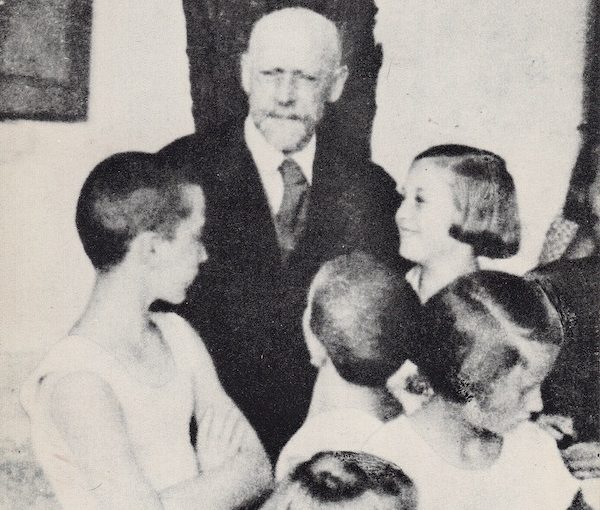
A postcard showing Janusz Korczak in the courtyard of the orphanage on Krochmalna Street in Warsaw, Poland, in the early 1930s.

An unprecedented interdisciplinary event will take place this summer at the University of British Columbia, focusing on the legacy of Janusz Korczak, a pioneer in the area of children’s rights and welfare.

Korczak is perhaps remembered most for his final act of heroism: his refusal to accept an offer of a reprieve, choosing instead to walk with the 200 or so orphaned children of his school as they were sent to their deaths at Treblinka. But it is his legacy as an educator, physician and writer that will be the focus of the 2019 Korczak Summer Institute. The two-week intensive program, called Advocacy in Action: The Legacy of Janusz Korczak, is open to graduate and undergraduate students across disciplines. It takes place July 2-11.

“To the best of my knowledge, there’s never been a university-based course on the work of Janucz Korczak, not in his native Poland, not in Israel, certainly not in North America,” said Rabbi Dr. Hillel Goelman, professor emeritus in UBC’s department of educational and counseling psychology, and special education. The program was developed across disciplines, reflecting Korczak’s range of academic and philosophical work.

“He was a pediatrician by training, so we reached out to the department of pediatrics to get their help and a number of faculty members are going to do Korczak-related activities,” said Goelman. “He was an educator, so the faculty of education were happy to co-sponsor the course with the Januscz Korczak Association [of Canada]. But it would also be open to people studying social work or any sort of child-focused activity. A lot of people at UBC support the whole cause of child activism and child welfare from an interdisciplinary perspective.”

Korczak’s philosophy inspired and informed the United Nations Charter on the Rights of Children. Importantly, his work was not limited to academics or writing, but was devoted to applying his values of child empowerment directly to the real world.

“Children are not the people of tomorrow but people today,” Korczak wrote. “They are entitled to be taken seriously. They have a right to be treated by adults with tenderness and respect, as equals.”

“In the orphanage that he ran in Warsaw, they had a children’s parliament, where children elected their leaders to make the rules and enforce the rules,” said Goelman. “There was a children’s court, where children could complain about their treatment either by the staff or by other students. There was a children’s newspaper that they published. He very much empowered children and he thought it was important to draw on this and give them opportunities to develop their own leadership. I think those are all very important contemporary messages for educators, social workers, pediatricians … and it’s kind of timeless. It’s really relevant to where we are today in terms of child activism, child welfare and child advocacy.”

The institute is designed to help participants transform their working environment to model democratic principles pioneered by Korczak in his writings, pedagogy and governance of the orphanages under his care. It will also encourage participants to adopt strategies to translate the respect for children’s rights into professional practices, including communication with parents and the larger community, and to learn how to help children in developing and sustaining their cultural identity, particularly among those who may struggle with multiple identities.

The course will be taught by Prof. Tatyana Tsyrlina-Spady, an internationally recognized expert on the life and legacy of Korczak and adjunct professor at Seattle Pacific University. She will be joined by a team of international and national invited speakers: teacher trainer and UNICEF consultant Jonathan Levy (Paris, France); founders and leaders in the field of social pediatrics Dr. Gilles Julien and Hélène Trudel (Montreal); researcher and practitioner of Korczak’s legacy Wojtek Lasota (Warsaw, Poland); several UBC professors of nursing and psychology; U.S.-Canadian writer Tilar Mazzeo (Victoria); and a Holocaust survivor and poet, Vancouverite Lillian Boraks-Nemetz.

Promoting Korczak’s pedagogical ideas, as well as their effect on children’s education, is part of the mandate of the Janucz Korczak Association of Canada, which was founded in 2002. The president, Jerry Nussbaum, lives in Vancouver, as do fellow board members Goelman and Boraks-Nemetz.

“His work is very much alive,” said Goelman of Korczak.

The deadline to register for the UBC course is May 28: pdce.educ.ubc.ca/child-advocacy.

Format ImagePosted on May 17, 2019May 16, 2019Author Pat JohnsonCategories LocalTags children, education, Hillel Goelman, history, Holocaust, Janusz Korczak, UBC
Recalling heroism, Holocaust

Recalling heroism, Holocaust

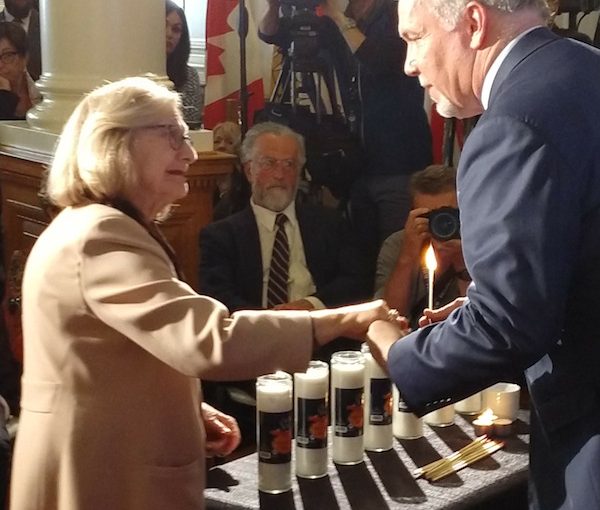
Holocaust survivor Rita Akselrod and Premier John Horgan at the Yom Hashoah commemoration that took place at the British Columbia legislature May 2. (photo by Pat Johnson)

The history of Jewish tragedy in the Holocaust – but also the heroism of Jews and non-Jews – was commemorated last week in moving ceremonies in Vancouver and Victoria.

Yom Hashoah, Holocaust Remembrance Day, occurred May 2 this year, coinciding with 27 Nissan in the Jewish calendar, the anniversary of the Warsaw Ghetto Uprising. A community commemoration convened by the Vancouver Holocaust Education Centre (VHEC) took place on the evening of May 1 at the Jewish Community Centre of Greater Vancouver. The following day, Holocaust survivors and others gathered in Victoria at the British Columbia legislature with the premier of the province and many elected officials in what has become an official annual commemoration.

Premier John Horgan assisted survivors and representatives of other targeted groups – people with disabilities, LGBTQ+, Roma – to light candles of remembrance.

“We need to remember that, if we do not stand together – Christians, Jews, Muslims, those who have no faith at all – if we do not stand together when hate raises its head, we will have failed not only those that have lost their lives so many decades ago in the millions, but folks who will come after us,” said Horgan. “We acknowledge the murders in San Diego and the tragic loss of life in Pittsburgh … in a synagogue there. We acknowledge the loss of Christian lives in Sri Lanka and the loss of Muslim lives in New Zealand. But, on this Yom Hashoah, we must always remember, in the presence of those who survived those horrors, that today we stand with you, tomorrow we will stand with you and forever we will remember the impacts of your lives and the consequences that you have lived for so many decades.”

Marie Doduck, a Holocaust survivor who lives in Vancouver, shared some of her life story with the audience at the legislature.

“Living in Brussels, Belgium, I was only three-and-a-half years old when my life was suddenly ripped apart and irrevocably changed by hate, by Nazism,” she said. “In 1939, our family, which was made up of 10 children – three were already married at the time with children of their own – were all separated by the scourge of war. We were all put into peril by the fact of our Jewishness – a crime under the rule of Nazis in Europe. We were marked for death by the accident of being born Jewish.”

She was hidden in a succession of non-Jewish homes and even in a Catholic convent.

“We had to run and to vanish in order to survive,” she said. “We became the children of silence. No talking, no crying, no disturbance – a blank mind with no feelings and no future. We lived only in the moment, felt nothing except hunger. Feelings like loneliness were a luxury. It was better not to feel. People and the world did not care. We were nothing – just Jews.

“This frightened little girl, Mariette, saw her beloved family disappear. My mother, Channah Malka, whom my firstborn is named after, and my brother, Albert, were deported to Auschwitz, where they were murdered. I saw my mother and brother being loaded into trucks…. That was the last time I saw either of them alive. Another brother, Jean, who was in the French Resistance, was hung by the Gestapo in the city square. Another brother, Simon, like hundreds of thousands, died three weeks after the war from the mistaken kindness of American and Canadian soldiers who liberated the camps and fed the fragile, thin and starving prisoners food that they could no longer digest.”

Like many survivors, Doduck’s experience is filled with close calls and fortunate near-misses.

“In order to survive, I jumped off moving trains and high buildings, was thrown into a sewer and was even hidden in a barn, where I took shelter in a bale of hay. I still bear the scar of being impaled by the pitch fork of a Nazi soldier searching there for Jews,” she said. “I lived mostly in darkness – literally – in dank cellars and other dark hiding places where the Nazis could not find me. When I returned to Brussels years later, I could not recognize the city in daylight, for my Brussels was a place of darkness.

After the war, Doduck immigrated to Canada as part of the War Orphans Project, the youngest of 1,123 Jewish children admitted to Canada in 1947 through an agreement between Canadian Jewish Congress and the federal immigration department.

“I arrived in Vancouver on Jan. 3, 1948, at age 12 and was taken in by a foster family,” said Doduck. “While I was warmly welcomed by the Jewish community and Canadian society – and grew up to be a proud Canadian – not everyone received a warm welcome when attempting to flee Nazi Germany. It was indeed the policy of many countries not to accept those seeking refuge.

“This is the important message that I share with students when I speak – that no society is immune to the dangers of discrimination and racism; and that we must work together to stand up when we see injustice in the world around us.”

B.C. Education Minister Rob Fleming, who emceed the event, noted the startling increase in antisemitic incidents in recent years and called for vigilance.

“Today also requires us to acknowledge the role that apathy and indifference played in enabling these atrocities to happen, the thousands of Jewish refugees turned away at our Canadian borders and the borders of other countries, the people who stood by and said nothing while their neighbours were hunted down in their homes because of their faith and identity,” said Fleming. “We come together to say never again.”

While mourning the atrocities, Fleming said, it is necessary to also remember the heroism of survivors and others who took the most dangerous risks to resist the dystopia of Nazism.

“They teach us that standing up for others, standing up for the values of tolerance and inclusiveness is how we can stop hate crimes, it’s how we can maintain and protect the peace that we are privileged to enjoy in our country.”

MLA Nicholas Simons played Kol Nidre on the cello to open the ceremony.

The evening before, the heroism of survivors was the topic of remarks from a member of the second generation. Carla van Messel, a board member of the VHEC, reflected on the lessons imparted by her father, Ies van Messel, who was a 5-year-old in Rotterdam, in the Netherlands, at the start of the war.

“Throughout my life, my father has demonstrated to me how to transform tragic memories into the strength to do good,” she said. “He taught my family that our Jewishness doesn’t make us evil or other and, therefore, by the same reasoning, neither should someone’s Germanness or Polishness or Arabness. He taught me that, if we don’t want something like the Holocaust to happen again, we have to continue to be better than the Nazis, and better than the nations who stood idly by. We have to actively protect all people … despite the history, despite the wounds, despite the deaths.

“As a second-generation survivor, I am energized by the examples of the survivors among us. They have inoculated us with their strength and resilience, with their will to turn bad into good. I want our survivors to know that they are leaving their memories, their essence, in good hands. Among the second generation are upstanding citizens of today’s very complicated world. They have taken the pain of their family’s personal history and transmuted it into the positive energy of tikkun olam. They continue to translate the hate of antisemitism into a hate of injustices: of racism, of bigotry, of sexism, of the demonization of otherness, of discrimination in all its many, many forms.”

The keynote address at Vancouver’s JCC was delivered by Lillian Boraks-Nemetz.

“Not a day passes when I don’t ask myself: Why did I survive when six million perished?” she said. “When 1.5 million [of the murdered] were children and, among them, my 5-year-old sister. And I survived. Why? When every European Jewish child was automatically sentenced to death by Hitler. I wonder: Was my survival a miracle? A twist of fate? The will of God? Why me?”

She detailed the series of close calls and fortunate happenstances that allowed her to survive, in part due to the persistence of her parents to do anything within their powers to save their two daughters.

The family was relocated into what would become the Warsaw Ghetto, sharing shelter with 20 other people in a three-room flat.

“Eventually, the ghetto grew more and more crowded – up to about 480,000 bodies in the small space of 1.3 square miles … with the lack of hygiene and medication, we were quarantined for typhus. Most of the boys and girls I played with died of the disease. Young children were dying on the streets; if not from illness, from starvation. Shabby and haunted people would simply pass by, powerless to help them,” she said.

“As 1942 approached, things got worse and worse. People out of desperation stole food from each other. I saw a woman carrying a bowl of soup when a man grabbed it. It spilled onto the pavement and the man fell to the floor licking the broth off the stones. All morality ceased to exist in an immoral, murderous universe of Nazi domination.”

As things in the ghetto deteriorated, Boraks-Nemetz’s parents bribed ghetto guards to allow young Lillian to escape. Her grandmother, who never entered the ghetto, had bought a little house in a nearby village, which she promised to give to a Catholic man who, in exchange, would let her live under his Polish name, ostensibly as siblings.

Boraks-Nemetz joined her grandmother and the man at the home.

“One night in the spring of 1943 we were outside in the yard, looking with horror at a blood-red sky above Warsaw,” she said. “We knew from a friend that it was the Warsaw Ghetto leveled to the ground by fire ordered by Hitler, after the courageous stand of the ghetto fighters against Nazi soldiers.”

Only after the war did she discover the fate of her sister.

“I found out that she was informed on by a Polish neighbour as a Jewish child and murdered by an unwilling Polish policeman who was commanded to do so, or else, by the Gestapo. The policeman found a ball lying on the street and threw it, telling my sister to run after it, then shot her in the back.”

While the Russians liberated her and her parents, Boraks-Nemetz said, the reality was not liberating.

“While adults worked to reestablish their lives, we children were left to grow up alone carrying the burden of experiences that nobody wanted to know about.… I was always told to forget and to let go by people who didn’t have a clue what was on my mind and in my soul. This was not a physical wound that results in a bruise or scab, which then falls off and mostly disappears. This was a branding on the Jewish soul with fire caused by man’s inhumanity to man, woman and child.

“It took me a long time after the war to realize myself as a human being who deserves to live and to be a Jew,” she said.

Philip Levinson, president of the VHEC board, introduced the procession of Holocaust survivors who lit candles in memory of the six million Jews murdered in the Holocaust. Cantor Yaakov Orzech chanted El Maleh Rachamim and survivor Chaim Kornfeld led Kaddish. Under music director Wendy Bross Stuart, violinist Nancy di Novo and the Yom Hashoah singers performed songs in Ladino, Yiddish and Hebrew. Sarah Kirby-Yung, a Vancouver city councilor, brought greetings from the city and read a proclamation. The evening ended as it does every year with the singing of “Zog Nit Keynmol,” “The Partisan Song.”

Format ImagePosted on May 10, 2019May 9, 2019Author Pat JohnsonCategories LocalTags British Columbia, Carla van Messel, history, Holocaust, Lillian Boraks-Nemetz, Marie Doduck, Rob Fleming, VHEC, Yom Hashoah
Dr. Ruth a force of nature

Dr. Ruth a force of nature

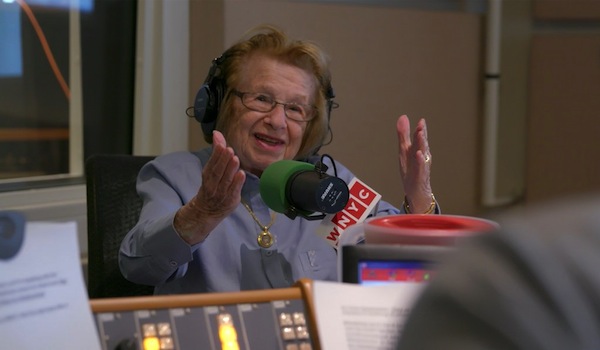
Celebrity sex therapist Dr. Ruth Westheimer started life as Karola Ruth Siegel in Weisenfeld, Germany. (photo from Mongrel Media)

Before she rocketed to 1980s TV fame as sex advisor Dr. Ruth, she was simply Ruth Westheimer. And long before she was Ruth Westheimer, she was Karola Ruth Siegel of Weisenfeld, Germany.

It is those formative early years that provide the most resonant and affecting passages in Ryan White’s solid documentary Ask Dr. Ruth, which is scheduled to open in Vancouver May 10. I’ll go even further: They provide the film with its raison d’etre.

Sure, lots of people were helped in ways big and small by Dr. Ruth’s high-profile acceptance of (almost) every form of sexual behaviour and by her uninhibited, direct language about intimate acts and love relationships. But what lifts Ask Dr. Ruth above a “where are they now” profile of an old-media, pop-culture celebrity is Karola Ruth Siegel’s experiences before, during and immediately after the Second World War.

Most audiences, especially non-Jewish viewers, will come to Ask Dr. Ruth for the sex. The mitzvah of the film, as it were, is that they will get the Holocaust.

To be clear, Dr. Ruth doesn’t see herself as a Holocaust survivor. She is “an orphan of the Holocaust,” which is the most poignant and wrenching phrase you’ll encounter all week.

Born in 1928, Karola Ruth was the sole child of observant Jewish parents. She was too young to fully understand when the Nazis sent her father to a labour camp in the 1930s. And, as bright as she was, she couldn’t fully grasp the long-term implications when her parents put her on a train to Switzerland with a group of Jewish children.

Placed in an orphanage, Karola Ruth and the other Jewish kids were handed housekeeping duties and some responsibilities for caring for the Swiss kids. They received food and shelter, but zero love and little compassion. A natural ringleader – on the train, she’d organized a sing-along to distract the homesick youngsters – Karola Ruth figured out ways to educate and entertain herself.

She discovered boys, of course, and the film accompanies her abroad to a warm reunion with her first boyfriend, Walter Nothmann. It’s pretty chaste stuff, presented by Westheimer with nostalgia and charm, which conveys universal attitudes of adolescence.

At the same time, though, Karola Ruth was devouring and savouring every letter and poem she received from her mother and father – until weeks, and then months, passed without any communication. (She preserved and protected these treasures throughout her travels, and keeps them in plastic sleeves in a notebook.)

The animation style used by filmmaker White to illustrate Karola Ruth’s Swiss period is annoyingly juvenile, unless one presumes that children are one of the intended audiences of Ask Dr. Ruth. Admittedly, those experiences are as accessible and relevant to today’s children as Anne Frank’s, if not more so, but parents and guardians would need to know that the focus of a documentary about a sex therapist isn’t, uh, sex.

At some point after the war, Westheimer accepted that her parents had been killed by the Nazis, but she never sought out the details. All these years later, while visiting Israel during the filming of Ask Dr. Ruth, she goes to Yad Vashem and learns that her father died in 1942 in Auschwitz. The notation for her mother is “disappeared/murdered.”

Ask Dr. Ruth skilfully weaves three threads and three distinct time frames: its subject’s biography from the 1930s to the 1960s, her high-profile heyday in the 1980s and 1990s, and her peripatetic schedule of speaking engagements and family contacts, climaxing with her 90th birthday last June.

The trek to Israel, fascinatingly, includes a visit with a friend from Kibbutz Ramat David, where Ruth Siegel – persuaded that Karola was too German, she dropped it – landed in Palestine at age 17. This remarkable chapter of her life includes ceding her virginity, being trained as a Haganah sniper and, on her 20th birthday during the War of Independence, being injured so badly in a bombing that there was a question whether she’d be able to use her feet again.

The next 70 years of Dr. Ruth Westheimer’s life, spanning Paris, New York, three husbands, two children, a doctorate at age 42, a radio show, household name recognition and four grandchildren, are acutely interesting. But the imprint of coming of age during the war, without her parents but with determination, resourcefulness, intelligence and humour, defined Karola Ruth Siegel and infuses Ask Dr. Ruth with timeless importance.

“From my background, all of the things I’ve survived,” Westheimer declares, “I have an obligation to live large and make a dent in this world.”

Michael Fox is a writer and film critic living in San Francisco.

Format ImagePosted on May 10, 2019May 9, 2019Author Michael FoxCategories TV & FilmTags documentary, Dr. Ruth, history, Holocaust, Ruth Westheimer
Marking Yom Hashoah

Marking Yom Hashoah

Israeli Prime Minister Binyamin Netanyahu places a wreath at Yad Vashem on Yom Hashoah. (photo from IGPO via Ashernet)

photo - On Yom Hashoah, Israel comes to a virtual standstill at 11 a.m., for two minutes, as sirens wail across the country – everyone stops what they are doing and stands at attention, in respect to the memory of the six million Jews who were murdered in the Holocaust
(photo from IGPO via Ashernet)

On Yom Hashoah, Israel comes to a virtual standstill at 11 a.m., for two minutes, as sirens wail across the country – everyone stops what they are doing and stands at attention, in respect to the memory of the six million Jews who were murdered in the Holocaust.

Format ImagePosted on May 10, 2019May 9, 2019Author Edgar AsherCategories IsraelTags Holocaust, Israel, Yom Hashoah
Traveling beyond classroom

Traveling beyond classroom

Springfield Collegiate Institute students walking into Auschwitz. (photo by Jim Osler, SCI)

Holocaust education is commonplace in Jewish schools. But, in public schools, discussion about the Shoah is at each teacher’s discretion. Some 14 months ago, teachers at Springfield Collegiate Institute public school in Oakbank, Man., decided they would take 30 Grade 11 and 12 students to see Second World War sites firsthand.

Despite that Oakbank is home to few Jewish families, the school has been inviting Holocaust survivors to speak to students and has been educating its students about the Holocaust for years. Last year, teachers Jim Osler and James Chagnon made the decision to take things further.

“While this was not on a topic brought up in a regular class, we organized activities outside of class time for these students in the evenings and on the weekends to educate them a little more,” said Chagnon of preparing the students for the 12-day trip, which started March 20.

“We visited a synagogue and talked to a rabbi about what it means to be Jewish, because we don’t have any experience with that,” Chagnon told the Independent. “We went and met two Holocaust survivors, who talked about their experiences in the camps. And we went to a conference on antisemitism hosted at the Rady JCC [in Winnipeg]. So, we did a lot of prep work outside of the school with these guys to make sure they’d be ready for what they’d be experiencing.”

Chagnon referred to a recent study that found that only about 30% of Canadian high school students had awareness or knowledge of the Holocaust.

“I had always taught English here in the school in addition to history – novels like The Diary of Anne Frank – and these seem to be getting pushed to the wayside,” said Chagnon. “The younger generations these days, especially in a community like ours that doesn’t have a big Jewish population … it’s just something I don’t think parents have a lot of experience with and, so, it’s not passed onto the kids. So, if they don’t learn about it in school or as part of our programs or clubs, they maybe aren’t going to learn about it at all.”

The school had wanted to take more than 30 students on the March trip, but had to stick to that maximum for logistical reasons. Participating students had to fundraise to pay their way.

Madison Stojak, in Grade 12, and Anna Palidwor, in Grade 11, were both born and raised in rural Manitoba, and had little knowledge or interaction with Jews prior to attending Springfield Collegiate.

photo - Springfield Collegiate Institute student Ana Palidwor, left, teacher James Chagnon, centre, and student Madison Stojak
Springfield Collegiate Institute student Ana Palidwor, left, teacher James Chagnon, centre, and student Madison Stojak. (photo by Jim Osler, SCI)

“Hearing Holocaust survivors’ stories and then going to the camps, like Auschwitz and Birkenau … you could remember what the survivors said and picture it, what they must have gone through while they were there,” Palidwor told the Independent. “How we felt while we were there has stuck with everybody after we came back. Also, we’re more aware of the race issues that are out there… That’s definitely stuck with me … realizing it’s still here, wherever we go, the hate.”

While the school group was at the Warsaw Ghetto, a man on a motorbike drove by and gave the middle finger to a group of Israeli students who were standing beside them. “After all that, you’re just more aware of it, anywhere you go,” said Palidwor.

Both Stojak and Palidwor have talked about their experiences with family and friends.

“When I shared it with my family members, it was kind of surreal to them,” said Stojak. “They were like, ‘How could other people treat people like this? How could this happen? How come no one stopped it?’ They were questioning the same things I think all of us were questioning on the trip.”

“One of the strong points we really tried to push on the students, in terms of their learning, to understand, is that this isn’t the first time this has happened,” Chagnon said. “We definitely want it to be the last time, so we can’t just sit by and be passive bystanders anymore. When you see antisemitism, you are now obligated to call it out, draw attention to it, so we can change the way the world works.”

When the students returned from the trip, they were taken aback by some of the reaction they heard from fellow students who did not go.

Stojak said, “I hadn’t heard any comments before the trip like these – until they realized we were there … people started making rude comments … hateful comments. I think they were saying it to get us upset, and I also think that they’re really undereducated and don’t understand how serious it is.

“One comment someone said to me was, ‘Don’t touch me with your Holocaust hands!’ That’s what someone said to me. And, as soon as he said that, I said, ‘What did you just say?’ And he repeated it. I looked at him and said, ‘You didn’t just say that to me. That’s ridiculous. Do you know how many millions of people died there? That’s not something you should be saying.’

“I stood up immediately and shut it down,” said Stojak. “It made me feel sick to my stomach. How could someone make a comment like this? When he said that, I pictured standing there at Auschwitz or Birkenau and thinking, how could someone be so ignorant to say that?”

“These kinds of comments are making us want to be more active,” said Palidwor, “and to explain it to more people who weren’t there and tell them what the Holocaust is.”

photo - The 30 Springfield Collegiate Institute students, three parent chaperones and two teachers in the old town square in Krakow, Poland
The 30 Springfield Collegiate Institute students, three parent chaperones and two teachers in the old town square in Krakow, Poland. (photo from SCI Students)

One of the things that stuck in Chagnon’s mind from the trip was the incident with the Israeli students. He noticed that there were a dozen security personnel with the Israeli student group but none with the Canadian school group.

“One of my students said, ‘Wow, I didn’t understand how bad it was – that these kids on a school trip from Israel have to be accompanied by security guards,’” said Chagnon. “That kind of struck me and I made sure to point it out to my students. It gives you a bit of perspective for the Jewish community – how scared they must be all the time – that they can’t send students to learn about the history of their people, their culture and religion, without having to send security with them.”

Another thing that stood out for Chagnon occurred when the group was visiting a Jewish cemetery and noticed that locals use the cemetery as a bathroom stop for their dogs.

“I’m a guest in their country, but I was shaking, I was so angry,” he said. “I couldn’t believe people would show such indignity to a group of people who suffered so much already.

photo - The memorial at Mila 18 Ghetto Uprising site in Warsaw, Poland
The memorial at Mila 18 Ghetto Uprising site in Warsaw, Poland. (photo by Jim Osler, SCI)

“We had a nightly debrief at the end of every evening,” he continued, “where we sat around and talked about the day, how we felt about it and our reactions to it, and that’s one thing I brought up … that some of this stuff may seem to have gone away … maybe it isn’t as bad as it was, but that doesn’t mean it’s not there, just bubbling under the surface, waiting for an opportunity to pop up.

“For me, that’s the reason we did a trip like this, and I know Jim [Osler] feels the same way.… They say people who don’t study history are doomed to repeat it and, for me, that’s very true. You have to talk about these things, even the ugly things in history, so we don’t let it happen again.”

Rebeca Kuropatwa is a Winnipeg freelance writer.

Format ImagePosted on May 3, 2019May 1, 2019Author Rebeca KuropatwaCategories NationalTags Anna Palidwor, antisemitism, education, Holocaust, James Chagnon, Jim Osler, Madison Stojak, Manitoba, Springfield Collegiate

Posts pagination

Previous page Page 1 … Page 21 Page 22 Page 23 … Page 44 Next page
Proudly powered by WordPress