Skip to content
  • Home
  • Subscribe / donate
  • Events calendar
  • Business Directory
  • FAQ
  • News
    • Local
    • National
    • Israel
    • World
    • עניין בחדשות
      A roundup of news in Canada and further afield, in Hebrew.
  • Opinion
    • From the JI
    • Op-Ed
  • Arts & Culture
    • Performing Arts
    • Music
    • Books
    • Visual Arts
    • TV & Film
  • Life
    • Celebrating the Holidays
    • Travel
    • The Daily Snooze
      Cartoons by Jacob Samuel
    • Mystery Photo
      Help the JI and JMABC fill in the gaps in our archives.
  • Community Links
    • Organizations, Etc.
    • Other News Sources & Blogs
  • JI Chai Celebration
  • JI@88! video

Recent Posts

  • Legal help for students
  • Revisiting myth of Lilith
  • Wrong person rebuked
  • Canada’s mixed messages
  • Questions for museum
  • Symposium on antizionism
  • Making soccer political
  • CJPAC lauds Pulver’s impact
  • City recognizes Vrba’s legacy  
  • Organ donation saves lives
  • Theodore’s March premiere
  • A healing Shabbaton
  • Supplying healthy food
  • A chime of metal tags
  • Yellowknife seder a first
  • Ishai energizes, unifies
  • A Lag b’Omer to remember
  • Expanding the healing
  • Hannah Senesh – a unique hero
  • Community milestones … May 2026
  • Sharing her testimony
  • Fall fight takes leap forward
  • The balancing of rights
  • Multiple Tony n’ Tina roles
  • Stories of trauma, resilience
  • Celebrate our culture
  • A responsibility to help
  • What wellness means at JCC
  • Together in mourning
  • Downhill after Trump?
  • Birth control even easier now
  • Eco-Sisters mentorship
  • Unexpected discoveries
  • Study’s results hopeful
  • Bad behaviour affects us all
  • Thankful for the police

Archives

Follow @JewishIndie
image - The CJN - Visit Us Banner - 300x600 - 101625

Tag: Holocaust

Danger in remaining silent

Danger in remaining silent

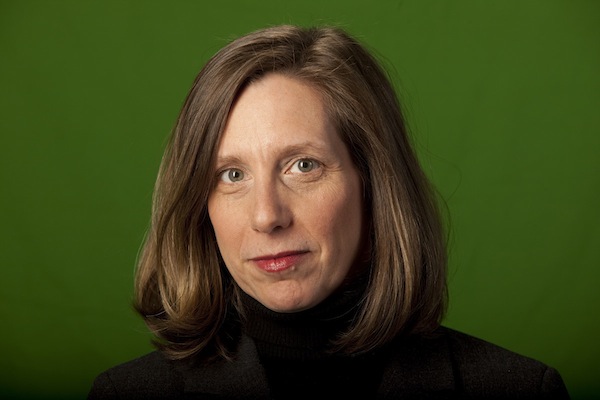
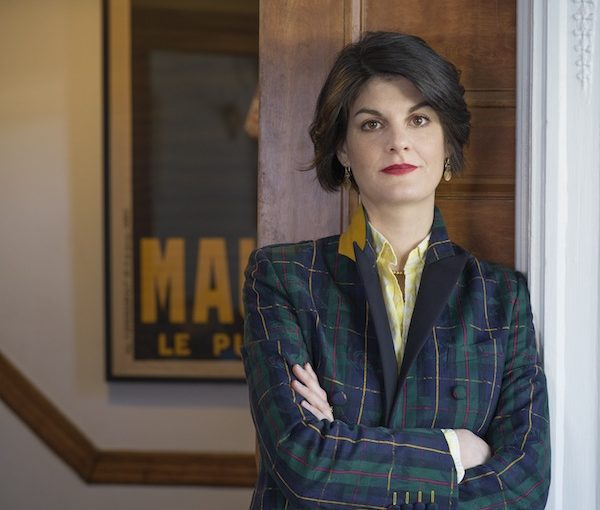
Marsha Lederman (photo by John Lehmann/Globe and Mail)

A few years ago, Marsha Lederman went with her mother, two sisters and a cousin on the adult portion of the March of the Living, which included a walk between the two main camps of the Auschwitz-Birkenau complex.

“The march from Auschwitz to Birkenau was somber and sorrowful, but it was also so empowering,” she recalled at the annual High Holidays Cemetery Service at Schara Tzedeck Cemetery in New Westminster Oct. 6. “We were marching with a statement to the world and a comforting message to the souls whose lives had ended so brutally on those grounds: ‘We are here, we are still living, we are multiplying, we remember you.’”

The family group proceeded to Radom, the town outside Warsaw where Lederman’s mother had grown up. The man who lived in the apartment where she had lived allowed them in and Lederman’s mother recounted her family’s years there.

“It was joyous,” Lederman said. “We were still on a high when we visited the memorial for the Radom Jews killed in the Holocaust. As I recall, it was in a fairly large square and seemed a little neglected. We were looking at this lonely memorial, the five of us women, when a group of, I would say, teenage boys began chanting something nearby. I don’t speak Polish, so I couldn’t understand what they were saying. But I did understand one thing: ‘Auschwitz-Birkenau.’ I don’t think they were offering their condolences.”

She reflected on the way she responded in that moment.

“We hurried away and said nothing. It was a safe thing to do, for sure. But, if that happened to me today, I would not walk away. I am done with walking away. Would I have put us in danger if I had turned around and confronted those boys? Maybe. But I know now that the real danger is in remaining silent.”

Lederman is the Vancouver-based Western arts correspondent for the Globe and Mail. Her father was born in Lodz, Poland, on erev Yom Kippur 1919. Her mother was born in Radom, Poland, in 1925. All four of their parents were killed in gas chambers at Auschwitz and Treblinka, as was Lederman’s father’s sister and little brother, and her mother’s little brother.

Lederman’s parents met in Germany after liberation and had one daughter there before moving to Canada, where they had two more daughters.

Lederman reflected on recent antisemitic incidents in North America and Europe, as well as her own encounters with antisemitism and racism, including a harrowing verbal attack on an Asian woman on the Skytrain at rush-hour, an incident in which Lederman was the only person to intervene.

“We have a duty to speak up,” she said. “We have a responsibility. This is our inheritance. I never had a bubbe or zadie to hug me or spoil me on my birthday or cook chicken soup for me. There’s nothing in my home that was theirs. I did not receive a single heirloom. But I did receive an inheritance – a duty to protect others from hate…. That is my inheritance and that is their legacy. Enough. Never again.”

She recalled being stunned during an interview with famed Vancouver photographer Fred Herzog, who died last month. Chatting after the main interview, Lederman asked the German-Canadian if he had experienced anti-German sentiment when he arrived here after the war. He launched into a discourse on the “so-called Holocaust” and said Jews died in the camps mostly because of lice and because Allied bombings prevented food from getting to them. Lederman agonized over whether to expose the admired photographer, eventually writing the story, for which she has been subjected to a range of criticism.

“Well, I have had enough,” she said. “And I’m going to fight to tell those stories and expose antisemitism and Holocaust denial and racism. I am not going to be quiet anymore. I think of all that was lost in the gas chambers; all the lives, of course, but also all the potential. With those millions of lives extinguished, what was lost with them? Poems were never written, beautiful artworks that were never painted, the cure for cancer, for Parkinson’s, the answer to the climate crisis?

“It was not just the people who were murdered that the world lost. It was all of their descendants and all of their descendants and all of that potential.… I talk about this because of what this leaves on our shoulders. I interviewed a Nisga’a poet, Jordan Abel, and he used a term to describe himself that I have adopted. He calls himself an intergenerational survivor of residential schools, which makes me an intergenerational survivor of Auschwitz. I do not take this lightly. With my parents’ survival came a hefty responsibility on me and on all of us who are descendants.”

At the service, Jack Micner, who led the ceremony and is also a member of the second generation, outlined a litany of antisemitic incidents and comments in Europe and North America in recent weeks.

“I suspect that those of our parents resting here in this cemetery would be furious to see what’s going on across the world,” he said. “We have to continue doing the type of work that VHEC [Vancouver Holocaust Education Centre] is doing in as many ways as we can think … it falls on us, because nobody’s going to do it for us.”

Rabbi Shlomo Estrin reflected on the loss of Chassidic communities during the Holocaust. Cantor Yaacov Orzech chanted El Maleh Rachamim.

Names were read of community members who have passed since the last High Holidays and a moment of silence was observed for the six million.

The Mourner’s Kaddish was recited by Jeremy Berger, a grandson of a Holocaust survivor. After the service ended, the Mourner’s Kaddish was also recited at the Holocaust Memorial in the cemetery.

The annual event is presented by the Vancouver Holocaust Education Centre with Congregation Schara Tzedeck and the Jewish War Veterans, and with support from the Jewish Community Foundation of Greater Vancouver.

Format ImagePosted on October 25, 2019October 23, 2019Author Pat JohnsonCategories LocalTags Holocaust, Kristallnacht, Marsha Lederman, memoir, racism, second generation, survivor, VHEC
Meaningful family trip to Kyiv

Meaningful family trip to Kyiv

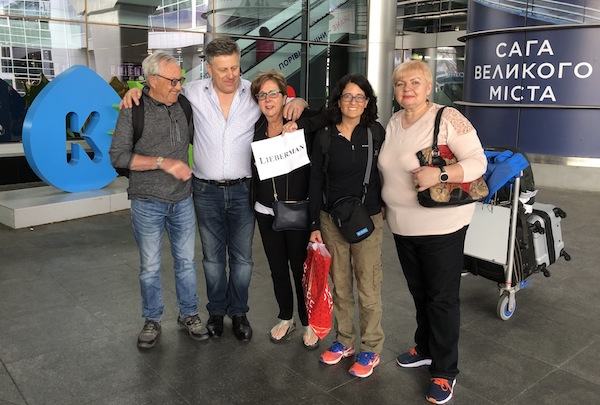
Left to right: Lucien, Grisha, Carole, Leanne and Svetlana at the airport in Kyiv, Ukraine. (photo from Carole Lieberman)

My husband Lucien, our daughter Leanne and I recently traveled to Kyiv, Ukraine, to meet Lucien’s first cousin and his family for the first time.

History has an interesting way of unfolding. Lucien’s father was one of 10 children born in Russia. The oldest daughter Sophie immigrated to Canada in 1912, to marry a farmer living in Rumsey, Alta. In 1923, Lucien’s grandparents, along with four of their children, including Lucien’s father Leo, made the cross-Atlantic journey from Russia to Alberta. Sadly, in 1927, their daughter Lucy, for whom Lucien was named, ended her life there at age 25 and, in another tragedy, their daughter Sophie, mother of five young children, was widowed.

Shortly after these tragedies, their daughter Manya chose to return to Russia on her own. And, in 1928, the grandparents were determined to return to Russia. And so, in November of that year, two brothers – Leo Lieberman, 33, and Sam Lieberman, 29 – embraced at the Calgary CPR station. Sam was escorting their parents back to Russia. Since their parents were in their 60s and were considered elderly, they could not manage the trip on their own. Sam expected to return to Canada once their parents were settled in Kharkov, but he never did. The brothers’ last words were about Leo’s new winter coat. “Leo, I like your coat. Where I am going you can’t find such a coat.” So, the brothers exchanged garments. They did not meet again until 1966, when Leo and his wife Clara went to the Soviet Union to try and find family.

photo - Cousins Grisha, left, and Lucien
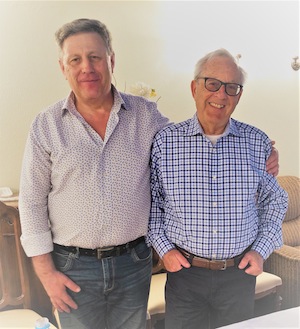
Cousins Grisha, left, and Lucien. (photo from Carole Lieberman)

Lucien grew up in Calgary aware that his parents had both left large families in the Soviet Union and that the Second World War had devastated those families. Sam’s story was tragic. He worked in Moscow in the 1930s as a translator. When the war came, he was taken into the army and survived four years in combat roles. He was wounded and, in 1946, he was arrested, charged and tried for the offence of being “anti-social to the regime” and sent to the Gulag, where he laboured for 10 years in a camp beyond the Arctic Circle. After Stalin’s death, Sam was discharged and allowed to return to his city of last residence, Chernivtsi in the Ukraine. There, at the age of 57, Sam married a younger woman and fathered a son, Gregory (Grisha).

The next generation of family in Canada always knew about Uncle Sam and Cousin Grisha. We had heard that Grisha lived in Madagan, which is closer to Anchorage than to Moscow. Decades passed without any contact but finally, in 2016, we learned that Grisha, his wife Svetlana and their two children were living in Kyiv, the capital of Ukraine. We met our new cousins on Skype in 2017 and began to catch up on decades of this lost connection.

Grisha and Svetlana’s son, Stanislaus Lieberman, is married to Natasha, has a 2-year-old daughter and is a lawyer in Kyiv. Their daughter,

photo - Tatiana Lieberman is known throughout Ukraine as Tina Karol
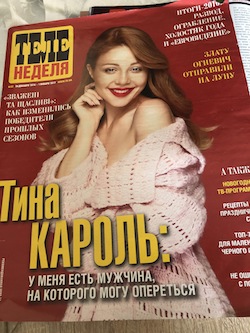
Tatiana Lieberman is known throughout Ukraine as Tina Karol. (photo from Carole Lieberman)

Tatiana Lieberman, affectionately called Tinotchka, is known throughout Ukraine as Tina Karol (tinakarol.com). Tina is a renowned singer who represented Ukraine in the 2006 Eurovision competition at age 21. She is the “face of Ukraine,” with billboard ads throughout Kyiv for Huawei and many cosmetic companies, and has the largest fan club in all of Ukraine. Her 10-year-old son Veniamin attends school in England and returns to Kyiv frequently. Tragically, Tina’s husband, Eugeny Ogir, who was her manager, died in 2013 at the age of 33, shortly after being diagnosed with an aggressive form of cancer.

Grisha speaks a reasonable amount of English and, thanks to Google Translate, we communicated well. We came to feel very close to our cousins after many Skype visits and plans were made to visit. There was no discussion – they insisted that we stay with them in their apartment so we would really get to know one another. It certainly was not our custom to stay with people we had never met in their two-bedroom, 1.5-bathroom apartment for eight nights but the visit was incredibly memorable and very special. Days before our arrival, Svetlana wrote that “they were trembling with anticipation.” We felt the same.

Our daughter Leanne, a teacher and a published author, met us at the airport in Kyiv. We were welcomed at the airport with a “Lieberman” sign and the warmest hugs and happiest tears. Throughout the visit and several times every day, Grisha would grab Lucien, hug and kiss him, saying, “You are my dear cousin.” Despite the 18-year age difference, there was a very strong cousin connection between the two men, cemented further by the traditional home-cooked Ukrainian food that we were so generously fed each day. We awoke to the smell of kreplach, borscht, haluptsi, cheese latkes and potato pancakes prepared by Svetlana and we enjoyed eating delicacies such as forshmuk, a chopped white fish salad. It was food that was so reminiscent of what Lucien’s mother had prepared for him when he was growing up in Calgary. We all laughed together when we were offered barbecued “kitchen.”

Our entire week was planned in advance and included not only family visits and meals, but a visit to a wonderful Ukrainian folk dance show at a huge auditorium where we were seated in the president’s box, welcomed with a champagne reception and presented with traditional Ukrainian outfits for Vishivanka, all arranged by Tina. Tina’s driver took us to a 26-acre monastery for a private tour and we were taught how to make varenikes in a private master class at lunch.

We gained a good sense of Tina’s personal life when we visited her stunning home and gardens, complete with a 24-hour armed security guard. Tina’s fans adore her and swarm her when they see her out in public.

Kyiv is a stunning city, with the Dneiper River running from north to south. The climate is warm in spring and the air is often beautifully fragrant with the scent of acacia trees, stronger in the morning and in the evening when we all strolled along the river. It has beautiful kashtana (chestnut) and lilac trees and a number of impressive bridges and lookouts. There are many parks, huge squares and an excellent subway system, accessed with the longest imaginable escalators. Like so many cities, it has far too much traffic (propka).

Tina arranged a private guided tour of Babi Yar for us with an English-speaking local woman. Babi Yar is now a beautiful treed park approximately a kilometre square in the northwest outskirts of Kyiv. On Sept. 29, 1941, Nazi troops rounded up Kyiv’s 34,000 strong Jewish community and massacred them all within 48 hours. Victims were shot and buried in the ravine. The Nazis then rounded up the local Romany people and residents of mental hospitals and extended the killing. During the two-year Nazi occupation, more than 100,000 bodies were dumped into the Babi Yar ravine. When the Red Army recaptured the city in 1943, there were only 80,000 people in Kyiv, one-tenth of its former population.

photo - Lucien, left, and Grisha at Babi Yar
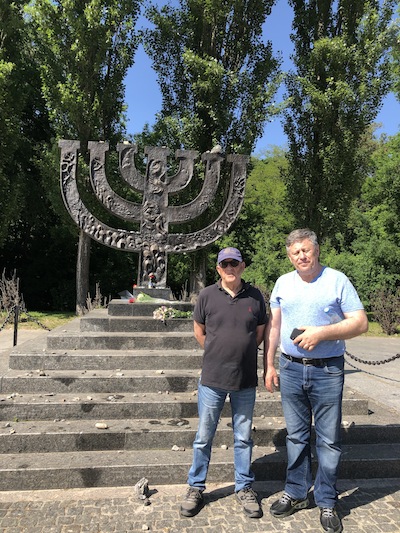
Lucien, left, and Grisha at Babi Yar. (photo from Carole Lieberman)

Today, there is little evidence of a deep ravine, only undulating terrain. There are numerous monuments, some remembering the many children killed, several with Hebrew inscriptions, and a beautiful bronze wagon, which depicts a typical Roma caravan. After the dissolution of the Soviet Union, the Ukrainian government invited the state of Israel to erect a monument, which was done in the form of a large menorah. Babi Yar is possibly the most prominent site representing the Holocaust in the former Soviet Union.

During the week that we were in Kyiv, a new president was sworn in. With Svetlana, we watched the televised inauguration of President Volodymyr Zelenskiy, a 41-year-old former comedian and the first Ukrainian president with a Jewish background, and we loved seeing Svetlana proudly sing the national anthem, in tears.

We visited Maidan, the central square of the city, saw the parliament buildings and surrounding Marinsky Park. We toured a fascinating military museum, visited an old synagogue and were taken to the famous opera house, where we thoroughly enjoyed seeing the ballet.

Every day was full of memorable moments. We spent several evenings sharing family photos – it was fascinating to see photos of us from the 1970s and ’80s, which were mailed to them by my in-laws and other relatives before we lost contact. We laughed, hugged, cried and shared stories, always with “Grishinke” grabbing and kissing “Lucienke” and proudly saying, “you are my cousin.” Together Grisha and Lucien enjoyed shemiskes, aka sunflower seeds, that only people who were raised by siblings would enjoy the same way.

We celebrated our last night together at a beautiful restaurant overlooking the river and marveled that the restaurant, like many other quality restaurants, had an excellent playroom where Stanislaus’s daughter Vesta played while we dined.

When we finally hugged everyone goodbye and thanked them for a visit that exceeded every expectation, Grisha responded, “I am the son of Sam.”

In 1951, after spending five years in the Gulag, a fellow prisoner was released and Sam asked him to please send a letter to his brother Leo informing him that he was still alive, giving him the address – Leo Lieberman, Calgary, Alberta, Canada. When the man was able to mail the letter, he omitted “Calgary” and the letter ended up in the Edmonton post office. The letter was sent to a Mr. Lieberman in Edmonton by a caring employee and was subsequently forwarded to Leo Lieberman in Calgary.

Carole Lieberman, a longtime Vancouver resident, is originally from Montreal. She is a mother of three, grandmother of four, and has enjoyed selling Vancouver real estate for almost 30 years.

Format ImagePosted on September 20, 2019March 28, 2022Author Carole LiebermanCategories TravelTags Babi Yar, family, history, Holocaust, Kyiv, Lieberman, Tina Karol, Ukraine
Eisen’s story of survival

Eisen’s story of survival

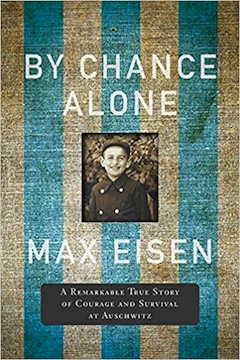
As public opinion surveys continue to tell us that vast numbers of people know little or nothing about the Holocaust, it was encouraging that Max Eisen’s memoir, By Chance Alone, became CBC Radio’s Canada Reads 2019 choice, bringing this wrenching narrative to many more eyes and ears.

Born in Czechoslovakia in 1929, Eisen enjoyed a childhood filled with shenanigans and idyllic summer excursions to his maternal family’s farm – until the Nazi invasion of his country, in 1938.

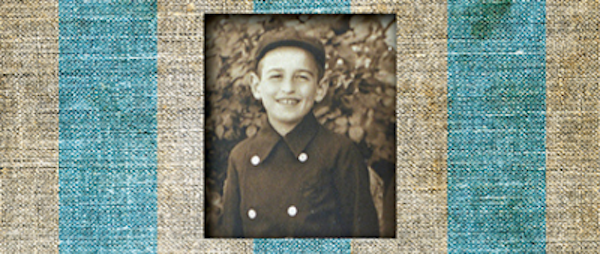
image - By Chance Alone book cover“At 9, I didn’t fully understand what was taking place, but I noticed the rising tensions in my hometown,” he writes.

Eisen’s father’s friends assembled at their home to listen to a major address by the Führer on a crystal radio. “All of us understood basic German,” he writes. Hitler’s words, “Wir werden die Juden ausradieren” – “We are going to eradicate all the Jews of Europe” – clarified for the young Eisen the import of the moment.

While traumas befell the family from then on, it was in the night after the first seder in 1944 that the worst of the family’s catastrophe began to unfold.

At 2 a.m., after the family had settled into bed after what Eisen calls their “last supper,” a neighbour arrived at their property urgently insisting that the family hide in the forest because he had overheard gendarmes saying that they would gather all the Jews in the vicinity the next day. Because it was Passover and the Sabbath, Eisen’s grandfather declared that the family would not travel. At 6 a.m., gendarmes forced their way into the home, gave the family five minutes to pack a bundle and be ready to depart their home.

The complicity of bystanders before, during and after the Holocaust permeates the book.

“On both sides of the road, the townspeople jeered and cursed at us as we passed. Many were looking out the windows of the Jewish homes they now occupied.… Many townsfolk who bought goods on credit from Jews like my grandfather were happy they wouldn’t have to pay the money back. Our deportation was an economic windfall for them.”

In the chaos of arrival at Auschwitz, Eisen had no idea of the seriousness of the separation of himself, his father and uncle from the rest of their family. The three would be the only ones to survive the first selection.

The everyday “indignities and deprivations” they had experienced before quickly turned to horrors. The forced labour he endured, long shifts of excruciatingly exhausting work on starvation rations, was fatal to those less strong.

His father and uncle were moved to another barracks and, after selection one day, Eisen could not find them.

“I ran to a fenced off holding area where the SS kept the selected prisoners until they were ready to transport them to Birkenau to be gassed.… My father reached out across the wire and blessed me with a classic Jewish prayer…. The same prayer my father once uttered to bless his children every Friday evening before the Sabbath meal. Then he said, ‘If you survive, you must tell the world what happened here. Now go.’”

At one point, when Eisen let down his guard and relaxed for a moment, an SS guard delivered a blow with the butt of his gun on the back of Eisen’s head. The nearly fatal attack put Eisen in the camp’s infirmary, which proved one of the chances that led to the book’s title. A surgeon, a Polish political prisoner, assigned Eisen the job of cleaning and running the operating theatre. Although the responsibilities he was forced to undertake and the things he witnessed were appalling, the comparative comfort of the job may have saved his life.

As the Nazi regime was on its last legs, “the SS ceased distributing rations and the water system was shut down,” Eisen writes. “I woke up to the smell of cooking meat.… Several inmates sat around a small stove and watched as a pot boiled. I could not imagine how they had acquired meat, but when I crawled to the latrine where the cadavers were stacked, I noticed that some of the bodies were missing pieces from their buttocks.”

On May 6, 1945, the camp was liberated, but the term lacks much meaning in the context. Everything and everyone Eisen knew was destroyed. When the Americans provided food, a stampede of starving people led to deaths by trampling. Those who got food suffered ruptured stomachs and many died on the spot.

After overcoming a nearly fatal bout of pleurisy, Eisen faced yet more incarceration. After the communist takeover of Czechoslovakia, his plan to find freedom abroad was dashed. Because he came from the eastern, Hungarian-speaking part of the country, he tried to obtain phony Hungarian ID and join a mass of Hungarian refugees passing through to the West. Discovered, he was imprisoned for a year.

When finally released, Eisen was given 24 hours to get out of his native country. Eventually, he made his way to Canada where, since the 1980s, he has educated school kids and others about the Holocaust.

“It is in this way,” he writes, “that I have fulfilled my final promise to my father: telling the story of our collective suffering so it will never be forgotten.”

Format ImagePosted on September 20, 2019September 17, 2019Author Pat JohnsonCategories BooksTags Canada Reads, CBC, Holocaust, Max Eisen, memoir
Creative, engaging memoir

Creative, engaging memoir

Nora Krug’s Belonging offers a thoughtful and artistic exploration of identity and history. (photo by Nina Subin)

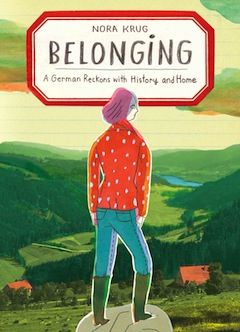
Nora Krug’s Belonging: A German Reckons with History and Home (Scribner, 2018) opens with a page made to look like it’s written in pencil on yellow graph paper. The illustration of a bandage takes up half the page, which is ostensibly “From the notebook of a homesick émigré: Things German.” Entry No. 1 is about Hansaplast, a type of bandage created in 1922 that Krug associates with safety, her mother having used it, for example, to stop Krug’s knee from bleeding after a roller-skating accident at age 6. “It is the most tenacious bandage on the planet,” writes Krug, “and it hurts when you tear it off to look at your scar.”

Belonging is the written and illustrated account of what happens when Krug decides to rip off the Hansaplast and examine the scars left by the history of her family – which had only been related to her in vague terms – and her country of birth, Germany. It is a creative and engaging memoir about Krug’s efforts to define for herself and reclaim for herself the idea of Heimat, tarnished by the Nazis’ use of it in propaganda.

image - Belonging book coverHeimat can refer to an actual or imagined location with which a person feels familiar or comfortable, or the place in which a person is born, the place that played a large part in shaping their character and perspective. Krug’s exploration of identity comprises archival research, interviews with family members and others, and visits to her mother’s and father’s hometowns – Karlsruhe (where Krug grew up) and Külsheim, respectively.

Alternating with the narrative of her discoveries are several notebook entries, on a range of items, from bread to binders to soap, which are both points of pride, as they are quality-made items, and metaphors. For example, Persil is “a time-tested German laundry detergent invented in 1907,” which Krug uses. However, she writes, “Some referred to the postwar testimonials written by neighbours, colleagues and friends in defence of suspected Nazi sympathizers as Persil Certificates. Persil guarantees your shirts to come out as white as snow.”

As well, Krug includes pages “From the scrapbook of a memory archivist,” which present odd and sometimes disturbing arrays of items found at flea markets on her research trips to Germany. These include Hitler Youth trading cards, a letter from the front containing a lock of hair and photographs of soldiers petting or holding various animals, mostly dogs.

But the main intrigue of the book comes from what Krug shares as she persists in her research, asking questions and scouring documents. She wants to find out all she can about her family’s involvement in the Holocaust, in particular that of her maternal grandfather, who died when Krug was 11, and her paternal uncle, who was drafted at 17 and shot and killed at age 18, before her father, a postwar baby, was born; her father was named after the brother he never knew. Despite her efforts, many of Krug’s questions remain unanswered.

At the end of Belonging, it’s not even clear if Krug – who readers find out early on married into a Jewish family – feels any less guilty or any more secure in her self and in her past. But she does manage to start the healing process on some family rifts. And she highlights a couple of steps towards healing that she witnesses in Germany. For example, of Külsheim – which had, in 1988, the 50th anniversary of Kristallnacht, abandoned a proposal for a memorial plaque where the synagogue once stood, before it was burned down the night of Nov. 10, 1938 – she writes: “Plans are made to restore Külsheim’s old mikvah, and a memorial stone is erected where the synagogue used to be, ‘as a manifestation of sadness and shame,’ Külsheim’s new mayor says on the day it is installed.”

The book ends as it began, with a notebook entry. No. 8 is Uhu, “invented by a German pharmacist as the first synthetic (bone-glue-free) resin adhesive in the world, in 1932.” Despite its world-record strength, which is why Krug imports it to repair everything from the soles of her shoes to broken dishware, Uhu “cannot cover up the crack.”

Format ImagePosted on September 20, 2019September 17, 2019Author Cynthia RamsayCategories BooksTags Germany, graphic novel, history, Holocaust, memoir, Nora Krug
Stories about the Holocaust

Stories about the Holocaust

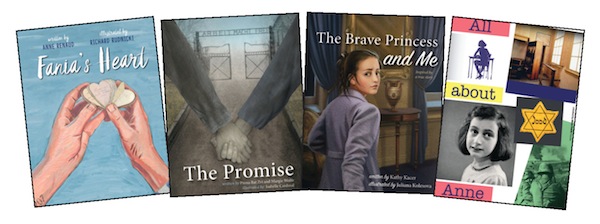
On the Jewish Independent’s bookshelf are four books recently published by Second Story Press. All are inspired by real women and girls, and all share lessons of bravery, solidarity and compassion, as well as of the Holocaust.

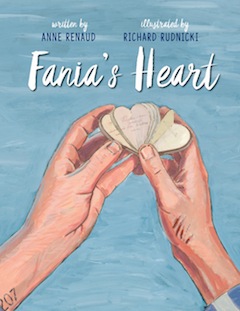
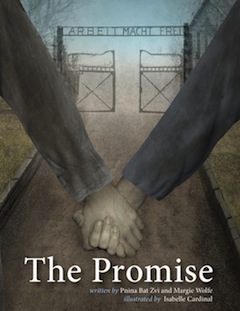
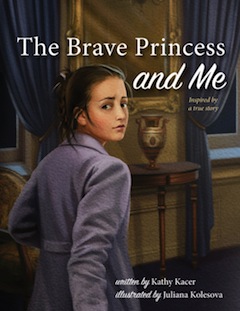
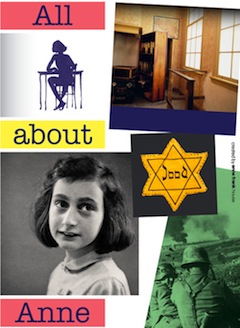
Fania’s Heart by Anne Renaud and illustrated by Richard Rudnicki, The Promise by Pnina Bat Zvi and Margie Wolfe and illustrated by Isabelle Cardinal, and The Brave Princess and Me by Kathy Kacer and illustrated by Juliana Kolesova are hard-covered picture books for readers ages 7-11. All About Anne, by Anne Frank House and illustrated by Huck Scarry (son of children’s authors Patricia Scarry and Richard Scarry), is a soft-cover encyclopedia of sorts for readers ages 9-13.

image - Fania’s Heart book coverFania’s Heart is based on the story of Fania Landau Fainer, from Bialystok, Poland, who survived Auschwitz. In the book, her daughter, Sorale (Sandy), who is “almost 10,” finds a heart-shaped book in her mother’s dresser, where she “was not supposed to rummage.” She takes it to her mom, who tells Sorale about the book’s origin – a 20th birthday present of unimaginable meaning, made by fellow prisoners, at great risk, with breadcrumbs and stolen or bartered thread, pencil, paper and other materials. It is a story told with minimal sentimentality and with illustrations in the 1950s-style of the time in which it would have taken place in real life. An author’s note explains the Holocaust very briefly and how the card, which unfolds “like an origami flower,” ended up at the Montreal Holocaust Museum.

image - The Promise book coverIn The Promise, cousins Bat Zvi and Wolfe tell the story of their mothers, Rachel and Toby, who survived Auschwitz. It starts two years after the sisters were separated forever from their parents, who gave Toby three gold coins to use “only if you have to” and advised, “above all, stay together.” When Rachel becomes ill and is taken from the barracks, the coins play a crucial part in Toby’s rescue attempt. In a four-sentence epilogue are photos of the real sisters, but no context other than that in the story itself, which mentions Nazis and Auschwitz but not the Holocaust. The artwork for the book is somewhat creepy – the disproportionally large heads are photo-like, and placed on more traditionally illustrated bodies.

image - The Brave Princess and Me book coverLess emotionally powerful – in part because there is too much text – is The Brave Princess and Me, which relates how Princess Alice hid Jewish mother and daughter Rachel and Alice Cohen in her home. The Nazis invaded Greece in 1941, and The Brave Princess and Me starts in 1943. Princess Alice, the mother of Prince Philip, was born deaf and she uses her impairment to protect the Cohens. More about the princess, who was honoured as one of the Righteous Among Nations, is included after the story.

image - All About Anne book coverRounding out the publications is All About Anne, a relatively comprehensive telling of Anne Frank’s story, which uses drawings, photographs and text from the Anne Frank House museum in Amsterdam. Its content is based on the questions most frequently asked by visitors to the museum. While it centres around Anne, her life and her diary, it includes broader information about the Second World War and the Holocaust. It is an excellent resource.

For more information on these and other books from Second Story Press, visit secondstorypress.ca.

Format ImagePosted on September 20, 2019September 17, 2019Author Cynthia RamsayCategories BooksTags education, Holocaust, Second Story Press, youth
Being Jewish in Sitka, Alaska

Being Jewish in Sitka, Alaska

The mountains of Sitka, Alaska. (photo by Deborah Rubin Fields)

“You have to look at Jews like Bina Gelbfish, to explain the wide range and persistence of the race. Jews who carry their homes in an old cowhide bag, on the back of a camel, in the bubble of air at the centre of their brains. Jews who land on their feet, hit the ground running, ride out the vicissitudes and make the best of what falls to hand, from Egypt to Babylon, from Minsk Gubernya to the district of Sitka.” (from Michael Chabon’s The Yiddish Policemen’s Union)

Unlike Bina Gelbfish, Lisa Busch is not a fictional character living in Sitka, Alaska. The executive director of the Sitka Sound Science Centre, she has lived in the city for 30 years. She and her husband have two daughters and are active in the local Jewish community. Busch described her congregation as laid-back.

photo - A Tlingit totem pole on grounds of Sitka’s Totem Park
A Tlingit totem pole on grounds of Sitka’s Totem Park. (photo by Deborah Rubin Fields)

The congregation functions out of people’s homes. It does not have its own building. What it lacks in a physical facility, however, it makes up for in creativity. “We share Shabbat and holidays,” said Busch. “When my kids were little, we had a tot Shabbat group of moms and kids and the kids did mitzvot, making challah for neighbours, etc.”

Also when her “kids were little, we put on a Purim play every year,” she said. “My family hosts a Passover seder every year and my husband makes homemade gefilte fish out of rock fish or halibut.”

Both of Busch’s daughters had bat mitzvah celebrations. They learned Hebrew via Skype and the family brought up a rabbi to oversee. Accordingly, the ceremonies were a mix of Jewish traditions and local ones.

Busch said Hebrew lessons are taught by whomever “we could find in town who was willing. For example, we have a Coast Guard air station and buoy tender here and, sometimes, someone was just in town for a few years and willing to pitch in with the teaching. Also, one of the more observant Jews here, David Voluck, spent time with my kids when they were older and met with them over Torah studies and Jewish ideas.”

Busch said, “I am so very appreciative of all the community members who helped educate our kids. I was raised a humanist Jew and, while I am confident in our Jewish values, there is always so much more to know, and having people around us who were willing to share what they know was so wonderful. I’m not sure I could have accessed those kinds of people or those kinds of lessons in a larger city.”

When asked who leads the congregation’s prayers and/or Torah reading, Busch said it’s the task of the person who suggests the event.

The Sitka Jewish community has contact with the congregations in Juneau and Anchorage. The city has had visiting rabbis from both places.

Nowadays, with her daughters grown up, Busch participates in Shabbat and holiday gatherings. What she likes best about her congregation is it casualness and flexibility.

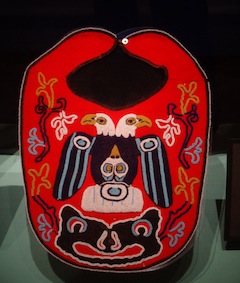
photo - A Tlingit bib from a display at Sitka’s Sheldon Jackson Museum
A Tlingit bib from a display at Sitka’s Sheldon Jackson Museum. (photo by Deborah Rubin Fields)

The flexibility of the Jewish congregation is reflected in the town as a whole, as today’s Sitka honours diversity. While this was not always the case – especially during the period of Russian rule (1799-1867) and when Alaska was a United States territory (statehood was achieved in 1960) – the culture of the indigenous Tlingit people is now highly respected.

There are examples, though, of acceptance that hearken to the past. One of the more humourous incidents involves St. Peter’s by the Sea, a small Episcopal church that is more than 100 years old. Before it opened in 1899, Bishop Peter Trimble Rowe and his congregants decided to include a rose window in the construction of the sanctuary. They placed an order with a glass company located in the eastern United States. They waited many months for the window to arrive. When the window finally came, they found that, instead of the Christian symbol that had been ordered as the focal point, there was a six-pointed Star of David. Considering the time it took to manufacture the window and the window’s complex dimensions, they decided to keep it. The church’s website notes that the Star of David window reminds congregants that Christianity grew out of Judaism.

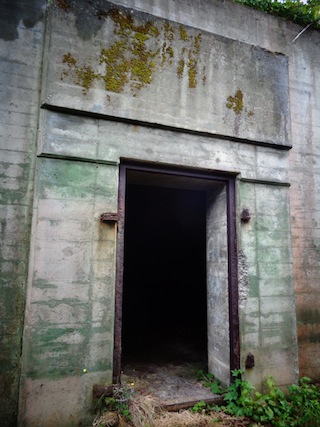
photo - The United States used Sitka as a defensive base in the Second World War. Ammunition magazines, gun emplacements and the headquarters command centre may still be seen at Fort Rousseau historic site
The United States used Sitka as a defensive base in the Second World War. Ammunition magazines, gun emplacements and the headquarters command centre may still be seen at Fort Rousseau historic site. (photo by Deborah Rubin Fields)

Jews apparently began to live in Alaska shortly after the United States purchased the territory from the Russian Empire. A small group of Jews opened up shops in Sitka and, in 1868, a year after the U.S. purchase, Emil Teichman sailed to the city on behalf of the London Fur Co. He wrote in his diary: “the traders, keepers of billiard saloons and dealers in spirits … were mostly of the Jewish race and carried on a more or less illicit trade with the soldiers and Indians, evaded customs and excise duties, and were liable to prosecution at any moment had the administration of the law not been so lax.” (A Journey to Alaska) Interestingly, one Friday night, by chance, he passed a warehouse where some 20 Jewish men were conducting Sabbath eve prayers. Teichman commented: “Jews everywhere, even in the most remote countries, practise their devotional exercises. I should scarcely have expected it in Sitka among a community which engaged in such very disreputable occupations.”

Surrounded by water, temperate rainforests, wildlife and mountains, Sitka (visitsitka.org) is a very pleasant, picturesque and friendly town. It is not hard to understand why Jews have chosen to make it their home.

Deborah Rubin Fields is an Israel-based features writer. She is also the author of Take a Peek Inside: A Child’s Guide to Radiology Exams, published in English, Hebrew and Arabic.

***

Historic decision

In 1938, Harold L. Ickes, U.S. secretary of the interior department visited various parts of Alaska. He wanted to see whether the Alaskan territory could be used as a resettlement sanctuary for persecuted German Jews. Ickes maintained much of Alaska was uninhabited and underdeveloped. He believed that mass Jewish resettlement could potentially strengthen security in a U.S. territory then deemed vulnerable to attack. He had interior undersecretary Harry A. Slattery write a report, The Problem of Alaskan Development. The proposal advocated for the relocation of incoming European refugees into four main parts of Alaska. Opposition came from both within the American Jewish community and from without. Ultimately, the proposal failed, as President Franklin Delano Roosevelt did not give it his backing. Knowing today what happened to European Jewry over the next seven years, this was indeed a sad decision. See Gerald S. Berman’s article, “Reaction to the Resettlement of World War II Refugees in Alaska,” Jewish Social Studies 44 (Summer- Autumn, 1982): 271-282.

– DRF

Format ImagePosted on September 20, 2019September 22, 2019Author Deborah Rubin FieldsCategories TravelTags Alaska, history, Holocaust, Judaism, Sitka, Tlingit
Survivor dances duet of life

Survivor dances duet of life

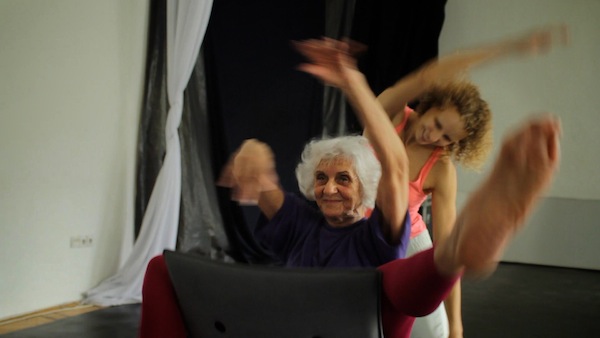
Éva Fahidi, in front, and Emese Cuhorka in a still from The Euphoria of Being, directed and written by Réka Szabó.

Éva Fahidi was 18 years old when she and her family were taken to Auschwitz. The men and women were separated. The women’s selection committee cut the line after Fahidi: “I went one way, and my whole family the other way. It was over. We are talking about a fraction of a moment, when one didn’t even have the faintest idea of what was really happening.” Forty-nine members of her family were murdered, including her mother, father and sister.

Fahidi tells this part of her story as dancer Emese Cuhorka, covered from head to toe in a black leotard, moves around her, expressing with her body some of what Fahidi is expressing verbally. This is but one of many moving scenes in The Euphoria of Being, written and directed by Réka Szabó. The Jewish Independent has chosen to sponsor the documentary’s screening at this year’s Vancouver International Film Festival, which runs Sept. 26-Oct. 11.

Szabó had heard Fahidi give a talk in Berlin, and she had read Fahidi’s memoir, The Soul of Things. She wrote to Fahidi about wanting to make a performance about her, with her it in. The almost-90-year-old Hungarian Holocaust survivor responded positively: “Every person should possess some form of healthy exhibitionism,” she says in the film. “I have more than is needed, so I don’t have any excuses.”

Cuhorka reminds Szabó of Fahidi. From this resemblance came the concept of a duet. At one of the first rehearsals, Fahidi shows Cuhorka what she’s able to do physically. “And, from the outside, it is like seeing an entire life at once,” says Szabó, as she watches them move together.

photo - Réka Szabó
Réka Szabó (photo by Dusa Gábor)

The documentary covers the three-month period prior to the October première of what would become Sea Lavender. The work is the collaborative creation of the three women and, while what we are shown of the final result is powerful, it is the process and the bonds formed by the women that have the most impact, and give the film its inspirational quality.

Fahidi is remarkable. She is smart, spirited, well-spoken and endearing. When she talks about her Holocaust experiences, it is as if she is reliving them; her eyes look unfocused, her body appears heavier, her anger remains. She says her family should have left Hungary in 1935. “But my poor father, he couldn’t see beyond his nose,” she says. So proud was he of what he had built, he couldn’t leave it behind and only go with the clothes on his back. “This is the eternal tragedy,” she says, “that you don’t see things for what they are when you see them. Absolute idiocy.”

The film then cuts to a photo of the family – her parents, sister and her – as Fahidi describes the way in which she imagines them being gassed. She talks about a documentary she saw on Zyklon B, how it was first tried on geese. Such factual expositions lay raw the depth of her grief.

Yet, when Szabó asks Fahidi to list some of the things that helped her survive, Fahidi remarks that you have to appreciate and value the fact that you’re alive. “The fact that you exist, in itself, is euphoric,” she says. Hence, the name of the documentary and of the choice of “the flying chair duet” as the final scene of the performance. In discussing the nature of tragedy, Fahidi concludes that it’s no use thinking about it because you always end up in the same sad place. “Meanwhile,” she says, “you live happily.”

Seeing Cuhorka and Fahidi work and perform together is delightful – the two really do bear similarities, and their mutual respect is evident. The closing text of the film notes, “At the age of 93, Éva is still performing regularly. So far, we have staged 77 performances of Sea Lavender in numerous cities, such as Berlin, Budapest and Vienna.” While it is too much to hope that the show will come to North America, it is satisfying to know of the project’s life-changing effect on Fahidi, who, apparently, “can’t imagine being alive and not performing the piece anymore.”

The Euphoria of Being screens Sept. 27, 12:30 p.m., at International Village 8, and Oct. 3, 7 p.m., and Oct. 4, 10 a.m., at Vancity Theatre. For tickets, visit viff.org.

Format ImagePosted on September 13, 2019September 10, 2019Author Cynthia RamsayCategories TV & FilmTags dance, documentary, Emese Cuhorka, Éva Fahidi, Holocaust, memoir, Réka Szabó, survivor, Vancouver International Film Festival, VIFF
Colour bursts forth in Conjunction

Colour bursts forth in Conjunction

Ira Hoffecker’s current solo exhibit at the Zack Gallery, Conjunction, runs until July 21. (photo by Olga Livshin)

Conjunction, Ira Hoffecker’s current solo exhibit at the Zack Gallery, opened on June 13 and runs until July 21.

German-born Hoffecker and her family moved to Canada in 2004. “I always liked art, but when I lived in Germany, my husband and I worked in marketing for the movie industry,” she explained in an interview with the Independent.

Once, when her children were still young, they came here for a family vacation and traveled Vancouver Island. “We loved it,” she said. So much that, when they moved here permanently, they settled in Victoria. As if that wasn’t change enough, Hoffecker also decided to switch careers and follow her lifelong love of art. She enrolled in the Vancouver Island School of Art and has been studying and creating ever since.

Hoffecker’s previous show at the Zack Gallery, in 2016, was dedicated to maps. Since then, her art has undergone a couple of transformations. Conjunction is much brighter and more expressive set of works, although the abstract component remains.

On the journey to her new colourful mode, Hoffecker went through a black-and-white stage, which was the focus of her master’s in fine arts’ thesis, which she completed last year. The works she created for her master’s degree include a number of huge paintings – abstracts made with tar on canvas – plus three documentary videos. The theme – “History as Personal Memory” – was a painful one for the artist. She recalled, “One of my professors said that my works are the interconnected layers of urban setting and history. ‘Where is your personal layer?’ he asked me.”

Taking this advice, she has been trying to delve into her personal recollections, to uncover her place in history, her “personal layer” among the historical layers dominating her art. “In ‘History as Personal Memory,’ I tore pages from a history book about the Third Reich, an era in history that many Germans would prefer to forget. Yet I think it is important to face and discuss this past. Such dialogue might prevent the horrors from happening again,” she said.

In Hoffecker’s art, the artist’s memories are intertwined with the history of her nation. “Correlations between my childhood abuse, which I tried to forget, and the history of Germany, which the Germans tried to eradicate from their memories, exist in my paintings and films,” she said.

In her art and her videos, she opens up about the abuse she suffered as a child at the hands of her grandfather, who was also a Nazi. She is convinced that such openness has helped her heal, whereas suppressing the memories led only to the festering of her inner wounds.

The same is true for historical memories, Hoffecker insisted. “Germany needs to remember, to confront and challenge complacency to prevent a repetition of historical atrocities,” she said.

Her master’s thesis was a deep and painful discovery, a journey in black-and-white to underscore the grimness and tragedy of the topic. Once it was completed, she was ready for a change of direction.

“I spent the summer last year in Berlin,” she said. “When I came back home to Victoria, I wanted to paint some colours again.”

Hoffecker’s current exhibit bursts with vibrant colours and optimism. The series Berlin Spaces, like most of her paintings, has several layers. “There are outlines of many famous Berlin buildings there,” she said, tracing the architectural lines embedded in the abstract patterns with her finger. “The Jewish Museum, the Philharmonie, the library, the Reichstag. It is like a reconstruction, when I think about the past. I overlay history and architecture.”

One of the paintings, a bright yellow-and-pink abstract, has writing among its patterns. “It means ‘forgetting’ in German,” Hoffecker explained. “A few years ago, I was invited to have a solo show in Hof, a city in Germany. I worked there in the archives, found many old maps and records. One of their buildings is a factory now. After the war, it was a refugee camp, and there is a plaque to commemorate the fact. But, during the war, it was a labour camp, a place from where Jewish prisoners were transported to concentration camps and death, but nothing is there to remind [people] of that past. The painting reflects the current happy state of the building, but it also reflects the tragic past, the past we shouldn’t forget.”

While not many art lovers will see the horrors of the labour camp in the airy and cheerful palette of the painting, Hoffecker doesn’t mind. Like other abstract artists, she infuses her images with hidden messages, but doesn’t insist on her personal intentions.

“I own the making,” she said. “I bring in my memories and my heart, but I have to leave the interpretation to the viewers. One man in Victoria loves my art. He bought two of my paintings. He said he sees animal in them. I don’t paint animals, but I’m glad people’s own experience resonates with my paintings.”

Hoffecker is very serious about her art, but bemoans the need for promotion. “I did marketing for movies professionally, but I never really cared [about the reaction]. If someone didn’t like the movie we were pushing, it was his business,” she said. “But to promote my own paintings is scary. When someone doesn’t like what I do, I care. It hurts. I don’t want to do it. An artist wants to be in her studio and paint. It is all I want: to paint and to exhibit. I want people to see my work. Besides, a show is the only time when I see many of my paintings together. I never can do that in my studio. I only see one or two at a time.”

To learn more about Hoffecker’s work, visit irahoffecker.com.

Olga Livshin is a Vancouver freelance writer. She can be reached at [email protected].

Format ImagePosted on July 5, 2019July 10, 2019Author Olga LivshinCategories Visual ArtsTags abuse, art, Germany, history, Holocaust, Ira Hoffecker, maps, memory, painting, Zack Gallery

Naming inhumanity

Concentration camps are in the news this week. The term, which was first used in the context of Jews in the Holocaust, is being invoked by opponents of the U.S. government’s detention of migrants from Latin America. Appallingly, those detained include hundreds of children who have been separated from their parents. These current child detainees are among the at least few thousand children who have been separated from their families over the last two years.

The use of “concentration camps” and phrases like “Never again” has been criticized by some high-profile Jewish activists and others as diminishing the meaning and seriousness of the Holocaust. Some see the use of these terms as a cheapening of the Jewish experience or a form of Jew-baiting. In contrast, it is not heartening that Republicans who sanctimoniously condemn the use of these terms have a crass political motivation for defending the sanctity of Jewish historical memory.

There is no question that the words are used for their shock value. And, at a time when short attention spans intersect with what is genuinely a grotesque affront to humanity, there is little wrong with shocking a complacent population.

Reports from the facilities tell of sickening conditions.

A group of lawyers who toured one of the facilities and spent days interviewing child-inmates said that the most basic standards demanded under international law around the treatment of children in custody are being ignored. Children are not supposed to be held for longer than 72 hours, but many have been incarcerated for weeks. They are crammed into windowless warehouses, unwashed for days, in mucous-stained clothing, without the most rudimentary necessities like soap or toothbrushes, sleeping on cold concrete floors, suffering lice-infestations and untreated influenza outbreaks. Guards bring diaperless 2- and 3-year-old children to the facility and ask older children to care for the younger ones. Teenagers serve as unofficial guards in exchange for extra food. Parents are being held separately in unknown locations and some experts have said it is likely some families will never be reunited.

The situation for adults is not to be ignored either. At one facility, about 900 migrants are incarcerated at a facility intended for 125. Cells intended for 35 people are jammed with more than 150.

In an unfathomable breach of what public relations folks call “optics,” there are plans to accommodate the ever-growing number of child detainees by repurposing Fort Sill, Okla., a site where Japanese-Americans were interned during the Second World War.

To be charitable, the argument over language reflects a struggle to find words for what is happening. The situation for these children (and adults) is intolerable in any country, least of all, perhaps, in the land that once welcomed the tired, the poor, the huddled masses yearning to be free.

Still, concerns over the desecration of the memory of the Holocaust are legitimate. We have witnessed too many instances where minor affronts are equated with Nazism and other massively inappropriate comparisons. But the Holocaust did not begin with crematoria. It began with dehumanization and othering and, as the will of the world to tolerate increasingly hostile acts against Jews was tested and found to be elastic, the perpetrators progressed into successive stages leading to genocide.

There is no way to predict the future and there is little point in making unnecessarily combustible assertions about impending genocide. But, when human beings are treated as they are in this circumstance and the trajectory is toward more of the same, people must militate against this inhumanity.

A consensus has developed among Holocaust educators and human rights activists that the term “Never again” does not apply solely to attempts to reprise anti-Jewish ideas and actions, but that the lesson of the Shoah is that we must be vigilant when any people are targeted.

It is unfortunate that the people who seem most inclined to use Holocaust-associated language in the context of current events are also people whose record on issues of concern to Jewish people are highly problematic, drawing reasonable suspicions to their motives. Terminology is important. But, the more we learn about what is happening to children and others in American detention facilities, the more hair-splitting over nomenclature seems to compound the inhumanity we are witnessing.

We are correct to be defensive about any perceived disrespect to the memory of the Holocaust and its victims. However, we might ask ourselves, when judging the appropriateness of such usage: If not now, when?

Format ImagePosted on June 28, 2019June 26, 2019Author The Editorial BoardCategories From the JITags concentration camps, discrimination, Holocaust, human rights, politics, United States
Not long ago, not far away

Not long ago, not far away

This child’s shoe and sock were found in January 1945 among thousands of others at Auschwitz-Birkenau, abandoned by the Nazis as the Red Army approached. (photo from Collection of the Auschwitz-Birkenau State Museum, Oswiecim, Poland. ©Musealia)

On display now at the Museum of Jewish Heritage in New York City, the exhibit Auschwitz: Not Long Ago. Not Far Away is the most comprehensive Holocaust exhibition ever mounted in North America about Auschwitz. Dedicated to the victims of the death camp, the goal of this exhibit is to make sure no one ever forgets.

A study conducted by the Conference on Jewish Material Claims Against Germany reported that 41% of Americans and 66% of millennials say they don’t know about the Auschwitz death camp, where more than a million Jews and others, including Poles, Sinti and Roma, Soviet prisoners of war, homosexuals, Jehovah’s Witnesses and others, were executed. And 22% of millennials say they haven’t even heard of the Holocaust.

image - Artist Alfred Kantor’s depiction of arrival in Auschwitz: “Throw away your baggage and run to the trucks”
Artist Alfred Kantor’s depiction of arrival in Auschwitz: “Throw away your baggage and run to the trucks.” (photo from Gift of Alfred Kantor, Museum of Jewish Heritage, N.Y.)

“Seventy-three years ago, after the world saw the haunting pictures from Auschwitz, no one in their right mind wanted to be associated with the Nazis,” Ron Lauder, founder and chair of the Auschwitz-Birkenau Foundation Committee and president of World Jewish Congress, said. “This exhibit reminds them, in the starkest ways, where antisemitism can ultimately lead and the world should never go there again. The title of this exhibit is so appropriate because this was not so long ago, and not so far away.”

The exhibition consists of 20 galleries spanning three floors, and features more than 700 original objects and 400 photographs. They are on loan from more than 20 institutions and private collections around the world, as well as the Auschwitz-Birkenau State Museum in Poland.

An audio guide given to each visitor upon entry details the items on display. Visitors will see hundreds of personal possessions, such as suitcases, eyeglasses, photos, shoes, socks and clothes that belonged to survivors and those murdered at the concentration camp. In one glass case, a child’s shoe is on display with a sock neatly tucked inside. We are left to wonder, who put that sock in the shoe and were they expecting the child to shower and then retrieve it?

photo - Determined to survive, and to have a head of hair again one day, Ruth Grunberger made this comb for herself in Auschwitz, using stolen scrap metal and wire
Determined to survive, and to have a head of hair again one day, Ruth Grunberger made this comb for herself in Auschwitz, using stolen scrap metal and wire. (photo from Collection of the Museum of Jewish Heritage. Gift of Ruth Mermelstein, Yaffa Eliach Collection donated by the Centre for Holocaust Studies.)

Auschwitz was located 31 miles west of Krakow in the small southern Polish town Oswiecim, which dates back to the Middle Ages. Jews were a part of its society for centuries. Auschwitz-Birkenau was conceived and initially constructed to house 100,000 Soviet prisoners of war and slave labour, before it became a factory of death. The architect who designed the camp was Fritz Ertl, a native of Austria. Ultimately, some 1.1 million Jews and thousands of others were killed there. Many who arrived at Auschwitz were sent directly from the overcrowded, sealed, windowless boxcars to the gas chambers and crematoriums.

There are videos throughout the exhibit, including one of Hitler and a large adoring crowd. There’s a concrete post that was a part of the fence at the Auschwitz camp, and a part of the original barrack for prisoners at the killing centre.

photo - Margit (Manci) Rubenstein made this Star of David necklace from material taken from the lining of her shoes and shoelaces while imprisoned in Auschwitz (1944)
Margit (Manci) Rubenstein made this Star of David necklace from material taken from the lining of her shoes and shoelaces while imprisoned in Auschwitz (1944). (photo from Collection of the Museum of Jewish Heritage. Gift of Sugar siblings in memory of Rosenfeld and Schwartz families.)

A German-made Model-2 boxcar, like those used to transport people to Auschwitz, sits outside the museum. In a video, survivors talk of the horrible conditions and stench inside those boxcars.

Viewers can see the operating table, test tubes and instruments used in medical experiments. There’s a gas mask used by the SS and a model of a gas chamber door used in crematoria 2, 3, 4 and 5 – and testimonies from survivors of the camp. To show the striking contrast between the victims and the perpetrators, there are photos of Rudolf Hess at his nearby residence with his family enjoying the outdoors.

Nazi ideology and the roots of antisemitism are traced from the beginning, to understand what happened before the gas chambers were created. Discrimination and bigotry against Jews existed long before Hitler came into power, of course. In one room, there’s an anti-Jewish proclamation issued in 1551 by Ferdinand I that was given to Hermann Göring for his birthday by German security chief Reinhard Heydrich. The proclamation required Jews to identify themselves with a yellow ring on their clothes. Heydrich noted that, 400 years later, the Nazis were completing Ferdinand’s work.

In a video seen near the end of the exhibition, Holocaust survivors urge people to refrain from hate and to work for peace.

This exhibition was in Madrid before coming to New York. This important and moving must-see exhibition is both a reminder and a warning.

Alice Burdick Schweiger is a New York City-based freelance writer who has written for many national magazines, including Good Housekeeping, Family Circle, Woman’s Day and The Grand Magazine. She specializes in writing about Broadway, entertainment, travel and health, and covers Broadway for the Jewish News. She is co-author of the 2004 book Secrets of the Sexually Satisfied Woman, with Jennifer Berman and Laura Berman.

***

Located in the Museum of Jewish Heritage, at 36 Battery Place, entry to the exhibit Auschwitz: Not Long Ago is by timed tickets available at mjhnyc.org. An audio guide is included with admission, and tickets range from $10 to $25. Hours are Sunday to Thursday, 10 a.m.-9 p.m. (last entry at 7 p.m.), and Friday, 10 a.m.-5 p.m. (last entry at 3 p.m.). The exhibit will be in New York until January 2020.

Format ImagePosted on June 14, 2019June 12, 2019Author Alice Burdick SchweigerCategories WorldTags Auschwitz, history, Holocaust, Nazis, Ron Lauder, Second World War

Posts pagination

Previous page Page 1 … Page 20 Page 21 Page 22 … Page 44 Next page
Proudly powered by WordPress