Under community pressure, a Richmond auction house backed down from selling a collection of Nazi memorabilia last weekend. Maynards Fine Art and Antiques was set to auction items including Nazi flags, military items and other war-era artifacts on Saturday. Two days before that, the Centre for Israel and Jewish Affairs was made aware of the items by a member of the community.
“We spoke to the lead appraiser, the person in charge of auctioning this lot,” said Nico Slobinsky, CIJA’s Pacific region director. “We provided context and tried to explain why auctioning these items was morally reprehensible. I would love to be able to tell you that we got positive engagement and understanding at the time when we had those conversations on Thursday. We did not get that positive engagement. It was clear to us from the response from the auction house that they were going to go ahead with the auction as originally planned.”
Community members and elected officials quickly mobilized and media seized the story. Individuals messaged the auction company and politicians lined up in opposition to the sale. Two members of the legislature from Richmond, Jas Johal and John Yap, spoke out, as did Andrew Wilkinson, leader of the B.C. Liberals.
Mike Sachs, past president of the Richmond congregation the Bayit and a Jewish community activist in Richmond, mobilized his contacts – even while vacationing in Mexico. He said Richmond Mayor Malcolm Brodie not only spoke out against this incident but promised to proclaim Holocaust Awareness Day in January 2020.
“People were just disgusted that Maynards would do such a thing,” said Sachs. “As a whole, we all agree enough of profiting off Jewish blood. Enough. We’re not going to accept it anymore.”
Sachs and Slobinsky praised community allies who spoke up. They both believe that historical artifacts like these should be in museums or educational institutions, where they can serve as educational tools in proper context.
CIJA is asking Maynards for an apology and a donation to the Vancouver Holocaust Education Centre. The organization extended an offer to the undisclosed owner of the items to assist in placing them in an appropriate venue.
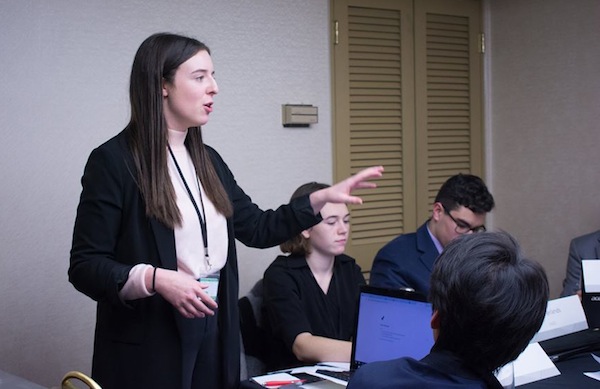
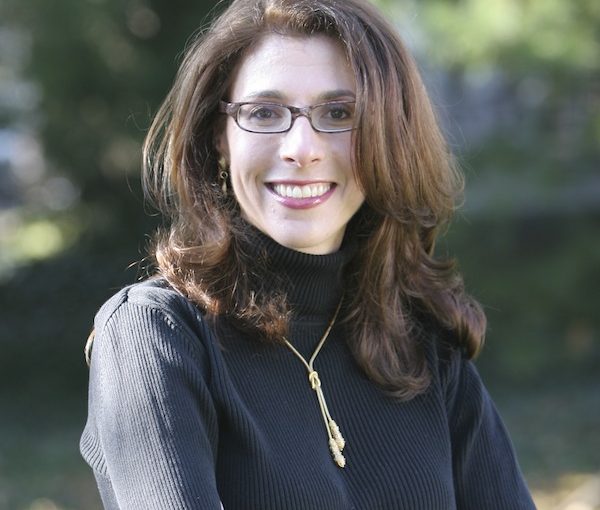
Maya Lichtmann (photo from Connect Model United Nations Vancouver)
Maya Lichtmann was selected in May as a Canadian high school intern for StandWithUs, an international organization that educates about Israel and fights antisemitism. She was chosen for the program after participating in a StandWithUs event at King David High School.
Lichtmann, a Grade 12 student at J.N. Burnett Secondary School in Richmond, attended a conference in August at the American Jewish University in Los Angeles with about 100 other high school interns, including about a dozen Canadians. She will join all high school and college interns in January at the same location.
As part of the internship, she recently delivered an educational program to two History 12 classes at her school. She covered the history of the Jewish people, how they came to Europe, the rise of Nazism, the Holocaust, the creation of the state of Israel and the rise of anti-Zionism. While she uses resources offered by StandWithUs, her presentations are developed independently.
“A lot of the presentations that StandWithUs have are catered toward Jewish audiences, because a lot of the kids who are doing the internship go to private Jewish schools,” she said. Because she goes to a public school, and one where a majority of students are of Asian heritage, she developed the presentations for audiences with limited knowledge of the topic. She received entirely positive feedback from a “100% non-Jewish audience,” she said.
Lichtmann plans to make a presentation about LGBTQ+ rights in Israel to her school’s gay-straight alliance, and one about Israel’s role in the international community at her Model United Nations Club, which she led as president last year. She will also be delivering a presentation at a student-run TEDx event.
“I’m very passionate about Israel,” she said. “It’s one of the key factors in fighting international antisemitism because I believe that unity and acceptance of Jewish people has been a struggle for the past 1,900 years, as the Jewish people were throughout the Diaspora, and I hope to continue to help Jewish people feel more accepted within society.”
She added: “My grandfather was in a concentration camp, Bergen-Belsen. We were forced to relocate after the Holocaust, so my family moved to Israel and my father was born in Israel and then immigrated to Canada. But my ties and connection to Israel are obviously still very strong.”
Lichtmann also is on her school’s student council, president of the school’s Women in Leadership Club, youth representative on the board of directors at the Thompson Community Centre in Richmond, and premier-elect of the Richmond-Delta Youth Parliament. She coaches cheerleading and tutors international students in English.
Lichtmann is a daughter of Mandy and Eyal Lichtmann and big sister to Noa and Liel.
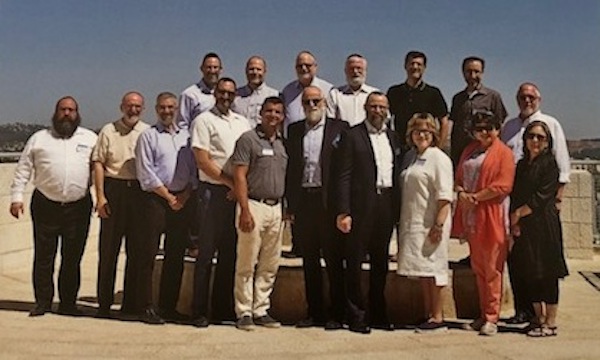
Chabad Richmond’s Rabbi Yechiel Baitelman, far left, was the only Canadian spiritual leader to participate in first-ever rabbinic seminar on Holocaust studies at Yad Vashem, the World Holocaust Remembrance Centre, this past July. (photo from Chabad Richmond)
For one week this past July, 15 pulpit rabbis gathered together to take part in the first-ever rabbinic seminar on Holocaust studies at Yad Vashem, the World Holocaust Remembrance Centre, in Jerusalem.
Yad Vashem is the foremost resource for Shoah educators, both Jewish and non-Jewish. Fourteen rabbis and rebbetzins from North America and one rabbi from Israel, all of whom are engaged in adult education, were invited to participate in the week-long pilot immersion program, which was sponsored by David and Ellie Werber and Martin and Bracha Werber. The diverse group of spiritual leaders spanned the religious spectrum.
Rabbi Yechiel Baitelman, director of Chabad Richmond, was the only Canadian rabbi to participate in the seminar, with the Jewish Federation of Greater Vancouver being a partial sponsor of his travels. He described the week of learning at Yad Vashem as “transformational, uncomfortable, overwhelming, extremely challenging, very enlightening and at times very inspiring. It’s going to take awhile to unpack all this information.”
Entitled Teaching the Shoah and Antisemitism: Opportunities, Challenges and Techniques, the seminar consisted of 65 hours of lectures by scholars and experts, plus testimonials from Holocaust survivors. Covering an array of topics, the point of the program was to help rabbis cultivate the skills necessary to create an educational curriculum and content for Holocaust studies in their schools, adult education classes and congregations at home. Yad Vashem’s challenge was to find unique approaches to teaching people about history, theology, antisemitism and Jewish values relating to the Holocaust, as well as to expand the breadth and scope of emissaries who will ensure the continuity of the stories and pass along the lessons learned from the Shoah.
The Yad Vashem seminar incorporated a multidisciplinary approach to Holocaust education and used various methodologies to help participants comprehend the complexity of the Shoah as a whole, never forgetting the personal stories of individuals. The curriculum included studying prewar Jewish life in Europe; the rise of Nazism; life in the ghettos; concentration camps and the attempted “Final Solution”; liberation from concentration camps; survivors returning to life in the “new world”; the ongoing pursuit of Nazi war criminals; the new antisemitism and anti-Israel rhetoric; physical and spiritual resistance; the role rabbis played during the Shoah; survivor testimony; and theological responses to the Holocaust.
Speakers included international researchers, professors and historians; a world expert on antisemitism; the head of Holocaust studies at Yad Vashem; a Nazi hunter; and several Holocaust survivors, including former chief rabbi of Israel, Rabbi Yisrael Meir Lau, and Rabbi Judge David Frenkel.
As the survivor population gets smaller, others need to ensure that the lessons of the Holocaust are never forgotten. Yad Vashem understands that rabbis have a special role to play in teaching about the rabbinic, theological and spiritual meanings and implications of the Holocaust. For his part, Baitelman will be looking for ways to collaborate with the Vancouver Holocaust Education Centre to create a curriculum for Jews and non-Jews alike.
“The challenge is how to talk to teens, 20-somethings, 30-somethings and 40-somethings about the Holocaust,” said Baitelman. “What should the message be?… We’re a people who have always told stories. Even though we are so many generations removed, in a sense, it is still my story, our story. The message is not only about where we come from, but also about where we are going.” He stressed that, with growing global antisemitism, we need to strengthen the Jewish people worldwide – Jewish education, Jewish values and Torah observance.
“Although we might struggle with faith,” said Baitelman, “we still need to look for G-d amidst the rubble and the hatred. It’s imperative that we find inspiration from those who survived the Holocaust, and find ways to teach tolerance, empathy and understanding.”
Baitelman believes it’s essential to address not only the theological question of “Where was G-d?” during the Holocaust, but also, “Where was man in all of this?”
“If, as a result of the Holocaust, one does not believe in G-d, then we have to believe in humanity,” he said. “The question is: ‘Where was the humanity of the people that perpetrated these crimes?’”
For the rabbi, a meaningful Jewish education involves people living Jewishly. “We need highly educated, well-informed Jewish kids living fully engaged Jewish lives,” he said. “We need children who are living proudly Jewish.”
Baitelman has taught several courses on the Holocaust through the Jewish Learning Institute, and has talked to teachers, school classes and new immigrants about antisemitism and the Holocaust. He said education needs also to address the important question of “Now what? What are we here for?”
Shelley Civkinis a happily retired librarian and communications officer. For 17 years, she wrote a weekly book review column for the Richmond Review, and currently writes a bi-weekly column about retirement for the Richmond News. She is a volunteer with Chabad Richmond.
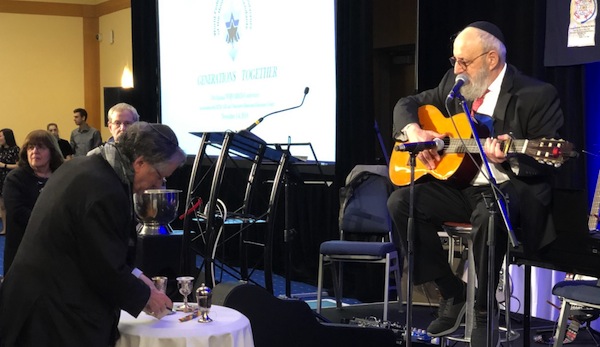
Child survivors Rabbi Joseph Polak, right, and Robert Krell at the Havdalah service Nov. 2, part of the annual conference of the World Federation of Jewish Child Survivors of the Holocaust and Descendants. (photo from Robert Krell)
When Halina Levitt was 2 years old in a part of Poland that is now in Ukraine, her mother left her with a Polish farm family to hide through the Holocaust.
“My mother luckily survived and came back to retrieve me,” Levitt told the Independent. “Of course, at that point, I was 5 years old and she was a total stranger to me. I didn’t want to go with her.”
The family who saved her didn’t want to relinquish her, either, and, as the conflict between the birth mother and the Polish family escalated, neighbours gathered and tried to intervene on behalf of the family as the mother tried to reclaim her child.
“She was quite scared for her life until we boarded the bus and got away from there,” Levitt said.
Rose Raport, a retired doctor from New Jersey, was also left with another family.
“I was given away to a Polish farmer at age 4,” she said. But her parents never returned. “I spent six years and, by the end of my stay with the Polish family, I found out that I’m left alone. There were no parents, there was no sibling, no family and that’s it.” She was turned over to the Jewish community and continued her life in a Jewish orphanage.
Karen Komar, a Massachusetts woman, managed to remain with her family in their home in Hamburg, Germany, until 1941. Then, an intervention by a distant American relative – Arthur Bulova, head of the Bulova watch company – succeeded in getting the family a visa to the United States.
These were just three of the experiences of people who convened in Vancouver Nov. 1-4 for the 31st annual conference of the World Federation of Jewish Child Survivors of the Holocaust and Descendants.
About 400 people attended the gathering – about 110 survivors, joined by members of the second, third and fourth generations, as well as spouses. Each has a unique experience, yet all who spoke with the Independent said such meetings are an opportunity to share time with those most likely to comprehend what they have endured and the lives they have led.
The conference was co-chaired by Vancouverites Marie Doduck and Dr. Robert Krell, both child survivors of the Holocaust.
The conferences create a feeling of belonging, said Doduck.
“Our survivors feel safe, they talk about their lives, their grandchildren, their past, their future, their thoughts in a safe place,” she said. “And the children felt a safe place to speak about their feelings, that they may not be able to do with their parents or grandparents.”
Child survivors – almost all of whom were hidden children during the war because almost none of the children who were sent to concentration camps survived – were not recognized, by themselves or others, as Holocaust survivors or as a distinct group until the 1980s. Because they were so young during the war, or because they were not in the camps, their experiences were dismissed by adults. A 1988 book by Helen Epstein, Children of the Holocaust: Conversations with Sons and Daughters of Survivors began a reconsideration of the individual and collective experiences of the second generation, but also of those who survived as hidden children and who were not, until then, considered “survivors.”
“We still are the children inside of us,” said Doduck. “When I speak in schools, I speak of the child inside of me, not this mother, grandmother, now great-grandmother that they’re looking at, this old lady. This old lady is really Mariette the child, who is starting, after 70 years growing up … who had no childhood, who lived with bombs and death and starvation and disease. I knew that, if I was sick, I would die, and most of us have these kinds of stories.”
Categories can be fluid, Krell explained. As a hidden child who survived in Holland thanks to a Christian family, he is a child survivor. But he is also a second generation, because his parents survived the camps and came back to claim him. This was statistically extraordinary, as the Netherlands had one of the highest Jewish death rates by country in the Holocaust.
Krell feels a special kinship with Abe Foxman, longtime head of the Anti-Defamation League, with whom he organized one of the first child survivor conferences, in 1991. Foxman was hidden from ages 2 to 5, just like Krell. His parents also returned to claim him, an even more statistically anomalous outcome, given that he was in Poland, which had the most catastrophic statistics of annihilation. Krell tried to get Foxman to attend this month’s conference, but the distance was too great to travel.
Location is an important part of the conferences, said Krell, and accessibility is one of the reasons they move annually in Europe, all over North America and to Israel, depending on the year. This year, almost half the attendees were British Columbians.
More than three dozen workshops, panel discussions and plenaries offered a range of topics for attendees, with some exclusive to survivors or successive generations. An art installation and a musical concluding evening added to the weekend experience.
Guest presenters included Rabbi Joseph Polak, a child survivor of Bergen-Belsen and author of After the Holocaust the Bells Still Ring; Dr. Catherine Chatterley, founding director of the Canadian Institute for the Study of Antisemitism; Prof. Chris Friedrichs, professor emeritus of history at the University of British Columbia; and Vancouverite Robbie Waisman, a survivor of Buchenwald, who spoke together with Éloge Butera, a survivor of the genocide against the Tutsis in Rwanda, about human rights activism. Krell’s plenary address opened the conference on the Saturday morning with a keynote titled The Future of Our Past: Informing and Inspiring Next Generations.
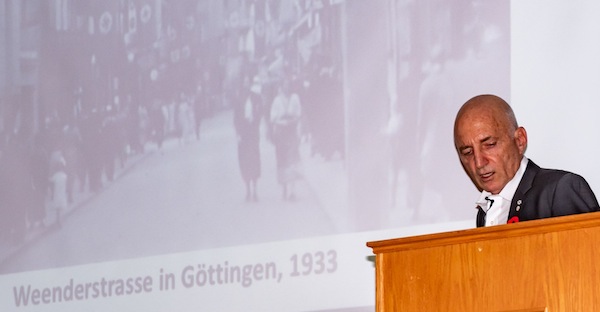
Dr. Michael Hayden delivers the keynote address at the annual Kristallnacht commemorative program Nov. 7. (photo by Al Szajman)
In the 1930s, German Jews were required to register all precious metals in their possession, a prelude to having them confiscated. In Hamburg alone, the Nazis collected 20 tons of silver, much of it Judaica. Of this, they melted down 18 tons. Two tons was deemed by the Nazi curator Carl Schellenberg to be of artistic or other value in its existing form.
After the war, Schellenberg was kept on by the British because his scrupulous indexing of artifacts made him valuable. His love of the city of Hamburg meant he ensured that some of the most precious pieces of stolen art and artifacts made their way to that city’s museum.
That is where Dr. Michael Hayden, a Vancouver researcher in molecular medicine and human genetics, and one of the world’s leading researchers in Huntington disease, was able to trace one of the few remaining pieces of his grandparents’ once-extensive collection of Judaica.
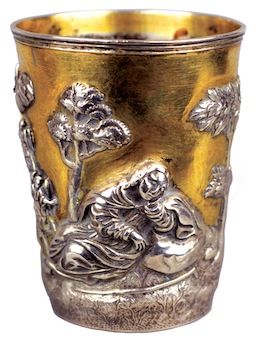
A silver Kiddush cup, crafted in 1757 and embossed with a vivid three-dimensional depiction of the story of Jacob’s vision of a ladder to heaven, which belonged to his grandparents, Gertrud and Max Raphael Hahn, has been restituted to the family. It is now on loan, a small artifact in size but one of the most stunning pieces in a just-opened exhibition at the Vancouver Holocaust Education Centre, titled Treasured Belongings: The Hahn Family & the Search for a Stolen Legacy.
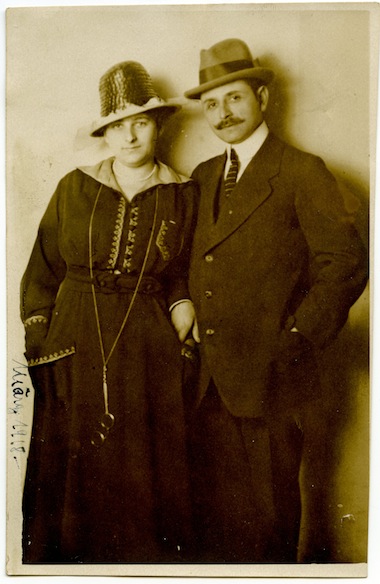
Max and Gertrud Hahn, the patriarch and matriarch of the German-Jewish Hahn family of Göttingen. Photo taken in Berlin, Germany, 1918. While their children, Rudolf and Hanni, emigrated to England, the couple did not survive the Holocaust. (photo from Hahn family)
Hayden delivered the keynote address at the annual Kristallnacht commemorative program Nov. 7, before the opening of the exhibition to the public. The exhibit runs to Nov. 27, 2020.
“It’s a story that it’s taken me a long time to confront,” Hayden told the Independent.
Hayden’s grandparents were transported to Riga, Latvia, in 1941, where they were murdered by Latvian collaborators of the Nazis. Max Hahn had been arrested for the first time on Kristallnacht, three years earlier, but, with Gertrud, had managed to secure the passage of many possessions to safe locations in the neutral countries of Sweden and Switzerland. More importantly, they had sent their two children, daughter Hanni and son Rudolf – Hayden’s father – to safety in London.
After the war, the orphaned pair retrieved the remnants of their family’s material possessions. Rudolf, who joined the British army in 1943 and adopted the less Germanic-sounding name Roger Hayden, moved to South Africa. There, more than a dozen boxes sat undiscussed in the family home. When Roger passed away, Michael Hayden shipped the boxes to his Vancouver home, where they sat, unopened, for another two decades.
When he finally confronted the parcels from his family’s past, he discovered a stamp collection, maps, artworks – and 9,000 original documents relating to his family’s history from the 1850s until 1941. These included heart-wrenching letters between Rudolf in England and his parents still in Germany.
While Michael Hayden was growing up, there were some items that his father had not kept stored away. One was a Paul Ritter violin that Rudolf had received on his bar mitzvah. Michael’s daughter, Anna, now a Vancouver hematology oncologist, played on it as a young person and Hayden hopes to one day hear grandchildren also play it. It is part of the exhibit. It is also a hint of how the family got its name. It was not a coincidence that, in anglicizing his name, Rudolf/Roger chose a variation on the surname of a legendary classical composer.
“There were piano recitals and all kinds of concerts in the Hahn family every Sunday,” said Hayden. “They used to have a little chamber orchestra, it was a totally different world. So, he chose the name Roger Hayden from Rudolf Hahn and I’m sure Hayden had some comfort for him because Haydn was so important in his life.”
Hayden credits the German government and museums for supporting restitution efforts. His family recently received a grant from the German federal government to hire a researcher to continue the search. Understandably, the challenges are great. The Hahn family’s collection of Judaica was considered one of the finest and most extensive in Germany, rivaling those of the Sassoon and Rothschild families. Because they had lent some objects to museums, and because of Max and Gertrud’s careful recordkeeping, the family has both photographs and detailed inventories of what the collection included before it was looted. Most families do not have such tangible proof.
Hayden emphasizes that any material value of restituted artifacts is irrelevant and the importance is because of personal significance, and that the process represents steps toward reconciliation and restoring dignity of Nazism’s victims.
“For me, personally, it’s been a process of coming to terms with the unimaginable horror and confronting it,” he said.
He has had very positive and some negative experiences during this work. He is impressed with the German government’s efforts to seek forgiveness for their country’s past, including memorializations like the 70,000 Stolpersteine, stumbling stones, that have been installed outside the last homes of victims of the Nazis, and the fact that the vast Holocaust memorial in Berlin is located between the embassies of major countries in the heart of the city.
“When I see Germany and I see what they’re doing, it’s been very instructive for me about confronting your history and confronting it unabashedly,” he said, making parallels with Canada’s reconciliation process with First Nations.
Germany’s response is especially admirable in comparison to other European countries that experienced collaboration and, rather than confronting their past, are actively denying it.
But, Hayden has had negative experiences, including the discovery that the school his father had attended in Hamburg had, as recently as a few years ago, what amounted to a museum to those students who had fought for the Nazis, with not a trace of the fate of the Jewish students who had attended. The Nazi display is now gone and a marker lists the names of Jewish students who were murdered. But he also discovered that the school’s long-held assurance that they had never participated in Nazi activities was fabricated, when photos emerged of the school festooned in Nazi flags and students and faculty making Heil Hitler salutes.
“At a personal level, for me, it’s trying to give up the stowaway of sorrow and pain on my shoulders that I’ve never confronted and to move forward,” Hayden said. “It’s not that I’m at forgiveness, but I recognize that forgiveness is not so much for those you are forgiving, but for the forgiver. You can give up your own toxic anger and move forward. For me, it’s also been a journey to acknowledge my own German ancestry and come to terms with it.”
He hopes that the exhibit, his family’s story and the larger facts of the Holocaust resonate in today’s world.
“We’ve got to be aware of ourselves as Jews of condemning other populations, we have to be aware of stereotyping, we have to be even more acutely aware from our own history about the struggles and making sure that we learn from that in the way that we conduct ourselves, so recognizing, as we look at children on television separated from their parents, that we too can be horrified by that and do whatever we can to make sure that we are not complicit or even silent in the face of all of this,” he said. “In certain circumstances, unless we really hold onto some deep principles of democratic culture and value of life, your neighbours can become your killers.”
As the search for additional family heirlooms continues, Hayden acknowledges the challenges. “I think it is a needle in a haystack to be honest, but it’s worth pursuing.”
Of the entire experience, he said: “It’s been an opportunity to give individuality and identity for two of six million people who were murdered, to rescue them from generalizations and understand who they were and understand their distinctiveness and to bring my grandparents out of obscurity and give them the warmth and respect they deserve.”
The Kristallnacht commemoration where Hayden spoke began with a candlelight procession of survivors. Cantor Yaacov Orzech chanted El Maleh Rachamim. Philip Levinson, president of the Vancouver Holocaust Education Centre (VHEC), introduced the event and Nina Krieger, the VHEC’s executive director, introduced the keynote speaker. Rabbi Jonathan Infeld offered reflections after Hayden’s address. Jody Wilson-Raybould, member of Parliament for Vancouver Granville, offered greetings, and Councilor Sarah Kirby-Yung read a proclamation from the City of Vancouver. The event was presented by the VHEC, in partnership with Congregation Beth Israel, the Jewish Federation of Greater Vancouver, the Jewish Community Centre of Greater Vancouver and the Robert and Marilyn Krell Endowment Fund of the VHEC.
At the University of British Columbia on Nov. 21, Prof. Robin Judd will speak on What’s Love Got to Do With It? Jewish War Brides and North American Soldier Husbands after the Second World War. (photo from Robin Judd)
Prof. Robin Judd noticed that a significant number of the earliest Holocaust memoirs written by women were penned by “war brides” who had married American, Canadian or British soldiers.
In the course of teaching about the Holocaust at Ohio State University, the coincidence struck her and, as happens in research, led her onto a new topic. She is nearing completion on a book about the experiences of Jewish women – and a few men – in Europe and North Africa who married Allied service personnel and moved to Canada, the United States or Britain. She will give a guest lecture on the subject at the University of British Columbia next week and the public is welcome to attend.
The lecture is titled What’s Love Got to Do With It? Jewish War Brides and North American Soldier Husbands after the Second World War, and Judd told the Independent that love certainly played a key role, but some of the other factors at play also interest her.
“What prompts individuals from radically different cultures, who may not necessarily speak the same language, what prompts them to create relationships with one another and long-lasting relationships, relationships that are going to result in marriage and then bring the civilians to Canada, Britain or the United States?” she asked.
Most of the soldiers that Judd is studying were Jewish themselves, though there are exceptions to the rule.
In some cases, the wives would arrive in the new country before or otherwise apart from their new husbands or fiancés. An entire infrastructure was in place to accommodate and integrate them.
“The war brides, particularly if you come to the United States or to Canada as a war bride, first you live with other war brides at least temporarily in a kind of war bride home or war bride camp and you travel on a war bride ship and there are particular Red Cross workers who teach English and show films and cooking classes,” she said.
If the fiancés or husbands were not yet decommissioned or were traveling with their units, the brides may have found themselves in the position of living with their new in-laws.
“These were not the spouses they were planning for their sons,” Judd comments. “And all of a sudden here you have this woman show up. You are processing stories that you are hearing about the war and all of a sudden here comes this person and you might not be able to communicate, you might not have a shared language, you might not know how to even ask questions about what this person had experienced.”
Feeling isolated and foreign, some of these women used the opportunity to express their experiences privately, to themselves, in writing.
“Some of the women that I’ve spoken to have told me that they used that time to write out their story, to put it to paper, because they needed to kind of get it out and there was no one with whom they could talk, literally,” she said. “But then, as they began to create networks, make new connections, maybe by that point their now-husbands have returned to Canada, Britain or the U.S., a number of them tell me that they then destroyed them.”
By an apparent coincidence, though, Judd concluded that it was disproportionately the women who had married soldiers who were among the first to publish English-language Holocaust memoir narratives for general readers in the 1970s and ’80s. She has a theory about this, but admits she could be wrong: these may have been some of the first women who were asked to speak about their early life and Holocaust experiences to Jewish women’s groups, federations and other community audiences, acclimating them to become among the first to put them on paper for general readers.
“But, again, I could be completely wrong,” she said.
Judd’s lecture is supported by a Holocaust education fund in UBC’s department of history to support undergraduate education on the Holocaust. The fund supports a biannual lecture, alternating years with the Rudolf Vrba Memorial Lecture, and is incorporated into an undergraduate course, History of the Holocaust, taught by Prof. Richard Menkis, who is also chair of the committee that manages the fund. The public is welcome to attend on Thursday, Nov. 21, 5-6:15 p.m., at Buchanan D217 at UBC.
An important event took place in Vancouver last weekend, as hundreds of child survivors of the Holocaust convened at a downtown hotel for the conference of the World Federation of Jewish Child Survivors of the Holocaust and Descendants. A Shabbat dinner, moving speeches, presentations and other events were attended by survivors, their children and grandchildren, with specific programs organized with the interests and needs of each group in mind.
Attendees felt the heavy presence of time, as some reflected that these conferences are seeing fewer survivors and that the firsthand knowledge of these events will soon be carried only by the second and third generations. (See next week’s paper for coverage of the event.) Attendees, who fortunately witnessed Vancouver over a few days of autumn sunshine, raved about the welcome they received from locals and the quality of the program and the achievements of the organizers. But it is Vancouverites who should be most honoured to have been able to meet and experience the spirit and resilience of these remarkable individuals. Each survivor has a very different survival story and life history, yet they come together in part because of a need to connect with others who are most likely to understand not only the facts of their Holocaust experiences, but the unique hurdles – and, notably, the many, many achievements – of having survived and thrived after an early life of often-unimaginable challenge.
We are now amid a week of solemn remembrance – the 81st anniversary of Kristallnacht, on the night of Nov. 9-10, followed by Remembrance Day, Nov. 11. These weighty commemorations are an opportunity to reflect on the past and to rededicate ourselves to a world free of hatred, war and genocide.
The past cannot be undone, but restitution and reconciliation can help to take that past and, in some small ways, find meaning that restores honour and dignity to the victims and those who carry their legacies. That is one of the themes of the new exhibit just opened at the Vancouver Holocaust Education Centre (VHEC).
Treasured Belongings: The Hahn Family and the Search for a Stolen Legacy opened Thursday, launched at the annual Kristallnacht Commemoration with a presentation by Dr. Michael Hayden, a renowned Vancouver medical researcher. Hayden’s grandparents, Max and Gertrud Hahn, who were murdered in the Holocaust, had one of Germany’s most significant collections of Judaica. The story of the survival of parts of that collection – and the ongoing efforts to locate and restitute other items – is not so much, he says, about the artifacts themselves, but about reclaiming the individuality and dignity of his grandparents and the lives that were stolen from them. (Again, next week’s paper will feature coverage of this event.)
For Hayden, the process has been emotional, sometimes rewarding, sometimes disheartening. But it is an act of dedication to restore the individuality of two of Nazism’s victims. Sheer numbers of genocide victims are almost incomprehensible, especially to young minds, which are the most critical target of contemporary Holocaust education. Intergenerational narratives like those of the Hahn-Hayden family, illuminated with tangible artifacts, are a vital means to bring this history in a meaningful way to the generations who will not have the opportunity to meet and hear testimony from those who witnessed and experienced that cataclysmic history themselves.
Those of us who have had the privilege of being entrusted with the stories of survivors, or the experiences of veterans of the wars against tyranny, must appreciate the importance of being witnesses to the witnesses. We should take a moment over this weekend to consider how we can act in our daily lives to advance a world that does justice to their memories and experiences.
Oxford University Press launched the first of its “Very Short Introductions” in 1995. Since then, the series has reached more than 600 volumes, which have been translated into 45 languages. To write the most recent in this series, Nazi Germany: A Very Short Introduction (2019), OUP made the happy choice of venerated Oxford historian Dr. Jane Caplan.
In what seems like an almost insurmountable challenge, Caplan succeeds in describing the details of the “horrifying” main events of this historical catastrophe, and identifying its main criminals, without simplifying. And she writes with an “edge” that is missing in many history narratives: thus, she speaks of the “insolence” of the Nazis’ manipulation of language into “sickening euphemisms”; of the “fraudulent artifice” of Nazi political and social institutions; and of the “ultimate disgrace” Nazism proved to be, to the Germans and their country.
In describing how ordinary citizens lived through “the horror of Nazism,” Caplan offers many quotations from speeches, newspapers, memoirs, journals and diaries to demonstrate the reich’s totality of control over German culture and communications. This total control led to “a redefinition of automatic habits of thought and behaviour,” from clothes to be worn, to facial expressions to be shown, to the demands for “Hitlerschnitt” (forced sterilization), and even to the details of the “Hitlergrusse” (that is, “Heil Hitler”) and what happened to those who didn’t raise their arms in the prescribed way and time.
More than 20% of this compact volume is given over to details of the Holocaust, which Caplan describes with both insight and anger, although rightly insisting that a study of Nazism must not be “confined” to this “ultimate horror.” For there are other lessons to be learned from Nazi Germany, especially for citizens of the 21st century, with its alarming return to populist beliefs and behaviours. Nazism reminds us, she says, of the dangers of “the exploitation of popular fears and resentments, the retreat of confidence in public institutions, the structural power of economic and political elites, the weaponization of prejudice, and the eternal temptation to turn a blind eye.”
In brief, anyone who likes history served at the traditional historian’s arm’s-length would be well-advised to avoid this caustic, openly judgmental, short, but long-remembered volume.
Graham Forst, PhD, taught literature and philosophy at Capilano University until his retirement and now teaches in the continuing education department at Simon Fraser University. From 1975 to 2010, he co-chaired the symposium committee of the Vancouver Holocaust Education Centre.
Vancouver Peace Poppies co-founder Teresa Gagné at the White Poppy Memorial in 2018. (photo by Diane Donaldson)
A local group is hoping to broaden the scope of Remembrance Day as more than an occasion to honour the brave men and women who have died while serving for their country. Through the distribution of white poppies, the Vancouver Peace Poppies (VPP) movement strives to extend the focus on Nov. 11 to all those who have suffered as a result of military conflicts.
Teresa Gagné, who co-founded VPP with Denis Laplante in 2008, stresses that the group intends no disrespect towards soldiers. Instead, they wish to bring more awareness to the toll warfare has on the whole population, whether it be the loss of life or other trauma experienced. Beyond representing the victims of war, civilian and military, the white poppy, according to VPP, also challenges the beliefs, values and institutions that create the view that war is unavoidable.
“I have always had respect and sympathy for veterans, who put their life, health and family on the line to serve,” Gagné said. “I believe they deserve recognition and support, but, for years, I was uncomfortable wearing a red poppy, because of the undercurrent of promotion and recruitment for present and future wars that I detect in many public events around the topic of supporting veterans. The white poppy attracts questions, and gives me a chance to explain the nuances of my support.”
A 2016 study by Alexandre Marc, a specialist in conflict and violence for the World Bank, brought to light the overwhelmingly disproportionate number of casualties among non-combatants as opposed to combatants in recent decades. According to some reports, civilians constitute 90% of wartime fatalities, a ratio that has existed since the mid-1950s.
What’s more, Marc’s research points out that global poverty is increasingly concentrated in countries affected by violence and that prolonged conflict keeps countries poor.
Gagné and Laplante have been active in the peace movement since their teens. Their 2008 launch of VPP began by distributing handmade white poppies as a way to promote discussion and a broader focus for Remembrance Day. The following year, while still a “kitchen table” operation, they imported 500 cloth poppies from Britain. VPP now sends out more than 5,000 poppies across Canada annually.
Since 2016, VPP has partnered with the B.C. Humanist Association to host Let Peace Be Their Memorial, an annual Remembrance Day wreath-laying ceremony that includes peace songs, short presentations and poetry. This year, the Multifaith Action Society is also a co-host. The event poster highlights, “The time and location of the ceremony has been chosen to avoid any appearance of competition with, or disrespect for, veteran-focused events.”
Holocaust remembrance
As in previous years, this year’s ceremony at Seaforth Peace Park on Nov. 11, 2:30 p.m., will include a special wreath laid in memory of Holocaust victims.
Two members of the Vancouver Jewish community, Marcy Cohen and Gyda Chud, are engaged in the local movement. In 2017, Cohen attended her first Let Peace Be Their Memorial and then sought to get others in the community involved.
Henry Grayman and Deborah Ross-Grayman with the Holocaust wreath at the memorial last year. (photo by Diane Donaldson)
“I was far more affected emotionally than I anticipated,” said Cohen of the occasion.
After learning of the history, values and focus of VPP, Chud recently joined the committee, and seeks to profile their work in the larger Jewish community. She represented Pacific Immigrant Resource Society (PIRS), a local refugee service group, in laying the refugee wreath in 2017 and 2018.
“The memorial serves as a powerful and compelling call to action for everything we can and must do to create a more peaceful world,” said Chud.
Last year’s Holocaust wreath was laid by Henry Grayman and Deborah Ross-Grayman, both children of Holocaust survivors. Having each experienced the intergenerational effects of trauma, the couple, both therapists, are facilitators for the Second Generation Group, an organization in Vancouver comprised of children of Holocaust survivors sharing their experiences among peers.
The people laying the Holocaust wreath at this year’s Let Peace Be Their Memorial have yet to be announced.
Poppies’ history
The red poppy widely worn today first appeared in 1921 on what was then called Armistice Day. In 1926, the No More War Movement, a British pacifist organization, came up with the idea for the white poppy and, in 1933, the Co-Operative Women’s Guild in the United Kingdom sold the first white poppies as a means of remembering that women had lost husbands, sons and fathers during wartime.
The wreaths that Vancouver Peace Poppies and other groups make, a mix of white and red poppies, highlight the amount of civilian suffering. VPP also distributes white poppies in schools in an effort to teach students that wars mostly kill non-military people, pollute the environment and send the message that violence as a means to settle disputes, even for adults, is acceptable.
VPP hands out its poppies by donation to increase awareness of its cause and not as a fundraiser. Poppies cost $1.25 each, of which 95 cents goes to the Peace Pledge Union, a pacifist organization based in London, England, which, since 1934, has advocated for nonviolent solutions to global problems. A $1 or $2 donation allows VPP to provide subsidized poppies for classroom use and free poppies to disadvantaged groups.
For poppies and more information, visit peacepoppies.ca or call 604-437-4453.
Sam Margolishas written for the Globe and Mail, the National Post, UPI and MSNBC.
Tamara Micner performs her one-woman play Holocaust Brunch this weekend at Chutzpah! (photo by Sophie le Roux)
“In recent years,” playwright Tamara Micner told the Independent, “I feel there’s been increasing discussion about inherited trauma in indigenous communities and in other minority communities, such as Japanese- and Chinese-Canadian communities. For me, it’s been valuable to remember that, sadly, we as Jews are not alone in inheriting collective trauma. In fact, I also know white, Christian Canadians who have it, too. The tsures we carry is unique in some ways, but we’re definitely in good company.”
Micner, who now lives in London, England, will be returning home to Vancouver for a couple of weeks to perform her new one-woman show, Holocaust Brunch, at the Chutzpah! Festival. It is one of two theatre works that will see their Canadian première at this year’s festival; the other is The Diary of Anne Frank LatinX, directed by Stan Zimmerman, who is based in Los Angeles.
While The Diary of Anne Frank was mounted by Fighting Chance Productions last year (jewishindependent.ca/glimpse-of-life-in-the-annex), Zimmerman’s production features only Latinx actors. This is what makes this version of the play – written by Frances Goodrich and Albert Hackett Based and adapted by Wendy Kesselman – unique.
“I chose to use Latinx actors for the characters in the attic,” Zimmerman told the Independent, “after seeing a CNN report about a Jewish woman in L.A. who arranged to hide a Latina mom and her daughters after her husband was suddenly deported by ICE [U.S. Immigration and Customs Enforcement].
“Contrary to initial media reports – that went worldwide – we are not replacing the Nazis with ICE agents [in the play]. We are performing a word-for-word production of the script that Natalie Portman starred in on Broadway in 1997. I’m not saying the situation is exactly the same as the Second World War, but there are parallels – parallels that we can hopefully learn from. Only then can we live by Elie Wiesel’s famous phrase, ‘Never again.’”
Emiliano Torres and Genesis Ochoa in The Diary of Anne Frank LatinX, which will be at Chutzpah! Nov. 6-9. (photo by Elvira Barjau)
Some Jewish community members were concerned about Zimmerman’s casting choice.
“Initially,” he said, “I had a few Jewish friends question my decision to cast Latinx actors in the play. For them, it was more about not wanting to tarnish the legacy of Anne Frank. But, when they saw that we were honouring her memory, they understood the power of this production. I took to heart the insightful words of a young Anne Frank from her diary – ‘Our lives are all different, and yet the same.’”
The concept of “different yet the same” is one of the reasons that Micner was interested in telling the stories of Bluma and Isaac Tischler, who have both passed away. Born in Poland, they “met in medical school in Tajikistan during the war, and went on to become renowned Vancouver doctors.”
“I have known the Tischler family since 1987, when their daughter Yael and I did What Do I Do When I’m Two? together at the JCC,” said Micner, referring to a program at the Jewish Community Centre of Greater Vancouver. “Our parents and grandparents have also known each other for many years.”
That said, Micner explored some of her gaps in understanding, through creating Holocaust Brunch.
“Growing up,” she said, “I felt there was a disconnect between ‘the Holocaust story’ I was taught, which focused on Western Europe and camps, and my own family’s story, which was about living in Eastern Europe (Poland) and surviving the war in the Soviet Union. The Tischlers’ story has those parallels as well, and it feels important to me to talk about a kind of Holocaust story that I haven’t seen told in wider culture, and that some non-Jews I know have never even heard.”
Micner is no stranger to writing plays based on people she knows.
“I have created shows in the past that are inspired by my own family,” she said. “Holocaust Brunch is partly about another family’s story, and started with the Tischlers offering me part of their family’s story to tell in a piece of theatre. I take that offer very seriously as an act of trust and a responsibility, as the creator and performer of the piece. We’ve had several conversations along the way about the central questions and themes of the piece as it has taken shape, and they have seen the show as it has evolved.”
One of the central aspects of the work is looking at trauma from a third-generation perspective.
“I am indeed part of the ‘third generation,’ and Holocaust Brunch explores what it’s like living as a descendant of Holocaust survivors, two generations removed from that history and trauma,” said Micner. “It’s certainly based on some of my experiences and, inevitably, incorporates aspects of other people’s experiences based on conversations I’ve been part of, books and articles I’ve read, and so on. There are many of us who are thinking and talking about these issues.”
In contrast, Zimmerman witnessed a lack of discussion and knowledge about the Holocaust and, specifically, The Diary of Anne Frank.
“I was quite shocked,” he said, “when the 15-year-old actor playing Anne told us that she did not know who Anne Frank was before auditioning for our production. As a Jew, I grew mad to learn that Anne’s diary is no longer required reading in the California school system. I decided then that it was vital to get as many student groups as possible to see this play, with this cast.”
And it hasn’t been only the cast and audiences who have learned something from the play.
“Although I was a good student at my temple’s Sunday school,” said Zimmerman, “being involved in this play opened my eyes to so many stories about the Holocaust that I never knew before. These important lessons were gained by visits to several museums and meeting many survivors and hearing their stories firsthand.”
He added, “As many of our survivors pass, it is important for us as artists to find creative ways to keep Anne’s story alive.”
One of the ways in which Micner creatively tells her story is with humour. Describing Holocaust Brunch as a “dark comedy,” Micner explained, “I think there’s a history of Ashkenazi Jews using comedy to look at hard things – the oppression we’ve suffered, displacement, antisemitism, poverty and so on. Holocaust Brunch is certainly engaging with that tradition,” she said. “I think there’s also a history of Ashkenazi humour being self-deprecating – as in, making fun of ourselves – and, one of the things I’ve been interested in, is looking at where that comes from and what it would mean for us not to be the butt of our own jokes. Holocaust Brunch is using comedy to look at communal trauma, and how we might be able to heal from that. The show also uses humour to explore stereotypes and assumptions that some non-Jews have about Jews. I think laughter helps us open up and look at hard places.”
For his part, Zimmerman would like audiences who come to see The Diary of Anne Frank LatinX “to feel like they literally stepped into the shoes of these characters – just like the actors have. Then we can all have this highly emotional and very visceral experience that can only be achieved communally with live theatre.”
Holocaust Brunch runs this weekend in the JCCGV’s Wosk Auditorium, Oct. 27, 1 p.m., and Oct. 28, 7 p.m. The Diary of Anne Frank LatinX, co-presented with Howard Blank of Point Blank Productions, is at the Rothstein Theatre Nov. 6, 8 p.m.; Nov. 7, 8 p.m.; Nov. 8, 1 p.m. and 8 p.m.; and Nov. 9, 2 p.m. For tickets to these and other Chutzpah! shows, visit chutzpahfestival.com.