Skip to content
  • Home
  • Subscribe / donate
  • Events calendar
  • News
    • Local
    • National
    • Israel
    • World
    • עניין בחדשות
      A roundup of news in Canada and further afield, in Hebrew.
  • Opinion
    • From the JI
    • Op-Ed
  • Arts & Culture
    • Performing Arts
    • Music
    • Books
    • Visual Arts
    • TV & Film
  • Life
    • Celebrating the Holidays
    • Travel
    • The Daily Snooze
      Cartoons by Jacob Samuel
    • Mystery Photo
      Help the JI and JMABC fill in the gaps in our archives.
  • Community Links
    • Organizations, Etc.
    • Other News Sources & Blogs
    • Business Directory
  • FAQ
  • JI Chai Celebration
  • JI@88! video

Recent Posts

  • Last hostage home
  • New bill targets hate crimes
  • Concerning actions
  • Recipes not always required
  • Survivor urges vigilance
  • Seniors profoundly affected
  • Farm transforms lives
  • Musical legacy re-found
  • A range of Jewish literature
  • A concert of premieres
  • Variety telethon on Feb. 22
  • Victoria club’s many benefits
  • Avodah dedicated to helping
  • Artists explore, soar, create
  • Life’s full range of emotions
  • Community needs survey closes March 29
  • Jerusalem marathon soon
  • Historic contribution
  • Chronicle of a community
  • Late-in-life cartoonist
  • Cashflow vs growth portfolio
  • My new best friend is Red
  • ישראלים רבים ממשיכים לתמוך בטראמפ ועדיין אינם מבינים במי מדובר
  • עשרים ואחת שנים בוונקובר
  • Supporting the Iranian people
  • The power of photography
  • A good place to start
  • When boundaries have shifted
  • Guitar virtuosos play
  • Different concepts of home
  • Broadway’s Jewish storylines
  • Sesame’s breadth and depth
  • Dylan Akira Adler part of JFL festival
  • Mortality learning series
  • A new strategy to brighten up BC
  • Sharing latkes and light

Archives

Follow @JewishIndie
image - The CJN - Visit Us Banner - 300x600 - 101625

Tag: art

Art as a form of storytelling

Art as a form of storytelling

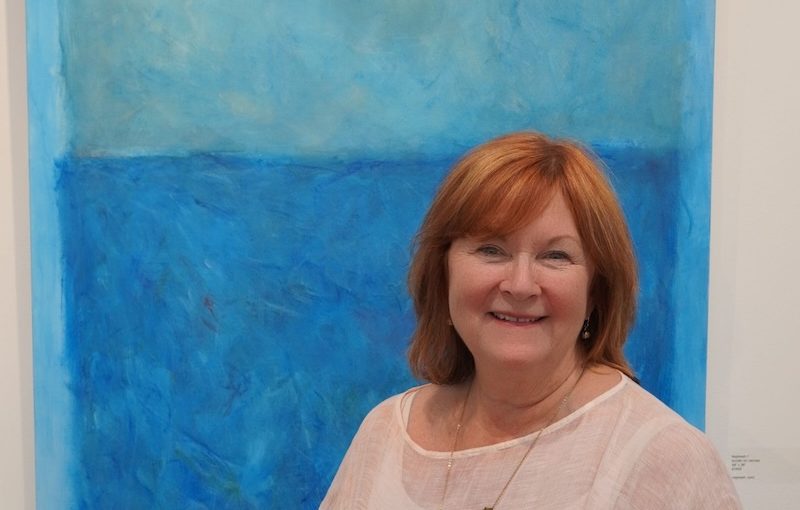
Sarah Dobbs is the new manager of the Sidney and Gertrude Zack Gallery at the Jewish Community Centre of Greater Vancouver. (photo from Zack Gallery)\

The Sidney and Gertrude Zack Gallery has a new manager, Sarah Dobbs, who showed an early affinity for her chosen field.

“My first time as a gallery host happened when I was about 8 years old,” she told the Independent. “My father was a journalist and a travel writer, and we lived in many countries when I was young: Spain, France, Morocco. Everywhere, my parents took me to art galleries, and I loved it.

“In the 1960s, while we were in Mexico, we often went to the local market. My father bought colourful folk sculptures. It was long before they became popular, we started collecting them. After we returned to Toronto, my family decided to have an exhibition of our collection. I was there, too. I enjoyed talking to people who came to see the show. I told them stories about this sculpture and that one. I liked sharing another culture with the people in my city. This entire experience had a huge impact on me. Even though I was young, I realized that art was storytelling. Art reflects our understanding of people and cultures.”

After receiving her degree in art history from the University of British Columbia and a master’s of education from the University of Toronto, Dobbs worked in the art world for more than 30 years.

“I ran commercial galleries and public galleries,” she said. “In the mid-’90s, I opened my own gallery, where I displayed mostly abstract art. I love abstract. Anyone can read their own story in an abstract painting.”

One of Dobbs’s most interesting projects happened when she was the director of the Burnaby Art Gallery.

“Part of my job there was to increase our interactions with the community,” she 

explained. “I started an outreach program for people who would never go to an art gallery on their own, specifically youths right out of jail. They were young. Most of them had yet to graduate from high school. We gave them disposable cameras and suggested they take photos of what was important in their lives (but not drugs). Then they would do collages of their photos and we displayed those collages in local bus shelters. Those collages reflected the teens’ lives, perhaps helped them to come to terms with it. The collages were also an opportunity for all of them to share their lives and their concerns with the wider public. I’m proud to say that all of our participants graduated from high school.” 

Projects like this, integrating art and public awareness, have accompanied Dobbs throughout her career. From 2002 to 2008, she worked in Ireland, at the National Gallery of Ireland and at the Irish Museum of Modern Art.

“We worked with hospital patients, but it wasn’t art therapy,” she said of that experience. “It was just doing art, participating. It reminded sick people of their healthy selves.”

Everywhere she has worked, Dobbs has helped people tell their stories through art, helped them deal with their suffering.

“In 2004, I was invited by a nurses’ charity to go to Sri Lanka for five weeks, to help the tsunami victims,” she recalled. “So many died there, children, old people. So much pain. I tried to do what I could to help, to ease that pain – I brought 98 kilos of art supplies with me.”

Later, in Kenya, she lived in a women’s peace-building village for a time.

“There were women from different tribes there, the tribes that were at war, that committed atrocities towards each other. But those women tried to build peace,” said Dobbs. “We would sit together and share stories. When women from different tribes saw similarities in their stories, felt their stories resonate with everyone, it helped in the peace-building process.”   

Dobbs has curated about 200 art exhibitions. In her opinion, deep knowledge of the art world is only part of being a successful curator.

“Of course, you have to be passionate about art,” she said. “But you also have to be very organized. You need to be patient with the artists – they are very sensitive. Encouraging artists, especially young artists, boosting their confidence is paramount. It helps them tell their stories. And you also need to be aware of who is going to see the art – to keep balance between artistic expression and public understanding. Sometimes, the latter could be a challenge. Another ongoing challenge is convincing people that art has value.”  

Those challenges can be exhausting, and even a successful art curator occasionally needs a break. Dobbs took such a break during the pandemic. The timing made sense, as most public spaces closed in 2020.

“For three years, I ran an integrated clinic, including traditional medicine, a naturopath, a massage therapist, etc. A break is good,” she said, “but I always come back to art. Sharing art with everyone is my joy.”

That’s why when the JCC announced that the Zack Gallery needed a new manager, she applied for the position.

“I have known about the Zack Gallery forever,” Dobbs said. “It is a wonderful place, a blend between a public gallery and a commercial art space. The gallery runs community exhibits. There is a theatre next door, which brings people in before the shows and during the intermissions. Children come in often. That is how art education starts for most of us, when a child wanders into an art gallery.” 

Olga Livshin is a Vancouver freelance writer. She can be reached at [email protected].

Format ImagePosted on July 26, 2024July 25, 2024Author Olga LivshinCategories Visual ArtsTags art, Sarah Dobbs, tikkun olam, Zack Gallery
Photos depict Oct. 7 trauma

Photos depict Oct. 7 trauma

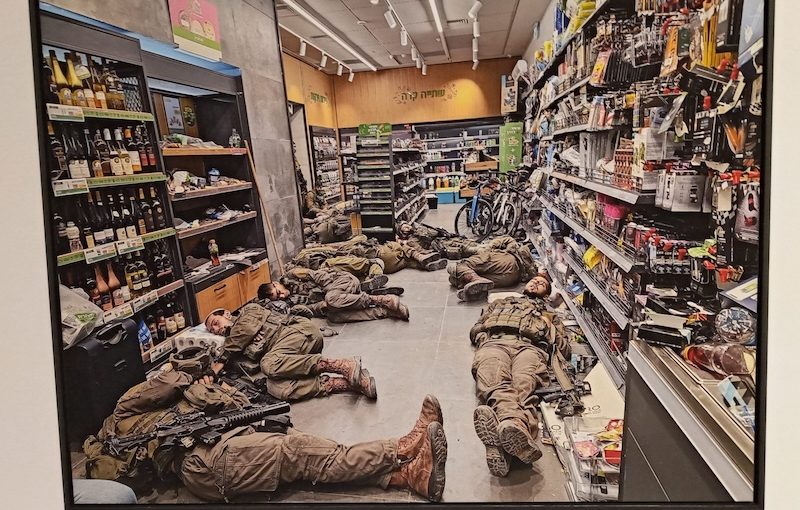
Batia Holini’s photo of Israeli soldiers sleeping on the floor of a grocery store near Kfar Aza on Oct. 8 is one of the works in the exhibit Album Darom. (photo by Gil Zohar)

Album Darom: Israeli Photographers in Tribute to the People of the Western Negev, which opened recently for a six-month temporary installation at the Petach Tikva Museum of Art, is the first group artistic endeavour in Israel to confront the tragedy of Hamas’s Oct. 7, 2023, massacre and the subsequent Gaza War, now in its 10th month. The ambitious tripartite installation Album Darom (Hebrew for Southern Album) incorporates a Facebook diary; a printed book of photographs accompanied by essays (published by Yedioth Ahronoth); and the museum exhibit.

Initiated by Prof. Dana Arieli, dean of the faculty of design at the Holon Institute of Technology, together with chief curator Irena Gordon, the project showcases 150 photographs, art installations and texts documenting the story of the western Negev region before and after Oct. 7. The exhibit includes the perspectives of 107 photographers and artists. Some of the participants in the album are world-renowned, others are amateurs. Lavi Lipshitz, the youngest featured photographer, lost his life fighting in Gaza. His mother penned the text accompanying his images.

The works in the album represent different photographic practices: artistic, personal and some staged, the intense images are upsetting. As well they should be in confronting mass murder.

Before walking around a corner to see Lali Fruhelig’s gruesome 3-D installation suggesting a corpse sprawled on the floor of a living room, a sign cautions: “The exhibition contains some potentially disturbing contents. Viewer discretion is advised.”

Arieli, a history professor and a photographer who explores remembrance culture and cultural manifestations of trauma, began the Album Darom project shortly after the Gaza war broke out.

“When something’s traumatic, you have to work or do something,” she said. 

Shocked by the murder of her friend Gideon Pauker from Kibbutz Nir Oz – who was killed just before his 80th birthday – she posted 100 daily historic and contemporary images of the Western Negev.

Initially, Arieli intended Album Darom to be exhibited at Kibbutz Yad Mordechai Museum just north of the Gaza Strip frontier. After the museum was damaged by rocket fire, this wasn’t feasible. Instead, she selected Petach Tikvah as the venue. She explained that the site – the first Yad Labanim memorial to fallen Israel Defence Forces soldiers from the War of Independence – is meant to be relevant to all Israelis. The museum offers free admission on Saturday, so observant Jews may visit on Shabbat.

Speaking to a group of journalists, Arieli compared Oct. 7 to the Nov. 4, 1995, assassination of then-prime minister Yitzhak Rabin. “Everyone is frozen in their memory of where they were,” she said.

Arieli and Gordon emphasized the intended cathartic nature of the exhibit. The two said the museum is a “safe space” and a “place for healing.” After experiencing the horrors of Oct. 7, Gordon found solace in this project, she added. “This is part of how we are coping with it all,” she said.

Miki Kratsman is one of the photographers whose depiction of his Oct. 7 nightmare is in the exhibit. Terrorists took his aunt Ophelia hostage from her home in Kibbutz Nir Oz. She was later released from Gaza in the November hostage exchange deal. 

Kratsman’s photograph, “In Aunt Ophelia’s Neighbourhood,” captures a modest kibbutz home collapsing as it is immolated in a fireball. 

“These are the kinds of things that need to be in a museum,” Arieli said of the photograph. “You’re looking at the destruction of Nir Oz.”

While vividly showing the devastation of the kibbutz, the burning home photograph is an enigma, and creates dialogue, she added.

But it is the human toll rather than the destroyed real estate that is most painful. Paradoxically, perhaps, Batia Holini’s peaceful photo of exhausted IDF soldiers sleeping on the floor of a grocery store near Kfar Aza on Oct. 8 hints at the savage warfare in which they have been engaged.

photo - “Funeral of Five Members of the Kutz Family who were Murdered in Kfar Aza,” a photo by Avishag Shaar-Yashuv
“Funeral of Five Members of the Kutz Family who were Murdered in Kfar Aza,” a photo by Avishag Shaar-Yashuv. (photo by Gil Zohar)

Avishag Shaar-Yashuv’s photograph, “Funeral of Five Members of the Kutz Family who were Murdered in Kfar Aza,” captures the searing emotion of the funeral of a family annihilated in the Hamas attack.

“I tried to focus and also wipe the tears at the same time,” Shaar-Yashuv said.

For this reviewer, the most symbolic part of the exhibit was a taxidermy display of a doe entitled “Bambi.” The exhibit references Felix Salten’s 1923 novel Bambi: A Life in the Woods and the 1942 animated movie produced by Walt Disney. Metaphorically, the hapless baby deer represents both the Six Million victims of the Holocaust and the 1,200 people murdered on Oct. 7.

Viewing Album Darom, one could conclude that the myth of the state of Israel protecting its citizens has been shattered. Arguably, Israelis today are no more secure than their ancestors were facing the Kishinev Pogrom of 1903, the Hebron Massacre of 1929 or the Farhud in Baghdad in 1941. 

Gil Zohar is a writer and tour guide in Jerusalem.

Format ImagePosted on July 12, 2024July 10, 2024Author Gil ZoharCategories Israel, Visual ArtsTags Album Darom, art, Israel, Oct. 7, photography, sculpture, South Album, trauma
Goldstein removed from exhibit

Goldstein removed from exhibit

Dina Goldstein stands in front of two of the 10 works that comprise her In the Dollhouse series featuring Barbie and Ken. (photo from Dina Goldstein)

Dina Goldstein had her work pulled from a Vancouver exhibition just days before it was set to open – in what she has described as “a blatant act of antisemitism.” But the gallery is claiming its decision to cut the Israeli-Canadian artist from the show was based on financial considerations, despite a recent news report and documentation from Goldstein that suggest there may have been other reasons.

An internationally acclaimed artist, Goldstein was scheduled to have her works shown at the Vancouver Centre of International Contemporary Art (CICA) from May 9 to June 29 as part of a group exhibition titled Toy Story, a look at the world of toys as seen through the eyes of artists from around the world. Goldstein, who received widespread attention for her Fallen Princesses and In the Dollhouse series of tableaux, was listed as recently as late April on the CICA website among the artists whose works would appear in the exhibit.

According to a report on Stir, a Vancouver website covering art news, Goldstein was notified by the gallery’s curator, Viahsta Yuan, on April 30 that her works – three pieces from the 10-image In the Dollhouse series – would not be shown during the exhibition. (Goldstein earlier had arranged for the gallery to pick them up on May 2.)

Regarding her agreement with CICA after a studio visit by the curator on April 26, Goldstein said, two large pieces and two medium pieces were confirmed, available at the studio, framed and ready to be installed.

“One medium piece had to be produced because it is a diptych with a missing partner. This she requested I get going on. The other selections would be printed in small format. I was waiting to hear about the production of the small version. [The curator] wanted to show all 10 images if possible,” Goldstein said.

But then, in Goldstein’s account, which was sent to the CJN, Yuan disclosed to her that the gallery had received an email from a small group of Vancouver artists who wanted her excluded because she supported Israel. The unnamed artists, in Goldstein’s words, felt that she did not deserve to exhibit her work during this time of war. Goldstein was offered an alternate solo exhibition within a year or two, or when the situation in Israel and Gaza might subside.

Yuan had, as Goldstein recalled, agreed that punishing an artist because of their Jewish identity was unjustifiable. Goldstein asked the curator to relay this message to the gallery committee, as well as the importance of standing up to discrimination. When she reached out to Yuan for an update on her meeting with the gallery committee, Goldstein received an email that cited, as she says, “a sudden budgetary issue as the reason for her removal. This explanation contradicted the previous acknowledgment of discrimination, with the decision now framed as a last-minute ‘creative choice.’”

“This experience takes me back to the times we may have had in our youth and being bullied. This is part of what antisemitism feels like,” Goldstein told the CJN, noting that the works in question have nothing to do with Gaza or Israel.

Goldstein, too, recounted that, unlike most people associated with the exhibition, she had been to Gaza and the West Bank while on an assignment in 1999, photographing Palestinians alongside her pictures from Jerusalem and Tel Aviv. She has shared those memories on Instagram in recent months.

In the Dollhouse, which was created by Goldstein in 2012, features a pink, adult-size dollhouse in which Barbie and Ken reside. The series offers satirical situations around the house, sometimes with a risqué approach to social commentary. Notes about the images on Goldstein’s website say that, in them, Barbie represents the notion that beauty is the ultimate trait and is necessary “to attain power and happiness.” Meanwhile, Ken discovers and expresses his true self after four decades of being “trapped in an imposed marriage.”

In the invitation to participate in the exhibition, CICA wrote that Goldstein’s dollhouse series “offers an intricate exploration of identity, conventional values, gender equality and beauty. The inclusion will not only enrich the depth of the exhibition but also provide viewers with a fresh and unique reflection on the toy that has influenced a generation of people.

“We believe that the inclusion of In the Dollhouse will offer a unique perspective and contribute significantly to the exhibition’s dialogue on the transformative power of toys as symbols within our lives.”

In Yuan’s version of events, as reported by Stir, after consultation with others at the gallery, CICA had originally selected five pieces from the series. After visiting Goldstein’s studio, she said only three of the pieces were ready.

Yuan then had another discussion with the gallery committee, and it was decided that CICA did not have the budget for production costs. Further, another artist was showing a piece about a dollhouse, and the gallery believed showing two works in dollhouses would be excessive.

CICA released a statement on May 4 in which it denied its decision to pull Goldstein’s work from the exhibition was based on “religious and cultural affiliation” but rather was related to financial considerations. Works by two other artists, Roby Dwi Antono and Aya Takano, CICA said, were also removed from the lineup. The organization emphasized its desire “to cultivate artistic dialogue and community engagement while emphasizing inclusivity and representation.”

“As a woman and BIPOC-led organization, prioritizing diversity is not just a goal but a guiding principle that informs every aspect of our work,” the statement from CICA read. “Since our inception, we have been dedicated to showcase a pluralistic range of contemporary art and ideas through our multidisciplinary exhibitions and programming.

“We are grateful to have collaborated with a distinguished group of over 35 local and international artists, with more than two-thirds from visible minority backgrounds. These cross-cultural collaborations are a testament to our commitment to platforming diversity while fostering a safe and accessible environment for all.”

CICA stressed that, like many nonprofit arts organizations, it faced budgetary constraints and, with limited resources, it needed to make difficult decisions. As a result, three artists were not shown because of limited finances, a short time frame and “curatorial direction.”

The cultural and religious background of an artist would never warrant exclusion from the gallery, CICA went on to say, and that decisions were made only on artistic merit and how a work would fit into an exhibition.

“Discrimination of any kind has no place within our organization, and we remain steadfast in our commitment to platforming 

diversity and ensuring equitable representation in everything we do. Looking ahead, we will continue to embed the values of equity, inclusion and diversity into every facet of our operations,” CICA said.

Established in 2021, CICA is a nonprofit, multidisciplinary arts organization. According to its website, it provides “a forum for everyone to step into the art and learn while having fun” and aims “to enhance public engagement in the arts and bridge local and international artists for idea exchange, knowledge sharing, and collaboration.” 

Sam Margolis has written for the Globe and Mail, the National Post, UPI and MSNBC. This article was originally published on thecjn.ca.

Format ImagePosted on May 24, 2024May 23, 2024Author Sam MargolisCategories Visual ArtsTags antisemitism, art, Centre of International Contemporary Art, CICA, Dina Goldstein, Fallen Princesses, In the Dollhouse, Viahsta Yuan
Art sale for Israel

Art sale for Israel

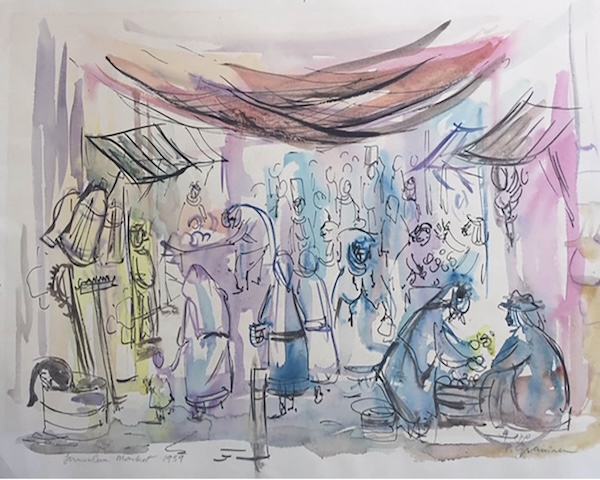
“Jerusalem Market, 1959,” watercolour and pencil, by artist Pnina Granirer, a graduate of Bezalel Academy of Art and Design in Jerusalem. Granirer will have a table of her artwork for sale in the atrium of the Jewish Community Centre of Greater Vancouver on Dec. 3, 10 a.m.-3 p.m., as part of the Chanukah Around the World party marketplace. The works will be unframed, priced from $100 to $500, with all proceeds being donated to Israel, in the hope that the donation will help it in its hour of need. For more on Granirer, go to pninagranirer.com.

The party is a joint event with multiple community partners: King David High School, Vancouver Talmud Torah, Richmond Jewish Day School, PJ Library, Camp Miriam, Jewish Museum and Archives of British Columbia, and the Kollel. In addition to the marketplace, it will feature games, iSTEAM activities, food, arts & crafts, museum displays, entertainment throughout, a community singalong and a JCC membership sale. Visit jccgv.com/jcc-chanukah-carnival.

Format ImagePosted on December 1, 2023November 30, 2023Author Pnina GranirerCategories Visual ArtsTags art, Hanukkah, Israel, JCC, painting, Pnina Granirer
Share delight of letters

Share delight of letters

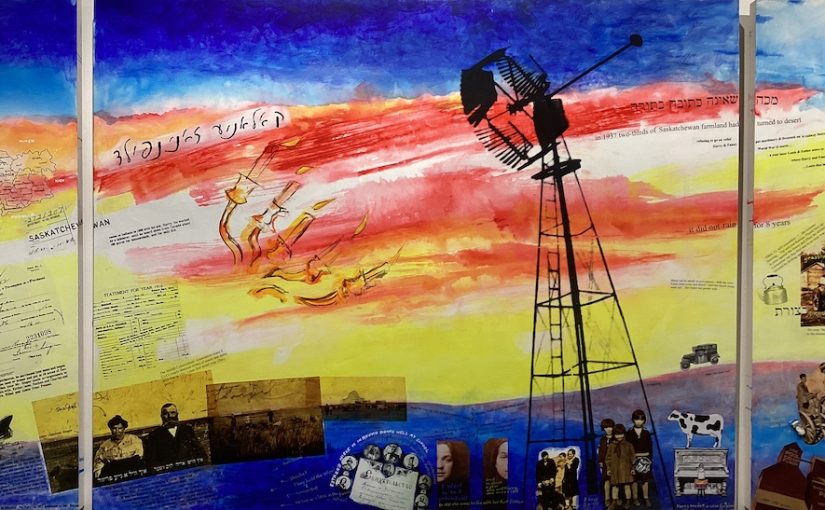
“Shabbat Saskatchewan,” by Esther Tennenhouse. Part of Otiyot (Letters), a joint exhibit with her son Joel Klassen, which is now at the Zack Gallery.

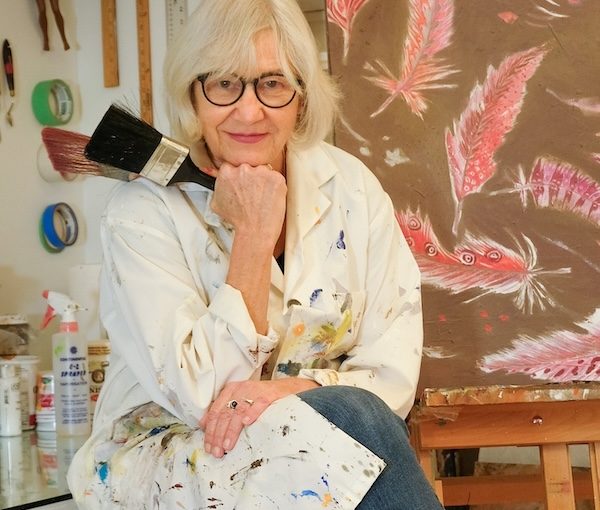
Colourful and playful, dark and ominous, Esther Tennenhouse’s artwork is engaging and thought-provoking, as she offers her take on Torah and midrash, immigration and language, orthodoxy and modernity. Otiyot (Letters), an exhibit she shares with her son Joel Klassen, opened at the Zack Gallery last week.

Tennenhouse’s sense of humour, curiosity, imagination and sincerity come through in the work on display, and in her responses to questions about the exhibit.

“Ot means ‘letter’ (of the alphabet) – it also means ‘sign’ and ‘signal,’” she told the Independent. “It was my first choice of name for the show: Ot – Starring the Letter Shin. Sounds like ‘ought,’ as in ‘thought.’ Ot was visually terse (and sounds adorable). That was why it was Ot in [the] JCC program book – I had to provide that bit before these pieces were made! Yikes! But it got changed to the longer plural in Hebrew and lost its zap. More truthful, though, as I have so many (too many) words of explanation on the wall beside each piece.”

All the works were made specifically for the exhibit, said Tennenhouse, “only for this place, for anyone who happens to walk into the JCC,” where the Zack Gallery is located.

“I was driven by my own relationship to the alef-bet: me, a quite secular, second-generation, Winnipeg-born Jew living in Vancouver, of prairie-born parents, who learned my aleph-bet as a child, quite long ago. I think many like me, with my sort of education, walk by these gallery doors, so I thought they might wander in and relate.”

Born and raised in Winnipeg, Tennenhouse went to Talmud Torah there from age 4 to 11, then to public school. She earned a bachelor’s in English and, while working at the Winnipeg Free Press, majored in sculpture at the University of Manitoba School of Art.

She moved to Aklavik, in the Inuvik region of the Northwest Territories, and then to Yellowknife, where she learned about ceramics at the Yellowknife Guild of Arts and Crafts. She later worked with translucent clays.

Moving with her family – husband Ron, son Joel and daughter Timmi – to Vancouver in 1995, Tennenhouse found a home at Or Shalom, participating in the Talmud and Torah study offered there, reengaging in Jewish education after a break of some 45 years.

Klassen also attends Or Shalom. His art background includes having drawn at home and working with painter Sylvia Oates – who he describes as a mentor – in her Parker Street studio. Klassen has had a one-man show in artist Noel Hodnett’s Parker Street studio, and he was in the Kickstart Disability Arts and Culture’s 2019 group show Nothing Without Us at the Cultch. For the past four years, he has attended the JCC’s Art Hive, which is facilitated by Kim Almond.

Klassen’s Hebrew letters and drawings are in five of the pieces at the Zack Gallery, said Tennenhouse.

“Making letters as individuals, each with their own character, was the most fun to do,” she said. “Jan Wilson, a friend and quilter, offered to help if I drew out the correctly sized letters backwards for transfer and picked the fabrics.”

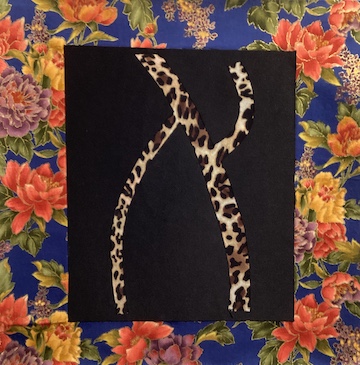
The letters comprise eight of the works on display, and offer much to think – and smile – about. Klassen’s aleph is filled in with leopard print fabric, surrounded in black with a flowered border. The word “wild” comes to mind as one looks at it, not just the wildness of animals and nature, but of human beings. The piece is called “Aleph in the Garden.”

photo - “Aleph in the Garden” by Esther Tennenhouse, Joel Klassen and Jan Wilson
“Aleph in the Garden” by Esther Tennenhouse, Joel Klassen and Jan Wilson.

“I did not shy away from diversity,” said Tennenhouse. “It’s sort of an underlying element. I felt the show had to offer something to any individual, whatever their history with the alef-bet, and it deals with very well-trodden themes. I felt a need for an element of surprise, which is one reason why Joel’s aleph became a leopard in the garden (of Eden?).”

A last-minute addition to the depictions is one of the 12 new letters for gender-neutral word endings that were created by Israelis graphic designer Michal Shomer a few years ago.

“They appeared in welcome signs outside schools and on IDF buildings, etc., but the kabbalist idea of the power of the alphabet lives on – the new letters were vigorously rejected by religious factions,” said Tennenhouse. “‘Changing the letters removes any kedusha (sanctity) the words have or any ability the words have of channeling God’s energy into the world,’ said sofer Rabbi Abraham Itzkowitz. ‘This project essentially makes Hebrew like any other language.’ Some of the signs were taken down. Religious schools were forbidden to use them.”

That said, Tennenhouse told the Independent, “What first tickled me into this aleph-bet project was the poetry and passion of the ideas of the early mystics. They conceived of letters of the alef-bet existing even before the creation of the world – all 22 were vessels of the divine, all things were created by their combinations. Meditative/ecstatic kabbalah taught that individual letters were something to meditate upon, which led to ecstasy, one of the steps to sense of union with G-d. American calligrapher Ben Shahn, who titled one of his books Love and Joy About Letters, quotes the 13th-century Rabbi Abulafia, who said the delight in combining letters is like being carried away by notes of music.”

Tennenhouse and Klassen’s “Shir” (song, poetry, chant, in Hebrew) is truly delightful, like a page out of a children’s book. A multimedia piece, it depicts several animals and the sounds they make, both in Hebrew and in transliteration, though the giraffe just “hum[s] at night.”

Two other works are striking, both on their own and in contrast to each other: Sinai 1 and Sinai 2.

photo - Detail of "Sinai 2" by Esther Tennenhouse and Joel Klassen
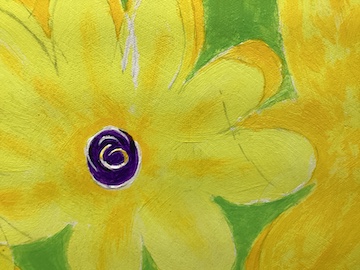
Detail of “Sinai 2” by Esther Tennenhouse and Joel Klassen.

The latter features three bright yellow flowers, surrounded by green. “It is a triangle canvas which is about the mountain bursting into bloom when Moses came down with the Ten Commandments – this was a midrash from the 1500s. The triangle has flowers by Joel. I asked him to put flowers on it, envisioning little flowers here and there – he just went swoosh woosh on it.”

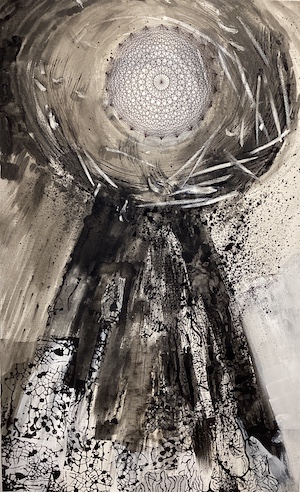
Sinai 2 is a vertical rectangle with whites, greys and blacks depicting a furious ball of activity on top of the mountain that includes the Hebrew letters.

photo - "Sinai 1" by Esther Tennenhouse
“Sinai 1” by Esther Tennenhouse.

“The Torah tells of fear, awe, the shaking mountain, seeing sounds, lightning, Moses’ anger, the breaking tablets,” said Tennenhouse. “Looking back, I overburdened the canvas [with] anger, though laying on the 231 Gates – a diagram from the Sefer Yetzirah which shows each letter combining with each other letter of the alef-bet – because I see the story of the giving of the Torah as a sort of creation story for our intense embrace of literacy. The diagram relates to Rabbi Abulafia’s talk of combination of letters but distracts visually from the anger/violence, [the] mountain, fear.”

There is so much more in this exhibit.

“Cursive Handwriting: Kovno Testament” is a stark, unfinished work, featuring the words, written in his own hand, of Lithuanian writer Eliezer Heiman, who died in the Kovno ghetto during the Holocaust. It was to have three more samples of cursive, said Tennenhouse. “I left room for them before I put on the image of Heiman’s tablets. Those spaces stayed empty. Everything else edited themselves out because of what happened in Israel on Oct. 7.”

There is the multimedia triptych “Shabbat Saskatchewan,” which Tennenhouse said “is me trying to use real photos and documents to create some presence of my mother’s grandparents and parents.”

“It ended up being centred on great-grandmother Esther Dudelzak Singer, Baba Faige (Fanny) Singer and my mother with her sisters,” she said. “Yiddish was their mamaloshen (mother tongue) and the Sonnenfeld community was religiously observant.”

“The Owl and the Pussy Cat” adds colour and vibrancy to Edward Lear’s black and white drawing of his nonsense poem, the Yiddish translation of which – by the late Marie B. Jaffe – fills the two side panels of this triptych. Tennenhouse couldn’t find much information out about Jaffe, she said, “But, thanks to Eddie Pauls at the Jewish Public Library in Montreal, [I] learned she immigrated to New York in 1909 from Lithuania.”

Tennenhouse began to see the owl and the cat in their boat as sailors braving the rough seas, traveling around the world to find “Di Goldene Medine,” “the Golden Land,” America.

“You might say ‘Saskatchewan,’ too, is about leaving home, traveling across seas and finding a new place but keeping your language and culture,” said Tennenhouse.

Otiyot (Letters) is on display at Zack Gallery until Nov. 12.

Format ImagePosted on October 27, 2023October 26, 2023Author Cynthia RamsayCategories Visual ArtsTags art, Esther Tennenhouse, Joel Klassen, multimedia, Otiyot, painting, Zack Gallery
About the Rosh Hashanah cover art

About the Rosh Hashanah cover art

I spent hours online trying to find a suitable piece of art for this year’s Rosh Hashanah cover, then even more hours for what I might do myself. I really wanted to include a shofar in whatever I did, as a call to hope and action, for myself as much as anyone else.

I stumbled on artist Yitzchok Moully’s Elul Shofar Art Challenge (moullyart.com). Moully’s work is bright, colourful, full of life. As I mulled it over, I received an email from local artist Merle Linde, who generously created art for the JI ’s Passover cover this year and for last’s year Rosh Hashanah issue. She sent me an emotionally charged piece lamenting the countless trees that have been destroyed by wildfires. The base painting was an acrylic pour, and I spent several fun hours learning about and practising the technique, deciding it wasn’t quite what I wanted for my shofar blast.

I eventually came across creativejewishmom.com, the site that inspired my 2020 Passover cover depicting the Israelites (made of corks) crossing the Red Sea, who made a second appearance for Passover 2021, participating in Zoom seders. This time, it was a Tashlich picture made with yarn, coloured paper and felt marker that caught my eye on creativejewishmom.com. Inspired, I made the JI masthead out of yarn and ink, and created the shofar and the hand holding it – I wanted there to be a human presence, as we are critical to any change, for better or worse.

image - JI Rosh Hashanah 2023 coverThe middle section of the page eluded me for days, and I tried various things that just didn’t feel or look right. Thankfully, a middle-of-the-night couple of hours resulted in the finished cover, albeit with some tweaking in Photoshop. It ended up being more cheerful than I was intending. I am happily surprised at my latent optimism, and hope that readers also find it uplifting.

Posted on September 1, 2023August 30, 2023Author Cynthia RamsayCategories Celebrating the HolidaysTags art, High Holidays, Merle Linde, Rosh Hashanah, shofar, Yitzchok Moully
Chance to create

Chance to create

Esther Rausenberg, artistic and executive director of the Eastside Arts Society. (photo by Wendy D)

Eastside Arts Society (EAS) presents the return of its two-day summer art-making event, CREATE! Arts Festival, taking place at Strathcona Park on July 22 and at various Eastside Arts District studios on July 23.

A community initiative designed to welcome guests to explore, learn and create art together with local artists, CREATE! features a variety of accessible visual and performing arts workshops for adults and youth, including watercolour painting, needle felting, indigo dying, pottery, glass fusing, photography, ukulele, Salish singing and storytelling.

“In addition to a variety of art workshops, demonstrations and public participation art installations, we are also incredibly proud to introduce our brand new festival art shop, featuring a curated selection of arts and crafts all handmade by local artists,” said EAS artistic and executive director Esther Rausenberg, who is a member of the Jewish community.

On July 22, there will be a series of outdoor art-making workshops taught by more than 15 artists who live and/or work in the Eastside Arts District, many of whom will be participating in CREATE! Arts Festival for the first time. Adult and youth workshops will be hosted by Taaye Wong, Tanna Po, Suzan Marczak, Nima Nasiri, Naomi Yamamoto, Niki Holmes, Ross den Otter, Daphne Roubini, Russell Wallace, Jewish community member Naomi Steinberg, Nicole Caspillo, Nathaniel Marchand, Eri Ishii and Chantal Cardinal (FELT à la main with LOVE). A children and youth workshop will be hosted by Amberlie Perkin and an all-abilities workshop by Alternative Creations Studio.

Saturday festivities will also include a general admission CREATE! Art Zone. Art demonstrations include painting, pottery and glass beading from Francis Tiffany, Julia Chirka (summer skool) and members of Terminal City Glass Co-op. Public participation art projects include a life-size colouring mural with Serena Chu of Chu Chu, squeegee art with Joanne Probyn, and the building and performing of two giant crow puppets – in honour of EAS’s unofficial mascot – with Jacquie Rolston. Opus Art Supplies will have a hands-on block carving and printing activation: carve and pull a mini-block print, and contribute to a collaborative printmaking collage.

A selection of local handmade artworks and goods, curated by OH Studio Project, will be available at the festival shop. There will be a fully licensed beer garden, serving beer, cider and wine from Strange Fellows Brewing, as well as an assortment of food from a collection of food trucks, including Earnest Ice Cream, Wak Wak Burger, Mahshiko and Camion Café.

On July 22, the 8th Annual Art! Bike! Beer! Crawl Brewery Tour & Fundraiser will, for the first time, end at the festival grounds.

Activities will move indoors on July 23, connecting participants with art production spaces in neighbouring Eastside studios, with additional art workshops hosted by members of the Terminal City Glass Co-op, Richard Tetrault, Sonya Iwasiuk, Grace Lee (eikcam ceramics) and Naomi Yamamoto.

Workshops are $35 (plus GST) for youth/adults, with the exception of Perkin’s workshop for children/youth at $20 (plus GST); children under the age of 12 must be supervised by an adult. The general public can access festival activities at Strathcona Park for a $5 general admission fee (children under age 12 are free). For full festival details and workshop registration, visit createartsfestival.ca.

– Courtesy Eastside Arts Society

Format ImagePosted on July 7, 2023July 6, 2023Author Eastside Arts SocietyCategories Visual ArtsTags art, family, festivals, music, painting
Parker Art Salon on display

Parker Art Salon on display

“Aqua,” by Violette Zohar Fiszbaum, who is one of the more than 50 artists participating in the Parker Art Salon exhibit at Pendulum Gallery. (photo from Violette Zohar Fiszbaum)

Pendulum Gallery in downtown Vancouver opened a new show on May 15 – What Moves You – by the Parker Art Salon. More than 50 artists, all having their studios at 1000 Parker St., presented one piece each for their annual exhibition. The art, including paintings, sculpture and photomontage, is inspiring and uplifting, brightening up the space around it.

While the exhibit is already open to visitors, the opening reception, and the launch of an online auction hosted by Waddington’s Auctions, will be held at the gallery on June 8, 6-8 p.m. Fifty percent of the auction proceeds will go to Beedie Luminaries, a scholarship program for students with potential who are facing financial adversity. To further promote the artists, there will be a Parker studios tour on June 10.

The Independent spoke with one of the Jewish artists participating in the show, Violette Zohar Fiszbaum, at Niche Art Gallery on Granville Island. She is one of Niche’s co-founders.

Fiszbaum grew up in Sao Paulo, Brazil. “I studied art as a teenager, but my parents thought you couldn’t make a living at art – they were right, it is tough. They wanted me to be a doctor or a lawyer or an engineer. After I graduated from high school, I studied chemical engineering. I also wanted to study astronomy and quantum physics, but, again, it is not easy to make a living. But it never stopped me. I always did some art and I keep up my interest in quantum physics, too. I read on it even now, when I can’t sleep.”

After she finished university, she went traveling: Europe, Asia, North America. “I studied Tibetan art restoration in Paris and I visited Tibet in the 1990s. Tibetan culture is exotic, yes, but very spiritual. It brought me closer to my Judaism, my spiritual roots. I think all spiritual cultures are connected,” she said.

Fiszbaum studied kabbalah. “I grew up secular,” she said. “My parents survived the Holocaust as children, got married in Israel, and then moved to Brazil. But Judaism came from the inside of me, from my studies and my travels. Zohar is my Hebrew name, and that’s how I sign my paintings.”

She visited Israel many times during her wandering days. One of her travels brought her to Vancouver, and she liked it here so much she decided to stay. “I worked in the movie industry for a time,” she said. “I wanted to act in movies, and I did.”

photo - Violette Zohar Fiszbaum
Violette Zohar Fiszbaum (photo from Violette Zohar Fiszbaum)

She also worked a lot at her art, and she continued studying art, as well. “In the last 10 years, I have been teaching art,” she said. “I teach mixed media. In the beginning, I was an assistant at Emily Carr [University of Art + Design]. Lately, I have had my own class at Olympic Village. It is a beautiful room. It faces the water. My students are all adults, and we are having fun together.”

Fiszbaum’s artistic interests are diverse. She plays piano. She dances. She enjoys photography. But, mostly, she paints. “I often paint with some music on. I turn on the music, dance and paint,” she said.

One of her preferred techniques is mixed media. “I like my paintings to have layers, to have a mystery, an intrigue. Using mixed media is like adding an archeological layer to the image, a depth,” she explained. “For example, I saw this old poster in Israel and I incorporated parts of it in one of my abstract paintings.”

Mixed media is also the technique that allows her to be successful at Niche, although commercial art has never been her focus. “I don’t paint just to sell,” she said. “I want to leave something beautiful behind. In the last two years, I sold and donated 100 pieces.”

She sells and markets herself through several venues. “My website, of course, Parker Art Salon, the East Side Culture Crawl – that is huge in Vancouver, the biggest annual art show in town. I use Instagram. Anywhere I go, really. I play tennis and I belong to a tennis club – I sold some of my paintings there. I like swimming, and I sold many of my Swimmers series paintings through my connections with other swimmers. My painting in the Parker Art Salon exhibition is one of my swimmers. I used to be a dancer, and the human body, its movements, always have fascinated me, both in the water and on land.”

But Niche Art Gallery is one of her favourite places. “It started as a pop-up store just before the COVID pandemic,” she explained. “Pop-up is a short-term lease, and it has been popular lately.”

After her pop-up term had expired, she teamed up with a few other artists and opened the gallery. “Many galleries on Granville Island closed during the pandemic, but Niche flourished,” she said.

Besides her paintings, Fiszbaum sells some unusual pieces at Niche, including funky denim caps. Each one is decorated with an assortment of mixed media: snatches of lace, old buttons and zippers, feathers, disassembled toy fragments, even an old phone keyboard. “It is fun to work on them,” she said. “I use only salvaged materials there. Now I want to make denim jackets.”

Fiszbaum likes working on commissions. “I enjoy the challenge,” she said. “I have created paintings to customers’ demands, both in size and in the colour palette. Sometimes, they wanted my paintings to match their couches and curtains; other times, their carpets and pillows; even a vase once. And I did it.”

Among the work for sale at Niche Art Gallery are Fiszbaum’s portraits. She returns to female portraits again and again. “My mother was beautiful, like Cleopatra,” she said. “I keep painting women’s portraits in order to capture her beauty, to share it with everyone.”

The show at Pendulum Gallery runs until June 16. For more information on the artists (who include many Jewish community members) and the auction, and to book your Parker studios tour, visit parkerartsalon.com.

Olga Livshin is a Vancouver freelance writer. She can be reached at [email protected].

Format ImagePosted on May 26, 2023May 25, 2023Author Olga LivshinCategories Visual ArtsTags art, auctions, Niche Art Gallery, Parker Art Salon, Pendulum Gallery, Violette Zohar Fiszbaum
Düsseldorf returns painting

Düsseldorf returns painting

Wilhelm von Schadow’s “The Artist’s Children” (1830).

The German city of Düsseldorf reached an agreement recently with the heirs of Max Stern (1904-1987), a Jewish art dealer forced to flee the city in 1937, ending a long-standing battle over the ownership of a painting, according to The Art Newspaper, which first reported the deal.

The family portrait from 1830, “The Artist’s Children,” by 19th-century Romantic painter Wilhelm von Schadow, has been held by the city since 1959, when it acquired the canvas from a private collector. It was discovered when a researcher from the National Archives in Ottawa found it in a catalogue for a 1967 Düsseldorf Museum Kunstpalast exhibition, which listed the painting’s location as the Stadtmuseum. In recent years, the Max Stern Art Restitution Project, based at Montreal’s Concordia University, and the Dr. Max and Iris Stern Foundation sought to reclaim it, contending that Stern sold the painting under duress.

Founded in 2002, the Stern Project, headed by Dr. Clarence Epstein, is seeking to track down the 220 Old Masters and Northern European artworks that formed Lot 168 in the November 1937 sale at Cologne’s Mathias Lempertz auction house, known as Auktion 392. The paintings constituted the inventory of Düsseldorf’s Galerie Stern that Nazi officials forced him to liquidate at vastly discounted prices. As well as the 1937 auction canvases, the Stern Project is seeking to regain the paintings the art dealer left with Cologne shipping agent Josef Roggendorf, which the Gestapo confiscated in 1938, when Stern was already in Britain.

As part of the agreement, Düsseldorf handed over the portrait on condition that the municipality immediately buys it back. The terms of the settlement, including how much the city paid to re-acquire the artwork, were undisclosed.

In a press release, Düsseldorf mayor Stephan Keller said he was pleased with the “fair and just solution” between the parties and that von Schadow’s artwork “will remain in Düsseldorf.” He added that the painting will go on view at the city’s Museum Kunstpalast starting in August.

Stern took over Galerie Stern on Königsallee, which was founded by his father Julius, in 1934. By order of the Nazi government, the gallery was “aryanized” in 1937. Its inventory was sold at a forced auction for a fraction of its value.

Armed with a single suitcase stuffed with his remaining possessions, Stern fled to London that year. But, in May 1940, when Hitler’s invasion of Britain seemed imminent, Scotland Yard rounded up more than 2,000 German and Austrian citizens, mostly Jews, and incarcerated them as enemy aliens. Stern was sent to an internment camp on the Isle of Man.

Hearing that some detainees were being sent to Canada to free up soldiers guarding British camps, Stern volunteered to join them. In North America, he believed, he would be well-positioned to help his mother and one sister in Britain, as well as his other sister and her family in France. But Canada, where he was greeted by bayonet-wielding soldiers, was even less hospitable than Britain. As Stern recalled years later, “We had to stage a hunger strike to convince the Canadian authorities that we were certainly not Nazis but, on the contrary, anti-Nazi.”

Held in a camp first near Fredericton, N.B., and later in Farnham, Que., he was put to work cutting down trees. Still, he remained optimistic, thankful for the food, shelter, clothing, exercise and 20 cents per day in pay. He also welcomed the opportunity to teach. Twelve years earlier, he had earned a doctorate in art history, which he put to use in classes for his fellow internees.

Stern’s talent and positive outlook caught the attention of William Birks, scion of the Montreal jewelry family, who headed the local branch of the National Committee on Refugees. Birks was openly critical of Canada’s restrictive and antisemitic immigration policy, which he called “narrow, bigoted and very short-sighted.” He believed the government should have sent trade missions to Europe to recruit men like Stern, “not wait for them to seek and beg us.” In 1941, he sponsored Stern’s release and move to Montreal.

Needing a job and hoping to assist in Canada’s war effort, Stern looked for work in an airplane factory. When he was not hired, he turned to the thing he understood best – art. “You’ll starve,” people told him, but he was certain he could be successful as a dealer in Montreal, because he had spotted a void he knew how to fill. Most of the city’s galleries were pushing stuffy 19th-century European genre and landscape paintings. No one was promoting or selling home-grown works because, as he later explained, “Canada didn’t have any confidence in its own artists.”

Stern pitched his vision to Rose Millman, who had just opened a space on rue Sainte-Catherine called the Dominion Gallery of Fine Art. Impressed by his assurance and expertise, she offered him a job for $12.50 a week. Stern said he wanted $17.50 and her promise to make him a full-fledged partner once he built up her business by conquering Canada, as he put it, “by selling Canadian artists.”

Within months, he was mounting exhibitions by contemporary Canadian painters. Over the years, they would include John Lyman, Goodridge Roberts, E. J. Hughes, Stanley Cosgrove, Jean-Paul Riopelle, and others whose names he would play a pivotal role in establishing. Stern secured their loyalty and best work by offering them monthly retainers for an agreed-upon number of works, already an established practice in France, Britain and the United States, but not yet in Canada.

Stern’s first major coup came in 1944, when he visited Emily Carr, then 72, at her home in Victoria. She showed him a room packed with 300 paintings. Struck speechless by her talent, he asked if he could mount an exhibition.

Laughing, she replied, “You will not sell a single painting.” The recipient of critical praise, Carr had yet to enjoy commercial success. “If you let me choose the paintings,” Stern replied, “I think I can make it a perfect success.”

In 1947, Stern and his wife Iris became the sole owners of the gallery.

Following the defeat of Nazi Germany, Stern endeavoured to track down his confiscated paintings. His efforts were largely unsuccessful. He died childless in 1987, and left his estate to Concordia University and McGill University in Montreal, as well as Hebrew University in Jerusalem.

The three schools later founded the Max Stern Art Restitution Project to reclaim the estimated 400 artworks lost during the 1930s. To date, the project has recovered 24 pieces, including paintings by Otto Erdmann, Nicolas Neufchatel and Jan Brueghel the Elder.

The case of von Schadow’s “The Artist’s Children” proved to be particularly complicated due to questions of provenance. When the city of Düsseldorf acquired the portrait in 1959, it was hung in the office of the city’s mayor. Decades later, when the Stern Foundation filed a claim for the artwork, it pointed out that, in 1937, Galerie Stern allowed for the piece to be reproduced in a book about paintings of children. But Düsseldorf city officials pushed back, arguing that the book did not prove the gallery owned the artwork at that point. There was no evidence of the painting being surrendered under Nazi persecution, the city contended.

In 2017, a scheduled exhibition in Düsseldorf about Stern and the Restitution Project was abruptly canceled due to local opposition, leading to intense controversy. The city’s stance apparently softened following the 2020 municipal elections.

“We couldn’t prove that it was not a restitution case, so we, as the city government, recommended to the assembly that it should be restituted,” Miriam Koch, the Düsseldorf city official in charge of culture, told The Art Newspaper. “The big parties in the city council supported restitution.”

According to Lynn H. Nicholas’ 1995 book The Rape of Europa: The Fate of Europe’s Treasures in the Third Reich and the Second World War, more than 140,000 pieces of artwork were looted under the Nazi regime. Most of them remain unclaimed.

Gil Zohar is a writer and tour guide in Jerusalem.

Format ImagePosted on May 26, 2023May 26, 2023Author Gil ZoharCategories Visual ArtsTags art, Düsseldorf, history, Holocaust, Max Stern Project, restitution, Wilhelm von Schadow
Check out JQT Artisan Market

Check out JQT Artisan Market

(photos from JQT Vancouver)

The JQT (Jewish Queer Trans) Artisan Market on May 15, 6-9 p.m., at the Peretz Centre features several local artists, and international performer Stav Meishar presents Oy Slay! at 8 p.m. For more information on the market and other JQT Heritage Month events, including the launch of the B.C. JQT Oral History Project at the Zack Gallery on May 28, visit jqtvancouver.ca.

Format ImagePosted on May 12, 2023May 11, 2023Author JQT VancouverCategories Visual ArtsTags art, JQT, market

Posts pagination

Previous page Page 1 Page 2 Page 3 Page 4 … Page 17 Next page
Proudly powered by WordPress