Skip to content
  • Home
  • Subscribe / donate
  • Events calendar
  • News
    • Local
    • National
    • Israel
    • World
    • עניין בחדשות
      A roundup of news in Canada and further afield, in Hebrew.
  • Opinion
    • From the JI
    • Op-Ed
  • Arts & Culture
    • Performing Arts
    • Music
    • Books
    • Visual Arts
    • TV & Film
  • Life
    • Celebrating the Holidays
    • Travel
    • The Daily Snooze
      Cartoons by Jacob Samuel
    • Mystery Photo
      Help the JI and JMABC fill in the gaps in our archives.
  • Community Links
    • Organizations, Etc.
    • Other News Sources & Blogs
    • Business Directory
  • FAQ
  • JI Chai Celebration
  • JI@88! video

Recent Posts

  • Eby touts government record
  • Keep lighting candles
  • Facing a complex situation
  • Unique interview show a hit
  • See Annie at Gateway
  • Explorations of light
  • Help with the legal aspects
  • Stories create impact
  • Different faiths gather
  • Advocating for girls’ rights
  • An oral song tradition
  • Genealogy tools and tips
  • Jew-hatred is centuries old
  • Aiding medical research
  • Connecting Jews to Judaism
  • Beacon of light in heart of city
  • Drag & Dreidel: A Queer Jewish Hanukkah Celebration
  • An emotional reunion
  • Post-tumble, lights still shine
  • Visit to cradle of Ashkenaz
  • Unique, memorable travels
  • Family memoir a work of art
  • A little holiday romance
  • The Maccabees, old and new
  • My Hanukkah miracle
  • After the rededication … a Hanukkah cartoon
  • Improving the holiday table
  • Vive la différence!
  • Fresh, healthy comfort foods
  • From the archives … Hanukkah
  • תגובתי לכתבה על ישראלים שרצו להגר לקנדה ולא קיבלו אותם עם שטיח אדום
  • Lessons in Mamdani’s win
  • West Van Story at the York
  • Words hold much power
  • Plenty of hopefulness
  • Lessons from past for today

Archives

Follow @JewishIndie
image - The CJN - Visit Us Banner - 300x600 - 101625

Tag: wisdom

Paintings inspired by women

Paintings inspired by women

Therese Joseph’s solo show at the Zack Gallery opened Oct. 12, but the official opening reception, which she will attend, takes place Oct. 30. (photo from Therese Joseph)

The new solo show at the Zack Gallery – Women, Words and Wisdom: Therese Joseph – celebrates the power of women in our lives.

Artist Therese Joseph’s mixed media paintings combine imagery and words in her depictions of women she admires. Not any specific woman, but all of them, a symbolic woman, and what she means to the artist. On the walls of the gallery, Joseph’s women are sad or sleeping, doubting or searching, traveling or dancing, but they all represent the artist’s interpretation of “woman,” in all her multifaceted complexity. 

Joseph grew up in Switzerland, and her road to Vancouver and an artistic career was a round-about one. When she was in her early 20s, she traveled to England to study English. There, she met a young engineer from Borneo. They fell in love and stayed in touch. A few years later, after he found work in Vancouver, he invited Joseph to join him. She had never been to Canada before.

“At first, I came for three months,” Joseph told the Independent. “I loved it here. Everyone was so open and friendly. I felt free here, felt that I could do anything I wanted. Life here was much less structured, not as many rules as back home in Switzerland. It felt like there could be more than one way to do stuff, and that freedom attracted me.”

Like many others, she was captivated by the nature of British Columbia.

“The mountains, the sea, the forest. It was like Switzerland, but more – more open, more generous,” she said.

Of course, it took time for every document to be signed and she could finally settle into her married life in Canada. 

“Home in Switzerland, I had an education as a kindergarten teacher, but my diploma wasn’t accepted here in Canada,” Joseph said. So, she opened an after-school art club for local children.
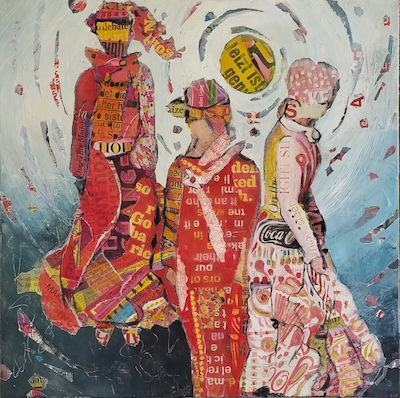
photo - “Wear Your Words” by Therese Joseph
“Wear Your Words” by Therese Joseph. (photo from Therese Joseph)

“I’ve always loved doing art, loved being creative,” she said. “I was involved in several community art projects with my young students in North Vancouver. We painted balconies, murals, created some street banners.”

But, eventually, she wanted to dedicate herself to art full-time, and she felt she needed more education in this regard. 

“At about the same time – year 2000 – a couple of my family members in Switzerland died, and it was hard for me. I couldn’t be there with my family as much as I wanted,” she shared.

Creating art felt like a necessity for her then, a balm to her grieving heart. She sold her art studio business and enrolled in art-related continuing education classes at Emily Carr University of Art + Design and Langara College.

“I took many classes and workshops in the next few years,” said Joseph. “Whenever I liked an artist, I found a way to learn from them. Among my mentors were Jeanne Krabbendam, Don Farrell, Lori Goldberg, Nurieh Mozaffari, Steven Aimone and more. I’d call it a self-directed art education.” 

She emerged from that time an accomplished artist and art teacher. She exhibited widely in Canada and abroad. She taught both children and adults.

“I love teaching art,” she said. “At first, I preferred teaching children, but, as my own children grew older, I gravitated towards teaching adults and seniors. Everything has its time.” 

Through all the changes in her life, Joseph kept making art. She paints figures and faces, flowers and feathers in her Dandelion Art Studio in North Vancouver.

“Women are my predominant subject,” she said. “They inspire me. They embody how strength and resilience can coexist with vulnerability, and how setbacks are merely steppingstones on the path to achieving one’s goals.”

Her technique is often mixed media. “I collect old magazines, newspapers, cards. People bring them to me, too. I rip them to pieces – never cut with scissors – and glue those text fragments to my canvases to see what could emerge. I love the process of creation, love the empty canvas that becomes an image with a meaning and a message. I never know what the current painting is about until it is done. The painting itself guides me.” 

At the beginning of this year, Joseph learned about the Zack Gallery’s call for artists and submitted her proposal for a solo show.

“I had enough paintings with text and letters to fill a gallery,” she said. “I wanted to emphasize the texts, so I started searching for quotes from famous women to attach to each painting. I read thousands of quotes on the internet before I made my selection for each painting. It was very interesting and amusing.” 

Her palette is colourful and her compositions sophisticated.

“None of them depict a specific woman,” she said. “They all come from my imagination. I wanted to paint something about perfume, and my painting ‘Fragrant Rain’ was the result.” The woman in the painting saunters under her umbrella, while the rain hides the details, though one can make out a perfume bottle in her bag. Coco Chanel’s tongue-in-cheek quote accentuates the painting.

“Wear Your Words” boasts three female figures, in red, pink and orange, their clothing decorated with disjointed texts. We don’t know what the women are doing. Are they dancing? Are they passing each other on the street? The letters filling their clothing jump at the viewers. “Words are the clothes your thoughts wear,” says the quote by Amanda Patterson that accompanies this painting.
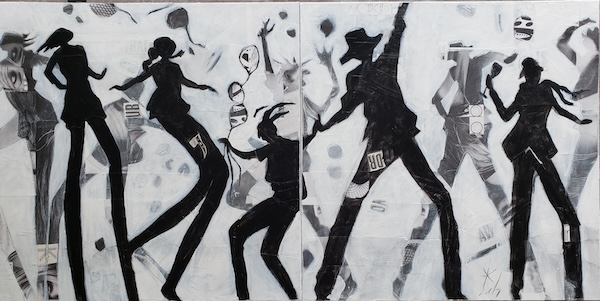
photo - “Shadows in Motion” by Therese Joseph, whose exhibit Women, Words and Wisdom is at the Zack Gallery until Nov. 18
“Shadows in Motion” by Therese Joseph, whose exhibit Women, Words and Wisdom is at the Zack Gallery until Nov. 18. (photo from Therese Joseph)

Most of the works on display are full of colour, so the one in black and white draws the eye. “Shadows in Motion” is actually a diptych. Joseph explained its roots.

“I’ve always loved traveling, and we traveled a lot. When, after 37 years of happy marriage, my husband passed away, I wanted to prove to myself that I could travel alone, too. I went to Mexico. I walked on the beach and watched my shadow. After awhile, I started posing, jumping and photographing my shadow in every awkward position. My hands were here and there, up and to the sides. I bent. I stretched. The sun was strong and my shadow seemed to dance. I wanted to capture every nuance. The painting was born out of those photos.”  

Another travel destination – Amsterdam – inspired a couple of paintings. “Strength Becomes Her” and “Moving On” both have the word “BISON” in them.

“I was in Amsterdam and visited an art show about bison,” Joseph explained. “It was in a warehouse – a huge building with many different artists. They had a catalogue as large as a newspaper, and I asked for two catalogues. When I came home, I tore those catalogues into shreds and used the ripped words in the paintings.”

Both paintings employ bold, punchy colours. Both are rather large.

“The bison is huge and powerful, and I wanted my paintings to reflect that,” said Joseph.

Women, Words and Wisdom opened Oct. 12 and will run until Nov. 18. The official opening reception, with the artist in attendance, will be held on Oct. 30, at 6 p.m. To learn more about the artist, visit thereseljoseph.com. 

Olga Livshin is a Vancouver freelance writer. She can be reached at [email protected].

Format ImagePosted on October 25, 2024October 24, 2024Author Olga LivshinCategories Visual ArtsTags art, collage, mixed media, painting, philosophy, Therese Joseph, wisdom, women, Zack Gallery
Past trauma can help us

Past trauma can help us

Rabbi Dr. Tirzah Firestone spoke in a Zoom webinar hosted by Victoria’s Kolot Mayim Reform Temple on Jan. 14. (PR photo)

Rabbi Dr. Tirzah Firestone unraveled intergenerational trauma, and offered solutions to help remedy it, in a Zoom webinar hosted by Victoria’s Kolot Mayim Reform Temple on Jan. 14. Firestone, the author of the award-winning 2019 book Wounds into Wisdom: Healing Intergenerational Jewish Trauma, is a Jungian psychotherapist and a leader in the Jewish Renewal movement.

“When I was first approached by Kolot Mayim last year to present this talk, nobody had any idea of the life-changing events that we would be experiencing,” Firestone began, acknowledging the geopolitical developments on and after Oct. 7. “Nor did I ever fathom when I wrote Wounds into Wisdom that it would be so very painfully relevant today in the midst of historical traumas in the making.”

An objective of the January talk was to address traumas experienced by one’s ancestors that get transmitted onto future generations in the form of fears, anxieties and hopelessness. Firestone’s goal is to help current generations “metabolize life better” so that the damaging psychological effects of trauma are not extended to future generations. In other words, those who come after should experience life from a position of resilience and hopefulness.

Firestone, who currently lives in Boulder, Colo., spoke about her own parents, who were deeply impacted by the Shoah – her mother as a German survivor and her father as an American soldier stationed in Germany.

“The past does not disappear. The painful histories our ancestors endured, along with their warmth, resilience and all their good resources, are intertwined within us, both psycho-spiritually as well as physically and physiologically,” said Firestone. “And they create the patterns of who we are and who we are becoming.”

Along these lines, the pain from trauma can be unspoken over the course of generations, yet becomes part of the individual nonetheless. Or, as in a quote from Israeli psychologist Dan Bar-On, cited by Firestone: “Untold stories often pass on more powerfully from generation to generation than stories that can be recounted.”

Ongoing patterns, whether ones of heroism and activism or depression and anxiety,  are transmitted across generations.  A young woman Firestone worked with, for example, became an activist, not knowing it ran in the family – her grandmother and great-aunt, neither of whom she had ever met, were rebels in their shtetl decades earlier.  

Another example involved a woman whose very first memories as a young child were nightmares. One night, she explained to her concerned mother why she would wake up crying so often. The image in the young child’s mind was of an old wooden town where a man at the train station would jump from the platform to the train tracks. The man would run along the tracks yelling, “Stop! Stop!”  The train would go on with the young man unable to catch it. 

When the mother heard her child’s story, she cried and asked in disbelief, “How could you possibly have known this?” It was the story of the child’s grandfather who, in the Second World War, found out belatedly that Jews in his town, including his young family, had been rounded up and deported by train. He ran after the train, but never caught up and never saw his family again. The man survived the Holocaust and started a new life and family in the United States.

Traumas can happen collectively.  Firestone noted that Israeli journalist Chemi Shalev wrote, “I am a Jew, and there are scenes of the Holocaust that are indelibly etched in my mind, even though I was not alive at the time.”

Firestone also outlined research conducted by Rachel Yehuda of New York’s Mount Sinai Hospital, which showed that the children of Holocaust survivors were three times more likely to develop post-traumatic stress disorder symptoms when exposed to traumatic events than the children of other Jews.

In the latter part of her talk, Firestone focused on what can be done towards healing trauma. Every family has its own ruptures and resources, no matter who or where it is, she said. Whether through intelligence, resilience or good fortune, every family today is a survivor. Thus, she asked, “What family resources can you tap to assist you in this current moment in history?”

Among some of the keys she highlighted for healing trauma, and which are discussed in greater depth in her book, is being aware of family legacies. This awareness, she asserts, will hinder the transmission of trauma to succeeding generations.

Another is to face one’s losses. “When we face our grief, we can start to feel our grief. When we don’t feel our grief, it becomes pathogenic. It makes disease on the inside of us,” she said.

A third technique for healing, according to Firestone, is “to harness the power of one’s pain.” That is, one can use the tremendous power contained in pain to bring on more destruction and further pain or to bring light, warmth and hope.

Firestone advised taking action. Here she employed a saying from Midrash: “Had I not fallen, I would not have arisen. Had I not been subject to darkness, I would not have seen the light.”

In concluding her remarks, Firestone said, “We have a mandate to draw on our ancestors’ greatest traits – their survival skills, their courage, their ingenuity – to apply to circumstances now. There are so many people who are suffering. What can we do from our own pain by harnessing its power and going places that we could not have gone before we endured [it]?”

For more on Firestone and her writings and ideas, visit tirzahfirestone.com. 

To register for future Kolot Mayim speaker series Zooms, the next of which takes place Feb. 4, click here.

Sam Margolis has written for the Globe and Mail, the National Post, UPI and MSNBC.

Format ImagePosted on January 26, 2024January 24, 2024Author Sam MargolisCategories LocalTags healing, intergenerational trauma, Kolot Mayim, resilience, Tirzah Firestone, wisdom
Proudly powered by WordPress