Skip to content
  • Home
  • Subscribe / donate
  • Events calendar
  • News
    • Local
    • National
    • Israel
    • World
    • עניין בחדשות
      A roundup of news in Canada and further afield, in Hebrew.
  • Opinion
    • From the JI
    • Op-Ed
  • Arts & Culture
    • Performing Arts
    • Music
    • Books
    • Visual Arts
    • TV & Film
  • Life
    • Celebrating the Holidays
    • Travel
    • The Daily Snooze
      Cartoons by Jacob Samuel
    • Mystery Photo
      Help the JI and JMABC fill in the gaps in our archives.
  • Community Links
    • Organizations, Etc.
    • Other News Sources & Blogs
    • Business Directory
  • FAQ
  • JI Chai Celebration
  • JI@88! video

Recent Posts

  • Last hostage home
  • New bill targets hate crimes
  • Concerning actions
  • Recipes not always required
  • Survivor urges vigilance
  • Seniors profoundly affected
  • Farm transforms lives
  • Musical legacy re-found
  • A range of Jewish literature
  • A concert of premieres
  • Variety telethon on Feb. 22
  • Victoria club’s many benefits
  • Avodah dedicated to helping
  • Artists explore, soar, create
  • Life’s full range of emotions
  • Community needs survey closes March 29
  • Jerusalem marathon soon
  • Historic contribution
  • Chronicle of a community
  • Late-in-life cartoonist
  • Cashflow vs growth portfolio
  • My new best friend is Red
  • ישראלים רבים ממשיכים לתמוך בטראמפ ועדיין אינם מבינים במי מדובר
  • עשרים ואחת שנים בוונקובר
  • Supporting the Iranian people
  • The power of photography
  • A good place to start
  • When boundaries have shifted
  • Guitar virtuosos play
  • Different concepts of home
  • Broadway’s Jewish storylines
  • Sesame’s breadth and depth
  • Dylan Akira Adler part of JFL festival
  • Mortality learning series
  • A new strategy to brighten up BC
  • Sharing latkes and light

Archives

Follow @JewishIndie
image - The CJN - Visit Us Banner - 300x600 - 101625

Tag: printmaking

Artist reflects on career

Artist reflects on career

Imre Székely, left, gives his artwork to then-prime minister Jean Chrétien. (photo from szekelygallery.com)

From his hometown of Győr, Hungary, a city halfway between Vienna and Budapest along the Danube River, to his studio in Victoria’s Chinatown, Jewish community member Imre Székely has been creating art for more than five decades, primarily in the linocut/monotype style of printmaking.

Linocut, also known as lino print, is a design carved in relief in linoleum. The art form was popularized in the early part of the 20th century. In monotype, an artist presses ink directly onto a plate. The plate is then pressed against paper to transfer the ink.
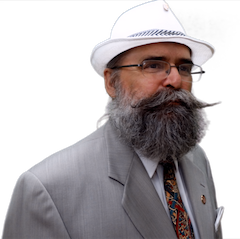
photo - As Imre Székely’s approaches 70 years old, he looks back at his career
As Imre Székely’s approaches 70 years old, he looks back at his career. (photo by Kor Gable)

Székely discovered his calling early in life, under the tutelage of Imre Krausz and István Tóvári-Tóth, both distinguished artists in Hungary. However, Hungary in the 1970s and 1980s was no place for anyone whose views differed from those of the regime. 

“The communist regime at the time did not have a role for a forward-thinking, modern artist. There wasn’t much chance of self-actualization,” Székely told the Independent.

Thus, in 1987, he said goodbye to his family and jumped on a westward-bound bus. His first stop was a refugee camp in Austria, then on to France, the Netherlands and, finally, Canada, in 1988. After stops in Winnipeg and Toronto, he set off west where, in 1991, he settled in Victoria, finding the provincial capital to be an ideal spot for his professional and private life. His wife and children joined him shortly after he arrived in British Columbia.

Székely describes himself as a hyper-surrealist artist, who blends “a variety of colours, patterns and shapes that are the spices of life.”

Throughout his career, he has donated his works and given them to people who couldn’t otherwise afford a work of art. He also has presented his artwork to provincial ministers, foreign dignitaries and prime ministers. 

In 1999, for example, he traveled to Rome for a personal audience with Pope John Paul II, to donate his work “Abba Pater” to the Vatican.

In 2001, he showed his gratitude to his adopted homeland by donating his art-deco-styled piece “Canada: Past, Present and Future,” to then-prime minister Jean Chrétien, who accepted it on behalf of the government of Canada.

“This occasion was especially meaningful to me, as it presented a way to express my thanks to Canada for accepting so many refugees to this country with open arms,” said Székely, who has also presented a work to Prime Minister Justin Trudeau. 

“Gifting Justin Trudeau with one of my art pieces was a highlight in my life … this kind of event was impossible in my home country under communist rule,” he told Senior Living Magazine in 2021.

One of the works of which he is most proud, “Hungarian Conquest (Honfoglalás),” was presented to the Hungarian parliament in Budapest. When, in 2010, Pecs, Hungary, was chosen as the European Capital of Culture, Székely provided the city with 31 of his works for a solo exhibition. His hometown Győr’s city hall houses his artwork and he has donated his works locally, to the City of Victoria and to the Hungarian consulate in Vancouver.
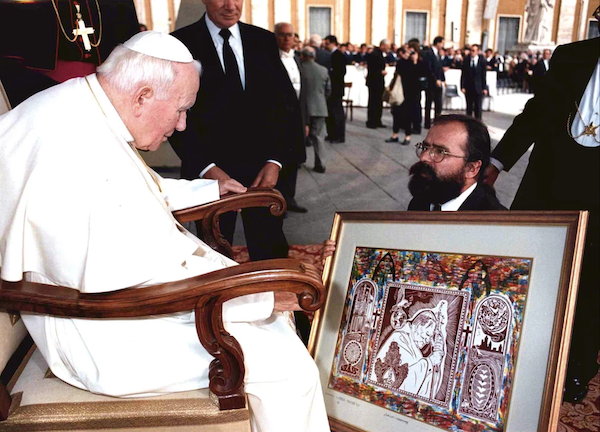
photo - Imre Székely at the Vatican in 1999, giving one of his artworks to Pope John Paul II
Imre Székely at the Vatican in 1999, giving one of his artworks to Pope John Paul II. (photo from szekelygallery.com)

At the height of the COVID-19 lockdowns in 2020, retreating to his studio, Székely produced “Satan Sneers,” a work in which, as an artist, he detaches himself from shared circumstances to show pity for the human race as it confronts an undetermined fate.

Székely sent a photo of the work to Dr. Tedros Adhanom Ghebreyesu, director-general of the World Health Organization, in the hope of donating the work. According to Székely, Dr. Tedros (his preferred moniker) liked the piece very much.

“Unfortunately, I couldn’t personally hand it over to him in Geneva at the time because the two-week quarantine was introduced before my departure,” Székely recalled. 

In 2021, the artist created a work entitled “Hope and Genius,” dedicated to Katalin Karikó, the biochemist and researcher at the University of Pennsylvania, who, together with Drew Weissman, took home the 2023 Nobel Prize in medicine for work leading to the discovery of mRNA vaccines to fight COVID-19.

“She deserves lots of thanks and appreciation from us all,” he said. “My work is recognition and homage to her human and scientific greatness.”

At present, Székely is working on several projects, one of which is called “Magical Artificial Intelligence,” a surrealistic piece on what he views as the issue that offers the most positive potential for humanity – and the most danger.

He hopes to donate works to other notable people in the political and business worlds, such as Bill Gates, Kamala Harris and Ernő Rubik, a fellow Hungarian who invented the Rubik’s Cube.

As he approaches his 70th birthday in December, Székely said he feels freer now than at any time in the past, drawing strength from family, friends and art.

“Artistic creation is the outflow of strength, good mood and joy of life. A true artist enjoys his own creative power. Creation is one of the most difficult things in the world, creating from nothing,” he said.

“I am convinced that art and culture will unite the world again. I know that artistic ability can be viewed as a blessing, but it is worthless without creative work and humility.” 

For more on Székely, visit szekelygallery.com. 

Sam Margolis has written for the Globe and Mail, the National Post, UPI and MSNBC.

Format ImagePosted on October 25, 2024October 24, 2024Author Sam MargolisCategories Visual ArtsTags art, COVID-19, immigration, Imre Székely, Linocut, milestones, monotype, painting, pandemic, printmaking, Victoria
Printmaker comes to city

Printmaker comes to city

Ian Kochberg at work. (photo from Ian Kochberg)

Next week, at the Circle Craft Winter Market, local community members will have a rare opportunity to meet Ontario artist Ian Kochberg and buy some of his work.

Kochberg has been a professional printmaker for 39 years. His studio is located in Richmond Hill, part of the Greater Toronto area. As a child, he didn’t dream of being a printmaker. In fact, he has a degree in animated film, but “to the chagrin” of his professors at the time, said Kochberg in an email interview with the Independent, “I had decided during my final year that film was not something I could pursue.”

He cited several reasons for his decision. One of them was his aversion to computers. “Although computer animation was in its infancy,” he said, “I knew that, in due course, computers would take over the animation industry. I have always had little interest in computers. Both professors and fellow students thought me insane.”

Another reason to opt out of a film career was his realization that he didn’t compromise easily. “I never worked well with others,” he said. “In college, the final year’s work was a group film. I was the only one who decided to go solo. I went in the first day to get the assignment parameters and came back the last with a finished film. Later, the college entered my film in numerous film festivals. It won a number of awards, but that was not how the industry works. Film requires a collaborative effort – printmaking does not.”

Fortunately, he stumbled into printmaking while still in college, and it was love at first sight. “I worked my way through college and university, hiring out as a freelance artist for ad agencies. I did everything: from illustration, to fabric design, to designing seat covers and bulkheads for a new fleet of Air Canada jets,” he said.

Among those agencies was a company that sold framed art to people in the legal profession. “They hired me to create a set of legal-themed illustrations, which they printed and framed,” explained Kochberg. “I received payment for each drawing, along with royalties on each sale. Life was good! The owner of the company, in an attempt to maintain control, told me ‘how expensive’ it was to print up those reproductions. Shortly thereafter, I discovered his lie. It was actually cheap to make copies of art.”

He decided to strike out on his own. His first foray into the life of an independent artist was a set of three drawings of old Ontario houses. “I had them printed up on a very high-quality paper, meticulously hand-painted each copy and then signed and numbered each as a limited edition. Being young, naïve, and not knowing any better, I brought these pieces into a real art gallery. The owner was highly knowledgeable and very gracious. He unashamedly heaped praise upon my work and my talent, employing an imaginative mélange of artsy adjectives.”

But, when Kochberg attempted to close the sale, the gallery owner gave him a lecture on the difference between original prints and reproductions. “I felt the proverbial light bulb go on over my head,” Kochberg recalled.

The gallery owner did purchase the prints that day, however. “He didn’t sell copies in his gallery, but he told me they were going to hang in his own house,” said Kochberg. “Whatever his motives, whether he actually liked them that much or it was simply a ‘pity sale’ matters not. Unbeknownst to him, he had forever altered the course of my life. The very next day found me in the library, where I researched printmaking techniques. Before I had even set foot into a printmaking studio, I had taught myself everything I needed to know to get started.”

He also got some exciting ideas of his own and took a 10-week course to get access to printmaking equipment. “When I finished the course, I purchased my first etching press,” he said.

Once he became involved in printmaking, Kochberg never looked back. For him, printmaking is a fascinating combination of research and intuition, design and fine art, creativity and technology.

“It is a cerebral, controlled process,” he said. “It is also unforgiving. Sometimes, I’ve spent up to 180 hours working on a single screen for a single color, with no way to make a correction if I made a mistake…. At one point, I actually counted how many times I had to pick up each and every piece of paper in an edition, do something to it, and put it down. As I recall, the number was around 120.”

According to his records, large pieces typically take him six to eight months, working full-time, to complete an edition. “The longest I’ve spent creating an edition has been 13 months,” he said.

Kochberg’s limited editions usually range from 100 to 300 original prints, all signed and numbered, and the source plates and screens are always destroyed after the edition is finished.

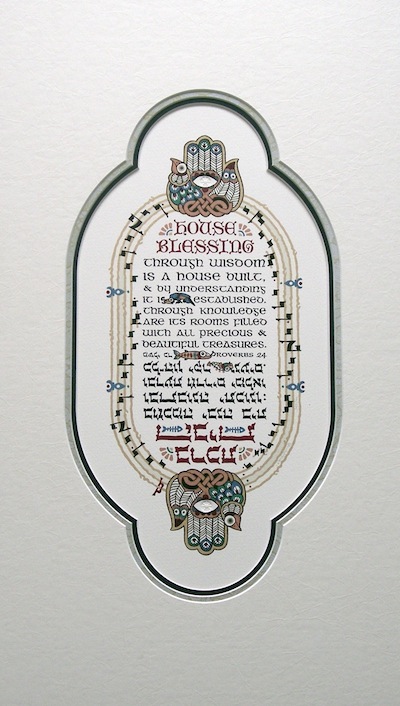
photo - Ian Kochberg’s “House Blessing”
Ian Kochberg’s “House Blessing.” (photo from Ian Kochberg)

Despite the demanding, labor-intensive technical process, every stage of printmaking still makes him feel “like a child in a toy store,” he said. “When these things no longer generate that kind of wonder and awe, it will be time to move on to something else.”

So far, after four decades of printmaking, it hasn’t happened yet. New ideas still swirl in the artist’s head, and his fans continue to admire his imagination and work. Some of his fans are celebrities. One of his prints even hangs in the Vatican. “I don’t recall the details – I have a horrible memory – but it was purchased for some special occasion involving the last pope. It was interesting shipping out a package to the Vatican,” he said.

“There have been countless warm stories and anecdotes about where my work hangs, for whom it was purchased and what individual pieces have meant to patrons,” he continued. “These are humbling and keep me grounded. The incident that stands out most clearly in my mind is that of a young lady who came to us at a show some years back, along with her baby daughter in a stroller. She told us that, when she was her daughter’s age, her mother similarly brought her to us in a stroller and purchased one of my works for her – to start her daughter’s collection. Now, all grown up, the young lady was doing the same for her own daughter – buying her child’s first ‘Kochberg.’ I felt quite honored, but it did make me feel old.”

Many of his pieces sport his signature combination of funky drawings, music notation, Judaic themes and a Celtic pattern. “Aside from my name, Ian, I have no Celtic or Irish connections,” he admitted. “One of my earlier Judaic pieces had an interlaced border. I copied the structure of the design from a Havdalah candle. People assumed it was a Celtic design. I don’t like arguing.”

The infusion of musical notes echoes his love of music, though he downplays his own talent in this realm. “I have no formal music training,” he explained. “I have played piano, but am not a pianist. I enjoy playing guitar and have written a number of songs, but am not a guitarist. I sing and, if you heard me sing, you’d know I am not a vocalist. I also play recorder, banjo and upright bass. In any event, I definitely do not consider myself a real musician.”

His family is musical though. His wife and children have all had formal musical training, and musical activities often feature as their family pastime. “About a year ago,” he said, “I started playing upright bass and joined the nonprofit community orchestra in which my wife, Arlene, plays a violin and our daughter, Toni, plays cello and bass.”

He finds both inspiration for his work and a relief from it in his family and in his various recreational pursuits. For many years, one of those was ballroom dancing, a hobby and part-time job.

“My wife and I taught social ballroom dancing for the local continuing board of education,” he explained. “This was not so much for extra income but to get us out of the studio and away from our work. When you have your own business, it never ends. We enjoyed our teaching very much. We taught for a full 20 years, until we realized that we just weren’t enjoying our classes as much. It was time to move on.”

Another of his lifelong interests is dogs. “We’ve had dogs for about 40 years,” he said. “Currently, we have a 10-year-old Black Russian terrier. I’m actually the ‘go-to dog guy’ in the neighborhood. Whenever people have questions or problems about their pooches or need information on specific breeds, they come to me. Friends of ours know that I enjoy talking dogs much more than art. Art is usually about me, while dogs are ‘just’ dogs.”

His affection for dogs in general, and his terrier in particular, has spilled into his writing. Kochberg’s hilarious true story about his dog was published in one of the Chicken Soup for the Soul series, The Dog Did What?: 101 Amazing Stories of Magical Moments, Miracles and … Mayhem (2014).

The Circle Craft market runs Nov. 9-13, and Kochberg will be located in booth #318.

Olga Livshin is a Vancouver freelance writer. She can be reached at [email protected].

Format ImagePosted on November 4, 2016November 3, 2016Author Olga LivshinCategories Visual ArtsTags Circle Craft, dogs, printmaking
Proudly powered by WordPress