קנדה מקילה באופן זמני על ישראלים המעוניינים להגר למדינה. זאת עקב מלחמת חרבות הברזל הארוכה המתנהלת כבר למעלה מארבעה חודשים בין ישראל לחמאס. המסלול הזמני והחדש יתקיים בשלב זה למשך כארבעה חודשים – עד לסוף חודש יוני
על פיו יוכלו ישראלים המעוניינים בכך לקבל ויזת עבודה בקנדה במשך שלוש שנים. מדובר בויזה פתוחה שתוכל לסייע בהמשך הדרך לקבלת אישור תושבות קבוע. ולאחר מכן אף לקבל אזרחות קנדית לכל דבר. מסלול זה שנפתח עתה עבור ישראלים כאמור בעקבות המלחמה, שימש בעבר כסיוע הומניטרי עבור אוקראינים ואוכלוסיית היזידים שנרדפת על ידי דאעש וכן גורמים איסלאמיים קיצונים
הקלות עבור ישראלים המעוניינים להגר לקנדה ניתנות עבור אלה שהם בעלי אשרת תייר המבקרים כאן (ללא קשר למועד הגעתם לקנדה). וכן לאלה שהם קרובי משפחה של אזרחים קנדיים, או אלה שמחזיקים בתעודות של תושבות קבע
עד תחילת מלחמת חרבות הברזל הקריטריונים להגירה לקנדה הקלו בעיקר על בעלי מקצועות מבוקשים וכן על בעלי השכלה גבוהה (בעלי תארים מתקדמים). אך בתנאי שכל אלה הם מתחת לגיל שלושים. וזאת, על פי שיטת הנקודות. מדי מספר חודשים משנה קנדה את גובה רף הניקוד אשר ממנו כל הבקשות מתקבלות
מסלולי ההגירה בקנדה מחולקים על פי הפרובינציות השונות. על פי השיטה על המבקש להגר לכאן מוטל להציג מספיק נקודות שנקבעות לפי מספר קריטריונים. ובהם: מקצוע, גיל ורמת האנגלית. מי מבקשים להגר לקנדה שהציג מספיק נקודות, יכול להגיש בקשה לתושבות קבע, לאחר מספר שנים לעבור מבחן (באזרחות) ואז להפוך לאזרח קבוע. כידוע אזרחים יכולים לבקש דרכון קנדי, נחשב לאחד הדרכונים המבוקשים ביותר בעולם במשך שנים
את הגשת המועמדות להגירה ניתן להגיש באופן עצמאי או להשתמש ביועצי הגירה המומחים לנושא, שיעזרו במילוי הטפסים הרבים. את הטפסים לבקשות הגירה ניתן להגיש מישראל, או מקנדה למי שנמצא כאן על פי ויזת עבודה או אלה שלומדים כאן
זמן ההמתנה לקבלת האישורים להגירה יכול להימשך כשנה ואף יותר מכך, בהתאם לרמת הנקודות של המבקש
באופן כללי מסלולי הגירה לקנדה נחלקים בגדול למסלולים זמנים ומסלולים לתושבות קבע. וזאת על פי קריטריונים שונים ובהם: הגירה לצעירים ומשכילים, הגירה על פי תוכניות של הפרובינציות השונות, מקצועות מבוקשים, הגירה לצורכי לימודים. וכן מסלולים למשקיעים פיננסים, קרובים מדרגה ראשונה ועוד
ניתן לקבל אשרות שהייה זמניות לצרכי לימודים גבוהים או עבודה. אם מעסיק קנדי מציע למועמד הצעת עבודה שעומדת בתנאים של משרד העבודה הקנדי, אפשר לקבל אשרת עבודה למשך מספר שנים. בדרך כלל אשרת עבודה מתקבלת מהר וניתן להאריכה בסך הכל עד שבע שנים. כמובן אם המשרה של העובד עדיין בתוקף. לאלה שעובדים בקנדה, העבודה תקנה להם נקודות כך שבתוך שנתיים הם יוכלו להגיש מועמדות של תושבות קבע במסלול המהיר. מי שקיבל שהתקבל ללימודים במוסד להשכלה גבוהה בקנדה (אוניברסיטהי או קולג’) למשך חצי שנה או יותר, יוכל לקבל ויזת לימודים. בתום סיום הלימודים המועמד יהיה זכאי לקבל ויזת עבודה בקנדה, למשך של שלוש שנים. זאת תלוי במסלול הלימודים ובאישור שהתקבל על ידי מוסד הלימודים. יש לזכור שעל מוסד הלימודים להיות מאושר על ידי מערכת ההגירה של קנדה. הלימודים או העבודה לאחריהם יכולים להקנות מספקי נקודות כדי להגיש מועמדות לקבלת תושבות קבע, במסלול המהיר
לפרובינציות השונות יש מסלולים מקוצרים ומהירים לקבלת תושבות קבע
אתר טוטל ג’ואיש טרבל שמיועד למטיילים יהודים שומרי מסורת האוכלים אוכל כשר, מפרסם מידע אודות קנדה
בחלק הראשון מתפרסם מידע כללי על קנדה
קנדה היא מדינה בחלקה הצפונית של צפון אמריקה, היא המדינה השנייה בעולם בגודל בשטח ואוכלוסייתה מונה קרוב לארבעים מיליון איש. קנדה מחולקת לעשר פרובינציות ושלוש וטריטוריות. המדינה היא מונרכיה חוקתית ודמוקרטיה פרלמנטרית. לקנדה גבול בודד עם ארצות הברית ומדובר על הגבול היבשתי הארוך בעולם, באורך של קרוב לתשעת אלפי קילומטרים. עיר הבירה של קנדה היא אוטווה בה נמצא הפרלמנט ומקום מושבה של הממשלה הפדרלית וכן של המושל הכללי, שמייצג את ראש המדינה – המלך של אנגליה. קנדה היא מושבה בריטית לשעבר והיא המדינה הגדולה ביותר בחבר העמים הבריטי. ברוב המדינה יש מזג אוויר קר בחורף, ובכלל מזג אוויר קר מאפיין את המדינה, אולם באזור דרום המדינה חם בקיץ. קנדה מאוכלסת בדלילות, רוב השטח הכפרי מיוער ובמדינה ישנם גם את הרי הרוקי. רוב תושבי המדינה גרים בערים גדולות ובינוניות, למעשה מדובר במדינה עירונית מאוד כאשר כשמונים ושניים אחוזים מהתושבים מתגוררים בערים. שליש מהאוכלוסייה חי בשלוש הערים הגדולות: טורונטו, מונטריאול, וונקובר. קרוב לשלושים מיליון תיירים מבקרים בקנדה מדי שנה. סיבות ההגעה שלהם למדינה מגוונות. ספורט החורף במדינה מפותח מאוד ומביא תיירות רבה למדינה, בקנדה יש גם הרבה פסטיבלים בחורף ובקיץ המושכים אליהם תיירים רבים מכל רחבי העולם
בחלק השני מתפרסם מידע על היהודים בקנדה
בקנדה גרים כארבע מאות ועשרים אלף יהודים שמהווים קצת יותר מאחוז מתושבי המדינה. מוצאם של רוב יהודי קנדה הוא אשכנזי אולם במדינה חיים גם יהודים ממוצא ספרדי, מזרחי ומגוירים. בקנדה ישנם מוסדות תרבות יהודיים רבים המשרתים את הקהילות הרבות במדינה על זרמיהם השונים. למרות היותם מיעוט קטן במדינה, נוכחות יהודי קנדה במדינה מתקיימת כבר מאז סיום מלחמת שבע השנים. רוב אוכלוסיית היהודים במדינה מתגוררת בערים הגדולות. בטורונטו ובמונטריאול חיות הקהילות היהודיות הגדולות במדינה, כאשר בטורונטו חיים כמאתיים וחמישים אלף יהודים ובמונטריאול למעלה ממאה אלף יהודים. אלו גם הערים בהן ניתן למצוא מסעדות כשרות וחנויות לממכר אוכל כשר. קהילות יהודיות חיות גם בערים אחרות אך אוכלוסייתן קטנה יותר, וגם הסיכוי למצוא בהם אוכל כשר קטן ונעשה קשה יותר לאיתור, אולם עדיין גם מחוץ לערים אלו ישנן מסעדות וחנויות כשרות גם מחוץ לטורונטו ומונטריאול
בחלק השלישי מתפרסם מידע על ונקובר
המדריך המלא למטיילים יהודים ולשומרי כשרות בוונקובר מפרסם מידע למטייל אודות מקומות כשרים (כגון מסעדות כשרות, בתי קפה, מאפיות וחנויות), וכן ומידע מגוון על מוסדות בקהילה היהודית בוונקובר או בסמוך אליה, כוללי בתי כנסת, מקוואות, בתי מלון כשרים או מוסדות המתאימים למטיילים דתיים, הקשורים לקהילה היהודית בוונקובר או לשאר חלקי בריטיש קולומביה. מוזכרים בין היתר שני ארגונים: הג’ואיש קומיונטי סנטר והכולל-אוהל יעקב. שני מקוואות: אחד בארגון של חב”ד ואחד בבית הכנסת שערי צדק. מוזכרים מספר בתי כנסת נוספים בעיר: בית המדרש, עץ חיים וטמפל שלום. ישנם גם שלושה בתי מלון בעיר המספקים אוכל כשר: הולידי אין, פארק אין-רדיסון והייקרופט סוויטס. בוונקובר יש גם מקומות שמספקים אוכל כשר: קפה ארבעים ואחד בג’ואיש קומיונטי סנטר, הקייטרינג של חב”ד, מאפיית גארדן סיטי בריצ’מונד, מסעדת מייפל גריל בקומת הקרקע של הכולל-אוהל יעקב, קפה נאווה, מאפיית סברה וחנות שהיא בעצם מחסן לאוכל כשר
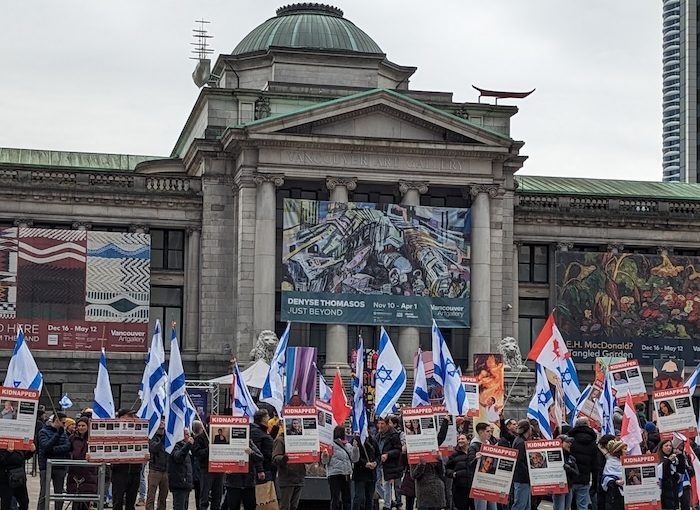
The weekly rally for Israeli hostages at the Vancouver Art Gallery Sunday, Feb. 18. (photo by Pat Johnson)
Family was the theme at the weekly rally for Israeli hostages at the Vancouver Art Gallery Sunday, Feb. 18, the day before British Columbians marked the Family Day holiday. Speakers took to a stage at the edge of the gallery’s north face out of respect for a makeshift memorial to Alexei Navalny, the Russian opposition leader who died in custody two days earlier.
“Family Day will be celebrated here tomorrow,” said Daphna Kedem, organizer of the weekly vigils for the hostages. “But this year casts a heavy shadow over the day for some families of our community here and in Israel…. It is difficult to be happy when families are waiting to be reunited with their loved ones, or for many families who have lost their loved ones.”
Dr. Michael Elterman, a psychologist, spoke of the psychological effects of what is happening in Israel and worldwide.
“We see the indescribable anguish in the families and we easily feel ourselves in their shoes and intuitively imagine what we might feel if that happened to us,” he said. “There has developed a related construct of post-traumatic stress disorder over the past decade … this is the sadness, anger and sometimes spiritual distress that arises from moral outrage. It is a broader set of reactions that arise even when the individual themselves were not present at the trauma but rather are morally outraged and left furious and depressed by events. This is even more likely where we identify so strongly with those who are personally impacted by Oct. 7.”
This anxiety is heightened by increases in antisemitic rhetoric and attacks, including in Vancouver.
“Some of you may be experiencing the symptoms of post-traumatic stress, such as disturbed sleep, intrusive thoughts, trouble concentrating and being easily startled,” Elterman said, adding that help is available through Jewish Family Services and other resources. Getting involved in the community response can help ease feelings of helplessness and he directed people to the Community Toolkit on the website of the Jewish Federation of Greater Vancouver.
“Remember to practise self-care in small ways, like proper nutrition and sleep,” he said. “Continue to do the things you previously enjoyed, even if you don’t feel like doing them. Finally, hug each other a little longer and a little tighter.”
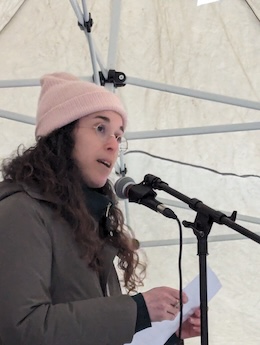
Aviya Kones, who works at Jewish Family Services, spoke not about the services offered by that organization, but about the people of Kfar Aza, where she grew up.
Aviya Kones speaks about the people of Kfar Aza, where she grew up. (photo by Pat Johnson)
“Kfar Aza was a desert oasis,” said Kones. “It was home, it was love and life, it was filled with unique and quirky and hilarious traditions and it was generations of family. It was also savagely and brutally destroyed after countless and seemingly endless hours of horrors.”
Her own childhood home was destroyed on Oct. 7.
She shared memories of three people who died that day.
“Smadar, a year above me, was tall, slender, so elegant,” she said. “Even as a child, I recall looking up to her. She had big, beautiful brown eyes and thick brown hair. I remember being awed by her grace, kindness and gentle nature.
“Nadav was two years older than me,” she said. “He knew how to make everyone laugh in every situation – not at anyone’s expense but maybe his own.
“Yoav was my age group,” she continued. “He had blue eyes, blond hair and a genuine smile. All the girls thought he was cute and all the guys wanted to be his best friend. He was shy, kind, creative and athletic. He loved his family. He was so close with his parents, his siblings and the many, many cousins he had living on the kibbutz.
“All three, amongst many others, tragically, brutally and with unimaginable cruelty, lost their lives on Oct. 7,” said Kones. “They were living in our beautiful oasis, our safe place, our home. They are survived by a broken and mourning community, generations of family that absolutely adored them and … all three were also survived by their young children. Nadav had two daughters, Smadar had three children and Yoav was a first-time dad to a little girl who was only 10 days old on Oct. 7.”
Rabbi Jonathan Infeld, senior rabbi at Congregation Beth Israel and head of the Rabbinical Association of Vancouver, said that Oct. 7 was not just an attack on Israelis or those living in Israel.
“It was indeed the beginning of an attack on the entire Jewish people,” he said. “It was a catalyst for antisemitism across the world that we have felt even here in Vancouver…. Too many of us have felt the antisemitism that began to boil over on that day.”
Gordon Shank, a First Nations member, a business innovator and a survivor of the Sixties Scoop, which saw Indigenous children abducted from their families and placed with white families, spoke of the centrality of family and the trauma of separation.
“I’ve known the pain of separation from family, being torn from the embrace of loved ones, albeit under different circumstances,” he said. “The Sixties Scoop and the current crisis in Gaza might stem from vastly different contexts yet, at their core, they resonate with the universal cry for the right to family, to unity and to belonging. This parallel is not to equate the experiences but to underline the shared understanding that every individual deserves to grow, to dream and to thrive within the warmth of their family’s love.”
Of the hostages and their families, Shank said: “Their pain is our pain. Their hope is our hope. Let our gathering today send a powerful message that we stand together across cultures and histories, united in our resolve to bring the hostages home.”
The march through downtown streets that has been a feature of the weekly events since October will be a monthly activity only for the coming weeks, Kedem told those gathered. The crowd then moved to the sidewalk adjacent Georgia Street for a demonstration, with a brief disruption by an individual waving a Palestinian flag.
Kedem has organized the weekly events since October and, early on, affiliated with the ad hoc international group Bring Them Home which, in turn, is affiliated with the Hostage and Missing Families Forum, in Israel.
Recently, Kedem also associated her activities with another international group, Run for their Lives, which encourages groups as small as a single individual to demonstrate solidarity with Israel and its hostages by walking, biking or running.
Yoav Brill’s documentary Apples and Oranges, about a moment in the history of the kibbutz movement, is mesmerizing. (photo by Avraham Eilat)
The 2024 Vancouver Jewish Film Festival takes place in person April 4-14 and online April 15-19. As usual, a diversity of offerings is included in this year’s festival and the Independent will review several films in this and upcoming issues. The Vancouver Jewish Film Centre also sponsors events throughout the year and some screenings take place before the annual festival begins. Full festival details will be online at vjff.org as April approaches.
Idealism remembered
Amid the euphoric aftermath of the 1967 war and the enduring popularity of the 1958 Leon Uris book Exodus (and its 1960 film incarnation), thousands of Jews and non-Jews descended on Israel to volunteer on kibbutzim.
They came to experience and emulate “the embodiment of man’s highest ideals – the kibbutznik,” as an apparently promotional film clip declares in Yoav Brill’s mesmerizing documentary Apples and Oranges. In just one particular spurt, 7,000 volunteers arrived in Israel en masse from around the world.
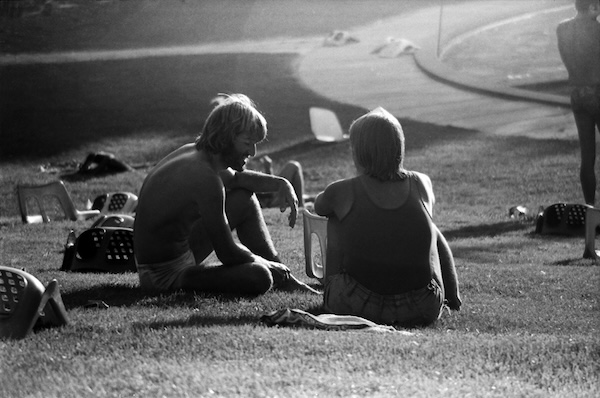
Through the recollections of aging Scandinavians, Brits, South Africans and others, and with nostalgia-inducing archival footage, the documentary shines a light on the socialist idealism and hippie adventurism that motivated these people to travel to the farming communities of rural Israel. Many returned, to Sweden, Denmark, wherever, and formed associations to support the kibbutzim and drum up more volunteers. So successful were they that the supply exceeded the demand. One group chartered a jumbo jet to go from Stockholm to Tel Aviv but the Israelis had to admit they had no use for 340 volunteers.
Generally, the spirit of the overseas visitors was welcomed, though the social impacts were not negligible. The temporary nature of their visits was disrupting. A middle-aged man reflects on his perspective as a kid on a kibbutz, welcoming all the strangers who became like big brothers and sisters, only to have his heart broken every time the groups departed from what he calls “the kibbutz fantasy.”
Strangers from another world – blond, exotic, sophisticated and drinking milk with their meals – descended on a cloistered society where all the teens had been together since kindergarten, introducing predictable social and hormonal disruptions. For their parts, many of the volunteers soon discovered they had no aptitude for the tasks to which they were set, although at least one Brit made use of his talents performing Shakespeare for an audience of cattle.
Many of the overseas youngsters were unabashedly out for sex, drugs and rock ’n’ roll. As one woman interviewed in the documentary says, “If there weren’t female volunteers at [Kibbutz] Mishmar HaSharon, many of our boys would still be virgins.”
In one incident that apparently caused national outrage, a group distributed hashish-laden brownies to an entire community, including at least one 8-year-old child, a crime that is not the least bit funny – but, of course, is hilarious when recounted by octogenarians who experienced it.
With their Cat Stevens and Bob Dylan LPs, the foreigners brought a little bit of Woodstock with them, and took away some Israeli dance routines. But the adventure, as the viewer knows more than do the figures in the old footage, would not end well. Terrorism, including a highly publicized attack in which a volunteer was murdered, would strangle the flow of future volunteers.
The documentary is a masterpiece of the genre, capturing the joy and exuberance of the experience for both Israelis and the visitors, but addressing the serious problems the interactions raised. The clash of cultures introduced existential issues, including around conversion, mixed marriages, secularization and, of course, the collapse of the traditional kibbutz.
The apples and oranges of the title, we are to understand, are the people who came together on the kibbutzim, as much as the produce they harvested.
Critics of the volunteer phenomenon seem to place some of the blame for the collapse of the kibbutz system on the labour underclass they represented, which undermined the egalitarian foundations of the movement.
The kibbutz network has largely petered out, almost entirely in spirit if not completely in form, and some of the Jews and non-Jews who came during the heyday have remained and integrated to varying degrees in the society that Israel has become. In one instance, an aging, bearded former volunteer actualizes his idealism by leading a ukulele orchestra.
The collapse of the idealistic experiment that the end of the film documents is expected but no less depressing for that. The slice of history and the magnificence of the story, so vividly told in the film, will stay with the viewer.
Transcendence of song
In Less than Kosher, the real star is the voice of Shaina Silver-Baird as Viv, an atheist turned cantor. (photo from Menemsha Films)
In Less than Kosher, a number of fairly two-dimensional character sketches come together – but with a redeeming twist.
A feature film that began its life as serialized online videos has the feel of excellent amateurism. Wayward Jewish girl meets rabbi’s bad boy son. Overbearing Jewish mother, well-intentioned buffoonish rabbi, go-along-to-get-along intermarried stepdad and hyper-chatty high school friend flesh out the cast.
Sitcom-like circumstances turn the atheist young woman into unlikely cantor. But the outstanding component of the film, the real star, is the voice of Shaina Silver-Baird, the lead actor and co-producer (with Michael Goldlist) of this cute confection.
The unlikely cantor Viv, whose once-promising pop music career is on the skids, has the voice of an angel and the story is less about her family or her romance with the (married) rabbi’s son than about the transcendent power of song. When she opens her lungs, Viv ushers in a changed world – and Silver-Baird’s voice invites the viewer into it. Music video-style segments, which Viv is dismayed to have dubbed “Judeopop,” raise the film to a different level. Liturgical music goes Broadway. Amy Winehouse does “Shalom Aleichem.”
A tiki-themed shiva is truly the icing on the sheet cake.
Mysterious case
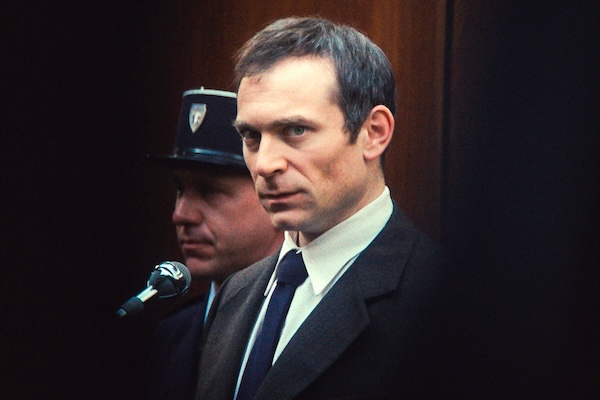
The Goldman Case is a dramatic reenactment of the case of Pierre Goldman. (photo from Menemsha Films)
He was guilty of much, but was he guilty of murder? Pierre Goldman maintained he was innocent of the latter charges and a based-on-a-true-story film explores not only a man’s possible guilt but the intergenerational impacts of Polish-French Jewish life in the mid-20th century and their potential explanations for some unusual behaviours.
The Goldman Case is a dramatic reenactment of a famous (in France, at least) case of the Jewish son of Polish resistance heroes, whose own life was impacted by an apparent need to fill the giant shoes of his parents. The son wanted to be “a Jewish warrior” and so became a communist revolutionary, traveling to Latin America, Prague and elsewhere in search of opportunities for valour.
Charged with a series of crimes, including the murder during a holdup of two pharmacists, Goldman was convicted in 1974 and sentenced to life imprisonment, though he maintained he was innocent in the two deaths. Following the 1975 publication of his memoirs, the judicial system reconsidered his case and major French voices, including Jean-Paul Sartre, took up his cause. This film is a (massively condensed) court procedural of that retrial.
Goldman’s Jewishness was not on trial but, interestingly, his defence team built their case partly around his family’s experiences.
The case – and the film – end with a new verdict. But the dramatic story would continue. Audiences will no doubt race to Google more about Goldman and his crimes and punishments. Enduring mysteries, though, will make the search necessarily unsatisfying. This cannot be said of the film, though, which is a gripping enactment, enlivened by the extremely animated courtroom drama, which suggests the French judicial system tolerates a great deal more outbursts than we expect in Hollywood depictions of North American judicial proceedings.
It is perhaps inevitable that, at a time of polarized thinking, many people seem incapable of holding two ideas in their minds at once.
Canadian politics has maybe not succumbed to the depths of entrenched division we see in our neighbours to the south, where Democrat-versus-Republican has taken on a tribal identification. However, almost every democratic society is experiencing intense divisions not only in opinion but in identification. That is, our identities, including political stands, are prioritized to represent core personal traits. If we identify less as, say “a Canadian who votes for the Purple Party,” but instead as “a Purple Canadian,” it can feel threatening to have a conversation with someone of different opinions.
Social media is a significant driver of this phenomenon. Not only do the algorithms embolden and reify extremism, but we are encouraged to share these extreme opinions. Inflammatory ideas that we once might have kept to ourselves are posted for all to see – and, if someone disagrees, we may perceive it as a personal attack and feel encouraged to carry out an online vendetta. In times past, we may have suspected that our neighbour or relative held ideas we disagreed with. Now, we may know what our friends and neighbours think and feel about myriad issues – and we might be motivated to take them on in a virtual slugfest over those differences.
In theory, this is a good thing – but only in theory. In a perfect world, social media gives us the opportunity to engage one another in informed, enriching dialogue. Clearly, the joke’s on us.
In reality, social media reduces the quality of dialogue to a dismissive, insulting snapback. Moreover, the comparative anonymity of the platforms gives us licence to vent our worst impulses with few checks and balances embedded in the systems.
It is in this troubled online culture that the current war between Israel and Hamas is being addressed by Canadians.
The context is additionally challenged by recent changes to Canadian law. The federal government reasonably demanded that social media platforms pay news producers for the content shared on their platforms. In response, the platforms blocked the content rather than pay for it. A business can choose whether to retail what others are wholesaling, to use a clunky parallel. Of course, social media platforms are not just any business. It is fair to argue that they are a form of public utility and so should be governed by different standards. That, though, is a discussion for a different time. Bottom line is that Canadians are debating online over current events without the advantage of sharing professional news content, with predictable outcomes around reach and veracity.
Binary or polarized thinking plays another role.
Antisemitism, as any reader knows, is at levels most of us have not seen in our living memories. This is not incidental to the current war but, crucially, neither is the war the cause. Antisemitism lies in wait, depending on an external spark to set it aflame. Nothing Israel does (or, for that matter, anything Hamas does) is the cause of antisemitism in Canada. We need to address domestic bigotry for what it is. The purest proof: other international disputes rarely, if ever, result in eruptions of racism in Canada … why does this one?
In response to concerns around antisemitism, we see – usually online, because that is where these sorts of “conversations” happen most visibly – many people responding predictably. If there is antisemitism in Canada, a common theme goes, blame Israel’s actions or existence. A slightly more extreme variation makes the case that, at a time when it is alleged that Palestinians are experiencing genocide or ethnic cleansing, why are we wasting time talking about (the presumably relatively inconsequential matter of) antisemitism?
At a minimum, the response to such ideas should be that two things can be true at the same time. There may be unfolding tragedies in the Middle East … but there is also racism at home that demands addressing. And, no, one cannot wait until the other is resolved. Just as we should be capable of holding two ideas at once, we must be able to condemn injustice at home and abroad. Why is this difficult?
Binary thinking implies that injustice abroad displaces injustice at home. The message many of us see on social media is, put bluntly, Canadian Jews should keep quiet about their problems, complaints or experiences while Palestinians are dying.
Something we can keep in mind when engaging online, in real time, or however we participate, is that our activism on global affairs, including those places in which we have a personal stake, is vital and necessary. But it also has very limited impacts globally. The Israeli government, Hamas and the international entities engaged in what negotiations exist are, frankly, not going to be moved much by marching Canadians or millions of memes on social media. Those who are going to be affected are our neighbours and family, who see often harmful, hateful and insensitive comments and feel bereft, anxious and alone.
We need to keep in mind this: whatever we say about Israel-Palestine lands hardest on the ears, hearts and minds closest to us. Condemning Israelis or Palestinians (or anyone else) has minimal effect in Israel or Palestine. It causes plenty of pain right here at home.
Although I have been doing Daf Yomi (studying a page of Talmud a page a day), I fell asleep a few days ago before I could finish learning my page of Talmud. I was worn out. And it was a page particularly relevant to my life.
Bava Kamma 99 talks about the value a craftsperson brings to the raw materials. For instance, if a customer brought wool to be dyed but something went wrong and the dyer made a mistake, the dyer would owe the customer the value of the wool. The value of the craftsperson’s enhancement is a different,additional calculation on top of the raw materials’ value. The skill and artistry that the craftsperson brings to their craft has economic value, which is part of what this tractate of Jewish law covers.
I’m a maker. I create lots of things, from baking bread to making labneh and many homemade family meals. I can make jams and pickles. I’m a hand spinner. I also dye yarn. I knit and design things. I even occasionally weave. I sew clothing, too, if in an elementary way. I appreciate it when I read about how a craftsperson adds value to raw materials in a Jewish text because it’s personally relatable. It shows that, in a time when everything was handmade, the rabbis valued the skilled work involved to make functional and sometimes beautiful things.
Since I had to study the rest of page 99 before heading on, I did half of that page and the next on the same day. Bava Kamma 100a talks about how teachers “go beyond” – not just in how they teach Torah, but in how they do mitzvot (commandments) and help others. Even though I trained as a teacher long ago, nobody’s an expert at everything. I teach some things, like hand spinning, and not others. I’m not able to “go beyond” as a sewing teacher, for example, and, instead, I searched for someone who could teach my kids.
My kids took sewing classes and attended sewing camp for two summers at a studio nearby. The small business owner was warm and inviting. It seemed to be a safe place. When she asked people to write blog posts for her, I did. It didn’t pay much but I thought it was a good community business, promoting slow fashion and reuse.
As many people were, I was in shock after Oct. 7. I didn’t immediately see anything concerning about this business, as it felt like it was “mostly” about sewing. Then, eventually, I began to realize that, in fact, there was an increasing trickle of activism on this social media feed. Like many Canadian progressives, this was part of a wider theme. Nothing was expressed in solidarity with the hostages or those who died on Oct. 7. Rather, the business began acknowledging and amplifying Palestinian influencers, posting participation in a raffle for the Red Crescent and posting ceasefire comments.
Every time I ask questions of someone I know – Why are you posting this? Do you support the right to a democracy to protect itself? – the exchanges, often disappointing, take an enormous amount of energy. Being brave and speaking out is tiring with so much antisemitism circulating.
I finally got up the nerve to ask the business owner … why are you posting about this, what does this activism about Israel and Gaza have to do with your small business? Are you Israeli or Palestinian? Are you an activist about a lot of things beyond slow fashion? If so, where is your outrage about Nigeria, Sudan, Syria, Uyghurs…?
In response, she did say she wanted all the hostages released, but she had never posted that publicly. Instead, she had reposted images promoting a tatreez (Palestinian embroidery) class. Fine, I thought, this aligned with her sewing business – but the image posted showed the outline of Israel with Arabic on top that read “PALESTINE” across the whole country. It erased Israel altogether.
I engaged via social media messaging, but saw it wasn’t likely to help. She asked, well, what do you want me to say? I suggested one could choose to be an ally of people you taught or worked with, or could choose to listen and to not amplify only one side. She didn’t choose either of those options. Instead, she decided to take down my writing from her site. I’d suggested that she could remove my name, if she chose, as it was her prerogative, that she’d bought my writing and owned it.
She then made things clear, saying it was “Only Jews who told her to ‘shut up’ or ‘stay in her lane as a Canadian.’” She said plenty of Jews aligned with her beliefs … although, based on the polls, I responded they were likely a minority. I suggested maybe only those Jewish customers brave enough to say something had spoken up.
I was initially sad to lose this community connection. I could have unfollowed this person without this discussion. My kids would never have taken another class. I’d never do business with her again. The depth of her concerning opinions wouldn’t have been revealed.
By exposing this small businessperson’s attitude, I learned more about what was “out there” in the local makers’ community. This included a willingness to lose business and relationships with students and clients who feel uncomfortable with these views.
I struggle sometimes to create a positive sewing lesson environment for my kids at home. However, there’s a different outcome here. I might grow as a person from “adding value to raw materials” as a craftsperson, to teaching more. This was something I could do. I falsely hoped that, if I tried hard to communicate, build bridges and connect with this person, things would change. But I need to continue learning and growing, too. Even this negative experience might have positive potential for growth.
When telling my family about the experience at the dinner table, my twins surprised me by saying, “Well, what took you so long? We could never go back there again.” Indeed, sometimes we give intolerant people too many chances to rise to the occasion, to become upstanding people. In this case, my kids knew the way before I did.
Joanne Seiffhas written regularly for the Winnipeg Free Press and various Jewish publications. She is the author of three books, including From the Outside In: Jewish Post Columns 2015-2016, a collection of essays available for digital download or as a paperback from Amazon. Check her out on Instagram @yrnspinner or at joanneseiff.blogspot.com.
Adam is one of the potential converts interviewed in the documentary Converts: The Journey of Becoming Jewish, directed by Rebecca Shore and Oren Rosenfeld, which is part of this year’s Vancouver Jewish Film Festival. (photo from convertsmovie.com)
A religion that encourages questions, one in which people can speak directly with God. A religion that’s thousands of years old, which so many have attempted to wipe out, yet still flourishes. A religion that’s intellectual and communal, which involves both the head and the heart.
Danya (photo from convertsmovie.com)
These are just some of the aspects of Judaism highlighted in Converts: The Journey of Becoming Jewish, directed by Rebecca Shore and Oren Rosenfeld. The 70-minute documentary is part of this year’s Vancouver Jewish Film Festival, which runs April 4-14 in theatres and April 15-19 online.
Converts follows Adam, Danya and Bianka as they go through the conversion process. Each have their own reasons for wanting to become Jewish.
Adam, a student at York University when we meet him, grew up in a violence-filled neighbourhood in Toronto. His father used the family’s savings – that could have gone into moving the family elsewhere –to establish a church, which failed. Adam was attracted to Judaism because, unlike the Christianity he grew up with, Judaism gave him the space to ask questions and to speak with God directly, though giving up belief in Jesus was hard, he admits.
Danya, a businesswoman from Costa Rica, found out in high school that she has Spanish-Portuguese Jewish roots, that her ancestors were forced to convert to Catholicism from Judaism centuries ago. She feels that ancestral pull and uproots her life, traveling to Israel with her daughter in the hope of converting and living there.
Bianka (photo from convertsmovie.com)
Bianka, a PhD student in chemistry at the University of Warsaw, lives in Radom, Poland. She immerses herself in a few other religions before finding comfort in what she considers Judaism’s scientific approach, but also in the warmth of the Jewish community, which she discovers by attending synagogue and holiday events.
Well-constructed and well-paced, Converts is a fascinating look at identity, family, community, religion, the search for meaning and the possibilities of change and self-actualization.
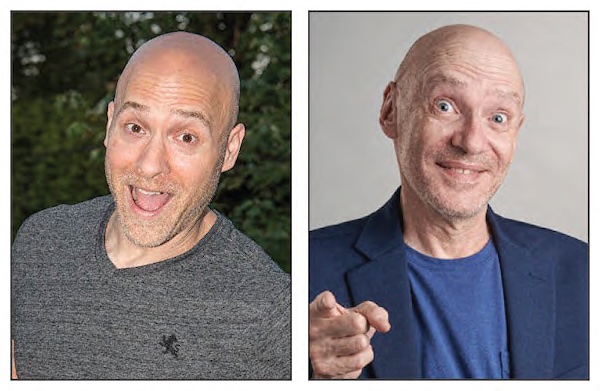
Kyle Berger, left, and David Granirer headline the Jewish Seniors Alliance’s A Night in the Catskills on March 17. (photos from JSA)
The Jewish Seniors Alliance of Greater Vancouver is celebrating its 20th anniversary with an event that’s all about laughter.
A Night in the Catskills: Jewish Humour Then and Now takes place at Congregation Schara Tzedeck March 17, 6 p.m.
“Jewish humour has enabled the Jewish world to gain strength through a history that shows that we should not be in existence today, but here we are bigger, stronger and better than ever!” said Marilyn Berger, a past president of JSA, who will make her debut as a stand-up comedian at the event. “Ask Kyle,” she said, referring to one of her sons. “I have given my family plenty to laugh about.”
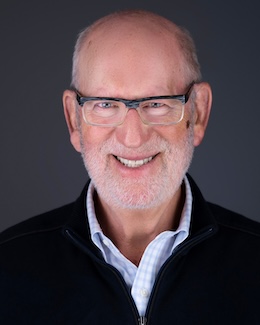
It is perhaps not a coincidence then that Kyle Berger preceded his mother on the standup stage, and also produces comedy shows. He and David Granirer, founder of Stand Up for Mental Health, are headliners of the 20th anniversary event, which will include a performance by magician Stephen R. Kaplan, aka the Maestro. The whole megillah will be emceed by JSA board member Michael Geller, whose involvement in JSA was inspired by his late father, Sam Geller.
“He derived a great deal of joy from regularly attending JSA events and this is one of the reasons why the organization is so special to me,” Geller told the Independent.
Michael Geller emcees JSA’s A Night in the Catskills at Schara Tzedeck. (photo from JSA)
“This comedy night is a follow up to a similar event organized by JSA 13 years ago,” he explained. “It was initiated by a phone call from the late Serge Haber, who called to tell me that the province had just canceled JSA’s gaming grant, but he knew my father would want me to help replace the funds. I asked how much was the grant. He said it was $18,000. I told him that was too much for me, but I had an idea.
“I was a fan of the website Old Jews Telling Jokes. Since JSA served many older Jews, I offered to book a room, buy some deli, and invite 17 of my friends to join me and each put up $1,000 and we would entertain one another with our favourite Jewish jokes.”
Haber – who founded JSA – liked the idea, as did the board, but they also wanted to join, and couldn’t afford to pay $1,000 each. So, the format was changed to one where people would attend and donate what they could, said Geller. Held at Congregation Beth Israel, almost 250 showed up.
“We presented clips from Old Jews Telling Jokes and invited people in the audience to share a joke in return for a donation. Everybody agreed it was a fabulous event,” said Geller. “There was just one small problem. We didn’t raise very much money.
“So, this year we are charging $118 dollars to attend. Some generous members of the community are coming forward and agreeing to be sponsors. This will allow other seniors in the community who can’t afford $118 to attend. It has also allowed us to hire Tim Bissett, an experienced professional event organizer to assist with the program.”
Stephen R. Kaplan is a special guest performer at the 20th anniversary celebration. (photo from JSA)
Expressing gratitude to the sponsors on behalf of JSA, Geller said, “we are hoping other community members will come forward, especially those who regularly share their favourite Jewish jokes on the golf course. Sponsors will be invited to participate in the program by telling a favourite joke or two, or introducing a favourite comedian or routine.”
For his part, Geller is preparing for his role as emcee by watching vintage and contemporary Jewish comedians and selecting material. “The program will also include some professional comedians who are volunteering their time, and special appearances by local rabbis who have been urged to share stories they would never tell in shul,” he said.
“I am thrilled to be celebrating our 20th anniversary and look forward to going from strength to strength as my own children now, believe it or not, become seniors!” said Berger, who shared her appreciation for the organization that Haber started.
“As I gracefully age,” she said, “I thank Serge for enabling me to spend my golden senior years embraced by the love that Seniors Alliance offers.”
“JSA undertakes many programs that benefit so many Jewish seniors, including the excellent Senior Line magazine,” said Geller. “While we are supported by many community organizations and foundations, we need additional funding. I am, therefore, hoping this evening will help promote the organization’s good work and, this time, actually raise money to allow it to continue.”
For tickets to A Night in the Catskills or to become an event sponsor, visit jsalliance.org or call 604-732-1555.
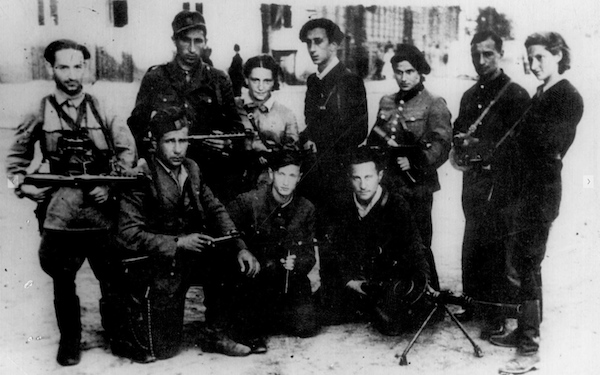
A still from the documentary Resistance: They Fought Back. (theyfoughtback.com)
Resistance: They Fought Back screens March 3, 2pm, at Rothstein Theatre. Presented by the Vancouver Jewish Film Centre, special guest at the screening will be director Paula S. Apsell.
The film’s synopsis reads: “We’ve all heard of the Warsaw Ghetto Uprising, but most people have no idea how widespread and prevalent Jewish resistance to Nazi barbarism was. Instead, it’s widely believed ‘Jews went to their deaths like sheep to the slaughter.’ Filmed in Poland, Lithuania, Latvia, Israel and the U.S., Resistance: They Fought Back provides a much-needed corrective to this myth of Jewish passivity. There were uprisings in ghettos large and small, rebellions in death camps, and thousands of Jews fought Nazis in the forests. Everywhere in Eastern Europe, Jews waged campaigns of nonviolent resistance against the Nazis.”
For tickets ($10) to the screening, visit vjff.org.
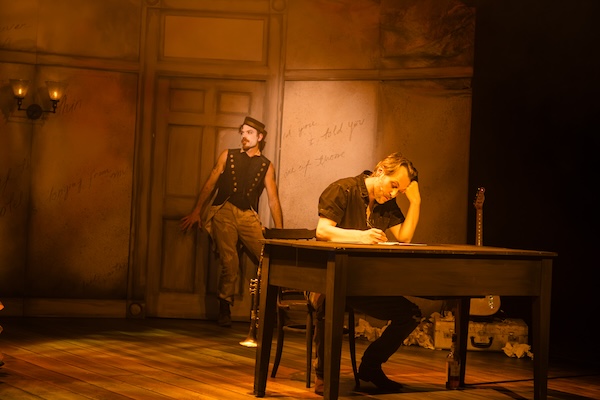
Jack Garton, playing a Jokeresque bellhop, manipulates the memories and thoughts of the Writer, played by Adrian Glynn McMorran. (Sarah Race Photography)
In Paper Thin Hotel, Leonard Cohen writes, “It is written on the walls of this hotel, you go to heaven once you’ve been to hell.” Heaven is where you will be if you catch Steve Charles and Tracey Power’s 2024 iteration of their 2012 hit Chelsea Hotel, playing at the Firehall Arts Centre until March 3.
Chelsea Hotel is a loving tribute to Cohen and his poetry, which transcends time and space while touching on enduring universal topics – passion, loss, sex, religion and politics. Although Cohen has been dead for more than seven years, his music and lyrics live on and perhaps are more relevant than ever given the troubled state of our world.
I saw the world première of the show back in 2012 (jewishindependent.ca/oldsite/archives/feb12/archives12feb10-02.html) and did not think anything could make it better but, after a cross-country tour and 400 performances, like a fine wine, it has improved with age. Half of the original cast returns to reprise their roles and they, too, have only become better with time. Power does triple duty as she choreographs, acts and directs, while Charles is musical director/arranger and musician/actor.
The sung-through musical revolves around a tortured writer (Adrian Glynn McMorran) shuttered up in a shabby room in New York’s Chelsea Hotel trying to forget his past so that he can be creative again. The show opens with him outstretched on a bed towering with crumpled paper, a metaphor for his cluttered mind. Each time he writes something down and throws it away, we feel his existential angst as he searches for inspiration from his life’s memories. Five actors, playing multiple characters, move in and out of his various visions, reminding him of his past romantic entanglements and indiscretions through songs like “Suzanne,” “Take this Waltz,” “First We Take Manhattan,” “Tower of Song,” “Dance Me to the End of Earth,” “Bird on a Wire” and, of course, “Hallelujah.”
All the scenes play out in the Writer’s mind – illusions in a carnival-like setting guided by a Jokeresque bellhop (a terrific Jack Garton) who pops in and out of the set as he manipulates the Writer’s memories and thoughts.
This truly ensemble production is a fusion of dance, music and theatre, with the multi-talented cast of six all triple threats – each capable of singing, dancing and playing the myriad instruments used in the show, ranging from the traditional – guitar, violin, keyboards and drums – to the more unconventional – banjo, ukulele, accordion and even a kazoo (showcased in the very erotic “I’m Your Man” number).
McMorran is sensational as the Writer. His vocals run the gamut from softly crooned ballads to frenetic rock ’n’ roll numbers. Power, Marlene Ginader and Michelle Bouey play the lovers and the muses, moving through the various vignettes in dreamlike, ethereal fashion. Ginader, in her blue raincoat, is touching in her portrayal of the jilted lover trying to get back into the Writer’s heart. Hovering quietly in the shadowy background, Charles switches effortlessly from instrument to instrument, until he emerges front and centre stage to sing a poignant “Famous Blue Raincoat.”
The staging is sublime. Kudos to set and costume designer Drew Facey for his fragile, paper-like set and simple costumes. John Webber’s mood lighting completes the surreal atmosphere.
As you unwrap the layers of this performance, so ably packaged by this wonderful cast, the pleasure only increases. There is so much to like in this production – don’t miss it.
As a bonus, on Feb. 23, the theatre is holding a special event, Endless Love, toasting the legacy of Cohen, which includes pre- and post-show receptions, cast mingling and, of course, the show. Tickets can be purchased at firehallartscentre.ca or by calling the box office at 604-689-0926.
Tova Kornfeld is a Vancouver freelance writer and lawyer.