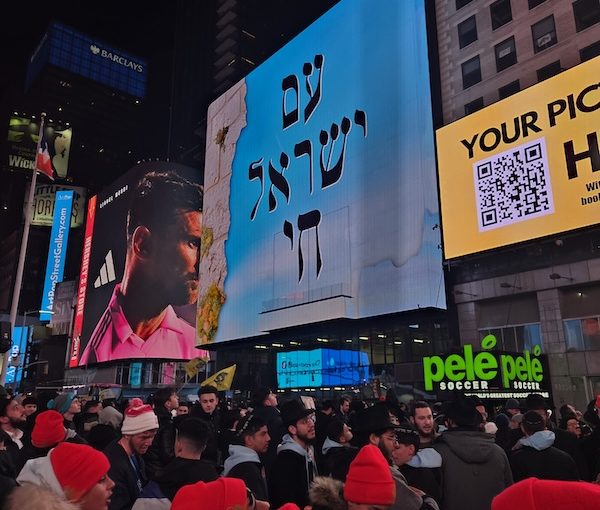
CTeen Shabbaton Havdalah in Times Square this past February. (photo from Chabad Richmond)
Richmond teenager Miriam Kriche addressed a global audience at the CTeen (Chabad Teens) International Jewish Teen Summit in New York City during the group’s annual Shabbaton. She shared her story of overcoming adversity and emerging as a local leader, guided by Rabbi Yechiel Baitelman of Chabad Richmond. Kriche’s story highlights the resilience and strength of Jewish youth, particularly significant in the wake of the events since Oct. 7.
Active in CTeenU and the Richmond CTeen chapter – projects of Chabad Richmond and the Bayit – Kriche has made significant contributions through her volunteer work with the Hebrew school and support for Holocaust survivors. Her journey is marked by personal challenges and a transformative trip to Israel.
The summit, which took place in New York Feb. 22-25, brought together more than 3,000 participants from 58 countries. It provided a platform for Jewish teens to connect, share their stories, and reinforce their commitment to their heritage and values during challenging times.
Kriche’s speech, infused with personal anecdotes and reflections on Jewish identity, encouraged her peers to find their purpose and connect with their community. Her message, which centred on the belief that everyone has a place and a role within the Jewish tradition, underscored the summit’s aim to empower Jewish youth.
She shared her journey of facing bullying and alienation, which led her to question her identity and purpose. She spoke of a trip to Israel that rekindled her faith and connection to her Jewish roots, inspiring her to embrace her heritage and lead with conviction.
The CTeen Summit featured a series of workshops, leadership training sessions and a Havdalah ceremony in Times Square.
“In a world where our youth are bombarded with countless challenges to their faith and identity, teens like Miriam Kriche stand as living examples, empowering the teens to hold strong and be ambassadors of their faith back home,” said Rabbi Mendy Kotlarsky, vice-chair of CTeen International.
Kriche’s participation and the presence of the Richmond delegation at the summit demonstrate the impact of youth leadership in fostering strong Jewish identities.
“Our teens have returned invigorated, ready to lead and make a difference within our community and beyond,” said Baitelman. “This experience has not only deepened their connection to their Jewish identity but has also empowered them to be a source of strength and inspiration to their peers.”
CTeen Richmond, sponsored by Chabad Richmond and the Bayit and led by Rabbi Schneur and Tamara Feigelstock, is a part of CTeen, a network of Jewish teenagers encompassing more than 730 chapters, focused on empowering Jewish teenagers to become leaders in their communities through acts of kindness, community service and a strong commitment to their values.
For more information about CTeen Richmond and upcoming events, contact Rabbi Feigelstock at 604-716-2770.
Alex Greenberg’s family experience drove his work for the Dallas Holocaust Museum. (photo from Alex Greenberg)
It was a winding road for Alex Greenberg to become head of animation at a leading creative technology firm in Vancouver.
Born in Moldova, Greenberg and his family made aliyah in 1990, when he was 11 years old. After a “pretty regular childhood” in Israel, high school graduation, military service and a bit of travel around the world, Greenberg settled down to study animation.
“Unfortunately, two months into school, the director of the school took the money and split,” he said. “My luck. All the money was gone, the money I got from my [military] service.”
He started looking for schools in Canada and the United States where he could continue his studies. He discovered the Art Institute of Vancouver and moved here, by himself, in 2003.
Fast-forward … Greenberg is immersed in immersive technology. As head of animation for ngx Interactive, he has his finger in many projects – including one that shares the testimonies of Holocaust survivors and which, of everything he has worked on, is closest to his heart.
Founded more than two decades ago in Vancouver, ngx’s 80 or so employees, according to the company’s website, help clients “reimagine what’s possible in physical and digital spaces.”
“We work with four main sectors,” said Greenberg.
The museum sector is a big one. The company took part in a major re-envisioning of the National Portrait Gallery in London, UK. It reopened last year featuring 41 multimedia exhibits, including an artificial intelligence-powered portrait experience, an animated projection wall featuring some of the gallery’s most stunning portraits, interactive touch screens, and documentary films produced by ngx.
The medical sector is another area and, if you have ever taken your kids or grandkids to BC Children’s Hospital, you may have seen the interactive aquarium ngx developed for the emergency room so that young patients and their families have something to take their minds off the stressful reasons for their visit.
A third area is themed attractions, which have engaged audiences in such diverse spaces as Vancouver’s Science World, SeaWorld Abu Dhabi, Jurassic World in Beijing and the Canada Pavilion at Expo 2020 in Dubai.
Their corporate and institutional work, another core area for ngx, includes an interpretive exhibition in the pharmaceutical sciences building at the University of British Columbia, where visitors explore the world of health, and a project for Roche Canada, in the Toronto area, where the global pharmaceutical company has an interactive space for employees to engage with the Roche brand story.
Other projects help visitors explore cultural institutions like the Citadel Heritage Centre in Halifax, Indigenous cultural storytelling at Wanuskewin Heritage Park in Saskatoon, and interpretive exhibits about nature at Wind Cave National Park in South Dakota.
Greenberg’s specific role in ngx projects is lighting and look development.
“When you are working on a project, there’s a certain style to it, lighting, a certain mood, something that will convey the story,” he said. “We don’t just create these experiences to make them look cool. There’s a lot of thought that is being put behind them, thinking about the colours and thinking about the movement and [in the case of the BC Children’s Hospital virtual aquarium] how kids are going to interact with it to help them relax.”
In his seven years with the company, one project stands out among the rest for Greenberg.
Visitors to the Dallas Holocaust Museum, in Texas, enter a room that transforms into a home in eastern Europe at the start of the Holocaust. Survivors share their testimonies as the home becomes no longer a refuge but a backdrop for the projection of scenes of atrocities. Then the screen rises and a holographic version of a survivor engages with the audience.
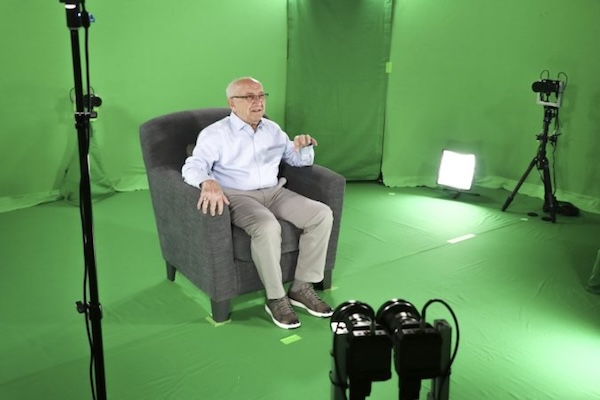
Hundreds of hours of interviews with survivors using 360-degree cameras allow for the realistic perspective of meeting these individuals in person. The project, called Dimensions in Testimony and developed in partnership with Steven Spielberg’s USC Shoah Foundation, introduces school groups and other museum visitors to a different survivor and their experiences each week of the year.
Visitors to the Dallas Holocaust Museum, in Texas, can interact with holographic versions of survivors. (photo from Dallas Holocaust Museum)
Hundreds of hours of interviews with survivors using 360-degree cameras allow for the realistic perspective of meeting these individuals in person. (photo from Dallas Holocaust Museum)
“This was one of the most impactful projects that I ever worked on,” Greenberg said. “You feel like you’re sitting in their living room. As you hear the story, the room begins to change. Lights going off, you hear marching of the boots outside, the rooms become slowly, almost unnoticeably dilapidated, just to show that the people were driven out of their homes and these homes are left with nothing but memories and a few photographs.
“After that introduction, the screen goes up and there’s a hologram production of that survivor. That’s the technology that the USC [Shoah] Foundation has developed. You can ask a question – for example, ‘What was your favourite sport when you were little?’ – and that would trigger a story where the survivor will be talking about where he used to play soccer with his friends when they were little.”
The project was close to home for Greenberg, whose grandfather lost his entire family in the Shoah.
“There was a big part of me in that experience,” said Greenberg. “I can tell and I can educate other people, people that are coming to this museum and people around the world that still don’t know what the Holocaust is, don’t know what a genocide is. It’s almost like I was telling my story.”
For Dan Russek, art abounds in urban settings, whether it be in the form of manhole covers, bike racks or other items and scenes that city dwellers regularly encounter. Spurred by an early love of photography, he has been surveying cityscapes with an eye for “public art that goes beyond the gallery.”
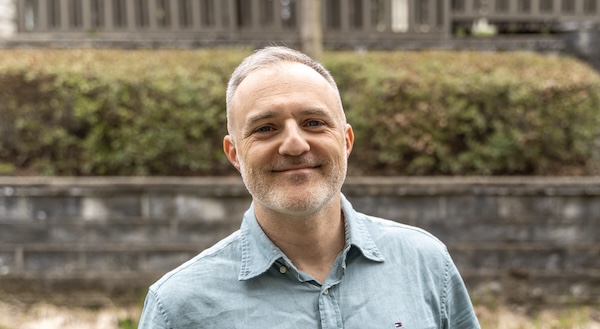
University of Victoria professor Dan Russek, author of Exercises in Urban Mysticism: Practical Poetry and other books. (photo from Dan Russek)
A professor in the department of Hispanic and Italian studies at the University of Victoria, Russek is the author of Exercises in Urban Mysticism: Practical Poetry, a 2020 book – written in Spanish, with the title Ejercicios de mística urbana: Poesía práctica, and published in Mexico – that explores the poetry of everyday life.
“One way I look at it is that I take the idea of modern art seriously,” Russek told the Independent. “When you see a painting by Jackson Pollock, you may understand its place in the history of art. But what Pollock is showing is a kind of texture, composition and movement that you can find outside of the gallery walls, appealing to a certain sensibility that takes you beyond the museum.”
Russek was intrigued by the 1996 book Manhole Covers, written by Mimi and Robert Melnick and published by MIT Press. It delved into how an object many consider ordinary can provide a record of the history of a city and, some would argue, be deserving of a spot in contemporary urban culture; in other words, seeing a utilitarian object as an “urban sculpture.”
Russek devoted a lot of space in his illustrated book to manhole covers, bike racks, various geometric structures and a variety of textures. Art, as he views it, extends far beyond the confines of canvas or paper. Indeed, by his admission, one of his favourite spots to be is on construction sites, especially in a place like Mexico City, where there are few restrictions for getting inside.
“You take something in itself that may not appear to be too interesting, but, when you look at it in a certain way, it becomes interesting. Or, to quote Gustav Flaubert, ‘Anything becomes interesting if you look at it long enough,’” Russek said.
As an example of this, Russek gives the work of American photographer Edward Weston in the 1920s and 1930s. As Russek describes it, in one image, Weston takes a simple green pepper and turns it into something “astounding.” The same can be done for bike racks and many other urban and industrial artifacts, he said.
Russek, who was born in Mexico, remembers being surrounded by relatives who were passionate about photography.
“As a kid, we would make an album while on a vacation. Each trip yielded an album, as did life events, weddings, bar mitzvahs,” he said. “Life was documented. It gave me a model. I began taking pictures in high school, and I realized I was interested in abstraction.”
Over the years, walking through the streets of cities like Chicago, Mexico City and Buenos Aires, Russek has been struck by many aspects of street art, including graffiti, another form of public art that is found beyond the gallery. In fact, some graffiti, he said, is as valuable as the art one finds in a museum.
“I wish I had my camera with me all the time. The reflections of light in the afternoon over the pavement, it’s phenomenal. The light making reflections on the water from a gutter – life is full of these interesting moments. Bringing the camera is a good thing because I don’t have to look for anything, the world sends it to me,” he said.
Russek completed a PhD in comparative literature at the University of Chicago, specializing in modern and contemporary Latin American literature and visual arts. His fields of research include the links between literature and the visual arts and media, urban studies and esthetics. He has explored the relations between modern technology, culture and literature, and centres on the notion of epiphany and the phenomenon of light. His first book, Textual Exposures: Photography in Twentieth Century Spanish American Narrative Fiction, was published in 2015 by University of Calgary Press.
Some of Russek’s next plans involve going beyond the printed page. He wants to make videos, as the medium “allows you to do more stuff, with music and the matching of images, that you cannot do in a book.” He also writes poetry (sonnets in particular) because, for one reason, “you can take an object or an emotion and write a poem about it and elevate it to a new level of importance.”
Argentine writer Julio Cortázar is an example Russek cites of an artist reaching beyond the confines of a particular medium, an approach that is multifaceted or experimental. In one work, Último Round (Last Round), Cortázar created an almanac-style book filled with articles, poems, essays and illustrations.
Aside from teaching and writing, Russek is the coordinator of the Latin American and Spanish Film Week, now in its 14th year, held in the fall at UVic’s Cinecenta. He is also the president of the Hispanic Film Society of Victoria.
Sam Margolishas written for the Globe and Mail, the National Post, UPI and MSNBC.
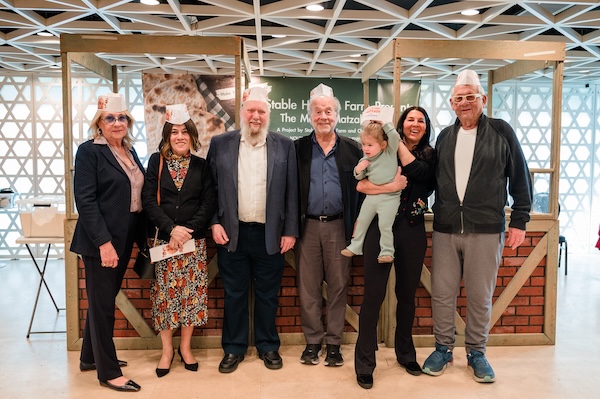
Left to right: Joanne Belzberg, Henia Wineberg, Rabbi Yitzchok Wineberg, Arnold Silber, Tammi Kerzner and Syd Belzberg. (photo by Yaletown Photography)
For more than three decades, the Model Matzah Bakery, organized by Chabad Lubavitch in British Columbia, has offered a unique and interactive Passover experience for thousands of participants. What started in the early 1990s has blossomed into an event anticipated by children, high school students, adults and seniors alike.
The hands-on program immerses participants in the ancient tradition of making matzah, a significant element of the Jewish holiday of Passover. From separating wheat kernels to baking the final product, attendees go through each step of the process, gaining a deeper understanding of the cultural, spiritual and historical significance behind this unleavened bread.
One of the highlights of the Model Matzah Bakery is its emphasis on participation. Everyone is invited to roll up their sleeves and get involved in every aspect of the process. We begin by separating wheat kernels from the chaff, a task that connects us with the agricultural roots of this ancient practice. Next, we grind the kernels into flour, followed by meticulous sifting to ensure the purity of the ingredients. As the flour mixes with water, laughter and excitement transform the process into a joyful communal experience. With expert guidance from volunteers, participants roll out the dough, making sure to create holes to prevent leavening. And all of this must be completed within a strict time limit of 18 minutes, after which the dough may begin rising, which will create chametz, leaven, which is not permitted during Passover.
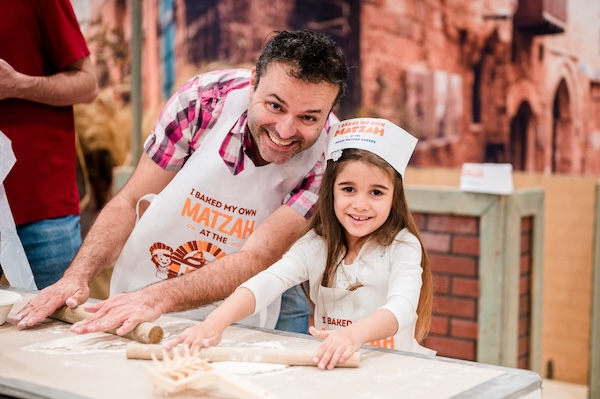
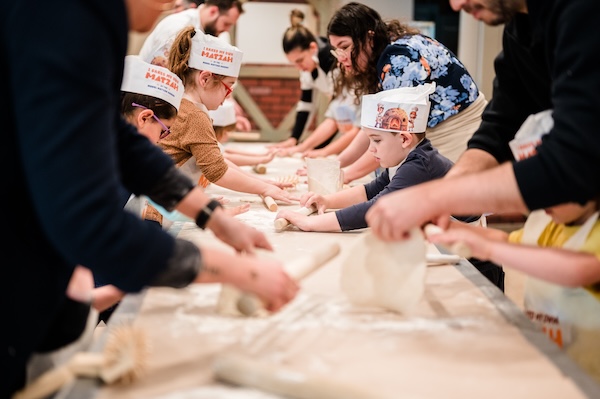
When participants left the Model Matzah Bakery, “they took with them not just matzah, but a sense of belonging and pride in their heritage.” (photos by Yaletown Photography)
This year, the Matzah Bakery got an upgrade as it partnered with Stable Harvest Farms. Not only did participants get to make matzah for Passover using locally grown, organic wheat, Stable Harvest Farms is also offering the chance for children to experience the process from farm to seder table – literally. Two family days will be hosted at the farm, where families will plant and then harvest their own wheat, which they will then use to create matzah for next Passover. Save the dates: May 12, a special Mother’s Day celebration, where the wheat will be planted, and Sept. 8, a pre-Rosh Hashanah experience, including harvesting the wheat and setting aside for Passover 2025/5785.
“Chabad is known for their innovative approach to Jewish education,” said one educator from a local Jewish day school. “This kind of hands-on, start-to-finish project will guarantee that the children remember the joy and excitement of the holiday for years to come.”
While initially designed for children, the Model Matzah Bakery has evolved to welcome participants of all ages. High school students and educators find themselves drawn to the program as an engaging way to learn about Jewish traditions, while adults and seniors appreciate the opportunity to celebrate their cultural heritage. This year, for the first time, children with special needs had their own opportunity to visit the bakery.
“It’s not just about making matzah; it’s about connecting with our heritage in a tangible way,” said Rachel Cohen, a long-time attendee of the Model Matzah Bakery. “The experience of being part of something so ancient yet so relevant to our lives today was truly special.”
Rabbi Dovid Rosenfeld, director of Lubavitch BC, which organizes this project, emphasized the importance of preserving and passing on these traditions to future generations. “Our goal isn’t just to teach about matzah making, but to create lasting memories and connections to our shared history through positive Jewish experiences,” he explained. “When participants left here, they took with them not just matzah, but a sense of belonging and pride in their heritage.”
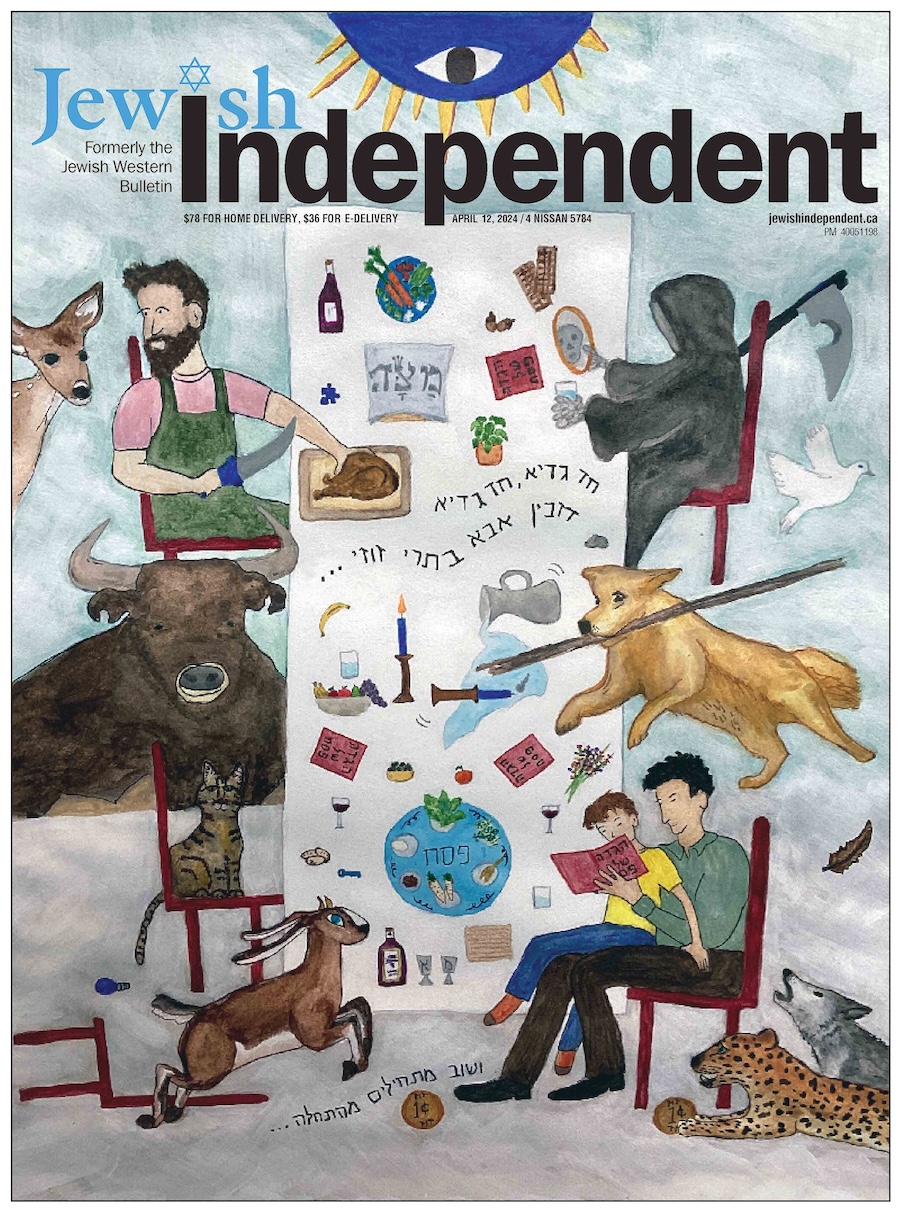
There are numerous interpretations of Chad Gadya (One Little Goat), which ends the Passover seder. A cumulative song, like “There Was an Old Lady Who Swallowed a Fly,” it starts with Father buying a goat, which is then eaten by a cat. Because it’s easier to summarize from the end, the last verse is, depending on your translation: then came the Holy One, Blessed be He, and slew the angel of death, who killed the butcher, who slaughtered the ox, that drank the water, that quenched the fire, that burnt the stick, that beat the dog, that bit the cat, that ate the goat. The Hebrew on the table in the cover image is the beginning of the song: Chad gadya, chad gadya, d’zabin Aba bitrei zuzei (that Father bought for two zuzim).
Often sung with different seder participants making the sounds of the succeeding aggressors, Chad Gadya is a cheerful song despite its violent imagery. With the numerous conflicts that mark human history and our present, I imagined the song’s characters, animate and inanimate, sitting down for a seder and what that might look like. This idea forms the centre of the cover scene.
While specifically about the Israeli-Palestinian conflict, Chava Alberstein’s 1989 version of Chad Gadya has always spoken to me more personally than politically. I have “been” the deer and dove of her song in my more empathetic and hopeful moments; her wolf and leopard in my more angry, fearful and hurt moments. As she sings – I, too, sometimes “don’t know who I am” in this world that can be so incredibly harsh. I, too, have thought, as Alberstein sings, and which I’ve written on the bottom of the cover art in Hebrew: “And we start again from the beginning …” each time one of us attacks another, with words or actions.
But giving up is not an option. So, while the characters of Alberstein’s song lie at the periphery of the seder image I created, 16 other symbols that might appear on a modern seder plate are scattered throughout. They represent what each of us can do to make ourselves better humans and the world a better place. They are not my ideas. I completely lifted all of them from “Beyond Bitter Herbs: Contemporary Additions to the Seder Plate” by Beverley Kort (with Leland Bjerg), which we ran in the Jewish Independent’s Passover issue last year.
Kort explains the meanings behind the fruit, acorns, chocolate, coloured light bulb, key, mirror, potatoes, banana, olives, basil, whole wheat matzah, vegetables, dried flowers, feather, rock and puzzle piece. For all the explanations, visit jewishindependent.ca/the-modern-seder-plate. Highlighting some of them: the acorns at the top of the picture represent an acknowledgement of Indigenous land rights; the rock above the dog’s head is symbolic of resilience; the key by the seder plate is about unlocking doors, embracing change; on the left side, the coloured lightbulb symbolizes the creative spirit; and the feather wafting off to the right is a reminder of the importance of kindness and compassion.
Passover is a story of survival and courage. At the heart of it, over these 2,000 years, our tenacity as a people and our willingness to stand up to those who would do us harm have remained steadfast.
One of the most widely observed Jewish holidays, Passover is a cherished opportunity for families and friends to gather and conduct the seder, a retelling of our ancestors’ story, beginning with a call from Moses to “let my people go” and concluding with the Jewish people’s freedom from slavery in Egypt.
But, this year, hundreds will mourn losses of family and friends murdered on Oct. 7. More than 100 families in Israel will have empty seats around their seder table, as their loved ones remain captive, held by Hamas terrorists in Gaza. And hundreds of thousands, from both the north and south of Israel, will celebrate our ancestors’ return from exodus away from their homes, having been displaced by the violence so heartbreakingly started on Oct. 7.
During the seder, we count the 10 plagues that G-d wrought upon the Egyptians. Today, one is confronted with the modern-day plague of antisemitism and Jew-hatred at levels never seen. The recent surge in online antisemitism continues to gain force, as misinformation, disinformation, lies and age-old conspiracies about Jews and Israel’s past and present capture the attention and play on the credulity of many around the world.
Since Oct. 7, even more online Jew-hatred and anti-Israel vitriol has been spilling onto streets across the world, endangering Jewish lives and, among our most elderly, evoking comparisons to a pre-Second World War Europe they witnessed firsthand and prayed never to see again.
Online hate engenders real-world threats and violence, and Canada is not immune. In some predominantly Jewish communities in Canada, there have been bomb scares in synagogues, bullets fired at Jewish schools, attacks on Jewish businesses and hateful graffiti on Jewish homes.
We have seen a wave of protests rife with violent hate speech – calls for “Free Palestine” or “From the river to the sea” – often strategically located to target Jewish neighbourhoods, schools, community centres and businesses.
On campuses nationwide, Jewish faculty, staff and students have been made to feel unsafe, insecure and even threatened.
These problems are not small. But neither are they new or insurmountable. CIJA’s mission to protect the quality of Jewish life in Canada has never been more meaningful, even crucial. Our team – across Canada and Israel – has been meeting with government officials, providing interviews and information to media, intervening with school boards and university administrations, working with local federations and grassroots Jewish community groups, and planning events and rallies, all to ensure the voice of the Jewish community is heard – to combat antisemitism, safeguard the security of the Jewish community and our institutions, educate Canadians about the important role Israel plays in Jewish life and identity, and advocate on behalf of Israel and for the return of the hostages.
We are working with government to advocate for long-overdue legislation to address online hate, demanding accountability from social media platforms, institutions and organizations. We are asking for – and receiving – grassroots help to participate in action alerts demanding change. We are using – and training community members and allies to use – social media to change the narrative, to educate, counter disinformation and inform.
Over these past months, CIJA has been involved in many battles – some lost, but many won. There have been moments of fatigue, sometimes even tears, and days when the weight of our work felt overwhelming. But we have drawn strength from the resilience of our brothers and sisters in Israel and from the courageous heart of the Jewish communities we serve in Canada.
As we recall the story of Passover at the seder table, let’s take a moment to remember both our ancestors’ journeys and our personal responsibility to ensure that, as it has for countless generations, our historic resolve to fight oppression will sustain us today.
Judy Zelikovitzis vice-president, university and local partner services, at the Centre for Israel and Jewish Affairs.
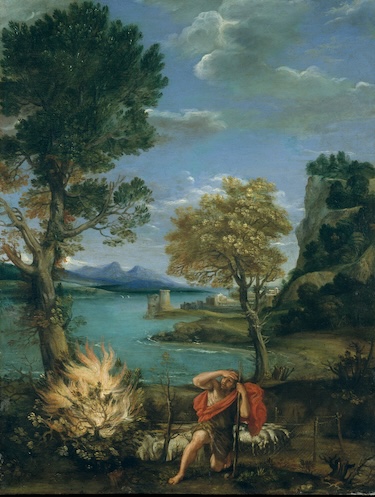
“Landscape with Moses and the Burning Bush,” by Domenichino (Italian, 1581-1641), painted sometime between 1610 and 1616. The Maggid, the storytelling portion of the Haggadah, is lengthy, yet it seems to dispense with the story of the Exodus in the barest of details. Where is Moses, or any of the other major characters? If telling the story of the Exodus is our essential task at the seder, it might seem that the Haggadah is more of an impediment than a facilitator. (image from Metropolitan Museum of Art)
* * *
Even if we were all sages, all wise, all learned in Torah, we would be obligated to tell the story of the Exodus. And anyone who tells the story of the Exodus in greater depth is to be praised. Once [five sages] sat together in Bnei Brak and went on telling the story of the Exodus from Egypt the entire night….
Retelling the grand drama of our departure from Egypt, discussing it and probing it, and looking for new ways to relate to it: almost every commentator writing about the seder begins by emphasizing that the central obligation of this night is to tell the story, ideally at great length. Whether through acting or analysis or making connections to our own experience, we look for ways to immerse ourselves in this story. These lines from the beginning of the Maggid section define the seder and drive home the point: there is no such thing as too much story. It is sometimes even a point of pride to announce how late into the night one’s seder lasted.
But the Haggadah, the seder’s ritual script, is strikingly ill-matched to the task of retelling. The Maggid, the storytelling portion of the Haggadah, is lengthy, yet it seems to dispense with the story of the Exodus in the barest of details and go on to other things. Where is Moses, or any of the other major characters? Where are the moments of high drama? If telling the story of the Exodus is our essential task at the seder, it might seem that the Haggadah is more of an impediment than a facilitator.
It might help to remember that the Haggadah is, like many liturgical texts, a composite that cannot be expected to flow in a simple, linear fashion. But I will argue that the main problem is that we are actually misunderstanding what it means to “tell the story” of the Exodus. We see this when we step back to think historically.
The Haggadah first developed around a guiding principle very different from our contemporary expectations, one that closely reflects earlier biblical and rabbinic sources. In short, the original task of the seder was not to tell our story but to tell God’s story; it was not to talk about how we were slaves but rather to appreciate and celebrate the fact that, by the grace of God, we are not and will not be slaves.
In the conceptual world of the Torah, this version of the story is not only the focus of the seder but also the linchpin of Jewish tradition; our entire commitment to serving God is an expression of our gratitude for God’s salvation. The critical task of the seder is to make that salvation personal by conveying to our children that not only our ancestors but we ourselves, in the present, owe our freedom and our very identity as a people to God’s kindness. As long as we are busy looking for a story that was never meant to be there, we risk overlooking this key theme at the heart of the Haggadah.
From haggadah to sipur
Rabbis throughout the medieval and modern periods consistently present the central mitzvah of the seder as lesaper, to retell or to recount the story of the Exodus. The term suggests a detailed narrative, a sense reinforced by the idea that the more we draw out or elaborate on the story the better. Maimonides, in the 12th century, for example, begins his discussion thus:
“It is a positive commandment of the Torah to recount [lesaper] the miracles and wonders wrought for our ancestors in Egypt on the night of the 15th of Nisan.… Whoever recounts at greater length [marbeh lesaper] the events which took place is worthy of praise.” (Hilkhot Hametz U’matzah, Laws of Hametz & Matzah 7:1)
Indeed, recounting the story of the Exodus is the only element other than eating matzah that Maimonides designates as essential.
The chasm between our expectations for seder storytelling and what our text has to offer opens up as soon as the Maggid begins. Right when we are settling in for a story to answer the four questions, the Haggadah offers these two sentences:
“We were slaves [avadim hayinu] to Pharaoh in Egypt, but Adonai our God brought us out from there with a mighty hand and an outstretched arm. And, had the Holy One not brought our ancestors out from Egypt, we, our children and our children’s children would still be slaves to Pharaoh in Egypt.”
This very, very short version of the Exodus story, a rephrasing of Deuteronomy 6:21, notes the Israelite enslavement but emphasizes God’s actions, in line with the commandment of lehaggid … for us – and our children, in particular – to celebrate Passover because God saved us from slavery.
Let’s put this in the context of the Mishnah’s guidelines for teaching children about the Exodus at the seder. The four questions we find in the Haggadah draw from Mishnah Pesachim 10:4, which provides detailed questions that the child may (or perhaps must) ask about the seder ritual. But for the parent’s response, the Mishnah provides only the following guidelines:
“According to the son’s knowledge, his father teaches him.
“He begins with genut [disgrace] and concludes with shevach [glory/praise].
“And he interprets [doresh] the passage: ‘My father was a wandering Aramean,’ until he concludes the entire section.”
The first line tells us that the response should be variable, tailored to the understanding of the particular child. The second sets the story’s basic framework: it should have a starting point, an end point and a narrative arc, leaving the rest to be filled in. The third line of the Mishnah identifies a passage from Deuteronomy 26 that briefly recapitulates the events of the Exodus and instructs us to interpret or study it closely in the manner of rabbinic midrash. Each of these is indeed a key part of the Maggid: the tradition of the four children expands on the idea of teaching each child according to her needs; two different proposals for texts that go from genut to shevach are included, “avadim hayinu” and a text from Joshua 24; and the longest section of the Maggid is a phrase-by-phrase interpretation of the passage, “My father was a wandering Aramean.”
“Avadim Hayinu” is intended to fulfil the second guideline. The words at the centre of that guideline, genut and shevach, suggest that the story we tell should trace the Israelites’ journey from disgrace to glory, from oppression to triumph. In Exodus 1-12, which traces the experience of Moses and the Israelites suffering from and then breaking free of Egyptian oppression, is indeed such a story.
But by this measure, the “avadim hayinu” passage in the Haggadah falls woefully short. It has the proper beginning and end, but that’s it. There is no middle and no elaboration to fill in what is missing. This has long been a major source of confusion for commentators. They posit that it is only intended as an opening, that it only indicates the starting point of the story rather than the whole story, or that it is a summary or abstract that precedes a fuller retelling. But these proposals merely highlight the simple fact that this is not the story we were led to expect. And none are at all convincing, since these two sentences clearly read as a self-contained unit, not as an introduction to something more expansive.
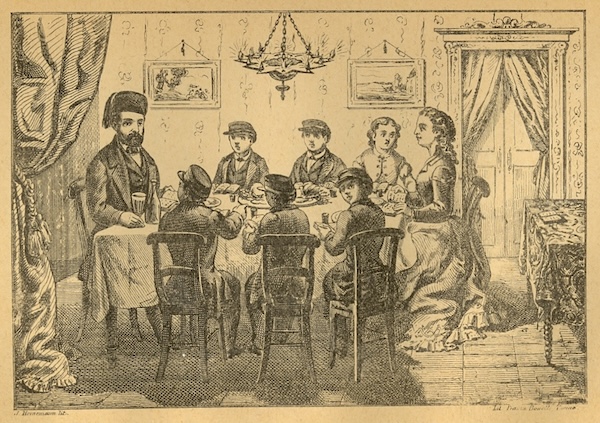
Detail from Seder Aravit ve-Haggadah, Corfu, 1877; engraved by A. Heinemann. When the Torah commands that we tell our children about the Exodus, it is referring specifically and exclusively to the wonders that God did on behalf of the Israelites. And the purpose of this commandment is to ensure that the next generation, recalling those acts, keeps an unshakeable faith in God’s love and a devotion to God’s mitzvot. (image from Library of Congress, Hebraic section)
Let’s take a step back and return to the Mishnah and, more specifically, its directive that parents teach their children a story that moves from genut to shevach. Although the word shevach can mean “glory” and, at first glance, seems to mean just that in the Mishnah, it is more typically used to signify “praise,” specifically praise of God. Understanding shevach as praise of God changes our understanding of the story the Mishnah wants us to tell. Rather than a story of Israel’s transformation from degradation to glory, we are to tell a narrative that begins with Israel’s degradation and concludes with a celebration of God’s might and love, as evidenced by the miracles of the Exodus. Looking back at “avadim hayinu” with this expectation, we can see that, indeed, it begins with the Israelites’ slavery and ends by describing the wonders God performed in the course of leading them to freedom. But we can go further, because these two elements are in fact the whole story. Perhaps, then, the directive is not “go from disgrace to glory” but only “mention disgrace and glory.”
In fact, the four times the Torah commands us to tell our children of the Exodus (Exodus 12:27, 13:8 and 14, Deuteronomy 6:21), it follows a similarly simple paradigm: (1) we were oppressed, but (2) we are no longer oppressed, thanks to God’s mighty and wondrous deeds. Degradation and praise are the only necessary points. Unlike later traditions, the goal of this telling is to instill in the children a sense of gratitude to God that will move them to join in the ritual and celebration, for which these two points suffice.
This affirms our sense that “avadim hayinu” was proposed as a complete fulfilment of the Mishnah’s mandate to tell a story that ends in praise of God. The Haggadah makes this clear in the next sentence, when it goes on to specify the moral of the “avadim hayinu” story: “Had the Holy One not brought our ancestors out from Egypt, we, our children and our children’s children would still be slaves to Pharaoh in Egypt.” This claim is implausible, living as we do, generations and centuries later, but it highlights the true purpose of lehaggid. It suggests that, had God not stepped in forcefully to alter their trajectory, the slaves would not have become a nation and the story of Israel would never have truly begun. This phrasing brings the story from the distant past closer to home. Real gratitude comes from the experience of having been personally saved. We need to understand and convey to our children that salvation is not a relic of the distant past, but that our own freedom is directly attributable to God’s wonders in Egypt. This reinforces the idea that the point is to teach about God’s actions, not the Israelites’ experience. Slavery serves only as the backdrop against which we learn to appreciate our freedom.
This message is, in fact, the foundation not only for one festival but for all of Torah: at Sinai, God’s identity as “the one who brought you out of Egypt” becomes the basis for God’s right to impose divine law. This connection is further expressed in the original setting from which “avadim hayinu” was taken, Deuteronomy 6. Here, the parent is commanded to teach about the Exodus in response to a child asking, “What are these rituals, statutes and laws that God commanded you?” This child is asking about the entire system of divine law, not the rituals of Passover, and yet the Exodus is still the answer. The message is the same: we were in need and God saved us with mighty deeds – and, it adds, led us to the Promised Land and gave us the law.
A wandering Aramean
Let’s turn now to the longest section of Maggid, an exegesis of Deuteronomy 26:5-8. This is the passage that begins with “arami oved avi,” “my father was a wandering Aramean,” in line with the third instruction we find in the Mishnah. The exegesis is written as a midrash, explicating phrase by phrase the biblical passage, which reads:
“My father was a wandering Aramean. He went down to Egypt with meagre numbers and sojourned there; but there he became a great and very populous nation. The Egyptians dealt harshly with us and oppressed us; they imposed heavy labour upon us. We cried to Adonai, the God of our ancestors, and Adonai heard our plea and saw our plight, our misery, and our oppression. Adonai freed us from Egypt with a mighty hand, with an outstretched arm and awesome power, and with signs and portents.”
This text does indeed begin at the beginning, with Jacob and family settling in Egypt and then being enslaved by the Egyptians; and it does end at the end, with God striking the Egyptians with “signs and portents.” What is conspicuously absent again is the middle, including everything that we would typically consider the drama of the narrative: the fear and bravery of Moses’s family; Moses’s crisis of identity and flight from Egypt; God giving him his mission at the Burning Bush; and Moses and Aaron’s confrontations with Pharaoh and their own people. Even the plagues, which in Exodus are a prolonged battle of wills and wits, are only briefly noted.
Many commentators, both traditional and modern, have struggled with the question of why this passage is chosen as the text for interpretation instead of a more robust summary from elsewhere in the Bible, or even portions of the original text of Exodus 1-12. Some propose quite implausible theories. Joshua Kulp offers refreshing clarity in the Schechter Haggadah with a simple and practical explanation:
“The passage was chosen because it is the briefest and yet still comprehensive passage in the Torah which tells the story of the descent to Egypt and the redemption. Such a short passage is prime material for midrash, a literary genre which focuses on individual words or phrases and connects them to other portions of the Torah. Exodus 12, or any other part of Exodus, is too long, digressive and not as comprehensive.”
In short, Kulp argues that the rabbis’ goal was to simply present a single, adequate review of the Exodus story for close reading. The limiting factor in the choice of text was that for the rabbis, close reading means midrash, a style of interpretation that works through a biblical text phrase by phrase, and, therefore, requires a fairly concise base text as its focus. These considerations made Deuteronomy 26 the obvious choice for the seder ritual. It would be impossible to read and interpret all of Exodus 1-12 within a single evening, while other summaries in the Bible are even briefer than the “arami oved avi” passage.
Kulp’s proposal is clearer and simpler than the alternatives, but it shares the basic assumption that this text is a less than ideal choice, that we should be telling a more complete version of these events, yet are saddled with one that leaves out key details. The distortions we find in how the story is told, with some elements described in detail and others passed over in silence, are an unavoidable but still unfortunate consequence.
I agree with Kulp’s assessment that other biblical reviews of the events of the Exodus (there are, depending how we count, at least 10 others) share the key features of the Deuteronomy passage. But I would argue that reading it in the context of these other passages actually reveals clearly what the Haggadah is doing and what it is not. It illustrates the distinction between recounting the Exodus as a story of the Israelites’ triumphant escape from slavery, and using it to enumerate praises of God – precisely the difference between lesaper and lehaggid.
These lists come in various forms, from songs of praise to speeches urging Israel to show gratitude, to confessions of Israel’s ingratitude. Psalm 136, known as the “Great Hallel,” is simply a list of God’s wonders across the full range of biblical history. It begins with the creation of the heavens, then describes God striking the Egyptian firstborn, bringing Israel out of Egypt and drowning Pharaoh’s army, followed by God defeating other kings in the desert and, ultimately, bringing Israel into the Promised Land. In Joshua 24, God speaks in the first person to highlight the wonders, including the Exodus, God did specifically on Israel’s behalf; while Psalm 106, a prayer of confession, emphasizes that God did these wonders despite Israel’s ingratitude and frequent rebellions. All of these focus on God’s actions, whether presenting them as evidence of God’s might, God’s kindness or God’s faithfulness.
“Arami oved avi” offers its own nuance on this theme. Originally a prayer of thanks to be said by Israelites bringing the first fruits of the Promised Land to the Temple, it describes in detail Israel’s descent, first to Egypt, then into oppression, and their cry for help. It describes Israel’s disgrace in order to frame God’s intervention as heroic, leading them up out of bondage, out of Egypt and back to the Promised Land, coming to their rescue in their hour of need, deepening the personal sense of appreciation and indebtedness. Even so, it is closely parallel to the other lists of God’s wonders. All of them recall the Exodus from Egypt specifically to present it as the preeminent example of God intervening in history, dramatically and publicly, on Israel’s behalf. The only relevant elements beyond the list of God’s acts are Israel’s need for them or response to them.
I want to emphasize how different this is from the original narrative in the book of Exodus. That text chronicles the human experience of slavery, following both the Israelites and the Egyptians, with a spotlight on Moses, Aaron and Pharaoh. God’s role is marginal until the final scenes. These other texts, by contrast, tell us only what God did, and notes human roles only to highlight God’s role.
The most illuminating example, though, is Psalm 78, which explicitly declares that it is the fulfilment of the mandate in Exodus to “tell your children.” Here are the key lines:
“We will tell the coming generation the praises of God and His might, and the wonders He performed. He established a decree in Jacob, ordained a teaching in Israel, charging our fathers to make them known to their children, that a future generation might know – children yet to be born – and in turn tell their children, that they might put their confidence in God, and not forget God’s great deeds, but observe His commandments.” (Psalms 78:4-7)
The psalmist is quite clear about both exactly what we must tell our children and why. When the Torah commands that we tell our children about the Exodus, it is referring specifically and exclusively to the wonders that God did on behalf of the Israelites in their time of need. And the purpose of this commandment, of repeatedly recalling those wonders, is to ensure that the next generation, recalling those acts, keeps an unshakeable faith in God’s love and a devotion to God’s mitzvot. The alternative, the psalm goes on to say, is also made clear in the Torah: the Israelites repeatedly lost that faith and rebelled during the desert journey, always with disastrous consequences.
And thus the picture comes into view in full clarity. It is true that “arami oved avi,” like the other reprises of the Exodus across the Bible, tells a very different story than Exodus 1-12. But that does not make any of these versions a deficient fulfilment of the Torah’s command, lehaggid. They are in fact fully in line with the lesson the Torah wants us to convey. Psalm 78 is literally the Bible’s prototype for how to properly fulfil it.
This is also the way almost the entire Haggadah approaches this command. It does not tell a tale that progresses from disgrace to praise, but one that includes only these two elements: we were in a place of disgrace and God redeemed us. And the point of this explanation is not the story itself but the lesson it teaches: God came for us in our time of need and did wondrous, astonishing, supernatural things on our behalf to bring us to freedom and make a place for us in the world. What we must do in the present is be thankful for those acts, acknowledging that they were done not just for our ancestors, but for us. Our devotion to God, which we show by performing the Passover ritual, celebrating the festival and observing all of God’s laws, flows directly from that awareness.
This framing opens up a whole new way to read the deeply evocative but enigmatic statement that concludes Maggid: “In every generation we must see ourselves as if we personally left Egypt.” Many explanations of this line take it to mean as if we had personally been enslaved, and this can be a springboard for cultivating empathy for all who are oppressed. But the Haggadah’s focus is not on slavery; it is on coming out of Egypt. Here, too, slavery recedes to the background and the Exodus is what matters. It is the Exodus, the exhilaration of being carried to safety in God’s hands, that always needs to feel like it just happened to us.
This is the real point of the seder ritual, for the Exodus to be happening in what we can call the Eternal Present. Like Moses’s paradoxical claim that all future generations stood/stand at Sinai, the seder is meant to make us feel for a moment that we are there on the banks of the sea, living that ecstatic moment of finally knowing that we are fully and irrevocably free. Look back and you will notice that the crucial claims in the Haggadah are in the present tense. If God hadn’t saved us, we today would still be slaves. In every era, including our own, there is an enemy pursuing us and, true to God’s promise, God saves us from their hand. Our freedom now is thanks to the Exodus; we are kept safe now because of God’s promise; and when we see that, when we really get it, we will be able to see ourselves as if we now are standing on the banks of that sea, that God’s salvation happened to us personally and thus makes a direct claim on each of us. We did not all experience slavery, but we have all been saved from it.
And the ritual prescribes that we respond to that awareness just as we did the first time, with an instinctive and unrestrained outpouring of song. This is the moment of transition in the seder: we go from the story of our disgrace to an intense song of praise filled with the intensity of those who have just escaped oppression. We, in this moment, know that we owe all we have to God’s salvation and, therefore, cannot help but begin pouring out songs of thanks. If we have done Maggid properly, Hallel will simply burst forth. This is where the night reaches its apex, when we are ready to relive the joy of salvation and to sing praise to God with the same intensity and gratitude as the Israelites who sang at the sea.
A time for singing
I have tried to demonstrate that the reason we often find it hard to engage meaningfully with the Haggadah is that the text is focused on a fundamentally different purpose than the one we typically bring to the table. Part of my goal has been to unlock the mystery in this familiar text, so we can see it anew and read it on its own terms; I have also tried to reclaim this earlier mission, which has been largely displaced by sipur. I would not wish to argue that storytelling should be removed, that we hold back from discussing slavery, from remembering Moses, Miriam and Aaron. Sipur enables us to include and engage children of all ages by filling in the missing narrative – playacting Moses’s showdown with Pharaoh, marching around like Israelites in the desert and making the plagues colourful and silly. In this way, our children are engaged and they come to know the story as their own. And the challenge of finding new layers of this story adds richness and creativity to the ritual.
But I also hope I have convinced you that the story is not an end in itself. A ritual’s sole function cannot be limited to retelling a familiar story, even if it is a great story. Even if it is our story. The goal of the seder ritual is for us to notice and to celebrate how far we have come; and to move us to joy, to gratitude and, ultimately, to hallel, to praising God.
So, the seder can be a time for telling wonderful stories or for reflecting on evils yet to be overcome. But don’t worry if you don’t get to the whole story. Don’t fret about its moral ambiguities. There is a time for self-critique, a time for feeling the weight of the world’s burdens. But not on this night. The seder is not the night to relive the suffering of being slaves. It is the night to relive the joy, the elation of that moment when we left slavery behind to embark on a new journey, full of promise and possibility. Looking at the open vistas around us, knowing that we were once slaves, how can we keep from singing?
Joshua Cahan compiled and edited the Yedid Nefesh Bencher and the Yedid Nefesh Haggadah. This article appears in the Spring 2023 issue of Sources: A Journal of Jewish Ideas, an award-winning print and digital journal (sourcesjournal.org) published by the Shalom Hartman Institute of North America (hartman.org.il) that promotes informed conversations and thoughtful disagreement about issues that matter to the Jewish community.
This introduction appears in In Every Generation: A Haggadah Supplement for 5784, recently published by the Shalom Hartman Institute (hartman.org.il).
The injunction, “Bekhol dor vador chayav adam lir’ot et atzmo keilu hu yatzah mimitzrayim,”“In every generation, each person is obligated to see themselves as if they had participated in the Exodus from Egypt,” is one of the most evocative lines in the Haggadah. It is a call to empathy, to feel the suffering and redemption of our ancient ancestors as our own. It is also a command to use the story to bring meaning into our own contexts, as we imagine ourselves being lifted out of despair and into freedom.
Every year, we see ourselves in this story in a different way – this is part of what makes the seder such a lasting and powerful ritual. This year, the reverberating trauma of Oct. 7, ongoing war in Gaza, thousands of Israelis displaced from their homes, rising antisemitism and weakening bonds of allyship around the world give us new lenses for understanding the Exodus story. In some cases, the words of the Haggadah feel more relevant; in others, the Haggadah’s proclamations clash with reality. How can we celebrate a holiday of freedom when more than 100 people are still held captive in Gaza? How do we call for all who are hungry to come eat at our tables when so many Israelis are not at their own seder tables and millions of Palestinians are on the brink of famine?
While there are no definitive answers to these questions, the Shalom Hartman Institute of North America has developed : A Haggadah Supplement for 2024, a collection of readings, essays and questions inspired by The Israeli Haggadah: Special Edition (Hebrew, 2024) by Mishael Zion and Noam Zion, celebrating the 20th anniversary of their 2004 Israeli Haggadah, later released in English as A Night to Remember: The Haggadah of Contemporary Voices. We encourage you to read In Every Generation as you prepare for the holiday and then to bring it to your seder table … to re-enter a generation-spanning conversation and envision ourselves anew in the Exodus story’s themes of persecution, resilience and redemption.
After Oct. 7, Mishael Zion began collecting and reading haggadot from the founders of the kibbutzim next to Gaza, finding strength in their determination and in the contemporary resonance of their additions to the Haggadah. He writes, “Reading their words, I was reminded that the power of the Exodus is not only in the covenant of common fate that we forged, but also a covenant of destiny…. It affirms that in every generation we can, and we must, change history.”
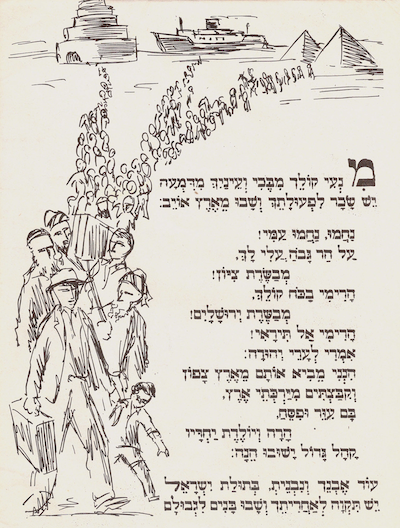
These haggadot include one created by founding members of what would become Kibbutz Be’eri, one of the kibbutzim in the Gaza Envelope that was attacked on Oct. 7, 2023. The nascent group related to the Exodus story of suffering and redemption and, like generations of Jews before and since, they added new layers to the ancient texts, recording their aspirations for their new community through supplemental texts and illustrations. As Yigal Zorea describes in Lines and Dots, his blog about Kibbutz Be’eri, several years after that first Passover, the kibbutz members hired designer Paul Kor to embellish their initial efforts. The image [on this page] comes from the end of Kor’s version of the Haggadah. It depicts groups from ancient history, including those scattered from the Tower of Babel, the Israelites enslaved in ancient Egypt and the ma’apilim arriving in the land of Israel during the British Mandate period, all arriving and merging into one collective at Kibbutz Be’eri, where they receive comforting verses from the prophets, affirming that their hardship will be rewarded and the Jewish people will be gathered together once more.
A page from the Kibbutz Be’eri Haggadah, designed by artist and author Paul Kor (1926-2001). (image from Shalom Hartman Institute)
The people who created the Kibbutz Be’eri Haggadah were in the early stages of building a safe and self-sustaining home in the desert, and their conditions were precarious. The Passover’s story of biblical enslavement and salvation served as the foundation for their own resilience. Their Haggadah is just one example from a rich history of Jews adapting the framework of the Haggadah to suit their contexts and to foster meaningful contemporary conversations. Many kibbutzim across Israel still make their own haggadot for Passover, timelessly drawing on the same hopes and questions that the founders of Kibbutz Be’eri included in 1946. But this year, six months after the kibbutz communities of the Gaza Envelope were attacked, it is particularly powerful to bring voices from these kibbutzim – their worry and their optimism – into our seder conversations, preserving this history of storytelling, even as the buildings and communities they built stand empty this Passover.
We invite you to use some or all the materials from In Every Generation to bring contemporary questions to an ancient ritual and story, and we encourage you to invite guests to bring their own supplemental materials, too. Like the founders of Kibbutz Be’eri, who created a Haggadah depicting the lush fields that surrounded them and quoting biblical texts, we hope the resources of In Every Generation will help you tell the story of the Exodus in a way that reflects the values, challenges and aspirations of Jews today. The supplement includes excerpts from kibbutz haggadot; essays on understanding and responding to the “wicked child”; pieces on the role of hope in Jewish history and in the present; and more.
This year, when we say “leshana haba’ah beyerushalayim,” “next year in Jerusalem,” may we do so with the intention and prayer that, next year, Jerusalem will be at peace. To download In Every Generation, visit hartman.org.il.
Rabbi Jessica Fisheris the director of rabbinic enrichment at the Shalom Hartman Institute of North America.
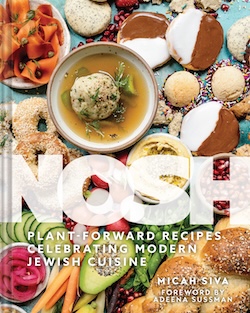
Chef and dietitian Micah Siva’s new cookbook, NOSH: Plant-Forward Recipes Celebrating Modern Jewish Cuisine, proves that plant-forward meals can be bursting with flavour and colour. (photo by Hannah Lozano)
“This is really good,” said my wife, as she tasted the steaming hot Spiced Cauliflower Chraime I had made from the new cookbook NOSH: Plant-Forward Recipes Celebrating Modern Jewish Cuisine (The Collective Book Studio) by chef and dietitian Micah Siva.
“‘Plant forward’ is a way of cooking and eating that emphasizes plant-based foods without limiting one’s diet to being vegetarian or vegan,” writes Siva. “This book is meant for anyone who follows a plant-based diet or is looking to adopt a plant-forward way of eating.”
It’s also for anyone who appreciates delicious food, from what I can tell from the plates I tried. Nonetheless, Siva does offer solid advice for meat-eaters wanting to become more plant-forward. In that regard, she talks about getting enough protein and iron, what can be substituted for eggs, etc.
On the Jewish side, she gives milk and butter substitutions to make a recipe pareve (permissible for observant Jews to eat with milk or meat dishes) and offers sample holiday menus. I found the Shabbat Matrix interesting – the cooking time required (little, more and lots) is on one axis and the effort involved (low and high) is on the other. Siva offers some ideas to think about
depending on the time and effort you can put into the meal. So, you can buy store-bought challah or make your own, make spritzers or just buy a bottle of wine and/or grape juice, for example.
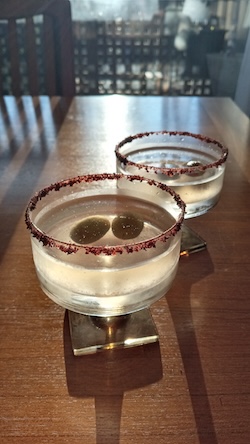
Given that Passover is approaching, I focused on a few of the recipes Siva highlights for the holiday. Her list comprises Turmeric Vegetable Matzo Ball Soup, Vegan “Gefilte” Cakes, the aforementioned Spiced Cauliflower Chraime, Herbed Horseradish Salad, Cast-Iron Potato and Caramelized Onion Kugel, Passover Black and White Cookies and Passover Coconut Macaroons. In addition to the chraime, I made the kugel and the macaroons. For fun, and because I have a huge bag of sumac from another cooking experience, I also made two Olive and Sumac Martinis – though neither my wife nor I are hard-liquor folks, we enjoyed our sips.
The production quality of this cookbook is high. The layouts are beautiful, with lots of colour photos and easy-to-follow instructions, which are supplemented by dietary labels (ex. vegan, gluten-free, Passover-friendly), the time required to get the food or drink on the table and clearly listed ingredients, as well as a brief introduction to each recipe and notes about certain ingredients that may be new to some cooks, or variations that could be used, possible substitutions.
NOSH includes a glossary and I learned a lot perusing it. Amba, for instance, is a “tangy, spicy, pickled mango-based condiment or sauce of Indian-Jewish origin” and toum is a “garlic sauce, similar to aioli, made of garlic, oil, salt, and lemon juice.” Siva gives some hints about measuring, choosing ingredients and shopping efficiently. There is an index at the back of the book, plus conversion charts for liquid and dry measures, and a Fahrenheit-Celsius temperature table. Acknowledgements and a bit about the author round out the publication.
In the few recipes I tried – and Passover-friendly ones at that – the expansive flavour palette on offer was evident.I look forward to making some of the 80+ other recipes in this cookbook, which illustrates the global diversity of Jewish culture. Siva may have grown up in Calgary, but her repertoire travels well beyond, to the Middle East, India, Africa, Europe and elsewhere Jews live or have lived. Her blog, at noshwithmicah.com, is worth checking out.
The cauliflower chraime was packed with spices – all of which I miraculously had in my cupboard! – and I will definitely make this dish again, as it was not only tasty but also easy to put together. According to Siva, it “is typically made with a whitefish poached in a tomato broth” and is often served in Sephardi families instead of gefilte fish during Passover. The recipe suggests serving it with couscous or rice, neither of which observant Ashkenazi Jews can eat during the holiday, so I plated it with mashed potatoes, which are OK for all Jews on Passover, and the two paired well.
It is worth sharing Siva’s note in the cookbook, acknowledging that the recipes “that are ‘Passover Friendly’ will have kitniyot,” even though “Ashkenazi Jews typically prohibit kitniyot, which includes rice, corn, millet, and legumes (beans), as they look too similar to grains. While customarily left out of Passover menus, it is not technically prohibited by the Torah.” So, “[i]f a recipe is listed as suitable for Passover, please use your discretion, and do what feels more comfortable for you and your family.”
In the recipes that follow, all of which I recommend, I don’t include (for space reasons) the informative introductions that appear in the book. I made only one adaptation, choosing not to dip the coconut macaroons into chocolate, my personal preference being to just enjoy the richness of the coconut, brightened by the splash of lime juice and zest.
SPICED CAULIFLOWER CHRAIME (serves 4, on the table in one hour)
The Spiced Cauliflower Chraime from NOSH will be an immediate favourite. (photo by Micah Siva)
2 tbsp extra-virgin olive oil 1/2 medium white onion, cut into 1/2-inch pieces 3 garlic cloves, finely chopped 3 tbsp tomato paste 4 tsp smoked paprika 2 tsp ground turmeric 1 tsp ground coriander 1 tsp ground cumin 1 tsp ground ginger 1/4 tsp ground cinnamon 1/2 tsp red chili flakes 1/4 tsp sea salt juice of 1 lemon (about 2 tbsp) 1/2 cup canned diced tomatoes 1 1/4 cups vegetable broth (low-sodium, if preferred) 1/2 cup golden raisins 1 small head cauliflower, cut into 6 wedges (if using a large cauliflower, cut into 8 wedges) 2 tsp date syrup or maple syrup 1/2 cup chopped fresh cilantro,for serving Cooked couscous or rice, for serving (I used mashed potatoes)
Heat the olive oil in a deep skillet over medium heat. Add the onion and cook until it begins to soften, 5 to 6 minutes.
Add the garlic, tomato paste, smoked paprika, turmeric, coriander, cumin, ginger, cinnamon, chili flakes, and salt, stir until combined, and cook for 2 to 3 minutes. Pour in the lemon juice, canned tomatoes, broth and raisins and stir to combine.
Place the cauliflower in the pan, cut side down in a single layer. Bring the liquid to a boil, decrease the heat to a simmer, cover and cook until the cauliflower is tender, 15 to 20 minutes.
Drizzle with the date syrup and garnish with the cilantro. serve with cooked couscous or rice.
Note: Store in an airtight container in the fridge for up to 5 days.Reheat in a pan, oven, or microwave until warmed through.
Variations: Substitute chopped dried apricots or figs instead of raisins. Looking for more protein? Add a can of drained and rinsed chickpeas along with the canned tomatoes and/or crumble some feta cheese on top.
CAST-IRON POTATO ANDCARAMELIZED ONION KUGEL (serves 10 to 12, on the table in 2 hours)
Micah Siva’s Cast-Iron Potato and Caramelized Onion Kugel can be a side or a meal. (photo by Micha Siva)
5 tbsp extra-virgin olive oil, divided 2 medium yellow onions, cut into 1/2-inch pieces 1 1/2 tsp salt, divided 2 pounds (3 or 4) russet potatoes 4 large eggs 1/2 tsp black pepper 1/4 cup matzah meal sour cream, coconut yogurt, crème fraîche or labneh, for serving (optional) fresh chives, chopped, for serving
In a 9-inch cast-iron pan, heat 2 tablespoons of the olive oil over medium heat until the oil is hot but not smoking. Add the chopped onions, spreading them evenly over the bottom of the pan. Decrease the heat to medium-low and let cook, undisturbed, for approximately 10 minutes.
Sprinkle the onions with 1/2 teaspoon of the salt and cook, stirring occasionally, until browned and broken down, 30 to 45 minutes. Once golden and caramelized, transfer the onions to a large bowl.
Preheat the oven to 350°F.
Add the remaining 3 tablespoons of olive oil to the cast-iron pan and place it in the oven to heat up while you prepare the potatoes.
Fill a large bowl with ice water.
Using a food processor fitted with the shredding disk, or a box grater on the largest hole, grate the potatoes. The potatoes will oxidize, so be sure to shred right before use.
Add the potatoes to the bowl of ice water. Let sit for 10 minutes to remove excess starch.
Drain the potatoes, transfer them to a clean kitchen towel, and wring out any excess liquid. The more liquid you can remove, the better! Add the potatoes to the bowl with the caramelized onions.
Add the remaining 1 teaspoon of salt, eggs, pepper and matzah meal and stir to combine.
Carefully remove the cast-iron pan from the oven and spread the potato mixture in the pan, pushing it down to compact the potatoes. It should sizzle on contact with the pan. Return the pan to the oven and bake for 1 hour, or until deep golden brown on top.
Serve with sour cream and chopped chives.
Note: Prepare this kugel up to 4 days in advance and store in an airtight container in the fridge.
Variation: Add 1/2 cup chopped parsley to the kugel along with the matzah meal.
Substitution: This recipe uses russet potatoes, but you can use Idaho potatoes instead.
PASSOVER COCONUT MACAROONS (makes 12 [large] macaroons, on the table in 45 minutes, including 10 minutes resting time)
Lime juice and zest make Micah Siva’s Passover Coconut Macaroons special. (photo by Cynthia Ramsay)
2 cups unsweetened shredded coconut 1/2 cup sugar 1/3 cup potato starch 1/2 cup canned full-fat coconut milk 1 tbsp lime juice 1/2 tsp lime zest 1/4 tsp sea salt 6 ounces (about 1 cup) dark chocolate chips 1 tbsp coconut oil
Preheat the oven to 325°F. Line a sheet pan with parchment paper.
In a medium bowl, combine the coconut, sugar, potato starch, coconut milk, lime juice, lime zest and salt until well combined.
Using a cookie scoop or ice cream scoop (large enough to fit approximately 2 tablespoons), scoop up some of the coconut mixture and pack it very firmly into the scoop. Use your fingers or the back of a spoon to press it into the scoop. Gently remove the coconut mound from the scoop and place it onto the prepared sheet pan. Tap the back of the cookie scoop to release it, if needed, and reform the mounds after placing them on the pan. Repeat with the remaining coconut mixture.
Bake for 22 to 25 minutes, or until golden. Let cool on the sheet pan. Once cool, remove them from the pan and place them on a plate. Line the sheet pan with wax paper.
While the macaroons are cooling, combine the chocolate chips and coconut oil in a microwave-safe bowl and microwave in 30-second increments, mixing well between each increment, until smooth.
Once the macaroons are cooled, dip the bottoms into the melted chocolate and place them on the prepared sheet pan. Refrigerate the macaroons until the chocolate is set, about 10 minutes.
Note: Once the chocolate has set, store the macaroons in an airtight container at room temperature for up to 5 days or in the refrigerator for up to 2 weeks. Store them in the freezer for up to 3 months.
Variation: Add 1 teaspoon of vanilla extract or 1/4 teaspoon of almond extract to the mixture in place of the lime zest and lime juice. Fold in 2 tablespoons of rainbow sprinkles and dip them into melted white chocolate.
OLIVE AND SUMAC MARTINI (serves 1, on the table in 10 minutes)
An Olive and Sumac Martini is one of the unique drink options in NOSH. (photo by Cynthia Ramsay)
1/2 ounce olive juice, plus more to rim the glass 1/2 tsp sumac, plus more to rim the glass 2 1/2 ounces gin or vodka 1/2 ounce dry vermouth ice 2 or 3 olives, pitted
Pour a little olive juice into a shallow dish. Place some sumac in another shallow dish. Dip the rim of a cocktail glass into the olive juice and then into the sumac. Gently shake off any excess sumac and set aside.
In a cocktail shaker or a jar with a lid, combine the gin, vermouth, 1/2 ounce olive juice and 1/2 teaspoon sumac and fill with ice. Stir or seal and shake until well chilled, 20 to 30 seconds. Strain the liquid into the rimmed cocktail glass and garnish with olives.
אירועי השבעה באוקטובר שהביאו למלחמה הקשה בין ישראל והחמאס ברצועת עזה הגבירו משמעותית את השנאה והאנטישמיות כלפי יהודים וישראלים שגרים בעולם. נשאלת השאלה האם הםנמצאים בסכנה קיומית? והאם השנאה והאנטישמיות יתמתנו לאחר סיום המלחמה בין ישראל והחמאס
לאור אירועי השבעה באוקטובר שהציגו תמונה קשה מנשוא של פעילות החמאס הרצחנית שכללה גם מעשי אונס והתעללות, ישראל, ישראלים ויהודים בחו”ל זכו לסימפטיה לתקופה קצרה שנמשכה כחודש ימים. אך כשהעולם רואה את מאות אלפי אזרחים בהם נשים ילדים רבים שנהרגו לאור הלחימה של צה”ל מול החמאס, הסימפטיה וההדה התחלפה בשנאה ואנטישמיות גלויה מול ישראל כמדינה, וכן כנגד ישראלים ויהודים שגרים ברחבי העולם. ככל הלחימה ברצועת עזה נמשכת, שמביאה להרס גדול תמונות קשות מתפרסמות בכל העולם של ילדים רעבים ורבים רבים שמתים בקרב האוכלוסייה המקומית, להבות השנאה גדלות בצורה חריפה ביותר
ישראלים ויהודים רבים בעולם המערבי שכולל את מדינות אירופה, ארה”ב וקנדה, מורידים פרופיל בחיי היום יום שלהם, מסתירים סממנים יהודים וישראלים ובודקים מי עוקב אחריהם. עד כה נרשמו הרבה תקריות נגד ישראלים ויהודים במדינות שונות וכנראה המצב אף יחריף, כל עוד נמשכת הלחימה ברצועת עזה ונרשמים הרבה קורבנות בנפש. לפי שעה אספקת מזון ומצרכים חיוניים לאוכלוסיה המסכנה של עזה רבתי, לא מספיקה
המלחמה בעזה הציתה כאמור את האנטישמיות בעולם שמגיעה לרמות גבוהות ביותר
יתכן ובמדינות דרום אמריקה זה לא מורגש אך בכל המערב זה מורגש כל הזמן וכל יום. תקריות נגד יהודים וישראלים נרשמות כל העת בערים רבות בעולם בהן ברלין, ניו יורק, לוס אנג’לס, לונדון, מונטריאול, טורונטו ועוד ועוד
ונקובר כרגע יחסית שקטה אך מדי סוף שבוע יש כבר הפגנות של פלסטינים ותומכיהם. להערכתי כשלושת אלפים משתתפים מגיעים לאירועים אלה שמתקיימים בעיקר בדאון טאון. אלפים צועדים לעבר הכיכר המרכזית בעיר – בין הרחובות רובסון ווסט ג’ורג’יה -והמשטרה סוגרת את הרחובות. זו תמונה לא נעימה כלל וכלל. הפגנות התקיימו גם בגשרים מתחברים לדאון טאון (בוארדד וגרנוויל) והתנועה התעכבה במשך שעות. הפגנות קטנות יותר מתקיימות באזורים מרוחקים יותר במטרו ונקובר
אתה אף פעם לא יודע מי יעמוד מולך ברחוב או בחנות האוכל וכידוע שונאי ישראל לא מבחינים במי תומך במדיניות ישראל במאה אחוז ומי שמתנגד למלחמה בעזה שהביאה לקורבנות רבים ורעב גדול. רבים הפכו לעיוורים לאור הסכסוך הנוכחי. וזה מצב חמור בפני עצמו
בנסיעה להוואי לא לקחתי לראשונה ספר בעברית אלה באנגלית. לא רק לטיסה אלה גם לקריאה בחדר במלון. בחדר אני לא נועל את הדברים כיוון שזה רק יכול לעורר חשד שאני מחביא משהו בעל ערך. לכן אין יותר ספרים בעברית בנסיעות
אני כידוע לא מדבר עברית ברחובות אך כשיש מפגש עם חבר או שניים דוברי עברית בקפה אין לי ברירה, כי הם לא מוכנים להסתתר ולדבר באנגלית ודווקא מבקשים לדבר בעברית
כשאני מדבר באנגלית עם מקומיים הם מבחינים במבטא שלי. רובם חושבים שאני בא מרקע צרפתי או גרמני שזה לא רע. אך אין לדעת מה יכול לקרות אם מישהו שאינני מכיר ידע שאני ישראלי לשעבר
הדברים רק הולכים ומחמירים. לא ידוע לאף אחד מאיתנו האם תירשם רגיעה במצב או השנאה והאנטישמיות אף יחריפו. להערכתי יקח עוד זמן רב עד שנרגיש להקלה במתח והחיים יחזרו למסלולם במדינות המערב. התקווה בסוף תנצח