The Tower of David Museum has started one of the largest conservation projects in Israel, with work underway for a $40 million renewal plan led by the Clore Israel Foundation together with the support of the City of Jerusalem, the Ministry of Jerusalem and Heritage, and the Israel Ministry of Tourism. The Israel Antiquities Authority is supervising the archeological excavations and conservation of the project, which will double the current area of the museum to 20,000 square metres (more than 215,000 square feet). There will be a new sunken-entrance visitor centre, café, additional public bathrooms, as well as seven new galleries, additional exhibition spaces and two elevators, making the ancient citadel accessible to all. An educational complex of offices, classrooms and an auditorium will be constructed and a promenade added, which will be lined with archeological findings from the site.
Throughout the next two years, the museum will remain open (within the guidelines of the Ministry of Health), with temporary exhibitions, guided tours and cultural activities. A capital campaign has been initiated to complete the renewal project. At the same time, the museum continues to raise working capital to ensure that, even during the project and through the pandemic, the story of Jerusalem continues to be told. Last year, more than 500,000 people visited the museum, generating income for 80% of its budget, but the pandemic shutdown cut its income to zero, forcing the furlough of 85% of the working staff. Despite this, a small team is still creating live and virtual programming. In addition to fundraising, the museum has petitioned the government of Israel, including the Ministry of Culture, for support.
ההתפתחויות הטכנולוגיות המהירות הובילו להיווצרות פערים בין מדינות מתקדמות ומדינות מתפתחות. מדינות רבות זקוקות לכוח אדם מיומן הבקיא ברזי הטכנולוגיה ומדינות נוספות מגייסות עובדים צעירים לצורך ביצוע עבודות פשוטות שונות. העידן המודרני והעובדה כי העולם הפך לכפר גלובלי, מספקים אפשרויות רבות לתעסוקה בכל רחבי העולם. לכן תופעת הרילוקיישן הופכת לנפוצה במיוחד יותר ויותר. חלק מאלה עושים רילוקיישן חוזרים לאחר סיום חוזה העבודה או הלימודים לארץ מוצאם. ואילו החלק האחר נשאר לגור באותן מדינות ואז הסטטוס שלהם משתנה למהגרים.
בשנים האחרונות לאור מה שקורה בישראל מתרבה מאוד מספר הישראלים שמבקשים לעבור ולגור במדינות אחרות, כמהגרים, כסטודנטים או על תקן של רילוקיישן. זאת למספר שנים או לצמיתות.
מדי שנה יוצאים מישראל אלפי עובדים לשליחות בחוץ לארץ מטעם מקום עבודתם. כמו כן, צעירים רבים נוסעים לצורך לימודים לתארים מתקדמים. זאת כאשר חלקם מחזיקים במשפחות וחלקם מעוניינים לפתח קריירה עצמאית. על פי הנתונים של הלשכה המרכזית לסטטיסטיקה, כעשרים אלף משפחות עוזבות את ישראל מדי שנה ועושות רילוקשיין למדינות שונות בחו”ל.
ארבעת היעדים המבוקשים ביותר לרילוקיישן מצד הישראלים הם המדינות: קנדה, ארצות הברית, הולנד ובריטניה.
קנדה נחשבת למדינה מתקדמת מאוד ומציעה רמת חיים טובה, משכורות גבוהות ותנאים סוציאליים מצוינים. ישראלים רבים בוחרים בקנדה כיעד לרילוקיישן וזאת בזכות איכות החיים וההשתלבות הנוחה והמהירה. כידוע מספר הישראלים שמהגרים לקנדה הולך ולגדל מדי שנה וכיום יש בה את הריכוז הרביעי בגודלו בעולם של יהודים. משכורת ממוצעת בקנדה מוערכת בלמעלה מחמישים אלף דולר בשנה.
ארה”ב מהווה יעד מבוקש עבור ישראלים לצרכי עבודה וזאת בזכות מגוון אפשרויות התעסוקה והשכר הגבוה. כן יש לזכור את ההסכמים בין המדינות ישראל וארה”ב. רובם של הישראלים בוחרים לגור במדינות במערב קליפורניה ובמזרח ניו יורק, שמציעות מרכזי תעסוקה גדולים דוגמת עמק הסיליקון. רבים מהישראלים המבצעים רילוקיישן לארצות הברית הינם עובדי ענף הייטק, מהנדסי תוכנה, מנהלי מוצרים ועוד. משכורת ממוצעת בענף ההייטק בארה”ב יכולה להגיע ליותר ממאה ושמונים אלף דולר בשנה.
הולנד מושכת אליה עובדים מענף ההייטק וכן עובדים בתחומי ההנדסה, התעשייה והניהול, האמנות ועוד. הולנד נחשבת למדינה שמאפשרת השתלבות בצורה נוחה וקלה ומציעה תנאים סוציאליים טובים ורמת שכר גבוהה. מדובר במדינה קטנה עם הרבה היסטוריה מצד אחד אך גם עם הרבה התפתחות טכנולוגית מצד שני. יש גם לזכור שהולנד נחשבת למדינה מאוד ליברלית. בהולנד השכר הממוצע מגיע ללמעלה מחמישים ושתיים אלף דולר.
עיר הבירה של בריטניה לונדון נחשבת לעיר בינלאומית ומודרנית המשלבת בצורה טובה בין עסקים לבין פנאי ובידור. לונדון נחשבת ליקרה, אולם יוקר המחייה בה התמתן בשנים האחרונות ודומה לזה הקיים בתל אביב שדווקא התייקרה מאוד לאחרונה. הדרישה באנגליה ובמיוחד בעיר לונדון היא בעיקר לעובדים בתחומי טכנולוגיה, פרסום, אינטרנט, מובייל ופיננסים. בבריטניה השכר הממוצע עומד על למעלה מארבעים וחמישה אלף דולר.
רילוקיישן לצרכי לימודים: ישראלים רבים בוחרים ללמוד בחו”ל בעיקר במקצועות בהם תנאי הקבלה בארץ נוקשים, כמו וטרינריה ורפואת שיניים. בנוסף, לימודים בחו”ל מציעים מסלולי הכשרה שאינם נלמדים בארץ. שכר הלימוד משתנה בין מדינה למדינה ובין מסלולים שונים. שכר הלימוד יכול לנוע בין כמה אלפי דולר או כמה אלפי יורו לשנה, ולהגיע אף עד לשבעים אלף דולר לשנה במוסדות לימוד יוקרתיים במיוחד. במספר מדינות כמו דנמרק, גרמניה ובנורבגיה הלימודים הם בחינם גם עבור סטודנטים זרים.
Premier John Horgan sent Selina Robinson a message: “A mensch is a good thing, right?”
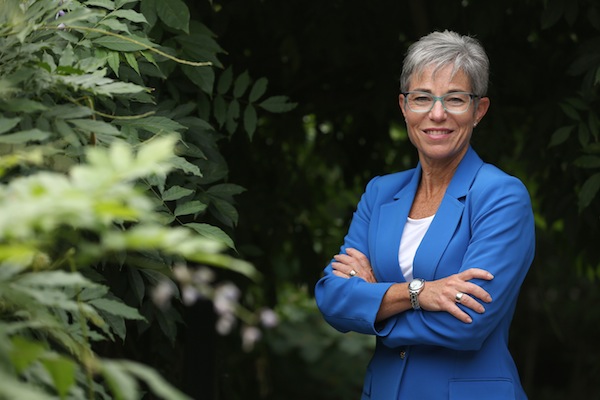
Robinson, the NDP government’s minister of municipal affairs and housing, is seeking reelection in the riding of Coquitlam-Maillardville. She sees herself as the Jewish maven around the cabinet table.
“I said yes, who called you a mensch?” Robinson recalled. “He just wanted to double-check.”
As she and other New Democrats campaign toward the Oct. 24 provincial election, Robinson and fellow cabinet member George Heyman spoke with the Jewish Independent. (In this issue, we also speak with Jewish candidates and spokespeople for other parties.)
As minister of housing, Robinson takes pride in the development of a major initiative called Homes for B.C.: A 30-Point Plan for Housing Affordability in British Columbia. Her ministry engaged with housing groups, renters, developers, economists, local government officials, planners and other thinkers. Then they convened people in a “World Café,” an engagement exercise in which people from different perspectives sit at a table and must come to agreed-upon recommendations on a topic.
“It was from that that we picked the best ideas and so it really came from all sides of the housing sector rather than pitting them against each other,” she said, acknowledging that she had to convince some to buy into the process because bureaucracy is not always amenable to novel approaches.
She cited two particular areas that she wants to “kvell about.” BC Housing, the agency that develops, manages and administers a range of subsidized housing in the province, is building housing on First Nations land.
“The feds, I don’t think, are building a lot of Indigenous housing and they’re supposed to,” she said. “No other province has stepped up to do that.… You’re a British Columbian and you need housing … if it’s land on reserve, it’s land on reserve – we’ll build housing.”
By providing housing in First Nations communities, it also helps people remain at home, rather than moving to the city, where housing is even more expensive and possibly precarious, she said.
“I’m very proud of that,” Robinson said.
The other point of pride is, Robinson admitted, “a geeky piece of legislation.” When she stepped into the role as the government’s lead on housing availability and affordability, she recognized that there is no data on what kind of housing exists and what’s needed.
“Local governments are responsible for land-use planning and deciding what kind of housing goes where – this is going to be multifamily, this is going to be single-family – but, if you were to ask them, how much do you have, how much more multifamily do you need, they couldn’t tell you, because nobody was collecting the data.”
She brought forward legislation that mandated local governments to do a housing needs assessment every five years to identify whether more housing options are needed for different age groups and types of families.
She also cited the government’s development of social housing, through the allocation of $7 billion over 10 years to build 39,000 units. So far, 25,000 units are either open, in construction or going through the municipal development process.
“My biggest worry is that the Liberals [if they are elected] will cancel all of those that are still in the development stage because they did that in 2001 when they formed government,” she said. “We’re so far behind the eight ball because they did that. I’m not saying it would have fixed everything, but, if there were another 5,000 units of housing out there, it wouldn’t be as bad as it is because there would be another 5,000 units.”
Every Friday, Robinson lights Shabbat candles and then shares a reflection on social media about her week.
“Lighting the Shabbat candles just grounds me in my identity,” she said. “I make myself take 10 minutes on a Friday at sundown to stop and to clear my head and to remind myself why I do the work. It’s not for the pay. It’s not for any of that; it’s not worth it. It’s who I am, what are my values and what’s important to me? What did I hear this week that reminds me of why this work is important?”
Robinson admitted she’s being partisan in saying that she believes NDP values are Jewish values.
“From my perspective, taking care of the world – whether it’s the environment, the people and all that’s within it – is our collective responsibility,” she said, adding with a laugh: “I think all Jews are New Democrats who just don’t know it yet.”
* * *
George Heyman, minister of environment and climate change strategy, is seeking reelection in the riding of Vancouver-Fairview. He is a son of Holocaust refugees, who escaped the Nazis with the help of Chiune Sugihara, the Japanese diplomat in Lithuania who illegally issued visas to about 6,000 Jews, many of whose descendants now live in Vancouver.
George Heyman (photo from George Heyman)
In 2019, Heyman took a family trip to Poland, which broadened his awareness of his family’s history and where he met family members he never knew he had. The Independent will run that story in an upcoming issue.
Speaking of his record in government, Heyman expressed pride in bringing in CleanBC, which he calls “a very detailed, independently modeled set of measures to get us to our 2030 target and beyond.”
He also said the government “completely revamped the province’s Environmental Assessment Act, incorporating the principles of the UN Declaration of the Rights of Indigenous Peoples.”
Collaborating with the First Nations Leadership Council, the government adapted the legislation to bring in affected local communities at the beginning of a project, before a proponent spends millions of dollars then has to go back to the drawing board due to local concerns.
“We’ve been investing in clean technology, we’ve approved transit plans that were stalled for years that the mayors of Metro Vancouver thought were critically important,” Heyman added. “We’re going to see the Broadway [SkyTrain] line commence to relieve the tremendous congestion on the Broadway corridor, both on buses and on the roads. And we’ll be working on ultimately being able to work with UBC and the city and the federal government to extend that to UBC.”
The government, he said, updated the Residential Tenancy Act to address tenants who were being threatened with eviction for suspect renovations and that saw people getting notices of rent increases as high as 40% because of loopholes in the act.
“We closed those loopholes, we held rent increases to the cost of living unless there is a legitimate demonstrated need to do renovation and repair and it’s fair to receive some compensation rent to pay for that,” he said.
Like Robinson, Heyman cited the construction of affordable housing, as well as supportive housing, to get homeless people off the street and provide them with services they need. He said the government has created 20,000 childcare spaces in the province “with significant fee reductions for families as we work our way toward a $10-a-day program.” Increased staffing in schools, mandated by a Supreme Court decision during the previous regime, is also an accomplishment, he said, as well as adding more investments in new schools for seismic upgrades, fire safety and heating and ventilation systems.
On the opioid crisis, Heyman acknowledged a surge in deaths since the beginning of the pandemic. “While there is much more to do, we managed to flatten the level of deaths up until COVID hit,” he said.
Also parallel to the pandemic was a realization of “the terrible state of many of our long-term-care homes.”
“We saw that deteriorate under the previous government,” he said. “With COVID, we saw the results of that. We saw people dying because workers were having to go to two or three different care homes, increasing the risk of infection, simply to cobble together a living. We took measures to allow our healthcare workers to work in one institution without suffering the loss of pay and we’re also investing in more beds and more equipment for long-term-care homes.”
New Democrats have been governing in a minority situation with the support of the Green party since 2017. Horgan called the snap election on Sept. 21, facing criticism for breaking fixed election date legislation and going to the polls during a state of emergency.
Rachael Segal is media spokesperson for the BC Liberals. (photo from BC Liberals)
Facing a campaign unlike any other, with shaking hands and kissing babies prohibited by social distancing protocols, all parties needed to reimagine how they would reach voters. Rachael Segal, media spokesperson for the BC Liberals, had to figure out how to get her party’s message to British Columbians.
“We can’t have a media bus, so, as the person responsible for media relations, how I connect with media now is very different than how I would do it in a normal campaign,” she said. “I’d be on the bus, I’d be with the leader.”
Instead, the leader is often driving himself to the modest-sized events that typify the 2020 campaign. Instead of facing a phalanx of TV cameras and radio mics, party leader
Andrew Wilkinson speaks to a pooled camera, with his message then shared among the media consortium. It’s an experience all parties are dealing with. But the leaders, as well as candidates in 87 ridings across the province, still have to communicate their positions.
“Obviously, Andrew still needs to get out there and get his message out there,” said Segal. “We’re making announcements daily, just like we would on a campaign normally, they’re just different.”
Wilkinson, a medical doctor as well as a lawyer, is particularly sensitive to the health risks and safety of his team, Segal said.
Segal, who grew up in Kerrisdale, is the official campaign spokesperson for the party during the election and is second-in-command at party headquarters when in non-campaign mode. As senior director of the party, her role is a loosely defined collection of responsibilities that she describes as “basically whatever hole is there, I try and fix it.”
One of her primary responsibilities is stakeholder relations, which means meeting with particular community groups and connecting them with the leader and other members of the legislature.
“Andrew and I have done Shabbat dinners, we’ve done Rosh Hashanah meals, we’ve done tons of Jewish community events,” Segal said by way of example. She also hosts the party’s podcast and started a young professional women’s group “to try to engage the 30-to-50-year-old women demographic, which is the largest swing demographic in British Columbia.”
Segal came to the role in April 2019. She already had a long resumé in education, politics and media.
She attended Vancouver Talmud Torah elementary and Magee high school and received her undergraduate degree at the University of Victoria, where she was the first president of the Jewish student organization when Hillel House opened there. She served as national president of the Canadian Federation of Jewish Students before graduating from UVic in 2005. She then went to the University of Leicester, in the United Kingdom, for a law degree, followed by a master of laws from Osgoode Hall, in Toronto.
She worked on Parliament Hill for Conservative MPs David Sweet and Scott Reid, as well as Senator Linda Frum, and was a senior policy advisor overseeing corrections and the parole board for then-minister of public safety Steven Blaney.
While studying in Toronto, Segal worked full time as an on-air legal and policy correspondent for Sun News, until that network shut down. She worked in criminal law and then civil litigation for a time but found it not her speed and returned to media, joining Toronto’s Bell Media radio station News Talk 1010. She returned to Vancouver in 2018 and covered as maternity leave replacement for the B.C. regional director of the Canadian Jewish Political Affairs Committee. She joined the BC Liberal party staff three days after that position ended.
“This election is really about who British Columbians can trust to lead them through economic recovery,” said Segal. “When we think about the ballot question, that’s really what British Columbians are voting on. Who do they trust to lead them through the next stage of this pandemic from an economic perspective? We have an incredible team who are all very experienced. We have former ministers, we have doctors, we have lawyers, we have just a really diverse and interesting team of very smart people.”
Given significant turnover – seven cabinet ministers have opted not to seek reelection – Segal questioned who would be on the frontbenches of a reelected NDP government.
“The question is, what does an NDP cabinet look like in the next government and do they have the bench strength to be the best party to lead this province economically?” she said.
Segal takes seriously her position as one of the few Jewish individuals on the campaign team.
“It’s a real privilege to be able to represent the community within this political sphere and it’s something I take very not lightly,” she said.
Of her job on the campaign and her slightly less hectic role the rest of the time, she added: “My job is pretty different, wild, fun. Every day is a new adventure. It’s pretty great. And we have such an incredible team, so they make it all even better.”
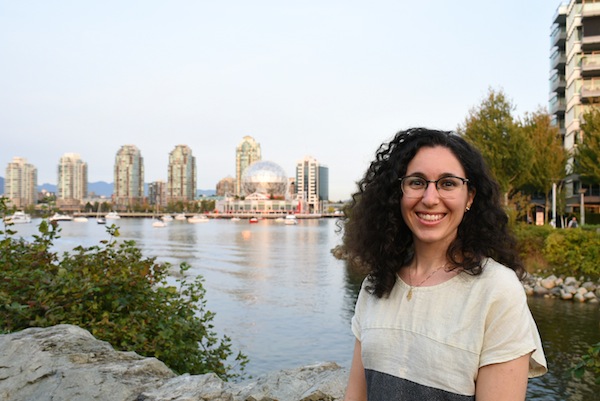
Maayan Kreitzman said the Green party knew it was getting the “full package” when they tapped her as their candidate in the provincial election for the riding of Vancouver-False Creek. There are schisms in the environmental movement between those who see value in direct action protests and those who endorse electoral politics. Kreitzman backs both.
Kreitzman is a leading member of the Vancouver chapter of Extinction Rebellion, a global movement that practises civil disobedience to draw attention to the climate and ecological crisis, she said, based on “a theory of change that learns from many movements in the past that have basically put their bodies in the way of injustice.” She cited as models the U.S. civil rights movement, the Indian independence movement and the suffragists.
The group shut down the Burrard Street Bridge last year and is currently involved, with other groups, in a camp in Burnaby that is physically blocking the construction of the TMX pipeline.
But Kreitzman has harsh words for the environmental movement and its limited impacts.
“The environmental movement over the last 30 years has won some battles but we’re obviously losing the war because the climate and ecological catastrophe continues unabated essentially,” she said.
While she believes in blockades, she also believes in ballots.
“I definitely believe in both,” she said. “I think when the Green party chose me as a candidate they knew that they were getting the full package. They were getting somebody who believes in direct action, who believes in doing things that are illegal when they are ethical and the right thing to do. There are other people in the Green party that believe that, too. [Former federal Green leader] Elizabeth May got arrested on Burnaby Mountain in 2018. I’m certainly not alone in that.”
Beyond the shortcomings of the environmental movement, she excoriated the political system’s status quo.
“It’s utterly failing. It’s not fit for purpose. It has not delivered the systemic changes to our economy that we need to see in order to actually have a sustainable life and future on this planet,” she said.
Above a range of policy topics she champions, Kreitzman wants to create a citizens’ assembly on climate and ecological justice – this parliament of ordinary people selected to reflect demography “would devolve power from elected government to a more representative and radically democratic form of government.”
“Citizens’ assemblies go through a very rigorous and well-facilitated deliberative process where they have access to experts and all the best information and then they are empowered to make either decisions or recommendations, depending how their terms of reference are set up,” she explained. “The citizens’ assemblies are able to make way better, faster and more radical decisions on issues that are totally intractable for elected politicians because elected politicians operate on such short cycles and they have such perverse incentives. It’s very hard and we’ve seen how totally incapable elected politicians around the world are of making the kinds of decisions that we need in order to survive on this planet.”
Kreitzman has been thrown into politics mere days after completion of her PhD in resources, environment and sustainability at the University of British Columbia. Her research specialized in sustainable agricultural systems and, more specifically, perennial agriculture.
She was born in Vancouver to a Canadian father and an Israeli-Canadian mother, attended Vancouver Talmud Torah and Eric Hamber high school and was active in Hillel at UBC, as well as in the Graduate Students Society.
She wants to win the election – but winning isn’t everything.
“This race is not just about that,” she said. “It’s also about telling the truth and just giving a platform to a sustainability scientist, a youngish person and somebody who is willing to talk very openly about the failures of our current government systems. Not just our current government and the NDP, but our current government system and their lack of democracy, and the failures of the environmental movement itself, because neither have been effective and so far nothing has really been effective.”
While she is critical of government generally, she has harsh words for the NDP government particularly.
“This government’s record on the environment has been a total loss, it’s a complete failure,” Kreitzman said. “They’ve embraced the oil and gas industry even more than the BC Liberals have and I never thought I would say those words, that the NDP government has actually been worse for climate change and the environment than the BC Liberals have been. It’s shocking, but it’s true.”
She referenced a report from Stand.Earth, which outlines subsidies to fracking and indicates that the oil and gas industry receives four times as much in provincial government subsidies than it produces in royalties to the province.
As the candidate in Vancouver-False Creek, she is sounding the alarm that sea-level rise will make parts of the most densely populated neighbourhoods of Vancouver uninhabitable.
* * *
Kreitzman’s colleague Scott Bernstein is running for the Greens in Vancouver-Kingsway. He sees it as an ideal opportunity to contrast NDP policy with his ideas because he is facing off against Adrian Dix, the minister of health.
Scott Bernstein (photo from Scott Bernstein)
Bernstein is director of policy at the Canadian Drug Policy Coalition, which is based in the faculty of health sciences at Simon Fraser University. While he has a graduate degree in environmental studies, his career has shifted to drug policy. He was a junior co-counsel on the landmark 2011 Insite case at the Supreme Court of Canada, which found that the federal government’s failure to grant an exemption allowing users to consume illicit drugs at the Vancouver safe consumption site breached the Charter of Rights because it undermined the “maintenance and promotion of public health and safety.”
He also worked at Pivot Legal Society in the Downtown Eastside and operated a private practice for a time as well, before coming to the drug coalition about three-and-a-half years ago. He has worked for George Soros’ Open Society Foundations, in New York, focusing on drug policy at the UN level and in Africa, and he spent two years with the U.S. Peace Corps in Uzbekistan.
The record-breaking recent months of opioid deaths contrasts, Bernstein said, with the response to COVID.
“There are a lot of structural problems with how the government is dealing with the overdose crisis and it really was highlighted when we had another public health crisis and, all of a sudden, we saw how the government could sort of snap to attention, dedicate funding, have information flow, have protocols and guidelines and resources available to address COVID where, in reality, the overdose crisis is now in the fifth year since it was declared a public health emergency in B.C. and we’ve never seen the response that we saw with COVID, that materialized in a few weeks,” he said. He credited retiring Minister of Mental Health and Addictions Judy Darcy as “a wonderful and caring person,” but added: “they also didn’t give her sufficient resources to deal with the problem and she doesn’t have a lot of power in the cabinet.”
* * *
Ian Goldman, the Green candidate in Vancouver-Fairview, grew up in Toronto and moved west in 1988 to attend law school at UBC. He later did a master’s in international relations, also at UBC, and has practised immigration law in private practice since 1998.
Ian Goldman (photo from Ian Goldman)
The first-time candidate is up against George Heyman, the NDP minister of environment and climate change strategy.
“It’s unfortunate that, in my area, the NDP have really strong support in the sense that he’s not really feeling pressure, I don’t think,” Goldman said. “Hopefully, I can make him feel some pressure. That’s the most important thing for me.”
The New Democrats have taken climate change more seriously than previous Liberal governments, he said, “But I think they’re more of a status quo party. They say they’re taking it seriously but then their actions show them out to be more status quo, no serious climate action, really.”
COVID is a serious issue, he said, but it has allowed governments at all levels to push environmental issues and climate change to the back burner, he argued.
“As soon as the pandemic’s over, people will wake up and say, oh my God, we’ve got a really serious issue here again,” said Goldman. “That’s why I joined the Green party. I’ve always been interested in environmental issues. My kids and I and my wife go for a lot of outdoor trips, we go hiking, a lot of outdoor activities we do together. That’s where my interest in the environment comes from.”
He added: “If people are really serious about tackling this issue, they should at least consider the Green party.”
* * *
Michael Barkusky (photo from Michael Barkusky)
Michael Barkusky, an economist and certified public accountant, is in a rematch with Andrew Wilkinson, now the leader of the Liberal party, in the riding of Vancouver-Quilchena. He acknowledged it’s an uphill battle in the Liberal stronghold.
“What I’m trying to do is strengthen the Green party in general,” he said. But it is also an opportunity to press the party leader on environmental issues.
“I think the BC Liberals need to improve their green credentials substantially to be relevant in the long term,” said Barkusky, who came to Canada from South Africa in 1980. (More about his background and career is in our story from the last election, at jewishindependent.ca/apartheid-impacted-views.) He said former premier Gordon Campbell was innovative on a range of policies, including the carbon tax. He said Campbell’s successor, Christy Clark, backtracked on Campbell’s environmental policies.
The Liberal party is, Barkusky said, a “broad church with some very conservative elements and [Wilkinson] probably can’t do a lot of things that he would do if he had a completely free hand. I think the pressure needs to be kept up on them as much as it has to be kept up on the NDP.”
As he campaigns, Barkusky said, voters tell him they think the NDP ran a good government in part because of the Green party’s influence.
“And now they [the NDP] are trying to say they’ll do a better job without us,” he said. “I can’t buy that.… Quite a lot of voters in the riding agree with me. They feel that we had good government in the last three years and they credit the Green party with being an element of it being good.”
While he disagrees with the Liberals’ promise to eliminate the provincial sales tax for a year, he said changing it could be justifiable. Reducing it from seven percent on most items, or changing the number of items it covers, is a discussion worth considering, he said. But he sees the promise as akin to the NDP’s promise in the last election to eliminate tolls on bridges.
“It’s just kind of instant popularity,” he said. “A relatively bad policy that will resonate well with a certain constituency.”
Barkusky finds it interesting that there are four Green candidates in Vancouver who are Jewish, and noted that the federal Green party just elected a Jewish woman to lead it.
“That’s a lot of tikkun olam consciousness,” he said.
***
Note: This article has been amended to reflect that Maayan Kreitzman is a leading member of the Vancouver chapter of Extinction Rebellion, not of the British Columbia chapter, as originally stated.
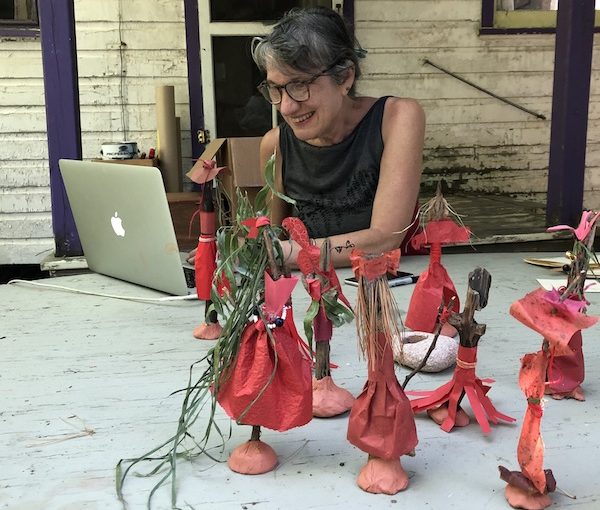
Grounds for Goodness Downtown Eastside: Adventures in Digital Community Art Making, led by Ruth Howard, is part of the Downtown Eastside Heart of the City Festival, which starts Oct. 28. (photo by Adrienne Marcus Raja)
Tikkun olam, the imperative to repair the world in which we live, is a core influence of the project Grounds for Goodness Downtown Eastside: Adventures in Digital Community Art Making. Led by Toronto-based theatre designer and educator Ruth Howard, the residency is part of the Downtown Eastside Heart of the City Festival.
The festival runs Oct. 28 to Nov. 8, and Grounds for Goodness, which “explores why and how people sometimes do good things towards others,” takes place Oct. 30 to Nov. 12. It comprises participant and audience interactive story-sharing, art-making, workshops and an evolving gallery online, as well as Downtown Eastside window displays. The residency is co-produced by Jumblies Theatre and Arts and Vancouver Moving Theatre.
Howard – who has participated in the festival before (jewishindependent.ca/putting-heart-into-city) – is the founder of Jumblies. She said tikkun olam is an underlying motivator in all her work – “and one of this project’s explicit intents is to connect its themes and questions, my Jewish heritage as a second generation Holocaust survivor and my vocation a community-engaged artist.
“Community arts is predicated on the working belief that bringing people together across differences can foster commonality and understanding,” she explained. “And yet, growing up in the 1960s, as the child of a German Jewish refugee (my mother and family escaped to England in 1938) and an experimental psychologist, I was bred on evidence that groups of people tend to do atrocious things towards others, with goodness being individual heroic exceptions. I was told at a young age about [Stanley] Milgram’s electric shock experiments, and understood the link between such cautionary tales and attempts by survivors to explain the Holocaust. My own uncle – Henri Tajfel, both social psychologist and Holocaust survivor – coined the term ‘social identity theory.’
“Therefore, my attention was grabbed a few years ago when I read some books about the saving of Danish and Bulgarian Jewish populations during the Holocaust by citizens of those countries. The Danish story was slightly familiar to me and the Bulgarian one not at all. I have since become quite obsessed by these and other instances (for example, Albania, the Rosenstrasse protests) that run against the grain of my and other people’s common assumptions about human behaviour and ‘nature.’ I felt compelled to tell these stories and learn more about the reasons behind them. I started to investigate the notion of ‘social goodness’ from many angles: history, psychology, anthropology, philosophy, memory, folk tale, legend, theory.”
With the help of independent research and creation grants, Howard “gradually brought the project into the work of Jumblies, inviting and including the responses of diverse community participants and groups. Now, we have a broad and growing repertoire of stories with which to play.
“However,” she stressed, “it’s important to me to uphold the project’s origins in Jewish perspectives and histories, and my own Jewishness: a complicated mix of darkness, hope and urgency to understand how to cultivate grounds for goodness through never forgetting what can happen in its absence.”
The Jumblies team in Toronto includes Howard’s daughter, web designer and choir conductor Shifra Cooper, and composer Martin van de Ven, also a member of the Jewish community.
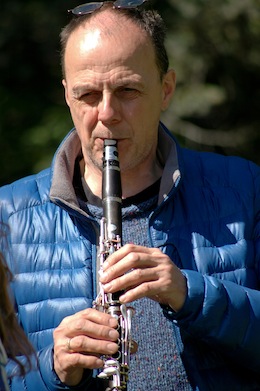
Martin van de Ven (photo from Heart of the City Festival)
In addition to being a composer for film, television, theatre and dance, van de Ven is a music facilitator and educator. He is also a clarinetist and has performed with the Flying Bulgar Klezmer Band, Chutzpah Ensemble, and Beyond the Pale. He has been involved in many Jumblies projects – as musical director, composer and/or performer. “Ruth and I have written several choral works together,” he told the Independent.
“To me, Jumblies is the embodiment of a music and art-making philosophy that believes the arts are there for everyone to create and not just for the well-trained elite,” he said. “Composers such as John Cage and Canada’s R. Murray Schafer talk about this in their writing and both were an early influence on my music education. Jumblies allows me to use my own skills and training to combine the efforts of trained and non-trained performers to create art, and specifically music, that serves the purpose of the moment, whether a stand-alone piece or something that supports a story being told. I think this work is important; it democratizes and decommodifies music-making and breaks down barriers to creation for community members who are otherwise shut out of the creative process. The myth that music-making is the sole purview of the highly skilled, and it is only worthwhile if it is commodified into a product to be consumed, is damaging to the whole idea of ‘homo ludens,’ the idea that a fundamental human attribute is the ability to play, invent and create.”
The community choir that Cooper directs embodies this concept of art being for everyone.
“The Gather Round Singers is an intergenerational community choir, made up of 30-plus mixed-ability, multi-aged singers, from across Toronto and beyond,” she said. “We exist within Jumblies Theatre, and so share their dedication to radical inclusivity and benefit from their experience in creating interdisciplinary work.”
Despite the challenges of COVID-19, the choir has been meeting weekly online since April, said Cooper, “to rehearse and perform new choral works designed or adapted for this new context” – that “[c]horal music is among the more challenging forms to adapt to online gathering, as video calling platforms such as Zoom are designed to reduce vocal overlap, and create latency that makes in-sync singing impossible.”
The Gather Round Singers will perform two new pieces for the opening of the DTES Vancouver residency, said Cooper – “one a world première by Martin van de Ven and one a work-in-progress by Arie Verheul van de Ven, both of which were developed this summer especially to be performed on Zoom. These are both part of Jumblies’ larger Grounds for Goodness project, which continues until a final presentation in June 2021, and will include several other new musical and choral pieces … and other composers (including Andrew Balfour, Christina Volpini and Cheldon Paterson).”
“Grounds for Goodness overall is a multi-year project that includes many partners, places and participants,” explained Howard. “It has been taking place through real-live and virtual activities for almost two years. There have been episodes in Nipissing First Nation (near North Bay, Ont.), Montreal, Brampton, the Ottawa Valley, Algoma Region (northern Ontario), and with various Toronto groups.… We have received funds to tour the project, which have now been adapted to allow for ‘virtual touring.’ The Vancouver iteration is the next big chapter in this project.”
For Grounds for Goodness Downtown Eastside, Martin van de Ven said, “we’ll be premièring a work called ‘Besa.’ ‘Besa’ is an Albanian Islamic concept about hospitality and the need to help and protect guests and those in need within and beyond your community.
“In Albania, during the Second World War (and Italian and then Nazi occupation), this meant that almost all Jewish people living and finding refuge in Albania were sheltered and hidden, and Albania ended up with a larger Jewish population at the end of the war than at the beginning. We created a work based on texts found in writings and interviews with Albanians – from the book Besa: Muslims who Saved Jews During WW II by Norman H. Gershman.
“The COVID-19 restrictions prevented us from developing this piece as we normally would,” he continued, “and so I composed a work that could be performed and rehearsed with everyone being online. It involved researching the technology, experimenting with Zoom meetings and audio programs, as well as writing music that allowed for enough flexibility to deal with internet latency. For our Vancouver residency, we will be presenting this work and sharing our experience of creating an artwork to be performed online with members of the Vancouver art community.”
Those Vancouver artists include Savannah Walling, Olivia C. Davies, Beverly Dobrinsky, Khari Wendell McClelland, Renae Morriseau and Rianne Svelnis, as well as 10 DTES-involved participants.
* * *
Van de Ven started music lessons when he was 6 years old – on recorder. “In elementary school,” he said, “my friends and I decided we wanted to form a circus. As the only one in the group with musical training, I was charged with writing the theme for the circus band. I dutifully started writing down half notes and quarter notes on paper and tried to play them on the recorder. The method worked fine but I soon realized I would need some additional training if I wanted it to sound good.
“I ended up with a musical education partially shaped by my father’s interest and taste for very modern classical and jazz music and eventually formal training at university,” he said. “In my late teens, I realized that my interest in science and engineering paled compared to the excitement I felt for a live performance, whether as an audience member or as a performer.”
In university, in addition to his formal training, van de Ven was involved in various jazz programs and, eventually, studied and performed in free improv ensembles. He also did a short stint in Europe, studying early computer music in electronic sound synthesis.
“Klezmer music has a history deeply rooted in East European and Middle Eastern music traditions. As a clarinetist,” he said, “it provided for me a wonderful vehicle to not only deeply emerge myself into a culture other than my own but also perform a lead role playing in a band.”
Shifra Cooper (photo by Liam Coo)
For her part, Cooper has loved choral singing her whole life. “And I bring this love to my own work,” she said, “while having always believed that bringing together community arts and choral singing requires a flexibility and a softening of our understanding of the boundaries of what ‘choral music’ can be – this is something that I have always been creatively driven by. In these times, I’m learning a lot more about how far this can go.
“Sometimes, turning things on their head can be revealing of new approaches, considerations or perspectives,” she said. “For example, one young woman who has sung with the choir for many years, said to me the other day: ‘In rehearsal, I always sit in the back row, so I only see the backs of people’s heads. I like on Zoom that I can see the faces of everyone I’m singing and performing with.’ Another choir member told me that she feels more confident and motivated to practise when she has her microphone off and is alone in her room following along – this confidence comes through strikingly in the recordings she shared with me for one of our digital projects. In these ways, sometimes, working online has revealed the limitations of our previously established norms for singing in-person. I think often now about how, whenever we can safely be back together, we might incorporate these learnings.
“Which is not to gloss over any of the challenges of meeting online,” stressed Cooper. “I think I can speak for at least the majority of the choir when I say we all immensely miss singing together – in sync, in harmony, in rhythm. And a digital space, even though full of many possibilities, is also full of boundaries and obstacles to folks joining in, especially those experiencing more precarious housing or financial insecurity. Our team worked closely all summer with members of the choir community to bridge this gap, purchasing and delivering internet-enabled devices to choir members and providing remote and in-person (socially distanced) trainings and trouble-shooting.” They did so with funding from several sources, notably the Toronto Foundation.
“Another part of my work has often included event management and digital design and, in the new reality of virtual art-making, these two often come together in interesting ways,” Cooper added. “I’m delighted to be designing a new interactive website for Grounds for Goodness at the DTES Heart of the City Festival, that will act as an online evolving gallery, showcasing new work created through the community workshops and acting as the container and guide for the culminating virtual event.”
The theme for this year’s Downtown Eastside Heart of the City Festival is “This Gives Us Strength.” One of the more than 50 events that will take place over the festival’s 12 days is Spotlight on the East End on Oct. 30, 8:30 p.m. Curated by artist-in-residence Khari Wendell McClelland, the online presentation will feature “the compelling creativity and strength of Vancouver’s Downtown Eastside-involved artists and residents who illuminate the vitality, relevance and resilience of our neighbourhood and its rich traditions, cultural roots and music.” Among those artists is klezmer-punk accordionist Geoff Berner, with whom JI readers will be familiar.
JI: You released Welcome to the Grand Hotel Cosmopolis late last year (jewishindependent.ca/honestly-jewish-and-radical) and you also had a new musical, then COVID hit. What have you been doing creatively over this time?
GB: I just finished working on a lovely project for KlezKanada with the great theatre artist Jenny Romaine and a lot of other talented folks. It’s called Vu Bistu Geven? (Where Have You Been?) and it’s about figuring out the history of the land that KlezKanada takes place on. It was commissioned for their 25th anniversary. It felt particularly right to work with Trina Stacey, a Kanien’kéha singer, researcher and teacher. We talked a lot during the making of the piece about the value of recovering our ancestors’ languages, in order to find a way to think outside of capitalism and colonialism.
JI: You were scheduled to perform an outdoors concert in Roberts Creek Sept. 11. Did that happen? In what ways does an in-person audience affect your performance?
GB: Yep, that concert went off nicely. Everyone was outdoors and properly distanced. The folks in Roberts Creek are lovely. I’ve played only two other shows like that since the pandemic, one at a park in Vancouver, for Alan Zisman, and another in Chilliwack at the Tractor Grease. It sure was nice to play live again. It’s been a bit of a strain these past months, not being able to do the thing I’ve devoted my life to doing. I miss that magic human connection that only live music can do.
JI: What inspires you to participate in events like the DTES Heart of the City Festival?
GB: What inspires me is the honour to be invited. I’ve tried to be a friend to folks in the DTES, opposing displacement by City Hall-backed developers, fighting to stop the war on drugs, fighting against legislated poverty, and other stuff. It means a lot that I’m allowed to be part of things.
JI: Chelm is a recurring theme/subject in your work. If you had to offer “advice from Chelm” for people coping right now, what might that be?
GB: Advice from Chelm? Well, Chelm was the “Village of Fools” of Jewish legend, but in fact it was a real place, where the people had to struggle to survive. They weren’t fools at all, just ordinary people trying to live. Several fine Yiddish poets came from Chelm. So the advice from Chelm is, the real fools are people who look down on communities of other human beings.
JI: You helped start the BC Ecosocialist Party. Any opinions on the election you’d like to share?
GB: I have real hopes for the BC Ecosocialists. B.C. voters need to at least have the choice to be able to vote for people who will actually stand up against LNG, Site C, legislated poverty, colonialism and the war on drugs.
* * *
Heart of the City runs Oct. 28 to Nov. 8. For tickets and information, visit heartofthecityfestival.com.
Risa Levine, chair of Jewish Federation of Greater Vancouver’s Community Recovery Task Force. (photo from Jewish Federation)
The Jewish community and its agencies have been dramatically affected by the COVID pandemic and its economic implications. But not a single agency has folded – and not a single employee has lost their job – in part because of the coordinated efforts of the Jewish Federation of Greater Vancouver.
That is the assessment of Risa Levine, who is chairing Federation’s Community Recovery Task Force. Levine, a retired justice who served on the Supreme Court of British Columbia and the B.C. Court of Appeal, was chosen to lead the major initiative, which will address the impacts of the pandemic on community agencies and help guide a possible rethinking of how programs and services might be delivered more efficiently or effectively in future.
The resilience of Jewish agencies stands in stark contrast to a much bleaker climate for nonprofit agencies in the general community. Among the many individuals and agencies the task force has heard from is Alison Brewin, executive director of Vantage Point, a resource agency for nonprofits in the province. “Alison told us that they expect about 25% of the nonprofits in British Columbia not to make it, to shut down,” said Levine. “Some already have and they expect that many of them won’t continue to operate.”
One of the things that Federation did almost immediately at the beginning of the emergency was intervene with a disbursement of emergency funds – $505,000, plus additional tranches released by individuals and families through their respective funds at the community foundation. In addition to this season’s annual campaign, canvassers are asking donors, if they are able, to make an additional contribution to the COVID emergency fund.
Levine was asked by Alex Cristall, chair of the board of the Jewish Federation of Greater Vancouver, to head the task force.
“I was on the allocations committee for Federation for 10 years, so that’s really directly related to what I’m doing now,” she said. “I had time and I think it’s crucial work to be done for our community, so I was honoured to be asked.”
Other task force members are Andrew Altow, Jill Diamond, Michelle Gerber, Hodie Kahn, Candace Kwinter, Shawn Lewis, David Porte, Justin L. Segal and Isaac Thau.
As well as confronting immediate needs of agencies, the task force presents an opportunity to consider the future more comprehensively, said Levine.
“The task force is taking a longer-term, holistic, strategic approach to look at how the community might look or how we think it should look coming out of this,” she said. The team is uniquely qualified to confront the challenges because of the diverse identities and experiences of the people on the task force, she said.
Task force members, collaborating with staff members Marcie Flom, executive director of the Jewish Community Foundation of Greater Vancouver, and Shelley Rivkin, Federation’s vice-president, planning, allocations and community affairs, are reaching out to all community partner agencies.
The crucial initial step is to determine how each agency has been impacted by COVID, what their immediate needs are, and what their requirements are likely to be for them to survive and continue their work.
“It’s just amazing and very impressive how resilient and responsive the agencies have been,” Levine said. “They are affected in different ways, depending on what their function is in the community and what they are doing.”
Jewish Family Services is on the very frontline, she said, addressing food security and housing for the most vulnerable in the community. They have expanded beyond their food bank to provision of meals, and providing delivery, which they did not do before.
“They are providing financial support for people, mental health support and so on,” said Levine. “Their client load has doubled, at least, since March and they’ve had to add to their staff and they are all working remotely. It’s been huge. And they’ve been amazing in terms of what they have been able to do.”
Synagogues have also stepped up in preparing and delivering meals to congregants, especially seniors and others who are particularly vulnerable and lack mobility because of transportation challenges and the reduced accessibility to routine services, she said.
She cited the Jewish Community Centre of Greater Vancouver’s nearly instant transition to online delivery of services. Smaller agencies, however, face greater challenges because they may not have the hardware, software and institutional capacity to make that kind of technological shift. Helping those agencies adapt to the technological and parallel needs was one of the priorities addressed at the outset, Levine said.
As the emergency campaign unfolds, the task force will continue assessing the situation.
“Ultimately,” said Levine, “the task force will be making recommendations for distribution of those monies, the Community Recovery Fund, and that will be based on the information we are gathering now about what the needs are and our assessment of how those funds can be strategically distributed to meet the needs of the community as they have changed and evolved through this crisis.”
In an historic victory, Annamie Paul was elected leader of the Green party of Canada Saturday, becoming the first Black person and the first Jewish woman to lead a federal political party. How historic this news is will depend on her impact on Canadian politics, beginning with her showing in a by-election in the riding of Toronto Centre at the end of this month.
Paul will also be challenged by some in her party who have taken exception not only to her moderate, conciliatory positions toward the Israeli-Palestinian issue but to her Jewishness itself. During the campaign, she was bombarded with antisemitic trolling, some from within her party, some from outside agitators. She overcame her nearest opponent, Dimitri Lascaris, on the eighth round of voting. Lascaris, one of Canada’s most vocal anti-Israel activists, was endorsed by a range of anti-Zionist figures, including Pink Floyd co-founder Roger Waters.
Lascaris has been a lightning rod in the party and the country for anti-Israel activists. When confronted during the campaign about the overt presence of antisemitic comments, ideas and harassment directed at Paul, Lascaris redirected, saying that antisemitism exists mostly on the right of the political spectrum.
Bigotry of every form must be acknowledged and condemned regardless of where it emerges. Pretending it does not exist and accusing one’s opponents of it while ignoring its presence in one’s own movement is a deeply unprogressive approach. Paul – as well as the Jewish community and all Canadians who seek justice and equality – must be vigilant and vocal as bigots react to the increased visibility of a Black Jewish woman leader.
The Green party has a history of problematic approaches to the Middle East, including a 2016 vote to endorse the BDS movement, later rescinded after then-leader Elizabeth May threatened to quit. That incident underscored the limited power of the leader’s role in the Green party. As Paul told the Independent in a recent interview (jewishindependent.ca/paul-hopes-to-make-history), she will not have the power, as leader, to make or alter party policy. May’s gambit – threatening to quit unless a position was reversed – is a rare tool in the kit.
Paul’s varied career has included roles as a director for a conflict prevention nongovernmental organization in Brussels, as an advisor at the International Criminal Court in The Hague and as a political officer in Canada’s mission to the European Union. She was co-founder and co-director of an innovation hub for international NGOs addressing global challenges and has worked with other NGOs, such as the Climate Infrastructure Partnership and Higher Education Alliance for Refugees. She was born in Toronto to a family that immigrated from the Caribbean and she converted to Judaism under a Hillel rabbi while studying at Princeton University.
In her interview with the Independent, Paul said she admires Canada’s politics of compromise, but that the climate crisis is an exceptional event that requires single-minded determination to address.
In her victory address Saturday, to a small group observing social distancing, she suggested the voting public is ready for politicians who look and think differently.
While British Columbians are focused on provincial politics with the Oct. 24 election – and the world awaits the outcome of perhaps the most consequential U.S. election in our lifetimes on Nov. 3 – we will keep an eye on the Oct. 26 Toronto Centre by-election to see the next step in the trajectory of this new leader on the federal scene.
My household is facing a lot of upheaval. The 100-year-old house next door was recently demolished, as the new owners wanted to live in an “old house neighbourhood” but in a new house. Their choice has been hard for us. It doesn’t preserve history and it’s not environmentally sustainable. The demolition and excavation are loud, and the shaking and vibrating has damaged our house and the neighbours’ homes, too. It’s a hard situation and we’ve got nowhere else to go, especially during a pandemic.
Years ago, when our twins were toddlers, we built a sturdy wooden fence around our front yard, to match the taller fence in the backyard. This fence has been a blessing. It’s kept kids and dogs safe, not to mention balls, badminton shuttlecocks, and more. Anything that strayed over the fence in any way – like, say, squash and cucumber vines – were completely trashed during this construction, which left a bare, muddy cavern on the other side. It’s been unsettling.
This physical boundary reminds me of other ones with which we’re all reckoning. As the pandemic continues, mask wearing and physically distancing from others has to be absolutely ingrained in us. Yet, articles online mention parents who hate having to enforce mask wearing with their kids, or how friends must make difficult decisions about whether to hang out with others who won’t wear masks. Our public health officials warn against mask shaming but these boundaries, these masks, are part of what keeps us safer.
This goes further, when considering how people manage remote school, work and public interactions where, frankly, all the rules have changed. Every family home, workplace and even transportation has changed. We set up boundaries – we build both physical and imaginary fences, through Plexiglass partitions and dots on the ground, to keep ourselves safe.
As Jews, none of this should be new to us, because the rabbis loved a good boundary! Whether it’s deciding what can or can’t be done on Shabbat, or how to manage keeping kosher, there are rules everywhere in Torah and rabbinic teachings. The rules, however, aren’t always clear or easy to follow. It requires both study and thought to decide what will work – and it isn’t always obvious how a Jewish person should interpret those rules or what’s important to follow.
Lately, I’ve been reading about how an eruv can work, because I’m studying Daf Yomi (a page of Talmud a day) and have been working through tractate Eruvin. What’s an eruv? Well, a simple definition (straight from the internet) is: “An urban area enclosed by a wire boundary which symbolically extends the private domain of Jewish households into public areas, permitting activities within it that are normally forbidden in public on the Sabbath.”
If you’ve wondered why it’s OK, in some traditional Jewish neighbourhoods, for people to push strollers or carry food over to a friend’s house on Shabbat, well, it’s because they’ve created this special ritual space. This creates a single “private space” that connects a whole community of homes. The eruv is so important in some places that it causes housing prices to go up within its borders.
Many times, I’ve heard complaints from people about how “there are too many rules” in some context or other. Whether it’s “fences cut up the landscape in our neighbourhood,” “Why can’t we eat in this room in the community centre?” or, from parents, “It’s so hard to make kids wear masks or stick to this rigid schedule.” However, for many, creating routine, structure and boundaries, physical or psychological, helps us in so many ways.
The example of the Shabbat and festival eruv is a way to see rules in a positive light. If the “rules” state that we cannot do something in the public sphere on Shabbat, look at how we can get around this by using an eruv, the rabbis say – we create a huge private “home” out of all of our homes. What a rich way to build community, belonging and togetherness!
Even if we’re not Shabbat observant or using an eruv, this is a reminder of why fences and boundaries can be used for good. Without our sturdy wooden fence, I suspect our kids and dog might fall into the enormous excavation hole and construction site next door. Without those masks or social distancing rules, we’d have to stay home completely during the pandemic.
It takes all of us to make boundaries work effectively. As Robert Frost writes in “Mending Walls,” there is a lot of resistance to walls. From hunters to animals to elves – “Something there is that doesn’t love a wall.”
However, Frost’s neighbour reminds us, “Good fences make good neighbours.” A boundary can keep us inside a rich and loving community. It can also keep us physically safe from harm or psychologically safe, by creating structure and limits to our days.
For now, we all need to embrace these boundaries. We must use these fences and walls to bolster us onwards, as we shelter through the winter and pandemic, even beyond the temporary walls of Sukkot.
Joanne Seiff has written regularly for CBC Manitoba and various Jewish publications. She is the author of three books, including From the Outside In: Jewish Post Columns 2015-2016, a collection of essays available for digital download or as a paperback from Amazon. Check her out on Instagram @yrnspinner or at joanneseiff.blogspot.com.