Skip to content
  • Home
  • Subscribe / donate
  • Events calendar
  • News
    • Local
    • National
    • Israel
    • World
    • עניין בחדשות
      A roundup of news in Canada and further afield, in Hebrew.
  • Opinion
    • From the JI
    • Op-Ed
  • Arts & Culture
    • Performing Arts
    • Music
    • Books
    • Visual Arts
    • TV & Film
  • Life
    • Celebrating the Holidays
    • Travel
    • The Daily Snooze
      Cartoons by Jacob Samuel
    • Mystery Photo
      Help the JI and JMABC fill in the gaps in our archives.
  • Community Links
    • Organizations, Etc.
    • Other News Sources & Blogs
    • Business Directory
  • FAQ
  • JI Chai Celebration
  • JI@88! video

Recent Posts

  • Sharing her testimony
  • Fall fight takes leap forward
  • The balancing of rights
  • Multiple Tony n’ Tina roles
  • Stories of trauma, resilience
  • Celebrate our culture
  • A responsibility to help
  • What wellness means at JCC
  • Together in mourning
  • Downhill after Trump?
  • Birth control even easier now
  • Eco-Sisters mentorship
  • Unexpected discoveries
  • Study’s results hopeful
  • Bad behaviour affects us all
  • Thankful for the police
  • UBC needs a wake-up call
  • Recalling a shining star
  • Sleep well …
  • BGU fosters startup culture
  • Photography and glass
  • Is it the end of an era?
  • Taking life a step at a time
  • Nakba exhibit biased
  • Film festival starts next week
  • Musical with heart and soul
  • Rabbi marks 13 years
  • Keeper of VTT’s history
  • Gala fêtes Infeld’s 20th
  • Building JWest together
  • Challah Mom comes to Vancouver
  • What to do about media bias
  • Education offers hope
  • Remembrance – a moral act
  • What makes us human
  • המלחמות של נתניהו וטראמפ

Archives

Follow @JewishIndie
image - The CJN - Visit Us Banner - 300x600 - 101625

Category: Visual Arts

Campbell’s art at Zack

Campbell’s art at Zack

Artist Olga Campbell and her grandson Arlo, for whom Campbell wrote her memoir, Dear Arlo: Letters to My Grandson. (photo from Olga Campbell)

Recently, Olga Campbell published her third book, a memoir, Dear Arlo: Letters to My Grandson. Campbell’s new solo show with the same name opened at the Zack Gallery on Jan. 9. It features a selection of paintings and sculptures from the book, as well as a short film.

“The film starts the exhibition,” Campbell told the Independent. “It contains my photographs of Vancouver and its people. It is called Everybody Has a Story. The show and the book portray one of those stories – my story. But millions of other people have their stories, too, and, in the film, in my photos, I tried to tell some of those stories.”

Campbell said, “The book and the show are my answers to the questions my grandson asks. He is interested in our family’s past. We are very close, he and I. We just went to Nepal together. I thought I would write this book for him, as my legacy.”

The book does not concentrate exclusively on pain and tragedy, on the deaths of her family members in the Holocaust. It also celebrates the power of art and writing as a transformational and healing tool. Besides letters to her grandson, the book includes Campbell’s poetry and art, essays written by the artist, and her family’s traditional recipes. (See jewishindependent.ca/a-multidimensional-memoir.)

The Zack Gallery show is a subset of the book, a selection of paintings and sculptures the memoir highlights. The paintings are mostly collages based on the artist’s photographs. Each photo is Photoshopped into infinity, so none of the faces in the paintings have any resemblance to their origins. Campbell likes to experiment with images, looking at them from different perspectives, applying different approaches. Like her inner child who never grew up, she plays with them, making up different stories for different levels of perception. 

One of the paintings, “Corridor of Memories,” has a couple of faces looking at the viewer with thoughtful, slightly anxious expressions. Behind those faces, a long corridor stretches into an unknown distance. The memories that come from that distance seem diverse and unsettling, a mix of positive and negative, but different for everyone.

image - “Corridor of Memories” by Olga Campbell
“Corridor of Memories” by Olga Campbell. (photo by Olga Livshin)

“There is bad there but there is also some good stuff there,” she said. “I played with the faces in that painting. I thought it would be interesting to make them three-dimensional. That’s how I came up with the sculptures in the show. They are the result of the images unfolding from 2D to 3D.”  

Another painting that underwent a similar metamorphosis is “Shall We Dance? – self meeting Self.” Campbell explained: “I took this image from the confines of a frame and brought it to life by making it three-dimensional. The title, ‘self meeting Self,’ refers to the small self, the individual, the ego, meeting the Universal Self, and the ensuing dance of Self-discovery, joy and wonder of life.”

The 3D dancers – a thickened silhouette of the flat painted image beside it – rotate. They are accompanied by the song “Shall We Dance,” played by a tiny music box, when someone winds it up.   

image - “The Sky is Falling” by Olga Campbell
“The Sky is Falling” by Olga Campbell. (photo by Olga Livshin)

Sometimes Campbell’s reconstruction of images results not in an additional dimension but in a deepening complexity of the original idea. In “The Sky is Falling,” she took a person’s outline from the painting beside it and embellished it with everything that she felt was relevant to our hectic lives. Unlike most of the other paintings in the gallery, there is no face in this one. The grey danger hangs over all of us, regardless of our facial features or skin colour.       

“There are lots of similarities in our world today and the one that preceded WWII,” said Campbell. “That’s why I put a crow in that painting. A crow is a traditional symbol of death, but also of transformation, of change and the future.”

Like the book it is based on, the show is not linear. It reflects the artist’s response to various events in her life, both happy and sad, from her coming of age, to the current war in Ukraine. Both the memoir and the show emphasize Campbell’s personal journey through the beauty and the trauma of life, so inextricably entangled together. 

At the gallery on Jan. 23, 7 p.m., Campbell will discuss her book and her art in an event co-presented by the Zack Gallery and the JCC Jewish Book Festival. Campbell’s exhibit will be on display until Jan. 27. To learn more, check out the artist’s website, olgacampbell.com. 

Olga Livshin is a Vancouver freelance writer. She can be reached at [email protected].

Format ImagePosted on January 17, 2025January 14, 2025Author Olga LivshinCategories Visual ArtsTags art, collage, Dear Arlo, JCC Jewish Book Festival, memoir, Olga Campbell, painting, Zack Gallery

A summer camp moment

image - cartoon featuring summer campers lining up at the camp clinic, by Beverley Kort

Posted on January 17, 2025January 15, 2025Author Beverley KortCategories Visual ArtsTags health care, Jewish summer camp, youth
Eastside artists open studios

Eastside artists open studios

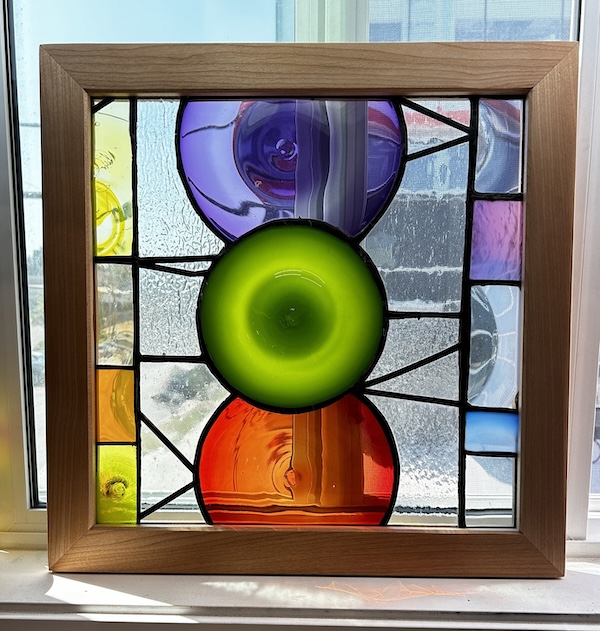
A stained-glass panel in a wood frame by Hope Forstenzer. (photo by Hope Forstenzer)

More than 500 artists are opening their studios, galleries or workshops to the public Nov. 14-17 for the 28th annual Eastside Culture Crawl Visual Arts, Design & Craft Festival. Among the artists are many Jewish community members, including Suzy Birstein, Olga Campbell, Ana Clara Feldman, Hope Forstenzer, penny eisenberg, Lori Goldberg, Lynna Goldhar Smith, Ideet Sharon, Stacy Lederman, Shevy Levy, Lauren Morris and Esther Rausenberg. 

“The Culture Crawl offers a unique opportunity to connect with our communities, to support artists in their livelihoods, and to come away inspired and reinvigorated by the countless ways in which artists explore and share their creativity with the world,” said Rausenberg, who is also the artistic and executive director of the Eastside Arts Society, which puts on the event.

Birstein, who creates and showcases her work from her 1000 Parker Street studio, is a figurative artist whose ceramic sculptures and paintings are self-portraits connecting her to women of history and mythology. 

“I am merging my own personal narratives with the narratives of inspiring women artists whose lives and art ‘embrace enchanting intrigues’ to transcend life’s challenges,” she explained. “This includes Frida Kahlo, Leonora Carrington, Leonor Fini, Vali Myers, Artemesia Gentileschi and Niki de Saint Phalle,” as well as figures like Athena and Alice in Wonderland.

photo - “I’m Going With Myself” by Suzy Birstein
“I’m Going With Myself” by Suzy Birstein. (photo by Byron Dauncey)

Her upcoming solo retrospective, curated by Dr. Angela Clarke at Il Museo, is now scheduled for 2026, rather than next year, which is what was originally planned. The retrospective will combine her Tsipora and Ladies-Not-Waiting series.

“This past year has brought me two profound highlights that resonate deeply in my artwork,” said Birstein. “First, I’ve embraced the idea that the Tsiporas – my Hebrew name, meaning ‘Bird’ – have always been part of the Ladies-Not-Waiting.

“On the personal side, my husband courageously and successfully underwent two major surgeries in 2024, which deepened my appreciation for life and the importance of love and compassion. Additionally, our daughter-in-law became a permanent resident of Canada, allowing our family to thrive together.

“These experiences have infused my art with newfound freedom, imagination, and a willingness to experiment with construction, colour and concept. Each piece I create reflects this journey and the richness of these connections, as with my Ladies-Not-Waiting.”

Birstein and fellow Crawl artist Lori Goldberg spent October in Italy on a self-directed residency, which comprised four segments, each with its own and overlapping purposes, said Birstein.

They explored art at Venice Biennale and other exhibits in Venice. They went to Amalfi, where, Birstein said, “I created a most special and memorable experience – to visit Gianni Menichetti, who was the partner of Vali Myers (one of my artists). In a valley above Positano, Gianni lives off the grid with his family of animals – 10 dogs, ancient doves, chickens, fish, a rooster and others. Gianni himself is a well-known poet, artist, writer, as well as protector and preserver of the land and its natural inhabitants. He’s a most unique human being. Although we were only together for 24 hours, it is as though we have always known each other and always will.”

In Napoli, said Birstein, “within the ancient graffiti-covered walls of this chaotic, lively city, we [were] exploring, experimenting and expressing evolving directions for our art practice.”

Lastly, they went to the island of Ischia for a family celebration, visiting thermal springs, gardens and the sea.

photo - "You sing my songs" by Suzy Birstein
“You sing my songs” by Suzy Birstein. (photo by Alan @ Fidelis Art Prints)

“There are moments in my life when personal and global experiences intertwine – what I like to call destiny with focus,” said Birstein. “My Italian adventure, from connecting with Gianni in Positano, family in Ischia and gallerists in Naples, to engaging with art at the Venice Biennale, inspires every aspect of my life. I sense that I’m in the midst of crafting my next ‘big story,’ which will undoubtedly reflect in my evolving art practice. These experiences shape not just who I am, but also how I create.”

Ceramics and glass artist Hope Forstenzer is also expanding the way she creates. 

“I got a grant to learn woodworking throughout 2024, and that’s been a big highlight,” she told the Independent. “I’ve been working to make pieces that use both glass and wood, and it’s been exciting and challenging to learn a whole new medium. My progress has been slow and steady, and some of the work I made will be in the Crawl this year.”

This is Forstenzer’s third year of making clocks for the Crawl, and she said she’s really been enjoying the process. 

“This year, I’m experimenting with different colours and patterns, and I’ve also got one that’s in a stained-glass panel in a wood frame I made. I’ve spent more time with clockworks and hand design, as well, and am experimenting with different materials for those aspects of the clocks.”

photo - A seder plate by Hope Forstenzer
A seder plate by Hope Forstenzer. (photo by Hope Forstenzer)

In addition to the clocks, visitors to Forstenzer’s studio in the Mergatroid Building, 975 Vernon Dr., will see her stained-glass panels in wood frames, blown seder plates, dreidel blown ornaments, small blown lamps with battery-powered LEDs inside, and some vessels and bowls.

“One of my roles at Terminal City Glass Co-op is the coordinator of the Learning Fire Program, and I’ll be doing a glassblowing demonstration with some of our students on Saturday the 16th from 1:15-3:15,” said Forstenzer.

For more about Learning Fire, visit terminalcityglass.com/pages/learning-fire.

Both Birstein and Forstenzer have works in the Culture Crawl’s preview exhibition, which runs to Nov. 29 at Pendulum Gallery, Alternative Creations Gallery, the Cultch and Charles Clark Gallery, with display dates depending on the venue.

For the full list of events and participating artists, go to culturecrawl.ca. 

Format ImagePosted on November 8, 2024November 7, 2024Author Cynthia RamsayCategories Visual ArtsTags 1000 Parker Street, art, Eastside Culture Crawl, glass, glass-blowing, Hope Forstenzer, Mergatroid Building, painting, sculpture, Suzy Birstein, Terminal City Glass Co-op
Paintings inspired by women

Paintings inspired by women

Therese Joseph’s solo show at the Zack Gallery opened Oct. 12, but the official opening reception, which she will attend, takes place Oct. 30. (photo from Therese Joseph)

The new solo show at the Zack Gallery – Women, Words and Wisdom: Therese Joseph – celebrates the power of women in our lives.

Artist Therese Joseph’s mixed media paintings combine imagery and words in her depictions of women she admires. Not any specific woman, but all of them, a symbolic woman, and what she means to the artist. On the walls of the gallery, Joseph’s women are sad or sleeping, doubting or searching, traveling or dancing, but they all represent the artist’s interpretation of “woman,” in all her multifaceted complexity. 

Joseph grew up in Switzerland, and her road to Vancouver and an artistic career was a round-about one. When she was in her early 20s, she traveled to England to study English. There, she met a young engineer from Borneo. They fell in love and stayed in touch. A few years later, after he found work in Vancouver, he invited Joseph to join him. She had never been to Canada before.

“At first, I came for three months,” Joseph told the Independent. “I loved it here. Everyone was so open and friendly. I felt free here, felt that I could do anything I wanted. Life here was much less structured, not as many rules as back home in Switzerland. It felt like there could be more than one way to do stuff, and that freedom attracted me.”

Like many others, she was captivated by the nature of British Columbia.

“The mountains, the sea, the forest. It was like Switzerland, but more – more open, more generous,” she said.

Of course, it took time for every document to be signed and she could finally settle into her married life in Canada. 

“Home in Switzerland, I had an education as a kindergarten teacher, but my diploma wasn’t accepted here in Canada,” Joseph said. So, she opened an after-school art club for local children.

photo - “Wear Your Words” by Therese Joseph
“Wear Your Words” by Therese Joseph. (photo from Therese Joseph)

“I’ve always loved doing art, loved being creative,” she said. “I was involved in several community art projects with my young students in North Vancouver. We painted balconies, murals, created some street banners.”

But, eventually, she wanted to dedicate herself to art full-time, and she felt she needed more education in this regard. 

“At about the same time – year 2000 – a couple of my family members in Switzerland died, and it was hard for me. I couldn’t be there with my family as much as I wanted,” she shared.

Creating art felt like a necessity for her then, a balm to her grieving heart. She sold her art studio business and enrolled in art-related continuing education classes at Emily Carr University of Art + Design and Langara College.

“I took many classes and workshops in the next few years,” said Joseph. “Whenever I liked an artist, I found a way to learn from them. Among my mentors were Jeanne Krabbendam, Don Farrell, Lori Goldberg, Nurieh Mozaffari, Steven Aimone and more. I’d call it a self-directed art education.” 

She emerged from that time an accomplished artist and art teacher. She exhibited widely in Canada and abroad. She taught both children and adults.

“I love teaching art,” she said. “At first, I preferred teaching children, but, as my own children grew older, I gravitated towards teaching adults and seniors. Everything has its time.” 

Through all the changes in her life, Joseph kept making art. She paints figures and faces, flowers and feathers in her Dandelion Art Studio in North Vancouver.

“Women are my predominant subject,” she said. “They inspire me. They embody how strength and resilience can coexist with vulnerability, and how setbacks are merely steppingstones on the path to achieving one’s goals.”

Her technique is often mixed media. “I collect old magazines, newspapers, cards. People bring them to me, too. I rip them to pieces – never cut with scissors – and glue those text fragments to my canvases to see what could emerge. I love the process of creation, love the empty canvas that becomes an image with a meaning and a message. I never know what the current painting is about until it is done. The painting itself guides me.” 

At the beginning of this year, Joseph learned about the Zack Gallery’s call for artists and submitted her proposal for a solo show.

“I had enough paintings with text and letters to fill a gallery,” she said. “I wanted to emphasize the texts, so I started searching for quotes from famous women to attach to each painting. I read thousands of quotes on the internet before I made my selection for each painting. It was very interesting and amusing.” 

Her palette is colourful and her compositions sophisticated.

“None of them depict a specific woman,” she said. “They all come from my imagination. I wanted to paint something about perfume, and my painting ‘Fragrant Rain’ was the result.” The woman in the painting saunters under her umbrella, while the rain hides the details, though one can make out a perfume bottle in her bag. Coco Chanel’s tongue-in-cheek quote accentuates the painting.

“Wear Your Words” boasts three female figures, in red, pink and orange, their clothing decorated with disjointed texts. We don’t know what the women are doing. Are they dancing? Are they passing each other on the street? The letters filling their clothing jump at the viewers. “Words are the clothes your thoughts wear,” says the quote by Amanda Patterson that accompanies this painting.

photo - “Shadows in Motion” by Therese Joseph, whose exhibit Women, Words and Wisdom is at the Zack Gallery until Nov. 18
“Shadows in Motion” by Therese Joseph, whose exhibit Women, Words and Wisdom is at the Zack Gallery until Nov. 18. (photo from Therese Joseph)

Most of the works on display are full of colour, so the one in black and white draws the eye. “Shadows in Motion” is actually a diptych. Joseph explained its roots.

“I’ve always loved traveling, and we traveled a lot. When, after 37 years of happy marriage, my husband passed away, I wanted to prove to myself that I could travel alone, too. I went to Mexico. I walked on the beach and watched my shadow. After awhile, I started posing, jumping and photographing my shadow in every awkward position. My hands were here and there, up and to the sides. I bent. I stretched. The sun was strong and my shadow seemed to dance. I wanted to capture every nuance. The painting was born out of those photos.”  

Another travel destination – Amsterdam – inspired a couple of paintings. “Strength Becomes Her” and “Moving On” both have the word “BISON” in them.

“I was in Amsterdam and visited an art show about bison,” Joseph explained. “It was in a warehouse – a huge building with many different artists. They had a catalogue as large as a newspaper, and I asked for two catalogues. When I came home, I tore those catalogues into shreds and used the ripped words in the paintings.”

Both paintings employ bold, punchy colours. Both are rather large.

“The bison is huge and powerful, and I wanted my paintings to reflect that,” said Joseph.

Women, Words and Wisdom opened Oct. 12 and will run until Nov. 18. The official opening reception, with the artist in attendance, will be held on Oct. 30, at 6 p.m. To learn more about the artist, visit thereseljoseph.com. 

Olga Livshin is a Vancouver freelance writer. She can be reached at [email protected].

Format ImagePosted on October 25, 2024October 24, 2024Author Olga LivshinCategories Visual ArtsTags art, collage, mixed media, painting, philosophy, Therese Joseph, wisdom, women, Zack Gallery
Artist reflects on career

Artist reflects on career

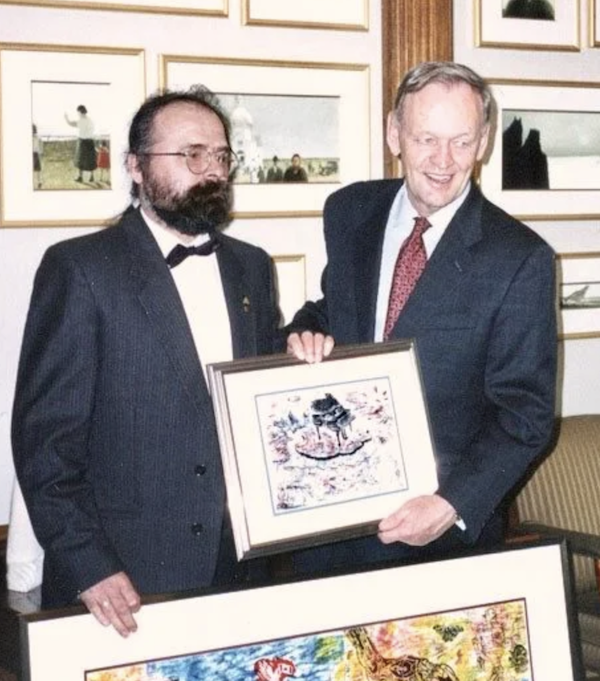
Imre Székely, left, gives his artwork to then-prime minister Jean Chrétien. (photo from szekelygallery.com)

From his hometown of Győr, Hungary, a city halfway between Vienna and Budapest along the Danube River, to his studio in Victoria’s Chinatown, Jewish community member Imre Székely has been creating art for more than five decades, primarily in the linocut/monotype style of printmaking.

Linocut, also known as lino print, is a design carved in relief in linoleum. The art form was popularized in the early part of the 20th century. In monotype, an artist presses ink directly onto a plate. The plate is then pressed against paper to transfer the ink.

photo - As Imre Székely’s approaches 70 years old, he looks back at his career
As Imre Székely’s approaches 70 years old, he looks back at his career. (photo by Kor Gable)

Székely discovered his calling early in life, under the tutelage of Imre Krausz and István Tóvári-Tóth, both distinguished artists in Hungary. However, Hungary in the 1970s and 1980s was no place for anyone whose views differed from those of the regime. 

“The communist regime at the time did not have a role for a forward-thinking, modern artist. There wasn’t much chance of self-actualization,” Székely told the Independent.

Thus, in 1987, he said goodbye to his family and jumped on a westward-bound bus. His first stop was a refugee camp in Austria, then on to France, the Netherlands and, finally, Canada, in 1988. After stops in Winnipeg and Toronto, he set off west where, in 1991, he settled in Victoria, finding the provincial capital to be an ideal spot for his professional and private life. His wife and children joined him shortly after he arrived in British Columbia.

Székely describes himself as a hyper-surrealist artist, who blends “a variety of colours, patterns and shapes that are the spices of life.”

Throughout his career, he has donated his works and given them to people who couldn’t otherwise afford a work of art. He also has presented his artwork to provincial ministers, foreign dignitaries and prime ministers. 

In 1999, for example, he traveled to Rome for a personal audience with Pope John Paul II, to donate his work “Abba Pater” to the Vatican.

In 2001, he showed his gratitude to his adopted homeland by donating his art-deco-styled piece “Canada: Past, Present and Future,” to then-prime minister Jean Chrétien, who accepted it on behalf of the government of Canada.

“This occasion was especially meaningful to me, as it presented a way to express my thanks to Canada for accepting so many refugees to this country with open arms,” said Székely, who has also presented a work to Prime Minister Justin Trudeau. 

“Gifting Justin Trudeau with one of my art pieces was a highlight in my life … this kind of event was impossible in my home country under communist rule,” he told Senior Living Magazine in 2021.

One of the works of which he is most proud, “Hungarian Conquest (Honfoglalás),” was presented to the Hungarian parliament in Budapest. When, in 2010, Pecs, Hungary, was chosen as the European Capital of Culture, Székely provided the city with 31 of his works for a solo exhibition. His hometown Győr’s city hall houses his artwork and he has donated his works locally, to the City of Victoria and to the Hungarian consulate in Vancouver.

photo - Imre Székely at the Vatican in 1999, giving one of his artworks to Pope John Paul II
Imre Székely at the Vatican in 1999, giving one of his artworks to Pope John Paul II. (photo from szekelygallery.com)

At the height of the COVID-19 lockdowns in 2020, retreating to his studio, Székely produced “Satan Sneers,” a work in which, as an artist, he detaches himself from shared circumstances to show pity for the human race as it confronts an undetermined fate.

Székely sent a photo of the work to Dr. Tedros Adhanom Ghebreyesu, director-general of the World Health Organization, in the hope of donating the work. According to Székely, Dr. Tedros (his preferred moniker) liked the piece very much.

“Unfortunately, I couldn’t personally hand it over to him in Geneva at the time because the two-week quarantine was introduced before my departure,” Székely recalled. 

In 2021, the artist created a work entitled “Hope and Genius,” dedicated to Katalin Karikó, the biochemist and researcher at the University of Pennsylvania, who, together with Drew Weissman, took home the 2023 Nobel Prize in medicine for work leading to the discovery of mRNA vaccines to fight COVID-19.

“She deserves lots of thanks and appreciation from us all,” he said. “My work is recognition and homage to her human and scientific greatness.”

At present, Székely is working on several projects, one of which is called “Magical Artificial Intelligence,” a surrealistic piece on what he views as the issue that offers the most positive potential for humanity – and the most danger.

He hopes to donate works to other notable people in the political and business worlds, such as Bill Gates, Kamala Harris and Ernő Rubik, a fellow Hungarian who invented the Rubik’s Cube.

As he approaches his 70th birthday in December, Székely said he feels freer now than at any time in the past, drawing strength from family, friends and art.

“Artistic creation is the outflow of strength, good mood and joy of life. A true artist enjoys his own creative power. Creation is one of the most difficult things in the world, creating from nothing,” he said.

“I am convinced that art and culture will unite the world again. I know that artistic ability can be viewed as a blessing, but it is worthless without creative work and humility.” 

For more on Székely, visit szekelygallery.com. 

Sam Margolis has written for the Globe and Mail, the National Post, UPI and MSNBC.

Format ImagePosted on October 25, 2024October 24, 2024Author Sam MargolisCategories Visual ArtsTags art, COVID-19, immigration, Imre Székely, Linocut, milestones, monotype, painting, pandemic, printmaking, Victoria

Processing the tragedy

On Sept. 28, Temple Sholom unveiled a new group exhibition in its gallery. “This is not a regular art show,” curator Rina Vizer told the Independent. “It is a commemoration of Oct. 7, of its hope and memories.”

Vizer has wanted to organize a show that would act as a fundraiser since the horrific terror attack on Israel last year.

“It has been the theme of my art from the moment I heard about the attack. I couldn’t process it in any other way than through my painting,” she said. “Last year, in September, we couldn’t even imagine that such an atrocity was possible. I wanted the other artists to do the same, to express what was beyond words through their paintings and share it with viewers.”

image - “HaTikvah” by Rina Lederer-Vizer is part of the Memory and Hope exhibit at Temple Sholom that Vizer curated to commemorate the terror attacks of Oct. 7, 2023
“HaTikvah” by Rina Lederer-Vizer is part of the Memory and Hope exhibit at Temple Sholom that Vizer curated to commemorate the terror attacks of Oct. 7, 2023. (image from Rina Vizer)

At first, she contemplated the Zack Gallery as a venue but it had a schedule to maintain, and its shows were booked well in advance. “Then I discussed with our rabbi some other art installation, and I asked him: ‘What about a show commemorating Oct. 7?’ And he agreed that it was a great idea to reflect on this calamity through art.”  

The timeline to find other contributors was very tight. “I started the process at the end of August,” she said. “My only condition [to the artists] was: it had to be new art, created as a reaction to Oct. 7. Nothing old would work.” 

Vizer contacted several people she knew personally, including Vivienne Davicioni, Sidi Schaffer and Glenda Leznoff. “I’ve also seen the art of Olga Campbell, and I had heard about Zohar Hagbi and her intuitive art studio. I was sure both of them would be a good fit for this show. The Zack Gallery director, Hope [Forstenzer], recommended Brian Gleckman, who agreed to participate. In all, we have seven Vancouver artists in this show.”

image - “Tikun Olam” by Brian Gleckman is part of the Memory and Hope exhibit, which is at Temple Sholom until Oct. 28
“Tikun Olam” by Brian Gleckman is part of the Memory and Hope exhibit, which is at Temple Sholom until Oct. 28. (image from Rina Vizer)

Vizer and Hagbi were born in Israel, Gleckman hails from the United States, Schaffer was born in Romania, Campbell in Iran, Davicioni in South Africa and Leznoff in Canada. Regardless of their countries of origin, all of them dedicated their artwork for this show to Israel, and all of the pieces reflect the traumatic impacts of Oct. 7.

Vizer’s paintings are not large, but they pack a punch. She signs her art as Rina Lederer-Vizer. “Lederer is my family name,” she explained. “But I only have one sister. When we go, the name will disappear. This way, I hope to keep it a bit longer.” Her painting “HaTikvah” is full of hope and despair in equal measure. A woman gazes up, her palms together in prayer, but her eyes are sad, her expression stark. Is she praying for the hostages’ return? Is she a hostage herself?

Another of her paintings, similar at first glance, is called “101 Days of Awe.” The woman in the foreground is from the diaspora, but her solidarity with the suffering in Israel is unmistakable. Like the figure in her painting, Vizer stalwartly expresses her solidarity with Israel.

“I have been attending the ‘Bring Them Home’ rallies every Sunday since last October,” she said. “We meet at the Vancouver Art Gallery at 2 o’clock. At first, there were thousands of people there each week. Now, it is a hundred or so, but I go.” 

At one of the rallies, Vizer carried a banner with the name and image of one of the hostages, Carmel Gat, a therapist from Tel Aviv. Vizer was so moved by Gat’s plight she used the portrait at her family seder. “I was shocked and angry when I learned on Sept. 1 that Gat was executed in a tunnel,” she said. That was when she painted “Light in Tunnel.” There are darkness and death in those tunnels, but, contends Vizer, light always comes after darkness.

image - “I See You” by Olga Campbell
“I See You” by Olga Campbell. (image from Rina Vizer)

Like Vizer, Campbell’s paintings are mostly figurative. “I See You” depicts a face, fearful and anxious. There is a catastrophe unfolding in front of this person, and they are helpless to prevent it. Another of Campbell’s paintings, a number of shadowed figures on a foggy background, bears a fateful title: “I Didn’t Get a Chance to Say Goodbye.” Campbell’s third painting, a black and white collage reminiscent of an old-fashioned newspaper, has an even more explicit title: “October 7.” 

The same title applies to one of Schaffer’s paintings. In a short email exchange with the Independent, she said about that horrible day: “The event had and still is impacting me very much. Early every morning, the first thing I do is turn on the TV to hear what’s happening in Israel. I am a child survivor of the Holocaust, and I hoped nothing like that would happen again, but the reality of today is different.”

Schaffer has two paintings in the show, and she explained her symbolism. “The small one is titled ‘October 7.’ It’s a collage. I have done it this year, not long ago. You can see prayer hands and a memory candle for those we lost. There is a child’s wooden rocking horse left without a child. In one of the videos after the horror, I saw a house totally destroyed. Only this horse alone remained on the front lawn.

“The second work is bigger and is titled ‘The Phoenix Reborn from Ashes.’ I worked on it for a few years, but, this year, inspired by the October tragedy, I finished it. I feel it gives hope of renewal, of better days to come, of freedom and joy.”

Leznoff, who is also a writer, talked about her experience joining this show. “I was invited to participate by Rina Vizer, who I met about a decade ago at Israeli dancing. This year, I have been very active writing letters to governments and organizations about antisemitism in Canada since Oct. 7. I had an op-ed in the National Post last January, when two British Columbia theatres canceled the play The Runner. Rina knew me as both an artist and a writer. She knew I have been very moved by the events, both in Israel and in Canada, so she asked me to contribute works I’ve done in response to the war.”

Leznoff’s two pieces in the exhibit are titled “Shattered” and “Morning Light.”

“The first painting is a mixed media piece that uses black ink and paint, yellow paint, a photo, dried flowers from my garden, and charcoal. The painting is abstract, however, there is a sense of something explosive and raw with the black paint,” she said. “For me, the yellow is a sign of hope, and the falling flowers are in memory of the tragedy of the flower children at the music festival.

“The other piece,” she continued, “is connected to a poem I wrote called ‘Winter Light’ that accompanies the painting. The poem is framed with the painting, and it’s about how the hostages and soldiers are always on our minds, and we are not giving up. Ironically, although I am a published writer, I hardly ever write poetry. I think both abstract painting and poetry handle emotional issues that are sometimes difficult to convey in a straight narrative.”

The Memory and Hope exhibit will be displayed at Temple Sholom until Oct. 28. The art is for sale and all proceeds from the sales will go to Hostages and Missing Families Forum: Bring Them Home Now, and Magen David Adom in Israel. 

Olga Livshin is a Vancouver freelance writer. She can be reached at [email protected].

Format ImagePosted on October 11, 2024October 15, 2024Author Olga LivshinCategories Visual ArtsTags Israel, memorial, Oct. 7, painting, Rina Vizer, Temple Sholom
Artist’s portals to elsewhere

Artist’s portals to elsewhere

Artist Amy J. Dyck sits amid her work “Bed Desk,” one of the pieces in her solo exhibit, Portals to Elsewhere, which opened at the Zack Gallery last month. (photo by Byron Dauncey)

The art of Amy J. Dyck is surreal and enigmatic. Her solo show Portals to Elsewhere opened on Aug. 25 at the Zack Gallery. Like any portal, it allows a viewer a glimpse into the artist’s sophisticated and contradictory inner world. 

“I loved drawing when I was young,” Dyck said in an interview with the Independent. “I liked little details: earrings, shoelaces. It was easy, like a game. Then I had a son and, like every young mother, I was always tired. Creating art at that point stopped just being fun. I needed to concentrate, to find time for my art, to figure out whether I wanted to spend that time. That was when I became a real artist.” 

That wasn’t the only time life challenged her. “I wanted to be a designer,” she said. “I started at design school but, after one year, I became too sick and had to drop out.” 

But she never abandoned learning – she taught herself, read textbooks and took occasional classes. And she never stopped creating – paintings and drawings, mixed-media collages and soft sculptures, ceramics and wood installations dominated her life, as she juggled being an artist with her non-artistic jobs, family and chronic illness.

Multilayered and metaphorical, Dyck’s collages and sculptures could be seen as a self-portrait of an artist battling a chronic disability.

“I’m often sick and can’t move much,” she said. “Sometimes, I spend several months in bed. That’s why I make soft sculptures. It’s easier when I’m in bed and can’t go to my studio. I have to be flexible with my materials and techniques to accommodate my illness.”

Despite the hardships associated with her ill health, Dyck’s works don’t display any bitterness or resentment. Instead, the artist is on a journey of self-discovery.

“I have to learn how to live in a body that’s broken,” she explained. “That’s what my art is about. My soft pieces are something I want to wrap around myself, to counteract my anxiety.”

All the sculptures on display at the gallery present complex knots of fabric, pipes stuffed with soft fillings. Combined with ceramic elements, leather, wood, feathers and other materials, these ouroboros reflect the artist’s struggles and her determination to live as fully as she can. Her philosophical piece “Blame Mosquito” is a fur ball with half a dozen ceramic hands coming out of it, pointing in all directions. “When I was young,” she recalled, “there was a traumatic event in my life. I blamed everyone – like those fingers pointing everywhere – until I realized that I myself carried some of the blame. That’s why one of the hands points back at me.”     

“Yellow Polka-dot Tail” also has sharp, dark spikes coming out of the soft, colourful tangle and pointing everywhere. “Those spikes are like my anger. They help me feel powerful,” she said.

Another piece, “Wing Head,” introduces a strange single wing decorating the sculpture’s head. “The wing is not functional,” she said. “Just like parts of my body. It is a possibility of flight, an idea, not a reality.” 

Dyck explores a body that doesn’t work well by creating allegorical figures with faulty anatomy, with the wrong number of fingers on a hand or mangled joints or tiny wings in the wrong places. “I’m processing my disability through symbolism,” she said.   

She uses second-hand materials for her sculptures. “I buy old clothing at thrift stores or internet marketplaces. The leather came from our old couch. My kids helped me dismantle it and cut out the pieces I could use,” she said.   

photo - “Wing Head” by Amy J. Dyck can be seen at the Zack Gallery until Oct. 1
“Wing Head” by Amy J. Dyck can be seen at the Zack Gallery until Oct. 1. (photo by Byron Dauncey)

The theme of a body disrupted, of limbs disconnected, continues in her painting-like mixed-media collages. Many of them have images of open doors, windows or arches. “They are my portals to elsewhere,” she said. “When I’m in bed, when I can’t move,  I look out of my window and imagine myself out there. I like being outdoors.”

The images are uncomfortable and deformed, but there is optimism, a strange equilibrium of what might be considered ugly and beautiful. Body parts surrounded by butterflies. Too many hands counterbalanced by birds and ghosts, black and white charcoal drawings incorporating splashes of real gold. All of them speak of a deep need to understand our own bodies, how they work and why they sometimes don’t. The style of the artist is unique and instantly recognizable, and that is what Dyck teaches aspiring artists – she offers classes at community centres and retirement homes. “I try to teach my students how to find their own voices,” she said. 

One of the most interesting examples of Dyck’s art is an installation called “Bed Desk.” Dyck explained its etymology.

“I promised the gallery a sculptural installation, but then I became very sick and couldn’t leave my bed,” she said. “My husband is a builder. He made those wooden stands that surround the circular space and act as frames for my drawings. He also made me a bed desk where I could draw while in bed, but I could only create pieces of the same shape and size as the desk surface. I channeled my longing to move, to feel strong into those drawings. The figures I drew are broken, like me, but they move, they grow, they adapt and evolve. The installation was funded by a Canada Council for the Arts grant. When you step into its circle to view the drawings, you enter your own portal to elsewhere.”

Dyck’s show will be at the Zack Gallery until Oct. 1. To learn more about the artist and her work, visit her website, amyjdyck.com. 

Olga Livshin is a Vancouver freelance writer. She can be reached at [email protected].

Format ImagePosted on September 13, 2024September 11, 2024Author Olga LivshinCategories Visual ArtsTags Amy Dyck, art, chronic illness, disability, painting, paintings, sculpture, Zack Gallery

Name inspires artist’s work

Growing up in Vancouver during the 1960s and ’70s, I was the dancer, my brother was the guitarist and my sister was the writer, soon to blossom into a visual artist as well.

Devorah Stone, my sister, is one of the contributors to this year’s Calling All Artists exhibit, which opens at Victoria’s Congregation Emanu-El on Aug. 26. Since the early 2000s, the mostly annual event has celebrated artists of many kinds – sculpture, ceramics, textile, poetry, mixed media, fabric, music – who offer their interpretation of a rabbinical or biblical text that they’ve studied with the synagogue’s spiritual leader, Rabbi Harry Brechner.

photo - Devorah Stone created a honeybee circle for this year’s Calling All Artists exhibit, which opens at Congregation Emanu-El Aug. 26
Devorah Stone created a honeybee circle for this year’s Calling All Artists exhibit, which opens at Congregation Emanu-El Aug. 26. (photo from Devorah Stone)

“This year’s theme is ‘animals’ and since my name means ‘Honeybee’ in Hebrew, I went with that,” Devorah told me. “The bees in my work are all hand-felted, a technique that involves pocking at wool and shaping the form. I decided to present the bees in circles because they are so crucial to the circle of life.”

The artists’ works are up for six months in the shul’s social hall. Devorah has been involved with the event for the last 10 years. Rabbi Brechner gives a lecture on the theme and how it pertains to Jewish traditions, sacred writings and thought once a month for five months before the celebration. This year, his teaching focused on the significant symbolic and ritual roles animals play in Jewish texts.

“I’ve learnt so much about both art and Judaism attending the rabbi’s lectures,” said Devorah. “Anyone can join … you don’t even need to be Jewish.” 

The Calling All Artists project is run by self-proclaimed “den mother” Barbara Pelman. She said there is a chapbook written every year with an explanation of each artist’s creative process and a copy of that is given out to guests.

“In last year’s Calling All Artists, I did the kohain gadol’s (high priest’s) breastplate with references to all the various colour and gem stones as described in the Torah,” said Devorah. “The only difference was the mannequin I used was a woman’s so I pretended that there might have been female priests at the time of the Temple!

“I’ve also done a collage of a person wearing a tallit and the burning bush, a three-dimensional piece of the Rosh Hashanah dinner, and another collage on a wooden cradle of the story of Abraham and Isaac.” 

Devorah has always been fascinated with art.

“As a child, there was nothing better than a box of crayons and endless paper,” she said. “I drew space ships, planets and alien worlds. I also drew castles and princesses. I loved it. My imagination had no limits.” 

In her 20s, Devorah spent four years at the University of Victoria, earning a bachelor of fine arts. All the while, she felt inspired by Emily Carr and Indigenous art.

“I loved the way Carr personified nature and her magnificent trees,” she shared. “I marveled at the complexities, elegance and craftsmanship of the First Peoples of the land.”

Our parents also brought us up with a strong Jewish identity.

photo - Devorah Stone
Devorah Stone (photo courtesy)

“Being Jewish, I was taken by the imaginative work of Chagall, his goats and houses and how everything seemed to be floating or suspended,” said my sister. “Later on, I began to be influenced by the school of Bauhaus design, especially Kandinsky, his calculated and yet whimsical designs.” 

After Devorah moved to Victoria 20 years ago, she joined the Pandora Arts Collective Society. The group exhibits its works at the Little Fernwood Gallery twice a year and Devorah recently sold a painting there.

The collective is a community of people whose mandate is to facilitate and support mental health through the social and educational benefits of a free and welcoming creative arts space. The studio is open to everyone: professionals, students and beginners. The atmosphere is especially sensitive to people who are using art therapeutically. Devorah is on their board and has planned events for them in the past.

“We inspire and mentor each other,” she said. “I have learnt so much about art from that group. I’ve been introduced to many different kinds of art and artists, as well as being influenced by so many artists in our synagogue. The joke is that you can’t throw a rock without hitting an artist in Victoria!” 

When she was living in and around Vancouver, Devorah brought up three children, two of whom live in the Lower Mainland. She visits all of us frequently and spends a lot of time on the ferry.

“I love doing fast sketches of the scenery as it goes by,” she said. “I also do fast sketches at outdoor concerts and festivals, which Victoria has so many of.” 

Devorah uses pencil crayons, acrylic paint and watercolours, creates collages and sometimes three-dimensional art made out of whatever she can find.  

“I love experimenting and I feel that all my art is influenced by being Jewish,” she said. “It all has a profoundly Jewish way of seeing nature and of being.”

The best way to view Devorah’s art is through Instagram @devlovesart. 

Cassandra Freeman is a journalist and improviser who lives in East Vancouver.

Format ImagePosted on July 26, 2024July 25, 2024Author Cassandra FreemanCategories Visual ArtsTags art, Calling All Artists, collage, Devorah Stone, education, Emanu-El, Harry Brechner, identity, Judaism, multimedia, painting
Art as a form of storytelling

Art as a form of storytelling

Sarah Dobbs is the new manager of the Sidney and Gertrude Zack Gallery at the Jewish Community Centre of Greater Vancouver. (photo from Zack Gallery)\

The Sidney and Gertrude Zack Gallery has a new manager, Sarah Dobbs, who showed an early affinity for her chosen field.

“My first time as a gallery host happened when I was about 8 years old,” she told the Independent. “My father was a journalist and a travel writer, and we lived in many countries when I was young: Spain, France, Morocco. Everywhere, my parents took me to art galleries, and I loved it.

“In the 1960s, while we were in Mexico, we often went to the local market. My father bought colourful folk sculptures. It was long before they became popular, we started collecting them. After we returned to Toronto, my family decided to have an exhibition of our collection. I was there, too. I enjoyed talking to people who came to see the show. I told them stories about this sculpture and that one. I liked sharing another culture with the people in my city. This entire experience had a huge impact on me. Even though I was young, I realized that art was storytelling. Art reflects our understanding of people and cultures.”

After receiving her degree in art history from the University of British Columbia and a master’s of education from the University of Toronto, Dobbs worked in the art world for more than 30 years.

“I ran commercial galleries and public galleries,” she said. “In the mid-’90s, I opened my own gallery, where I displayed mostly abstract art. I love abstract. Anyone can read their own story in an abstract painting.”

One of Dobbs’s most interesting projects happened when she was the director of the Burnaby Art Gallery.

“Part of my job there was to increase our interactions with the community,” she 

explained. “I started an outreach program for people who would never go to an art gallery on their own, specifically youths right out of jail. They were young. Most of them had yet to graduate from high school. We gave them disposable cameras and suggested they take photos of what was important in their lives (but not drugs). Then they would do collages of their photos and we displayed those collages in local bus shelters. Those collages reflected the teens’ lives, perhaps helped them to come to terms with it. The collages were also an opportunity for all of them to share their lives and their concerns with the wider public. I’m proud to say that all of our participants graduated from high school.” 

Projects like this, integrating art and public awareness, have accompanied Dobbs throughout her career. From 2002 to 2008, she worked in Ireland, at the National Gallery of Ireland and at the Irish Museum of Modern Art.

“We worked with hospital patients, but it wasn’t art therapy,” she said of that experience. “It was just doing art, participating. It reminded sick people of their healthy selves.”

Everywhere she has worked, Dobbs has helped people tell their stories through art, helped them deal with their suffering.

“In 2004, I was invited by a nurses’ charity to go to Sri Lanka for five weeks, to help the tsunami victims,” she recalled. “So many died there, children, old people. So much pain. I tried to do what I could to help, to ease that pain – I brought 98 kilos of art supplies with me.”

Later, in Kenya, she lived in a women’s peace-building village for a time.

“There were women from different tribes there, the tribes that were at war, that committed atrocities towards each other. But those women tried to build peace,” said Dobbs. “We would sit together and share stories. When women from different tribes saw similarities in their stories, felt their stories resonate with everyone, it helped in the peace-building process.”   

Dobbs has curated about 200 art exhibitions. In her opinion, deep knowledge of the art world is only part of being a successful curator.

“Of course, you have to be passionate about art,” she said. “But you also have to be very organized. You need to be patient with the artists – they are very sensitive. Encouraging artists, especially young artists, boosting their confidence is paramount. It helps them tell their stories. And you also need to be aware of who is going to see the art – to keep balance between artistic expression and public understanding. Sometimes, the latter could be a challenge. Another ongoing challenge is convincing people that art has value.”  

Those challenges can be exhausting, and even a successful art curator occasionally needs a break. Dobbs took such a break during the pandemic. The timing made sense, as most public spaces closed in 2020.

“For three years, I ran an integrated clinic, including traditional medicine, a naturopath, a massage therapist, etc. A break is good,” she said, “but I always come back to art. Sharing art with everyone is my joy.”

That’s why when the JCC announced that the Zack Gallery needed a new manager, she applied for the position.

“I have known about the Zack Gallery forever,” Dobbs said. “It is a wonderful place, a blend between a public gallery and a commercial art space. The gallery runs community exhibits. There is a theatre next door, which brings people in before the shows and during the intermissions. Children come in often. That is how art education starts for most of us, when a child wanders into an art gallery.” 

Olga Livshin is a Vancouver freelance writer. She can be reached at [email protected].

Format ImagePosted on July 26, 2024July 25, 2024Author Olga LivshinCategories Visual ArtsTags art, Sarah Dobbs, tikkun olam, Zack Gallery
Photos depict Oct. 7 trauma

Photos depict Oct. 7 trauma

Batia Holini’s photo of Israeli soldiers sleeping on the floor of a grocery store near Kfar Aza on Oct. 8 is one of the works in the exhibit Album Darom. (photo by Gil Zohar)

Album Darom: Israeli Photographers in Tribute to the People of the Western Negev, which opened recently for a six-month temporary installation at the Petach Tikva Museum of Art, is the first group artistic endeavour in Israel to confront the tragedy of Hamas’s Oct. 7, 2023, massacre and the subsequent Gaza War, now in its 10th month. The ambitious tripartite installation Album Darom (Hebrew for Southern Album) incorporates a Facebook diary; a printed book of photographs accompanied by essays (published by Yedioth Ahronoth); and the museum exhibit.

Initiated by Prof. Dana Arieli, dean of the faculty of design at the Holon Institute of Technology, together with chief curator Irena Gordon, the project showcases 150 photographs, art installations and texts documenting the story of the western Negev region before and after Oct. 7. The exhibit includes the perspectives of 107 photographers and artists. Some of the participants in the album are world-renowned, others are amateurs. Lavi Lipshitz, the youngest featured photographer, lost his life fighting in Gaza. His mother penned the text accompanying his images.

The works in the album represent different photographic practices: artistic, personal and some staged, the intense images are upsetting. As well they should be in confronting mass murder.

Before walking around a corner to see Lali Fruhelig’s gruesome 3-D installation suggesting a corpse sprawled on the floor of a living room, a sign cautions: “The exhibition contains some potentially disturbing contents. Viewer discretion is advised.”

Arieli, a history professor and a photographer who explores remembrance culture and cultural manifestations of trauma, began the Album Darom project shortly after the Gaza war broke out.

“When something’s traumatic, you have to work or do something,” she said. 

Shocked by the murder of her friend Gideon Pauker from Kibbutz Nir Oz – who was killed just before his 80th birthday – she posted 100 daily historic and contemporary images of the Western Negev.

Initially, Arieli intended Album Darom to be exhibited at Kibbutz Yad Mordechai Museum just north of the Gaza Strip frontier. After the museum was damaged by rocket fire, this wasn’t feasible. Instead, she selected Petach Tikvah as the venue. She explained that the site – the first Yad Labanim memorial to fallen Israel Defence Forces soldiers from the War of Independence – is meant to be relevant to all Israelis. The museum offers free admission on Saturday, so observant Jews may visit on Shabbat.

Speaking to a group of journalists, Arieli compared Oct. 7 to the Nov. 4, 1995, assassination of then-prime minister Yitzhak Rabin. “Everyone is frozen in their memory of where they were,” she said.

Arieli and Gordon emphasized the intended cathartic nature of the exhibit. The two said the museum is a “safe space” and a “place for healing.” After experiencing the horrors of Oct. 7, Gordon found solace in this project, she added. “This is part of how we are coping with it all,” she said.

Miki Kratsman is one of the photographers whose depiction of his Oct. 7 nightmare is in the exhibit. Terrorists took his aunt Ophelia hostage from her home in Kibbutz Nir Oz. She was later released from Gaza in the November hostage exchange deal. 

Kratsman’s photograph, “In Aunt Ophelia’s Neighbourhood,” captures a modest kibbutz home collapsing as it is immolated in a fireball. 

“These are the kinds of things that need to be in a museum,” Arieli said of the photograph. “You’re looking at the destruction of Nir Oz.”

While vividly showing the devastation of the kibbutz, the burning home photograph is an enigma, and creates dialogue, she added.

But it is the human toll rather than the destroyed real estate that is most painful. Paradoxically, perhaps, Batia Holini’s peaceful photo of exhausted IDF soldiers sleeping on the floor of a grocery store near Kfar Aza on Oct. 8 hints at the savage warfare in which they have been engaged.

photo - “Funeral of Five Members of the Kutz Family who were Murdered in Kfar Aza,” a photo by Avishag Shaar-Yashuv
“Funeral of Five Members of the Kutz Family who were Murdered in Kfar Aza,” a photo by Avishag Shaar-Yashuv. (photo by Gil Zohar)

Avishag Shaar-Yashuv’s photograph, “Funeral of Five Members of the Kutz Family who were Murdered in Kfar Aza,” captures the searing emotion of the funeral of a family annihilated in the Hamas attack.

“I tried to focus and also wipe the tears at the same time,” Shaar-Yashuv said.

For this reviewer, the most symbolic part of the exhibit was a taxidermy display of a doe entitled “Bambi.” The exhibit references Felix Salten’s 1923 novel Bambi: A Life in the Woods and the 1942 animated movie produced by Walt Disney. Metaphorically, the hapless baby deer represents both the Six Million victims of the Holocaust and the 1,200 people murdered on Oct. 7.

Viewing Album Darom, one could conclude that the myth of the state of Israel protecting its citizens has been shattered. Arguably, Israelis today are no more secure than their ancestors were facing the Kishinev Pogrom of 1903, the Hebron Massacre of 1929 or the Farhud in Baghdad in 1941. 

Gil Zohar is a writer and tour guide in Jerusalem.

Format ImagePosted on July 12, 2024July 10, 2024Author Gil ZoharCategories Israel, Visual ArtsTags Album Darom, art, Israel, Oct. 7, photography, sculpture, South Album, trauma

Posts pagination

Previous page Page 1 Page 2 Page 3 Page 4 … Page 25 Next page
Proudly powered by WordPress