Skip to content
  • Home
  • Subscribe / donate
  • Events calendar
  • Business Directory
  • FAQ
  • News
    • Local
    • National
    • Israel
    • World
    • עניין בחדשות
      A roundup of news in Canada and further afield, in Hebrew.
  • Opinion
    • From the JI
    • Op-Ed
  • Arts & Culture
    • Performing Arts
    • Music
    • Books
    • Visual Arts
    • TV & Film
  • Life
    • Celebrating the Holidays
    • Travel
    • The Daily Snooze
      Cartoons by Jacob Samuel
    • Mystery Photo
      Help the JI and JMABC fill in the gaps in our archives.
  • Community Links
    • Organizations, Etc.
    • Other News Sources & Blogs
  • JI Chai Celebration
  • JI@88! video

Recent Posts

  • SFU honours Gloria Gutman
  • Lifting people’s spirits
  • Wedding a ray of light
  • Indigeneity and Zionism
  • Rule of law broken: councilor
  • Football and its roles
  • The burden of defence
  • Fish Café returns after fire
  • All right in what goes wrong
  • Nuns & mermaids at TUTS
  • Camp offers holiday retreat
  • Students and mentors inspire
  • Once-in-a-lifetime trip
  • 100 dancers, one heart
  • Money for the sciences
  • What “Jewish food” means
  • Have a cookie, schnitzel too
  • Federation now across BC
  • Israel fighting for its existence
  • Deal strengthens Iran
  • Patriotic belonging diminishes
  • A campaign to engage
  • Upstanders’ first live event
  • Responding to Carney
  • Having your own home
  • Music a family tradition
  • Musical to warm heart
  • Community milestones … June 2026
  • Sharing her passion for Israel
  • Or Shalom reopens its doors
  • JFS from past to future
  • Need holistic approach
  • Sharing stories, advice
  • Journalist shares fears
  • Skills to live together
  • Road to independence

Archives

Follow @JewishIndie
image - CJN box ad Rockowers 2026

Byline: Rebeca Kuropatwa

Tikkun olam through photos

Tikkun olam through photos

With his photos, Liron Gertsman hopes to raise awareness of environmental issues. (photo by Liron Gertsman)

Recent Vancouver high school graduate and award-winning photographer Liron Gertsman is heading to the University of British Columbia to study biology. His main passion is taking photos of nature, particularly birds, in the hope of sparking in viewers feelings of love and awe for the environment, leading to improved conservation.

“I believe people need to see the natural world if they want to protect it, so I try to do that through my photos,” Gertsman told the Independent in an interview.

From as young as 5 or 6 years old, Gertsman spent a great deal of his spare time walking around his neighbourhood, keeping an open eye.

“Around that time, my parents gave me a blue miniature camera,” he recalled. “Right from the start, I began taking pictures of birds and nature … and it grew and grew until, when I was 12, I bought my first personal DSLR camera equipment. And, since the very start, I’ve loved birds and have been fascinated by their behaviours … and have done my best to photograph them.”

Gertsman’s love of nature does not seem to have come from his parents, who are both businesspeople. His dad is a real estate tax consultant and his mom is an accountant.

“It was a big combination of things,” said Gertsman. “A lot of it was self-learning things – reading on the internet, reading books, and there were [other] influences because the bird-watching community is very large…. I would go attend bird walks and meet people that way. My Grade 2 teacher was a really big environmentalist and created an environmental conservation club at school.”

photo - Cobalt-winged parakeets. “To get this photo,” said Liron Gertsman, “I waited for hours three days in a row in a blind in the hot and humid rainforest of Yasuni National Park in Ecuador”
Cobalt-winged parakeets. “To get this photo,” said Liron Gertsman, “I waited for hours three days in a row in a blind in the hot and humid rainforest of Yasuni National Park in Ecuador.” (photo by Liron Gertsman)

Now that he is heading to UBC, Gertsman is not sure if he will integrate photography with research on birds, or if he will become a professional nature photographer.

“There are a lot of biologists who use photography to document their work,” he said. “They’re doing work that is hopefully going to benefit conservation and they need photographers, or they, themselves, will document their own work … to put it into a format that is easier for people to comprehend. Hopefully, I’ll get involved in some research projects – maybe over the summers – that will allow me to do things like that…. But, I’ll see what calls me more in the years to come and make a decision in a few years.”

Gertsman posts his photos on his website and social media accounts, and some have won contests. Most recently, three of his photos were recognized by the Audubon Photography Awards, winning the youth category prize and honourable mentions.

“It’s a great way to show more people your work, show them the beauty of nature,” said Gertsman. “Some of my photos have been featured, in the past, in magazines and in web articles.

“We are at a point now in the world where, if we don’t change something big … we’re going to be heading into some dark times. The environment is at a very unstable point right now. Our actions in the next little while are going to have a big impact on whether there’s going to be nature and a natural environment to live in, in the years to come.

“Everything we have as people comes from nature,” he continued. “Without nature, we can’t survive. But, it can be hard for people to understand that. It’s not a direct link. If you cut down a tree, it’s not going to have an impact on most people’s lives.”

But, on a larger scale, it matters. “So,” he said, “what I’m trying to do is, by photographing the natural world in the most beautiful way I possibly can and showing it to as many people I possibly can, I’m trying to educate the world the best I can on how incredible the environment is and how worth protecting it is.”

photo - The talons of a wild bald eagle, photographed on the southwest coast of British Columbia. “It was sitting near a popular walking trail, so perhaps it was used to attention from its human admirers,” said Liron Gertsman
The talons of a wild bald eagle, photographed on the southwest coast of British Columbia. “It was sitting near a popular walking trail, so perhaps it was used to attention from its human admirers,” said Liron Gertsman. (photo by Liron Gertsman)

This past spring, Gertsman was in Israel, one of the most amazing places in the world for birdwatching, as “all the birds migrating from Africa to Europe pass through in Israel,” he said.

There are many ways people can help promote the environment, he added. “You can help me spread my message – tell your friends, share my website, follow me on social media, my Instagram. I post, almost every day, my latest pictures on Instagram. Hopefully, through that, I’ll be able to reach more people.

“It’s increasingly difficult to motivate people to do things individually, but individual action can have wide affect. When a government adds a regulation, it has an impact and, when regulations are taken away, that too has a huge impact. So, in the way we think about our political leaders, there’s something we can do as a nation there.

“But also, just on an individual scale, cutting down on driving, not using plastic straws … little things, like carpooling, things you do every day can make a big difference. And, just spreading the message of how amazing nature is, and getting out and enjoying nature yourself.”

For more information, visit lirongertsman.com or @liron_gertsman_photography on Instagram.

Rebeca Kuropatwa is a Winnipeg freelance writer.

Format ImagePosted on August 24, 2018August 22, 2018Author Rebeca KuropatwaCategories Visual ArtsTags birds, environment, Liron Gertsman, photography, tikkun olam
Kakagi comes to B.C.

Kakagi comes to B.C.

Kakagi is, left to right, Jacob Brodovsky, Jesse Popeski, Jonathan Corobow and Max Brodovsky. (photo by Jen Doerksen)

The band Kakagi (pronounced ke-KA-gi) is coming to Vancouver next month as part of a tour that includes several B.C. stops.

Officially formed in September 2015, Kakagi is Jacob Brodovsky (guitar and vocals), his brother, Max Brodovsky (drums), Jonathan Corobow (bass) and Jesse Popeski (guitar). The four Winnipeg-area musicians met and first started jamming together when they were campers at B’nai Brith Camp in Kenora, Ont. Lake Kakagi is 100-plus kilometres south of Kenora.

“When me, Max and Jonathan were all staff (at BB), we all started playing together,” said Jacob Brodovsky. “We’ve been playing now for two-and-a-half years. Jesse and I played in the band in high school, from around ages 12 to 18. And then, Max and John always jammed together in high school, so it worked out nicely.”

The four each went their own way in university, but, once they finished school, they came back together to form the band.

“We are all either done with school or are taking a break, to be able to focus on this full-time … so the timing was good to do some heavier touring,” said Brodovsky.

Kakagi’s music is reminiscent of Neil Young, on the folk rock or indie rock spectrum.

Being a young band, Kakagi has so far been playing mainly locally, but they headed east on tour in July – Toronto, Ottawa, Peterborough and Sault Ste. Marie – and will head out west in September. The tour is called Staying Up Late, and is in support of their first EP, which they recorded in Winnipeg over the winter.

“I think we’re getting a better hang of being an actual touring band, figuring out how to make that sustainable, how much forward planning is needed to make that possible,” Brodovsky said.

After the western leg of the tour, he said, “we’ll probably head back to Winnipeg to do some song writing. We’ll be putting out another EP in January 2019, called High Hopes. That’s pretty much in the can. We just have to do a little fixing on it. Then, we’ll head to Montreal in the spring to record our first full-length album.”

Kakagi has wanted to play in Vancouver for some time now and are happy to have created enough of a buzz with their music to warrant the trip.

“We know a bunch of people in Vancouver, and it’s also one of the bigger markets in the country, so it’s a good city to get our footing,” said Brodovsky. “There is a lot of (music) industry in Vancouver. Also, we just love B.C., so we’re making the tour as long as possible to be in Vancouver and to the island.”

Kakagi will be at the Roxy in Vancouver on Sept. 5 and at Wheelies in Victoria on Sept. 8. They are also playing in Kelowna, Nelson and other B.C. communities. For more information, visit kakagimusic.com.

Rebeca Kuropatwa is a Winnipeg freelance writer.

Format ImagePosted on August 24, 2018August 22, 2018Author Rebeca KuropatwaCategories MusicTags indie rock, Kakagi, Winnipeg
Sweet birthday party for kids

Sweet birthday party for kids

Jordana Saks gets great joy from baking. (photo from Saks of Sweets)

“I love baking, because it’s a fun activity that allows me to be creative. More importantly, there is nothing more fulfilling than the wide-eyed smiles I see on other faces when they enjoy something that I have baked.”

Jordana Saks’ love of baking inspired her to create Saks of Sweets, which plans and leads kids’ birthday parties. “What better way to celebrate a birthday than with friends while baking, decorating and eventually eating the delicious cookies?” she asks on the business’s website.

Born and raised in Niagara Falls, Ont., Saks studied cognitive science at McGill University in Montreal, before heading to San Francisco for a year. She arrived in Vancouver about 18 months ago, and has been in love with the city ever since.

Recalling her early sweet baking impressions, Saks said, “I started baking as young as 6 years old. My mom and aunt inspired me to bake, and taught me the tricks of the trade. When the eggs in my aunt’s fridge were past the expiry date, she used to call me over to practise the art of cracking an egg.

“Every year at Chanukah, for the family party, my aunt and I would make cookies and spend hours decorating them with unique designs. In addition to this tradition, we baked at least one new recipe each month. Still, to this day, when I visit home, we get together for a baking day – trying new recipes and recreating past ones.”

When Saks was studying at McGill, she used baking as a stress reliever, leaving her and her roommate with an abundance of baked goods.

“To prevent ourselves from eating an entire cake or a couple dozen cookies, I started an Instagram account called Saks of Sweets, where I could share when and what I was baking,” said Saks. “My friends would comment on what they wanted to try. I would find out where they were studying on campus and would deliver the goods, until nothing was left of that batch.”

When she moved to Vancouver, Saks recalls listening to a podcast called Side Hustle School, with Chris Guillebeau. “The entrepreneurial wheels in my brain were turning,” she said. “I was thinking about my passions and how I could channel those into a business. And, combined with my love for baking is my love for working with children. I’ve had many experiences working with kids and have enjoyed every one of them. After sitting down for an hour at a coffee shop and thinking about how to combine these two passions, the idea for Saks of Sweets quickly emerged.”

Saks of Sweets provides in-house baking birthday parties. Saks’ clients have loved the parties because, as parents, they do not need to stress or worry about anything except for inviting the children. The rest of the planning is in the hands of Saks of Sweets and Saks leads every party, along with one helper.

“We set up the individual baking stations, and the children will learn to roll out the Saks of Sweets shortbread cookie dough,” said Saks. “They will then choose from a wide variety of cookie cutters to create their cookies.

“While the cookies are in the oven, the children will decorate and personalize their baking aprons. Lastly, they will have a wide range of icing colours and sprinkles to decorate their unique creations. As an extra bonus, the take-home box for the cookies and the personalized aprons double as a loot bag.”

Prospective clients only need to provide a table for the rolling and decorating, and a working oven for the baking. Some parents like to provide a meal for the children, like ordering in pizza.

photo - Saks of Sweets brings the party to your children
Saks of Sweets brings the party to your children. (photo from Saks of Sweets)

For those not wanting to have the party in their own home, Saks of Sweets partners with the Jewish Community Centre of Greater Vancouver, so that people can rent the centre’s party room for the birthday celebration.

“Right now, I am doing cookie cutting and decorating, but I’d like to move more into baking other delicious things, such as cakes, cupcakes, pies and more,” said Saks. “This expansion will happen soon, when the time is right.

“When I started this business, my hope was to channel my passions into throwing a creative birthday party that makes both the children and parents happy. I wasn’t overly concerned about the business scalability or strategy, because I didn’t want to get bogged down in the details or dissuade myself from taking that first step.

“From that perspective, my hopes have been met. Each party has been extremely well received by the parents, and the children are always smiling. My only new hope is that I can throw these more often.”

Saks of Sweets is Vancouver’s only in-house baking birthday party. The business concept is all about convenience. It is meant to be stress-free for parents, so they can also enjoy their child’s party.

Saks of Sweets can accommodate most dietary restrictions or allergies and works with clients to tailor the party to any needs or wishes. “For example, in the past, I’ve had to ensure all ingredients are kosher … and I can do parties for families that are kosher,” said Saks. “Furthermore, the ingredients and the cookies are all nut-free. However, they may contain traces of nuts, due to baking utensils that may have touched nuts in the past.”

The cost for a Saks of Sweets party for 10 to 12 children is $300, and each additional child after 12 is $22. For more information, visit saksofsweets.ca.

Rebeca Kuropatwa is a Winnipeg freelance writer.

Format ImagePosted on July 13, 2018July 11, 2018Author Rebeca KuropatwaCategories LocalTags baking, business, children, food, JCC, Jordana Saks
New views on heart disease

New views on heart disease

Dr. Ross Feldman is leading various teams as the principal investigator for women’s health at the Institute of Cardiovascular Sciences at the city’s St. Boniface Hospital. (photo from Dr. Ross Feldman)

Many of us are under the impression that heart disease mainly affects men. But researchers have been trying for the last few decades to change this skewed view. One such researcher, Dr. Ross Feldman, recently found his way to Winnipeg. Feldman is leading various teams as the principal investigator for women’s health at the Institute of Cardiovascular Sciences at the city’s St. Boniface Hospital.

According to Feldman, “Most of what we know in terms of risk and benefit and treatment of those factors that contribute to heart disease initially came from studies of younger people with more advanced risk factors – be it cholesterol, high blood pressure, [etc.] – and what the benefit was from the treatment of those problems, in terms of reducing risk of heart attacks or strokes. Women tended not to be included in those studies, because premenopausal heart disease risk is so much lower. So, in the earlier days, we developed guidelines that were mostly based on findings in younger men. It really wasn’t appreciated that women had accelerating risk after menopause.”

This new understanding about the connection between post-menopause and heightened risk of heart disease has only come to light in the past 10 to 15 years. The Heart and Stroke Foundation is only now, within the last year, opting to make the topic a priority.

“I think it’s taken even longer for it to register on the psyche of healthcare professionals … that women are at an increased risk post-menopause,” Feldman told the Independent. “They’re also much less likely to be diagnosed appropriately, less likely to get appropriate treatment, and they are more likely to have complications with trying to fix blood vessel problems. They’re less likely to be sent out following a cardiac event on all the right medications. And then, ultimately, a little more likely to die of heart disease.”

Feldman believes this lag time – for women to get the correct diagnostics and treatments – will not change anytime soon, unfortunately, as the training provided in medical schools is still based on past knowledge about women and heart disease. Medical students are still being taught that women are more likely to present with atypical chest pain, with no further explanation, said Feldman.

“If women are most likely to present that way, why are you calling it atypical chest pain?” he asked. “It gives you an idea of how male-centric our whole approach to heart disease has been. What we get out of it is, you often see a dichotomy, that sometimes you’ll see premenopausal women at risk of being over-treated.

“A woman, premenopause with hypertension, probably doesn’t need blood pressure-lowering therapy unless their blood pressure is greater than 160 over 100. Whereas, a post-menopausal woman with multiple smaller elevations in individual risk factors – a little bit higher blood pressure, a little bit higher cholesterol – will often get overlooked…. Yet, she is at a much greater risk than will be projected, based on consideration of any individual risk factor.

“There needs to be a sex-specific approach to management of the risk factors of heart disease and the presentation for heart disease,” he said. “The guidelines for that approach are still in flux.”

As medical practitioners are lagging behind the latest findings about women and heart disease, Feldman said that premenopausal women don’t need to be as concerned about risk factors that may be a little out of whack, such as LDL cholesterol or blood pressure. However, he said, post-menopausal women need to be advocates for more aggressive treatment for even seemingly marginal elevations in risk factors.

“The problem is that primary care professionals, a lot of them, will tend to underestimate the risks,” said Feldman. “There are reasonable calculators that will tell people, if you add up several small risks for a post-menopausal woman, that translates into an overall risk level that mandates more aggressive therapy. Generally, blood pressure and cholesterol are the most important factors to look at, but it’s the whole aggregate risk based on the calculation that tells you how aggressively you need to treat, regardless of the extent of the elevation.”

While researchers like Feldman are working on sex-specific therapies, women can help themselves by reducing their degree of risk via exercise, maintaining a healthy weight and a healthy diet, keeping hydrated and finding ways to keep stress and anxiety levels down.

“As women age, as with men, excessive salt intake increases blood pressure and often that excessive salt doesn’t primarily come from the salt shaker, but from processed foods,” said Feldman. “When shopping, shop the rim of grocery stores. Stay away from the aisles. Maybe shop in the frozen food sections, but probably not.

“To date, there is no real sex-specific preventative approach. That is, exercise, as far as I know, is as effective in blood pressure reduction and weight reduction for men as it is for women … maybe a little more effective in women, but likely marginal differences. I think it’s important for women to know that weight gain and a more sedentary lifestyle are bigger risks for them than for men. Men tolerate being couch potatoes a little better than women do.

“The slope of the line for weight gain in men is pretty linear,” he said. “In women, there’s an increase in slope of weight gain after menopause. Women’s systems are less tolerant of the kinds of changes that occur with age than men’s.

“We know there are ethnic differences in risk tolerance,” he added. “We know that Asians are less tolerant to weight gain than Caucasians. That is a genetic difference. We hadn’t appreciated that sex differences work the same way, although we should have, as, ultimately, a sex difference is a genetic difference.”

Rebeca Kuropatwa is a Winnipeg freelance writer.

Format ImagePosted on July 13, 2018July 11, 2018Author Rebeca KuropatwaCategories NationalTags heart disease, menopause, Ross Feldman, science, women
#MeToo and education

#MeToo and education

Lu Winters, academic and student wellness counselor at King David High School. (photo from Lu Winters)

In the fourth of a series of articles on sexual harassment and violence in the Jewish community, the Jewish Independent speaks with Lu Winters of King David High School, Elana Stein Hain of the Shalom Hartman Institute and Rabbi Carey Brown of Temple Sholom.

The first step in reducing bullying and other abuse in schools is to work with the students, said Lu Winters, academic and student wellness counselor at King David High School.

“I build connections with students in class,” she told the Independent. “And, with various groups in the school, I sometimes take them on trips. After the connection has been built, then the helping relationship can happen. It can happen one-on-one, in groups, in gender groups and through workshops.

“At King David, I’ve created a wellness program. Each grade receives a workshop, or two or three, depending on what’s going on during the year, on specific topics that I think are age-appropriate. I wish I could do every workshop for every single grade, but then the academic part of school would fall to the wayside.

“We run workshops on topics like LGBTQ awareness; healthy relationships with your body; self-esteem; stress and anxiety; drugs and alcohol; choices and values; and sexual health.”

Since the start of the #MeToo movement, Winters has seen some momentum. People have a lot to say about the movement, she said. “We haven’t had a specific workshop about it this year, but it’s on my radar for next year. During our sexual health education classes, we do address sexual harassment and consent, including talking about the roles of everyone involved, people’s faith, and making appropriate decisions for themselves at the right time … what to do if, G-d forbid, anything happens: who to talk to, what kind of support you can get.”

photo - Elana Stein Hain, scholar resident and director of faculty at the Shalom Hartman Institute
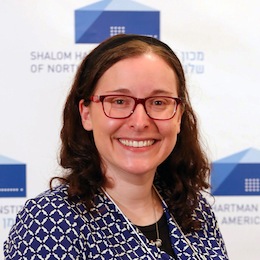
Elana Stein Hain, scholar resident and director of faculty at the Shalom Hartman Institute. (photo from Elana Stein Hain)

In the greater Jewish educational sphere, the Shalom Hartman Institute has produced a series of videos about related topics and examines how scripture has educated Jews on the subject over the years. Elana Stein Hain, scholar resident and director of faculty, has been leading the project.

“What we do is essentially develop curriculum around challenges facing the Jewish people,” Stein Hain told the Independent. “And I wouldn’t even say it’s about developing curriculum as much as developing conceptual frameworks for thinking about issues that arise. We’re an educational think tank. We ask ourselves what issues are now facing the Jewish people and consider how to develop educational material that deepens how we think about these issues. Then, we speak with change agents in the Jewish community about some ways of thinking.”

Stein Hain and her team began by looking for Torah teachings that address the topic of harassment directly. They came up with a three-part video series, which launched with a presentation that addressed the question of how, as a 21st-century teacher, you can educate people with our most sacred text and have the value proposition of our most sacred text being very important and continuing to give us the wisdom we seek, said Stein Hain. “And, also, we address the absence or relative absence of women’s voices and women as an audience.”

The next video talk was by Dr. Paul Nahme, a member of the institute’s Created Equal Team. He speaks on how definitions of manhood are dependent on cultural context.

“There’s this ‘boys will be boys’ kind of assumption and he says that, actually, there are places in Jewish tradition where that assumption had been challenged,” explained Stein Hain. “Young men were being trained to not be bravado macho, arrogant and assertive – to instead be trained to think about what it means to have doubts, to need someone else’s help. That was in contrast to what masculinity was understood to be.”

The last talk in the series was done by another member of the team, Dr. Arielle Levites, who discusses the portrayal of women in some Jewish traditional texts.

“It’s a deep folk story about women who try to move beyond their station or to move beyond the assumptions of them being portrayed as monsters,” said Stein Hain. “And she relates that to the … women who come forward with claims of sexual harassment or sexual violence who become seen as the offending party, getting questioned and vilified in certain ways.”

All of the videos can be accessed at hartman.org.il.

“The idea is really to get to the root of education,” said Stein Hain. “We are glad that people are going to do trainings on sexual harassment, on mandated reporting and on how to respond in the moment. We’d like to get to the root thought process of a culture that has come to this. And we want to learn how we can educate better, so we can have an adaptive change in the way people think, talk and act. Then, society and the Jewish community in particular can be built upon a different foundation.”

The educational realm within synagogues has also felt reverberations of the #MeToo movement, according to Rabbi Carey Brown of Temple Sholom.

photo - Rabbi Carey Brown of Temple Sholom
Rabbi Carey Brown of Temple Sholom. (photo from Carey Brown)

“I have seen an incredible amount of conversation among rabbis about this issue,” said Brown. “Some have been from within female rabbinic circles of women … some confronting it … things that people had kept within themselves for years or decades … and, now, gaining the courage to talk about it – everything from struggles to trying to understand the situation insofar as its professional implications for female rabbis … major discussions are being had on the topic at our annual conferences.

“Within the congregation, I haven’t had any individuals come to talk to me about personal experience,” she said. “But I have had a sense that women are feeling more free to bring up topics having to do with abuse, with safety, within the congregation, [at the] board level or [from a] staff perspective.”

A couple of months ago, the synagogue’s Men’s Club had a program on the #MeToo movement and sexual harassment in the workplace, including panel discussion on the topic in which Brown participated.

“I was really glad they took the initiative to have this program,” said Brown. “This didn’t come from the rabbis; it came from their leadership wanting to have an opportunity to talk about it. The conversation was really good and those who attended were very engaged and didn’t want to leave.”

Brown spoke about the Jewish perspective, discussing its tradition of values and ideas around sexual harassment, as well as her own personal experience with harassment.

“We talked a lot about consent,” said the rabbi. “A few different pieces of Talmud were discussed. We looked at this one that was about what happens if a man – one who counts money for a woman from his hand to her hand in order to look upon her – even if he has accumulated knowledge of Torah and good deeds like Moses, he will not be absolved from punishment.

“We talked about how, if someone even has a good reputation in the community, is known for their knowledge, good deeds and business … if they are abusive or using their power in a way that puts someone else in a position in which they are abused and powerless … our tradition says that, no, that is not OK.”

Abuse can be as simple as the way one person looks at another – if there is a misuse of power or position to objectify someone, Jewish tradition says that is not acceptable, stressed Brown.

“We talked about how we need to stand up when someone is being objectified, abused or put into a difficult situation,” she said. “That is part of our Jewish imperative – not to look away. It is part of what the Torah teaches us: that we can’t be indifferent and we must act.”

Over the years, Brown has had inappropriate comments directed at her. She said, “I’ve received comments like, ‘You don’t look like a rabbi’ or ‘If my rabbi looked like you, I’d have gone to shul a lot more when I was younger,’ or comments on my clothing and hair, and such.

“I mentioned at the event with the Men’s Club that my experience, both in Vancouver at Temple Sholom and in Boston, has been that the longer that I am the rabbi of a community, the stronger the relationships. And, I feel some of those things begin to fade away … within the regular, active population of the synagogue.

“It’s often when I’m in a new environment with people who don’t know me – at a shivah minyan, a wedding or something like that – my antennae go up. I’m very aware that it’s very likely I’ll get comments that are really inappropriate or that I have to psyche myself up a little bit to deal with.

“If I’m at a shivah minyan, I’m there to comfort the bereaved. I’m generally not going to confront in that situation,” she said. “I will take it with a grain of salt and maybe grumble about it to a friend. But, sometimes I’ll say, ‘That’s not appropriate.’ Sometimes, I’ll hear things like, ‘I’ve never kissed a rabbi before.’ And, I’ll say, ‘Well, we don’t need to kiss.’ I’ll push back a little bit to establish some boundaries.”

Rebeca Kuropatwa is a Winnipeg freelance writer.

Format ImagePosted on June 29, 2018June 28, 2018Author Rebeca KuropatwaCategories LifeTags #MeToo, Carey Brown, Created Equal, education, Elana Stein Hain, harassment, KDHS, King David High School, Lu Winters, Shalom Hartman Institute, Temple Sholom
Trying to increase inclusion

Trying to increase inclusion

Alisa Polsky, left, and Leamore Cohen attended the Jewish Federations of Canada-United Israel Appeal’s Pushing the Boundaries: Disability, Inclusion and Jewish Community conference in Toronto April 15-17. (photo by Liora Kogan)

Jewish Federations of Canada-United Israel Appeal’s Pushing the Boundaries: Disability, Inclusion and Jewish Community conference took place in Toronto April 15-17. It was the first national Jewish conference on these topics, and two representatives of the Jewish Commmunity Centre of Greater Vancouver attended.

Leamore Cohen, inclusion services coordinator at the JCCGV, was a panelist in a discussion on vibrant, inclusive communities and recreation. She was joined at the conference by Alisa Polsky, a member of the Bagel Club, a social group for adults with diverse needs.

“The Bagel Club community is very important for social interaction with other people, and to know there are other opportunities for learning and discovery,” Polsky told the Independent. “I got to discover the Vancouver I didn’t know before.

“The club inspires me to try new things that I’d never tried before. I’ve learned a lot about myself over the years and it has pushed me out of my shell. I’m grateful for this. I’m grateful for all the opportunities the club has provided, like going to Israel with my friends and this conference.”

Polsky has been an active member of the Vancouver Jewish community for years, with volunteering being a value her parents instilled in her as a child. At the time, the educational system had dubbed her “disabled.”

“When I was going to school, I was just pushed through,” said Polsky. “This was elementary school. I didn’t get the education I deserved. I was put into a special needs class. The education system segregated me away from the regular class. The teachers only wanted to work with the ‘normal’ kids.

“I would have liked more schooling. I deserved more schooling. I deserved to be in the classroom with the ‘normal’ kids. This still hurts. I am glad that things have changed, but it’s not enough. Some kids are still segregated today. We have to work together to change that. If not, more kids will feel like I did, which is not fair or right.”

Last year, on the trip to Israel with the Bagel Club, Polsky got to meet Member of Knesset Ilan Gilon, with whom she spoke about the struggles of people with diverse needs in Canada for proper benefit rates.

photo - Alisa Polsky at the Pushing the Boundaries: Disability, Inclusion and Jewish Community conference
Alisa Polsky at the Pushing the Boundaries: Disability, Inclusion and Jewish Community conference. (photo by Liora Kogan)

“When the Pushing the Boundaries conference came up, Leamore asked if I wanted to go,” said Polsky. “She told me that she was speaking with the Jewish Federation of Greater Vancouver about having someone from our community attend. She said the Federation believed this was very important. It’s important to see how other organizations work with people with all kinds of diverse abilities, and that people with diverse abilities get to be part of the national conversation.”

This was the first conference Polsky had ever attended. She was happy to discover that, while other organizations charge for various activities, including the Pushing the Boundaries conference, the JCCGV and Vancouver Federation take into account the financial barriers many people with diverse needs face, and do not charge for such programs.

“I loved learning more about the youth-led mentoring programs in Israel, Krembo Wings,” said Polsky. “We got to spend time with them when we visited Israel. When I was younger, I never went to programs like that. I did volunteer and helped kids with learning disabilities learn how to swim. Given the chance, I was able to show that we all have something to give. Organizations like Krembo Wings ensure that the next generation will help each other to learn and achieve their potential, no matter who they are.”

Polsky said it is very important to hear from other Jewish groups about what they offer in their communities and what their issues are. In this way, she said, she and others can be stronger self-advocates and more involved in the community.

Maybe most encouraging for Polsky was realizing that she has partners in her goal for equal rights for community participation, and also that Jewish organizations are beginning to work together across Canada to remove barriers.

“I am overcoming these barriers through my membership with the Bagel Club community, with my family, who have been there for me, through volunteering and through my spiritual community,” said Polsky. “I feel it is my time to give back to the community that has given me so much over the years.

“The conference was about the lives of Jewish people with diverse abilities – and they should be at the table. I am proud that I was at the table with Leamore.”

Polsky said there is a lot to be gained from attending gatherings like Pushing the Boundaries. In particular, there is the opportunity to “exchange ideas and share resources,” said Polsky. “It’s also important to understand our history as Jewish people, and as people with diverse needs in this country. I’d like readers to recognize that we’re all partners in making the community better.”

Some conference highlights for Polsky included the synagogue panel on creating inclusive communities and the recreation panel, in which Cohen took part. There were other topics covered, as well.

“As a Jewish woman and a woman with diverse needs, it was hard, but important to learn about the eugenics movement in Canada,” said Polsky. “This movement meant that a woman who had a pregnancy where a child who was mentally or physically challenged would be encouraged to abort the pregnancy. Families were also encouraged to institutionalize their disabled children. And they also forced sterilization.

“We learned about the denationalization movement and the development of community living.

We also learned about integration into schools and housing developments that are currently being built, which are inclusive and accessible, in Ontario.”

Polsky said she is fortunate to be living in a cooperative, and living independently. She noted that some people with diverse needs, who may require semi-independent living, are still segregated in Canada today, due to zoning laws that keep them out of certain neighbourhoods, which she describes as “horrible.”

“Having participated in this conference,” she said, “I can tell other people what I have learned and I can encourage people in my community to vote and to get active in their communities. I can remind politicians how powerful we can be when we work together and that disabilities communities are large and strong, and that we can make a difference in all aspects of community life.”

For more information about the conference, visit jewishcanada.org.

Rebeca Kuropatwa is a Winnipeg freelance writer.
Format ImagePosted on June 22, 2018June 19, 2018Author Rebeca KuropatwaCategories NationalTags accessibility, Alisa Polsky, diversity, inclusion, JCC, Jewish Federations of Canada
Digital impact on our lives

Digital impact on our lives

(photo from publicdomainpictures.net)

Dr. Simon Trepel, child analyst and psychiatrist at the Manitoba Adolescent Treatment Centre, is seeing an increasing number of children and teenagers using phones – even during sessions.

“I was hearing more and more from parents about some difficulties they were having around technology and screen time,” said Trepel. “I was noticing, even in my own family, how pervasive screens are becoming … as a preferred source of entertainment, as well.

“When this stuff marinates in you for awhile, it makes you curious about deeper questions about what’s going on. It ultimately behooves anybody who is working in mental health to start wondering about all the ingredients that might be contributing to someone’s mental health…. I became more curious about how these devices and screen time might be affecting, not just kids and teens, but, really, all of us.”

According to Trepel, using technology in daily life is no longer a choice. It is a fundamental part of how we all get by. Most of us check our phones several times a day, and conduct business and communication on our phones or tablets almost exclusively.

He said there are about four billion people using the internet right now worldwide, and a third of those people are children and teens. There are about five billion people using mobile phones and a little over three billion people on social media at any given time, he said. And, these are all increases of anywhere from five to 15% in comparison to the previous year.

“These trends are changing how we communicate,” said Trepel. “They are changing how much face-to-face communication we have and the nature of the communication itself. The previous generation would use words and texts. Now, videos, pictures and memos are the preferred way to communicate. It’s changing the very ingredients we use to communicate with one another.”

There are implications to this change, especially in children, whose not yet fully developed brains are particularly susceptible to getting into trouble online. But, Trepel said, there is something that can be done – and it starts with adults getting off their phones and other screens, especially when around young people. We also need to start talking about these issues, as kids who come from homes that discuss such topics tend to be less at risk.

“When there’s a more negotiated amount of technology use and supervision and things like that, that is a good thing,” said Trepel. “But, there are many, many kids who have a combination of not a lot of supervision combined with having an immature brain, and these kids are the ones we are most worried about getting into trouble online.

“We worry that screens are displacing a lot of other activities that might be healthier than being on technology – things like getting adequate sleep or being outside. The amount of hours spent outside is now at about half of what it used to be. It’s gone from about 18 hours a week to about seven hours a week in one single generation.”

Getting a handle on this will not be easy, but it starts with parents making the time to fully understand the tech diet of their kids. Just like we monitor their food intake, we need to monitor their tech intake.

“Sit down with them and let them take you through a typical day,” advised Trepel. “What types of sites are they using and for how long? What types of interactions are they are having on this site? The timing of this is important. Is it the first thing they do in the day, getting on their device? Is it the last thing they do before bed? Do they themselves detect any problems with their screen use? Are they running into any cyber-bullying or being taken advantage of? Do they feel better or worse after using their phones? Do they notice phones cutting into their sleep, or do they notice themselves having a difficult time stopping themselves from checking? This is the beginning of getting data about how your kids and teens are using their phones. But, it’s also starting to ask the question of whether or not this is becoming a problem for your kid or teen.”

Trepel suggested that, when you monitor your kids, you want to make sure it is active monitoring – that you are co-viewing and discussing the sites that they are on. It is also important to avoid spy-type programs, he said, as kids will find ways to work around them.

Aim to be playing together, following each other on social media. Use any opportunity for educational guidance – not so much making it a single conversation, but, instead, an ongoing dialogue about the device. You can ask for their help learning about social media, for example. “I think that’s a very elegant way to cover a lot of bases,” said Trepel. “It allows the parent to learn a lot about what the kid is using, in terms of technology use. But, it also updates the parents as to what these social media sites are all about – how they are navigated, how they are used.

“It may also be a great way for kids and parents to spend more time together, interacting with each other, teaching each other. While they might teach you about Twitter, you might be able to point out various ways they are using the technology that might be helpful or harmful. You might, if the child teaches you Twitter, find out if the child has a public account and is being followed by hundreds of people the child has never met before.

“It’s not only a way to have a child feel good about helping a parent, but, once the parent knows more about the technology, the parent can start to look for red flags.”

Studies have shown that parental behaviour is one of the most powerful influences on a child’s behaviour. So, Trepel suggests taking an honest look at yourself as a parent, about how embedded these devices are in your own life. And then, start to change that for yourself, while also becoming a good role model for your kids.

“You want to be proactive with your kids,” said Trepel. “You don’t want to wait until there’s a problem. You want to educate them to the possibility of problems.

“You also want to be proactive about texting and driving. This really might be the drinking and driving of our generation. I remember, when I was in high school, there was MADD, Mother’s Against Drunk Driving. I think we need some sort of revival of that, looking at parents being concerned about texting and driving. The stats from Manitoba are striking that, just five or 10 years ago, we were seeing maybe 3,000 collisions per year. And, in the span of just a few years, it’s now up to 11,000 collisions involving distracted driving per year – a four- or fivefold increase, about 30 distracted driving collisions a day.”

Trepel said it is best to avoid taking technology away without offering an alternative. Make it easy for kids to see their friends in real life, he said. Let them go over to their friends’ houses, take them places they want to go, and do things they want to do – provide them with in-person opportunities. Play a board game, do arts-and-crafts, encourage them to learn to play an instrument or participate in a sport. Off-screen activities, he said, have a greater likelihood of making your kids feel happy as compared to on-screen activities.

Trepel suggested having your kids turn off their phone notifications at important times of the day, like sleep time, family time, meal time, school time, and so on. And make sure that you do the same.

“Every time we get a signal from our phone, it could be someone liking our photo or giving us a compliment, or something we anticipate might be good,” said Trepel. “And that reward system in our brain kicks into gear and compels us to want to check what the notifications are. Once our screen is on and in our hands, we might end up surfing or doing something else we weren’t even intending to do – at the expense of whatever original activity we were doing before the notification occurred. So, we have to make sure that we turn off all those attention stealers.”

Trepel recommended that parents turn off the wifi after 9 p.m., or even earlier, if they think there will be a significant battle to have their kids turn off their screens in the evening or if it is affecting their ability to do homework.

Or, he added, you can get your kids a phone with no internet capabilities. Some executives, he said, have even switched back to such phones, as they were wasting too much of their time when they had a phone with more tech capabilities.

For starters, Trepel said, begin the conversation. Ask your kids for ways to keep things under control. Dialogue, go back and forth, and find ways that work for your family.

Rebeca Kuropatwa is a Winnipeg freelance writer.
Format ImagePosted on June 8, 2018June 6, 2018Author Rebeca KuropatwaCategories NationalTags cellphones, children, family, health, Simon Trepel, technology, teenagers

Taking abusers to court

In the third of a series of articles on sexual harassment and violence in the Jewish community, the Jewish Independent speaks with lawyer Megan Ellis, Q.C.

Megan Ellis is one of the first lawyers in Canada to have devoted a significant part of her practice to pursuing claims on behalf of adult survivors of sexual assault and childhood sexual abuse.

In 1976, Ellis began volunteering at a rape crisis centre in Vancouver. This led to jobs working at rape crisis centres in Vancouver and in London, England, from the late 1970s to early 1980s.

“I was interested in law,” she said. “I always have been. It was my intention to become a lawyer eventually.”

Ellis passed the bar in 1988 and went into civil claims. In 1992, she and her partner led a successful challenge to the time limitation in Canada. As a result, in 1993, the law was changed in British Columbia, and the province became the first jurisdiction in Canada to remove the time limit for survivors to bring claims against perpetrators and institutions regarding sexual abuse.

In that groundbreaking case, an uncle was charged with sexually abusing several girls in the family over several decades from the 1950s to 1970. The girls were toddlers – as young as 2 years old – when the abuse began, and it continued into their early teens.

Many more cases have since followed.

“I have children’s parents who call me and ask what to do when their kids have been sexually abused,” said Ellis. “I discuss with them what they want their outcome to look like. Often, they haven’t decided if they want to go through a criminal process or not. So, they have to make that decision initially. If they decide they want to go through a criminal process, I ask them to wait until that is concluded before commencing a civil process – unless there are unusual circumstances, like it looks like the perpetrator might die, move all their assets to a Swiss bank account, or something like that.”

Once a decision is made to proceed through the civil system, Ellis collects all the relevant documents, such as income records, counseling records, medical records and educational records – as much information as possible. She then reviews everything and starts the process of drafting the legal documents, filing them and serving them to the perpetrator or institution.

“One thing I always discuss is whether or not that should be preceded by a demand letter,” said Ellis. “Sometimes, I collect all the information and put together a settlement letter in hopes the person will settle and pay out the claim, rather than go through the more public civil system.”

The settlement letter states what the accused did, that these are the consequences and the accuser wants X amount of dollars paid within a given time frame. The letter also states that, if the accused does not pay, the accuser will sue.

If the perpetrator does not settle, one can expect the legal cost to run between $10,000 and $15,000. Ellis advises her clients to verify that the perpetrator has assets.

“There are many people I have to tell, ‘Look, I do not doubt what you’re telling me at all, but it might appear that the perpetrator doesn’t have assets,’” said Ellis. “And there’s no point suing someone who doesn’t have assets.”

Claimants also need to take into consideration that, to date, the damages awarded for sexual abuse have been very low; in some cases, similar to what someone would get for mild whiplash from an accident.

“They don’t actually recognize the long-term effects of one incident, depending on the circumstances,” said Ellis. “They’ve been getting better over the years, but there’s still quite a long stretch before judges understand the very serious long-term implications.… There are 25-year-olds who get raped and it has a profound impact on the rest of their lives. The social reaction to being raped and the effects that it has are long-term. They are permanent. I think it’s fair to say that anyone who’s been raped has been permanently changed by that experience.”

In British Columbia, a lawsuit can take two to three years from start to finish. As for privacy, one can expect a ban on publication, though that is not guaranteed. Both the court records and courtrooms are publicly accessible.

If one is determined to confront their perpetrator, they may have a hard time finding representation. Lawyers who take on such cases are overburdened.

“My instructions for my staff are that I am booked for no more than four consultations per week,” said Ellis. “That was two or three years ago. Now, I’ve cut off … I’m not able to take more. I have enough now to keep me going for quite some time and I can’t possibly take any new cases. So, it’s gone from four per week to zero. And I’m not keeping tabs on all the people I’m turning away. I give other names, but I’m not sure of who’s taking these cases at the moment.”

Ellis has been instrumental in changing the law that allowed perpetrators to claim bankruptcy to escape paying the judgment.

“What started to happen in the first few years I was doing this is that the perpetrators would fight the cases and then spend all their money defending themselves,” said Ellis. “And then, they’d end up going bankrupt and walk away from the judgment.

“I was involved in amendments to the bankruptcy and insolvency act, which meant that you didn’t get rid of a judgment for assault or sexual assault just by going into bankruptcy – the judgment survives the bankruptcy. So, they may have gotten rid of their assets, but they haven’t lost their capacity to earn income, their inheritances … there are ways to go after them. The perpetrator’s thinking before was that they’d rather pay lawyers than pay their accusers, thinking that, then, it’ll be gone and they won’t have to worry about it.

“Funnily enough, I haven’t had a case where the perpetrator has gone into bankruptcy since.”

Since the #MeToo movement, Ellis has noticed a change in how various companies and institutions deal with their responsibility, a shift to more appropriate responses to allegations of abuse. The movement also has helped instil in people’s minds is that, typically, when it comes to sexual abuse, there is not just one victim, there are many.

“This is because there are all kinds of efforts the perpetrator makes to silence their victims,” said Ellis. “Societal mores are such that it doesn’t take a whole lot, because there’s fear and disbelief … and then, the perpetrator adds to it by saying, ‘If you ever tell anyone, you won’t be believed,’ etc.

“One thing that is particularly problematic in institutions is that they generally turn a blind eye in order to protect themselves … unless somebody’s standing on their doorstep with a picket sign.

“Essentially, what’s happened is that someone is now standing on their doorstep with a picket sign. Many of the institutions I’ve sued, there were, I believe, people, who knew but didn’t come forward, partly due to consequences for workers, teachers, social workers … for coming forward and making an accusation. They don’t want to take it on.”

Institutions are learning the hard way that it’s more cost effective for them to educate their employees about what abuse is and to report it.

“One place where there is still a lot of abuse is in the workplace,” said Ellis, giving the example of sexual harassment. “But, that’s an employment law context and I personally have never dealt with those cases.”

Rebeca Kuropatwa is a Winnipeg freelance writer.

Posted on May 18, 2018May 16, 2018Author Rebeca KuropatwaCategories NationalTags abuse, harassment, law, Megan Ellis
The ethics of cloning

The ethics of cloning

Prof. Arthur Schafer, head of the Centre for Professional and Applied Ethics at the University of Manitoba. (photo from Arthur Schafer)

After a few Chinese researchers recently released a report about their successful cloning of monkeys, the ethics debate about both cloning and the use of monkeys for research reignited.

“It’s not the first time primates have been cloned,” University of Manitoba philosophy professor Arthur Schafer told the Independent, “but it is the first time it has been done by this method.”

A primate is a zoological classification for mammals such as humans, apes and monkeys that are distinguished by, among other things, higher intelligence than other animals.

“The method previously used for cloning primates was called ‘embryo splitting.’ That’s what happens when a mother has identical twins,” explained Schafer, who heads the Center for Professional and Applied Ethics at the U of M and lectures on the ethics of cloning. “The method they used [in China] is called ‘the Dolly Method,’ named after the famous cloning of Dolly the Sheep. Dolly the Sheep was cloned from the breast tissue of the animal being cloned. (Dolly was named after Dolly Parton.) They used an adult cell.”

An advantage of this method over the cell-splitting technique is that you have the potential of getting many more clones, said Schafer. With cell-splitting, you can only get two.

With respect to the ethics of cloning and of using monkeys for research, Schafer said, “The first point is that the success rate is very low – two out of 60. They produced a number of additional embryos that didn’t result in live births or healthy animals.

“With Dolly the Sheep, the success rate was even lower…. Well over 200 clones of Dolly were produced to get one successful live birth of a healthy Dolly clone.”

Another important question is whether or not this research will make human cloning more likely. At present, a major reason why creating a human clone would be unethical is because the chances of the baby being born severely impaired physically or mentally are very high. “No ethical physician would want to use this as reproductive technology or would participate in it, because the chances of getting a healthy baby would be small,” said Schafer.

He said, “The technology will get better and better and could, eventually, maybe in the not-too-distant future, be safe and effective. And, at that point, it might become a viable way for a couple to have a baby. So, if you think this reproductive technology is ethically objectionable for humans, then you’d be opposed to primate experimentation on those grounds.”

For those whose primary objection to human cloning “is that it’s ineffective and unsafe” and “that you have a lot of stillborn babies and that those born alive would have a high chance of being severely impaired,” improvements of the technology could be a reason for primate testing.

Schafer said that human reproductive cloning could become as effective as in vitro fertilization (IVF).

“People got very irate in 1978 when a baby was born by IVF,” he said. “They thought this was a method that was morally wrong – a crime against the baby, against society. But somehow, it is turning out to be not so unsafe, not significantly less safe than natural childbirth. And it can enable, maybe a couple million couples, to have babies who wouldn’t otherwise be able to.”

Schafer postulated that, just as IVF is no longer on the current ethics chopping block, so too cloning may someday reach the point of being considered safe enough to be an acceptable reproduction method.

“The whole debate is about if it is unethical and, if yes, why?” said Schafer. “I think everyone agrees that safety and effectiveness is critical. But, once we get beyond that, some feel it is a case of playing God.”

Currently, human cloning research will land you in prison. But, animal cloning research is allowed in some countries on the grounds that it is for the purpose of making higher-producing animals – a chicken that can lay more eggs, for example, or a cow that can produce more milk or is better at putting on meat. Cloning research for such purposes has been allowed and has been given large financial resources.

“So, where it’s permitted, the rationale is that this technology will enable us to do medical research and to advance scientific knowledge in a way that will improve the quality of lives,” said Schafer. “It’s a matter of weighing and balancing your hope for benefit against your fear of repercussions.

“In discussions I’ve had with Jewish authorities, who although are divided amongst themselves, the predominant strand stresses that one value trumps all others – that being human life. So, you could use that as the basis for an argument that any technology that would hold promise of saving human lives would be favoured by Judaism.”

There is still the concern about conducting research on monkeys.

“Many people, and not just animal rights advocates, regard primates as the last animals, eligible animals, for experimentation,” said Schafer. “They are the most intelligent, the most like us. They have highly developed brains and nervous systems. They are, in many ways, more intelligent than human beings who are impaired or adults who have dementia or are in a vegetative state. We don’t allow medical research on severely cognitively impaired human beings, so how could it be ethical to do research on these closest relatives in the animal world, primates?”

Schafer said there has been a drastic decline in the amount of research done on primates in general, and monkeys in particular.

“You can’t justify the risks of severe harm on primates,” said Schafer. “Either they shouldn’t be used at all or, a compromise position, they should only be used as a last recourse for medical research – only used when incredibly necessary and for a supremely important goal.”

It is on these lines that scientists justify some of the research being done on Alzheimer’s and Parkinson’s.

“They believe this technology will allow them to produce animal models that will facilitate research on diseases such as Alzheimer’s and Parkinson’s,” said Schafer. “So, do we need to do this research? Are there other better alternatives? Is the moral [price of] experimenting on primates too high to justify the medical benefits it hopes to achieve? These are all issues that are critical to the debate.”

Rebeca Kuropatwa is a Winnipeg freelance writer.
Format ImagePosted on May 18, 2018May 16, 2018Author Rebeca KuropatwaCategories NationalTags Arthur Schafer, cloning, Dolly the Sheep, ethics, Judaism, science
Operation Ezra update

Operation Ezra update

Khalaf and Gawre’s family is the 10th to come to Winnipeg thanks to Operation Ezra. (photo from Michel Aziza)

What started as a small local initiative has grown to be a leader, by example, and a reminder of what can be achieved when an intention is set and action is taken.

About a year ago, the Jewish Independent ran a story about Operation Ezra in Winnipeg that, at the time, was aiming to sponsor five Yazidi refugee families. Led by Michel Aziza, a local businessman and once a refugee himself (from Morocco), and a small group of individuals connected to the Jewish community, the initiative was a response to the plight of the Yazidi people being viciously persecuted by ISIS in Iraq.

Nafiya Naso, now a young woman, who came to Winnipeg as a child with her family, has been an instrumental figure in Operation Ezra.

“She was reaching out to people outside their community to raise awareness of the genocide that was going on, March of 2015,” said Aziza, recalling Naso’s early involvement. “I was semi-retired and looking for something to occupy myself, and this was a good opportunity for me to get involved with a volunteer-type of project. Essentially, that’s what I have been involved with over the last almost three years.

“At the beginning,” he said, “we knew nothing about the Yazidi people. After talking with Nafiya, we identified a family of eight people and thought we could raise the necessary funds to submit a sponsorship application. We started lining up a few speaking engagements for Nafiya…. We started speaking to people, making calls, and … the original target was $34,000 for this family of eight … [and] within three or four weeks, we raised $34,000. And that number kept on growing as people talked to other people.”

To date, with the generous help of people in Winnipeg and elsewhere, Operation Ezra has raised just over $500,000. This has made it possible for them to sponsor 10 Yazidi families – 55 people – with the last family having arrived in March.

“As soon as we realized this was bigger than a grassroots project, we decided to incorporate Operation Ezra within the organized Jewish community,” said Aziza.

Jewish Child and Family Service (JCFS) saw this as an opportunity to do something in line with what they were already doing – helping with the settlement of immigrants and refugees – so they came on board, gradually reaching out to other organizations and agencies.

Gray Academy of Jewish Education and the Jewish Foundation of Manitoba joined the effort and, currently, Operation Ezra is an umbrella group of some 20 different agencies and organizations. Most of the members are Jewish, but not all. There are two churches involved, the Salvation Army and a number of corporate partners, with IKEA being the biggest name.

Many volunteers help Operation Ezra in various aspects of the settlement process. Naso has been hired by JCFS to manage everything.

One service Operation Ezra offers is an English-as-an-additional-language (EAL) program, which takes place at a synagogue every Thursday, with 70 to 80 refugees attending and about 20 volunteer teachers. Some Yazidi participants are government-sponsored.

Out of the total 250 refugees who are government-sponsored, about 100 have asked for help from Operation Ezra. “So, we are touching the lives of about 200 people,” said Aziza. “We have organized and have helped organize many community events for the Yazidi people. We celebrated Yazidi New Year’s 6768 on April 18, 2018, with a very large number of people coming out for that dinner,” he said by way of example. “We’re trying to help this group of newcomers to get organized, and to organize themselves as a community … to socialize and to help each other and so on.”

According to Aziza, Operation Ezra is the only multifaith group doing this work in North America.

One recipient family of Operation Ezra is Majid and Safya, along with their children. They shared their thoughts on their experience to date, with translating help as needed from Naso.

“My name is Majid. I was born and raised in a small village…. I am married with two kids – one boy who is 4 and one girl who is 6. My wife, Safya, and I are currently enrolled in EAL classes, hoping to learn English and find work in the near future.

“On August 3rd, 2014, at around 9 a.m., my family, community members and I fled to Mount Sinjar. We were lucky to have escaped when we did. If we had stayed any longer, I would be in a mass grave with many other Yazidis. I can still hear the rapid gunfire as ISIS members surrounded everyone who wasn’t able to flee and started shooting.

“We then reached Mount Sinjar, where we stayed for seven days with little to no food or water. As we were coming down the mountain closer to the Kurdistan region, we were able to hop into a truck. But, soon after, we saw ISIS members driving at us, firing round after round. I still don’t know how we escaped that day. Everything was such a blur. All I really remember was covering my kids and wife, hoping they would make it. Fortunately, we all made it to a refugee camp in Dohuk.

“The conditions in the camp were very scary. We were always worried about getting enough to eat, drink … about medical treatment. And we stayed for a few months, but couldn’t make it. So, we left for Turkey hoping for better living conditions.

“After spending almost two years in Turkey,” he said, “we heard about Operation Ezra and reached out. And, by some miracle, we were sponsored. Everything felt like it was going to be OK after we received confirmation we would be coming to Canada.

“I will never forget the welcome we received coming down at the airport. I was in awe of all the people who had come to greet us and welcome us into their community.”

Majid said they arrived in Canada in December 2016. “My experience in Canada has been great and could not be any better!” he said. “I have many friends and family who are in refugee camps in Iraq and Turkey who call me and tell me that the situation in the camp is getting worse by the day. My dreams are that my family and I are able to live in Canada without the fear we faced back home – the constant fear for our lives, hate and discrimination we faced because of our religious beliefs.

“I encourage all Canadians to reach out to Operation Ezra and learn about this amazing program, the only program of its kind in the world today. We have thousands of Yazidi still living in segregated refugee camps, fearing for their lives and waiting for anyone to reach out and lend a helping hand. I also encourage the Canadian government to support groups like Operation Ezra to help out more refugees.”

Khalaf and Gawre’s family are the most recent Operation Ezra arrivals to Winnipeg. (Although they were the last family Operation Ezra had planned to sponsor, the group has unanimously decided to continue their efforts.)

“My name is Khalaf and I arrived in Winnipeg on March 29th with my mother, who is 83 years old, my wife, and five kids – two boys and three girls, ages ranging from 12 to 24. I was ripped away from my four older kids after ISIS attacked our village (Dugere).

“At 8 a.m., we heard gunshots and got calls from other Yazidi villages that ISIS had murdered hundreds of men and was kidnapping all the women and young girls. Ten minutes later, my family and I started walking toward the mountain. My mom and dad were so lucky they were able to get rides to the refugee camp in Dohuk. My wife, Gawre, and five children were stranded on the mountain for seven days.

“We were able to escape the mountain with the help of PKK [Kurdistan Workers’ Party]. We lived in a refugee camp on Dohuk for six months. The conditions were horrible and heartbreaking. Many people died in the camps, because there was no humanitarian aid, no water and no medical care. My father passed away, because we could not get him the medical attention he needed.

“Shortly after, we decided to go to Turkey. It was no better there, but we did not have a choice and could not afford to move back to Iraq again.

“My sister and her family were sponsored by Operation Ezra just over a year ago. We got on the list when we heard about this amazing project from the people in the refugee camp.

“Months after contacting Nafiya [Naso] and Asmaeil, we were told we would be sponsored! My family and I definitely won the lottery here. We will always be grateful for everyone who made this possible.

“My dream is to see my family and Yazidis around the world live free of persecution. We hope and encourage all Canadian and other countries around the globe to support groups like Operation Ezra and help them in saving lives.”

Naso added, “Operation Ezra is working to raise more funds and keep sponsoring Yazidi refugees. There are thousands waiting who are in desperate need of help. They have no voice, so we must be a voice for them and speak out for them.”

For more information and to make a donation, email [email protected] or visit jewishwinnipeg.org/community-relations/operation-ezra.

Rebeca Kuropatwa is a Winnipeg freelance writer.

Format ImagePosted on May 4, 2018May 2, 2018Author Rebeca KuropatwaCategories NationalTags immigration, Iraq, ISIS, Michel Aziza, Nafiya Naso, Operation Ezra, refugees, terrorism, tikkun olam, Winnipeg, Yazidi

Posts pagination

Previous page Page 1 … Page 9 Page 10 Page 11 … Page 31 Next page
Proudly powered by WordPress