Skip to content
  • Home
  • Subscribe / donate
  • Events calendar
  • Business Directory
  • FAQ
  • News
    • Local
    • National
    • Israel
    • World
    • עניין בחדשות
      A roundup of news in Canada and further afield, in Hebrew.
  • Opinion
    • From the JI
    • Op-Ed
  • Arts & Culture
    • Performing Arts
    • Music
    • Books
    • Visual Arts
    • TV & Film
  • Life
    • Celebrating the Holidays
    • Travel
    • The Daily Snooze
      Cartoons by Jacob Samuel
    • Mystery Photo
      Help the JI and JMABC fill in the gaps in our archives.
  • Community Links
    • Organizations, Etc.
    • Other News Sources & Blogs
  • JI Chai Celebration
  • JI@88! video

Recent Posts

  • SFU honours Gloria Gutman
  • Lifting people’s spirits
  • Wedding a ray of light
  • Indigeneity and Zionism
  • Rule of law broken: councilor
  • Football and its roles
  • The burden of defence
  • Fish Café returns after fire
  • All right in what goes wrong
  • Nuns & mermaids at TUTS
  • Camp offers holiday retreat
  • Students and mentors inspire
  • Once-in-a-lifetime trip
  • 100 dancers, one heart
  • Money for the sciences
  • What “Jewish food” means
  • Have a cookie, schnitzel too
  • Federation now across BC
  • Israel fighting for its existence
  • Deal strengthens Iran
  • Patriotic belonging diminishes
  • A campaign to engage
  • Upstanders’ first live event
  • Responding to Carney
  • Having your own home
  • Music a family tradition
  • Musical to warm heart
  • Community milestones … June 2026
  • Sharing her passion for Israel
  • Or Shalom reopens its doors
  • JFS from past to future
  • Need holistic approach
  • Sharing stories, advice
  • Journalist shares fears
  • Skills to live together
  • Road to independence

Archives

Follow @JewishIndie
image - CJN box ad Rockowers 2026

Byline: Rebeca Kuropatwa

Elman’s grows in Vancouver

Elman’s grows in Vancouver

Millie Krause, who runs Elman’s, with receptionist Bonita Bouchard. (photo from Elman’s)

They started making horseradish 80 years ago and haven’t stopped. Elman’s Food Products is still making horseradish in small batches and, over the years, they have added new pickled products to the mix.

Today, Elman’s is run by Millie Krause, widow of the founder’s son, Manny Finkleman, who passed away in 2004. The company is gradually increasing its reach west from Winnipeg, led by Millie Krause’s daughter, Payton.

Six years ago, Payton Krause moved to Vancouver to be closer to friends and expand the family business, in which she first started working in the late 1980s. By then, the family had moved the company out of the garage and into its current-day location on Jarvis Avenue in Winnipeg’s North End.

“At that time, Payton, my daughter, was working here,” Millie Krause told the Independent. “And that was good, because she could keep an eye on things while I was running back and forth to hospitals, and taking Manny back and forth to this and that.”

In 2004, Manny Krause passed away. Since then, the brunt of the management has been in his wife’s hands.

“It was a really big learning curve for me, because my background was in sales. It took awhile,” she said. “Everybody wanted the same deals that Manny used to give and they didn’t really know who I was … but we survived.

“I always say that, if you don’t know something, find out. Just ask. If we look a little stupid or something down the road, who cares? Just get it done. That’s really the attitude we took it with. Now, what Manny said to me before he passed away … was that I should run it [Elman’s] for a couple of years, with Payton’s and everyone’s help … and then, sell it. So, 15 years later, I’m still here. The thing is, back then, when Manny was running the business, he ran it, if I might say, by the seat of his pants. He dealt with every problem that came up at the time, but he didn’t really remember what he did the next time, so it was like constant chaos.”

She and her daughter have tried “to reformulate the company and brand it – brand it into something that maybe wasn’t there at the time,” she said.

They position their products in the specialty food section, staying away from big retailers like Walmart and Giant Tiger. They sell the product by promoting the story behind it – making sure people know they’re a small, local family business with a long history in the city.

“I think we’ve succeeded in doing that,” said Krause, saying the process has “been a little slow.”

“Before Manny passed away,” she explained, “we were shipping from Winnipeg to Thunder Bay, and then west, but in very small ways. Then, Payton wanted to move out there, as apparently she needs mountains and water around her, and she wanted to open it up further. Actually, she’s done that.”

Expansion means winning over new clients, and that is exactly what her daughter is achieving in Vancouver.

“In fact, Payton had to pass a taste test,” said Krause. “Some of the wannabe customers she went to call on cut up 10 slices of pickles and said, ‘OK, now, which one is yours?’ And, I think she thought, ‘Sheesh! What if I get this wrong?’ But, she got it right.”

One breakthrough is that Elman’s pickles are included in all B.C. Ferries’ burgers. “They put the pickle on the top of the bun,” said Krause.

As another example, she said Elman’s are also used by Fairmont Hotels in Vancouver.

“The goal is to obviously get more business,” she said. “Up until this point, we didn’t have a lot of boots on the ground. We don’t have salespeople. The only ‘salespeople’ we have is Payton in the Vancouver area, but she has managed to do quite well. That is her goal – to get as much business as we can. It will hopefully get to a point that we can get enough business to be busy continually.”

Krause is hoping to get in with another large food service restaurant, which would allow Elman’s not only to be busier but to have the working capital to keep operations going. According to its website, the company currently has about 10 regular staff and casual employees.

Elman’s products carry a kosher certification from OU Kosher. For more information, visit elmans.ca.

Rebeca Kuropatwa is a Winnipeg freelance writer.

Format ImagePosted on October 19, 2018October 18, 2018Author Rebeca KuropatwaCategories NationalTags business, Elman's, horseradish, kosher, Millie Krause
Talks on animals, ethics

Talks on animals, ethics

Jeffrey Cohan of Jewish Veg speaks at a few local venues next week. (photo from Or Shalom)

There is no disputing the notion that God intended for us to eat a vegetarian diet, though eating meat out of necessity is permitted, according to Jeffrey Cohan, executive director of Jewish Veg, who will be in Vancouver next week for three presentations on animals and ethics.

Cohan’s father passed away at the age of 52 from a heart attack, when Cohan was 12 years old. “That’s always been in the back of my mind – what I can do to avoid the same fate,” Cohan told the Independent. “But, for the first 40 years of my life, I was a passionate meat eater and, although I was in good shape, I knew I needed a dietary change, as my cholesterol was up to 100 and I was approaching the age where my dad experienced heart disease.”

Cohan recalled a Simchat Torah when he was in his early 40s. The Torah reader came to a verse wherein God says to eat only plants and, for the first time, the possibility of being a vegetarian resonated with Cohan, and he and his wife immediately changed their diet. That was about 11 years ago.

“Then, I started researching intensively what the rest of the Torah and other Jewish texts said about this issue,” said Cohan. “I found out about an organization called Jewish Vegetarians of North America (JVNA). I was very excited. It was getting word out that this is what the Torah and our tradition actually says. At the time, I was working at the Jewish Federation of Greater Pittsburgh.”

Looking further into JVNA, Cohan learned, to his dismay, that it was run by only two volunteers, had an outdated website and no real relationships with the institutional Jewish community. This spurred him to go to New York to meet with these volunteers and a few others who were involved. He gave a presentation about what they could do to build up the organization. They asked him to become JVNA’s executive director – and Cohan said yes.

Since then, JVNA, which is now called Jewish Veg, has gone on to form relationships with some of the biggest Jewish organizations, said Cohan, including “those that deal with the demographic group most receptive to our message – young adults – partnering with Hillel.

“We created the first-ever vegan Birthright trips,” he added. “It’s been very gratifying. We are heading to Vancouver next, which is pretty exciting, being the first time we’ll give presentations in Canada…. Judaism, even when we were living in ghettos in Europe, does not exist in isolation. It is affected by external society to a great extent. Especially in America and especially in the 20th and 21st centuries in America and Canada, it’s been a two-way relationship.

“If you look at every social justice movement that has achieved success in the U.S. in the last 120 years – women’s rights, organized labour, the civil right movement, the LBGTQ movement – every one of these movements has had Jews involved in the leadership,” he said. “And this movement cannot be the exception. It goes back to the very raison d’être (reason for being) in Judaism, which is that we weren’t just given the Seven Laws [of Noah]. We were given a much higher bar to live up to. And, therefore, it is incumbent on the Jewish community, on this movement, to be at the forefront as we have been in other social justice movements. That’s exactly why Jewish Veg’s work is so important, because we’re mobilizing the Jewish community.”

According to Cohan, the work Jewish Veg is doing is inspiring the Christian community to follow suit. As an example, he said he was told by a longtime member of the Unity Church that they are creating a movement within their faith called Unity Veg.

Israel has become one of the most the most vegan-friendly countries in the world, said Cohan. “We actually … point towards Israel as an example for Canadian and American Jews to follow,” he said. “Jews speak on college campuses here [in the United States] about what’s going on in Israel and why they should be following its lead.”

While Cohan’s trip to Vancouver is the first for Jewish Veg in Canada, he is planning to soon speak in Toronto, Montreal, Winnipeg, Calgary and Edmonton.

Cohan hopes all people will become vegetarian one day, but his current aim is to meet people where they are. “We have something called our Veg Pledge program, which you can see on our website, which helps people transition to plant-based diets,” he said. “We don’t just come in, love them and leave them. We give them an opportunity to use our free resources to transition to plant-based diets at the pace that works for them.

“The way it’s structured,” he explained, “is that you start with a pledge, which can either be sticking your toe in the water or diving in head first, based on your comfort level. We really believe that helping people with the how is just as important as the why.”

During his visit here, Cohan will make three presentations: one hosted by the Vancouver Humane Society on Oct. 16, 7 p.m., in the Alma Vandusen and Peter Kaye rooms at Library Square Conference Centre; one at Or Shalom Synagogue on Oct. 18, 7:30 p.m.; and one at the University of British Columbia on Oct. 19, 1:30 p.m., hosted by Hillel BC at a Schmooze & Schmear gathering.

“I think a question you’ll hear many Jewish people ask is, ‘How does the Torah apply to our modern lives?’” said Shelley Stein-Wotten, program coordinator at Or Shalom. “We found it fascinating that Jeffrey’s own path to going vegan stemmed from his study of Torah and we wanted to provide an opportunity for him to share his story and create a space to have an open dialogue around if, as individuals and as a community, we can establish a Jewish framework to address climate change and make healthful food choices, which have inherent connections.”

Rebeca Kuropatwa is a Winnipeg freelance writer.

Format ImagePosted on October 12, 2018October 9, 2018Author Rebeca KuropatwaCategories LocalTags ethics, Jeffrey Cohan, Jewish Veg, Judaism, lifestyle, Or Shalom, Shelley Stein-Wotten, Torah, vegan, vegetarian
Adversity leads to innovation

Adversity leads to innovation

Sara Raposo-Blouw, left, and Erin Goldberg taste the chocolate mocha and vanilla blueberry flavours of Thrive. (photo by Ian Blouw)

Erin Goldberg, 30, was only 5 years old when it was discovered that she had rhabdomyosarcoma in her abdomen, attached to one of her ovaries.

Rhabdomyosarcoma (RMS) is an aggressive and highly malignant form of cancer that develops from skeletal muscle cells that have failed to fully differentiate. It is generally considered to be a disease of childhood, as the vast majority of cases occur in those below the age of 18.

Growing up in Winnipeg, Goldberg spent almost 130 days at the Health Sciences Centre (HSC) receiving treatments and recovering from procedures over a two-year span before she was cleared of RMS.

Goldberg’s struggle with the cancer and her unwavering will to make the world a better place have served as a driving force in her life ever since. And her memories from that time, as a child struggling to keep food down, have led to her helping develop a liquid food replacement that would have been priceless to her when she had RMS.

“Basically, everything I ate was making me nauseous, and that was due to chemotherapy,” Goldberg told the Independent. “It sort of alters your taste. And I would also throw up anything I would eat. It was important to have as many bland foods as possible. With liquid nutrition, it’s a lot easier to consume your calories than with anything solid. It’s denser and is a better option in the hospital.”

Goldberg said she went into nutrition because she was interested in disease prevention. After meeting Sara Raposo-Blouw and Lisa Reed, dieticians at the HSC, and them sharing their experiences with one another, they came up with the idea of a liquid nutritional drink. They knew, firsthand, the lack of options people had.

“The beverage options in hospitals were really lacking,” said Goldberg. “Patients find the taste of what there is too sweet. I recently spoke to my friend’s dad, who is a psychiatrist, and he actually prescribes Boost six times a day for one of his patients, because he has a motor disorder … he’s constantly moving, so his caloric requirement is elevated so much. He needs to have six of these beverages in addition to his regular food intake. When you have that much of something that is too sweet and has ingredients that are highly processed, or if you’re vegan or have allergies, you just can’t do it. You need an alternative. And there was really nothing out there.”

Goldberg and partners have developed a new option, called Thrive, that uses local ingredients, two of them being flax oil and pea protein. The formula is completely plant-based and free of major allergens, like dairy, soy, corn and wheat.

The trio solicited the help of a Burnaby beverage developer to help them produce the drink with the necessary specialized equipment.

While competitors have come out with flavoured drinks and drinks that cater to particular groups of users, Thrive differs in that it is a basic formula that everyone can use, adding their own ingredients as desired, depending on their needs.

“Currently, we have one adult formula, but we’re working on one for children,” said Goldberg. “The main difference between the one for adults and the one for children is the protein content. It’s very easy for us to adjust the formula accordingly. And, as far as different patient populations, we don’t have other types of formulas. Basically, if a higher caloric content is necessary, then more of the beverage would be prescribed. But, at this time, we only have one formula.

“The palatability really stands out for our product compared to these other competitors,” she said. “A lot of the ingredients they use are bitter. They are trying to mask that bitter taste with the sweetness, coming up with flavours like chocolate, strawberry and vanilla.”

Because of its mild flavour, Thrive also can be used to make solid food, similarly to milk, but with a much higher nutritional punch. For those seeking a flavoured drink, they can choose to add whatever flavour they wish to the degree of sweetness they like.

A couple of months ago, Goldberg flew to Montreal to accept the Social Mitacs Entrepreneur Award and a $5,000 cheque, in recognition of what she and her partners are doing. Different levels of government have also stepped up with funding, as has North Forage.

“We’ve been receiving support from North Forage, a business incubator in Winnipeg,” said Goldberg. “They’ve helped us get off the ground and understand the business side of things, because we are coming at it from a science background. So, the three of us needed some input there.

“We are currently looking for investors,” she added. “We have a couple that are interested, but we need more to move on to our next phase and are looking at government funding. Once we are up and running, our first year, we are planning on having online sales direct to the consumer.”

Based in Winnipeg, their initial target is to partner with the Winnipeg Regional Health Authority, as well as other health authorities across Canada. Goldberg is confident that, once they taste the product and look at the nutritional information, the authorities will sign on.

The partners are also confident that their target timeline of production by next summer can be met, even with the need to do a scale-up and validation trial in Quebec because no facility in Manitoba is currently capable of doing this.

“We require very specialized equipment when it comes to the aseptic packaging that we require, because we want our product to be shelf-stable, so it doesn’t have to be in the refrigerator,” said Goldberg. “That equipment is very expensive and very specialized. They have it in Quebec. Once we scale-up, we will go to Toronto and that will be our facility to actually produce the product on an ongoing basis.”

At the moment, the partners are working with their lawyers to set up the deal structure to bring in investors for the validation tests (costing $250,000).

For more information, visit vitalfoods.ca.

Rebeca Kuropatwa is a Winnipeg freelance writer.

Format ImagePosted on October 5, 2018October 3, 2018Author Rebeca KuropatwaCategories NationalTags cancer, Erin Goldberg, health, nutrition, Winnipeg
Eliminating chlorine’s effects

Eliminating chlorine’s effects

Elliot Kimelman’s C-Spray is available online at amazon.ca. (photo from Elliot Kimelman)

Going for a swim is something many people enjoy. But, many times, even if you shower right after, you can still smell the chlorine. If only there was a way to prevent that. Now, thanks to Winnipegger Elliot Kimelman, there is.

Kimelman attended Gray Academy of Jewish Education for elementary and high school. He took to swimming as a child and kept it up, eventually becoming a swimming instructor in Grade 10.

“I was really enjoying my job, but that’s how the idea for C-Spray started – because my skin started getting really irritated by the pool water,” he explained. “I have quite sensitive skin, so it bothered me a lot. I knew I had to be in the pool for work, but, at the same time, I could literally feel the damaging effects on my skin, which I didn’t like.”

He tried various products, but didn’t find them very effective. So, he researched the topic more deeply and found that certain combinations of minerals and vitamins have the potential of eliminating chlorine molecules. And, with help from some friends who were studying chemistry at the University of Manitoba, he developed a chlorine-eliminating body spray.

“Basically, I found that Vitamin C is one of the active ingredients in a solution I created that eliminates chlorine on skin, hair, swimsuits, or anything,” said Kimelman. “I felt that this was cool and very interesting.

“I started creating the solution, just for myself, and I used it and loved it … and didn’t think much of it. Then, I was discussing it with my coworkers and friends, and they all said, ‘Elliot, you have a really interesting product there. Why don’t you try bringing it to market?’ So, I thought to myself, ‘That sounds great. But, how do I do that?’”

He was in high school at the time.

In Grade 12, Kimelman enrolled in an entrepreneurial program for students, called Junior Achievement. When his group was looking for an idea for a product or a service to create in a four- to five-month period, Kimelman pitched the idea of C-Spray and the group liked it.

“They all thought it was quite unusual,” he said. “They didn’t really understand it. I don’t think I understood it at that point. But, they didn’t have any other interesting ideas, so we thought, ‘Why not?’ That’s when C-Spray was born.

“I was the president of that entrepreneurial group. And so, we met every week for five months. We created this product – the beta version, the testing, the prototype – and we brought it to market, in the sense that there were a few trade fairs that were organized for us that we sold the product at … which was all very exciting.”

Then, Kimelman found his first client – the owner of Swimming Matters, a swimwear accessory outlet in Winnipeg. They were interested in the product and agreed to carry it on a trial basis.

But, being part of a short-term program, C-Spray was shelved when Kimelman’s Junior Achievement stint ended. He went off to business school but soon decided to re-launch C-Spray, which he did this past summer.

“At that point, I’d studied business for almost two years,” he said, “so I had a better sense of what accounting was, what marketing was, how operations worked, etc. And, I felt I might as well try to start this business up again when I come home for the summer…. I arrived back in May and I put the pedal to the metal, and basically started C-Spray again. I started Winnipeg production, getting all the pieces moving. Then, of course, the most difficult part – getting the sales. I started talking to everyone I knew, every store I could think of – a store for luxury swimwear, cheap swimwear, anything related to aquatics whatsoever.”

Kimelman has been getting feedback from a wide range of customers, from high-end swimwear retailers who are worried about chlorine on their swimwear, to people who swim all the time and are worried about the chlorine’s effect on their skin and hair.

C-Spray has been on sale via amazon.ca, as well as at 10 other retail outlets in Winnipeg and Toronto. The product comes in two spray bottle sizes, 240 millilitres, which should be good for about 160 uses, and half that size.

“How it works is, after you swim, whether in a chlorinated pool or hot tub, you get out, hop in the shower and rinse off whatever pool water you have on you,” said Kimelman. “Then, you spray an ample amount of C-Spray all over your body and hair – anywhere you’d like to eliminate chlorine…. It doesn’t actually turn soapy … there aren’t any additives in it whatsoever. You spread it around your body and hair, and then shower as usual. You can use whatever products you’d like. At the end of the process, you’ve completely eliminated chlorine, which soap alone doesn’t do.”

Kimelman said that, even in saltwater pools, high levels of chlorine are used, so you should follow the same process.

While other products on the market claim to eliminate chlorine, Kimelman has found that they mostly just mask the smell.

C-Spray differentiates itself in a few ways. First, it is made with a combination of vitamins, minerals and stabilizing salts. “There are no additives, parabens (preservatives), perfumes, colours or sulfates,” said Kimelman. “It’s a completely natural, raw formula, which a lot of customers like.”

Second, he said, “When you do chemical tests to other products specifically marketed as being chlorine-eliminating shampoo and body wash … in beakers, you see the concentration of chlorine via these DPD tablets…. C-Spray eliminates the chlorine instantly, but these other products either don’t or they only mask the smell of chlorine, but it still exists. So, C-Spray is more effective than most sprays on the market.”

The only reason you will not find C-Spray in retail stores in other places in Canada, including Vancouver, is because Kimelman has not yet had time to spread the word.

“I’m happy to work with any retailer, to give some samples or give an introduction remotely,” said Kimelman. “My plan is now to primarily focus on maintenance and building the company slowly and organically while I finish school.”

Rebeca Kuropatwa is a Winnipeg freelance writer.

Format ImagePosted on October 5, 2018October 3, 2018Author Rebeca KuropatwaCategories NationalTags business, Elliot Kimelman, swimming, Winnipeg
Campaign’s new chair

Campaign’s new chair

Dr. Jonathon Leipsic (photo from Jewish Federation of Greater Vancouver)

When Jonathon Leipsic decided to take on the role of campaign chair for the Jewish Federation of Greater Vancouver this year, it was not because he had too much free time on his hands.

Leipsic is a physician and practising radiologist, with a focus on heart and lung imaging. He holds a number of positions, including being a professor of radiology and cardiology at the University of British Columbia, vice-chair of research for the UBC department of radiology, chair of the department of radiology for Providence Health Care and regional department head of medical imaging of Vancouver Coastal Health. He has published extensively and is the editor of two textbooks; he also speaks internationally on cardiopulmonary imaging.

“I decided to take on this role as campaign chair for a number of reasons,” Leipsic told the Independent. “I am deeply grateful and proud to be part of this incredible Jewish community and am driven to contribute to making it and all of Klal Israel stronger. I have served as board chair at Vancouver Talmud Torah, and currently serve on the board there and at Schara Tzedeck and King David High School.

“The Federation annual campaign leadership, for me, is a tremendous honour and privilege, enabling me to work with such a great team and a group of volunteers with the goal of supporting, nurturing and strengthening our community.”

For Leipsic, Jewish peoplehood and the continuity of the community and Jewish traditions are paramount. He hopes that his passion and commitment will be clear to community members, and that they will share in his vision of further building the community and ensuring that Jewish life is accessible to all who desire it.

“I want to express my gratitude to the entire community for their support and commitment,” said Leipsic. “I feel blessed to be part of a community filled with so many exceptional people and institutions, and I will work tirelessly throughout this campaign to help make it even stronger.

“The community and Am Israel are incredibly important to me, and both Karly and I will continue to volunteer and donate to the greatest extent possible to ensure that our children and, God-willing, our grandchildren, will share in the same blessings we have – to live in a strong Jewish community filled with love and strong institutions, and with a strong and prospering state of Israel.”

Leipsic praised the annual campaign volunteers. “There are nearly 300 volunteer canvassers who take time out of their busy lives to make calls and meet with donors about their gifts,” he said. “They are busy making those calls right now and I want to thank them.

“I also want to thank all of our donors for answering those calls, for meeting with their canvassers and for fulfilling the mitzvah of tzedakah.

“Thank you for supporting the community through the annual campaign. You are helping families struggling with the high cost of living to fully participate in Jewish community life. And, you’re bringing Jewish programs to members of our community who live beyond Vancouver’s city limits – from the Fraser Valley to the Sea-to-Sky corridor. Todah rabah.”

For information about and to donate to the Federation annual campaign, visit jewishvancouver.com.

Rebeca Kuropatwa is a Winnipeg freelance writer.

Format ImagePosted on September 21, 2018September 20, 2018Author Rebeca KuropatwaCategories LocalTags annual campaign, Jewish Federation, Jonathon Leipsic, philanthropy
A personal perspective

A personal perspective

April Ford (photo by Antonella Fratino)

In the fifth and final articles of a series on sexual harassment and violence, the Jewish Independent speaks with Montreal writer April Ford.

As the late Maya Angelou wrote in I Know Why the Caged Bird Sings, “There is no greater agony than bearing an untold story inside you.”

Montreal-born fiction writer and essayist April Ford, who has been working as associate publisher for Southern Fried Karma, a literary press in Atlanta, Ga., since December 2017, knows this all too well.

“I’m honoured to stand alongside any woman who’s been mistreated, whether or not there’s a hashtag appended to her experience,” said Ford, a bold, heart-on-her-sleeve survivor of abuse. “The #MeToo movement, like any grassroots quest for equality, is one of unleashed compassion, controversy and confrontation … and, right now, it’s a mess. Sometimes, it seems more interested in the public shaming du jour of a celebrity sexual predator than in collective healing, and that frustrates me.”

Ford said she is not a believer in public shaming. “Black Mirror brilliantly depicts this nastiness in White Bear, season 2, episode 2,” she said.

“I’m even skeptical about how much the #MeToo movement can help women who’ve been abused, but who don’t have Twitter accounts, blogs or access to other popular venues for the dissemination of dark secrets to the masses … in exchange for emoticons and the chance to go viral,” she added.

In terms of some of the stories that have come out of the movement and how they have affected her, Ford said, “The story I’ve followed most closely is that of Concordia University in Montreal, where I completed the undergraduate creative writing program in 2007. Throughout the course of my degree, I spent a lot of time on campus as an aspiring but uncertain writer, and I sought mentorship from a handful of professors. I was consistently treated very, very well – there were no strings, pressures or consequences attached to the help and encouragement I received. That said, thanks to rumours, I knew to stay away from certain individuals within that concentrated world.

“Also, I started the program when I was 23 and, I think, being a few years older than the typical undergraduate student buffered me against harassment. Or maybe the negative experiences in my life outside of the program had trained me how to get through a situation as cleanly as possible, without giving anything away that wasn’t part of the experience I had signed on for, or having it taken from me without my consent.”

Regarding some of the high-profile people who have been outed as abusers via the #MeToo movement, Ford said, “I certainly have an opinion about how to cope with the abusive actions of people, whether family members, friends, mentors, celebrities or demi-gods. First, you have to be clear on your definition of abuse … and consistent. If you’re going to accuse one person of abusing you, then you can’t switch to a sliding scale when some actor or comedian you love is proven guilty of the same offence. And, no, I don’t believe you can separate the teacher, leader or artist from the abuser. That’s like saying you can separate all the white fur from the cream fur in a cat the colour of sand. It’s ridiculous.”

Ford was adopted as a child and only discovered after marrying a Jewish man (they have since divorced) – that her birth family may have Jewish roots.

When she was 15 years old, her adoptive parents, who had been fighting for years, decided to call it quits. Her mother left their home. Not long after, Ford lost her virginity to Bruce, a 34-year-old man. Up until then, she said, she “had hardly kissed a boy.”

Bruce instructed her to start taking birth control, “which I did,” said Ford, “as soon as I found a clinic that would dispense the pill to me for free and without questions like, ‘Where are your parents?’

“While my parents were dealing with the failure of their marriage, I was dealing with the euphoria and confusion that come with being a 15-year-old girl with no adult in her life to anchor her to a safe place. My mother, in trying to move forward from the damage my father’s abuse had caused her, was unable to be a mother to me. My father, in trying to hold his world together with rage, essentially fast-tracked me into the hands of a man who … [abused] me. I did my best to keep quiet – to hide the fact that this man I had rebelliously told everyone that I loved more than life itself was raping me every weekend.

“A lot of people in my life at the time could sense there was more to the story,” she said. “But, instead of getting involved or simply buying me a hot chocolate and asking how I was doing, they stopped being my friends.”

At that time, the mothers of Ford’s former friends insulted her with terms like “slut” and “whore” and said she had no business being anywhere near their daughters, sons and husbands. Ford went from being a decent student at a private Catholic high school for girls, a horse-lover and aspiring Olympic rider, to being what she referred to as “someone to be ashamed of, an afterthought.”

Ford can still vividly recall the whispers that, to her ears, were like screams of “all-knowing” grownups predicting that she was – at that young age – already done for; that she would end up pregnant, hooked on drugs and collecting welfare.

“None of that happened,” said Ford. “Not even close. Over the years, I’ve occasionally reconnected with people from that period. And, after they express exaggerated delight to see how well I’ve done for myself, they’d defensively stammer things like, ‘You seemed so mature and into your own thing … we just figured that’s how it was…. You said you were happy. Anyway, look at you now. Everything happens for a reason, right?’ No, it doesn’t.

“I’m sure some survivors can relate to my next statement: Bruce didn’t abuse me all the time. Not every time we had sex was rape, and there were times when he tried to initiate and I refused, and my wish was granted.” But there were several instances, as well as other types of abuse, that are too graphic to describe here.

Ford finds the whole concept of “moving on” troubling.

“It’s not a tidy process and it takes time,” said Ford. “It takes a lifetime. For me, moving on involved a lot of self-injurious behaviour in my late teens through to my 20s, and a lot of self-hate that I eventually learned to disguise as wit.

“My ‘disguise’ actually helped me push forward, to appear exponentially more confident than I was, so that I could create opportunities for myself. I’ve found there’s an expectation of real-life survivors of abuse to tell our tales demurely, to dab our eyes and conclude with, ‘But that was then, and I am stronger for it.’”

One message Ford has for other survivors is to not assume that people, including family and friends, will protect the deeply personal stories and truths you tell them. She advised that survivors tell their stories to the authorities and to people in positions to protect them, physically and legally. Most importantly, Ford stressed that survivors take charge of their emotional safety.

“In the years immediately following my break up with Bruce, I felt constantly in need of confessing my unworthiness to anyone who didn’t know the story, from new acquaintances to college professors to bartenders,” said Ford. “Thankfully, there haven’t been many cases where someone I’d confided in judged me unfairly. Mostly, people are compassionate and kind. But then, just last year, a pair of colleagues at the university where I had taught for eight years ‘profiled’ me, let’s call it … because they disagreed with a choice I’d made in my private life. They accused me of victimhood, based on what I’d shared with them in our friendships. We are no longer friends.”

As a self-described atheist, when in need of support, Ford prefers systems she can interact with directly, such as “proper nutrition, regular exercise and sleep hours, close friends and cuddly animals, work and pastimes that light joyful fires in her belly, and the occasional double shot of rum with a splash of Coke on the side. These things I can trust to always be available to me, and I am free to adjust and readjust their proportions to fit my always in-flux needs.

“What has not worked for me, in terms of healing, is writing about my experiences for the sole purpose of healing. I am a fiction writer to the bone. Sure, I graft details from my life onto the stories I write. But, actually, I use fiction to explore other people’s nightmares, so that I can take a break from my own. I need one kind of noise in my head to cancel out the survivor noise, if that makes sense.”

While Ford hopes that sharing her story here will do some good in the world, she would rather not impose her story on anyone. Further, she feels strongly that no one who has been abused is obligated to become a spokesperson for others.

“Sometimes,” she said, “the abuse a person experiences is so extreme that she needs the rest of her life just to learn how to step outside of her house without fear.”

Rebeca Kuropatwa is a Winnipeg freelance writer.

Format ImagePosted on September 7, 2018September 6, 2018Author Rebeca KuropatwaCategories WorldTags #MeToo, abuse, April Ford, culture, harassment, women
World without prisons?

World without prisons?

Prof. Liat Ben-Moshe teaches disability studies at the University of Toledo. (photo from Liat Ben-Moshe)

University of Toledo assistant professor Liat Ben-Moshe moved to the United States in 2002 to do her doctorate in disability studies at Syracuse University, as the field was not offered in Israel at the time.

Ben-Moshe describes the field as one “that looks at disability as an identity and a culture.”

“So,” she said, “we read things about mad culture – ‘mad’ as in ‘crazy’ – deaf culture and a variety of disability histories, disability laws and social movements related to disabilities … as well as representation [of] people with disabilities and disability, in general, in films and in literature.”

Ben-Moshe is a member of and has been a leading voice in the disability community. She works to educate anyone who will listen about disability rights, to change the outlook.

“We are not asking for charity,” said Ben-Moshe. “We are asking for what is rightfully ours, like an increase in disability stipends and things of that nature. At that time, there was also no kind of formulated disability law.” Now, there is, and there are both similarities and differences between such laws in Canada, the United States and Israel, she said, noting, “They are all rights-based laws, discrimination-based laws.”

As Ben-Moshe was developing her understanding of disability law and how society began looking differently at people with disability, she started seeing correlations between how people with disabilities were being treated in institutions and how prisoners were being treated.

Society has dismantled many large institutions for people with mental and intellectual disabilities. “People don’t really understand how massive these institutions were,” said Ben-Moshe. “Some of them housed 3,000 people with intellectual disabilities in the heyday.

“Closures of these facilities came out of a desire to really change the way that we understand what disability means and how to react to it on a social level,” she explained. “We don’t need to be segregated in order for the civility to be viable in our communities. And the reason I’m connecting it to the prison arena is because there has been – and, today, for sure – a vibrant, although quite small, social movement that advocates for the closure of prisons…. By that, I mean prison abolition.”

Ben-Moshe contends that people should not be locked away as punishment.

“It’s really a radical framework – to understand how we can react to each other differently and how we can respond to harm that’s done to us differently … without segregation, without locking people away,” she said. “When you take this [locking up] idea of out of sight, out of mind, [something] that only exacerbates the root of the harm, you can see a lot of connections between this [non-segregating] framework and the framework of deinstitutionalization.”

Just as some people thought that deinstitutionalization could not work, there are those who don’t believe that decarceration is achievable. But Ben-Moshe said we can learn from how deinstitutionalization took place in most American states and in Canada, and how well it has worked, in general.

“How do we learn from it, as a historical precedence?” she said. “A lot of my work is about bridging those two ideas – frameworks and social movements.”

Ben-Moshe mentioned the 128-page ebook called Are Prisons Obsolete? by Angela Davis (Penguin Random House, 2003). In it, says the description online, Davis argues that “American life is replete with abolition movements and, when they were engaged in these struggles, their chances of success seemed almost unthinkable. For generations of Americans, the abolition of slavery was sheerest illusion. Similarly, the entrenched system of racial segregation seemed to last forever, and generations lived in the midst of the practice, with few predicting its passage from custom…. Davis expertly argues how social movements transformed these social, political and cultural institutions, and made such practices untenable.”

There is no short answer to the question of how to abolish prisons. But, according to Ben-Moshe, the answer has to come from communities. The prison abolition movement in the United States, she said, is led by the black feminist movement and, in Canada, it is led by indigenous groups, as these communities are most impacted by the prison system.

Insofar as the movement’s success in both countries, Ben-Moshe said, “I’d say, definitely, there is, in Canada, a pretty vibrant prison abolition movement. As it is in the U.S., it’s pretty varied. Some of it does come from the indigenous perspective. For example, the idea of sentencing circles.

“In many indigenous communities, there has never been a prison. So, we don’t necessarily need to go back in time to see what it means to live in a world without a prison. We can talk to the indigenous people who have never bonded to this idea of prison. Not to romanticize it. I mean, harm has been done in those communities, but how did they deal with it? That’s definitely something that’s going on in Canada, as well.”

Ben-Moshe pointed to the somewhat new concept of using ankle bracelets, as opposed to imprisonment, as a misguided move. The way she sees it, by doing this, instead of reducing incarceration, the prison walls become endless.

“These are for-profit things that people who are incarcerated have to pay for,” said Ben-Moshe. “And what we see is that people who would have not even been incarcerated before now get ankle bracelets.”

In the same way that disability can’t exist in a place with no barriers, prisons can cease to exist if people are taught how to better work within society’s limits.

“If everyone spoke sign language, those who are deaf wouldn’t even be categorized as disabled, because they would just be a linguistic minority,” said Ben-Moshe. “Disability is not something in people. It’s something in the interaction between people and their environment.

“In disability studies, we talk about ‘ablism’ (able-ism), which is oppression that people with disabilities face. But, I also connect that to racism, sexism and other forms of oppression, to say that we’re always living simultaneous forms of privilege and oppression.”

Rebeca Kuropatwa is a Winnipeg freelance writer.

Format ImagePosted on September 7, 2018September 6, 2018Author Rebeca KuropatwaCategories WorldTags decarceration, deinstitutionalization, disability, mental health, prison reform
We are hardwired to be kind

We are hardwired to be kind

Dr. Brian Goldman is an emergency physician at Toronto’s Mount Sinai Hospital. (photo by Christopher Wahl)

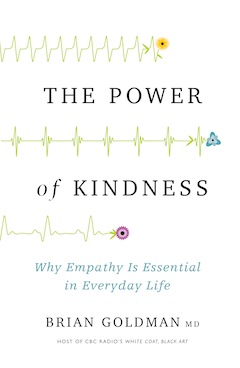
According to Dr. Brian Goldman, author of The Power of Kindness: Why Empathy is Essential in Everyday Life (HarperCollins Publishers, 2018), we all have the innate ability to be kind, gentle and to give of ourselves without the need to get anything in return.

Goldman, who works as an emergency physician at Mount Sinai Hospital in Toronto, said the idea for The Power of Kindness had been germinating in his mind for a long time.

“I had originally pitched a book on empathy and health care,” he said, “and my publisher, HarperCollins, came back to me and asked why I don’t instead aim a little broader and write a book about empathy in the world at large, not focus just on the hospital.”

About the concept, he said, “The wise physician knows how to say, ‘I don’t know.’ The book doesn’t say how it feels to say ‘I don’t know’ 17 times in a row. At some point, you’re terrified that they’re going to say, ‘Why don’t you get us someone here right now who can answer our questions?’ And you’re afraid of being unmasked as being inadequate.”

In recognizing this in himself, Goldman decided to travel the world to speak to some of the kindest people to hopefully internalize their kindness and find ways to pass their enlightenment onto others. In doing this, he said, “I found answers and, for the rest, you’re going to have to read the book. But, I will tell you one thing. I found that some people are born with empathy.

“I found one extraordinary child,” he said, by way of example, “who was nicknamed ‘Ta Ta.’ And he, at the time that I met him, was [almost] 3 years old. His mom, Shala, adopted a man on the streets of Sao Paulo who had been homeless for nearly 40 years and called him her soulmate. The striking thing about her situation is that her son, as a toddler … without ever having known what his mom had done, adopted his own homeless man. You can’t make that up.

“At a time, whatever nurturing she provided had set the stage for him to be as empathic as her. But, he [also] feels things and understands things intuitively about Adriano, the man who he befriended in the same way that Shala did.”

Goldman met people for whom empathy comes naturally and some who are gifted in empathy, but he also realized that we all share the same common experiences – adversity, disappointment, shock, loneliness, physical ailments and failure.

“I think, more often than not, it’s these experiences that are the engine for empathy,” said Goldman. “Because, after that, you can either die or you can pay it forward. And the way you pay it forward is to provide comfort and empathy for people who are going through what you went through. That was probably the common denominator that I saw again and again.

“Shame-based people tend to absorb the idea that they cannot make a mistake. If they do, it will be the end of everything.

“My intuitive guess is that a lot of health professionals feel that way and that’s why they go into the health professions … because they are hoping that, if they can do enough good works, it will make up for the one mistake they made.

“I was very much like that. I wasn’t totally like that, because, if I were more like that, I’d be unaware of all the things I’m saying right now.”

image - The Power of Kindness book coverAccording to Goldman, kindness and empathy are the ability to imagine what it is like to be somebody else, to see things through their eyes and act accordingly, to put yourself in their place.

“Unless you have a narcissistic personality disorder, in which your brain circuits will show you’re less capable of empathy, you’re capable of empathy,” said Goldman. “Everyone is hardwired for empathy. But, the thing is that, at the highest levels of executive function, empathy is a choice and we are constantly being distracted by competing priorities – my needs versus yours, my family versus your family. I’m running around like a pinball … boy, that’s a dated metaphor … but I can’t be all things to all people all the time. It’s impossible. Somebody is going to judge what I’ve delivered as unkind care.

“To become more kind in everyday life,” he said, “first of all, believe in your hardwiredness to be capable of being kind and empathic. Know that there are things that get in the way and they are very stereotypical – lack of face-to-face time, spending more time on social media, contacting people on social media, and less time on listening and face-to-face and being able to recognize cues that say that somebody’s more unhappy than their words are telling you.”

Goldman suggests learning which factors get in your way and to start creating ways that work for you to push those distractions aside. In The Power of Kindness, he talks about breathing exercises – about how we get distracted by unpleasant thoughts and feelings and how to re-centre ourselves and allow the negativity to float away.

“I use the metaphor of a parade,” he said. “There are beautiful floats and they represent nice thoughts – happy things that have happened or that I’m looking forward to – and you let them float by without judging them. Then, every once in awhile, there is a lousy float that’s ugly – the boss who is yelling at you, the coworker or somebody who you think is whispering about you behind your back, or the person who gave you the finger in traffic when you were both driving.

“The reason I like the float metaphor is that, with a lousy float, you let it go by – you imagine you’re in the stands, reviewing the floats as they go by. If it’s a parade, you let it go by, because there will be another nice one down the road in a couple of minutes.”

As for what sort of reception the book has garnered so far, Goldman said it has been very positive.

“Maybe the world is ready for a book like this because we’re all living at such a time when … people are going for kill shots on Twitter and there’s so much nastiness…. We’re watching, in the United States, kids being separated from their parents and put into cages. We need kindness.”

Rebeca Kuropatwa is a Winnipeg freelance writer.

Format ImagePosted on September 7, 2018September 6, 2018Author Rebeca KuropatwaCategories BooksTags Brian Goldman, empathy, health, lifestyle
New way to see apartments

New way to see apartments

Jordan Billinkoff, left, and Josh Glow started the company Gryd, winner of the Canadian Federation of Apartment Associations’ New Product or Service of the Year Award. (photo from Gryd)

The Toronto-based start-up Gryd is reinventing the look and feel of finding a place to rent.

Created by Winnipeg Jewish community members Jordan Billinkoff and Josh Glow – who started their careers as b’nai mitzvah photographers/videographers – Gryd provides property management companies with a virtual reality (VR) video of the place they want to rent out.

The idea is sometimes a hard sell to management companies, Billinkoff told the Independent, but renters are lining up to use it. The Canadian Federation of Apartment Associations has recognized Gryd as the best new product on the market.

“I’ve always been very interested in technology and digital media,” said Billinkoff. “And, when I was younger, I was making a lot of videos for fun, and people started saying I could make money shooting videos. So, I started shooting bar mitzvah videos.”

At 24, he started doing more commercial work, mainly in real estate, which led him to start a company called Property Reel, which produced photos and videos for real estate properties.

“And then,” he said, “I realized there are a lot more opportunities for new technologies and enhancing the user experience … the way people search for properties online. So, I decided to change the name to Gryd and we got involved with VR [virtual reality], augmented reality (AR), technologies.”

Billinkoff went to Gray Academy of Jewish Education until Grade 7 before transferring to Grant Park High School and then finishing high school at the University of Winnipeg Collegiate.

“I was always curious about what was coming up next and I wanted to experiment with new technologies that I thought would be promising,” said Billinkoff. “I saw a lot of promise and potential in 3-D technology.

“When I say 3-D technology, I think of VR and AR. Both of these technologies are built on video game engines. The same tools that developers use to make video games are what our developers use to create 3-D models for VR and AR apps.”

So, they bought a 3-D camera and started filming some properties and some 3-D models of properties to gauge public interest. It was a hit with some of their already existing clients.

The product takes a couple of different forms.

“There are the 3-D tours,” said Billinkoff. “With the 3-D tours, you can view them with the headset on. So, the 3-D tours you can put online and you can use them on a desktop, tablet or phone.

“Taking it to the next level, you have a virtual reality headset and can view it in VR. So, you’re immersed in the property, which creates a dimensionally accurate 3-D model.”

To achieve this, Gryd uses a 3-D scanning camera that creates a wire frame of the environment it’s in. It places each VR photograph on top of the wire frame to make a 3-D model of the property. It is not a mere rendering, but a 3-D model that is dimensionally accurate.

On top of this, there is the floor plan, which users can view by clicking that option. “You can move it around in 3-D, so you can see different vantage points of the floor plan,” said Billinkoff. “The traditional virtual tours were 360-degree panoramic photos, where you click on one, wait for it to load, then click on another. But, with these 3-D models, you can actually walk around with a full range of motion … and, there are no loading wait times.”

photo - Gryd allows users to see a rental space as if they were actually in it
Gryd allows users to see a rental space as if they were actually in it. (photo from Gryd)

VR goggles are a new technology and most companies are just starting to use them in their leasing centres or corporate offices. The technology allows a potential lessee or buyer to be immersed in a place that is not yet built.

Because the technology is so new, Billinkoff has been holding off on releasing his 3-D videos for the past few years in order to build up a content library of tours before they launch.

While the 3-D headsets cost close to $300, Gryd is selling ones that are only $15 and allow anyone to use their own smartphone as the 3-D screen.

The biggest challenge has been convincing property managers to invest $250 on a property that typically rents in a couple of weeks during a slow period.

“So, we’re kind of fighting for the renters, to create a better user experience even in these markets where everything is leasing anyways,” said Billinkoff.

While most property managers are open to the idea of shooting 3-D tours, he said, “They just have such low vacancies that, a lot of times, they won’t even have a vacancy available, to be able to shoot the unit, for another half a year. So, there are a lot of logistical issues with that, because of the low vacancy.

“Also, property management isn’t known for being the most innovative industry. So, a lot of property managers are comfortable with their old-school routines and processes. This is something very new and high-tech.”

When Gryd first started shooting VR in 2015-2016, they would not mention it in the sales pitch, knowing it would likely cause resistance. Instead, they shot as many 3-D tours as they could over two to three years. Then, they launched a VR app, which has a library of 3-D tours, and property managers receive this bonus.

“We sold them the 3-D tours,” said Billinkoff. “Then, one day, which was a couple months ago, we put the switch on, and all the tours turned VR. And we informed all our clients that they now have this new and awesome bonus.”

At first, Billinkoff did all the shooting, but now Gryd has a network of trained photographers all over the country. Both Billinkoff and Glow have relocated from Winnipeg to Toronto to expand their business.

If someone visits gryd.com now, they will not yet be able to search for a place in Vancouver. But, that addition is currently in the works. Billinkoff anticipates that it will come into effect as of spring 2019.

“The number one thing we hear from all the property managers is that having the 3-D tours pre-qualifies the renters,” said Billinkoff. “So, if a renter is coming in to see the unit in person, they’re already very well-informed. They’ve already seen everything they need to know online. So, if they are coming in, they are already ready to put down a deposit on the property. They are just confirming everything is what it looks like online.

“It just makes the process more efficient, as they [the property managers] are weeding out tire kickers from coming in and taking a look at the apartment. Then, on the opposite end, it works great for renters, as they don’t need to waste time going to apartments they aren’t interested in. When they go to an apartment, they already know they like it, as they’ve seen everything online.”

For more information, visit gryd.com.

Rebeca Kuropatwa is a Winnipeg freelance writer.

Format ImagePosted on August 31, 2018August 29, 2018Author Rebeca KuropatwaCategories NationalTags Gryd, housing, Jordan Billinkoff, Josh Glow, technology, Winnipeg
Love your uniqueness

Love your uniqueness

Pamela Schuller will share her story at FEDtalks Sept. 16. (photo from JFGV)

On Sept .16 at Vancouver Playhouse, as part of FEDtalks, Pamela Schuller, an internationally known disability and mental health advocate and professional stand-up comedian, will share her story. Her aim? To inspire attendees to remember and cherish what makes them unique.

Schuller divides her time between being running a Jewish teen mental health initiative in New York City and traveling the world, using her own experiences to discuss inclusion and the importance of embracing differences and disabilities.

“I tell my story of growing up with a severe case of Tourette syndrome (TS) and obsessive compulsive disorder (OCD) … and how, over time, I learned how to be more than OK with those things,” said Schuller. “I learned to love them and embrace them, and found that they add positive, incredible things to my life when I allow them to.”

According to the website tourette.ca, TS is “a neurodevelopmental or brain-based condition that causes people who have it to make involuntary sounds and movements called tics.” And, according to the Canadian Mental Health Association (cmha.ca), OCD is “a mental illness … made up of two parts – obsessions and compulsions. People may experience obsessions, compulsions or both, and they cause a lot of distress.”

Growing up in America’s Midwest, Schuller felt she stood out as the oddball kid with TS. Her mom had a hard time raising her. And, as her mom struggled, so did Schuller – dealing with having TS, as well as with numerous trips to the hospital for broken bones and depression. It took a boarding school environment for Schuller to be able to come out of her shell.

“I’d always felt like I was something my community had to work through, that I was a nuisance,” Schuller told the Independent. “But, at this boarding school … well, I’m not going to tell the whole story … I’ll save that for when I’m in Vancouver. But, I can tell you that the school knew that, if I was going to pull myself out of this space of feeling worthless, I’d need to have something about myself that I loved. So, their goal was to help me find one thing about myself that I loved. And we used that to catapult me into realizing that the one thing I love about myself translates into other areas of my life. And that, maybe, I don’t love this thing despite TS, but maybe, in actuality, TS adds to this thing that I love.”

Schuller speaks openly about being depressed before experiencing this mental shift, and of not having wanted to be a part of this world.

“To be honest, I think it’s a journey that doesn’t stop,” she said. “I still have days where it feels like having TS is bad, embarrassing or painful. And I have to remind myself that it’s OK and that there are still things I love about myself … and that, a lot of them, I learned because of TS.

“The first thing I learned that I love about myself was my sense of humour. But, it took some time to channel that sense of humour from snarky and sarcastic … to a more channeled sense of humour.

“Then, over time, I started talking seriously, not using humour, about what it means to love differences, to love the most challenging thing about yourself, the thing you struggle with the most.

“A few years ago, I realized that stand-up and talking about disabilities don’t have to be separate. So, I combined them into a talk, with humour and storytelling.”

A few years ago, Schuller earned a master’s degree in child advocacy and policy, with an emphasis on creating inclusive communities.

She believes that much of celebrating differences is about believing it is possible – that, whatever you bring to a community, you can be a part of that community.

Stand-up comedy serves as a sort of therapy for Schuller. “When I’m on stage, it’s not that my TS calms down … but, even on a tough day, I’m reminded that I love my brain,” she said. “And my brain allows me to do stand-up and have TS.

“That reminder allows me to see other things about me that I love. I think I’ve always seen the world from a different point of view, in part, because of TS. Comedy allows me to point those things out and, in a way, speak without being judged.”

Schuller encourages people to find the one thing that makes them incredible and unique.

As far as what people can expect to get out of her talk, Schuller said, “It doesn’t matter if you have a disability or not, the message is pretty universal. So, you can expect to laugh, to think about things and, maybe, sometimes, to cry, because feelings come up.

“Some of these conversations are tough. We’re all afraid of what we don’t know or maybe we don’t feel so great about ourselves or what we bring into this world. I think, by pairing humour with some of these messages and storytelling, it makes people think – about themselves and how they treat others, how they treat people in their community and what their community is doing.

“I walk into teen communities and I have everyone laughing and thinking,” she said. “And, when I finish, the teens line up to talk to me, share with me or ask questions. So, I think that my goal is to not be preachy, but to be a conversation starter.

“Typically, when communities bring me, they’ll have me perform for everyone. Then, I’ll do workshops, classes and programs. I’ve been working with communities around being inclusive for years, professionally, sharing ideas and talking about the tension points in your community around inclusion and how can we come up with some ideas that might help that.”

Schuller and her family have realized that, sometimes, the things they struggle with the most can also be their greatest strengths.

“It doesn’t mean I don’t still end up in the hospital from broken bones, from TS, but, even in those tough moments, as a family, we’re able to find humour … and to find those moments where, we’re like, ‘OK, this is so amazing … how cool that we’re learning this, doing this or experiencing this.’”

For tickets to FEDtalks ($36), visit jewishvancouver.com.

Rebeca Kuropatwa is a Winnipeg freelance writer.

Format ImagePosted on August 24, 2018August 22, 2018Author Rebeca KuropatwaCategories LocalTags annual campaign, comedy, FEDtalks, Jewish Federation, mental health, Pamela Schuller, philanthropy

Posts pagination

Previous page Page 1 … Page 8 Page 9 Page 10 … Page 31 Next page
Proudly powered by WordPress