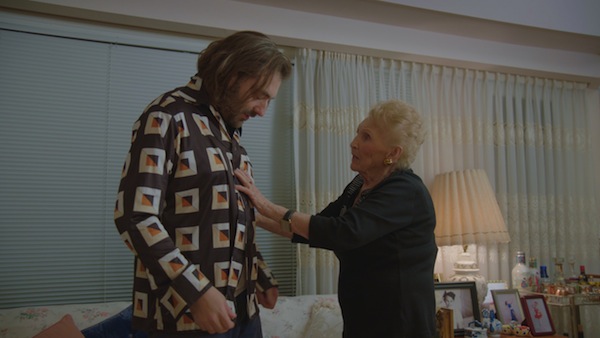
A scene from the documentary Martha, in which director Daniel Schubert is given a more appropriate shirt by his grandmother, Martha Katz. (Courtesy NFB)
Two very different scenes in the National Film Board of Canada’s short documentary film Martha – which will be released on International Holocaust Remembrance Day, Jan. 27 – combine to highlight the joy and pain that is life. Directed and co-written by Daniel Schubert, a grandson of the film’s subject, Martha Katz, there is a funny and relatable interaction where his grandmother questions his choice of shirt for the filming and provides him with a more appropriate one. This lighthearted exchange contrasts with the heart-wrenching tour that Katz takes with her grandson through the Holocaust Museum LA.
Born in Berehove, Czechoslovakia, Katz is 14 years old when she’s taken to the ghetto, then to Auschwitz. Both of her parents and two of her brothers were murdered in the Holocaust; she, along with two other brothers and two sisters, survived the concentration camps. She speaks, with emotions near the surface, about some of her experiences. The documentary is a mix of seemingly spontaneous moments, while other parts are scripted reenactments or prepared questions being asked and answered.
“My original idea for the documentary,” Schubert told the Independent, “was to track Martha and her two sisters’ incredible journey together through the ghettos and, eventually, Auschwitz. After Auschwitz, they were even forced to work at a German bomb factory together in Allendorf, manufacturing the bombs. The fact that Martha and her two sisters managed to stay together and survive through all of the horrors of the concentration camps, to me, was a miracle. I thought that would make an amazing documentary.
“But, as we developed it at the NFB, we realized that a more traditional cinéma vérité documentary could be a viable way to tell her story, too. I did not know many of the facts beforehand, so many of the things she told me in the film came as a surprise. My grandmother and I have a warm and loving relationship and I thought, why not show that on screen as I find out all of these amazing things?
“The other thing about my grandmother,” added Schubert, “is she’s hilarious. She’s the classic Jewish grandmother and I wanted that to come across. I wanted this to also be a real picture of a grandmother and her grandson and how we naturally interact.
“We also decided that in between these cinéma vérité moments would be cinematic vignettes narrated by my grandmother herself. There were many more amazing things she went through, but, due to time constraints, I picked those stories.”
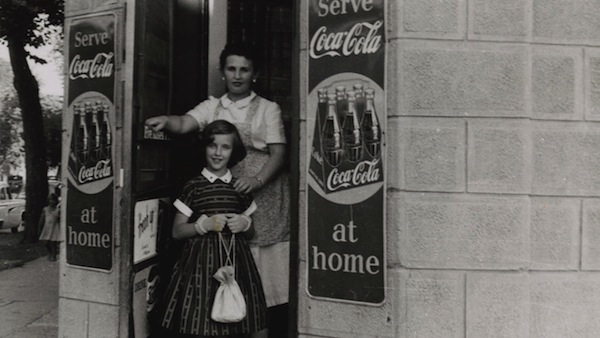
One of the stories is how, after the war, in Vienna, his grandmother met and married Bill Katz, who had been in a labour camp. The couple went to Winnipeg, with $200 they had saved up. They had two children – Jack and Sharon – and struggled financially. It was his grandmother who suggested they go into business for themselves. She went to night school, then saw an ad for a grocery store for sale – she bought it, learning on the job. There are some wonderful photos and video in this part of the film.
Martha Katz saw an ad for a grocery store for sale – she bought it, learning on the job. (photo from NFB)
It was her goal in life for her two children to have whatever they wanted and she talks about her happiness at having had them. “We had to have a life again,” she says, stressing that this doesn’t mean she doesn’t think about the Holocaust all the time, because she does – “I hope it should never happen again. That’s all.”
“Bringing her to the museum was a bit of a tough decision, but she encouraged us to go,” said Schubert. “The intention was to see whether there was anything new that she and I could both learn about the atrocities committed. And, as it turned out in the film, there was; specifically, about the excruciating length of time the gas chamber took, in some cases, to exterminate those poor victims trapped inside, including my great-grandmother and her young son. Suffice to say, it took way longer than expected, and neither of us knew how long they may have had to suffer inside.”
It was for health reasons that Katz, who is now 90 years old, moved to Los Angeles.
“My grandmother suffered from chronic bronchitis since the war and, because of Winnipeg’s frigid winters, the doctors advised her to move somewhere warmer, or else her life could be at risk,” explained Schubert. “My grandfather’s brother lived in Los Angeles, so they helped them get settled there. They came to Winnipeg from Europe in 1948 and moved to Los Angeles in 1964.”
The 22-minute documentary is dedicated to the memory of Katz’s older sister, Rose Benovich. The statement at the film’s end notes: “Her courage in Auschwitz is the reason I am alive today.”
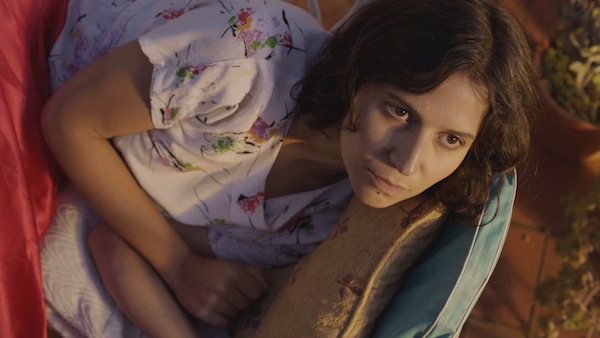
Catalina Beraducci plays Noemí Goldberg in the Topic film Noemí Gold. (photo from Topic)
For his first feature film, writer and director Dan Rubenstein has done well. Noemí Gold, which is currently streaming exclusively on Topic, is a quietly engaging story that touches upon serious issues, though never delves into them. While the story is somewhat scattered and doesn’t always make sense, the acting is strong and the glimpse into Argentine culture interesting.
The title role is played by Catalina Beraducci, who is perfect for the part. Noemí Goldberg, 27, has accidentally become pregnant from a tryst with an egotistical artist of questionable talent and character. She is an unassuming person, recently graduating with her master’s in architecture, though she doesn’t appear to have a job. When she seeks a doctor who can perform an abortion – which was an illegal procedure in Argentina until just last month – she has some trouble raising the money she’ll need to go to Uruguay to get one.
Noemí has a couple close friends – eccentric roommate Rosa and party-girl Sol – both of whom help in small but important ways. Also in Noemí’s court is her grandmother, though we find out later in the movie that their relationship has had its complications. Lastly, while all this is going on, Noemí’s cousin, David, comes to visit from Los Angeles, where his family moved when he was 7, for tragic reasons we eventually find out.
David and Noemí were once close, but, for most of the movie, their interactions are strained. David works for an energy drink company and his job is, literally, to post photos on Instagram of himself enjoying the drink in various places and while doing various activities. (He is the only one in the film who has a job, it seems.) Social media plays a prominent role in the narrative as a whole – and, hopefully, younger viewers will take it not only as a representation of themselves in film but as a critique of how much time they dedicate to promoting the fun they are ostensibly having versus actually having fun.
Women’s rights, religion (via a discussion with and seduction attempt of two young Mormon missionaries), what constitutes art (one amusing scene features an objectively poor dancer filming her own performance using a camera on a selfie stick, while being cheered and applauded by an adoring audience), the importance of forgiveness, the challenges of being a good friend, the imperfection but necessity of family, and many other topics run through Noemí Gold. There are no pronouncements and the laidback pace could fool one into thinking there is not much of substance in the film, but they’d be wrong.
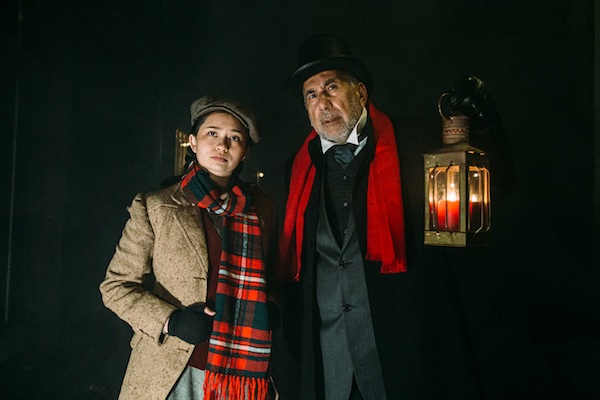
David Adams as Scrooge and Scotia Browner as Tiny Tim in Metro Theatre’s production of A Christmas Carol – The Radio Play. (photo by Nicol Spinola)
Metro Theatre was all set to provide socially distanced, safety-first live performances of A Christmas Carol – The Radio Play this month. But then the provincial restrictions on gatherings came down, and the struggling theatre company had to cancel its in-theatre run. But the production team used what holiday spirit it had to film the show and an online version will be available for viewers to watch from Dec. 21 through Jan. 3.
“We are fortunate to have our talented friends Nico Dicecco and [playwright] Erik Gow film the show and put together a beautiful digital stream of it that is available by donation,” stage manager Kat Palmer told the Independent.
Palmer has had a few shows canceled since the pandemic hit. “Right at the beginning of COVID,” she said, “I was in rehearsals for a sweet little concert Wendy Bross Stuart put together called With a Song in My Heart. I was also looking forward to Hello Dolly! at Theatre Under the Stars. And, most importantly, my company, Raincity Theatre, was gearing up for our production of Cabaret. Obviously, intimate, site-specific theatre is not possible during COVID.”
But A Christmas Carol – The Radio Play was created with COVID-19 protocols in mind. The theatre is a large space, enough for patrons to be distanced from one another. “Even the set was designed to keep actors more than six feet apart at all times,” said Palmer. In rehearsals, every cast member arrived masked and wore their mask until they were in their show spacing, she said. For the stage show, they were ready with two understudies, prepared to go on, lest “any actor wake up with any sort of tickle in their throat.”
But those plans went for naught when, last month, large public gatherings were prohibited and the show, which was to open Dec. 3, was delayed to organize the online version.
“It is no surprise that COVID has deeply impacted our arts community,” said director Chris Adams. “The Metro Theatre is a not-for-profit theatre company that relies on ticket sales to get by. Once a thriving arts hub in a former movie-house, Metro has been hit hard by COVID restrictions that have seriously impacted their revenue. The Metro also rents out their space to schools and dance companies over the quieter spring/summer months but, due to our new reality, that was also impossible this year. The Metro Theatre is at risk of closing its doors.”
Nonetheless, the show is also raising money for the charity Backpack Buddies.
“When Charles Dickens published A Christmas Carol in 1843, charitable giving soared overnight,” said Palmer. “The story has forever changed how we celebrate the holiday season and reminds us of the importance of generosity. It is in this spirit that the Metro always selects a charity to support each year at Christmas.
“Early in the show, we meet Abigail – an orphan who speaks of food insecurity. It is shocking to find parallels between children today and the Dickensian era. British Columbia has one of the highest child poverty rates in Canada, with 20% of children living below the poverty line. The Backpack Buddies program provides backpacks of food to children in need so that they do not go hungry over the weekend.”
A Christmas Carol – The Radio Play is an original work by writer Gow, based on the Charles Dickens novel, of course.
“With Christmas Carol, there is an expected order that ghosts appear. Erik has decided to shake it up,”
said Adams. “There are also some scenes that do not appear in the book that add an extra level of character development.”
The radio play stars David Adams as Ebeneezer Scrooge, who meets all the characters in A Christmas Carol, “from Bob Cratchit to Jacob Marley, but with only six actors creating and voicing over 40 of the beloved characters,” reads the play’s description. Joining David Adams “on stage” will be Roger Monk, Jill Raymond, Chris Ward, Emilia Michalowska and Scotia Browner. The COVID covers were Jim Stewart and Courtney Shields, who is also the assistant director of the production.
“All of our actors have created a character for their narrator in addition to playing every character in the piece,” said Palmer. “For the majority of our performers, they play four or five characters each. For the simplicity of the storytelling, David plays Scrooge but has also created a very unique and distinct character for his narrator. While David has played many Jewish characters, like the Merchant of Venice, Tevye and Fagin, he is not Jewish himself. Although, he has had to learn some Yiddish for roles from time to time.”
As for being a Jewish person working on a Christmas play, Palmer said, “At this time of year, I sometimes feel like Scrooge. I despise the commercialism of the holiday season, how it seems to consume the entire month of December and don’t get me started on cheesy Christmas movies. But, as a Jewish person working on this show, it is easy to see Jewish values on every page of the script. Yes, A Christmas Carol takes place at Christmas but, in many ways, A Christmas Carol is really a story of teshuvah, tzedakah and tikkun olam…. It’s a story that celebrates kindness, charity and human transformation – ideals that all parents hope to instil in their children – ideals that have deep roots in Jewish tradition. Don’t we all want to believe even the worst among us has a core of goodness?”
The filmed version of A Christmas Carol – The Radio Play is available by donation at metrotheatre.com.
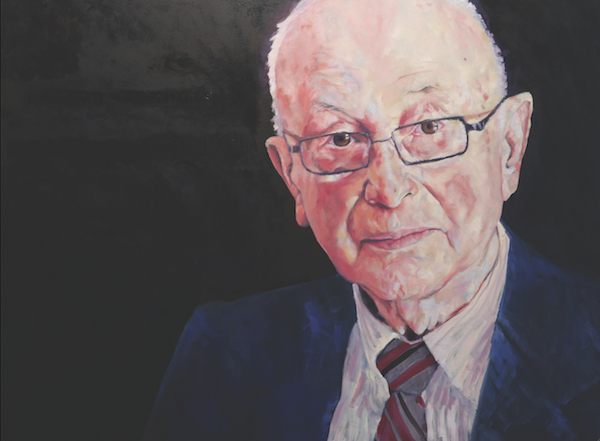
A portrait of Robbie Waisman, by artist Carol Wylie. Part of the exhibit They Didn’t Know We Were Seeds, at the Zack Gallery to Jan. 4.
Even via a wobbly Zoom-led tour, the impact of Saskatoon artist Carol Wylie’s portraits – nine of Holocaust suvivors and nine of residential school survivors – can be felt.
The title of the solo exhibit at the Zack Gallery until Jan. 4 is They Didn’t Know We Were Seeds. It is taken from the proverb: “They buried us … they didn’t know we were seeds.” And the choice of 18 portraits was deliberate.
“It was quite quick and early in the process I decided that 18 had to be the number,” said Wylie at the exhibit’s virtual opening Nov. 19, “because there’s so much darkness in the stories but there’s so much light and life in the survival… [T]here’s three of the Holocaust survivors who are involved with the March of the Living and to actually go back to the camps, to Auschwitz, and to make that walk when you were there; I can’t imagine the courage it takes. And they do it so that others are educated. That’s the rising above it and making something really powerful out of a black, dark experience.
“And I see the same thing with residential school survivors, like Gilbert [Kewistep] and like Eugene [Arcand], who spend so much of their time going around to schools and speaking in public about their experiences to make sure people are educated about that. And, again, reliving what they went through every time they tell it, I’m sure.
“So, the 18 and the connection to chai, to life, came really early in the process. It had to be 18, because that validation of life that these people represent … had to be present.”
The scale of the paintings was also chosen purposefully. “I want these portraits to take up space and to be very present and, for when you’re standing in front of them, to have them fill up your field of vision, so that you can’t wander past, uninterested and unengaged,” said Wylie.
The project started several years ago, she explained. “I saw Nate Leipciger speak at the Holocaust memorial service in Saskatoon and, it’s ridiculous, I’ve been [attending] for lots of years but, for some reason, that year, it hit me for the first time how elderly all these people are getting.”
The firsthand experience that is so powerful is soon to be lost, she said, and “I felt there was something that I had to do to help to preserve that.” And she would do it with the best tool she had, her passion and ability to create portraits.
“What I have learned over the years,” she said, “is that, when you capture the nuances of a person’s face, you really reflect who they are and much of their history and how they’re made up of that history. Even though it’s not like hearing a verbal story, it’s seeing a story in a different form.
“I started this idea to do a series of portraits of Holocaust survivors. And then, as I entered into it, little things started to pop up that were connecting the Jewish survival to the residential school experience. It started with a community seder at our local synagogue, where our rabbi, who is very forward-thinking, always has elements on the tables that recognize other groups … and, that particular year, he had made special mention of making sure that we understand – especially in Saskatchewan, where we have a really dark history of residential schools – the experience of the Indigenous people that we live with.
“And I started thinking, it’s not a parallel experience, but it’s an experience that is shared in terms of pain and suffering and then survival and rising above it…. And, because I live in Saskatchewan, this is part of the history of the land that I call home, that I’m a settler in, that this is a time of truth and reconciliation, it’s a time of trying to address these issues, so, as a personal step towards reconciliation, I can sit down, listen to the stories of some of these residential school survivors and bear witness to them and bring them in to be part of this project, so that they can converse through their portraits, as a group of survivors.”
It was only after making this decision that Wylie discovered that people like Vancouver’s Robbie Waisman – who is among those featured in the exhibit – were already meeting with residential school survivors to share ideas and experiences.
The project took about three-and-a-half years to complete. Waisman is the only Vancouver-based subject. “All the other Holocaust survivors were from Toronto, Edmonton and Saskatoon, and all the residential school survivors are from Saskatchewan,” said Wylie in an email interview with the Independent.
“I had to be really careful,” she noted at the exhibit opening. “There’s a very, very fraught history of non-Indigenous artists and non-Indigenous photographers representing Indigenous peoples and I knew I was stepping into this murky ground. All the way along, I had to keep asking myself questions about my own integrity around this, what are the reasons for why you’re doing this and does every single survivor that you talk to understand fully what this project is about and [are they] fully on board with it. At the end, I thought, if there are people who are criticizing it, that’s fine, but, I feel, after conversations I’ve had with many residential school survivors, that it’s more important that we raise this issue and more important that I make this step towards reconciliation than be fearful of doing something that maybe I shouldn’t be doing or that the art world might perceive that I shouldn’t be doing.”
When the work was completed, Arcand and Kewistep “smudged the work before it went off on its first exhibition. Then they gave me a smudge kit that I could use myself, if I wanted to, in the future. It was extremely meaningful to me; it was almost like they’d given it their stamp of approval, as well as imbuing it with these good graces and these good thoughts and this positive energy before the work went anywhere and anyone had a chance to see it.”
The exhibit has been shown in various places and will travel elsewhere after its time at the Zack.
Wylie’s general process in doing portraits is to speak with her subjects first.
“I think that, in order for the mask that we all wear in the world to protect ourselves, in order for that to drop, there needs to be time spent talking,” she said. “There’s this very strange artificial intimacy that happens when you’re sitting two feet – before COVID times – away from somebody that you’re drawing, and you’re talking and you’re looking intently at them…. So, I always wait until that couple of hours of conversation and visiting is over and then I pull out my camera.
“I need to work from photographs because I like to get a strong resemblance and I can’t have people coming back endlessly to sit for me…. But that’s when I take them, is after that time has been spent, that conversation has happened, and their mask has come down and they are open.”
The openness that is seen in the subject’s faces, stressed Wylie, “is not something that I put there, it’s something that they had. Seriously, I paint what I see… And that captures what they have, what they are, because it’s all within there, it’s all in their face.”
Given the caveat that there is something intangible about what makes a good portrait, Wylie said in an email, “I believe a portrait should bear resemblance to the subject. But, in addition, it should feel like the portrait is inhabited; like it contains the spirit of an individual. You often hear people comment about the eyes in a portrait following them. I think that’s the sensation of some element of the person, and not just their resemblance, being present. I also like to see evidence of the artist in the work in the form of brushstroke, colour choices, etc. This trace of the artist distinguishes a painted portrait from a photo.”
She described her need to create portraits as “a compulsion I’ve had since I was a child. Even then,” she said, “I drew people, made my own paper dolls. In my grad school investigations I discovered, I believe, that it’s because of a fascination I have with the mystery of consciousness, and the fact that we can never share another’s consciousness. We learn about ourselves through our interactions with others and these connections enrich our being.
“The face is a major part of how we communicate and is strongly connected to our identity,” she said. “Yet, we cannot see ourselves the way others see us, so there’s this mystery around faces. What do they hide? What do they reveal? How do you feel as ‘you’ wearing your face? How do I communicate as ‘me’ wearing my face? I am just never tired of painting a portrait, but am always excited when I begin a new one.”
The exhibit opening was hosted by gallery director Hope Forstenzer, who credited her predecessor, Linda Lando, for bringing this show in. The exhibit is open by appointment and via onlyatthej.com. A commemorative book, being prepared with Wylie’s help, is in the works, as well, said Forstenzer.
On Dec. 9, 6-8 p.m., the gallery is having a Zoom event with Waisman and Wylie, as well as Lise Kirchner from the Vancouver Holocaust Education Centre and Shelley Joseph from Reconciliation Canada. Readers interested in attending should email Forstenzer at [email protected].
As I watched the National Film Board of Canada short film Old Dog, which preceded a documentary screening at this year’s Vancouver International Film Festival, I did a double take. Or, rather, a double listen. I knew that voice. And the credits confirmed it – former longtime Independent Menschenings columnist Alex Kliner was the voice of the elderly gentleman caring for his elderly dog.
Old Dog was created by writer and director Ann Marie Fleming.
“This film started off as a way of talking about aging, inspired by my namesake, Ann-Marie Fleming, who I often get mixed up with in internet searches,” said Fleming in an interview on nfb.ca. “The other Ann-Marie has a company that makes technologies for aging dogs and also for their humans. I was struck by the compassion she has for these vulnerable animals, helping them navigate the latter stages of their lives, and by how much dogs have to teach human beings.”
“Full disclosure,” Fleming told the Independent, “I made a film about twins and doubles many years ago (It’s Me, Again) and there is another Ann Marie Fleming out there I have been confused with, so it’s not unusual that I would do some sleuthing. When I read Ann-Marie’s interview and mission statement on her website for her company, Dog Quality, which makes technologies for senior dogs, I was really moved by her saying that she felt she was her best self when she was caring for her aging canines.”
So, Fleming contacted her namesake last year, and then approached the NFB, who agreed to produce it, and even suggested she use her “team” to make it: animator Kevin Langdale and composer/sound designer Gordon Durity.
“I went to 100 Mile House to meet Ann-Marie and her old dogs (literally), listen to her stories, see her technologies and get some reference footage for the animation,” said Fleming. “Then I wrote the very simple script and drew a storyboard. Kevin took my designs and made them his own – he definitely improves on them. Then it was recording the voice, cutting together an animatic, doing the animation.
“Gordon and I discussed the vibe I wanted – Dave Brubeck ‘Take 5’ meets ‘Freddy the Freeloader.’ Cool jazz from when our human character would have been in his youth. A few months later and shazam! The film is finished right as we go into a lockdown across the country.”
Fleming listened to many great voices for this film, she said. In her mind, she would think, “Does he sound mature enough? Does he sound like he really has a connection with his dog? Alex didn’t sound like anybody else. (You recognized him immediately, right?) The warmth and vulnerability and humour and care he had was just there.”
Alex was the consummate professional, she added. “I felt he was very generous to me with his performance in this little film. He can say a line a dozen nuanced ways. I love working with actors.”
Alex has been in the industry a long time, and his desire to act goes back even further – to Jewish school, when he just 7 years old, and was asked by the teacher to read the Yiddish poem “Why a Grandmother is the Way She is.”
“And I did the poem, and I got a huge applause – not so much perhaps because of the talent but because I spoke Yiddish so beautifully,” Alex told me. “And I did speak it beautifully, just the way any person who has a first language speaks it beautifully. I liked the applause and I liked doing the poem. I liked the ambience of the whole thing and, at that point, I decided I was going to be an actor. And, 20 years later, at age 27, I became a professional actor, got all my union cards because I was working in the theatre, in a union company.”
Over the years, he has been in theatre, radio, film and television, and he’s worked as both an actor and as a director. A very partial list of people with whom he has shared the screen include Melanie Griffiths, Vince Vaughn, Ellen Burstyn, Ryan Reynolds, Eddie Murphy, William H. Macy, Christopher Plummer, Sylvester Stalone, Jerry Lewis, Laura Linney, Isabella Rosselini, Jack Lemmon, Mariel Hemingway, Valerie Harper, Mandy Patinkin and Robin Williams.
“I worked with them either as an actor or as a background performer who interacted with the actor,” said Alex.
He was Mickey Rooney’s stand-in in Night at the Museum, which is also where he worked with Dick Van Dyke and Ben Stiller, among others.
The audition for Old Dog was an ordinary call, said Alex. While he hasn’t done much by way of voice work, he has done some dubbing of acting parts that didn’t come out properly sound-wise in the filming. The process for Old Dog was similar, he said.
“I just did one line and then the director said, OK, time to do the next line. Sometimes, she would ask me to do it two or three times but never more than three times,” he said. “The whole thing took a little more than an hour.”
In this type of work, while the actor doesn’t see the animation, he said, “You know what she wants, like your attitude toward the dog … and then you bring that attitude or that feeling or emotion to the line. But you do it without seeing the movie and then they sync what I’ve done vocally to the film.”
Alex’s wife, Elaine, works with him in the film industry. “We’re both still working,” said Alex. “It keeps us happy and young.”
Earlier this fall, the National Film Board of Canada released the short Come to your senses, co-created Alicia Eisen and Sophie Jarvis. It is part of NFB’s The Curve, an online series “featuring the talents of 40 creators and filmmakers, giving a voice to millions whose lives have been touched by COVID-19.”
Eisen, a member of the Jewish community, is an animation filmmaker and visual artist, while Jarvis is a writer and director. Both women are based in Vancouver and have worked together before.
“We met in 2015, when Alicia was in pre-production on her first short film, Old Man,” they co-wrote in an email interview with the Independent. “A mutual friend introduced us, as he knew that Sophie was interested in learning more about stop-motion. It turned out that we live across the street from each other, and a wonderful friendship was formed.
“We first worked together on a short film for kids that blended live action (Sophie’s arena) with stop-motion (Alicia’s arena) and was basically a vessel for us to learn more about each other’s practice and to test the waters of a working relationship. It was an intense experience that threw every obstacle at us, and we came out stronger and ready for more. Which leads us to the stop-motion short film we are currently working on with the National Film Board, Zeb’s Spider.”
When their work was interrupted by the pandemic back in March, they said, “It was very disorienting to have that full-time routine stopped cold, so, when the NFB offered us the opportunity to contribute to their pandemic series, The Curve, it was a blessing to focus our creative energy into something new, and completely different from anything we have ever created before.”
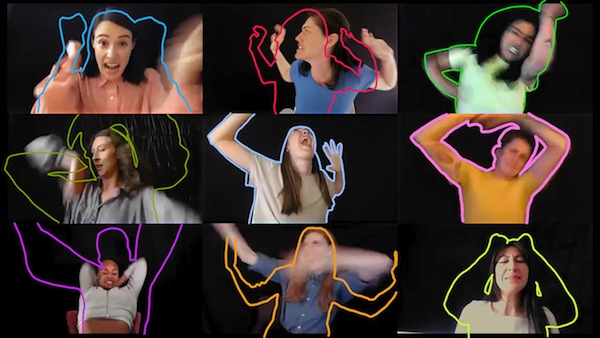
Using the format of a group Zoom, Come to your senses explores the question, “Is the human need to make sense of chaos an inherently chaotic pursuit?”
“The five senses can be a somewhat intangible subject to explore, especially through film (which is an audiovisual medium). We aimed to evoke the other three senses with these limitations, which meant that we had to get a little weird with imagery and sound,” said Eisen and Jarvis. “A large part of our process was to let our intuition guide us; instead of planning what footage we needed to collect to complete the film, we issued open guidelines to ourselves and our artistic collaborators and worked with what we received…. It was exciting to see the patterns and instincts that were shared amongst the group (who were all working remotely from each other), and these similarities helped guide our process into the next phase: the edit.
“Our editor, Kane Stewart, was integral to helping organize this experimental film and to creating what you see in the final cut. We gave him direction on the tone and the arc, and detailed notes on the material that we wanted to include, but ultimately let him organize the material with fresh eyes. Our sound designer, Eva Madden, took the core intention of the project and brought her own spin to the film, which was exciting. The score really sets a tone, and we were thrilled to work with Yu Su, whose personal work we admire.”
The film is voiced by an AI voice-generator, said Eisen and Jarvis. “This way, we could manipulate the speed of the voice and revel in the tech restrictions that come with that choice (which are mirrored in the group video call). We landed on a voice named Tessa, who struck the right tone – gentle but commanding, like a self-help audiobook.”
The artists collaborating on the film were people with whom Eisen and Jarvis had worked over the years: Mona Fani, Suzanne Friesen, Meredith Hama-Brown, Charlie Hannah, Kara Hornland, Arggy Jenati and Janessa St. Pierre.
“We gave everybody a list of creative prompts designed to be completed within two days … things like ‘choose a spherical item from your home and interact with it using each of your five senses.’ We asked each person to approach each prompt with a design sensibility informed by our mood board, but to ultimately bring their own flair and artistry to it, so what we received from each person was unique, yet fit into the collage that ultimately makes the film.”
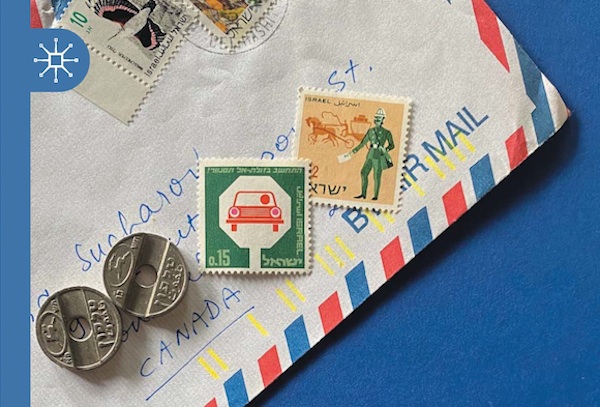
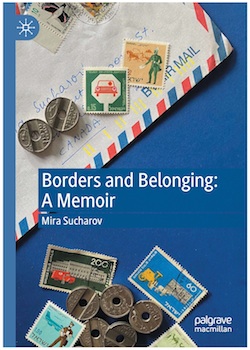
Many Jewish Independent readers will be familiar with the name Mira Sucharov. Whenever the paper ran her op-eds, at least one passionate letter to the editor could be expected. Agree with her or not on the topic of the Israeli-Palestinian conflict, she makes you think. And her latest book, Borders and Belonging: A Memoir, offers insight into how her mind works and how she has come to form her continually evolving ideas on the controversial subject.
But it’s not all politics and there’s no academic speak, though Sucharov is well-trained and has much experience in these areas – she is a professor in Carleton University’s department of political science and is University Chair of Teaching Innovations; she has developed courses for the university and has won teaching awards; she has multiple writing and editing credits. Borders and Belonging explores Sucharov’s political views and their development, but gives more time to childhood experiences, both happy and anxiety-ridden, including being a child of divorce, past romantic crushes, tales from Jewish summer camp, insights gained from living on a kibbutz, and more. It is an at-times cringeworthingly open coming-of-age story.
“I gave my dad and my mom parts to read, and I checked the scene about my daughter with her, as I did want at least their tacit blessing that this memoir wasn’t going to cause pain,” said Sucharov when the Independent asked about her candidness. “As for other family members, I basically let the chips fall where they may. I did make an effort to generally not try to ‘score points’ regarding other family members, for the most part. There’s a maxim in writing creative non-fiction (memoir), one that my writing mentor emphasized to me as well: write from scars, not wounds. Not only did I not try to actively make my family and friends appear in a bad light, I tried, most of the time anyway, to spotlight my own foibles and vulnerabilities. I think it makes for a more interesting read anyway. No one wants to read a memoir written by a narrator who is defensive and who is unaware of her own flaws.”
And Sucharov reveals many of her perceived flaws. She has dealt with high levels of anxiety her whole life, it seems, and, in many an instance, her stomach flips or lurches from feelings of rejection, excitement over a boy, worry over being among kids she doesn’t know, pleasure at being in beautiful surroundings, or tension at being confronted by someone who disagrees with her.
In addition to the sometimes-brutal self-assessment, readers will also be struck by Sucharov’s memory. The details – books read, games played, reimagined conversations, etc. – are noteworthy. And Sucharov did take notes, she said. She kept a journal for a couple of summers when she was a camp counselor and when she was in Israel in the early 1990s. But, she said, “I remember a lot. For some childhood scenes, I juxtaposed memories of objects I knew I owned (specific toys, games, clothing and books) with particular events I recall occurring. So, for example, when ‘Leah’ sleeps over, I don’t recall if I read Roald Dahl on that particular night, but I do know that I read lots of Roald Dahl at that point in my life, so I inserted it as a period detail.
“Same with the Archie comic being read in the cabin while I inadvertently undress in front of a boy, causing me great embarrassment. I don’t know for certain whether we were reading Archie comics on that particular day, but I do know that we read Archie comics during that time in our life. Adding these details is a way of setting scene and drawing the reader into a world, rather than writing, ‘we used to read Archie comics.’ I treasured my toys, books and games. I’m still trying to forgive my mom for selling my remote-controlled R2-D2 robot toy at a garage sale for five bucks one summer, while I was away at camp.”
By way of another example, Sucharov said, “As for the separation scene that takes place before I’ve even turned 4: my own memory is that my parents asked me to pick toys to place in one house and in another. Recently, though, my dad gave me a different account: he said that he and my mom took me into their bed, placed me between them and broke the news. I do not recall this. So, instead, I used the memory that I did have, even if it had been partly of my own creation. In that case, it may not have been totally accurate, but it succeeds at capturing the emotional dynamics of the event – me having to cope with my parents’ separation, which was traumatic.”
Other aspects, such as exactly which scary Disney movie she watched at her dad’s, were verified with one of her “all-time favourite tools: IMDb!” And some instances she recounts are composites of multiple moments.
Sucharov has no regrets about laying so much out there publicly. “I’m a firm believer in modeling vulnerability,” she said.
“In writing and in teaching, it creates a crucial connection between writer or professor/instructor and reader or student,” she added. “By introducing our backstage selves, it can help others better learn how to soar. It is an ethic of generosity.”
The character of Guy Nehama, played by Reshef Levi, dreams of becoming a standup comic. (photo from Topic)
It took me a couple of episodes, but then I was hooked. Initially, most of the characters on the award-winning Israeli show Nehama – in particular the lead, Guy Nehama, played by Reshef Levi – are completely unappealing, even annoying. While they more or less stay that way, they do start to show shades of competence and compassion, and begin to use humour to salve as often as to stab. But, most importantly, their intrigues, become, well, intriguing, and more plentiful.
The series starts dramatically, to say the least. Guy’s wife careens off the road, the car rolls (if I’m remembering correctly – so much has happened since then). She manages to get out of the vehicle but doesn’t make it far, though she does manage to make a short phone call. Since it’s the starting point of everything and the main plot, it’s not too much of a spoiler to share that she dies, leaving Guy with their five children, ranging in age from baby to high schooler.
A tech guru working for a beast of a man, Guy – as he repeats often – is the household’s sole breadwinner. Before his wife’s death, he had little or no time for parenting. After she dies, he has no choice but to change his attitude and his approach. It’s difficult, though, not just because of his own self-absorption, but because of the people around him and their pressures and secrets.
Overarching all this is Guy’s dream of becoming a standup comic. He had been the more talented half of a comedy duo and the fact that his partner went on to become famous, while he became his family’s breadwinner in a “real” job, frustrates Guy to no end. In the first couple of episodes, where we don’t see Guy perform, it is hard to believe that this whiny, lacklustre man who constantly dictates ridiculous stories into a recorder could be funny, but turns out he is, which, combined with him trying to do right by his kids, makes him an underdog to root for, as he discovers his wife had lied to him on more than one account – and others, including his children, continue to lie to him.
There are 10 episodes in the first season of Nehama. The acting is superb, the comedy is dark; the hour-long shows go quickly. Topic, a streaming service launched last year by First Look Media, can be accessed on topic.com, AppleTV, Android, Roku, Amazon Prime and elsewhere.
These loaded sweet potatoes were satisfyingly filling. (photo by Ingrid Weisenbach)
In a word: yum. I tried out four recipes in The Tahini Table: Go Beyond Hummus with 100 Recipes for Every Meal by Amy Zitelman with Andrew Schloss. All were delicious. All worth making. I will definitely bring more tahini into my life, but not every day, as the meals are somewhat complicated to make; at least they were for me.
Published by Surrey Books, an imprint of Agate Publishing, the cookbook is gorgeous. The colour photos by Jillian Guyette and the overall look and layout make The Tahini Table as much eye-candy as cooking guide. The first chapter is all about tahini – what it is, how to use and store it, with a foray into hummus and halvah and ingredients one should have close at hand, such as avocados, various oils, garlic and onion, yogurt, different vinegars, date syrup, etc. There is a relatively helpful instruction on how to mince garlic and a section on herbs and spices. Each recipe is labeled with the diets with which it is aligned; vegan or gluten-free or Paleo, for example.
There are six chapters, covering sauces, dips, breakfasts, lunch-type food and sides, main courses and, finally, desserts. While Zitelman promises easy and quick recipes – and perhaps they are if you do as recommended and stock up on the sauces, dressings and dips – I was starting from scratch. The two mains – the benedict and the sweet potatoes – each took almost two hours to make. Only once I started did I see, for example, that one of the benny recipe ingredients was pickled red onion, carrot or radish … go to page 127. So, off to make that before I could proceed. Oh, and don’t be fooled, as I was, by the directions for the pickles – for the benedict, you only need to make pickled onions, so adjust accordingly, unless you’re also wanting to have the carrots and radishes for other purposes. (In the end, I was happy to have made all three, but I was quite hangry while making them.)
Zitelman, who is a co-founder with her sisters of Soom Foods, writes in the introduction, “we founded Soom Foods with a vision that tahini would be a staple pantry item in the American market simply because it is a delicious, nutritious and versatile ingredient. Although this ambition was somewhat far-fetched at the time, tahini is increasingly recognized as a superfood that is rich in omega-6 fatty acids, protein and calcium.” More reason, if I needed it, to experiment further with the recipes in The Tahini Table. Here are the ones I’ve kitchen-tested so far, sans Zitelman’s informative and delightful preambles or suggestions, because of space limitations.
The Tahini Benedict was very tasty. (photo by Ingrid Weisenbach)
TAHINI BENEDICT (serves two)
sauce 2 large egg yolks 1 tbsp freshly squeezed lemon juice 1⁄4 cup premium tahini paste 1⁄2 garlic clove, chopped 1⁄4-1⁄2 tsp sea salt 2-3 tbsp boiling water
eggs 1 tomato, cut into 4 rounds 3 tsp extra virgin olive oil, divided fine sea salt and freshly ground black pepper, to taste 1⁄2 tsp ground cumin 1 tbsp white vinegar 4 large eggs
assembly 2 English muffins, split and toasted 1⁄2 cup pickled red onion, carrot or radish (see below)
To make the sauce: Fill a blender with very hot tap water to warm up the container. Wait five minutes, then drain. Add the egg yolks, lemon juice, tahini, garlic, salt and two tablespoons boiling water. Blend on medium speed until just combined, about 30 seconds. If the sauce is too thick, add the remaining one tablespoon of boiling water and blend to combine. Set aside.
To make the eggs: Turn on the broiler to high and position the broiler rack as close to the heating element as it will go.
Coat the tomato rounds with two teaspoons of the oil and set on a broiler pan. Season with salt and pepper and sprinkle on the cumin. Broil until the surface is speckled but the tomato is still firm, about three minutes.
Meanwhile, fill a 10- to 12-inch skillet with water and bring to a boil over medium heat. Add the vinegar.
Crack each egg into a separate cup or ramekin. Gently slip each egg from its cup into the water. Turn the heat to medium-low so that the water in the pan barely simmers.
Poach the eggs until the whites are set and the yolks remain creamy, about two minutes.
To assemble: Put an English muffin on each plate. Top each half with a broiled tomato. Use a slotted spatula to remove each egg from the water, wait a few seconds to let any extra water drain back into the pan, then place it on the tomato. Top each with sauce and a little pile of pickled red onion. Serve immediately.
QUICK PICKLES (makes about three cups)
6 carrots, peeled and julienned 1 red onion, peeled and very thinly sliced 12 red summer radishes, trimmed and thinly sliced 1 1⁄2 cups apple cider vinegar 1 1⁄2 cups water 6 tbsp honey 1 tbsp fine sea salt 1⁄2 tsp crushed red pepper
Put each of the cut veggies in their own pint container.
In a small saucepan, combine the vinegar, water, honey, salt and crushed red pepper and bring to a boil over medium-high heat. Pour a third of the pickling mixture over each of the veggies. Let cool for about 30 minutes before serving.
Store in closed containers in the refrigerator for up to two weeks.
LOADED TAHINI SWEET POTATOES (serves four)
1 leek, trimmed, halved lengthwise, thinly sliced (white and pale green parts) 1 (15-ounce) can chickpeas, rinsed and drained 2 tbsp extra-virgin olive oil, divided 1 garlic clove, minced with coarse sea salt 1 tsp ground coriander 1⁄2 tsp ground cumin 1⁄2 tsp smoked paprika pinch ground cinnamon fine sea salt and freshly ground black pepper, to taste 4 medium sweet potatoes, halved lengthwise 1 bunch lacinato kale, coarsely chopped 1 cup orange-rosemary tahini sauce (see below) 12 cherry tomatoes, quartered 1⁄4 cup chopped fresh flat-leaf parsley hot sauce, to taste
Turn the oven to 400ºF.
Toss the leek and chickpeas with one tablespoon of the olive oil on a rimmed sheet pan. Add the garlic, coriander, cumin, paprika, cinnamon, salt and pepper and toss to coat everything evenly. Push the leek and chickpea mixture to the edges of the sheet pan.
Rub the cut surfaces of the sweet potatoes with the remaining one tablespoon of olive oil and season with salt and pepper. Put the sweet potatoes, cut-side down, in the centre of the sheet pan. Bake until the potatoes are fork-tender, about 45 minutes.
While the potatoes are baking, boil the kale in a good amount of salted water until tender, about 10 minutes.
When the potatoes are tender, put two halves on each plate and flatten them with the back of a large fork. Transfer the kale to the sheet pan and toss with the chickpeas and leeks. Drizzle some of the tahini sauce over the potatoes and pile the veggies on top. Top with more tahini sauce and the tomatoes, parsley and hot sauce.
ORANGE-ROSEMARY TAHINI SAUCE (makes about 2 cups)
1 tbsp extra-virgin olive oil 2 tbsp finely chopped fresh rosemary leaves 2 garlic cloves, minced with coarse sea salt grated zest and juice of 1 orange (about 1⁄3 cup) 2 tbsp freshly squeezed lemon juice 1 cup premium tahini paste 1 tsp ground cumin 3⁄4 cup ice-cold water
Heat the olive oil in a small skillet over medium heat just until warm, less than a minute. Stir in the rosemary, remove from the heat and give it 10 minutes or so to cool down and get flavourful.
Meanwhile, combine the garlic, orange juice and lemon juice in a medium bowl. Let it sit for one to two minutes. Whisk the orange zest, tahini and cumin into the garlic mixture until just combined. Don’t worry if it gets thick and grainy. Whisk in the water, a quarter cup at a time, until the sauce is smooth and creamy. It should be the consistency of a creamy salad dressing, like ranch.
Stir the cooled rosemary oil into the tahini.
Store in a closed container in the refrigerator for up to three days.
TEHINA REGINA COOKIES (makes about 40 cookies)
1⁄2 cup premium tahini paste 1 cup granulated sugar 3 large eggs 1 1⁄2 tsp vanilla extract 1⁄8 tsp almond extract [optional, I’d say, as I could barely taste it] 2 1⁄4 cups all-purpose flour 2 1⁄2 tsp baking powder 1⁄2 tsp fine sea salt 1⁄4 tsp ground cardamom 1 cup white sesame seeds
Tehina Regina Cookies – a few never made it to the cooling rack. (photo by Cynthia Ramsay)
Mix the tahini and sugar in a large bowl until well combined. Beat in the eggs, vanilla and almond extract until the mixture is smooth.
Mix the flour, baking powder, salt and cardamom in a medium bowl, then stir the flour mixture into the batter just until there are no visible dry spots. The dough will be very stiff. Wrap it in plastic and refrigerate for at least one hour or as long as 24 hours.
Set two oven racks near the centre of the oven. Turn the oven to 350ºF. Line two sheet pans with parchment paper or silicone baking mats.
Put the sesame seeds in wide bowl. Scoop the dough with a one-tablespoon measure and arrange as mounds on a big sheet of aluminum foil, plastic wrap or parchment. Wet your hands and roll the mounds into egg-shaped ovals. As each one is made, coat all over with sesame seeds and place on the prepared pans, about one inch apart. You will probably get 13 to 14 cookies per pan.
Bake until golden brown, about 10 minutes. Cool the cookies for two minutes on the pans, then transfer them to wire racks to cool completely. When the pans are at room temperature again, form the remaining batter into cookies and bake in the same way.
Store in a closed container at room temperature for up to two weeks.
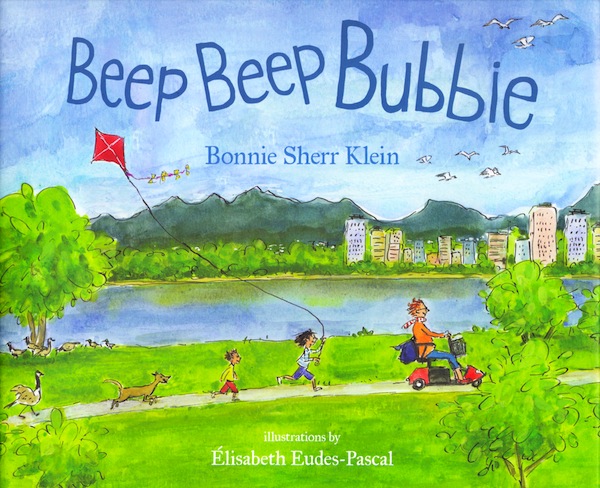
“I learned about climate marches and I learned about dancing bubbies,” said my niece Fae, 9, when we were discussing Bonnie Sherr Klein’s new children’s book, Beep Beep Bubbie, over FaceTime. Among other things, my niece Charlotte, 7, learned “you can learn to ride a bike at 53 and anything is possible.… And I learned about grandmothers who can shush a crying boy.”
Amid much laughter, including talk about dogs pooping – Bubbie has a dog – and what my nieces recalled of Vancouver from their visit here last year, Beep Beep Bubbie offered more discussion than I had anticipated. But, before I get to that, I have to say, for the record, that my nieces have dancing bubbies in their lives, and bubbies who can shush crying children, so they more related to these aspects of Bubbie’s character than learned from them. With that qualification and butt covering, I continue with the review, starting with the basic story of the book.
It is Shabbat and Kate and her little brother Nate are going to visit their grandmother, who is going to take them to Granville Island to buy apples for Rosh Hashanah. The kids have been told there’ll be a surprise waiting for them at Bubbie’s. That surprise, though – Bubbie’s new scooter – isn’t a happy one initially for Kate, who “already missed the Bubbie she used to have. That Bubbie danced and took them to climate marches.” However, during the afternoon’s adventures, Bubbie’s scooter not only allows her to venture farther from home than she otherwise would have been able to manage, but has other advantages, as well.
After their trip to Granville Island, Kate shares a library book that she’s brought along for the visit. About American educator, activist and suffragist Frances Willard, Kate and Nate find out that Willard “fought for women to have the right to vote. When Frances was 53 years old, she learned to ride a bicycle to show that women could do anything.” A conversation ensues about why Willard wouldn’t have known how to ride a bike. “People were afraid women’s ankles would show under their petticoats,” explains Bubbie. “Can you believe it?”
Well, at my nieces’ house, this part of the book was met with disbelief and more laughter, as Charlotte was keen to show off her ankles, which were hard to see, given the placement of their computer and her being the height of a 7-year-old. But, before things deteriorated into mayhem, Fae said, “I also learned that girls are tough.” And, she “learned another reason why women weren’t treated fairly in the past.”
“And what was that reason?” I asked.
“Because women didn’t ride bikes because their ankles were going to show. And they couldn’t vote, [it was] like they didn’t have an opinion.”
“It’s definitely not fair,” said Charlotte about people thinking that girls showing their ankles was wrong.
All in all, Beep Beep Bubbie elicited much talk and not an insignificant amount of gymnastics. The illustrations by Élisabeth Eudes-Pascal are wonderfully colourful and fun; full of energy and movement. Both Fae and Charlotte gave a resounding “yes” when asked if they liked the pictures.
One the drawings is a two-page spread of Bubbie, Kate and Nate and the park, where they join in the fun of flying kites. One young person is in a wheelchair, and Charlotte asked why Bubbie had chosen a scooter instead. Not knowing the answer, I asked the author. Here is her response: “I chose a motorized scooter over a wheelchair, btw, because it felt more sportif,” wrote Klein in an email, “and I am lucky enough to be able to transfer, which keeps me a bit more mobile.”
I like knowing, but the reasons aren’t important, as far as the story goes. Art is to be interpreted and my nieces and I talked about a lot of ideas, from serious to silly, during our FaceTime book review session.
Published by Tradewind Books, Beep Beep Bubbie can be purchased from pretty much any online bookseller. Enjoy!