Skip to content
  • Home
  • Subscribe / donate
  • Events calendar
  • News
    • Local
    • National
    • Israel
    • World
    • עניין בחדשות
      A roundup of news in Canada and further afield, in Hebrew.
  • Opinion
    • From the JI
    • Op-Ed
  • Arts & Culture
    • Performing Arts
    • Music
    • Books
    • Visual Arts
    • TV & Film
  • Life
    • Celebrating the Holidays
    • Travel
    • The Daily Snooze
      Cartoons by Jacob Samuel
    • Mystery Photo
      Help the JI and JMABC fill in the gaps in our archives.
  • Community Links
    • Organizations, Etc.
    • Other News Sources & Blogs
    • Business Directory
  • FAQ
  • JI Chai Celebration
  • JI@88! video

Recent Posts

  • Story of Israel’s north
  • Sheltering in train stations
  • Teach critical thinking
  • Learning to bridge divides
  • Supporting Iranian community
  • Art dismantles systems
  • Beth Tikvah celebrates 50th
  • What is Jewish music?
  • Celebrate joy of music
  • Women share experiences 
  • Raising funds for Survivors
  • Call for digital literacy
  • The hidden hand of hate
  • Tarot as spiritual ritual
  • Students create fancy meal
  • Encouraging young voices
  • Rose’s Angels delivers
  • Living life to its fullest
  • Drawing on his roots
  • Panama City welcoming
  • Pesach cleaning
  • On the wings of griffon vultures
  • Vast recipe & story collection
  • A word, please …
  • מארק קרני לא ממתין לטראמפ
  • On war and antisemitism
  • Jews shine in Canucks colours
  • Moment of opportunity
  • Shooting response
  • BC budget fails seniors
  • Ritual is what makes life holy
  • Dogs help war veterans live again
  • Remain vital and outspoken
  • An urgent play to see
  • Pop-up exhibit popular
  • An invite to join JWest

Archives

Follow @JewishIndie
image - The CJN - Visit Us Banner - 300x600 - 101625

Byline: Cynthia Ramsay

Capturing community spirit

Capturing community spirit

Photograher David Cooper in a self-portrait.

David Cooper is renowned for the skill with which he captures energy and light in photographs and film. But the multiple-award-winning artist was not appointed a Member of the Order of Canada in 2020 only for his “innovative contributions to Canadian performance photography,” but also “for his dedicated mentorship of emerging artists.” One of the many ways in which he has shown that dedication is his support of the Downtown Eastside (DTES) community in which he is based.

Cooper has taken countless photographs for the DTES Heart of the City Festival since the annual festival began 19 years ago, and for Vancouver Moving Theatre – the festival’s main presenter, along with Carnegie Community Centre and the Association of United Ukrainian Canadians – for at least three decades. The festival photo sessions at his studio have been community-building gatherings and the festival provides copies of their photos to the culturally and socially diverse artists who live, perform and create in the neighbourhood. This year’s Heart of the City takes place Oct. 26-Nov. 6, with more than 100 events throughout the DTES and online.
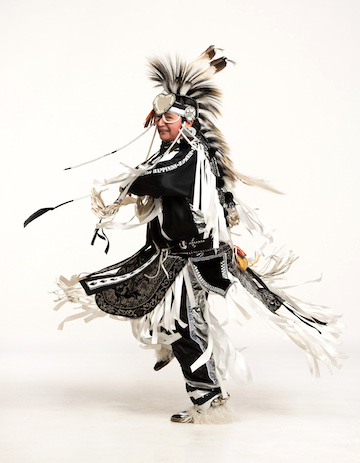
photo - Larissa Healey, from the Heart of the City Festival, in a photo taken by David Cooper
Larissa Healey, from the Heart of the City Festival, in a photo taken by David Cooper.

It was Vancouver Moving Theatre co-founder Terry Hunter who introduced Cooper to the Heart of the City Festival, since it involved artists, writers, singers and storytellers and Cooper’s career has always been in the arts. Though that wasn’t always where his interest lay.

“I started training at U of T [University of Toronto] for architecture,” Cooper told the Independent. “It was a five-year undergraduate program and I came out west after my second year, as a break. I’ve always had a camera but never had formal photography training beyond a summer course at Banff when I was a teenager. Through a friend, I checked out a local theatre company to see if they needed any photos taken. Eventually, I was given a chance to shoot a play at the Vancouver Playhouse Theatre, directed by Christopher Newton. They were really excited about the results from a dress rehearsal and offered me a job. I spent four years there in the publicity department, also creating posters and marketing material.”

Cooper is from Forest Hill in Toronto. He grew up in a conservative Jewish neighbourhood. “I went to Hebrew school but I stopped practising Judaism when I moved out west from my family,” he said. “I still go back for special occasions and joined the JCC here in Vancouver.”

As a theatre, dance and music photographer for more than 40 years, Cooper’s photos and videos have publicized more than 60 companies throughout Canada and the United States. The Shaw Festival, Bard on the Beach, Arts Club Theatre, the Royal Winnipeg Ballet, 605 Collective, Karen Flamenco Company, Vancouver Opera, Vancouver Symphony, Electra Women’s Choir, Chor Leoni Men’s Choir, Spirit of the West and Uzume Taiko Drummers are just a dozen-plus of the groups with which he has worked. He has been a stills photographer for several TV series and his dance videos have been shown internationally. In addition, he teaches and mentors students, holds workshops for both amateur and professional photographers, and photographs for theatre and dance schools.

Among the many recognitions Cooper has garnered, he received a Jessie Richardson Theatre Award in 1995 for his outstanding contribution to the Vancouver arts community and was elected a pioneer member of the B.C. Entertainment Hall of Fame in 2006.

“I’ve mostly been a theatre photographer, shooting live shows,” said Cooper. “I spent 15 years shooting film and transitioned to digital in 2001. It was a Canada Council grant in 1978 that took me to the Royal Winnipeg Ballet to learn more about ballet and I spent two weeks in class and rehearsals documenting the process.”

Firefly Books in Ontario recently published the coffee table book David Cooper Body of Work: Theatre and Dance Photography. Each of the 500 copies published includes a limited-edition print signed by Cooper.
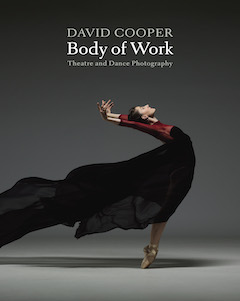
photo - Only 500 copies of David Cooper Body of Work have been printed
Only 500 copies of David Cooper Body of Work have been printed.

“I have worked with a great graphic designer and art director, Scott McKowen, for 30 years, photographing marketing materials for the Stratford Festival, the Shaw Festival, Yale Repertory Theatre, Canadian Stage, Theatre Calgary and others together,” said Cooper of how the publication came to be. “He suggested we compile all our work into a book and include my dance work that is separate from the theatre.”

According to Firefly’s website, the book includes essays on Cooper’s theatre photography (by Newton, artistic director emeritus of the Shaw Festival), on his dance images (by Vancouver writer and arts commentator Max Wyman) and on his marketing images (by McKowen). Ballet dancer Evelyn Hart “has contributed an appreciation, and Cooper himself discusses the most intimate relationship between photographer and subject – portraiture.”

When asked what the most gratifying parts of his career are, Cooper told the Independent: “Working with talented performers. Getting to travel all across Canada and the U.S. shooting for different arts organizations.”

For more information on Cooper, visit davidcooperphotography.com. To purchase a copy of David Cooper Body of Work, go to fireflybooksstand.com. And for the lineup of this year’s Heart of the City Festival, check out heartofthecityfestival.com.
Format ImagePosted on October 7, 2022October 5, 2022Author Cynthia RamsayCategories Visual ArtsTags dance, David Cooper, Downtown Eastside, DTES, Heart of the City, photography, theatre, tikkun olam
It’s all about love and family

It’s all about love and family

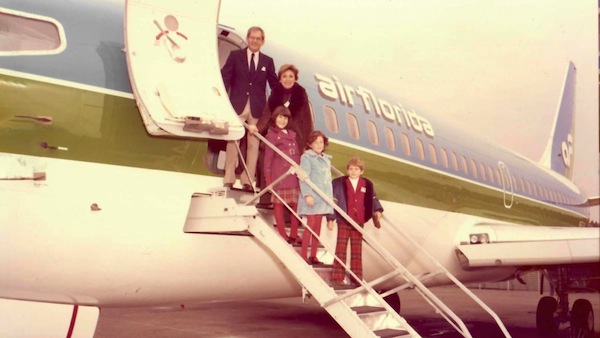
Last Flight Home follows Air Florida founder Eli Timoner’s last weeks of life. (still from film)

The Vancouver International Film Festival opens Sept. 29, and this year’s festival will be impressive, if the releases reviewed by the Independent are any indication.

Last Flight Home, a very personal and moving documentary written and directed by Ondi Timoner, will have viewers in tears. It will also have viewers contemplating mortality, family and what makes life full and worth living.

The film follows the last weeks of Timoner’s father Eli’s life. No stranger to hardship – he had been paralyzed on his left side since a stroke almost 40 years earlier – a bedridden 92-year-old Eli tells his family he wants to die. Immediately. Living in California, he could make that choice, and does make that choice. Once he passes the state assessment, the required 50-day waiting period begins.

During this time, Eli says his goodbyes to his wife, kids, grandkids and other relatives, to friends and to former employees. He offers advice and, with the help of those whose lives have been made better by his existence, he comes to love himself, finally shedding, after decades, the shame he felt at not being what he considered a good provider for his family. Before his stroke, he had been a wealthy businessman – founder and head of Air Florida – but, afterward, he and his wife had to declare bankruptcy and money was tight from then on.

Thankfully, Eli had those 50 days. While it was sad that he didn’t know how successful he really was in life until he chose to die, at least he did die knowing that he had loved and that he was loved.

* * *

photo - In Karaoke, married couple Meir and Tova rediscover their love for each other
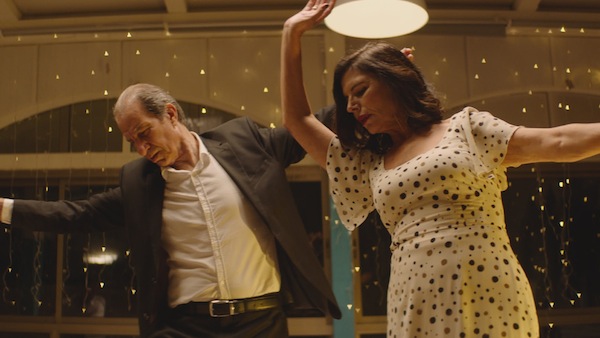
In Karaoke, married couple Meir and Tova rediscover their love for each other. (still from film)

The Israeli film Karaoke, written and directed by Moshe Rosenthal, also deals with mortality and late-in-life realizations. Long-married couple Meir and Tova have long lost their passion for each other and, really, for living. It takes the arrival of a new neighbour, Itsik, to bring out both the best and worst in them and in their relationship.

Itsik is rich and confident, a player in every sense of the word. While his loud karaoke parties annoy most everyone in the building, the residents who gain the privilege of an invitation feel not only special, but a little superior, more worldly, as they open themselves up to the possibilities that Itsik embodies.

Billed as a comedy, Karaoke is more cringey than funny, and the musical score even makes it seem creepy at times, as does the pacing and lighting. That said, the acting is excellent and it does have some funny moments. As well, the messages are refreshing: love can be reignited and you can have adventures at any age.

* * *

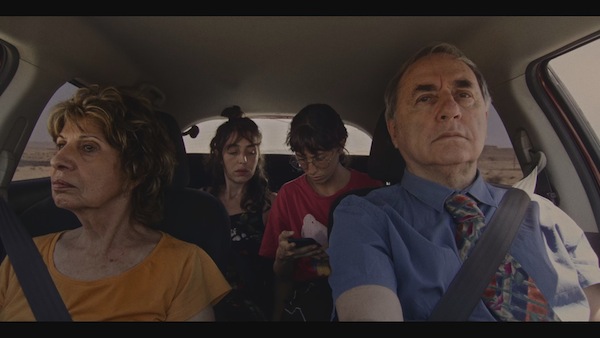
photo - To make Killing Ourselves, Maya Yadlin got her parents and sister to come out to the desert to film
To make Killing Ourselves, Maya Yadlin got her parents and sister to come out to the desert to film. (still from film)

To make the 15-minute short Killing Ourselves, Israeli filmmaker Maya Yadlin took her parents and sister to the desert. According to her bio, this is something Yadlin often does – make movies about and starring her family. The result in this case is a delightful, amusing peek into their relationships. Most viewers will appreciate the interactions, with her parents both begrudgingly and proudly helping “film student” Yadlin with her homework and her sister, an actress, coming along for the ride – and the work.

* * *

VIFF runs until Oct.  9: viff.org.

Format ImagePosted on September 16, 2022September 16, 2022Author Cynthia RamsayCategories TV & FilmTags Eli Timoner, end-of-life, MAiD, movies, Vancouver International Film Festival, VIFF
Solving a family cold case

Solving a family cold case

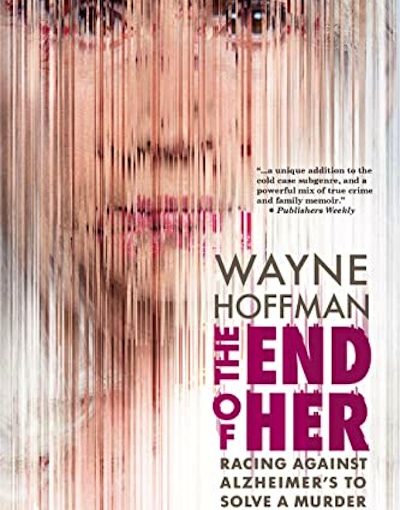
Wayne Hoffman’s latest book is about his efforts to solve the 1913 murder of his great-grandmother before his mother’s dementia takes full hold of her mind.

Well into his book The End of Her: Racing Against Alzheimer’s to Solve a Murder, Wayne Hoffman notes that it wasn’t until his mother was admitted into a nursing home that he began to read books and watch films about the disease, finding comfort in other people’s stories.

Hoffman’s nonfiction account of his mother’s decline – and his search for his maternal great-grandmother’s killer – was released this past February by Heliotrope Books. Perhaps coincidentally, I only cracked its proverbial spine (I have an electronic copy) a couple of weekends ago, the same weekend my father moved into a retirement home.

I was drawn to The End of Her both as the daughter of a parent with dementia and as a former Winnipegger. It was indeed comforting to read about how Hoffman’s family dealt with his mother’s dementia, how her dementia presented itself and how difficult the medical system was to navigate. There were many commonalities with my family’s experience, despite this part of Hoffman’s story taking place in the United States. Originally from Maryland and now living in New York, Hoffman is executive editor of the Jewish online magazine Tablet. He is a journalist, who also has published three novels, which almost guaranteed the The End of Her would be a compelling read.

Admittedly, I did not follow all the connections between Hoffman’s relatives across generations, nor find that part so interesting. But I did understand how Hoffman discovered more family during his research than he knew he had, and that this was a silver lining, though it could never compensate for the lost relationship with his mother.

Hoffman’s mother loved to tell stories and one of the more intriguing ones was of how her maternal grandmother, who had lived in Winnipeg, had been shot by a sniper while sitting on her porch nursing her new baby. Never believing the story, Hoffman kept his thoughts to himself until a video he made at Passover in 2010 revealed that his mother’s memory was failing. He thought about how the Passover story is handed down through generations, and how his family’s stories also become a part of history. He decided to challenge his mother’s – and his aunt’s – narrative about the 1913 murder of their grandmother, Sarah Fainstein. And his mother returned the challenge – asking him to tell her, then, what had happened.

Over the next 10 years or so, Hoffman searched, in fits and starts, for the true story of his great-grandmother’s death, finally finding information when he searches for Feinstein instead of Fainstein. The death certificate notes that it was, indeed, homicide. The amount of information Hoffman is able to piece together from a wide variety of sources, including conflicting newspaper reports and official documents, is impressive. He figures out the mystery to his satisfaction, but its veracity is unlikely to ever be known.

Unfortunately, by the time he reaches his conclusion, his mother’s dementia is to the point where she cannot absorb it. The photos and stories that his mother shared with him throughout his life are now his responsibility. A responsibility he takes seriously.

Format ImagePosted on September 16, 2022September 14, 2022Author Cynthia RamsayCategories BooksTags Alzheimer's, dementia, history, murder, Wayne Hoffman

Recollections of youth – Hatzaad Harishon

Sybil Kaplan, whose food articles often appear in the Jewish Independent, has a broader life experience than those articles would suggest, of course. In a recently self-published memoir, she shares a little of that experience: her time as a youth leader/advisor with the Black youth group Hatzaad Harishon, which translates as First Step.

Hatzaad Harishon: A “First Step” Love Story is as much a labour of love as was author Sybil Kaplan’s time spent in the group, which started in 1965 and ended in 1969. The group itself lasted only from 1964 to 1972.

Hatzaad Harishon is based on notes  and articles Kaplan wrote at the time, newspaper articles from which she cites extensively and other research. Many of the group’s key first members and leaders have passed away, so the contemporary voice of the book is Kaplan, with her perspective on the internal politics and ultimate impact of the group. All the names and the various comings and goings of members will mean little to most readers but it’s good to have them on record.

The publication would be mainly of interest to people who were in or encountered the group in their youth. It also would be valuable for researchers of American Jewish community history. There is published research about the group, but not an abundance of it.

Kaplan became involved in Hatzaad Harishon when she was asked to be a dance leader. The group participated in dance and other cultural events in an effort to increase interaction between white and Black Jews. There were other white Jewish leaders in the organization, including its founding director, Yaakov (or Yaacov) Gladstone, who was a Canadian Hebrew teacher. Internal and external politics contributed to the group’s dissolution, including race issues but also disagreements about how much the youth should be able to direct their own affairs, as opposed to taking direction from the adults involved.

One of the more intriguing – and sobering – aspects of Hatzaad Harishon and the period in history that it covers is how much has changed, and how much has not. Black Jews, and Jews of colour in general, still face discrimination and are still questioned about their Jewishness. New groups have formed in recent years in Canada and, no doubt, elsewhere to try and make the Jewish community more inclusive.

Hatzaad Harishon is available for purchase from Kaplan, at [email protected].

Posted on September 16, 2022September 14, 2022Author Cynthia RamsayCategories BooksTags Hatzaad Harishon, history, memoir, Sybil Kaplan
The elements of a hit song

The elements of a hit song

I freely admit it, I was one of those angsty teens who wrote bad poetry to express all my big feelings. I also wore a lot of black, but that’s not relevant here. What kind of surprises me about myself is that, despite having taken piano for years, learned various other instruments and sung in choirs since I was in single digits age-wise, it wasn’t until last year that I put some not-bad (not-great) poetry to music and wrote a song. It was inspired by my wife and it must have been beginner’s luck, because I’ve not been able to replicate that success.

This is a long preamble to why I was excited when award-winning songwriter and music consultant Molly Leikin emailed that she had a new book out: Insider Secrets to Hit Songwriting in the Digital Age (Permuted Press). While it’s too soon to say whether it will help me write another song, I did find it informative, easy to read – Leikin has a great sense of humour – and full of practical advice. I’ve just been too busy to do many of the myriad exercises and put in the time necessary to hone any skills.

There is a whole chapter on making the time to write, as well as how to quiet the inner critic, who often stops creative-aspiring people dead in their tracks. Other chapters focus on writing lyrics, composing a melody, picking a strong song title, working with a writing partner, overcoming writer’s block and other aspects of the process. There are also chapters on what needs to be done to get a song published, what royalties are, and what types of jobs you might be able to do to sustain yourself until your music can. Interspersed between the how and what chapters are interviews Leikin has conducted with some of her peers, other songwriters, producers and industry professionals.

Insider Secrets is targeted at writers who want to get into the business. And whether one succeeds at that is as much hard work as it is talent, probably more. One great aspect of Leikin’s approach is that she believes in being kind to oneself, so offers several ideas for how to reward yourself when you do put in the hard work.

“Whatever you do,” she writes, “make a point of acknowledging that you’re doing it as a reward for what you’ve just created. It is a victory in itself, just because you did it, not because your song was downloaded 10 million times. The victory starts with you.”

Ultimately, Leikin says, it comes down to persistence. It is also crucial to understand that a creative life is not a straight path, but an up-and-down one, and you have to learn how to navigate the challenges.

“A writer’s job is to write,” states Leikin. “If you do that, keep raising the level of your craft and write your fingerprint, and hustle your hustle, someday, the world will know your work. But until then, I want you to feel in your bones that you have the magic to go the distance. No Grammy can give that to you. Honestly, you have to give it to yourself, every day, all day, for the rest of your life.”

To purchase the book and for more information on Leikin, visit songmd.com.

Format ImagePosted on September 16, 2022September 14, 2022Author Cynthia RamsayCategories BooksTags Molly Leikin, music, music industry, songwriting, writing
Making the best of a mess

Making the best of a mess

Two picture books recently released by Kalaniot Books exemplify the publisher’s mission “to help young children and their families explore the diverse mosaic of Jewish culture and history.”

On the face of it, The Very Best Sukkah: A Story From Uganda by Shoshana Nambi and illustrator Moran Yogev may not seem to have much in common with Mendel’s Hanukkah Mess Up by Chana and Larry Stiefel and illustrator Daphna Awadish. But both charming publications explore the themes of inclusion via the experiences of their youthful protagonists.

The Very Best Sukkah centres around Shoshi, who likes to win any challenge, even when there’s none put forward. For example, despite her brother Avram’s plea for her to wait up, she makes sure to beat the other children to school – again. Shoshi shares, “My grandmother is always reminding me that life is not a competition. ‘Jajja,’ I tell her, ‘it’s not like I always have to win the race. I just like being at the front. The view is better there!’”

Shoshi and her brothers live with their “grandparents in a little house surrounded by coffee trees in the Abayudaya Jewish community of Uganda.” Shoshi races home on Friday nights to help her jajja make the holiday meal, in particular the kalo bread – it’s her job to mix the cassava and millet flour for the dough. The family then walks to synagogue, where the rabbi reminds the kids that their favourite holiday is coming up: Sukkot. The siblings start planning how they will make the best sukkah in the village.

Every family’s sukkah is different, “and each one reflects its builder’s special skills and talents.” For the most part, the differences are respected, but there is jealousy that Daudi, who sells samosas in the village, has enough money saved to buy “fancy battery-operated lights and elegant crochet trim in the big town of Mbale to decorate his sukkah.”

Life has a way of making playing fields level, however, and unfortunate weather one night causes mayhem, even for Daudi and his daughter, especially for Daudi, whose sukkah is destroyed. But the villagers rally around him and, in the end, the most beautiful sukkah is the one to which everyone contributes. A wonderful message, well delivered and boldly and colourfully drawn.

The Very Best Sukkah has a page about the Abayudaya, a glossary of terms and the lyrics of “Hinei Ma Tov” in Hebrew, Luganda and English: “See how good and pleasant it is for brothers and sisters to sit down together.”

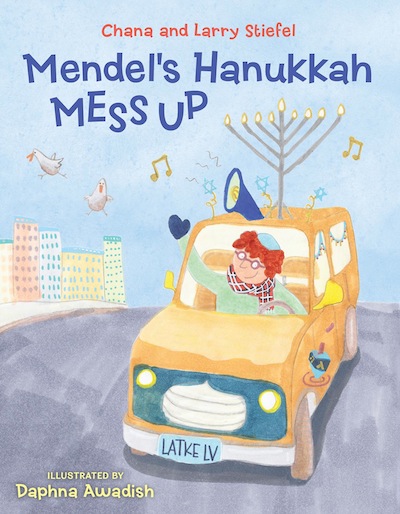
image - Mendel’s Hanukkah Mess Up book coverMendel’s Hanukkah Mess Up also features something getting wrecked. In this story, it’s a crashed-up Mitzvah Mobile rather than windblown sukkot. And, whereas it’s nature that destroys Daudi’s sukkah, it’s Mendel who doesn’t notice the bridge that’s so low as to crumple the large chanukiyah on the Mitzvah Mobile’s roof.

Anyone who knew Mendel could have predicted such an outcome when the rabbi asked him to drive the vehicle, as Mendel has a long history of mishaps, including having accidentally left a tray of jelly doughnuts on the rabbi’s chair. “Splat! ‘Oy, Mendel.’”

The unique nature of the vehicle and the accident draw a TV news team to the scene.

“‘What’s the story here?’ asked Rachel, the reporter.

“‘Um, well…’ Mendel’s words mushed like applesauce. ‘I blew it again,’ he sighed.

“Then Mendel thought of the lessons Rabbi Klein taught him. He stood up taller, like the shamash – the special Hanukkah candle that lights all of the others.

“As Mendel faced the camera, his words began to flow like silky sour cream.

“‘Hanukkah shows us the power of every person to make a difference. To rise up like the Jewish soldier Judah Maccabee fighting the mighty Greeks,’” he told Rachel. ‘If a tiny flask of oil can light up a menorah for eight days, we each have a spark to light up the world.’”

Mendel manages to turn his mistake into a win – spreading the story and joy of Hanukkah. It’s a fun story, with illustrations that are imaginative, engaging and detailed.

Mendel’s Hanukkah Mess Up ends with the story of Hanukkah and a glossary, instructions on how to play dreidel, the words to “Oh, Hanukkah” and a recipe for potato latkes, meant to be used by the young readers and their chosen adult.

For more information on these and other books, visit kalaniotbooks.com.

Format ImagePosted on September 16, 2022September 14, 2022Author Cynthia RamsayCategories BooksTags Abayudaya, Chana and Larry Stiefel, Chanukah, children's books, Daphna Awadish, Hanukkah, Jewish holidays, Kalaniot Books, Moran Yogev, Shoshana Nambi, Sukkot
Gili Yalo returns to city

Gili Yalo returns to city

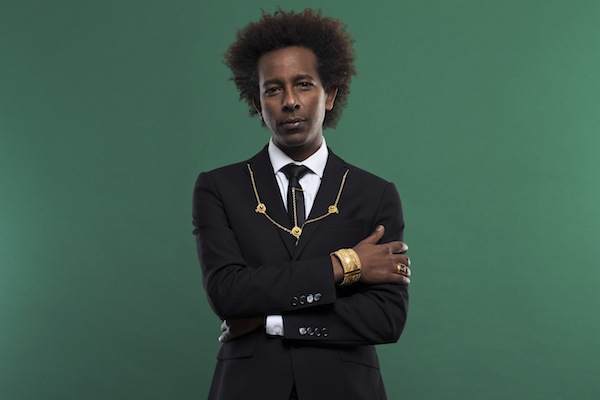
Gili Yalo performs in Vancouver on Sept. 24 for a Chutzpah! Plus event. (photo from Chutzpah!)

Israeli singer-songwriter Gili Yalo returns to Vancouver for a Chutzpah! Plus concert on Sept. 24. It’s his first time back in the city since 2015, when he was part of the band Zvuloon Dub System. Yalo said he can’t wait – “the last time at the Chutzpah! Festival was wonderful!” he told the Independent.

In 2015, Zvuloon Dub was touring the United States and other countries. “Part of the tour was the Chutzpah! Festival,” said Yalo, “and we finished the tour in Montego Bay, Jamaica, performing in the legendary festival SumFest. After being part of Zvuloon Dub for seven years, I felt that it was the right time and the right spot to start something new. I came back to Tel Aviv and started working on new songs for my solo career.”

Yalo’s eponymous first solo album, released in 2017, was very well-received and he followed it up in 2019 with the EP Made in Amharica, on which he collaborated with Dallas-based musicians in Niles City Sound, a studio in Fort Worth. He has released several singles and has played on stages and in festivals around the world.

But, even though he has been a singer his whole life and performing almost as long – including in children’s choirs and during his time in the Israel Defence Forces – Yalo resisted making music a career. Among his alternate endeavours was being a club owner.

“I opened the club for Israeli Ethiopian people, who didn’t feel safe to stand in line at Israeli clubs; back then we got a lot of refusal just because of the colour of our skin,” he explained. “At the club, there were two floors, one of R&B and reggae/dancehall music, the other one was Ethiopian music. It really affected me because I have heard and learned lots of Ethiopian music.

“After several years of running the club, I felt that I needed to do something different in my life … and I told myself, you don’t want to regret not trying to achieve your biggest dream, and I decided that I had to try and overcome my fears. It was natural for me to make a fusion of Ethiopian music and Western music such as jazz, funk, R&B and reggae, because that was my life between home and the outside.”

Born in Ethiopia, Yalo was 4 or 5 years old when he and his family fled to escape famine in 1984. Traveling by foot, it took them about two months to walk from the Gondar region, in northern Ethiopia, to refugee camps in Sudan, where they stayed for several months, until being airlifted to Israel as part of Operation Moses.

“Lots of the songs that I’m writing are talking about identity, journey and integration into society, so I think all of it came from the experience of making aliyah and the difficulty in the process,” Yalo told the Independent.

There are many things that Yalo would still like to accomplish, but, right now, he said, “I especially want to share music.” He wants to write good songs, collaborate “with musicians that I appreciate, and take my music to a place that it can inspire lots of people.”

Playing in Vancouver with Yalo will be Nadav Peled (guitar), Dor Heled (keys), Billy Aukstik (trumpet), Eran Fink (drums) and Geoffrey Muller (bass).

About coming to the city, Yalo said, “I want to say that Vancouver is one of the best places in the world. I’ve seen so many places thanks to music and, if it wasn’t so far away from my family, I would definitely consider living there.”

For tickets to the Sept. 24, 8 p.m., concert at the Rothstein Theatre, visit chutzpahfestival.com.

Format ImagePosted on September 2, 2022September 1, 2022Author Cynthia RamsayCategories MusicTags Chutzpah!, Gili Yalo, Israel, music, Rothstein Theatre
Many reasons to learn improv

Many reasons to learn improv

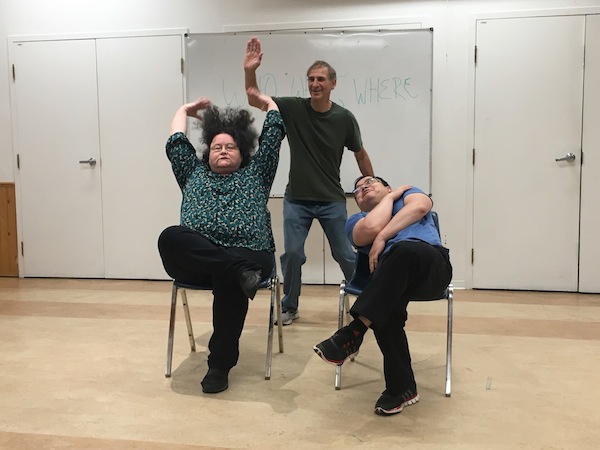
Students Adrianne Fitch and Brian Nguyen, with instructor Irwin Levin behind them. Levin and Cass Freeman teach a free workshop on Sept. 13. (photo by Adam Abrams)

“When I teach a series of eight classes, I see people who are quite scared and nervous and sometimes very shy, and watch them become daring and playful improvisers towards the last class, and that is quite satisfying,” Cass Freeman told the Independent.

Freeman and her husband, Irwin Levin, are teaching an improv workshop with a focus on teamwork at Mount Pleasant Neighbourhood House Sept. 13. As well, Freeman is teaching a series at the Roundhouse Community Arts and Recreation Centre that runs eight Tuesday nights, starting Sept. 20.

“We really care about our students’ experiences,” said Freeman, who has taught improv comedy games on and off since the early 1990s. “We really want them to enjoy themselves and relax so they can be spontaneous. We rarely put people on the spot and, when we do, we coach them, so they don’t have to struggle up there alone.”

Freeman was an injured dancer when she found Vancouver Theatresports, now called the Improv Centre. “I saw them perform one night in the 1980s,” she said, “and I thought, ‘I can do that!’ So, I took a series of classes there and ended up performing in their first-ever Rookie Night. I was terrified, but I remember the audience endowing me as embarrassed, so I just hid behind the other players for a whole scene and did OK.

“Improv is such a positive form of theatre,” she added. “The people are really great, very playful and intelligent. I was quite a negative person in some ways, during my 20s especially. Improv really turned around my life. I was much more accepting of other people’s ideas. And I found the work to be really healing.”

Levin first heard about improv from Freeman. “I was doing standup comedy when I met Cass and found out that she was doing improv,” he said. “I was attracted to both Cass and improv simultaneously! (We met in 1994 and were married in 2000.) Now I will be taking a standup course as well as assisting Cass in improv workshops, so I will be getting the best of both comedy worlds.”

The couple has recently started their own improv business.

“We’d like to spread some playfulness, laughter and joy around our little corner of the world,” said Freeman about the venture. “We’d like to teach improv games for teamwork, stress reduction and creativity or just plain fun in as many different organizations as we can. People in the Jewish community have an amazing sense of humour, so we’d love to teach anyone in the community who is interested.”

photo - Cass Freeman teaches an eight-class improv course at the Roundhouse this month, starting Sept. 20
Cass Freeman teaches an eight-class improv course at the Roundhouse this month, starting Sept. 20. (photo by Irwin Levin)

Freeman has worked as a freelance journalist in radio, television and print since 1987. Her first article in the Jewish Independent, which was then called the Jewish Western Bulletin, was in 1982 – about human rights activist Judy Feld Carr and her efforts over some 30 years to bring Jews out of Syria. Her most recent article was this past April, a profile of Vancouver Playback Theatre.

Local readers may also know Freeman’s name from The World According to Keith, a 2004 documentary for Bravo TV that she co-produced, about Theatresports creator and instructor Keith Johnstone.

“Keith Johnstone created Theatresports, along with his university students in Calgary, during the late 1970s,” explained Freeman. “He has also taught improv all over the world and there are now more than 150 theatre troupes who perform Theatresports and other formats he has created, like Maestro Impro and his favourite format, called the Life Game. You can see Maestro Impro at Tightrope Theatre in Vancouver.

“Keith trusted me to make a documentary about him because after I watched his righthand man, Dennis Cahill, do a weekend workshop in Calgary, he said to me, ‘You were great, you were like a fly on the wall. We’ve had other journalists here and they were quite obnoxious.’

“Keith became like a second father to me,” said Freeman. “My dad came from England and Keith has the same wicked British sense of humour. We still keep in touch and I have an autographed book from him that says, ‘Be average, Cassandra,’ since he noticed that when I was in his workshops that I tried too hard.”

Another memorable moment in her career came when she was teaching at the Vancouver School Board night school, which she did for about five years. “One night,” said Freeman, “the administrator called me into his office and said, ‘The instructor next door to you is complaining that his students can’t concentrate because your students are laughing too much.’ It was the best insult anyone has ever given me.”

Levin recalled a private workshop he and Freeman did this past July. “One of the students was so inspired,” said Levin, “he has decided to pursue a career in acting.”

But aspirations to be an actor are not the main reason to learn improv.

“Improv can relieve stress, reduce stage fright and improve self-esteem,” said Freeman. “Improv games encourage creativity, quick thinking and communication skills, and are a great tool for breaking the ice, having fun and building team spirit.”

She described improv as a team sport, with almost all the games being about supporting the other person or people onstage with you. This is why it’s a great way to get over stage fright, she said, “because the focus will rarely be on you alone, like it is in standup comedy.”

Freeman and Levin welcome people of all ages, backgrounds and abilities to take their classes, as well as members of the LGBTQ+ community. And, as mentioned previously, fellow members of the Jewish community.

“We’d love to hear someone say ‘oy!’ on our stage. Or any other Yiddish or Hebrew phrases,” said Freeman. “There aren’t many improvisers out there who are Jewish and we’d like to change that.”

There are also not many improv instructors who are Jewish, she said. Nor instructors who have a disability.

“I’m among the many people who have an invisible disability,” she shared. “I’ve had it since I was 19. The way it affects me today, a few decades later, is that I can’t stand in line on pavement and I can’t walk at all unless I’m wearing a very shock absorbing running shoe. So, when I teach, I have to wear runners. At our last workshop, nine out of the 14 people participating said they had something physically wrong with them. We are delighted to be able to teach people with varying physical abilities.”

The free team-focused workshop on Sept. 13, 6-7:30 p.m., is part of Mount Pleasant Neighbourhood House’s Generations Moving Together (GMT) program, which “encourage[s] community involvement, movement, learning and connection between younger and older generations.” To register for the workshop, contact GMT coordinator Daniela Gunn-Doerge at [email protected] or call 604-879-8208, ext. 225. (Refreshments are provided.)

The improv classes at the Roundhouse run on Tuesdays from Sept. 20 to Nov. 8, 6:30-8:30 p.m. It’s $160, but half price for people who have a Leisure Access Card. To register, click here or call the Roundhouse on Sept. 17 at 604-713-1800. Freeman and Levin can be reached at [email protected] or 604-872-4638.

Format ImagePosted on September 2, 2022September 1, 2022Author Cynthia RamsayCategories Performing ArtsTags acting, education, improv
A new creative arts market

A new creative arts market

Siblings Becky, left, and Margaux Wosk (photo from We Belong!)

The first-ever We Belong! Festival will take place Aug. 27 in Downtown Vancouver. Organized by siblings Margaux and Becky Wosk, We Belong! is a “one-of-a-kind creative arts market with a focus on giving disabled artists the opportunity to showcase and sell their art.”

Margaux Wosk is a self-taught artist, an activist and a disability rights advocate, fighting for disabled small business owners to get resources. Becky Wosk is an artist, designer, writer and musician; she and Emmalee Watts form the duo Hollow Twin.

Margaux Wosk started their business, Retrophiliac (shopretrophiliac.com), more than 10 years ago. Its focus is on visual art.

“Being an openly autistic person,” said Wosk, “I found that there was a void in the marketplace for the type of items I wanted to see and purchase.

“My business has really ramped up in the last five years,” they continued, “and I focus on autistic, neurodiversity and disability pride items, such as enamel pins, patches and stickers. I design retro-inspired pins, stickers and patches as well. I also have other items I offer and I have over 26 retailers between Canada and the United States.”

Wosk also uses their business “as a way to talk to the government about disabled small business owners” and they have gone to the provincial budget meeting two years in a row “to rally for funding and resources for other people like myself.”

They explained, “Currently, as it stands, we have no resources, and any of the funding that goes to ‘inclusive employment’ only goes to employers that hire disabled people, not disabled people who own their own business.”

Part of the mission of the We Belong! Festival is to raise awareness.

“I have been part of other markets and I do enjoy it, but none of them meet all of my needs,” said Wosk. “I find that sometimes there are financial barriers, sometimes the events are just too long and I find that it can take a toll on my mind and body. I wanted to create something with little barriers for other disabled artists and we were lucky enough to be the recipients of the Downtown Vancouver BIA’s [Public Space] Vibrancy Grant. This way, we won’t have to charge our vendors any costs and we can provide them tables, canopies and chairs. I want people to see what we’re all capable of.”

The Downtown Vancouver Business Improvement Association helped secure the market’s space at 855 West Hastings St. (Lot 19), and it is being provided free of charge. The location, which is between Burrard and Howe streets, is close to Waterfront Station and other public transit points.

“Once the location and date were confirmed,” said Becky Wosk, “we were able to figure out how many vendors we can accommodate and, from there, we put out a call to artists/makers. We have a specific budget to work with, so we have been able to gather quotes for the supplies we will need to make this event successful.

“When working on an event,” she said, “it’s important to work backwards from the date that you have secured and determine what needs to be ordered/booked in advance of that date – for example, canopies need to be booked 30 days out etc. [There are] lots of small details to be mindful of!”

In addition to the vendors who will be selling their creations, the market will include four nonprofits: Artists Helping Artists, Curiko, the Jewish Community Centre of Greater Vancouver’s Art Hive, which is run by Leamore Cohen, and the BC People First Society, on whose board Margaux Wosk sits, as regional director, Lower Mainland West.

While the deadline to apply as an exhibitor has passed, the Wosks are still looking for volunteers to help with set up and tear down. Anyone interested should email [email protected].

The Aug. 27 market runs from 11 a.m. to 3 p.m.

Format ImagePosted on August 19, 2022August 18, 2022Author Cynthia RamsayCategories LocalTags art, Art Hive, BC People First Society, Becky Wosk, business, disability awareness, diversity, inclusion, JCC, Margaux Wosk, markets, We Belong!
The journey to healing

The journey to healing

Katherine Matlashewski is creator, performer and co-producer of Disclosure, which “explores the struggles of a survivor searching for pathways toward healing in an adversarial medical system.” (photo from Disclosure Productions)

“Disclosure was inspired by a true story that focuses on the process of healing,” explained Katherine Matlashewski, creator, performer and co-producer of the production that will see several performances during the Vancouver Fringe Festival, Sept. 8-18.

“The way in which trauma affects the mind and body is complex and unique to each individual,” Matlashewski told the Independent. “Through movement, spoken word, soundscape and humour, Disclosure explores the struggles of a survivor searching for pathways toward healing in an adversarial medical system.”

An interdisciplinary artist, Matlashewski is a graduate of Studio 58. She has trained with Arts Umbrella and the Arts Club, and has performed with several companies, including Theatre Replacement, Metro Theatre, Stage 43 and Royal City Musical Theatre. The award-winning theatre artist is an instructor at Carousel Theatre for Young People and Arts Umbrella.

“Prior to attending Studio 58,” she said, “my training was based in movement and musical theatre. In musical theatre, when a character does not have the words to express themselves, they sing. When singing is not enough, they dance. I do not always have the words to describe how I am feeling, so I naturally turn to creating interdisciplinary works. While I was developing Disclosure, I realized that combining multiple disciplines could be utilized to convey what could not be communicated through text.”

Every Fringe performance of Disclosure will include a 10-minute post-show discussion facilitated by a representative from WAVAW Rape Crisis Centre.

The first iteration of the one-person show was presented at Studio 58 as part of Matlashewski’s graduation solo performance this past spring. “With the hopes of expanding Disclosure to a wider audience,” she said, “I applied for the 2022 Vancouver Fringe Festival. After my performance at Studio 58, I was approached by director Jane Heyman about developing my show further. After being selected as a Vancouver Fringe Festival lottery finalist, I reached out to Jane about directing the show for the Fringe and I was overjoyed when she accepted! I then began building a creative team of local emerging and early career artists.”

Heyman is also a member of the Jewish community, and she was already attached to the production when creative producer Natasha Zacher came on board.

“Katherine and I connected in May 2022, after Disclosure was accepted into the Vancouver Fringe Festival,” said Zacher. “However, we have known each other for a few years, since working alongside each other on a (very!) different Vancouver Fringe Festival show in 2015. Katherine reached my way as she knew a good deal about my professional journey, integrating work as an independent theatre-maker and a mental health clinician. We reconnected quickly on the premise and hopes for the production, and I was very glad to join the team.”

As a producer, Zacher said, “My primary focuses are on seeking funding for the show (grants, sponsorships, donations), creating and managing our budget, coordinating timelines for marketing and promotions initiatives for the show … contracting artists, liaising with the Vancouver Fringe team regarding production needs and, recently, developing and facilitating COVID-19 safety plans.”

Given the nature of the production, there are additional safety plans.

“It is important to take the time to create a safe, inclusive and accessible rehearsal and performance space,” said Matlashewski. “Part of my artistic practice is to create a ‘room agreement.’ This is a living document, written by the artists involved in the production. In our room agreement, we include boundaries and guidelines about how we will communicate and conduct ourselves in the rehearsal process. Something I value is taking the time to include a check in and out at the beginning and end of each rehearsal day.

“In addition,” she said, “to promote self-care, the artistic team has decided to stagger rehearsals, and also observe Shabbat by not rehearsing on Fridays.”

The seriousness of the material does not mean Disclosure is devoid of lighter moments.

“There are many ways to heal from trauma. Humour is one of them!” Matlashewski said. “Having witnessed and experienced generational trauma, I have come to understand that humour can help create distance from a difficult incident. In addition, sometimes humour is more palatable for an audience. For me, the journey to healing is like a rollercoaster. It is not linear in any way. Even in the most challenging of times, humour can facilitate healing.”

Disclosure will be presented at the NEST on Granville Island during the Fringe Festival. For anyone wanting to support the show, there is a GoFundMe campaign. “Funds raised will go directly to production costs and compensating the artists involved for their time, energy and expertise,” said Matlashewski.

Other ways to support the production include buying tickets to one of the shows (vancouverfringe.com/festival/disclosure), sharing the GoFundMe page link (gofund.me/43a8ae0d) with friends and following the production on Instagram (@disclosure.production).

“I am looking forward to seeing how the audience responds to the performance,” said Zacher. “I don’t have any expectations, and want to walk into the experience of getting the show on stage as an open book. I hope the audience feels empowered to take with them whatever supports them to feel seen and heard.”

Format ImagePosted on August 19, 2022August 22, 2022Author Cynthia RamsayCategories Performing ArtsTags Disclosure, GoFundMe, healing, healthcare, Jane Heyman, Katherine Matlashewski, medical system, Natasha Zacher, sexual assault, Vancouver Fringe Festival

Posts pagination

Previous page Page 1 … Page 26 Page 27 Page 28 … Page 84 Next page
Proudly powered by WordPress