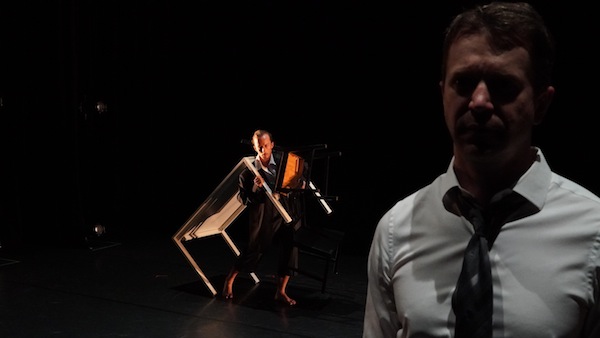
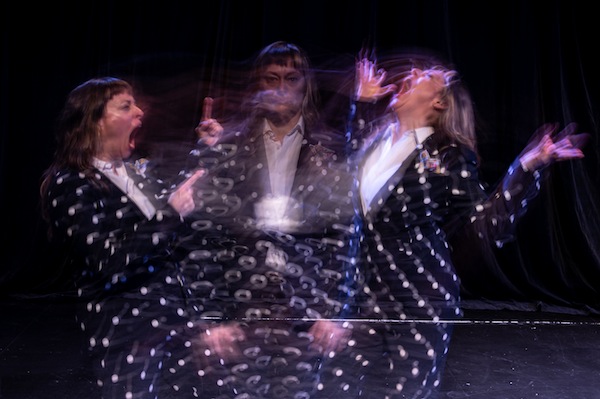
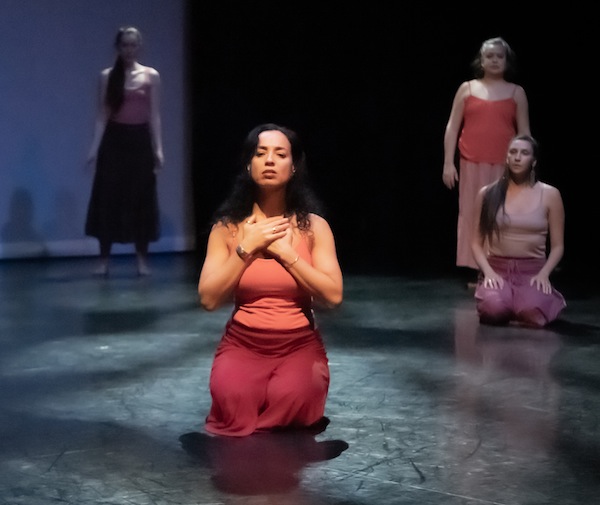
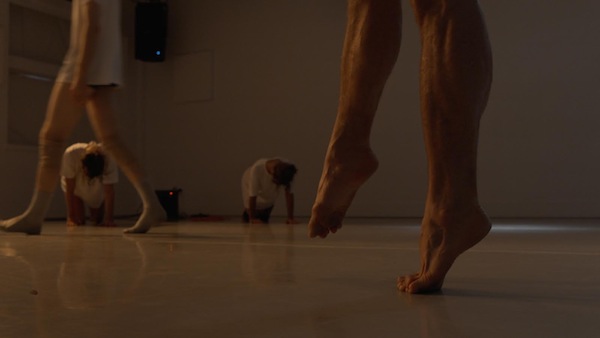
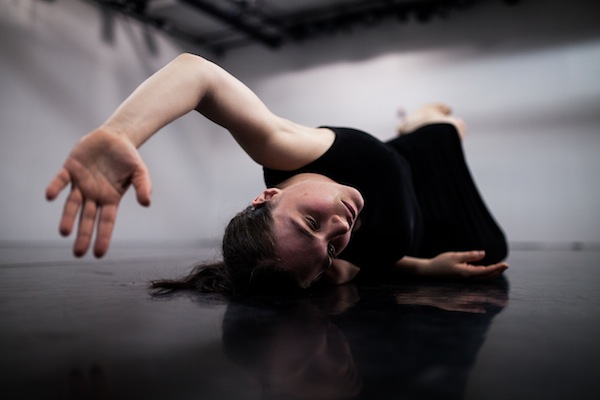
Take This Waltz performers Ted Littlemore, left, and Daniel Okulitch. (photo by Victoria Bell)
Take This Waltz world premières at Rothstein Theatre Sept. 10-11.
“The concert as a whole tells a story, and each song finds its place within that story,” Idan Cohen told the Independent about Take This Waltz, which sees its world première as a Chutzpah! Plus event Sept. 10-11 at the Rothstein Theatre.
Cohen is the artistic director of Ne. Sans Opera and Dance, so it might seem odd that he’s staging a show celebrating the music of Leonard Cohen. But he’s a fan of the Canadian icon, who died in 2016, and this production piqued his interest.
“I’ve admired Cohen’s lyrics and music for years,” said Cohen, who is not related to the singer-songwriter. “So, when Daniel Okulitch, one of Canada’s most appreciated operatic baritones reached out to me to directly to produce Take This Waltz, I immediately said yes. Daniel’s vision was to look at Cohen’s music through the classical tradition of the Song Cycles (Lieds). I thought that it was a really interesting way to look at Cohen’s music through a fresh, exciting lens.”
Okulitch contacted Cohen after having created a successful online concert that included some of Leonard Cohen’s work, as well as that of other singer-songwriters, which took place via Pacific Opera Victoria in winter 2020. Okulitch wanted to add dance to the concert.
“I knew that, if I was to take this on, I would want to focus on Cohen’s body of work and say something meaningful about the times we live in,” said Idan Cohen. “Ne. Sans’ mandate is to follow the operatic tradition in the full sense of it – to create work that integrates all the classical arts of theatre, music, dance, set and costume design. It is challenging to do in this economy, but I strongly believe in this type of offering.
“It took us some time to fundraise so that we can present this work as I believe it should be presented,” he noted. “We have an ensemble of cello, violin and accordion, with stunning arrangements by Adrian Dolan, and Daniel’s voice is so rich and sensitive, that it speaks straight to the heart. Amir Ofek is designing the set, Itai Erdal creating the light design and Christine Reimer the costumes. Alongside Daniel is the dancer/musician Ted Littlemore, with whom I’ve been collaborating for almost five years, who’s such a wonderful artist. I am truly blessed, and I hope that we’ll not just do justice to Cohen’s legacy, but help audiences experience it in a different, new way.”
About that legacy, Cohen added, “I had coffee with the wonderful Vancouver-based composer Rodney Sharman the other day, to discuss a future project that we’re working on, and Rodney said something that I found to be really relevant to Take This Waltz. He said that he thinks that my body of work is a variation of two core elements: love and death. And I thought to myself, that’s life, right? Cohen got it. His wisdom is so profound that it sometimes seems as if he knew the secrets of the human soul. I think it’s because he was brutally honest, a thing that we don’t see a lot in our contemporary culture. There’s so much pain and often bitterness and anger in his work, that are then composed in such generosity and love. What a beautiful combination. My work is to honour that.”
About his collaborators on Take This Waltz, Cohen said the production started at Pacific Opera Victoria, “as an intimate, beautiful concert of various music that included just a few of Cohen’s songs, and Vancouver Opera decided to support its development and creation. Jessica Gutteridge, a wonderful human and the artistic director of Chutzpah!, has given us a very generous creative residency at the Norman and Annette Rothstein Theatre in Vancouver’s JCC [to further develop the work]. It’s all live, no film or projections. I felt that Cohen’s work needs to be honest and direct. Having said that, there are quite a few surprises in the show – you’ll just have to come and see!”
Take This Waltz is being presented with Pacific Opera Victoria and Vancouver Opera, and Chutzpah!’s live music programming is supported by a grant from AmplifyBC. The Sept. 10-11 shows are also being supported by the Bierbrier family, in memory of Len Bierbrier, who was a dear friend of Chutzpah! board chair Lloyd Baron, said Gutteridge. Bierbrier was also a friend of Leonard Cohen, she said.
While most people cannot claim that level of connection to the legendary musician, many people do feel connected to him in some way. When asked to confirm that, indeed, he was not related to the singer-songwriter, Idan Cohen said, “We are all related, aren’t we? I first heard Cohen’s music through my dad and, in many ways, always felt that he is a father figure to me. So many of us feel that way about him and his music and poetry. I love him like family. Does that count?”
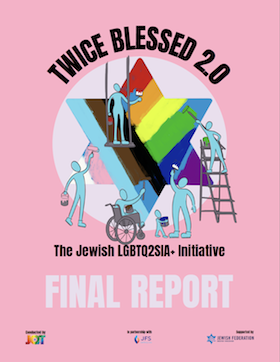
The recently released report, Twice Blessed 2.0: The Jewish LGBTQ2SIA+ Initiative, offers a hint of just how diverse the Metro Vancouver Jewish community is. In that diversity lies challenges and opportunities.
“Embarking on Twice Blessed 2.0: The Jewish LGBTQ2SIA+ Initiative has been an important step in acknowledging our gaps and our commitment to learn and work towards diversity and inclusion in the Jewish community,” write Carmel Tanaka, founder and executive director of JQT Vancouver, and Tanja Demajo, chief executive officer of Jewish Family Services Vancouver, in the final report’s preamble. “It is important to identify the work that has and has not been done. Taking pause and asking ourselves: Where are we today? What prevents us from engaging deeper into these conversations about diversity and inclusion? And where do we want to go?”
“The word diversity is used so often these days, but it is not easy to define what it means on a day-to-day basis in an environment such as JFS,” Demajo told the Independent. “This process started simply by acknowledging ‘we don’t know what we don’t know’ but we are willing to learn. Carmel and I started conversations about the LGBTQ2SIA+ community and how open JFS is to their members. Saying everyone is welcome is not enough, it takes much more commitment and work. There could have been other ways to engage in that conversation, but we started with the training and learning about the work done in 2004.”
“We are honoured to have collaborated with Dr. Jacqueline Walters, who did the 2004 survey that never saw the day of light,” said Tanaka. “It is so rare to be able to include those who have come before us in ways that help with continuity and give the opportunity for healing. A lot has changed since 2004, not just in the Jewish community on LGBTQ2SIA+ inclusion, but also more broadly, especially surrounding language and terminology. So, we paid homage to the 2004 questions and updated how these questions were asked in 2022.”
Developed from the 2004 community needs assessment conducted by JFS, many of the 2022 questions were the same, but others were added or reworded to reflect changing times or for clearer results. The survey was distributed over a two-month period this past spring, and 111 people responded, compared to 56 responses in 2004; there were three people who responded to both surveys.
The majority of respondents to the 2022 survey were in the 30-39 age bracket (or older) and ethnically self-identified as Jewish, in addition to being Canadian and of varying European identities. Of the 111 respondents, 31.8% identified as disabled (mental health, chronic pain, etc.) and 24.1% as neurodivergent (ADHD, autism, anxiety, PTSD). In 2022, half of respondents identified themselves as cultural Jews, with one-third practising other religions or ways of life; 50% were in multi-faith/racial/ethnic/cultural relationships.
These were just some of the findings indicating that there is broad diversity within the Jewish community. The findings, in part, were generated by the open-endedness of many of the questions.
“JQT approached the creation of the 2022 survey with great care and intention – a love letter to the Jewish queer and trans community,” said Tanaka. “It was and remains extremely important to JQT that the experience of filling out this survey was not triggering for those who are on the spectrum of Jewish and LGBTQ2SIA+ identities. All too often, these types of surveys, which ‘study’ our communities, don’t allow for self-identification (are not asking open-ended questions), instead forcing those being surveyed into checking boxes – boxes that either don’t fully encompass who we are and/or other us and/or are hurtful to us.”
When she saw the results, Demajo said, “I had this moment of realization that there is much social justice work that we need to do in order to reach out to those who need the support. One of the questions we ask ourselves often is ‘who are we missing and why?’ This survey and the answers we received made it clear that the community we are supposed to serve is very diverse and requires us to wrestle with questions of gender, race and religion. Some may argue that these are political questions but, for us, these are questions that impact our service delivery. If someone doesn’t feel welcomed in our space, no matter how dire their needs are, they will not accept the support.”
“The finding that most resonated with my personal experience is that, today, so many of us in the JQT community are mixed like me and/or are in mixed relationships like my family – mixed racially, culturally, ethnically, religiously, etc.,” said Tanaka, who self-describes as queer, neurodivergent and Jewpanese. “Growing up in Vancouver’s Jewish community as a mixed kid was pretty isolating. It’s great to see that the future of the Jewish community is mixed!
“The finding that surprised me the most was how many Jewish queer and trans people identify as white or Caucasian when asked about their ethnicity and race,” she added. “It wasn’t too long ago when Jews were not considered white, so it’s sobering to learn of this shift in identity.
“The finding that made me the most sad,” she said, “was how the JQT community, especially our seniors, feel about aging and entering long-term care. Honestly, it’s terrifying.”
Some of the comments made by seniors who responded to the survey were: “As a transgendered Jew long-term care is a frightening prospect as transgendered seniors are often abused in long-term care”; “Worry that my relationship will not be seen as real”; and “I fear that it will be primarily heterosexual and that I will have to go back into the closet.”
Among the 13 calls for actions made in the report are: “Develop inclusive care services for Jewish LGBTQ2SIA+ seniors” and “Ensure that senior care home intake adequately assesses the needs of LGBTQ2SIA+ residents.”
Jewish Federation of Greater Vancouver supported the survey, and one of the other recommendations is to allocate some of the annual campaign funds to the “operational costs of providing year-round Jewish LGBTQ2SIA+ programming for all ages and community outreach in both Jewish and LGBTQ2SIA+ communities.” More education is recommended, including diversity, equity, inclusion (DEI) training, and more “open discussion with rabbis, synagogues and boards to adopt an ‘open tent’ policy regarding intermarriage.” To see the full set of recommendations, visit jqtvancouver.ca/twice-blessed-2.
That all four of the 2004 recommendations still apply – more education of community leaders, a larger Jewish presence at LGBT activities, inclusion of LGBT Jewish community members on Jewish committees and boards, and increased LGBT presence at Jewish events – indicates the challenges of change, the report notes. However, Twice Blessed 2.0 also highlights some progress, including JQT’s recent partnering with the Vancouver Jewish Film Festival on a queer Jewish film, with the Zack Gallery on the first Jewish LGBTQ2SIA+ art exhibit and with the Jewish Museum and Archives of British Columbia on the first B.C. Jewish Queer and Trans Oral History.
As for JFS, Demajo said the agency’s priorities for the next year are “allocating funds for further training and awareness building” and to “partner on initiatives with LGBTQ2SIA+ agencies, ensure LGBTQ2SIA+ friendly Jewish mental health support, [and] adjust our policies to include DEI.”
She said, “JFS is in a unique position in the community to touch lives of a diverse community. At the same time, those we support don’t always reach out to us, we need to reach out to them. And, in order to do that, sensitivity, understanding of social justice and intersection of culture, gender, race and religion is essential for our ability to do the work in a sensitive and uplifting way.”
Another of the calls for action is for the adoption of a “Nothing about us without us” approach and Tanaka thanked Demajo and JFS for doing just that.
“Building trust between the JQT community and JFS, learning from one another, is the key to building a healthier Jewish community,” said Tanaka, noting that JQT is a volunteer-run group and “the only homegrown Jewish LGBTQ2SIA+ nonprofit in Canada in operation today,” funded solely by donations and grants.
JQT has presented the findings to the JFS board and in staff training, and would like the opportunity to present them to other local Jewish organizations. However, response to the report has been quiet, said Tanaka, who postulated that there is a “fear of airing dirty laundry.”
“The truth is that we’re not here to point fingers,” she said. “We’re here so that queer and trans Jews – and, in general, marginalized Jews on the periphery of the Jewish community, whether they be Jews of Colour, patrilineal Jews, disabled Jews, queer and/or trans Jews, etc. – can also benefit and have access to the same infrastructure as the mainstream Jewish community.”
Cynthia Ramsay is a member of the JQT Vancouver board.
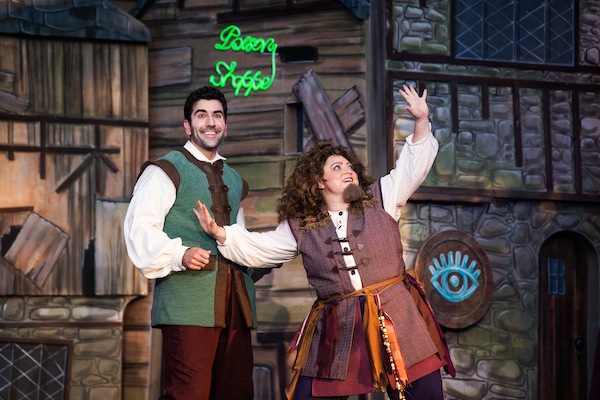
Much of the humour in Something Rotten! comes from Nostradamus (Jyla Robinson), right, leading Nick (Kamyar Pazandeh) astray with incorrect visions of the future. (photo by Emily Cooper)
Theatre Under the Stars is a fun, relaxing way to ease yourself back into theatre after the COVID hiatus. Its two productions, Something Rotten! and We Will Rock You, are happy fare that alternate nights through Aug. 27, outdoors at Stanley Park’s Malkin Bowl.
The Independent saw Something Rotten! on opening night, hoping to see Jewish community member Daniel Cardoso, who plays Jewish moneylender Shylock in the TUTS productions. However, it was understudy Simon Abraham who took on the role of the moneylender that night. He and the entire cast put on a great show.
In this comedy, set in 1595, Shakespeare is monopolizing the theatre industry and playwright siblings Nick and Nigel Bottom are trying to write a hit. They face several challenges, including being in debt to Shylock, who is willing to forgive that debt if they permit him to produce their new production. However, they initially refuse because he and they could be put to death, as Jews at the time were permitted few professions, one of which was moneylender.
Something Rotten! takes on – in very light manner – antisemitism, the treatment of the poor and the place of women in Shakespeare’s time. It also takes on these issues as they are depicted in Shakespeare’s plays and poetry.
“Shylock has been a very interesting character to explore and I extremely grateful to our director, Rachel Peake, for giving me the chance to do so,” Cardoso told the Independent in an interview before the show opened. “In researching for this part, I certainly took a cursory look at Merchant of Venice, but only so I could have an idea of who Shakespeare’s Shylock is. Because of how much Something Rotten! subverts the audience’s expectations of these well-known Shakespearean characters, there are only a few similarities between what I’m doing and what we see in Merchant of Venice. I don’t think that antisemitism is a central theme of this show, but we certainly get a view of it through Shylock.
“I also dove into what antisemitism looked like during the time of the Renaissance,” he continued, noting that Jews were “expelled from England in the late 13th century and only officially allowed to return in the mid-17th. However, it does appear that there were indeed Jewish people living in England during Shakespeare’s time and that some even fled to England from Spain and Portugal, due to the Inquisition.”
Cardoso sees parallels between Shakespeare’s time and today’s undocumented immigrants in both Canada and the United States and the refugee crises around the world. “In trying to find a way into the Shylock ofSomething Rotten!,” he said, “I found myself drawing on these modern-day examples, as well as trying to imagine what it must have been like for Jewish people in the time of the Renaissance or various other points in history. I found that, given my own connection to the community, this hit quite close to home for me. At the end of the day, he’s a smart guy who works hard and, despite the obstacles in front of him, he is able to be an equal and a friend to many of the characters in the show.”
Not such a smart guy is Nick Bottom (Kamyar Pazandeh) who, in trying to skip the hard work and best Shakespeare (Daniel Curalli), seeks out a soothsayer, Nostradamus (Jyla Robinson), who tells him that musicals are the popular theatre of the future. Nick sinks the last pennies he and his wife Bea (Katie-Rose Connors) have into a musical production with a reluctant Nigel (Vicente Sandoval), who has Shakespeare’s talent but lives in his brother’s shadow. It is only after Nigel meets Portia (Cassandra Consiglio), the daughter of Puritans, that he becomes to his own self true.
The homage to and satire of both musicals and Shakespeare makes for a lot of laughs and reference guessing – is that line or musical snippet from Annie, Evita, Rent, A Chorus Line, or more than a dozen other shows? Standout songs are “God, I Hate Shakespeare,” with the Bottom brothers’ differing views of their main competitor; “The Black Death,” a cheery ditty about the plague, the Bottoms’ first musical attempt; “Will Power,” Shakespeare enjoying his rockstar status, amid fawning, crying, screaming, fainting fans; and “Make an Omelette,” the title song of the Bottoms’ new musical. Foreseeing Omelette instead of Hamlet as Shakespeare’s best-ever play is only one of the soothsayer’s many slightly incorrect visions.
“It’s been a privilege to get to work on Something Rotten!” said Cardoso, who has been in four other TUTS productions. “It’s an extremely funny show and, if you’re a fan of either musical theatre or Shakespeare, then you’ll have a fun time at this show. And, if you like both, even better!”
For tickets to either of this season’s productions, visit tuts.ca.
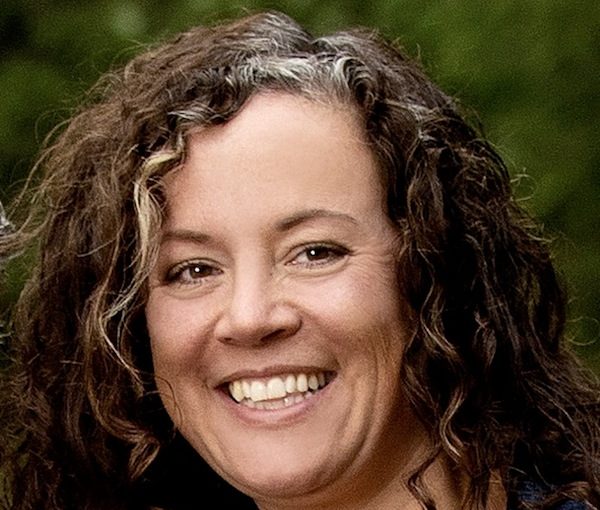
Michelle Demers Shaevitz, artistic director of Mission Folk Music Festival, which runs July 22-24. (photo from Mission Folk Music Festival)
“Mission Folk Music Festival is a wonderful combination of the familiar and the magical,” artistic director Michelle Demers Shaevitz told the Jewish Independent of how the festival has thrived for 35 years. “We’ve had the great privilege of presenting interesting and engaging music and art in a stunning setting. Imagine this creativity set among the trees, overlooking the river. We are very lucky.”
The annual festival takes place in Fraser River Heritage Park in Mission. This year, it runs over the weekend of July 22-24.
Demers Shaevitz’s history with the Mission Folk Music Festival goes back to 1991, the year she graduated from high school.
“I started by handing out volunteer tags, graduated to driving performers, moved into performer services and, from there on, to assisting our founder, Francis Xavier, with general management. When he departed in 2016, the board asked me to step into this role as the festival’s second artistic director. Adjacent to all of this, I spent 10 years working in student affairs for Simon Fraser University and the University of the Fraser Valley, as well as moving to Seattle, getting married, and having a kid.”
She credits the festival for that move and her marriage. People come to Mission from Seattle every year to volunteer and Demers Shaevitz said she has made many friends as a result.
“I was headed down there to stay with some of them and see a festival band, the Duhks, from Winnipeg,” she said. “These friends own a wine shop, West Seattle Cellars, and the night after the show, I met my future husband in the Riesling section. I’m so lucky for this festival for giving me the life I have.”
And part of that life is the Jewish community into which she married. She described herself as blessed to have it. “From the start of our relationship, Ben and I decided to incorporate Jewish traditions and holidays into our relationship,” she said. “We’re involved in the JCC here and our son attended Jewish day school for preschool and pre-K. We are members of Kol HaNeshamah in West Seattle and our son has just started Hebrew classes. I am grateful for the acceptance I’ve found in the community, as well as their amazing willingness to share knowledge, traditions and culture with me.”
In addition to the Mission Folk Music Festival, Demers Shaevitz works with Festival du Bois in Maillardville, an historic francophone neighbourhood in Coquitlam, and the Subdued Stringband Jamboree in Bellingham, Wash. She has also volunteered and served as a board member with Northwest Folklife in Seattle.
“I am lucky to have a supportive partner and a good internet connection,” she said of working remotely, notably on the folk festival. “The pandemic really demonstrated the capacity to produce and manage an event from outside of Mission. I’m generally up to Mission two to three times a month, which increases as we get closer to the festival.”
The organizing process for the music festival – which involves more than 300 volunteers – revolves around storytelling.
“If I can focus on the artistic side, I start with a story or an idea that I would like to explore,” she explained. “This year, I am digging into the idea of homecoming. I focus on artists who tell a great story through their music. Artists who are grounded in a culture and/or tradition. Artists who represent a diverse window through which to experience the world around us. It’s important to me that we highlight and celebrate diverse voices and communities. I take this responsibility very seriously.”
Another responsibility she and the festival as a whole take seriously is reconciliation – the event takes place in a park where a residential school once stood.
“We have planned our festival to respectfully acknowledge the footprint of the original site,” said Demers Shaevitz. “We are deepening relationships with the local Sto:lo community as we remain committed to the principles of the Truth and Reconciliation Commission. We continue to work towards a deeper understanding of what role we can play in the healing of this space.
“We recognize the privilege we have in presenting music and dance on these grounds and will continue to work with affected communities to prioritize their experiences,” she added.
“It’s a thrill for us to return in person to Fraser River Heritage Park for our 35th anniversary festival,” said Demers Shaevitz in the press release. “I’m excited to welcome folks back to the park to share some amazing global music with them. This year’s lineup offers festival-goers everything from singer-songwriter folk to Celtic, blues, bluegrass and soul to the uniquely amazing nu-folk of Estonia’s Puuluup, the electrifying sound of Chile’s Golosa La Orquesta and, for our Saturday night main stage final act, the dynamic Québécois zydeco of Le Winston Band…. From the heart of B.C.’s Rockies, Shred Kelly will help kick off the festival Friday night, and a true Canadian treasure, William Prince, will close the show on Sunday. And in between – there’s an incredible range of tunes to enjoy.”
Leading the festival through the worst of COVID had its challenges, but also its silver linings.
“I am so grateful to have been able to work with a talented bunch of dedicated folks to produce our two online festivals,” said Demers Shaevitz. “The highlight of this for me was all the ways in which people demonstrated their willingness to support us in any way that they could. The resilience of the artists, the community to continue was so heartening. It truly fed my heart and soul. I think that I’ve continued to draw upon that resilience to get through this return to music, this return to ‘live.’”
In addition to the concerts, the three-day live event includes music workshops, Wee Folks programming “so kids and their families can enjoy listening to the music while they play,” food and artisan markets and a licensed bistro on site. For evening, day or weekend passes, including an option to camp at the site, visit missionfolkmusicfestival.ca.
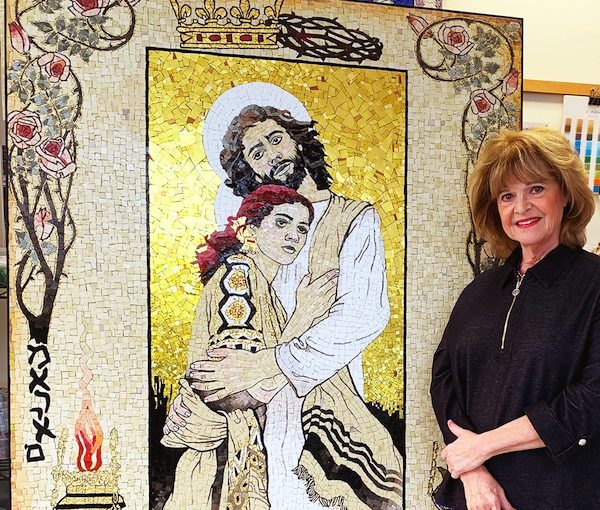
Lilian Broca stands with “Mary Magdalene, The Sacred Union,” which is one of seven panels comprising her current exhibit, Mary Magdalene Resurrected. (photo from Lilian Broca)
Lilian Broca’s artistic canon includes four series on biblical women. The latest, Mary Magdalene Resurrected, is at Il Museo at the Italian Cultural Centre until Aug. 15.
“Each series is an interpretation of a different concern,” Broca told the Independent. “Lilith is the rebel signifying hope for human courage and gender equality. Queen Esther, also courageous and wise, her story addressing the theme of sacrifice and self-empowerment, is actively involved in politics; in her time, known as an almost exclusive masculine realm. Judith, a warrior at heart who single-handedly saves her town from total annihilation, speaks of female effectiveness in the military world – a masculine tradition that she breaks, proving women don’t necessarily excel only in the domestic sphere.
“Unlike Esther and Judith, both actively involved in the masculine domain, Mariam [Mary] is a much more complex figure,” said Broca. “Her story has been greatly redacted in the first couple of centuries CE, leaving us various versions, which offer divergent perspectives of her importance and placement in the life of Yeshua Ben Yosef [Jesus]. One of the concerns in this series is about women’s place, or lack thereof, in institutions – which even in our 21st century – are restrictively based on gender.”
While it may seem odd that Mary Magdalene is included in Broca’s body of work, she reminded the Independent that Mary was “also Jewish until she died, as Christianity did not appear as such until the Edict of Milan in 313 CE and, universally, only at the Council of Nicea in 325 CE.”
A painter for many years, Broca’s Lilith series was created and exhibited in that medium, while Esther, Judith and Mariam are portrayed in mosaics.
“In 2000, I attended The Creation of the World in Jewish and Christian Art with Discussion on Illuminated Manuscripts at the Vancouver Public Library with speakers/presenters Bezalel Narkiss and Dr. Aliza Cohen-Mushlin, both of Israel,” explained Broca. “There, I saw a slide show Bezalel presented on ancient synagogues in the Levant. The Dura Europos in Syria had a beautiful fresco illustrating the Queen Esther story. I was mesmerized and, once home, I started to do some serious research on the Esther stories (more than one version)…. It was during the research that I found out that the palace in which Esther lived with her Persian king, Hashayarshah/Xerxes, had floors ‘encrusted with rubies and porphyry in pleasing designs.’ These were mosaics and, for me, a good omen. I knew I should return to creating mosaics one day, something I experimented with as a student (at 19) but stopped soon after. So, I decided to create the whole Esther series in mosaic glass.”
More than 10 years ago, Broca’s interest in Mary Magdalene was piqued by something she read on the discovery in the 1940s of the Gnostic Gospels, but various circumstances delayed further study, including a visit to her studio by Dr. Adolfo Roitman, curator of the Dead Sea Scrolls, who was in town to give a lecture. He loved the Esther series and suggested she do one on Judith, which she did.
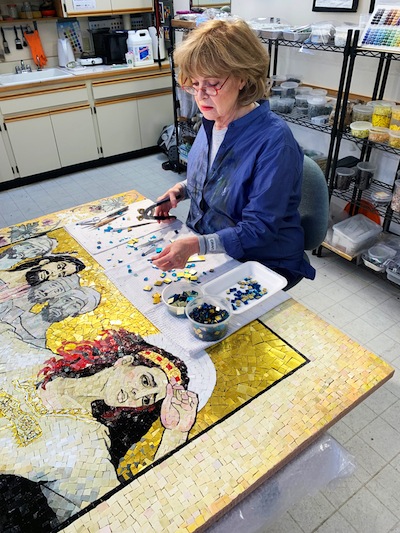
Only in 2016 did Broca return her attention to Mariam. Over eight months, she read dozens of books and essays, and drew and painted the cartoons (drawings for mosaics) for the series now on display. In making the panels, Broca had the help of Adeline Benhammouda, who used to work for Mosaika Studio in Montreal. When Broca was diagnosed with cancer, she asked the studio to make the last two mosaics in the series.
“In the meantime,” said Broca, “the pandemic slowed down activities in all institutions, especially art galleries, and I didn’t know what would happen to my future exhibition.”
The pandemic also temporarily reduced the supply of N95 masks that protected Broca – who suffered a lung infection after her radiation treatment was complete – from the silica dust that results from grinding the glass mosaic tesserae.
One of Broca’s projects as a Shadbolt Independent Scholar at Simon Fraser University was to write a letter describing her activities during the self-isolation months of COVID. All the scholars’ letters were published and Broca’s can be found at the bcreview.ca/2021/02/14/broca-pandemic-magdalene. It is addressed to Mariam and, in it, Broca explains why she chose large (79-by-48-inch) panels for this series.
“In the past, women artists, their works and their stories were mostly associated with the intimate and the small, as though they dared not take up valuable space and time,” she wrote. “As you know from my past art works, I resent that timid notion. My heroines insist and demand the space and importance that long ago was offered to masculine achievements in the military, politics and commerce.
“And, finally, Mariam, after reading so many diverse accusations, betrayals, and the vilification you were subjected to over the centuries, I have decided to express the existence of disparate accounts of your story with text in each mosaic panel, hence the illuminated manuscript composition and unifying motif. Each panel displays three to four lines in an ancient language spoken during your time on earth.”
The languages featured are Aramaic, Hebrew, Ancient Greek, Armenian, Latin, Amharic and Coptic. Broca chose to make seven panels because seven “is a sacred number in the Jewish tradition.”
“Symbolism plays an important part in my artworks and this series is no exception,” Broca told the Independent. “Each drawing includes symbols that are meaningful in both Judaic and Christian traditions. Whether they are flowers, fruit, boats, pottery or textile patterns, these symbols speak of the distant past, yet most of them are recognizable today. Just like an illuminated manuscript page, I sought to illuminate what lies hidden or repressed through the symbols on the borders of each ‘page.’ Hopefully, through them, new ideas can be brought to life.”
Lilian Broca working on the panel “Mary Magdalene, Defiled and Defamed.” Her exhibit, Mary Magdalene Resurrected, is at Il Museo until Aug. 15. (photo from Lilian Broca)
While the Esther and Judith stories have a beginning and an end, Broca said, “Mariam unfortunately is a figure that appears suddenly in Yeshua’s (arguably) 33rd year and disappears right after the Crucifixion that same year. The Gnostic Gospels and other historical documentation that refer to her following the crucifixion are interwoven with legend and myth, none of which is accepted by academics. I chose scenes from all sources, scenes that I felt relayed best her high social status during Yeshua’s life, the love and closeness the two shared, her marginalization once Yeshua died and there was no one to protect her against the ill will and jealousy of the Apostles, the relationship with Mary the Virgin and, finally, my personal vision of a balanced religion, any religion.”
For the series, Broca studied the history of the Jews in the first-century BCE to first-century CE period. “I loved all that research,” said Broca. “I learned so much about Judaism in the process. It was reassuring to read Yeshua’s Jewish parables and to realize that he was very, very concerned with the lack of faith he found in the small beit hamidrash(es) they had in those days and, of course, in the temple. The political situation at that time was extremely complex and the ‘ruling class’ of Sadducees and Pharisees kept the masses in poverty while most of them aligned themselves with the Romans and became wealthier than they had ever dreamed. Yeshua never planned on starting a new religion; on the contrary, he wanted a return to the old ways. My understanding is that the 12 disciples were responsible for all the changes that ensued after Yeshua’s death.”
During the drawing stage of the series, Broca said she consulted two academics – Dr. Mary Ann Beavis and Margaret Starbird – about “‘how far can I push the envelope?’ before I get reprimanded by Christians for profanity or blasphemy.” For instance, wondered Broca, is it OK to portray Jesus washing Mary Magdelene’s feet?
“Each time I heard their answers,” said Broca, “I weighed them carefully, because, after all, I do retain an artistic licence for expressing my own perspective in art. But, at the same time, as a Jewish woman (not a Jewish artist) who embarks on a sensitive subject, I had to make sure I respect the Christian beliefs. I would not appreciate a Christian person making art that endorses what I consider derogatory Jewish images or symbolism.”
At the exhibit’s opening, Broca said, “I am not a theologian nor a religious person and my point of view remains, as always, a feminist one.”
She noted, “Mary Magdalene lived in a strict patriarchal society when women had few rights and freedoms, yet she left her sanctuary, her home and family, in order to follow a single man, without a job or an income, without a fixed address, a man traveling with an entourage of 12 other men spreading the word of God.”
She said, “For 20 centuries, Yeshua, or Jesus, has been both a bridge and a barrier between the Jewish and the Christian faiths. Although I find Jesus equally fascinating, this body of work here, is not about him. It is strictly about his favourite and beloved disciple, Mary the Magdalene.”
The documentary Mary Magdalene in Conversation with Lilian Broca is in post-production. The film, for which Broca wrote the script, is fully subsidized by the Canada Council for the Arts. It follows the journal Broca started in early 2016, when she embarked on her research.
“My hope is that the Mary Magdalene series will open new avenues to perceive the hugely influential relationship between Yeshua and Mariam … as well as considering what happened to that relationship in the hands of the male founders of Christianity,” said Broca. “In addition, I hope that, through my Mariam mosaics, viewers will be profoundly motivated to reexamine this whole critical episode of human history.”
In a 2020 article, Italian Cultural Centre director and curator Angela Clarke spoke in this context about Broca’s body of work as a whole, noting: “Through her mosaics, Broca looks to glass shards as a means to remind viewers that the traditional paradigms associated with traditional institutions and power dynamics can be broken through and reconstructed into a world that is more healing.”
Jewish artists participating in Dancing on the Edge July 7-16 include Tara Cheyenne Friedenberg in Pants. (photo by Wendy D Photography)
Several Jewish community artists are part of the 34th annual Dancing on the Edge lineup, which includes more than 30 productions July 7-16.
Tara Cheyenne Friedenberg will share part of a new solo called Pants, which is a work-in-progress. Tasha Faye Evans will perform in the première of Raven Spirit Dance’s Confluence and Vanessa Goodman’s Core/Us will see its local debut. Rebecca Margolick will bring the now-complete solo Bunker + Vault to the festival, whose home base is the Firehall Arts Centre.
Of Pants, Cheyenne Friedenberg said, “The full-length show will premiere at the Firehall in the ’23/24 season and centres around my experience as a ‘mostly’ female-identifying person who has been questioning the gender binary in private and in my art practice all my life. The younger generation, including my child, is inspiring the challenging of the gender binary in ways my generation never had the language for. Pants uses personal narrative comedy/stand-up and dance to trace how gender stereotypes and expectations affect a life, an identity, and how poking holes in all of it can bring healing and catharsis.”
She noted, “The piece is being created with consultation, interviews and collaboration from a variety of artists working outside the gender binary.”
Cheyenne Friedenberg created Pants in collaboration with choreographer Kate Franklin, theatre artist Cameron Mackenzie (ZeeZee Theatre) and dramaturge Joanna Garfinkel (who is also a member of the Jewish community).
Evans is a theatre and dance artist, writer and festival producer, with Coast Salish, Welsh, and European Jewish heritage. She described Raven Spirit Dance’s Confluence as “a beautiful weaving of Indigenous women from across these lands. The piece is about the things we carry as women, how we hold each other and how the land holds all of us.
“The piece,” she said, “was shared two years ago at the Talking Stick Festival and, days later, we all went into lockdown and our worlds changed.”
Tasha Faye Evans in Raven Spirit Dance’s Confluence. (photo by Erik Zennström)
When theatres began to reopen, Confluence was the first piece that brought Raven Spirit together again – they performed an excerpt of it at Dancing on the Edge. “This year,” said Evans, “we are delighted to be brought together again, premièring the work and being able to take a deep breath together as life continues to unfold in these unprecedented times.”
Goodman’s Core/Us is a new group work that she has been in the process of creating on and off since the fall of 2019. During the piece, which runs about 70 minutes, Goodman said “four dancers transverse our perception of how we hear movement and see sound, with mesmerizing results. The live movement and sound score sculpt an ever-evolving atmosphere that builds gravity for the body. Patiently shifting states and layers of momentum define this piece, marked by its immersive world-building. The work asks for both tenderness and strength from the performing artists.”
Vanessa Goodman’s Core/Us. (photo by David Cooper)
Core/Us will be performed by Anya Saugstad, Eowynn Enquist, Ted Littlemore and Adrian de Leeuw with lighting by James Proudfoot. Shion Skye Carter and Sarah Formosa have also been a part of the creative process, said Goodman.
The group has worked closely with artist Brady Marks on the piece. “Her incredible knowledge of sonic composition has made a deep impact on our process together,” said Goodman. “We are looking forward to sharing the work in Seattle with On the Boards and Velocity just before DOTE, then we are excited to première it here in July.”
Rebecca Margolick in Bunker + Vault. (photo by Maxx Berkowitz)
Margolick has performed the first 10 minutes of the solo Bunker + Vault in Vancouver previously and said she is excited to be bringing the full show to DOTE.
“It’s now a finished 35-minute solo,” she said. “I showed 20 minutes in Montreal, and I showed the full piece in Carcassonne, France, and in San José, Costa Rica, once in November 2021 and just recently in May 2022.
“The work is very much based on personal experience,” she continued. “In it, there is a lot of imagery steeped in memory, women, mothers, womb and resilience. Some inspiration and imagery in the solo came from reading through the archives at the 92nd St Y in New York City detailing the lives of immigrant Jewish women, from 1890 to 1950, residing at the Clara de Hirsch Home for Working Girls, and where and how my experience has overlapped with theirs.”
Dancing on the Edge takes place at Firehall Arts Centre, Scotiabank Dance Centre and various other locations. It also features online performances, as well as dance films and discussions. Tickets are pay-what-you-wish from $15 to $35, and offsite outdoor performances are free. For tickets and more information, visit dancingontheedge.org.
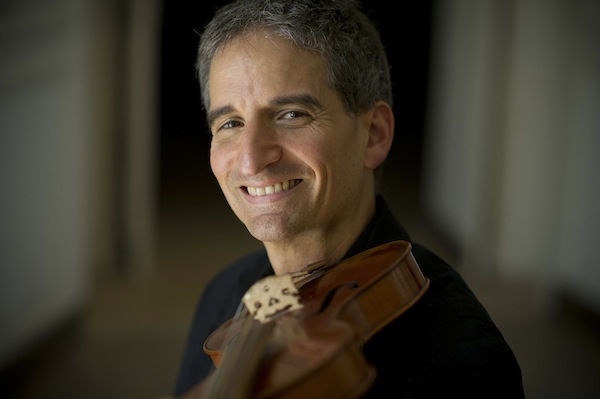
Artist-in-residence David Greenberg has multiple performances at this year’s Vancouver Bach Festival: Scottish Baroque and Other Traditions. (photo by J.B. Millot)
Violinist David Greenberg teaches a course called Cape Breton-Baroque Integration, which is “devoted to creating living moments on the violin through the art of ‘keeping it swirly.’” He keeps it swirly by a range of techniques, but the intangible part derives from his love of Baroque and Cape Breton music.
Greenberg is co-artist-in-residence at Early Music Vancouver this year along with David McGuinness, and the pair will play in a few performances as part of this summer’s Vancouver Bach Festival: Scottish Baroque and Other Traditions, which takes place July 26 to Aug. 6 at various venues in Vancouver.
Early Music Vancouver’s artists-in-residence program started last summer, with Cree-Métis Two-Spirit baritone Jonathon Adams. The program was initiated by EMV artistic and executive director Suzie LeBlanc “to honour Canada’s diverse heritages while at the same time exploring the convergences between ‘world music’ and early music.” Greenberg came to be an artist-in-residence through his connection to LeBlanc, who is an interdisciplinary artist – he has performed with her many times over the years.
“Many of those collaborations involved a degree of integration between folk and Baroque music,” Greenberg told the Independent. “Often, those collaborations included David McGuinness, who is also a close friend and colleague from Glasgow, a scholar of 18th-century Scottish music, a brilliant musician on various keyboard instruments and the founder and director of Concerto Caledonia.
“David and I have worked together for over 20 years,” said Greenberg, “mostly on projects that involve some degree of Baroque-traditional stylistic integration. Suzie asked David and me to be co-artists-in-residence for the 2022 festival since this year’s theme is the integration of Baroque and Scottish traditional music.
“Over the two-week festival … David and I will perform solo, chamber and orchestral concerts. We will also coach young musicians and perform with BOMP (Baroque Orchestra Mentorship Program) as part of our activities.”
Greenberg was born in Washington, D.C., and grew up in Maryland. He lived in Canada for 30 years, but is currently living in Corvallis, Ore.
A graduate of Indiana University’s Early Music Institute, he has performed, taught and recorded in multiple places around the world, but mainly in North America and Western Europe. In addition to LeBlanc, he has performed with more than a dozen groups and performers, and been a guest soloist and/or director with several orchestras. Between these collaborations and his own ensemble Puirt a Baroque (pronounced poorsht-a-baroque, and meaning tunes from the Baroque), he has recorded more than 80 CDs. As well, he is a composer and arranger, and he co-authored Traditional Celtic Violin Music of Cape Breton: The DunGreen Collection with Kate Dunlay.
“I started playing at age 4, dabbled in both classical music and traditional folk fiddle as a kid, went to conservatory and got depressed, switched over to Early Music performance, which suited my temperament better, and joined Tafelmusik (Toronto-based Baroque orchestra) for a decade in the ’90s,” said Greenberg.
“Alongside my Baroque playing, I dove into learning the Cape Breton fiddle style, started a few bands, worked with many colleagues around the world…. The combination of the Baroque and Cape Breton musical languages is where my sense of 18th-century Scottish violin music comes from. Italian and Scottish composers are connected by way of some Italians living and working in Scotland in the 18th century, resulting in an inevitable mixing of the styles, though to what degree is a matter of opinion.”
He said the fun thing about the Baroque and Cape Breton styles “is how their esthetic hierarchies are totally different. So that means they work as effective comic relief for each other! Cape Breton music is basically the continued, naturally evolving, living tradition of 18th-century Scottish Highland fiddling. A strange fact is that Baroque music was popular in Scotland about 50 years beyond when it died out in continental Europe. That means that the Scottish traditional music and Scottish Baroque music coexisted side-by-side in 18th-century Scotland, including many examples of music that lie somewhere between the two styles.”
Greenberg plays a Baroque-style violin made in 2000 by Masa Inokuchi in Toronto. He said, “Cape Breton music is played on a modern fiddle these days, but it works on a Baroque fiddle within the appropriate context.”
And as for a little more context on Greenberg and his musical range, he shared, “My mom has always loved singing Yiddish songs and accompanying herself on the piano. I enjoy backing her up on fiddle when I visit her.”
For tickets go to the Vancouver Bach Festival, visit earlymusic.bc.ca.
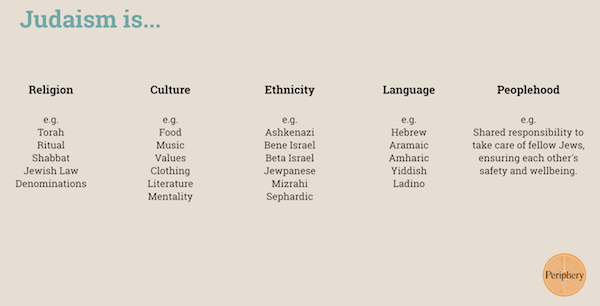
A page of the Intro to Judaism booklet that can be downloaded as part of the Periphery curriculum, which offers a framework to talk and learn about diversity within the Jewish community.
“Make space for a productive and respectful conversation” – this is the first suggested action to frame the use of the recently released Periphery curriculum.
Periphery – a film and photography exhibit exploring the ethnic diversity of Toronto’s Jewish community (jewishindependent.ca/discussing-jewishness) – came out last fall. The new curriculum builds on that 27-minute documentary. It comprises another nine short videos, all under eight minutes each, and lesson guides for students in grades 8 through 12 in both the Jewish and public school systems. There is also a guide for Jewish groups and organizations, which could be used for non-Jewish groups.
Launched by the Toronto-based nonprofit No Silence on Race and the Ontario Jewish Archives (a department of UJA Federation of Greater Toronto) with the organization Facing History and Ourselves (an American group with a Toronto branch), the curriculum is Ontario-focused. That said, most of the information is broadly based and relevant to Canadians no matter where they live, and no matter their age.
There are differences in the curricula for each of the three grade groupings (Grade 8, grades 9 and 10, and grades 11 and 12), the Jewish versus public school content, and the community dialogue package. However, the basic format and information is similar, with appropriate adaptations for probable starting points in knowledge and experience.
The common learning aims include “a greater awareness and understanding about who Jewish people are and the ethnic diversity within Jewish communities”; “Possess a stronger framework for understanding the complexities of intersectional identity, using their own identities as a foundation”; “Understand the difference between individual and group identity with a focus on belonging and recognition”; and the role of students and community members in creating inclusive community spaces. In addition, for example, the Jewish community curriculum also suggests that participants: “Discuss the intersections of race, privilege, mobility (i.e Jewish professional opportunities), power as it relates to Jewish identity and ashkenormativity.”
Before delving into the films and lesson suggestions, the curriculum offers a few activities that help frame what viewers are about to watch and discuss – beginning with making “space for a productive and respectful conversation.”
The most extensive part of the guides is the screening prompts and activities. They are organized by topics based on those of the videos, such as “Hyphenated Identities,” “Immigrating to Canada” and “Finding Strength in One’s Heritage.” They include pre-screening and post-screening questions for each film and topic, and these questions elicit self-evaluation and the sharing of stories and views on identity, race, multiculturalism, sexuality, antisemitism and social justice, as well as discussion of the experiences and opinions of the interviewees featured in the films.
The final part of the guide attempts to have participants take what they have learned out into the world, beyond the classroom or boardroom or office. For example, the title of the last section of the Jewish community dialogue is “Now What?: Social Justice within the Jewish Community and Beyond.” It begins with discussion from a global perspective – using a quote from Canadian anthropologist Wade Davis to talk about questions like, “What does it mean for us to hear from different voices of humanity?” It then highlights a quote from the Mishna and one from Pirkei Avot to further reflect on the idea that repairing the world, tikkun olam, begins within the community.
In addition to the curricula, there are related materials available to download, from worksheets to help understand the concepts being discussed and organize one’s thoughts, to an introduction to Judaism, to a glossary of terms. The poem “Unpacking the Periphery,” by Akilah Allen-Silverstein, can also be downloaded. It concludes “For each other as allies, I pray we can stand tall / Diminish the fine lines, deepen our understanding, / Listen with compassion / Listen with empathy / Act with courage / Act with reason / Because this is the season / To do better / To act on the Open Letters / To be more than trend setters / But intentional change makers.”
All of the Periphery curricula and resources are free and downloadable at peripheryexhibit.org.
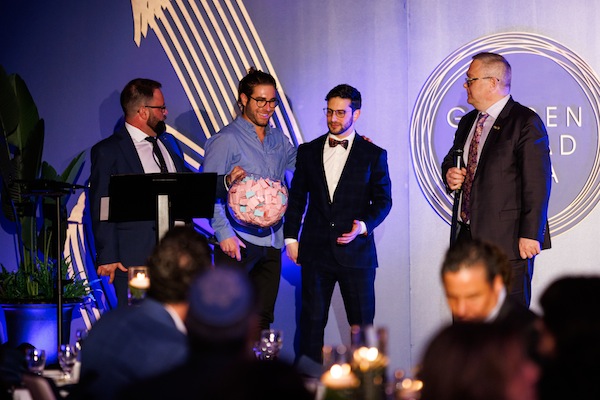
Left to right, Alex Monchamp, Aaron Friedland, David Kaye and Howard Blank prepare to draw the 50/50 winner at King David High School’s Golden Thread Gala on May 12. (photo from KDHS)
“The reality is King David took a student who genuinely struggled, exposed me to meaningful ways to make a difference – they gave me passion and purpose, they provided me with academic rigour to realize my dreams, provided me with confidence, and then added a fundamental layer of Jewish and humanist values,” said Aaron Friedland, addressing a full house at King David High School’s Golden Thread Gala on May 12.
“And what is interesting is how unremarkable my story at King David is,” he continued. “There are simply too many grads who King David has helped to overcome the odds and flourish – and it’s the outcome of brilliant and caring educators investing in us.”
Friedland is founder and executive director of the Simbi Foundation, which helps underserved and refugee communities access education. He is a National Geographic Explorer and a PhD candidate in the field of econometrics, focusing on the interplay of economics and education. And these are only a few of the many accomplishments and projects on Friedland’s growing resumé.
He came to King David in Grade 8, he said, after having attended four different elementary schools. “I’m incredibly dyslexic,” he shared, “and there was a time when teachers told my parents I likely wouldn’t make it to university.”
But there is more to King David than preparing students for university, he added. “The world doesn’t just need more university grads. The world needs more global citizens who are passionate about creating positive impact and who have the skill set to realize their dreams. Tonight is about celebrating a school that has developed a tried-and-true approach to developing global citizens who thrive while engaging in tikkun olam, or repairing the world. And I’m not sure if you’ve seen or have been reading the news, but the world could use a little repair.”
Mentioning COVID-19, Russia’s war on Ukraine, the challenge to Roe v Wade in the United States and generally declining literacy rates, he spoke about the need for hope. He then cited primatologist and anthropologist Jane Goodall, whom he had interviewed on Simbi Foundation’s Impact in the 21st Centurypodcast.
“Jane explained, ‘Hope isn’t just wishful thinking – it’s rolling up our sleeves and doing something about the problem.’ And she shared a few pieces of wisdom,” said Friedland.
“When we’re feeling a lack of hope, it’s important to remember just how much power we each possess.
“When we’re feeling stuck, we must think globally and act locally. She means that we must find causes we’re passionate about and start making a difference immediately,” he said. “No action is too small. Jane spoke about the addictive nature of helping. And, once we’re helping, we’re part of the solution and it feels great – so we do more of it.
“And, when I pushed Jane further, she explained that she stays hopeful for three reasons. One, our amazing human intellect. Two, the indomitable human spirit – meaning, we don’t give up. And three, the power of young people.
“Jane believes in the power of young people so strongly,” said Friedland, “that it is where she invests all of her time, specifically high schoolers, because she believes that those are the people who are going to change our planet and change the world. And, after speaking with Jane, it got me thinking about how King David is the exact breeding ground for the types of people who come out and positively impact the world and give us hope.”
A visit to KDHS by farmer J.J. Keki, a leader of Uganda’s Abayudaya Jewish community, was the spark for Friedland’s tikkun olam work and further study. The Simbi Foundation began its life as the Walking School Bus and the organization now builds solar-powered classrooms, known as BrightBoxes, in Ugandan and Indian refugee settlements, with each installation providing up to 6,000 students with access to education and electricity. The foundation’s chief operating officer and co-founder is Ran Sommer, another KDHS graduate.
The Golden Thread Gala celebrated the almost 750 students who have graduated from KDHS since it was established – and it raised $202,491 for the school.
The gala, which was held at Congregation Beth Israel, began with a piano and vocal performance by student Joseph Gabay, and also featured a song performed by students Kailey Bressler, Rachel Gerber, Mhairi Hemingson and Kiera Katz; group member Sara Bauman was unable to attend. Alex Monchamp, deputy head of school, stepped in to welcome the crowd because head of school Russ Klein couldn’t be there either, but Klein’s emcee duties were taken on by actor David Kaye, another KDHS alum. As part of his emceeing, Kaye interviewed on stage two other KDHS grads – Jordan Grubner and Ava Katz – about their time at the school and how it prepared them for the larger world.
Rabbi Stephen Berger, head of Judaic studies, did the blessing over the bread before the meal and gave a few remarks, as did gala committee co-chairs Heidi Seidman and Sherri Wise, and KDHS board members Alain Guez and Chana Charach. Howard Blank led the live auction.
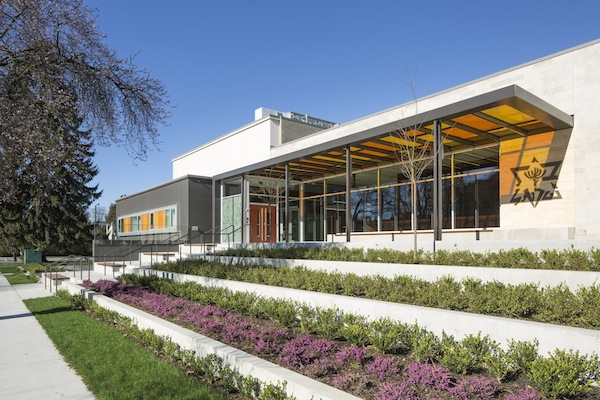
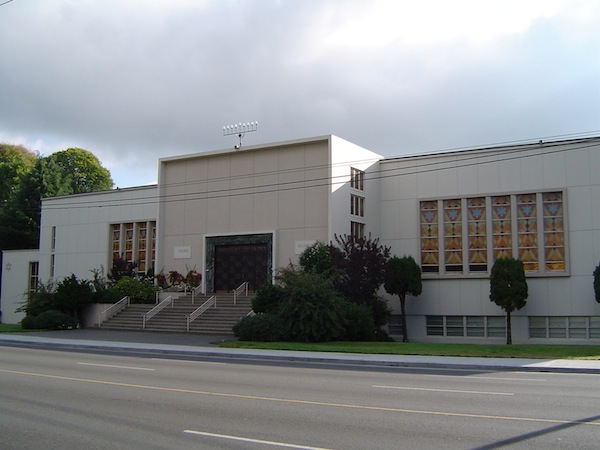
The new Beth Israel building welcomes people from 28th Avenue, while the original building (below) had its entrance on Oak Street. (photos from Beth Israel)
Congregation Beth Israel celebrates its 90th anniversary with a gala on June 12. It will feature “a walk down memory lane through each of the past nine decades,” as well as music, cocktails, dinner and other activities.
While the congregation’s history began in the 1920s, it wasn’t formally established until 1932. In a feature article in The Scribe (2008), community historian Cyril Leonoff, z”l, quotes an Oct. 9, 1931, editorial in the Jewish Western Bulletin, the predecessor of the Jewish Independent. A meeting had been held at the Jewish Community Centre, which was at Oak Street and 11th Avenue in those years, to discuss the possibility of a new congregation. The editorial commented:
“There can be no doubt in the minds of anyone that there is a distinct need for a Conservative or semi-Reform congregation in Vancouver. There are hundreds of Jews and Jewesses and their children who are so far removed by environment and training from the strictly Orthodox service that they have no inclination or desire to attend the synagogue now in existence here. The absence of [such a] synagogue carrying the services at least partly in English, has created a void in the religious life of many of our Jewish people…. The consensus of opinion in the community is … that a new congregation will be welcomed.”
The Jewish Community Centre was considered the best location initially, as the synagogue’s founding was during the Great Depression. Leonoff again cites that Oct. 9, 1931, editorial: “That the Community Centre, situated, as it is, convenient to all residential districts, would be the ideal place in which to set up the new congregation until such time as there are sufficient funds available for the erection of a separate building.”
The original building, dedicated in 1949. (photo from Beth Israel)
It wasn’t until the end of the Second World War that the land along Oak Street between 27th and 28th avenues – where the synagogue still stands – was bought. As Beth Israel’s website notes, “by the late 1940s, both a rabbi (David Kogan) and a building site – at 27th and Oak – became available and, in 1949, Beth Israel’s synagogue was dedicated.”
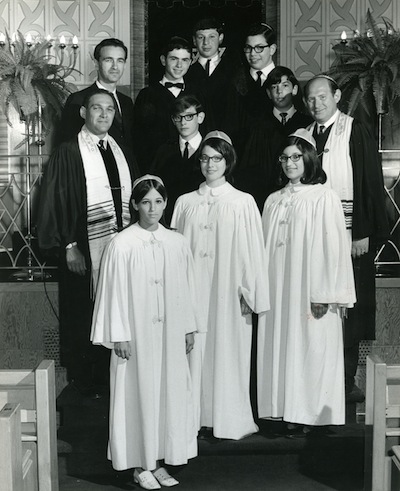
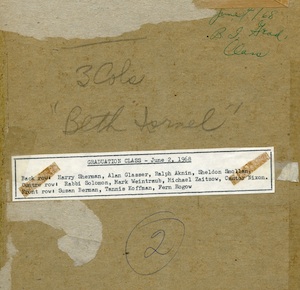
The June 2, 1968, graduation class photo and the caption on the back (below) were given to the Jewish Independent for this article. (photo from Beth Israel)
The congregation grew over the years and, for three of those first several decades, the synagogue was led by Rabbi Wilfred and Rebbetzin Phyllis Solomon, Cantor Murray Nixon, z”l, and Ba’al Tefillah, Torah reader and teacher David Rubin z”l.
Programs increased, as did the participation of women, beyond a bat mitzvah ceremony. According to the BI website, “In the late 1980s, it became clear that women, now well-educated in Jewish ritual and study, were ready to move up to the bimah and take their place as full participants in synagogue ritual. By 1989, women were called to the Torah for their own aliyot, were counted in the minyan and acted as sh’lichat tzibbur (prayer leader). Beth Israel was the first major Canadian Conservative congregation to become fully egalitarian.”
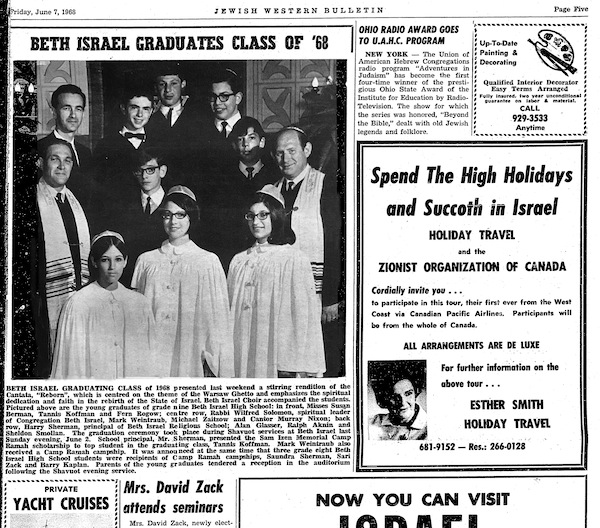
The notation “3 Cols ‘Beth Israel’” would have been written by Jewish Western Bulletin staff probably, as the announcement in the paper (below) ran over three columns. (photo from Beth Israel)
The synagogue’s current senior spiritual leader, Rabbi Jonathan Infeld, and his wife Lissa Weinberger came to Beth Israel in 2006 via Ohev Shalom Synagogue in Marlboro, N.J. He told the Independent at the time: “We are very excited about moving to Vancouver, taking on an exciting challenge and being part of this community. I didn’t really know much about Beth Israel when we visited Vancouver, but after doing some research, I realized what a wonderful synagogue with a rich history it was.”
The June 7, 1968, Jewish Western Bulletin article announcing the year’s graduates from Beth Israel.
“It has been a pleasure working with Beth Israel as its rabbi for almost 17 years,” Infeld told the JI last week. “I remember the first day I walked into the synagogue. The congregants were wonderful. They were kind and welcoming. But the building was dated and literally falling apart. Everyone knew that we needed a new space for our spiritual home. After a few years, we were able to build an incredible and beautiful new synagogue that will last us for generations. We built a synagogue building for a new millennium…. Beth Israel has always been at the heart of the Vancouver’s Jewish community. I am proud to be part of that. I am sure that the spirit of Beth Israel will be strong for at least another 90 years. I look forward to helping to nurture it for many years to come.”
Construction on the current building began in 2012 and it was dedicated in September two years later. Along with Infeld, Beth Israel is currently led by Rabbi Adam Stein, Ba’alat Tefillah Debby Fenson and youth director Rabbi David Bluman.
“According to Mishna Pirkei Avot,” said Infeld, “a person is strong at the age of 80 and bent over at the age of 90. Beth Israel certainly has shown that 90 is the new 80. We are stronger than we have ever been. We are a synagogue built on the shoulders of giants. Many great women and men have dedicated their time, sweat and tears into building Beth Israel to be the synagogue that we are today. We greatly appreciate that. We could not be where we are today if it were not for them. And we greatly appreciate all of the people who continue to support us so that we can continue to grow and serve the Vancouver Jewish community. Ninety years is a big milestone in the life of synagogue. We really look forward to celebrating our 100th anniversary in 10 years.”
The 90th anniversary gala chair is Dale Porte and committee members are Howard Blank, Alexis Doctor, Jean Gerber, Myrna Koffman, Debby Koffman, Alan Kwinter, Debbie Setton, Leatt Vinegar and David Woogman. To purchase tickets to the June 12 celebration, call the synagogue office at 604-731-4161 or visit bethisrael.ca.