Skip to content
  • Home
  • Subscribe / donate
  • Events calendar
  • News
    • Local
    • National
    • Israel
    • World
    • עניין בחדשות
      A roundup of news in Canada and further afield, in Hebrew.
  • Opinion
    • From the JI
    • Op-Ed
  • Arts & Culture
    • Performing Arts
    • Music
    • Books
    • Visual Arts
    • TV & Film
  • Life
    • Celebrating the Holidays
    • Travel
    • The Daily Snooze
      Cartoons by Jacob Samuel
    • Mystery Photo
      Help the JI and JMABC fill in the gaps in our archives.
  • Community Links
    • Organizations, Etc.
    • Other News Sources & Blogs
    • Business Directory
  • FAQ
  • JI Chai Celebration
  • JI@88! video

Recent Posts

  • Sharing her testimony
  • Fall fight takes leap forward
  • The balancing of rights
  • Multiple Tony n’ Tina roles
  • Stories of trauma, resilience
  • Celebrate our culture
  • A responsibility to help
  • What wellness means at JCC
  • Together in mourning
  • Downhill after Trump?
  • Birth control even easier now
  • Eco-Sisters mentorship
  • Unexpected discoveries
  • Study’s results hopeful
  • Bad behaviour affects us all
  • Thankful for the police
  • UBC needs a wake-up call
  • Recalling a shining star
  • Sleep well …
  • BGU fosters startup culture
  • Photography and glass
  • Is it the end of an era?
  • Taking life a step at a time
  • Nakba exhibit biased
  • Film festival starts next week
  • Musical with heart and soul
  • Rabbi marks 13 years
  • Keeper of VTT’s history
  • Gala fêtes Infeld’s 20th
  • Building JWest together
  • Challah Mom comes to Vancouver
  • What to do about media bias
  • Education offers hope
  • Remembrance – a moral act
  • What makes us human
  • המלחמות של נתניהו וטראמפ

Archives

Follow @JewishIndie
image - The CJN - Visit Us Banner - 300x600 - 101625

Byline: Cynthia Ramsay

Systemic change possible?

Systemic change possible?

Eleanor Boyle’s Mobilize Food! Wartime Inspiration for Environmental Victory Today offers concrete ideas for how food systems can be transformed. (Julie Doro Photography)

I plan to make the Honourable Woolton Pie. Just for fun, not necessarily because I think it’ll taste wonderful, though it might. Named after Lord Woolton (Frederick Marquis), who was appointed minister of food in 1940 Britain, it represents several of the British government’s goals during the war years: it was “meatless, thrifty, filling, and made use of domestically produced in-season foods.” The recipe is in Eleanor Boyle’s latest book, Mobilize Food! Wartime Inspiration for Environmental Victory Today (FriesenPress, 2022). The book is the only reason I know who Woolton is. More importantly, the book offers many reasons to feel less naïve for mostly believing that humankind can save ourselves and the planet before we kill ourselves and the planet.

Mobilize Food! is an optimistic examination of Second World War rationing and other wartime policies in England and how the lessons from that period could help us counter the climate crisis by changing our food systems, to start. Lest one think that Boyle is a pie-eyed dreamer, she has solid credentials – a bachelor’s in psychology, a master’s in food policy and a doctorate in neuroscience. The Vancouverite also has been a journalist and she taught for many years. She wrote the book High Steaks: Why and How to Eat Less Meat (New Society, 2012).

image - Mobilize Food! book coverDespite all of Boyle’s education and experience, she still believes that radical change is possible. This is heartening in and of itself. But it’s the 42-page bibliography that I found more assuring. The recommendations Boyle makes in Mobilize Food! are based on extensive research. And they consider what individuals, governments and businesses are already doing, as well as what they could be doing more of (which is a lot). She is not arguing for a socialist utopia, or a utopia of any sort, though she does imagine more engaged, civic-minded communities than I think currently exist anywhere in the world. That said, she gives an example of a city that apparently has ended hunger – Belo Horizonte, Brazil, “which in 1993 declared access to food as every citizen’s right. It then implemented food price subsidies, supply and market regulation, supports for urban agriculture, education on food preparation and nutrition, and job creation in the food sector.”

How does this relate to Second World War Britain? As did Britain during the 1940s, Belo Horizonte set up state-subsidized restaurants that are open to everyone (to avoid stigmatizing people on lower incomes), it feeds kids in the public education system every day, it partners with private grocery stores so that they can sell cheaper fruits and vegetables, and it supports family farms, among other actions “that help democratize food.”

Boyle provides copious data and examples of how the food industry, as it stands, is contributing to climate change “by contributing at least a quarter of human-caused GHGs [greenhouse gases].” It does this through its use of fossil fuels, the cultivation of monocultures (“vast, unnatural acreages of single-species crops”) and destroying ecosystems by removing or burning vegetation, among other activities. One of the eye-opening stats is: “Some analysts calculate the contribution of livestock to overall anthropogenic GHGs as at least 30% and as high as 51%.”

Boyle argues persuasively that how we produce and consume food can be transformed. The first half of Mobilize Food! runs through all that Britain did to make significant changes, “from national agricultural policy to the family dinner plate. They didn’t wait for dire food shortages or society-wide agreement of exactly how to proceed. Even before war was declared, government set up a high-powered food committee to craft plans for making food systems crisis-ready.” They used multiple strategies and strived for general engagement using PR campaigns and other tools. “The programs were simple but transformational,” writes Boyle, “based on shifts toward domestically produced, plant-rich and minimally processed foods. Together those programs adequately fed the population – and, in many ways, better than prewar, by providing broader and more equitable access to food and enhanced health [reducing diabetes and heart disease, for example].”

The wartime measures also show that people can change how they eat and act, she notes. But leadership is key – Lord Woolton was very charismatic, it seems, and, on the larger scale, Boyle writes, “Only governments have the mandate for the public good, the oversight for national strategy and the legislative levers. Only public officials can do the necessary system-wide planning, coordinate sectors, forge agreements across regions, and make the tough decisions.” Lastly, such massive change relies on everyone participating: “We’ll need to think systems-wide and involve every segment of society, every community, every food-related business and civic organization, and every one of us.”

Boyle admits this all “sounds like fantasy. But, as the story of World War II Britain shows, such a transformation has occurred.” Am I personally convinced we have what it takes to mobilize so drastically? The larger whole is still too much for me to contemplate, but I can eat even less meat and fewer processed foods, buy more from local growers, invest in businesses that improve the environment and/or social outcomes, support politicians who are working toward a healthier and more inclusive society. No doubt, there is much more that I could be doing, but it’s a start.

I’m glad that I read Mobilize Food! Full of images (including awesome wartime PR posters), data and stories from people who lived through the war effort, it is engaging on many levels. It reminded me that what seems impossible may not actually be so. And the importance of hope – combined with action – cannot be overstated.

For more information, visit eleanorboyle.com.
Format ImagePosted on March 24, 2023March 22, 2023Author Cynthia RamsayCategories BooksTags climate crisis, education, Eleanor Boyle, England, environment, governance, history, Mobilize Food!, policy, rationing, Second World War
Burying sacred books

Burying sacred books

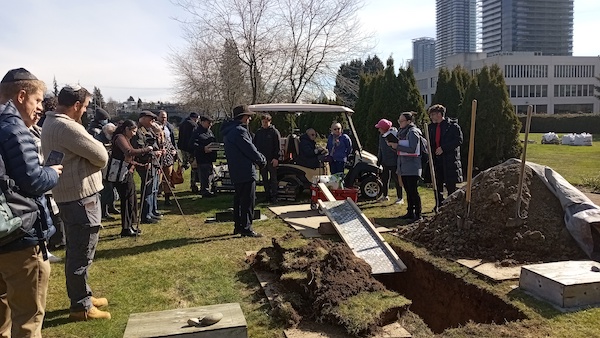
On March 9, community members gathered to bury sacred Jewish texts at Beth Israel Cemetery. (photo by Cynthia Ramsay)

According to Jewish law, no sacred texts and objects are allowed to be thrown out. This includes anything with God’s name printed on it. These texts and objects must be buried in a respectful way,” explained Rabbi Jonathan Infeld of Congregation Beth Israel in an email to the Jewish Independent about the March 9 Genizah Project ceremony at the synagogue’s cemetery. “Since a burial spot is not always convenient, people store their sacred material in a special place called a genizah until they can be buried.”

A few months ago, Infeld received a phone call from Eugene Barsky, a librarian at the University of British Columbia. Barsky was looking for a place to bury a considerable number of sacred books that were beyond repair. Infeld “immediately said yes.”

“But I wanted to do much more than just bury the materials,” the rabbi said. “I asked if he would be interested in a community-wide program, and Eugene also agreed. After that, we sought other interested parties including UBC Jewish studies, Hillel BC, King David High School, Peretz Centre and the Waldman Library.”

Representatives of these organizations were present on March 9, including students from KDHS and UBC. Infeld spoke about how sacred objects and texts not only give Jews a connection to our spiritual existence, but a social connection as well.

“And, no matter what differences we may have as a people, we are brought together within a rubric of study, of prayer, all connected to the written word,” he said. “For us, as a Jewish people, the book is sacred. For us, as a Jewish people, study is a sacred task, a sacred opportunity. And so, it only makes sense that, when we have studied, have brought a book to its conclusion, that’s literally falling apart, we don’t just throw it away, but the book, or the sacred object, has become our friend and become part of us. And so, according to Jewish tradition, we bury it.”

Barsky highlighted one of the many books being buried: a Pentateuch (the Five Books of Moses) published in Furth, Germany, in 1805. “I wish we could preserve these books, but some of them are molding,” he said. “We have a preservation lab at UBC but they reviewed them and some of them just could not be preserved.”

Barsky asked two members of the Vancouver Jewish Folk Choir – Stephen Aberle and Aurel Matte – to sing a couple of songs. The pair led “Hinei Ma Tov,” about how pleasant it is when sisters, brothers, all of us, gather together; and “Al Sh’loshah Devarim,” about the three things on which the world stands (Torah, divine service, acts of love) and by which the world endures (truth, justice, peace).

For UBC student Ellie Sherman, the burial ceremony was particularly meaningful, “as someone who spends every day reading more and more information, paying close attention to authors and narrators, and focusing on crafting assignments with correct references, to give credit where credit is due.”

She said, “The need for the genizah recognizes that the significance of words is beyond two-dimensional figures on a page, that the lessons we learn and the knowledge we gain from our books can be infinite, just as the meaning behind the words.”

Gregg Gardner, associate professor and Diamond Chair in Jewish Law and Ethics at UBC, shared how the name genizah came about. “The ancient rabbis of the first centuries tell a story about a king,” he said. “The king’s name is Munbaz. This king travels to Jerusalem, where there is drought and a famine. To provide relief, Munbaz gives away his fortune to the needy. Munbaz bizbez, Munbaz spends. His brothers confront him and demand an explanation as to why he’s giving away the family fortune…. Munbaz says that he does not bizbez the fortune … but rather he ganaz the fortune, he stores it, he saves it…. Munbaz explains that, by giving your money to charity here on earth, you do not waste your money … you save it in the world to come, in the afterlife.

“The word genizah literally means ‘storing’ and, in doing so, it can denote hiding from view,” he said. “Ancient Jewish traditions going back to the first centuries, the Second Temple period, talk about hiding many things, even the holy vessels from the Jerusalem Temple, and there are traditions in which the word ganaz is associated with storing valuables.”

Gardner said, “We are here at a cemetery, essentially taking these books out of use, laying them to rest, and yet, at the same time, going back thousands of years, the genizah has been a story not only about death, but about Jewish life.”

Richard Menkis, associate professor of medieval and modern Jewish history at UBC, picked up on this last aspect. During the planning for the burial, he said, there was a feeling towards solemnity, even mourning. But, he said, “there was a whole other sensibility that we could be bringing to it.”

He spoke of the Jews of Algeria, who would place items wherever they could around the synagogue and “several weeks later, they would carry them, the books, the other objects, in sacks. They’d escort them to the cemetery and bury them and, on that day, there would be a feast and special hymns for the occasion. There were similar customs in the community in Morocco of Meknes.

“The Sephardic Jews of Jerusalem had a custom of placing sacred objects and texts in the walls of the synagogue and, every three to seven years, would … joyously take them from the synagogues to a special section in one of the cemeteries in Jerusalem.”

The joy would come, said Menkis, from knowing that “the respect and honour that they were giving to these items would bring down upon them a variety of divine segulot, a variety of blessings. For some, it might be, we can call down rain. For others, it might be to prevent a plague.”

Menkis said, “I embrace the Genizah Project as the moral opposite of a horrible feature of modern life – the book burning. While the book burning denigrates ideas and discussion, the genizah shows reverence for ideals and aspirations.”

Those gathered were reminded of this reverence by Rabbi Kylynn Cohen, senior Jewish educator of Hillel at UBC, who led the service by the gravesite. As in the burial of a human body, she said, it is up to us to do the carrying when a person – or, in this case, the books – cannot go forth themselves.

Everyone helped transport the books from the chapel to the gravesite. Maiya Letourneau, head librarian of the Waldman Library, held up a book with gold embossing, another with lace embroidery. She said, “When we’re thinking about the memories that books create and the importance that they have in our lives, as a librarian, it can be really, really hard to take a book out of the collection, but it’s part of maintaining a healthy library, it’s part of making sure the library is useful for years to come, and it’s just an important part of what we do.”

After those gathered recited the Kaddish d’Rabbanan, the prayer that is said whenever a minyan of Jews finishes studying, Rabbi Stephen Berger, head of Judaic studies at KDHS, spoke about the class he brought to the ceremony, which has been studying Malachi, the Book of Kings. “It’s not just that we study to know,” he said. “The studying itself, opening the book and learning the book is a religious act in Judaism. And that’s why we treat it so carefully and so succinctly and sanctify it…. All these acts [serve to remind us] this is who we are, and we should live up to the title of the People of the Book.”

BI Rabbi Adam Stein concluded the ceremony with Eitz Chayim Hi, which most congregations sing when putting the Torah scrolls back in the ark at the end of a Torah service. It describes the Torah as a tree of life.

Format ImagePosted on March 24, 2023March 22, 2023Author Cynthia RamsayCategories LocalTags Adam Stein, Aurel Matte, Beth Israel, books, Ellie Sherman, Eugene Barsky, genizah, Gregg Gardner, Hillel, JCC, Jonathan Infeld, Judaism, KDHS, Kylynn Cohen, Maiya Letourneau, Richard Menkis, Stephen Aberle, Stephen Berger, UBC, Waldman Library

Local heads new office

B’nai Brith Canada has returned to Vancouver. This time with a local office headed by Aron Csaplaros, who was born and raised in Vancouver.

B’nai Brith and its now-defunct newspaper the Jewish Tribune last made their presence felt here in 2009. In an interview with the Jewish Independent, Csaplaros emphasized “that our organization is not the B’nai Brith of the 1960s or 1970s, or the 2000s. Mr. [Michael] Mostyn took over control of our organization in 2014 as CEO and has created a ‘B’nai Brith 2.0.’ We are still heavily involved in affordable housing, feeding the vulnerable and seniors and social programming (something we hope to bring to B.C. as well in the future), but our main focuses have been advocacy and combating antisemitism.”

photo - Aron Csaplaros is the regional manager of the new local office of B’nai Brith Canada
Aron Csaplaros is the regional manager of the new local office of B’nai Brith Canada. (photo from B’nai Brith Canada)

As regional manager, Csaplaros said, “My mandate is 100% focused on combating antisemitism in our province. This includes responding to incidents of antisemitic vandalism, liaising with Jewish organizations on university campuses regarding antisemitism, and also keeping tabs on antisemitic individuals and organizations active in B.C. and devising strategies, which can range from working with local police and Crown prosecutors on criminal charges, removal of their platform, which they use to spread hate, or other legal measures we can take. I am also working on having the provincial government and municipalities across B.C. adopt the crucial IHRA [International Holocaust Remembrance Alliance] definition of antisemitism.”

Csaplaros acknowledged that there are already organizations based in British Columbia that deal with antisemitism and discrimination.

“B’nai Brith’s goal, and my presence in B.C., is not to compete with, duplicate or replace the important work that other organizations do,” he said. “On the contrary, we plan to work together with other organizations when we can establish a united front against antisemitism and Jew-hate.

“The value that B’nai Brith, and my presence here, adds is our laser focus on fighting antisemitism and the legal acumen that B’nai Brith possesses to aid us in this goal. We have several staff lawyers with expertise in criminal law and constitutional law, and many of our staff members (including myself and our CEO, Michael Mostyn) have legal backgrounds in litigation. This gives the ability to devise creative strategies when dealing with antisemitic organizations and individuals, and allows us to work closely with police departments and Crown prosecutors.

“We also have a Canada-wide network of volunteer Jewish lawyers called the Matas Law Society,” he said. “These lawyers are available to assist us in anything from writing submissions for parliamentary committee hearings, to intervening in court cases that impact the Jewish community.

“We are also the only Jewish organization in Canada to have an anti-hate hotline and a mobile app with the same purpose, where people can report incidents of antisemitism or other forms of discrimination. In addition, we have produced an annual, comprehensive audit of antisemitic incidents in Canada, and this publication is used by, among other entities, Statistics Canada, the U.S. State Department and Tel Aviv University. B’nai Brith does not engage in Israel advocacy, and we only respond to issues concerning antisemitism in Canada affecting Canadian members of the Jewish community. We also have a lean but well-connected team working at our organization, which allows us to respond quickly to incidents as they arise.”

Csaplaros started his position as the B.C. regional manager for B’nai Brith in January, and has met with local leaders in the Jewish community, politicians, and leaders of non-Jewish organizations that are also involved in combating hatred and discrimination, he said.

Csaplaros was born to a family of Hungarian immigrants, with his grandfather having been the first to arrive in Canada, in the 1950s. His parents arrived in 1995.

“I was brought up in a traditional Jewish household, and my paternal grandmother is a child survivor of the Holocaust,” he said. “I grew up very close to Congregation Schara Tzedeck, the synagogue which I am a member of and still attend to this day with my wife. I sit in the same seat that my grandfather purchased over 30 years ago, and it gives me great pride to continue his legacy by sitting in his seat and regularly attending services and events at the synagogue.

“I attended Vancouver Talmud Torah all the way from preschool until graduating in seventh grade,” he continued. “I then spent a year at King David High School, before transferring to Pacific Torah Institute (PTI) [which is no longer in Vancouver] and completing high school there. I then spent three years in their post-high school program, before attending Yeshivas Chofetz Chaim in New York for a year, where I received my bachelor’s degree in rabbinical studies.”

Throughout his time at PTI and at the yeshivah in New York, Csaplaros said, “I was engaged in learning with community members and teaching how to read Jewish source texts in their original format. I was also involved in community outreach, spending time and studying with elementary and high school-aged students from disadvantaged backgrounds. I also served on the board of directors of PTI.”

After his bachelor’s degree, Csaplaros attended law school at the University of Calgary, completing his articles at Kornfeld LLP.

“I’ve always had a passion for research, advocacy and governmental affairs, and I regularly participated in debates organized by Federation,” he said. “Yeshivah studies also involve debate and plenty of research, so that is another reason I chose to pursue a yeshivah education for several years. I then decided that the best way for me to develop my advocacy skills and learn more about the structure of Canada’s government was to attend law school…. I knew from the beginning of my legal studies that I wanted to be a litigator and, in the future, focus on human rights and civil liberties matters. Throughout law school, I was involved in initiatives to increase access to justice for members of the Indigenous community.”

During his time at Kornfeld LLP, Csaplaros said, “I focused on litigation, including construction, real estate and general commercial litigation. I was fortunate to appear in court several times and run a small claims trial on my own.

“These experiences further strengthened my desire to be an advocate,” he said, “and, as my time as an articling student at the firm was coming to a close, I learned that B’nai Brith Canada was looking for a regional manager for B.C. whose main mandate would be advocacy and fighting antisemitism and hatred in all forms. I knew that B’nai Brith Canada is a leader in fighting antisemitism in Canada, and I also knew that I could use my knowledge of the legal system to help me further this goal.”

Csaplaros can be reached at [email protected].

Posted on March 10, 2023March 9, 2023Author Cynthia RamsayCategories LocalTags antisemitism, Aron Csaplaros, British Columbia, B’nai Brith Canada, safety

Helping people stay at home

People are living longer and, ideally, they’d be living longer at home. Pragmatically, this means that they and their primary caretaker(s) would need support not just for medical care, but for errands and companionship, as well. Enter Rona Goodman and her small business, Bubbymobile.com.

“Bubbymobile.com is a senior concierge service that offers a multitude of non-medical services to families. They include companionship, lunch, errand running, grocery shopping, accompanying to medical appointments and check-ups, transportation, walks and more,” Goodman told the Jewish Independent.

photo - Rona Goodman
Rona Goodman (photo from Bubbymobile.com)

Goodman thought of the concept for Bubbymobile.com a few years ago but waited until the pandemic subsided and it was safe to launch.

“I would say it’s been around a year since I started, and it is going very well,” she said. “It’s growing organically and that’s the way I wanted it. Mostly word of mouth and recommendations, and that’s the best advertising you can get. I would love to meet more families in the community.

“The concept came to fruition when I was visiting my friend’s mom who was in a seniors home. I would take her for walks and be her companion. I met several people in the facility who didn’t have anyone visit them or assist with their non-medical needs. After researching, I thought this service would be a great resource to complement what is already out there.”

Goodman named her business after her maternal grandmother.

“My bubby was the best and the matriarch of our family,” said Goodman. “I’m from Montreal and grew up with a close family because of my bubby and zadie. Every Friday night since I can remember, we would have dinner at their house with my family, aunts, uncles and cousins. We all grew up together and I wanted to honour my bubby with the name.”

Goodman said she had two wonderful grandmothers, but “my dad’s was my grandmother…. Both were lovely but I did spend more time with my bubby cause of Friday night dinners. But we (me, my brother and sister) did visit my grandmother and would take her out for drives and lunches/dinners and had lovely visits. She made the best coleslaw…. Both of my grandfathers passed when I was pretty young. Everyone has had a bubby or grandmother or grandfather, so it’s really in honour of them all!”

For Goodman, two of the best things about being Jewish are family and giving back. “You take care of the ones you love and give back to others who may not be as fortunate,” she said. “There was always an extra plate for dinner at Bubby’s house for drop-ins and friends. You also must be compassionate, patient, a good listener, understanding, kind and giving to do this kind of work. That’s how I walk through this world and this service is a natural fit for me. I also do volunteer work for VCDS (Vancouver Cancer Drivers Society), a wonderful organization that involves transportation.”

In addition to Bubbymobile.com, Goodman is a musician and a public-relations professional.

“My professional life has always been about passion, creativity and being of service,” she said about the common threads that tie her diverse endeavours together. “I’ve worked in the music industry for over 25 years in many areas of the business. From record labels, musician, songwriter to sales, marketing and publicity. As a PR person, I’ve learned a lot about communication, understanding people’s needs, listening to their stories and reaching out and engaging community – I think it brings out the kid in me and keeps me vibrant and young. These qualities are important when working with seniors, as it’s parallel in many ways.

“As a composer, songwriter and producer, I tell stories through music, lyrics and composition,” she added. “Music is a healer and there is nothing better to lift the soul. To be a composer, you need to write about life’s experiences and adventures. That’s why I love hearing the stories shared by my seniors. What a gift to be in their presence really. I would happily pick up my guitar and sit and play some music for someone that I’m working with. It’s fun and I’m grateful that I can give that little extra service to my clients. There is nothing better than to share the love of music.”

Ultimately, Goodman would like to be able to offer Bubbymobile’s services in every community in the province.

“In the long term,” she said, “I would like to build the business so it can develop into a franchise opportunity across Canada. The more I talk with people, the more excited they are that I’m doing this and how much it is needed. As we grow older, we are living longer, and I find it does provide some relief for families looking for that extra support. I’ve talked with families who may not be living in Vancouver who need extra assistance for their loved ones. Many are also too busy with work and raising families to visit during the week. That’s why I’m here – for that extra support.”

Posted on March 10, 2023March 9, 2023Author Cynthia RamsayCategories LocalTags Bubbymobile.com, companionship, healthcare, Rona Goodman, seniors
B’nai mitzvah tutoring

B’nai mitzvah tutoring

Sasha Kaye (photo from B’nai Mitz-Van)

Sasha Kaye recently launched B’nai Mitz-Van, a tutoring service that prepares b’nai mitzvah students for their Torah and Haftarah readings. She also offers basic voice training, performance anxiety management and d’var Torah writing support.

Kaye completed a double major in voice performance and psychology for her bachelor’s degree from the University of British Columbia, and she has a master’s degree in performance science from the Royal College of Music in London, England. In her master’s thesis, Kaye examined the experiences of musicians with moderate-to-severe performance anxiety in simulated performance environments.

“I came back to Vancouver in January 2023,” Kaye told the Independent. “Most of my time so far has been spent unpacking and readjusting to life in Vancouver!”

Kaye grew up attending Congregation Har El, where she is a member. She has led services as a lay cantor. “I performed at various holiday and milestone community events, and participated in extracurricular, Jewish-led activism with peers from King David High School,” she said about her younger years.

Kaye has performed with the University Singers choral ensemble, UBC Opera, the Vancouver Orchestra Club and Postmodern Camerata, among other groups. She performs as a solo recitalist and has almost 10 years of teaching experience.

“I came up with the idea for B’nai Mitz-Van while I was still in London, and the idea was partially inspired by my master’s thesis,” she said of her latest venture. “In addition to struggling with an anxiety disorder, I had particularly vivid performance anxiety as a musician. The two collided pretty spectacularly for my own bat mitzvah. Despite being well-prepared for it, I was constantly ruminating on potential mishaps and catastrophizing the consequences. What if I got so anxious that I forgot the trope for my Torah reading? What if I forgot the words? What if my voice cracked? What if I dropped the Torah? I would let my family down. These cognitive distortions are evident to my adult self, but the distress was very real to 12-year-old Sasha. When I told people I was anxious, they told me I had nothing to be anxious about. While I’m sure they were trying to reassure me, this ultimately dismissed my feelings and made me feel much worse. I had zero tools to cope with or manage my anxiety.”

Kaye said she has little recollection of the bat mitzvah itself. “I was so anxious, I essentially blacked out,” she said. “Based on second-hand information, I did well enough on the day, but I was unable to enjoy the simchah – and that’s ultimately what the day should have been about. B’nai mitzvot should be joyous occasions for everyone, including the b’nai mitzvah themselves.

“As someone who knows how to chant Torah and Haftarah, and knowing what I know now about performance anxiety, my hope is that B’nai Mitz-Van can both teach young adults what they need to know for their special day, and also give them the tools to manage feelings of nervousness or anxiety that they may have.”

Kaye has experience teaching b’nai mitzvah-age kids from when she used to teach singing lessons, which she did for about three years, and she has five more years of experience teaching older students.

“Performance anxiety is extremely common,” said Kaye. “While it may or may not necessarily impact the quality of your performance, that doesn’t make it any less uncomfortable to deal with.

“The experience can manifest cognitively, meaning through the kinds of thoughts you have, like fixating on the possibility of making mistakes in performances and overestimating the consequences; physiologically, meaning through bodily sensations like racing heart, dry mouth, shaking or feeling restless; emotionally, like feelings of nervousness, dread or irritability; or behaviourally, like avoiding practising.

“How to manage performance anxiety is the million-dollar question!” she said. “There are a number of techniques and methods that have been researched, and different things may work for different people. Some things that can help pretty reliably, if they are practised, are feeling prepared in your material; breathing exercises, like box breathing; grounding exercises that focus your senses on the here and now; and examining your self-talk, that is, how you talk to yourself in your own mind.

“Retraining self-talk can take a long time and it can be very challenging,” she acknowledged, “but it helps to start by noticing how you talk to yourself. Would you speak that way to a friend who was going through the same thing? If not, chances are your self-talk needs some adjusting from the harsh and self-defeating to the encouraging and self-supporting.”

About working with b’nai mitzvah-aged kids, Kaye said they “are at a really fascinating stage in life. They’re starting to come into their own sense of self, and they’re able to start thinking critically about the world around them without the cynicism that can follow us as adults. There’s an enthusiasm and idealism for tikkun olam that’s really refreshing.”

And, given her years of experience as a tutor of academic writing, Kaye can help students organize their enthusiasm and their ideas into a clear and concise d’var Torah. “More importantly,” she said, “I help them find their own way of relating to their parsha, so they can find the lesson they want to share with the congregation.”

Kaye offers both in-person and online lessons. She can be reached at [email protected] or 236-515-9469.

Format ImagePosted on March 10, 2023March 9, 2023Author Cynthia RamsayCategories LocalTags B'nai Mitz-Van, b'nai mitzvah, education, Judaism, music, Sasha Kaye, tutoring, writing
Artfully exploring heritage

Artfully exploring heritage

Lindsey Tyne Johnson (photo from Lindsey Tyne Johnson)

Returning from a Birthright trip to Israel in 2019, artist Lindsey Tyne Johnson was inspired. Learning the aleph-bet, she made a laser-engraved spirit board in Hebrew, but accidentally arranged the letters left to right, as they would be in English, and not right to left, as Hebrew is read. The mistake spurred her not only to create the exhibit Hebrew Spelled Backwards, which is on display at the Kamloops Art Gallery until April 1, but to explore her cultural heritage, from which she had been estranged, and learn more about Judaism.

The other, more sombre, inspiration for the Hebrew spirit board and the exhibit was, Johnson writes in a blog post, a “desire to feel closer to my brother after the events that left him homeless and his eventual passing.”

“Born with the name Liam, my brother changed his name to his chosen Hebrew name, Noah as an adult,” she writes on her website (lindseytynejohnson.com). “My mother had mentioned our Jewish ancestry to us as children, but my brother was the only person to explore it…. I can still remember it as what my mother called ‘one of his many phases’ in his late teenage years. She chalked it up to a phase, but it’s the string I use to tie memories of my brother together.”

“My brother was the first person I witnessed who explored their Jewish heritage,” Johnson told the Independent. “When he moved to Vancouver in his early 20s, he legally changed his name to his Hebrew name, Noah. He struggled a lot with his mental health, and there were times when I felt like I was losing the brother I grew up with. It was an attempt to feel closer to him that I went on Birthright and had a bat mitzvah. I wanted to remember the part of him that was happy, passionate and excited about life.

“My brother lost his life to fentanyl in 2021. It was devastating and broke my family apart,” said Johnson, who has two other siblings. “Many struggle to understand substance abuse/mental illness’s connection to generational or cyclical trauma. It’s unfair to look down upon those who might suffer from those things. I try my best to advocate for the destigmatization of mental illness where I can, though I’ve had to be careful not to let others’ ideas also negatively affect my mental health.”

While not a large exhibit, Hebrew Spelled Backwards is powerful, thought-provoking in a serious way, but also using humour. For the exhibit’s images, Johnson explains on her website, “The sandy colour palette was chosen as a tribute to the desert, a significant location in Jewish history and culture. I use digital media to blend traditional Jewish motifs with modern techniques, creating a dynamic visual experience.”

Johnson said, “Like many artists, my process is sporadic and requires a particular head space to create something I’m happy with. I often have ideas for pieces while doing mundane daily activities; if I don’t write them down, they’re lost forever. I practise a lot of sequential art, which is usually silly comics about everyday life, but they’re generally never seen by other humans. My style reflects the graphic novels I like to consume. I can’t help but be inspired by artists like Craig Thompson and Marjane Satrapi, both visually and thematically. My dream is to produce a graphic novel one day.”

The Hebrew Spelled Backwards exhibit comprises not only Johnson’s artwork, but her voice. Each picture has a QR code and viewers can hear Johnson give explanations of the Hebrew words and some context for the images, making the exhibit more accessible and inclusive. The illustrations variously include Jewish symbols and/or Hebrew text, supernatural elements, pop art iconography (a Warholesque can of Birthright’s Instant Bat-Mitzvah, for example) and current topics of concern, like rapper Ye’s antisemitic comments, poignantly drawn as a short series of cellphone text messages from a mom to her child that ends with the child asking, “mum, why is ye mad at us?” This is one of the works that, as the exhibit description reads, “examines the complexities of identifying as Jewish and the fear and uncertainty that often come with it.”

“I have a couple of fears about identifying myself as Jewish,” Johnson told the Independent. “Initially, when diving into Jewish culture and Judaism as a religion, I was afraid people might not think I was ‘Jewish enough,’ since only one of my parents has Jewish ancestry. My siblings and I were raised without Jewish traditions or education…. Having a bat mitzvah really helped with that fear, though. I’m also grateful that I’ve never really encountered anyone from the Jewish communities I’ve belonged to that has made me feel that way.

image - “RaeF” by Lindsey Tyne Johnson
“RaeF” by Lindsey Tyne Johnson

“The other part of that fear was that people would think differently of me or assume certain tropes or ideologies about me if I publicly identified myself as Jewish. This is an unfortunate reality I’ve experienced, even if subtly. Most commonly, people think I’m OK with antisemitic jokes or jokes that involve the Holocaust. It’s an exhausting thing to experience.”

Putting together the exhibit has allowed Johnson not only to explore her fears, but also her own biases.

“Creating these pieces required me to reflect on the experiences of people like Batsheva Dueck (aka Cynical Duchess, a modest fashion content creator) or more conservative Jews, who experience more assumptions made about them based on their dress or religious beliefs,” she said. “Since working on this exhibition, I’ve been more sensitive to times when I’ve excused antisemitic values expressed by my peers or acquaintances. When I lived in Brooklyn, I lived with someone who spoke quite negatively about Hasidic communities. This has been an excellent opportunity to witness my biases and encourage others to reflect on their biases or assumptions, too.

“It’s also allowed me to tie other pieces of my identity together,” she continued. “I’ve been able to connect my Irish ancestry with my Jewish ancestry, for example. It has given me a sense of wholeness or completeness and I’ve accepted that I can be many things all at the same time and I’ve accepted that that’s OK. We all contain multitudes.”

Johnson went to Ireland this past summer to visit where her Ashkenazi family moved to in the 19th century, and “to visit the Irish Jewish Museum and Waterford treasures.”

“I was probably in the fourth grade when my mother talked to my siblings and me about it,” said Johnson of first learning about her Jewish heritage. “It was after I had come home and talked about how we were learning about World War II at school. It was surreal to hear my mother, an immigrant from England, talk about a side of our ancestry that had never really been discussed before. I didn’t understand what it meant at the time.”

Johnson herself has lived many places. She was born in Edmonton in 1993, but her family moved to Saskatchewan and then Prince George, B.C., shortly after.

“I spent most of my youth in Prince George but moved to Dawson City, Yukon, as soon as I could save up enough money to attend the Yukon School of Visual Arts,” she said. “Yukon SOVA is a one-year foundational arts program. Still, I decided to stay in the Yukon upon completion and remained in the territory for about five years before I moved to Brooklyn in 2018. I was in Brooklyn for only half a year before moving to Kamloops to be closer to my family, but it made a lasting impression. Going from a territory of 35,000 people to my neighbourhood in Williamsburg with four times that amount was dizzying.”

Johnson said she loves the Kamloops Jewish community. “I joined shortly after moving to Kamloops from Brooklyn and felt incredibly welcomed,” she said. “The [Okanagan Jewish Community Centre] president, Heidi Coleman, is a huge inspiration and comfort to me. It’s pretty relaxed in terms of how often we have gatherings. We don’t have a synagogue or a place to meet, so we usually celebrate holidays at someone’s house. The ‘younger’ (20 to 30 years old) of us have a close bond, and I often have a group of us over for various holidays, too.”

Johnson is currently in her third year at Thompson Rivers University, where she is doing a bachelor’s in criminology. “I’m most interested in victimology,” she said. “I think Canada and most of the world fail victims of crime to an astronomical degree. It’s wild to think about how much attention we give criminals without considering how we could better support the survivor or victims of their crimes.”

Artistically, she is planning a piece that more specifically honours her brother Noah. “I want to educate the general public about how the consequences of generational or cyclical trauma can lead to mental health struggles like substance abuse,” she said. “I would like to highlight that it’s not specifically someone’s ‘fault’ for struggling the way they do.”

For more on Johnson, visit lindseytynejohnson.com. Kamloops Art Gallery’s website is kag.bc.ca.

Format ImagePosted on February 24, 2023February 22, 2023Author Cynthia RamsayCategories Visual ArtsTags digital art, family, Hebrew, history, intergenerational trauma, Kamloops Art Gallery, Lindsey Tyne Johnson, social commentary, stigma, substance abuse
Series tries to inspire climate action

Series tries to inspire climate action

Tikkun olam, repairing the world, is a central tenet of Jewish life, but sometimes the task can seem overwhelming. The climate crisis looms large for all of us, but especially for younger folks, who will bear the brunt of its effects. A new graphic novel for 6-to-12-year-old readers offers an optimistic, fun story about the power of kindness – towards ourselves, other people, animals, the environment – to energize and inspire us to action, to at least try and fix things.

I Can Hear Your Heart Beep, published by Planet Hero Kids in Vancouver, is the first book of the children’s graphic novel series Steve and Eve Save the Planet. Written by Paul Shore and Deborah Katz Henriquez, with imaginative and colourful illustrations by Prashant Miranda, the book is being released on Feb. 25, in recognition of International Day of the Polar Bear, which takes place Feb. 27. One of the book’s two main characters is a polar bear, Steve, who lives in the Arctic. Steve, Eve (an electric vehicle) and their friends come to realize that it is up to them to do whatever they can to clean up the environment and try to stem the global warming that is, among other things, reducing the animals’ food supply.

image - I Can Hear Your Heart Beep book coverEve ends up in the Arctic accidentally. Bullied and ostracized by her “gassy car cousins,” who tell her, “You’re just a heartless machine, sister – like us – you’ll never make a difference in this world!” she takes off (she has wings) to find her “pack,” other electric vehicles. On her way to Norway, she experiences a malfunction that lands her in the Arctic, where she is found by Steve, who’s having problems of his own – driven to stealing food because he’s so hungry, and missing his parents, who went away to find food and haven’t returned.

I Can Hear Your Heart Beep is the genesis story of the two likely-to-become environment heroes, Steve and Eve. We find out their motivations and meet their first sidekicks/allies, the other Arctic animals, and Burger the Booger, their first nemesis of, no doubt, more to come.

For readers wondering about the choice of an electric car as a heroine, Shore writes on the book’s website: “The spark that started our Planet Hero Kids journey first became visible when my pyjama-wearing 8-year-old daughter spontaneously hugged an electric car! That day of our first EV test drive, my daughter laid her little body on the car’s hood with arms outstretched across it, and with one ear against the smooth metal she said, ‘she has a heartbeat.’ The fact that the car seemed calm, gentle and fun … seemed to tell her that the machine was as friendly as a family pet.

“The realization that young children intuitively understand what is healthier for them and the planet sent me in search of partners to help create an uplifting climate action kids book that would cultivate hope and a sense of opportunity during the challenging era in which our children find themselves growing up.”

Shore took the idea to Henriquez, who, he told the Independent, he “first met at an author’s reception at the JCC book festival several years ago!” The pair began their collaboration, eventually connecting with Miranda.

I Can Hear Your Heart Beep can be ordered from Amazon. For more information on the series, visit savetheplanetbook.com.

Format ImagePosted on February 24, 2023February 22, 2023Author Cynthia RamsayCategories BooksTags children's books, climate crisis, Deborah Katz Henriquez, Paul Shore, Planet Hero Kids, Prashant Miranda, tikkun olam
Fresh new fairy tale

Fresh new fairy tale

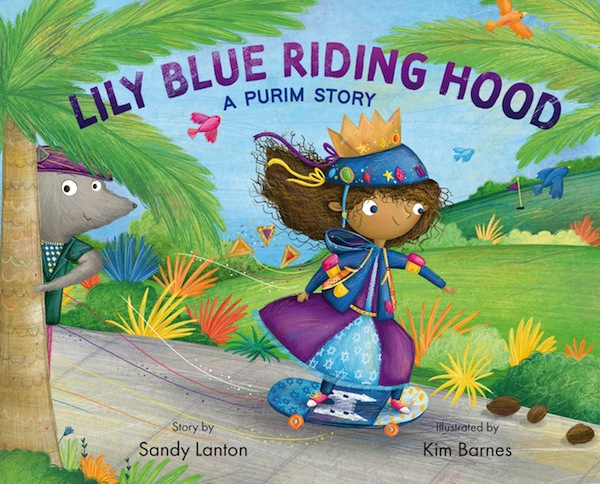
Making old, familiar stories new and fresh again. Writer Sandy Lanton and illustrator Kim Barnes do just this with their take on Red Riding Hood: Lily Blue Riding Hood, published by Seattle’s Intergalactic Afikoman.

Lily loves to skateboard and almost every page of Lily Blue Riding Hood is full of movement, as she swiftly rolls to everywhere she needs to be. On Purim, it’s to Granny’s house, with her blue hoodie pulled over her Queen Esther costume, its crown atop her helmet, her backpack full of hamantashen she’s just baked (leaving behind the messiest of kitchens). On the way, she passes Thaddeus T. Wolfe and chats long enough with him that the smell of the hamantashen gets him plotting how he can get Granny’s treats for himself.

Readers can make their own treats using the recipe for Lily’s Skateboarding Hamantashen, which are the regular triangle shape, but then attached to a long flat cookie, the “skateboard,” and either small round cookie or candy “wheels.” The recipe page also includes a paragraph on what Purim is and how it’s celebrated.

Lily Blue Riding Hood is a colourful and humour-filled modern-day Jewish fairy tale that will make both adult and child readers smile.

Format ImagePosted on February 24, 2023February 22, 2023Author Cynthia RamsayCategories BooksTags children's books, fairy tales, Intergalactic Afikoman, Kim Barnes, Purim, Sandy Lanton
Emotionally packed film

Emotionally packed film

Ofir Raul Graizer’s America features a love triangle of sorts, between Iris (Oshrat Ingadashet) and Eli (Michael Moshonov), above, who meet at her and Yotam’s flower shop, and Yotam (Ofri Biterman) and Eli, whose afternoon swim turns tragic. (screenshots courtesy Beta Cinema)

On Feb. 23 at Fifth Avenue Cinemas, the Vancouver Jewish Film Festival offers an award-winning teaser to next month’s festival. Ofir Raul Graizer’s America is an emotionally packed film that says as much with dialogue as it does visually.

We meet Ilai Cross in Chicago, where he is a beloved swimming teacher. With gentle sensitivity and patience, he helps kids overcome their fears and become comfortable in the water. He is great at his job, and seems happy, if solitary.

A phone call from a lawyer informing him that his father has died sends Ilai – whose real name, it turns out, is Eli Greenberg – back to Israel. He’s obviously uncomfortable being “home,” his policeman father’s retirement plaques and guns everywhere. There are reasons Eli left Israel for the (mythical) land of opportunity, America, which we eventually find out.

In contrast to his father’s stark, rundown, predominantly beige house and untended yard is the vibrant, life-filled flower shop of his childhood friend Yotam and fiancée Iris, and their brightly coloured living space, where they welcome Eli for dinner. Between some too-long hugs and what seem like yearning looks, one wonders just how close were friends Eli and Yotam, but the film gives nothing away.

image - Yotam and Eli swimming
(screenshot courtesy Beta Cinema)

When the two friends go swimming at an old haunt, an accident leaves Yotam in an extended coma. At first blaming Eli for the incident, Iris eventually bonds with him, in part because of their shared loss. When, 18 months later, Yotam wakes up, life changes again for Eli and for Iris, both of whom must make their own decisions as to what they consider the morally responsible way forward.

The acting is excellent. While Oshrat Ingadashet was awarded for her performance at the Jerusalem Film Festival last year, both Michael Moshonov, as Eli, and Ofri Biterman, as Yotam, deserve kudos, as well. All three actors play their roles with quiet force, emoting as much in a gesture as in words. The relatively sparse dialogue invites viewers to focus on what else is pictured in each scene, and Graizer lets shots of newspaper articles, an actor’s face or the landscape help tell the story. He respects viewers’ ability to handle ambiguity, answering enough questions to satisfy, but leaving much to discuss afterward. Cinematographer Omri Aloni’s work adds beauty and depth to the production.

America screens at the Rothstein Theatre on Feb. 23, at 7 p.m. To see the trailer and buy tickets to see the movie, visit vjff.org.

The Vancouver Jewish Film Festival opens March 9 and runs to March 16 at Fifth Avenue. There will be more in-person screenings March 17-19 at the Rothstein Theatre and select films will be available online March 19-26.

Format ImagePosted on February 10, 2023February 9, 2023Author Cynthia RamsayCategories TV & FilmTags drama, Israel, Ofir Raul Graizer, Vancouver Jewish Film Festival, VJFF
JDC’s Ukraine efforts

JDC’s Ukraine efforts

Marina Sonkina shares her experiences as a volunteer with the JDC in Poland last year, helping Ukrainian refugees. (photo by Masumi Kikuchi)

This year’s annual Raoul Wallenberg Day in Vancouver honoured the American Jewish Joint Distribution Committee (JDC) for “its courageous support for Ukrainian refugees.”

“In addition to vast internal displacement, from a population of 41 million Ukrainians, eight million (mostly women and children, and some seniors) have fled to Europe and other parts of the world,” said Alan Le Fevre in his opening remarks.

Le Fevre is on the board of directors of the Wallenberg-Sugihara Civil Courage Society, which hosts the Wallenberg Day commemorations. This year, the event was presented in partnership with Congregation Beth Israel, and it took place at the synagogue on Jan. 22.

The JDC’s work helping Ukrainian refugees “continues its illustrious history,” said Le Fevre, noting that, “since its founding in 1914, the JDC has provided support for refugees whenever and wherever needed, propelled by Jewish values and a commitment to mutual responsibility.”

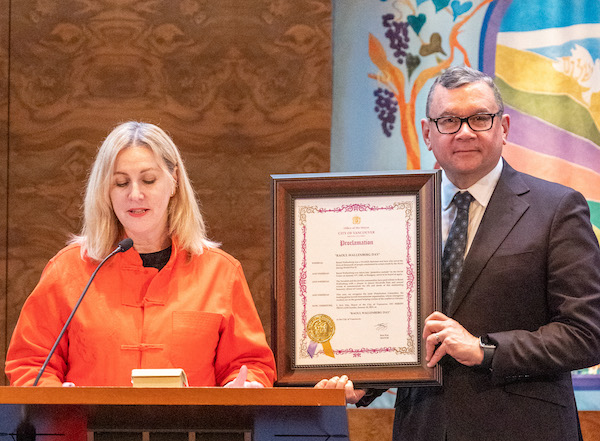
The City of Vancouver’s proclamation of this year’s Wallenberg Day was read by Deputy Mayor Sarah Kirby-Yung, attending on behalf of Vancouver Mayor Ken Sim. She was joined by Councilor Mike Klassen.

Kirby-Yung had helped celebrate the start of the Lunar New Year that morning, and still had on the red jacket she had worn for that event because the Asian community “has suffered much in the past few years, [with] anti-Asian hate and, sometimes, that plight has been very analogous to what our Jewish community has suffered” and one of the best things about the city, and what she sees in the work of the JDC, is “communities and cultures, and people of different faiths and backgrounds, who come together to stand against injustice and to support each other.”

photo - Vancouver Deputy Mayor Sarah Kirby-Yung reads the city’s proclamation of this year’s Wallenberg Day, the framed copy of which is being held by Councilor Mike Klassen
Vancouver Deputy Mayor Sarah Kirby-Yung reads the city’s proclamation of this year’s Wallenberg Day, the framed copy of which is being held by Councilor Mike Klassen. (photo by Masumi Kikuchi)

WSCCS board member George Bluman introduced the afternoon’s guest speaker, Dr. Marina Sonkina, a local educator and writer. “Soon after Russia attacked Ukraine, Marina applied to volunteer with the Jewish Joint Distribution Committee, as someone who speaks Russian, Ukrainian and other languages and as someone who has been a refugee herself,” he said. “Almost immediately, she was accepted and flew to Poland at the end of March.

“After arriving in Warsaw, about five hours later, Marina was at the Polish-Ukrainian border, where she served in a camp as a frontline responder, offering fleeing refugees medical and psychological support.”

Sonkina, who has relatives in Russia and Ukraine, said most of her family is out of Russia at this point.

“If we are talking about why didn’t Russians resist,” she said, “I think those more than one million people who left Russia when the draft, conscription, was announced, that is the only accessible form of not revolt, but saying no to Putin. Otherwise, it is pretty much a fascist state.”

While Putin is the person who launched the war, she wondered about others’ culpability: all those who overlooked Putin’s actions over the 22 years of his being power, which has seen him poison his opponents and annex Crimea, among other things. What was the West’s role, she asked, as they worked with Putin as a business partner first, putting his authoritarianism second?

In Warsaw, Sonkina was one of the people who met Holocaust survivors being extracted from Ukraine, to be housed in Germany. The next day, she worked in a refugee camp, where there were already more than two million refugees. (For more on Sonkina’s experience in Poland, read her account at jewishindependent.ca/helping-ukrainian-refugees.)

JDC helped everybody, said Sonkina. A moral responsibility to repair the world, tikkun olam, is part of JDC’s mandate and she saw this responsibility in action. She remarked on the goodwill of people from around the world, of a range of ages, who were helping in different ways, including taking refugees into their homes. The strength and independence of the refugees also left an impression on Sonkina – they didn’t want to take handouts, she said, and they wanted to know whether they could get jobs in the country that harboured them.

“One of the things that I quickly realized – a part of persuading them to go to this country or that was just the human contact that was so important,” she said. The refugees she met had experienced such trauma, and her acknowledgement of what they had gone through allowed some of them to cry. “It was sometimes hard,” Sonkina admitted, visibly emotional. “But there were also funny stories,” she added, sharing a couple of those stories before WSCCS board member Gene Homel took the podium.

An historian teaching about Europe in the 20th century for many years, Homel had been in Ukraine eight or nine years ago, and he echoed what Sonkina had said about Ukrainians’ “intense loyalty” – “the attachment to the land, culture and language” – but, he said, “I want to make the point that, in Ukraine today, the focus of loyalty is a civic one, it’s on the national state rather than ethnicity, it’s a pluralistic and multiethnic society that’s being created, forged largely as a result of Russia’s criminal attack on Ukraine.”

Homel provided a brief overview of the JDC’s work from its founding in 1914 to its current work with Ukrainian Jews and non-Jews, and he introduced businessman and philanthropist Gary Segal, who became familiar with JDC’s work in 2007, on a Jewish Federation of Greater Vancouver trip to Ethiopia, led by JDC professionals. He’s been a board member since 2012.

“I marvel at the compassion, intelligence, resourcefulness and resolve with which the dedicated staff and volunteers carry on their sacred work,” said Segal, noting that JDC helps communities of all backgrounds and faiths, and doesn’t just respond to acute situations, but also to endemic poverty, food insecurity and the plight of refugees, as well as antisemitism.

“Since 1914, we’ve rescued more than one million Jews in danger, from places like Ethiopia, Yemen, Bosnia and Herzegovina, and Ukraine,” said Segal, who spoke about various JDC initiatives, including its medical programs in countries like Ethiopia.

photo - Gary Segal, a board member of the American Jewish Joint Distribution Committee, speaks about JDC’s history and his involvement with the organization
Gary Segal, a board member of the American Jewish Joint Distribution Committee, speaks about JDC’s history and his involvement with the organization. (photo by Masumi Kikuchi)

It was on that 2007 trip that Segal met Dr. Rick Hodes, JDC’s medical director in Ethiopia, whose care for kids with severe spinal deformities (with Ghanaian spine surgeon Dr. Oheneba Boachie-Adjei) inspired Segal to get involved, too. He brought a young Ethiopian to Vancouver for back surgery and established in Vancouver the organization Bring Back Hope, which has raised some $3 million to support spine surgeries, preventative screening, and more. (See jewishindependent.ca/oldsite/archives/jan11/archives11jan14-02.html and several articles on jewishindependent.ca.)

Returning to JDC’s work in Ukraine since the war began, Segal noted that, to date, the organization “has cared for 35,000 vulnerable and elderly poor; it evacuated 13,000 Jews from Ukraine; provided over 40,000 refugees with food, medicine, trauma support; received over 19,000 incoming calls at the emergency centre; and provided over 1.3 million pounds of humanitarian assistance.”

Segal then brought his talk around to Raoul Wallenberg, Sweden’s special envoy to Hungary in 1944, who saved tens of thousands of Jews from deportation and death. “The original fund of $100,000 that [Wallenberg] received from the War Refugee Board came from the American Joint Distribution Committee and, when that was finished, he received additional funds from the JDC,” said

Segal, who concluded, “I would say, so much of what JDC does is giving hope. Hope is a powerful word, an essential element in everyone’s life…. Hope can give us the strength and the will to continue in our darkest moments, to aspire and believe that things can and will be better.”

On behalf of the JDC, Segal accepted, with thanks, the Wallenberg-Sugihara Civil Courage Award from Le Fevre.

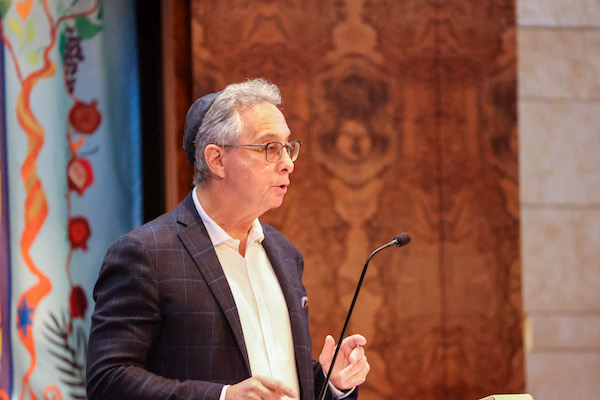
Other components of the afternoon included a few words from Beth Israel’s Rabbi Jonathan Infeld, a short documentary on Norwegian Fridtjof Nansen, who received the 1922 Nobel Peace Prize for his work on behalf of displaced persons after the First World War, and a compilation of JDC’s work in Ukraine since the Russian invasion.

WSCCS board member Judith Anderson introduced the videos, giving more of Nansen’s background and achievements, including “the repatriation of 450,000 prisoners of war, mostly held in Soviet Russia” and “[in] response to a severe famine in Soviet Russia, Nansen directed relief efforts that saved between seven million and 22 million people from starvation.”

Anderson said, “The Nansen story is directly relevant to Ukraine. The headquarters for Nansen’s mission to Russia was in Ukraine’s Kharkiv, and Nansen donated part of his Nobel Peace Prize money to establish a major agricultural project in Ukraine.”

She thanked the Norwegian Refugee Council and the Nobel Peace Centre for permission to show the videos about Nansen and JDC staff members and directors – Shaun Goldstone, Solly Kaplinski and Alex Weisler – for compiling the material for the Ukraine Crisis video.

The Wallenberg-Sugihara Civil Courage Society is named after Wallenberg for his actions during the Holocaust, and Chiune Sugihara, who, as vice-consul in Lithuania for Japan during the war, issued transit visas that allowed thousands of Jews from Poland and Lithuania to escape. For more information on the society and to see videos of the Jan. 22 event, visit wsccs.ca.

Format ImagePosted on February 10, 2023February 9, 2023Author Cynthia RamsayCategories LocalTags Alan Le Fevre, American Jewish Joint Distribution Committee, Gary Segal, Gene Homel, George Bluman, JDC, Judith Anderson, Marina Sonkina, refugees, Sarah Kirby-Yung, Ukraine, Wallenberg-Sugihara Civil Courage Award, Wallenberg-Sugihara Civil Courage Society, war

Posts pagination

Previous page Page 1 … Page 23 Page 24 Page 25 … Page 85 Next page
Proudly powered by WordPress