Skip to content
  • Home
  • Subscribe / donate
  • Events calendar
  • News
    • Local
    • National
    • Israel
    • World
    • עניין בחדשות
      A roundup of news in Canada and further afield, in Hebrew.
  • Opinion
    • From the JI
    • Op-Ed
  • Arts & Culture
    • Performing Arts
    • Music
    • Books
    • Visual Arts
    • TV & Film
  • Life
    • Celebrating the Holidays
    • Travel
    • The Daily Snooze
      Cartoons by Jacob Samuel
    • Mystery Photo
      Help the JI and JMABC fill in the gaps in our archives.
  • Community Links
    • Organizations, Etc.
    • Other News Sources & Blogs
    • Business Directory
  • FAQ
  • JI Chai Celebration
  • JI@88! video

Recent Posts

  • Sharing her testimony
  • Fall fight takes leap forward
  • The balancing of rights
  • Multiple Tony n’ Tina roles
  • Stories of trauma, resilience
  • Celebrate our culture
  • A responsibility to help
  • What wellness means at JCC
  • Together in mourning
  • Downhill after Trump?
  • Birth control even easier now
  • Eco-Sisters mentorship
  • Unexpected discoveries
  • Study’s results hopeful
  • Bad behaviour affects us all
  • Thankful for the police
  • UBC needs a wake-up call
  • Recalling a shining star
  • Sleep well …
  • BGU fosters startup culture
  • Photography and glass
  • Is it the end of an era?
  • Taking life a step at a time
  • Nakba exhibit biased
  • Film festival starts next week
  • Musical with heart and soul
  • Rabbi marks 13 years
  • Keeper of VTT’s history
  • Gala fêtes Infeld’s 20th
  • Building JWest together
  • Challah Mom comes to Vancouver
  • What to do about media bias
  • Education offers hope
  • Remembrance – a moral act
  • What makes us human
  • המלחמות של נתניהו וטראמפ

Archives

Follow @JewishIndie
image - The CJN - Visit Us Banner - 300x600 - 101625

Author: Rebeca Kuropatwa

Try to reduce screen time

Try to reduce screen time

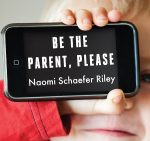
In her latest book, Be the Parent, Please (Templeton Press, 2018), author Naomi Schaefer Riley reminds parents to take back control and help their kids find healthier means of entertainment.

Originally from Massachusetts, this New York mom of three kids (ages 11, 9 and 5) is no stranger to society’s pressure to give children whatever they want, including the latest technology.

“Over the last few years, I myself struggled with the issues of how to handle screen time, and I’ve watched a lot of other parents struggle with it,” Schaefer Riley told the Independent. “As a journalist, I wanted to talk to experts and do reading, and find out what the research says … and talk to parents about strategies they were using to deal with this.

“The pressure to hand over screens to kids starts almost immediately these days,” she said, “The iPhone came out a little more than 10 years ago, coinciding with the birth of my oldest daughter. It took a couple years but, by the time she was in preschool, a lot of parents, even to have a basic conversation with another person, would hand over their phone just in order to distract the child.”

Today, tablets and cellphones have become a source of all things entertainment for kids (let alone adults), whether that involves looking at pictures of themselves, creating videos or playing games.

“When my kids were younger, we let them watch one show every night, some half-an-hour cartoon,” said Schaefer Riley. “Then, my son was born and the fight began over what they were watching and who gets to pick each night. And it became more of a struggle to tell them you’re going to turn off the TV…. A book I read enlightened me, called The Plug-In Drug. It came out a little more than 40 years ago and was mostly about TV and videogames.

“The author noted that, when you turn off a screen, it’s almost like waking a child up from a nap. It’s a trance-like state and they’re so into it that it’s almost like a change from sleep to wakefulness when you turn it off. And they become cranky. It can be as long as a half hour before they adjust back to reality. I think I was tired of the crankiness, too, of every time I turned it off, to have this fight ensue.”

At the Schaefer Riley house, there are a lot of toys and the kids are expected to entertain themselves without the TV. “But, a lot of parents don’t make that expectation,” she said. “They assume that, unless the child has a screen, the parent has to be entertaining them at all times, that the child can never be restless or irritated.”

She went on to explain that it’s not a parent’s job to ensure that their child is 100% engaged in something at all times. Instead of screens, she suggested, “Why not give your kids some pots and pans to bang together or some cardboard boxes? These are things we know are good for building fine and gross motor skills, and [that] encourage kids to explore things.
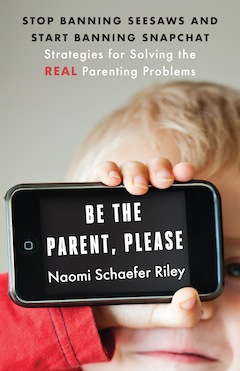
image - Be the Parent, Please book cover“I think what the screens have allowed is for us to exercise more control over our kids and keep them on a tighter leash. You don’t need to go all the way to the park. You can just sit in the living room and give your kid an iPad. That way, I don’t need to worry about whether you know enough about crossing the street or whether you’ve achieved that level of independence. The phone will allow me to have this tether on you. This is not very beneficial to kids in the long run.”

Children are now finding tasks difficult to handle if they cannot immediately text their parents for advice or counsel about their lives, argued Schaefer Riley. There is constant communication, with technology serving as a crutch for helicopter parenting.

“A lot of parents have confessed to me … they know, deep down … that they don’t need studies to tell them that their kids are on screens too much,” said Schaefer Riley. “Parents know this.”

It’s time to apply basic parenting strategies to technology, she said. “I know it sounds simplistic to say, but your kid doesn’t generally ask for chocolate cake for breakfast in the morning; they know there’s none for breakfast. If you talk about screen-time limits and stick to them, your kid will not be on you constantly…. If you stick with the rules you set for a few weeks or months, your child will learn that there is no point in asking again; they already know what the answer is and will stop asking for things you consistently say ‘no’ to. The idea is to bring parents back to reality and back to a sense of where they do have control.”

According to Schaefer Riley, the life skill of asking for assistance from an adult is one that many children are missing out on, due to the reliance on tablets and phones.

“I see the kids … my daughter is on the swim team … and they all walk out of practice and everyone is texting their parents – pick me up in five or 10 minutes outside,” said Schaefer Riley. “I’m like, ‘who are you?’ These are not your chauffeurs. I think that’s how we’ve come to think of ourselves.”

Schaefer Riley said observant families, who turn off their phones on Shabbat, have an advantage, as the children come to appreciate that there is something to be gained from family time. “I think,” she said, “that more and more people, whether they are religious or not, are trying to find that ‘technology Sabbath,’ as they like to call it, to give themselves a break … either at meal times, or one day a week, or on vacation. It’s considered a luxury now, to be able to get away from your phone.”

Schaefer Riley emphasized that her book is not meant to scold anyone. She herself faces these challenges.

“There’s a lot of pressure coming from technology companies and schools, and from the culture generally, that are really pushing you to hand over these devices to your kids,” she said. “It takes some willpower to say no, that’s not for my child, or this much time is not for my child.

“There’s a point at which you need to go into your community and find allies,” she added. “Everywhere I went, every community of people I’ve spoken with, there wasn’t just one family trying to hold the line. There were several and, sometimes, they weren’t connected with each other. But, if you do a little searching, you can find people trying to take a similar tactic, and it helps to have allies.”

Rebeca Kuropatwa is a Winnipeg freelance writer.

Format ImagePosted on April 27, 2018April 25, 2018Author Rebeca KuropatwaCategories BooksTags children, Naomi Schaefer Riley, parenting, technology
Israel’s 70th

Israel’s 70th

(photo from Ashernet)

Israeli Prime Minister Binyamin Netanyahu addressed a special meeting of the Israeli cabinet in Independence Hall in Tel Aviv on April 20 in honour of the 70th anniversary of the proclamation of the modern state by Israel’s first prime minister, David Ben-Gurion. Plans are to restore Independence Hall and turn it into a museum, where the Declaration of Independence will be displayed publicly for the first time. The document is currently stored at the State Archive in Jerusalem.

Format ImagePosted on April 27, 2018April 25, 2018Author Edgar AsherCategories IsraelTags independence, Israel, Netanyahu
שיתוף הפעולה הטכנולוגי

שיתוף הפעולה הטכנולוגי

שיתוף הפעולה הטכנולוגי בין קנדה לישראל מתרחב משמעותית. (צילום: tec_estromberg)

מועצת המנהלים של קרן קנדה-ישראל תממן שמונה פרוייקטים חדשים בסכום כולל של כחמישה עשר מליון שקל (שהם כמישה מיליון ושלוש מאות אלף דולר קנדי). הפרוייקטים יבוצעו בשיתוף פעולה עם חברות בתחומים הבאים: חקלאות, רובטיקה, תקשורת לווינים, טכנולוגיות, מזון וטכנולוגיה נקייה (קלינטק). רשימת שמונה החברות שזכו בתקציבים של קרן קנדה-ישראל כוללת את: פלורה-פוטוניקה – בתחומי החקלאות, אינובופרו – בתחומי החקלאות, סי-נייצ’ר – בתחומי החקלאות, אף.אף.אר רובוטקס – בתחומי הרובוטים לחקלאות, גילת רשתות לווינים – בתחומי תקשורת לווינים, קנופי מדיה – בתחומי הטכנולגיות לאינפורמציה ותקשורת, אטלנטיום טכנולוגיות – בתחומי המזון והטכנולוגיה הנקייה (קלינטק) ואפקון בקרה ואוטומציה – בתחומי הטכנולוגיה הנקייה (קלינטק).

יצויין שקנדה כיום היא אחת השותפות המשמעותיות של ישראל, בתחום החדשנות. בנוסף לשיתוף הפעולה עם קרן קנדה-ישראל, מתבצעים שיתופי פעולה נוספים עם ממשלת מחוז קוויבק, ממשלת מחוז אונטריו וגורמים נוספים, בתחומי בריאות, תחבורה חכמה ועוד. התקציב הכולל של מחקר ופיתוח הכולל של פרוייקטים בין קנדה וישראל שאושרו בשנה האחרונה, עומד על לא פחות מכארבעים ושניים מיליון שקל (שהם כחמישה עשר מיליון דולר קנדי).

אומר שר הכלכלה של ממשלת ישראל, אלי כהן: “קשרי החדשנות בין ישראל לקנדה קיימים כבר יותר מארבעים שנה. מדובר במנוף כלכלי בילטרלי חשוב מאין כמוהו, המחבר בין חברות, חוקרים, ויזמים ישראלים וקנדים. שיתוף הפעולה הטכנולוגי שלנו עם קנדה, על מגוון ערוציו הוא נכס אסטרטגי חשוב למדינת ישראל ולאקוסיסטם הטכנולוגי שלנו”.

מנכ”ל רשות החדשנות ,אהרון אהרון, מוסיף: “קנדה מפעילה מערכות חדשנות מתקדמות ומפותחות מאד, הן ברמה הפדרלית והן ברמה המקומית. רשות החדשנות מפעילה מגוון תכניות ברמות שונות שמאפשרות לחברות טכנולוגיה ישראליות בתחומים שונים ליהנות ממערכות חדשנות אלה, ולשתף פעולה עם חברות וגופים קנדיים”.

הקרן הדו-לאומית קנדה-ישראל שמופעלת על ידי רשות החדשנות הוקמה לפני כעשרים וארבע שנים (ב-1994). מאז היא עוסקת בחיבור שבין חברות טכנולוגיה בין שתי המדינות. וזאת במימון של פרוייקטים של מחקר ופיתוח משותפים. בנוסף לקרן הדו-לאומית, רשות החדשנות מפעילה מספר הסכמי שיתוף פעולה עם גורמים נוספים בקנדה. כאמור בהם בין היתר ממשלת מחוז אונטריו. במסגרת זו אושרו בחודש פברואר שנה זו ארבעה פרוייקטים חדשים בתחומי: החקלאות, טכנולוגיה נקייה (קלינטק), תעופה, חלל וטכנולוגיות לאינפורמציה ותקשורת. ההיקף הכספי של פרוייקטים אלה עומד על כארבעה מיליון שקל (שהם כמיליון וחצי דולר קנדי). גם עם ממשלת קוויבק נחתמו (בשנה שעברה) הסכמים ליישום ארבעה פרוייקטים חדשים, בסכום של כעשרה מיליון שקל (שהם כשלושה וחצי מיליון דולר קנדי). הרשות לחדשנות מפעילה בנוסף תוכנית ייעודית של אימות פתרונות בריאות לקשישים בבתי חולים בכל רחבי קנדה. ובמקביל הרשות לחדשנות מפעילה תוכנית חדשה בתחומי התחבורה החכמה בקנדה.

המפלגה השמרנית תכיר בירושלים כבירת ישראל

מפלגת השמרנים הקנדית בראשות אנדרו שייר, תכיר בירושלים כבירת ישראל כפי שארה”ב עשתה. ארה”ב הבטיחה להעביר את שגרירותה מתל אביב לירושלים בקרוב. כך הכריז שייר אם מפלגתו תנצח בבחירות 2019 את מפלגת השלטון הליבראלית בראשות ג’סטין טרודו. בהודעה רשמית של השמרנים נאמר בין היתר כי: “המפלגה מכירה בעובדה כי ישראל, כמו לכל מדינה ריבונית אחרת, שמורה הזכות לקבוע היכן תמצא בירתה”.

יש לזכור שהמפלגה השמרנית בראשות סטיבן הרפר, החזיקה בשלטון במשך קרוב לעשר שנים. דווקא הרפר שהיה מקורב מאוד לישראל, לא חשב להכיר בירושלים כבירת ישראל. שייר חושב אחרת.

Format ImagePosted on April 25, 2018April 25, 2018Author Roni RachmaniCategories עניין בחדשותTags Andrew Scheer, Canada, Conservative Party, Israel, Jerusalem, technology, אנדרו שייר, טכנולוגיה, ירושלים, ישראל, מפלגה השמרנית, קנדה
My chat with Ed Asner

My chat with Ed Asner

Ed Asner stars in A Man and His Prostate, which is at the Anvil Centre Theatre for two nights only: April 27-28. (photo from ACT)

I did my homework. I had read and watched interviews. I had my questions ready. I was prepared. But Ed Asner is a force of nature – a funny, caring and curious one, but a force of nature nonetheless. And nature is more powerful than the proverbial man. I learned that in high school English class – man has a chance against another man or his own internal demons, but not so much against nature.

I was calling Asner about his upcoming performances in New Westminster at the Anvil Centre Theatre April 27-28. He stars in A Man and His Prostate, written by his longtime friend Ed Weinberger, a multiple-award-winning scribe (including a Writers Guild of America Lifetime Achievement Award), who has written for countless TV series – for soooo many comedies. Both Weinberger and Asner know funny, so this show promises to be hilarious. But its purpose is also to make a point: “that point being,” Asner told me succinctly, “get examined.” Hear that, guys?

I’ve interviewed famous people before so that wasn’t the reason I got somewhat flustered in speaking with Asner. Admittedly, I loved and watched every episode of The Mary Tyler Moore Show and its spinoff drama Lou Grant. I have enjoyed Asner in various other roles over the years, including on Murdoch Mysteries (as Santa Claus, of all things) and, of course, as the voice of Carl Fredricksen, the grumpy protagonist in Up, who made me cry. Hearing such a well-known voice respond to your questions is very cool, and a little unnerving, but there was more to it.

I called Asner at the number I was given by the publicist for the local show. The woman who answered the phone simply said he’d had to leave and that I should try his cell, so I did, thinking nothing of it. The connection wasn’t great, but I reached Asner – he was in an L.A. hospital waiting to get a CT scan. When I wished him well and said we could reschedule the interview, he said, “Let’s try to talk now. It’ll help me pass the time.”

As I started asking him questions, he stopped me: “Are you uncomfortable doing this?”

“No,” I said, “I’m happy to keep your mind off things if that’s going to help.” I got as far as finding out that Weinberger had approached Asner about a year and a half ago to take on this role, but the line really was bad and we weren’t hearing each other – he said he’d call me back. But it was Asner’s righthand man (Nick, I think) who phoned, telling me that Asner had gone in for his CT, and they would call again once it was complete.

Next call: “Are you OK?” I asked.

“I’m fine. Well, maybe a little dizzy,” said Asner. Or, at least that’s what I think he said. After a spike of feedback came through the phone, I admitted, “I can barely hear you.”

In a louder voice, enunciating carefully and speaking slowly, he responded, “I said, maybe a little bit of syphilis.”

I might have taken a beat before saying, “Oh my. Really?! Is that the headline I can put?”

While it may not be apparent on first meeting, I can be bawdy with the best of them, and I enjoy such banter when all involved are of age and it’s in good fun. And this would turn out to be one of the most fun interviews I’ve conducted.

Laughing, I said, “So it all went well, the CT scan?”

It had indeed. He’d had a fall but was OK. I thanked him for calling me back, and he let me know, “Well, I’m reversing the charges.”

“You should!” I said. “You’re paying for this now. Oh my gosh. I was hoping to get my parents to pay for it.” (I was in Ottawa, and was calling him from my parents’ house.)

“Ah, no, no, no,” he assured me. “Anyway, you’ve got a lovely voice.”

“As do you, of course. But a little more famous than mine.”

“Well, I’ve been working at it longer.”

We eventually returned to where we had left off. “Were you involved in any of the writing process, or is there improv involved?” I asked about the show.

“Not on this,” said Asner. “I worked with him [Weinberger] on our book together, called The Grouchy Historian, which came out in October. We worked together on that, but he wrote A Man and His Prostate all by himself.”

“And you obviously liked what he wrote.”

“I love it.”

Asner said his first performance of A Man and His Prostate was in the fall of 2016, but then he stopped the interview again, leaving the phone with Nick – the two were still at the hospital, about to grab a very late lunch. Getting into a rhythm for this interview was proving impossible. Case in point, when Asner returned to the line, he started interviewing me. Why was I calling from Ottawa? I explained I was at home for Passover and asked if he had attended a seder. “No, we were on the road,” he said, going on to ask me about the weather in Ottawa, how many were in my family, whether I had grown up in Vancouver. When I let him know that I had grown up in Winnipeg, he said, “Oh, God.” And, while I fumbled to regain my role as interviewer, he continued his train of thought, “Froze your ass off didn’t you?”

“I did,” I admitted. “And that’s why I live in Vancouver now.”

After some PG-rated politically incorrect exchanges, I managed to get back to my questions.

The first shows of A Man and His Prostate were in California, he said, then they did a few in New York.

“Do you do what the show preaches? Do you get regular prostate exams?” I asked.

“Well, I’m due for one, I must tell you,” he said.

Asner called A Man and His Prostate “wonderfully funny,” and said “it stresses a very important point – that point being, get examined.”

He said the show is “very rewarding to do because the laughter is prevalent.”

At 88, he has no plans to retire. As for his beginnings in the profession, he said his desire to be an actor “didn’t achieve consciousness until I did the lead in the play at university.” He said, “I had done radio in high school, and loved it, but full-fledged stage-acting, I hadn’t thought of that.”

That doesn’t mean he didn’t like the spotlight as a kid. “I loved to get up and sing Adon Olam louder than anyone else,” he said, adding, “My bar mitzvah was a failure.”

He explained, “I spoke too fast, and angered my father. I put my hands behind my back, hovering over my ass, that angered him, as well. I was a prize student … but that bar mitzvah was not of prime quality.”

Asner grew up in an Orthodox home and, he said, “I’d say I pursued acting, probably, as part of my atonement” for his bar mitzvah. He said acting was at least a partial atonement in that it involved “pleasing the crowd, reciting or reading the script correctly and empathetically … all kinds of things.”

While no longer religious, Asner attributed his activism to “the intensity of my raising, the love of my parents, the constant identification as a Jew, [being] born in the time of Hitler.”

The actor has seven grandchildren. When I asked about whether he actively tries to engage them in the world around them, he joked, “Nope. I don’t like ’em.”

“You only hang out with them when you have to?” I asked.

“Uh huh. They don’t like me. It’s a perfect fit.”

I told him how much I enjoyed the Funny or Die video Old People Don’t Care About Climate Change, in which he took part. I mentioned it because one of his lines in it is, “My grandkids are spoiled anyway. They could use a little hardship.” The video’s message, of course, is that younger people must take action to protect the environment.

“I worship the earth,” Asner told me. “I don’t necessarily worship any god.”

Returning to the reason for the interview, I asked him whether he had anything else to say about A Man and His Prostate. “You’ll be there, and you’ll see how right I was to urge you to come,” he said.

The show is about Weinberger’s “journey to discover his inner self both literally and figuratively,” reads the press material. “This near tragedy is masterfully transformed into a poignant monologue perfectly portrayed by Asner as he visits the hospital in preparation for a surgery he needs but doesn’t want.”

“There’s mostly jokes all the way, or building up to a joke,” Asner said. “But then we get to that little section where I talk about the celebrities who have died – it’s a long list of celebrities – and I make the serious point that, every 16 minutes, a man dies of prostate cancer in the United States.”

As we wound up, he said, “You’re a wonderful interviewer, I don’t care what they say about you.”

“You should only believe half the rumours,” I returned.

A charmer to the end, he said, “I can’t wait to meet you.”

After I told him I didn’t think that was an option for me, he asked, “Why not?”

“Because you’re you!”

He told me to tell the publicist, “Well, say that I asked for you.”

“OK,” I said. “And I’ve now got it on tape, so I can actually prove that I’m not just making that up.”

“That’s right,” he agreed. “That’s absolutely right.”

He said, I “could even bring Momma” – my mother had answered the phone when he called back.

“Momma might even fly to Vancouver for that,” I responded before handing the phone over to my mom so she could say goodbye.

For tickets ($75) to A Man and His Prostate at the Anvil Centre Theatre April 27-28, 7:30 p.m., visit ticketsnw.ca or call 604-521-5050.

Format ImagePosted on April 20, 2018April 18, 2018Author Cynthia RamsayCategories Performing ArtsTags Anvil Centre, Ed Asner, Ed Weinberger, health, Judaism, prostate cancer, theatre
S Word changes perceptions

S Word changes perceptions

Craig Miller in a shot from the documentary The S Word, which screened for the first time in Western Canada on March 22 in Winnipeg. (photo from MadPix, Inc.)

Jewish Child and Family Service of Winnipeg (JCFS) partnered with the Suicide Prevention Network and the Jewish Federation of Winnipeg’s Young Adult Division to show the documentary The S Word for the first time in Western Canada. The screening took place March 22 at the JCC Berney Theatre, and the event’s aim was to help put a stop to the silence surrounding the subject of suicide.

“Suicide is widespread and affects all age groups and communities,” said Carli Rossall, JCFS addictions and mental health caseworker. “There are many ‘S words’ that reinforce the behaviour around suicide, such as silence, stigma, shame and struggle. The hope is to turn this around into S words such as support, survival, sharing and solutions.”

Rossall has taken the lead in organizing this project, along with Cheryl Hirsh Katz, JCFS manager of adult services, and Shana Menkis, JCFS director of operations.

JCFS is a member of the Suicide Prevention Network, which is a group of agencies and individuals committed to enhancing the mental wellness and quality of life of people in Winnipeg, preventing suicides and supporting those bereaved by suicide.

“I think our goal with this [event] was to begin to create a safe space within the community where topics like suicide can be freely and openly discussed,” said Rossall. “Staying silent doesn’t make an issue cease to exist. Suicide is a reality in our community as it is in all communities. Healing requires openness, acceptance and dialogue. The more we talk about these things, the more fluency we develop when it comes to hard conversations, [and] the better equipped we all are to support one another.”

“Bringing this film to our city and specifically to this community,” Hirsh Katz added, “will hopefully give a voice to this problem and put a face to the solution.”

The S Word aims to open the conversation surrounding suicide. Its director, Lisa Klein, is a survivor of both her father’s and her brother’s suicides. In the film, she wanted to show the voices of those who survived suicide attempts, as well as others, to provide an honest portrayal of the thoughts and feelings surrounding suicide. She further wanted to provide positive messaging.

“It’s an outstanding collection of stories that, unlike other films on the same subject, shines a light on hope,” said Klein. “It talks about language, relationships, relapses in mental health, and about how recovery is rarely a straight trajectory. It’s very real and raw. I consider it to be one of the best mental health documentaries I’ve ever seen … unique in its approach to an otherwise familiar topic.

“We hear about suicide epidemics, about over- and under-medicating, about the bereaved when it comes to suicide in the community, but, rarely do we hear from survivors. Frankly, I don’t know if ‘survivor of suicide’ is a concept most people even know exists.”

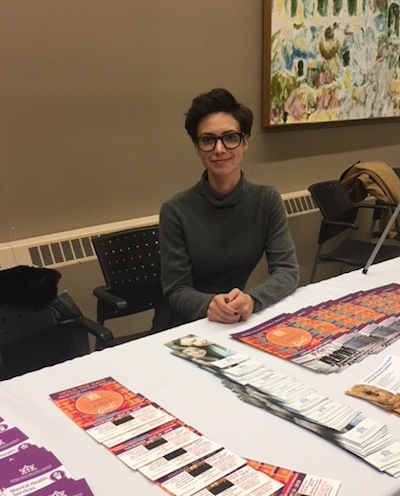
photo - Carli Rossall, Jewish Child and Family Service of Winnipeg addictions and mental health caseworker, at the information table on March 22
Carli Rossall, Jewish Child and Family Service of Winnipeg addictions and mental health caseworker, at the information table on March 22. (photo from JCFS)

“Loss is never easy to talk about,” said Rossall. “But, when loss gets tied together with morality, as suicide often does, an added layer of stigma exists. Anything that challenges our definition of ‘right,’ ‘moral’ or ‘normal’ tends to make us uncomfortable – and it often makes people look to blame.

“Generally,” she said, “people who have thoughts of suicide suffer from intense psychological pain, where there is a feeling of hopelessness, isolation, and no alternative. The reasons for this can vary, from those experiencing mental health challenges or physical illness, to those who have experienced trauma, are struggling financially or have addictions. The rise in suicide rates may be due to life’s increasing pressures and complex circumstances.”

It was in her late teens that Klein lost her father and then, three months later, her brother, to suicide.

“It’s something that obviously is a huge part of my life, my existence, and it wasn’t something that right away I knew what I’d do with,” said Klein. “It affected me greatly. I really didn’t know who to talk to. That was a big part of why I did this film, because it’s so difficult to talk to people when you’ve lost people. They don’t know what to say to you.

“When I came out to L.A. and went to graduate school, I did a film prior to this one…. We started to do documentaries. We did one on bipolar personalities and, when we did that one, we had someone who was in the film who had lost their daughter to suicide. I thought, OK, I’ve dealt with this. And then, almost immediately, I realized that I actually hadn’t. I thought it was time to do something, because people weren’t, and aren’t, talking about it enough, not talking about it responsibly.”

As Klein began researching the topic, she found a large community of people dealing with suicide – so great a number that they were holding conventions in the United States about it. Klein found this resource helpful when it came to finding specific stories to include in her film.

While The S Word is not yet widely available, Klein has worked to get the message across through teachers, mental health professionals and survivors. And she created a toolkit that is on the movie’s website that anyone can access to find ways to bring the message to their communities.

“We’ve signed with an educational distributor and eventually it will be available – probably in the late fall…. We want to help open the conversation, for sure,” said Klein. “We want people to feel less alone, like they’re not the only ones going through this. And we want people to know that they can be there for somebody else, too. Also, to know that, if you, yourself, are struggling, there are people to talk to.

“A lot of times, what can really kill people, what can drive people to this is the silence or the hopeless feeling of being alone – feeling that they have nobody to talk to, and the stigma and shame keep people from talking about it.

“We see this also in the rape culture and the whole #MeToo movement,” she added. “People who were so afraid to talk are now coming forward. And it’s so important to be able to do this. We want to be part of that conversation.”

Klein invited everyone to visit the film’s website – theswordmovie.com – for more information and to watch the many interviews conducted with suicide survivors that did not make it into the film (click on the “#SWordStories” link). She further encouraged people to send in written stories about their own experiences to the website.

In Winnipeg, JCFS is ready to help anyone in need, via their active mental health services program for the Jewish community and counseling services that are open to the general public. In Vancouver, Jewish Family Services is also ready to help.

“Through these supports, there are opportunities for individuals and families to address their concerns, feelings related to suicide, and other issues on a proactive basis,” said JCFS’s Hirsh Katz. “There are also several other community-based agencies in Winnipeg that provide both crisis and non-crisis work with suicide. The Canadian Association for Suicide Prevention is a nationwide organization dedicated to offering support. Livingworks Education Inc. is a leading provider of suicide intervention training through various workshops – the training is focused on identifying, speaking and intervening with people who have thoughts of suicide, and it is invaluable for individuals ages 15 and over who want to help people be safer from suicide.”

Rebeca Kuropatwa is a Winnipeg freelance writer.

Format ImagePosted on April 20, 2018April 18, 2018Author Rebeca KuropatwaCategories TV & FilmTags #SWordStories, Carli Rossall, health, JCFS, Lisa Klein, suicide, survivors, Winnipeg
#MeToo waves reverberate

#MeToo waves reverberate

Rabbi Mark Dratch (photo from Mark Dratch)

In the first of a series of articles on sexual harassment and violence in the Jewish community, the Jewish Independent speaks with Rabbi Mark Dratch, executive vice-president of the Rabbinical Council of America and founder of JSafe, the Jewish Institute Supporting an Abuse Free Environment, about child abuse.

The “Me Too” movement was started more than 10 years ago to help survivors of sexual violence. Propelled by the hashtag #MeToo, the long-overdue public discussion about sexual harassment and violence against women has revealed that most women have at one point or other in their lives – and usually on more than one occasion – been belittled or threatened, harassed and/or assaulted.

It also has become clear that much abuse occurs – or first occurs – in childhood, and that such abuse is often perpetrated by individuals considered trustworthy, such as a family member, a family friend or someone in an authoritative role, like a teacher, coach or spiritual leader.

Rabbi Mark Dratch, executive vice-president of the Rabbinical Council of America (RCA) and founder of JSafe, the Jewish Institute Supporting an Abuse Free Environment, first became acquainted with the issue when he was working as a pulpit rabbi.

“It was probably about 30 years ago,” he told the Independent. “When I was a young rabbi, I became aware of instances of child abuse in the Jewish community and I was very displeased – by the way the situations were being handled, by the way victims were being treated, by the way communities were in a state of denial … and that many of our institutions were not responding appropriately to the allegations. Victims were becoming re-victimized and we weren’t protecting the safety of victims in our community.”

In a paper on child abuse within the Orthodox community, Dratch argued that the then-status quo way of handling these cases was, in fact, based on misinterpretations of the spirit and letter of Jewish law. He addressed, for example, the notion that one must not speak ill of others and their actions, using the Torah to explain that, in instances of child abuse, this sanction does not apply. Taking it a step further, he showed that, in situations such as child abuse, people have an obligation to speak up. His paper was distributed to members of the RCA, and also to many Jewish child and family services agencies in the United States.

“People objected to calling the child protective agencies or civil authorities because of what was perceived to be a religious ban against reporting a fellow Jew to the civil authorities,” said Dratch. “So, I advocated very strongly and proved that it’s not the case – that there’s an obligation to call and work hard to share that information, and to establish community policies that advocate the importance of reporting. There is a whole host of other Jewish values that are good and appropriate but, when they’re misapplied, they can be very harmful.

“I started to get more and more involved in the issue and became aware of more issues. I became involved in organizations in the Jewish community, the general community and the interfaith community that dealt with issues of child abuse.

“This was a period of education for me in terms of the nature of the incidents, but also various responses, and I have been involved ever since,” he said. “Also, for a number of years, I’ve been involved in trying to educate the community and address the objections people have … trying to advocate for policy and to change attitudes. Over the 30 years or so, we see that the community is in a very different place than it was then.”

Thanks to movements like #MeToo, many survivors have become less fearful of speaking out. “Many of them had felt that, somehow, the stereotype that this doesn’t happen in the Jewish community further alienated them and made it difficult for them to acknowledge the abuse,” said Dratch.

Although he admitted we still have a long way to go, Dratch said he feels that the topic is now more common in community discussions. He also said there are now more supports in place for survivors to come forward and get the help they need from the community. As well, more institutions are developing policies of prevention and response in regards to child abuse.

“I think we are now way beyond the situation where there was denial that this was happening,” said Dratch. “We’re way beyond a situation where the community denies that it has any responsibility in prevention and such.”

According to Dratch, the RCA has been a leader in this field, giving rabbis the tools to respond appropriately if complaints of child abuse come up.

“We serve as a resource to our rabbis looking for guidance on how to handle specific situations that may arise in their communities,” said Dratch. “And, we’ve also evolved our mechanisms for holding our rabbis accountable if there are complaints against them for boundary violations or abuse.”

With respect to the Orthodox community, Dratch has found that the number of females victimized is generally lower than that of males, while numbers in the general community indicate that females are more likely targets of child abuse than males. He attributes the difference as likely being due to the increased segregation of the sexes in Orthodox communities.

“The larger culture, in the Jewish and Orthodox community, has enabled and empowered people to come forward and share their complaints and seek justice,” said Dratch. “We will continue to look for ways to educate our rabbis and our communities, and to make our communities and institutions safer.”

While Dratch deals mostly with the Orthodox community, in previous years, he has been involved with the entire spectrum of the Jewish community. In his view, the phenomenon of abuse does not discriminate between observant and non-observant.

“It doesn’t discriminate at all,” he said. “And we have an obligation, as individuals and as a community, to be there for every member of our larger community. Many people who are involved in these things think that we are no different than the general community. It’s really hard to know what our numbers are. My position is that even one is too many. And we certainly have many more than one victim.”

According to Dratch, in the general community – Jewish and non-Jewish together – one out of seven boys and one out of three or four girls become victims of child abuse.

Rebeca Kuropatwa is a Winnipeg freelance writer.
Format ImagePosted on April 20, 2018April 18, 2018Author Rebeca KuropatwaCategories WorldTags #MeToo, child abuse, harassment, Judaism, Mark Dratch

Antisemitism exposed

It recently came to light that Jeremy Corbyn, the leader of the Labour Party in the United Kingdom, was a member of at least one closed Facebook group where antisemitic rhetoric and hatred, including the most ridiculous assertions based on the Protocols of the Learned Elders of Zion and other such bunkum, was liberally purveyed.

David Collier, an independent British researcher, released an in-depth analysis of the kind of content that appeared in the group to which Corbyn and other leading Labour activists belonged. Members of the group routinely threw around phrases like “Jewnazi” and “Zionazi.” Members posted articles about the “Rothschild Empire,” the “Zionist agenda and New World Order” and “Jewish organ trafficking,” the latter, as the title implies, being a modern incarnation of blood libel.

About Mein Kampf, one poster urged: “Everybody should be forced to read it, especially Jews who have their own agenda as to why they were not liked.” Members have claimed that Hitler “supported Zionism” and that the Holocaust is being exploited so that Jews can oppress others – all the while shielding themselves with the assertion that “criticizing Israel isn’t the same as antisemitism.”

When caught, Corbyn, who has called Hamas and Hezbollah “friends,” defended his online association with antisemitism by saying, “Had I seen [evidence of antisemitism], of course, I would have challenged it straight away, but I actually don’t spend all my time reading social media.” In fact, even the most cursory glance at the page would indicate this is a site with which no legitimate public figure should be associated.

An older incident was made public about the same time, in which Corbyn defended the artist in a case where a local government opted to paint over an overtly antisemitic mural on a public wall. Later, Corbyn would claim he hadn’t really looked at the mural, which clearly depicts stereotypically Jewish looking men divvying up money on the backs of the oppressed, while the symbol of the Illuminati, a figment of the antisemitic movement’s imagination, hovers above them.

The fact that overt antisemitism, which has existed in the Labour Party for some time, has finally had a bright light shone on it, has brought some surprising reactions. Some MPs and other Labour activists have called for MPs who attended a rally against antisemitism to be blackballed from the party. You read that right.

Those whose dogged campaigning has brought the unseemly underbelly of antisemitism on the British left to light seem to now face the daunting task of ensuring that the blame for the problem – and the task of fixing it – falls to the perpetrators, not the victims.

Posted on April 20, 2018April 18, 2018Author The Editorial BoardCategories From the JITags anti-Israel, antisemitism, England, Jeremy Corbyn, Labour Party

Class leads to understanding

This academic year marks the second session of Writing Lives, a two-semester project at Langara College, coordinated by instructor Dr. Rachel Mines. Writing Lives is a partnership between Langara, the Vancouver Holocaust Education Centre and the Azrieli Foundation. Last fall, students learned about the Holocaust by studying literary and historical texts. In January, students began interviewing local Holocaust survivors and are now in the process of writing the survivors’ memoirs, based on the interviews. Students are keeping journals of their personal reflections on their experiences as Writing Lives participants. They used their most recent journal entry to reflect on the topic of Multicultural Perspectives. Here are a few excerpts.

It’s been more than half a year since I decided to join the Writing Lives program. The historical context should have been enough motivation for me to join when I first heard of the program about a year ago, but I hesitated. I’d never done a writing project as large or as important as this. I felt that my skills and experience were inadequate in preserving the stories of Holocaust survivors. I still feel that way.

As a child and then later, as a student of history, I regarded my sources as just that: sources. The stories I listened to were filtered, edited for a younger audience. The books and films I read and watched were similarly altered. As I delved into the history and historiography of it all, I had an inkling in the back of my mind that people actually lived through these events, experienced them. But the moment our survivor partner started telling his story, it really struck me that yes, this is real, these are real people.

This project isn’t just a curiosity, an interest – it has become more of a duty. It has been mentioned many times since the program started that it is crucial for these stories to be told, written down and passed on, for time is running out. I never felt the gravity of that responsibility until we heard the history from someone who saw it with his own eyes.

– J.V. Malabrigo

***

Courses like Writing Lives are a reminder of the damage complacency can cause. Without knowledge, without tolerance, we are doomed to walk in circles until our hatred ends our capacity to recognize each other as human beings. We will fail to recognize that we all bleed, cry, laugh and need each other to survive.

I have learned the beauty of a human story. I have learned what it truly means to be triumphant and what it means to be a survivor. I am learning what it means to achieve true greatness and compassion, despite the lack of it that is shown to so many. I have explored the reality of how complacency may be our true enemy. I have learned that ignorance and acceptance of extremism means turning off our humanity and letting hatred rule minds and hearts alike.

We see history as ancient stories…. Through this class, I understand how to immortalize living, breathing history and to show a history of peace and love coming out of trauma and violence.

– Heather Parks

***

The Writing Lives program has had a significant impact on me. I hope to become an elementary school teacher, specifically teaching a primary grade (kindergarten to Grade 3). Holocaust education may be out of my hands in terms of the curriculum, but there is a major, never-ending lesson that I take away from this experience. I hope to teach my students the importance of embracing and celebrating our differences.

When someone looks different from us, celebrates different holidays, eats different food – whatever the case may be – these are opportunities to learn and to love. If there are things we notice about each other that we don’t understand, there are ways to respectfully ask questions. We will always have differences of views and opinions, but the most important thing to remember is that no single person’s opinion is “proper” or more important than anyone else’s. Our differences make us unique. Our differences are what make the world such an amazing place. If we remember the importance of respect and understanding, we can ensure that we will never see another Holocaust.

– Chelsea Riva

***

My father is Chinese South African. Born in 1965 in Johannesburg, South Africa, he grew up in the final stages of apartheid. This racist system denied people of colour, namely black people, basic human rights and dignity. Laws were based on the race or colour of a person and, while laws were well-defined for most ethnic groups, Chinese people in South Africa were such a small minority that most of their daily lives fell into a legal grey area. In this system, Chinese people were above black people, below white people. Chinese people in some cases would be allowed into white institutions but could be refused service at the discretion of the owner. While Chinese people were given certain privileges, at the end of the day, my family was denied the full rights of humanity. They had to carry identification cards, they were victims of racism and their lives were constructed in fear of punishment from a racist system whose punishment was seemingly random.

My mother is Japanese. Born in 1965 in Hiroshima, Japan, she grew up in a conservative society that often refuses to talk about its violent history of invasion, colonialism and war. This is not to say that my mother herself denies this history, but, in general, Japanese people become uncomfortable when discussing the role of Japan as an invading force in Asia. Numerous Japanese war crimes remain unacknowledged to this day, and even those that have been acknowledged have never reached the same global recognition as the crimes of the Holocaust.

It is unfair to compare separate instances of invasion, imprisonment or murder. The discrimination my father experienced was distinctive and had similarities to the Holocaust, but by no means was it the same. The invading history of my mother’s homeland was horrific, but to compare the actions of the Japanese army and government to those of the Nazis dilutes the complicated issues of Japanese society while disrespecting the unique experience of those terrorized by the Japanese. However, it was with knowledge of these two sides of my family, both Chinese and Japanese, that I took this class.

Taking this class did not change my perspective of the Holocaust. Instead, the Holocaust became more real, more detailed. I came to this class with the utmost respect for what we were studying and with an intense desire to do something that “mattered,” which is a common goal for many people my age. What I didn’t expect was to form such a personal connection with our survivor. I didn’t expect for it to become so real that I would break down crying.

My experience in this class has been enriching in ways that I didn’t expect. I don’t think that I can say this class changed me, but it deepened the ideas of legacy that I held because of my background, and it helped personalize the Holocaust. My family’s history helped me form a deep respect for my elders. Because of them, I learned that there is power in the retelling of stories told with fear, shame and beauty. I have family that comes from the side of both the oppressed and the oppressors, and this informed my perspective and my need to take this class.

– Yukiko Takahashi-Laisut

Posted on April 20, 2018April 18, 2018Author Writing Lives studentsCategories LocalTags Azrieli Foundation, education, Holocaust, Langara College, VHEC, Writing Lives

Rituals can help us with loss

My nephew L’s public elementary school principal just died unexpectedly. She wasn’t old, and it was very sudden. The school closed for an afternoon so everyone could go to a memorial service. He’s upset … as any 9-year-old kid would be. His family lives near my parents, in Virginia, so, when my brother called for grandparent backup, they went right over. They needed to help my nephew start learning and talking about death.

This is so hard, but, in some ways, we are lucky. Judaism has rituals, information and thousands of years of coping with this topic. We can joke about it, sure, but nobody comes out of this thing called life alive. Better to have some things in place ahead of time, so you’re ready for it.

There are those who try to protect kids from sad or upsetting events, and keep them home and shelter them from funerals. This is a disservice to kids, who need to learn how these things work. I experienced several deaths and attended funerals as a little kid, as close family and friends died. Watching my family members mourn, going through shivah and attending services with them to say Kaddish helped me get a grip on the losses of people I loved, even though I wasn’t old enough to do much of this myself.

By comparison, my husband didn’t lose close family members until he was a young adult in his twenties. He didn’t have a deep understanding of traditional Jewish practices, about what would happen and how. In a short span of time, he lost all his grandparents and his mother. Going through the rituals, attending services to say Kaddish and to mourn his mother, was very hard. It was a long year, and we were in grad school, far away from family. However, we used those rituals as a crutch, and it helped us get through it together.

Although my mom is retired, she worked as a Jewish educator and administrator for many years. She still helps manage arrangements for the sale of Jewish burial plots for her Virginia congregation. My mom often helps people as they deal with a sudden death, a long illness or another difficult situation. She was recently invited to talk to the Grade 6 religious school class as they studied Jewish mourning and death.

It turned out that L’s older brother, age 12, was in that class. Although he recognized many of the pictures in my mom’s presentation, he said he learned some new things, too. He recognized the 140-year-old cemetery in Alexandria, where he visits and helps out sometimes. My mom covered basic traditions, but she also talked about how we can comfort friends who lose grandparents – the real details that help us cope with loss. Most poignant for me, though, was the new story my mother told me that she’d mentioned in the class. It was a way to help kids learn to support friends with their losses.

When my mom was 12, there was a phone call in the middle of the night. She heard her dad crying, which she’d never heard before. His father, her grandfather “Poppa,” had died. Her friends at school came up to her. They were sorry to hear about his death. Poppa used to carry around big packets of Juicy Fruit gum in his pockets. He’d hand out sticks of gum to all the kids at the end of High Holiday services. Those friends helped her remember her grandfather in a loving, wonderful way.

In Leviticus, which we read each week at synagogue at this time of year, there are long lists of “shoulds” and “should nots” and instructions for how we should do things. Some of these rules seem rigid. Many aren’t really applicable in a world without ritual sacrifices in the Temple in Jerusalem. However, we have both rabbinic teachings and the Tanakh sacrifice experience. We’re offered tools for how to mourn and how to manage through hard times. That history can propel us forward.

My family and community “practised” with kids so they were ready. True, it may be bending someone’s rules to recite Kaddish in the backyard over a beloved pet who has died. It may not be exactly correct to light a yahrzeit candle and recite Kaddish over a beloved (non-Jewish) elementary school principal who has died, but this “practising” doesn’t matter to most. The Jewish rituals and traditions that exist around death aren’t really about the person who died. It’s about how the rest of us will move forward.

Death is a part of life. It’s dang hard. However, hard things don’t go away because we decide not to talk about them or face them. Instead, brave people conquer difficult challenges through facing them head on. My nephew L is one of those brave people. He uses a wheelchair, signs and uses an iPad communication device to talk – and shows such compassion. He told my mother, “Now I know how you felt when your mom died.”

This week, my nephew heard that we are about to adopt a new dog. He hadn’t realized that one of our dogs died last fall, right before Yom Kippur. He was reassured that our dog Harry was old, and very sick … and that is how most of us die. However, it’s through talking about this that we can move on towards celebrating a new “family member,” too.

Talking about death isn’t easy, but we need to do it – in calm, peaceful ways – long before something sudden happens to us or our families. Talking about death in a Jewish context and acknowledging the value of the rituals that help us cope with it may be one of the deepest ways we can celebrate life.

Joanne Seiff writes regularly for CBC Manitoba and various Jewish publications. She is the author of three books, including From the Outside In: Jewish Post Columns 2015-2016, a collection of essays available for digital download or as a paperback from Amazon. See more about her at joanneseiff.blogspot.com.

Posted on April 20, 2018April 18, 2018Author Joanne SeiffCategories Op-EdTags children, death, health, Judaism
Success in comedy biz

Success in comedy biz

Mark Breslin (photo from Temple Sholom)

Yuk Yuk’s co-founder Mark Breslin is excited to be entertaining Jewish Vancouverites at Temple Sholom’s annual spring fundraiser May 6.

“I can’t get enough Jews in my life,” he told the Independent. “I’m married to a Catholic woman but I’m a Jew through and through. Any time I can talk about Jews and Jewishness, and my unique views on that, I jump at the opportunity because comedy is the jazz of our people. That’s how I express my Jewishness in the biggest way, not by keeping kosher or going to Israel each year, but through comedy.”

Breslin opened his first Yuk Yuk’s location in 1976. Today, he has 15 Yuk Yuk’s franchises across the country, has published four books, produced programs for television and radio, and appeared in theatrical productions. He’s a sought-after public speaker and, in December 2017, he was awarded the Order of Canada.

“Comedy is not usually something people respect, so it’s gratifying that some bureaucrats in Ottawa see what I’ve done with my life and think it has value,” he said. “But all the people I’d like to lord this over are dead now.”

Those people include a high school principal who informed Breslin he was a menace to society, as well as his aunts and uncles, who refused to attend his shows “because they thought I was wasting my life.”

Back when he started Yuk Yuk’s, Breslin said he received no support or encouragement from the people closest to him. “My mother was a child actress in the Yiddish stage in 1920, so you’d think she would be thrilled about what I was trying to build in comedy, but instead she was appalled by it right to the grave. My father was more ambivalent. He respected Yuk Yuk’s as a business and was proud of me, though he didn’t find the comedy funny. Even my friends thought I was nuts.”

When he began the first Yuk Yuk’s location, in Toronto, Breslin said his main goal was to avoid law school. “I thought I’d do comedy for a couple of years and find something else to do when it ran out of steam,” he admitted. “I never thought it would become my life!”

Initially, the Toronto Yuk Yuk’s was known as “that Jewish club,” because the names of the performing comedians were all Jewish. “When standup started, it was a very Jewish thing to do,” explained Breslin. “A lot of the comedians at that time were my friends from high school or university, and they gravitated to Yuk Yuk’s because they knew me.”

Today, standup is a mainstream phenomenon and Yuk Yuk’s is no longer known as a Jewish club. One thing that’s remained unchanged from the get-go, however, is Breslin’s insistence that his clubs be uncensored. “I’ve never censored an act in the 42 years I’ve been in business,” he said. “Being uncensored is important because the clubs are small enough that no one can control them. We have an obligation to be the official opposition and, these days, it’s more important than ever.” While he conceded that most comics exercise their right of free speech to talk about sex, not politics, he said, “Still, the opportunity is there.”

Yuk Yuk’s has two locations in British Columbia: Abbotsford and Vancouver. The Vancouver club opened in 1988 and is located on Cambie Street, near City Hall. It’s always been a success, said Breslin. “I measure success by some level of profitability, but also by how impactful our product is on the wider community and on comedy in general,” he said.

Among the comedians who got their start at Yuk Yuk’s are Russell Peters, Jim Carrey, Howie Mandel, Mike Bullard and Gerry Dee.

Breslin said that, on May 6, at the Temple Sholom event, he plans to talk about how each Jew has their own unique form of Jewishness and how we treat our culture as a Chinese buffet, picking what we want from it.

“I’m going to talk about the golden age of Judaism, 1950 to 1975, when it was cool and sexy to be a Jew,” he said. “I’ll try to figure out what happened between then and now, and why we’re a people in need of a good PR person. I’ll also reveal a lot of fun stuff about my life, my family and things I’ve done, relating that to comedy in general and what it means as a Jewish art form.”

For event details, visit templesholom.ca/inspired. The evening at Performance Works on Granville Island is titled Inspired to Act and includes comedy, music by Adrienne Robles and Liel Amdour, and the 2018 Tikkun Olam Youth Awards.

Lauren Kramer, an award-winning writer and editor, lives in Richmond. To read her work online, visit laurenkramer.net.

Format ImagePosted on April 20, 2018April 18, 2018Author Lauren KramerCategories Performing ArtsTags comedy, Mark Breslin, Temple Sholom, tikkun olam, Yuk Yuk's

Posts pagination

Previous page Page 1 … Page 384 Page 385 Page 386 … Page 667 Next page
Proudly powered by WordPress