Skip to content
  • Home
  • Subscribe / donate
  • Events calendar
  • News
    • Local
    • National
    • Israel
    • World
    • עניין בחדשות
      A roundup of news in Canada and further afield, in Hebrew.
  • Opinion
    • From the JI
    • Op-Ed
  • Arts & Culture
    • Performing Arts
    • Music
    • Books
    • Visual Arts
    • TV & Film
  • Life
    • Celebrating the Holidays
    • Travel
    • The Daily Snooze
      Cartoons by Jacob Samuel
    • Mystery Photo
      Help the JI and JMABC fill in the gaps in our archives.
  • Community Links
    • Organizations, Etc.
    • Other News Sources & Blogs
    • Business Directory
  • FAQ
  • JI Chai Celebration
  • JI@88! video

Recent Posts

  • Sharing her testimony
  • Fall fight takes leap forward
  • The balancing of rights
  • Multiple Tony n’ Tina roles
  • Stories of trauma, resilience
  • Celebrate our culture
  • A responsibility to help
  • What wellness means at JCC
  • Together in mourning
  • Downhill after Trump?
  • Birth control even easier now
  • Eco-Sisters mentorship
  • Unexpected discoveries
  • Study’s results hopeful
  • Bad behaviour affects us all
  • Thankful for the police
  • UBC needs a wake-up call
  • Recalling a shining star
  • Sleep well …
  • BGU fosters startup culture
  • Photography and glass
  • Is it the end of an era?
  • Taking life a step at a time
  • Nakba exhibit biased
  • Film festival starts next week
  • Musical with heart and soul
  • Rabbi marks 13 years
  • Keeper of VTT’s history
  • Gala fêtes Infeld’s 20th
  • Building JWest together
  • Challah Mom comes to Vancouver
  • What to do about media bias
  • Education offers hope
  • Remembrance – a moral act
  • What makes us human
  • המלחמות של נתניהו וטראמפ

Archives

Follow @JewishIndie
image - The CJN - Visit Us Banner - 300x600 - 101625

Author: Olga Livshin

Music from around the world

Music from around the world

Local group MNGWA helps open the World Music Festival on April 26. (photo from Vancouver World Music Festival)

The Vancouver World Music Festival celebrates cultural diversity through music, and world-class musicians from Mexico, Brazil, Africa, Spain, the United States and Canada are participating in this year’s festival, which runs April 26-29. Among them is local group MNGWA (pronounced Ming-Wah).

The festival was founded in 2014 by Tom Landa and Robin Layne, both friends and members of the band Locarno. Their belief is that music can help heal, educate and transform society, leading to better cultural understanding.

Rooted in Afro-Latin and cumbia rhythms, MNGWA mixes elements of psych rock, surf, salsa, reggae and hip-hop into one polyrhythmic pot.

“We started the band about five years ago,” band member Anton Ayzikovsky told the Independent. “Today, we have eight core members: five from the former USSR, two originally from Mexico, and one born Canadian. At first, we were nameless. Then we chose the name MNGWA. It is not an acronym. Mngwa is a mythical African cat from Tanzanian legends. Nobody ever saw it, but everyone was afraid of it.”

Descriptions on the internet compare a mngwa to a leopard, although the former is apparently much larger, the size of a donkey, with brindled grey fur and a ferocious temperament.

“Our music has African, as well as Latin rhythms, so we wanted to find a name that would emphasize that connection,” fellow band member Boris Mandlis explained. “One of our players, our music director Nick Lagasse, is a radio host on CJSF radio. Once a week, he goes on air with his program, Wandering Rhythms, selects a country and plays the native bands from that country. He suggested the name MNGWA, and we all loved it.”

The ensemble draws inspiration for their music from many and varied folk traditions. They are well known on the local festival circuit.

“We play at festivals and venues all around British Columbia,” said Ayzikovsky. “Usually, it is only during spring, summer and fall. We could have played more often, every week, if we wanted to, but, for all of us, the band and the music is a hobby, not a profession. We do it for fun. We like to see people dancing to our music.”

Professionally, Ayzikovsky is an engineer, while Mandlis is a web designer. Besides their university educations and high-tech jobs, there are other similarities between the two musicians. Both of them immigrated to Canada from Russia via Israel: Mandlis, 10 years ago; Ayzikovsky, 15. Both play percussion instruments.

“I play congas, a Latin American percussion,” Mandlis said. “I started learning it about 10 years ago, when I still lived in Israel. I played drums as a kid in Russia. As an adult, I liked listening to Latin music, especially when congas played. Finally I thought, why not learn to play it?”

Ayzikovsky started playing drums as a child in Russia. “My mom is a piano teacher, but I never wanted to play piano,” he said. “I fell in love with percussions at school and have been playing drums as an amateur with many bands over the years.”

Ayzikovsky and Mandlis met through their individual music, and the beginning of MNGWA was sparked by a strange coincidence.

“We had played together only once before that time,” Mandlis recalled. “On that day, we played for awhile, then took a break. There were seven of us and, for some reason, we decided to play this children’s game, Rock-Paper-Scissors. And we all threw scissors simultaneously. All seven of us. I’d say that showed some kindred spirits.”

The group has been together ever since, and most of their projects – new music and lyrics – are collaborations.

“Someone comes up with an idea or a tune,” Ayzikovsky explained. “Often it is Nick Lagasse. Then we jam together. Nick also writes lyrics, he or Blanca [Escobar] or some of the others.”

One of their songs on YouTube, “La Rumba de Kingsway,” is a wonderful and funny tribute to the historic Vancouver thoroughfare. It is also indicative of the group’s style, a blend of cultural influences from all over the world. “We call it cumbia, Vancouver-style,” said Mandlis.

Their unique and eclectic blend is well suited to the ideals of the World Music Festival.

“This year will be the first time we’ll participate in this festival,” said Mandlis, “but we know all the bands playing in it. We listened to them before and liked what they’re doing.”

Ayzikovsky and Mandlis also said the group believes, as do the festival organizers, that music has the power, in a small way, to bring about peaceful, needed change.

The World Music Festival takes place at different venues around Vancouver. MNGWA helps launch the event on April 26, 7 p.m., at Guilt & Co. For the full schedule and tickets, visit worldmusicfest.ca. MNGWA’s website is mngwa.ca.

Olga Livshin is a Vancouver freelance writer. She can be reached at [email protected].
Format ImagePosted on April 20, 2018April 18, 2018Author Olga LivshinCategories MusicTags Anton Ayzikovsky, Boris Mandlis, MNGWA, world music
Festival fêtes Russian music

Festival fêtes Russian music

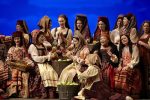
A scene from Vancouver Opera’s production of Eugene Onegin. (photo by Trudie Lee)

“I’ve sung a lot of Russian, and I love it,” Jewish community member and opera singer Leah Giselle Field told the Jewish Independent. Field will have a lot to love at this year’s Vancouver Opera Festival, which starts next weekend.

Russian White Nights, the second annual Vancouver Opera Festival, celebrates Russia’s luminous midsummer nights. Among the festival offerings is Eugene Onegin, based on the classic of Russian literature by Alexander Pushkin, which was turned into a lyric opera with a libretto co-written by Pyotr Ilyich Tchaikovsky with K.S. Shilovsky. The festival will also feature the première of The Overcoat, an opera based on Nikolai Gogol’s famous short story, as well as Requiem for a Lost Girl, an original chamber musical collaboration that explores themes around homelessness and violence towards women.

According to the press material, Eugene Onegin – which plays April 29 in the afternoon, and the evenings of May 3 and May 5 – promises “breathtaking music [and] choreography, lavish orchestrations and compelling arias.” Field will be playing the role of Larina, the mother of the two main female protagonists of the story, Olga and Tatyana.

“The libretto includes portions of the original verses of Pushkin,” Field said, noting that the score is one of her favourites. “Tchaikovsky originally thought it would be blasphemy to make Pushkin’s poem into an opera, but eventually he agreed. I love the Pushkin poem the opera is based on as well – it’s so environmentally evocative, it is so Russian, and it takes you into right into that environment.”

A number of Russians feature in the cast, including baritone Konstantin Shushakov (Onegin), soprano Svetlana Aksenova (Tatiana) and tenor Alexey Dolgov (Lensky). This new production has been created in collaboration with Calgary Opera and is directed by Tom Diamond and conducted by Jonathan Darlington. Eugene Onegin will be sung in Russian with English surtitles projected on a screen.

In addition to Eugene Onegin, Field will participate in a chamber music performance of Dmitri Shostakovich’s From Jewish Folk-Poetry Op. 70 on May 4, 5 p.m., at CBC Studio 700. This song cycle was written in 1948 by the Soviet composer, who initially wrote eight songs that were meant to reflect the hardships of being Jewish in the Soviet Union. In order to disguise this sensitive material, Shostakovich added three more songs depicting the “great life” Jews had under the Soviet regime. Despite these efforts, the censors were not fooled and refused to approve the work – it could not be performed until after Stalin’s death in March 1953.

On the lighter side, Field will also appear in a family-oriented original adaptation of Maurice Sendak’s Where the Wild Things Are, a student performance co-produced by Vancouver Opera and Delta School of Music on May 5, 1 p.m., also at CBC Studio 700. The production is one of four offerings aimed at children and/or teens on the festival’s Family Day.

Vancouver Opera general director Kim Gaynor, also a member of the Jewish community, is in her second season at the organization, which she came to after years working the festival circuit in Europe. Gaynor told the Independent that she has modified the Vancouver festival quite a bit from its first year, trying to take a more “out of the box” approach. This includes a more diverse and daring program with a mixture of classical and contemporary works, and the inclusion of chamber music. The festival will also include three films: the silent film Man With A Movie Camera on April 28, the 2001 CBC production of The Overcoat on April 29 and 1965’s Dr. Zhivago on May 1.

The festival starts on April 28 with an outdoor celebration at Queen Elizabeth Theatre Plaza that features Russian cultural performers, food trucks, market vendors, a circus presentation, a movie screening and a patio bar. Festivities that day will get underway at 2 p.m., and a highlight will be the re-creation of the pinnacle of white nights celebrations in Russia that evening. A 40-foot schooner with scarlet sails will serve as the stage for acrobatics, music and custom-designed projections on the 22-foot-high sails in a performance suitable for all ages. Scarlet Sails will also be offered April 29 and May 3 and 5.

The Vancouver Opera Festival runs to May 6. The full program and more information can be found at vancouveropera.ca.

Matthew Gindin is a freelance journalist, writer and lecturer. He is Pacific correspondent for the CJN, writes regularly for the Forward, Tricycle and the Wisdom Daily, and has been published in Sojourners, Religion Dispatches and elsewhere. He can be found on Medium and Twitter.

Format ImagePosted on April 20, 2018April 18, 2018Author Matthew GindinCategories Performing ArtsTags chamber music, film, Kim Gaynor, Leah Giselle Field, Onegin, opera
B.C. premier tours JCC

B.C. premier tours JCC

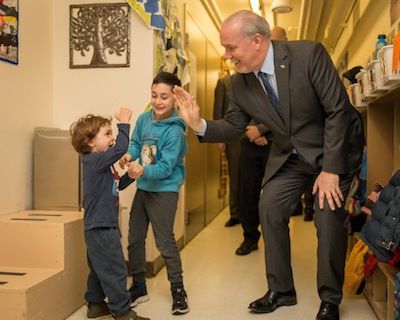
B.C. Premier John Horgan toured the Jewish Community Centre of Greater Vancouver on March 29, speaking with community members of all ages. (photo from Office of the Premier)

B.C. Premier John Horgan visited the Jewish Community Centre of Greater Vancouver just before erev Pesach, March 29.

The premier had visited the JCCGV before, but only to attend meetings in the boardroom, and this was his first visit as the province’s head of government.

photo - Horgan toured the building, visited the Vancouver Holocaust Education Centre, the sports facilities and spent time with children and parents at the daycare
Horgan toured the building, visited the Vancouver Holocaust Education Centre, the sports facilities and spent time with children and parents at the daycare. (photo from Office of the Premier)

Horgan toured the building, visited the Vancouver Holocaust Education Centre, the sports facilities and spent time with children and parents at the daycare.

In a statement to the Independent after the meeting, the premier said: “People drive community. Touring the centre really hit that message home.… I was glad to meet with and hear from community leaders, see the range of services being provided and visit with kids, parents and educators at the childcare centre in advance of Passover.”

On April 12, the premier also participated in a Yom Hashoah ceremony at the B.C. Legislature, which included numerous survivors of the Holocaust. In next week’s Independent, there will be more about the Yom Hashoah commemorations that took place in Victoria and Vancouver.

“Our goal was for him to get to know us and get to see our centre, get to understand the level and breadth of activities we offer,” said Eldad Goldfarb, executive director of the JCCGV. “His focus was primarily on childcare and I think he had a few more visits during that day to other [childcare] facilities.… We wanted him to see what we are doing and we wanted him to hear about our plans for the future.”

While there was no formal agenda for the meeting, after the tour, Horgan met with representatives of agencies that are located in the building. He was introduced and thanked by Alvin Wasserman, vice-president of the JCCGV.

While affordable housing was not on the agenda officially, Goldfarb said he discussed with the premier the opportunity for including such accommodations within the planned redevelopment of the JCCGV site. The new provincial government made a substantial commitment to affordable housing in its first budget, Feb. 27.

Nico Slobinsky, director of the Pacific Region for the Centre for Israel and Jewish Affairs, said Horgan was at the centre more to listen than to talk.

“He was there to learn a little bit about what the centre does and the opportunity to connect with the community since becoming premier,” said Slobinsky, who helped arrange the visit. “He hasn’t had a chance yet to do that. He did that before but not since becoming premier.

“As a community,” he said, “we have long enjoyed a great relationship with the provincial government and we are very happy to see that continue.”

Format ImagePosted on April 20, 2018April 18, 2018Author Pat JohnsonCategories LocalTags British Columbia, CIJA, Eldad Goldfarb, JCCGV, John Horgan, Nico Slobinsky, politics
The magic of laughter

The magic of laughter

Magician Stephen Kaplan entertains at last month’s Empowerment session. (photo from Jewish Seniors Alliance)

On March 21, the Jewish Seniors Alliance, in partnership with Temple Sholom Seniors, once again brought the community a magical program of laughter.

In the program, which was the second in the 2017/18 JSA Snider Foundation Empowerment

Series with the theme Laughter and Music: Feeding the Soul, magician Stephen Kaplan delighted the audience of more than 100 people with his energy, sense of humour and enthusiasm.

Kaplan introduced himself as “the Maestro of Magic” and, as such, he said he conducts the magic that is within us all. Combining interactive entertainment with jokes and surprises is what he loves to do – and he does it so well.

The audience was shrieking with laughter and wonder. How did he guess that Heather’s first boyfriend’s name was Peter? How did he guess that Lila was thinking of the city Winnipeg? And how did he guess that the card that Bonny picked was a seven of diamonds? Did he really guess all that? It doesn’t matter. As a finale, he took a section of the Vancouver Sun, tore it into pieces and, within seconds, put it back together.

Gyda Chud, his preschool teacher, introduced him beautifully. Was she the one who instilled the charm and magic in him? Kaplan made sure that every one of the attendees left the program with a big smile.

The afternoon began with greetings from Bill Gruenthal, Arthur Gutman told some jokes and led the audience in Passover songs, and Ken Levitt, JSA president, encouraged people to join the JSA, if they hadn’t already.

Two more Empowerment sessions on the theme Laughter and Music are coming up: Perla’s Music Workshop on April 17 with Congregation Beth Israel, in conjunction with the Jewish Family Services’ Seniors Lunch program; and Music for Our Hearts and Songs We Love on June 25, with the Kehila Society in Richmond. For more information, visit jsalliance.org or call 604-732-1555.

Tamara Frankel is a board member of Jewish Seniors Alliance.

Format ImagePosted on April 20, 2018April 18, 2018Author Tamara FrankelCategories Performing ArtsTags comedy, Empowerment, JSA, magic, seniors, Snider Foundation, Stephen Kaplan
Mystery photo … April 20/18

Mystery photo … April 20/18

B’nai B’rith, 1977. (photo from JWB fonds, JMABC L.09486)

If you know someone in this photo, please help the JI fill the gaps of its predecessor’s (the Jewish Western Bulletin’s) collection at the Jewish Museum and Archives of B.C. by contacting [email protected] or 604-257-5199. To find out who has been identified in the photos, visit jewishmuseum.ca/blog.

Format ImagePosted on April 20, 2018April 18, 2018Author JI and JMABCCategories Mystery PhotoTags B'nai B'rith, history, Jewish museum, JMABC, JWB
High-tech medicine

High-tech medicine

A 1-year-old boy being treated with a novel gene therapy drug. “Usually, this type of injury with a hemophiliac patient would involve hours in the emergency room, with repeated doses of intravenous coagulation factors,” said Prof. Gili Kenet, director of the National Hemophilia Centre at Sheba Medical Centre. (photo from IMP)

From wearables that allow cardiac specialists at a hospital in Ramat Gan to monitor a patient’s cardiac performance thousands of miles away from home, to giving gravely ill patients a new lease on life with groundbreaking new therapies, Israeli medical innovators are almost literally thumbing their noses at the Angel of Death and changing the way we live.

According to start-up “ecosystem” sources, there are at least 6,000 active start-up companies operating in Israel. Within the realm of digital health, the number of active start-up companies engaged in this field has grown from 65 companies in 2005 to more than 400 in 2018. A significant number of these start-ups are being financially supported by global corporations such as Philips, GE Healthcare, Merck and IBM. Some of these companies have opened up offices close to start-up hubs in Haifa (near the Technion) and Metro Tel Aviv, the recognized “capital” of Israeli business and high-tech.

photo - This digital watch developed by the Sheba medical team and Datos Health is equipped with an app that contains a care path specially designed for each patient
This digital watch developed by the Sheba medical team and Datos Health is equipped with an app that contains a care path specially designed for each patient. (photo from IMP)

“Israel serves as a global incubator of innovative ideas for a variety of reasons,” said Dr. Eyal Zimlichman, deputy director general, chief medical officer and chief innovation officer at Sheba Medical Centre, which is located in Ramat Gan and is the largest facility of its kind in the Middle East. “First of all, it’s in our genes. Secondly, there is the military aspect, where we are taught to improvise when necessary in the field. These things allow us to be naturally innovative. This has trickled down into the medical field, where we are offering the highest level of medical care. I also believe unique innovations in medicine, that will impact the world for the next 100 years, will be developed in Israel.”

Prime examples of Sheba Medical Centre’s innovative efforts revolve around combating potentially fatal diseases such as cancer with immunotherapy, oncology’s new medical “magic bullet”; targeting hemophilia with a novel gene therapy drug; and creating an app for a wearable device used by people with serious heart and diabetes issues.

Immunotherapy is a treatment that uses our body’s own immune system to invade and destroy cancer. CAR-T (chimeric antigen receptor) and TIL (tumour-infiltrating lymphocytes) are not universal cancer cures at this stage. However, there are ongoing clinical trials being conducted for major pharmaceutical companies and America’s National Institutes of Health at Sheba Medical Centre’s oncology unit, where end-stage cancer patients are being treated with CAR-T, which specifically targets leukemia and lymphoma, and TIL, which zeroes in on melanoma and ovarian cancer patients.

Seventeen people with cancer were treated at Sheba during an initial CAR-T trial, after all of these patients had displayed zero improvement in the wake of traditional chemotherapy treatments and bone marrow transplants. Of the 17, 75% had a complete response to the CAR-T. One of those patients, an 8-year-old girl from Bnei Brak, was the first child to achieve complete remission from childhood leukemia. A Sheba centre oncologist said, “When we came to give her the CAR-T cells, she was very, very sick. She couldn’t even get out of bed. When we came back to visit her three weeks later, she was going back and forth on her rollerblades.”

A few weeks ago, a 1-year-old boy became the youngest patient in the world suffering from both severe hemophilia A and an unusual allergy to be treated with a gene therapy drug that only recently was approved for use in the United States. The new drug, developed by an American biopharmaceutical company, contained a “bispecific antibody” that was injected into the child at Sheba Medical Centre. According to clinical trial results published in The New England Journal of Medicine, the drug has shown a 90% reduction in bleeding in children and a 70% reduction in adults.

photo - Prof. Gili Kenet
Prof. Gili Kenet (photo from IMP)

“This is a new, exciting era with many novel options for improved care and even complete cure of patients with hemophilia,” said Prof. Gili Kenet, director of the National Hemophilia Centre at Sheba. “The child’s mother is so happy with the new treatment. The child had experienced a head trauma, but required no further therapy at all. Usually, this type of injury with a hemophiliac patient would involve hours in the emergency room, with repeated doses of intravenous coagulation factors. However, there were no complications, as his hemostasis (blood factors) was completely normal.”

Within the realm of what is known as IoT (internet of things), Prof. Robert Klempfner is blazing a trail of what he has dubbed IoMT (internet of medical things), where heart patients are able to engage in cardiac care and rehabilitation using wearables (for example, a high-tech watch), without having to return to the hospital for treatment.

“Today, the challenge for both heart doctors and cardiac care patients is what happens after a coronary event (heart attack), intervention or heart surgery,” said Klempfner. “What kind of regimen can be created for someone who might have had surgery at Sheba but lives and works in faraway places such as the United States or other countries? Within the new world of telemedicine and digital health, we have the technology to create rehab programs that are a win-win experience for both the hospital and the patient.

“We give cardiac care patients a watch,” he explained, “that is equipped with an app developed by the Sheba medical team and Datos Health [an Israeli start-up company]. The app contains a care path specially designed for each patient, containing rehab regimens, education material and secure communication with our patients. The medical centre receives data from wherever he/she is located when they are walking, exercising, doing other physical activities. Our technicians then analyze the info and provide ongoing feedback, assisted by smart algorithms provided by the innovative system.

“The program is also primed,” he said, “for patients who suffer from hypertension and diabetes that are now able to transmit all their measurements automatically to our system. This not only saves the patient time, by not having him/her return to the hospital, it saves the hospital time and bed space, so we are able to treat more patients. This ushers in a new era in digital healthcare.”

For more information on Sheba Medical Centre’s oncology unit, visit shebaonline.org.

Format ImagePosted on April 20, 2018September 30, 2019Author Steve K. Walz IMP MEDIA LTD.Categories IsraelTags cancer, children, health, IoMT, IoT, science, Sheba Medical Centre, technology
Tel Aviv’s Independence Trail

Tel Aviv’s Independence Trail

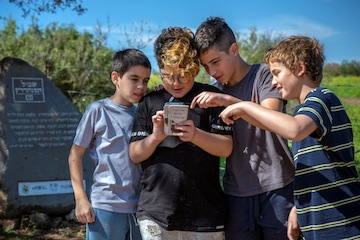
Children follow the new Independence Trail in Tel Aviv. (photo by Ricky Rachman)

In honour of Israel’s 70th Independence Day, the city of Tel Aviv has introduced a new interactive walking route that takes visitors past 10 of the city’s heritage sites. All of the sites are connected in some way with the Declaration of Independence and the beginnings of Tel Aviv itself.

The trail is just under a kilometre long and features a golden track that illuminates at night. The route begins at the first kiosk of Tel Aviv, at the intersection of Rothschild Boulevard and Herzl Street. The walking route brings two stories to life that are central to the story of modern Israel: the birth of Tel Aviv, the first Jewish, self-governed, Hebrew-speaking city, in 1909; and how, in 1948, Tel Aviv would make way for the birth of the state of Israel, fulfilling a millennia-old dream.

Visitors can follow the route with a mobile app, or can guide themselves using a map that features information in eight different languages.

The building of the trail demanded extensive infrastructure work, including the implementation of a unique lighting system that allows visitors to walk along the trail at night. The Independence Trail was inspired by the Freedom Trail in Boston, one of the most popular heritage sites in the United States.

The Independence Trail’s 10 sites are:

The first kiosk was established in 1910, and quickly became a central meeting place. During the 1920s, about 100 kiosks operated in the city under the Association of the Kiosk and Soft Drink Store Owners.

photo - The mosaics at Nahum Gutman Fountain
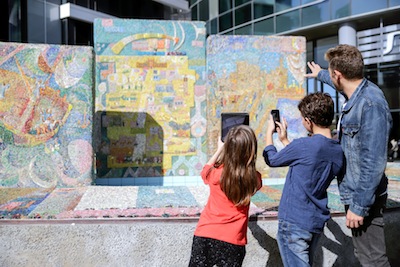
The mosaics at Nahum Gutman Fountain. (photo by Ricky Rachman)

Nahum Gutman Fountain: Nahum Gutman was an Israeli artist who grew up in Tel Aviv along with the new city, and whose work reflected the simplicity of the early days of “the First Hebrew City.” An illustrator, photographer and writer, Gutman was awarded the Israel Prize in 1978. His mosaics around the fountain tell us the history of Jaffa, the ancient port city from which Tel Aviv was born.

Akiva Aryeh Weiss’s house: Weiss was the founder of the Ahuzat Bayit neighbourhood, which evolved into Tel Aviv. As president of the then newly established building society, Weiss presided over the 1909 lottery in which 66 Jewish families drew numbers written on seashells to determine the allocation of lots in the about-to-be established city.

Shalom Meir Tower: former site of the Herzliya Hebrew Gymnasium, the first Hebrew-language high school. The building on Herzl Street was a major Tel Aviv landmark until 1962, when it was razed for the construction of the tower. Its destruction sparked widespread recognition of the importance of conserving historical landmarks. Today, Shalom Meir Tower is home to a visitors centre about the history of Tel Aviv, which is open, free to the public, on weekdays.

The Great Synagogue was the spiritual centre of Tel Aviv, located in the heart of the city’s business centre. The building features a huge dome, elaborate lighting fixtures and magnificent stained glass windows.

The Haganah Museum is located in what was the home of Eliyahu Golomb, the founder and de facto commander of the Haganah. From 1930 to 1945, the Haganah’s secret headquarters were located in this house. Golomb’s residential room, his office on the ground floor, as well as the exterior of the house, were fully preserved. The museum will be open to the public free of charge during 2018, to mark Israel’s 70th anniversary.

Bank of Israel’s Visitors Centre, at the historical headquarters of Israel’s national bank, presents the history of the financial system in Israel. It features an extensive exhibit of banknotes and coins issued from pre-state days to the present. The centre also will be open to the public free of charge until the end of the year.

Tel Aviv Founders Monument is dedicated to the men and women who established Tel Aviv in the first half of the 19th century. It is a quiet spot, dotted with benches and centred around a small pool and fountain.

Statue of Meir Dizengoff, honouring the first mayor of Tel Aviv, who was known for riding his horse from his home – which is now Independence Hall – to City Hall, which was then located on Bialik Street. The statue of Dizengoff on his horse was created by artist David Zondolovitz.

Independence Hall: Dizengoff dedicated his home for the establishment of the Tel Aviv Museum of Art. In the home, on May 14, 1948, the ceremony of the Declaration of Independence took place.

In addition to the Independence Trail, visitors will be able to enjoy, until the end of December, the Israeli Democracy Pavilion, which features a presentation about the story of the Declaration of Independence. The project, which is a collaboration between the Israel Democracy Institute and the Tel Aviv-Yafo Municipality, takes place in a majestic pavilion on Rothschild Boulevard, in which visitors are shown a film in 360 degrees, highlighting important moments of Israeli democracy. The pavilion is surrounded by arcades reflecting the diversity of Israeli society. Selected quotes from the Declaration of Independence are showcased on the pavilion’s arches and visitors are invited to sign a pledge to uphold the core values of the declaration. Entry to the film is free of charge, and the pavilion is expected to travel to other cities in Israel next year.

Format ImagePosted on April 20, 2018April 18, 2018Author Edgar AsherCategories IsraelTags history, Independence Trail, Israel, Tel Aviv, tourism
Follow the Sanhedrin

Follow the Sanhedrin

The trail crosses the Galilee from Beit She’arim to Tiberias. (photo by Israel Antiquities Authority from Ashernet)

photo - Dozens of stone relay stations along the path transmit information and activities to hikers’ mobile telephones
Dozens of stone relay stations along the path transmit information and activities to hikers’ mobile telephones. (photo by IAA from Ashernet)

This year in the Galilee, thousands of students have been excavating and organizing the first “smart trail,” in which dozens of stone relay stations along the path transmit information and activities to hikers’ mobile telephones. The trail comprises part of the celebration of Israel’s 70th year of independence, and just opened. It extends 70 kilometres and is divided into sections, tracing the movements of the country’s greatest figures, the Sanhedrin sages, who rehabilitated the Jewish people following the Bar Kokhba Revolt. As did the Sanhedrin, the trail crosses the Galilee from Beit She’arim to Tiberias, passing through magnificent landscape, such as Nahal Zippori, Yodfat, Mount Arbel and Mount Atzmon.

Format ImagePosted on April 20, 2018April 18, 2018Author Edgar AsherCategories IsraelTags Galilee, Israel, Sanhedrin, tourism
מחשבותינו ותפילותינו

מחשבותינו ותפילותינו

רבים מתושבי קנדה משאירים את מקלות ההוקי שלהם מחוץ לביתם לאות הזדהות עם קבוצת המבולדט ברונקוס. (צילום: Andrew Scheer)

תאונת הדרכים מהקשות בתולדות קנדה: שישה עשר הרוגים מרביתם שחקני הוקי צעירים וארבעה עשר נוספים נפצעו

קנדה חוותה בראשית החודש (ה-6 באפריל) את אחת מתאונות הדרכים הקשות ביותר בתולדות המדינה, עת נמנו שישה עשר הרוגים, וארבעה עשר נפצעו מרביתם קשה, כאשר אחת מהפצועות נפטרה מפציעותיה. כל זאת כתוצאה מהתנגשות חזיתית בין אוטובוס של קבוצת ההוקי המבולדט ברונקוס, שהכיל עשרים ותשעה נוסעים: עשרים וארבעה שחקנים צעירים (בגילאי 16-21), ארבעה מלווים בהם טראפיסטית והנהג, לבין משאית עם סמי-טריילר. התאונה התרחשה בצומת חשוכה של בכביש המהיר 35 באזור צפון מזרח של מחוז סיסקצ’ואן. במקום קרו כבר תאונות בעבר אך עד עתה לא בוצעו עבודות לשיפור המצב של הצומת.

מבין שש עשרה ההרוגים: עשרה הם שחקנים, מאמן הקבוצה (42), עוזר מאמן הקבוצה (28), סטטיסטיקאי של הקבוצה (18), הטראפיסטית של הקבוצה (24, שהייתה כאמור אחת מהפצועות הקריטיות ונפטרה בינתיים מהפציעה), עיתונאי מקומי (29) והנהג (59). שלושה מהפצועים שוחררו כך שעשרה פצועים נמצאים עדיין בבית החולים, בהם שניים במצב קריטי והשאר במצב קשה עד בינוני. בסוף השבוע החולף החל מסע הלוויות של שישה עשר הרוגי התאונה הקשה. חמש עשרה הלוויות נערכות בהמבולדט (עיירה קטנה בת ששת אלפים תושבים) ומחוז, והלוויה נוספת תתקיים באלברטה.

שחקני הוקי של המבולדט ברונקוס (הקבוצה נוסדה בשנת 1970) היו אמורים להשתתף במשחק חצי גמר, במסגרת הפליאוף בהוקי לצעירים של אזור מערב קנדה. כל ההרוגים והפצועים שהו באוטובוס, ולעומת זאת נהג הסמי-טריילר לא נפצע. הוא זוכה לטיפול נפשי צמוד בשלב זה. הנהג עבד רק שבועיים בחברת ההובלה שהיא הבעלים של הסמי-טריילר. משרדי החברה נמצאים בקלגרי ובבעלותה שתי משאיות בלבד. שר התחבורה של מחוז אלבטרה הודיע כי בשלב זה רשיון התפעול של חברת ההובלה הושעה. וזאת עד לברור נסיבות התאונה המדוברת.

נשיא קבוצת המבולדט ברונקוס, קווין גרינגר, הוציא הודעה קצרה לעיתונות בעקבות התאונה הקשה: “מחשבותינו ותפילותינו עם המשפחות של העובדים והספורטאים שלנו, כמו גם עם כל מי שהושפע ונפגע מהטרגדיה הנוראה הזו. משפחת ברונקוס שלנו שרויה בהלם כאשר אנו מנסים לעכל את האובדן המדהים שלנו”.

גם ראש ממשלת קנדה, ג’סטין טרודו, הגיב על האירוע הקשה, באמצעות חשבון הטוויטר שלו: “אני לא יכול לתאר לעצמי מה עובר עתה על משפחות וההורים של הנפגעים. ליבי יוצא לכל אלה שנפגעו בטרגדיה הנוראה הזו, בקהילת המבולדט ומעבר לה”.

אחד מהשחקנים שנהרגו תאונה זו, לוגן בולט, תרם את איבריו להצלת חיים של לא פחות משישה חולים קשים. לאור זאת קמפיין תרומות האיברים ברחבי קנדה זוכה מעתה לתשומת לב רבה, ומספר האזרחים שמוכנים לתרום את האיברים שלהם להצלת אחרים גדל משמעותית מראשית החודש.

במקביל מספר התרומות הכספיות לטובת המשפחות השכולות ומשפחות הנפגעים גדל בהתמדה כל הזמן. את הפרוייקט התחילה תושבת המבולדט, סילביה קלינגטון, והוא זכה להתייחסות בכל העולם. בסוף השבוע האחרון מספר התרומות הגיעו כבר ליותר מאחד עשר מיליון דולר. יותר ממאה ועשרים אלף איש מרחבי העולם (מלמעלה משמונים מדינות), תרמו כספים למטרה חשובה. זאת באמצעות אתר ‘גו פאנד מי’. מדובר בקמפיין התרומות הגדול ביותר של האתר בקנדה, והשלישי בגודלו מאז הוא נוסד. צפוי שמספר התרומות הכספיות ימשיך לגדול עוד ועוד.

יצויין עוד שרבים רבים מתושבי קנדה משאירים את מקלות ההוקי שלהם מחוץ לביתם לאות הזדהות עם קבוצת המבולדט ברונקוס והאסון הכבד שקרה לה ולעיירה המבולדט.

Format ImagePosted on April 18, 2018Author Roni RachmaniCategories עניין בחדשותTags Broncos, Hockey, Humboldt, ברונקוס, הוקי, המבולדט
Cabaret a timely show

Cabaret a timely show

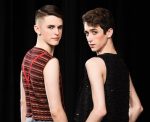
Michael Wilkinson, left, and Kurtis D’Aoust in Royal City Musical Theatre’s Cabaret, which plays at Massey Theatre until April 29. (photo by Emily Cooper)

The musical Cabaret is a classic in the English-speaking world. Since its Broadway première in 1966, it’s been staged multiple times in many countries, and its acclaimed movie version of 1972 won eight Oscars. This April, Royal City Musical Theatre (RCMT) brings the show to New Westminster’s Massey Theatre.

“I saw the Cabaret movie many years ago, but it’s quite different from the stage musical, which I saw for the first time on Broadway in New York, starring Alan Cumming, in 2015,” actor Michael Wilkinson told the Independent. “The Broadway production was spectacular; not only is the show filled with great songs and dance numbers, but the various storylines were, and are, timely to current events that we’re seeing around the world today.”

With music by John Kander and lyrics by Fred Ebb, the show is loosely based on the book Cabaret, written by Christopher Isherwood.

“Taking place in Berlin [in 1931] just before the Nazis came to power, Cabaret demonstrates how there was an increasing presence of far-right wing politics, which is not dissimilar to some of the political movements we’re seeing in the United States,” said Wilkinson, who is a member of the Jewish community. “It provides a stark reminder of how we need to stand up for those who are most vulnerable in society.”

In the RCMT production, Wilkinson plays Victor, one of the performers at the cabaret. Victor is a dancer, singer and waiter, Wilkinson explained. “As Victor, I spend most of the play singing and dancing in the ensemble numbers, as well as serving and fooling around with the patrons. It’s a fun role, and many dance numbers are very energetic.”

Unlike most members of the cast, Wilkinson doesn’t see his professional life revolving around theatre. “I actually am not studying acting,” he said. “I did study theatre for one year right after high school in New York at NYU. However, after an amazing year, I decided that theatre school was not for me, so I returned to Vancouver. I’m currently one year away from graduating with a bachelor of arts from UBC’s Institute for Gender, Race, Sexuality and Social Justice. I would love to work in arts marketing or management, but I am also very passionate about youth education.”

For him, theatre is a beloved hobby, although he did want to be an actor as a child. “I grew up taking theatre and music classes, which I loved. I went to the fine arts theatre program at Lord Byng Secondary School,” he said. “I participated in school plays. I also participated throughout high school in many community and professional theatre productions across the Lower Mainland. And I’ve continued to do so into adulthood. I love to do theatre in my spare time, and companies like RCMT provide a great opportunity for this.”

Being in a musical is ideal for the young performer.

“I started playing violin when I was 5 and I played oboe in my high school band, so music has always been a part of my life,” he said. “Musicals just seemed like a natural genre for me to fall into when I became interested in theatre. I love being in big musicals, like Cabaret. RCMT is a great company because they present big musicals every year, which is not something that every theatre company is able to do. This is my fourth show with RCMT. With them, I’ve had lots of fun in the smaller featured roles or as part of the ensemble.”

Over the past several years, Wilkinson has performed with many theatrical companies in Vancouver. In addition to RCMT, he has played in shows put on by Theatre Under the Stars, Awkward Stage Productions, Gateway Theatre, Bard on the Beach, and Footlight Theatre.

“Most of them have been non-paying [roles], which was fine growing up and going through high school,” he said. “I never expected to get paid at that age. However, this year, RCMT introduced an actor honoraria, which is very helpful to offset transportation costs. While this is certainly not the case for many other cast members, I’m not at a point where I’m looking to make a living from doing theatre. I have two other part-time jobs, my UBC classes and rehearsals, so [being in] shows that do not pay, or at least not very much, works for me.”

The timing of a show is more important to him than the financial side, because he has to juggle his schedule. This is why he doesn’t go to auditions very often. “I only audition for productions that I would really want to be in and that I know I can commit to, in terms of rehearsals and performance dates,” he said.

He enjoys everything involved in putting on a show. “I love the rehearsal process,” he said, “because it is so exciting to watch a production come to life with all its elements: music, choreography, scene work, props, costumes, sets and lights, and eventually the audience. It is also great to get to know a new group of actors as we come together to work on a production. The Vancouver theatre community is quite small, so there are usually some familiar faces, but every cast kind of becomes a family for the duration of a show – some of my best friends I’ve met through theatre. And, of course, performing the final product in front of the audience is always very exciting.”

Wilkinson is not sure yet what his future holds, or even where he will be after graduation. “I’ve lived in Vancouver my whole life, minus my one year in New York,” he said. “Vancouver is home, but if a really great job presented itself outside of Vancouver, I would never say no. I’m also interested in doing my master’s degree at some point, so that may involve a move, as well. I think it’s important to be happy in whatever we’re doing, so that’s how I try to guide my education, work and theatre to balance in my life.”

Cabaret opened at Massey Theatre April 12 and runs until April 29. For tickets and information, visit royalcitymusicaltheatre.com.

Olga Livshin is a Vancouver freelance writer. She can be reached at [email protected].

Format ImagePosted on April 13, 2018April 13, 2018Author Olga LivshinCategories Performing ArtsTags Cabaret, Holocaust, Massey Theatre, Michael Wilkinson, musical theatre

Posts pagination

Previous page Page 1 … Page 385 Page 386 Page 387 … Page 667 Next page
Proudly powered by WordPress