Haley K. Turner has made a parody of her own Chanukah song, in an effort to get Adam Sandler’s attention.
On Nov. 3, local singer-songwriter Haley K. Turner is releasing what might be the only original Chanukah song set for release this year, and one of only a few in the last 25 years. Inspired by a recent plea from Adam Sandler for “someone out there” to write a new Chanukah song, Turner did just that.
In the tradition of nostalgic, sentimental classics such as “Have Yourself a Merry Little Christmas,” “Intangible Things (A Hanukkah Song)” features a string orchestra with lyrics that were completed early this year, on the very last snow day of last winter.
Since Sandler asked for the song, Turner decided he should know about it. In an attempt to garner his support, she wrestled an alligator in a Happy Gilmore parody video, which can be seen on YouTube; created a tutorial on “How to Get in Touch with Adam Sandler”; and recorded a parody of her own new song, “Intangible Things.”
The videos showcase Turner’s spirited side, one that may not have been recognizable from the vulnerable storytelling displayed on her debut LP in from the dark, which was released early 2020. (See jewishindependent.ca/find-comfort-in-music.) It was recorded at Monarch Studios with Juno-nominated producer and musician Tom Dobrzanski (Said the Whale, the Zolas). Her 2011 EP, Ready or Not, was produced by Ben Kaplan (Mother Mother, Five Alarm Funk).
It may take a miracle to get Sandler’s attention but, as Chanukah shows us, miracles do happen.
To hear “Intangible Things” once it’s released, as well as its parody and the Happy Gilmore video, visit facebook.com/haleykmusic.
Alley Theatre, in partnership with Good Night Out Vancouver, presents the world première of a multi-perspective, docu-theatre dance creation entitled #whatnow, Oct. 28-Nov. 7, at the Russian Hall, as part of the Downtown Eastside Heart of the City Festival.
After collecting hours of audio interviews from people of different genders, sexual orientations, cultures, ages and abilities, real-life stories and reflections around the #metoo movement come to life through the mediums of headphone verbatim (explained below) and dance.
Marisa Emma Smith (photo from Alley Theatre)
“This piece is both a celebration of survival and a call for action,” explained co-director and sexual assault survivor Marisa Emma Smith. “What surprised me the most about interviewing people is their natural humour and poeticism. We couldn’t have written better lines to describe the things they went through or committed. I am so honoured to have met them all.”
Co-director and choreographer of #whatnow is Amber Barton, who has been a featured performer at the Chutzpah! Festival.
“We’re living in a time of increased awareness and social justice,” said Barton. “For me, that means it’s important to keep our conversations, such as the ones around the #metoo movement, alive. #whatnow is a unique performance experience that helps us to continue these conversations. I feel so privileged to be part of this production and to be trusted with the stories that have been shared with us.”
Amber Barton (photo from Alley Theatre)
#whatnow includes testimonials from survivors of harassment, misconduct and assault, as well as stories from those who took accountability for their harms. Throughout the piece, Barton has crafted ensemble movement that articulates tone, environment and viewpoints. The work also uses the format “headphone verbatim,” where edited audio interviews are played through headphones to actors on stage and the actors mimic and repeat what they hear, in real time. Every cough, stutter and hesitation is reproduced, and the actors never “memorize the lines.”
#whatnow features performances by Sabrina Symington, Yvonne Wallace, Patrick Dodd, Emily Grace Brook and Siobhan Sloane-Seale. Running time is approximately 80 minutes, with professionally facilitated conversations afterward. There are a few gender-specific performances, to allow for an honest and supported environment for audiences to respond to the performance with other people of the gender they identify as most. As well, there is ASL interpretation at the Nov. 7 show.
Tickets start at $15 and $2 from every ticket goes to Pacific Association of First Nations Women. The Oct. 28 preview is two-for-one. Visit alleytheatre.ca.
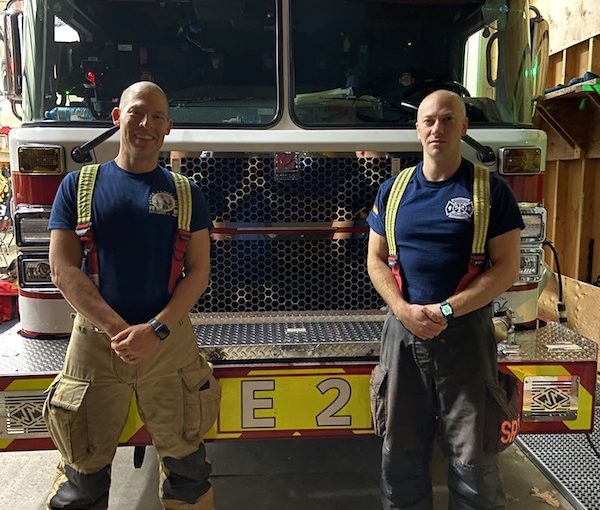
Firefighters Daniel Greenberg, left, and Adam Bender. (photo from Adam Bender)
There are not many Jewish firefighters in Vancouver – but two of them serve together in Fire Hall #2 in the Downtown Eastside.
Being Jewish is not all Daniel Greenberg and Adam Bender have in common. They are also both Ontario-born men, about 40, who came to firefighting comparatively late in life after other careers. And both have young families who they get to spend quality time with because the shift work inherent in their profession offers a flexibility that the 9-to-5 grind does not.
The two met while stationed together in the Downtown Eastside, a posting unlike any other in the city. The vast majority of calls to which they respond are drug overdoses and related emergencies. The leading minds of politics, policing and healthcare have not been able to resolve the epidemic of addiction that grips the neighbourhood and, if firefighters had the solution, it would have been implemented by now, but they don’t.
“This issue is often discussed amongst the firefighters,” said Greenberg. “We obviously don’t know the solution. It’s a terrible situation. It is difficult to see. You are seeing human beings living in a state that, honestly, you don’t expect human beings to live in…. Safer places for them to go, more permanent housing situations, access to treatment programs – any and all of the above sound wonderful and ideal.”
Vancouver Fire and Rescue recognizes the toll that serving in this challenging hall can take and they have a limit of 80 shifts – or about a year – before being transferred to a more conventional hall.
When he started, Greenberg got some advice from a veteran firefighter.
“Don’t make their emergency your emergency,” he was told. This may be easier said than done, of course, and Greenberg said the fire department takes the risks seriously. During recruitment, trainees go through resiliency training to prepare them in advance for what they might encounter, and the department is sensitive to the impacts tough calls can have.
“If we witness a particularly troubling call, you are essentially taken out of service and you are provided with counseling,” said Greenberg.
This is a major advancement from the old-style approach, which Greenberg characterized as “Tough it up, shake it off, on to the next.”
“We are all made to feel really supported,” he said of the current atmosphere.
Greenberg became a firefighter in Ontario after working in construction and teaching physical education and kids with special needs. He moved west when his wife, Emily Greenberg, was hired as head of school at Vancouver Talmud Torah. They have three kids, ages 12, 10 and 6.
“I was really searching for a career path that I’d be very passionate about, that would suit my strengths and my interests. Frankly, also, a job that could support my family and my wife not only financially but also me being able to be around the family a lot more than a simple 9-to-5,” he said.
Jewish people may be overrepresented in many helping professions, but not this one. Greenberg isn’t sure why.
“I think, historically, whether I’m generalizing or not, most Jews are steered towards professions that are more of the white-collar variety: lawyers, doctors, builders, entrepreneurs,” he said. “Certainly anything that involves a level of danger, perhaps, doesn’t speak to Jewish people. Mothers are probably a key ingredient there.”
Coming to firefighting after wider experiences, Greenberg has no regrets.
“It’s really exceeded my expectations,” he said. “Every firefighter I speak to truly loves the job.”
He sees his work as an embodiment of the value of tikkun olam.
“I’m fortunate to have a job and a career where I may not be helping the world at large per se, but to an individual in that moment, in their most dire moment, it feels pretty good to be there with my crew helping them and potentially saving lives,” he said.
Greenberg also picks up some shifts as a supply teacher and he is starting a new side business involving cosmetic tattooing for hair loss. He noted that he may be the only Jewish vegan firefighter in North America.
Greenberg met Adam Bender at the hall. It was a total coincidence that two practising Jews – maybe the only ones on the job – would end up in the same station.
Bender was born in Oakville, Ont., but spent formative years in Israel. His parents moved there when he was a year old and they returned to Canada around the time of the first Gulf War, when Bender was in Grade 1.
In Hamilton, Ont., at this point, Bender admitted he was not a model student.
“To say that I was kind of a piece of crap would be an understatement,” he said. He was kicked out of school and, to avoid being kicked out of his house, he made a deal to go on a five-month ulpan on a kibbutz in Israel.
But Bender’s parents got more than they bargained for when he returned home from ulpan with a surprise.
“I did something my parents I don’t think thought was part of the deal when I signed up for ulpan,” he said. “I signed up with the Israeli army. I broke the news to them when I came home that I was going back in a month.”
He served two years (since he was joining at age 21, rather than 18, he was not required to commit to the usual three years) and made it into the paratroopers and special forces.
“Special forces unit [was] probably the biggest influence on my character in terms of understanding the ability to accomplish goals,” said Bender. He returned to Canada, intending to study at the University of Toronto but, again, school wasn’t a good fit and he joined the Canadian military. There, he also served in the special forces.
He met his now-wife and proposed shortly before a six-month deployment in Iraq. The understanding was more intuitive than explicit that, for the marriage to work, a career other than the military was required.
They married in 2017 and now have two kids, 3 and 1. He joined Vancouver Fire and Rescue in 2018.
Like Greenberg, Bender isn’t sure why more Jews don’t choose their path, but suggests “the Jewish grandmother card” may play a role. “There’s a lot of other professions that are a lot more attractive, let’s say, and safer. Firefighting is a blue-collar job at the end of the day.”
The Greenberg and Bender families hope to get together for Shabbat dinner one of these weeks, but the pandemic has thwarted that hope so far. Meanwhile, Bender said, it’s a happy coincidence that the two tribe members ended up together.
“There obviously wasn’t any strategic implementation of putting the two Jewish kids together on one crew,” said Bender. “We’re kind of lucky that that happened.”
On Oct. 8, nonagenarian Gloria Levi was the featured speaker at the JSA Snider Foundation Virtual Empowerment Series session co-sponsored by Jewish Seniors Alliance and the Peretz Centre for Secular Jewish Culture. The topic was What Inspires Me at 90.
Gyda Chud, co-president of JSA and president of the Peretz Centre, welcomed the approximately 70 attendees and shared the background of JSA’s Empowerment series.
Fran Goldberg introduced Levi as a feminist, an activist, a COVID survivor, a gerontologist, a therapist, a social worker and a woman of tremendous confidence, who finds joy in even the darkest of moments.
From her talk, it seems that Levi does indeed find inspiration in everything around her, from rustling breezes and glistening sunsets to soulful self-discovery. She finds meaning in both everyday happenings and the larger matters of the heart and social justice. If we were to sum up Levi’s nuanced and profound wisdom in a word, it would be wholeness. She elevates the whole person with all their perfect imperfections.
To Levi, self-discovery and self-knowledge are paramount values. She illustrated the importance of being true to oneself with the charming story of Rabbi Zusia, who lamented to God, bemoaning his not being like Moses and Abraham. God advised him to be exactly who he is – Zusia. The goal in life is not to strive for perfection but to be authentically oneself.
Through Levi’s lens of wholeness, even a global disaster like COVID-19 has vital lessons. A COVID-19 survivor, Levi refers to the virus as the 11th plague, but also is passionate about the important issues that the pandemic has brought to light. For example, it revealed the discrepancy between the haves and the have nots: the ones who support our daily life – the grocery store clerks, hospital employees, delivery drivers and food workers, among others – in stark contrast with the wealthy. The pandemic has yielded an awakening, a heightened awareness that things need to change on numerous levels, both environmentally and socially, said Levi.
Along with her commitment to social justice, Levi draws connections and inspiration from Jewish sources; for example, she refers to Leviticus, in which God tells Moses to instruct the Israelites to give the land a rest. During the sabbath year, the land is to lie fallow and to be “released” from cultivation, she explained. Weaving rest and restoration into our physical and spiritual worlds is a much-needed change, she said.
In conclusion, Levi quoted Ecclesiastes and reminded us that “vanity of vanities; all is vanity.” Her advice: embrace life, enjoy meaningful relationships and small kindnesses – and find inspiration all around us.
Tamara Frankelis a member of the board of Jewish Seniors Alliance and of the editorial committee of Senior Line magazine. She is also a board member of the Jewish Community Centre of Greater Vancouver.
Think you’re not a puzzle person? Think again. “We solve puzzles of every sort, every day. They show up in so many of our life choices – in our decision-making, in our development of human relationships, in time-management, and so on,” writes local Jewish community member Jonathan Berkowitz. “Although puzzles are usually considered to be activities of recreation, having any facility with puzzle-solving enhances other life skills. It helps you with listening, parsing, decoding, defining, lateral thinking – in short, problem-solving.”
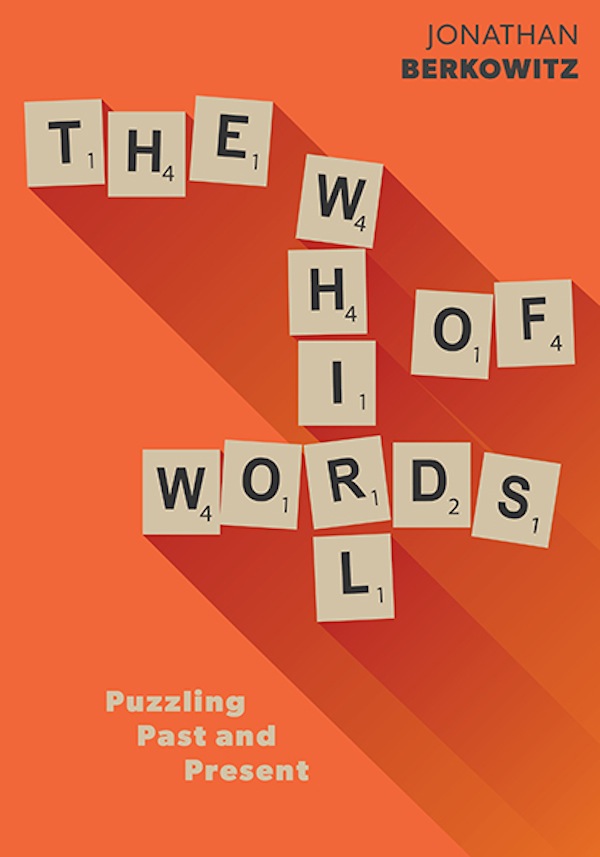
In his recently published book, The Whirl of Words: Puzzling Past and Present (FriesenPress), Berkowitz gets into the nitty gritty – history, philosophy, etymology, mechanics – of puzzle construction and solving in a conversational style that makes for good reading, even if you don’t absorb all the details on the first go. In fact, an ability to give something the once-over and then revisit it is an important aspect of puzzle-solving. It’s the second of eight steps that Berkowitz offers for solving puzzles, which would serve well for any puzzling situation.
Puns, by the way, are a part of wordplay, which, writes Berkowitz, “involves perceiving patterns where none were expected. Pattern matching is a hallmark of intelligence. It is at the root of science and art. Much of thinking is really just finding the underlying pattern.”
Berkowitz is adept at both science and art. He appears regularly on CBC Radio 1, where he is “the Word Guy” on the show North by Northwest. He creates and solves puzzles and is a member of the National Puzzlers’ League. Oh, and he’s a professor of statistics at the University of British Columbia’s Sauder School of Business.
The Whirl of Words is about all kinds of wordplay, the main types of which, Berkowitz explains, “involve letter play (wordplay involving the letters of the alphabet and their usage in words without regard to sound or sense), sound play (wordplay involving the sounds of words without regard to letters or meanings) and meaning play (wordplay involving the meanings of words without regard to letters or sounds).”
There is a chapter on numbers, both as words (one, two, three, etc.) and as mathematical concepts. There are discussions of the potential cognitive and other benefits of puzzle-solving, such as learning about a range of topics, from sports to geography to politics.
“Word puzzles improve vocabulary, grammar, spelling and communication skills, boost memory and enhance cognitive and analytical skills,” writes Berkowitz. “By improving your problem-solving skills, you may also improve your performance at work and in other areas of life. They can be a positive factor for your mental health, because focusing your attention on a puzzle can aid relaxation, ward off anxiety, and keep your emotions under control. After all, how can you think negative thoughts when you’re concentrating on a puzzle? And, doesn’t it feel fantastic when you solve a puzzle?”
Going back to his eight steps, out of context, they could be mistaken for a self-help guide:
“The puzzle is in the details. Read the instructions carefully. Then read them again.”
“Give it the once-over, twice. Assess the challenge.”
“Don’t just sit there, try something.”
“Don’t give up; persist.”
“Open your toolbox.” What approach might lead to a solution?
“Use the force wisely. Be systematic and efficient.”
“Sleep on it…. Like a train, once you are on a track, it is difficult to change tracks. Put the puzzle aside and come back to it with fresh eyes and a refreshed brain.”
“You are not alone. It is perfectly fine to seek help from resources.”
As is also true with general life circumstances, the key to getting better at something is to practise. And Berkowitz provides plenty of puzzles for readers to solve, as well as the answers to them at the end of each chapter.
The Whirl of Words includes a selected biography for those interested in further learning, and a much-needed glossary – most readers will discover many new words and terms while enjoying this book.
To read excerpts from The Whirl of Words and to purchase a copy of it for yourself or a fellow puzzle lover, visit thewhirlofwords.com.
With gratitude to HaShem, mazel tov to Shmuel Hart (King David High School Class of 2016) and Reut Rappoport on their joyous and spirited wedding at Sakoya Gardens (just outside Jerusalem) on June 15, 2021. Elated parents – Alexander Hart and Kathryn Selby of Vancouver, and Rabbi Jason and Meira Rappoport of Alon Shvut, Gush Etzion, Israel – are so very proud of the newlyweds. The couple resides in Jerusalem, Israel, and both are currently studying at Hebrew University.
* * *
Now in its seventh year, the Canadian Jewish Literary Awards recognizes and rewards the finest Canadian writing on Jewish themes and subjects. This year, the awards ceremony, which took place on Oct. 17, was presented on Zoom and is available for viewing on the Canadian Jewish Literary Awards YouTube channel.
The winner in the fiction category was Nothing the Same, Everything Haunted: The Ballad of Motl the Cowboy by Gary Barwin (Random House Canada). It follows a wannabe cowboy, Motl, as he and his mother flee Vilna and the Nazis’ massacre of the Jews. The ensuing events, characters and horror are met by Motl with humorous absurdity in the face of tragedy.
Plunder: A Memoir of Family Property and Nazi Treasure (Houghton Mifflin Harcourt) by Menachem Kaiser, which tells the story of the author’s quest to reclaim a residential building his family owned in Poland before the Shoah, won for best biography.
Lisa Richter won the poetry prize for Nautilus and Bone (Frontenac House). A reimagining of the unconventional life of Yiddish poet Anna Margolin, this collection also won the 2020 National Jewish Book Award for Poetry, the first time a Canadian poet has ever received the American honour.
For children and youth literature, the winner was Osnat and Her Dove (Levine Querido) by Sigal Samuel, with illustrations by Vali Mintzi. It is based on a true story. Although girls in 15th-century Mosul were told, “Reading is for boys,” Osnat convinces her rabbi father to teach her to read. As she grows older, she asks her father to seek a groom who will allow her to study Torah, and she helps run her father’s religious school while raising her own children. After her father’s death and, later, her husband’s, Osnat becomes the school’s leader, making her the world’s first female rabbi.
For scholarship, the awardee was Survivors: Children’s Lives After the Holocaust by Rebecca Clifford (Yale University Press), which is an exploration of the life trajectories of 100 children who were 10 years old or younger at the time of their liberation in 1945. Through archives found in 12 countries, including Canada, and through personal interviews, the author follows the impact the events of the Holocaust had on their lives, and on those who educated them.
In the category of writing about the Holocaust, the winner was In the Lights of Days: The Untold Story of Women Resistance Fighters in Hitler’s Ghettos (William Morrow) by Judy Batalion. The book points out the lack of recognition and the misrepresentation of women’s roles during the war, the actions they took to fight, as well as their crucial importance.
The Canadian Jewish Literary Awards jury for 2021 was Edward Trapunski, Pierre Anctil, Rona Arato, Miriam Borden, Rita Davies, Alain Goldschläger and Adam Sol.
Ben-Gurion University of the Negev student village (photo from CABGU)
Fourteen new buildings have been added to the student village at Ben-Gurion University of the Negev (BGU) in Israel. It will allow more than 1,000 students options from studio apartments to married student housing.
“The student village lets them choose their living quarters in accordance with their personal preference,” said BGU president Prof. Daniel Chamovitz, “while everything they could need is nearby: the north campus and the conference centre, which are in development, a hotel for visiting students and faculty, stores and coffee shops … and the high-tech park, the train station and the university’s country club are just a short walk away.”
The student village offers apartments suitable for religious students and those with disabilities. Any registered student is eligible to apply for a room. The rooms come fully furnished with a smart TV, beds, closets, desks, a full kitchen, a sitting area and a solar water heater. Full maintenance service is offered, as is 24/7 security, a 24-hour service hotline, bicycle rooms, laundry rooms, and more.
“Situated in the country’s southern region, the university is known to be a destination institution,” said Mark Mendelson, chief executive officer of Canadian Associates of BGU. “This means that students who attend the university also live either on campus or in the communities in and around the university, including the city of Be’er Sheva. In addition, almost 60% of the undergraduate student body volunteers in their respective neighbourhoods, which is really something very unique to BGU and has brought outstanding community involvement to the citizens of Be’er Sheva.”
After COVID-19 hit, The Eichmann Project – Terminal 1 evolved into a per- formance directed to a camera. (photo from Pathos-Mathos Company)
Art has many facets, forms and reasons for being. As much as it can be an escape from our daily realities, it can help us process and understand them, sometimes in vastly different ways. The Chutzpah! Festival, which opens Nov. 4 with City Opera Vancouver singers performing to the Marx brothers’ A Night at the Opera, features many examples of entertainment with multiple purposes.
On the face of it, Project InTandem’s dance double bill (Nov. 6-7) might seem to have nothing in common with the theatre work The Eichmann Project – Terminal 1 (Nov. 8). Yet both deal with, among other things, trauma and post-traumatic stress disorder, as well as our ability to change ourselves and even our circumstances.
The Eichmann trial
Lilach Dekel-Avneri and the Pathos-Mathos Company’s Terminal 1 examines the 1961 trial, in Israel, of Adolf Eichmann, one of the main perpetrators of the Holocaust. The books of attorney-general Gideon Hausner, political theorist Hannah Arendt and journalist and poet Haim Gouri, “with their testimonies on the trial, were the inspiration for the three main ‘characters’” of the theatre work, explained Dekel-Avneri. “My dramaturg, Liat Fassberg, and I, like in a Greek tragedy, positioned the two main characters with opposing worldviews, one against of the other. The words by poet Haim Gouri, who was present at the courtroom and reported daily from there, were composed and treated as a chorus. The chorus tries to advance in telling the tale of the trial while providing a dramatic lament on the happenings.
“It is actually a trial of the trial,” said Dekel-Avneri, “dotted with texts from researchers of the Holocaust and post-traumatic stress disorder, poets, philosophers, and performers’ live comments between those three main voices. The COVID-19 epidemic presents itself in the team’s testimonies and actions, erasing all plans and forcing project evolution into a digital performance to the camera.”
Dekel-Avneri refers to the Eichmann trial as “the first reality show in Israel.”
“A lot has been said about the connection between trials and performance,” she explained. “The Eichmann trial was the first trial-show recorded in front of a live audience, that actually bought tickets, and was projected live on the radio, later on television, with the full documentary show now available on the internet.”
Terminal 1 explores the concepts of collaboration and obedience, and asks, “What is our responsibility as citizens, as artists?”
“It’s an extension of Arendt’s brilliant manifest evoking the citizens to think by themselves and not to obey automatically. Not to automatically be part of horrific systems, just because they say: do this and not that,” said Dekel-Avneri. “We are thinking creatures, the least we can do is use our heart and brain, take responsibility for our actions, and not collaborate with demons.”
The show initially was created to be interactive with an audience and then remade for film because of COVID.
“During 2020, at the beginning of the outbreak, the Israel Festival, where we premièred, decided to move online, so I made my choice,” said Dekel-Avneri. “Since I do not believe in shooting a theatre show and screening it, I had to let go of my vision for the full project I was working on for six years, and re-create it as something new, made especially for the camera.
“The Eichmann Project – Terminal 1 is, for me, the first station, like its name,” she continued. “The last station may be completed in the future, or not. It will need to start almost from the beginning. We hope that one day we will find a sponsor or a theatre to collaborate with and fulfil the vision of this Via Dolorosa of 21 live scenes. The trial is not going anywhere and, unfortunately, we, by ‘we’ I mean humanity, do not learn from our past mistakes, so it looks like it will remain relevant for awhile.”
Lilach Dekel-Avneri (photo by Shachaf Dekel)
Dekel-Avneri recently premièred Crowned, which she described as “a performative portrait, broken by the encounter with time, shattered in the prism of the plague, emerging through a web of video and audio testimonies by seven women at different decades of their lives, which coalesce into a course of a lifetime. An attempt to leave a monument to the voice of femininity at the current time, femininity striving, despite everything, to see the opportunity for growth within the crisis and wonder about the intersection between life and art at a time of change. These women take responsibility of their actions, future and well-being,” she said.
“In a way,” she added, “Crowned is a post-traumatic response to what COVID did to The Eichmann Project. After being torn apart from my original vision and separated from the audience, I prepared a show for any situation – we are not afraid from lockdowns or the camera anymore. The camera became a friend, a tool and a partner, to continue creating performative works.”
Struggle, empowerment
Project InTandem – which was cofounded by Calgary-based producers and choreographers Sylvie Moquin and Meghann Michalsky in 2017 – brings two works to the Chutzpah! Festival: Deep END by Michalsky and moving through, it all amounts to something by Moquin.
“This double-bill,” explains the press material, “explores themes of female struggle and empowerment…. Michalsky investigates how movement can accumulate and evolve through set rounds and repetition. Moquin’s work is inspired by the concept of neuroplasticity and the journey of rewiring one’s patterning.”
Project InTandem – Meghann Michalsky and Sylvie Moquin – bring two works to the Chutzpah! Festival. (photo by Tim Nguyen)
The pair met for the first time when they both created short works for a production at the University of Calgary, eventually forming Project InTandem “to share workload, resources, and to create an opportunity for emerging artists to produce evening length work.”
“Having Meghann as a collaborator has always pulled me to a higher standard,” Moquin told the Independent. “I think we work together in a way that elevates us to achieve more than what might be possible on our own. It also makes the journey of being an artist less lonely.”
“Our approaches to dance can sometimes overlap because we have had similar experiences or opportunities, or trained within similar methods,” they said in their email interview with the JI. “All of our accumulated experiences as dancers and movers inform us as creators; those experiences become like an inventory of information.”
Moquin has been a dancer within Michalsky’s choreographic works since 2018, so that also informs their relationship.
“Some of our shared values include creating work with visceral physicality, creating opportunities within our city, elevating the production value of contemporary dance work, and always prioritizing integrity,” they said.
Each has her own interests, though.
“I am really interested in exploring what the body can endure in this work,” said Michalsky. “We push and we push again. As performers, we pass through movements and states and eventually surrender to things that are no longer needed. I am interested in seeing the dancer go through something tangible in real time, something that is honest and showcases risk and vulnerability. As a choreographer, I play with conflict from both internally in the body and externally in the space and I desire for both of these things to be felt by the audience.”
About her piece, moving through, Moquin said, “When creating this work, I was completely immersed with investigating partner work (the way bodies engage and interact) as well as being upside down. I used these primary desires to dig into the concept of neuroplasticity – the way we adapt, the way we can gain governance over our thinking; sometimes even the feeling of being trapped in our own mind and thoughts.
“I am a big believer that we must fail in order to succeed,” she continued. “As a choreographer, I use the sensing body to somatically approach theories I find fascinating in the world. I am especially interested in how bodies interact with one another, how they can support each other to fly, spin, and find themselves upside down effortlessly. I am keenly interested in the effects of the mind, the power of our thoughts, and the ability for change and growth. I would say that my research and choreography seeks to find a sense of hope within a world of chaos.”
The initial vision of moving through included the use of “walls.”
“I couldn’t get the idea out of my mind, and so I finally started looking into building/creating something to fulfil these ideas,” said Moquin. “The material used (a form of Plexiglass) was almost a happenstance. I became fascinated by the translucent quality. I had no way of knowing how this material would have such an impact within our world merely months after creating and premièring the work in March 2020. As I watch this work now, two years later, after a global pandemic, it is almost startling to watch the dancers engaging with these Plexiglass structures.”
The Chutzpah! Festival runs Nov. 4-24. For tickets and the full lineup, visit chutzpahfestival.com or call 604-257-5145.
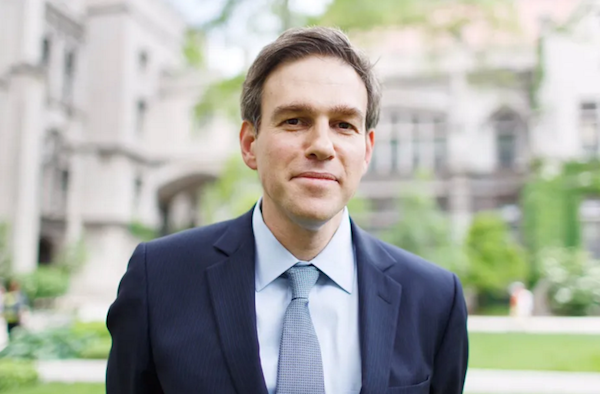
Bret Stephens (photo from harrywalker.com/speakers/bret-stephens)
Western media have got the narrative of the Israeli-Palestinian conflict wrong, says Bret Stephens, a Pulitzer Prize-winning journalist, editor and columnist who is an opinion writer for the New York Times. But, for a journalist to diverge from that entrenched storyline is almost impossible.
Stephens, a former editorial page editor at the Wall Street Journal and managing editor of the Jerusalem Post, recalled when he first started covering the region, in 2000.
“I went out there purely wearing my journalist’s hat and saw a story that was very different from the story that was being reported by many of my colleagues in the mainstream press,” said Stephens in a Sept. 23 webinar hosted by Honest Reporting Canada.
“I think lots of the Western press have continued to get much of the story dead wrong, most of all on that fundamental question: who is the aggressor?”
An example of media’s inability to diverge from a predetermined storyline came in 2019, he said, when residents of Gaza were protesting against the oppression and economic deprivation brought on by the Hamas regime that governs the seaside enclave. The global media, which tends to focus disproportionately on Palestinian concerns, almost entirely ignored the anti-Hamas activism, Stephens said.
“They wanted the world to believe that Palestinians in Gaza had one problem,” Stephens said, “and the name of that problem was Israel.”
Accurate reporting from Palestine is also a challenge because Western media hire freelancers, or “stringers,” in Gaza and the West Bank who do not operate with the same freedoms that reporters in Israel enjoy.
“They have colleagues in Gaza, where the pressure is not-so-subtle for those stringers to toe a particular ideological line, to not report stories that would be inconvenient for the Hamas narrative,” he said.
Winning the battle of ideas, Stephens said, is a priority for Hamas.
“The field of combat is not the battle they know they’re ultimately going to lose against Israel, but the one they think they’re going to win in the realm of public opinion,” he said.
Stephens clarified that he is a columnist, paid to have opinions. But too many journalists today, he said, either view themselves as activists or cannot differentiate their own opinions from straightforward reporting.
The broader context of societal understanding of what were once considered verifiable truths does not bode well for Jews, he added.
“Race is replacing ethnicity as the defining marker of group and personal identification,” he said. “Now we have this new kind of racialism that is dividing people into people of colour and white people. So Jews find themselves, or the majority who are not Jews of colour find themselves, shunted into a racial classification that they don’t recognize as their own.
“I don’t think of myself as a white guy,” he said. “I don’t feel like I have participated in any system of white supremacy. I am the son of a woman who was a hidden child in the Holocaust. She was hunted down for not being white. A Jew. To somehow pair me in this new scheme with the white mask is an injustice to millions of Jews who feel deeply discomfited by this new racialism.”
He added: “Jews have never, never done well when racialist dogma becomes a defining feature of society.”
Other social trends should alarm Jewish people, said Stephens, a conservative writer who calls himself a “never-Trump Republican.”
“The concept of personal success is now being called privilege,” he said. “There are all kinds of Jews who came to these shores in North America with nothing, or next to nothing, and who achieved, by virtue of hard work, effort, ingenuity, good luck, whatever. But now success is being called privilege and privilege is being seen as a product not of individual merit, but as a system of oppression.”
Further, he said, independent thinkers are now being treated as heretics, “and Jews have a long tradition of independent thinking.”
The widespread acceptance of outlandish lies, exemplified by the so-called “Pizzagate” theory, the group QAnon and the idea that the 2020 U.S. presidential election was unjustly stolen from Donald Trump, are an indication of fringe ideas seeping into the body politic, he said.
“We now have come to a place where, increasingly, we are a nation that can bring ourselves to believe anything and a nation that can bring itself to believe anything … sooner or later, is going to have no problem believing the worst about Jews. This is the moment that we’re in.
“Conspiracy thinking has gone mainstream and there is no bigger conspiracy theory in the world than antisemitism,” he said.
Stephens challenged the rote assertion that “anti-Zionism is not antisemitism” by making a stark comparison.
“What is antisemitism?” he asked. “It is a belief, born in the 19th century, that Jews were imposters and swindlers. They were imposters because they were pretending to be Europeans, whether German or French or Italians or whatever, but they were really Semites; that they are not from Europe, they are from the Middle East. And, it said further, these imposters are swindlers because they are trying to swindle real Europeans out of their financial wealth and culture and heritage or whatever. Now, think of what anti-Zionism has shown us. Anti-Zionism is the view that Jews are imposters and swindlers, that they claim to have a Middle Eastern descent but there is no Jewish connection to the land of Israel – that’s the line. And they’re swindlers – they’re swindling Palestinians out of their land.”
Stephens said he supports a two-state solution, “just not now.”
“In theory, a two-state solution is the ideal outcome,” he said. “We should labour towards that, while knowing that it could take 10 or 50 years.
“The prospect of a Palestinian state today isn’t about where you draw the borders. It’s about whether a self-governing Palestinian state can have enough pluralism, liberalism, democracy, tolerance and, above all, a willingness to live in an enduring peace with its neighbours … because the last thing Israel needs is re-creating what the Gaza Strip has become in the West Bank.”
Demanding Palestinian self-determination now, he said, is like inducing a baby in the 20th week of pregnancy.
“It’s going to result in tragedy. Let’s be mindful of what the long-term goal is, but let’s be practical and thoughtful and sensible about how we get to it.”
Honest Reporting Canada describes itself as an independent grassroots organization promoting fairness and accuracy in Canadian media coverage of Israel and the Middle East. The webinar is available for viewing at honestreporting.ca.
There has been a trend among some pro-Israel people and others to depict the U.S. Democratic party as having fallen prey to a far-left agenda, a wolf of extremism seeking to reinvent the social fabric of the country in the sheep’s clothing of “progressive” values.
There are indeed some voices in the Democratic party that press the party to views that are less mainstream – as there are in the Republican party. There is no Democratic equivalent to the radical Republican misanthropes like Lauren Boebert, Paul Gosar and Marjorie Taylor Greene, who have plumbed the depths of dark web conspiracies. Yet members of the so-called “Squad,” a group of Democrats, have taken positions on Israel and Palestine that reject the traditional bilateral American support for Israel’s security. This was never starker than during the recent vote to fund Israel’s Iron Dome defensive anti-missile shield. Members of the Squad, and a handful of other members of Congress, held up a vote on a massive budget bill until American support for Israel’s defence was removed.
The capitulation by senior Democrats was condemned by many, but the victory of the anti-Israel voices was short-lived. The next day, the House voted by a 420-9 landslide to provide the very funds that had been excised from the bigger bill the day before. The numbers could not be clearer. American leaders remain overwhelmingly committed to the bilateral relationship and to Israel’s defence.
The Iron Dome was depicted by some of the dissenting members of Congress as a tool of Israeli oppression. It is, however, a defensive technological wonder whose sole purpose is to save lives. Opposing American support for the program based on economic concerns could be justifiable – a billion dollars is no small change. But those who voted against it have given no indication of thriftiness. Interested in raising taxes on the wealthiest and spending more on domestic programs, as well as passing the Build Back Better Act, which would increase spending on social programs and infrastructure, lower spending does not seem to be a defining motivation for these congresspeople. President Joe Biden has already said he will approve the funding.
We see plenty of Republicans condemning the more extreme members of the Democratic caucus. And we see Democrats condemning the members of the opposition that the late senator John McCain memorably dubbed “whackadoodles.” But perhaps we should all be looking in our own backyards to get our own houses in order.
Speaking of which, Canada is not immune to offside officials. Jenica Atwin was a Green MP who accused Israel of apartheid before huffing across the floor from the Green party to the governing Liberals, where she was quickly forced to retract her earlier comments. The People’s Party of Canada, while not gaining a seat in the recent election, nevertheless significantly expanded their support base across the country, while advancing intolerant, often conspiratorial ideas. Still, Canadian extremists look like small potatoes next to the American examples.
When winning at any cost becomes seen as crucial – because the other side has been demonized to such a degree that their victory is seen as an existential threat – it is easier to accept the unacceptable if it comes from “our” side and to condemn it with self-righteous indignation when it appears on the other side.
Partisanship is too often preventing us from doing the right thing. This behaviour is self-defeating, put mildly. Ignoring inherent malevolence for immediate gain is a recipe for long-term failure, not only for a party’s political fortunes but, far more gravely, for our democratic, pluralistic society as a whole.
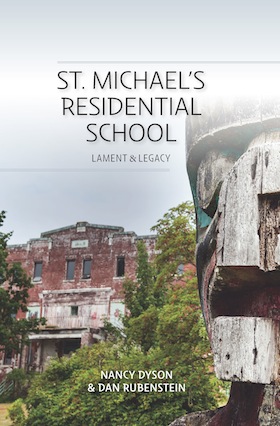
St. Michael’s Residential School in 2013, Alert Bay, B.C. (Courtesy Hans Tammemagi, from the book St. Michael’s Residential School: Lament & Legacy)
In 1970, Nancy Dyson and her husband, Dan Rubenstein, worked for a short time at the Alert Bay Student Residence, previously and most commonly known as St. Michael’s Indian Residential School. Dyson shares their experiences, with a brief section by Rubenstein, in the book St. Michael’s Residential School: Lament & Legacy (Ronsdale Press, 2021).
“This book is a must-read for all Canadians,” writes Chief Dr. Robert Joseph, ambassador for Reconciliation Canada and a survivor of St. Michael’s, in the foreword. “It is honest, fair and compelling. It is a story that screams out for human decency, justice and equality. It also calls for reconciliation and a new way forward! Two recently wed idealists arrive at Alert Bay on Canada’s Pacific central coast to work at St. Michael’s Residential School. They hire on as childcare workers. Little do Dan and Nancy in their youthful enthusiasm know they will be shaken to the core before too long.”
Yet, despite being shaken, the couple did not realize the extent of the abuse and harm being inflicted on their charges, nor that such abuse was being carried out across the country – and had been since the first schools opened in the 1800s to when the last one closed in 1996.
“In 2015, the Truth and Reconciliation Commission (TRC) Reports were released. Like many Canadians, we were shocked by the findings,” writes Dyson in the introduction. “Over a hundred-year span, thousands of Indigenous children had experienced what we had witnessed at St. Michael’s. Especially shocking were the stories of sexual abuse that had occurred along with the emotional and physical abuse we had witnessed. When we read the survivors’ statements and realized the lasting, tragic legacy of the schools, we felt compelled to share our story.”
The couple does so with the intent to bear witness to the survivors’ experience. “In adding our voices to the voices of survivors,” writes Dyson, “we hope that the history of residential schools will not be forgotten or denied.”
Dyson and Rubenstein were married in March 1970 in Rubenstein’s family home, near the campus of Vassar College, in Poughkeepsie, N.Y., from which Dyson graduated in May that year. A brief series of events landed them in Vancouver, where they decided to stay awhile, because Canada “seemed more benign and compassionate than the United States, which was then severely polarized by the Vietnam War.”
While staying with friends, they learned about openings for childcare workers at the residential school in Alert Bay. Along with one of those friends, they applied for the jobs and succeeded in getting interviews. The school administrator explained to them that St. Michael’s, which had been run by the Anglican Church, was taken over by the federal government in 1969 – this was a national change in policy, because of a Labour Relations Board of Canada ruling a few years earlier that school staff had to be paid as much as government employees doing similar jobs. The churches couldn’t afford the increased costs, so the government took over. Though, as Dyson notes – in dialogue given to the administrator – the churches still had “a strong influence.”
At the time that Dyson and Rubenstein joined St. Michael’s staff, the school wasn’t a school anymore, but a residence, with most of the kids attending public school in Alert Bay and the handful that made it to Grade 9 taking the ferry to Port McNeill for their education. Including Dyson and Rubenstein, there were seven childcare workers for 100-plus kids. Dyson was put in charge of 18 teenage girls and Rubenstein the 25 youngest boys, most of whom were 6 or 7 years old.
From the beginning, even before their interview, as they walk up the concrete steps of the residence, and notice the rusty radiators and drab hallways, they have misgivings. Their friend declined the job offer, but they accepted, thinking “it has to be better than living in the States.”
During their brief tenure at St. Michael’s, they witnessed the brutal treatment of the children, in the name of discipline, as well as the poor food, clothing, shelter and, of course, the kids weren’t allowed to learn anything about their own culture. There were suicides, some girls prostituted themselves, some students took their anger out on their peers.
Dyson and Rubenstein tried to support the kids and did indeed connect with a few of them. The couple tried to force some changes, along with other people in Alert Bay, but there was really no way they could improve the situation. Ultimately, Dyson couldn’t take it anymore and quit. Rubenstein, however, still wanted to try and change things from within, despite having been attacked with a knife by a cook who thought that the Jew among the Anglicans was the Antichrist. Rubenstein was fired from his job after he and Dyson shared their concerns about the residence with government inspectors.
The names of people in the book have been changed and the dialogue is based on memory. Dyson inserts excerpts from the TRC reports into her narrative to reinforce not only what she is saying about St. Michael’s but to show that what was happening there was, sadly and disgustingly, happening at residential schools across Canada.
Rubenstein’s story comes as an epilogue, after a section with some of his photos from 1970/71, as well as a few more recent ones, including of the reconciliation ceremony in Ottawa in 2015. Rubenstein writes about the continuing impact of the residential schools and some of his realizations. He speaks candidly of the difficulties he has in reconciling what he witnessed with the image he has of Canada “as a just and compassionate country.” As well, he admits, “I also struggle to reconcile my own sense of decency with my failure to advocate on behalf of the children after I left St. Michael’s. Like other Canadians – former childcare workers, teachers, administrators, principals, clergy and government officials – I remained silent.”
Dyson and Rubenstein have written St. Michael’s Residential School: Lament & Legacy not only to state publicly what they witnessed and did or didn’t do. They want to encourage other Canadians to join in the process of reconciliation, and offer some ideas for entry points, mainly the TRC reports. The book ends with a quote from the TRC’s final report:
“Reshaping national history is a public process, one that happens through discussion, sharing and commemoration…. Public memory is dynamic – it changes over time as new understandings, dialogues, artistic expressions and commemorations emerge.”
St. Michael’s Residential School: Lament & Legacy is available for purchase at Amazon and other booksellers. In the acknowledgements, Dyson and Rubenstein note that a portion of the royalties received for the book “will be donated to Reconciliation Canada and the Indian Residential School Survivors Society.”


 Since Sandler asked for the song, Turner decided he should know about it. In an attempt to garner his support, she wrestled an alligator in a Happy Gilmore parody video, which can be seen on YouTube; created a tutorial on “How to Get in Touch with Adam Sandler”; and recorded a parody of her own new song, “Intangible Things.”