Nature-inspired artist

Two of artist Monica Gewurz’s paintings – “Silver Marsh” (above) and “Dawn II” – are featured in the exhibition of the Nature Trust of British Columbia’s Artist of the Year Award. “Silver Marsh” was inspired by a sunset at Addington Point Marsh, one of NTBC’s properties, which aims to conserve waterfowl and fish habitat, and “Dawn II” by a visit to Vaseux Lake in the Okanagan, an NTBC property that protects habitat for bighorn sheep and other threatened species.

Two of artist Monica Gewurz’s paintings have been selected by a jury to be included in the exhibition of the Nature Trust of British Columbia’s Artist of the Year Award. The joint show of the Federation of Canadian Artists and the Nature Trust opens on Oct. 18 at the Federation Gallery on Granville Island.

Before turning her focus to art in the past several years, Gewurz had worked in both the public and private sectors, in areas from commercial real estate to tourism to aboriginal issues. However, art was an integral part of her upbringing in Peru.
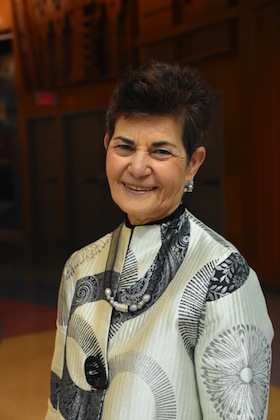
photo - Monica Gewurz
Monica Gewurz (photo from Monica Gewurz)

“For my parents, art was as important as science,” Gewurz told the Independent. “My mother was also an artist, and she exposed me to art at an early age – not just Judaica and Peruvian art but also art from different cultures. We traveled a lot. I always enjoyed visiting museums and art galleries. And I always had my camera with me, always took pictures. Landscapes and close-ups, textures and patterns always fascinated me.”

Upon graduating high school, however, she chose a different path.

“In the early 1970s, I was studying to become a veterinarian in Peru. At that time, South America went through some economic and political unrest,” she said. “Peru had a military government, and antisemitism was on the rise. My university was hit repeatedly with strikes and class closures. Getting an education was becoming difficult and dangerous. That was when I decided to move to Canada. With my parents’ financial support, I came alone to continue my studies at the University of Guelph. My parents immigrated later, in 1985.”

After university, Gewurz worked for the Canadian government, but she couldn’t abandon her art. “My photography, jewelry and painting all started as hobbies. I needed an outlet to balance my hectic and stressful full-time job…. In 2000, I started making tribal and sculptural jewelry. I was successful enough to showcase my pieces in national craft shows and then commercially in some galleries, here in Vancouver and in the U.S.”

She knew that most professional artists had formal art education, so she enrolled at Emily Carr University of Art + Design in 2011. “I could study there part-time while working,” she said. “It would also allow me the opportunity to meet other artists.”

She finished her studies at Emily Carr in 2016. Coincidentally, she couldn’t continue at her government job for much longer. “Due to a life-threatening autoimmune illness, in 2017, I had to retire,” she explained. “That gave me the opportunity to embark on a new career as a professional artist.”

Gewurz’s paintings are mostly abstracts, reflecting the landscapes of the West Coast. “The force and energy of water and its associated reflective light, the interplay of shadows and colours in a landscape, have always drawn me in as a scientist and an artist,” she said. “The endlessly changing skies and the patinas of precious minerals mesmerize me. I am fascinated with the contrasting nature of life. I paint it all to provide an escape to a dream-like place.”

Fractals in nature and stylized figures frequently populate her paintings. She doesn’t strive for photographic correctness. “Painting in abstract challenges me to represent reality in a veiled, mysterious and intriguing way,” she said. “Abstraction and the use of texture allow me the freedom to change what I see and feel into my own expression. The artistic process is, for me, one of constant discovery and conversation. The painting speaks to me, tells me what it needs, and I respond.”

Although initially she used brushes, she said, “Lately, I transitioned to using mainly a palette knife and other unconventional tools. As a result, my art became more abstracted and complex.”

She bases her paintings on her own photographs and on her memory; she never paints on location. “I paint from the heart and intuitively,” she said. “I don’t paint anything specific in a landscape and that’s what I love about it – the process of being able to use the paint any way I want. I leave out a lot of visual information. That allows the viewers to use their imagination, to see and describe every painting in their own way.”

Gewurz gifts much of her art to charities and friends. “It is exciting for me to witness the connection some of my ethereal-looking paintings elicit in viewers,” she said. “It humbles me, when people I’ve never met immerse themselves in the layers, shades and textures of my paintings and then share with me how they are seduced into a visual, tactile and emotional response. When such a connection is made, I feel that I accomplished my mission. Of course, the cherry on the cake is when somebody buys a painting and becomes a collector and, many times, a friend.”

She shared one such a case. In 2014, an interior designer from Singapore saw one of her mixed media paintings at an exhibit and contacted her for a commission. The painting was two by two feet, said Gewurz, “but she wanted a much larger one, measuring seven by four feet, for her client, a new five-star hotel in Hong Kong. That was a turning point in my career and a huge jump in scale for me. That painting still hangs in their lobby.”

Mixed media seems to be Gewurz’s preferred style. She incorporates in her pieces ancient and modern materials, such as textiles, sand, rust, aluminum foil, copper and silver. She paints in multiple layers to seduce viewers in visual and visceral encounters. But, whatever the materials, her theme remains predominantly nature.

image - “Dawn II” by Monica Gewurz
“Dawn II” by Monica Gewurz

Gewurz’s love of nature led to her involvement with the Nature Trust of British Columbia (NTBC). “I am a donor and volunteer,” she said.

She is also an active member of the Federation of Canadian Artists (FCA).

“One of the main FCA missions is to outreach and raise awareness about conserving the environment and natural spaces,” she said. “Every year, FCA asks their membership to submit a proposal for a show that deals with social and environmental issues. I submitted the idea to have a joint show with NTBC, as they had a common vision, and also to take the opportunity to celebrate their respective anniversaries. Both director boards reviewed and accepted my proposal.”

Of course, she longed to participate in the show as well, since its underlying purpose – the conservation of British Columbia’s endangered habitats – is close to her heart.

“FCA holds several juried shows every year,” said Gewurz. “I regularly submit and often get juried in to showcase in them. This time, I applied as well. I was thrilled and honoured that two of my paintings were admitted. There was a lot of competition.”

Gewurz’s commitment to environmental issues extends beyond her participation in such shows and groups.

“I use upcycled materials in some of my mixed media art,” she explained. “There is beauty in repurposing materials because of their distinctive uniqueness and imperfect textures. Also, the fact of my using them conveys the message to the viewer about the importance of decreasing waste and minimizing our carbon footprint.”

She added, “Art can certainly open people’s eyes to how much our lifestyles imperil the planet. Art could encourage all of us to make positive changes.”

See more on Gewurz’s website, mgdesigns.org.

Olga Livshin is a Vancouver freelance writer. She can be reached at olgagodim@gmail.com.
Correcting historical record

Jonas Noreika, who was executed by the Soviets in 1947, has been revered in his native Lithuania and by its expatriate community as a national hero and an anti-communist patriot.

This vaunted hero, however, has come under intense scrutiny of late, largely as a result of the findings of his own granddaughter, Silvia Foti. Her research has revealed that Noreika, whose nom de guerre was “General Storm,” was in fact a Nazi collaborator, responsible for the murder of thousands of Lithuanian Jews – sometimes, on his own initiative.

In her new book, The Nazi’s Granddaughter: How I Discovered My Grandfather Was a War Criminal (Regnery Publishing, 2021), Foti documents her path from hearing stories about his almost legendary stature to her discovery of the disturbing truth.

The book, the writing of which had been undertaken to fulfil Foti’s mother’s (Noreika’s daughter’s) dying wish, was intended as a tribute. Foti succeeded in assembling hundreds of documents related to Noreika’s life, including an antisemitic pamphlet that he authored in 1933, and KGB transcripts of his prison interrogations.

At first, Foti did not want to believe the story that was emerging from the various written sources, finding it “too scary, too painful, too shameful.” Nonetheless, as a journalist, she could not ignore the rumours that she encountered during her investigative trips to Lithuania. She pursued the matter, in the hope that an examination of her grandfather’s acts during the Second World War would exonerate him.  Ultimately, she found so much evidence about his role in killing Jews that it was impossible to act as though it did not exist.

“I wanted to throw the manuscript away so many times, to just drop the whole project. I kept asking myself, Why me? Why am I the one to discover all this? I finally came to realize that, because I am the granddaughter, I would most likely get the most attention,” Foti told the Independent. “I am a practising Catholic, and I pray over this story constantly. My strength came from believing that this is the truth, and the truth needs to prevail, no matter the cost to me.”

What started out as a journey of discovery has now been the recipient of international attention. Foti’s story has been covered by the Wall Street Journal, the New York Times and the BBC, among others.

“So much seemed accidental, inadvertent. I didn’t mean to discover that my grandfather was a Holocaust perpetrator. I didn’t mean to discover that the government of Lithuania refuses to acknowledge his role in the Holocaust and, instead, has declared him a hero,” Foti said.

In 2018, when she was 18 years into her project and believing it was nearing completion, she learned of a lawsuit by Grant Gochin, who lost 100 relatives in the Holocaust, against the Genocide Research and Resistance Centre of Lithuania.  They compared notes and joined forces in getting the story out to the international community.

The revelations about Noreika were, to say the least, not easy for many Lithuanians to accept.

“Today, now that the book is out, I face anger, fear and resentment from many Lithuanians who are still in denial over Lithuanians’ role in the Holocaust. I get hate email and death threats, accusations that I work for the Russians, that I’m a traitor to Lithuania, even that someone else wrote the book instead of me. So many Lithuanians think Grant wrote the book,” Foti recounted.

“Grant has an accounting degree and I have two writing degrees and yet, for Lithuanians, it’s easier for them to think Grant hypnotized me and wrote the book,” Foti added. “Lithuanians still have a lot of superstitions concerning Jews. They just can’t believe a Lithuanian would accuse her own grandfather of such horrors. In some ways though, I understand them, because I was there about 20 years ago – minus the superstitions.”

Foti believes, at present, that Lithuania has backed itself into a corner and needs to admit that the Genocide Centre, “its great arbiter” of what took place in the country during the Holocaust, has made a grave error in deeming Noreika a hero. Nevertheless, she does not think such an about-face will happen anytime soon.

“It would be a hari-kari move that would necessitate that the Genocide Centre fall on its sword. How could a mere granddaughter in Chicago uncover so much information about Jonas Noreika, and how could the nation’s legions of historians under the government’s payroll not?” she asked.

“This was Lithuania’s last graceful chance to own up to its role in the Holocaust,” she said. “It could have saved face if its legal system did its due diligence. Unfortunately, the court systems there have a reputation for being corrupt; holdovers from the Soviet era. Because Grant Gochin has exhausted all legal avenues in Lithuania, he now is able to take it to the European Union’s International Court of Human Rights.”

The Nazi’s Granddaughter was edited by Lisa Ferdman of Vancouver.

Sam Margolis has written for the Globe and Mail, the National Post, UPI and MSNBC.

Security tops JFNA agenda

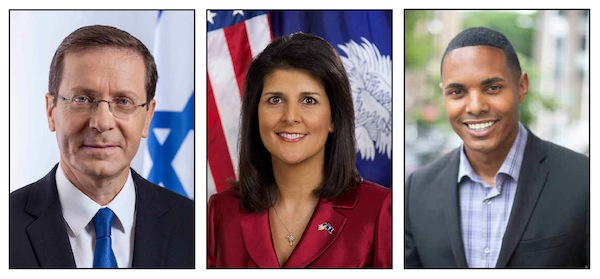
Israeli President Isaac Herzog, left, former U.S. ambassador to the United Nations Nikki Haley and U.S. Congressman Ritchie Torres all spoke on Sunday at the General Assembly of the Jewish Federations of North America. (PR photos)

Antisemitism, community security, caring for the most vulnerable and relations between Jews in Israel and in the Diaspora were among the topics highlighted at the 2021 General Assembly of the Jewish Federations of North America. Normally a multi-day gathering, this year’s conference was a virtual event condensed into 90 minutes on Oct. 3.

Jewish Federations of North America (JFNA) is the umbrella agency representing 146 independent federations and 300 smaller communities across the continent.

Eric Fingerhut, president and chief executive officer of JFNA, credited federations and their supporters for turning a matching grant of $18 million into $62 million to fund frontline Jewish social services organizations during the pandemic.

While the challenges of the pandemic absorbed resources during the past year and a half, Fingerhut addressed a range of issues, noting that it is not easy being an optimist right now.

“We face enormous challenges, which can make it difficult to maintain a positive outlook,” he said. On top of the pandemic and urgent issues of racial justice, Jewish communities across the continent have been confronted by the most sustained and virulent antisemitism in recent memory.

He also addressed the challenges of being an inclusive Jewish community.

“I’m not naïve,” said Fingerhut. “I know that our communities are not now, nor have they ever been, perfect. We have let too many people slip through the cracks unnoticed or unserved. We have not always been there when people needed us the most. We have sometimes struggled to keep up with the ever-changing character of the Jewish community.”

Fingerhut was not the only president to address the truncated assembly. Israel’s President Isaac Herzog emphasized the need to continue building bridges between Israel and the Diaspora, working together to reignite a passion for Zionism among North American youth and instil in Israeli young people awareness of and connections to Diaspora Jews.

“Too many American Jewish youth are disinterested in what being Jewish means and in a complex understanding of the realities and challenges facing Israel,” Herzog said. “Some of them, a very small minority, are too willing to accept distorted labels and libels against the Jewish state. At the same time, on the other side of the ocean, far too many Israelis show too little interest in Jewish life outside of Israel and lack a nuanced understanding of their sisters and brothers in the Diaspora.”

He stressed that, as president of the state of Israel, he makes it his personal mission to strengthen the lines of communication and reinforce the underlying bond and mutual responsibility.

The theme of mutual responsibility was echoed by Mark Wilf, chair of JFNA’s board of directors. When thousands of rockets rained down on Israel last May, he said, federations in North America mobilized to repair and rebuild damaged infrastructure in Israel.

Confronting security issues closer to home was another theme running through the event. Wilf noted that 45 federations have adopted and enhanced community security initiatives and the goal is for every federation and Jewish community on the continent to meet best practices in community safety protocols.

The annual General Assembly events generally attract a raft of Israeli, American and Canadian politicians and elected officials. Due to the unique circumstances, American politicians were limited to one Republican and one Democrat.

Nikki Haley, former governor of South Carolina and President Donald Trump’s appointee as United States ambassador to the United Nations from 2017 to 2019, said the “ancient evil of antisemitism is on the rise.”

“I encountered the sad reality at the United Nations,” she said. “Hateful governments, like Iran, didn’t even bother to hide their hostility toward Jews. I heard it in their words, I saw it in their deeds. Other countries were more subtle. They didn’t go after the Jewish people. Instead, they went after the Jewish state. No other country faces so many insults, no other country is singled out for such attack. Of course, they say, it’s just about opposing Zionism. Well, you and I know the truth. Anti-Zionism is antisemitism.”

She took a swipe at the BDS movement, which seeks to boycott, divest from and sanction Israel.

“While BDS claims to be about justice, it’s a blatant attempt to starve Israel of funding, friends and a future,” she said, noting that she was the first U.S. governor to prohibit public entities in her state from doing business with companies engaged in “discriminatory” boycotts.

She lauded the Abraham Accords, which have led to normalized relations between Israel and the United Arab Emirates, Sudan, Morocco, Oman and Bahrain.

“There were those who said it couldn’t be done,” said the former ambassador and potential Republican presidential candidate. “Now it’s happening before our eyes. Israel is bravely leading the Middle East into a brighter future.”

Also addressing the virtual assembly was Democratic Congressman Ritchie Torres. While a first-term representative elected less than a year ago, the 33-year-old from the south Bronx in New York City has gained attention as a gay, Afro-Caribbean American. Representing the economically poorest district in the country, Torres, a former New York city councilor, is a strong progressive voice on social issues including public housing, predatory loans and gang violence. He has gained notice in the Jewish community and among pro-Israel voters for distancing himself from other progressive Democrats by being an articulate and unapologetic supporter of Israel.

“I feel like all of us in public life have an obligation to speak out forcefully against extremism, no matter what form it takes,” he said. “The rise of a demagogue like [former British Labour Party leader] Jeremy Corbyn is cautionary tale of what could happen when antisemitism infects the bloodstream of a nation’s politics. All of us have an obligation to ensure that extremism is fought at every turn and in every form.”

The idea that it is incompatible to be progressive and pro-Israel is, he said, “a vicious lie.”

He condemned anti-Israel organizations in the United States for co-opting important issues like police violence and immigration and turning them into battering rams against Israel.

Like Haley, he slammed the BDS movement. The contributions of Jewish activists working in partnership with other social justice movements are threatened by litmus tests that seek to prevent pro-Israel Jews from participating in those movements, said Torres.

The antisemitic violence and vandalism that spiked in the spring of this year is “a wake-up call that the Jewish community cannot afford to be complacent about,” he said.

Keys to happiness

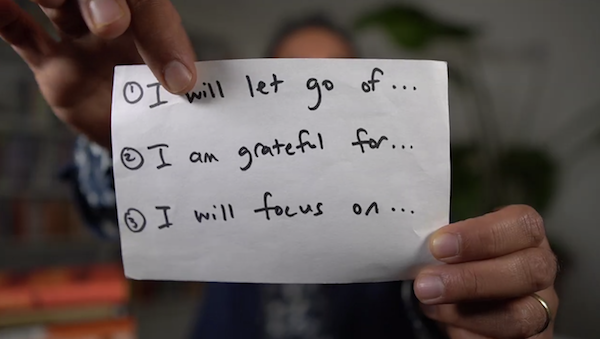
Neil Pasricha, the keynote speaker at Jewish Federation of Greater Vancouver’s The Community of Awesome event Oct. 3, contends that people can be more content in their lives if they take two minutes every morning to finish these three thoughts: “I will let go of … I am grateful for… I will focus on….” (screenshot)

In lieu of the traditional large in-person event that launches the Jewish Federation of Greater Vancouver’s annual campaign, a livestream broadcast from Hillel House at the University of British Columbia Sunday night highlighted the successes and challenges of the pandemic year.

“Donors have given more generously than ever before,” said Lana Marks Pulver, chair of the annual campaign. “Organizations have innovated faster and better. Volunteers have dedicated countless hours pitching in wherever they are needed – that includes more than 200 volunteer canvassers for the annual campaign.

“The pandemic has shown us that we are really good at overcoming challenges,” she said. “We know that, whatever the future holds, we can be there for one another and we will be there.”

Ezra Shanken, chief executive officer of the Jewish Federation, thanked sponsors, in particular Air Canada, which has provided five tickets to anywhere in North America, one for each of the five Jewish day schools in the region, to give to an educator to reconnect with family.

Candace Kwinter, chair of the Federation board, noted that, early in the pandemic, a think tank had predicted that 25% of B.C. nonprofits would not survive the economic and social consequences of the crisis.

“We are very proud that no local Jewish organization has folded,” said Kwinter. “And thank goodness, because demand for their programs and services has only grown.”

A video highlighted the work of Jewish Family Services Vancouver, one of 32 partners supported by the annual campaign. Their services include the Jewish Food Bank, a crisis line and programs for seniors to use iPads to connect with one another.

In the last fiscal year, Kwinter said, Jewish Federation distributed $11.8 million, including $3 million through the Jewish Community Foundation. In addition, the foundation distributed more than $270,000 through their unrestricted grant program, to allow community organizations to adapt.

The Oct. 3 event’s keynote presenter was Neil Pasricha, who is the bestselling author of seven books, including You are Awesome, The Happiness Equation and The Book of Awesome. He is one of the most popular TED Talks presenters. After obtaining his MBA from Harvard, he worked as director of leadership at Walmart for a decade.

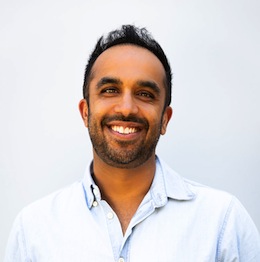
photo - Neil Pasricha
Neil Pasricha (photo by Leia Vita)

The Toronto-based speaker focused on how to be happy, noting that the pandemic has resulted in higher rates of anxiety, loneliness and suicide than ever. With the enthusiastic energy of a 1950s disc jockey, Pasricha disputed what he called the assumption that happiness flows from great work, which leads to big success and then to happiness.

“It’s the opposite,” he said. “You have to be happy first, then you do great work and the big success follows.”

Happy people, he said, are 31% more productive, have 37% higher sales and are 300% more creative.

“Happy people get promoted 40% more often,” he added. “More importantly, happy people live an average of 10 years longer.”

He suggests that everybody take two minutes in the morning to write down three commitments.

“When you wake up, I want you to spend two of the 1,000 waking minutes a day doing a little exercise,” Pasricha said. “You write down these three things. I will let go of … I am grateful for… I will focus on.…”

When we consciously think about and write down the things that bother us, he said, we live life with greater contentment and happiness.

“Saying something that is bothering you, writing it down, actually helps you get it off your chest.”

Opening of Dayson Residences

The Dayson and Barnett families were on hand to celebrate the opening of Tikva Housing Society’s Ben and Esther Dayson Residences. (photo from Tikva Housing)

Although the weather was not ideal, almost 100 people attended the opening of Tikva Housing Society’s Ben and Esther Dayson Residences on Sept. 26.

Due to COVID-19 restrictions, the event had to be held outside under tents. Rhonda Sacks, chair of Tikva, welcomed everyone and thanked the Ben and Esther Dayson Charitable Foundation and the Dayson and Barnett families for their ongoing generosity and support. She acknowledged the three generations of the Dayson and Barnett families who were present and the importance of the younger ones to witness this momentous occasion.

Sacks recognized the Jewish Federation of Greater Vancouver for understanding the immediate need for affordable housing in the Jewish community and thanked them for their leadership and advocacy. Ezra Shanken, chief executive officer of the Jewish Federation, brought greetings and reiterated the importance of not only saying thank you but also showing the younger generation how, because of their great-grandparents, the community is taking care of those in need of affordable housing.

Philip Dayson spoke on behalf of the family and mentioned that it was the desire of his mother, Esther Dayson, to help those less fortunate and to have a lasting legacy, like these townhomes.

photo - The younger generation of the Dayson/Barnett family cut the ribbon at the opening of Tikva Housing Society’s Ben and Esther Dayson Residences
The younger generation of the Dayson/Barnett family cut the ribbon at the opening of Tikva Housing Society’s Ben and Esther Dayson Residences. (photo from Tikva Housing)

Many of the residents in attendance took the opportunity to personally thank the donors and their families.

Hannah Amar, one of the residents at the Dayson Residences, spoke on behalf of the 32 families who live there. She spoke of the importance of having safe and secure accommodation, especially during COVID, and how grateful she is to Tikva and to its donors for her beautiful home.

This housing development is part of a partnership of the City of Vancouver and the Vancouver Community Land Trust; there were many donors and partners on the project.

More than 100 people live in the residences, including almost 60 children. As one of the residents said, “The sense of community and Jewish life is beyond what we could have imagined. We are so fortunate to be living here.”

The event also paid tribute to Susana Cogan, z’l, who was the driving force behind Tikva Housing from 2009 to 2017. Cogan was instrumental in developing these residences, as well as others that Tikva owns and/or operates. A commemorative bench in her memory sits adjacent to the children’s playground.

For more information about Tikva Housing, call the office at 778-998-4582.

– Courtesy Tikva Housing

JSA takes stock of the year

The Jewish Seniors Alliance of Greater Vancouver’s annual general meeting took place on Sept. 23, with a few board members in the sukkah at Congregation Beth Israel and many others participating on Zoom.

Gyda Chud, co-president of JSA, welcomed everyone, acknowledging that the meeting was taking place on unceded Indigenous territory and expressing hope in the moving forward of truth and reconciliation. She also called for a moment of silence for JSA supporters who had passed away during the past year.

This being the second year that JSA members were unable to celebrate together with a dinner and the recognition of volunteers who have contributed to the well-being of older adults, Chud expressed the wish that, next year, we would all be able to break bread together.

Rabbi Adam Stein, associate rabbi of Beth Israel, who is on the board of JSA, said the blessing for sitting in the sukkah and spoke about Sukkot. Pointing to the different parts of the lulav and etrog, he said the myrtle could be compared to an eye, the willow to a mouth, the palm to a human body and the etrog to a heart. This personifies the work of JSA and its volunteers, he said, helping them physically and spiritually, to be seen (myrtle), to be heard (willow), to stand up tall (palm) and to have heart in all they do.

The minutes of the past meeting and the agenda for the present meeting were accepted. Treasurer Alan Marchant presented the financial report, prepared by J. Stein & Associates, noting that the wage subsidies from the government had been helpful.

Larry Shapiro, JSA co-president, presented the presidents’ report. JSA continued to deliver services in spite of the difficulties of COVID, and re-organized as necessary, he said.

He and Chud look forward to a third year of working together, Shapiro added, and he thanked the board, staff, committee chairs and all of JSA’s supporters for their work.

The chairs of the various committees then presented their reports, which are available in full on the JSA’s website, jsalliance.org.

The report of peer support services, which is chaired by Rita Roling, was presented by Chud. All of the services had to be delivered by phone or online. Staff were trained on Zoom so that weekly webinars for volunteer development could be provided. Peer services also held three picnics in the park, as an outdoor barbecue. Margot Beauchamp was thanked for the quality assurance reports to Vancouver Coastal Health.

Tammi Belfer spoke for the communications committee. She thanked Rochelle Garfinkel, Jenn Propp and Liz Azeroual for their help in producing a monthly newsletter with the goal of informing and educating the community of the ongoing work of JSA.

Lyle Pullan then reported for the membership committee. JSA has 550 supporters, he said, as well as 146 life members.

In discussing the fundraising, Serge Haber emphasized the help that various foundations have given to JSA over the years.

I gave the report for the program committee. As in past years, this committee is once again co-hosting the Empowerment Series with other seniors organizations in the community. This year, the theme is “Be Inspired.” The committee also puts on two forums, one in the fall and one in the spring.

Editor Dolores Luber noted that Senior Line is now a 40-page magazine, completely written by volunteers. She thanked Propp for her graphic design work and all of the writers and readers. Anyone can sponsor a page in the publication, she said.

Tony DuMoulin of the advocacy committee highlighted the paper they produced on long-term care, as well as the all-candidates meeting that JSA co-sponsored with a number of other seniors groups. He thanked Beauchamp for her work with the committee. And one of the committee’s initiatives for the coming year – a seniors advocacy council to combat ageism – was put to a vote and the resolution passed.

This was followed by the nomination committee’s report, presented by Ken Levitt. Motions to fix the number of directors at 21 for the coming year and approve the nomination slate were passed.

A short video about the peer support program concluded the meeting, which was organized by Tamara Frankel and Tammi Belfer, with technical support from Marchant and other help from JSA staff.

Shanie Levin is program coordinator for Jewish Seniors Alliance and on the editorial board of Senior Line magazine.

Confront challenges

Everyone could use some insight on how to confront life’s challenges. That’s why Chabad Richmond is offering a three-part online Zoom program called Inlook Outlook: Guidance from the Rebbe for Confronting Life’s Challenges on Wednesdays, Oct.13, 20 and 27, 7:30-8:30 p.m.

“This program focuses on the timely and relevant reflections and sage advice written by the Lubavitcher Rebbe, Rabbi Menachem Mendel Schneerson, throughout his lifetime, to those seeking his counsel,” said Rabbi Yechiel Baitelman, director of Chabad Richmond. “What’s fascinating is that the Rebbe’s insights and perspectives are still applicable today. The Rebbe drew from his profound grasp of Torah wisdom, and combined it with a nuanced sensitivity to each individual’s unique circumstances.”

The three-part program is “a shared dialogue around navigating change and managing stress, while defining and staying true to one’s purpose,” said Baitelman. “The Rebbe reminds us that whatever life challenges we face, we are always given the inner spiritual resources to overcome them.”

The Rebbe believed that how you think about any situation determines how you feel about it.

“By reflecting on practical advice penned to individuals during critical life-junctures, this program provides perspectives on life that begin from the inside out, starting from the soul and one’s destiny on earth. The Rebbe helped people find opportunity where others saw adversity,” added Baitelman.

Sign-in information for the program will be provided at the time of registration. Cost is $54 per person. To register, call 604-277-6427 or visit chabadrichmond.com/inlookoutlook.

– Courtesy Chabad Richmond

Highlighting social goodness

The Nov. 1 online event Finding Grounds for Goodness includes the première presentation of Finding Grounds for Goodness in the Downtown Eastside, which was created during last year’s Heart of the City Festival. (photo from Jumblies Theatre)

This year’s Downtown Eastside Heart of the City Festival, which runs Oct. 27-Nov. 7, includes the screening of short videos from Jumblies Theatre and partners on the theme of “social goodness.”

Jumblies’ multi-year Grounds for Goodness project is an artful exploration of why and how people sometimes act in good ways towards each other. As it has adapted to community-engaged art-making during pandemic times, this project has generated a varied and whimsical collection of short videos with communities and artists from around Canada.

At the Nov. 1, 4 p.m., online event Finding Grounds for Goodness, hosted from Toronto by Jumblies staff, a sampling of these short films will be shared, including the première presentation of Finding Grounds for Goodness in the Downtown Eastside, which was created during last year’s Heart of the City Festival with DTES creative community members and Vancouver and Toronto artists.

Jewish community member Ruth Howard is the founder and artistic director of Jumblies Theatre, which makes art in everyday and extraordinary places with, for and about the people and stories found there. The Jumblies project was originally inspired by the history about the rescue of Albanian Jews during the Second World War by Albanian Muslim people.

Composer Martin van de Ven, an expert in klezmer and Jewish music, who has been involved in many Jumblies projects, told the Independent, in an interview last year about the DTES’s Grounds for Goodness, about besa, “an Albanian Islamic concept about hospitality and the need to help and protect guests and those in need within and beyond your community.

“In Albania,” he explained, “during the Second World War (and Italian and then Nazi occupation), this meant that almost all Jewish people living and finding refuge in Albania were sheltered and hidden, and Albania ended up with a larger Jewish population at the end of the war than at the beginning.” (See jewishindependent.ca/highlighting-goodness.)

The festival at large

The 18th Annual Downtown Eastside Heart of the City Festival is presented by Vancouver Moving Theatre in association with Carnegie Community Centre, the Association of United Ukrainian Canadians and a host of community partners. It will feature more than 100 events throughout the DTES and online.

This year’s festival theme, “Stories We Need to Hear,” resonates today as people grapple with the dramatic impact of the pandemic, ongoing displacement, the fentanyl crisis, and the reality of bigotry and systemic racism.

In the words of late DTES poet Sandy Cameron, “When we tell our stories we draw our own maps, and question the maps of the powerful. Each of us has something to tell, something to teach.”

The 12-day festival includes music, stories, poetry, theatre, ceremony, films, readings, forums, workshops, discussions, art talks, history talks and visual art exhibitions. The Art in the Streets program features surprise pop-up music and spoken word activities on sidewalks and small plazas throughout the historic district.

A few highlights of this year’s festival are We Live Here, a large-scale outdoor project projecting hyper-speed videos of Downtown Eastside artists’ artwork, produced by Radix Theatre; Honouring Our Grandmothers’ Healing Journey Launch, three days of ceremony, teachings and storytelling honouring grandmothers who traveled to the DTES (with Further We Rise Collective and Wild Salmon Caravan); and Indigenous Journeys: Solos by Three Woman, which profiles local artists Priscillia Mays Tait (Gitxsan/Wet’suwet’en), Kat Zu’comulwat Norris (Lyackson First Nation) and Gunargie O’Sullivan aka ga’axstasalas (Kwakuilth Nation).

Elder and activist Grace Eiko Thomson reads from and talks about her book Chiru Sakura (Falling Cherry Blossoms), which chronicles her and her mother’s journey through racism, and Eiko Thomson’s advocacy for the rights of Canadians of Japanese ancestry. In My Art Is Activism: Part III, DTES resident Sid Chow Tan shares videos from his archival collection that highlight Chinese Canadian social movements and direct action in Chinatown, particularly redress for Chinese head tax and exclusion. And the ensemble Illicit Projects presents Incarcerated: Truth in Shadows, three shadow plays dedicated to people who have faced unjust treatment in Canada’s incarceration system.

Other events honour various DTES performing artists and shared cultures. The festival involves professional, community, emerging and student artists, and lovers of the arts.

For tickets and more information, visit heartofthecityfestival.com.

– Courtesy Heart of the City Festival

Jewish take on bomb

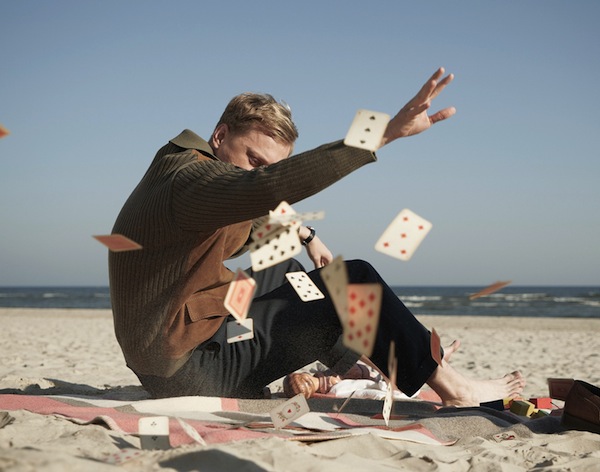
Philippe Tlokinski stars in Adventures of a Mathematician. (photo from Samuel Goldwyn Films)

Forgotten your calculus? Simple geometry is more than sufficient to follow the triangular saga of Polish-Jewish brainiac Stanislaw Ulam from the cloistered classrooms of Harvard to Robert Oppenheimer’s atomic-bomb “startup” in dusty New Mexico.

The third point on Ulam’s map is Lvov, Poland, where his parents, sister and niece live in tenuous safety. Until the Nazis blast across the border and blow down the doors of every Jewish home.

Adventures of a Mathematician opens in Cambridge on the eve of the Second World War, where Stan (Philippe Tlokinski) lives with his younger brother Adam. The news trickling out of Poland gets objectively worse, but going back to Europe is out of the question. So Stan Ulam embraces another way of combating the Nazis, proffered by his best friend and fellow emigré scientist, Johnny von Neumann (Fabian Kocieki) – join a bunch of other geniuses on the top-secret Manhattan Project.

Writer-director Thor Klein’s intelligent, efficient script relies on our knowledge of the war and the Holocaust (and countless movies on those subjects) to concisely convey the gravity of the situation and, importantly, avoid the familiar clichés. At the same time, Klein skilfully involves us in Ulam’s personal life – he’s a witty man with an appreciation for gambling odds, who knows a smart woman when he meets her at a party – without trivializing the larger historical events.

Klein’s other great achievement, because of its U.S.-centred subject matter, is making Adventures of a Mathematician, which he shot in Germany and Poland with local crew, European actors and German, Polish and British financing, totally look and feel like an American film. It’s a masterful trick, which requires dedication and skill at every level of the production.

Klein makes his job easier, admittedly, by depicting Ulam as an acclimated, assimilated American rather than a European fish out of water.

Where Adventures of a Mathematician (which takes its title from Ulam’s memoir) veers from traditional Hollywood filmmaking is in the dramatic conflict. It’s not the war, which is always off-screen. Tension enters Ulam’s marriage later in the film, and we care about that relationship, but that’s not the movie’s motor, either.

Instead, Klein has made a film about philosophical and existential dilemmas, internalized in the person of Ulam – a cerebral, introverted man who largely keeps his emotions to himself, even when he is debating technical solutions with his equally stubborn boss, Edward Teller (Joel Basman).

Not many Hollywood executives would back a film whose protagonist is pitched on the horns of another triangle, namely the conflicting pulls of intellectual satisfaction, personal morality and professional ambition. Stanislaw Ulam, action hero, isn’t the easiest sell to North American audiences.

But, once you get hooked by this utterly accessible film and its remarkable central character, you’re in for a rewarding and thought-provoking experience.

A likable character for much of the film, Ulam becomes more solitary as his doubts grow about devising and building a weapon of mass destruction – especially after the Nazis are defeated.

Tlokinski’s performance, which does incorporate a ridiculous (by modern measures) amount of cigarette smoking, is never less than compelling.

Adventures of a Mathematician trusts the audience enough to omit most of the melodramatic conversations and passages endemic to a Second World War-era scenario. I’m thinking specifically of Ulam’s survivor’s guilt, which is palpable without him needing a speech or a scene to convey it.

A 2020 film whose release was delayed by the pandemic and limited to a handful of festival appearances (including the Toronto and New York Jewish film festivals), Adventures of a Mathematician solves for x with nary a misstep. It can be rented via Apple TV, and possibly other platforms.

Michael Fox is a writer and film critic living in San Francisco.

Learning from Noah

This week, Jewish Addiction Community Services of Vancouver (JACS) is speaking across the community at various synagogues to help spread the word of how we can help those struggling with a substance use disorder. The talk centres around the weekly Torah portion, Noah, and what we can learn from it.

Who doesn’t know the story of Noah and the ark? Animals two by two, Noah saves the world.

The parashah (Torah portion) opens with: “Noah was a righteous man. He was perfect in his generation. Noah walked with God.” No wonder, then, that when God saw all the evil and sin and decided to “reboot” the system, He chose Noah as his agent on the ground.

But, there is a darker side to Noah’s personal story. The man we find at the end of the parashah is not the “perfect” man introduced to us at the outset.

The parashah tells us that, after the waters recede, the very first thing Noah does upon leaving the ark is plant a vineyard. And immediately thereafter: “He drank the wine and became drunk, and he uncovered himself in his tent.”

A casual read might lend itself to a wisecrack: after being cooped up with animals and no shower for so long, who wouldn’t crave a drink? We might chalk it up to a one-time overindulgence. But the rabbis tell us otherwise, that this digression from the central plot line is no accident. The parashah is drawing our attention to Noah’s misplaced priorities: instead of turning his energy to rebuilding and repopulating the world, his first priority was getting drunk. Thus, the rabbis consider Noah one of the first Jewish alcoholics.

And the story gets more distressing. Ham, Noah’s son, discovers his father passed out, and brings his two brothers into the mix as well, to cover their father’s naked body. The brothers are embarrassed, if not ashamed, to find their father in such a state. And, when Noah wakes up from his drunken stupor and pieces it all together, he is mortified. But instead of engaging in a moment of self-reflection, Noah channels his feelings into a rage and curses Ham and his descendants. In short, family chaos reigns, and shalom bayit (peace of the home) couldn’t be further from the truth.

This, then, is one of the earliest stories that gives rise to the saying that “addiction is a family disease” – it wreaks havoc on everyone. Through this lens, we might be tempted to judge Noah harshly for this significant failing. “How could he do such a thing?” “Did he not think of the consequences?” And, perhaps worst of all, “instead of taking responsibility for his actions he lashes out at his family? This is not OK!” At the extreme, in today’s world of uber political correctness, where cancel culture reigns, some might even be tempted to write off Noah altogether.

That said, yielding to the temptation to judge Noah would be missing the central point of the story. To be sure, Noah does not deserve a “free pass” on his behaviour, but questioning “how did this happen?” or “to what extent should we hold Noah accountable?” is of secondary importance. Far more important than “why did he do it” is “why are we surprised that he did?”

Noah was tasked by God with the responsibility for saving all species during the flood, and then repopulating the world thereafter. Is it any wonder he felt intense pressure? Let alone the significant possibility that, mixed with immense relief at being alive, Noah may have also suffered from a significant dose of survivor’s guilt.

We know that different people handle stress differently, and some end up resorting to coping mechanisms that are hugely self-destructive. Noah was in that camp. To be sure, he made some choices that ultimately led to his alcohol dependency, but, unfortunate as that may be, he was probably not the first to do so, and most certainly not the last.

At a Friday night service at Temple Sholom, Rabbi Dan Moskovitz, as part of his sermon, asked for a show of hands: how many in the sanctuary have been touched (self or a loved one) by substance abuse? The majority of hands went up. In short, our Jewish community is no different from any other subset of our world: far too many are afflicted by a substance use disorder.

This fact led to the formation a few years ago of JACS Vancouver. JACS’s mission is twofold.

First and foremost, JACS’s professional team helps individuals and their loved ones find a path to sustained recovery from substance abuse. If you or a loved one is struggling with substance abuse, JACS is here for you – no judgment, just support and a helping hand to navigate the system and get the resources you need to get better.

Second, JACS is dedicated to community awareness and education, striving to reframe the conversation around substance abuse disorders from judgment to compassion and support. To be clear, substance abuse disorder is a disease, not a choice: nobody sets out with intention to become drug- or alcohol-dependent. Yes, the individual’s path to acquiring a substance use disorder probably included some bad personal choices along the way, but how is that any different from a heart attack victim whose daily commute included hitting the Tim Hortons drive-through? Why do we judge the former, but organize meals and visits for the latter? And, of course, fear of being judged is a huge deterrent to reaching out for help.

Returning to Noah, the parashah is providing fair warning that none of us, not even the “a righteous man who walked with God” is guaranteed a smooth sailing through life (pun intended).

The Talmud teaches that “whoever saves one life saves the world entire.” What the parashah tells us is that Noah saved the world. What it teaches us is that it is our job by reaching out with compassion and understanding to help people save themselves.

For more information, visit jacsvancouver.com.

– Courtesy JACS Vancouver