Religion and the state

A week is a lifetime in politics, goes an adage. And so it would seem. Just one week ago, we posited that Binyamin Netanyahu’s coalition of the right was likely to form the next government in Israel. Since then, Benny Gantz, head of Israel’s Blue and White party, has been reinvigorated by Netanyahu’s challenges in pulling together a coalition, after original exit polls had the Likud-led coalition at 60 seats out of the 120 in the Knesset. This number has dropped through the actual vote count to 58, and it has changed the outlook.

As it has in the previous two elections, the result will hinge on the decision of Avigdor Liberman and his Yisrael Beitenu party, a right-wing but defiantly secular movement. Liberman has publicly released his demands for support. Among them: he will not support a government led by Netanyahu (or any other individual under indictment) and he wants to increase the number of ultra-Orthodox serving in the military, introduce civil marriage, thereby taking control of this lifecycle event from the exclusive purview of the rabbinate, and hand decision-making about commerce and transportation on Shabbat to local governments. Meanwhile, Gantz is having a rebellion in his own ranks about seeking support from the largely Arab Joint List in parliament. So, the process is largely back to where it’s been for more than a year, with no more certainty of who will form the next government.

Whatever happens, Liberman’s sweeping secularist proposals are nothing to ignore. The ally-turned-nemesis of Netanyahu, Liberman seems to have learned from the masters how to leverage minimal electoral success to enormous political advantage. In the past, it has been the religious parties that conditioned their support for desperate-to-make-a-deal leaders on getting key benefits and concessions for their respective communities. If Liberman succeeds in helping create a Blue and White government that implements some of his plans, it will represent the same tail-wagging-dog effect that religious parties used to assert Orthodox standards across much of Israeli society. Except Liberman will leverage his seven seats to repeal some or much of what those religious parties have achieved.

This Israeli moment brings to mind other rapidly changing political fortunes. Joe Biden, whose campaign was struggling to survive a few weeks ago, is suddenly (again) the undisputed front- runner for the Democratic nomination in the United States. There is another parallel between Israel and the United States that is currently evolving, this one less publicly known. While Liberman strives to diminish the connection between religion and state in his country, U.S. President Donald Trump is moving his country more in the direction of Israel’s religiously influenced society.

As in Canada, many religious organizations in the United States do an enormous amount of good, in many cases filling in gaps where government services can’t or won’t. Republican administrations have tended to expand – contract out, if you will – some social services previously delivered by governments, while the Obama administration, for example, introduced safeguards to prevent those agencies from discriminating against individuals or groups who they might deem outside their theological teachings.

Writing in the New York Times Sunday, Katherine Stewart, author of a book on religious nationalism, warned that Trump is eliminating those Obama-era safeguards and making it easier for publicly funded agencies to discriminate. For example, clients receiving services from a taxpayer-supported Christian organization could be forced to profess allegiance to Jesus in order to access services or an employee could be fired for not living a “biblical lifestyle,” the definition of which the religious organization, presumably, could define at their own whim.

A test case in Missouri seems innocent enough: a church maintains it should get federal funding to build a kids’ playground; that being refused such money represents discrimination against religion. The corollary is clear: if preventing tax money from funding religious organizations (even for something as innocuous as a playground) is discrimination, Stewart warns, “then the taxpayer has no choice but to fund religion.” This would represent an abrogation of one of the most fundamental cornerstones of the U.S. Constitution: the First Amendment, which declares, “Congress shall make no law respecting an establishment of religion, or prohibiting the free exercise thereof….” The framers of the Constitution were concerned not only that eliminating the barrier between government and religion would corrupt a government intended to serve all citizens but, perhaps equally, that it would corrupt religious institutions themselves. A number of the people on the test case’s side are also leaders among Trump’s evangelical constituency.

What was especially jarring when perusing the Sunday Times was a far more prominent story – on page A4, to be specific – about how Quebec’s secularism law is having a detrimental effect on civil servants, mostly women, from cultural minorities. The law, which precludes people who work in most roles in the public service from showing any external indications of religiosity – a kippa, a headscarf, a crucifix, a turban – is preventing individuals from beginning or advancing in their careers and, in some cases, effectively chasing them out of the province.

These disparate examples from three very different societies indicate the folly both of excessive religious interference in governmental affairs and heavy-handed efforts to have the opposite effect. Somewhere in the middle must be a commonsensical approach to these extremities. Of the three countries in the examples, Israel is perhaps the one where the challenges are most concrete and affect the most people. What, if anything, happens as result of Liberman’s gambit will be a fascinating experiment to watch.
Be sure to wash your hands

Before bed each night, our kids practise their reading, both in Hebrew and in English. We have a routine where I knit and sit next to a kid, listening to him reading his Hebrew Grade 3 stories, and their dad does English with the other kid. Then we switch. Recently, I’ve heard two separate easy-reader versions of the story about Hillel and the mitzvah of cleanliness.

For those of you who might not be up on Grade 3 curriculum, Hillel was a great teacher of Torah. One day, he is rushing off and his students ask him, “Where are you going?” He answers, “To do a mitzvah!” And they say, “What is the mitzvah?” And he says, “Cleaning is a mitzvah!” as he heads to the bathhouse.

In one story, it points out that Hillel was also trying to show that, in general, keeping clean is important. We should clean our fruits and vegetables before eating, clean our bodies, clean our houses, etc. This is obviously a useful lesson for kids. It’s good to know that Hillel taught us to keep clean. (I’ll need to mention this next time I’m asking everyone to tidy up their toys and things!)

Even in the Torah, there are multiple reminders to wash. While this isn’t news for Jews, frequent washing isn’t every culture’s practice. During outbreaks of the Black Death in Europe, Jewish communities were often spared because of their insistence on cleanliness, while those around them were dirty and, therefore, more prone to catching this illness. This meant most Jews avoided the plague (Black Death), which was transmitted by rats and fleas. Unfortunately, this also led to situations in which the Jewish community was blamed for the illness, because why weren’t the Jews getting sick, when everyone else was? Through the lens of history, we know why – they washed and, therefore, had fewer fleas and rats around.

In the Torah portion Ki Tisa (Exodus 30:11-34:35), G-d tells Moses to construct a fancy washstand for Aaron and his sons in the Tent of Meeting. Essentially, being clean is part of doing holy work.

The weird thing about all this isn’t that our tradition spends a lot of time on how to properly wash and keep clean and, therefore, be ready for holy work. The weird thing is how often we forget to wash despite this information.

The outbreak of COVID-19 (the coronavirus) is a firm reminder of what we can do, every day, to stay well. We can wash our hands, with soap, with some frequency. You can recite the alphabet or the aleph-bet to be sure you’ve washed long enough. Washing well is not some mystical religious ritual. It’s essential to our health and well-being.

We can also practise social distancing, another tradition straight out of the Torah. Lepers had to stay outside the camp for several days, for example. This is not new information, folks! It was old news by the time the rabbis were creating our oral tradition, what became the Talmud.

The advice around a virus outbreak changes every day, so I cannot predict what officials will know or say when this article is published. However, disease outbreaks aren’t new. We’ve been wrestling with how to deal with them for as long as the Jewish people has been around. Considering things like skin diseases and leprosy as part of this, then, as mentioned, there’s information about how to deal with that going to the Torah.

One parallel that I can’t skip is – remember the golden calf? When Moses was getting the Ten Commandments, there was a mad rush to collect valuables and build the golden calf as a way to reassure the scared and frustrated Israelites. But it didn’t turn out so well. Acquiring wealth or idols didn’t help us avoid scary or frustrating things. We can’t know the future and alas, no amount of gold – or toilet paper – can keep us healthy.

The gold calf story reminds me of the reports of preppers, who are madly hoarding hand sanitizer, toilet paper, masks and other essentials. They are afraid, of course, but this illogical amount of acquisition causes shortages. It also gouges others by trying to resell these items at high prices. Of course, medical professionals haven’t advised anyone to do this hoarding – and Moses didn’t tell anyone to build a golden calf either.

We have to rely on the best medical advice we can get and do practical, everyday things to stay safe, like washing and social distancing.

I hope everybody stays healthy, but it would be wrong of me not to do my part in encouraging that. So? In the words of another famous character in our household, Ernie from Sesame Street, “Now everybody wash! Everybody – wash your hands!”

Some things just don’t change.

Joanne Seiff has written regularly for CBC Manitoba and various Jewish publications. She is the author of three books, including From the Outside In: Jewish Post Columns 2015-2016, a collection of essays available for digital download or as a paperback from Amazon. Check her out on Instagram @yrnspinner or at joanneseiff.blogspot.com.

A focus on the environment

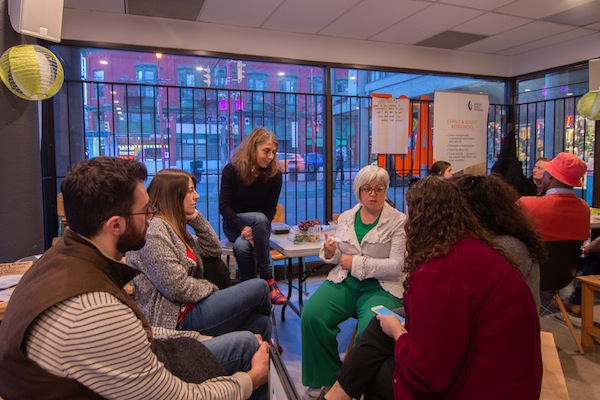
Transportation and sustainability consultant Tanya Paz, centre, participates in Tu b’Shevat Circle: Teachings from the Earth, an event spearheaded by Or Shalom Synagogue in partnership with Jewish Family Services, JQT Vancouver and UNIT/PITT Society for Art and Critical Awareness. Or Shalom’s Rabbi Hannah Dresner is seated on the stool to Paz’s right. (photo by Matt Hanns Schroeter)

More than two dozen individuals whose work involves food security and climate change issues met on Feb. 9 for Tu b’Shevat Circle: Teachings from the Earth, an event spearheaded by Or Shalom Synagogue in partnership with Jewish Family Services, JQT Vancouver and UNIT/PITT Society for Art and Critical Awareness.

Those who gathered work or devote time to such organizations as Grandview Woodland Food Connection, Sustainabiliteens, Coquitlam Farmers Market and Extinction Rebellion. They came together to explore various topics, including how their Jewishness intersects with their work in secular organizations, envisioning a sustainable world and the Jewish community’s role in social justice.

“I noticed that so many of these organizations are spearheaded by young Jews and felt it important to create an opportunity for them to see one another and recognize this aspect of kinship in their work … and whether this commonality enhances the work, draws them into kinship or stimulates any collaboration,” said Or Shalom’s Rabbi Hannah Dresner.

Or Shalom brought on Carmel Tanaka to organize a gathering. Through meetings with young adults and stakeholder groups, Tanaka met a number of people whose careers relate to food security and social justice, but most weren’t working for Jewish organizations nor were they connected to one another within a Jewish context. She and Dresner agreed it was worth bringing them together to see what conversations would blossom.

Tanja Demajo, chief executive officer of Jewish Family Services, said JFS provided funding for the event because they believed in the value of the project.

“There are a lot of Jewish and young Jewish people who are interested in food security and questions of accessibility, which is very interesting from a perspective of … whether this work is modulated by [Jewish] values and how this translates to day-to-day practice,” she said. “At the end of the day, it didn’t really matter if the different participants were working in a Jewish or non-Jewish community.”

Some attendees revealed that, for them, being Jewish is secondary to their focus on environmental issues.

“The room was full of people who identify in varying degrees with their Jewishness and, for some, it’s an important aspect of their identity and, for others, it isn’t integral,” Tanaka said.

Dresner spoke to the indelible connection between environmental action and Judaism. “In my understanding of Judaism, saving our world is at the heart of what it means to have a Jewish spiritual life,” she said. “Creative energy, or the vitality of spirit, is always flowing toward us. It’s what I’d call the ‘world that’s always coming,’ or the ongoing nature of creation. We can encourage and aid this vitality, helping to direct it where most needed, or we can impede the flow. When we are selfish and impede creative flow, the result is a deprivation of generative spirit, spirit denied to corners of creation, and we see results like species blinking into extinction.”

The rabbi wants to spend more time with young Jews working in social justice. “The Judaism I believe in mandates their work as the highest mitzvah of our moment,” she said. “It’s a misconception born of the compartmentalized Judaism in which many of us were raised not to understand that attention to the environment is a Jewish priority.”

Aaron Robinson, chair of Grow Local Society Tri-Cities, a food security group that runs the Coquitlam Farmers Market, said his work for the organization won’t ever have a Jewish mandate, but his Judaism is tied into what he does. “Personally, I can never underestimate the role that Jewish values play in the way I see the world, especially when it comes to tikkun olam,” he said, adding, “I guess it’s become engrained in me, but it was nice to bring it back to the surface to see, wow, there is this Jewish connection to all this work that we’re doing.”

Robinson appreciated the opportunity to connect with other Jews working in similar fields and hopes the conversations will continue.

Some people discussed not feeling supported by the Jewish community to undertake the work they do within a Jewish context. Tanaka said she believes the Vancouver Jewish community hasn’t focused attention on these issues until recently, citing the 2019 climate march and protests as a galvanizing factor, and said it’s time for the local community “to support young Jewish adults who are doing this kind of work … because these are Jewish issues at the end of the day.”

Some at the event suggested funding for environmental advocacy was needed. Dresner said there was also a desire for bridge building. “They seem to be asking for an arm of organized Jewish community to create some occasional containers for their gathering, just to share within the hybrid of their niche or to explore potential collaborations,” she said. “Or Shalom will be looking at finding funding to continue holding this group and its outgrowth in a loose, nurturing embrace.”

Demajo said the JFS food security program has already benefited from the event. “Being exposed to more city-wide programs and initiatives and being exposed to all different voices gives a different perspective to JFS,” she said, “because it opens up new ideas.”

Shelley Stein-Wotten is a freelance journalist and comedy writer. She has won awards for her creative non-fiction and screenwriting and enjoys writing about the arts and environmental issues. She is based on Vancouver Island.

For Nanaimo-area kids

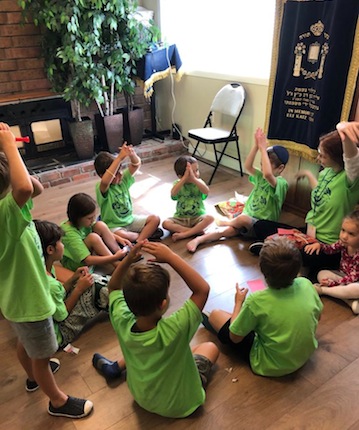
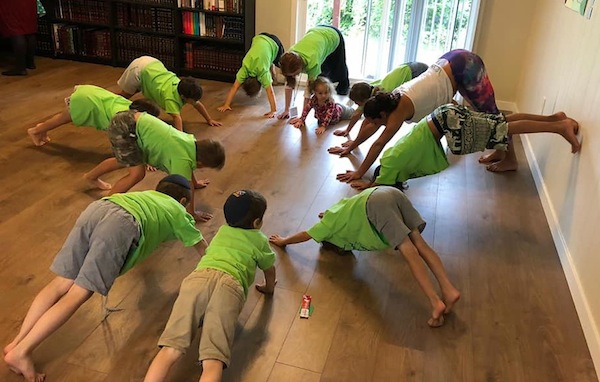
The first Camp Gan Israel in Nanaimo was last summer at the Shemtovs’ home, which doubles as the Chabad Nanaimo centre. (photos from Blumie Shemtov)

For the first time last summer, Blumie Shemtov offered a Jewish day camp for kids 5- to 10-years-old from her home in suburban Nanaimo, where she and her husband, Rabbi Bentzi Shemtov, operate Chabad Nanaimo and Central Vancouver Island. With no dedicated Jewish infrastructure in the city, families in the small and relatively disparate Jewish community are enthusiastic about the day camp.

A few years after Chabad Nanaimo started up, Blumie Shemtov met several families interested in having their young kids experience Jewish camp. She offered the five-day Camp Gan Israel in July 2019. Shemtov was struck by the sense of belonging that developed among the 10 children who attended, most of whom are the only Jews in their schools, she said.

“The idea was a week where children could be around other Jewish children and gain that sense of pride … and know that they are not the only ones” in the community who are Jewish, she told the Independent.

photo - The first Camp Gan Israel in Nanaimo was last summer at the Shemtovs’ home, which doubles as the Chabad Nanaimo centreJewish prayer, songs, culture and history were taught against a backdrop of recreational activities. Much of the day was spent in the Shemtovs’ backyard and large downstairs recreation room, but, to expand the activities, Shemtov and her counselors took campers on day trips to the beach, forested trails and even a trampoline gym.

She said, while some families attend holiday events throughout the year, the camp was the first immersive Jewish experience for many of the children.

“There’s something that’s holding everyone together,” she said. “The Jewish aspect that they don’t get regularly, I think, is an extra plus that makes people feel automatically closer together. Some people don’t feel the need [to be in Jewish community] until they have it.”

Research in recent years about the value of Jewish day camps has suggested they create long-term personal investment in Jewish community, much like overnight camp experiences, but have a lower barrier to entry financially and may have the ability to reach more children and families.

A 2018 report by Judith Samuels for the Foundation for Jewish Camp noted that day camps engage parents in the experience as well and allow “for a greater partnership between the camp and the camper’s parents surrounding the growth and skill-building that takes place at summer camp…. Unlike in overnight camp, day campers return home to their families each evening to share stories, songs and new learnings from their day.”

A companion report authored by Ramie Arian suggests why day camps might work so well in regions with no formal Jewish community space. It concludes, “Day camps can operate with much greater flexibility in the size and shape of their facility” than overnight camps.

Basha Bishop wanted her two daughters to attend the Nanaimo camp so that they would have more exposure to Jewish culture and history and “learn more about their heritage.” Both girls have grown up in Nanaimo and attend some events at Chabad throughout the year. While Bishop believes her daughters already had a strong sense of being Jewish, the camp was “important for them to have the exposure” to Judaism. At home, they talk about Jewish values and discuss Jewish-related topics, but, mainly, Bishop wants to teach her kids that “they have options available as their faith.”

“They’ve always adopted this idea of everything is kind of fluid – there’s no one way of doing anything,” she explained. “They can take what they need and feel like a part of community.” She said they will attend the camp again this summer.

Shemtov thinks the effort people made to have their kids attend is a testament to their dedication to community-building and Jewish learning.

“The beautiful thing I see here is, in other places, people send their kids to camp to get them out of the way, to give them something to do,” Shemtov said. “Over here, some parents are almost sacrificing their family time and vacations because they feel this camp is more important … and the experience [their kids] are going to gain is important.”

If more families come forward, Shemtov will consider extending the camp to two weeks this July. For more information, visit jewishnanaimo.com.

Shelley Stein-Wotten is a freelance journalist and comedy writer. She has won awards for her creative non-fiction and screenwriting and enjoys writing about the arts and environmental issues. She is based on Vancouver Island.

Balabusta does nothing

(photo from pexels.com)

Lest you think this Accidental Balabusta has been slacking off, let me set the record straight. I’ve been sick since the middle of November and haven’t had the koach to do anything, including writing or cooking. No need for the gory details; suffice it to say that it’s worn me down to a nub.

It’s been a struggle to find the silver lining in all this, and months of illness has taken its toll both physically and emotionally. There were days I couldn’t see the end in sight, and felt like my life had no purpose – a soul-destroying way to feel. There was no energy to do what I love: volunteering, attending Torah classes, meeting with friends.

In the absence of meaningful activities, my mind became a slave to anxiety and rumination, and the negativity spilled over into my various relationships. Let’s face it, no one likes a chronic complainer. Desperate to snap out of that funk, I didn’t have the mental or physical energy to attempt it.

Fast forward. I’m almost fully recovered. So, which came first – recovery or a sense of optimism?

Since regaining the bulk of my energy and well-being, I can now look at that period of suffering and negativity with a more balanced perspective. Which answers the aforementioned question – recovery came first. Which stands to reason, as it’s nearly impossible to feel positive in the midst of ongoing poor health. At least for regular folk.

A short video I watched while I was sick, by Goldie Plotkin, called Inner Strength – Courage and Faith for Life’s Challenges, was pretty inspirational, albeit vague. It emphasized the importance of “seeing the blessings in the challenges,” and learning how to use these challenges as “springboards for good.” Having overcome and embraced her own personal life challenges, Plotkin views adversity and struggle as “impetuses to grow and learn” from, and resiliency as an integral character trait. What puzzles me is this: How exactly do people “access” these blessings while they’re in the throes of illness? Or can we? Maybe it’s only after the fact that we can perceive the blessings.

The question remains: Is there a way to cope more effectively while we’re in the eye of the storm?

It got me thinking. What do Jews of great faith do when faced with illness and suffering? They think positively. Since they trust that G-d does everything for the good, they have faith that something positive will come from every experience. “Tracht gut vet zein gut” – “Think good and it will be good.” A life-affirming attitude, for sure. And one that probably takes a lifetime to cultivate. Unless you happen to be a Chassid. And still.

As my health improves, and the negativity lifts, I’m reminded of a joke from a book called There Must be a Pony, where a boy wakes up on Christmas morning and finds a pile of horse manure under the tree, instead of gifts. Possessing an extraordinarily optimistic outlook, the boy immediately starts shoveling the manure, exclaiming enthusiastically, “With all this manure, there must be a pony somewhere!”

If only faith and trust in G-d were that easy.

During the latter part of my recovery, when I actually had the energy to get dressed, I promised myself that I would do something every day to get out of my head: go for a walk, listen to a Jewish-themed podcast, read something inspiring. Anything to distract my mind from its endless loop of pessimistic storylines.

I started reading a book called Positivity Bias: Practical Wisdom for Positive Living. It gave me some practical tools to help stop my cycle of negativity. One such tool is the concept of “cognitive restructuring” or “reframing,” which was integral to me turning the corner. It’s a technique that helps people view situations from a different perspective and, when a person’s perspective changes, their thinking and behaviour often change as well. It helps one challenge the veracity of negative, often inaccurate, perspectives, and reframe their thinking. Based on cognitive behavioural therapy, the long and short of it is this – if you want to feel better, change your mind.

The essence of the book is simple yet profound. Since our thoughts and words influence how we feel and behave, each of us has the power to reshape our lives. Mindfulness and consciousness are huge parts of this process. If our thoughts are not helping us or moving us forward, then we need to change how we think. The catch is that it’s difficult to do and it’s an ongoing challenge.

An article I read recently – “Ten Hacks for Mental Control that Every Human Being Should Know” by Tzvi Freeman – was also helpful. It talks about negative thoughts and how to counteract them in a healthy way. (Read: from a Chassidic perspective.) Naturally, most of the references are to religious thought and practice. According to Freeman, the challenge is not just stopping ourselves from having negative thoughts, but finding wholesome thoughts and actions to replace the negative ones.

Relaxation techniques, like breathing meditation, and distractions such as paying attention to external stimuli, work well, too. Basically, getting outside your own head. While both approaches work, I personally think replacing unhealthy thoughts with healthy ones is the better alternative, since it not only redirects your mind, but also retrains it in a significant, consequential way.

If I’ve learned anything from this experience, it’s that cultivating positivity requires superhuman vigilance and self-control. It demands that we learn to regulate, train and discipline ourselves in how we behave, how we speak and, most importantly, how we allow ourselves to think. And it’s key to living a more intentional, meaningful, happy life.

Am I walking the walk? All I can say is I’m trying. Day by day. Moment by moment. Every one of us is a flawed human being, but each of us has the potential to make our life better, more purposeful. My advice is to use whatever works for you. Just remember that there’s something to learn from everybody.

If all that fails … try prayer. I’m a huge fan. Surrendering to something greater than oneself isn’t a sign of weakness; it’s a sign of strength and faith. And it’s just a thought, but maybe don’t ask G-d to heal you. Maybe, instead, ask G-d to give you the emotional and physical strength and courage to heal yourself. Just saying.

Shelley Civkin aka the Accidental Balabusta, is a happily retired librarian and communications officer. For 17 years, she wrote a weekly book review column for the Richmond Review. She’s currently a freelance writer and volunteer.

Gotta Sing! Gotta Dance! deadline April 1

(photo from Gotta Sing! Gotta Dance!)

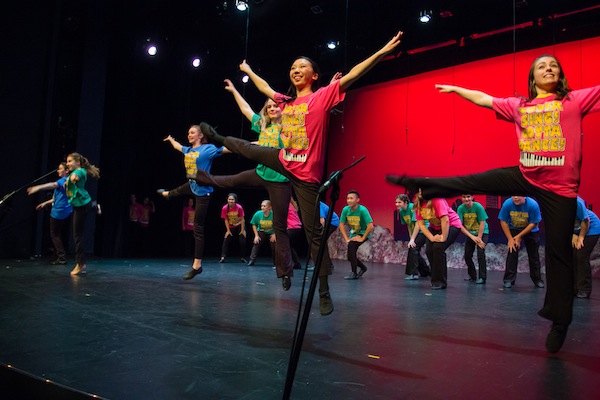
The deadline to apply for Gotta Sing! Gotta Dance! at the Jewish Community Centre of Greater Vancouver July 7-30 and Aug. 4-27 is April 1. With participants ages 9 to 19 from various parts of Canada and elsewhere in the world, director and creator of the program Perry Ehrlich will be joined this year by faculty including musical directors Wendy Bross Stuart and Diane Speirs; director Chris McGregor; choreographers Jason Franco, Keri Minty and Meghan Anderssen; acting coach Amanda Testini; and Mariana Munoz, set construction and costume co-ordination. The final production of each session will be Wild Wild West Side Story, featuring an original script and a repertoire from Broadway and movie musicals. Also being offered is the finishing school, for serious musical theatre students attending Gotta Sing! Gotta Dance!, and a boot camp dance program. Scholarships are available.

Supporting gender diversity

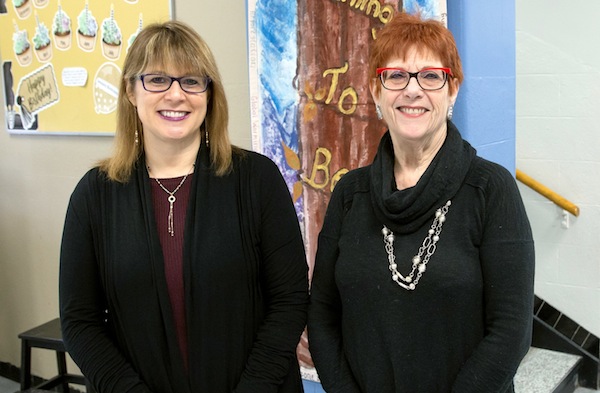
Ara Morris, principal of Brock Corydon School, left, and Naomi Finkelstein, co-founder of Parents Family Friends of Transgender Individuals. (photo from Morris and Finkelstein)

The Winnipeg School Division recently assembled a panel to discuss ways to best support trans and gender diverse children and youth, especially in school settings.

Ara Morris, principal of Brock Corydon School, was invited to sit on the Jan. 22 panel, which took place at Prince Charles Education Resource Centre. “Our school has been very active in talking about gender,” said Morris. “We’ve been making changes to our school as a result of having children in our school who are transgender. We want all of our students, all of our families, to feel included, important, and as equal members of our community and so, to do that, sometimes we have to reflect on the different ways that we are speaking, the different language that we are using.

“We know that many times children identify themselves in all different ways,” she said. “We want to be respectful of that. We have had a lot of professional development for our teachers and that has included programs from the Rainbow Resource Centre,” which offers support, counseling and educational programs for LGBTQ2S+ individuals and allies.

Brock Corydon has invited the parent of a transgender student to speak with school staff, and teachers have led sessions among themselves, as well as having had other teachers come to share how they work on being inclusive in the classroom.

“Our school division has a policy and it was updated in June 2018 for diversity and equity,” said Morris. “With all the research that our school division has been doing, I’d be surprised if other school divisions weren’t doing the same.”

Morris has received many phone calls from other principals asking for suggestions, and she works with parents to identify any needs, such as the need for a gender-neutral bathroom, which the school now has.

Even though full-time staff has been educated on the topic, part-time or causal staff also need to be informed about the proper way for teachers to speak at the school, including the use of gender-neutral language.

Naomi Finkelstein, a retired teacher and the mother of a trans child, was also on the event panel. Finkelstein was dealing with the situation 13 years ago and recalled having tried to find proper supports, which were lacking. She started a support group with another parent, called Parents Family Friends of Transgender Individuals (PFFOTI).

“I had a daughter and, when she was about 20 and a half, she came out and shared that she was transgender,” said Finkelstein. “I knew that this was something I was going to have to get support for, so I went to the Rainbow Resource Centre.”

PFFOTI started out with the two founding members and is now providing support to 170 parents. “Of course, that many do not come to all the meetings and, really, what happens is people kind of grandfather out. Their children are older now, they’ve made their transitions … maybe some have had surgery and they don’t feel the need to attend anymore. We’re always getting new people,” said Finkelstein.

“Our group is specifically for parents,” she continued, “because there are some parents who have just found out and they need the support. And there are always Kleenex boxes on the table. For some parents, it is a real shock.

“I was shocked, too, but I did my crying at home in the shower, which was really very good. There was something, I don’t know why, it was almost like being in a womb, feeling protected in there…. We want the parents to be able to share their fears and concerns; you can’t do that if a child is there.”

Over the years, Finkelstein has developed a list of do’s and don’ts for parents who suspect that their child might be trans.

The do’s list includes respecting your child’s identity and following your child’s lead and listening to them about what trans is all about. Each child is different and there’s no right way to be trans. As Finkelstein pointed out, “some go on hormones, some don’t, and some just dress in what they consider the gender’s clothing.”

The list encourages parents and others to learn about the difference between sex and gender – gender is a social construction, whereas sex is biological.

PFFOTI advises parents to start by helping and educating themselves so they can better help their child. “This involves reading and coming to support groups,” said Finkelstein. “And parents need to take into account if there are other siblings. There can be issues for the other siblings, and they need to be educated, too.”

If the children are minors, parents need to take the lead in setting up doctors’ appointments, buying appropriate clothing, getting haircuts, etc.

“Truly, the key to success is offering the kids your unconditional support,” said Finkelstein. “One of the support groups online, their motto was, ‘Fake it until you make it.’ But, we also talk about what parents need to do within the school system and that they need to advocate for their children. Although the human rights law says that they have rights, not all school divisions are on board. Winnipeg [School Division] 1 is totally on board and they have a process. We need parents to take part in the process and get the school to take part in the process.

“And a critical thing is bathroom talk,” she said. “You have to talk to your child before you go to the administration, so you’re both on the same page as to what the child wants to do. Some schools now have non-gender-specific bathrooms, which is great. I wish every school would have one.

“And then they have to talk to the administration about what their rights are. They should know those rights before they go in.”

Setting up a safe person at the school, with the help of administration, who the child can go to, someone who affirms their identity, if they are having problems, is also important, as is talking about the school’s anti-bullying policy and how that is handled.

“Past the age of 12 and up, you’re also dealing with all these hormones that rage through the child’s body,” said Finkelstein. “So, some kids are going to have to get on blockers to prevent their periods and their breasts from developing, and stuff like that.”

Parents and others must understand that a child’s identification as trans is not likely a passing phase. Although some children identify as trans and later change their mind, that is uncommon. So, do your best to avoid calling your child by their previous name, said Finkelstein.

Parents “really have to make an effort not to misgender,” she said. “Misgendering kind of denies their existence as a person, and that’s a big negative. But, as a parent, if you screw up, you just apologize. I think kids are very understanding about that. As long as you don’t deliberately misgender a child, they are open to the fact that, you’ve had them for 13, or 18, or 20 years, and, yeah, that other name is going to come out. It takes you awhile to reformat.”

Another PFFOTI recommendation is to never out your child – let them do it when they are ready.

“Statistics have proven that, [even] with children who are trans who get support from their parents and their family … four percent commit suicide,” said Finkelstein. “The statistics are much higher – about 45% – for those who do not get support. This past summer, we lost four kids (three in Winnipeg and one who had moved to Vancouver).”

Finkelstein regularly checks in with her son to talk about his mental health and to assure him she accepts him as he is.

Rebeca Kuropatwa is a Winnipeg freelance writer.

Creation of now-iconic pant

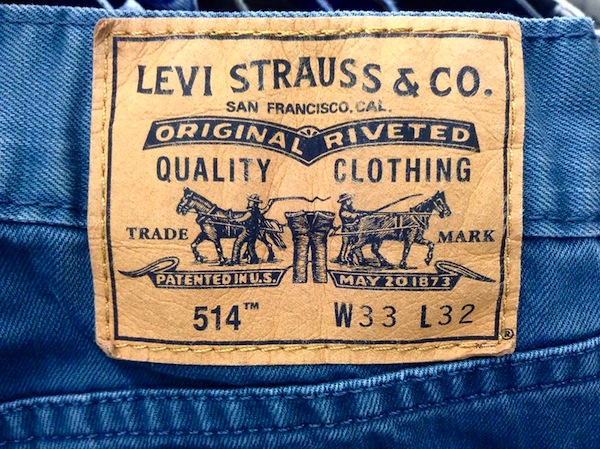
Jeans bearing the Levi Strauss & Co. trademark.

Nothing quite compares to the essential staple that almost all of us have in our closets, with styles including flare, skinny, low-rise, high-rise, boyfriend, ripped, the list goes on. If you haven’t guessed already, I’m referring to jeans. They epitomize fashion versatility, taking us from a city stroll in a pair of sneakers to our favourite restaurant in the evening with a boot or dress shoes. There are few fashion houses, from couture to street wear, that haven’t designed their own style. But, for the original jean, we have to thank Levi Strauss & Co.

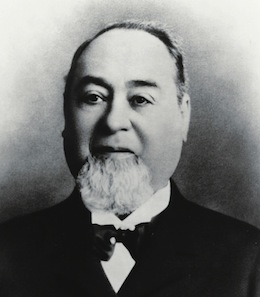
Loeb Strauss, born 1829 in Bavaria, was the youngest of seven children. At age 16, after his father’s death and with increasingly harsh restrictions and discrimination towards Jews, he decided – with his mother and two of his three sisters – to move to New York. There, two of his brothers welcomed him into their dry goods business.

photo - Levi Strauss
Levi Strauss. (photo from Wikipedia)

In the 1850s, in the midst of the gold rush, Strauss saw potential opportunities to set up shop in the West and he did so, opening a branch of the family business in San Francisco, where he changed his name from Loeb to Levi.

Levi Strauss & Co. became a rapid success, selling merchandise to local customers as well as to those in neighbouring cities. Strauss became a respected figure among the Jewish community, known to have a sharp business mind and a kind demeanour. He was also known for giving back to community, donating to both Jewish and non-Jewish charities.

The nature of the business – and the course of fashion worldwide – changed when Strauss was approached by Jacob W. Davis, a regular customer and acquaintance, who came to collect an order of canvas for his tailoring business. Davis made durable work wear, or “waist overalls,” as he called them, from special fabric that was primarily used to make tents. Having developed a system to prevent the overalls from ripping at the pockets by adding copper rivets at the corners (allowing them more longevity), he knew he discovered something big but, in order to proceed, he needed financial backing, primarily for the patent fee. Strauss became his business partner in 1873.

Levi Strauss & Co.’s jeans were produced largely for the labour workforce. However, over the years, they became a choice piece of clothing for women and men in any profession, at least when not working. Levi’s entered the world of film in 1938 when John Wayne wore a pair of Levi’s 501 jeans, transforming them into the American cowboy’s leading attire.

photo - According to the company’s website, the trademark depicting two horses attempting to pull apart a pair of Levi’s waist overalls, symbolizes “the strength of the clothing in the face of competition.” It was introduced in 1886
According to the company’s website, the trademark depicting two horses attempting to pull apart a pair of Levi’s waist overalls, symbolizes “the strength of the clothing in the face of competition.” It was introduced in 1886. (photo from levistrauss.com)

The financial success of Levi Strauss & Co. allowed Strauss to expand his business to many diverse industries, from banking to electricity. His philanthropy also expanded and he gave to many Jewish organizations, notably helping found and establish the Reform congregation Emanu-El in San Francisco.

While Strauss never married and had no children of his own, he had a strong relationship with his nephews. When he died, in 1902, Levi Strauss & Co. and most of his estate went to his four nephews and other family members; many charities were also beneficiaries named in his will.

Over six generations, Levi Strauss & Co. has remained a family-run business, manufacturing not only jeans but other casual wear, accessories and a children’s line. One of the largest brand apparel companies in history, the Levi Strauss name is universally recognized. Now run by the Haas family, decedents of Strauss, the family and business continue Strauss’s legacy in another important way – by being one of the most charitable families in the Bay Area.

Ariella Stein is a mother, wife and fashion maven. A Vancouverite, she has lived in both Turkey and Israel for the past 25 years.

Predicting the future

Trend forecasters Lior Fisher Shiloni, left, and Nataly Izchukov. (photo by Michael Topyol)

What do jeans, trench coats and a little black dress all have in common? A place of honour in women’s wardrobes, that’s for sure. And it’s no accident – the three are timeless trends that have been around for decades.

“A trend is a state of mind, a very, very wide perspective that begins in the margins and slowly reaches the masses,” said Israeli trend forecaster Nataly Izchukov. “A trend undergoes evolution and is here to stay. People always think it comes and goes, but that’s actually a mistake. It develops and updates, and it’s here to stay.”

In 2014, Izchukov founded the Visionary, a Tel Aviv lifestyle and design trend forecasting agency that deciphers for its customers the way the wind is blowing. She and her business partner, Lior Fisher Shiloni, also expose the Israeli public to the art of forecasting and even pass on their knowledge in a first-of-its kind local “trendology” school.

Forecasting the future, Izchukov explained, begins in researching the past. She and her team study what has happened in the past year or so across the world, from politics and economics to natural disasters, cinema and fashion, and try to understand how it will affect esthetics and designs. “For example, one of the leading trends for the summer of 2020 is going to be acid-bright colours,” she said. Its source of influence? The yellow vests movement in Paris.

The second step is social research, which involves identifying their clients’ audience and what interests them on social networks and in the media. The third step is what Izchukov calls iconography, the interpretation of the findings in a more abstract way. This all leads to conclusions regarding megatrends and the microtrends that ensue.

Izchukov gave the example of older solo women travelers. More older women are jet-setting off by themselves, but are still looking to feel safe and secure and have a sense of community on their travels. This translates into many different microtrends for Izchukov’s clients, including how hotels are decorated and the colour palette that best suits their guests.

The biggest megatrend, however, is sustainability. “It deals with promoting the status of women, with poverty, with education, it’s a very, very wide issue,” said Izchukov.

Trends are not fads. Fads are not sustainable; they enter and exit our lives quickly. Top examples of fads, Izchukov noted, are Kardashian-style cycling shorts, the 1990s digital pet Tamagotchi craze and a recent favourite – handheld spinners. By contrast, a trend can take three to four years to go mainstream, and not all businesses have patience for such a process.

“They mostly want us to create fads, but we’re really seeing a change developing in 2020,” she said of her clients. “The biggest change is the extreme climate happening across the world. What happened now in Australia [with widespread bushfires] is one of these extreme cases that made people say, ‘OK, there’s a problem here.’ There was great denial of the topic among companies.”

The emphasis on sustainability is causing apprehension in the Israeli business scene, she said. One of the problems is the high cost of creating sustainable fashion.

“The product ends up being expensive and people don’t really want to spend that money on it,” Izchukov said. “There’s still a gap between the goodwill of people for the world to be a better place, and people wanting a good and attractive price, and you have to think how to bridge it.”

Izchukov predicts some big changes in the coming decade for fashion, food and hospitality in Israel.

“In fashion, a few very substantial things are going to happen – mostly companies that will change their appearance and their production lines in a more sustainable, ecological and recycling direction,” she said. “There’ll be fewer stores but these will include a lot more content and information that is beyond fashion.”

In Israel, there will be greater inclusion of people with disabilities in the fashion world, she said. This is in line with the global trend for inclusivity, which sees fashion houses employing ambassadors of all sexes, genders, religions and sizes.

In the Israeli hospitality sector, we can expect “the substantial entry of more hostels and of very affordable hotels,” she said. “They’ll try to create a very interesting experience in their locations in terms of the customer and the hotel itself.”

Izchukov predicts that food will increasingly go in the direction of “how we can eat in a healthier manner that precisely matches our needs and our bodies.”

She said, “Artificial intelligence will greatly help to resolve the issues of need and of customization.”

Food is also a great example of the impact local cultures have on trends. Izchukov noted the failure of American companies such as Starbucks to succeed in Israel. While Israelis like to think that the global giant failed because the local coffee is far superior, Izchukov suggested it has more to do with the Israeli state of mind. Self-service, waiter-less, eateries are a doomed business model in Israel, she said, because locals much prefer personal attention.

Israel21c is a nonprofit educational foundation with a mission to focus media and public attention on the 21st-century Israel that exists beyond the conflict. For more, or to donate, visit israel21c.org.

Israel’s quirky design house

Peleg Design’s Magnetic Vase is a bestseller. (photo from Peleg Designs)

From optical illusion flower vases to playful elephant-shaped cutlery drainers, Shahar Peleg wants his products to bring his customers joy, but first and foremost to fulfil a need in their home.

How does he figure out what those needs are? “Some of the ideas came to us while daydreaming, some in the shower, some we woke up with and some just came to us by email,” reads the website’s Suggest an Idea section.

People from all over the world reach out, the designer and founder of the brand told Israel21c. “Once in awhile, we get a great idea and we pay royalties to the designers or inventors,” he said. “It’s really amazing because a lot of people have a lot of ideas.” For example, the Bag Bunny, a magnetic rabbit-shaped tool for easily opening plastic packaging, was inspired by a customer suggestion.

photo - Shahar Peleg wants his products to bring his customers joy, but first and foremost to fulfil a need in their home
Shahar Peleg wants his products to bring his customers joy, but first and foremost to fulfil a need in their home. (photo from Facebook)

Founded in 2005 and based in Tel Aviv, Peleg Design’s online store offers around 100 unique products that stem from everyday needs, each with quirks, twists or optical illusions that Peleg describes as “magical.” Nothing, he said, is what it seems.

The product that kicked off the company’s success was a vase Peleg designed for his own wedding in 2005. These “floating” vases are anchored by magnetic bases hidden underneath the tablecloth. To this day, the vase set is one of Peleg Design’s bestsellers. “It was a huge hit,” he said. “That’s what really began to generate business.”

Another universal problem Peleg wanted to solve was grime building up at the bottom of a cutlery drainer. His answer was Jumbo, an elephant-shaped cutlery holder that drains water out of its trunk, directly into the sink.

Peleg said function is key, and design secondary, to usefulness. But, still, he hopes his customers will fall in love with his “cute” designs.

His newest item, the Egguins, is an example of that cuteness. The penguin-shaped eggholder is not only visually amusing, but makes it easy to remove eggs from boiling water and store them in the fridge. One comment on Peleg Design’s Instagram page calls the item “the best thing since sliced bread.”

Many of Peleg’s products are made from plastic but they are meant to last. Sensitive to environmental issues, he explained that he wants his customers to develop an emotional connection to the items and use them for as long as possible before discarding them.

Passion and profession

Growing up, Peleg dreamed of being an astronaut, but he would eventually find his passion in a different form of exploration: design.

Peleg studied interior design at the Holon Institute of Design. A class project made him realize he had an eye for creating quirky but useful knick-knacks. He had made a wine-bottle holder that seemed to defy gravity. He was able to sell a few even before graduating.

“It started from selling one product in two or three stores in Tel Aviv,” he said. “It’s now become both my passion and my profession.”

photo - The Jumbo cutlery holder drains into the sink straight away
The Jumbo cutlery holder drains into the sink straight away. (photo from Peleg Designs)

What began as a one-man show has expanded to more than 30 countries, including the United States, Japan, Peru, France and South Korea. Some designs can even be found at the gift shop of the Louvre Museum in Paris and the Museum of Modern Art’s gift shop in New York City, where the Magnetic Vase is one of its bestselling items.

Peleg explained that his products are available in most major economies, excluding those that have no political relations with Israel. He hopes one day that will change, and he says so to the businesspeople he meets from countries like Iran and Kuwait.

Every now and then, Peleg receives an email from an Israeli customer, with a photo of his Magnetic Vase on a shelf in the MOMA gift shop. They are so happy to see an Israeli designer’s product among some of the world’s best, he said, noting, “That makes me proud.”

For more information, visit peleg-design.com.

Israel21c is a nonprofit educational foundation with a mission to focus media and public attention on the 21st-century Israel that exists beyond the conflict. For more, or to donate, visit israel21c.org.